4th Grade · Geometry · CCSS 4.G · NYC Elementary Math
4th Grade Geometry — 30 Practice Questions with Answers & Explanations
A complete class lesson on 4th grade geometry: points, lines, rays, and angles; parallel and perpendicular lines; classifying triangles and quadrilaterals; and lines of symmetry — aligned to CCSS 4.G. Includes plain-English theory, labeled diagrams, and 30 practice questions with hidden answers and step-by-step explanations. Built by SOMATH, the math school on the Upper West Side of Manhattan.
If your child is starting the geometry unit in 4th grade, this is the lesson we’d hand them in class. Fourth grade geometry (CCSS 4.G) is where students stop just naming shapes and start classifying them — sorting triangles by their sides and angles, telling a rhombus apart from a parallelogram, and recognizing when two lines are parallel versus perpendicular. There are no formulas to memorize here; the whole unit is built on careful vocabulary and careful looking, which makes it one of the most satisfying topics in elementary math to teach and to learn.
This unit matters more than it might seem at first glance. The habits your child builds now — describing a shape by its properties instead of just its outline, reading an angle instead of guessing at it — are exactly what 5th grade geometry builds on, when shapes get plotted on a coordinate plane and organized into a hierarchy (a square is also a rectangle, which is also a parallelogram). That hierarchy thinking then carries straight into middle-school geometry, where angle relationships and transformations take over. Skipping past the vocabulary now just means re-learning it later, under more pressure.
Below you’ll find the full lesson in the order we teach it at SOMATH: a theory section for each of the six core ideas, with a labeled diagram for every concept, followed by 30 practice questions covering the entire unit, each with a hidden answer and a plain-English explanation. Try each question yourself before revealing the answer — that struggle is where the actual learning happens.
Sections
- Section 1 · Points, Lines, Rays & Segments
- Section 2 · Angles & the Protractor
- Section 3 · Parallel & Perpendicular Lines
- Section 4 · Classifying Triangles
- Section 5 · Classifying Quadrilaterals
- Section 6 · Lines of Symmetry
- Section 7 · 30 Practice Questions
- How SOMATH prepares 4th graders
- Parent FAQ
Section 1 · Points, Lines, Rays & Segments
The four basic building blocks of every geometry figure — CCSS 4.G.A.1
The building blocks
Every shape in geometry, no matter how complicated, is built from four simple pieces. A point is an exact location — it has no length or width, and we mark it with a dot and a capital letter, like point P. A line segment has two endpoints and a definite length, like segment AB. A ray starts at one endpoint and keeps going forever in one direction — think of a flashlight beam. A line has no endpoints at all; it extends forever in both directions, and we draw arrows on both ends to show that.
The order of the letters matters for rays: ray CD starts at C and points toward D and beyond. It is not the same as ray DC, which would start at D and point toward C instead.
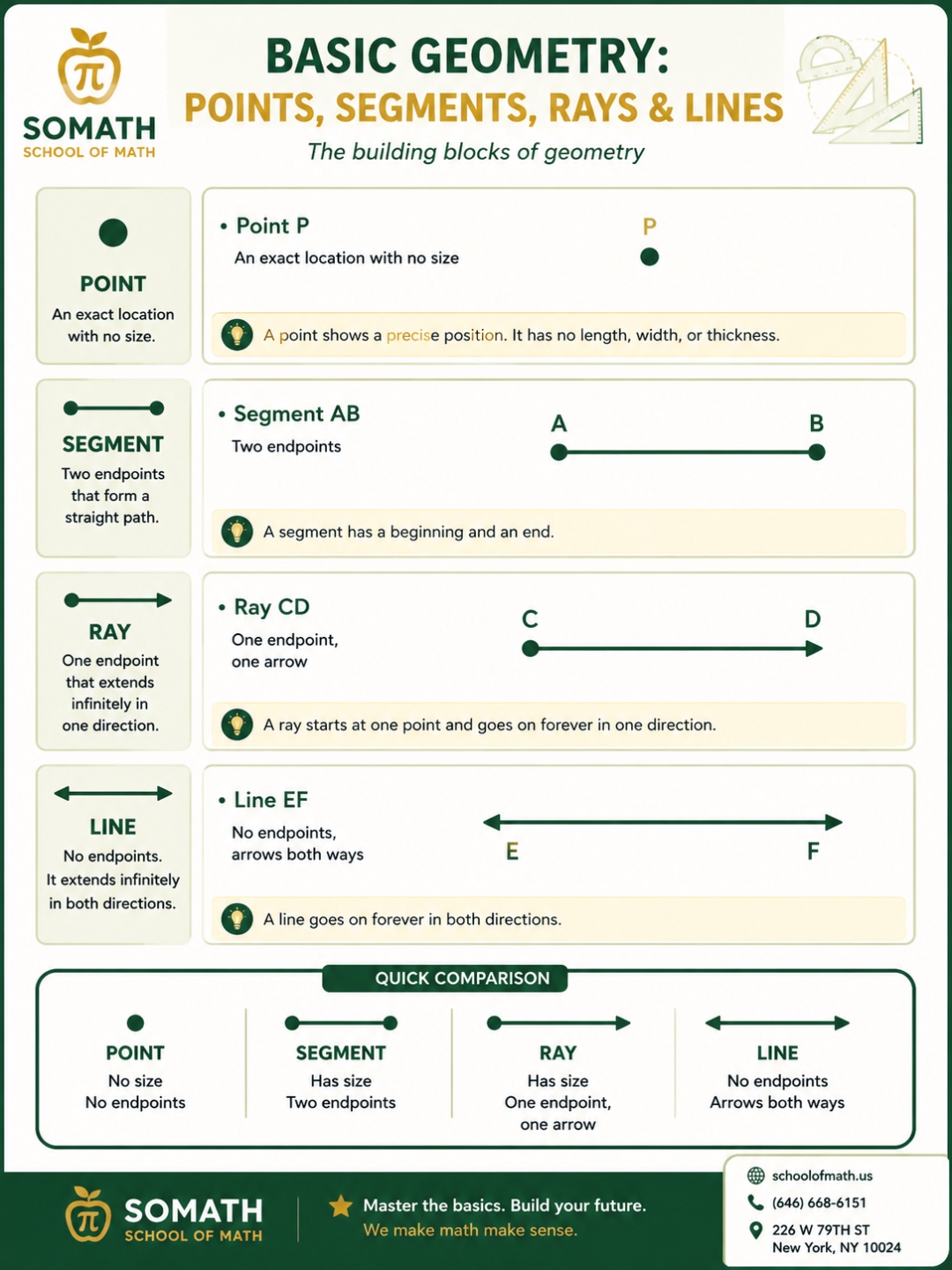
A quick way to remember the difference: count the endpoints. Zero endpoints means a line, one endpoint means a ray, and two endpoints means a segment. A point is different from all three — it is not a path at all, just a single location.
Section 2 · Angles & the Protractor
Right, acute, obtuse, and straight angles, plus how to read a protractor — CCSS 4.G.A.1, 4.MD.C.5/6/7
What is an angle?
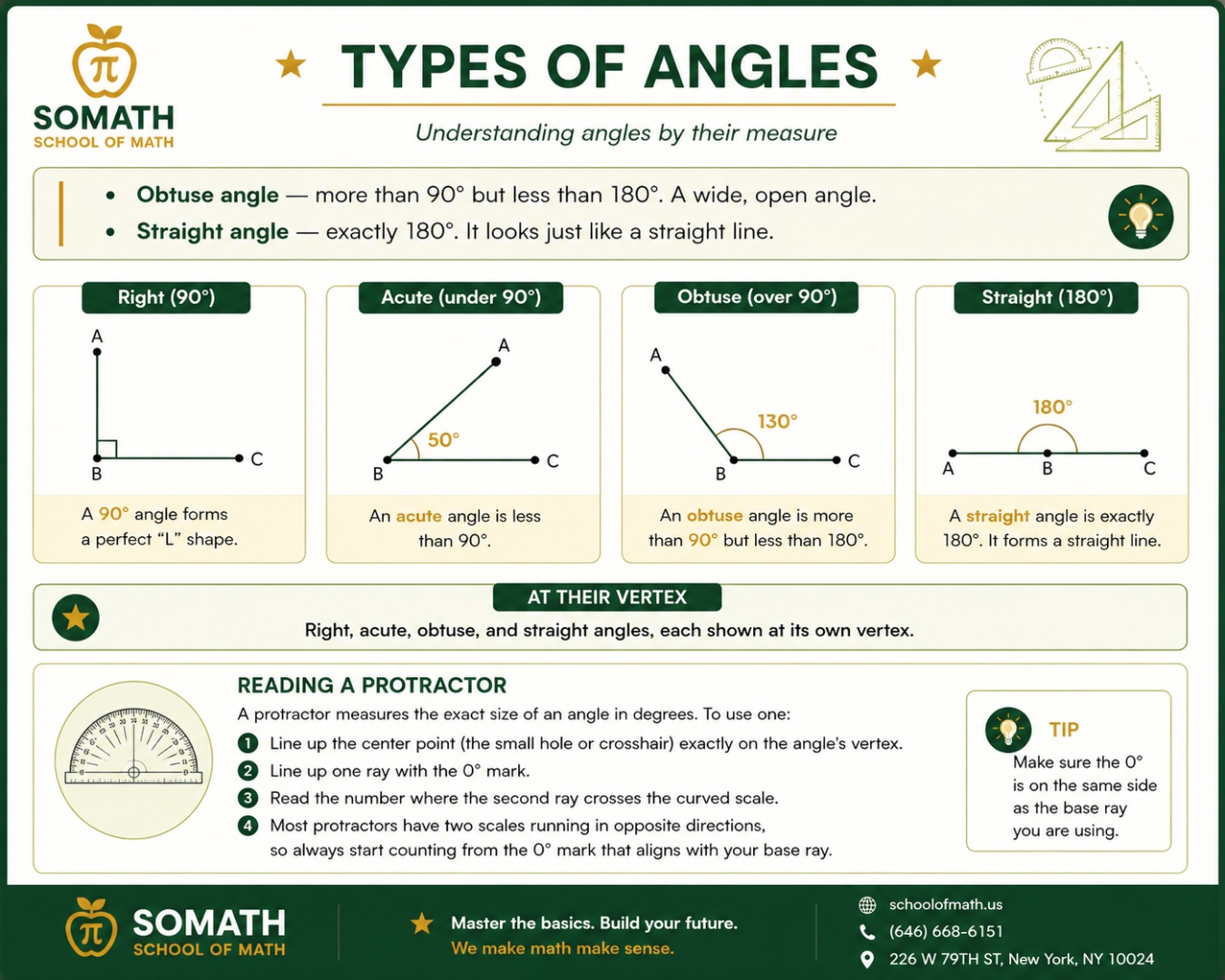
An angle is formed when two rays share the same endpoint, called the vertex. We measure angles in degrees (°), and a full circle is 360°. Fourth graders sort angles into four categories:
- Right angle — exactly 90°. Looks like the corner of a piece of paper. Marked with a small square in the corner.
- Acute angle — less than 90°. A narrow, "sharp" angle.
- Obtuse angle — more than 90° but less than 180°. A wide, "open" angle.
- Straight angle — exactly 180°. It looks just like a straight line.
Reading a protractor
A protractor measures the exact size of an angle in degrees. To use one: line up the center point (the small hole or crosshair) exactly on the angle's vertex, line up one ray with the 0° mark, and then read the number where the second ray crosses the curved scale. Most protractors have two scales running in opposite directions, so always start counting from the 0° that lines up with your first ray.
One more useful fact for 4.MD.C.7: when two angles sit side by side and together form a larger angle or a straight line, you can find a missing angle by addition or subtraction. If two angles together make a straight line (180°) and one measures 120°, the other must measure 180° − 120° = 60°.
Section 3 · Parallel & Perpendicular Lines
Lines that never meet, and lines that cross at a right angle — CCSS 4.G.A.1, 4.G.A.2
Parallel lines
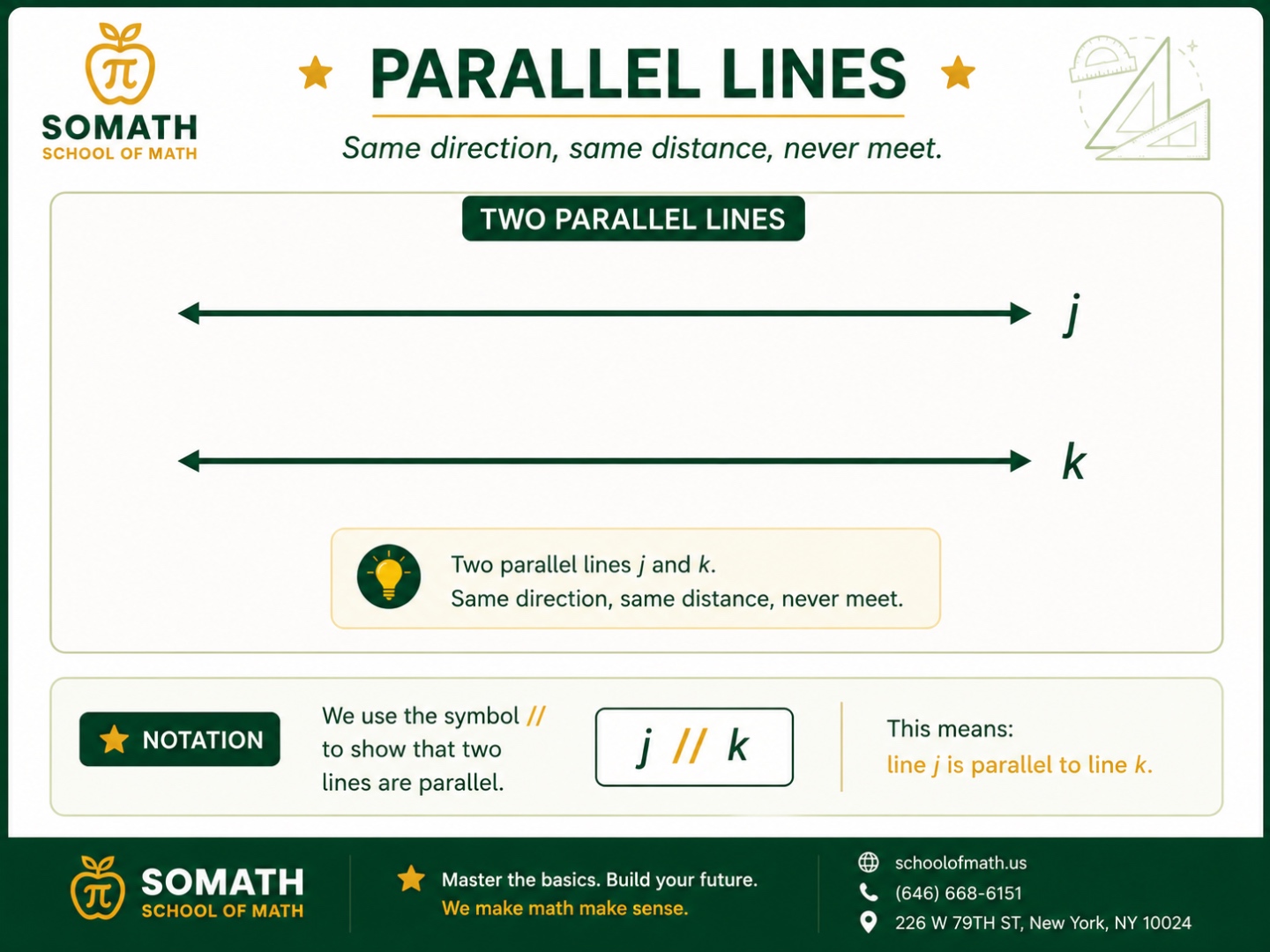
Parallel lines stay exactly the same distance apart forever and never cross, no matter how far you extend them — like the two rails of a train track. In a diagram, parallel lines are marked with matching tick marks (little dashes) to show they will never meet.
Perpendicular lines
Perpendicular lines cross each other and form a right angle (90°) at the point where they meet — like the horizontal and vertical edges of a window pane. In a diagram, a small square in the corner marks the right angle where perpendicular lines cross.
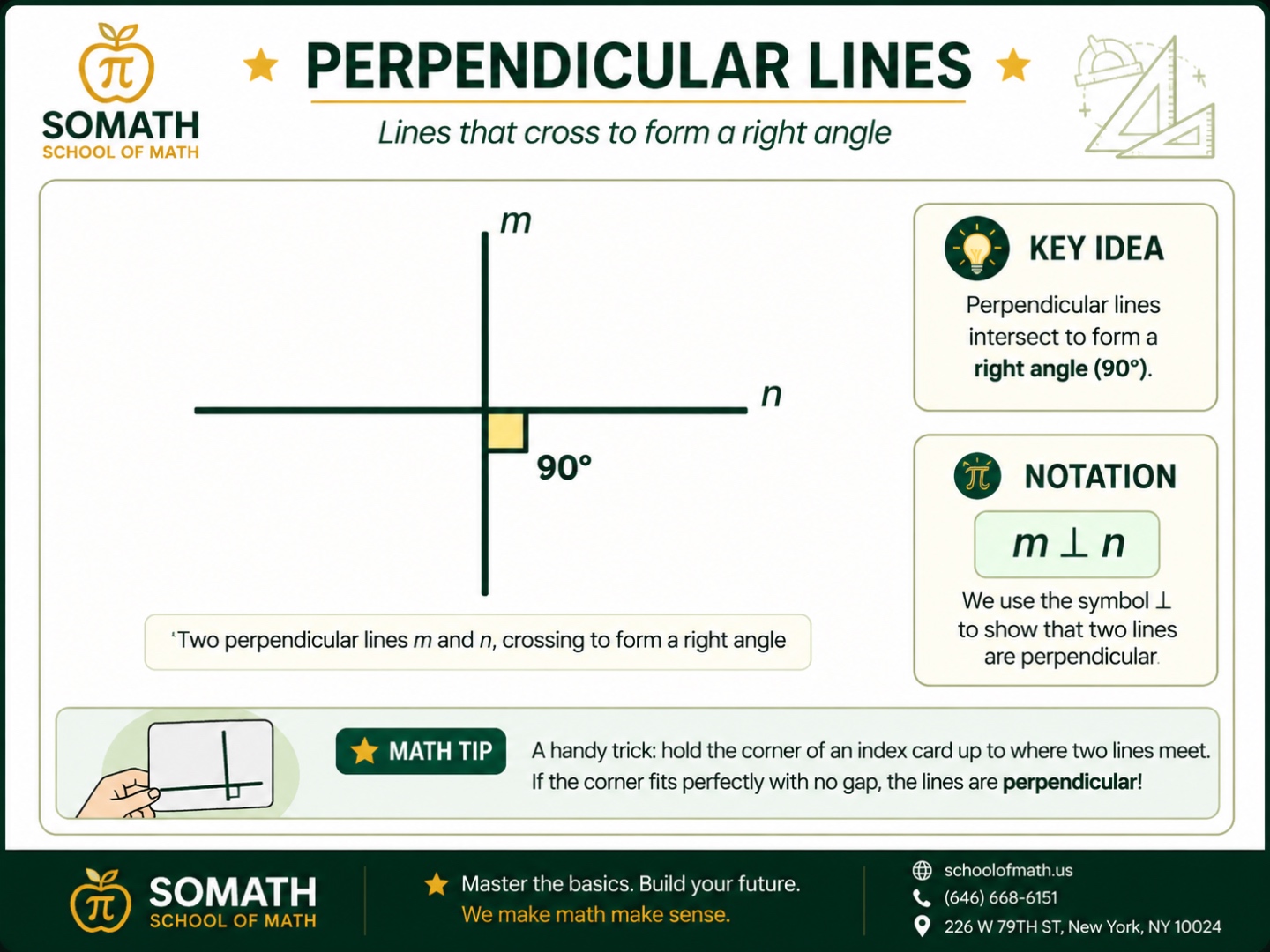
A handy trick: hold the corner of an index card up to where two lines meet. If the corner fits perfectly with no gap, the lines are perpendicular.
Section 4 · Classifying Triangles
Sorting triangles by their sides and by their angles — CCSS 4.G.A.2
By sides
- Equilateral — all 3 sides equal (and all 3 angles equal, 60° each).
- Isosceles — exactly 2 sides equal.
- Scalene — no sides equal.
By angles
- Right triangle — has one 90° angle.
- Acute triangle — all 3 angles are less than 90°.
- Obtuse triangle — has one angle greater than 90°.
Every triangle gets one label from the "sides" group and one label from the "angles" group — for example, a triangle can be a "right isosceles triangle" if it has one right angle and two equal sides.
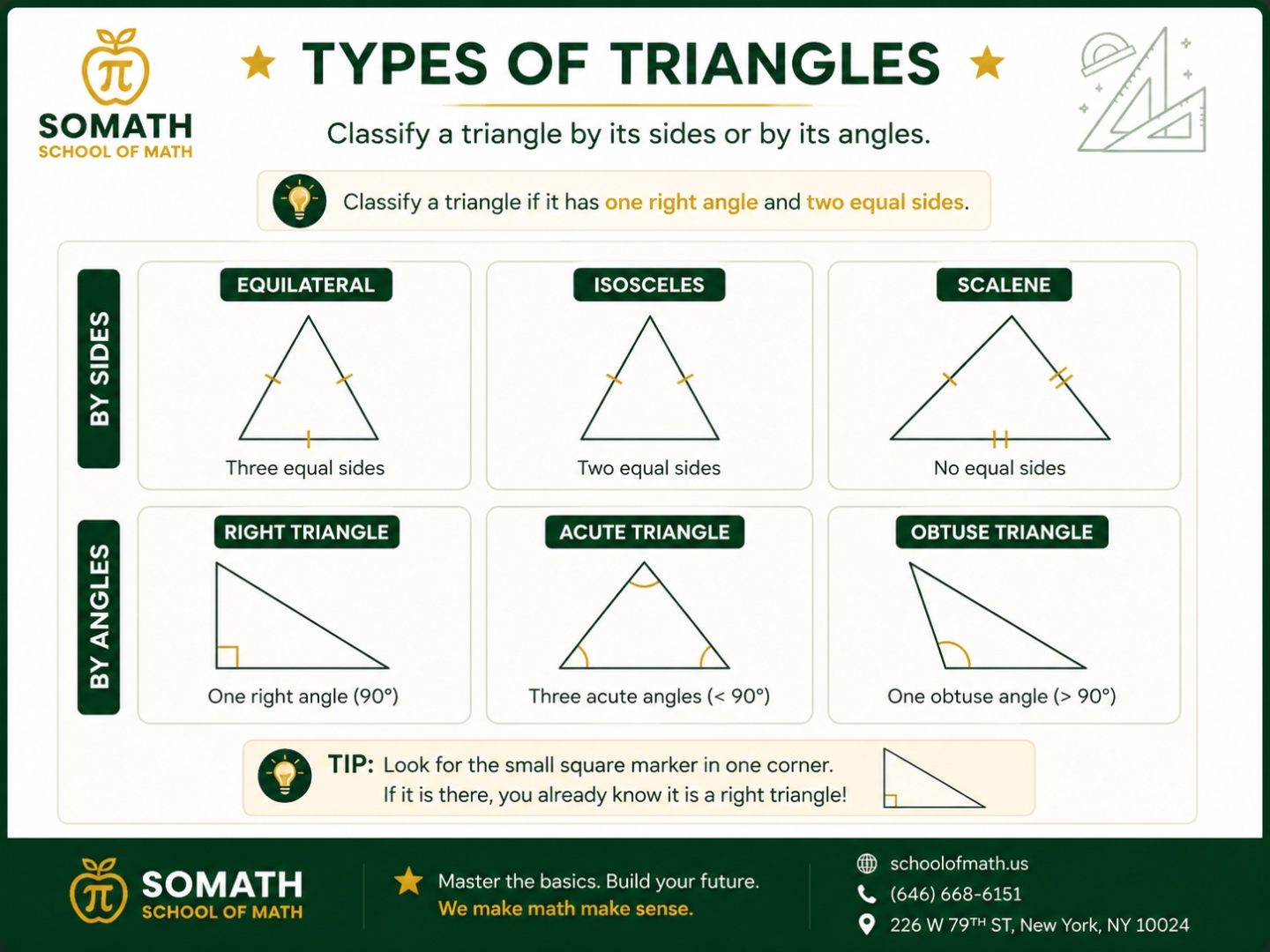
Tip for spotting a right triangle fast: look for the small square marker in one corner. If it is there, you already know the triangle's angle type without measuring anything.
Section 5 · Classifying Quadrilaterals
Squares, rectangles, rhombuses, parallelograms, trapezoids, and kites — CCSS 4.G.A.2
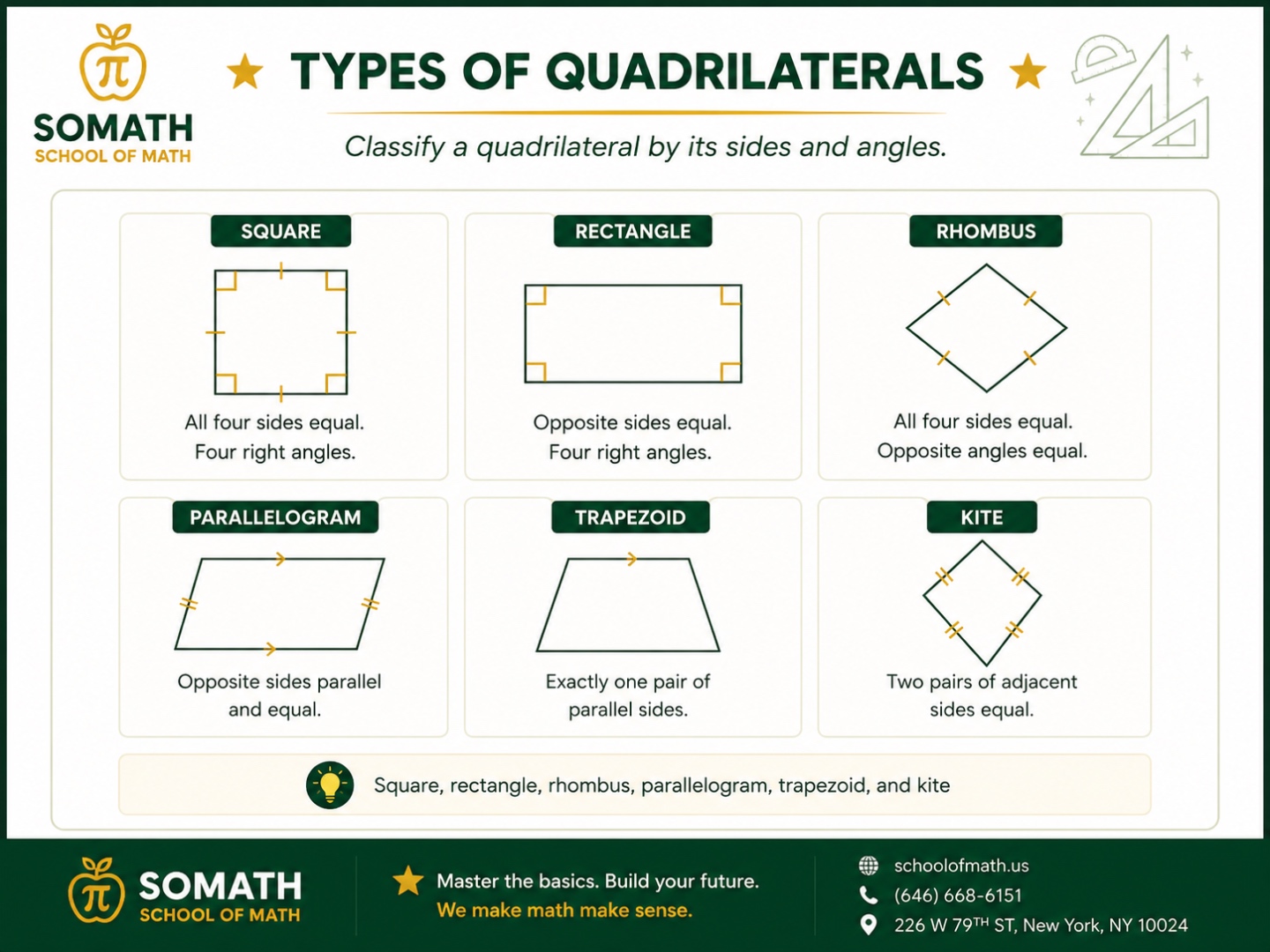
Four-sided shapes, sorted by their properties
- Square — 4 right angles AND 4 equal sides.
- Rectangle — 4 right angles, opposite sides equal (not all 4 sides need to match).
- Rhombus — 4 equal sides, but angles are not necessarily right angles.
- Parallelogram — both pairs of opposite sides parallel (and equal in length).
- Trapezoid — exactly one pair of parallel sides.
- Kite — two pairs of adjacent (next-to-each-other) sides equal, instead of opposite sides.
Here's the part that trips students up: a square is also a rectangle (it has 4 right angles) and also a rhombus (it has 4 equal sides). A shape can have more than one correct name — the most specific name is usually the best one to use.
Section 6 · Lines of Symmetry
Folding a figure perfectly in half — CCSS 4.G.A.3
What is a line of symmetry?
A line of symmetry is an imaginary fold line that divides a figure into two matching halves — if you folded the figure along that line, the two halves would land exactly on top of each other. Some figures have many lines of symmetry, some have just one or two, and some (like a scalene triangle) have none at all.
A useful shortcut: a regular shape (all sides and angles equal) with n sides has exactly n lines of symmetry. A square (4 equal sides) has 4; a regular pentagon (5 equal sides) has 5; an equilateral triangle (3 equal sides) has 3. A circle has infinitely many lines of symmetry, since any diameter divides it into two matching halves.
Lines of symmetry: equilateral triangle (3), square (4), regular pentagon (5), regular hexagon (6), letter H (2), letter A (1), and a circle (infinite)
Letters and everyday objects are great practice for this skill: the letter A has 1 line of symmetry (vertical), the letter H has 2 (vertical and horizontal), and the letter F has 0 (no fold makes it match itself).
Section 7 · 30 Practice Questions
Every core idea from Sections 1–6, mixed together. Try each one, then reveal the answer.
Q1 · Points, Lines & Rays
Which of these figures has exactly two endpoints and no arrows?
- A) A ray
- B) A line
- C) A line segment
- D) A point
Correct answer: C) A line segment
A line segment is the only one of these four figures with two definite endpoints. A ray has one endpoint and one arrow, and a line has no endpoints at all — it goes on forever in both directions.
Q2 · Points, Lines & Rays
Look at the figure. What is this figure called?
- A) Line segment MN
- B) Ray MN
- C) Line MN
- D) Angle MN
Correct answer: A) Line segment MN
The figure shows two labeled endpoints, M and N, connected by a straight path with no arrows. A figure with two endpoints and no arrows is a line segment, written segment MN.
Q3 · Points, Lines & Rays
Look at the figure. What is this figure called?
- A) Line segment XY
- B) Ray XY
- C) Line XY
- D) Point X
Correct answer: B) Ray XY
The figure starts at point X and has one arrow pointing toward Y, showing that it keeps going forever in that one direction. A figure with one endpoint and one arrow is a ray, named starting from its endpoint: ray XY.
Q4 · Points, Lines & Rays
Look at the figure. What is this figure called?
- A) Line segment GH
- B) Ray GH
- C) Line GH
- D) Point G
Correct answer: C) Line GH
The figure has arrows on both ends and passes through points G and H, meaning it extends forever in both directions. A straight figure with arrows on both ends and no endpoints is a line, written line GH.
Q5 · Points, Lines & Rays
Which statement is true about a point?
- A) A point has length but no width
- B) A point shows an exact location and has no size
- C) A point always has two endpoints
- D) A point extends forever in one direction
Correct answer: B) A point shows an exact location and has no size
A point is just a single exact location in space — it has no length, width, or size at all. It is usually drawn as a small dot and named with a capital letter, like point P.
Q6 · Angles
What type of angle is shown in the figure?
- A) Acute angle
- B) Right angle
- C) Obtuse angle
- D) Straight angle
Correct answer: B) Right angle
The small square marker in the corner of the angle is the standard symbol for a right angle, which measures exactly 90°. Right angles look like the corner of a piece of paper.
Q7 · Angles
What type of angle is shown in the figure?
- A) Acute angle
- B) Right angle
- C) Obtuse angle
- D) Straight angle
Correct answer: A) Acute angle
The angle opens less than a right angle would — it measures less than 90°. Any angle that measures less than 90° is called an acute angle.
Q8 · Angles
What type of angle is shown in the figure?
- A) Acute angle
- B) Right angle
- C) Obtuse angle
- D) Straight angle
Correct answer: C) Obtuse angle
This angle opens wider than a right angle but is still less than a straight line — it measures more than 90° and less than 180°. That makes it an obtuse angle.
Q9 · Angles & the Protractor
A student lines up a protractor to measure an angle, placing one ray on the 0° line. The other ray crosses the scale at the mark shown. What is the measure of this angle?
- A) 60°
- B) 90°
- C) 120°
- D) 150°
Correct answer: C) 120°
When one ray of the angle is lined up with the 0° mark on the protractor, you read the measurement where the second ray crosses the curved scale. Here the second ray crosses at 120°, so the angle measures 120°, which also makes it an obtuse angle.
Q10 · Angles
Two angles sit side by side and together form a straight line. One angle measures 110°. What is the measure of the other angle?
- A) 60°
- B) 70°
- C) 80°
- D) 90°
Correct answer: B) 70°
A straight angle always measures 180°. If two angles together make a straight line, their measures must add up to 180°. Since 180 − 110 = 70, the other angle measures 70°.
Q11 · Parallel & Perpendicular Lines
Look at the two lines in the figure. They run in the same direction, and if you drew them out longer in both directions they would still not meet. What are these lines called?
- A) Perpendicular lines
- B) Intersecting lines
- C) Parallel lines
- D) Right-angle lines
Correct answer: C) Parallel lines
Lines that stay the same distance apart and never meet, no matter how far you extend them, are called parallel lines. The matching tick marks in a figure are the usual way to show that two lines are parallel.
Q12 · Parallel & Perpendicular Lines
Look at the figure below. Two straight lines cross at one point, and there is a small mark drawn at the corner where they meet. What are these two lines called?
- A) Parallel lines
- B) Perpendicular lines
- C) Curved lines
- D) Ray lines
Correct answer: B) Perpendicular lines
Lines that cross to form a right angle (90°) are called perpendicular lines. You can check this with the corner of an index card: if the corner fits exactly into the angle, the lines are perpendicular.
Q13 · Parallel & Perpendicular Lines
Which real-world example best shows a pair of perpendicular lines?
- A) The two rails of a train track
- B) The horizontal and vertical edges of a window pane
- C) Two lanes of a highway running side by side
- D) The strings of a tennis racket that are all parallel
Correct answer: B) The horizontal and vertical edges of a window pane
The horizontal top edge and the vertical side edge of a window pane meet at a right angle, which makes them perpendicular. Train rails and highway lanes are examples of parallel lines instead, since they run side by side and never meet.
Q14 · Classifying Triangles
Look at the triangle in the figure. Each of the three sides has the same single tick-mark. What type of triangle is this, based on its sides?
- A) Scalene triangle
- B) Isosceles triangle
- C) Equilateral triangle
- D) Right triangle
Correct answer: C) Equilateral triangle
A triangle with all three sides the same length is an equilateral triangle. Equilateral triangles also always have three equal 60° angles, which makes them acute triangles too.
Q15 · Classifying Triangles
A triangle has side lengths of 5 cm, 5 cm, and 8 cm. How should this triangle be classified by its sides?
- A) Scalene
- B) Isosceles
- C) Equilateral
- D) Right
Correct answer: B) Isosceles
This triangle has exactly two sides of equal length (5 cm and 5 cm) and one different side (8 cm). A triangle with exactly two equal sides is called an isosceles triangle.
Q16 · Classifying Triangles
Look at the triangle in the figure. One of its corners is marked with a small square. What type of triangle is this, based on its angles?
- A) Acute triangle
- B) Obtuse triangle
- C) Right triangle
- D) Equilateral triangle
Correct answer: C) Right triangle
The small square marker shows a 90° angle at that vertex. A triangle with one right angle is called a right triangle, and it is one of the special triangle types called out specifically in fourth grade geometry.
Q17 · Classifying Triangles
Look at the figure. Two of the triangle's sides are marked with matching tick marks; the third side has no tick-mark at all. How should this triangle be classified by its sides?
- A) Scalene
- B) Isosceles
- C) Equilateral
- D) It cannot be classified without knowing the angles
Correct answer: B) Isosceles
The matching double tick marks on two of the sides tell us those two sides are equal in length. A triangle with exactly two equal sides is isosceles — you do not need to know the angle measures to classify a triangle by its sides.
Q18 · Classifying Triangles
A triangle has angle measures of 50°, 60°, and 70°. How should this triangle be classified by its angles?
- A) Right triangle
- B) Obtuse triangle
- C) Acute triangle
- D) Straight triangle
Correct answer: C) Acute triangle
All three angles (50°, 60°, and 70°) measure less than 90°. When every angle in a triangle is acute, the whole triangle is called an acute triangle.
Q19 · Classifying Triangles
Look at the triangle in the figure. Compare its largest angle to the corner of a piece of paper — the largest angle is clearly wider than that corner. What type of triangle is this, based on its angles?
- A) Acute triangle
- B) Right triangle
- C) Obtuse triangle
- D) Equilateral triangle
Correct answer: C) Obtuse triangle
A triangle with one angle greater than 90° is called an obtuse triangle. A triangle can have at most one obtuse angle, since the three angles always add up to 180°.
Q20 · Classifying Quadrilaterals
Ari draws a four-sided shape and tells his sister two things about it: (1) every corner fits exactly against the corner of a piece of paper, and (2) if he measured the four sides with a ruler he would get the same length every time. Which shape did Ari draw?
- A) Rectangle
- B) Square
- C) Rhombus
- D) Trapezoid
Correct answer: B) Square
A square has all the properties of both a rectangle (4 right angles) and a rhombus (4 equal sides) at the same time. That is why a square is considered a special type of both rectangle and rhombus.
Q21 · Classifying Quadrilaterals
A quadrilateral has all four sides marked with a single tick-mark, and none of its corners are marked with a small square. What is this shape called?
- A) Square
- B) Rectangle
- C) Rhombus
- D) Trapezoid
Correct answer: C) Rhombus
A quadrilateral with all four sides equal in length, but without right angles, is a rhombus. If the corners were right angles too, it would be a square instead.
Q22 · Classifying Quadrilaterals
A quadrilateral has the top side and the bottom side marked with matching arrow-marks (which mean those two sides run in the same direction), while the two other sides are not marked. What is this shape called?
- A) Parallelogram
- B) Trapezoid
- C) Rhombus
- D) Kite
Correct answer: B) Trapezoid
A quadrilateral with exactly one pair of parallel sides is called a trapezoid. This is different from a parallelogram, which needs both pairs of opposite sides to be parallel.
Q23 · Classifying Quadrilaterals
A quadrilateral has a small square in each of its four corners. Two of its sides are long and the other two are short. What is this shape called?
- A) Square
- B) Rectangle
- C) Rhombus
- D) Kite
Correct answer: B) Rectangle
A quadrilateral with 4 right angles where opposite sides are equal, but not all four sides equal, is a rectangle. Every square is a rectangle, but not every rectangle is a square.
Q24 · Classifying Quadrilaterals
Look at the quadrilateral in the figure. The top and bottom sides carry matching arrow-marks, and the left and right sides carry a different set of matching arrow-marks. None of its corners are marked with a small square. What is the best name for this shape?
- A) Trapezoid
- B) Rectangle
- C) Parallelogram
- D) Kite
Correct answer: C) Parallelogram
A quadrilateral with both pairs of opposite sides parallel is a parallelogram. Since this one has no right angles, it is a parallelogram but not a rectangle.
Q25 · Lines of Symmetry
How many lines of symmetry does the square in the figure have?
- A) 1
- B) 2
- C) 4
- D) 0
Correct answer: C) 4
A square can be folded perfectly in half along a vertical line, a horizontal line, and both diagonals — that is 4 different lines of symmetry, more than any other quadrilateral in this lesson.
Q26 · Lines of Symmetry
How many lines of symmetry does the scalene triangle in the figure have?
- A) 0
- B) 1
- C) 2
- D) 3
Correct answer: A) 0
A scalene triangle has three sides of three different lengths, so there is no line you can draw that folds the triangle perfectly in half. That means a scalene triangle has 0 lines of symmetry.
Q27 · Lines of Symmetry
How many lines of symmetry does a regular pentagon (shown in the figure) have?
- A) 3
- B) 4
- C) 5
- D) 0
Correct answer: C) 5
A regular pentagon has 5 equal sides and 5 equal angles, and it has exactly 5 lines of symmetry — one line through each vertex and the midpoint of the opposite side. In general, a regular shape with n equal sides has n lines of symmetry.
Q28 · Lines of Symmetry
How many lines of symmetry does the letter H (shown in the figure) have?
- A) 0
- B) 1
- C) 2
- D) 4
Correct answer: C) 2
The letter H can be folded in half along a vertical line straight down the middle, and also along a horizontal line straight across the middle — both folds match perfectly. That gives the letter H exactly 2 lines of symmetry.
Q29 · Lines of Symmetry
How many lines of symmetry does the equilateral triangle in the figure have?
- A) 1
- B) 2
- C) 3
- D) 0
Correct answer: C) 3
An equilateral triangle has three equal sides and three equal angles, and it can be folded in half three different ways — once through each vertex and the midpoint of the opposite side. That gives it exactly 3 lines of symmetry.
Q30 · Mixed Review
Look carefully at the figure. Which name best matches the shape shown?
- A) Square
- B) Rectangle
- C) Rhombus
- D) Trapezoid
Correct answer: B) Rectangle
A rectangle (that is not a square) has 4 right angles, opposite sides equal but not all 4 sides equal, and exactly 2 lines of symmetry (one vertical, one horizontal). A square would also have 4 right angles, but it has 4 equal sides and 4 lines of symmetry instead of 2.
How SOMATH prepares 4th graders
SOMATH (School of Math) is a math-focused school on the Upper West Side of Manhattan, cofounded by Marcelo Ambrozio, our Northwestern-trained lead math teacher. Marcelo personally designed our elementary curriculum, including this geometry unit, and teaches many of our 4th grade small-group classes himself.
- Small-group in-person classes (6–8 students max) at 226 W 79th Street on the Upper West Side. Same room, same teacher, same students, week after week — not a rotating cast of tutors.
- Full NY 4th grade curriculum coverage, including the 4.G geometry unit, 4.MD measurement and angle standards, multi-digit multiplication and division, and fraction equivalence.
- Young Fermats track for students ready to go beyond grade level — early exposure to logical reasoning, proof-style thinking, and competition-style problem solving that builds directly on the classification skills in this lesson.
- Hands-on diagrams and manipulatives, not just worksheets — students fold paper to find lines of symmetry and use real protractors to measure real angles, the same way this lesson uses labeled figures instead of abstract definitions.
- Free 30-minute in-person diagnostic evaluation before enrollment, with a written report within 48 hours identifying exactly which skills need the most work.
Ready to build a stronger geometry foundation?
Start with a free 30-minute in-person evaluation at our Upper West Side classroom, 226 W 79th St, 1st Floor, New York, NY 10024. Includes a written diagnostic report within 48 hours — yours to keep whether you enroll or not.
Book Free Evaluation → or call (646) 668-6151
Want your child in a Kid Einsteins class at SOMATH?
Grades 3–4 program (ages 8–10). Multiplication mastery, long division, fractions and decimals, geometric reasoning with area and perimeter, and multi-step word problems — the core of upper-elementary math.
Parent FAQ — 4th Grade Geometry
What is CCSS 4.G?
CCSS 4.G is the fourth grade Geometry domain of the Common Core State Standards for Mathematics. It asks students to draw and identify points, lines, line segments, rays, and angles (right, acute, obtuse); recognize parallel and perpendicular lines; classify two-dimensional shapes based on their lines and angles, including identifying right triangles; and recognize and draw lines of symmetry.
When does my child learn geometry in 4th grade?
Most NYC schools teach the 4.G geometry unit in the second half of the school year, often in the spring, after students have built a strong foundation in multi-digit multiplication, division, and fractions. Some schools weave angle measurement (4.MD.C) in alongside the geometry unit since the two standards reinforce each other.
Is 4th grade geometry hard?
For most students, 4th grade geometry is more about vocabulary and careful observation than difficult calculation — there are no formulas to memorize yet. The challenge is usually keeping the vocabulary straight (ray vs. line vs. segment, or rhombus vs. parallelogram) and reading a protractor accurately. With a little practice sorting shapes and angles by their properties, most students pick it up quickly.
Does my child need a protractor at home?
A protractor is helpful but not required for most of the 4.G content, since a lot of angle classification (right, acute, obtuse) can be done by eye or by comparing to the corner of a piece of paper. A protractor becomes useful once your child is asked to measure and draw specific angle sizes (4.MD.C.6), so a basic plastic protractor is a good five-dollar investment.
What comes after 4th grade geometry (5th grade prep)?
In 5th grade, geometry shifts to the coordinate plane — plotting points using ordered pairs and classifying 2D shapes into a hierarchy of categories (for example, understanding that a square is also a rectangle, a rhombus, and a parallelogram). The vocabulary and shape-classification skills from 4th grade are exactly what make that hierarchy click in 5th grade, and it continues on into middle-school geometry with angle relationships and transformations.
How do I help at home?
Point out real-world examples: the right angle where two walls meet, the parallel lines of a ladder, the line of symmetry in a butterfly or a letter of the alphabet. Ask your child to sort household objects by shape and explain why a shape is or isn’t a square versus a rectangle. A few minutes of “what shape is this and why” conversation does more than a worksheet.
What if my child is struggling?
Struggling with 4.G is usually a vocabulary problem, not a math problem — the fix is repetition with the actual words (acute, obtuse, perpendicular, parallelogram) paired with pictures, not more worksheets. If your child is still mixing up basic terms after a few weeks of classroom instruction, a focused small-group or one-on-one review of just this unit, with plenty of drawing and sorting, usually closes the gap quickly.
Does SOMATH tutor 4th grade geometry?
Yes. SOMATH runs small-group elementary math classes (6–8 students) on the Upper West Side that cover the full 4th grade NY curriculum, including the 4.G geometry unit, taught by cofounder Marcelo Ambrozio and our elementary team. Families start with a free 30-minute in-person evaluation to see exactly where a student stands before enrolling.