Kid Einsteins · Class 19 · Fractions with Unlike Denominators · Grades 3–5 · NYC Math Class
Adding & Subtracting Fractions with Unlike Denominators — 25 Practice Questions with Theory & Hidden Answers (Kid Einsteins Class 19)
Quick answer: to add or subtract fractions with unlike denominators, (1) find the least common denominator (LCD), (2) rewrite each fraction using that denominator, (3) add or subtract the numerators only (keep the common denominator), and (4) simplify. Example: 1/3 + 1/2 = 2/6 + 3/6 = 5/6. Full theory, worked examples, and 25 practice questions with click-to-reveal step-by-step answers. Built for the SOMATH Kid Einsteins program (grades 3–5) on the Upper West Side of Manhattan.
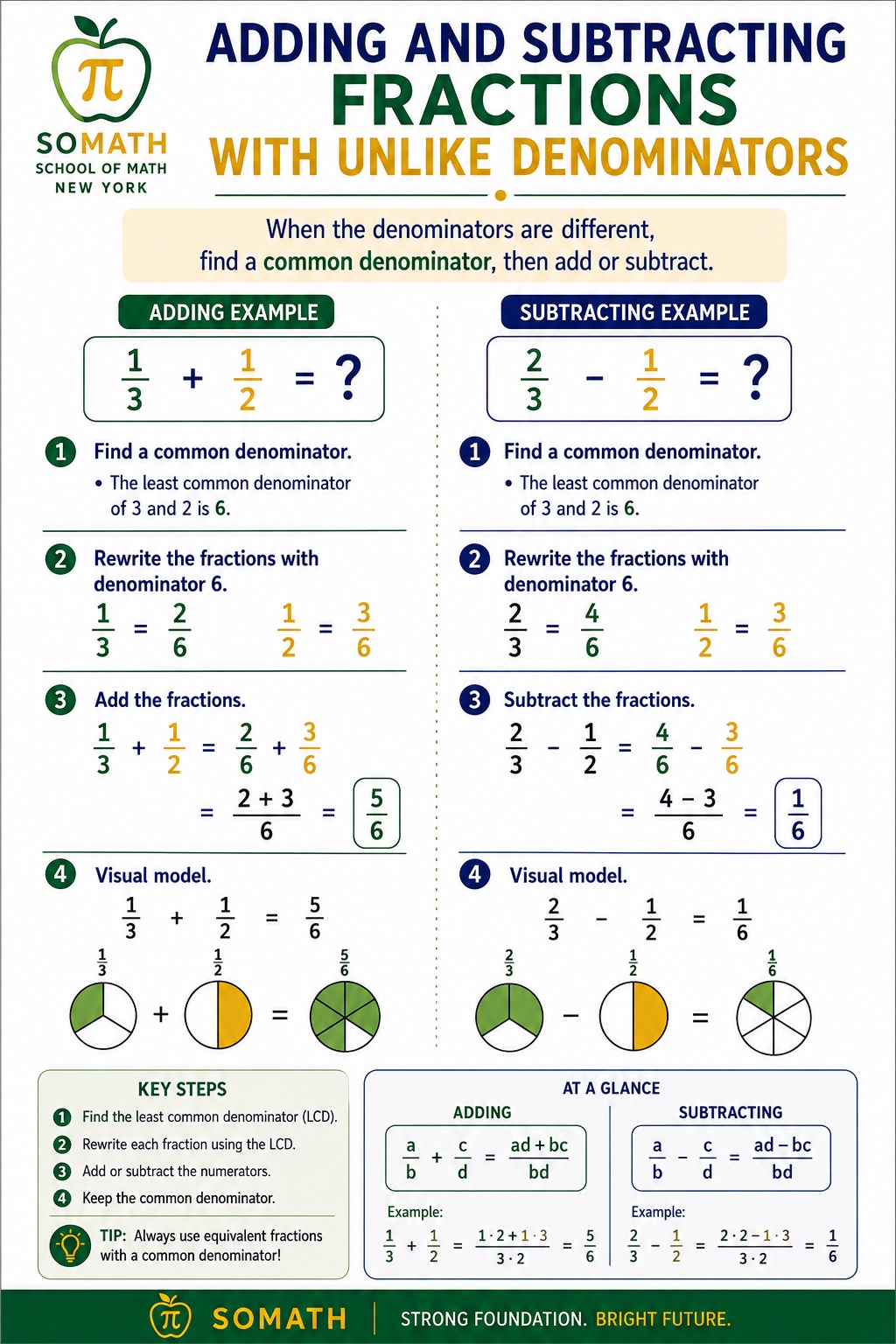
This is Class 19 of the SOMATH Kid Einsteins arc — the class where fractions stop being scary. Students who mastered equivalent fractions (Class 10) and adding & subtracting fractions with like denominators (Classes 11 and 12) are now ready for the real move: changing the denominator so pieces are the same size, then adding as usual. Once that click happens, everything downstream — multiplying fractions, mixed numbers, algebra, ratios — gets easier.
Every question below has a hidden button that reveals the answer and the reasoning, so a student can practice honestly and then check their thinking. Written by the same team that teaches Kid Einsteins at SOMATH, a math-focused school on the Upper West Side of NYC run by cofounder Marcelo Ambrozio (Northwestern-trained) and cofounder Vivianne Wright (Harvard MBA).
- Warm-up: draw the two circle models from the hero image on the board; do 1/3 + 1/2 together (10 min).
- Read the four-step method aloud — write it as a checklist on the whiteboard (5 min).
- Students attempt the 25 questions with the answers hidden (25 min).
- Reveal answers as a group and re-teach the LCD step if 3+ students missed the same question (10 min).
What’s in this lesson
1. Why we need a common denominator
You can only add pieces that are the same size
Think of a pizza cut into halves and another pizza cut into thirds. If someone has 1/2 of one pizza and 1/3 of the other, how much pizza do they have in total? You can’t just say “1/2 + 1/3 = 2/5.” That would mean 2 out of 5 pieces — but the halves and the thirds are not the same size, so 2 out of 5 isn’t a real amount.
The fix is to cut both pizzas into the same-sized pieces. If we cut both into sixths, the half-pizza becomes 3 pieces (1/2 = 3/6) and the third-pizza becomes 2 pieces (1/3 = 2/6). Now we can add: 3/6 + 2/6 = 5/6.
The rule: before you can add or subtract fractions, both denominators must be the same number. That shared number is called a common denominator. The smallest one that works is called the least common denominator, or LCD.
2. Finding the least common denominator (LCD)
The LCD is the LCM of the two denominators
The least common denominator of two fractions is the smallest number that both denominators divide into evenly. It is the same as the least common multiple (LCM) of the two denominators.
Three ways to find the LCD:
- List the multiples of each denominator until you find one they share. Fastest for small numbers.
- Check if one is a multiple of the other. If it is, the larger one is the LCD. Example: for 3 and 6, the LCD is 6.
- Multiply the denominators. This always gives a common denominator (just not always the smallest). Great as a backup: 3 × 4 = 12, so 12 is a common denominator of 3 and 4.
Common LCDs to know cold:
| Denominators | LCD | How to see it |
|---|---|---|
| 2 and 3 | 6 | 2 × 3 |
| 2 and 4 | 4 | 4 is a multiple of 2 |
| 2 and 5 | 10 | 2 × 5 |
| 3 and 4 | 12 | 3 × 4 |
| 3 and 5 | 15 | 3 × 5 |
| 3 and 6 | 6 | 6 is a multiple of 3 |
| 4 and 6 | 12 | list multiples |
| 4 and 8 | 8 | 8 is a multiple of 4 |
| 5 and 10 | 10 | 10 is a multiple of 5 |
| 6 and 8 | 24 | list multiples |
3. The four-step method — worked example
Add 1/3 + 1/2 step by step
| Step | What you do | Applied to 1/3 + 1/2 |
|---|---|---|
| 1 | Find the LCD of the two denominators. | LCD of 3 and 2 is 6. |
| 2 | Rewrite each fraction with the LCD (equivalent fractions). | 1/3 = 2/6 · 1/2 = 3/6 |
| 3 | Add or subtract the numerators only — keep the common denominator. | 2/6 + 3/6 = 5/6 |
| 4 | Simplify if possible. | 5/6 is already in lowest terms. |
Why step 2 works: to rewrite 1/3 as sixths, multiply the top and the bottom by the same number. 3 × 2 = 6, so 1 × 2 = 2, giving 2/6. Multiplying top and bottom by the same number doesn’t change the value of a fraction — it just re-labels it in smaller pieces. This is the equivalent-fractions idea from Class 10.
4. Subtracting fractions with unlike denominators
Exactly the same four steps — just subtract in step 3
Worked example: 2/3 − 1/2.
- LCD of 3 and 2 is 6.
- Rewrite: 2/3 = 4/6 and 1/2 = 3/6.
- Subtract numerators: 4/6 − 3/6 = 1/6.
- Simplify: 1/6 is already in lowest terms.
That’s the second circle model from the hero image at the top of this page: two-thirds of a pie minus one-half of a pie leaves one-sixth of a pie.
5. The cross-multiply shortcut (for the two-fraction case)
Adding: a/b + c/d = (a·d + b·c) / (b·d)
Subtracting: a/b − c/d = (a·d − b·c) / (b·d)
Cross-multiply each numerator with the other denominator, then the denominator is just b · d. It always works, but the denominator bd may not be the LCD, so you may need to simplify. Two examples:
- 1/3 + 1/2 = (1·2 + 3·1) / (3·2) = 5/6 — already simplified.
- 1/4 + 1/6 = (1·6 + 4·1) / (4·6) = 10/24 = 5/12 — simplify by dividing top and bottom by 2.
Use the LCD method to keep numbers small and avoid simplifying at the end. Use the cross-multiply shortcut when the LCD is awkward or you’re doing quick mental math.
6. The 5 most common mistakes
- Adding the denominators. 1/2 + 1/3 is not 2/5. The denominator names the piece size; once pieces are the same size, only the number of pieces (the numerator) changes.
- Multiplying the numerator by one number and the denominator by another. To rewrite 1/3 as sixths, multiply both top and bottom by 2. Not one by 2 and the other by 3.
- Forgetting to simplify. 6/8 is a correct answer, but 3/4 is the finished answer.
- Using the wrong LCD. Every common denominator works, but the LCD keeps numbers small. 1/3 + 1/6: LCD is 6, not 18.
- Ignoring signs in subtraction. 1/4 − 1/3 is negative (it’s 3/12 − 4/12 = −1/12). For grade 3–4 problems, always make sure the first fraction is larger before you subtract, or use a number line.
25 practice questions
Adding & subtracting fractions with unlike denominators — from “same as one of the denominators” to two-step word problems. Click Show answer & solution under each question after you try.
Q1. 1/2 + 1/4
Add the fractions. Give the answer in lowest terms.
Answer: 3/4
LCD of 2 and 4 is 4 (since 4 is a multiple of 2). Rewrite: 1/2 = 2/4. Then 2/4 + 1/4 = 3/4. Already in lowest terms.
Q2. 1/3 + 1/6
Add. Simplify if possible.
Answer: 1/2
LCD of 3 and 6 is 6. Rewrite 1/3 = 2/6. Add: 2/6 + 1/6 = 3/6. Simplify: 3/6 = 1/2 (divide top and bottom by 3).
Q3. 1/3 + 1/2
Add. This is the hero-image example.
Answer: 5/6
LCD of 3 and 2 is 6. Rewrite: 1/3 = 2/6 and 1/2 = 3/6. Add: 2/6 + 3/6 = 5/6. Already in lowest terms.
Q4. 1/4 + 1/6
Add and simplify.
Answer: 5/12
LCD of 4 and 6 is 12. Rewrite: 1/4 = 3/12 and 1/6 = 2/12. Add: 3/12 + 2/12 = 5/12. Already in lowest terms.
Q5. 2/3 + 1/4
Add.
Answer: 11/12
LCD of 3 and 4 is 12. Rewrite: 2/3 = 8/12 and 1/4 = 3/12. Add: 8/12 + 3/12 = 11/12.
Q6. 3/5 + 1/2
Add. Answer may be an improper fraction; convert to a mixed number.
Answer: 11/10 = 1 1/10
LCD of 5 and 2 is 10. Rewrite: 3/5 = 6/10 and 1/2 = 5/10. Add: 6/10 + 5/10 = 11/10. As a mixed number: 1 1/10.
Q7. 1/2 + 1/3 + 1/6
Add all three. Find one LCD that works for all.
Answer: 1
LCD of 2, 3, and 6 is 6. Rewrite: 1/2 = 3/6, 1/3 = 2/6, 1/6 = 1/6. Add: 3/6 + 2/6 + 1/6 = 6/6 = 1.
Q8. 2/3 − 1/2
Subtract. This is the second hero-image example.
Answer: 1/6
LCD of 3 and 2 is 6. Rewrite: 2/3 = 4/6 and 1/2 = 3/6. Subtract: 4/6 − 3/6 = 1/6.
Q9. 3/4 − 1/2
Subtract.
Answer: 1/4
LCD of 4 and 2 is 4. Rewrite: 1/2 = 2/4. Subtract: 3/4 − 2/4 = 1/4.
Q10. 5/6 − 1/3
Subtract and simplify.
Answer: 1/2
LCD of 6 and 3 is 6. Rewrite: 1/3 = 2/6. Subtract: 5/6 − 2/6 = 3/6. Simplify: 3/6 = 1/2.
Q11. 7/8 − 1/4
Subtract.
Answer: 5/8
LCD of 8 and 4 is 8. Rewrite: 1/4 = 2/8. Subtract: 7/8 − 2/8 = 5/8. Already in lowest terms.
Q12. 2/3 − 1/4
Subtract.
Answer: 5/12
LCD of 3 and 4 is 12. Rewrite: 2/3 = 8/12 and 1/4 = 3/12. Subtract: 8/12 − 3/12 = 5/12.
Q13. 4/5 − 1/10
Subtract.
Answer: 7/10
LCD of 5 and 10 is 10. Rewrite: 4/5 = 8/10. Subtract: 8/10 − 1/10 = 7/10.
Q14. 1/2 + 3/8
Add.
Answer: 7/8
LCD of 2 and 8 is 8. Rewrite: 1/2 = 4/8. Add: 4/8 + 3/8 = 7/8.
Q15. 5/6 + 1/4
Add. Convert improper fractions to mixed numbers.
Answer: 13/12 = 1 1/12
LCD of 6 and 4 is 12. Rewrite: 5/6 = 10/12 and 1/4 = 3/12. Add: 10/12 + 3/12 = 13/12 = 1 1/12.
Q16. 3/8 + 1/6
Add.
Answer: 13/24
LCD of 8 and 6 is 24. Rewrite: 3/8 = 9/24 and 1/6 = 4/24. Add: 9/24 + 4/24 = 13/24. Already in lowest terms.
Q17. 7/10 − 1/5
Subtract and simplify.
Answer: 1/2
LCD of 10 and 5 is 10. Rewrite: 1/5 = 2/10. Subtract: 7/10 − 2/10 = 5/10. Simplify: 5/10 = 1/2.
Q18. 1 − 3/8
Subtract from a whole. Hint: rewrite 1 as an equivalent fraction with denominator 8.
Answer: 5/8
Rewrite 1 = 8/8. Subtract: 8/8 − 3/8 = 5/8.
Q19. Fill in the missing fraction: 1/2 + ___ = 3/4
What fraction goes in the blank?
Answer: 1/4
Rearrange: missing fraction = 3/4 − 1/2. LCD of 4 and 2 is 4. Rewrite: 1/2 = 2/4. Subtract: 3/4 − 2/4 = 1/4.
Q20. Compare: 1/2 + 1/3 or 2/3 + 1/6? Which is bigger?
Compute both, then compare.
Answer: 2/3 + 1/6 = 5/6 is bigger (and both are equal to 5/6).
Left side: 1/2 + 1/3 = 3/6 + 2/6 = 5/6. Right side: 2/3 + 1/6 = 4/6 + 1/6 = 5/6. They are equal. Good trap-question — students who add denominators would get 2/5 and 3/9, both wrong.
Q21. Pizza word problem
Maria ate 1/4 of a pizza. Her brother ate 1/3 of the same pizza. How much of the pizza did they eat in total?
Answer: 7/12 of the pizza
LCD of 4 and 3 is 12. Rewrite: 1/4 = 3/12 and 1/3 = 4/12. Add: 3/12 + 4/12 = 7/12. Sanity check: 7/12 is a little more than half the pizza — realistic for two kids.
Q22. Homework word problem
Alex finished 2/3 of his homework before dinner and 1/6 more after dinner. How much of his homework is done?
Answer: 5/6 of the homework
LCD of 3 and 6 is 6. Rewrite: 2/3 = 4/6. Add: 4/6 + 1/6 = 5/6. He still has 1/6 to do.
Q23. Ribbon word problem
A ribbon is 3/4 of a yard long. You cut off 1/3 of a yard for a bow. How much ribbon is left?
Answer: 5/12 of a yard
LCD of 4 and 3 is 12. Rewrite: 3/4 = 9/12 and 1/3 = 4/12. Subtract: 9/12 − 4/12 = 5/12. Sanity check: less than half a yard is left, which matches cutting off a big piece from a small ribbon.
Q24. Two-step word problem
A water bottle is 1/2 full. Emma drinks 1/8 of the bottle, then refills the bottle by 1/4. What fraction of the bottle is now full?
Answer: 5/8 of the bottle
Start: 1/2 = 4/8. Drink: 4/8 − 1/8 = 3/8. Refill: 3/8 + 1/4 = 3/8 + 2/8 = 5/8. The bottle is now more than half full.
Q25. Challenge: three unlike denominators
Compute: 1/2 + 1/3 + 1/4. Give the answer as a mixed number if improper.
Answer: 13/12 = 1 1/12
LCD of 2, 3, and 4 is 12. Rewrite: 1/2 = 6/12, 1/3 = 4/12, 1/4 = 3/12. Add: 6/12 + 4/12 + 3/12 = 13/12. As a mixed number: 1 1/12. That’s slightly more than one whole — makes sense since 1/2 + 1/3 + 1/4 is a bit more than 1/2 + 1/3 + 1/6 = 1.
Answer key summary
| Q# | Answer | Q# | Answer | Q# | Answer |
|---|---|---|---|---|---|
| 1 | 3/4 | 10 | 1/2 | 19 | 1/4 |
| 2 | 1/2 | 11 | 5/8 | 20 | equal (5/6) |
| 3 | 5/6 | 12 | 5/12 | 21 | 7/12 |
| 4 | 5/12 | 13 | 7/10 | 22 | 5/6 |
| 5 | 11/12 | 14 | 7/8 | 23 | 5/12 |
| 6 | 1 1/10 | 15 | 1 1/12 | 24 | 5/8 |
| 7 | 1 | 16 | 13/24 | 25 | 1 1/12 |
| 8 | 1/6 | 17 | 1/2 | ||
| 9 | 1/4 | 18 | 5/8 |
About SOMATH & Kid Einsteins
SOMATH — School of Math is a math-focused school on the Upper West Side of Manhattan for students in grades 1–12. The Kid Einsteins program (grades 3–4, extends into grade 5 for fraction work) covers multiplication and division fluency, fractions and decimals, area and perimeter, ratios, and structured word problems in small groups of up to 6 students. This is Class 19 of the Kid Einsteins arc — adding and subtracting fractions with unlike denominators.
Classes are taught by cofounder Marcelo Ambrozio (Northwestern-trained, 20+ years teaching math in NYC) and the SOMATH team.
Location: 226 W 79th St, 1st Floor, New York, NY 10024 (Upper West Side)
Phone: (646) 668-6151
Email: hello@schoolofmath.us
Book a free 30-minute evaluation for your child — we’ll place them in the right small group.
Related SOMATH posts
- Division Facts & the Inverse of Multiplication — Kid Einsteins Class 6
- Long Division with Three-Digit Dividends — Kid Einsteins Class 7
- Fractions & Decimals — How They Connect
- Pre-Algebra Class 5: Equivalent Fractions, Comparing & Converting Decimals
- Pre-Algebra Class 6: Four Operations on Fractions & Mixed Numbers
- Kid Einsteins course page (full 48-class syllabus)
- All SOMATH blog posts »