SOMATH Essay · A story about loving math
The 24 Greatest Mathematicians of All Time
And how every single one of them learned to love math — because none of them were born that way.
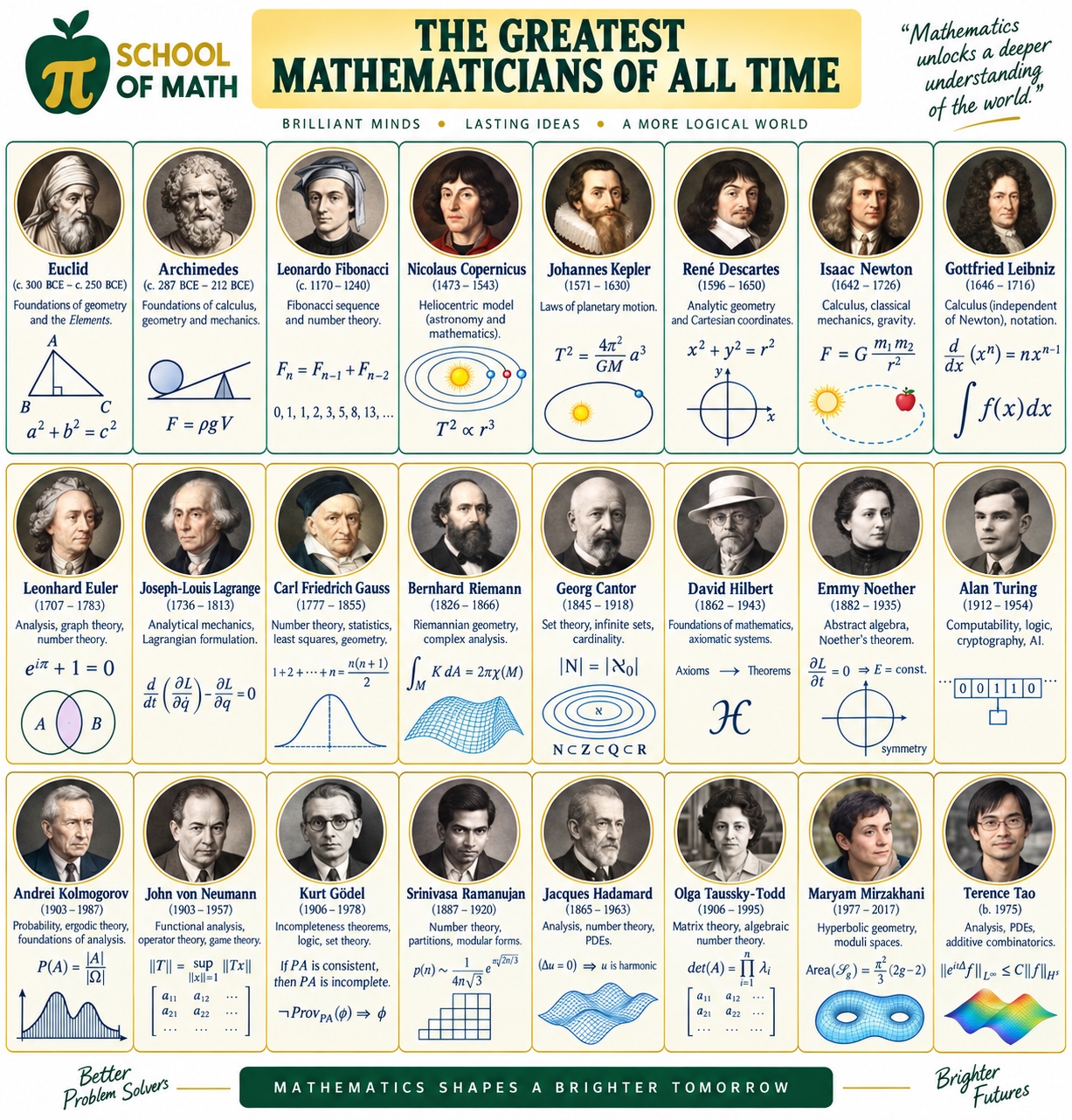
Every so often at School of Math (SOMATH), a parent tells us that their child has “never liked math.” And every so often, a few months later, that same child comes in on a Saturday morning and asks whether they can stay for the next class too.
What changed is not the child. What changed is what math looks like when someone shows it to them properly — as a puzzle, a story, a pattern in the world, a game with rules that make sense — instead of a worksheet with a deadline.
The 24 people below are the ones history remembers as the greatest mathematicians who ever lived. Their portraits sit on the wall of our classroom in Manhattan. But the reason we made this poster wasn’t the equations under their names. It was their stories — because each of them started somewhere, and each of them was shown math by someone.
“Mathematics unlocks a deeper understanding of the world.” — the SOMATH poster, top-right corner
Antiquity through the Scientific Revolution
Geometry, arithmetic, motion, and the coordinate plane — the tools every math student still uses.
Euclid (c. 300 BCE – c. 250 BCE)
Foundations of geometry, the Elements.
We know almost nothing about Euclid's personal life — but we know exactly how he learned to love math: he collected it. Working at the great library of Alexandria, he gathered every geometry proof anyone in the Greek world could find, arranged them so that each theorem followed logically from the last, and wrote the Elements. It became the second-most-printed book in history after the Bible and shaped how mathematics has been taught for 2,300 years.
Archimedes (c. 287 BCE – 212 BCE)
Foundations of calculus, geometry, mechanics.
Archimedes fell in love with math by playing with physical things — levers, pulleys, and water. The famous story of him leaping from his bath shouting “Eureka!” captures how he actually worked: turn a real-world puzzle (does the king's crown have too much silver in it?) into geometry, then let the geometry solve the puzzle. He calculated π to two decimals, invented the compound pulley, and figured out the volume of a sphere — centuries before anyone had calculus.
Leonardo Fibonacci (c. 1170 – 1240)
Fibonacci sequence, number theory.
Fibonacci grew up in Pisa but traveled with his merchant father across North Africa. There he met Arab mathematicians using the Hindu–Arabic numerals (0, 1, 2, 3, …) that Europe hadn't adopted yet. He fell in love with how much easier they made calculation, and in 1202 he wrote Liber Abaci to bring them home. As a side illustration he described a rabbit-breeding problem — and gave the world the sequence 1, 1, 2, 3, 5, 8, 13, … that now carries his name.
Nicolaus Copernicus (1473 – 1543)
Heliocentric model.
Copernicus was a Polish church administrator with an astronomer's obsession on the side. He learned to love math because the Ptolemaic model of the heavens — with Earth at the center — kept needing more and more mathematical patches to match the sky. He spent decades quietly working out a cleaner model with the Sun at the center. He waited until he was dying to publish it, and it started the Scientific Revolution.
Johannes Kepler (1571 – 1630)
Laws of planetary motion.
Kepler was hired to fit a circle to Mars' orbit and spent years failing. He loved math enough to keep going — through the death of his first wife, the trial of his mother for witchcraft, and constant financial trouble — until he finally admitted the orbit wasn't a circle. It was an ellipse. That answer, and the two laws that followed, gave Isaac Newton the data he needed to invent gravity.
René Descartes (1596 – 1650)
Analytic geometry, Cartesian coordinates.
Descartes, according to legend, invented the coordinate plane while lying in bed watching a fly on the ceiling — he realized he could describe the fly's position with two numbers. Whether or not the story is true, his real insight was that algebra and geometry are the same subject. Every equation is a shape, every shape is an equation. It's the reason every math class you'll ever take has an x-axis and a y-axis.
Isaac Newton (1642 – 1726)
Calculus, classical mechanics, gravity.
Newton fell in love with math during the plague of 1665, when Cambridge shut down and he went home to his mother's farm. Alone for two years, still in his early twenties, he invented calculus, worked out the laws of motion, decomposed white light with a prism, and drafted the theory of universal gravitation. He later called this his annus mirabilis — the year he learned the language the universe actually speaks.
Gottfried Leibniz (1646 – 1716)
Calculus (independent of Newton), notation.
Leibniz was a philosopher, diplomat, and librarian who invented calculus at the same time as Newton, working completely independently. He loved math because he loved notation — the right symbols, he believed, could let people reason about anything. The integral sign ∫ and the notation dy/dx that every calculus student writes today are his. Newton's version won the priority fight; Leibniz's version won the way we actually write it down.
The 18th and 19th Centuries
Analysis, algebra, number theory, and the deep foundations of the subject.
Leonhard Euler (1707 – 1783)
Analysis, graph theory, number theory.
Euler is the most productive mathematician who ever lived — and he wrote roughly half of it after going blind in his sixties, dictating to his sons. He learned to love math from his father, a pastor who had studied under Johann Bernoulli, and never stopped. He is the reason we write f(x), e, i, π, and Σ the way we do — and his identity eiπ + 1 = 0 is often called the most beautiful equation in mathematics.
Joseph-Louis Lagrange (1736 – 1813)
Analytical mechanics, Lagrangian formulation.
Lagrange grew up in Turin and taught himself math from a paper he found by Edmond Halley — by 19 he was a professor. He loved math for its elegance: he rewrote all of Newton's mechanics without a single geometric diagram, using only algebra and calculus. His Mecanique Analytique is the foundation of everything modern physics does with energy and motion.
Carl Friedrich Gauss (1777 – 1855)
Number theory, statistics, least squares, geometry.
Gauss's love of math showed up when he was a child. The story goes that his elementary teacher, wanting to keep the class busy, asked them to add up 1 + 2 + 3 + … + 100. Gauss did it in seconds by pairing 1+100, 2+99, 3+98 … and multiplying. He went on to invent the normal distribution (that bell curve on the poster), prove the fundamental theorem of algebra, and become known as the Princeps Mathematicorum — the Prince of Mathematicians.
Bernhard Riemann (1826 – 1866)
Riemannian geometry, complex analysis.
Riemann was painfully shy, deeply religious, and one of the most original thinkers in the history of math. He learned to love math from his father, a Lutheran pastor, and from Gauss himself in Gottingen. His theory of curved spaces sat unused for 60 years — until Einstein needed exactly that language to write general relativity in 1915. His unsolved hypothesis about the zeros of the zeta function is still the most famous open problem in math.
Georg Cantor (1845 – 1918)
Set theory, infinite sets, cardinality.
Cantor proved something that seems impossible: some infinities are bigger than others. The infinity of counting numbers (1, 2, 3, …) is smaller than the infinity of decimals between 0 and 1. His contemporaries hated the idea, and the fight cost him his mental health. But he loved the subject too much to abandon it, and today set theory is the foundation of every branch of modern math.
David Hilbert (1862 – 1943)
Foundations of mathematics, axiomatic systems.
Hilbert believed math should be built from the ground up like a cathedral, with every stone (every axiom) carefully placed. He loved math as a builder — a person who wanted the whole structure to be solid. In 1900 he stood in front of the world's mathematicians in Paris and read out 23 unsolved problems that would shape the whole 20th century. Several are still open.
Emmy Noether (1882 – 1935)
Abstract algebra, Noether's theorem.
Noether was the greatest woman mathematician of her era and the founder of modern abstract algebra. She was refused a paid faculty position for years because German universities didn't hire women; she lectured under male colleagues' names. Her theorem — that every symmetry of the laws of physics corresponds to a conservation law — is the reason energy is conserved, the reason momentum is conserved, and the deepest connection between math and the physical world we know.
Alan Turing (1912 – 1954)
Computability, logic, cryptography, AI.
Turing fell in love with math as a lonely English schoolboy who read Einstein on his own and understood him. He turned that love into the abstract idea of a machine that could compute anything computable — the Turing machine, which is the theoretical foundation of every computer you have ever used. During WWII he led the team at Bletchley Park that broke the German Enigma code and helped end the war years earlier.
The 20th Century and Living Mathematicians
Probability, logic, computing, and the fields that shape modern life — including the first woman ever to win the Fields Medal.
Andrei Kolmogorov (1903 – 1987)
Probability, ergodic theory, foundations of analysis.
Kolmogorov put probability on rigorous footing in 1933 with just three axioms — and the entire modern theory of probability, statistics, and randomness follows from them. He learned to love math from his aunt, who raised him and started a village school. He would spend his life not only doing math but building schools for gifted Soviet children, because he believed a love of math had to be taught early.
John von Neumann (1903 – 1957)
Functional analysis, operator theory, game theory.
Von Neumann was famous for how fast he thought. He could multiply eight-digit numbers in his head as a child, and later helped design the Manhattan Project bomb, the first stored-program computer, the mathematics of quantum mechanics, and the theory of games. He loved math for the range of things you could do with it — and he did all of them.
Kurt Gödel (1906 – 1978)
Incompleteness theorems, logic, set theory.
Gödel was a quiet Austrian logician who proved something devastating: no consistent mathematical system rich enough to include arithmetic can prove all the true statements inside it. Some truths are literally unprovable. It's the closest thing math has to a philosophical earthquake, and it changed forever what we mean by “proof.”
Srinivasa Ramanujan (1887 – 1920)
Number theory, partitions, modular forms.
Ramanujan is the most romantic story in modern mathematics. A self-taught clerk in Madras with almost no formal training, he filled notebooks with thousands of identities so strange his contemporaries could not tell if he was a crank or a genius. G. H. Hardy at Cambridge recognized the genius, brought him to England, and Ramanujan produced results that mathematicians are still proving today, more than a century after his death at 32.
Jacques Hadamard (1865 – 1963)
Analysis, number theory, PDEs.
Hadamard was a French analyst whose life spanned almost a century of mathematics — and included a book, The Psychology of Invention in the Mathematical Field, where he tried to figure out how great mathematicians actually think. He loved math not just as a subject but as a way of paying attention. His proof of the prime number theorem in 1896 is one of the great results of 19th-century analysis.
Olga Taussky-Todd (1906 – 1995)
Matrix theory, algebraic number theory.
Taussky-Todd was a pioneer of matrix theory and one of the first women to shape modern computational mathematics. She fled Nazi-era Vienna, worked at the UK's National Physical Laboratory during WWII on aircraft flutter (using matrices to keep planes from shaking apart), and later became the first woman on the Caltech mathematics faculty.
Maryam Mirzakhani (1977 – 2017)
Hyperbolic geometry, moduli spaces.
Mirzakhani grew up in Tehran, competed on the Iranian Math Olympiad team, and in 2014 became the first woman ever to win the Fields Medal — math's equivalent of the Nobel Prize. She said she fell in love with math when she realized proofs felt like solving mysteries. She died of cancer at 40. Her work on the geometry of curved surfaces is now a whole subfield of its own.
Terence Tao (b. 1975)
Analysis, additive combinatorics.
Tao is often called the greatest living mathematician. He learned arithmetic at 2, competed in the International Math Olympiad at 10 (winning a bronze; he won gold at 13), and got his PhD at 20. He works across so many fields — harmonic analysis, number theory, partial differential equations, combinatorics, random matrices — that colleagues joke he plays chess against the whole discipline at once. He won the Fields Medal in 2006.
What all 24 stories have in common
Read those 24 short lives back-to-back and you notice something. Almost none of these people were forced into math. What they had was a moment.
- A father, an aunt, a mentor, or a teacher who noticed. (Gauss’ teacher. Ramanujan’s Hardy. Kolmogorov’s aunt. Turing’s solitary reading of Einstein.)
- A problem that would not let them go. (Kepler and Mars. Cantor and infinity. Newton, alone on a farm, watching an apple.)
- A first taste of the feeling that math is a language that describes the world — not a subject with a grade attached.
That’s it. That’s the pattern. It is nothing that requires being a prodigy — most of these people weren’t. It requires being shown math by someone who loves it, at a moment when you are ready to see it.
This is why SOMATH exists. Not to drill your child through a workbook, and not to promise medals. Our job is to give a child that moment — and then to be there for the many moments after.
Frequently asked questions
Who is the greatest mathematician of all time?
Who invented calculus?
Who is the greatest woman mathematician of all time?
How did the greatest mathematicians learn to love math?
Can a kid who dislikes math learn to love it?
Where can my child learn math this way in NYC?
Your child can learn to love math.
That’s what we do at SOMATH — the small, in-person math school at 226 W 79th St on the Upper West Side of Manhattan. Grade 1 through AP Calculus, in classrooms small enough that a teacher can notice which problem makes your child sit up.
Book a free evaluation → Read what SOMATH is → Call (646) 668-6151