Trend Report · Math Enrichment · NYC 2026
The 2026 Math Enrichment Boom: Why NYC Parents Are Reacting to the ChatGPT Homework Crisis
46% of middle schoolers now use ChatGPT for homework — up from 30% just seven months earlier. Combined with the widest 8th-grade NAEP score gap since 2003 and the NYC Solves curriculum mandate reaching Upper West Side classrooms this fall, the result is the biggest surge in demand for small-group, human-led math enrichment we’ve seen in a decade.
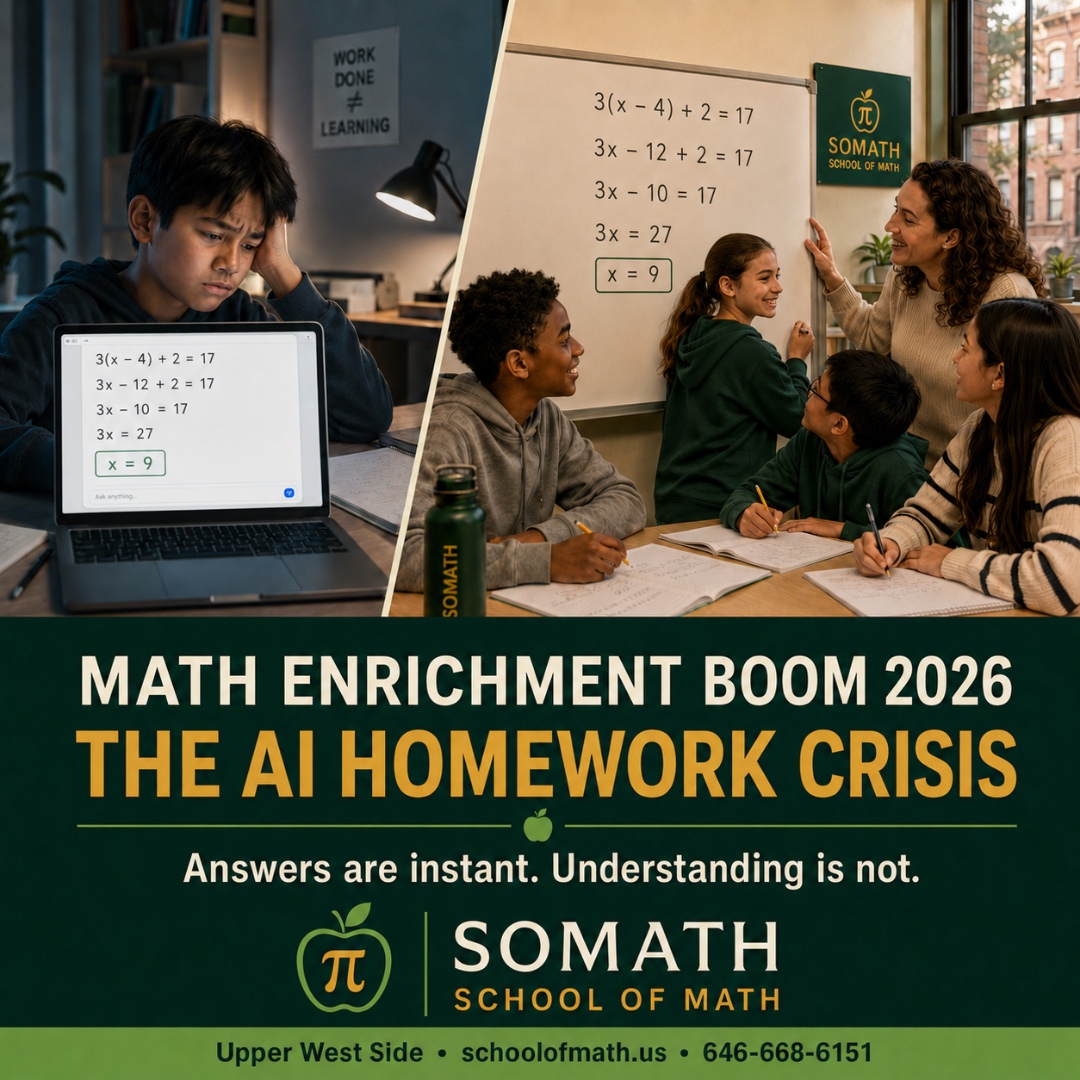
Short answer. Math enrichment — structured, cumulative math instruction outside of school — is having its biggest moment since the pandemic. Three forces are driving it: an explosion of AI homework use that is measurably hurting retention, a NAEP score decline that has parents alarmed, and a NYC curriculum standardization that arrives in Upper West Side middle schools this September. Families are responding by moving away from ad-hoc tutoring toward small-group, in-person enrichment programs with a real syllabus.
What’s in this report
The trend in one sentence
Between May and December 2025, ChatGPT homework use among US middle schoolers rose from 30% to 46% (RAND American Youth Panel). By early 2026, 54% of US teens report using AI chatbots for schoolwork, with math help one of the two most common tasks (Pew Research Center). Parents are noticing that homework isn’t teaching anymore — it’s being outsourced — and they are responding by seeking real math instruction outside of school.
46%
of US middle schoolers used AI for homework by December 2025
RAND, Dec 2025
+53%
jump in middle-school AI homework use in 7 months
RAND, May–Dec 2025
61%
higher MAP-test growth for students with a human teacher plus AI vs AI-only
EDM 2026 study
$17.3M
NYC Solves curriculum expansion reaching UWS middle schools this fall
NYC DOE, May 2026
Force 1: AI is eating middle-school math learning
The RAND American Youth Panel — the largest longitudinal survey of US teens on technology use — found that middle-school AI homework use climbed from 30% in May 2025 to 46% by December 2025. That’s a 53% increase in seven months. For high schoolers, the number is now 63%. Pew’s February 2026 survey confirms it independently: 64% of US teens now use AI chatbots, and 54% have used one for schoolwork.
The problem isn’t AI itself — it’s how kids are using it. A December 2024 study from University College London coined the term metacognitive laziness to describe what happens when students lean on AI as an answer key: they retain less, transfer less, and lose the ability to notice their own mistakes. When your 7th grader types a word problem into ChatGPT and copies the answer, they are not learning — they are being tutored by a system that has no idea what they don’t yet know.
What parents are seeing. Kids finishing homework in 20 minutes that used to take an hour. Grades holding steady on homework, but quiz and test scores dropping. A vague, hard-to-pin sense that the child “kind of gets it” but can’t explain the steps. Those are the signals of AI-assisted homework, not deeper learning.
Force 2: NAEP scores show the widest gap since 2003
The 2024 NAEP results (released early 2025) confirmed what teachers had been seeing: 8th-grade math scores are at their lowest point since 2003, and the bottom third of students has fallen further behind than at any point in the assessment’s history. Fourth-grade scores are only marginally better. The pandemic gap has not closed — it has widened.
Upper West Side parents watching their child’s report card versus their child’s actual math performance are running into this gap in person. School-level A’s and B’s no longer signal grade-level mastery. That’s why enrichment is replacing tutoring in the parent conversation: tutoring reacts to a bad grade; enrichment builds the fluency that prevents the bad grade in the first place.
Force 3: NYC Solves lands in UWS classrooms this fall
In May 2026, NYC Public Schools announced a $17.3 million expansion of NYC Solves, bringing the city’s standardized math curriculum to 10 additional middle-school districts — including Manhattan District 3, which covers the Upper West Side. Starting September 2026, MS 54, MS 245, MS 247, and other D3 schools will adopt one of three approved curricula, most likely Illustrative Mathematics.
Two consequences for parents. Standardization improves consistency across schools, which is a good thing. But it also compresses the range of what your child sees in the classroom. If your child is ahead, the pacing will feel slow. If your child is behind, the pacing will feel merciless. Either way, outside enrichment becomes the way to work at the right level.
What we’re hearing from UWS parents. “My daughter’s teacher told the class they’re not allowed to use ChatGPT for homework, but she does anyway.” “His grades look fine but he can’t do the problems in front of me.” “We tried an app but he just clicks through it.” “We tried a college tutor but she cancelled twice.” The families I’m talking to want a real classroom with a real teacher — something with structure, accountability, and a syllabus.
Why parents are choosing enrichment over tutoring in 2026
Tutoring reacts to problems. Enrichment builds capacity. Here is the distinction we’re watching UWS families make in 2026:
| Ad-hoc tutoring | Structured enrichment |
|---|---|
| Reactive — you hire when a grade drops. | Proactive — a year-round program with its own syllabus. |
| Homework help — whatever the school assigns that week. | Sequential curriculum — the sub-skills that actually build mastery. |
| 1-on-1 with a college student or gig-economy tutor. | Small group of 4–6 with a credentialed educator. |
| Often cancels, reschedules, or churns instructors. | Same teacher, same cohort, weekly classes for months. |
| No diagnosis, no measured progress. | Placement evaluation, per-strand progress reports. |
| Peaks in demand around report card time. | Steady weekly cadence independent of school pacing. |
Small-group enrichment is winning the 2026 UWS parent decision because it fixes the failure modes of both ad-hoc tutoring (churn, no syllabus, no diagnosis) and AI-only homework help (metacognitive laziness, no accountability, no relationship). A 2026 study in the EDM proceedings measured a 61% higher gain on standardized MAP tests for students in human-plus-AI tutoring versus AI-only. The research is clear: humans in the loop, AI as a helper.
What to look for in a 2026 math enrichment program
Ask these five questions of any Upper West Side program you consider.
- Is there a published, sequential syllabus? If the answer is “we adapt to your child,” that usually means there is no curriculum — just worksheets pulled ad-hoc.
- Who is teaching, and what are their credentials? Ask for names. The gap between a credentialed educator and a college student is enormous.
- What is the group size? Groups larger than 6 lose the personal attention. 1-on-1 is often unnecessary and always more expensive.
- How do you diagnose and communicate progress? A real program will place your child through a written evaluation and send you regular per-strand reports.
- What is the schedule and cadence? Weekly, same day, same time is far more effective than variable scheduling. The consistency is where the fluency comes from.
How SOMATH is set up for this moment
SOMATH is the Upper West Side’s math school — not a tutoring service and not an app. We run 10 leveled programs from Little Newtons (grades 1–2) through AP Calculus, in small groups of six, taught in person at 226 W 79th Street by Harvard- and Kellogg-trained educators. Every program follows a written syllabus we developed in-house. Every student gets a placement evaluation before starting, and parents receive regular per-strand feedback. Membership is monthly, weekly cadence, year-round.
If you’ve been watching the trend and wondering what to do next, the answer is simple: book a free 30-minute placement evaluation. We’ll diagnose where your child is now, tell you honestly whether we’re the right fit, and walk you through the program that matches their level.
Grades 1–12 · Upper West Side
Book a free 30-minute placement evaluation
In-person at 226 W 79th St or online via Zoom. We’ll assess your child’s current level across every strand, recommend the right SOMATH program, and answer any questions about membership, scheduling, and pricing. No commitment.
FAQ
Is math enrichment really growing in NYC in 2026?
Yes. Three data points confirm the trend. ChatGPT homework use among US middle schoolers jumped from 30% to 46% in seven months (RAND). 2024 NAEP results showed 8th-grade math scores at their lowest since 2003. And NYC Public Schools announced a $17.3M expansion of NYC Solves that reaches Upper West Side middle schools this fall. All three forces are pushing UWS families toward small-group, in-person math enrichment.
Why isn’t AI enough for my child’s math learning?
AI is useful as a helper but fails at three things human teachers do best: diagnosing what your child doesn’t yet know, holding them accountable when they coast or copy, and building the relationship that motivates a kid to try hard on a hard problem. A 2026 study measured 61% higher MAP-test growth for students with human-plus-AI tutoring vs AI-only. The research is settled: humans in the loop.
What’s the difference between tutoring and enrichment?
Tutoring reacts — you hire a tutor when your child hits a wall on a homework assignment or a test. Enrichment builds — a structured, cumulative program with its own syllabus that runs independent of school pacing. Tutoring is short-term rescue. Enrichment is long-term capacity. In 2026, UWS parents are increasingly choosing the latter.
Why are small-group programs winning over 1-on-1 tutoring?
Cost, peer effects, and sustainability. Small groups of 4–6 cost dramatically less per hour than 1-on-1 while retaining most of the personal attention. Kids learn faster when they see how a peer thinks through a problem. And a real classroom with a consistent teacher and cohort is something a child can commit to year-round, unlike a rotating cast of gig tutors.
How do I choose an enrichment program on the Upper West Side?
Ask five questions: (1) Is there a written, sequential syllabus? (2) Who is teaching, and what are their credentials? (3) What is the group size? (4) How do you diagnose and communicate progress? (5) What is the schedule cadence? At SOMATH we run a free 30-minute placement evaluation, publish full syllabi at schoolofmath.us/programs, cap groups at six, and every teacher is Harvard- or Kellogg-trained.
Related reading
- AI Math Tutoring NYC 2026: What UWS Parents Should Know
- Math Enrichment vs. Tutoring in NYC: What’s the Difference?
- NYC Math Tutoring & Enrichment Trends 2026: A UWS Parent’s Guide
- SOMATH vs. Russian Math, Kumon, and Mathnasium
Sources. RAND American Youth Panel, Dec 2025 · Pew Research Center, Feb 2026 · The Nation’s Report Card (NAEP 2024) · NYC Public Schools press release, May 21 2026 · Educational Data Mining 2026 proceedings, “Improving Hybrid Human-AI Tutoring by Differentiating…”