Algebra 1 · NY Regents · Exam Prep · June 2026
NY Regents Algebra 1 — June 2026: Full Walkthrough of All 35 Questions
The June 17, 2026 New York State Regents Algebra 1 exam is one of the cleanest recent exams — it hits every core Algebra 1 strand without any oddball topics. It is a great snapshot of exactly what a rising 9th- or 10th-grader needs to master, whether they are aiming to take Regents this coming January, next June, or just want to test how solid their Algebra 1 skills are.
This post gives you the complete exam: every one of the 35 questions transcribed verbatim, with a step-by-step worked solution hidden under each question so students can attempt each problem first. Between the parts, we break down the underlying theory the students needed to know. And at the top of this page you can download the original PDF from the New York State Department of Education.
What’s in this walkthrough
How the Regents Algebra 1 exam is graded
The Regents Algebra 1 exam is 3 hours long and has four parts, totaling 86 raw points across 35 questions:
- Part I — 24 multiple-choice questions, 2 points each (48 pts). No partial credit.
- Part II — 6 short-response questions, 2 points each (12 pts). Show work; a bare correct answer earns only 1 point.
- Part III — 4 extended-response questions, 4 points each (16 pts). Full work required.
- Part IV — 1 six-point question with multiple sub-parts.
The 86 raw points are converted to a scaled score out of 100 using a conversion chart published by the state each June. Historically, a raw score in the low 30s scales to a passing 65, and a raw score around 60-64 scales to an 85 (the “mastery” level used by many high schools for course credit).
Theory: the 10 topic areas tested
Before diving into the problems, here is a quick refresher on each of the topic clusters this June 2026 exam covered. Students who are shaky on any of these should stop at the theory box and revisit the ideas before attempting the corresponding questions.
1. Arithmetic and geometric sequences
A sequence is a list of numbers following a pattern. Two patterns dominate the Regents:
- Arithmetic: you add a common difference d each step. Formula: an = a1 + d(n − 1).
- Geometric: you multiply by a common ratio r each step. Formula: an = a1 · rn−1.
Check which pattern applies: subtract consecutive terms — if the difference is constant, it is arithmetic. Divide consecutive terms — if the ratio is constant, it is geometric.
2. Solving linear equations and inequalities
Standard playbook: distribute, combine like terms, move variables to one side and constants to the other, then divide by the coefficient. For inequalities, everything is the same except: if you multiply or divide by a negative number, flip the inequality sign.
Literal equations (like A = ½bh solved for h) use the same steps as regular equations — you just leave letters where numbers usually go.
3. Polynomials: multiplying, factoring, subtracting
Three moves show up nearly every year:
- FOIL / distribute to expand products of binomials: (a + b)(c + d) = ac + ad + bc + bd.
- Difference of squares: a2 − b2 = (a − b)(a + b). So 4x2 − 25 = (2x − 5)(2x + 5).
- Subtracting polynomials: distribute the minus sign to every term inside the parentheses before combining like terms. This is where the most avoidable errors happen.
Also know terminology: degree is the highest exponent, leading coefficient is the number in front of that term, constant term is the term with no variable, and a trinomial has exactly three terms.
4. Quadratics: solving four different ways
For an equation of the form ax2 + bx + c = 0, you have four solving methods and Regents can ask for any of them:
| Method | When to use it |
|---|---|
| Factoring | When it factors nicely with integer roots |
| Zero-product property | Whenever the equation is already in factored form — each factor set to 0 gives a root |
| Completing the square | When they ask you to convert to vertex form, or when factoring is hard |
| Quadratic formula | Always works: x = (−b ± √(b2 − 4ac)) / (2a) |
The axis of symmetry is x = −b / (2a), and the vertex sits on that line. For a projectile h(t) = −16t2 + v0t + h0, the max height occurs at the vertex, and the object hits the ground when h(t) = 0.
5. Functions and function notation
A function is a rule that assigns exactly one output to each input. In set-of-pairs form {(3, −4), (−4, 3), (1, 1), …}, the first coordinate cannot repeat. To evaluate h(−1) when h(x) = x2 − 3x + 1, substitute −1 everywhere you see x.
The zeros of a function are the x-values where f(x) = 0. In factored form, apply the zero-product property to read them off directly.
6. Function transformations
Given a base function f(x):
- f(x − h) shifts the graph right by h. f(x + h) shifts left by h. (Sign is opposite of what most students expect.)
- f(x) + k shifts up by k. f(x) − k shifts down by k.
So “shift 3 right and 4 up” is f(x − 3) + 4.
7. Lines: slope, forms, and graphs
Given two points (x1, y1) and (x2, y2), the slope is m = (y2 − y1) / (x2 − x1). Then use:
- Point-slope form: y − y1 = m(x − x1). Regents loves this one — you can use either of the two given points.
- Slope-intercept form: y = mx + b.
8. Systems of equations and inequalities
Two equations in two unknowns are solved by substitution (isolate one variable, plug into the other) or elimination (add or subtract to cancel a variable). When one equation is linear and the other quadratic, substitution is almost always faster.
For inequalities: graph each boundary line (dashed if strict < or >, solid if ≤ or ≥), shade the correct side, and the solution is where the shaded regions overlap. Any point in that overlap satisfies both inequalities.
9. Statistics: two-way tables, quartiles, correlation, regression
Skills tested:
- Two-way table percentages: the denominator matters — make sure you divide by the correct row or column total.
- Quartiles: split ordered data into halves at the median, then find the median of each half. Q1 is the median of the lower half; Q3 is the median of the upper half.
- Correlation vs. causation: a correlation only tells you two variables move together. It becomes causal only when one variable actually forces the other to change (e.g., pressing the brake pedal directly causes deceleration).
- Linear regression: using a calculator, enter the data into two lists and run LinReg(ax+b). The r-value is the correlation coefficient; the closer to ±1, the stronger the linear fit.
10. Radicals, exponents, exponential growth, and unit conversion
Three routine skills:
- Radicals: √a · √b = √(ab). Simplify by pulling out perfect squares: √18 = √(9 · 2) = 3√2. Rationalize a denominator by multiplying top and bottom by the same radical.
- Exponent rules: (ab)n = anbn, (am)n = amn.
- Exponential growth: in y = a · bt, the base b is 1 + r when growing at rate r. So V(t) = 96,949 · (1.0448)t means 4.48% growth per year.
- Unit conversion: multiply by conversion factors written as fractions equal to 1. Cancel units diagonally until you get to the target.
Part I — Multiple Choice (24 questions × 2 pts = 48 pts)
Answer all 24 questions in this part. Each correct answer will receive 2 credits. No partial credit will be allowed.
Question 1
What is the 20th term of the arithmetic sequence 4, 7, 10, 13, …?
- (1) 61
- (2) 64
- (3) 79
- (4) 83
Answer: (1) 61
Identify: first term a1 = 4; common difference d = 7 − 4 = 3.
Apply: an = a1 + d(n − 1).
Compute: a20 = 4 + 3(20 − 1) = 4 + 57 = 61.
Question 2
What is the value of x in the equation 0.5x − 4 = 8 − x?
- (1) 6
- (2) 8
- (3) 18
- (4) 24
Answer: (2) 8
Move all x to one side: add x to both sides → 1.5x − 4 = 8.
Move constants: add 4 → 1.5x = 12.
Divide: x = 12 / 1.5 = 8.
Question 3
The binomial 4x2 − 25 is equivalent to
- (1) 4(x + 5)(x − 5)
- (2) 4(x − 5)(x − 5)
- (3) (2x − 5)(2x + 5)
- (4) (2x − 5)(2x − 5)
Answer: (3) (2x − 5)(2x + 5)
This is a difference of squares: a2 − b2 = (a − b)(a + b).
Rewrite: 4x2 = (2x)2 and 25 = 52, so 4x2 − 25 = (2x)2 − 52 = (2x − 5)(2x + 5).
Verify by FOILing: (2x)(2x) + (2x)(5) − (5)(2x) − (5)(5) = 4x2 + 10x − 10x − 25 = 4x2 − 25. ✓
Question 4
A function is defined by the following set of points:
{(3, −4), (−4, 3), (1, 1), (x, 2)}
What is a possible value for x?
- (1) 1
- (2) 2
- (3) 3
- (4) −4
Answer: (2) 2
Rule: in a function, no x-value can appear more than once. The x-values already used are 3, −4, 1, so x cannot equal any of those.
Of the four choices, only x = 2 is not already used, so it is the only value that keeps the relation a function.
Question 5
The expression (4xy2)3 is equivalent to
- (1) 12x3y6
- (2) 12x3y8
- (3) 64x3y6
- (4) 64x3y8
Answer: (3) 64x3y6
Rule: (abc)n = anbncn and (am)n = amn.
Distribute the exponent 3 to each factor: 43 · x3 · (y2)3 = 64 · x3 · y6.
Common trap: (2) uses 12 = 4 · 3, but the exponent multiplies, it does not distribute across the 4.
Question 6
Allison was asked to write a third-degree trinomial with a leading coefficient of 4 and a constant term of 5. Which expression satisfies these conditions?
- (1) 4x3 − 5
- (2) 3x4 + 5
- (3) 4x3 + 8x2 + 5
- (4) 3x4 + 2x3 − 5
Answer: (3) 4x3 + 8x2 + 5
Check three conditions on choice (3):
- Third-degree: highest exponent is 3. ✓
- Trinomial: three terms (4x3, 8x2, 5). ✓
- Leading coefficient 4 (the number in front of the highest-degree term). ✓
- Constant term 5. ✓
Choice (1) is a binomial, choice (2) is a binomial of degree 4, choice (4) is a trinomial but degree 4 and constant −5.
Question 7
Given the sequence 128, 64, 32, …, which formula could be used to find the nth term of this sequence?
- (1) an = 128(−2)n−1
- (2) an = 128(½)n−1
- (3) an = 128 − 2(n − 1)
- (4) an = 128 + ½(n − 1)
Answer: (2) an = 128(½)n−1
Detect the pattern: each term is half the previous one, so this is geometric with common ratio r = ½.
Apply an = a1 · rn−1 with a1 = 128.
Choice (1) uses r = −2 which would give alternating signs; choices (3)-(4) are arithmetic formulas, but the differences here are not constant (128 → 64 is −64, not −2).
Question 8
When a bicyclist increases the pressure on the brakes, the speed of the bicycle decreases. This relationship can best be described as a
- (1) negative correlation and causal relationship
- (2) negative correlation and non-causal relationship
- (3) positive correlation and causal relationship
- (4) positive correlation and non-causal relationship
Answer: (1) negative correlation and causal relationship
Correlation direction: brake pressure goes up, speed goes down — one variable increases while the other decreases → negative correlation.
Causal? Yes — the brake physically applies friction that removes energy, directly forcing the speed down. This is a genuine cause-and-effect link, not a coincidence.
Question 9
A garden club plans to plant 40 flowering plants this year. They will only purchase daffodils that cost $4 per plant and tulips that cost $5 per plant. All prices include tax. The club has $170 to spend on plants. Which equation could be used to find the number of daffodil plants, d, the club purchases?
- (1) 4d + 5(170 − d) = 40
- (2) 4d + 5(40 − d) = 170
- (3) 5d + 4(170 − d) = 40
- (4) 5d + 4(40 − d) = 170
Answer: (2) 4d + 5(40 − d) = 170
Define the variables: d = daffodils; tulips = 40 − d since together they total 40 plants.
Set up cost equation: (daffodil cost) + (tulip cost) = total spent, so 4d + 5(40 − d) = 170.
Choices (1) and (3) put 40 on the wrong side; choice (4) swaps the daffodil price ($4) with the tulip price ($5).
Question 10
A function is defined as h(x) = x2 − 3x + 1. What is the value of h(−1)?
- (1) 1
- (2) 2
- (3) 3
- (4) 5
Answer: (4) 5
Substitute x = −1:
h(-1) = (-1)² - 3(-1) + 1 = 1 + 3 + 1 = 5Watch the sign: −3(−1) = +3, not −3.
Question 11
The zeros of p(x) = x(3x + 2)(x − 5) are
- (1) −⅔ and 5, only
- (2) ⅔ and −5, only
- (3) −⅔, 0, 5
- (4) ⅔, 0, −5
Answer: (3) −⅔, 0, 5
Zero-product property: a product equals zero when any factor equals zero. Set each factor to 0:
x = 0 3x + 2 = 0 → x = -2/3 x - 5 = 0 → x = 5All three are zeros. Choice (1) forgets that x = 0 is also a factor; choices (2) and (4) get the signs of ±⅔ and ±5 wrong.
Question 12
If f(x) = 1.25x and g(x) = 3x + 10, what is the smallest positive integer of x for which f(x) > g(x)?
- (1) 18
- (2) 19
- (3) 67
- (4) 69
Answer: (2) 19
Big idea: exponential eventually beats linear. Just test the two smallest choices with your calculator.
x = 18: f(18) = 1.25^18 ≈ 55.5 g(18) = 3(18)+10 = 64 → f < g x = 19: f(19) = 1.25^19 ≈ 69.4 g(19) = 3(19)+10 = 67 → f > g ✓The crossover happens between 18 and 19, so x = 19 is the smallest integer where f(x) > g(x).
Question 13
What is an equation of the line that passes through the points (2, 5) and (−2, −1)?
- (1) y − 5 = ⅔(x − 2)
- (2) y − 5 = &frac32;(x − 2)
- (3) y − 2 = ⅔(x − 5)
- (4) y − 2 = &frac32;(x − 5)
Answer: (2) y − 5 = &frac32;(x − 2)
Slope: m = (5 − (−1)) / (2 − (−2)) = 6 / 4 = 3/2.
Point-slope form: y − y1 = m(x − x1). Using the point (2, 5): y − 5 = &frac32;(x − 2).
Choices (3) and (4) reverse the coordinates — they use 5 as the x-coordinate. Choice (1) has the slope inverted.
Question 14
At a local high school, students were asked to name the sport they like to watch the most. The results are summarized in the table below.
| Football | Basketball | Baseball | |
|---|---|---|---|
| Male | 40 | 35 | 15 |
| Female | 20 | 40 | 10 |
Approximately what percentage of female high school students preferred to watch basketball?
- (1) 35
- (2) 40
- (3) 53
- (4) 57
Answer: (4) 57
Watch the denominator. The question asks about female students only, so the denominator is the total number of females: 20 + 40 + 10 = 70.
Compute: 40 / 70 ≈ 0.5714 = 57.14% → rounds to 57%.
Choice (1) 35% uses total students (75 + 70 = 145) instead of just females; choice (3) 53% comes from dividing 40 by (35+40) mixing genders.
Question 15
An equation that yields the same solutions as x2 − 10x − 24 = 0 is
- (1) (x + 5)2 = 1
- (2) (x − 5)2 = 1
- (3) (x + 5)2 = 49
- (4) (x − 5)2 = 49
Answer: (4) (x − 5)2 = 49
Complete the square: move the constant, then add (b/2)2 to both sides.
x² - 10x - 24 = 0 x² - 10x = 24 x² - 10x + 25 = 24 + 25 (b/2)² = (-10/2)² = 25 (x - 5)² = 49The middle term is −10x so we factor into (x − 5)2, not (x + 5)2.
Question 16
The function f(x) is shifted three units right and four units up. The result of this transformation is
- (1) f(x − 3) + 4
- (2) f(x + 3) + 4
- (3) f(x + 4) − 3
- (4) f(x − 4) − 3
Answer: (1) f(x − 3) + 4
Horizontal shift: shifting right by 3 replaces x with x − 3 (opposite sign from what most students expect).
Vertical shift: shifting up by 4 adds 4 to the whole function.
Question 17
Hana was asked to solve a quadratic equation. Her first step is shown below.
x² - 8x = 3 Step 1: x² - 8x + 16 = 3 + 16The property that Hana used is the
- (1) distributive property
- (2) commutative property
- (3) additive inverse property
- (4) addition property of equality
Answer: (4) addition property of equality
What Hana did: she added 16 to both sides of the equation to complete the square. Whenever you add the same quantity to both sides of an equation, you are invoking the addition property of equality — the rule that lets equations stay balanced.
Distributive would move a factor across a sum; commutative would swap the order of terms; additive inverse would add opposites to get zero.
Question 18
A data set is given below:
28 28 28 28 32 32 34 34 40 42
What is the value of the upper quartile of this data set?
- (1) 28
- (2) 32
- (3) 34
- (4) 42
Answer: (3) 34
Order: data is already sorted, 10 values total.
Find the median (splits data in half): the median sits between the 5th and 6th values, both equal to 32. Median = 32.
Upper half (5 values above the median): 32, 34, 34, 40, 42. The median of this upper half — the middle value — is 34. That’s Q3.
Question 19
When −3x2 + 7x − 1 is subtracted from 2x2 − 3x + 10, the result is
- (1) 5x2 + 4x + 9
- (2) 5x2 − 10x + 11
- (3) −5x2 + 4x + 9
- (4) −5x2 + 10x − 11
Answer: (2) 5x2 − 10x + 11
Rewrite carefully: “A is subtracted from B” means B − A. Here B = 2x2 − 3x + 10, A = −3x2 + 7x − 1.
(2x² - 3x + 10) - (-3x² + 7x - 1) = 2x² - 3x + 10 + 3x² - 7x + 1 (distribute the minus) = (2 + 3)x² + (-3 - 7)x + (10 + 1) = 5x² - 10x + 11The most common error is forgetting to flip all three signs inside the second polynomial when distributing the subtraction.
Question 20
The value of a home in Buffalo can be modeled by the function V(t) = 96,949(1.0448)t, where V(t) is the value of the house after t years. What is the percent of increase in the value of the home each year?
- (1) 1.0448%
- (2) 0.0448%
- (3) 0.448%
- (4) 4.48%
Answer: (4) 4.48%
Growth-rate rule: in an exponential function y = a · bt with growth, b = 1 + r where r is the growth rate written as a decimal.
Here b = 1.0448, so r = 1.0448 − 1 = 0.0448 = 4.48%.
Choice (1) confuses the whole growth factor with the growth rate; (2) forgets to move the decimal.
Question 21
A rod is an old English measure of distance that is equivalent to 5.5 yards. How many inches are 2.5 rods? [1 yard = 3 feet]
- (1) 66
- (2) 165
- (3) 198
- (4) 495
Answer: (4) 495
Chain of conversions: rods → yards → feet → inches.
2.5 rods × (5.5 yd / 1 rod) × (3 ft / 1 yd) × (12 in / 1 ft) = 2.5 × 5.5 × 3 × 12 = 495 inchesEach factor is a ratio equal to 1, so you can multiply freely and units cancel diagonally until only inches remain.
Question 22
When solving the equation 2x2 − 3x − 6 = 0 using the quadratic formula, the solutions are
- (1) (3 ± √57) / 4
- (2) (3 ± √39) / 4
- (3) (−3 ± √57) / 4
- (4) (−3 ± √39) / 4
Answer: (1) (3 ± √57) / 4
Identify: a = 2, b = −3, c = −6.
Quadratic formula: x = (−b ± √(b2 − 4ac)) / (2a).
-b = -(-3) = 3 b² - 4ac = (-3)² - 4(2)(-6) = 9 + 48 = 57 2a = 4 x = (3 ± √57) / 4The most common error is losing a sign on −4ac: −4(2)(−6) = +48, not −48. That would give 39 (choice 2), which is why 39 is the tempting distractor.
Question 23
For which function is the axis of symmetry x = −4?
- (1) f(x) = −x2 − 4x − 1
- (2) g(x) = −x2 + 8x + 5
- (3) h(x) = x2 + 8x + 3
- (4) k(x) = x2 + x − 4
Answer: (3) h(x) = x2 + 8x + 3
Formula: axis of symmetry is x = −b / (2a). Compute for each:
(1) a = -1, b = -4 → x = -(-4)/(2·-1) = 4/-2 = -2 ✗ (2) a = -1, b = 8 → x = -8/(2·-1) = -8/-2 = 4 ✗ (3) a = 1, b = 8 → x = -8/(2·1) = -8/2 = -4 ✓ (4) a = 1, b = 1 → x = -1/2 ✗Question 24
In simplest radical form, the product of 2√6 and 5√3 is
- (1) 10
- (2) 21
- (3) 30√2
- (4) 10√18
Answer: (3) 30√2
Multiply coefficients and radicals separately:
(2√6)(5√3) = (2·5) · √(6·3) = 10 · √18 = 10 · √(9·2) = 10 · 3 · √2 = 30√2Choice (4) 10√18 is correct as an intermediate step but not fully simplified. “Simplest radical form” means pulling out every perfect-square factor.
Part II — Short Response (6 questions × 2 pts = 12 pts)
Show all work. A correct numerical answer with no work shown receives only 1 credit.
Question 25
Express the product of (1 − 2x) and (3 − 5x) as a polynomial in standard form.
Answer: 10x2 − 11x + 3
FOIL:
(1 - 2x)(3 - 5x) = (1)(3) + (1)(-5x) + (-2x)(3) + (-2x)(-5x) = 3 - 5x - 6x + 10x² = 10x² - 11x + 3Standard form means writing terms in descending degree, so the x2 term comes first.
Question 26
On the set of axes below, graph f(x) = |x| − 3 over the domain −7 ≤ x ≤ 7.
Answer: V-shaped graph with vertex at (0, −3), passing through (−7, 4) and (7, 4).
Strategy: the parent function |x| is a V with vertex at the origin. Subtracting 3 shifts the whole V down by 3, so the new vertex is (0, −3). The two arms have slopes ±1.
Sample points:
x = -7 → f = |-7| - 3 = 7 - 3 = 4 x = -3 → f = 3 - 3 = 0 x = 0 → f = 0 - 3 = -3 (vertex) x = 3 → f = 3 - 3 = 0 x = 7 → f = 7 - 3 = 4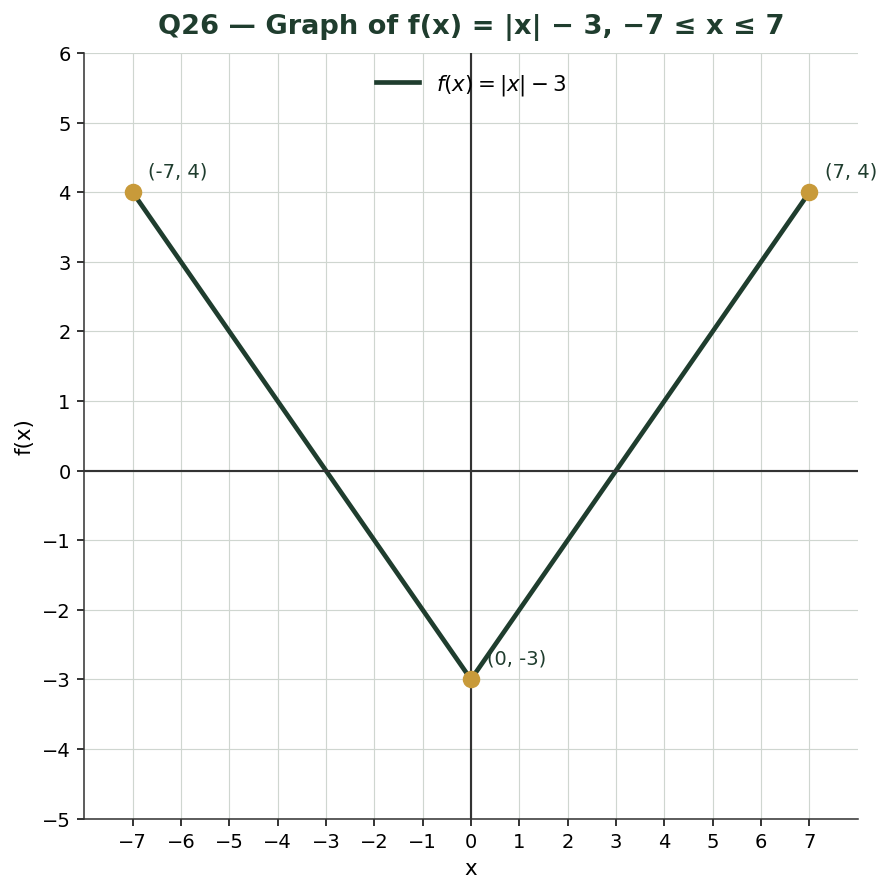
Question 27
Solve the inequality algebraically:
−4x + 1 > 9 + 3(2x + 1) + x
Answer: x < −1
-4x + 1 > 9 + 3(2x + 1) + x -4x + 1 > 9 + 6x + 3 + x (distribute the 3) -4x + 1 > 7x + 12 (combine like terms on the right) -4x - 7x > 12 - 1 (move x's left, constants right) -11x > 11 x < -1 (÷ by -11, FLIP the inequality)The crucial move is flipping the inequality when dividing by −11. Forgetting this is the #1 error on Regents inequality problems.
Question 28
Solve the formula A = ½ bh for h in terms of A and b.
Answer: h = 2A / b
Isolate h by undoing the operations attached to it:
A = (1/2) b h 2A = bh (multiply both sides by 2) 2A / b = h (divide both sides by b)This is the standard triangle-area rearrangement — useful in geometry when you know the area and base but need the height.
Question 29
The table below shows the population of Manhattan for the years indicated, according to the U.S. Census Bureau.
| Year | Population |
|---|---|
| 1970 | 1,539,233 |
| 1980 | 1,428,285 |
| 1990 | 1,487,536 |
| 2000 | 1,537,195 |
| 2010 | 1,585,873 |
| 2020 | 1,643,734 |
Determine the average rate of change of the population per year between the years 1980 and 2020, rounded to the nearest integer.
Answer: 5,386 people per year
Average rate of change = (change in output) / (change in input).
Rate = (1,643,734 - 1,428,285) / (2020 - 1980) = 215,449 / 40 = 5,386.225 ≈ 5,386 (nearest integer)Only the endpoints of the interval matter — the values in between (1990, 2000, 2010) are irrelevant for this calculation.
Question 30
Rewrite 5 / √3 as a fraction with a rational denominator.
Answer: 5√3 / 3
Rationalize by multiplying numerator and denominator by √3:
5/√3 · (√3/√3) = 5√3 / (√3 · √3) = 5√3 / 3This works because √3 · √3 = 3, giving an integer denominator.
Part III — Extended Response (4 questions × 4 pts = 16 pts)
Show all work. A correct numerical answer with no work shown receives only 1 credit.
Question 31
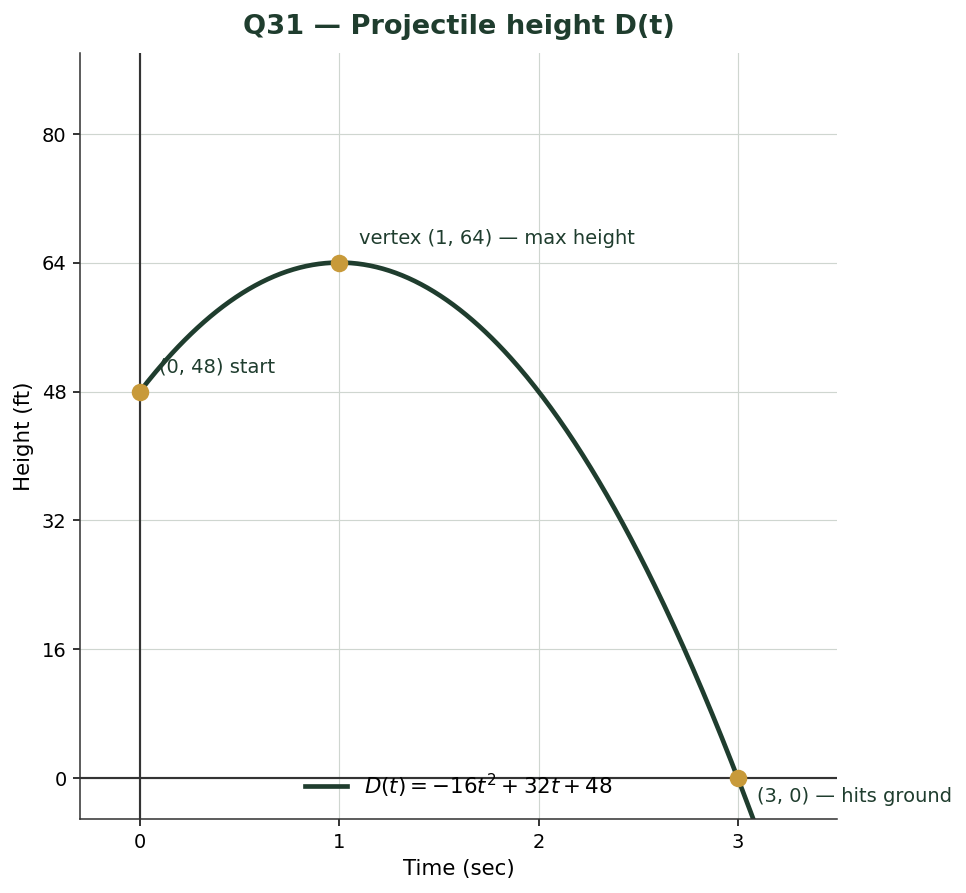
A ball is tossed up into the air from the deck of a building. The distance that the ball is above the ground t seconds after it is tossed can be modeled by the function D(t) = −16t2 + 32t + 48, where the distance is measured in feet.
On the set of axes, graph D(t) = −16t2 + 32t + 48. State the maximum number of feet above the ground that the ball will reach. State the number of seconds after the toss it will take the ball to hit the ground.
Answer: Max height = 64 ft. Ball hits ground at t = 3 seconds.
Vertex (max height) — use t = −b / (2a) with a = −16, b = 32:
t = -32 / (2·-16) = -32 / -32 = 1 second D(1) = -16(1)² + 32(1) + 48 = -16 + 32 + 48 = 64 feetGround (D = 0) — set the function equal to 0 and solve:
-16t² + 32t + 48 = 0 -16(t² - 2t - 3) = 0 (factor out -16) t² - 2t - 3 = 0 (t - 3)(t + 1) = 0 t = 3 or t = -1 (reject negative) → t = 3 secondsKey points for the graph: y-intercept (0, 48), vertex (1, 64), root (3, 0). Parabola opens downward.
Question 32
Solve the following system of equations algebraically for all values of x and y.
y = −2x + 3
y = x2 − 5x + 3
Answer: (0, 3) and (3, −3)
Set the two expressions for y equal to each other:
-2x + 3 = x² - 5x + 3 0 = x² - 5x + 3 + 2x - 3 (move everything to one side) 0 = x² - 3x 0 = x(x - 3) x = 0 or x = 3Find y for each using the simpler linear equation y = −2x + 3:
x = 0 → y = -2(0) + 3 = 3 → (0, 3) x = 3 → y = -2(3) + 3 = -3 → (3, -3)Always verify by plugging into the second (quadratic) equation. At (3, −3): y = 9 − 15 + 3 = −3 ✓.
Question 33
The table below shows the number of years of experience, x, working as a salesperson and their corresponding salaries, y, in thousands of dollars.
| Years (x) | Salary (y, thousands) |
|---|---|
| 2 | 15 |
| 3 | 28 |
| 5 | 42 |
| 9 | 54 |
| 13 | 64 |
| 16 | 90 |
State the linear regression equation for these data. Round all values to the nearest hundredth. State the correlation coefficient to the nearest hundredth. State what the correlation coefficient indicates about the linear fit of the data.
Answer: y = 4.61x + 11.93; r ≈ 0.98; the data have a strong positive linear relationship.
On a TI-84:
- Press STAT → 1: Edit. Enter x values in L1, y values in L2.
- Turn on diagnostics: 2nd → 0 (CATALOG) → scroll to DiagnosticOn → ENTER twice.
- Press STAT → CALC → 4: LinReg(ax+b). Set Xlist:L1, Ylist:L2. Calculate.
Calculator output: a ≈ 4.6094, b ≈ 11.9296, r ≈ 0.9836. Rounded: y = 4.61x + 11.93 and r = 0.98.
Interpretation: since r ≈ 0.98 is very close to +1, there is a strong positive linear correlation — as years of experience increase, salary tends to increase, and a linear model fits the data very well.
Question 34
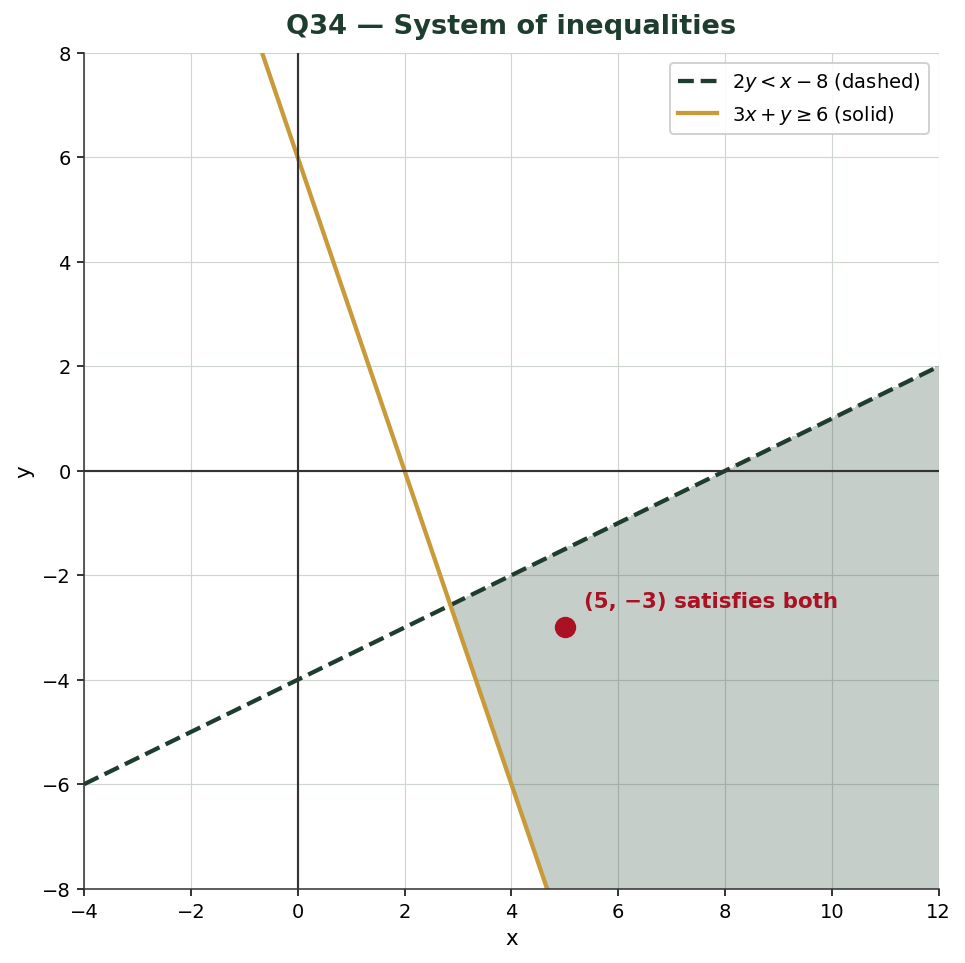
Graph the system of inequalities on the set of axes below. Then state the coordinates of a point that satisfies both inequalities. Justify your answer.
2y < x − 8
3x + y ≥ 6
Answer: any point in the shaded overlap works — e.g. (5, −3).
Rewrite each in slope-intercept form:
2y < x - 8 → y < (1/2)x - 4 boundary y = (1/2)x - 4, DASHED, shade below 3x + y ≥ 6 → y ≥ -3x + 6 boundary y = -3x + 6, SOLID, shade aboveTest the point (5, −3):
Inequality 1: 2(-3) < 5 - 8 → -6 < -3 ✓ Inequality 2: 3(5) + (-3) ≥ 6 → 12 ≥ 6 ✓Both are satisfied, so (5, −3) is in the overlap region.
Part IV — Six-Point Question (1 question × 6 pts = 6 pts)
Show all work. A correct numerical answer with no work shown receives only 1 credit.
Question 35
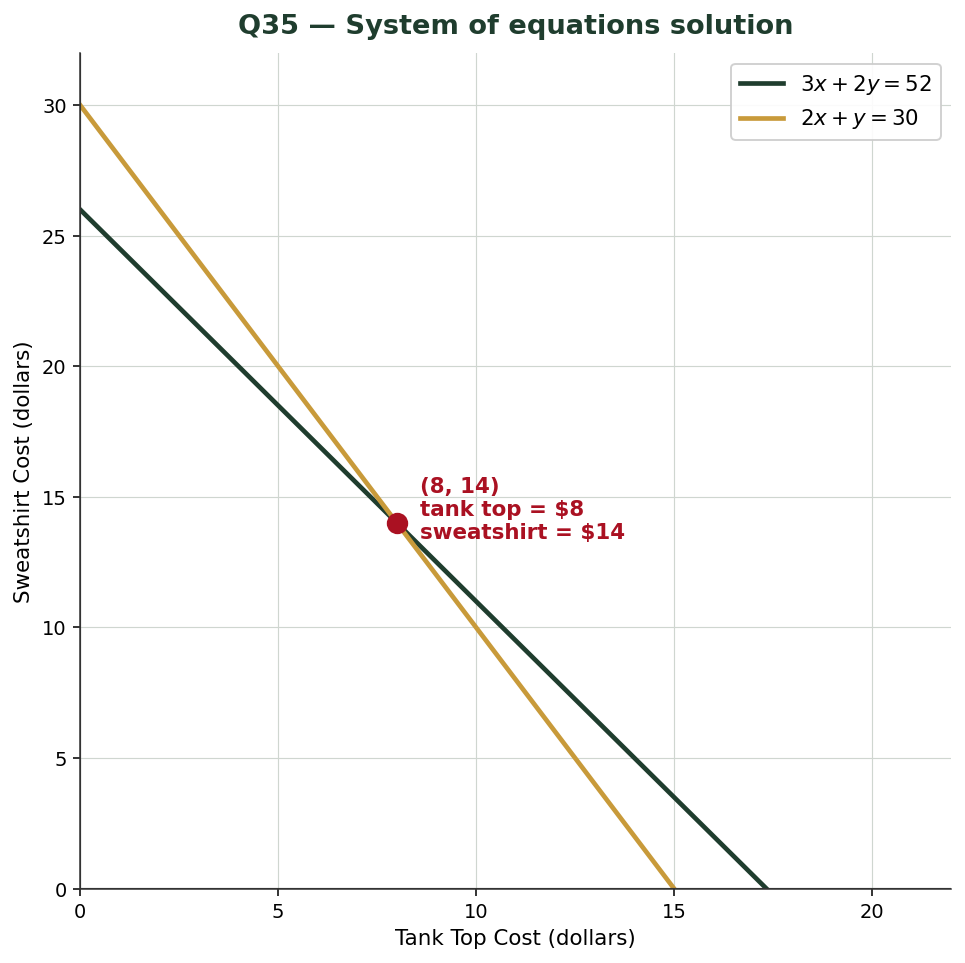
At a department store in a tax-free state, Jane can either buy three tank tops and two sweatshirts for $52, or two tank tops and one sweatshirt for $30. If x represents the price of one tank top and y represents the cost of one sweatshirt, write a system of equations that could be used to model this situation. On the set of axes, graph the system. State the coordinates of the point of intersection of your lines. Explain what each coordinate of the point of intersection means in the context of the problem.
Answer: System: 3x + 2y = 52 and 2x + y = 30. Intersection: (8, 14). Tank top = $8, sweatshirt = $14.
Write the system. Each purchase becomes one linear equation:
3 tank tops + 2 sweatshirts = $52 → 3x + 2y = 52 2 tank tops + 1 sweatshirt = $30 → 2x + y = 30Solve algebraically (elimination or substitution). Using substitution on the second equation:
2x + y = 30 → y = 30 - 2x Substitute into 3x + 2y = 52: 3x + 2(30 - 2x) = 52 3x + 60 - 4x = 52 -x = -8 x = 8 Then y = 30 - 2(8) = 14Interpretation. The x-coordinate x = 8 is the price of one tank top ($8). The y-coordinate y = 14 is the price of one sweatshirt ($14). Together, this is the only pair of prices consistent with both of Jane’s purchases.
Answer key at a glance
| # | Part | Answer |
|---|---|---|
| 1 | I | (1) 61 |
| 2 | I | (2) 8 |
| 3 | I | (3) (2x−5)(2x+5) |
| 4 | I | (2) 2 |
| 5 | I | (3) 64x³y⁶ |
| 6 | I | (3) 4x³ + 8x² + 5 |
| 7 | I | (2) 128(½)ⁿ⁻¹ |
| 8 | I | (1) neg. correlation, causal |
| 9 | I | (2) 4d + 5(40−d) = 170 |
| 10 | I | (4) 5 |
| 11 | I | (3) −⅔, 0, 5 |
| 12 | I | (2) 19 |
| 13 | I | (2) y − 5 = &frac32;(x − 2) |
| 14 | I | (4) 57 |
| 15 | I | (4) (x − 5)² = 49 |
| 16 | I | (1) f(x − 3) + 4 |
| 17 | I | (4) addition property of equality |
| 18 | I | (3) 34 |
| 19 | I | (2) 5x² − 10x + 11 |
| 20 | I | (4) 4.48% |
| 21 | I | (4) 495 |
| 22 | I | (1) (3 ± √57)/4 |
| 23 | I | (3) h(x) = x² + 8x + 3 |
| 24 | I | (3) 30√2 |
| 25 | II | 10x² − 11x + 3 |
| 26 | II | V-shape, vertex (0, −3) |
| 27 | II | x < −1 |
| 28 | II | h = 2A/b |
| 29 | II | 5,386 people/year |
| 30 | II | 5√3 / 3 |
| 31 | III | Max 64 ft, hits ground at t = 3 s |
| 32 | III | (0, 3) and (3, −3) |
| 33 | III | y = 4.61x + 11.93; r ≈ 0.98 |
| 34 | III | (5, −3) satisfies both |
| 35 | IV | Tank top $8, sweatshirt $14 |