Algebra 1 · Class 17
Factoring Trinomials: Leading Coefficient 1 and Not 1
Turn a trinomial into a product you can explain and check. Start with the GCF, choose a signed number pair, then factor, multiply back, and apply the result.
Explore eight illustrated topics with five fresh practice questions each. The lesson includes 40 practice questions, eight Homework review questions, and twelve Homework word problems. Each has a blue Answer control with detailed working. Unless a question says otherwise, factor completely over the integers.
This is an independent topic in the Algebra 1 rolling syllabus; earlier class attendance is not required. Review the methods here, try each question, and use multiplication to check your work. See the schedule or book an evaluation at SOMATH.
Download the student workbook (PDF)22 pages · Supplied cover, eight teaching images, all 60 questions · Generous blank working space · No exercise solutions
Understanding trinomial structure
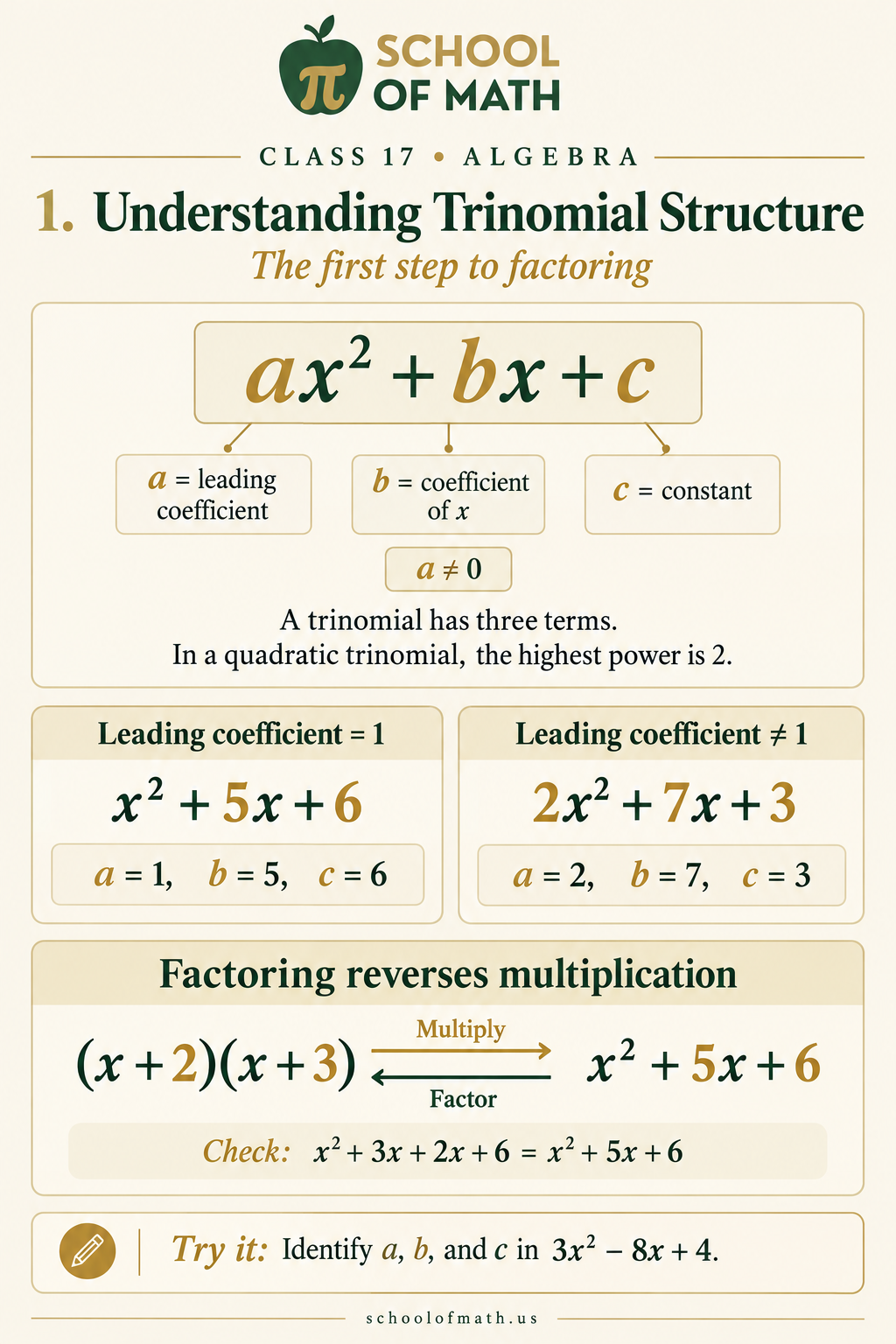
Write a quadratic trinomial in descending powers: \(ax^2+bx+c\), with \(a\ne0\). The signed number \(a\) is the leading coefficient, \(b\) is the coefficient of \(x\), and \(c\) is the constant. A missing written coefficient of \(x^2\) means 1.
Factoring reverses multiplication: it rewrites one expression as a product with the same value for every \(x\). Identifying the coefficients helps you choose a method; it does not mean the expression is already an equation to solve.
Practice: try these five questions
Q1
Identify a, b, and c, then factor.
Answer
\(\left(x + 3\right) \left(x + 5\right)\)
Write the polynomial in standard form and read the coefficients with their signs.
\[x^{2} + 8 x + 15\]The original signed coefficients are \(a=1,\quad b=8,\quad c=15\). The leading coefficient is 1.
The GCF is 1, so no common numerical or variable factor needs to be removed.
Find two integers with product \(15\) (the constant term) and sum \(8\). Use \(3\) and \(5\).
\[\begin{aligned}(3)(5)&=15\\3+(5)&=8\end{aligned}\]Use the pair as the constants in the two binomial factors, retaining any outside GCF.
\[\left(x + 3\right) \left(x + 5\right)\]
Check and justify
Multiply all the factors, including the GCF. The result must match every original coefficient.
Q2
Identify a, b, and c. State whether a equals 1, then factor.
Answer
\(\left(x + 2\right) \left(2 x + 1\right)\)
Write the polynomial in standard form and read the coefficients with their signs.
\[2 x^{2} + 5 x + 2\]The original signed coefficients are \(a=2,\quad b=5,\quad c=2\). The leading coefficient is not 1.
The GCF is 1, so no common numerical or variable factor needs to be removed.
Find two integers with product \(4\) (a × c) and sum \(5\). Use \(1\) and \(4\).
\[\begin{aligned}(1)(4)&=4\\1+(4)&=5\end{aligned}\]Split the middle term into two terms with the selected coefficients. The following work is for the quadratic inside any outside GCF.
\[2 x^{2} + x + 4 x + 2\]Factor each group. The binomial inside both groups must match; factor a negative coefficient when needed.
\[x\left(2 x + 1\right) + 2\left(2 x + 1\right)\]Factor out the common binomial and restore the outside GCF, if there was one.
\[\left(x + 2\right) \left(2 x + 1\right)\]
Check and justify
Multiply all the factors, including the GCF. The result must match every original coefficient.
Q3
Identify the signed coefficients, then factor.
Answer
\(\left(x - 2\right) \left(4 x - 1\right)\)
Write the polynomial in standard form and read the coefficients with their signs.
\[4 x^{2} - 9 x + 2\]The original signed coefficients are \(a=4,\quad b=-9,\quad c=2\). The leading coefficient is not 1.
The GCF is 1, so no common numerical or variable factor needs to be removed.
Find two integers with product \(8\) (a × c) and sum \(-9\). Use \(-8\) and \(-1\).
\[\begin{aligned}(-8)(-1)&=8\\-8+(-1)&=-9\end{aligned}\]Split the middle term into two terms with the selected coefficients. The following work is for the quadratic inside any outside GCF.
\[4 x^{2} - 8 x - x + 2\]Factor each group. The binomial inside both groups must match; factor a negative coefficient when needed.
\[4 x\left(x - 2\right) - 1\left(x - 2\right)\]Factor out the common binomial and restore the outside GCF, if there was one.
\[\left(x - 2\right) \left(4 x - 1\right)\]
Check and justify
Multiply all the factors, including the GCF. The result must match every original coefficient.
Q4
Rewrite in standard form, identify a, b, and c, then factor.
Answer
\(\left(x + 3\right) \left(x + 8\right)\)
Write the polynomial in standard form and read the coefficients with their signs.
\[x^{2} + 11 x + 24\]The original signed coefficients are \(a=1,\quad b=11,\quad c=24\). The leading coefficient is 1.
The GCF is 1, so no common numerical or variable factor needs to be removed.
Find two integers with product \(24\) (the constant term) and sum \(11\). Use \(3\) and \(8\).
\[\begin{aligned}(3)(8)&=24\\3+(8)&=11\end{aligned}\]Use the pair as the constants in the two binomial factors, retaining any outside GCF.
\[\left(x + 3\right) \left(x + 8\right)\]
Check and justify
Multiply all the factors, including the GCF. The result must match every original coefficient.
Q5
Identify the original signed coefficients. Factor out a negative factor before completing the factorization.
Answer
\(\left(4 - 3 x\right) \left(x - 2\right)\)
Write the polynomial in standard form and read the coefficients with their signs.
\[- 3 x^{2} + 10 x - 8\]The original signed coefficients are \(a=-3,\quad b=10,\quad c=-8\). The leading coefficient is not 1.
Factor out \(-1\). Divide every term by this common factor and keep it outside.
\[-1\left(3 x^{2} - 10 x + 8\right)\]Find two integers with product \(24\) (a × c) and sum \(-10\). Use \(-6\) and \(-4\).
\[\begin{aligned}(-6)(-4)&=24\\-6+(-4)&=-10\end{aligned}\]Split the middle term into two terms with the selected coefficients. The following work is for the quadratic inside any outside GCF.
\[3 x^{2} - 6 x - 4 x + 8\]Factor each group. The binomial inside both groups must match; factor a negative coefficient when needed.
\[3 x\left(x - 2\right) - 4\left(x - 2\right)\]Factor out the common binomial and restore the outside GCF, if there was one.
\[\left(4 - 3 x\right) \left(x - 2\right)\]
Check and justify
Multiply all the factors, including the GCF. The result must match every original coefficient.
Check the greatest common factor first
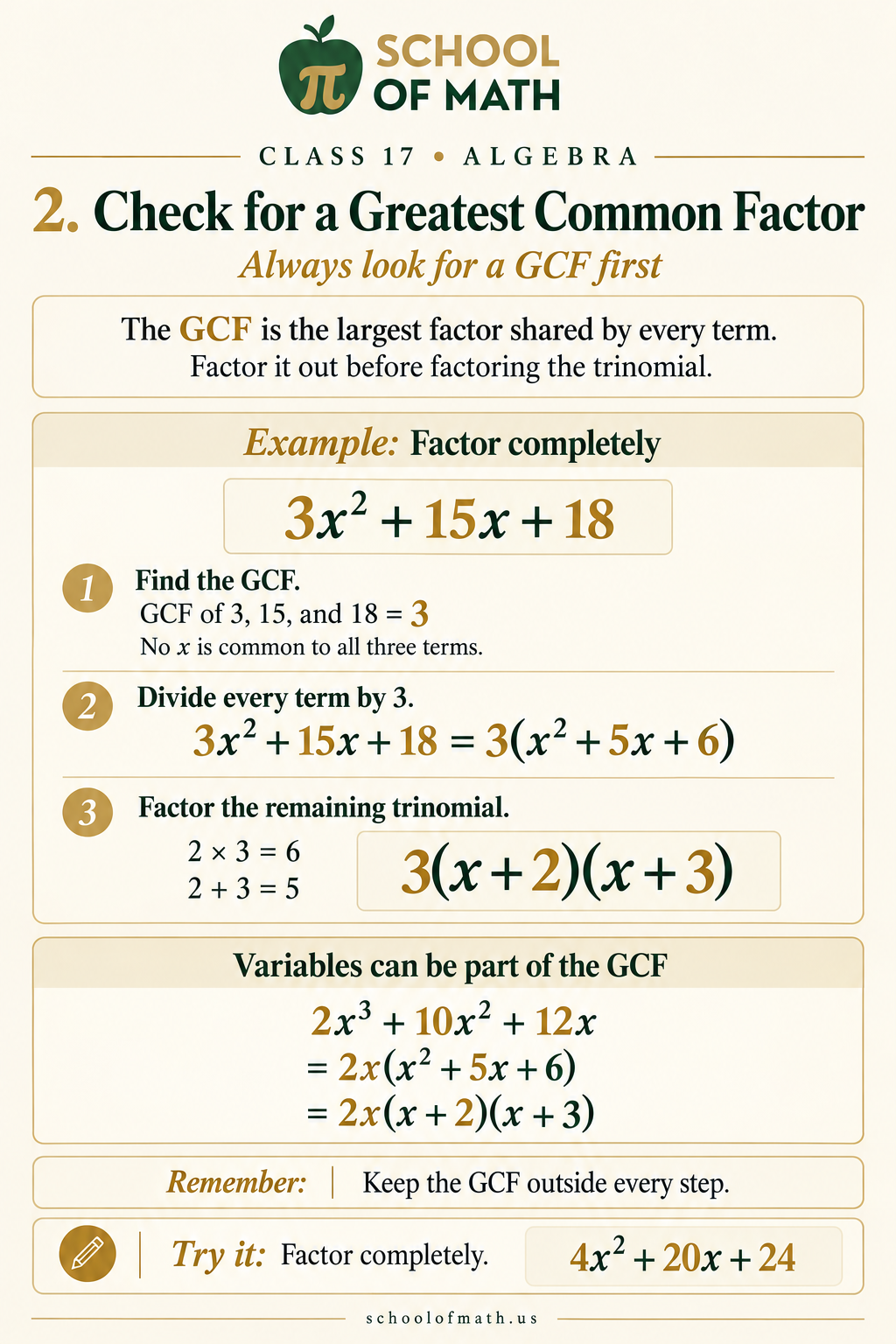
Find the greatest numerical factor shared by all coefficients and the smallest power of each variable present in every term. Pull that GCF outside before factoring the remaining trinomial.
Keep the GCF in the final answer. If the leading coefficient is negative, factoring out a negative common factor often makes the remaining quadratic easier to use. A polynomial of degree 3 or 4 may become quadratic after a variable GCF is removed.
Practice: try these five questions
Q6
Factor completely over the integers.
Answer
\(\left(x + 5\right) \left(4 x + 8\right)\)
Factor out \(4\). Divide every term by this common factor and keep it outside.
\[4\left(x^{2} + 7 x + 10\right)\]Find two integers with product \(10\) (the constant term) and sum \(7\). Use \(2\) and \(5\).
\[\begin{aligned}(2)(5)&=10\\2+(5)&=7\end{aligned}\]Use the pair as the constants in the two binomial factors, retaining any outside GCF.
\[\left(x + 5\right) \left(4 x + 8\right)\]
Check and justify
Multiply all the factors, including the GCF. The result must match every original coefficient.
Q7
Factor completely over the integers.
Answer
\(\left(x - 5\right) \left(6 x - 12\right)\)
Factor out \(6\). Divide every term by this common factor and keep it outside.
\[6\left(x^{2} - 7 x + 10\right)\]Find two integers with product \(10\) (the constant term) and sum \(-7\). Use \(-5\) and \(-2\).
\[\begin{aligned}(-5)(-2)&=10\\-5+(-2)&=-7\end{aligned}\]Use the pair as the constants in the two binomial factors, retaining any outside GCF.
\[\left(x - 5\right) \left(6 x - 12\right)\]
Check and justify
Multiply all the factors, including the GCF. The result must match every original coefficient.
Q8
Factor completely over the integers.
Answer
\(3 x \left(x + 3\right) \left(x + 5\right)\)
Factor out \(3 x\). Divide every term by this common factor and keep it outside.
\[3 x\left(x^{2} + 8 x + 15\right)\]Find two integers with product \(15\) (the constant term) and sum \(8\). Use \(3\) and \(5\).
\[\begin{aligned}(3)(5)&=15\\3+(5)&=8\end{aligned}\]Use the pair as the constants in the two binomial factors, retaining any outside GCF.
\[3 x \left(x + 3\right) \left(x + 5\right)\]
Check and justify
Multiply all the factors, including the GCF. The result must match every original coefficient.
Q9
Factor completely over the integers.
Answer
\(\left(- 2 x - 8\right) \left(x + 5\right)\)
Factor out \(-2\). Divide every term by this common factor and keep it outside.
\[-2\left(x^{2} + 9 x + 20\right)\]Find two integers with product \(20\) (the constant term) and sum \(9\). Use \(4\) and \(5\).
\[\begin{aligned}(4)(5)&=20\\4+(5)&=9\end{aligned}\]Use the pair as the constants in the two binomial factors, retaining any outside GCF.
\[\left(- 2 x - 8\right) \left(x + 5\right)\]
Check and justify
Multiply all the factors, including the GCF. The result must match every original coefficient.
Q10
Factor completely over the integers.
Answer
\(6 x^{2} \left(x - 2\right) \left(2 x - 1\right)\)
Factor out \(6 x^{2}\). Divide every term by this common factor and keep it outside.
\[6 x^{2}\left(2 x^{2} - 5 x + 2\right)\]Find two integers with product \(4\) (a × c) and sum \(-5\). Use \(-4\) and \(-1\).
\[\begin{aligned}(-4)(-1)&=4\\-4+(-1)&=-5\end{aligned}\]Split the middle term into two terms with the selected coefficients. The following work is for the quadratic inside any outside GCF.
\[2 x^{2} - 4 x - x + 2\]Factor each group. The binomial inside both groups must match; factor a negative coefficient when needed.
\[2 x\left(x - 2\right) - 1\left(x - 2\right)\]Factor out the common binomial and restore the outside GCF, if there was one.
\[6 x^{2} \left(x - 2\right) \left(2 x - 1\right)\]
Check and justify
Multiply all the factors, including the GCF. The result must match every original coefficient.
Leading coefficient 1: positive constant
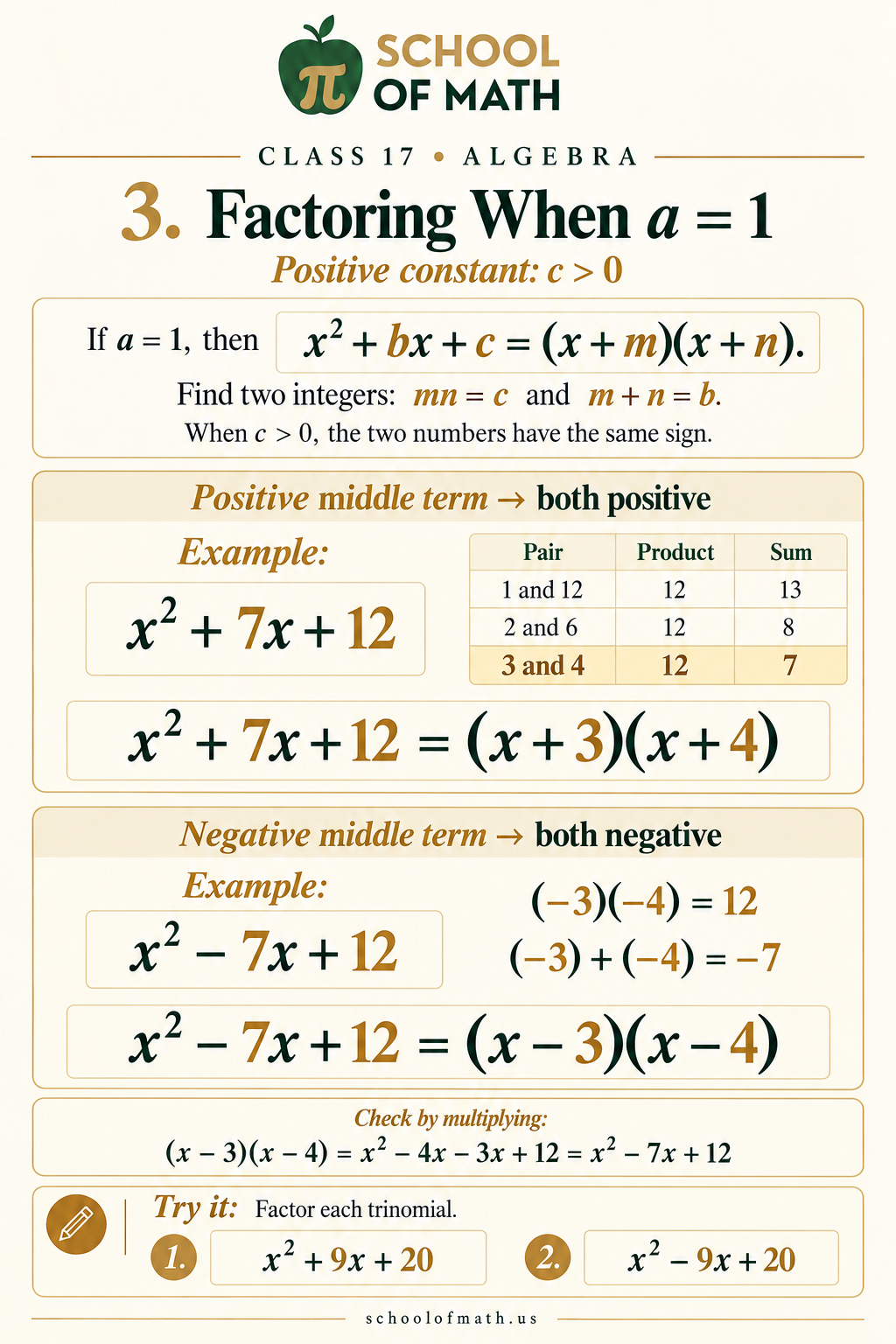
For \(x^2+bx+c\), look for integers \(m,n\) with \(mn=c\) and \(m+n=b\). Then the factors are \((x+m)(x+n)\). Check both the product and the sum.
When \(c>0\), the pair has the same sign. A positive \(b\) requires two positive numbers; a negative \(b\) requires two negative numbers. List factor pairs systematically rather than guessing only one pair.
Practice: try these five questions
Q11
Factor completely over the integers.
Answer
\(\left(x + 3\right) \left(x + 7\right)\)
The GCF is 1, so no common numerical or variable factor needs to be removed.
Find two integers with product \(21\) (the constant term) and sum \(10\). Use \(3\) and \(7\).
\[\begin{aligned}(3)(7)&=21\\3+(7)&=10\end{aligned}\]Use the pair as the constants in the two binomial factors, retaining any outside GCF.
\[\left(x + 3\right) \left(x + 7\right)\]
Check and justify
Multiply all the factors, including the GCF. The result must match every original coefficient.
Q12
Factor completely over the integers.
Answer
\(\left(x + 5\right) \left(x + 7\right)\)
The GCF is 1, so no common numerical or variable factor needs to be removed.
Find two integers with product \(35\) (the constant term) and sum \(12\). Use \(5\) and \(7\).
\[\begin{aligned}(5)(7)&=35\\5+(7)&=12\end{aligned}\]Use the pair as the constants in the two binomial factors, retaining any outside GCF.
\[\left(x + 5\right) \left(x + 7\right)\]
Check and justify
Multiply all the factors, including the GCF. The result must match every original coefficient.
Q13
Factor completely over the integers.
Answer
\(\left(x - 7\right) \left(x - 4\right)\)
The GCF is 1, so no common numerical or variable factor needs to be removed.
Find two integers with product \(28\) (the constant term) and sum \(-11\). Use \(-7\) and \(-4\).
\[\begin{aligned}(-7)(-4)&=28\\-7+(-4)&=-11\end{aligned}\]Use the pair as the constants in the two binomial factors, retaining any outside GCF.
\[\left(x - 7\right) \left(x - 4\right)\]
Check and justify
Multiply all the factors, including the GCF. The result must match every original coefficient.
Q14
Factor completely over the integers.
Answer
\(\left(x - 9\right) \left(x - 8\right)\)
The GCF is 1, so no common numerical or variable factor needs to be removed.
Find two integers with product \(72\) (the constant term) and sum \(-17\). Use \(-9\) and \(-8\).
\[\begin{aligned}(-9)(-8)&=72\\-9+(-8)&=-17\end{aligned}\]Use the pair as the constants in the two binomial factors, retaining any outside GCF.
\[\left(x - 9\right) \left(x - 8\right)\]
Check and justify
Multiply all the factors, including the GCF. The result must match every original coefficient.
Q15
Factor completely over the integers.
Answer
\(\left(x - 14\right) \left(x - 9\right)\)
The GCF is 1, so no common numerical or variable factor needs to be removed.
Find two integers with product \(126\) (the constant term) and sum \(-23\). Use \(-14\) and \(-9\).
\[\begin{aligned}(-14)(-9)&=126\\-14+(-9)&=-23\end{aligned}\]Use the pair as the constants in the two binomial factors, retaining any outside GCF.
\[\left(x - 14\right) \left(x - 9\right)\]
Check and justify
Multiply all the factors, including the GCF. The result must match every original coefficient.
Leading coefficient 1: negative constant
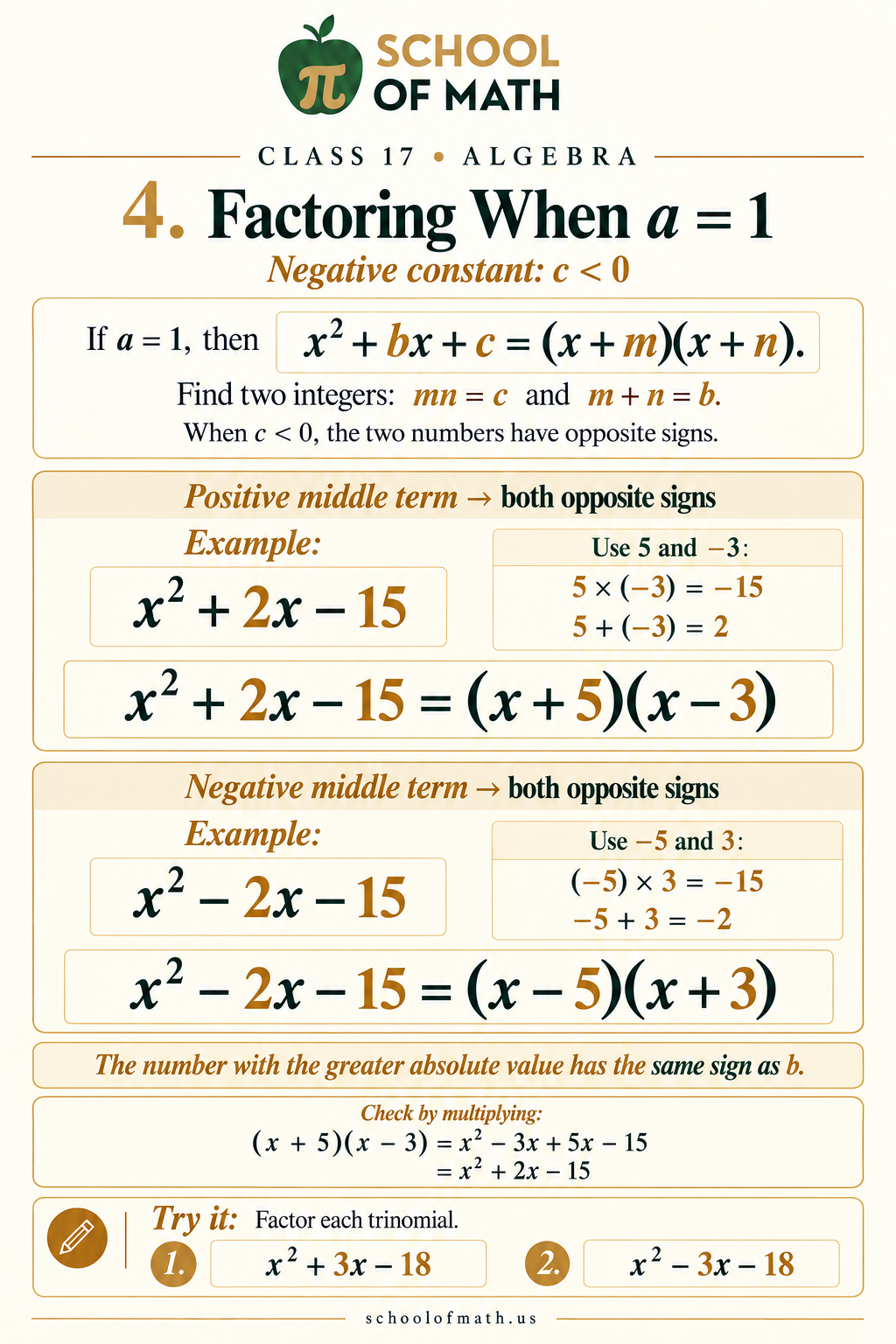
When \(c<0\), one member of the pair is positive and the other is negative. Their product must be \(c\), while their signed sum must be \(b\).
If \(b>0\), the positive number has the greater absolute value. If \(b<0\), the negative number has the greater absolute value. The sign of \(c\) determines opposite signs regardless of the sign of \(b\).
Practice: try these five questions
Q16
Factor completely over the integers.
Answer
\(\left(x - 3\right) \left(x + 8\right)\)
The GCF is 1, so no common numerical or variable factor needs to be removed.
Find two integers with product \(-24\) (the constant term) and sum \(5\). Use \(-3\) and \(8\).
\[\begin{aligned}(-3)(8)&=-24\\-3+(8)&=5\end{aligned}\]Use the pair as the constants in the two binomial factors, retaining any outside GCF.
\[\left(x - 3\right) \left(x + 8\right)\]
Check and justify
Multiply all the factors, including the GCF. The result must match every original coefficient.
Q17
Factor completely over the integers.
Answer
\(\left(x - 9\right) \left(x + 4\right)\)
The GCF is 1, so no common numerical or variable factor needs to be removed.
Find two integers with product \(-36\) (the constant term) and sum \(-5\). Use \(-9\) and \(4\).
\[\begin{aligned}(-9)(4)&=-36\\-9+(4)&=-5\end{aligned}\]Use the pair as the constants in the two binomial factors, retaining any outside GCF.
\[\left(x - 9\right) \left(x + 4\right)\]
Check and justify
Multiply all the factors, including the GCF. The result must match every original coefficient.
Q18
Factor completely over the integers.
Answer
\(\left(x - 7\right) \left(x + 9\right)\)
The GCF is 1, so no common numerical or variable factor needs to be removed.
Find two integers with product \(-63\) (the constant term) and sum \(2\). Use \(-7\) and \(9\).
\[\begin{aligned}(-7)(9)&=-63\\-7+(9)&=2\end{aligned}\]Use the pair as the constants in the two binomial factors, retaining any outside GCF.
\[\left(x - 7\right) \left(x + 9\right)\]
Check and justify
Multiply all the factors, including the GCF. The result must match every original coefficient.
Q19
Factor completely over the integers.
Answer
\(\left(x - 11\right) \left(x + 7\right)\)
The GCF is 1, so no common numerical or variable factor needs to be removed.
Find two integers with product \(-77\) (the constant term) and sum \(-4\). Use \(-11\) and \(7\).
\[\begin{aligned}(-11)(7)&=-77\\-11+(7)&=-4\end{aligned}\]Use the pair as the constants in the two binomial factors, retaining any outside GCF.
\[\left(x - 11\right) \left(x + 7\right)\]
Check and justify
Multiply all the factors, including the GCF. The result must match every original coefficient.
Q20
Factor completely over the integers.
Answer
\(\left(x - 14\right) \left(x + 11\right)\)
The GCF is 1, so no common numerical or variable factor needs to be removed.
Find two integers with product \(-154\) (the constant term) and sum \(-3\). Use \(-14\) and \(11\).
\[\begin{aligned}(-14)(11)&=-154\\-14+(11)&=-3\end{aligned}\]Use the pair as the constants in the two binomial factors, retaining any outside GCF.
\[\left(x - 14\right) \left(x + 11\right)\]
Check and justify
Multiply all the factors, including the GCF. The result must match every original coefficient.
The ac method for a leading coefficient other than 1
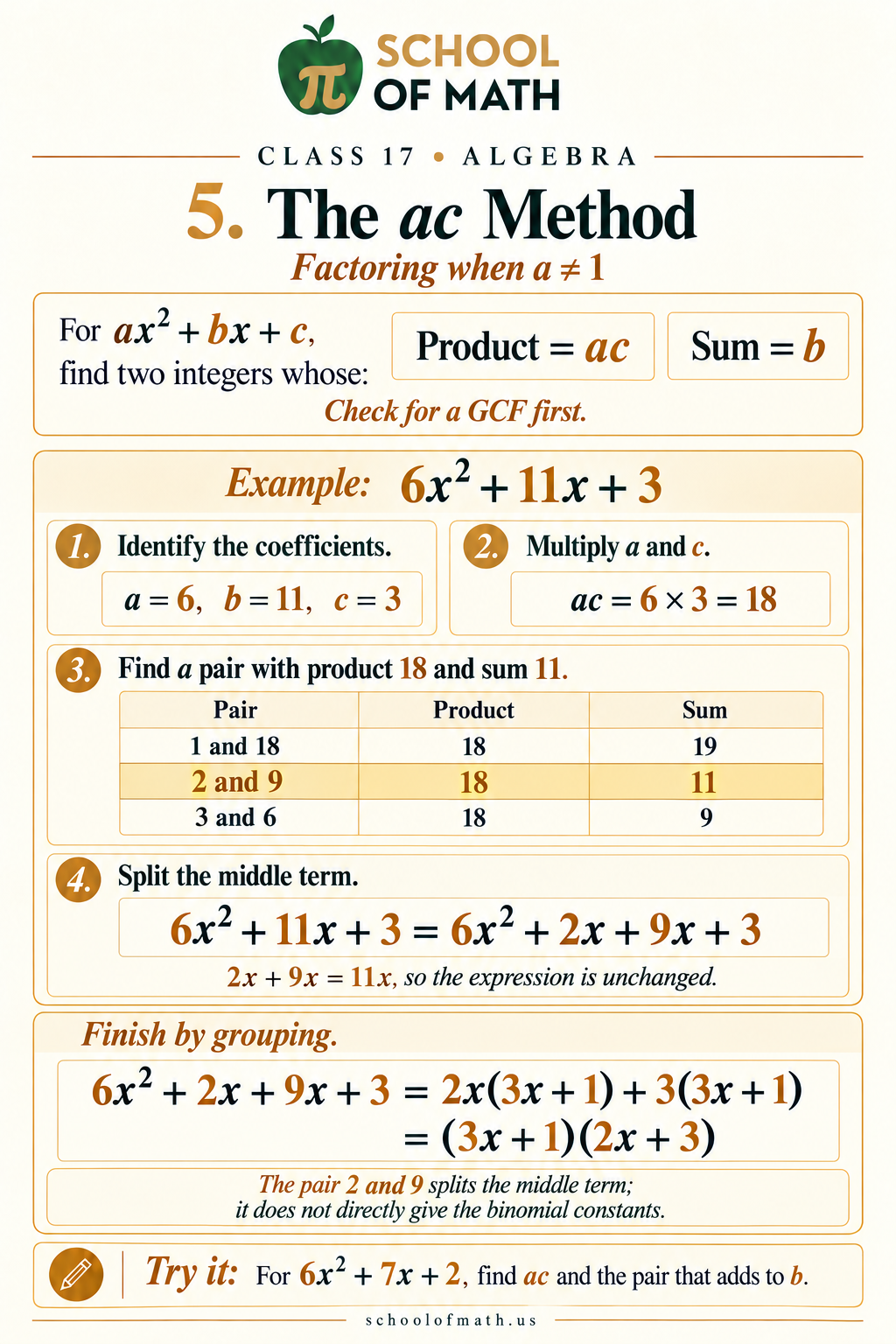
After removing the GCF, find two integers whose product is \(ac\) and whose sum is \(b\). These numbers split the middle term; they are not automatically the constants in the final binomials.
Replace \(bx\) with the two matching variable terms, group the resulting four terms in pairs, and factor a common binomial. You can use this method when \(a=1\) too, but the direct sum-and-product method is shorter then.
Practice: try these five questions
Q21
Factor completely over the integers.
Answer
\(\left(x + 4\right) \left(2 x + 1\right)\)
The GCF is 1, so no common numerical or variable factor needs to be removed.
Find two integers with product \(8\) (a × c) and sum \(9\). Use \(1\) and \(8\).
\[\begin{aligned}(1)(8)&=8\\1+(8)&=9\end{aligned}\]Split the middle term into two terms with the selected coefficients. The following work is for the quadratic inside any outside GCF.
\[2 x^{2} + x + 8 x + 4\]Factor each group. The binomial inside both groups must match; factor a negative coefficient when needed.
\[x\left(2 x + 1\right) + 4\left(2 x + 1\right)\]Factor out the common binomial and restore the outside GCF, if there was one.
\[\left(x + 4\right) \left(2 x + 1\right)\]
Check and justify
Multiply all the factors, including the GCF. The result must match every original coefficient.
Q22
Factor completely over the integers.
Answer
\(\left(x + 3\right) \left(3 x + 2\right)\)
The GCF is 1, so no common numerical or variable factor needs to be removed.
Find two integers with product \(18\) (a × c) and sum \(11\). Use \(2\) and \(9\).
\[\begin{aligned}(2)(9)&=18\\2+(9)&=11\end{aligned}\]Split the middle term into two terms with the selected coefficients. The following work is for the quadratic inside any outside GCF.
\[3 x^{2} + 2 x + 9 x + 6\]Factor each group. The binomial inside both groups must match; factor a negative coefficient when needed.
\[x\left(3 x + 2\right) + 3\left(3 x + 2\right)\]Factor out the common binomial and restore the outside GCF, if there was one.
\[\left(x + 3\right) \left(3 x + 2\right)\]
Check and justify
Multiply all the factors, including the GCF. The result must match every original coefficient.
Q23
Factor completely over the integers.
Answer
\(\left(x + 2\right) \left(4 x + 3\right)\)
The GCF is 1, so no common numerical or variable factor needs to be removed.
Find two integers with product \(24\) (a × c) and sum \(11\). Use \(3\) and \(8\).
\[\begin{aligned}(3)(8)&=24\\3+(8)&=11\end{aligned}\]Split the middle term into two terms with the selected coefficients. The following work is for the quadratic inside any outside GCF.
\[4 x^{2} + 3 x + 8 x + 6\]Factor each group. The binomial inside both groups must match; factor a negative coefficient when needed.
\[x\left(4 x + 3\right) + 2\left(4 x + 3\right)\]Factor out the common binomial and restore the outside GCF, if there was one.
\[\left(x + 2\right) \left(4 x + 3\right)\]
Check and justify
Multiply all the factors, including the GCF. The result must match every original coefficient.
Q24
Factor completely over the integers.
Answer
\(\left(x + 3\right) \left(5 x + 2\right)\)
The GCF is 1, so no common numerical or variable factor needs to be removed.
Find two integers with product \(30\) (a × c) and sum \(17\). Use \(2\) and \(15\).
\[\begin{aligned}(2)(15)&=30\\2+(15)&=17\end{aligned}\]Split the middle term into two terms with the selected coefficients. The following work is for the quadratic inside any outside GCF.
\[5 x^{2} + 2 x + 15 x + 6\]Factor each group. The binomial inside both groups must match; factor a negative coefficient when needed.
\[x\left(5 x + 2\right) + 3\left(5 x + 2\right)\]Factor out the common binomial and restore the outside GCF, if there was one.
\[\left(x + 3\right) \left(5 x + 2\right)\]
Check and justify
Multiply all the factors, including the GCF. The result must match every original coefficient.
Q25
Factor completely over the integers.
Answer
\(\left(2 x + 5\right) \left(3 x + 2\right)\)
The GCF is 1, so no common numerical or variable factor needs to be removed.
Find two integers with product \(60\) (a × c) and sum \(19\). Use \(4\) and \(15\).
\[\begin{aligned}(4)(15)&=60\\4+(15)&=19\end{aligned}\]Split the middle term into two terms with the selected coefficients. The following work is for the quadratic inside any outside GCF.
\[6 x^{2} + 4 x + 15 x + 10\]Factor each group. The binomial inside both groups must match; factor a negative coefficient when needed.
\[2 x\left(3 x + 2\right) + 5\left(3 x + 2\right)\]Factor out the common binomial and restore the outside GCF, if there was one.
\[\left(2 x + 5\right) \left(3 x + 2\right)\]
Check and justify
Multiply all the factors, including the GCF. The result must match every original coefficient.
Split and group with signed terms
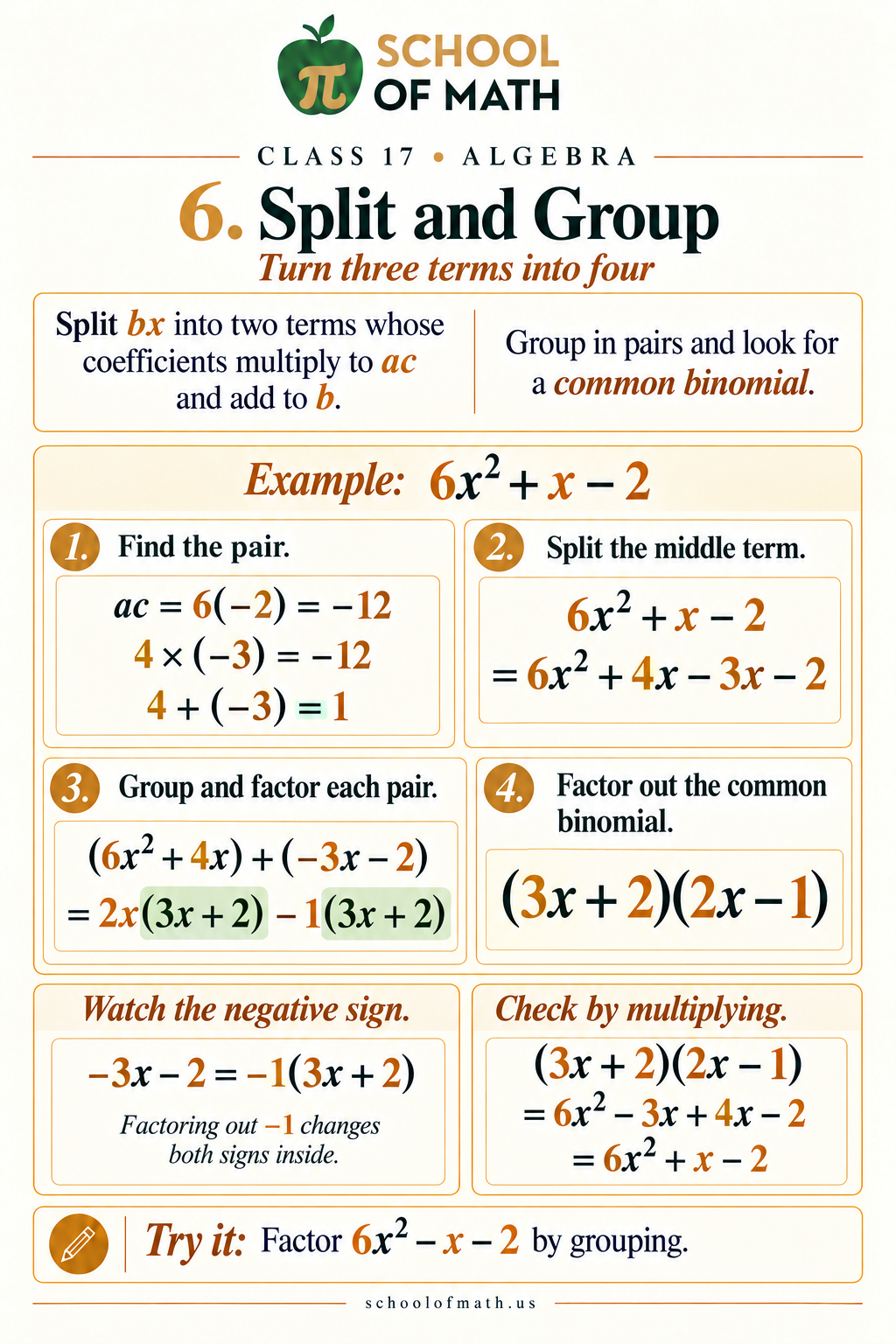
Keep the sign on every term when you split the middle term. Factor the GCF from each pair so that the binomial left inside each group is exactly the same.
You may need to factor a negative number from the second group. That changes both signs inside its parentheses. Once the common binomial matches, factor it out and keep the other factors.
Practice: try these five questions
Q26
Factor completely over the integers.
Answer
\(\left(x + 4\right) \left(2 x - 1\right)\)
The GCF is 1, so no common numerical or variable factor needs to be removed.
Find two integers with product \(-8\) (a × c) and sum \(7\). Use \(-1\) and \(8\).
\[\begin{aligned}(-1)(8)&=-8\\-1+(8)&=7\end{aligned}\]Split the middle term into two terms with the selected coefficients. The following work is for the quadratic inside any outside GCF.
\[2 x^{2} - x + 8 x - 4\]Factor each group. The binomial inside both groups must match; factor a negative coefficient when needed.
\[x\left(2 x - 1\right) + 4\left(2 x - 1\right)\]Factor out the common binomial and restore the outside GCF, if there was one.
\[\left(x + 4\right) \left(2 x - 1\right)\]
Check and justify
Multiply all the factors, including the GCF. The result must match every original coefficient.
Q27
Factor completely over the integers.
Answer
\(\left(x - 3\right) \left(3 x - 1\right)\)
The GCF is 1, so no common numerical or variable factor needs to be removed.
Find two integers with product \(9\) (a × c) and sum \(-10\). Use \(-9\) and \(-1\).
\[\begin{aligned}(-9)(-1)&=9\\-9+(-1)&=-10\end{aligned}\]Split the middle term into two terms with the selected coefficients. The following work is for the quadratic inside any outside GCF.
\[3 x^{2} - 9 x - x + 3\]Factor each group. The binomial inside both groups must match; factor a negative coefficient when needed.
\[3 x\left(x - 3\right) - 1\left(x - 3\right)\]Factor out the common binomial and restore the outside GCF, if there was one.
\[\left(x - 3\right) \left(3 x - 1\right)\]
Check and justify
Multiply all the factors, including the GCF. The result must match every original coefficient.
Q28
Factor completely over the integers.
Answer
\(\left(2 x - 3\right) \left(2 x + 5\right)\)
The GCF is 1, so no common numerical or variable factor needs to be removed.
Find two integers with product \(-60\) (a × c) and sum \(4\). Use \(-6\) and \(10\).
\[\begin{aligned}(-6)(10)&=-60\\-6+(10)&=4\end{aligned}\]Split the middle term into two terms with the selected coefficients. The following work is for the quadratic inside any outside GCF.
\[4 x^{2} - 6 x + 10 x - 15\]Factor each group. The binomial inside both groups must match; factor a negative coefficient when needed.
\[2 x\left(2 x - 3\right) + 5\left(2 x - 3\right)\]Factor out the common binomial and restore the outside GCF, if there was one.
\[\left(2 x - 3\right) \left(2 x + 5\right)\]
Check and justify
Multiply all the factors, including the GCF. The result must match every original coefficient.
Q29
Factor completely over the integers.
Answer
\(\left(2 x - 3\right) \left(3 x - 2\right)\)
The GCF is 1, so no common numerical or variable factor needs to be removed.
Find two integers with product \(36\) (a × c) and sum \(-13\). Use \(-9\) and \(-4\).
\[\begin{aligned}(-9)(-4)&=36\\-9+(-4)&=-13\end{aligned}\]Split the middle term into two terms with the selected coefficients. The following work is for the quadratic inside any outside GCF.
\[6 x^{2} - 9 x - 4 x + 6\]Factor each group. The binomial inside both groups must match; factor a negative coefficient when needed.
\[3 x\left(2 x - 3\right) - 2\left(2 x - 3\right)\]Factor out the common binomial and restore the outside GCF, if there was one.
\[\left(2 x - 3\right) \left(3 x - 2\right)\]
Check and justify
Multiply all the factors, including the GCF. The result must match every original coefficient.
Q30
Factor completely over the integers.
Answer
\(\left(2 x + 1\right) \left(4 x - 3\right)\)
The GCF is 1, so no common numerical or variable factor needs to be removed.
Find two integers with product \(-24\) (a × c) and sum \(-2\). Use \(-6\) and \(4\).
\[\begin{aligned}(-6)(4)&=-24\\-6+(4)&=-2\end{aligned}\]Split the middle term into two terms with the selected coefficients. The following work is for the quadratic inside any outside GCF.
\[8 x^{2} - 6 x + 4 x - 3\]Factor each group. The binomial inside both groups must match; factor a negative coefficient when needed.
\[2 x\left(4 x - 3\right) + 1\left(4 x - 3\right)\]Factor out the common binomial and restore the outside GCF, if there was one.
\[\left(2 x + 1\right) \left(4 x - 3\right)\]
Check and justify
Multiply all the factors, including the GCF. The result must match every original coefficient.
Perfect squares and integer-irreducible trinomials
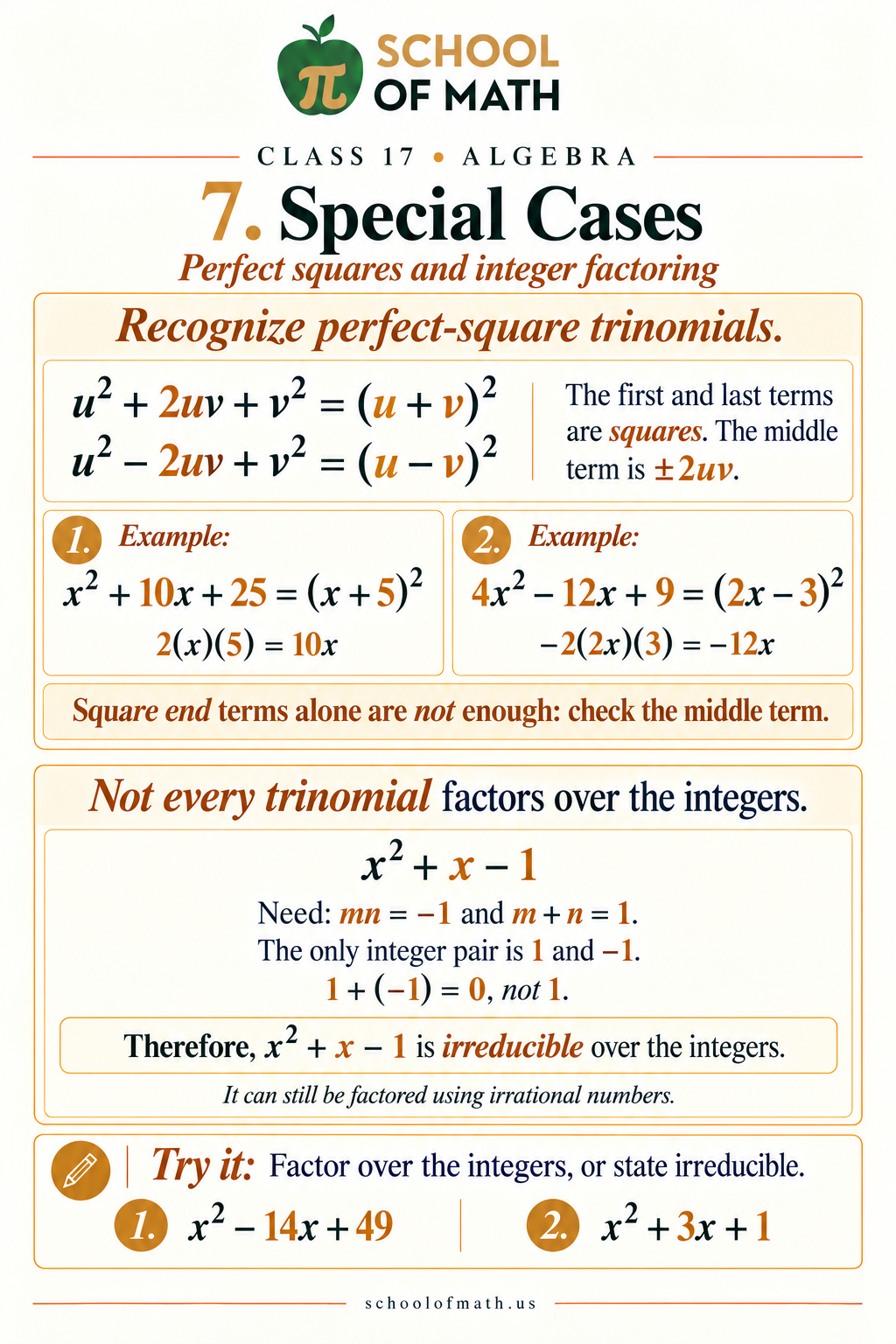
A perfect-square trinomial has the form \(u^2+2uv+v^2=(u+v)^2\) or \(u^2-2uv+v^2=(u-v)^2\). Square first and last terms are not enough: verify the middle term.
Some primitive quadratics do not factor into integer-coefficient linear factors. If no integer pair has product \(ac\) and sum \(b\), state that the quadratic is irreducible over the integers. That does not by itself rule out factors using irrational or complex numbers.
Practice: try these five questions
Q31
Factor completely over the integers.
Answer
\(\left(x + 6\right)^{2}\)
The GCF is 1, so no common numerical or variable factor needs to be removed.
Find two integers with product \(36\) (the constant term) and sum \(12\). Use \(6\) and \(6\).
\[\begin{aligned}(6)(6)&=36\\6+(6)&=12\end{aligned}\]Use the pair as the constants in the two binomial factors, retaining any outside GCF.
\[\left(x + 6\right)^{2}\]The repeated binomial can be written as a square. Its middle term is twice the product of its two terms.
\[2\left(x\right)\left(6\right) = 12 x\]
Check and justify
Multiply all the factors, including the GCF. The result must match every original coefficient.
Q32
Factor completely over the integers.
Answer
\(\left(3 x - 5\right)^{2}\)
The GCF is 1, so no common numerical or variable factor needs to be removed.
Find two integers with product \(225\) (a × c) and sum \(-30\). Use \(-15\) and \(-15\).
\[\begin{aligned}(-15)(-15)&=225\\-15+(-15)&=-30\end{aligned}\]Split the middle term into two terms with the selected coefficients. The following work is for the quadratic inside any outside GCF.
\[9 x^{2} - 15 x - 15 x + 25\]Factor each group. The binomial inside both groups must match; factor a negative coefficient when needed.
\[3 x\left(3 x - 5\right) - 5\left(3 x - 5\right)\]Factor out the common binomial and restore the outside GCF, if there was one.
\[\left(3 x - 5\right)^{2}\]The repeated binomial can be written as a square. Its middle term is twice the product of its two terms.
\[2\left(3 x\right)\left(-5\right) = - 30 x\]
Check and justify
Multiply all the factors, including the GCF. The result must match every original coefficient.
Q33
Factor completely over the integers.
Answer
\(3 \left(x - 4\right)^{2}\)
Factor out \(3\). Divide every term by this common factor and keep it outside.
\[3\left(x^{2} - 8 x + 16\right)\]Find two integers with product \(16\) (the constant term) and sum \(-8\). Use \(-4\) and \(-4\).
\[\begin{aligned}(-4)(-4)&=16\\-4+(-4)&=-8\end{aligned}\]Use the pair as the constants in the two binomial factors, retaining any outside GCF.
\[3 \left(x - 4\right)^{2}\]The repeated binomial can be written as a square. Its middle term is twice the product of its two terms.
\[2\left(x\right)\left(-4\right) = - 8 x\]
Check and justify
Multiply all the factors, including the GCF. The result must match every original coefficient.
Q34
Factor over the integers, or explain why no integer factorization exists.
Answer
Irreducible over the integers.
The GCF is 1, so no common numerical or variable factor needs to be removed.
For an integer factorization, the middle-term pair must have product -4 and sum 1.
All distinct signed integer pairs with that product are: -4 and 1 (sum -3); -1 and 4 (sum 3); -2 and 2 (sum 0).
None has the required sum. Therefore the quadratic is irreducible over the integers; this statement is about the allowed coefficients, not a claim about every larger number system.
Check and justify
Every possible signed integer factor pair of -4 was tested; none adds to 1.
Q35
Test all relevant ac pairs and factor over the integers, or state irreducible.
Answer
Irreducible over the integers.
The GCF is 1, so no common numerical or variable factor needs to be removed.
For an integer factorization, the middle-term pair must have product 6 and sum 3.
All distinct signed integer pairs with that product are: 1 and 6 (sum 7); -6 and -1 (sum -7); 2 and 3 (sum 5); -3 and -2 (sum -5).
None has the required sum. Therefore the quadratic is irreducible over the integers; this statement is about the allowed coefficients, not a claim about every larger number system.
Check and justify
Every possible signed integer factor pair of 6 was tested; none adds to 3.
Check and apply your factors
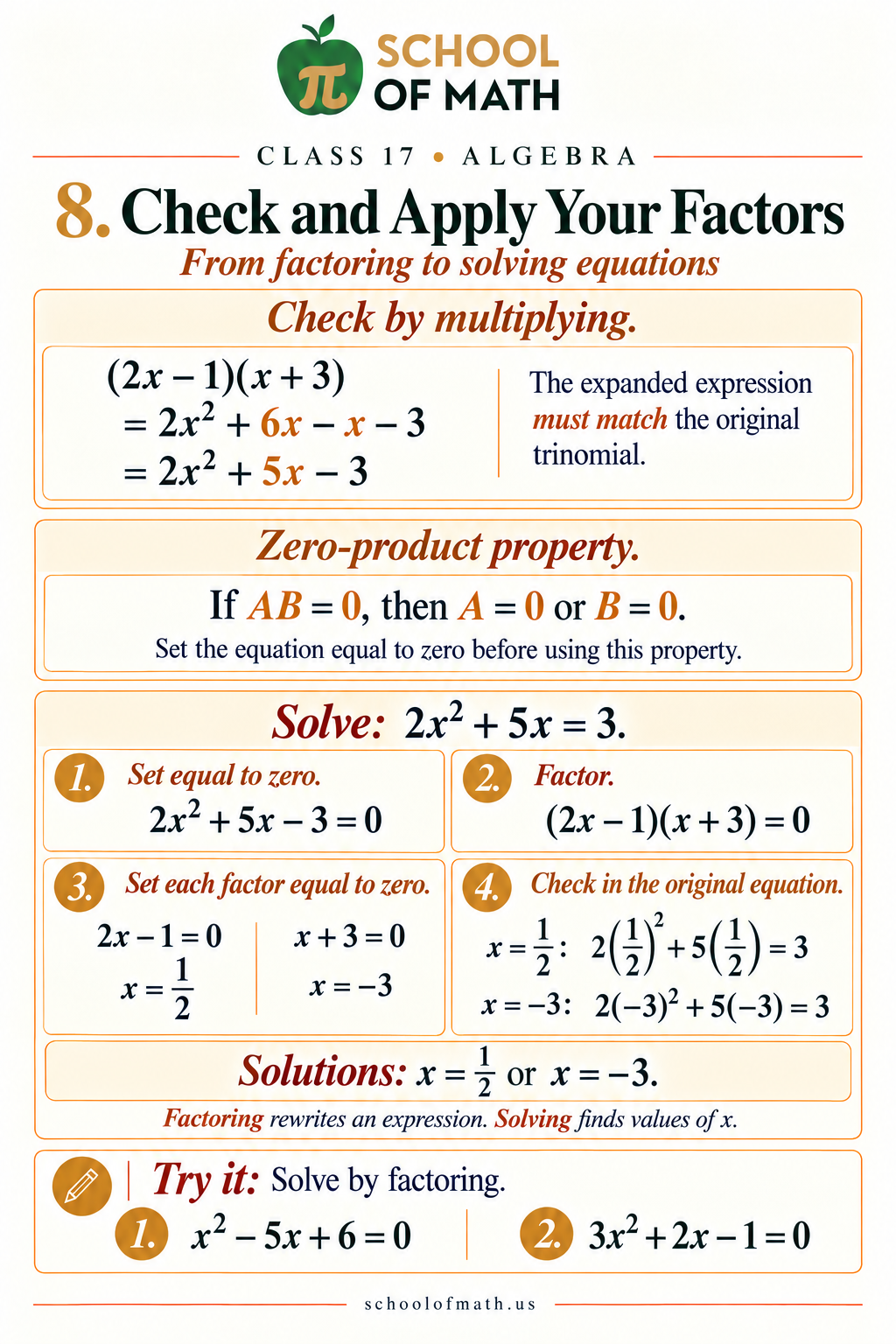
Expand your final product and compare every coefficient with the original polynomial. A matching first and last term is not enough; the middle term must match too.
Factoring an expression does not produce values of \(x\). To solve an equation by factoring, first put all terms on one side so the product equals zero. Then use the zero-product property: at least one factor must be zero. Keep solutions from a variable GCF, including \(x=0\).
Practice: try these five questions
Q36
A student claims the factors are (3x + 4)(x + 2). Expand that proposal, explain the error, and factor correctly.
Answer
\(\left(x + 4\right) \left(3 x + 2\right)\)
The proposed product expands to \(3x^2+10x+8\). Its middle coefficient is 10, not 14, so it does not match the original.
The GCF is 1, so no common numerical or variable factor needs to be removed.
Find two integers with product \(24\) (a × c) and sum \(14\). Use \(2\) and \(12\).
\[\begin{aligned}(2)(12)&=24\\2+(12)&=14\end{aligned}\]Split the middle term into two terms with the selected coefficients. The following work is for the quadratic inside any outside GCF.
\[3 x^{2} + 2 x + 12 x + 8\]Factor each group. The binomial inside both groups must match; factor a negative coefficient when needed.
\[x\left(3 x + 2\right) + 4\left(3 x + 2\right)\]Factor out the common binomial and restore the outside GCF, if there was one.
\[\left(x + 4\right) \left(3 x + 2\right)\]
Check and justify
Multiply all the factors, including the GCF. The result must match every original coefficient.
Q37
Solve by factoring and check both solutions.
Answer
\(x=3\ \text{or}\ x=5\)
Subtract the entire right side from both sides, expand as needed, and combine terms so one side is zero.
\[x^{2} - 8 x + 15 = 0\]The GCF is 1, so no common numerical or variable factor needs to be removed.
Find two integers with product \(15\) (the constant term) and sum \(-8\). Use \(-5\) and \(-3\).
\[\begin{aligned}(-5)(-3)&=15\\-5+(-3)&=-8\end{aligned}\]Use the pair as the constants in the two binomial factors, retaining any outside GCF.
\[\left(x - 5\right) \left(x - 3\right)\]The factored product is zero. A nonzero numerical factor cannot make it zero, so set each variable-containing factor equal to zero.
\[\left(x - 5\right) \left(x - 3\right) = 0\]Solve this factor equation.
\[x - 5=0\quad\Longrightarrow\quad x=5\]Solve this factor equation.
\[x - 3=0\quad\Longrightarrow\quad x=3\]Collect the algebraic solutions.
\[x=3\ \text{or}\ x=5\]
Check and justify
Multiply all the factors, including the GCF. The result must match every original coefficient.
Substitute each root in the original equation, not only the factored version:
For \(x=3\):
For \(x=5\):
Q38
Solve by factoring. Put the equation in zero-product form first.
Answer
\(x=-5\ \text{or}\ x=\frac{3}{2}\)
Subtract the entire right side from both sides, expand as needed, and combine terms so one side is zero.
\[2 x^{2} + 7 x - 15 = 0\]The GCF is 1, so no common numerical or variable factor needs to be removed.
Find two integers with product \(-30\) (a × c) and sum \(7\). Use \(-3\) and \(10\).
\[\begin{aligned}(-3)(10)&=-30\\-3+(10)&=7\end{aligned}\]Split the middle term into two terms with the selected coefficients. The following work is for the quadratic inside any outside GCF.
\[2 x^{2} - 3 x + 10 x - 15\]Factor each group. The binomial inside both groups must match; factor a negative coefficient when needed.
\[x\left(2 x - 3\right) + 5\left(2 x - 3\right)\]Factor out the common binomial and restore the outside GCF, if there was one.
\[\left(x + 5\right) \left(2 x - 3\right)\]The factored product is zero. A nonzero numerical factor cannot make it zero, so set each variable-containing factor equal to zero.
\[\left(x + 5\right) \left(2 x - 3\right) = 0\]Solve this factor equation.
\[x + 5=0\quad\Longrightarrow\quad x=-5\]Solve this factor equation.
\[2 x - 3=0\quad\Longrightarrow\quad x=\frac{3}{2}\]Collect the algebraic solutions.
\[x=-5\ \text{or}\ x=\frac{3}{2}\]
Check and justify
Multiply all the factors, including the GCF. The result must match every original coefficient.
Substitute each root in the original equation, not only the factored version:
For \(x=-5\):
For \(x=\frac{3}{2}\):
Q39
Solve by factoring and retain exact fractional solutions.
Answer
\(x=\frac{2}{3}\ \text{or}\ x=4\)
Subtract the entire right side from both sides, expand as needed, and combine terms so one side is zero.
\[3 x^{2} - 14 x + 8 = 0\]The GCF is 1, so no common numerical or variable factor needs to be removed.
Find two integers with product \(24\) (a × c) and sum \(-14\). Use \(-12\) and \(-2\).
\[\begin{aligned}(-12)(-2)&=24\\-12+(-2)&=-14\end{aligned}\]Split the middle term into two terms with the selected coefficients. The following work is for the quadratic inside any outside GCF.
\[3 x^{2} - 12 x - 2 x + 8\]Factor each group. The binomial inside both groups must match; factor a negative coefficient when needed.
\[3 x\left(x - 4\right) - 2\left(x - 4\right)\]Factor out the common binomial and restore the outside GCF, if there was one.
\[\left(x - 4\right) \left(3 x - 2\right)\]The factored product is zero. A nonzero numerical factor cannot make it zero, so set each variable-containing factor equal to zero.
\[\left(x - 4\right) \left(3 x - 2\right) = 0\]Solve this factor equation.
\[x - 4=0\quad\Longrightarrow\quad x=4\]Solve this factor equation.
\[3 x - 2=0\quad\Longrightarrow\quad x=\frac{2}{3}\]Collect the algebraic solutions.
\[x=\frac{2}{3}\ \text{or}\ x=4\]
Check and justify
Multiply all the factors, including the GCF. The result must match every original coefficient.
Substitute each root in the original equation, not only the factored version:
For \(x=\frac{2}{3}\):
For \(x=4\):
Q40
Solve by factoring. Explain why dividing by x at the start could lose a solution.
Answer
\(x=0\ \text{or}\ x=2\ \text{or}\ x=5\)
Do not divide both sides by \(x\): that would assume \(x\ne0\) and could discard the solution \(x=0\). Factor the variable out instead.
Subtract the entire right side from both sides, expand as needed, and combine terms so one side is zero.
\[2 x^{3} - 14 x^{2} + 20 x = 0\]Factor out \(2 x\). Divide every term by this common factor and keep it outside.
\[2 x\left(x^{2} - 7 x + 10\right)\]Find two integers with product \(10\) (the constant term) and sum \(-7\). Use \(-5\) and \(-2\).
\[\begin{aligned}(-5)(-2)&=10\\-5+(-2)&=-7\end{aligned}\]Use the pair as the constants in the two binomial factors, retaining any outside GCF.
\[2 x \left(x - 5\right) \left(x - 2\right)\]The factored product is zero. A nonzero numerical factor cannot make it zero, so set each variable-containing factor equal to zero.
\[2 x \left(x - 5\right) \left(x - 2\right) = 0\]Solve this factor equation.
\[x - 5=0\quad\Longrightarrow\quad x=5\]Solve this factor equation.
\[x - 2=0\quad\Longrightarrow\quad x=2\]Solve this factor equation.
\[x=0\quad\Longrightarrow\quad x=0\]Collect the algebraic solutions.
\[x=0\ \text{or}\ x=2\ \text{or}\ x=5\]
Check and justify
Multiply all the factors, including the GCF. The result must match every original coefficient.
Substitute each root in the original equation, not only the factored version:
For \(x=0\):
For \(x=2\):
For \(x=5\):
Homework review
One question reviews each image. Show the factors and justify your method.
R1
Identify a, b, and c, then factor completely.
Answer
\(\left(x - 3\right) \left(5 x - 4\right)\)
Write the polynomial in standard form and read the coefficients with their signs.
\[5 x^{2} - 19 x + 12\]The original signed coefficients are \(a=5,\quad b=-19,\quad c=12\). The leading coefficient is not 1.
The GCF is 1, so no common numerical or variable factor needs to be removed.
Find two integers with product \(60\) (a × c) and sum \(-19\). Use \(-15\) and \(-4\).
\[\begin{aligned}(-15)(-4)&=60\\-15+(-4)&=-19\end{aligned}\]Split the middle term into two terms with the selected coefficients. The following work is for the quadratic inside any outside GCF.
\[5 x^{2} - 15 x - 4 x + 12\]Factor each group. The binomial inside both groups must match; factor a negative coefficient when needed.
\[5 x\left(x - 3\right) - 4\left(x - 3\right)\]Factor out the common binomial and restore the outside GCF, if there was one.
\[\left(x - 3\right) \left(5 x - 4\right)\]
Check and justify
Multiply all the factors, including the GCF. The result must match every original coefficient.
R2
Factor completely over the integers.
Answer
\(\left(x + 5\right) \left(6 x + 24\right)\)
Factor out \(6\). Divide every term by this common factor and keep it outside.
\[6\left(x^{2} + 9 x + 20\right)\]Find two integers with product \(20\) (the constant term) and sum \(9\). Use \(4\) and \(5\).
\[\begin{aligned}(4)(5)&=20\\4+(5)&=9\end{aligned}\]Use the pair as the constants in the two binomial factors, retaining any outside GCF.
\[\left(x + 5\right) \left(6 x + 24\right)\]
Check and justify
Multiply all the factors, including the GCF. The result must match every original coefficient.
R3
Factor completely over the integers.
Answer
\(\left(x - 9\right) \left(x - 7\right)\)
The GCF is 1, so no common numerical or variable factor needs to be removed.
Find two integers with product \(63\) (the constant term) and sum \(-16\). Use \(-9\) and \(-7\).
\[\begin{aligned}(-9)(-7)&=63\\-9+(-7)&=-16\end{aligned}\]Use the pair as the constants in the two binomial factors, retaining any outside GCF.
\[\left(x - 9\right) \left(x - 7\right)\]
Check and justify
Multiply all the factors, including the GCF. The result must match every original coefficient.
R4
Factor completely over the integers.
Answer
\(\left(x - 5\right) \left(x + 9\right)\)
The GCF is 1, so no common numerical or variable factor needs to be removed.
Find two integers with product \(-45\) (the constant term) and sum \(4\). Use \(-5\) and \(9\).
\[\begin{aligned}(-5)(9)&=-45\\-5+(9)&=4\end{aligned}\]Use the pair as the constants in the two binomial factors, retaining any outside GCF.
\[\left(x - 5\right) \left(x + 9\right)\]
Check and justify
Multiply all the factors, including the GCF. The result must match every original coefficient.
R5
Use the ac method and show the matching pair.
Answer
\(\left(x + 4\right) \left(3 x + 1\right)\)
The GCF is 1, so no common numerical or variable factor needs to be removed.
Find two integers with product \(12\) (a × c) and sum \(13\). Use \(1\) and \(12\).
\[\begin{aligned}(1)(12)&=12\\1+(12)&=13\end{aligned}\]Split the middle term into two terms with the selected coefficients. The following work is for the quadratic inside any outside GCF.
\[3 x^{2} + x + 12 x + 4\]Factor each group. The binomial inside both groups must match; factor a negative coefficient when needed.
\[x\left(3 x + 1\right) + 4\left(3 x + 1\right)\]Factor out the common binomial and restore the outside GCF, if there was one.
\[\left(x + 4\right) \left(3 x + 1\right)\]
Check and justify
Multiply all the factors, including the GCF. The result must match every original coefficient.
R6
Split the middle term and factor by grouping.
Answer
\(\left(2 x + 1\right) \left(5 x - 3\right)\)
The GCF is 1, so no common numerical or variable factor needs to be removed.
Find two integers with product \(-30\) (a × c) and sum \(-1\). Use \(-6\) and \(5\).
\[\begin{aligned}(-6)(5)&=-30\\-6+(5)&=-1\end{aligned}\]Split the middle term into two terms with the selected coefficients. The following work is for the quadratic inside any outside GCF.
\[10 x^{2} - 6 x + 5 x - 3\]Factor each group. The binomial inside both groups must match; factor a negative coefficient when needed.
\[2 x\left(5 x - 3\right) + 1\left(5 x - 3\right)\]Factor out the common binomial and restore the outside GCF, if there was one.
\[\left(2 x + 1\right) \left(5 x - 3\right)\]
Check and justify
Multiply all the factors, including the GCF. The result must match every original coefficient.
R7
Factor over the integers, or justify why it is irreducible.
Answer
Irreducible over the integers.
The GCF is 1, so no common numerical or variable factor needs to be removed.
For an integer factorization, the middle-term pair must have product 7 and sum 4.
All distinct signed integer pairs with that product are: 1 and 7 (sum 8); -7 and -1 (sum -8).
None has the required sum. Therefore the quadratic is irreducible over the integers; this statement is about the allowed coefficients, not a claim about every larger number system.
Check and justify
Every possible signed integer factor pair of 7 was tested; none adds to 4.
R8
Solve by factoring and check the roots.
Answer
\(x=- \frac{3}{2}\ \text{or}\ x=\frac{5}{2}\)
Subtract the entire right side from both sides, expand as needed, and combine terms so one side is zero.
\[4 x^{2} - 4 x - 15 = 0\]The GCF is 1, so no common numerical or variable factor needs to be removed.
Find two integers with product \(-60\) (a × c) and sum \(-4\). Use \(-10\) and \(6\).
\[\begin{aligned}(-10)(6)&=-60\\-10+(6)&=-4\end{aligned}\]Split the middle term into two terms with the selected coefficients. The following work is for the quadratic inside any outside GCF.
\[4 x^{2} - 10 x + 6 x - 15\]Factor each group. The binomial inside both groups must match; factor a negative coefficient when needed.
\[2 x\left(2 x - 5\right) + 3\left(2 x - 5\right)\]Factor out the common binomial and restore the outside GCF, if there was one.
\[\left(2 x - 5\right) \left(2 x + 3\right)\]The factored product is zero. A nonzero numerical factor cannot make it zero, so set each variable-containing factor equal to zero.
\[\left(2 x - 5\right) \left(2 x + 3\right) = 0\]Solve this factor equation.
\[2 x - 5=0\quad\Longrightarrow\quad x=\frac{5}{2}\]Solve this factor equation.
\[2 x + 3=0\quad\Longrightarrow\quad x=- \frac{3}{2}\]Collect the algebraic solutions.
\[x=- \frac{3}{2}\ \text{or}\ x=\frac{5}{2}\]
Check and justify
Multiply all the factors, including the GCF. The result must match every original coefficient.
Substitute each root in the original equation, not only the factored version:
For \(x=- \frac{3}{2}\):
For \(x=\frac{5}{2}\):
Homework word problems
Twelve problems progress from interpreting factors to modeling and solving quadratic equations. Give units and reject any roots that do not fit the story.
W1
A rectangle has area x² + 9x + 18 square centimeters and one side x + 3 cm, with x positive. Factor the area to find the other side. Then find both side lengths and the area when x = 4.
Answer
\(\left(x + 3\right) \left(x + 6\right)\)
Area equals the product of the two side lengths. Match the known side to one factor.
The GCF is 1, so no common numerical or variable factor needs to be removed.
Find two integers with product \(18\) (the constant term) and sum \(9\). Use \(3\) and \(6\).
\[\begin{aligned}(3)(6)&=18\\3+(6)&=9\end{aligned}\]Use the pair as the constants in the two binomial factors, retaining any outside GCF.
\[\left(x + 3\right) \left(x + 6\right)\]
Check and justify
Multiply all the factors, including the GCF. The result must match every original coefficient.
In context: The other side is x + 6 cm. At x = 4, the sides are 7 cm and 10 cm, giving area 70 cm².
W2
A rectangular tile has area x² − 10x + 21 square units. One side is x − 3 units and x > 7. Find the other side by factoring, then evaluate both sides and the area at x = 10.
Answer
\(\left(x - 7\right) \left(x - 3\right)\)
The restriction x > 7 ensures both proposed side lengths are positive.
The GCF is 1, so no common numerical or variable factor needs to be removed.
Find two integers with product \(21\) (the constant term) and sum \(-10\). Use \(-7\) and \(-3\).
\[\begin{aligned}(-7)(-3)&=21\\-7+(-3)&=-10\end{aligned}\]Use the pair as the constants in the two binomial factors, retaining any outside GCF.
\[\left(x - 7\right) \left(x - 3\right)\]
Check and justify
Multiply all the factors, including the GCF. The result must match every original coefficient.
In context: The other side is x − 7 units. At x = 10, the sides are 7 and 3 units, and the area is 21 square units.
W3
A rectangular mat has area 2x² + 11x + 12 square feet. Its width is 2x + 3 feet and x is positive. Factor to find its length. Evaluate the dimensions and area at x = 2.
Answer
\(\left(x + 4\right) \left(2 x + 3\right)\)
Factor the area and identify the factor paired with the known width.
The GCF is 1, so no common numerical or variable factor needs to be removed.
Find two integers with product \(24\) (a × c) and sum \(11\). Use \(3\) and \(8\).
\[\begin{aligned}(3)(8)&=24\\3+(8)&=11\end{aligned}\]Split the middle term into two terms with the selected coefficients. The following work is for the quadratic inside any outside GCF.
\[2 x^{2} + 3 x + 8 x + 12\]Factor each group. The binomial inside both groups must match; factor a negative coefficient when needed.
\[x\left(2 x + 3\right) + 4\left(2 x + 3\right)\]Factor out the common binomial and restore the outside GCF, if there was one.
\[\left(x + 4\right) \left(2 x + 3\right)\]
Check and justify
Multiply all the factors, including the GCF. The result must match every original coefficient.
In context: The length is x + 4 feet. At x = 2, the dimensions are 7 feet by 6 feet and the area is 42 square feet.
W4
A square display has area x² + 18x + 81 square centimeters, where x is nonnegative. Find a formula for its side length, then find the perimeter when x = 3.
Answer
\(\left(x + 9\right)^{2}\)
Recognize a perfect square. A physical side length must be positive.
The GCF is 1, so no common numerical or variable factor needs to be removed.
Find two integers with product \(81\) (the constant term) and sum \(18\). Use \(9\) and \(9\).
\[\begin{aligned}(9)(9)&=81\\9+(9)&=18\end{aligned}\]Use the pair as the constants in the two binomial factors, retaining any outside GCF.
\[\left(x + 9\right)^{2}\]The repeated binomial can be written as a square. Its middle term is twice the product of its two terms.
\[2\left(x\right)\left(9\right) = 18 x\]
Check and justify
Multiply all the factors, including the GCF. The result must match every original coefficient.
In context: The side length is x + 9 cm. At x = 3 it is 12 cm, so the perimeter is 4 × 12 = 48 cm.
W5
Three identical rectangular banners have total area 3x² + 21x + 30 square feet. Each has width x + 2 feet and x is positive. Factor the total area to find each banner’s length. Find the area of one banner and the total area at x = 4.
Answer
\(\left(x + 5\right) \left(3 x + 6\right)\)
The common factor 3 represents the three identical banners. The remaining quadratic is the area of one banner.
Factor out \(3\). Divide every term by this common factor and keep it outside.
\[3\left(x^{2} + 7 x + 10\right)\]Find two integers with product \(10\) (the constant term) and sum \(7\). Use \(2\) and \(5\).
\[\begin{aligned}(2)(5)&=10\\2+(5)&=7\end{aligned}\]Use the pair as the constants in the two binomial factors, retaining any outside GCF.
\[\left(x + 5\right) \left(3 x + 6\right)\]
Check and justify
Multiply all the factors, including the GCF. The result must match every original coefficient.
In context: Each banner has length x + 5 feet. At x = 4, one banner is 6 by 9 feet and has area 54 square feet. The three banners have total area 162 square feet.
W6
A rectangular garden is 5 meters longer than it is wide and has area 84 square meters. Use factoring to find its dimensions.
Answer
\(x=-12\ \text{or}\ x=7\)
Let x be the width in meters, with x > 0. The length is x + 5.
Subtract the entire right side from both sides, expand as needed, and combine terms so one side is zero.
\[x^{2} + 5 x - 84 = 0\]The GCF is 1, so no common numerical or variable factor needs to be removed.
Find two integers with product \(-84\) (the constant term) and sum \(5\). Use \(-7\) and \(12\).
\[\begin{aligned}(-7)(12)&=-84\\-7+(12)&=5\end{aligned}\]Use the pair as the constants in the two binomial factors, retaining any outside GCF.
\[\left(x - 7\right) \left(x + 12\right)\]The factored product is zero. A nonzero numerical factor cannot make it zero, so set each variable-containing factor equal to zero.
\[\left(x - 7\right) \left(x + 12\right) = 0\]Solve this factor equation.
\[x - 7=0\quad\Longrightarrow\quad x=7\]Solve this factor equation.
\[x + 12=0\quad\Longrightarrow\quad x=-12\]Collect the algebraic solutions.
\[x=-12\ \text{or}\ x=7\]
Check and justify
Multiply all the factors, including the GCF. The result must match every original coefficient.
Substitute each root in the original equation, not only the factored version:
For \(x=-12\):
For \(x=7\):
In context: The roots are −12 and 7. Reject the negative width; the garden is 7 meters wide and 12 meters long, and 7 × 12 = 84.
W7
The product of two consecutive positive integers is 132. Model the situation with a quadratic equation and find the integers.
Answer
\(x=-12\ \text{or}\ x=11\)
Let x be the smaller positive integer. The next integer is x + 1.
Subtract the entire right side from both sides, expand as needed, and combine terms so one side is zero.
\[x^{2} + x - 132 = 0\]The GCF is 1, so no common numerical or variable factor needs to be removed.
Find two integers with product \(-132\) (the constant term) and sum \(1\). Use \(-11\) and \(12\).
\[\begin{aligned}(-11)(12)&=-132\\-11+(12)&=1\end{aligned}\]Use the pair as the constants in the two binomial factors, retaining any outside GCF.
\[\left(x - 11\right) \left(x + 12\right)\]The factored product is zero. A nonzero numerical factor cannot make it zero, so set each variable-containing factor equal to zero.
\[\left(x - 11\right) \left(x + 12\right) = 0\]Solve this factor equation.
\[x - 11=0\quad\Longrightarrow\quad x=11\]Solve this factor equation.
\[x + 12=0\quad\Longrightarrow\quad x=-12\]Collect the algebraic solutions.
\[x=-12\ \text{or}\ x=11\]
Check and justify
Multiply all the factors, including the GCF. The result must match every original coefficient.
Substitute each root in the original equation, not only the factored version:
For \(x=-12\):
For \(x=11\):
In context: Reject x = −12 because the integers must be positive. The integers are 11 and 12, and 11 × 12 = 132.
W8
A rectangular sign is 3 centimeters longer than twice its width. Its area is 65 square centimeters. Find its width and length by factoring.
Answer
\(x=- \frac{13}{2}\ \text{or}\ x=5\)
Let x be the positive width in centimeters. The length is 2x + 3.
Subtract the entire right side from both sides, expand as needed, and combine terms so one side is zero.
\[2 x^{2} + 3 x - 65 = 0\]The GCF is 1, so no common numerical or variable factor needs to be removed.
Find two integers with product \(-130\) (a × c) and sum \(3\). Use \(-10\) and \(13\).
\[\begin{aligned}(-10)(13)&=-130\\-10+(13)&=3\end{aligned}\]Split the middle term into two terms with the selected coefficients. The following work is for the quadratic inside any outside GCF.
\[2 x^{2} - 10 x + 13 x - 65\]Factor each group. The binomial inside both groups must match; factor a negative coefficient when needed.
\[2 x\left(x - 5\right) + 13\left(x - 5\right)\]Factor out the common binomial and restore the outside GCF, if there was one.
\[\left(x - 5\right) \left(2 x + 13\right)\]The factored product is zero. A nonzero numerical factor cannot make it zero, so set each variable-containing factor equal to zero.
\[\left(x - 5\right) \left(2 x + 13\right) = 0\]Solve this factor equation.
\[x - 5=0\quad\Longrightarrow\quad x=5\]Solve this factor equation.
\[2 x + 13=0\quad\Longrightarrow\quad x=- \frac{13}{2}\]Collect the algebraic solutions.
\[x=- \frac{13}{2}\ \text{or}\ x=5\]
Check and justify
Multiply all the factors, including the GCF. The result must match every original coefficient.
Substitute each root in the original equation, not only the factored version:
For \(x=- \frac{13}{2}\):
For \(x=5\):
In context: The roots are −13/2 and 5. Only the positive width is valid: the sign is 5 cm wide and 13 cm long, and 5 × 13 = 65.
W9
A 6-meter by 10-meter garden is surrounded on all four sides by a path of uniform width x meters. The garden and path together cover 96 square meters. Find the path width.
Answer
\(x=-9\ \text{or}\ x=1\)
The outside dimensions are 6 + 2x and 10 + 2x because the path adds width on BOTH sides. A physical path requires x > 0.
Subtract the entire right side from both sides, expand as needed, and combine terms so one side is zero.
\[4 x^{2} + 32 x - 36 = 0\]Factor out \(4\). Divide every term by this common factor and keep it outside.
\[4\left(x^{2} + 8 x - 9\right)\]Find two integers with product \(-9\) (the constant term) and sum \(8\). Use \(-1\) and \(9\).
\[\begin{aligned}(-1)(9)&=-9\\-1+(9)&=8\end{aligned}\]Use the pair as the constants in the two binomial factors, retaining any outside GCF.
\[\left(x - 1\right) \left(4 x + 36\right)\]The factored product is zero. A nonzero numerical factor cannot make it zero, so set each variable-containing factor equal to zero.
\[\left(x - 1\right) \left(4 x + 36\right) = 0\]Solve this factor equation.
\[x - 1=0\quad\Longrightarrow\quad x=1\]Solve this factor equation.
\[x + 9=0\quad\Longrightarrow\quad x=-9\]Collect the algebraic solutions.
\[x=-9\ \text{or}\ x=1\]
Check and justify
Multiply all the factors, including the GCF. The result must match every original coefficient.
Substitute each root in the original equation, not only the factored version:
For \(x=-9\):
For \(x=1\):
In context: Reject x = −9. The path is 1 meter wide, making the outside dimensions 8 m by 12 m. Their product is 96 m².
W10
A fundraiser sells x gift bags at a price of 30 − x dollars per bag. Find the positive whole-number values of x that give revenue $200, with a positive price. State the price for each option.
Answer
\(x=10\ \text{or}\ x=20\)
Revenue equals quantity times price. Require x to be an integer with 0 < x < 30.
Subtract the entire right side from both sides, expand as needed, and combine terms so one side is zero.
\[- x^{2} + 30 x - 200 = 0\]Factor out \(-1\). Divide every term by this common factor and keep it outside.
\[-1\left(x^{2} - 30 x + 200\right)\]Find two integers with product \(200\) (the constant term) and sum \(-30\). Use \(-20\) and \(-10\).
\[\begin{aligned}(-20)(-10)&=200\\-20+(-10)&=-30\end{aligned}\]Use the pair as the constants in the two binomial factors, retaining any outside GCF.
\[\left(10 - x\right) \left(x - 20\right)\]The factored product is zero. A nonzero numerical factor cannot make it zero, so set each variable-containing factor equal to zero.
\[\left(10 - x\right) \left(x - 20\right) = 0\]Solve this factor equation.
\[x - 20=0\quad\Longrightarrow\quad x=20\]Solve this factor equation.
\[x - 10=0\quad\Longrightarrow\quad x=10\]Collect the algebraic solutions.
\[x=10\ \text{or}\ x=20\]
Check and justify
Multiply all the factors, including the GCF. The result must match every original coefficient.
Substitute each root in the original equation, not only the factored version:
For \(x=10\):
For \(x=20\):
In context: Both options are valid: 10 bags at $20 each or 20 bags at $10 each. Each produces $200 in revenue.
W11
A model gives a ball’s height as h(x) = −5x² + 15x + 20 meters, where x is elapsed time in seconds. According to this model, when does the ball reach the ground after release?
Answer
\(x=-1\ \text{or}\ x=4\)
Ground level means height zero. Set h(x) = 0 and require elapsed time x ≥ 0.
Subtract the entire right side from both sides, expand as needed, and combine terms so one side is zero.
\[- 5 x^{2} + 15 x + 20 = 0\]Factor out \(-5\). Divide every term by this common factor and keep it outside.
\[-5\left(x^{2} - 3 x - 4\right)\]Find two integers with product \(-4\) (the constant term) and sum \(-3\). Use \(-4\) and \(1\).
\[\begin{aligned}(-4)(1)&=-4\\-4+(1)&=-3\end{aligned}\]Use the pair as the constants in the two binomial factors, retaining any outside GCF.
\[\left(20 - 5 x\right) \left(x + 1\right)\]The factored product is zero. A nonzero numerical factor cannot make it zero, so set each variable-containing factor equal to zero.
\[\left(20 - 5 x\right) \left(x + 1\right) = 0\]Solve this factor equation.
\[x - 4=0\quad\Longrightarrow\quad x=4\]Solve this factor equation.
\[x + 1=0\quad\Longrightarrow\quad x=-1\]Collect the algebraic solutions.
\[x=-1\ \text{or}\ x=4\]
Check and justify
Multiply all the factors, including the GCF. The result must match every original coefficient.
Substitute each root in the original equation, not only the factored version:
For \(x=-1\):
For \(x=4\):
In context: The roots are −1 and 4. Discard the negative time. The ball reaches the ground after 4 seconds in this model; −5(4²) + 15(4) + 20 = 0.
W12
An open box is made by cutting squares of side x cm from each corner of an 18 cm by 26 cm sheet, then folding up the sides. The base area must be 240 cm². Find the physically valid cut size and the resulting box volume.
Answer
\(x=3\ \text{or}\ x=19\)
The base dimensions are 18 − 2x and 26 − 2x. Require 0 < x < 9 so both base dimensions and the height are positive.
Subtract the entire right side from both sides, expand as needed, and combine terms so one side is zero.
\[4 x^{2} - 88 x + 228 = 0\]Factor out \(4\). Divide every term by this common factor and keep it outside.
\[4\left(x^{2} - 22 x + 57\right)\]Find two integers with product \(57\) (the constant term) and sum \(-22\). Use \(-19\) and \(-3\).
\[\begin{aligned}(-19)(-3)&=57\\-19+(-3)&=-22\end{aligned}\]Use the pair as the constants in the two binomial factors, retaining any outside GCF.
\[\left(x - 19\right) \left(4 x - 12\right)\]The factored product is zero. A nonzero numerical factor cannot make it zero, so set each variable-containing factor equal to zero.
\[\left(x - 19\right) \left(4 x - 12\right) = 0\]Solve this factor equation.
\[x - 19=0\quad\Longrightarrow\quad x=19\]Solve this factor equation.
\[x - 3=0\quad\Longrightarrow\quad x=3\]Collect the algebraic solutions.
\[x=3\ \text{or}\ x=19\]
Check and justify
Multiply all the factors, including the GCF. The result must match every original coefficient.
Substitute each root in the original equation, not only the factored version:
For \(x=3\):
For \(x=19\):
In context: The roots are 3 and 19. Only x = 3 lies between 0 and 9. The base is 12 cm by 20 cm and the height is 3 cm, giving volume 12 × 20 × 3 = 720 cm³.
Quick questions and answers
Why check for a GCF first?
Removing the greatest common factor simplifies the coefficients and helps you factor completely. Keep the GCF in the final product, including any variable factor.
What changes when the leading coefficient is not 1?
Use a pair whose product is ac and whose sum is b, then split the middle term and factor by grouping. The pair is not automatically the pair of final binomial constants.
How do I choose the signs?
A positive constant requires a same-sign pair; a negative constant requires opposite signs. In both cases the signed sum must equal the middle coefficient.
How do I recognize a perfect square?
Check the first and last terms and verify that the middle term is plus or minus twice the product of their square-root terms. Square end terms alone are not sufficient.
What if no integer pair works?
After removing the GCF, state that the quadratic is irreducible over the integers if no integer pair has product ac and sum b. Other coefficient systems may still allow factorization.
When can I set each factor equal to zero?
Only when the product equals zero. First move all terms to one side of an equation, then factor and apply the zero-product property. Factoring an expression alone does not solve an equation.
Do I need earlier class attendance?
No. This is an independent topic in a rolling course. The lesson includes the methods, practice, and worked answers needed for this topic.