AP Calculus AB · Unit 1 · Class 1 · Grades 11–12
AP Calculus AB Class 1 — Can Change Occur at an Instant? Introducing Limits
The core intuition behind ALL of AP Calculus in one class: slope classically needs two points, but calculus lets us find the slope at a single instant using a limit. We’ll build the tangent-line problem, the area problem, and the average-versus-instantaneous rate of change — the three ideas Unit 1 (10–12% of the AB exam) rests on. Includes 20 original SOMATH practice questions with click-to-reveal answers.
Short answer up top. Yes, change can occur at an instant — that’s the whole point of calculus. Classically a slope needs two points, but calculus defines the instantaneous rate of change as the LIMIT of average rates over intervals that shrink toward zero. As the interval shrinks, the average rate settles on a single number, and that number IS the instantaneous rate. That single idea powers derivatives, tangent lines, related rates, and every physics problem you’ll ever solve.
The big idea: why we need calculus
Algebra and precalculus give you tools for constant or average behavior. Slope of a line, average speed over an hour, total distance from a formula. Calculus asks a harder question: what if the rate is changing every single moment, and you want to know the rate right NOW?
Think about a car speedometer. It reads “38 mph” at 2:07:14 PM. That’s not an average over any interval — it’s the speed at that instant. Or think about a Ferris wheel: your height changes continuously, and your rate of change (how fast you’re rising) also changes continuously. Precalculus can’t tell you either of those exactly. Calculus can.
The paradox that started calculus
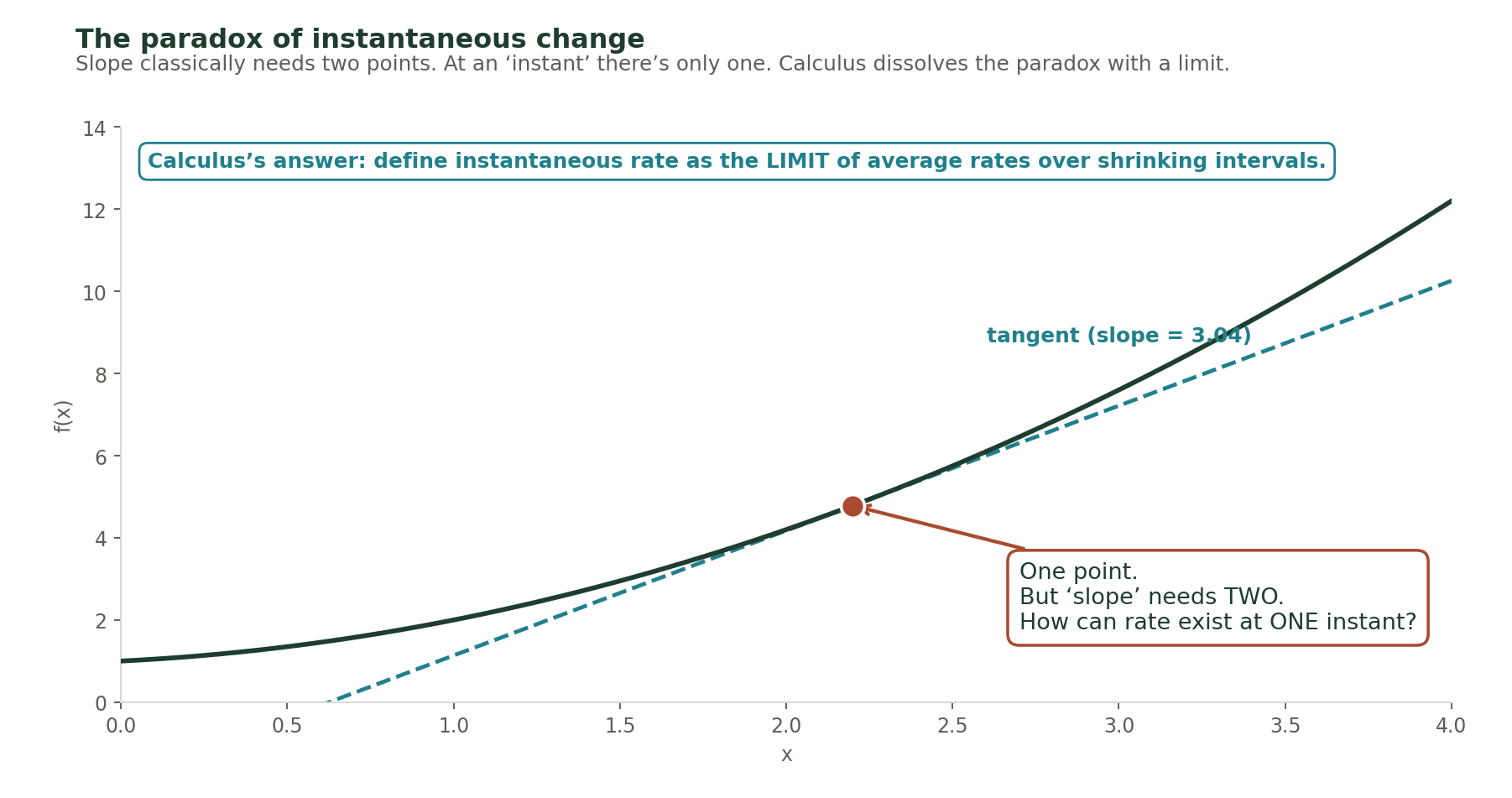
Slope classically needs TWO points: slope = (y₂ − y₁) / (x₂ − x₁). But an “instant” is one moment — ONE point. So how can there be a rate of change at a single instant when the very definition of rate requires two points?
Newton and Leibniz’s answer, in the 1670s: don’t compute the slope AT the point. Compute the average slope over an interval NEAR the point, then let the interval shrink to zero. If those average slopes settle on one number, call that number the instantaneous slope. That number-settling process is called a limit. Every idea in AP Calculus is built on top of it.
The tangent-line problem (differential calculus)
The tangent-line problem is: given a curve y = f(x) and a point on it, find the exact slope of the curve at that point. That slope is the instantaneous rate of change of f. It’s also called the derivative of f at that point — but we won’t define derivatives formally until Class 3. Right now the point is just to see WHY we need limits.
The strategy: pick a nearby point on the curve, draw the line through both points (a secant line), and compute its slope. That secant slope is the AVERAGE rate of change of f over the interval. Then let the nearby point slide toward the point of interest. As the two points get closer, the secant line rotates and lines up with the true tangent at the point.
Secant slope formula
Given a function f and two x-values a and a + h, the secant slope through (a, f(a)) and (a+h, f(a+h)) is:
msec = [ f(a + h) − f(a) ] / h
This is called the difference quotient. The instantaneous slope (the tangent slope) is what you get when h shrinks to zero:
mtan = limh→0 [ f(a + h) − f(a) ] / h
Read: “the limit, as h approaches zero, of the difference quotient.” When you learn the derivative in Unit 2, this exact expression will be its formal definition.
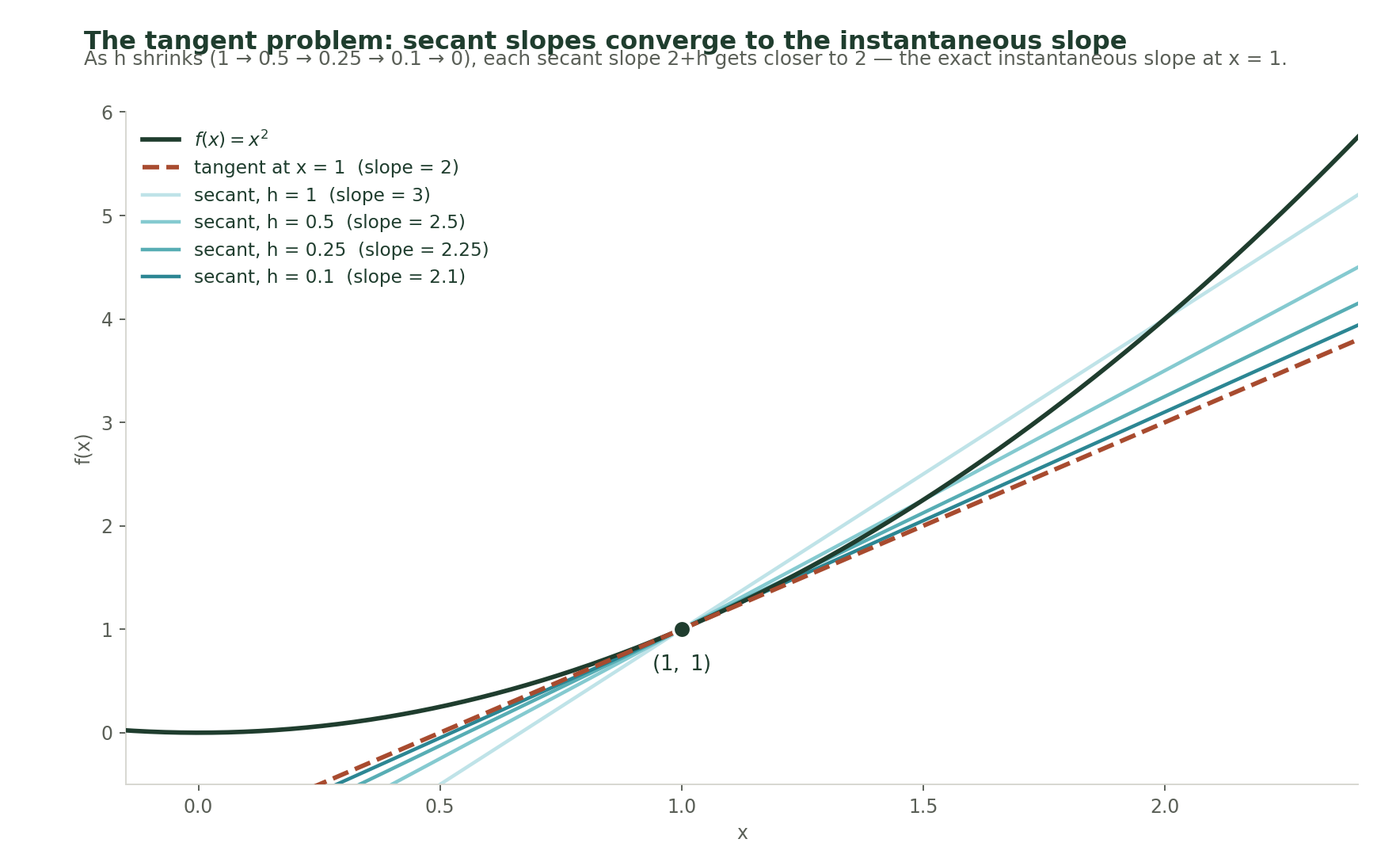
Try it in your head. For f(x) = x² at x = 1, the secant slope is [(1+h)² − 1²] / h = (2h + h²) / h = 2 + h. As h shrinks to zero, 2 + h shrinks to 2. So the tangent slope at x = 1 is exactly 2. No calculator, no formula — just a limit.
The area problem (integral calculus)
The area problem is the tangent problem’s partner: given a curve y = f(x) and an interval [a, b], find the exact area of the region between the curve and the x-axis. For rectangles and triangles you already know the formulas. For an arbitrary curve, geometry doesn’t help — but calculus does.
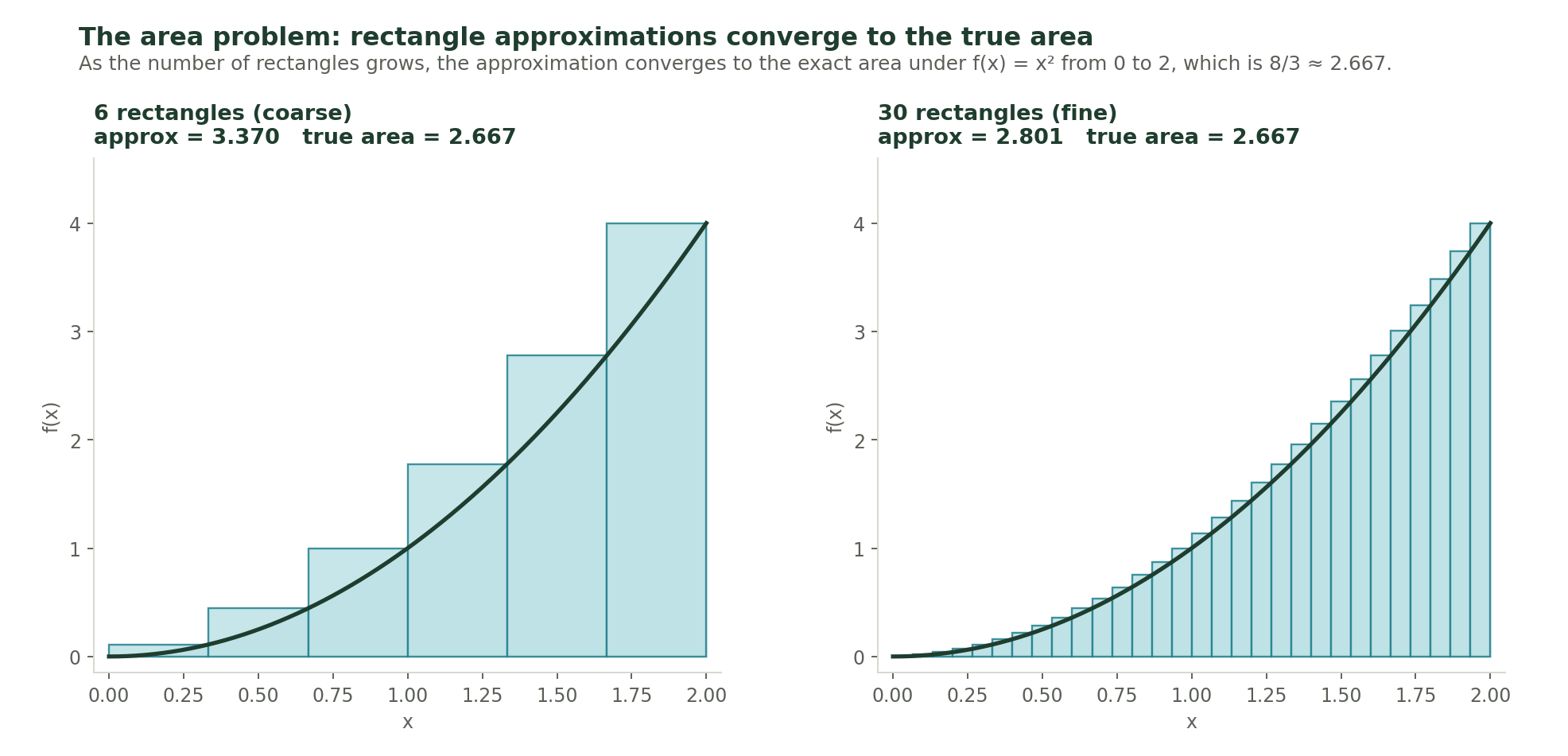
The strategy mirrors the tangent problem: approximate, then take a limit. Slice the region into n thin rectangles whose heights come from the function, add up their areas, and let n grow to infinity. The rectangle sums settle on a single number, and that number is the exact area. This will become the definite integral in Unit 6.
Why the tangent problem and the area problem are connected
They look like completely different questions — one is about slope, the other is about area — but they turn out to be two sides of the same coin. The Fundamental Theorem of Calculus (Unit 6) says: if you can find a function whose derivative is f, you can compute the area under f exactly. That’s the punchline of the entire course. But we have to build up to it.
Average vs. instantaneous rate of change
The single most useful skill to master in Class 1 is telling average rate of change apart from instantaneous rate of change. AP graders test this on nearly every free-response problem in Unit 1 and Unit 4.
Two definitions to memorize
Average rate of change of f on [a, b]:
AROC = [ f(b) − f(a) ] / (b − a)
Units: (units of f) per (units of x). Geometrically, this is the slope of the SECANT line through the two endpoints.
Instantaneous rate of change of f at a:
IROC(a) = limh→0 [ f(a + h) − f(a) ] / h
Same units. Geometrically, this is the slope of the TANGENT line at x = a.
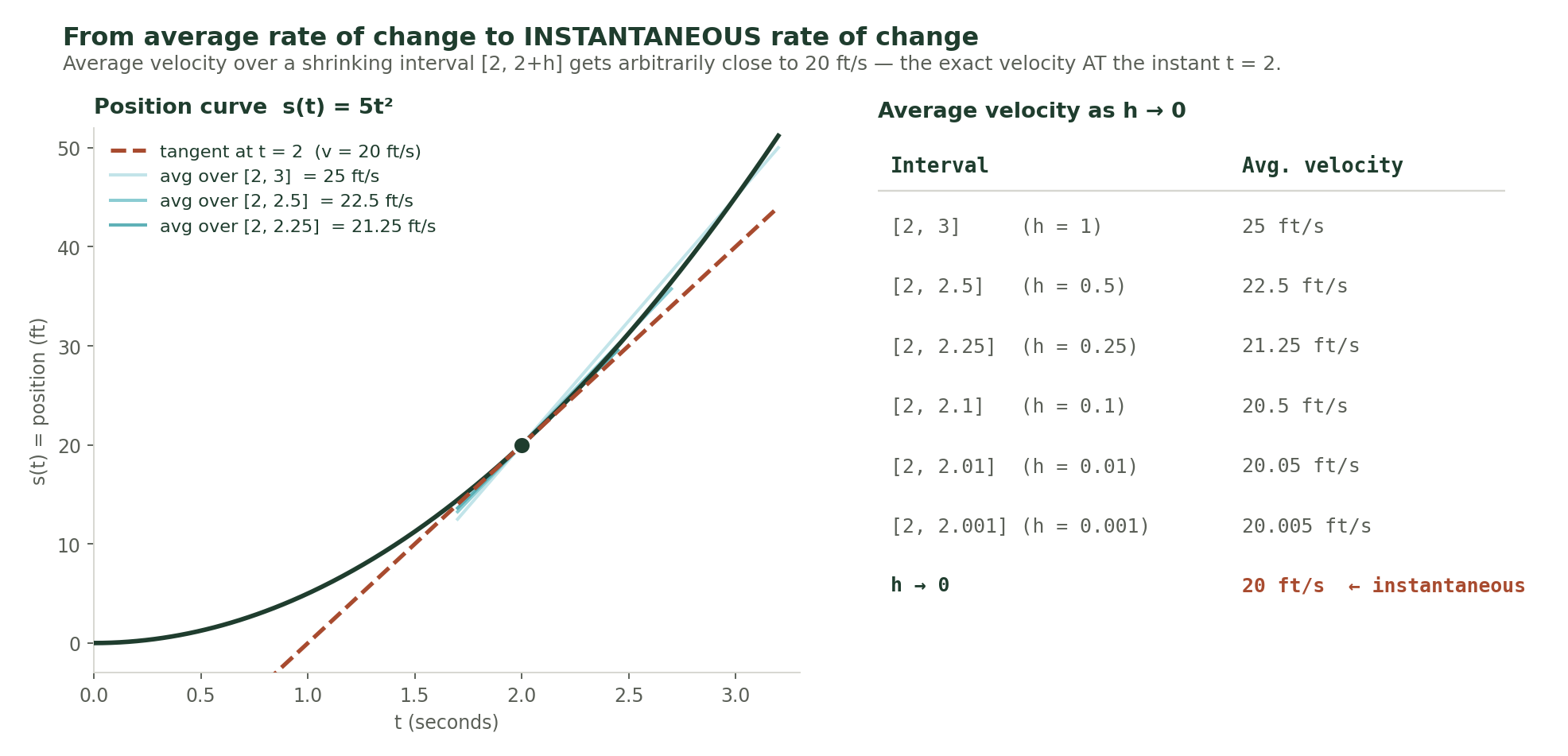
The physics version of the same distinction is average velocity vs. instantaneous velocity. If s(t) is the position of an object at time t:
- Average velocity on [t₁, t₂] = [ s(t₂) − s(t₁) ] / (t₂ − t₁)
- Instantaneous velocity at time t = limh→0 [ s(t + h) − s(t) ] / h — the speedometer reading
The one-question test. If a problem says “over the interval [a, b]” or gives you two moments in time, it wants an AVERAGE rate. If it says “at time t =” or “at the instant when” or “at the moment,” it wants INSTANTANEOUS. Writing the wrong one loses the point on the AP.
Local linearity: zooming makes curves straight
Here’s a visual argument for why the tangent-line idea even makes sense. Take any smooth curve, pick a point, and zoom in on the graph around that point. Zoom again. And again. What you’ll see is that the curve becomes indistinguishable from a straight line — specifically, from its tangent line at that point.
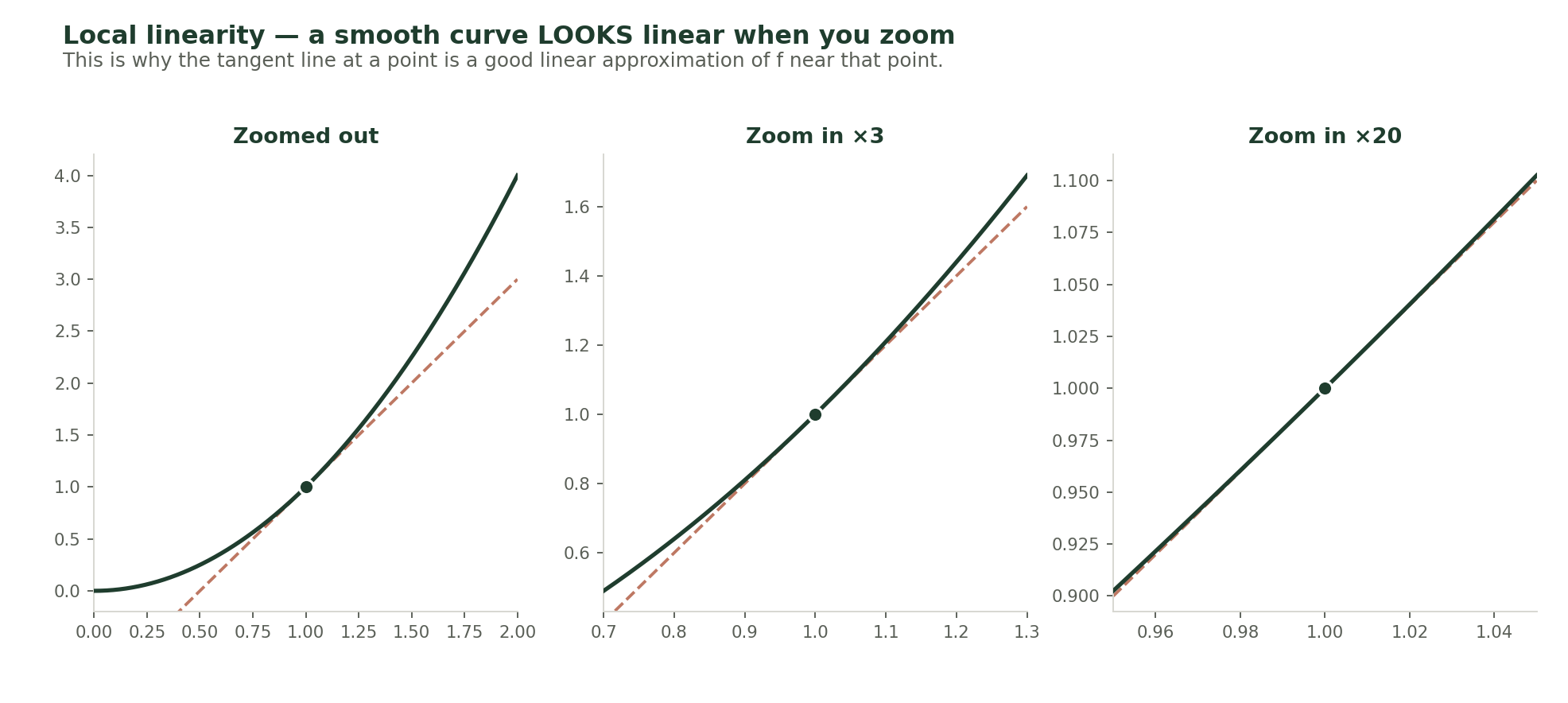
This is why the tangent line is such a good approximation of the function near the point: near enough, the curve IS the tangent line, up to a tiny error. Local linearity powers linear approximation, differentials, and Newton’s method, all coming in Unit 4.
Not every function has this property. Functions with sharp corners (like |x| at x = 0) or vertical tangents (like ∛x at x = 0) don’t look linear no matter how far you zoom. Those are exactly the points where the derivative fails to exist — a topic we’ll return to in Unit 2 (differentiability).
AP Calculus AB & BC at SOMATH
Prep for the AP Calculus exam on the Upper West Side
Our AP Calculus courses run 2-hour weekly classes covering all of Unit 1–8 for AB (or 1–10 for BC), with original SOMATH problem sets, full free-response practice, and AB/BC exam simulations. AP tuition is $800/month plus a one-time $99 registration fee. Book a free evaluation at our 226 W 79th Street classroom to get started.
20 practice questions with click-to-reveal answers
The 20 questions below cover the core Class 1 skills: reading secant/tangent slopes off graphs, computing average rate of change, recognizing when a problem is asking for average vs. instantaneous, and using a shrinking-interval table to estimate an instantaneous rate. Each question hides its answer until you click. Try the question first, then check.
Question 1 · Average rate of change from a formula
Let f(x) = x² + 3x. Find the average rate of change of f on the interval [1, 4].
Answer: 8
Key idea. Average rate of change is [ f(b) − f(a) ] / (b − a) — the slope of the secant line through the two endpoints.
f(1) = 1 + 3 = 4 f(4) = 16 + 12 = 28 AROC = (28 - 4) / (4 - 1) = 24 / 3 = 8Why this works. The formula is just the slope formula from algebra applied to the two points on the graph.
Question 2 · Interpreting average rate in context
A car’s position (in feet) at time t (in seconds) is s(t) = 5t². Find and interpret the average velocity of the car over the interval [0, 4].
Answer: 20 ft/s. The car traveled at an average speed of 20 feet per second during those 4 seconds.
Key idea. Average velocity over [t₁, t₂] is total displacement divided by elapsed time.
s(0) = 0 s(4) = 5 * 16 = 80 avg velocity = (80 - 0) / (4 - 0) = 80 / 4 = 20 ft/sWhy this works. This is exactly the average rate of change formula applied to a position function. Notice we don’t need to know how fast the car was going at any particular instant — just the start and end positions.
Question 3 · Recognizing which rate is asked for
A skier’s height above the base lodge is H(t). For each phrase, say whether it describes an AVERAGE or an INSTANTANEOUS rate of change: (a) “the skier’s speed at the moment she crosses the finish line,” (b) “the skier’s average speed over the last 20 seconds,” (c) “the reading on her GPS watch at t = 12,” (d) “how fast she was dropping between t = 5 and t = 15.”
Answer: (a) instantaneous · (b) average · (c) instantaneous · (d) average
Key idea. Words like “at the moment,” “at t =,” and “now” signal INSTANTANEOUS. Words like “over the interval,” “between,” and “average” signal AVERAGE.
Why this works. An instantaneous rate is defined at a single time; an average rate is defined between two times.
Question 4 · Secant slope with the difference quotient
Let f(x) = x². Compute the secant slope from x = 3 to x = 3 + h, and simplify.
Answer: 6 + h
Key idea. Plug into the difference quotient and simplify the numerator BEFORE dividing by h.
f(3 + h) = (3 + h)^2 = 9 + 6h + h^2 f(3) = 9 m_sec = [ f(3 + h) - f(3) ] / h = (9 + 6h + h^2 - 9) / h = (6h + h^2) / h = 6 + hWhy this works. The − 9 in the numerator cancels the + 9, and every remaining term has a factor of h we can divide out.
Question 5 · From secant slope to tangent slope
Using the result of Question 4, what is the slope of the tangent line to f(x) = x² at x = 3?
Answer: 6
Key idea. The tangent slope is the LIMIT of the secant slope as h shrinks to zero.
m_tan = lim_{h -> 0} (6 + h) = 6 + 0 = 6Why this works. Once the difference quotient is simplified (no h in the denominator), just substitute h = 0. The tangent slope at x = a for x² is 2a, so at a = 3 it’s 6. You’ll prove this in general in Unit 2.
Question 6 · Shrinking-interval table for instantaneous velocity
A ball’s position is s(t) = 5t². Complete the table of average velocities on the interval [2, 2 + h] for h = 1, 0.5, 0.1, 0.01, 0.001. What is the instantaneous velocity at t = 2?
Answer: 20 ft/s
Key idea. Build the average velocity over each interval, then look at what the numbers approach.
h avg velocity = [s(2+h) - s(2)] / h 1 25 ft/s 0.5 22.5 ft/s 0.1 20.5 ft/s 0.01 20.05 ft/s 0.001 20.005 ft/s h -> 0 20 ft/s <- instantaneousWhy this works. The pattern is 10 + 5h, which shrinks to 10 · 2 = 20 as h → 0. The instantaneous velocity at t = 2 is exactly 20 ft/s.
Question 7 · Secant slope from a graph
The point (1, 1) is on the graph of f(x) = x³, and so is (2, 8). Find the slope of the secant line connecting them.
Answer: 7
Key idea. Two points, one slope formula.
m_sec = (8 - 1) / (2 - 1) = 7 / 1 = 7Why this works. Nothing calculus-specific here yet — it’s just the algebra slope of the line through two known points on the curve. That secant slope IS the average rate of change of x³ on [1, 2].
Question 8 · Interpret an instantaneous rate
The number of active students at SOMATH is N(t) at time t (weeks after January 1). If the instantaneous rate of change of N at t = 10 is 3.5 students/week, what does that mean in plain English?
Answer: At exactly 10 weeks after January 1, the number of active SOMATH students is growing at a rate of 3.5 students per week.
Key idea. An instantaneous rate of change is always given with units of (units of output) per (units of input), and it tells you the momentary trend at that instant.
Why this works. The number 3.5 students/week does NOT mean 3.5 students actually enrolled that week. It means the enrollment trend, right at that moment, is 3.5 per week. If that rate continued unchanged for 2 weeks, we’d expect roughly 7 more students. AP graders LOVE this kind of interpretation question — state the number, the units, and the moment.
Question 9 · Negative rate of change
A cup of coffee cools according to T(t) in degrees Fahrenheit, where t is in minutes. The average rate of change of T on [0, 15] is −3.2 °F/min. What does the negative sign tell us?
Answer: The coffee is cooling — its temperature dropped, on average, by 3.2 °F every minute during those 15 minutes.
Key idea. The sign of a rate of change tells you the direction: positive means the quantity is increasing, negative means it’s decreasing.
Why this works. A negative slope on a temperature-vs-time graph is a downward tilt, which visually means the value is falling. AP problems will always ask you to interpret the sign in context, not just report the number.
Question 10 · Building a difference quotient
Write (but don’t simplify yet) the difference quotient for g(x) = √x at x = 4.
Answer: (√(4 + h) − 2) / h
Key idea. The difference quotient at x = a is [ g(a + h) − g(a) ] / h. Just substitute.
g(4) = sqrt(4) = 2 g(4 + h) = sqrt(4 + h) diff quotient = [ sqrt(4 + h) - 2 ] / hWhy this works. Difference quotients for square-root functions look scary because you can’t just cancel h. You’ll simplify these in Unit 1 lessons on limits using the conjugate trick — multiply top and bottom by (√(4 + h) + 2).
Question 11 · Average velocity of a dropped object
An object is dropped from rest and falls freely. Its position (measured downward from the release point in meters) is s(t) = 4.9 t², where t is in seconds. Find the average velocity on the interval [1, 3].
Answer: 19.6 m/s
Key idea. Average velocity is [ s(t₂) − s(t₁) ] / (t₂ − t₁).
s(1) = 4.9 * 1 = 4.9 m s(3) = 4.9 * 9 = 44.1 m avg velocity = (44.1 - 4.9) / (3 - 1) = 39.2 / 2 = 19.6 m/sWhy this works. The object went from 4.9 m below the release point to 44.1 m below in 2 seconds — that’s 39.2 m of drop, or 19.6 m/s on average. Notice this is BIGGER than the average of the instantaneous velocities at t = 1 (9.8 m/s) and t = 3 (29.4 m/s), which averages to 19.6 — that’s a coincidence for constant-acceleration motion, not a general rule.
Question 12 · Estimating instantaneous velocity from a shrinking table
Using s(t) = 4.9 t² from Question 11, compute the average velocity over [3, 3 + h] for h = 0.1, 0.01, and 0.001. What is the instantaneous velocity at t = 3?
Answer: 29.4 m/s
Key idea. Average velocity approaches instantaneous velocity as h shrinks to 0.
h s(3+h) avg v = [s(3+h) - s(3)] / h 0.1 4.9 * 9.61 = 47.089 (47.089 - 44.1) / 0.1 = 29.89 m/s 0.01 4.9 * 9.0601 = 44.394 (44.394 - 44.1) / 0.01 = 29.449 m/s 0.001 4.9 * 9.006001 = 44.129 (44.129 - 44.1) / 0.001 = 29.4049 m/s h -> 0 -> 29.4 m/s <- instantaneousWhy this works. The pattern is 9.8 · 3 + 4.9h = 29.4 + 4.9h, which shrinks to 29.4 as h → 0. Physically, this is the free-fall velocity 3 seconds in: v = gt = 9.8 · 3 = 29.4 m/s. Calculus will let you derive this without a table.
Question 13 · Area under a constant function
A car cruises at a constant speed of 60 mph for 2 hours. Sketch the velocity-vs-time graph. What is the area under the graph between t = 0 and t = 2? What does that area represent?
Answer: The area is 120, and it represents the total distance the car traveled — 120 miles.
Key idea. When the graph is velocity vs. time, area under the curve = distance traveled. For a constant speed, the region is a rectangle: base × height.
area = base * height = 2 hours * 60 mph = 120 milesWhy this works. Because the speed is constant, no calculus is needed — just a rectangle area. This is the simplest possible “area problem.” The whole point of integral calculus is to handle the case where the speed (or any rate) is NOT constant, so you can’t just use base × height.
Question 14 · Rectangle approximation of area
Estimate the area under f(x) = x² on [0, 2] using 4 right-endpoint rectangles of equal width.
Answer: 3.75
Key idea. Split [0, 2] into 4 equal subintervals of width Δx = 0.5, and use the right endpoint of each subinterval as the rectangle’s height.
right endpoints: 0.5, 1.0, 1.5, 2.0 heights f(x) = x^2: 0.25, 1.00, 2.25, 4.00 widths (delta x): 0.5 each approx area = 0.5 * (0.25 + 1.00 + 2.25 + 4.00) = 0.5 * 7.50 = 3.75Why this works. Each rectangle has area height × width. Summing them approximates the area under the curve. The true area is 8/3 ≈ 2.667, so 4 right rectangles OVER-estimate. That’s because x² is increasing on [0, 2] — right endpoints give the tallest possible heights.
Question 15 · True area with more rectangles
In Question 14, we got 3.75 with 4 rectangles. The true area under x² on [0, 2] is 8/3 ≈ 2.667. Which of these choices would bring us CLOSEST to the true area? (a) 2 rectangles, (b) 8 rectangles, (c) 100 rectangles, (d) 1 rectangle.
Answer: (c) 100 rectangles
Key idea. More rectangles ⇒ each is narrower ⇒ less of the curve is missed ⇒ the sum approaches the true area.
Why this works. This is exactly the limit idea for integrals: area = limn→∞ (sum of n rectangle areas). As n grows, the approximation converges to the exact area. You’ll formalize this as a Riemann sum in Unit 6.
Question 16 · Local linearity intuition
A calculator’s screen shows f(x) = √x zoomed WAY in near x = 4, and the curve looks perfectly straight on screen. What is that straight line the calculator is showing, in calculus language?
Answer: It’s (visually) the tangent line to f(x) = √x at x = 4.
Key idea. When you zoom hard enough on a smooth curve at a point, the curve becomes indistinguishable from its tangent line at that point. That’s local linearity.
Why this works. For √x at x = 4, the tangent line has slope 1 / (2√4) = 1/4 and passes through (4, 2). So the zoomed-in line the calculator shows has slope about 0.25 — and if you zoom out again, it separates from the curve as you move away from x = 4.
Question 17 · When local linearity FAILS
Which of the following functions FAILS to be locally linear at x = 0? (a) f(x) = x², (b) g(x) = sin x, (c) h(x) = |x|, (d) p(x) = ex.
Answer: (c) h(x) = |x|
Key idea. Local linearity requires the curve to look like a single straight line when you zoom. A sharp corner never looks like a single line, no matter how much you zoom.
Why this works. The absolute value function has a corner at x = 0 — the left side has slope −1, the right side has slope +1. No single tangent line fits both sides. That’s why h(x) = |x| is NOT differentiable at x = 0 — a fact you’ll prove in Unit 2. The other three functions are smooth everywhere and locally linear at every point.
Question 18 · Average vs. instantaneous on a graph
A function f is graphed on [0, 6]. Which of the following is represented by the SLOPE of the SECANT line through (1, f(1)) and (5, f(5))? (a) instantaneous rate of change at x = 3, (b) average rate of change on [1, 5], (c) tangent slope at x = 1, (d) tangent slope at x = 5.
Answer: (b) average rate of change on [1, 5]
Key idea. The slope of a secant line through the endpoints of an interval IS the average rate of change on that interval, by definition.
Why this works. Secant slope = [ f(5) − f(1) ] / (5 − 1), and that formula is average rate of change on [1, 5]. Options (a), (c), and (d) are instantaneous rates at specific points, which correspond to TANGENT slopes, not secant slopes. Only in special cases (constant slope, or by the Mean Value Theorem) will the secant slope equal an instantaneous slope somewhere.
Question 19 · Writing an instantaneous rate as a limit
Let f(x) = 1/x. Write (but don’t evaluate) an expression involving a limit that represents the instantaneous rate of change of f at x = 2.
Answer: limh→0 [ 1/(2 + h) − 1/2 ] / h
Key idea. The instantaneous rate of change at x = a is limh→0 [ f(a + h) − f(a) ] / h. Just plug in a = 2 and f(x) = 1/x.
IROC(2) = lim_{h -> 0} [ f(2 + h) - f(2) ] / h = lim_{h -> 0} [ 1/(2 + h) - 1/2 ] / hWhy this works. This is just careful substitution. You’ll simplify complex fractions like this using a common denominator in your Unit 1 limit computations. The eventual answer, using Unit 2 rules, is −1/4.
Question 20 · Reasoning about signs and steepness
A snowboarder’s elevation E(t) in feet is shown on a smooth graph. At the moment she is going down the steepest part of the run, which of these is TRUE about the instantaneous rate of change of E? (a) It’s a large positive number. (b) It’s zero. (c) It’s a large negative number. (d) It’s a small negative number close to zero.
Answer: (c) a large negative number
Key idea. The instantaneous rate of change corresponds to the SLOPE of the tangent line, which is the tilt of the curve at that moment.
Why this works. “Going down” means elevation is decreasing — so the tangent slope is NEGATIVE. “Steepest” means the magnitude of the tilt is as big as it gets — so the slope is a LARGE (in absolute value) negative number. The answer must be (c). This kind of graphical, sign-and-magnitude reasoning is how AP graders test whether you understand rate of change on a conceptual level, not just as an algebra exercise.
What’s next in Unit 1
Class 1 gave you the WHY: rate of change at an instant, area under a curve, and the need for limits to define both. The rest of Unit 1 gives you the HOW:
- Class 2 — Defining and estimating limits. Graphs, tables, one-sided limits, limit notation, and why limx→a f(x) is a question about x-values NEAR a, not x = a itself.
- Class 3 — Computing limits algebraically. Direct substitution, factor-and-cancel, the conjugate trick, and limit laws.
- Class 4 — Continuity, IVT, and infinite limits. When you CAN plug in, when discontinuities happen, and how asymptotes show up as limits.
By the end of Unit 1 you’ll be ready for Unit 2: derivatives — a formal, general-purpose machine for instantaneous rates of change.
Ready to prep for AP Calculus AB or BC?
Join SOMATH’s AP Calculus track this fall
2-hour weekly classes on the Upper West Side or online. Original SOMATH problem sets, full AP-style free-response practice, and mock exams timed to the real May AP schedule. Tuition $800/month plus a one-time $99 registration fee.
Written by the SOMATH team at 226 W 79th Street, New York, NY 10024. Call (646) 668-6151 to talk to a teacher or book a free 60-minute evaluation.
Related posts
- Sister AP arc: AP Statistics Class 1 — Statistics as the Study of Variation
- AP Stats companion: AP Statistics Class 2 — Displaying Categorical Data
- SOMATH AP Prep course page: See the AP Calculus course →
Continue with AP Calculus AB & BC
Use this lesson alongside the AP Calculus AB & BC course. For current exam preparation and related practice, start with these guides.