In the News · NYC Homeschooling · SOMATH Homeschool Support
Homeschooling in NYC: How SOMATH Supports Homeschool Families with Math
SOMATH cofounder Vivianne Wright and her 9-year-old daughter Violetta were featured in the New York Post’s September 9, 2026 story on the rise of NYC homeschooling. Homeschooling in New York has grown more than 200% in 15 years, and more than 14,000 NYC families now teach at home. This post explains why our family chose homeschooling, how SOMATH supports homeschool families with math, and what an in-person math track looks like alongside a home curriculum.
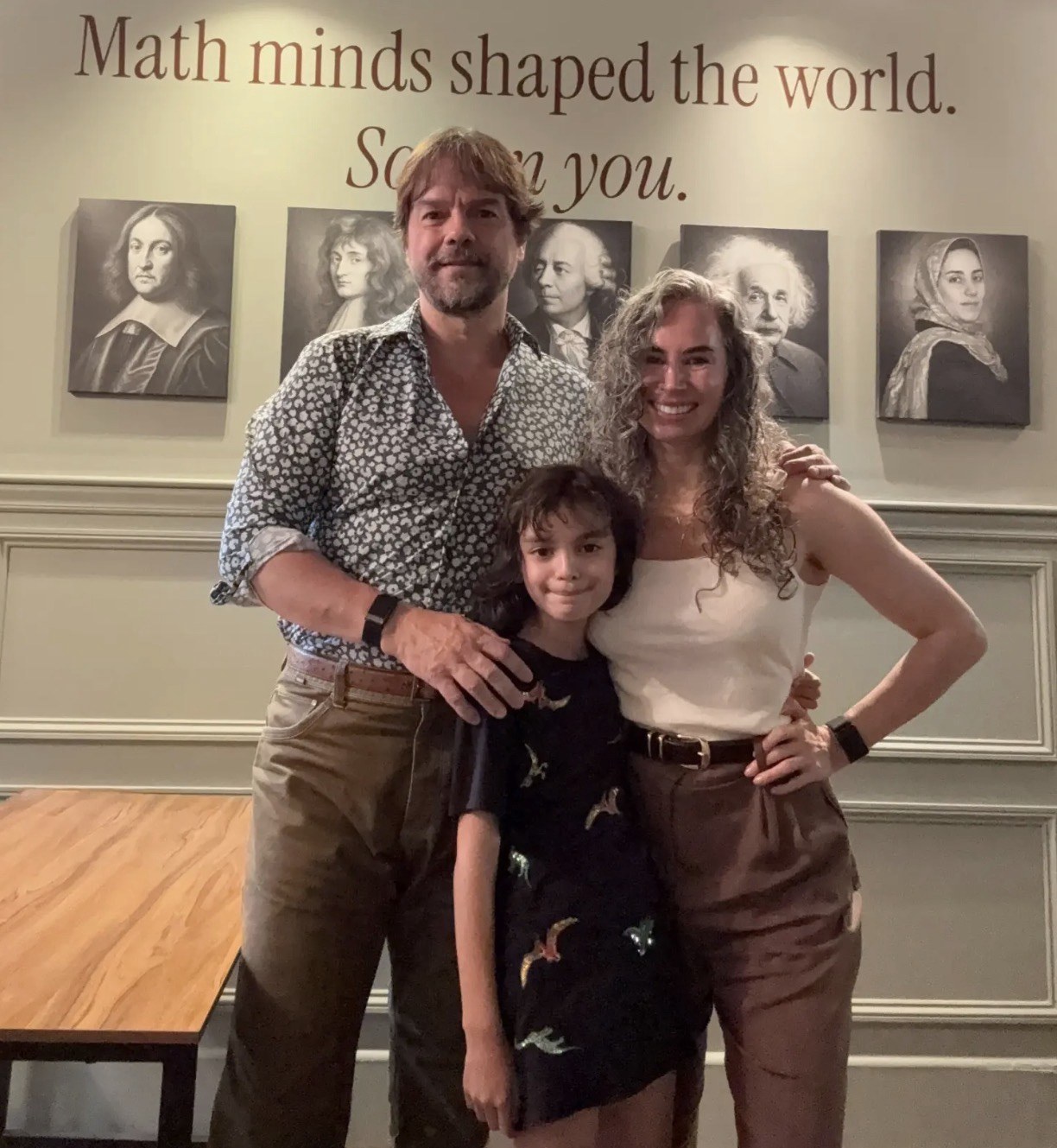
Photographed inside SOMATH at 226 W 79th St on the Upper West Side, under our classroom’s “Math minds shaped the world” portrait wall (Fermat, Newton, Euler, Einstein, and Maryam Mirzakhani). Left to right: Marcelo Ambrozio, Violetta (9), and Vivianne Wright. Vivianne and Violetta were featured in the New York Post on September 9, 2026.
If you’re a NYC parent reading this because you saw the New York Post story on why so many families are pulling their kids out of school — welcome. We’re Vivianne Wright and Marcelo Ambrozio, cofounders of SOMATH — School of Math at 226 W 79th St on the Upper West Side. Our 9-year-old daughter Violetta is one of the more than 14,000 homeschooled children in New York City in the 2025–2026 school year. This is why we made that choice, and how we support the growing number of NYC homeschool families who ask us the same question every week: “What do we do for math?”
Short answer: SOMATH runs a small-group, in-person math track for homeschool students in grades 1–12, alongside our regular school-day enrichment classes. You can enroll for a free 30-minute evaluation, call us at (646) 668-6151, or read on for the details.
What’s in this post
- What the New York Post reported
- Why our family chose to homeschool
- The NYC homeschooling numbers, briefly
- The one question every homeschool parent asks: “What about math?”
- How SOMATH supports homeschool families
- How we teach Violetta math at SOMATH
- IHIP and quarterly progress reports
- SOMATH vs. online math programs for homeschoolers
- Frequently asked questions
1. What the New York Post reported
On September 9, 2026, the New York Post published “Why NYC parents are homeschooling their kids in 2026” by Marissa Matozzo. The piece profiles several NYC families who now teach at home, including Vivianne and Violetta. The reporting captures a real shift in New York: homeschooling is no longer a fringe choice, and it’s no longer only about religion or ideology. It’s families making an educational decision.
In the article, Vivianne describes recognizing Violetta’s academic talents, running into scheduling conflicts between her own work and Violetta’s school hours, and eventually building a home curriculum that includes math, world folklore, judo, art, chess, and piano.
2. Why our family chose to homeschool
We didn’t set out to homeschool. Vivianne said it plainly in the Post: “Homeschooling wasn’t our original plan.” What changed was a series of small realizations that added up:
- Violetta was ahead of her grade in math and reading. Her school did what most schools do — taught to the middle of the class. That’s the right call for a public school teacher with 25 students, but it meant Violetta was rehearsing skills she had already mastered.
- The schedule didn’t fit our life. Running SOMATH means we’re in the classroom evenings and weekends. A rigid 8:20 to 3:00 public-school day cut into the hours we could actually be present with her.
- We wanted room for depth. Violetta loves math, world folklore, judo, art, chess, and piano. Fitting all of that around a full school day plus homework was starting to squeeze out the things she cared most about.
- We already run a school. As educators, we knew what a strong curriculum looks like and knew we could build one at home. That’s a specific advantage that most homeschool parents don’t start with — and it’s the reason SOMATH now shares its curriculum and classroom with other homeschool families in the neighborhood.
3. The NYC homeschooling numbers, briefly
If it feels like more of your friends are homeschooling this year, you’re not imagining it. Here are the numbers the Post cited, drawn from state data:
Two things stand out. First, the trend line: NY homeschooling has tripled since the 2009–2010 school year. Second, the intent: a 2025 NYC Department of Education survey cited in the Post found 21% of homeschooling parents believed their children received a more challenging education at home than they had in public school. This isn’t opting out. For many families, it’s opting up.
4. The one question every homeschool parent asks: “What about math?”
We meet a lot of homeschool parents on the Upper West Side. Every single one of them, without exception, raises math within the first two minutes of the conversation. Not because they don’t feel capable — most of them are perfectly capable. But because math is the one subject where a bad early foundation is very hard to fix later, and every parent knows it.
Here’s what usually happens:
- Grades 1–3 feel manageable at home. Counting, addition, subtraction, simple word problems — a parent can absolutely teach these.
- Around grade 4, fractions arrive, and the “wait, was that the right way to explain it?” questions start.
- By grade 6, most parents want a second set of eyes. Pre-algebra and integer operations get technical fast.
- By grade 8, if the plan includes SHSAT or a specialized-high-school application, the family needs a real curriculum and a real coach. Algebra, geometry, and problem-solving are non-negotiable.
- Grades 9–12: algebra II, precalculus, AP Calculus, SAT, AP Statistics. Very few parents want to shoulder this alone, and most shouldn’t have to.
This is where SOMATH fits in. We’re a real math school — a physical classroom on 79th Street, with a 24-class curriculum ladder taught by cofounder Marcelo Ambrozio and the SOMATH team. Homeschool families use us the same way school-day families use us: as the math component. The difference is when and how often.
Homeschooling in NYC? Come see our classroom.
We’re one block from the 79th St 1 train. Book a free 30-minute evaluation for your homeschool student — grades 1–12. You’ll leave with a written diagnostic and a plan you can drop straight into your IHIP.
226 W 79th St, 1st Floor, New York NY 10024 · See the SOMATH schedule · (646) 668-6151
5. How SOMATH supports homeschool families
Homeschool students at SOMATH get the same small-group classes as school-day students, structured a little differently to fit a home schedule:
- Morning and midday slots. Most homeschool families prefer to do their core academic work in the morning, so we hold homeschool math classes during school hours — not just after 4:00 PM like traditional after-school enrichment.
- Small groups of 4–8 students at the same level. Not by age — by actual skill. Two homeschooled 8-year-olds can be years apart in math, and we place based on the written diagnostic, not the birthday.
- One-hour weekly classes plus optional 1-on-1 tutoring. The class is the long-term engine (curriculum, problem-solving, competition prep). Tutoring layers on top for anything specific — a test date, a hard unit, a competition.
- Written diagnostic before enrollment. Every child starts with a free evaluation. We tell you honestly if we’re the right fit for your family, and if we’re not, we’ll point you to who is.
- IHIP-ready documentation. Curriculum outlines, quarterly progress reports, and attendance records — formatted for the New York State homeschool submission process (more on that in section 7 below).
- Full grade-1-to-AP-Calculus ladder. Little Newtons (K–2), Kid Einsteins (3–5), SOMATH middle-school math (6–9 including Algebra 1 / Algebra 2 / Geometry), and Digital SAT / AP Calculus / AP Statistics at the top of the ladder. You don’t have to change programs when your child changes grade.
6. How we teach Violetta math at SOMATH
People sometimes ask if Violetta gets special treatment because her parents run the school. She doesn’t — because “special treatment” at SOMATH is just the standard treatment: a written diagnostic, placement into a small group at the right level, a real curriculum, and honest reporting.
Here’s the specific structure we use for her:
- Weekly small-group math class at SOMATH, in the group that matches her level (currently a mixed 3rd–4th grade Kid Einsteins section). She sits with 5–7 other kids at the same math level, most of whom are not homeschooled.
- Two shorter home practice sessions each week, using SOMATH’s worksheets and problem sets. Marcelo reviews her work; Vivianne handles the scheduling.
- Cross-subject integration. When Violetta is doing world folklore, we look for the math — the base-20 Maya number system, tessellations in Islamic geometric art, the arithmetic in African string games. Homeschooling makes this kind of integration easy in a way school schedules rarely allow.
- Quarterly written progress report, the same format we use for every SOMATH student, filed with the school district as part of her IHIP.
- Competition track when she’s ready. Right now that means Math Kangaroo and Noetic. Later it will mean AMC 8, MATHCOUNTS, and eventually SHSAT prep — the same competition ladder every SOMATH middle-schooler follows.
This is the model we open to other homeschool families in the neighborhood. You don’t have to build the math component of your homeschool curriculum from scratch. We already built ours.
7. IHIP and quarterly progress reports
New York State requires every homeschool family to file an Individualized Home Instruction Plan (IHIP) with their local school district, plus quarterly progress reports and an annual assessment. Math must be taught every year, K–12. Parents don’t need a teaching certification or a college degree to homeschool, but the paperwork is real. Here’s how SOMATH fits into that process for the families we teach:
| IHIP requirement | What NYS asks for | What SOMATH provides |
|---|---|---|
| Curriculum listing | What math curriculum the child will follow this year | A one-page written outline of the SOMATH curriculum for the child’s placement level (grade 1 through AP Calculus) |
| Instructor name | Who is teaching | Marcelo Ambrozio (Northwestern, 15+ years teaching NYC math) or the SOMATH teacher assigned to the child’s class |
| Instructional hours | Enough hours per year to meet NYS minimums | Attendance record from the weekly class plus any additional 1-on-1 tutoring hours |
| Quarterly progress reports | 4 reports per year describing progress | A written narrative report at the end of each SOMATH quarter, with topics covered, skills mastered, and next-quarter plan |
| Annual assessment | Standardized test or written evaluation each year | A written assessment on request, or coordination with a nationally-normed test if the family prefers a score |
None of this replaces the parent’s IHIP submission — you’re still the responsible party with the district. But it means the math part of your paperwork is essentially done for you.
8. SOMATH vs. online math programs for homeschoolers
Most homeschool families we meet have already tried at least one online math program. The comparison usually looks like this:
| Feature | Online math program (Khan Academy, IXL, Beast Academy Online, etc.) | SOMATH in-person math |
|---|---|---|
| Format | Self-paced videos + adaptive practice | Live, in-person, small group of 4–8 at the same level |
| Teacher present | No — algorithm-graded | Yes — a real math teacher, in the room |
| Best at | Procedural practice, drill, mastery of routine skills | Problem-solving, conceptual depth, competition preparation, discussing your reasoning out loud |
| Homeschool fit | Excellent as a supplement or for daily practice | Excellent as the primary weekly math class, or as a rigor upgrade over online-only |
| Social interaction | Minimal — usually solo | High — small group of peers at the same level, taught by an adult |
| IHIP documentation | Progress dashboards; parent writes the narrative | Written quarterly progress reports and curriculum outline provided |
| Cost | Free to ~$20/mo | Enrichment class pricing — ask us for current rates |
The families who get the most out of SOMATH usually keep an online program for daily 15–20-minute practice and use SOMATH as the weekly “real math class” where a teacher pushes them into harder problems and asks them to justify their reasoning. The two roles are complementary, not competitive.
9. Frequently asked questions
Does SOMATH work with homeschool families in NYC?
Yes. We run an in-person math track for homeschool students grades 1–12 from our Upper West Side classroom. Homeschool families use SOMATH as the full math component of their IHIP, or as a supplement to whatever they already do at home. Book a free evaluation to get placed.
What are the NYC homeschooling requirements for math?
New York State requires an IHIP that names the curriculum, quarterly progress reports, attendance records, and an annual assessment. Math must be taught every year, K–12. Parents don’t need a certification or a degree. SOMATH provides IHIP-ready curriculum outlines and quarterly written progress reports for the families we teach.
Can a homeschooled child still take the SAT, SHSAT, and AP exams?
Yes — on exactly the same footing as any other NYC student. Our enrichment ladder feeds directly into SHSAT prep, Digital SAT prep, and AP Calculus AB and BC. Homeschooling doesn’t close any doors; it just changes the shape of the school day.
Isn’t homeschooling bad for socialization?
This is the most common concern parents raise, and it’s a fair one to think about. The honest answer is: it depends entirely on what a family does with the time. Homeschool families who structure regular group activities — math class, sports, art class, chess club, book clubs, playdates — get plenty of socialization. Families who don’t, don’t. In our experience, a weekly small-group class like SOMATH is one of the healthier social settings a child can have: 4–8 kids at the same skill level, an adult in the room, working on hard problems together.
How much does SOMATH cost for homeschool families?
Homeschool students pay our standard small-group enrichment rate. There’s no separate “homeschool premium.” The free evaluation tells you which class your child is placed in, and we’ll email you current pricing before you enroll. For a general sense of NYC enrichment pricing, our enrichment vs. tutoring guide lays out typical rate ranges across the city.
How do I get started?
Two options. Fastest: call (646) 668-6151 and we’ll book your evaluation over the phone. Or go to schoolofmath.us/evaluation and pick a time online. Bring your child, plan on 30 minutes, and you’ll leave with a written diagnostic and a specific placement recommendation — no obligation to enroll.
About SOMATH — School of Math
SOMATH — School of Math is a math-focused school on the Upper West Side of Manhattan for students in grades 1–12. We serve both traditional-school families (after-school and weekend enrichment) and NYC homeschool families (in-person math track during and outside school hours). Curriculum led by cofounder Marcelo Ambrozio (Northwestern-trained, 15+ years teaching NYC math). Cofounder Vivianne Wright (Harvard) leads family experience and homeschools our 9-year-old daughter Violetta — featured in the New York Post on September 9, 2026.
Location: 226 W 79th St, 1st Floor, New York, NY 10024 · Upper West Side
Phone: (646) 668-6151 · Email: hello@schoolofmath.us
Book: Free evaluation · Schedule · Home
Related SOMATH posts
- Math Enrichment vs. Math Tutoring — a clear guide for NYC parents
- Elementary Math Enrichment on the UWS: What K–5 Parents Need to Know
- Math Enrichment for K–2 — the Little Newtons approach
- When Should Your Child Start Math Enrichment? An Age-by-Age Guide
- Gifted Math Programs in Manhattan — an honest 2026 comparison
- All SOMATH blog posts »
Source: “Why NYC parents are homeschooling their kids in 2026” by Marissa Matozzo, New York Post, September 9, 2026.