SOMATH Reference · Measurement · Grades 4–8
Imperial System vs Metric System: 7 Conversions Every Student Should Know
One printable SOMATH chart with the seven imperial↔metric conversions students meet the most — inch, foot, yard, mile, gallon, ounce, and pound — plus worked examples, mental-math shortcuts, and the two pitfalls that trip everyone up (U.S. vs. U.K. gallons, and weight ounces vs. fluid ounces).
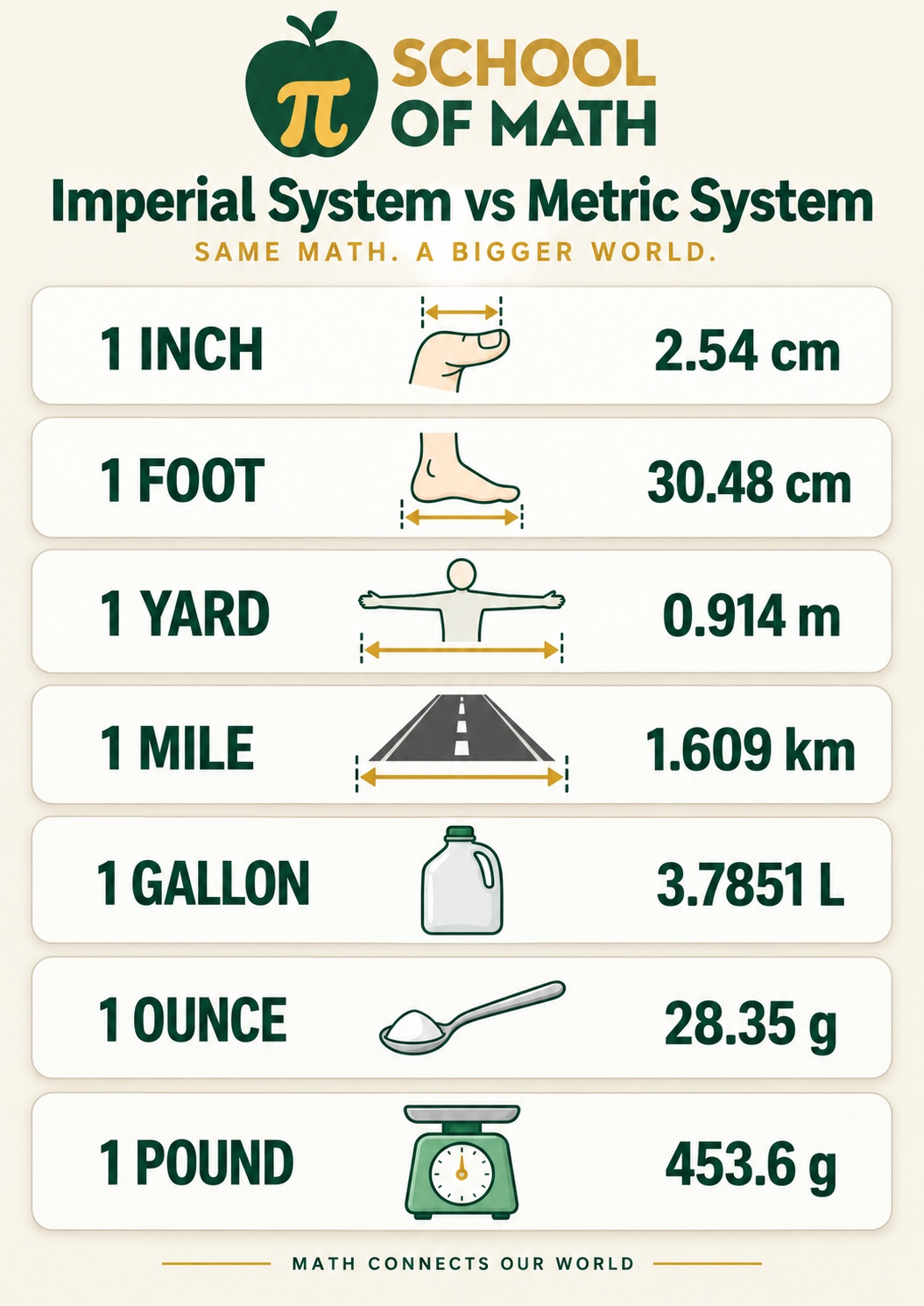
Quick-reference table
| Imperial unit | Category | Metric equivalent |
|---|---|---|
| 1 inch | Length | 2.54 cm |
| 1 foot | Length | 30.48 cm |
| 1 yard | Length | 0.914 m |
| 1 mile | Length | 1.609 km |
| 1 gallon | Volume | 3.7851 L |
| 1 ounce | Weight | 28.35 g |
| 1 pound | Weight | 453.6 g |
Why this chart matters
The United States is one of only three countries in the world that hasn’t officially adopted the metric system for everyday life. The other two are Liberia and Myanmar. Everywhere else — and inside every science classroom, every SAT and ACT math section, every doctor’s office lab report — you’ll see meters, liters, grams, and Celsius.
Students who are fluent in both systems can read a road sign in Europe, a nutrition label at home, a chemistry problem on a test, and a physics lab from anywhere in the world without getting stuck on the units. That fluency starts with the seven conversions on this chart.
1 inch = 2.54 cm · Length
An inch is the smallest length on the poster. It’s roughly the width of an adult’s thumb. In the U.S., inches show up on rulers, TV screens (a “55-inch TV”), and clothing sizes.
The exact conversion is 1 inch = 2.54 cm — that number is not a rounding, it’s a definition set by international agreement in 1959.
- A 12-inch ruler = 12 × 2.54 = 30.48 cm. (That’s also 1 foot — see the next row.)
- A 6-inch pencil ≈ 15.24 cm.
- A 55-inch TV ≈ 140 cm along the diagonal.
1 foot = 30.48 cm · Length
A foot is 12 inches. It’s the everyday U.S. unit for a person’s height (“I’m 5 feet 8″”), room dimensions, and ceiling heights.
1 foot = 30.48 cm = 0.3048 m exactly. A quick classroom estimate: 1 foot ≈ 30 cm.
- A 5'8″ person ≈ 173 cm.
- An 8-foot ceiling ≈ 2.44 m.
- A 100-foot football play ≈ 30.5 m.
1 yard = 0.914 m · Length
A yard is 3 feet, roughly the distance from one hand to the other with arms stretched out (which is why the poster shows a person with arms wide). Yards are the standard for American football fields and for fabric at the store.
1 yard = 0.9144 m ≈ 91.4 cm. A meter is slightly longer than a yard — useful when you’re converting: a metric 100 m race is a few steps longer than the American 100-yard dash.
- A 100-yard football field ≈ 91.4 m.
- 3 yards of fabric ≈ 2.74 m.
- A 10-yard first down ≈ 9.14 m.
1 mile = 1.609 km · Length
A mile is 5,280 feet — the U.S. unit for road distance and speed (“miles per hour”). The rest of the world drives in kilometers, so this is one of the most useful conversions for anyone traveling or reading the news.
1 mile = 1.609 km. The reverse is just as useful: 1 km ≈ 0.621 miles.
- 60 mph ≈ 97 km/h.
- A 5K race = 5 km ≈ 3.1 miles.
- A 26.2-mile marathon ≈ 42.2 km.
Quick mental math: multiply miles by 1.6 to get kilometers. Divide kilometers by 1.6 to get miles.
1 gallon = 3.7851 L · Volume
A U.S. gallon is the standard container for milk, gasoline, and paint. It splits into 4 quarts, 8 pints, or 128 fluid ounces.
1 U.S. gallon = 3.7854 L (the poster rounds to 3.7851 L). Watch out: the UK Imperial gallon is different — about 4.546 L — so when you see “gallon” on a British recipe or fuel-economy chart, it’s not the same unit.
- A 1-gallon milk jug ≈ 3.79 L.
- A 12-gallon gas tank ≈ 45.4 L.
- “30 mpg” is roughly 7.8 L per 100 km.
1 ounce = 28.35 g · Weight
An ounce (oz) is the small U.S. weight unit — used for food portions (“a 4-oz burger”), letters, and cosmetics. There are 16 ounces in a pound.
1 oz = 28.3495 g ≈ 28.35 g. A quick classroom shortcut: 1 oz ≈ 28 g.
- A 1-oz slice of cheese ≈ 28 g.
- A 4-oz burger patty ≈ 113 g.
- An 8-oz cup of coffee ≈ 227 g (by weight).
1 pound = 453.6 g · Weight
The pound (lb) is the everyday U.S. unit for body weight, grocery items, and shipping. 1 pound = 16 ounces.
1 lb = 453.592 g ≈ 0.454 kg. Going the other way: 1 kg ≈ 2.205 lb.
- A 150-lb person ≈ 68 kg.
- A 5-lb bag of flour ≈ 2.27 kg.
- A 100-lb dog ≈ 45.4 kg.
Quick mental math: to go from pounds to kilograms, divide by 2.2. From kilograms to pounds, multiply by 2.2.
Mental-math shortcuts worth memorizing
- Miles → km: multiply by 1.6. km → miles: divide by 1.6 (or multiply by 0.6).
- Feet → meters: multiply by 0.3. Meters → feet: multiply by 3.3.
- Pounds → kilograms: divide by 2.2. kg → lb: multiply by 2.2.
- Gallons → liters: multiply by 3.8. Liters → gallons: divide by 3.8.
- Ounces → grams: multiply by 28. (Weight ounces, not fluid.)
- Inches → centimeters: multiply by 2.5 (exact is 2.54).
- Fahrenheit → Celsius: subtract 32, then divide by 1.8. (Bonus — not on the poster, but the one temperature students always ask about.)
Two pitfalls this chart doesn’t warn you about
- U.S. gallon ≠ U.K. gallon. The U.S. gallon is 3.785 L. The U.K. (Imperial) gallon is 4.546 L — about 20% larger. When a British car ad says “50 mpg,” the U.S. equivalent is roughly 42 mpg.
- Weight ounces (oz) ≠ fluid ounces (fl oz). The poster’s 1 oz = 28.35 g is a weight. If a recipe says “8 fl oz of milk,” that’s a volume — 8 fl oz ≈ 237 mL. They’re close for water, but never assume they’re the same.
Frequently asked questions
What is the imperial system?
Why is 1 inch exactly 2.54 cm?
How do you convert miles to kilometers quickly?
Are the U.S. gallon and the U.K. gallon the same?
What’s the difference between a fluid ounce and a weight ounce?
Why do U.S. students still need to learn the metric system?
When do U.S. students learn imperial-to-metric conversion?
Want your child fluent in both systems?
SOMATH teaches unit conversion in our pre-algebra and middle-school tracks — and revisits it again in SAT and ACT prep. Book a free evaluation and we’ll place your child at the right entry point.
Book a free evaluation → See the class schedule → Call (646) 668-6151