Little Newtons Class Pack · Class 11 · Grades 1–2
Little Newtons Class 11: Needs vs. Wants and Saving in a Piggy Bank
The whole Class 11 financial-literacy foundation on one page. Eight illustrated SOMATH posters walk your child through what money is, needs vs. wants, the four things you can do with money (earn/spend/save/share), what a piggy bank is (deposit, withdrawal, savings), saving over time to reach a goal, counting coins and dollars, the 3-jar system (Save · Spend · Share), and everyday money decisions. Under each poster: theory drawn directly from the poster and 5 practice questions with click-to-reveal explanations — 40 total.
Class 11 of the SOMATH Little Newtons course
Enroll in Little Newtons — grades 1–2
This class pack is part of SOMATH’s Little Newtons rolling syllabus, taught in small in-person groups on the Upper West Side. Join at any class number without losing the thread — students can start on Class 11 today.
See the full Little Newtons course →What’s in this class
- Concept 1: What is money?
- Concept 2: Needs vs. wants
- Concept 3: Earn, spend, save, share
- Concept 4: What is a piggy bank?
- Concept 5: Saving over time — reach a goal
- Concept 6: Counting your savings — coins & dollars
- Concept 7: The 3-jar system — Save · Spend · Share
- Concept 8: Everyday money decisions
Total practice questions: 40 (5 per poster).
1. What is money?
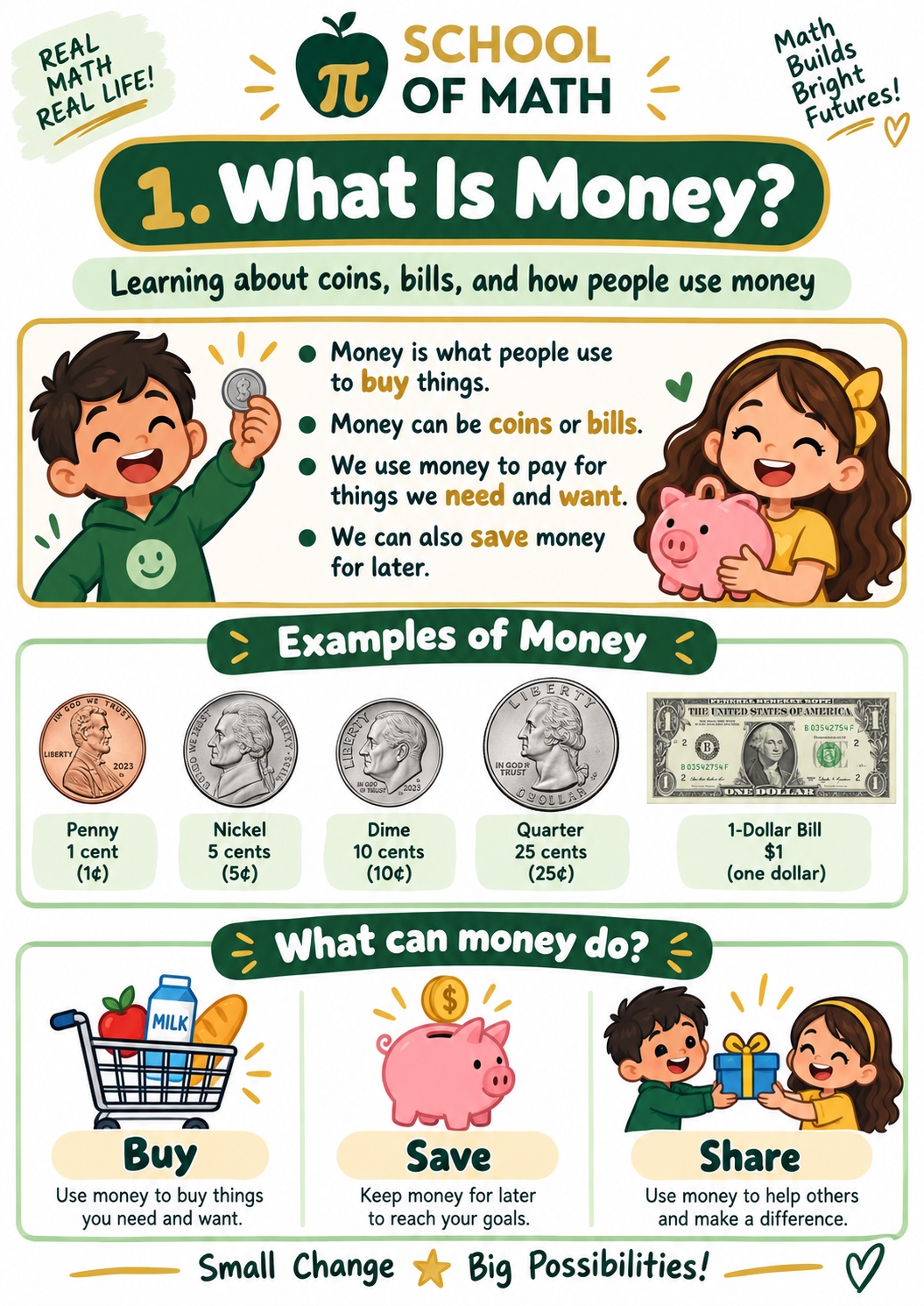
According to this SOMATH poster, money is what people use to buy things. Money can be in the form of coins or bills. We use money to pay for the things we need and the things we want — and we can also save money for later.
Examples of U.S. money (from the poster)
- Penny — 1 cent (1¢)
- Nickel — 5 cents (5¢)
- Dime — 10 cents (10¢)
- Quarter — 25 cents (25¢)
- 1-dollar bill — $1
What can money do?
The poster shows three things money can do:
- Buy — use money to buy things you need and want.
- Save — keep money for later to reach your goals.
- Share — use money to help others and make a difference.
Practice — 5 questions from this poster
-
Q1. What is money used for?
Show explanation
According to the poster, money is what people use to buy things. We use money to pay for things we need and things we want. -
Q2. What are the two forms of money shown on the poster?
Show explanation
Coins (penny, nickel, dime, quarter) and bills (like the $1 bill). -
Q3. How many cents is a quarter worth?
Show explanation
A quarter is worth 25 cents (25¢). -
Q4. The poster shows three things money can do. What are they?
Show explanation
Buy (buy things you need and want), Save (keep money for later to reach your goals), and Share (use money to help others). -
Q5. Which coin is worth more — a dime or a nickel?
Show explanation
A dime is worth more. A dime = 10¢ and a nickel = 5¢.
2. Needs vs. wants
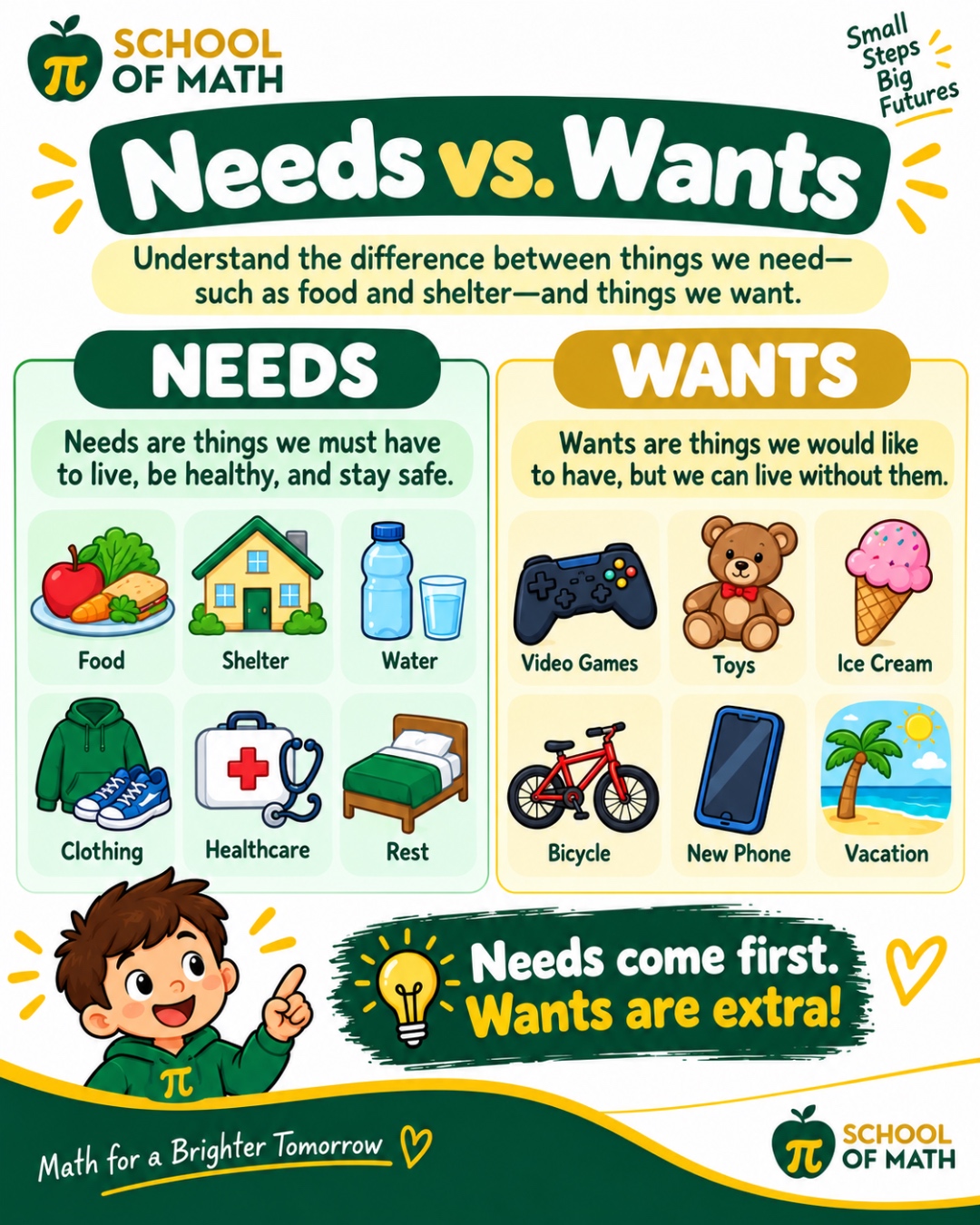
This SOMATH poster teaches the difference between things we need and things we want.
Needs
Needs are things we must have to live, be healthy, and stay safe. The poster shows six needs:
- Food
- Shelter
- Water
- Clothing
- Healthcare
- Rest
Wants
Wants are things we would like to have, but we can live without them. The poster shows six wants:
- Video games
- Toys
- Ice cream
- Bicycle
- New phone
- Vacation
Practice — 5 questions from this poster
-
Q1. What is a need?
Show explanation
A need is something we must have to live, be healthy, and stay safe — like food, water, shelter, and healthcare. -
Q2. What is a want?
Show explanation
A want is something we would like to have, but we can live without it — like a video game or a toy. -
Q3. Is ice cream a need or a want? Why?
Show explanation
A want. The poster puts ice cream on the Wants side. It’s a treat — we can live without it. -
Q4. Sort into needs and wants: shelter, video games, rest, bicycle.
Show explanation
Needs: shelter, rest. Wants: video games, bicycle. -
Q5. Fill in the blank from the bottom of the poster: “Needs come ____. Wants are ____.”
Show explanation
“Needs come first. Wants are extra.” When money is limited, pay for needs before wants.
3. Earn, spend, save, share
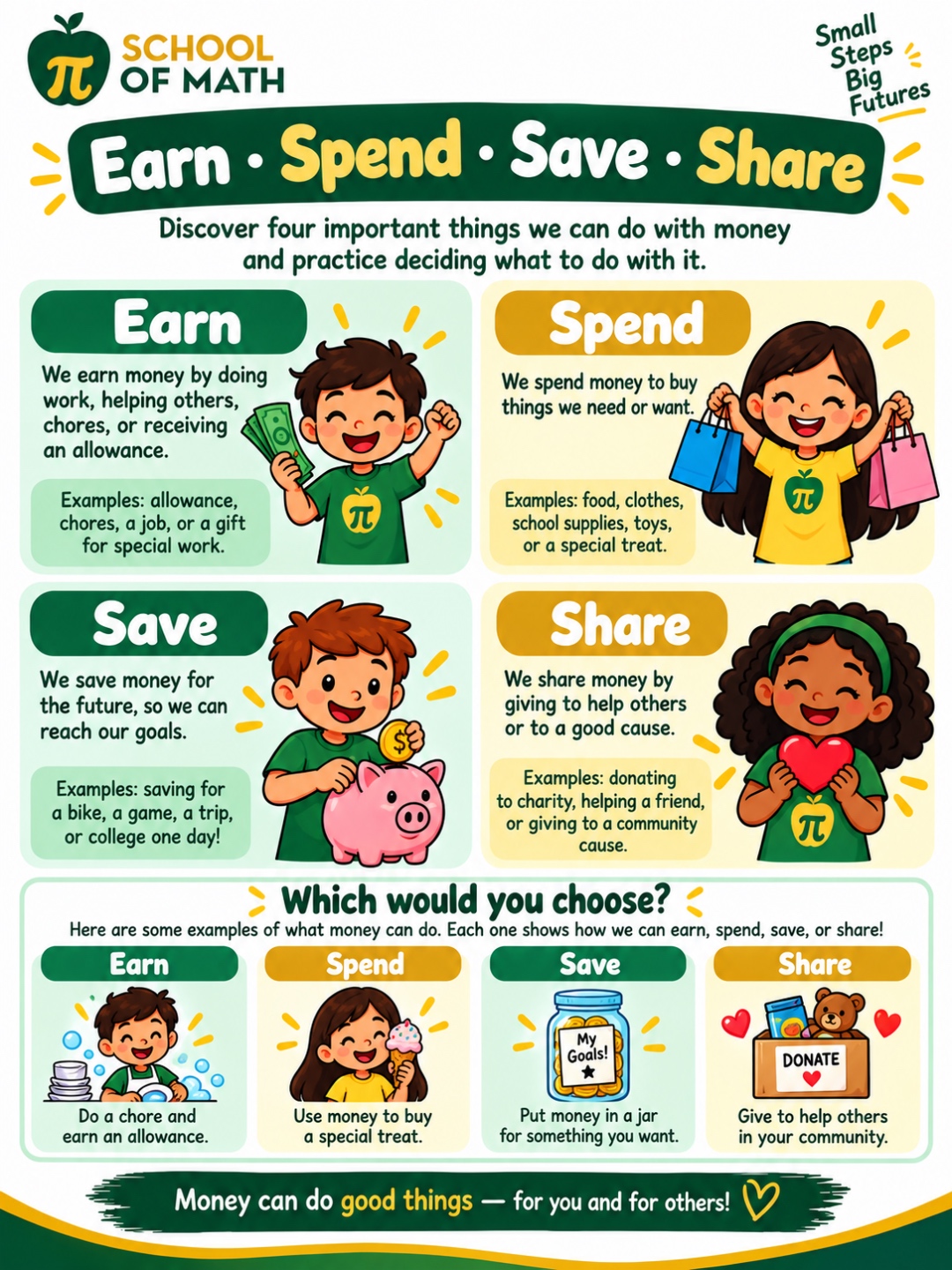
The poster says there are four important things we can do with money.
| Word | What it means (from the poster) | Examples |
|---|---|---|
| Earn | We earn money by doing work, helping others, chores, or receiving an allowance. | Allowance, chores, a job, or a gift for special work. |
| Spend | We spend money to buy things we need or want. | Food, clothes, school supplies, toys, or a special treat. |
| Save | We save money for the future, so we can reach our goals. | Saving for a bike, a game, a trip, or college one day. |
| Share | We share money by giving to help others or to a good cause. | Donating to charity, helping a friend, or giving to a community cause. |
“Which would you choose?” — the four examples on the poster
The bottom of the poster shows four everyday examples, one for each word:
- Earn — do a chore and earn an allowance.
- Spend — use money to buy a special treat.
- Save — put money in a jar for something you want.
- Share — give to help others in your community.
Practice — 5 questions from this poster
-
Q1. According to the poster, what are the four things we can do with money?
Show explanation
Earn, Spend, Save, and Share. -
Q2. Which of the four words means “we do work or chores and money comes to us”?
Show explanation
Earn. The poster says we earn money by doing work, helping others, chores, or receiving an allowance. -
Q3. Which of the four words is for money we use now to buy something?
Show explanation
Spend. -
Q4. Which of the four words is for money we keep for the future to reach a goal?
Show explanation
Save. The poster gives examples: a bike, a game, a trip, or college one day. -
Q5. On the ‘Which would you choose?’ block, which word matches the example “put money in a jar for something you want”?
Show explanation
Save. Putting money in a jar toward something you want later is saving. The other three examples on the poster are: Earn — do a chore and earn an allowance; Spend — use money to buy a special treat; Share — give to help others in your community.
4. What is a piggy bank?
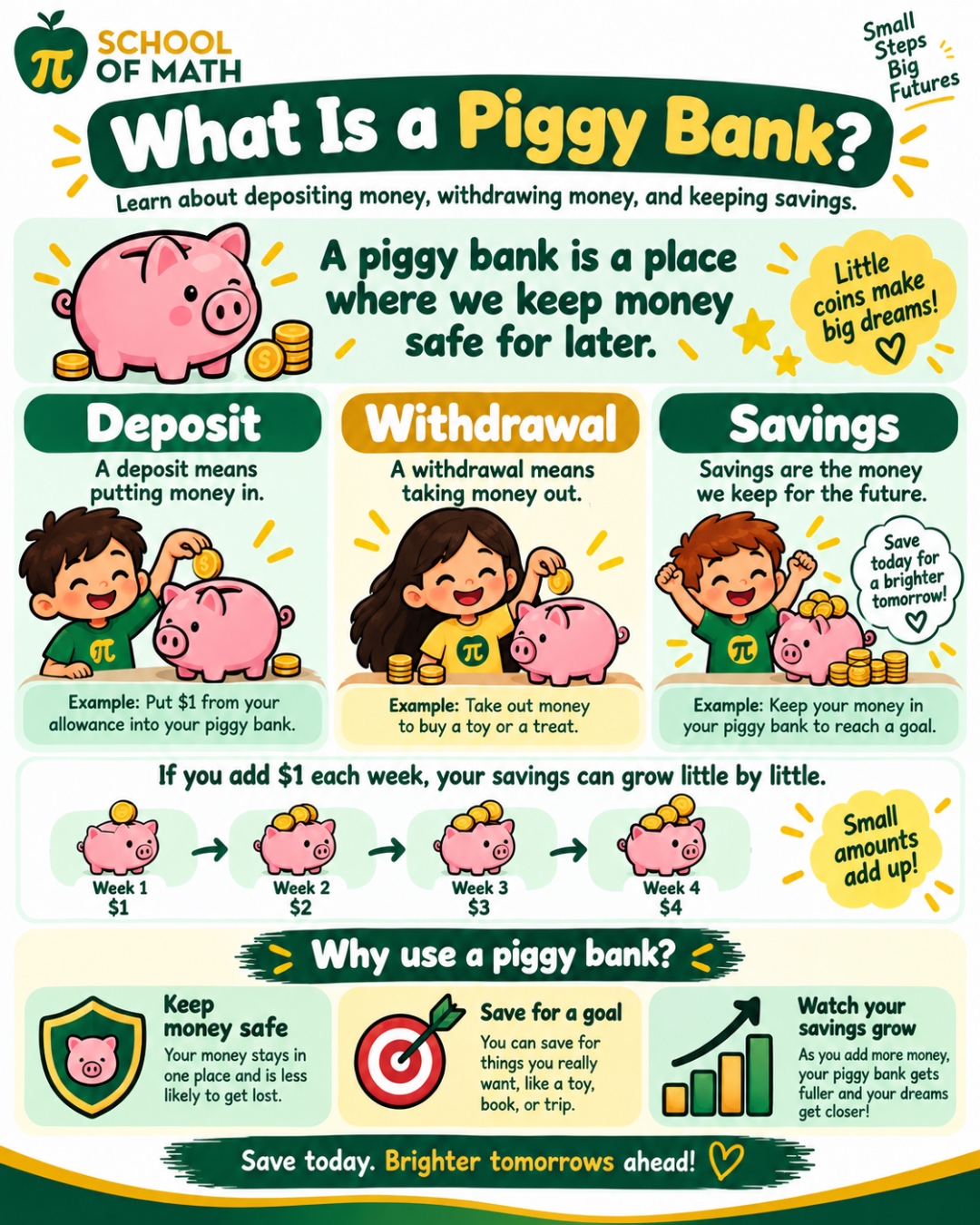
The poster defines a piggy bank as “a place where we keep money safe for later.” It teaches three important money words:
- Deposit — putting money in. Example from the poster: put $1 from your allowance into your piggy bank.
- Withdrawal — taking money out. Example: take out money to buy a toy or a treat.
- Savings — the money we keep for the future. Example: keep money in your piggy bank to reach a goal.
Small amounts add up
The poster shows a $1-a-week example: after Week 1 you have $1, after Week 2 you have $2, after Week 3 you have $3, and after Week 4 you have $4.
Why use a piggy bank?
- Keep money safe — your money stays in one place and is less likely to get lost.
- Save for a goal — you can save for something you really want, like a toy, book, or trip.
- Watch your savings grow — as you add more money, your piggy bank gets fuller and your dreams get closer.
Practice — 5 questions from this poster
-
Q1. Fill in the blank from the poster: “A piggy bank is a place where we keep money ____ for later.”
Show explanation
Safe. “A piggy bank is a place where we keep money safe for later.” -
Q2. What word means putting money in?
Show explanation
Deposit. -
Q3. What word means taking money out?
Show explanation
Withdrawal. -
Q4. The poster shows a $1-a-week savings example. How much is in the piggy bank after Week 4?
Show explanation
$4. Week 1 = $1, Week 2 = $2, Week 3 = $3, Week 4 = $4. -
Q5. Name one reason (from the poster) to use a piggy bank.
Show explanation
Any one of: keep money safe (less likely to get lost), save for a goal (a toy, book, or trip), or watch your savings grow as you add more money.
5. Saving over time — reach a goal
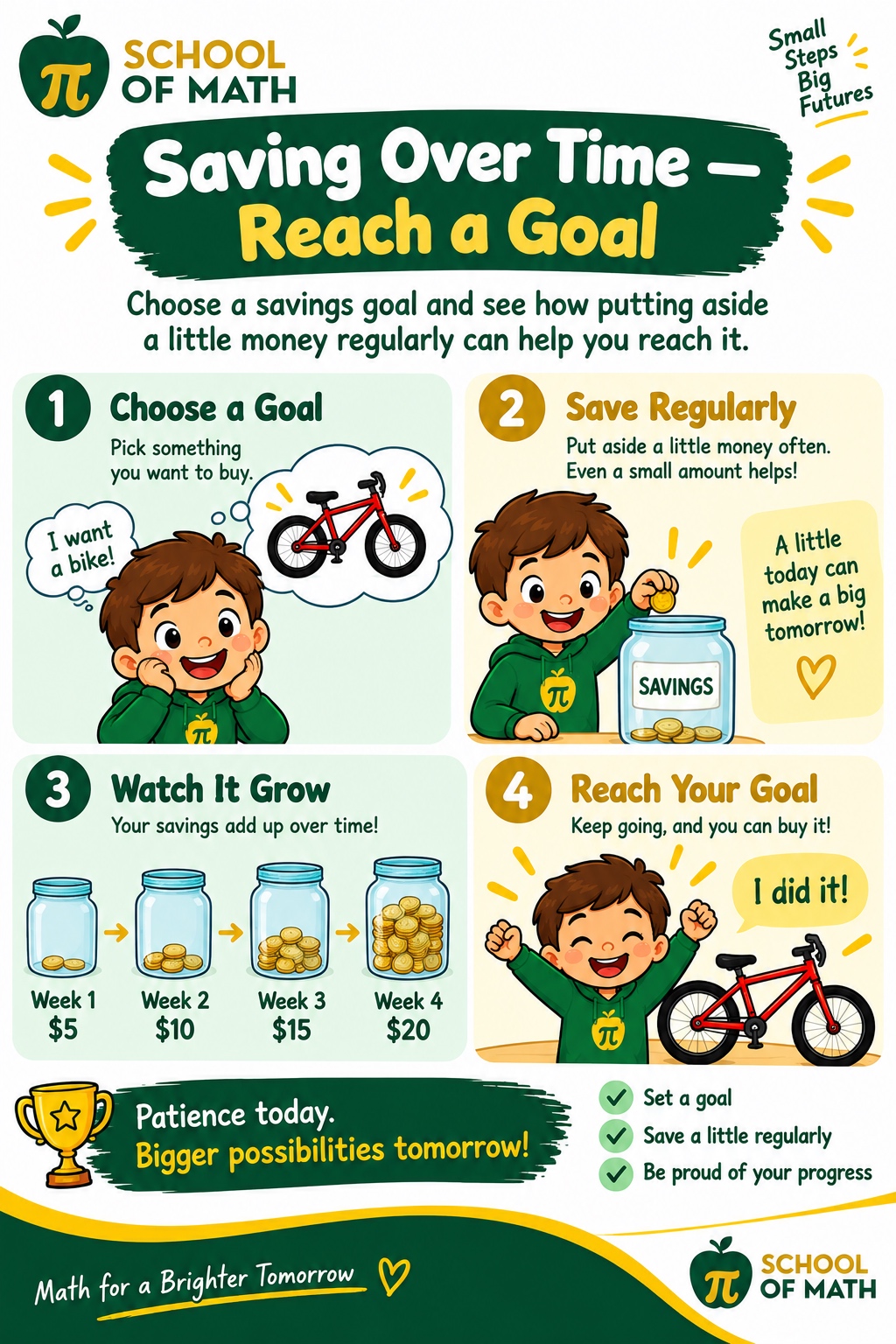
This poster gives kids a 4-step plan for saving over time.
- Choose a Goal. Pick something you want to buy (the poster shows a bike).
- Save Regularly. Put aside a little money often. Even a small amount helps.
- Watch It Grow. Your savings add up over time. The poster shows: Week 1 = $5, Week 2 = $10, Week 3 = $15, Week 4 = $20.
- Reach Your Goal. Keep going, and you can buy it — “I did it!”
How the math works
The example on the poster is $5 saved every week. That gives:
- Week 1: $5
- Week 2: $5 + $5 = $10
- Week 3: $10 + $5 = $15
- Week 4: $15 + $5 = $20
This is skip counting by 5 — the same skip counting your child will practice again in Little Newtons Class 12.
Practice — 5 questions from this poster
-
Q1. What are the four steps on the poster?
Show explanation
1) Choose a Goal, 2) Save Regularly, 3) Watch It Grow, 4) Reach Your Goal. -
Q2. In Step 1, what does the boy on the poster want?
Show explanation
A bike. The thought bubble says “I want a bike!” -
Q3. How much money is in the jar at Week 3?
Show explanation
$15. Week 1 = $5, Week 2 = $10, Week 3 = $15. -
Q4. How much money did the child save each week in the poster example?
Show explanation
$5 per week. That’s why the jar grows by $5 each week: $5 → $10 → $15 → $20. -
Q5. If the same child kept saving $5 a week for one more week, how much would be in the jar at Week 5?
Show explanation
$20 + $5 = $25.
6. Counting your savings — coins & dollars
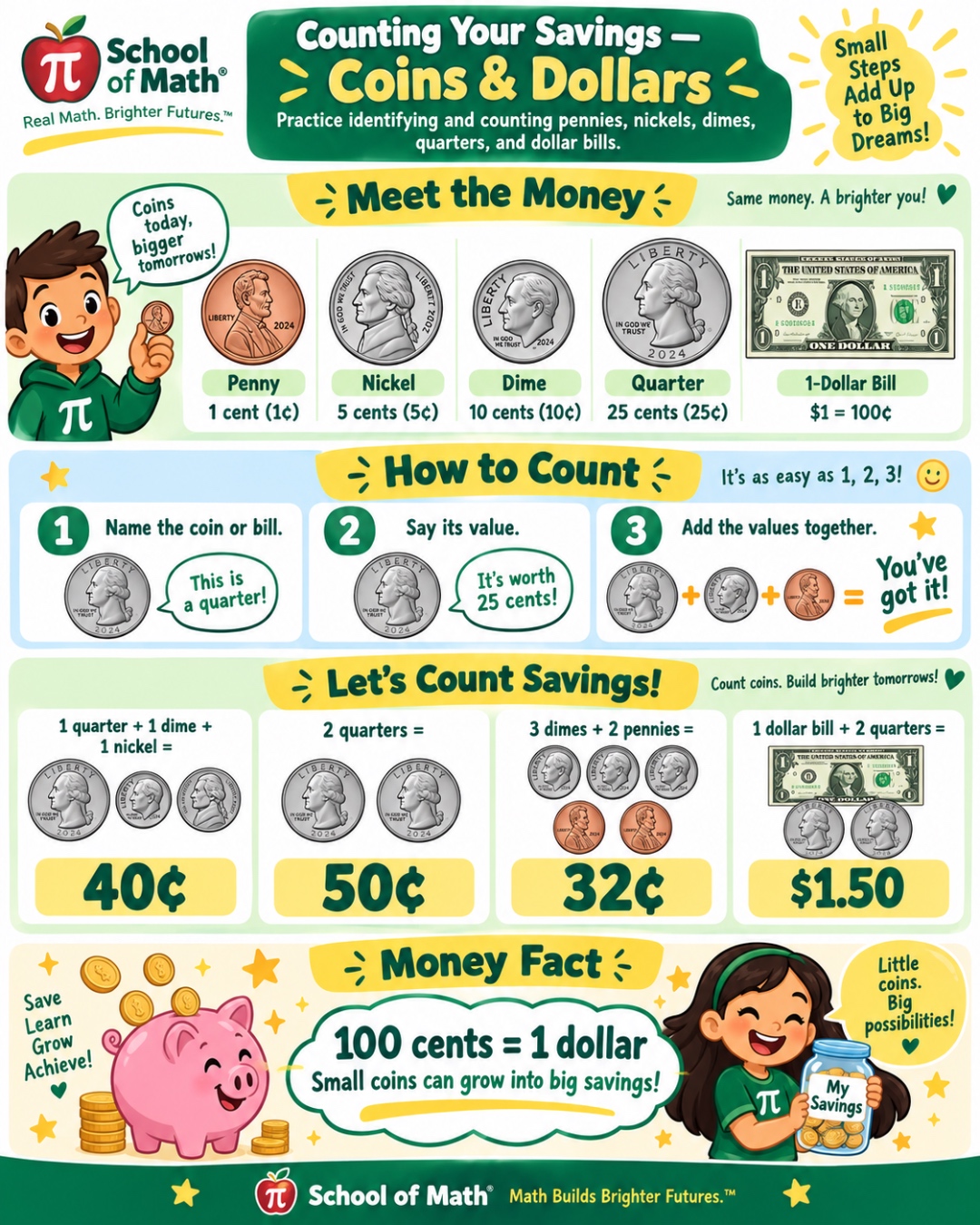
This poster teaches how to identify and count pennies, nickels, dimes, quarters, and dollar bills.
Meet the money
| Coin / Bill | Value |
|---|---|
| Penny | 1 cent (1¢) |
| Nickel | 5 cents (5¢) |
| Dime | 10 cents (10¢) |
| Quarter | 25 cents (25¢) |
| 1-Dollar Bill | $1 = 100¢ |
How to count (poster’s 3-step method)
- Name the coin or bill. (“This is a quarter!”)
- Say its value. (“It’s worth 25 cents!”)
- Add the values together.
Worked examples from the poster
- 1 quarter + 1 dime + 1 nickel = 25 + 10 + 5 = 40¢
- 2 quarters = 25 + 25 = 50¢
- 3 dimes + 2 pennies = 30 + 2 = 32¢
- 1 dollar bill + 2 quarters = $1.00 + 50¢ = $1.50
Practice — 5 questions from this poster
-
Q1. How many cents are in $1?
Show explanation
100 cents. The poster says: 100 cents = 1 dollar. -
Q2. Count: 1 quarter + 1 dime + 1 nickel = ?
Show explanation
25 + 10 + 5 = 40¢ (this is the first example on the poster). -
Q3. Count: 2 quarters = ?
Show explanation
25 + 25 = 50¢ — that’s half a dollar. -
Q4. Count: 3 dimes + 2 pennies = ?
Show explanation
30 + 2 = 32¢. -
Q5. Count: 1 dollar bill + 2 quarters = ?
Show explanation
$1.00 + 50¢ = $1.50.
7. The 3-jar system — Save · Spend · Share
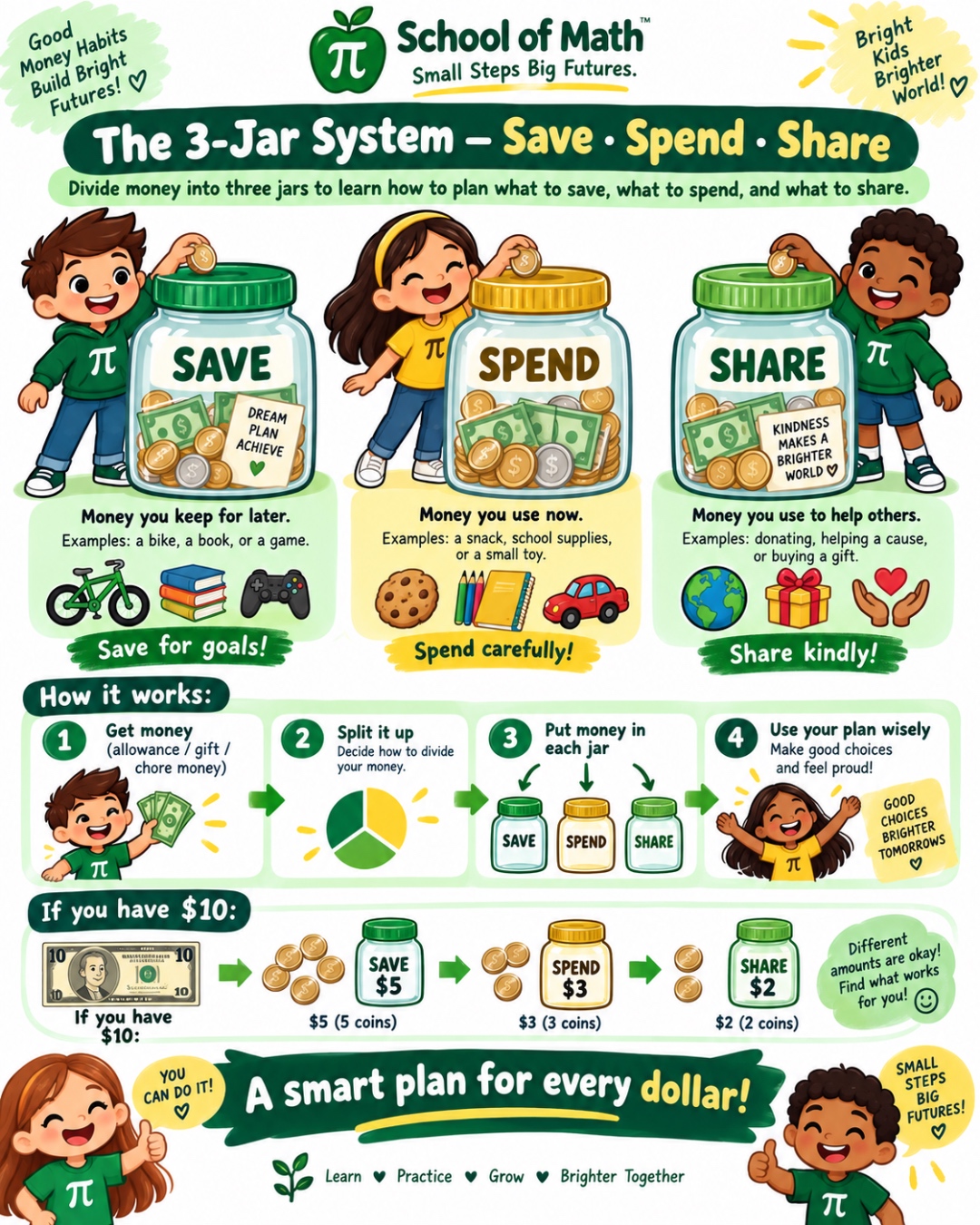
The 3-Jar System is a simple way to plan what to save, what to spend, and what to share. You divide your money into three jars.
| Jar | Meaning (from the poster) | Examples |
|---|---|---|
| SAVE | Money you keep for later. | A bike, a book, or a game. |
| SPEND | Money you use now. | A snack, school supplies, or a small toy. |
| SHARE | Money you use to help others. | Donating, helping a cause, or buying a gift. |
How it works (4 steps on the poster)
- Get money — allowance, a gift, or chore money.
- Split it up — decide how to divide your money.
- Put money in each jar.
- Use your plan wisely — make good choices and feel proud.
Poster example: if you have $10
- SAVE = $5
- SPEND = $3
- SHARE = $2
Total: $5 + $3 + $2 = $10. Every dollar has a job. The poster reminds kids: “Different amounts are okay — find what works for you.”
Practice — 5 questions from this poster
-
Q1. Name the three jars on the poster.
Show explanation
SAVE, SPEND, and SHARE. -
Q2. Which jar is for “money you keep for later”?
Show explanation
SAVE. Examples on the poster: a bike, a book, or a game. -
Q3. Which jar is for “money you use now”?
Show explanation
SPEND. Examples on the poster: a snack, school supplies, or a small toy. -
Q4. The poster shows an example with $10. How does it split up?
Show explanation
SAVE = $5, SPEND = $3, SHARE = $2. Total: $5 + $3 + $2 = $10. -
Q5. The poster lists 4 steps for how the 3-jar system works. What is Step 1?
Show explanation
Get money (from an allowance, a gift, or chore money).
8. Everyday money decisions
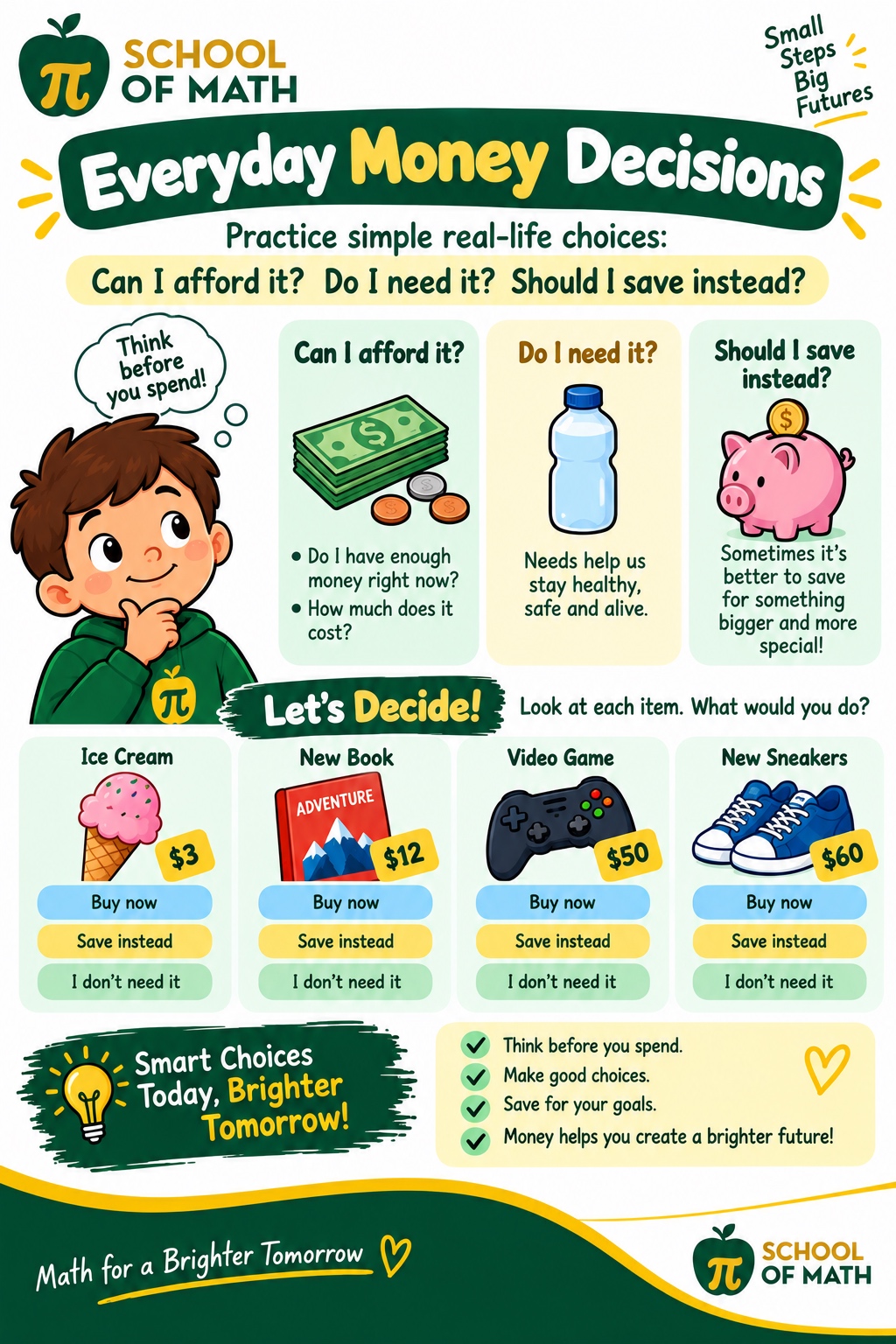
Before buying anything, this poster teaches kids to ask three questions:
- Can I afford it? Do I have enough money right now? How much does it cost?
- Do I need it? Needs help us stay healthy, safe, and alive.
- Should I save instead? Sometimes it’s better to save for something bigger and more special.
“Let’s Decide” — the four items on the poster
| Item | Price | Choices |
|---|---|---|
| Ice Cream | $3 | Buy now · Save instead · I don’t need it |
| New Book | $12 | Buy now · Save instead · I don’t need it |
| Video Game | $50 | Buy now · Save instead · I don’t need it |
| New Sneakers | $60 | Buy now · Save instead · I don’t need it |
Practice — 5 questions from this poster
-
Q1. Name the three questions the poster asks you to think about before buying.
Show explanation
1) Can I afford it? 2) Do I need it? 3) Should I save instead? -
Q2. You have $10 in your SPEND jar and the video game costs $50. Can you afford it?
Show explanation
No. $10 is less than $50, so you cannot afford it right now. You would need to save $40 more (or pick something you can afford). -
Q3. Your feet grew and your old sneakers don’t fit. The New Sneakers on the poster cost $60. Is this a need or a want?
Show explanation
A need. Shoes that fit are on the needs side (like on Poster 2). If your feet grew and old shoes don’t fit, new shoes are a need. -
Q4. You have $5 in your SPEND jar. The ice cream costs $3 and the new book costs $12. Which one can you afford today?
Show explanation
You can afford the ice cream ($3 is less than $5). The book costs $12, and $12 is more than $5, so you can’t buy the book yet — you would need to save $7 more. -
Q5. Fill in the poster’s ending: “Smart choices today, ______ tomorrow.”
Show explanation
Brighter. “Smart choices today, brighter tomorrow.”
Frequently asked questions
What is a need vs. a want (for kids)?
What are the four things you can do with money?
What is the 3-jar system for kids?
How do you count coins and dollars?
What questions should a child ask before buying something?
What age is this class pack for?
Where does SOMATH meet, and how do I enroll?
Ready to enroll?
SOMATH Little Newtons meets in small in-person groups at 226 W 79th St, 1st Floor, New York, NY 10024 (Upper West Side). Book a free evaluation and we’ll place your child at the right entry point in the rolling syllabus.
Book a free evaluation → See the class schedule → Call (646) 668-6151