Little Newtons · Class 1 · Grades 1–2
Number Sense to 20: Counting and Comparing
Number sense to 20 means knowing what numbers represent, counting objects accurately, and comparing amounts. In this Little Newtons class, children count forward and backward, use a number line, and explain which group has more, fewer, or the same number.
Study the eight images in order. After each image, try five new questions that increase in difficulty. Finish with ten word problems, for 50 questions altogether. Each question has a small blue Answer button with a worked explanation; the practice is different from the poster examples.
This lesson belongs to the Little Newtons program. View the class schedule or book an evaluation to discuss a starting point for your child.
Understanding numbers 0–20
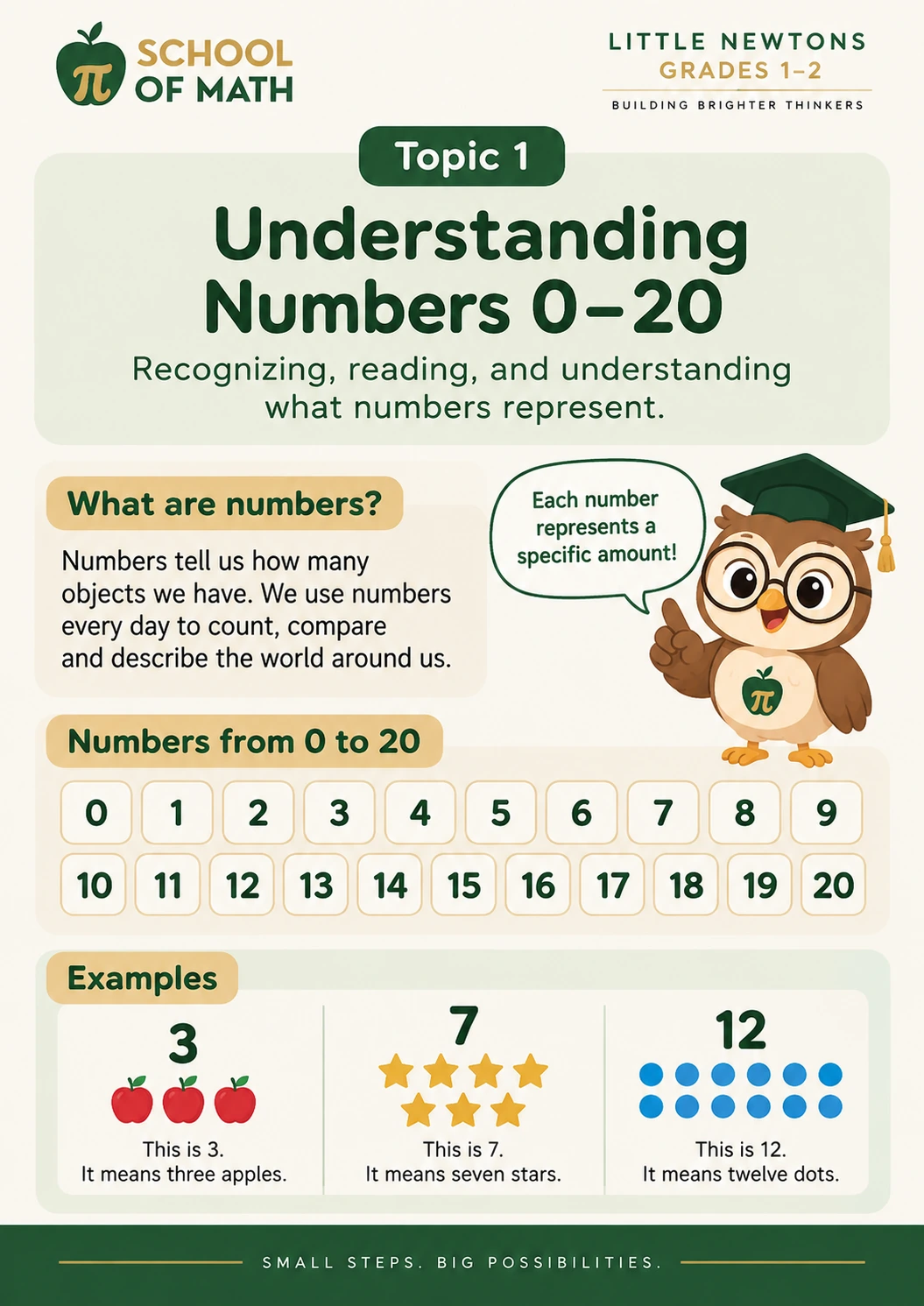
A numeral is a written number, and a number word is its name. Both can tell us an amount. Zero means there are no objects in a group. Count carefully, then connect the amount to its numeral and name.
Try it yourself: five questions, increasing difficulty
Q1 Practice 1 of 5 · Start
An empty basket has no balls. Which numeral tells how many balls are in it?
Answer
0.
Zero means none. Do not start at one when there are no objects to count.
Q2 Practice 2 of 5 · Build
Write the numeral for “six.” Then say the number word for 9.
Answer
6; nine.
The word six matches the numeral 6. The numeral 9 is read as nine.
Q3 Practice 3 of 5 · Apply
Which numeral means “fourteen”: 4, 14, or 17? Explain your choice.
Answer
14.
Fourteen is one group of ten and four more. It is not just four.
Q4 Practice 4 of 5 · Explain
A group has one full ten and eight extra counters. Write the numeral and its number word.
Answer
18; eighteen.
Start with ten, then count eight more: 11, 12, 13, 14, 15, 16, 17, 18.
Q5 Practice 5 of 5 · Challenge
A mystery number is one more than 16 and one less than 18. What is it? Show how both clues fit.
Answer
17.
The next number after 16 is 17. The number immediately before 18 is also 17.
Counting forward
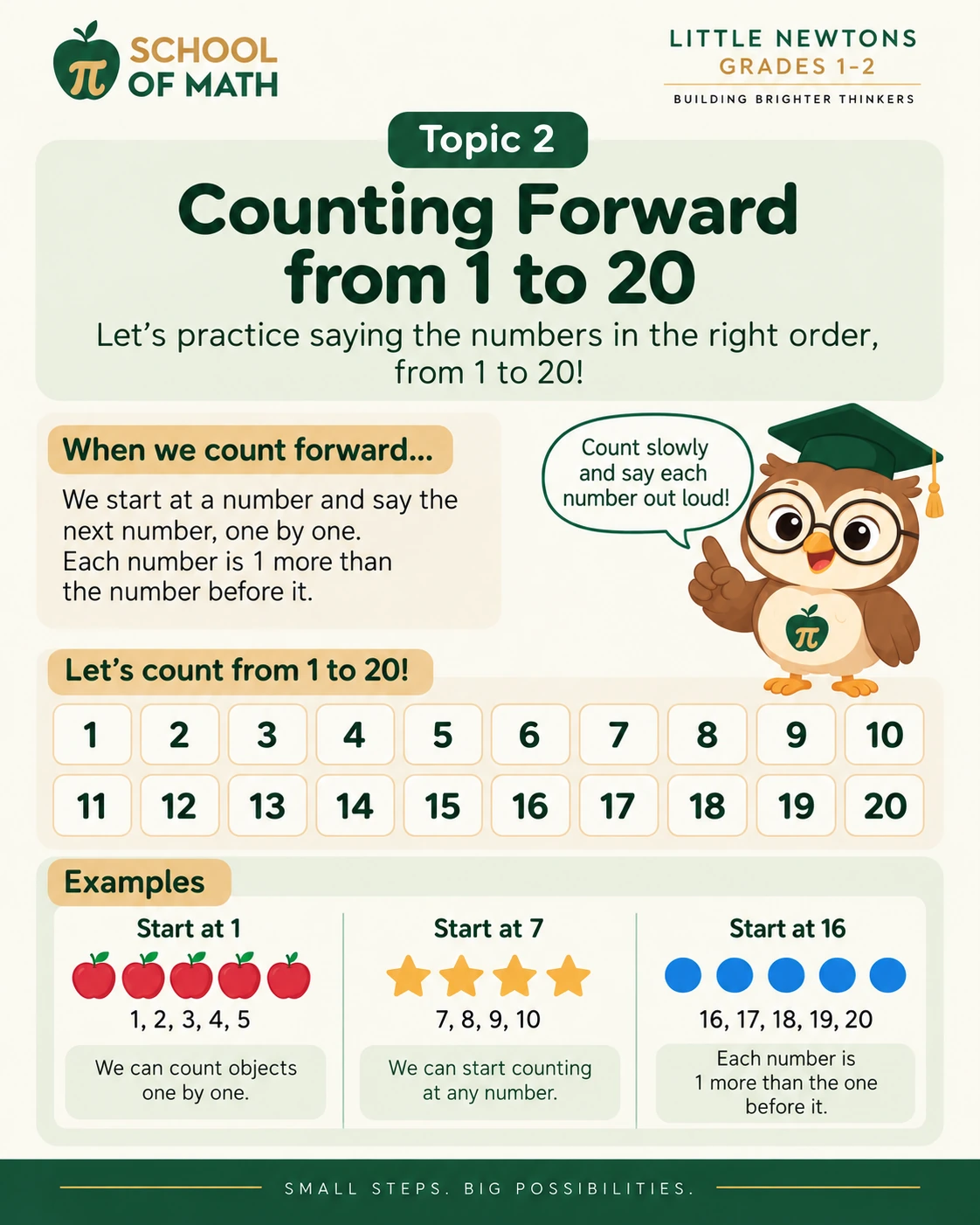
Counting forward by ones means saying the next number each time. You can start at any number; you do not need to restart at one. When a question asks for three steps after a starting number, do not count the starting number as a step.
Try it yourself: five questions, increasing difficulty
Q6 Practice 1 of 5 · Start
Start at 3. Say the next two numbers.
Answer
4, 5.
Each number is one more: 3, 4, 5. The two numbers after 3 are 4 and 5.
Q7 Practice 2 of 5 · Build
Fill in the missing number: 9, 10, __, 12.
Answer
11.
Count forward by one. Eleven comes between ten and twelve.
Q8 Practice 3 of 5 · Apply
Start at 12. Write the next four numbers.
Answer
13, 14, 15, 16.
Keep going one at a time. The starting number 12 is not one of the four new numbers.
Q9 Practice 4 of 5 · Explain
Fill both gaps: 13, __, 15, __, 17.
Answer
14 and 16.
Read the completed count: 13, 14, 15, 16, 17. Each step adds one.
Q10 Practice 5 of 5 · Challenge
Lena says, “8, 9, 11, 12, 13.” Which number did she skip? Rewrite the count without a gap.
Answer
She skipped 10. The count is 8, 9, 10, 11, 12, 13.
Ten comes immediately after nine and before eleven. Check every neighboring pair.
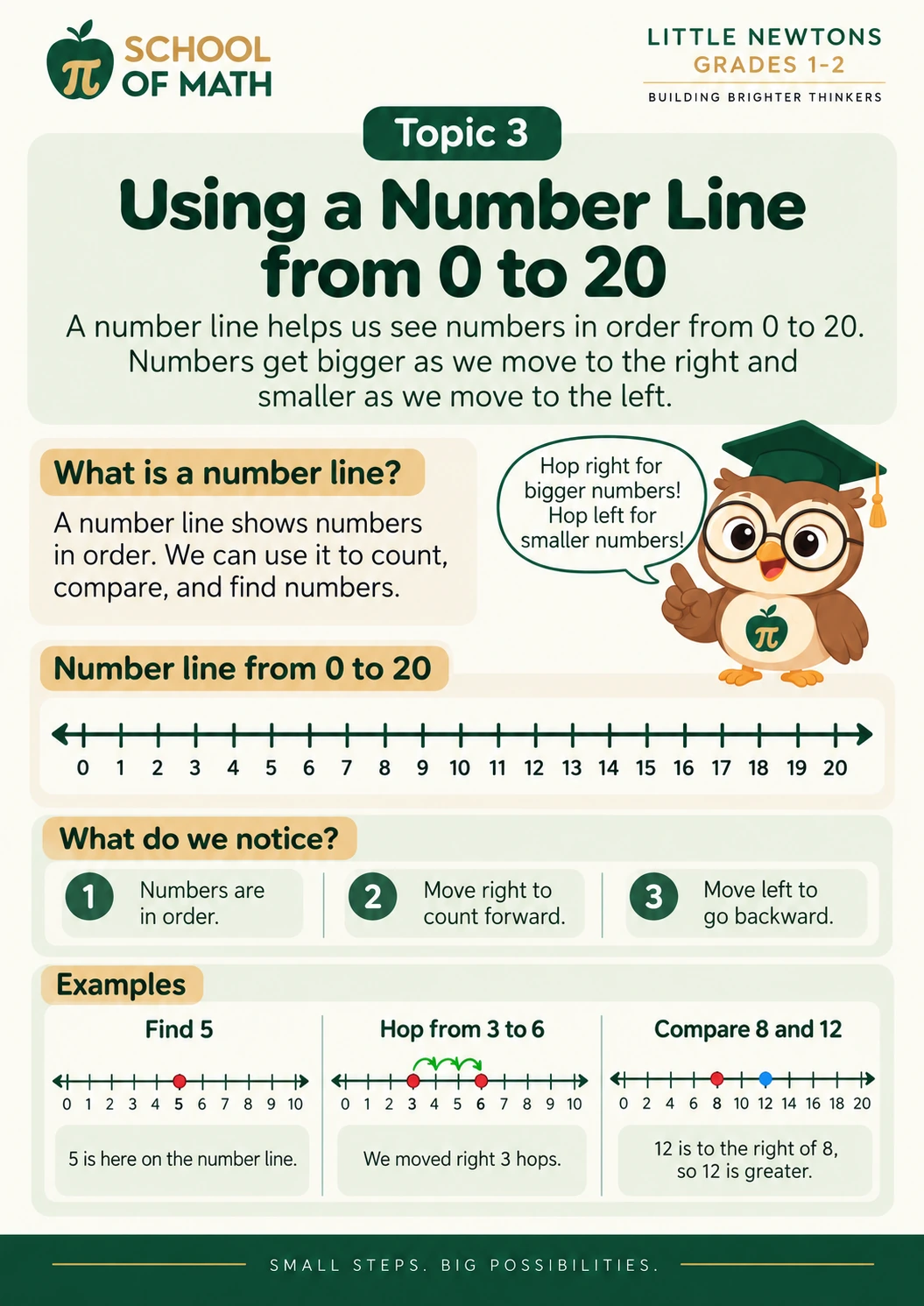
Using a number line
- 0
- 1
- 2
- 3
- 4
- 5
- 6
- 7
- 8
- 9
- 10
- 11
- 12
- 13
- 14
- 15
- 16
- 17
- 18
- 19
- 20
On a number line that marks every whole number, one space is one step. Move right for a larger number and left for a smaller number. Count the spaces you move, not the starting position. The complete strip below includes every number from zero to twenty.
Try it yourself: five questions, increasing difficulty
Q11 Practice 1 of 5 · Start
On the number line, what number is one step to the right of 6?
Answer
7.
Moving one space right makes the number one greater: 6 to 7.
Q12 Practice 2 of 5 · Build
Start at 11 and hop two spaces right. Where do you land?
Answer
13.
The two landing numbers are 12 and 13.
Q13 Practice 3 of 5 · Apply
Start at 16 and hop three spaces left. Where do you land?
Answer
13.
Count the landing numbers backward: 15, 14, 13.
Q14 Practice 4 of 5 · Explain
How many one-space hops take you from 9 to 14? In which direction do you move?
Answer
Five hops to the right.
The landing numbers are 10, 11, 12, 13, 14. There are five hops, even though six numbers appear when the starting point is included.
Q15 Practice 5 of 5 · Challenge
Start at 7, hop four spaces right, and then hop two spaces left. Where do you finish?
Answer
9.
First land at 11 by counting 8, 9, 10, 11. Then move left to 10 and 9.
Counting backward
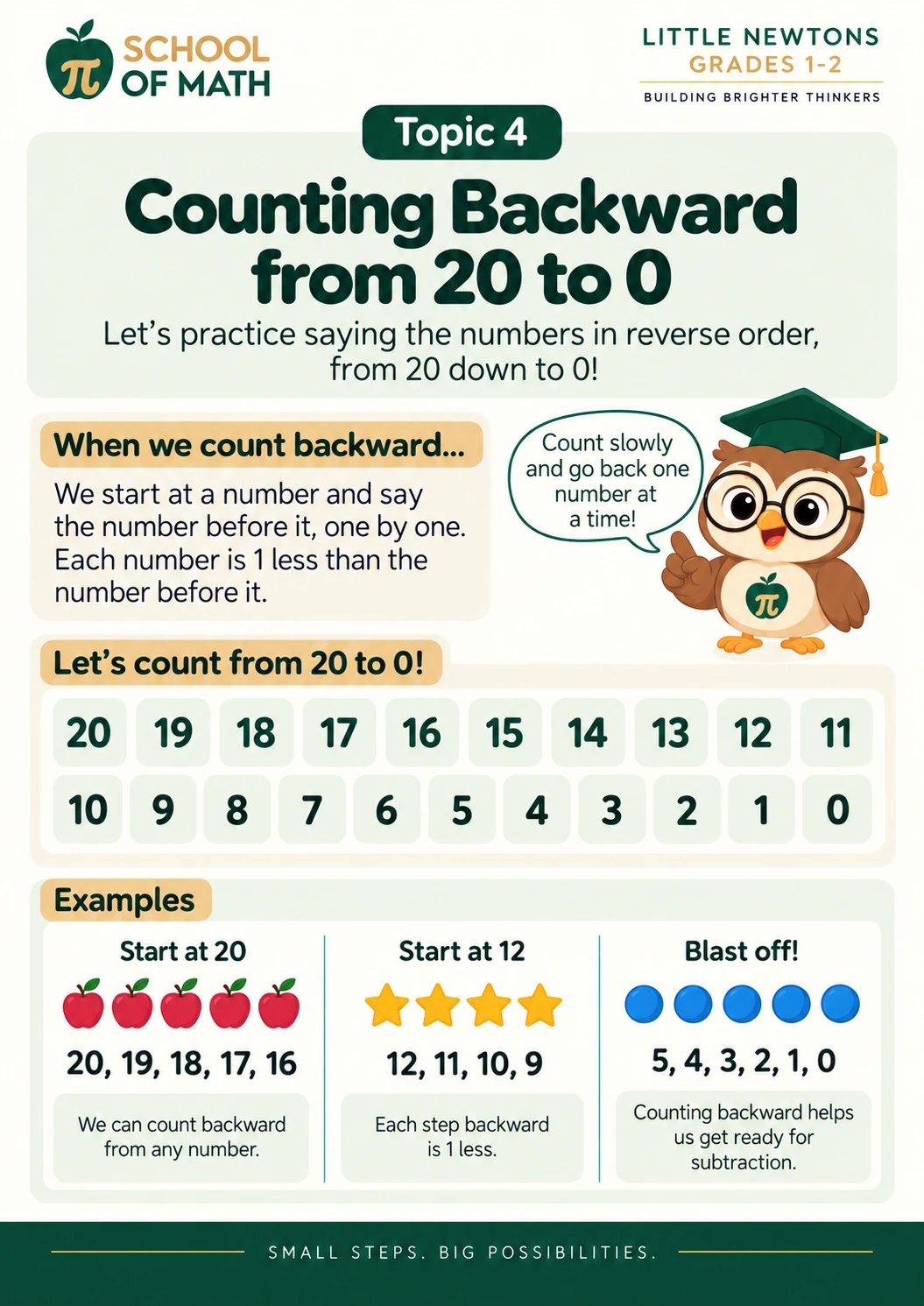
Counting backward by ones means saying the number that is one less each time. Practice crossing ten carefully: eleven, ten, nine. When you are counting objects left after some are removed, move back one number for each object removed.
Try it yourself: five questions, increasing difficulty
Q16 Practice 1 of 5 · Start
Start at 8. Say the next two numbers when counting backward.
Answer
7, 6.
Each number is one less than the number before it.
Q17 Practice 2 of 5 · Build
Fill the gap: 15, 14, __, 12.
Answer
13.
The complete count is 15, 14, 13, 12.
Q18 Practice 3 of 5 · Apply
Start at 11. Write the next four numbers counting backward.
Answer
10, 9, 8, 7.
Move down one at a time. Ten comes between eleven and nine.
Q19 Practice 4 of 5 · Explain
Fill both gaps: 18, __, 16, __, 14, 13.
Answer
17 and 15.
Read the sequence again: 18, 17, 16, 15, 14, 13.
Q20 Practice 5 of 5 · Challenge
Noah says, “14, 13, 11, 10.” Find the missing number, then continue the corrected count down to 8.
Answer
Missing number: 12. Correct count: 14, 13, 12, 11, 10, 9, 8.
Insert twelve between thirteen and eleven. Keep decreasing by one until eight.
Counting objects once each
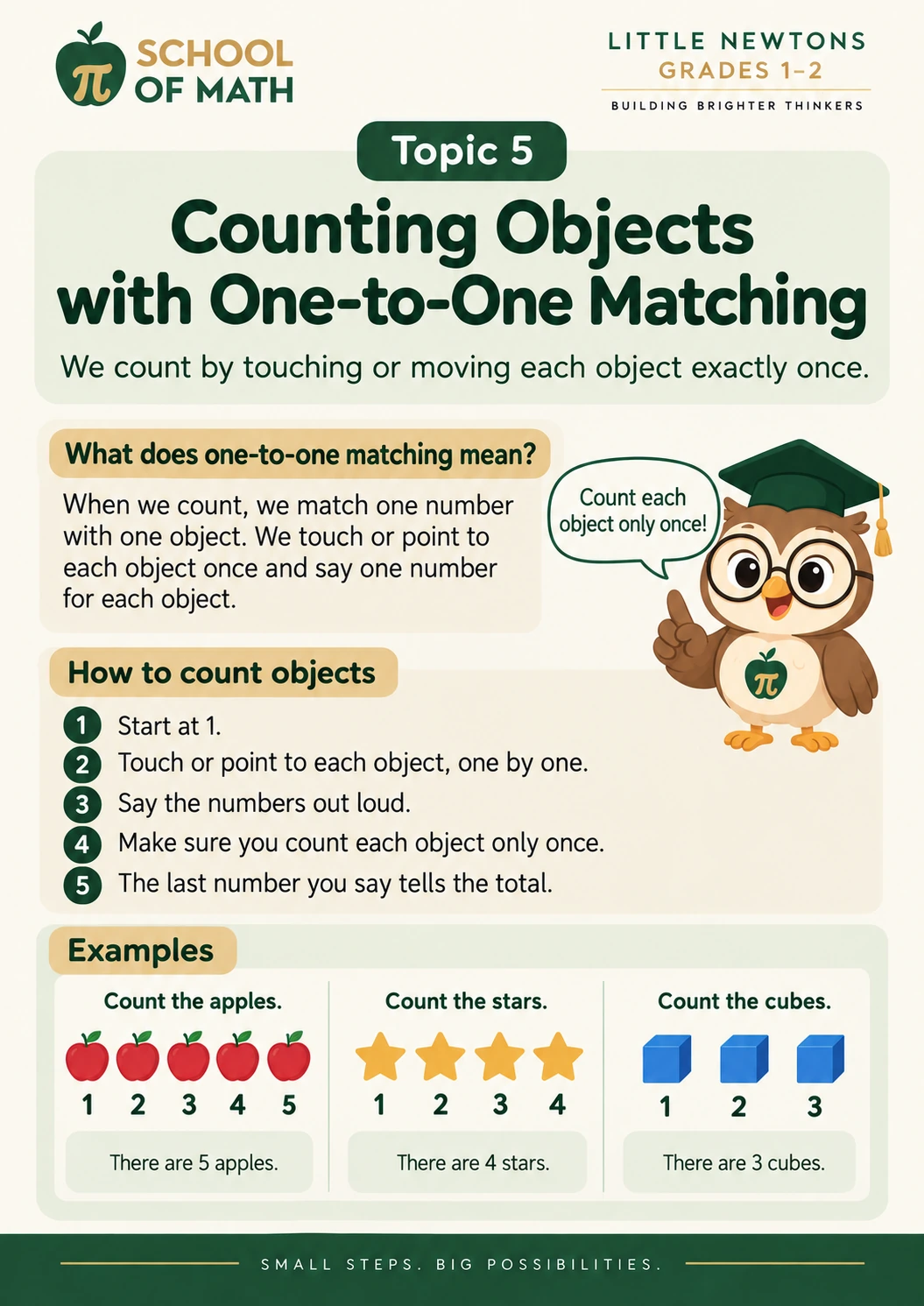
Match one spoken number to one object. Point to each object, or move it into a counted pile, so you neither skip it nor count it twice. If objects are in rows, count one row at a time. A new row does not mean you restart at one.
Try it yourself: five questions, increasing difficulty
Q21 Practice 1 of 5 · Start
Count these counters. Touch or point to each counter once.
Answer
6 counters.
Say 1, 2, 3, 4, 5, 6 while pointing to one new counter for each number.
Q22 Practice 2 of 5 · Build
Count all the counters in both rows. Do not restart at one on the second row.
Answer
9 counters.
The first row has five. Continue 6, 7, 8, 9 across the second row, giving nine altogether.
Q23 Practice 3 of 5 · Apply
A tray contains 11 beads. You move 8 beads into a counted pile. How many beads still need to be counted?
Answer
3 beads.
After eight, there are three more beads to count: the ninth, tenth, and eleventh.
Q24 Practice 4 of 5 · Explain
There are 13 buttons. A child counts every button, but counts exactly one button twice. What total does the child say, and what is the correct total?
Answer
The child says 14; the correct total is 13.
One button was included an extra time. Recount each button once to get thirteen.
Q25 Practice 5 of 5 · Challenge
There are 16 counters. Sam counts every counter except one, and counts exactly one of the other counters twice. He says 16. Is his counting method correct? Explain.
Answer
No. His total happens to be 16, but his method is not correct.
Missing one counter removes one from the count; counting another twice adds one back. The mistakes cancel, but he must still count every counter exactly once.
Understanding “how many?”
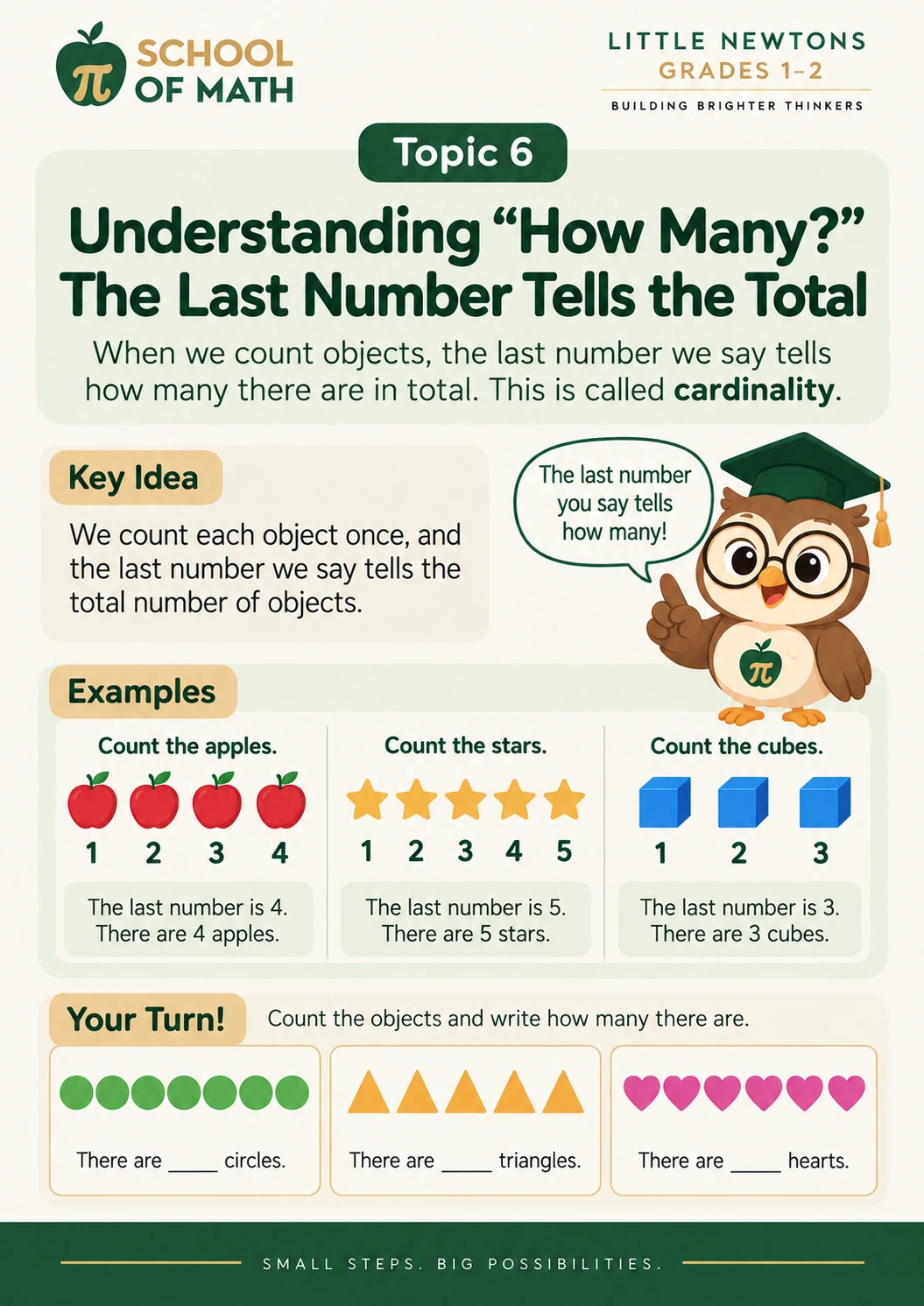
When you count each object exactly once starting at one, the last number you say tells the total. This idea is called cardinality. Rearranging a group does not change how many objects it contains. Adding or removing an object does change the total.
Try it yourself: five questions, increasing difficulty
Q26 Practice 1 of 5 · Start
You count a group correctly and the last number you say is 8. How many objects are in the group?
Answer
8 objects.
The final number in a correct count tells the size of the whole group.
Q27 Practice 2 of 5 · Build
Count the counters. What is the last number you say, and how many counters are there?
Answer
The last number is 10, so there are 10 counters.
Count one counter for each number from one to ten. Ten describes the whole group, not only the last counter.
Q28 Practice 3 of 5 · Apply
You count 12 shells. You spread the same shells farther apart without adding or removing any. How many shells are there now?
Answer
12 shells.
Only their positions changed. A longer row does not automatically mean more objects.
Q29 Practice 4 of 5 · Explain
You count 15 beads. One more bead is added. What is the new total? Can you find it without recounting from one?
Answer
16 beads.
Yes. Keep the known total fifteen and count one more: sixteen.
Q30 Practice 5 of 5 · Challenge
You count 18 blocks. You put 3 blocks into a bag and spread the remaining blocks into a circle. How many blocks are outside the bag? Explain whether the circle changes the total.
Answer
15 blocks remain outside the bag.
Count back three from eighteen: 17, 16, 15. Moving those fifteen into a circle does not add or remove any.
Comparing quantities
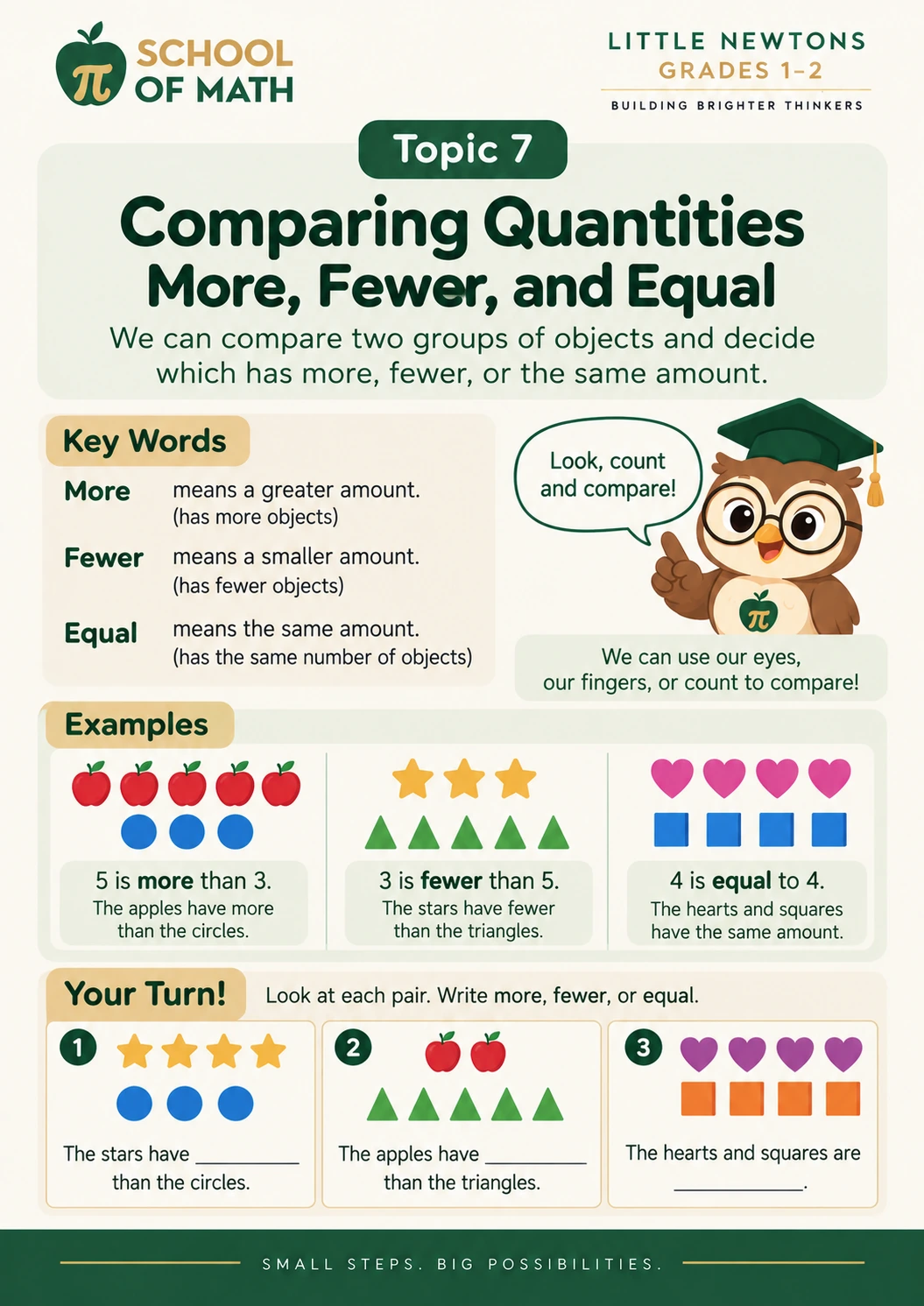
More and fewer compare how many objects there are, not how large the objects look. Two groups are equal when they have the same number. Pair one object in the first group with one in the second; leftovers show which group has more and how many more.
Try it yourself: five questions, increasing difficulty
Q31 Practice 1 of 5 · Start
One plate has 6 crackers and another has 9 crackers. Which plate has more?
Answer
The plate with 9 crackers.
Nine is greater than six. Pair six crackers from each plate and three remain on the second.
Q32 Practice 2 of 5 · Build
One box has 11 toy cars and another has 8 toy cars. Which box has fewer?
Answer
The box with 8 toy cars.
Eight is less than eleven, so it is the smaller group.
Q33 Practice 3 of 5 · Apply
A row has 10 buttons. A circle also has 10 buttons. Are the quantities more, fewer, or equal?
Answer
Equal.
Each group has ten. The different arrangements do not change the counts.
Q34 Practice 4 of 5 · Explain
There are 7 large blocks and 12 tiny beads. Which group has more objects, and how many more?
Answer
The beads have 5 more objects.
Pair seven beads with the seven blocks. Five beads remain. The size of an object does not change how many objects it counts as.
Q35 Practice 5 of 5 · Challenge
A red tray has 14 counters and a blue tray has 9. You add 3 counters to the blue tray. Which tray now has more, and by how many?
Answer
The red tray has 2 more.
The blue tray now has twelve: 10, 11, 12 after nine. Compare fourteen with twelve; two red counters remain after pairing.
Comparing numbers with <, >, and =
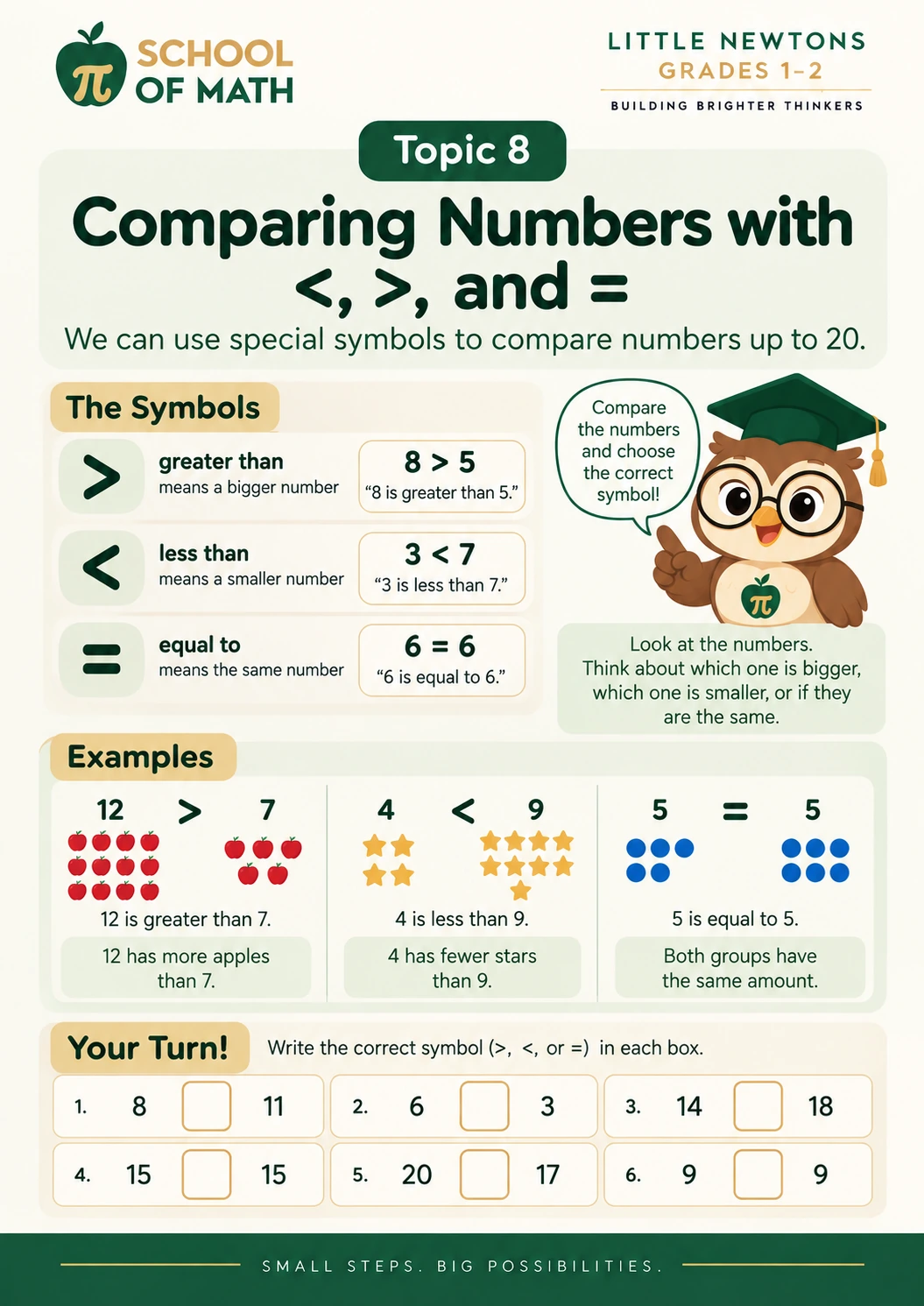
Read a comparison from left to right. The symbol < means less than, > means greater than, and = means equal to. The open side of < or > faces the greater number; the point faces the smaller number. Work out each side first if it contains a count or an addition.
Try it yourself: five questions, increasing difficulty
Q36 Practice 1 of 5 · Start
Choose <, >, or = to make this true: 2 __ 6.
Answer
2 < 6.
Two is less than six. The open side faces six.
Q37 Practice 2 of 5 · Build
Choose <, >, or =: 16 __ 13.
Answer
16 > 13.
Sixteen is greater than thirteen. The open side faces sixteen.
Q38 Practice 3 of 5 · Apply
Choose <, >, or =: 10 __ 10. Read the sentence aloud.
Answer
10 = 10. Ten is equal to ten.
The two amounts are the same, so use the equals sign.
Q39 Practice 4 of 5 · Explain
Put 6, 19, and 12 in increasing order. Use < between the numbers.
Answer
6 < 12 < 19.
Increasing order goes from least to greatest. Six comes first, then twelve, then nineteen.
Q40 Practice 5 of 5 · Challenge
Fill both blanks with comparison symbols: 8 + 3 __ 12 and 18 − 4 __ 14.
Answer
8 + 3 < 12 and 18 − 4 = 14.
Count on three from eight to get eleven; eleven is less than twelve. Count back four from eighteen to get fourteen, which equals fourteen.
Ten final word problems
Start with a simple count, then work toward two-step stories and equal groups. Draw or move objects, explain your thinking, and include what the number counts in your answer.
W1 Library books
A reading corner has 4 books. A teacher adds 2 more. How many books are there now?
Answer
6 books.
Start at four and count two more: five, six.
W2 Crayon box
Mila has 9 crayons. She puts 1 crayon away. How many crayons are still on her desk?
Answer
8 crayons.
One less than nine is eight.
W3 Game-board hops
Owen’s game piece is on 6. He moves forward 5 spaces. On which number does he land?
Answer
11.
Count the landing spaces: 7, 8, 9, 10, 11. The starting square does not count as a move.
W4 Giving each child a cup
There are 12 children at a table and 10 cups. Every child needs one cup. How many more cups are needed?
Answer
2 more cups.
Pair ten cups with ten children. Two children are left without cups.
W5 Sticker collections
Ana has 13 stickers and Ben has 9. Who has more, and how many more?
Answer
Ana has 4 more stickers.
Count from nine up to thirteen: 10, 11, 12, 13. Four extra stickers are needed to match Ana’s group.
W6 Beads in a circle
Leo counts 15 beads. He moves them into a circle and then adds 2 beads. How many beads are in the circle now?
Answer
17 beads.
Rearranging leaves the count at fifteen. Adding two gives sixteen, seventeen.
W7 Seats on a bus
A small bus has 18 seats. At first, 14 seats are occupied. Then 2 more children sit in empty seats. How many seats are empty now?
Answer
2 seats.
At first four seats are empty because fourteen and four make eighteen. Two of those four become occupied, leaving two empty seats.
W8 Fruit baskets
Basket A has 11 oranges. Basket B has 8 oranges. A teacher adds 2 oranges to Basket B. Which basket has more now, and by how many?
Answer
Basket A has 1 more orange.
Basket B now has ten. Compare eleven with ten: Basket A has one more.
W9 Toy-car parking
There are 17 toy cars in a parking lot. First, 4 cars leave. Then 3 cars arrive. How many cars are there now? Is this more or fewer than at the start?
Answer
16 cars, which is 1 fewer than at the start.
Count back four from seventeen to thirteen. Count on three to sixteen. Sixteen is one less than seventeen.
W10 Making two teams equal
Team Green has 12 counters and Team Gold has 8. You may move counters from Green to Gold, without adding or removing any. How many counters should you move to make the groups equal?
Answer
Move 2 counters. Each team will have 10.
After moving one counter, the groups have eleven and nine. Move one more, and the groups have ten and ten. Each move makes Green one smaller and Gold one larger.
Quick questions and answers
What is number sense to 20?
It means recognizing numbers from zero to twenty, counting accurately, connecting a numeral to an amount, and comparing which amount is greater, smaller, or equal.
How should a child count objects?
Point to or move each object exactly once and say one number for each object. Starting at one, the last number spoken gives the total.
Does spreading objects apart make a group larger?
No. Moving the same objects changes their arrangement, not their number. The total changes only when objects are added or removed.
How do forward and backward counting work?
When counting by ones, each forward step is one more and each backward step is one less. On a number line with every whole number marked, move right to count forward and left to count backward.
How do children choose <, >, or =?
Compare the amounts first. Use < for less than, > for greater than, and = for the same amount. The open side of < or > faces the greater number.
What practice is included in Little Newtons Class 1?
The class contains eight posters in order, five original questions after every poster, and ten final word problems. All fifty questions have hidden worked answers and stay within the zero-to-twenty range.