Regents Geometry · Math Enrichment
Parallel Lines in a Triangle & the Midsegment Theorem: SOMATH’s Regents Geometry Guide
The Basic Proportionality Theorem (Thales' Theorem), its converse, and the Midsegment Theorem — three of the most heavily tested proportionality theorems on the NY Regents Geometry exam — explained with diagrams, worked examples, and the K–12 SOMATH math-enrichment arc that builds mastery on the Upper West Side.

The short answer: when a line is drawn parallel to one side of a triangle, it divides the other two sides proportionally and creates a smaller triangle similar to the original. That's the Basic Proportionality Theorem (also known as Thales' Theorem or the Side-Splitter Theorem). The Midsegment Theorem is the special case where the parallel line connects the two midpoints — the resulting midsegment is parallel to the third side and exactly half its length. Together, these two theorems anchor the similarity, coordinate-proof, and part-and-whole reasoning that appears on nearly every NY Regents Geometry exam.
This is the third post in our Regents Geometry math-enrichment series. Part one covered rigid transformations (translation, reflection, rotation). Part two covered non-rigid transformations (dilation, stretch, compression). This post picks up where dilations leave off — the same proportionality that governs a dilation also governs any parallel line drawn inside a triangle.
SOMATH — School of Math on the Upper West Side at 226 West 79th Street, first floor, phone (646) 668-6151 — teaches these theorems across our Young Fermats (grades 5–8) and high-school Geometry tracks. Every family starts with a free 30-minute in-person evaluation and a written diagnostic within 48 hours — yours to keep whether you enroll or not.
The Basic Proportionality Theorem (Thales' Theorem)
If a line is parallel to one side of a triangle, it divides the other two sides proportionally.
In triangle ABC, suppose D is on side AB and E is on side AC, with segment DE parallel to side BC. Then:
AD / DB = AE / EC
Equivalently, comparing each subsegment to the whole side:
AD / AB = AE / AC = DE / BC
The second form is what you use when you want to bring the parallel segment DE itself into the proportion — particularly useful when the Regents asks you to solve for the length of the parallel segment.
- The Regents calls this either the Basic Proportionality Theorem, Thales' Theorem, or the Side-Splitter Theorem. Same theorem, three names.
- The converse also holds — and it's the more useful direction on Regents constructions and proofs.
If a line divides two sides of a triangle proportionally, it is parallel to the third side.
In triangle ABC, if D is on AB and E is on AC and AD/DB = AE/EC, then DE is parallel to BC.
This converse is exactly how the NY Regents tests the theorem on 2-credit Part II questions. You are given ratios and asked to prove two segments are parallel. On the June 2026 Regents Part II Question 28, students used this converse to solve for FD = 48.
Similar triangles from a parallel line
When DE is parallel to BC in triangle ABC, the small triangle ADE and the big triangle ABC are similar. Here's why: they share angle A, and because DE is parallel to BC, corresponding angles ADE and ABC are congruent (by the corresponding-angles postulate). Two pairs of congruent angles → AA similarity → triangle ADE is similar to triangle ABC.
Because the triangles are similar, all three pairs of corresponding sides are proportional:
AD / AB = AE / AC = DE / BC
This is the form of the proportion that lets you solve for DE itself — which is exactly what the SOMATH infographic's Visual Example does: given AD = 6, DB = 4 (so AB = 10), AE = 9, EC = 6 (so AC = 15), and BC = 10, the proportion 6/10 = 9/15 = DE/10 gives DE = 6. (Reading the ratios as 3/5 confirms the scale.)
Worked example (Regents-style). In triangle ABC, D is on AB and E is on AC. DE is parallel to BC. AD = 6, DB = 4, and BC = 10. Find DE.
Solution. Because DE is parallel to BC, triangles ADE and ABC are similar. Use the whole-side proportion:
AD / AB = DE / BC
AD = 6, AB = AD + DB = 6 + 4 = 10, BC = 10.
6 / 10 = DE / 10 → DE = 6
Answer: DE = 6.
The Regents also asks the converse question — you are given ratios and asked to show DE is parallel to BC. Same theorem, applied backward.
The Midsegment Theorem

In any triangle, the segment connecting the midpoints of two sides is parallel to the third side and half its length.
If D and E are the midpoints of two sides of triangle ABC, then:
DE || AB and DE = ½ AB
- The midsegment is any segment that joins the midpoints of two sides of a triangle.
- A triangle has exactly three midsegments — one parallel to each side, each equal to half the length of the side it is parallel to.
- The three midsegments together form a smaller triangle inside the original, called the medial triangle, which is similar to the original with a scale factor of 1/2.
Why it's true (the two-step proof)
The Midsegment Theorem follows directly from the two theorems above.
- Show DE is parallel to AB. Because D is the midpoint of one side and E is the midpoint of another, the ratio of division on each side is 1:1. So the two sides are divided proportionally (both in ratio 1:1). By the converse of the Basic Proportionality Theorem, DE is parallel to AB.
- Show DE = ½ AB. With DE parallel to AB, triangles CDE and CBA share angle C and have the proportional sides CD/CB = CE/CA = 1/2 (midpoint definition). So triangles CDE and CBA are similar by SAS similarity, and every ratio of corresponding sides equals 1/2 — including DE/AB. Therefore DE = ½ AB.
Read the two theorems together: the Basic Proportionality Theorem gets you parallel; then the similarity it produces gets you the exact 1/2 ratio. Both halves are Regents-ready.
Worked Regents-style midsegment problem
Problem. In triangle ABC, D is the midpoint of side AC and E is the midpoint of side BC. If AB = 24 and DE is the midsegment parallel to AB, find DE. If a second midsegment, EF, is parallel to AC and AC = 18, find EF.
Solution, DE. By the Midsegment Theorem, DE = (1/2)AB = (1/2)(24) = 12.
Solution, EF. By the Midsegment Theorem, EF = (1/2)AC = (1/2)(18) = 9.
One-line answer, one-step calculation. That's the SOMATH difference — a student who has the theorem memorized answers this Part I 2-credit question in under fifteen seconds. Students who have to reason from first principles spend two minutes.
Practice question: the Midsegment Theorem in action
This is a classic Regents Geometry multiple-choice question that tests the Midsegment Theorem in its purest form. The setup: a triangle with midpoints marked on two of the three sides. Only one of the four options is guaranteed to be true no matter what the triangle looks like — that is what the words “must always be true” are asking. Try it before revealing the answer.
Question — Regents Geometry, multiple choice
In the diagram below of ▵ABC, points D and E are the midpoints of CA and CB, respectively.
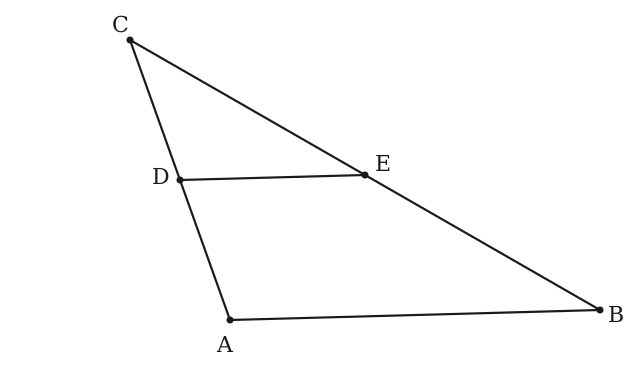
Which statement must always be true?
- DE = ½AB
- DE = ½AC
- AD = ½AB
- AB = ½DE
Answer: (1) DE = ½AB.
Why. The segment DE connects the midpoints of two sides of the triangle — the midpoint of CA and the midpoint of CB. A segment connecting the midpoints of two sides of a triangle is called a midsegment, and the Midsegment Theorem says exactly two things about it:
- The midsegment is parallel to the third side. So DE ∥ AB.
- The midsegment is half the length of the third side. So DE = ½ AB.
The third side here is AB (the side D and E do not touch), so DE = ½AB is guaranteed. That is choice (1). ✔
Concrete check. Put the triangle on the coordinate plane: A(0, 0), B(10, 0), C(2, 6). Then:
- D = midpoint of CA = ((2 + 0)/2, (6 + 0)/2) = (1, 3)
- E = midpoint of CB = ((2 + 10)/2, (6 + 0)/2) = (6, 3)
- DE length = |6 − 1| = 5
- AB length = |10 − 0| = 10
- Check: DE = 5 = ½(10) = ½AB. ✔
Notice that both D and E have the same y-coordinate (3), so DE is horizontal — and AB is horizontal too, since both A and B have y = 0. That confirms DE is parallel to AB. The theorem checks out on both counts.
Why the other choices fail.
- (2) DE = ½AC. Wrong side. The Midsegment Theorem relates DE to the third side AB, not to AC. In the coordinate example, AC = √(2² + 6²) = √40 ≈ 6.32, so ½AC ≈ 3.16 — nowhere near DE = 5. A common trap: students sometimes match DE to a side whose midpoint D happens to lie on. But the theorem always points to the opposite side.
- (3) AD = ½AB. Wrong segment. AD is half of CA (since D is the midpoint of CA), not half of AB. In the coordinate example, AD = distance from (0, 0) to (1, 3) = √10 ≈ 3.16, while ½AB = 5. Not equal. This choice mixes up which two sides the midpoint relates.
- (4) AB = ½DE. Right idea, flipped ratio. The Midsegment Theorem does relate AB and DE, but the midsegment (DE) is the shorter one, not the longer one. This choice would make the third side AB the shorter one, which is backwards. Any time a triangle midsegment is drawn, remember: the midsegment is the shorter piece — half the length of the third side.
The Regents shortcut. Whenever a Regents question shows a triangle with two midpoints marked and asks “which must be true?” scan the answer choices for the pattern “(midsegment) = ½(third side)” — identifying the third side as the one whose endpoints are the two non-midpoint vertices. That single pattern-match wins the question in under 30 seconds.
The connection to Basic Proportionality. This is also a special case of the Basic Proportionality Theorem (Thales’ Theorem): if D and E are midpoints, then CD/DA = CE/EB = 1, so DE is parallel to AB. Combined with the fact that ▵CDE is similar to ▵CAB at ratio 1:2, every corresponding side must also be at ratio 1:2 — including DE:AB. The Midsegment Theorem is Basic Proportionality plus the extra fact that the ratio equals ½.
The two theorems, side by side
| Theorem | What you know | What you conclude | Key proportion | Special length rule? |
|---|---|---|---|---|
| Basic Proportionality Theorem (Thales' / Side-Splitter) | A line parallel to one side of a triangle | The other two sides are divided proportionally — and the small triangle is similar to the big one | AD/DB = AE/EC or AD/AB = AE/AC = DE/BC |
Depends on the given ratio |
| Converse of Basic Proportionality | Two sides divided in equal ratio | The dividing segment is parallel to the third side | AD/DB = AE/EC ⇒ DE || BC |
n/a |
| Midsegment Theorem | Segment connects the midpoints of two sides | That segment is parallel to the third side and half its length | DE || AB, DE = ½ AB |
Yes — midsegment is always exactly half the third side |
How this ties to earlier posts in the series
The Basic Proportionality Theorem is the “quiet twin” of a dilation:
- A dilation with scale factor k stretches a whole figure by k from a center point — all points scale.
- A parallel line inside a triangle stretches (or shrinks) only part of the figure — but the ratios still hold, by the same underlying similarity.
That's why the Regents mixes these topics on Part III and IV questions: a coordinate proof might ask you to find the image of a segment under a dilation, then use the midsegment theorem to show two sides of the resulting figure are parallel. Same toolkit, applied twice.
If you have not read the earlier posts, start with Regents Geometry Rigid Transformations and Regents Geometry Non-Rigid Transformations. Together with this post, they cover the entire transformations-and-similarity core of the exam.
How SOMATH teaches proportionality (K–12 arc)
- Little Newtons (grades K–2): equal parts, halving and doubling, paper-folding to create midsegments before students know the word.
- Kid Einsteins (grades 3–5): ratios, proportional reasoning, scale drawings, similar figures introduced by intuition — two shapes that look the same but different sizes.
- Young Fermats (grades 5–8): triangle midsegments experimentally verified with rulers, similar triangles by AA, and the Basic Proportionality Theorem stated and used before it's formally named.
- High-school Geometry: full Regents-level treatment — theorem names, two-column proofs, coordinate proofs of the midsegment theorem, and Regents Part II–IV applications like the June 2026 side-splitter question.
Our high-school Geometry teachers hold degrees from Harvard, Northwestern, Columbia, and NYU. Every SOMATH student who has taken the January or June Geometry Regents has scored proficient or higher.
Quick memory tips for the Regents
- Parallel to a side → proportional sides. Whenever you see a line inside a triangle marked parallel to a side, immediately set up the Basic Proportionality Theorem — you almost always need it.
- Two names, one theorem. The Regents sometimes calls it Thales' Theorem, sometimes the Basic Proportionality Theorem, sometimes the Side-Splitter Theorem. All the same theorem.
- Midpoints → midsegment → half. The word “midpoint” anywhere in a Regents diagram is a trigger to apply the Midsegment Theorem: the joining segment is parallel to the third side and exactly half as long.
- Every triangle has three midsegments. They form the medial triangle — similar to the original with a scale factor of 1/2 (so its perimeter is 1/2 the perimeter, and its area is 1/4 the area).
- The converse is a Regents favorite. If you are given proportional divisions and asked to prove parallelism, you're using the converse of the Basic Proportionality Theorem.
Book a free math enrichment evaluation
If your child is preparing for the January or June Regents Geometry — or building toward Geometry via middle-school Common Core — the fastest way to know where they stand is a real diagnostic. Book a free 30-minute in-person evaluation at SOMATH. Your child works one-on-one with a SOMATH teacher, and you receive a written diagnostic within 48 hours — specifically what your child has mastered, where the gaps are, and what to work on next. Yours to keep whether you enroll or not.
SOMATH is at 226 West 79th Street, first floor, between Broadway and Amsterdam. Phone (646) 668-6151. See our weekly class schedule or browse all courses grades 1–12.
Related reading: Regents Geometry Rigid Transformations · Regents Geometry Non-Rigid Transformations · Regents Geometry June 2026 Part II Answers · Best Math Enrichment on the Upper West Side.
Free 30-minute evaluation
Ready for Regents Geometry? Let’s find out.
Book a free 30-minute one-on-one evaluation. We’ll diagnose exactly where your child stands on similarity, proportionality theorems, coordinate proofs, and the rest of the Regents Geometry arc, and send a written summary within 48 hours — yours to keep whether you enroll or not.
Book a Free EvaluationSee if a SOMATH class is a fit for your child
We run in-person small-group classes on the Upper West Side, K–12, from Little Newtons in Grade 1 through AP Calculus, SAT Math, and Regents Geometry / Algebra in high school. Every family starts with a free 30-minute in-person evaluation and a written diagnostic within 48 hours — yours to keep whether you enroll or not.