Regents Geometry · Math Enrichment
Regents Geometry Rigid Transformations: SOMATH's Upper West Side Math Enrichment Guide
Translation, reflection, rotation — the three isometries that anchor every congruence proof on the NY Regents Geometry exam. Here is what they are, how the coordinate rules work, and how SOMATH's math enrichment on the Upper West Side prepares students to master them.

The short answer: a rigid transformation (or isometry) is a movement of a figure on the coordinate plane that preserves size and shape. The NY Regents Geometry exam tests three: translation (a slide), reflection (a flip), and rotation (a turn). All three preserve distance, side lengths, angles, perimeter, and area. Translation and rotation preserve orientation; reflection reverses it. Every Regents congruence proof is built on the idea that two figures are congruent when one can be mapped onto the other by a sequence of rigid motions.
SOMATH — School of Math on the Upper West Side at 226 West 79th Street, first floor, phone (646) 668-6151 — covers rigid transformations across our Young Fermats (grades 5–8) and Geometry high-school tracks. Kids build the transformations physically before they see the coordinate rules, then chain them together into full congruence arguments. Every family starts with a free 30-minute in-person evaluation and a written diagnostic within 48 hours — yours to keep whether you enroll or not.
What is a rigid transformation?
A rigid transformation — the formal Regents word is isometry — is any movement of a figure on the coordinate plane that keeps the figure the same size and shape. If you cut a triangle out of paper and slide, flip, or turn it, you have performed a rigid transformation. The paper triangle before and after are congruent because you did not stretch or shrink it.
Every rigid transformation preserves the following properties. Memorize this list — the Regents will ask about it directly, and the same six properties are the building blocks of every congruence proof:
- Shape — the figure remains the same type of shape.
- Size — the figure does not get bigger or smaller.
- Side lengths — every side of the figure stays the same length.
- Angles — every angle keeps its measure.
- Perimeter — the total distance around the figure is unchanged.
- Area — the space inside the figure is unchanged.
What can change: location (where the figure is) and, in the case of reflection and sometimes rotation, orientation (which way the figure faces). Everything else stays exactly the same. That is the point of the word "rigid" — the figure is not deforming, only moving.
The three rigid transformations, in detail
The New York Regents Geometry exam tests three specific rigid transformations. Every congruence question on the Regents can be answered by identifying which of these three (or which composition of them) maps one figure onto another.
Translation — a slide
A translation slides every point of the figure the same distance in the same direction. Think of pushing a book across a desk without turning it.
Coordinate rule: (x, y) → (x + a, y + b)
This means: add a to every x-coordinate and add b to every y-coordinate. Positive a shifts right, negative a shifts left. Positive b shifts up, negative b shifts down.
Example: Translate the square with vertices (−3, 2), (−1, 2), (−1, 4), (−3, 4) four units to the right: apply (x, y) → (x + 4, y). New vertices: (1, 2), (3, 2), (3, 4), (1, 4). Same square, four units to the right.
What is preserved: distance between points, side lengths, angles, perimeter, area, orientation. What changes: location.
Reflection — a flip over a line
A reflection flips every point of the figure over a fixed line, called the line of reflection. Think of the line as a mirror. Each point ends up the same distance from the mirror as before, but on the opposite side.
Coordinate rules for the most common lines:
- Over the y-axis: (x, y) → (−x, y)
- Over the x-axis: (x, y) → (x, −y)
- Over the line y = x: (x, y) → (y, x)
- Over the line y = −x: (x, y) → (−y, −x)
Example: Reflect the square from the previous example over the y-axis. Apply (x, y) → (−x, y) to (1, 2), (3, 2), (3, 4), (1, 4). New vertices: (−1, 2), (−3, 2), (−3, 4), (−1, 4). Same square, mirrored on the left of the y-axis.
What is preserved: distance between points, side lengths, angles, perimeter, area. What changes: location and orientation — the reflected figure is a mirror image of the original.
Rotation — a turn about a point
A rotation turns every point of the figure around a fixed point (the center of rotation) by a specified angle. On the Regents the center is almost always the origin.
Coordinate rules for rotations about the origin:
- 90° counterclockwise: (x, y) → (−y, x)
- 180° (either direction): (x, y) → (−x, −y)
- 270° counterclockwise (or 90° clockwise): (x, y) → (y, −x)
Example: Rotate the square with vertices (2, 0), (4, 0), (4, 2), (2, 2) by 90° counterclockwise about the origin. Apply (x, y) → (−y, x). New vertices: (0, 2), (0, 4), (−2, 4), (−2, 2). Same square, rotated a quarter-turn.
What is preserved: distance from the center, side lengths, angles, perimeter, area. What may change: location and orientation (which way the figure faces).
The summary table Regents students memorize
Every SOMATH Geometry student learns this table by the second week of the transformations unit. If you can reproduce it from memory, most Regents multiple-choice transformation questions become a five-second answer.
| Transformation | Moves the figure by | Coordinate rule (common case) | Changes size or shape? | Changes orientation? |
|---|---|---|---|---|
| Translation | Sliding in a straight line | (x, y) → (x + a, y + b) |
No | No |
| Reflection | Flipping over a line | (x, y) → (−x, y) over y-axis |
No | Yes (reverses) |
| Rotation | Turning around a point | (x, y) → (−y, x) 90° CCW at origin |
No | Maybe (depends on angle) |
All three preserve shape, size, side lengths, angles, perimeter, and area. That preservation is what makes them rigid. The word Regents uses for rigid transformations — isometry — literally means "same measure" in Greek.
Why rigid transformations are the foundation of Regents Geometry congruence
Older geometry curricula defined two triangles as congruent when their sides and angles matched (SSS, SAS, ASA). The modern New York State Regents Geometry standards reframe congruence: two figures are congruent if and only if one can be mapped onto the other by a sequence of rigid transformations. Every SSS, SAS, and ASA proof is really a rigid-motion proof underneath.
That is why Regents Geometry students who understand rigid transformations deeply outperform students who memorized the shortcuts. The Regents exam frequently asks:
- "Which sequence of rigid motions maps triangle ABC onto triangle A'B'C'?"
- "State a single rigid motion that maps figure P onto figure Q."
- "Given the coordinate rule
(x, y) → (y, −x), identify the transformation and its parameters." - "Prove that triangle ABC is congruent to triangle DEF using a sequence of rigid motions." (constructed response, 4–6 points)
A student who has practiced the three transformations concretely, derived the coordinate rules, and chained them together into congruence arguments handles all of those questions confidently. A student who has only seen the rules once in class often freezes.
Worked example: a Regents-style problem
Problem. Triangle ABC has vertices A(1, 2), B(4, 2), C(4, 6). Triangle A'B'C' has vertices A'(−2, 1), B'(−2, 4), C'(−6, 4). Describe a sequence of rigid transformations that maps triangle ABC onto triangle A'B'C'.
Solution. First identify what changed. In ABC the right angle is at B(4, 2) with legs of length 3 (horizontal) and 4 (vertical). In A'B'C' the right angle is at B'(−2, 4) with legs of length 3 (vertical) and 4 (horizontal). The horizontal leg became vertical — a 90° rotation is involved.
Step 1. Rotate ABC 90° counterclockwise about the origin. Apply (x, y) → (−y, x):
- A(1, 2) → (−2, 1)
- B(4, 2) → (−2, 4)
- C(4, 6) → (−6, 4)
The rotated image is exactly A'B'C'. Answer: a single rotation of 90° counterclockwise about the origin maps triangle ABC onto triangle A'B'C'. Since a rotation is a rigid transformation, the triangles are congruent.
On the actual Regents, that kind of question is worth 4 points on the constructed-response section. A student who owns the coordinate rules for the three rigid transformations answers it in under three minutes and moves on. That is the real payoff of math enrichment: not tricks, but confidence.
Practice question: identifying a sequence of rigid transformations
This is a classic Regents Geometry multiple-choice question. You are shown three congruent triangles on a coordinate plane and asked to name the two rigid transformations that connect them, in order. Try it before revealing the answer — the trick is to check orientation and position at each step.
Question — Regents Geometry, multiple choice
Triangles ABC, A′B′C′, and A″B″C″ are graphed on the set of axes below.
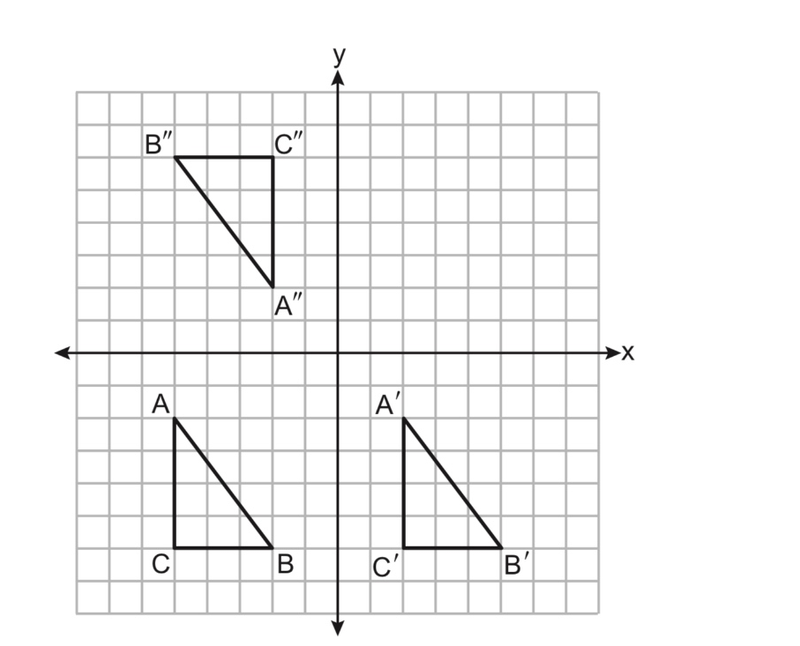
Which sequence of transformations maps ▵ABC onto ▵A′B′C′, and then maps ▵A′B′C′ onto ▵A″B″C″?
- a translation followed by a rotation
- a rotation followed by a translation
- a line reflection followed by a rotation
- a translation followed by a line reflection
Answer: (1) a translation followed by a rotation.
Strategy. With any “which sequence of transformations” question, ask two questions at each step:
- Did the orientation change? A reflection flips orientation (turns a clockwise triangle into a counterclockwise one). Translations and rotations do not flip orientation.
- Did the shape turn? If the triangle’s tilt is the same, it’s a translation. If the tilt changed, a rotation happened.
Read the coordinates. From the graph:
- ▵ABC: A(−7, −1), B(−4, −5), C(−7, −5). Right angle at C. Vertical leg CA = 4, horizontal leg CB = 3.
- ▵A′B′C′: A′(2, −1), B′(5, −5), C′(2, −5). Right angle at C′. Same shape as ▵ABC.
- ▵A″B″C″: A″(−2, 2), B″(−5, 6), C″(−2, 6). Right angle at C″.
Step 1: ▵ABC → ▵A′B′C′. Compare corresponding vertices:
- A(−7, −1) → A′(2, −1)
- B(−4, −5) → B′(5, −5)
- C(−7, −5) → C′(2, −5)
Every point moved +9 in x and 0 in y. The rule is (x, y) → (x + 9, y). That is a translation 9 units to the right. The triangle’s tilt did not change, and its orientation did not flip. Step 1 is a translation. ✔
Step 2: ▵A′B′C′ → ▵A″B″C″. Compare corresponding vertices:
- A′(2, −1) → A″(−2, 2)
- B′(5, −5) → B″(−5, 6)
- C′(2, −5) → C″(−2, 6)
Now the triangle has rotated: in ▵A′B′C′, the right-angle vertex C′ is at the bottom-left; in ▵A″B″C″, the right-angle vertex C″ is at the top-right. The triangle has been flipped upside down.
Look for a rotation center. The midpoint of each pair of corresponding points should be the same fixed center. Compute midpoints:
- midpoint of A′ and A″: ((2 + (−2))/2, (−1 + 2)/2) = (0, 0.5)
- midpoint of B′ and B″: ((5 + (−5))/2, (−5 + 6)/2) = (0, 0.5)
- midpoint of C′ and C″: ((2 + (−2))/2, (−5 + 6)/2) = (0, 0.5)
All three midpoints are the same point, (0, 0.5). That means every point and its image are the same distance from (0, 0.5) but on opposite sides — a 180° rotation about the point (0, 0.5). Step 2 is a rotation. ✔
Check orientation to rule out reflection. In ▵ABC, going A → B → C traces the triangle clockwise. In ▵A″B″C″, going A″ → B″ → C″ also traces clockwise. Orientation was preserved throughout, so no reflection was involved. That eliminates choices (3) and (4).
The answer. Step 1 was a translation and Step 2 was a rotation, so the sequence is a translation followed by a rotation — choice (1).
The takeaway. Two habits will save you time on every “sequence of rigid transformations” question: (a) check orientation first — if orientation flipped, a reflection is in the sequence; if not, only translations and rotations are; (b) if any corresponding pair has the same y-value (or same x-value) and the triangles look identically oriented, that step is almost always a translation. If the triangle has rotated between two images, compute midpoints of corresponding vertices to find the rotation center.
Rigid vs. non-rigid: what about dilations?
The Regents Geometry exam also tests one non-rigid transformation: the dilation. A dilation changes size (bigger or smaller) while preserving shape. It produces similar figures, not congruent ones. The distinction matters:
- Rigid transformations (translation, reflection, rotation) preserve size and shape → produce congruent figures.
- Non-rigid transformations (dilation) preserve shape only → produce similar figures.
- Compositions of rigid transformations are always rigid. Compositions that include a dilation produce similar (but not necessarily congruent) figures.
If a Regents question asks whether two figures are congruent, look for a sequence of rigid motions. If it asks whether they are similar, dilations are allowed. That single distinction is worth 2–4 points on almost every Regents Geometry exam.
How SOMATH teaches rigid transformations (K–12 arc)
At SOMATH we introduce transformations gradually across our grade-level tracks, so by the time a student sits for Regents Geometry the ideas are second nature, not something crammed the week before the test.
- Little Newtons (grades K–2): physical slides, flips, and turns of shapes cut from paper. Kids build intuition before any coordinate plane appears.
- Kid Einsteins (grades 3–5): coordinate plane basics; plotting points; translation as a shift; symmetry (which is really reflection).
- Young Fermats (grades 5–8): all three rigid transformations on the coordinate plane. Students derive the coordinate rules themselves before we hand them the summary. SHSAT students see transformations in geometry problems here.
- High-school Geometry: full Regents-level treatment. Coordinate rules memorized, compositions chained together, and the modern rigid-motion definition of congruence used in proofs.
Our high-school teachers hold degrees from Harvard, Northwestern, Columbia, and NYU, and full-time SOMATH teachers write specific written feedback on every student after every unit. If your child is preparing for the January or June Regents Geometry, the transformations unit is one of the first places to build depth. Read our Regents Geometry January 2026 preparation guide for the full unit-by-unit breakdown, or our best math enrichment guide for the Upper West Side for how our program compares to other UWS options.
Quick memory tips for the Regents
- Rigid = same size. Translation, reflection, and rotation only move or turn the figure — they never change size or shape.
- Reflection is the odd one out. It is the only rigid transformation that reverses orientation (mirror image).
- Memorize the four common reflection rules. y-axis, x-axis, y = x, y = −x. These four cover 90% of Regents reflection questions.
- Memorize the three rotation rules about the origin. 90° counterclockwise, 180°, 270° counterclockwise. Clockwise angles are just the counterclockwise complement.
- When mapping one figure to another, look for what stayed the same first. If a horizontal side became vertical, rotation is involved. If the figure "flipped," a reflection is involved. If nothing turned or flipped, it is a translation.
Book a free math enrichment evaluation
If your child is heading into Regents Geometry — or into any of the middle-school Common Core topics that lead there — the best move is to see exactly where they are today. Book a free 30-minute in-person evaluation at SOMATH. Your child works one-on-one with a SOMATH teacher, and you receive a written diagnostic within 48 hours — specifically what your child has mastered, where the gaps are, and what to work on next. Yours to keep whether you enroll or not.
SOMATH is at 226 West 79th Street, first floor, between Broadway and Amsterdam. Phone (646) 668-6151. See our weekly class schedule or browse all courses grades 1–12.
Related reading: Elementary Math Enrichment on the Upper West Side (K–5 parent's guide) · After School Math Program on the Upper West Side (2026 Parent's Guide) · Best Math Enrichment on the Upper West Side · Best Math Tutor on the Upper West Side.
Free 30-minute evaluation
Ready for Regents Geometry? Let’s find out.
Book a free 30-minute one-on-one evaluation. We’ll diagnose exactly where your child stands on transformations, congruence, and the rest of the Regents Geometry arc, and send a written summary within 48 hours — yours to keep whether you enroll or not.
Book a Free EvaluationSee if a SOMATH class is a fit for your child
We run in-person small-group classes on the Upper West Side, K–12, from Little Newtons in Grade 1 through AP Calculus, SAT Math, and Regents Geometry / Algebra in high school. Every family starts with a free 30-minute in-person evaluation and a written diagnostic within 48 hours — yours to keep whether you enroll or not.