Pre-Algebra · Class 17
Solving Multi-Step Equations with Variables on Both Sides
Keep the equation balanced as you simplify, collect variables, and isolate the unknown. Learn to recognize when a solution is unique, impossible, or true for every real number.
Work through eight illustrated topics with five fresh practice questions each, followed by Homework review and Homework word problems. There are 40 practice questions and 20 homework questions, all with hidden worked answers. Try each problem before opening its blue Answer control.
This is an independent topic in the Pre-Algebra rolling syllabus; earlier class attendance is not required. Review the balance rule here, then choose a comfortable starting point. See the schedule or book an evaluation at SOMATH.
Download the student workbook (PDF)22 pages · Supplied cover, eight teaching images, all 60 questions · Generous blank working space · No exercise solutions
Understanding balance and equivalent equations
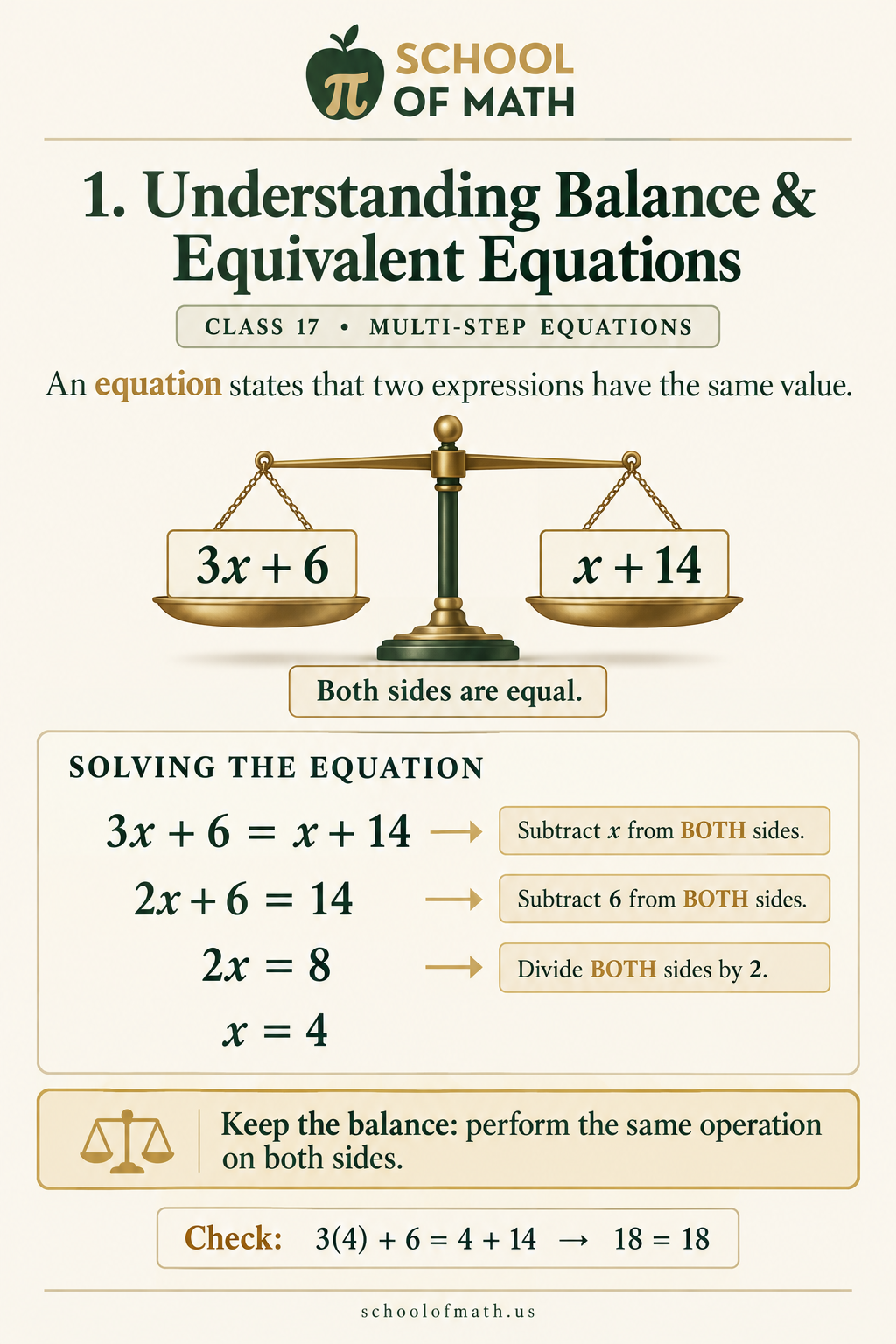
An equation says that its two sides have the same value. Equivalent equations have exactly the same solutions. To preserve that balance, add or subtract the same quantity on both sides, or multiply or divide both sides by the same nonzero constant.
The aim is to isolate the variable, not to “move” symbols without a reason. If you subtract \(x\) from the left, subtract \(x\) from the right too. Check the final value by replacing the variable in the original equation.
Practice: try these five questions
Q1
Solve for x. Show the operation applied to both sides.
Answer
\(x = 5\)
Subtract \(x\) on both sides to collect the variable terms on the left.
\[x + 7 = 12\]Subtract \(7\) on both sides to isolate the variable term.
\[x = 5\]
Check in the original equation
Substitute \(x = 5\) into each side of the original equation.
Left side
Right side
Both sides equal \(17\), so the value checks.
Q2
Solve and explain why subtracting 2x from both sides preserves equality.
Answer
\(x = 7\)
Subtract \(2 x\) on both sides to collect the variable terms on the left.
\[2 x + 3 = 17\]Subtract \(3\) on both sides to isolate the variable term.
\[2 x = 14\]Divide both sides by \(2\). Keep the result exact.
\[x = 7\]
Check in the original equation
Substitute \(x = 7\) into each side of the original equation.
Left side
Right side
Both sides equal \(31\), so the value checks.
Q3
Solve for x. Show the operation applied to both sides.
Answer
\(x = 8\)
Subtract \(3 x\) on both sides to collect the variable terms on the left.
\[2 x - 6 = 10\]Add \(6\) on both sides to isolate the variable term.
\[2 x = 16\]Divide both sides by \(2\). Keep the result exact.
\[x = 8\]
Check in the original equation
Substitute \(x = 8\) into each side of the original equation.
Left side
Right side
Both sides equal \(34\), so the value checks.
Q4
A student subtracts 2x only from the left side. Explain the error, then solve correctly.
Answer
\(x = 6\)
Subtracting 2x from only one side changes the balance. Subtract 2x from BOTH sides; the right side then becomes 29.
Subtract \(2 x\) on both sides to collect the variable terms on the left.
\[4 x + 5 = 29\]Subtract \(5\) on both sides to isolate the variable term.
\[4 x = 24\]Divide both sides by \(4\). Keep the result exact.
\[x = 6\]
Check in the original equation
Substitute \(x = 6\) into each side of the original equation.
Left side
Right side
Both sides equal \(41\), so the value checks.
Q5
Solve. Explain why it is valid to collect the variables on either side.
Answer
\(x = 7\)
Either side works if every operation is applied to both sides. This solution collects variables on the left; its negative coefficient is not an error.
Subtract \(5 x\) on both sides to collect the variable terms on the left.
\[15 - 3 x = -6\]Subtract \(15\) on both sides to isolate the variable term.
\[- 3 x = -21\]Divide both sides by \(-3\). Keep the result exact.
\[x = 7\]
Check in the original equation
Substitute \(x = 7\) into each side of the original equation.
Left side
Right side
Both sides equal \(29\), so the value checks.
Combining like terms on each side
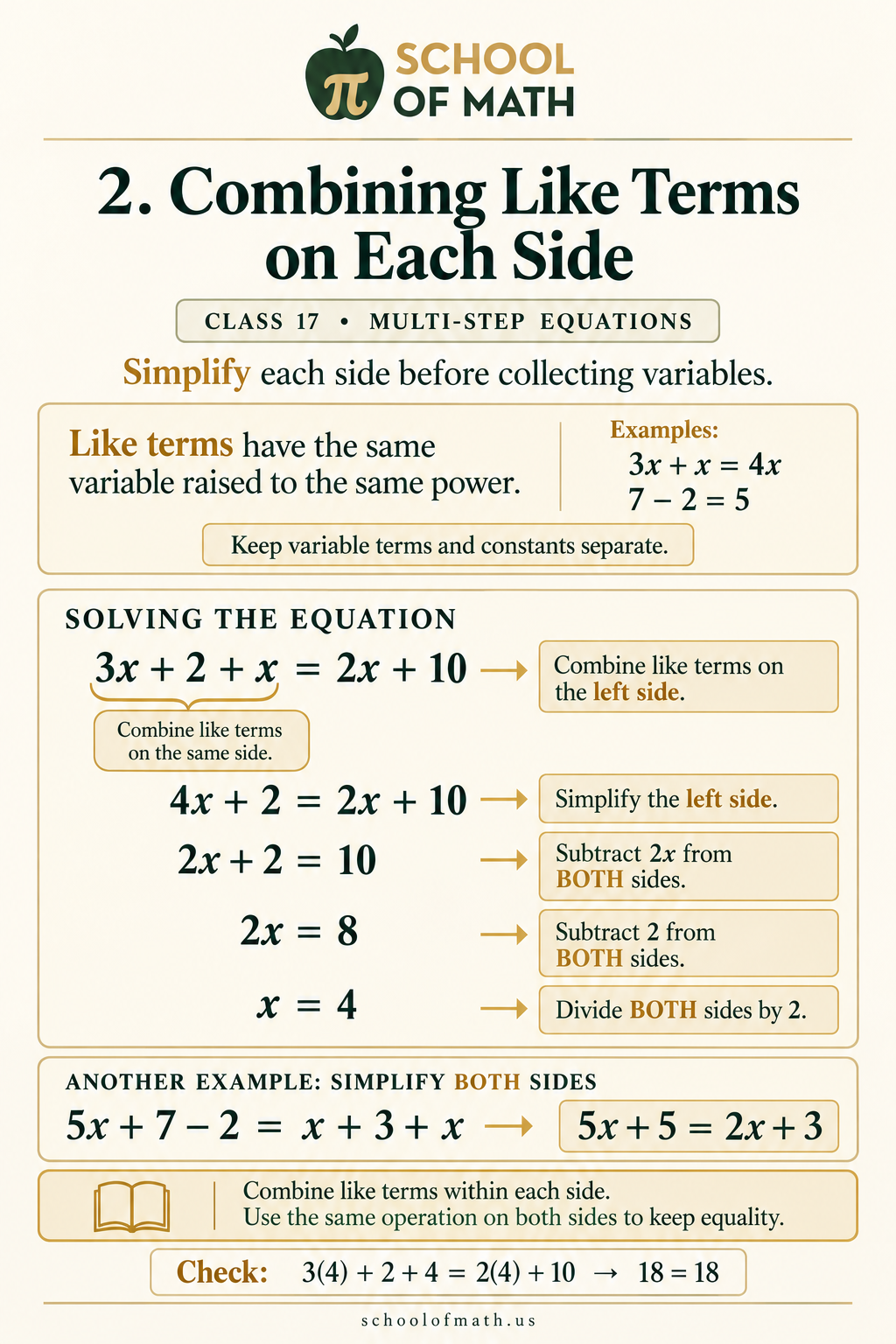
Like terms contain the same variable to the same power. Add their coefficients: \(2x+5x=7x\). Constants combine with constants, but \(7x+4\) cannot become \(11x\).
Simplify each side separately before collecting variables across the equals sign. Keep the sign attached to each term: \(8x-3x\) means \(8x+(-3x)\), so it becomes \(5x\).
Practice: try these five questions
Q6
Solve for x. Show the operation applied to both sides.
Answer
\(x = 5\)
Distribute any grouped factors to every term, then combine like terms on each side separately.
\[5 x + 4 = x + 24\]Subtract \(x\) on both sides to collect the variable terms on the left.
\[4 x + 4 = 24\]Subtract \(4\) on both sides to isolate the variable term.
\[4 x = 20\]Divide both sides by \(4\). Keep the result exact.
\[x = 5\]
Check in the original equation
Substitute \(x = 5\) into each side of the original equation.
Left side
Right side
Both sides equal \(29\), so the value checks.
Q7
Solve for x. Show the operation applied to both sides.
Answer
\(x = 7\)
Distribute any grouped factors to every term, then combine like terms on each side separately.
\[5 x + 8 = 2 x + 29\]Subtract \(2 x\) on both sides to collect the variable terms on the left.
\[3 x + 8 = 29\]Subtract \(8\) on both sides to isolate the variable term.
\[3 x = 21\]Divide both sides by \(3\). Keep the result exact.
\[x = 7\]
Check in the original equation
Substitute \(x = 7\) into each side of the original equation.
Left side
Right side
Both sides equal \(43\), so the value checks.
Q8
Solve for x. Show the operation applied to both sides.
Answer
\(x = 12\)
Distribute any grouped factors to every term, then combine like terms on each side separately.
\[4 x + 6 = 3 x + 18\]Subtract \(3 x\) on both sides to collect the variable terms on the left.
\[x + 6 = 18\]Subtract \(6\) on both sides to isolate the variable term.
\[x = 12\]
Check in the original equation
Substitute \(x = 12\) into each side of the original equation.
Left side
Right side
Both sides equal \(54\), so the value checks.
Q9
Solve for x. Show the operation applied to both sides.
Answer
\(x = 8\)
Distribute any grouped factors to every term, then combine like terms on each side separately.
\[5 x + 6 = 3 x + 22\]Subtract \(3 x\) on both sides to collect the variable terms on the left.
\[2 x + 6 = 22\]Subtract \(6\) on both sides to isolate the variable term.
\[2 x = 16\]Divide both sides by \(2\). Keep the result exact.
\[x = 8\]
Check in the original equation
Substitute \(x = 8\) into each side of the original equation.
Left side
Right side
Both sides equal \(46\), so the value checks.
Q10
Simplify both sides, solve, and check the original unsimplified equation.
Answer
\(x = 9\)
Distribute any grouped factors to every term, then combine like terms on each side separately.
\[4 x - 4 = 2 x + 14\]Subtract \(2 x\) on both sides to collect the variable terms on the left.
\[2 x - 4 = 14\]Add \(4\) on both sides to isolate the variable term.
\[2 x = 18\]Divide both sides by \(2\). Keep the result exact.
\[x = 9\]
Check in the original equation
Substitute \(x = 9\) into each side of the original equation.
Left side
Right side
Both sides equal \(32\), so the value checks.
Collecting variables on one side
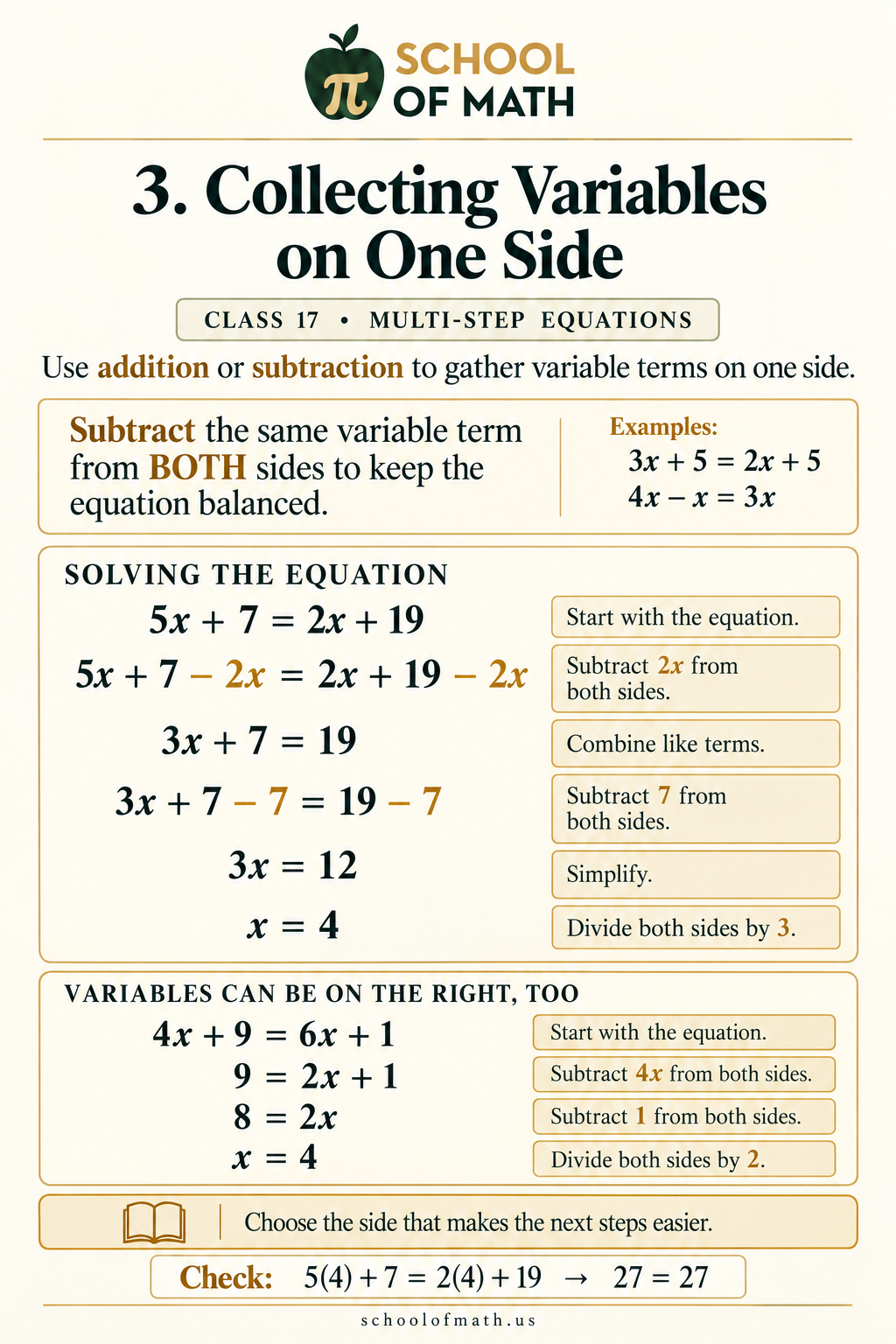
Add or subtract a variable term on both sides so that only one side contains the variable. Then undo the constant term and divide by the remaining coefficient.
It is often convenient to keep a positive variable coefficient, but a negative coefficient is equally valid. For example, from \(-4x=20\), dividing both sides by \(-4\) gives \(x=-5\).
Practice: try these five questions
Q11
Solve for x. Show the operation applied to both sides.
Answer
\(x = 5\)
Subtract \(x\) on both sides to collect the variable terms on the left.
\[3 x + 8 = 23\]Subtract \(8\) on both sides to isolate the variable term.
\[3 x = 15\]Divide both sides by \(3\). Keep the result exact.
\[x = 5\]
Check in the original equation
Substitute \(x = 5\) into each side of the original equation.
Left side
Right side
Both sides equal \(28\), so the value checks.
Q12
Solve for x. Show the operation applied to both sides.
Answer
\(x = 7\)
Subtract \(5 x\) on both sides to collect the variable terms on the left.
\[4 x - 4 = 24\]Add \(4\) on both sides to isolate the variable term.
\[4 x = 28\]Divide both sides by \(4\). Keep the result exact.
\[x = 7\]
Check in the original equation
Substitute \(x = 7\) into each side of the original equation.
Left side
Right side
Both sides equal \(59\), so the value checks.
Q13
Solve for x. Show the operation applied to both sides.
Answer
\(x = 6\)
Subtract \(7 x\) on both sides to collect the variable terms on the left.
\[25 - 4 x = 1\]Subtract \(25\) on both sides to isolate the variable term.
\[- 4 x = -24\]Divide both sides by \(-4\). Keep the result exact.
\[x = 6\]
Check in the original equation
Substitute \(x = 6\) into each side of the original equation.
Left side
Right side
Both sides equal \(43\), so the value checks.
Q14
Solve for x. Show the operation applied to both sides.
Answer
\(x = -5\)
Subtract \(5 x\) on both sides to collect the variable terms on the left.
\[- 3 x - 9 = 6\]Add \(9\) on both sides to isolate the variable term.
\[- 3 x = 15\]Divide both sides by \(-3\). Keep the result exact.
\[x = -5\]
Check in the original equation
Substitute \(x = -5\) into each side of the original equation.
Left side
Right side
Both sides equal \(-19\), so the value checks.
Q15
Solve and leave the answer as an exact fraction.
Answer
\(x = - \frac{5}{2}\)
Subtract \(2 x\) on both sides to collect the variable terms on the left.
\[6 x + 11 = -4\]Subtract \(11\) on both sides to isolate the variable term.
\[6 x = -15\]Divide both sides by \(6\). Keep the result exact.
\[x = - \frac{5}{2}\]
Check in the original equation
Substitute \(x = - \frac{5}{2}\) into each side of the original equation.
Left side
Right side
Both sides equal \(-9\), so the value checks.
Solving equations with parentheses
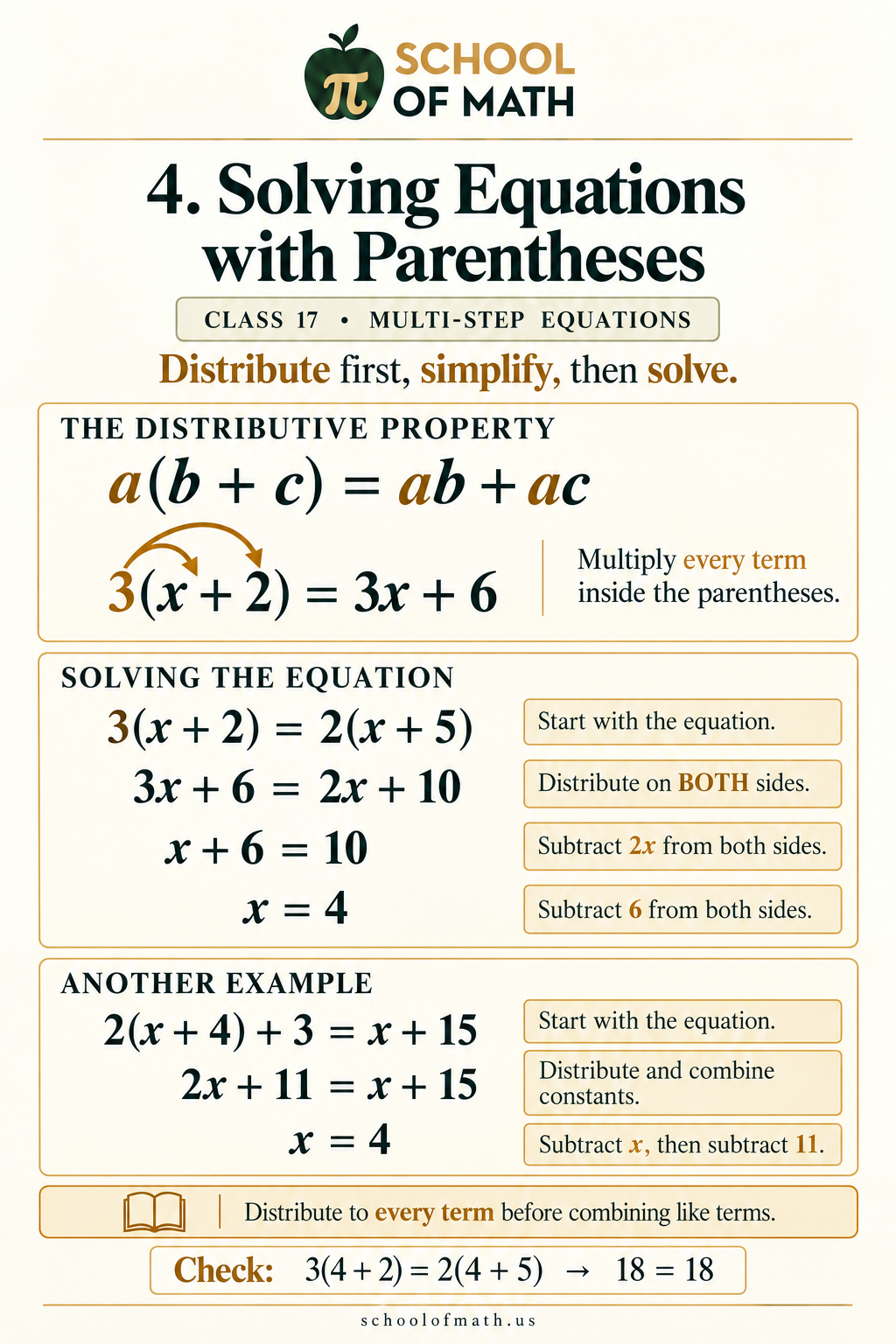
The distributive property multiplies every term in a group: \(a(b+c)=ab+ac\). After distributing on both sides, combine like terms before isolating the variable.
Do not forget constants outside parentheses. In \(2(x+3)+5\), distribution gives \(2x+6+5=2x+11\). You may sometimes divide out a common outside factor first instead.
Practice: try these five questions
Q16
Solve for x. Show the operation applied to both sides.
Answer
\(x = 7\)
Distribute any grouped factors to every term, then combine like terms on each side separately.
\[2 x + 10 = x + 17\]Subtract \(x\) on both sides to collect the variable terms on the left.
\[x + 10 = 17\]Subtract \(10\) on both sides to isolate the variable term.
\[x = 7\]
Check in the original equation
Substitute \(x = 7\) into each side of the original equation.
Left side
Right side
Both sides equal \(24\), so the value checks.
Q17
Solve for x. Show the operation applied to both sides.
Answer
\(x = 8\)
Distribute any grouped factors to every term, then combine like terms on each side separately.
\[4 x - 4 = 2 x + 12\]Subtract \(2 x\) on both sides to collect the variable terms on the left.
\[2 x - 4 = 12\]Add \(4\) on both sides to isolate the variable term.
\[2 x = 16\]Divide both sides by \(2\). Keep the result exact.
\[x = 8\]
Check in the original equation
Substitute \(x = 8\) into each side of the original equation.
Left side
Right side
Both sides equal \(28\), so the value checks.
Q18
Solve for x. Show the operation applied to both sides.
Answer
\(x = 4\)
Distribute any grouped factors to every term, then combine like terms on each side separately.
\[3 x + 14 = 2 x + 18\]Subtract \(2 x\) on both sides to collect the variable terms on the left.
\[x + 14 = 18\]Subtract \(14\) on both sides to isolate the variable term.
\[x = 4\]
Check in the original equation
Substitute \(x = 4\) into each side of the original equation.
Left side
Right side
Both sides equal \(26\), so the value checks.
Q19
Solve for x. Show the operation applied to both sides.
Answer
\(x = 3\)
Distribute any grouped factors to every term, then combine like terms on each side separately.
\[10 x - 15 = 3 x + 6\]Subtract \(3 x\) on both sides to collect the variable terms on the left.
\[7 x - 15 = 6\]Add \(15\) on both sides to isolate the variable term.
\[7 x = 21\]Divide both sides by \(7\). Keep the result exact.
\[x = 3\]
Check in the original equation
Substitute \(x = 3\) into each side of the original equation.
Left side
Right side
Both sides equal \(15\), so the value checks.
Q20
Solve for x. Show the operation applied to both sides.
Answer
\(x = 5\)
Distribute any grouped factors to every term, then combine like terms on each side separately.
\[6 x - 3 = 4 x + 7\]Subtract \(4 x\) on both sides to collect the variable terms on the left.
\[2 x - 3 = 7\]Add \(3\) on both sides to isolate the variable term.
\[2 x = 10\]Divide both sides by \(2\). Keep the result exact.
\[x = 5\]
Check in the original equation
Substitute \(x = 5\) into each side of the original equation.
Left side
Right side
Both sides equal \(27\), so the value checks.
Working with negative signs
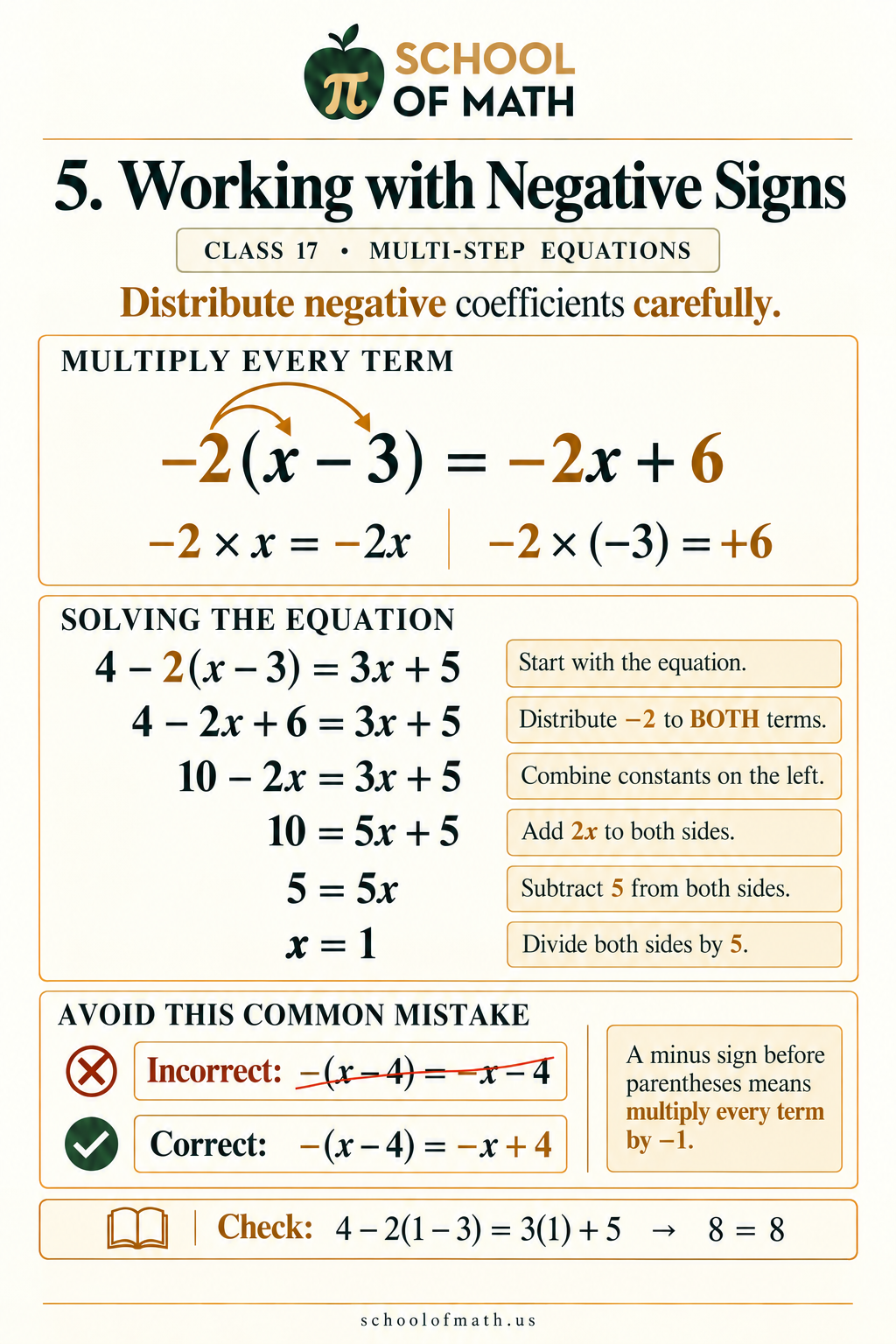
A minus sign before parentheses is a factor of \(-1\). It changes the sign of every term: \(-(x-7)=-x+7\). A factor such as \(-3\) must also multiply every term.
Keep negative terms intact while combining. After simplifying, use the usual balance operations; dividing by a negative number is allowed in an equation. The equals sign remains an equals sign.
Practice: try these five questions
Q21
Solve for x. Show the operation applied to both sides.
Answer
\(x = 2\)
Distribute any grouped factors to every term, then combine like terms on each side separately.
\[7 - x = 2 x + 1\]Subtract \(2 x\) on both sides to collect the variable terms on the left.
\[7 - 3 x = 1\]Subtract \(7\) on both sides to isolate the variable term.
\[- 3 x = -6\]Divide both sides by \(-3\). Keep the result exact.
\[x = 2\]
Check in the original equation
Substitute \(x = 2\) into each side of the original equation.
Left side
Right side
Both sides equal \(5\), so the value checks.
Q22
Solve for x. Show the operation applied to both sides.
Answer
\(x = 3\)
Distribute any grouped factors to every term, then combine like terms on each side separately.
\[15 - 2 x = 3 x\]Subtract \(3 x\) on both sides to collect the variable terms on the left.
\[15 - 5 x = 0\]Subtract \(15\) on both sides to isolate the variable term.
\[- 5 x = -15\]Divide both sides by \(-5\). Keep the result exact.
\[x = 3\]
Check in the original equation
Substitute \(x = 3\) into each side of the original equation.
Left side
Right side
Both sides equal \(9\), so the value checks.
Q23
Solve for x. Show the operation applied to both sides.
Answer
\(x = 3\)
Distribute any grouped factors to every term, then combine like terms on each side separately.
\[2 - 3 x = x - 10\]Subtract \(x\) on both sides to collect the variable terms on the left.
\[2 - 4 x = -10\]Subtract \(2\) on both sides to isolate the variable term.
\[- 4 x = -12\]Divide both sides by \(-4\). Keep the result exact.
\[x = 3\]
Check in the original equation
Substitute \(x = 3\) into each side of the original equation.
Left side
Right side
Both sides equal \(-7\), so the value checks.
Q24
Solve for x. Show the operation applied to both sides.
Answer
\(x = 1\)
Distribute any grouped factors to every term, then combine like terms on each side separately.
\[14 - 6 x = x + 7\]Subtract \(x\) on both sides to collect the variable terms on the left.
\[14 - 7 x = 7\]Subtract \(14\) on both sides to isolate the variable term.
\[- 7 x = -7\]Divide both sides by \(-7\). Keep the result exact.
\[x = 1\]
Check in the original equation
Substitute \(x = 1\) into each side of the original equation.
Left side
Right side
Both sides equal \(8\), so the value checks.
Q25
Distribute all negative factors carefully and solve.
Answer
\(x = - \frac{1}{2}\)
In the left side, negative 3 times negative 1 is positive 3. On the right, 2 multiplies both x and 6.
Distribute any grouped factors to every term, then combine like terms on each side separately.
\[8 - 6 x = 2 x + 12\]Subtract \(2 x\) on both sides to collect the variable terms on the left.
\[8 - 8 x = 12\]Subtract \(8\) on both sides to isolate the variable term.
\[- 8 x = 4\]Divide both sides by \(-8\). Keep the result exact.
\[x = - \frac{1}{2}\]
Check in the original equation
Substitute \(x = - \frac{1}{2}\) into each side of the original equation.
Left side
Right side
Both sides equal \(11\), so the value checks.
Solving equations with fractions and decimals
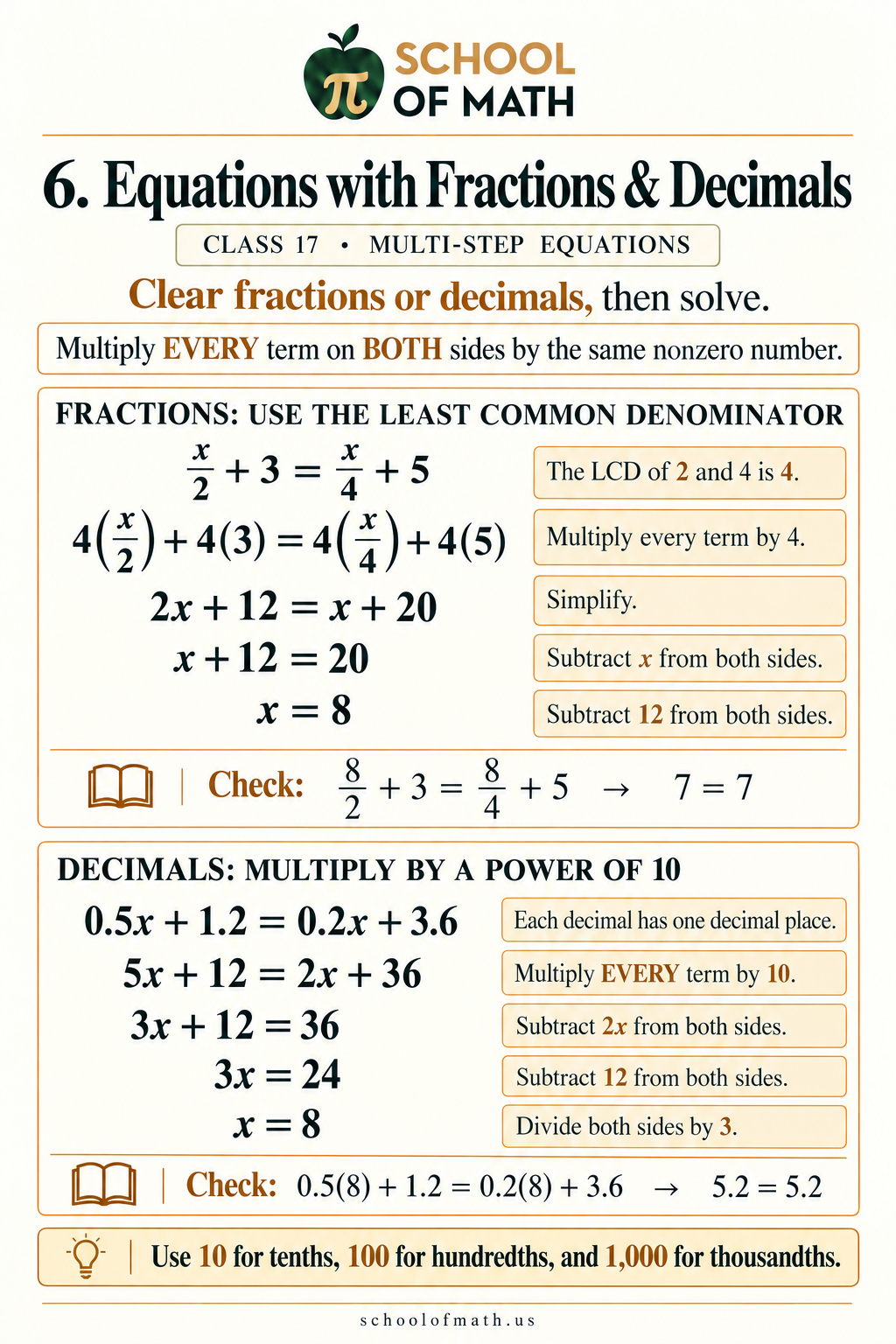
For constant denominators, multiply every term on both sides by the least common denominator (LCD). This clears the fractions while preserving equality. A fraction bar groups the entire numerator.
For decimals, use a power of 10 large enough to make every coefficient and constant a whole number. Use 10 for tenths and 100 for hundredths. Keep exact values throughout the calculation instead of rounding.
Practice: try these five questions
Q26
Solve for x. Show the operation applied to both sides.
Answer
\(x = 18\)
Multiply EVERY term by 6, the LCD of 3 and 6.
\[2 x + 12 = x + 30\]Subtract \(x\) on both sides to collect the variable terms on the left.
\[x + 12 = 30\]Subtract \(12\) on both sides to isolate the variable term.
\[x = 18\]
Check in the original equation
Substitute \(x = 18\) into each side of the original equation.
Left side
Right side
Both sides equal \(8\), so the value checks.
Q27
Solve for x. Show the operation applied to both sides.
Answer
\(x = 7\)
Multiply EVERY term by 10 to clear the tenths.
\[7 x + 14 = 2 x + 49\]Subtract \(2 x\) on both sides to collect the variable terms on the left.
\[5 x + 14 = 49\]Subtract \(14\) on both sides to isolate the variable term.
\[5 x = 35\]Divide both sides by \(5\). Keep the result exact.
\[x = 7\]
Check in the original equation
Substitute \(x = 7\) into each side of the original equation.
Left side
Right side
Both sides equal \(\frac{63}{10}\), so the value checks.
Q28
Solve for x. Show the operation applied to both sides.
Answer
\(x = 10\)
Multiply both sides by 12, keeping each numerator grouped.
\[3 \left(x + 2\right) = 4 \left(x - 1\right)\]Distribute any grouped factors to every term, then combine like terms on each side separately.
\[3 x + 6 = 4 x - 4\]Subtract \(4 x\) on both sides to collect the variable terms on the left.
\[6 - x = -4\]Subtract \(6\) on both sides to isolate the variable term.
\[- x = -10\]Divide both sides by \(-1\). Keep the result exact.
\[x = 10\]
Check in the original equation
Substitute \(x = 10\) into each side of the original equation.
Left side
Right side
Both sides equal \(3\), so the value checks.
Q29
Solve for x. Show the operation applied to both sides.
Answer
\(x = 14\)
Multiply EVERY term by 100 to clear the hundredths.
\[25 x + 150 = 10 x + 360\]Subtract \(10 x\) on both sides to collect the variable terms on the left.
\[15 x + 150 = 360\]Subtract \(150\) on both sides to isolate the variable term.
\[15 x = 210\]Divide both sides by \(15\). Keep the result exact.
\[x = 14\]
Check in the original equation
Substitute \(x = 14\) into each side of the original equation.
Left side
Right side
Both sides equal \(5\), so the value checks.
Q30
Solve for x. Show the operation applied to both sides.
Answer
\(x = 17\)
Multiply EVERY term by 6. The standalone 1 becomes 6.
\[2 \left(2 x - 1\right) + 6 = 3 \left(x + 7\right)\]Distribute any grouped factors to every term, then combine like terms on each side separately.
\[4 x + 4 = 3 x + 21\]Subtract \(3 x\) on both sides to collect the variable terms on the left.
\[x + 4 = 21\]Subtract \(4\) on both sides to isolate the variable term.
\[x = 17\]
Check in the original equation
Substitute \(x = 17\) into each side of the original equation.
Left side
Right side
Both sides equal \(12\), so the value checks.
How many solutions?
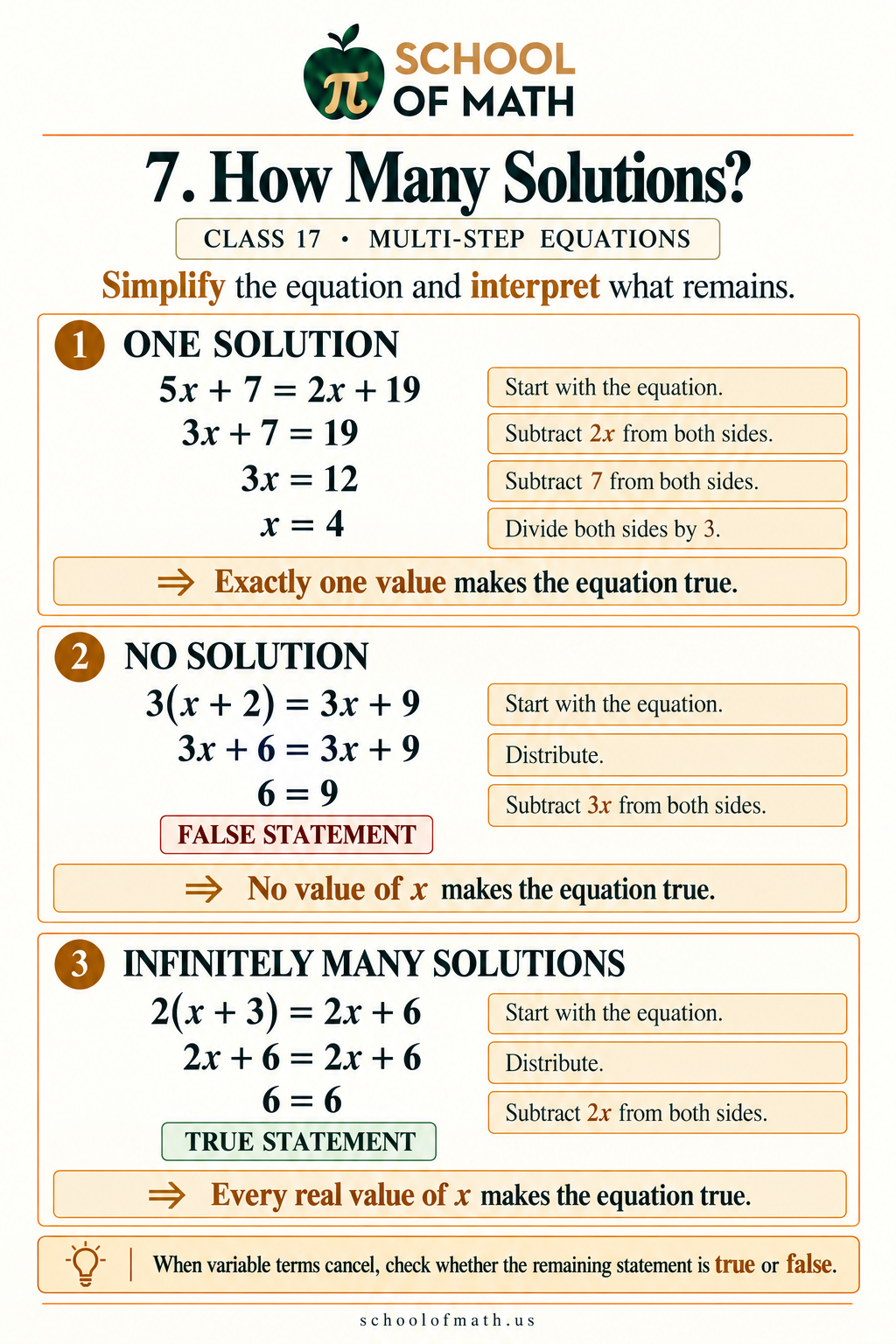
After simplifying, a linear equation can have one solution, no solution, or infinitely many solutions. A nonzero variable coefficient leads to one value after division.
If all variable terms cancel, inspect the remaining statement. A false statement such as \(4=9\) means no solution. A true statement such as \(4=4\) means every real value works. Neither outcome means \(x=0\).
Practice: try these five questions
Q31
Classify the equation as one solution, no solution, or infinitely many solutions. If there is one solution, find it.
Answer
\(x = 6\) (one solution)
Subtract \(2 x\) on both sides to collect the variable terms on the left.
\[2 x + 3 = 15\]Subtract \(3\) on both sides to isolate the variable term.
\[2 x = 12\]Divide both sides by \(2\). Keep the result exact.
\[x = 6\]
Check in the original equation
Substitute \(x = 6\) into each side of the original equation.
Left side
Right side
Both sides equal \(27\), so the value checks.
Q32
Classify the number of solutions. Explain the statement left when the variables cancel.
Answer
No solution.
Distribute any grouped factors to every term, then combine like terms on each side separately.
\[5 x + 10 = 5 x + 13\]Subtract \(5 x\) on both sides to collect the variable terms on the left.
\[10 = 13\]The variables cancel and the remaining statement is false. No choice of x can make these two different constants equal. Do not divide by a zero coefficient.
Why this classification is correct
The original left side minus the original right side simplifies to \(-3\). It is a nonzero constant, so equality is impossible for every real x.
Q33
Classify the number of solutions. Explain why checking only one value is not a proof.
Answer
Infinitely many solutions: every real value of x.
A successful substitution checks only that particular value. To prove that every real value works, simplify the two expressions and show that they are identical.
Distribute any grouped factors to every term, then combine like terms on each side separately.
\[4 x - 7 = 4 x - 7\]Subtract \(4 x\) on both sides to collect the variable terms on the left.
\[-7 = -7\]The variables cancel and the remaining statement is true. The original expressions are identical for every real x, so this is not merely a claim that x equals zero.
Why this classification is correct
The original left side minus the original right side simplifies to \(0\). It is always zero, which proves equality for every real x.
Q34
Simplify and classify. Do not divide by zero.
Answer
No solution.
Distribute any grouped factors to every term, then combine like terms on each side separately.
\[5 x + 2 = 5 x + 8\]Subtract \(5 x\) on both sides to collect the variable terms on the left.
\[2 = 8\]The variables cancel and the remaining statement is false. No choice of x can make these two different constants equal. Do not divide by a zero coefficient.
Why this classification is correct
The original left side minus the original right side simplifies to \(-6\). It is a nonzero constant, so equality is impossible for every real x.
Q35
Simplify both sides completely and determine the solution set.
Answer
Infinitely many solutions: every real value of x.
Distribute any grouped factors to every term, then combine like terms on each side separately.
\[8 x - 2 = 8 x - 2\]Subtract \(8 x\) on both sides to collect the variable terms on the left.
\[-2 = -2\]The variables cancel and the remaining statement is true. The original expressions are identical for every real x, so this is not merely a claim that x equals zero.
Why this classification is correct
The original left side minus the original right side simplifies to \(0\). It is always zero, which proves equality for every real x.
Modeling word problems and checking solutions
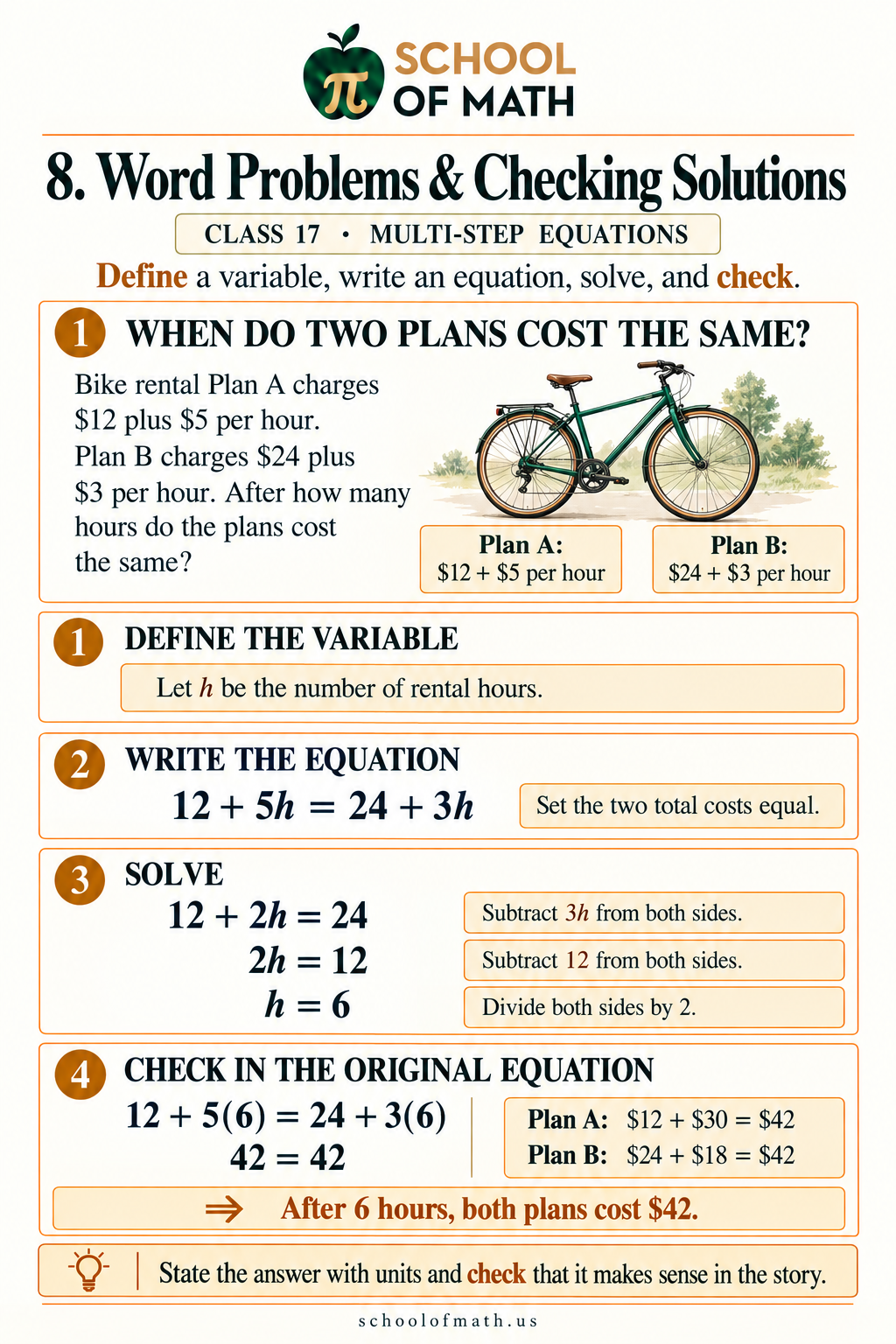
Define a variable with units, write an expression for each quantity, and set the expressions equal when the story asks when they match. Include fixed fees, rates, discounts, and repeated groups.
Solve the equation, then substitute into both original expressions. Finish with a sentence answering the story. A mathematical solution must also fit the context: a number of children cannot be negative or fractional.
Practice: try these five questions
Q36
Scooter Plan A charges $14 plus $4 per hour. Plan B charges $26 plus $2 per hour. After how many hours do the costs match, and what is that cost?
Answer
\(x = 6\)
Let x be the rental time in hours. Set the two total costs equal.
\[14 + 4 x = 26 + 2 x\]Distribute any grouped factors to every term, then combine like terms on each side separately.
\[4 x + 14 = 2 x + 26\]Subtract \(2 x\) on both sides to collect the variable terms on the left.
\[2 x + 14 = 26\]Subtract \(14\) on both sides to isolate the variable term.
\[2 x = 12\]Divide both sides by \(2\). Keep the result exact.
\[x = 6\]
Check in the original equation
Substitute \(x = 6\) into each side of the original equation.
Left side
Right side
Both sides equal \(38\), so the value checks.
In context: After 6 hours, both plans cost $38. Six hours is a valid nonnegative rental time.
Q37
Maya has saved $18 and adds $6 each week. Leo has saved $42 and adds $3 each week. After how many weeks will they have equal savings?
Answer
\(x = 8\)
Let x be the number of weeks from now. Each total is starting savings plus weekly savings times x.
\[18 + 6 x = 42 + 3 x\]Distribute any grouped factors to every term, then combine like terms on each side separately.
\[6 x + 18 = 3 x + 42\]Subtract \(3 x\) on both sides to collect the variable terms on the left.
\[3 x + 18 = 42\]Subtract \(18\) on both sides to isolate the variable term.
\[3 x = 24\]Divide both sides by \(3\). Keep the result exact.
\[x = 8\]
Check in the original equation
Substitute \(x = 8\) into each side of the original equation.
Left side
Right side
Both sides equal \(66\), so the value checks.
In context: After 8 weeks, each has $66. The solution is a whole, nonnegative number of weeks.
Q38
Two identical boxes each contain 3x + 2 markers. A large box contains 4x + 20 markers. Together, the two identical boxes hold as many markers as the large box. Find x and the number of markers in each small box.
Answer
\(x = 8\)
Let x be the number represented by the variable in each packing expression. Multiply the small-box count by 2.
\[2 \left(3 x + 2\right) = 4 x + 20\]Distribute any grouped factors to every term, then combine like terms on each side separately.
\[6 x + 4 = 4 x + 20\]Subtract \(4 x\) on both sides to collect the variable terms on the left.
\[2 x + 4 = 20\]Subtract \(4\) on both sides to isolate the variable term.
\[2 x = 16\]Divide both sides by \(2\). Keep the result exact.
\[x = 8\]
Check in the original equation
Substitute \(x = 8\) into each side of the original equation.
Left side
Right side
Both sides equal \(52\), so the value checks.
In context: x = 8. Each small box contains 3 × 8 + 2 = 26 markers; the pair and the large box each contain 52 markers.
Q39
Two printing services charge $12 plus $1.75 per poster and $24 plus $1.25 per poster. For how many posters do the prices match, and what is the shared cost?
Answer
\(x = 24\)
Let x be the number of posters. Set the complete bills equal.
\[12 + 1.75 x = 24 + 1.25 x\]Multiply every term by 100 to work with whole numbers of cents.
\[1200 + 175 x = 2400 + 125 x\]Distribute any grouped factors to every term, then combine like terms on each side separately.
\[175 x + 1200 = 125 x + 2400\]Subtract \(125 x\) on both sides to collect the variable terms on the left.
\[50 x + 1200 = 2400\]Subtract \(1200\) on both sides to isolate the variable term.
\[50 x = 1200\]Divide both sides by \(50\). Keep the result exact.
\[x = 24\]
Check in the original equation
Substitute \(x = 24\) into each side of the original equation.
Left side
Right side
Both sides equal \(54\), so the value checks.
In context: For 24 posters, both services charge $54. A whole-number poster count makes this solution usable.
Q40
A kayak rental costs $30 for the first hour plus $8 for each additional hour. A second rental costs $18 plus $10 for every hour. For a whole-number rental of at least one hour, when do the costs match?
Answer
\(x = 2\)
Let x be the total hours, with x at least 1. The first rental has x − 1 additional hours, not x.
\[30 + 8 \left(x - 1\right) = 18 + 10 x\]Distribute any grouped factors to every term, then combine like terms on each side separately.
\[8 x + 22 = 10 x + 18\]Subtract \(10 x\) on both sides to collect the variable terms on the left.
\[22 - 2 x = 18\]Subtract \(22\) on both sides to isolate the variable term.
\[- 2 x = -4\]Divide both sides by \(-2\). Keep the result exact.
\[x = 2\]
Check in the original equation
Substitute \(x = 2\) into each side of the original equation.
Left side
Right side
Both sides equal \(38\), so the value checks.
In context: At 2 hours, both rentals cost $38. The result satisfies the requirement of at least one whole hour.
Homework review
One question revisits each illustrated topic. Show your operations and verify the result.
R1
Solve using equal operations on both sides.
Answer
\(x = 6\)
Subtract \(3 x\) on both sides to collect the variable terms on the left.
\[4 x + 2 = 26\]Subtract \(2\) on both sides to isolate the variable term.
\[4 x = 24\]Divide both sides by \(4\). Keep the result exact.
\[x = 6\]
Check in the original equation
Substitute \(x = 6\) into each side of the original equation.
Left side
Right side
Both sides equal \(44\), so the value checks.
R2
Combine like terms, then solve.
Answer
\(x = 6\)
Distribute any grouped factors to every term, then combine like terms on each side separately.
\[3 x + 7 = x + 19\]Subtract \(x\) on both sides to collect the variable terms on the left.
\[2 x + 7 = 19\]Subtract \(7\) on both sides to isolate the variable term.
\[2 x = 12\]Divide both sides by \(2\). Keep the result exact.
\[x = 6\]
Check in the original equation
Substitute \(x = 6\) into each side of the original equation.
Left side
Right side
Both sides equal \(25\), so the value checks.
R3
Collect the variables on one side and solve.
Answer
\(x = -5\)
Subtract \(7 x\) on both sides to collect the variable terms on the left.
\[- 4 x - 8 = 12\]Add \(8\) on both sides to isolate the variable term.
\[- 4 x = 20\]Divide both sides by \(-4\). Keep the result exact.
\[x = -5\]
Check in the original equation
Substitute \(x = -5\) into each side of the original equation.
Left side
Right side
Both sides equal \(-23\), so the value checks.
R4
Distribute, simplify, and solve exactly.
Answer
\(x = \frac{15}{2}\)
Distribute any grouped factors to every term, then combine like terms on each side separately.
\[4 x + 5 = 2 x + 20\]Subtract \(2 x\) on both sides to collect the variable terms on the left.
\[2 x + 5 = 20\]Subtract \(5\) on both sides to isolate the variable term.
\[2 x = 15\]Divide both sides by \(2\). Keep the result exact.
\[x = \frac{15}{2}\]
Check in the original equation
Substitute \(x = \frac{15}{2}\) into each side of the original equation.
Left side
Right side
Both sides equal \(35\), so the value checks.
R5
Explain the sign of each distributed term and solve.
Answer
\(x = 3\)
Distribute any grouped factors to every term, then combine like terms on each side separately.
\[17 - 2 x = 3 x + 2\]Subtract \(3 x\) on both sides to collect the variable terms on the left.
\[17 - 5 x = 2\]Subtract \(17\) on both sides to isolate the variable term.
\[- 5 x = -15\]Divide both sides by \(-5\). Keep the result exact.
\[x = 3\]
Check in the original equation
Substitute \(x = 3\) into each side of the original equation.
Left side
Right side
Both sides equal \(11\), so the value checks.
R6
Clear the fractions and solve.
Answer
\(x = 14\)
Multiply every term by 6.
\[2 \left(x + 1\right) + 12 = 3 x\]Distribute any grouped factors to every term, then combine like terms on each side separately.
\[2 x + 14 = 3 x\]Subtract \(3 x\) on both sides to collect the variable terms on the left.
\[14 - x = 0\]Subtract \(14\) on both sides to isolate the variable term.
\[- x = -14\]Divide both sides by \(-1\). Keep the result exact.
\[x = 14\]
Check in the original equation
Substitute \(x = 14\) into each side of the original equation.
Left side
Right side
Both sides equal \(7\), so the value checks.
R7
Determine whether there is one solution, no solution, or infinitely many solutions.
Answer
Infinitely many solutions: every real value of x.
Distribute any grouped factors to every term, then combine like terms on each side separately.
\[6 x - 7 = 6 x - 7\]Subtract \(6 x\) on both sides to collect the variable terms on the left.
\[-7 = -7\]The variables cancel and the remaining statement is true. The original expressions are identical for every real x, so this is not merely a claim that x equals zero.
Why this classification is correct
The original left side minus the original right side simplifies to \(0\). It is always zero, which proves equality for every real x.
R8
Game Center A charges $9 admission and $5 per game. Center B charges $21 admission and $3 per game. For how many games do the totals match?
Answer
\(x = 6\)
Let x be the number of games. Compare admission plus the game charges.
\[9 + 5 x = 21 + 3 x\]Distribute any grouped factors to every term, then combine like terms on each side separately.
\[5 x + 9 = 3 x + 21\]Subtract \(3 x\) on both sides to collect the variable terms on the left.
\[2 x + 9 = 21\]Subtract \(9\) on both sides to isolate the variable term.
\[2 x = 12\]Divide both sides by \(2\). Keep the result exact.
\[x = 6\]
Check in the original equation
Substitute \(x = 6\) into each side of the original equation.
Left side
Right side
Both sides equal \(39\), so the value checks.
In context: For 6 games, both centers charge $39.
Homework word problems
Twelve stories progress from simpler comparisons to grouped expressions, decimal rates, discounts, and multi-part challenges. Define the variable and include units in your final sentence.
W1
Nina has 6 stickers and gets 2 more each day. Omar has 12 stickers and gets 1 more each day. After how many days will they have the same number?
Answer
\(x = 6\)
Let x be the number of days. Add each starting amount to the stickers gained.
\[6 + 2 x = 12 + x\]Distribute any grouped factors to every term, then combine like terms on each side separately.
\[2 x + 6 = x + 12\]Subtract \(x\) on both sides to collect the variable terms on the left.
\[x + 6 = 12\]Subtract \(6\) on both sides to isolate the variable term.
\[x = 6\]
Check in the original equation
Substitute \(x = 6\) into each side of the original equation.
Left side
Right side
Both sides equal \(18\), so the value checks.
In context: After 6 days, they each have 18 stickers.
W2
A club shirt order costs $10 for setup plus $3 per shirt at one shop. Another shop charges $22 for setup plus $1 per shirt. How many shirts make the totals equal?
Answer
\(x = 6\)
Let x be the number of shirts. Include the setup fee only once in each bill.
\[10 + 3 x = 22 + x\]Distribute any grouped factors to every term, then combine like terms on each side separately.
\[3 x + 10 = x + 22\]Subtract \(x\) on both sides to collect the variable terms on the left.
\[2 x + 10 = 22\]Subtract \(10\) on both sides to isolate the variable term.
\[2 x = 12\]Divide both sides by \(2\). Keep the result exact.
\[x = 6\]
Check in the original equation
Substitute \(x = 6\) into each side of the original equation.
Left side
Right side
Both sides equal \(28\), so the value checks.
In context: For 6 shirts, the total is $28 at either shop.
W3
Ava starts with 25 points and earns 4 points per round. Ben starts with 10 points and earns 7 per round. After how many rounds will their scores be equal?
Answer
\(x = 5\)
Let x be the number of rounds. Starting points plus points per round gives each score.
\[25 + 4 x = 10 + 7 x\]Distribute any grouped factors to every term, then combine like terms on each side separately.
\[4 x + 25 = 7 x + 10\]Subtract \(7 x\) on both sides to collect the variable terms on the left.
\[25 - 3 x = 10\]Subtract \(25\) on both sides to isolate the variable term.
\[- 3 x = -15\]Divide both sides by \(-3\). Keep the result exact.
\[x = 5\]
Check in the original equation
Substitute \(x = 5\) into each side of the original equation.
Left side
Right side
Both sides equal \(45\), so the value checks.
In context: After 5 rounds, each score is 45 points.
W4
Delivery Company A charges $16 plus $5 per box. Company B charges $40 plus $2 per box. For how many boxes do they charge the same, and what is that charge?
Answer
\(x = 8\)
Let x be the number of boxes. Set the two complete delivery charges equal.
\[16 + 5 x = 40 + 2 x\]Distribute any grouped factors to every term, then combine like terms on each side separately.
\[5 x + 16 = 2 x + 40\]Subtract \(2 x\) on both sides to collect the variable terms on the left.
\[3 x + 16 = 40\]Subtract \(16\) on both sides to isolate the variable term.
\[3 x = 24\]Divide both sides by \(3\). Keep the result exact.
\[x = 8\]
Check in the original equation
Substitute \(x = 8\) into each side of the original equation.
Left side
Right side
Both sides equal \(56\), so the value checks.
In context: For 8 boxes, both companies charge $56.
W5
A rectangle has width 9 cm and length x cm. Its perimeter equals the perimeter of a triangle whose sides are x cm, 14 cm, and 16 cm. Find x and the common perimeter.
Answer
\(x = 12\)
Let x be the unknown length in centimeters. The rectangle perimeter is twice the sum of length and width; the triangle perimeter is the sum of its three sides.
\[2 \left(x + 9\right) = x + 30\]Distribute any grouped factors to every term, then combine like terms on each side separately.
\[2 x + 18 = x + 30\]Subtract \(x\) on both sides to collect the variable terms on the left.
\[x + 18 = 30\]Subtract \(18\) on both sides to isolate the variable term.
\[x = 12\]
Check in the original equation
Substitute \(x = 12\) into each side of the original equation.
Left side
Right side
Both sides equal \(42\), so the value checks.
In context: x = 12 cm. Both perimeters are 42 cm. The triangle sides 12, 14, and 16 cm satisfy the triangle inequalities.
W6
Three equal packets each contain x + 4 beads. Adding 5 loose beads gives the same total as two boxes containing x + 13 beads each. Find x and the number of beads in each packet.
Answer
\(x = 9\)
Let x be the number in the packing expressions. Model both complete bead collections.
\[3 \left(x + 4\right) + 5 = 2 \left(x + 13\right)\]Distribute any grouped factors to every term, then combine like terms on each side separately.
\[3 x + 17 = 2 x + 26\]Subtract \(2 x\) on both sides to collect the variable terms on the left.
\[x + 17 = 26\]Subtract \(17\) on both sides to isolate the variable term.
\[x = 9\]
Check in the original equation
Substitute \(x = 9\) into each side of the original equation.
Left side
Right side
Both sides equal \(44\), so the value checks.
In context: x = 9. Each packet contains 13 beads; three packets plus 5 beads total 44, matching two boxes of 22.
W7
Photo Lab A charges $20 plus $2.50 per print. Lab B charges $35 plus $1.75 per print. How many prints make the bills equal, and what is the bill?
Answer
\(x = 20\)
Let x be the number of prints. Compare the full bills.
\[20 + 2.5 x = 35 + 1.75 x\]Multiply every term by 100 to clear the decimals.
\[2000 + 250 x = 3500 + 175 x\]Distribute any grouped factors to every term, then combine like terms on each side separately.
\[250 x + 2000 = 175 x + 3500\]Subtract \(175 x\) on both sides to collect the variable terms on the left.
\[75 x + 2000 = 3500\]Subtract \(2000\) on both sides to isolate the variable term.
\[75 x = 1500\]Divide both sides by \(75\). Keep the result exact.
\[x = 20\]
Check in the original equation
Substitute \(x = 20\) into each side of the original equation.
Left side
Right side
Both sides equal \(70\), so the value checks.
In context: At 20 prints, both labs charge $70.
W8
Two alternative ribbon plans use the same original supply of x meters. Plan A uses one-third of the supply plus 18 meters. Plan B uses one-half of the supply plus 8 meters. Both plans use the same amount. Find the original supply and the amount used by either plan.
Answer
\(x = 60\)
Let x be the original ribbon supply in meters. Set the two amounts used equal.
\[\frac{x}{3} + 18 = \frac{x}{2} + 8\]Multiply every term by 6.
\[2 x + 108 = 3 x + 48\]Subtract \(3 x\) on both sides to collect the variable terms on the left.
\[108 - x = 48\]Subtract \(108\) on both sides to isolate the variable term.
\[- x = -60\]Divide both sides by \(-1\). Keep the result exact.
\[x = 60\]
Check in the original equation
Substitute \(x = 60\) into each side of the original equation.
Left side
Right side
Both sides equal \(38\), so the value checks.
In context: The original supply is 60 meters. Either plan uses 38 meters, leaving 22 meters. The plans are alternatives, not simultaneous allocations.
W9
An equipment rental package costs $50 for the first two hours and $6 for each additional hour. A second package costs $20 plus $9 for every hour. For a whole-number rental of at least two hours, when do the costs match?
Answer
\(x = 6\)
Let x be the total hours, with x at least 2. The first package has x − 2 additional hours.
\[50 + 6 \left(x - 2\right) = 20 + 9 x\]Distribute any grouped factors to every term, then combine like terms on each side separately.
\[6 x + 38 = 9 x + 20\]Subtract \(9 x\) on both sides to collect the variable terms on the left.
\[38 - 3 x = 20\]Subtract \(38\) on both sides to isolate the variable term.
\[- 3 x = -18\]Divide both sides by \(-3\). Keep the result exact.
\[x = 6\]
Check in the original equation
Substitute \(x = 6\) into each side of the original equation.
Left side
Right side
Both sides equal \(74\), so the value checks.
In context: At 6 hours, both packages cost $74. Six is a whole number at least 2.
W10
A school orders three boxes containing x + 2 notebooks each and two packs containing x notebooks each. Another order has four boxes containing x + 5 notebooks each plus one loose notebook. The totals match. Find x and the total notebooks in each order.
Answer
\(x = 15\)
Let x be the number in each packing rule. Add all contributions in each order before setting the totals equal.
\[3 \left(x + 2\right) + 2 x = 4 \left(x + 5\right) + 1\]Distribute any grouped factors to every term, then combine like terms on each side separately.
\[5 x + 6 = 4 x + 21\]Subtract \(4 x\) on both sides to collect the variable terms on the left.
\[x + 6 = 21\]Subtract \(6\) on both sides to isolate the variable term.
\[x = 15\]
Check in the original equation
Substitute \(x = 15\) into each side of the original equation.
Left side
Right side
Both sides equal \(81\), so the value checks.
In context: x = 15. The first order contains 3 × 17 + 2 × 15 = 81 notebooks; the second contains 4 × 20 + 1 = 81 notebooks.
W11
Print Shop A charges an $18 setup fee plus $2.40 per poster, then applies a $6 discount to the entire bill. Shop B charges $8 plus $2.80 per poster. Find the number of posters at which the final bills match and the cost.
Answer
\(x = 10\)
Let x be the number of posters. Subtract the discount once, not once per poster.
\[18 + 2.4 x - 6 = 8 + 2.8 x\]Multiply every term by 10 to clear the decimals.
\[180 + 24 x - 60 = 80 + 28 x\]Distribute any grouped factors to every term, then combine like terms on each side separately.
\[24 x + 120 = 28 x + 80\]Subtract \(28 x\) on both sides to collect the variable terms on the left.
\[120 - 4 x = 80\]Subtract \(120\) on both sides to isolate the variable term.
\[- 4 x = -40\]Divide both sides by \(-4\). Keep the result exact.
\[x = 10\]
Check in the original equation
Substitute \(x = 10\) into each side of the original equation.
Left side
Right side
Both sides equal \(36\), so the value checks.
In context: At 10 posters, both final bills are $36. The discount has been applied exactly once.
W12
A workshop offers Plan A: $60 covers two participants, each additional participant costs $7, and a $4 coupon reduces the whole bill. Plan B charges a $24 booking fee plus $9 for every participant. For a whole-number group of at least two people, find the group size at which costs match. Then determine which plan is cheaper for 15 participants and by how much.
Answer
\(x = 9\)
Let x be the total participants, with x at least 2. Plan A charges for x − 2 additional participants and subtracts one $4 coupon.
\[60 + 7 \left(x - 2\right) - 4 = 24 + 9 x\]Distribute any grouped factors to every term, then combine like terms on each side separately.
\[7 x + 42 = 9 x + 24\]Subtract \(9 x\) on both sides to collect the variable terms on the left.
\[42 - 2 x = 24\]Subtract \(42\) on both sides to isolate the variable term.
\[- 2 x = -18\]Divide both sides by \(-2\). Keep the result exact.
\[x = 9\]
Check in the original equation
Substitute \(x = 9\) into each side of the original equation.
Left side
Right side
Both sides equal \(105\), so the value checks.
In context: For 9 participants, both plans cost $105. For 15 participants, Plan A costs 60 + 7 × 13 − 4 = $147 and Plan B costs 24 + 9 × 15 = $159. Plan A is cheaper by $12.
Quick questions and answers
What does it mean to keep an equation balanced?
Apply the same addition, subtraction, or multiplication or division by a nonzero constant to both sides. This preserves the solution set.
Must the variable end up on the left?
No. You can collect variables on either side. Keeping a positive coefficient can make arithmetic easier, but a negative coefficient is also valid.
How do I distribute a negative sign?
Treat the sign as part of the factor. Multiply that factor by every term in the group, including the sign of each term. A negative times a negative gives a positive.
How do I clear fractions or decimals?
Multiply every term on both sides by a suitable nonzero number: the least common denominator for constant fractions, or an appropriate power of 10 for decimals.
What if all variable terms cancel?
A remaining true statement means infinitely many solutions; a false statement means no solution. Neither case means that the variable equals zero.
What homework is included?
Eight Homework review questions, one per image, and twelve Homework word problems are included. Every homework question has a hidden worked answer.
Do I need to attend an earlier class?
No. This is an independent topic in a rolling course. The lesson explains the balance rule and the methods needed here; class numbers identify syllabus topics rather than attendance prerequisites.