Standalone learning resource · 7 visual lessons · 80 questions
Pre-Algebra Essentials:
80 Original Word Problems
Pre-algebra essentials connect arithmetic to algebra through powers, roots, factorization, expressions, equations, inequalities, and functions. This free SOMATH Journal class brings those seven ideas together with visual explanations, 70 original topic-based word problems, and 10 cumulative questions.
Visual lesson 1 of 7 · Questions 1–10
Powers
Repeated multiplication, exponent rules, and signed bases.
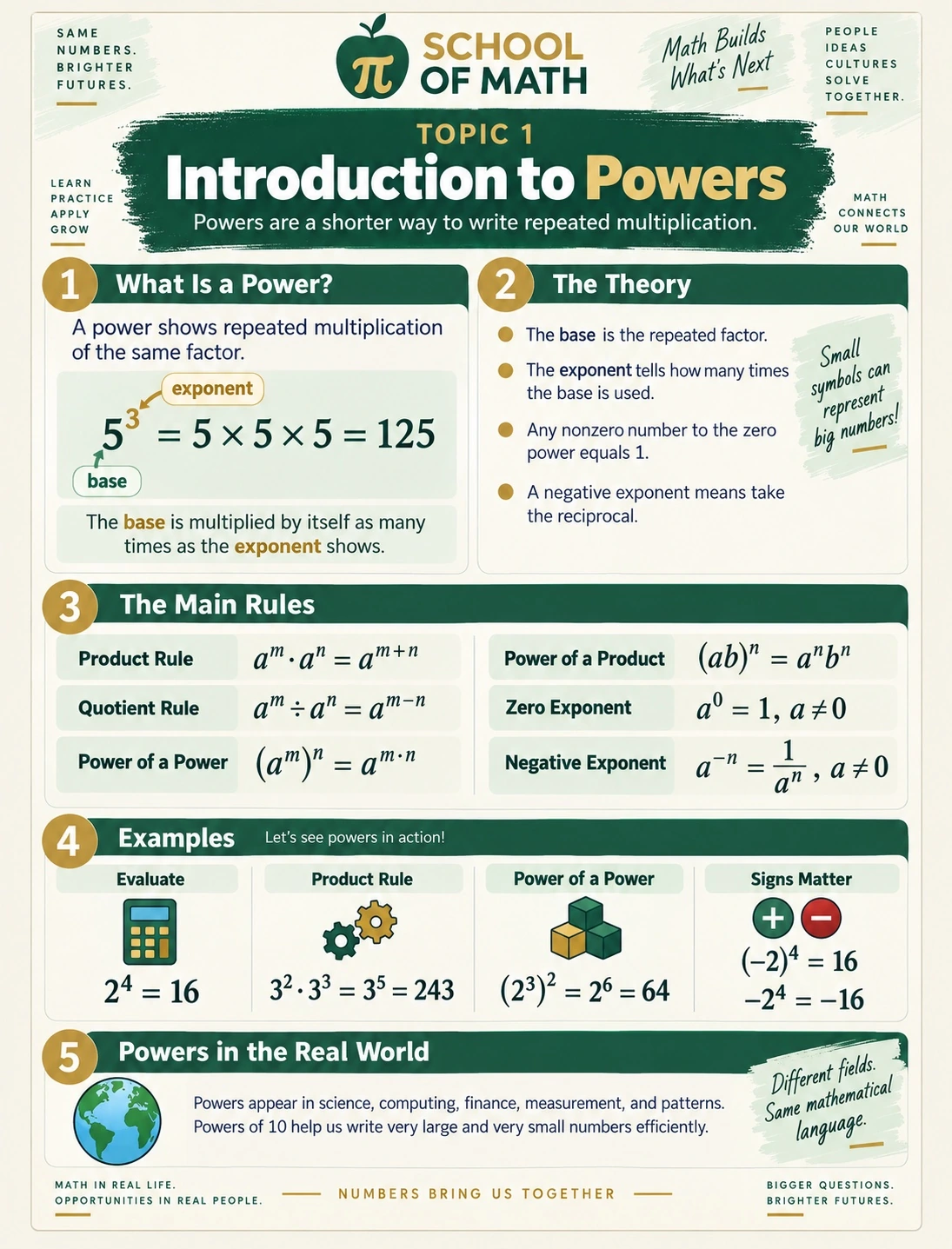
Key ideas in words
A power aⁿ multiplies the base a by itself n times when n is a positive whole number. For the same base, multiply powers by adding exponents and divide powers by subtracting exponents; a denominator cannot be zero. A power raised to a power multiplies the exponents. For a ≠ 0, a⁰ = 1 and a⁻ⁿ = 1/aⁿ. Parentheses decide whether a negative sign belongs to the base.
Watch for this: An exponent counts equal factors, not repeated addition. In particular, (−a)² and −a² do not mean the same thing.
10 original powers word problems
Work in order: Foundation → Build → Challenge. Try each problem before opening its answer.
-
01 Square mosaic
FoundationA mosaic has 6 rows with 6 tiles in each row. Write the number of tiles as a power, identify its base and exponent, and find the total.
Answer
6² = 36 tiles; base 6, exponent 2.
There are two equal factors: 6 × 6. Therefore the power is 6² and the mosaic contains 36 tiles.
-
02 Cube of blocks
FoundationA solid cube is built with 4 small blocks along each edge. How many small blocks fill the cube? Write a power before calculating.
Answer
4³ = 64 blocks.
Multiply length × width × height: 4 × 4 × 4. The three equal dimensions give 4³ = 64.
-
03 Doubling counters
FoundationA game starts with 3 counters. The number of counters doubles at the end of each round. How many are there after 5 rounds?
Answer
96 counters.
Five doublings multiply the starting amount by 2⁵. Thus 3 × 2⁵ = 3 × 32 = 96.
-
04 Stacked trays
BuildA storage rack holds 7² trays, and each tray contains 7³ beads. How many beads are on the full rack? Express the answer as one power and then as a number.
Answer
7⁵ = 16,807 beads.
Multiply the numbers of trays and beads per tray. Since the bases match, 7² × 7³ = 7²⁺³ = 7⁵ = 16,807.
-
05 Equal data packets
BuildA file contains 2¹² bytes. Each packet carries exactly 2⁵ bytes. How many packets are required, with no unused space?
Answer
2⁷ = 128 packets.
Divide the file size by the packet size: 2¹² ÷ 2⁵ = 2¹²⁻⁵ = 2⁷ = 128. The units are packets because bytes are divided by bytes per packet.
-
06 A larger square
BuildA square display has 3³ lights along each side. How many lights are in the full square array?
Answer
3⁶ = 729 lights.
The side has 3³ = 27 lights. Squaring the side gives (3³)² = 3³×² = 3⁶ = 729.
-
07 Shrinking a model
BuildA model is 240 cm long. Each of 4 resizing steps halves its length. Use a negative exponent to describe the change and find the final length.
Answer
240 × 2⁻⁴ = 15 cm.
Four halvings multiply the length by (1/2)⁴ = 2⁻⁴ = 1/16. The final length is 240/16 = 15 cm.
-
08 Two scoring rules
ChallengeIn a game, a player's score is −3. Rule A squares the entire score. Rule B squares the magnitude 3 and then assigns a negative sign. What does each rule produce, and how much larger is Rule A's result?
Answer
Rule A: 9; Rule B: −9. Rule A is 18 points larger.
Rule A gives (−3)² = 9. Rule B gives −3² = −9 because the exponent is evaluated before the leading negative sign. Their difference is 9 − (−9) = 18.
-
09 Multipliers and a zero exponent
ChallengeA simulation's token count is modeled by 6² × 6³ ÷ 6⁴ × 9⁰. It then shares the tokens equally between 2 teams. How many tokens does each team receive?
Answer
3 tokens per team.
The powers of 6 combine to 6²⁺³⁻⁴ = 6. Since 9 is nonzero, 9⁰ = 1. There are 6 × 1 = 6 tokens, and 6/2 = 3 per team.
-
10 Comparing growth plans
ChallengeTwo simulated gardens start with 8 seedlings each. In Plan A the count doubles at the end of every week. In Plan B it quadruples at the end of every two-week period. After 6 weeks, how many seedlings does each plan have? What fraction of Plan A's seedlings must be removed to leave 128?
Answer
Both plans have 512 seedlings; remove 3/4 of Plan A's seedlings.
Plan A has 8 × 2⁶ = 512. Plan B completes three two-week periods, so it has 8 × 4³ = 8 × (2²)³ = 512. Leaving 128 means removing 512 − 128 = 384; the removed fraction is 384/512 = 3/4.
Visual lesson 2 of 7 · Questions 11–20
Roots
Undoing powers and interpreting positive lengths.
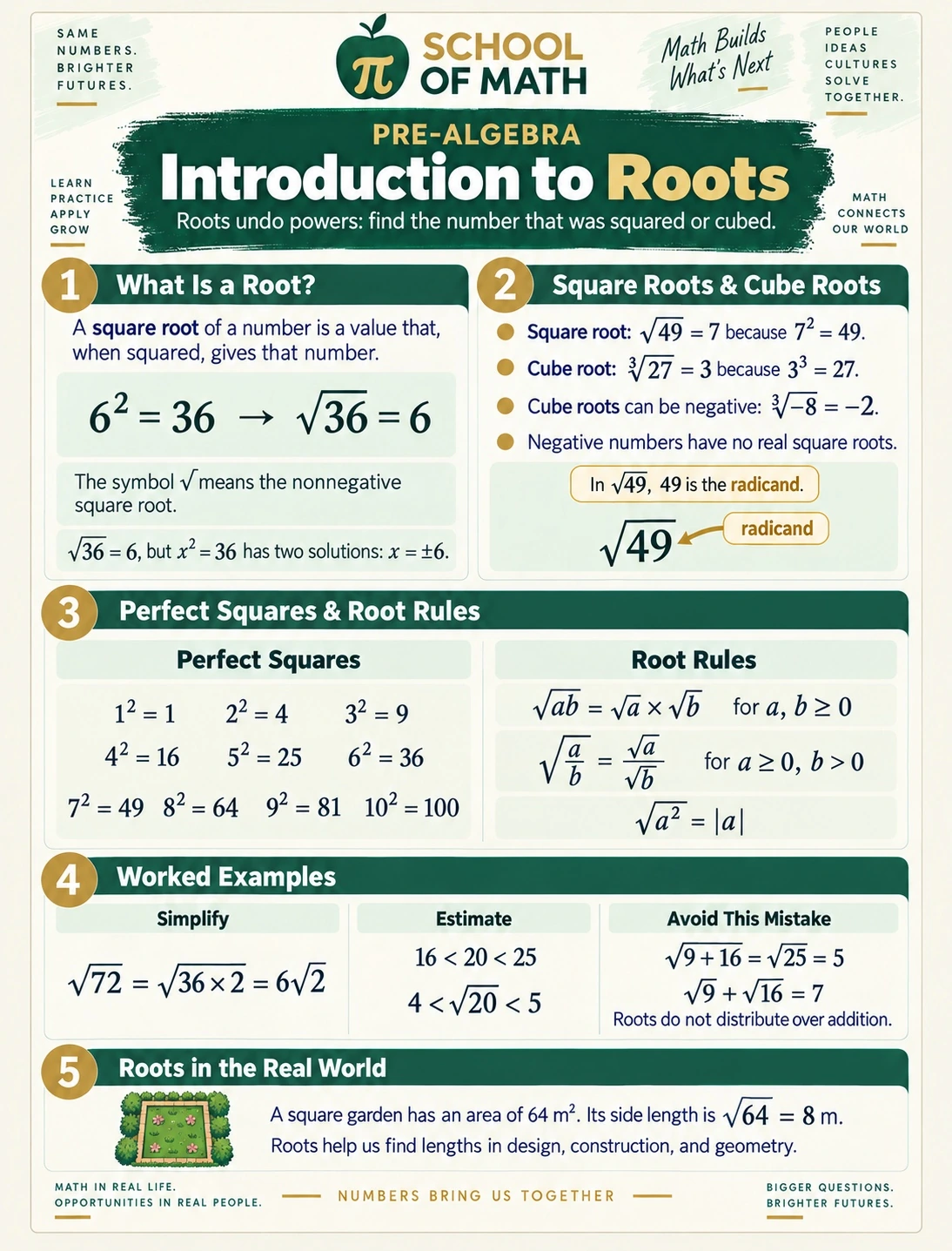
Key ideas in words
The principal square root √a is the nonnegative number whose square is a, for a ≥ 0. An equation x² = a with a > 0 has two real solutions, ±√a, but a physical side length uses the positive value. Cube roots can be negative. For nonnegative a and b, √(ab) = √a × √b; for a ≥ 0 and b > 0, √(a/b) = √a/√b. For real x, √(x²) = |x|.
Watch for this: Square roots do not distribute over addition. Simplify a radical by removing a perfect-square factor, and keep exact roots until a question asks you to round.
10 original roots word problems
Work in order: Foundation → Build → Challenge. Try each problem before opening its answer.
-
11 Square tablecloth
FoundationA square tablecloth has an area of 81 square feet. What is its side length?
Answer
9 feet.
For a square, side² = area. The side is the positive root √81 = 9 feet; a negative length is not meaningful.
-
12 Cube-shaped container
FoundationA cube-shaped container has a volume of 125 cubic centimeters. What is the length of each edge?
Answer
5 cm.
If the edge is s, then s³ = 125. Since 5 × 5 × 5 = 125, s = ∛125 = 5 cm.
-
13 Two positions
FoundationA robot's signed position x on a line, in meters from a marker, satisfies x² = 121. List every possible position and its distance from the marker.
Answer
x = −11 m or 11 m; both are 11 m from the marker.
Both (−11)² and 11² equal 121. The two signed positions are ±11, while distance is |x| = 11 meters.
-
14 Between two lengths
BuildA square mural has an area of 45 square meters. Between which two consecutive whole numbers does its side length lie? Explain without a calculator.
Answer
Between 6 m and 7 m.
Because 6² = 36 < 45 < 49 = 7², taking nonnegative square roots gives 6 < √45 < 7.
-
15 Exact side length
BuildA square stage has an area of 98 square meters. Give its side length in simplest radical form.
Answer
7√2 meters.
Write 98 = 49 × 2. Then √98 = √49 × √2 = 7√2 meters.
-
16 Square from a ratio
BuildA square photograph has an area of 225/16 square inches. What is its exact side length?
Answer
15/4 inches, or 3.75 inches.
The positive side length is √(225/16) = √225/√16 = 15/4 inches. Squaring 15/4 returns 225/16.
-
17 Joining two areas
BuildTwo square fabric pieces have areas 25 cm² and 144 cm². Their material is cut and rearranged without waste into one square. What is the new side length, and why is adding the old side lengths incorrect?
Answer
13 cm, not 17 cm.
The new area is 25 + 144 = 169 cm², so the new side is √169 = 13 cm. The old sides are 5 and 12 cm, but their sum 17 has square 289, not 169.
-
18 Distance between square centers
ChallengeTwo square panels have areas 50 cm² and 200 cm². They are placed side by side with one pair of edges touching and their centers on a horizontal line. How far apart are their centers? Give an exact answer.
Answer
15√2/2 cm.
The side lengths are √50 = 5√2 and √200 = 10√2. Center-to-center distance is half the first side plus half the second: (5√2 + 10√2)/2 = 15√2/2 cm.
-
19 Fencing a radical-length garden
ChallengeA square garden has area 180 m². A 2 m opening is left for a gate. How much fencing is needed? Give an exact answer and then round to the nearest tenth of a meter.
Answer
24√5 − 2 meters, approximately 51.7 m.
The side is √180 = 6√5 m. The full perimeter is 4 × 6√5 = 24√5 m. Subtract the opening: 24√5 − 2 ≈ 51.6656, which rounds to 51.7 m.
-
20 A border around a square
ChallengeA square painting has an area of 196 cm². A frame of the same width on all four sides makes the total outer area 324 cm². Find the frame's width and the area occupied by the frame.
Answer
Frame width: 2 cm. Frame area: 128 cm².
The painting's side is √196 = 14 cm; the outer side is √324 = 18 cm. The extra 4 cm consists of two equal frame widths, so each is (18 − 14)/2 = 2 cm. Subtract areas for the frame: 324 − 196 = 128 cm².
Visual lesson 3 of 7 · Questions 21–30
Factorization
Prime factors, greatest common factors, and reversing distribution.
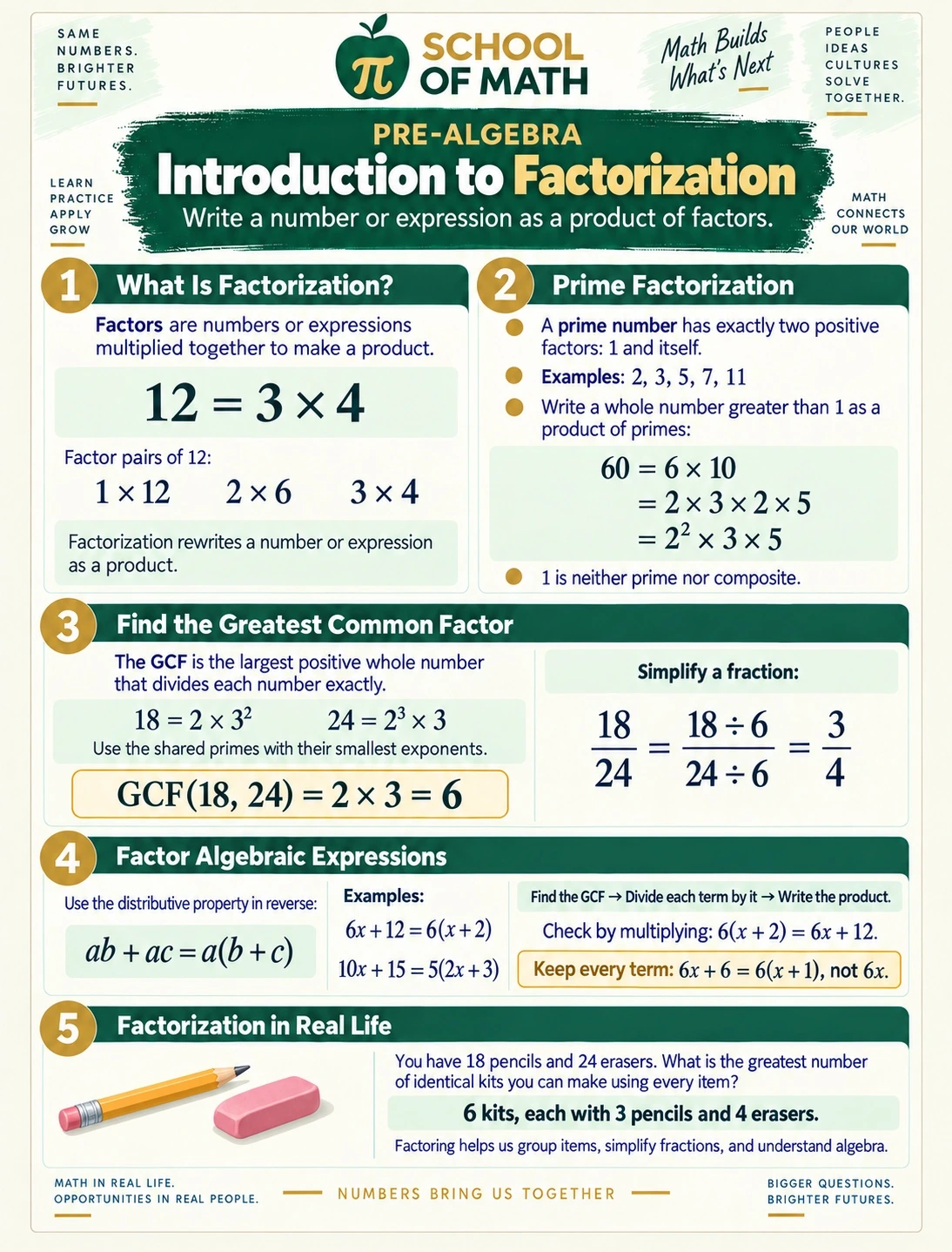
Key ideas in words
Factorization rewrites a number or expression as a product. Prime factorization uses only prime-number factors. The greatest common factor (GCF) is the largest factor shared by the given numbers or terms. In an expression, factoring out the GCF reverses the distributive property: ab + ac = a(b + c).
Watch for this: For the greatest possible number of identical kits with no leftovers, use the GCF, not a multiple. Expand a factored expression to check that every original term returns.
10 original factorization word problems
Work in order: Foundation → Build → Challenge. Try each problem before opening its answer.
-
21 Rectangular seating
FoundationA club has 20 chairs and wants a rectangular arrangement with at least 2 rows and at least 2 chairs per row. List the different factor-pair arrangements, counting rotations as the same arrangement.
Answer
2 × 10 and 4 × 5.
The positive factor pairs of 20 are 1 × 20, 2 × 10, and 4 × 5. Exclude 1 × 20 because both dimensions must be at least 2; do not count 10 × 2 separately.
-
22 Prime-sized packages
FoundationA shipment contains 84 markers. Write 84 as a product of primes to describe the shipment's prime factorization.
Answer
84 = 2² × 3 × 7.
Divide successively: 84 = 2 × 42 = 2 × 2 × 21 = 2² × 3 × 7. All remaining factors are prime.
-
23 Identical party bags
FoundationA host has 30 stickers and 42 cards. What is the greatest number of identical party bags that can use all the items, and what goes in each bag?
Answer
6 bags, each containing 5 stickers and 7 cards.
The GCF of 30 and 42 is 6. Divide each supply by 6: 30/6 = 5 stickers and 42/6 = 7 cards.
-
24 Longest equal strips
BuildA craft table has ribbons 48 cm and 72 cm long. Both must be cut into pieces of the same greatest possible whole-centimeter length, with no waste. Find that length and the total number of pieces.
Answer
24 cm per piece; 5 pieces in total.
The GCF of 48 and 72 is 24. The ribbons produce 48/24 = 2 and 72/24 = 3 pieces, totaling 5.
-
25 Simplifying a survey fraction
BuildOf 96 students surveyed, 60 chose a walking trip. What fraction chose the walking trip, in simplest form? Show the common factor you remove.
Answer
5/8 of the students.
The fraction is 60/96. The GCF is 12, so (60 ÷ 12)/(96 ÷ 12) = 5/8; 5 and 8 share no factor greater than 1.
-
26 Factoring a printing cost
BuildA printer's total charge for x posters is represented by 14x + 21 dollars. Factor out the greatest common factor, then find the charge for 5 posters.
Answer
7(2x + 3); the charge for 5 posters is $91.
The GCF of 14 and 21 is 7, so 14x + 21 = 7(2x + 3). At x = 5, this is 7(10 + 3) = 91 dollars.
-
27 Three-item supply kits
BuildA teacher has 54 pencils, 90 index cards, and 126 paper clips. Find the greatest number of identical kits that use every item, and list the contents of one kit.
Answer
18 kits: 3 pencils, 5 cards, and 7 paper clips each.
The GCF of 54, 90, and 126 is 18. Dividing the quantities by 18 gives 3, 5, and 7, respectively. A greater number of kits cannot divide all three totals.
-
28 Area as a product
ChallengeA rectangular banner has area 18x + 30 square centimeters and height 6 cm, where x is positive. Factor its area to find the width. Then find its perimeter when x = 4.
Answer
Width: 3x + 5 cm. At x = 4, the perimeter is 46 cm.
Factor 18x + 30 = 6(3x + 5). Dividing the area by the 6 cm height gives width 3x + 5. At x = 4 the width is 17 cm, so perimeter = 2(17 + 6) = 46 cm.
-
29 Variable factors in a garden
ChallengeA rectangular garden has area 12x² + 20x square meters and width 4x meters, where x > 0. Factor the area completely to find its length. Find its area when x = 3.
Answer
Length: 3x + 5 m. At x = 3, area = 168 m².
The greatest common factor is 4x, so 12x² + 20x = 4x(3x + 5). Cancel the nonzero width 4x to get length 3x + 5. At x = 3, width is 12 m and length is 14 m; their product is 168 m².
-
30 Reorganizing identical kits
ChallengeA club has 72 badges, 120 stickers, and 168 cards. First it makes the greatest possible number of identical kits with no leftovers. It then combines every 3 of those kits into one larger kit. How many larger kits result, and what does each contain?
Answer
8 larger kits, each with 9 badges, 15 stickers, and 21 cards.
The GCF of 72, 120, and 168 is 24, giving 24 small kits with 3 badges, 5 stickers, and 7 cards each. Combining them in groups of 3 yields 24/3 = 8 larger kits, with 3 times each small-kit quantity. Check: 8 × (9, 15, 21) = (72, 120, 168).
Visual lesson 4 of 7 · Questions 31–40
Expressions
Translating situations and simplifying without an equals sign.
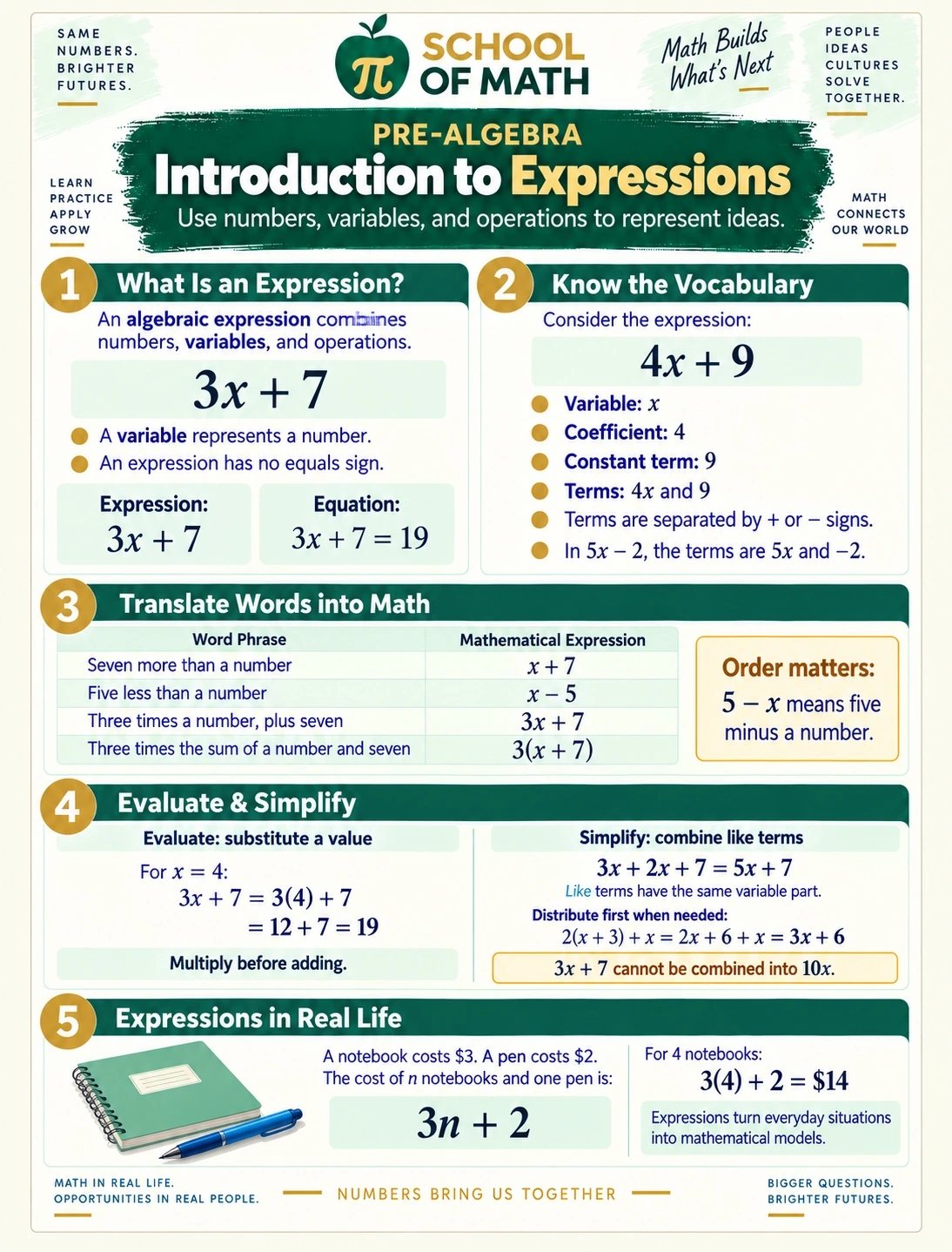
Key ideas in words
An algebraic expression describes a quantity using numbers, variables, and operations. A coefficient multiplies a variable, a constant has a fixed value, and terms are separated by addition or subtraction at the top level. To evaluate an expression, substitute a value. To simplify, combine like terms and use distribution while keeping the value unchanged.
Watch for this: An expression names a quantity; an equation states that two quantities are equal. Define the variable and its units before writing your model, and use parentheses when a whole group is multiplied.
10 original expressions word problems
Work in order: Foundation → Build → Challenge. Try each problem before opening its answer.
-
31 Trading cards
FoundationMilo owns c trading cards and receives 9 more. Write an expression for his new total. In your expression, identify the variable and the constant.
Answer
c + 9; variable c, constant 9.
The unknown starting number is represented by c. Receiving 9 cards means adding 9, so the new total is c + 9.
-
32 Cost of oranges
FoundationOranges cost $4 per bag. Write an expression for the cost of b bags, and identify the coefficient of b.
Answer
4b dollars; the coefficient is 4.
Multiply 4 dollars per bag by b bags. The number multiplying b is 4, so 4 is the coefficient.
-
33 A day at the pool
FoundationPool admission costs $8 per person and a locker costs $5 per group. Write an expression for a group's total cost if p people share one locker, then evaluate it for 6 people.
Answer
8p + 5; for 6 people, $53.
The admissions total is 8p and the group adds one $5 locker fee. At p = 6, 8(6) + 5 = 48 + 5 = 53.
-
34 Adding walking distances
BuildOn each school day, Sam walks x kilometers in the morning and 2x kilometers in the afternoon. Sam also walks 4 kilometers on Saturday. Write and simplify the total for 5 school days plus Saturday.
Answer
15x + 4 kilometers.
One school day contributes x + 2x = 3x. Five days give 5(3x) = 15x; add Saturday's 4 km to get 15x + 4.
-
35 Twice the whole collection
BuildA workshop makes twice as many bracelets as the sum of a student's current b bracelets and 6 extra bracelets. Write the expression using parentheses, then expand it.
Answer
2(b + 6) = 2b + 12.
The quantity being doubled is the entire sum b + 6. Distribute 2 to both terms: 2b + 2 × 6 = 2b + 12.
-
36 Ticket sales after a fee
BuildA club sells a adult tickets for $12 each and s student tickets for $7 each. It pays a fixed $25 room fee. Write an expression for the money left, then evaluate it when a = 4 and s = 9.
Answer
12a + 7s − 25; the club has $86 left.
Add the two ticket revenues, then subtract the fee. Substituting gives 12(4) + 7(9) − 25 = 48 + 63 − 25 = 86.
-
37 A rectangle's perimeter
BuildA rectangular poster is x + 4 cm long and x − 1 cm wide, with x > 1. Write and simplify its perimeter. Find the perimeter when x = 7.
Answer
4x + 6 cm; at x = 7, 34 cm.
Perimeter is twice the length plus twice the width: 2(x + 4) + 2(x − 1). Expanding gives 2x + 8 + 2x − 2 = 4x + 6. At x = 7, 28 + 6 = 34.
-
38 Discount before delivery
ChallengeA store sells n identical games at $18 each. It takes 25% off the entire merchandise total, then adds a $6 delivery fee. Write a simplified cost expression and evaluate it for 4 games.
Answer
13.5n + 6 dollars; 4 games cost $60.
After a 25% discount, 75% of the merchandise cost remains: 0.75(18n) + 6 = 13.5n + 6. For n = 4, 54 + 6 = 60. The delivery fee is not discounted.
-
39 Tracking water
ChallengeA tank starts with 5x + 18 liters. It loses x + 4 liters on each of 3 days, then receives 2x liters. Write and simplify the final amount, then evaluate it when x = 6.
Answer
4x + 6 liters; at x = 6, 30 liters.
Model every change: (5x + 18) − 3(x + 4) + 2x. Distribute the subtraction to get 5x + 18 − 3x − 12 + 2x = 4x + 6. Substituting x = 6 gives 24 + 6 = 30.
-
40 Comparing package costs
ChallengePlan A charges $6 for each of n activity packets and an $8 handling fee. Plan B charges $4 per packet, a $2 materials charge for each of the same n packets, and a $3 handling fee. Write both total-cost expressions. Is one always cheaper for every whole-number n ≥ 0?
Answer
A(n) = 6n + 8; B(n) = 6n + 3. Plan B is always $5 cheaper.
Plan B simplifies from 4n + 2n + 3 to 6n + 3. Subtract the totals: (6n + 8) − (6n + 3) = 5. The variable terms cancel, so the difference is $5 regardless of the number of packets.
Visual lesson 5 of 7 · Questions 41–50
Equations
Solving for an unknown and checking the original situation.
Key ideas in words
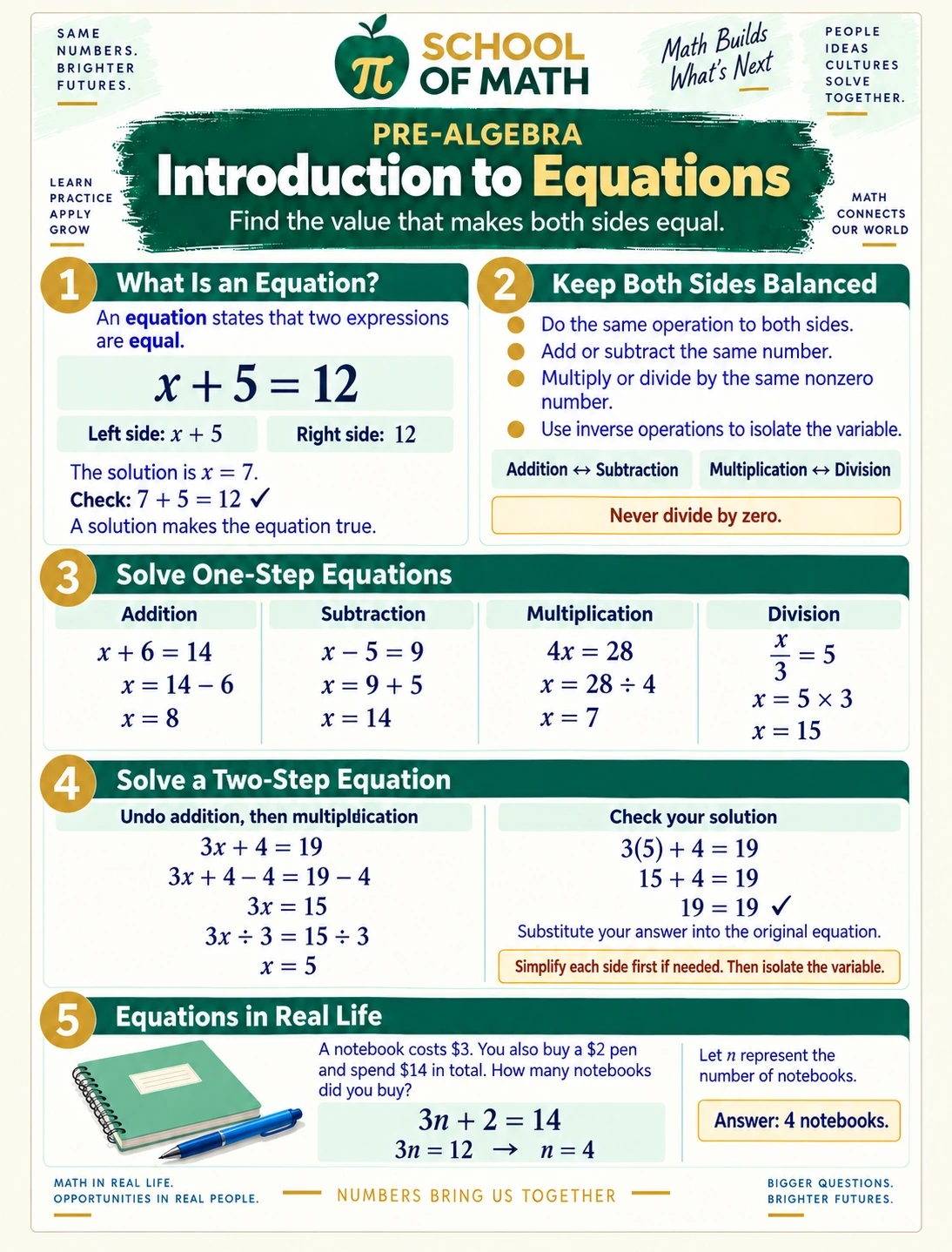
An equation says that two expressions are equal. Solve by performing the same valid operation on both sides, using inverse operations to isolate the unknown. In multi-step equations, simplify each side, collect variable terms, and then isolate the variable. Check a proposed solution in the original equation and in the context.
Watch for this: The answer must fit the situation as well as the algebra. An equation can also have no solution or infinitely many solutions if the variable terms cancel.
10 original equations word problems
Work in order: Foundation → Build → Challenge. Try each problem before opening its answer.
-
41 Missing marbles
FoundationAfter receiving 8 marbles, Lena has 23. How many marbles did she have at first? Write and solve an equation.
Answer
15 marbles.
Let m be the starting number. Then m + 8 = 23. Subtract 8 from both sides to get m = 15; check 15 + 8 = 23.
-
42 Equal pencil boxes
FoundationSeven identical boxes contain 63 pencils altogether. How many pencils are in each box?
Answer
9 pencils per box.
Let p be pencils per box. The equation is 7p = 63, so p = 63/7 = 9. Check: 7 × 9 = 63.
-
43 Sharing a ribbon
FoundationA ribbon is cut into 5 equal pieces. Each piece is 8 cm long. What was the original length? Write an equation that uses division.
Answer
40 cm.
Let r be the original length. Then r/5 = 8. Multiply both sides by 5: r = 40 cm.
-
44 Taxi model
BuildFor this problem, a taxi charges a $7 starting fee plus $4 for each mile. A trip costs $39. How many miles was the trip?
Answer
8 miles.
Let m be the miles. Solve 4m + 7 = 39: subtract 7 to get 4m = 32, then divide by 4 to get m = 8. Check 4(8) + 7 = 39.
-
45 Three identical lunch orders
BuildThree identical lunch orders each contain a sandwich costing x dollars and a $4 drink. The total is $45. Find the price of one sandwich.
Answer
$11.
The equation is 3(x + 4) = 45. Divide by 3 to obtain x + 4 = 15, then subtract 4: x = 11. Each lunch costs $15.
-
46 Two savings accounts
BuildNoor starts with $18 and saves $6 per week. Eli starts with $42 and saves $3 per week. After how many weeks will their totals be equal, and what will each total be?
Answer
After 8 weeks; each will have $66.
Solve 18 + 6w = 42 + 3w. Subtract 3w and 18 to get 3w = 24, so w = 8. Both expressions then equal 66.
-
47 Reading the rest
BuildA reader finishes 2/5 of a book, then reads 18 more pages. There are 54 pages left. How many pages are in the book?
Answer
120 pages.
Let p be the total pages. After the first stage, 3p/5 remain. Therefore 3p/5 − 18 = 54, giving 3p/5 = 72 and p = 120. Check: 48 + 18 + 54 = 120.
-
48 Two different admissions
ChallengeA museum group buys 14 tickets. Adult tickets cost $13 and child tickets cost $8. The total is $142. How many of each ticket did the group buy?
Answer
6 adult tickets and 8 child tickets.
Let a be adult tickets; then 14 − a are child tickets. Solve 13a + 8(14 − a) = 142, so 5a + 112 = 142 and a = 6. The child count is 8; check 78 + 64 = 142.
-
49 When plans cannot match
ChallengePlan A costs $5 per session plus a $12 fee. Plan B costs $5 per session plus a $19 fee. At how many sessions will the total costs be equal? Use an equation to justify your answer.
Answer
They are never equal; the equation has no solution.
Setting the costs equal gives 5s + 12 = 5s + 19. Subtracting 5s gives 12 = 19, which is false. Plan B remains $7 more expensive for every allowed session count.
-
50 A discount and two age groups
ChallengeA group of 18 visitors pays $9 per child and $15 per adult. A group discount takes $12 off the ticket total, and a $6 reservation fee is then added. The final bill is $198. How many adults and children are in the group?
Answer
7 adults and 11 children.
Let a be adults, so there are 18 − a children. Solve 15a + 9(18 − a) − 12 + 6 = 198. This simplifies to 6a + 156 = 198, so a = 7. Then 18 − 7 = 11 children. Check: 105 + 99 − 12 + 6 = 198.
Visual lesson 6 of 7 · Questions 51–60
Inequalities
Modeling limits, reversing signs, and whole-number solutions.
Key ideas in words
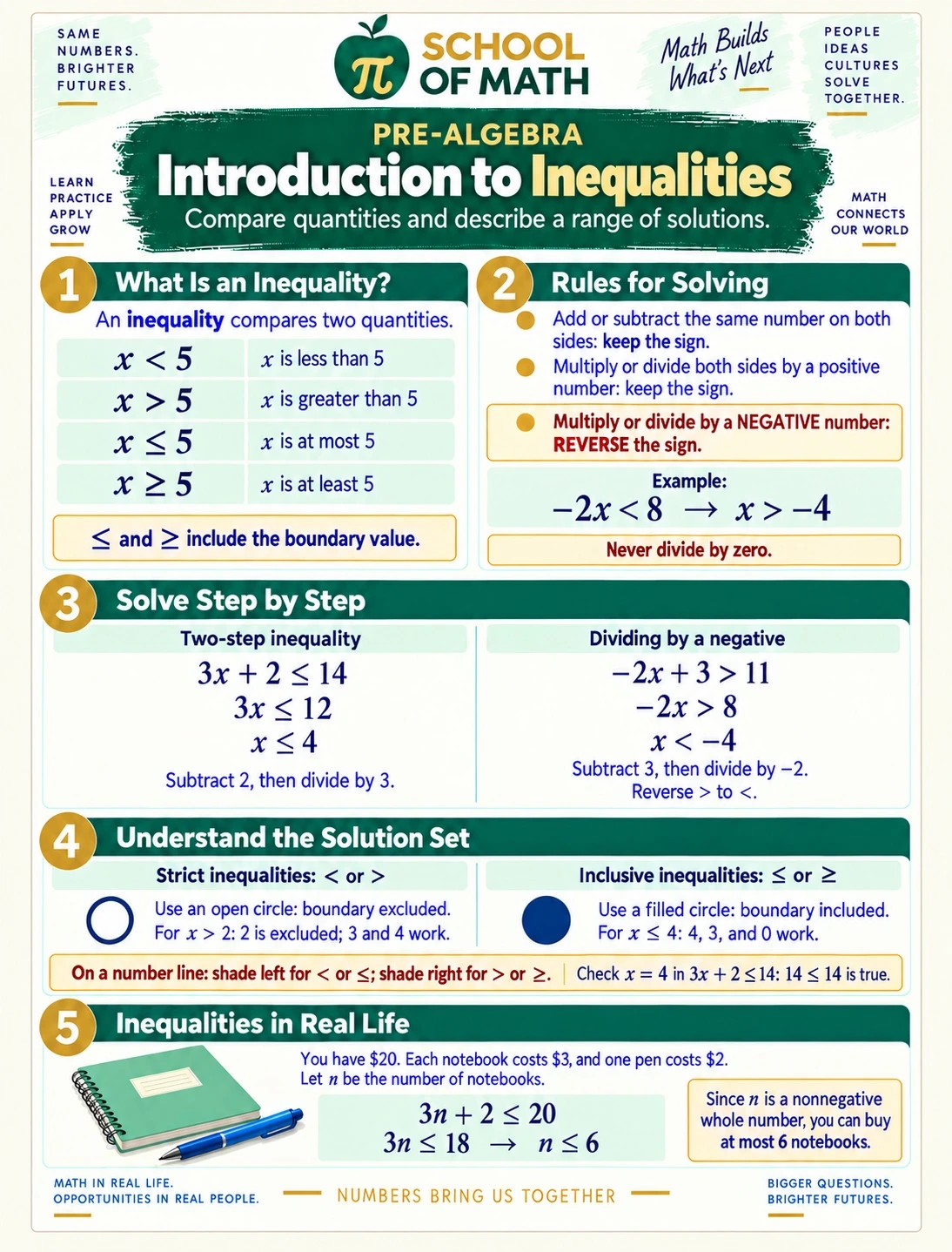
An inequality compares quantities with <, >, ≤, or ≥. The phrases at most and no more than include equality; at least and no less than do too. Solve much like an equation, but reverse the inequality when multiplying or dividing both sides by a negative number. State whether the variable may be any real number or only whole numbers.
Watch for this: On a number line, < and > use an open endpoint; ≤ and ≥ use a closed endpoint. For purchases and people, use the allowed whole-number values instead of rounding an unaffordable amount up.
10 original inequalities word problems
Work in order: Foundation → Build → Challenge. Try each problem before opening its answer.
-
51 A ride's height rule
FoundationA ride requires a height of at least 132 cm. Write an inequality for a rider's height h. Does a rider who is exactly 132 cm tall qualify?
Answer
h ≥ 132; yes.
At least includes the boundary value. Therefore h can equal 132 or be greater than 132.
-
52 A backpack limit
FoundationA backpack must weigh less than 8 kg. Write an inequality for its weight w, and say whether 7.9 kg and 8 kg are allowed.
Answer
0 ≤ w < 8; 7.9 kg is allowed, but 8 kg is not.
Weight is nonnegative in this situation. Less than means the upper boundary is excluded, so w = 8 does not satisfy the rule.
-
53 Buying postcards
FoundationPostcards cost $4 each. A student has $27. Write an inequality for the number n of postcards and find the greatest number the student can buy.
Answer
4n ≤ 27; at most 6 postcards.
Divide by 4: n ≤ 6.75. Since n must be a nonnegative whole number, the greatest allowed value is 6. Seven postcards would cost $28.
-
54 Saving toward a goal
BuildA student has $17 and saves $9 each week. After how many whole weeks will the student have at least $80?
Answer
At least 7 weeks.
Solve 17 + 9w ≥ 80. Subtract 17: 9w ≥ 63; divide by 9: w ≥ 7. At week 7 the total is exactly $80.
-
55 Craft supplies with a fee
BuildA craft supplier charges $6 for delivery and $7 per kit. A club can spend no more than $54. How many whole kits can it order at most?
Answer
6 kits.
Solve 6 + 7k ≤ 54, giving k ≤ 48/7, approximately 6.86. Restricting k to nonnegative whole numbers gives a maximum of 6. Six kits cost $48; seven cost $55.
-
56 Cooling a sample
BuildA sample starts at 19°C and cools at a constant rate of 4°C per minute in a model. For how long is its temperature strictly above 3°C? Time t may be any nonnegative real number.
Answer
0 ≤ t < 4 minutes.
Model the condition as 19 − 4t > 3. Then −4t > −16. Dividing by −4 reverses the sign, giving t < 4. Include t ≥ 0 because elapsed time cannot be negative; at t = 4 the temperature is exactly 3°C.
-
57 Selecting a cheaper plan
BuildPlan A costs $14 plus $3 per visit. Plan B costs $6 plus $5 per visit. For which whole numbers of visits is Plan A strictly cheaper?
Answer
For 5 or more visits.
Solve 14 + 3v < 6 + 5v. Subtract 3v and 6: 8 < 2v, so v > 4. Four visits gives equal prices; the first whole-number value making A cheaper is 5.
-
58 Weight range
ChallengeA shipping box weighs 2 kg before identical 0.75 kg items are added. Its total weight must be at least 5 kg and no more than 8 kg. Which whole numbers of items are allowed?
Answer
4, 5, 6, 7, or 8 items.
Write 5 ≤ 2 + 0.75n ≤ 8. Subtract 2 throughout and divide by 0.75 to get 4 ≤ n ≤ 8. Keep only whole numbers. Both endpoints are allowed.
-
59 A discount and a strict budget
ChallengeAn order contains n art sets priced at $12 each. A 15% discount applies to the merchandise, followed by an $8 delivery fee. The final cost must be strictly less than $90. Find the greatest whole number of sets that can be ordered.
Answer
8 art sets.
The cost is 0.85(12n) + 8 = 10.2n + 8. Solve 10.2n + 8 < 90 to get n < 82/10.2 = 410/51, approximately 8.039. The largest whole number is 8; its cost is $89.60.
-
60 Two limits on a fundraiser
ChallengeA club sells each bracelet for $9. Materials cost $3 per bracelet, and the table fee is $42. The club wants a profit of at least $150, but has at most $150 available for materials before selling. Find every possible whole-number quantity of bracelets, assuming all made are sold.
Answer
Any whole number from 32 through 50 bracelets.
Profit is 9n − 3n − 42 = 6n − 42. Requiring 6n − 42 ≥ 150 gives n ≥ 32. The separate materials budget gives 3n ≤ 150, so n ≤ 50. Intersect the two conditions: 32 ≤ n ≤ 50, with n a whole number.
Visual lesson 7 of 7 · Questions 61–70
Functions
Input-output rules, domains, and comparing models.
Key ideas in words
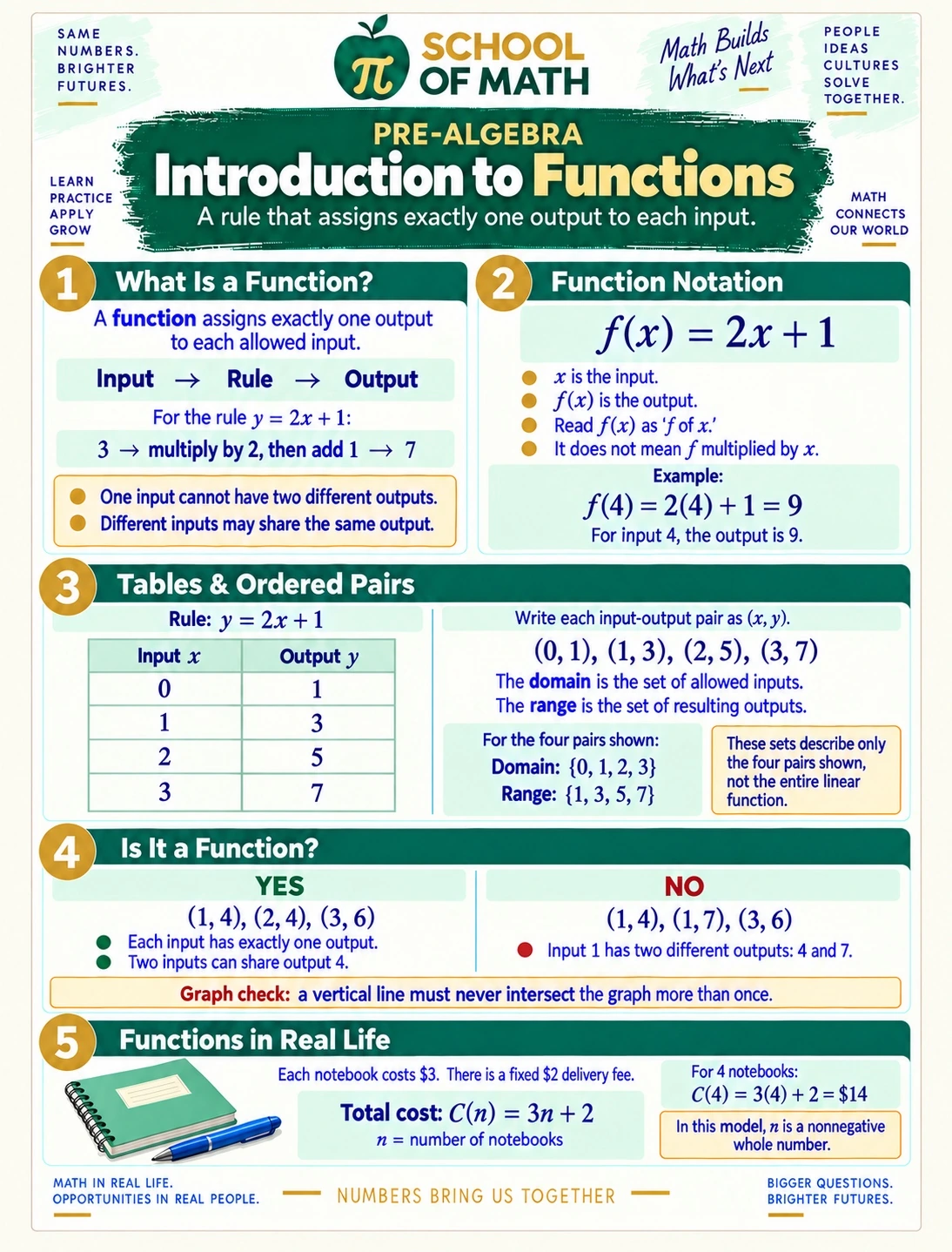
A function assigns exactly one output to each allowed input. Function notation f(x) names the output for input x; it does not mean f multiplied by x. The domain is the set of allowed inputs, and the range is the set of resulting outputs. Two different inputs may share an output, but one input cannot have two different outputs in a function.
Watch for this: Define the input and output before deciding whether a relation is a function. For a graph with input on the horizontal axis, a vertical line must never meet the graph at more than one point.
10 original functions word problems
Work in order: Foundation → Build → Challenge. Try each problem before opening its answer.
-
61 Machine output
FoundationA token machine follows the rule T(n) = 3n. If 5 tokens are inserted, how many points are returned?
Answer
15 points.
Substitute the input n = 5 into the rule: T(5) = 3 × 5 = 15.
-
62 A delivery rule
FoundationA bakery models an order's cost by C(b) = 5b + 4 dollars, where b is the number of bread boxes. Find C(7) and explain the meaning of 4.
Answer
C(7) = $39; 4 is the fixed $4 delivery fee.
Substitute 7: C(7) = 5(7) + 4 = 39. The term 5b changes with the box count; the constant 4 is charged once per order.
-
63 Building an input-output table
FoundationA rental model is R(h) = 4h + 7 dollars. For the domain {0, 1, 2, 3} hours, list every ordered pair and the range.
Answer
Pairs: (0, 7), (1, 11), (2, 15), (3, 19). Range: {7, 11, 15, 19}.
Evaluate the rule once for each allowed input: 4(0) + 7 = 7, then 11, 15, and 19. The range contains these outputs only because the stated domain contains only four inputs.
-
64 Students and lockers
BuildA record pairs each student ID with a locker number: (101, 8), (102, 8), (103, 12). Is locker number a function of student ID, even though two students share locker 8?
Answer
Yes, it is a function of student ID.
Each input ID occurs with exactly one output. IDs 101 and 102 sharing output 8 does not violate the definition of a function.
-
65 Detecting inconsistent records
BuildA vending-machine record pairs a button number with its assigned price: (1, 2), (2, 3), (1, 4), (3, 5). Does this record define price as a function of button number? Explain.
Answer
No; input 1 has two different outputs, 2 and 4.
A function requires one assigned price for each button. Button 1 appears with both $2 and $4, so the relation fails the function rule.
-
66 Finding the input
BuildA bicycle rental follows C(h) = 8h + 6 dollars. A customer pays $54. How many hours did the customer rent the bicycle?
Answer
6 hours.
Set the output equal to the bill: 8h + 6 = 54. Then 8h = 48 and h = 6. Check: C(6) = 54.
-
67 A contextual domain
BuildA tray holds at most 8 muffins, sold for $2.50 each with no fee. Let C(m) = 2.5m. State the domain and range when a customer may buy any whole number of muffins that fit on one tray, including none.
Answer
Domain: {0, 1, 2, 3, 4, 5, 6, 7, 8}. Range: {$0, $2.50, $5, $7.50, $10, $12.50, $15, $17.50, $20}.
Only whole-number inputs from 0 through 8 fit the context. Multiply each by $2.50 to generate the nine allowed outputs; do not include intermediate amounts such as $1.
-
68 Recovering a linear rule
ChallengeA delivery service's cost increases by a constant amount for each added parcel. Its records show (2 parcels, $17), (5 parcels, $29), and (8 parcels, $41). Find a rule C(n) and predict the cost for 11 parcels.
Answer
C(n) = 4n + 9; 11 parcels cost $53.
The cost rises $12 when the parcel count rises 3, so the rate is $4 per parcel. Using C(2) = 17 gives 8 + b = 17, so the fixed fee b is 9. Then C(11) = 44 + 9 = 53.
-
69 A tank's changing amount
ChallengeA tank drains according to V(t) = 60 − 2.5t liters, starting at t = 0 minutes and stopping when empty. Give the realistic domain and range. When will exactly 15 liters remain?
Answer
Domain: 0 ≤ t ≤ 24. Range: 0 ≤ V ≤ 60. Exactly 15 liters remain after 18 minutes.
The tank empties when 60 − 2.5t = 0, giving t = 24. Throughout the continuous draining interval, the volume takes every value from 60 down to 0. For 15 liters, solve 60 − 2.5t = 15, so t = 45/2.5 = 18.
-
70 Choosing a function under a budget
ChallengeA club needs at least 10 and at most 18 identical shirts. Printer A charges A(n) = 7n + 35 dollars; Printer B charges B(n) = 9n + 11 dollars. The budget is $150. Which printer allows the greatest number of shirts, how many can be ordered, and how much does that order cost?
Answer
Printer A allows 16 shirts for $147.
For A, 7n + 35 ≤ 150 gives n ≤ 115/7, so at most 16 whole shirts. For B, 9n + 11 ≤ 150 gives n ≤ 139/9, so at most 15. Both meet the 10–18 requirement, but A permits one more shirt. Check A(16) = 147 and A(17) = 154.
Cumulative practice · Questions 71–80
10 final pre-algebra review questions
Start with one-step applications and build toward questions that combine several ideas. All answers are hidden until you choose to reveal them.
-
71 A squared quantity
FoundationA square display has 8 rows of 8 badges. How many badges are displayed? Write your calculation as a power.
Answer
64 badges.
The total is 8 × 8 = 8² = 64.
-
72 Recovering a side
FoundationA square mat covers 100 square feet. What is its side length?
Answer
10 feet.
The positive side length is √100 = 10 feet. Check 10² = 100.
-
73 Equal snack packs
FoundationA teacher has 28 crackers and 44 grapes. What is the greatest number of identical snack packs with no leftovers, and what is in each?
Answer
4 packs, with 7 crackers and 11 grapes per pack.
The GCF of 28 and 44 is 4. Divide each total by 4 to get 7 crackers and 11 grapes.
-
74 A simplified earnings model
BuildOn each of 4 afternoons, a student earns x dollars walking dogs and $3 cleaning a workbench. The student then spends $7. Write and simplify the money remaining.
Answer
4x + 5 dollars.
The four afternoons produce 4(x + 3). Subtract spending: 4(x + 3) − 7 = 4x + 12 − 7 = 4x + 5.
-
75 Solving a purchase
BuildA purchase of identical $6 sketchbooks plus a $5 delivery charge costs $47. How many sketchbooks were purchased?
Answer
7 sketchbooks.
Solve 6s + 5 = 47. Subtract 5 and divide by 6: s = 42/6 = 7. Check: 6(7) + 5 = 47.
-
76 A budget boundary
BuildA workshop charges $13 for supplies plus $8 per participant. A family can spend at most $70. What is the greatest number of participants it can pay for?
Answer
7 participants.
Solve 13 + 8p ≤ 70, so p ≤ 57/8 = 7.125. The largest whole-number value is 7. Seven cost $69, while eight cost $77.
-
77 Writing and reversing a function
BuildA bike shop charges a fixed setup fee plus a constant hourly rental rate. A 2-hour rental costs $23 and a 5-hour rental costs $44. Find C(h), then find the rental time that costs $65.
Answer
C(h) = 7h + 9; $65 pays for 8 hours.
The rate is (44 − 23)/(5 − 2) = 21/3 = $7 per hour. The setup fee is 23 − 7(2) = $9. Solve 7h + 9 = 65 to get h = 8.
-
78 Roots, perimeter, and rounding
ChallengeA square patio has area 128 m². A 3 m opening is left in its border. Border material is sold in 2 m strips and can be cut without waste. How many strips must be purchased to supply the remaining border?
Answer
22 strips.
The side is √128 = 8√2 m, so the required border length is 32√2 − 3 ≈ 42.2548 m. Divide by 2 to get approximately 21.1274 strips. Round up to 22; 21 strips supply only 42 m.
-
79 Growth and an integer limit
ChallengeA simulated colony starts with 5 cells and doubles after each complete hour. A container may hold at most 600 cells. What is the greatest whole number of hours it can remain in the container under this model? How many cells are present then?
Answer
6 complete hours; 320 cells.
The count after h hours is 5 × 2ʰ. At h = 6 it is 5 × 64 = 320 ≤ 600. At h = 7 it is 5 × 128 = 640 > 600. Since doubling increases the count each hour, 6 is the greatest allowed whole-number time.
-
80 Final planning challenge
ChallengeA square community garden has area 225 m² and needs fencing on all four sides except a 3 m gate. Fence is sold in 3 m panels at $18 per panel. Every volunteer kit needs 2 gloves and 3 ties; there are 30 gloves and 48 ties, and unused supplies may remain. A delivery costs $24, lunch costs $8 per volunteer, and the total budget is $470. At least 10 volunteers must attend, each receiving one kit and one lunch. Find the panels needed and the greatest possible number of volunteers. Give the total cost and money left.
Answer
19 panels; 13 volunteers; total cost $470; $0 left.
The garden side is √225 = 15 m. Fence length is 4(15) − 3 = 57 m, requiring 57/3 = 19 panels and costing 19 × 18 = $342. Including delivery leaves 470 − 342 − 24 = $104 for lunches, so 8v ≤ 104 gives v ≤ 13. Kits allow at most min(30/2, 48/3) = min(15, 16) = 15 volunteers, so the budget is the tighter limit. Thirteen meets the minimum of 10. Total cost is 342 + 24 + 8(13) = $470; the kits use 26 gloves and 39 ties.
Pre-algebra essentials: common questions
What are pre-algebra essentials?
Pre-algebra essentials are the ideas that connect arithmetic to algebra: powers, roots, factors, expressions, equations, inequalities, and input-output functions. This standalone SOMATH lesson practices those seven topics through original word problems.
How many questions are in this lesson?
There are 80 questions: 10 word problems under each of seven posters, followed by 10 cumulative review questions. Every set moves from simpler applications toward multi-step reasoning.
Are these the same questions as the examples in the posters?
No. The practice problems use new situations and calculations rather than copying the posters' worked examples. The posters teach the ideas; the questions test independent application.
How do I reveal the answers?
Select the small blue Answer control beneath any problem. It reveals the result and worked reasoning. Select it again to hide the answer, or use Tab and Enter on a keyboard.
How should I use this for pre-algebra review?
Start with the poster and its text summary, then attempt the ten questions in order. Write a model, show each step, label units, and check your answer. Work through one topic at a time if needed, then complete the ten final questions.
Is this lesson tied to a particular SOMATH course?
No. This is a free, standalone SOMATH Journal learning resource. It is not assigned to a course or numbered syllabus.
Explain the reasoning, not just the result.
After the final review, choose one question you found difficult and explain it in your own words. Identify the model, the operation, and the check that confirms your answer.
For more independent learning, visit the SOMATH Journal. To discuss your student's next learning steps, request a math evaluation or contact School of Math.
Original practice problems and worked explanations by SOMATH School of Math. The seven SOMATH instructional posters are presented in their supplied order. When referencing this resource, cite Pre-Algebra Essentials: 80 Original Word Problems, published September 18, 2026.