Pre-Calculus · Class 1
Function Families: Linear, Quadratic, Polynomial, and Rational
Read any function by its structure. Learn what makes a rule a function, where it is defined, and how linear, quadratic, polynomial, and rational families behave, transform, and model real situations.
Explore eight illustrated topics with 40 practice questions, eight Homework review questions, and twelve Homework word problems. All 60 questions include detailed working behind blue Answer controls. Work over the real numbers, use interval notation for domains and ranges, and keep exact values unless a question requests rounding.
This is an independent topic in the AP Pre-Calculus rolling syllabus; earlier class attendance is not required. Use the explanations here, try each question, then reveal the check. See the schedule or book an evaluation at SOMATH.
Download the student workbook (PDF)22 pages · Supplied cover, eight teaching images, all 60 questions · Blank working space · No exercise solutions
What is a function? Inputs, rules, and outputs
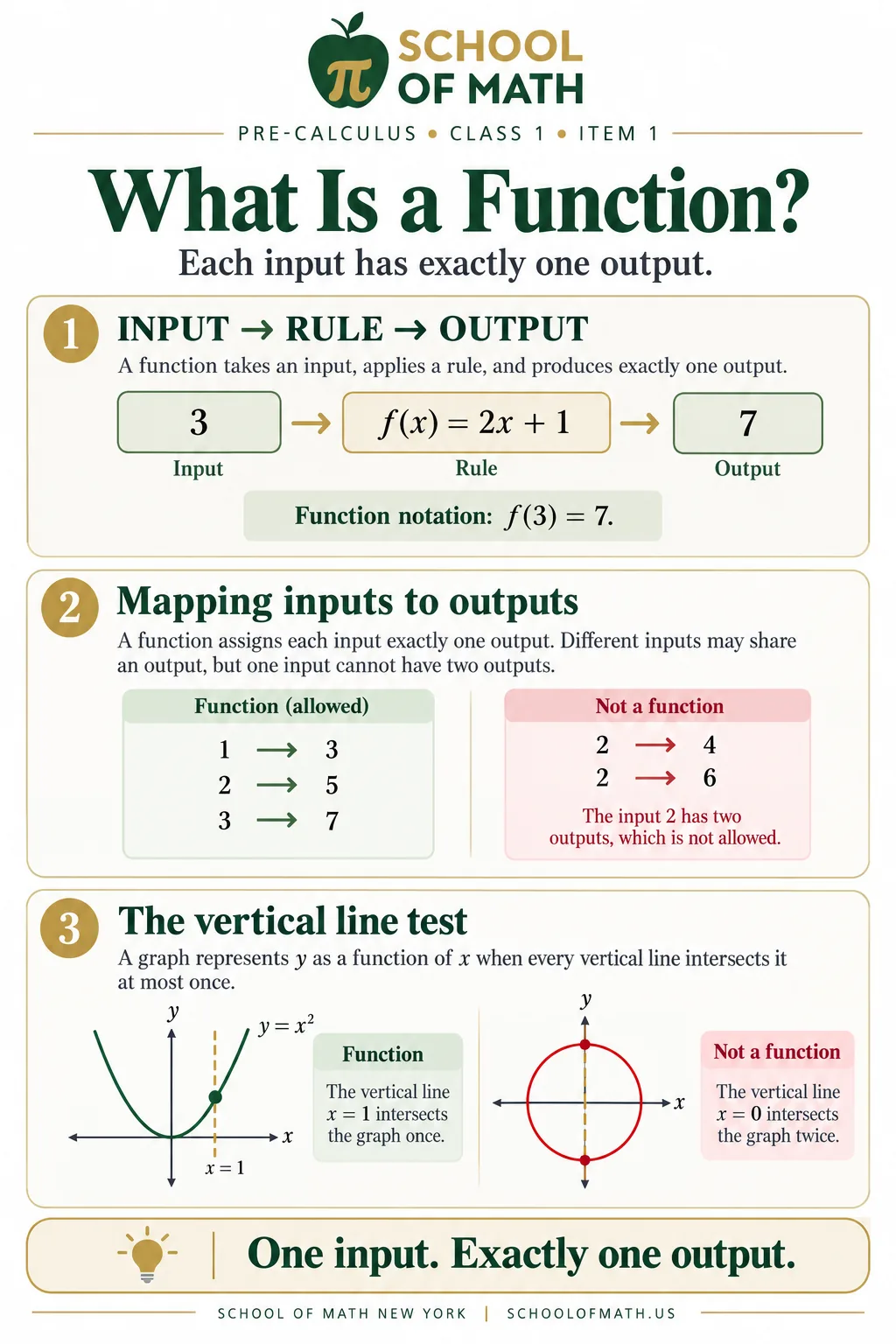
A function is a rule that takes an input, applies the rule, and produces exactly one output. In the poster, the input 3 enters the rule \(f(x)=2x+1\) and the output is 7. Function notation records this as \(f(3)=7\): the letter in parentheses is the input, and the value of the expression is the output.
Different inputs may share an output, but one input can never have two outputs. The mapping \(1\to3,\;2\to5,\;3\to7\) is a function. The mapping \(2\to4,\;2\to6\) is not, because the input 2 is sent to two different places.
On a graph, the same idea becomes the vertical line test: a graph represents \(y\) as a function of \(x\) when every vertical line meets it at most once. The parabola \(y=x^2\) passes the test; a circle fails it because the vertical line \(x=0\) crosses the circle twice.
Practice: try these five questions
Q1
Let \(f(x)=3x-5\). Evaluate \(f(4)\), \(f(-2)\), and \(f(0)\). Write each result in function notation.
Answer
\(f(4)=7,\quad f(-2)=-11,\quad f(0)=-5\)
Replace \(x\) by 4 and simplify.
\[f(4)=3(4)-5=12-5=7\]Replace \(x\) by \(-2\). Keep the parentheses so the sign is handled correctly.
\[f(-2)=3(-2)-5=-6-5=-11\]Replace \(x\) by 0. The output is the constant term.
\[f(0)=3(0)-5=-5\]
Check
Each input produced exactly one output, which is what function notation promises: the input sits inside the parentheses and the output is the value of the expression.
Q2
Decide whether each relation is a function. Explain using the input-output rule.
Answer
Relation A is a function. Relation B is not a function.
Relation A: inputs 1, 2, and 3 each appear once. Two different inputs (1 and 2) share the output 4, which is allowed.
\[A:\;1\to4,\quad 2\to4,\quad 3\to9\]Relation B: the input 1 appears twice with different outputs, 2 and 5. One input with two outputs breaks the rule.
\[B:\;\{(1,2),\,(1,5),\,(3,7)\}\]
Check
The test is always about inputs, never about outputs. Repeated outputs are fine; a repeated input with different outputs is not.
Q3
Let \(g(x)=x^2-2x\). Find \(g(5)\) and \(g(-3)\). What do the results tell you about functions and repeated outputs?
Answer
\(g(5)=15\) and \(g(-3)=15\). Two different inputs can share one output.
Substitute 5.
\[g(5)=5^2-2(5)=25-10=15\]Substitute \(-3\), squaring the negative number carefully.
\[g(-3)=(-3)^2-2(-3)=9+6=15\]Both inputs give 15. That does not violate the definition: each input still has exactly one output.
Check
If you were asked instead to solve \(g(x)=15\), you would get both \(x=5\) and \(x=-3\). Solving an equation can return several inputs; evaluating a function returns one output.
Q4
Use the vertical line test to decide which equations define \(y\) as a function of \(x\).
Answer
\(y=|x|\) and \(y=x^3\) are functions of \(x\). \(x=y^2\) and \(x^2+y^2=9\) are not.
\(y=|x|\): each \(x\) gives exactly one absolute value, so every vertical line meets the V-shaped graph once.
\(x=y^2\): the input \(x=4\) gives two outputs, so the vertical line \(x=4\) meets the sideways parabola twice.
\[x=4\;\Rightarrow\;y=2\;\text{or}\;y=-2\]\(x^2+y^2=9\): this circle of radius 3 is crossed twice by \(x=0\), at \((0,3)\) and \((0,-3)\).
\(y=x^3\): cubing any real number gives one result, so every vertical line meets the curve exactly once.
Check
A quick algebraic version of the test: if you can solve for \(y\) and get a single expression in \(x\), the equation defines a function.
Q5
Let \(h(x)=2x+1\). (a) Find the input \(x\) for which \(h(x)=11\). (b) Simplify \(h(a+1)\).
Answer
(a) \(x=5\). (b) \(h(a+1)=2a+3\).
(a) Set the rule equal to the desired output and solve for the input.
\[2x+1=11\]\[2x=10\quad\Rightarrow\quad x=5\](b) The input is the whole expression \(a+1\). Substitute it in place of \(x\), then distribute.
\[h(a+1)=2(a+1)+1\]\[h(a+1)=2a+2+1=2a+3\]
Check
Substitute back: \(h(5)=2(5)+1=11\). For part (b), test \(a=0\): \(h(1)=3\) and \(2(0)+3=3\). Both agree.
Domain and range
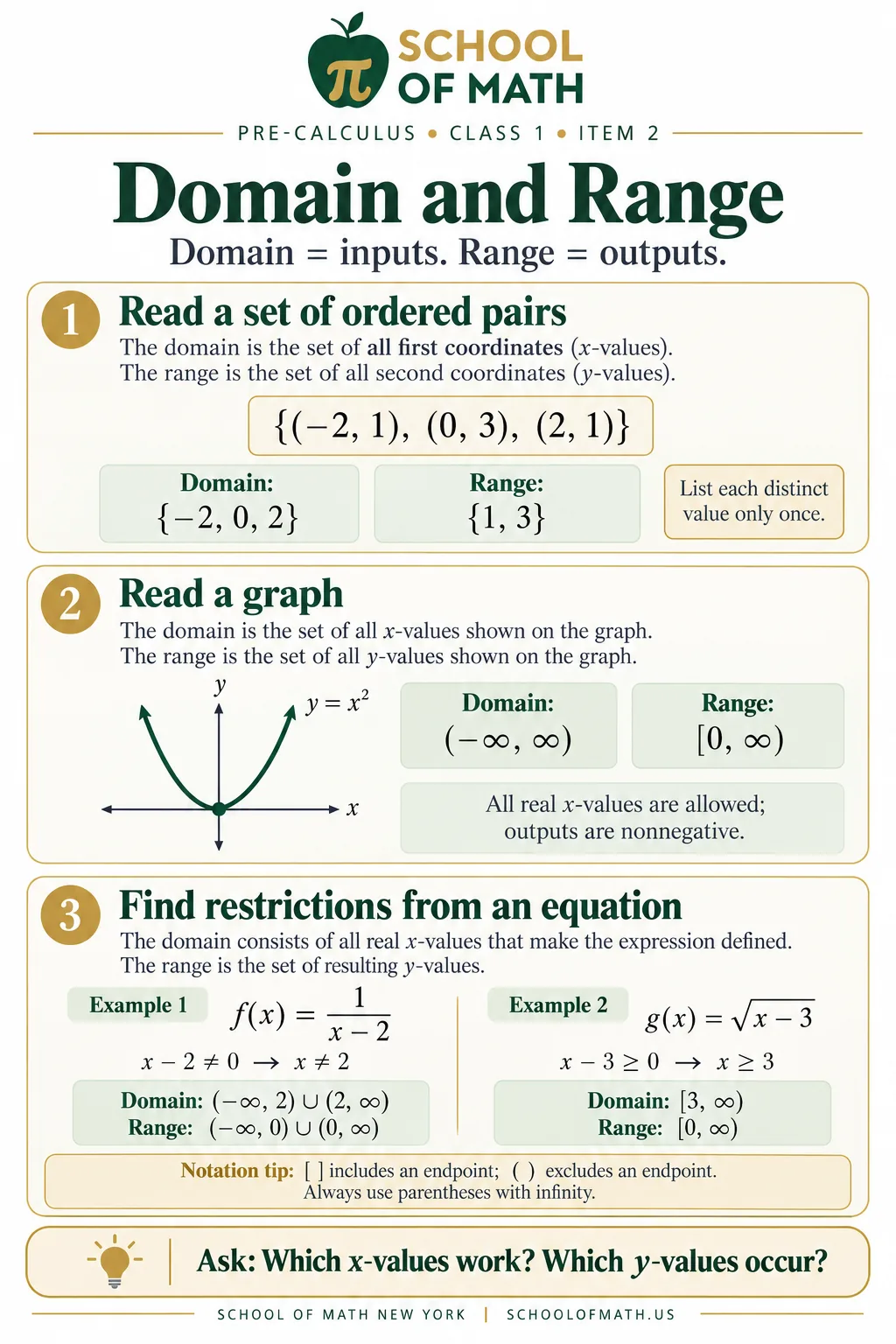
The domain of a function is the set of all inputs (\(x\)-values); the range is the set of all outputs (\(y\)-values). For a set of ordered pairs such as \(\{(-2,1),(0,3),(2,1)\}\), list the first coordinates once each for the domain, \(\{-2,0,2\}\), and the second coordinates once each for the range, \(\{1,3\}\).
For a graph, read the domain left to right and the range bottom to top. The parabola \(y=x^2\) uses every real \(x\), so its domain is \((-\infty,\infty)\); its outputs are never negative, so the range is \([0,\infty)\).
For an equation, find the \(x\)-values that make the expression defined. A denominator cannot be zero: \(f(x)=\dfrac{1}{x-2}\) requires \(x\ne2\), so the domain is \((-\infty,2)\cup(2,\infty)\) and the range is \((-\infty,0)\cup(0,\infty)\). A square root needs a nonnegative radicand: \(g(x)=\sqrt{x-3}\) requires \(x\ge3\), giving domain \([3,\infty)\) and range \([0,\infty)\). A square bracket includes an endpoint, a parenthesis excludes it, and infinity always takes a parenthesis.
Practice: try these five questions
Q6
State the domain and range of the relation. Is it a function?
Answer
Domain \(\{-3,-1,0,4\}\); range \(\{-1,2,5\}\). It is a function.
List each distinct first coordinate once for the domain.
\[\text{Domain}=\{-3,-1,0,4\}\]List each distinct second coordinate once for the range. The output 2 appears twice but is written once.
\[\text{Range}=\{-1,2,5\}\]No input repeats with a different output, so the relation is a function.
Check
Four ordered pairs, four different inputs: the pairing is one output per input, exactly as the definition requires.
Q7
Find the domain and range of the function. Use interval notation.
Answer
Domain \((-\infty,-5)\cup(-5,\infty)\); range \((-\infty,0)\cup(0,\infty)\).
The only restriction is a zero denominator. Exclude the value that makes \(x+5=0\).
\[x+5\ne0\quad\Rightarrow\quad x\ne-5\]Write the domain as two intervals around the excluded point.
\[(-\infty,-5)\cup(-5,\infty)\]A fraction with nonzero numerator 4 can never equal 0, so 0 is the only output that does not occur.
\[\text{Range: }(-\infty,0)\cup(0,\infty)\]
Check
Try to solve \(\dfrac{4}{x+5}=0\): multiplying through gives \(4=0\), which is impossible. That confirms 0 is missing from the range.
Q8
Find the domain and range of the function. Use interval notation.
Answer
Domain \([4,\infty)\); range \([0,\infty)\).
The radicand of a real square root must be nonnegative.
\[2x-8\ge0\]Solve the inequality.
\[2x\ge8\quad\Rightarrow\quad x\ge4\]The endpoint 4 is included because \(\sqrt{0}=0\) is defined, so use a square bracket.
\[\text{Domain}=[4,\infty)\]A principal square root is never negative and starts at 0 when \(x=4\), then grows without bound.
\[\text{Range}=[0,\infty)\]
Check
Test values: \(g(4)=0\), \(g(6)=2\), \(g(3)=\sqrt{-2}\) is undefined. The boundary at 4 behaves exactly as the interval notation claims.
Q9
The graph of \(f(x)=-x^2+4\) is a parabola that opens downward with vertex \((0,4)\). State its domain and range from the graph's shape.
Answer
Domain \((-\infty,\infty)\); range \((-\infty,4]\).
Any real number can be squared, negated, and added to 4, so every \(x\) is allowed.
\[\text{Domain}=(-\infty,\infty)\]The highest point is the vertex at \(y=4\). Since \(-x^2\le0\), every output is at most 4.
\[-x^2+4\le4\]Outputs go down forever as \(|x|\) grows, so the range extends to \(-\infty\) and includes 4.
\[\text{Range}=(-\infty,4]\]
Check
Compare with the poster's \(y=x^2\), range \([0,\infty)\). Reflecting and shifting flips the range to end at the new maximum, 4.
Q10
Find the domain of the function. Two restrictions apply.
Answer
Domain \([-1,3)\cup(3,\infty)\).
The square root in the numerator requires a nonnegative radicand.
\[x+1\ge0\quad\Rightarrow\quad x\ge-1\]The denominator cannot be zero.
\[x-3\ne0\quad\Rightarrow\quad x\ne3\]Combine: start at \(-1\) (included), remove 3, and continue to infinity.
\[[-1,3)\cup(3,\infty)\]
Check
Check the boundary points: \(h(-1)=0/(-4)=0\) is defined, so \(-1\) is included; \(h(3)\) divides by zero, so 3 is excluded.
Linear functions: slope, intercepts, and constant change
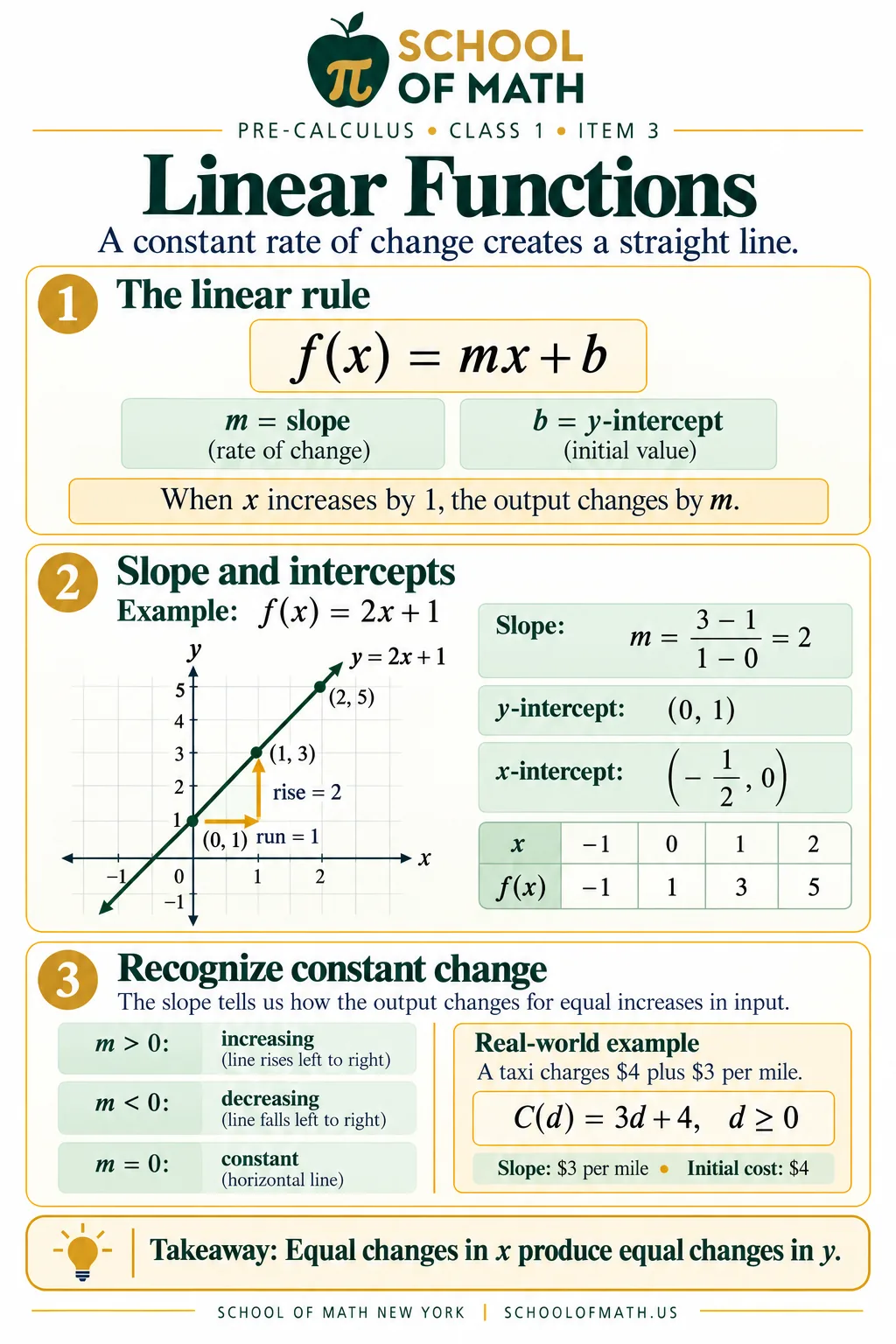
A linear function has the rule \(f(x)=mx+b\). The slope \(m\) is the rate of change: when \(x\) increases by 1, the output changes by \(m\). The constant \(b\) is the \(y\)-intercept, the initial value at \(x=0\).
For \(f(x)=2x+1\), the points \((0,1)\), \((1,3)\), and \((2,5)\) lie on the line. The slope is \(m=\dfrac{3-1}{1-0}=2\) (rise 2 for run 1), the \(y\)-intercept is \((0,1)\), and the \(x\)-intercept comes from \(2x+1=0\), which gives \(\left(-\tfrac12,0\right)\). In the table, equal steps of 1 in \(x\) always produce equal steps of 2 in \(f(x)\).
The sign of the slope tells the direction: \(m\gt0\) increasing, \(m\lt0\) decreasing, \(m=0\) constant. In context, a taxi that charges $4 plus $3 per mile is \(C(d)=3d+4\) for \(d\ge0\): the slope is the $3 per-mile rate and the intercept is the $4 initial cost.
Practice: try these five questions
Q11
For the linear function, state the slope, the \(y\)-intercept, and the \(x\)-intercept, and say whether the function is increasing or decreasing.
Answer
Slope \(-3\); \(y\)-intercept \((0,6)\); \(x\)-intercept \((2,0)\); decreasing.
Match the rule to \(mx+b\). The coefficient of \(x\) is the slope and the constant is the \(y\)-intercept.
\[m=-3,\qquad b=6\;\Rightarrow\;(0,6)\]For the \(x\)-intercept, set the output equal to 0 and solve.
\[-3x+6=0\]\[x=2\;\Rightarrow\;(2,0)\]A negative slope means the line falls from left to right, so the function is decreasing.
Check
Moving from \((0,6)\) to \((2,0)\) is a run of 2 and a fall of 6, and \(\dfrac{-6}{2}=-3\) matches the slope.
Q12
A line passes through \((1,2)\) and \((4,11)\). Find the slope and write the function in the form \(f(x)=mx+b\).
Answer
\(m=3\); \(f(x)=3x-1\).
Compute the slope from the two points.
\[m=\frac{11-2}{4-1}=\frac{9}{3}=3\]Use one point to find \(b\).
\[2=3(1)+b\]\[b=-1\]Write the rule.
\[f(x)=3x-1\]
Check
Second point: \(f(4)=3(4)-1=11\). Both points satisfy the rule.
Q13
The table shows outputs of a function at equally spaced inputs. Show the function is linear, write its rule, and find \(f(10)\).
| \(x\) | 0 | 1 | 2 | 3 |
|---|---|---|---|---|
| \(f(x)\) | 5 | 8 | 11 | 14 |
Answer
First differences are constant (3), so \(f(x)=3x+5\) and \(f(10)=35\).
Compute first differences between consecutive outputs.
\[8-5=3,\quad 11-8=3,\quad 14-11=3\]Equal changes in \(x\) produce equal changes in \(f(x)\), so the function is linear with slope 3. The output at \(x=0\) is the intercept 5.
\[f(x)=3x+5\]Evaluate at 10.
\[f(10)=3(10)+5=35\]
Check
Check against the table: \(f(3)=3(3)+5=14\), which matches the last column.
Q14
Classify each linear function as increasing, decreasing, or constant, and give its rate of change.
Answer
\(f\) is decreasing (rate \(-2\)); \(g\) is constant (rate 0); \(h\) is increasing (rate \(\tfrac12\)).
Rewrite \(f\) in \(mx+b\) order: \(f(x)=-2x+7\). Slope \(-2\lt0\): decreasing. Each unit increase in \(x\) lowers the output by 2.
\(g(x)=5\) has slope 0: a horizontal line, so the output never changes.
\(h(x)=\tfrac12x+1\) has slope \(\tfrac12\gt0\): increasing. Each unit increase in \(x\) raises the output by one half.
Check
Test with \(x=0\) and \(x=2\): \(f\) goes \(7\to3\), \(g\) goes \(5\to5\), \(h\) goes \(1\to2\). The directions match the slopes.
Q15
A gym charges a $25 enrollment fee plus $40 per month. Write a function \(C(m)\) for the total cost after \(m\) months, state a sensible domain, find \(C(6)\), and find how many months give a total of $345.
Answer
\(C(m)=40m+25\), \(m\ge0\) (whole months); \(C(6)=\$265\); 8 months cost $345.
The $40 per month is the rate of change (slope) and the $25 fee is the initial value (intercept).
\[C(m)=40m+25,\qquad m\ge0\]Evaluate at 6 months.
\[C(6)=40(6)+25=240+25=265\]Set the cost equal to 345 and solve for \(m\).
\[40m+25=345\]\[40m=320\quad\Rightarrow\quad m=8\]
Check
\(C(8)=40(8)+25=345\). Units: dollars per month times months gives dollars, plus the one-time fee in dollars.
Quadratic functions: vertex, symmetry, and zeros
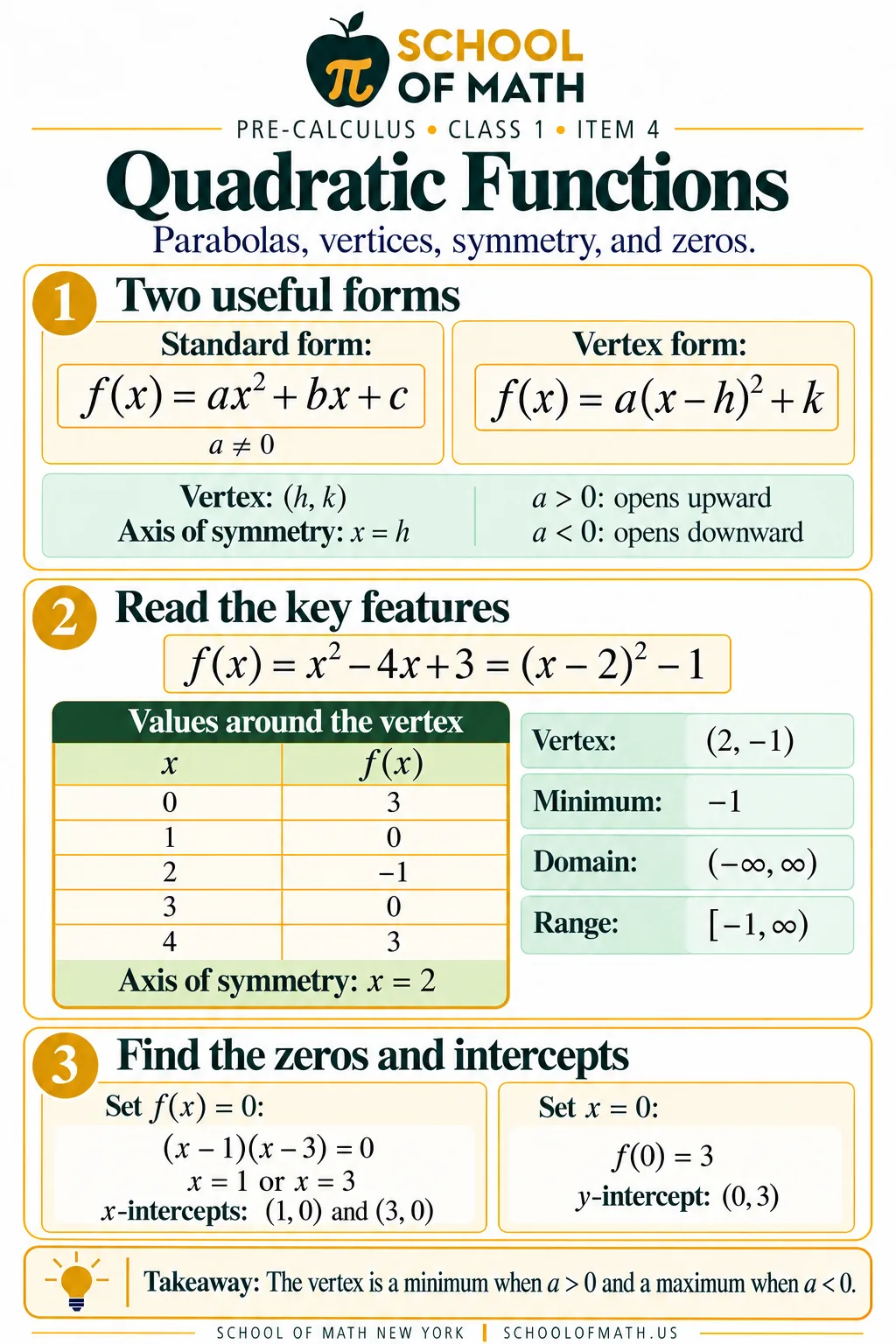
A quadratic function can be written in standard form \(f(x)=ax^2+bx+c\) with \(a\ne0\), or in vertex form \(f(x)=a(x-h)^2+k\). The vertex is \((h,k)\), the axis of symmetry is the vertical line \(x=h\), and the sign of \(a\) sets the direction: \(a\gt0\) opens upward and the vertex is a minimum; \(a\lt0\) opens downward and the vertex is a maximum.
The poster uses \(f(x)=x^2-4x+3=(x-2)^2-1\). A table of values around the vertex shows the symmetry: \(f(0)=3,\;f(1)=0,\;f(2)=-1,\;f(3)=0,\;f(4)=3\). The vertex is \((2,-1)\), the minimum value is \(-1\), the domain is \((-\infty,\infty)\), and the range is \([-1,\infty)\).
To find zeros, set \(f(x)=0\): \((x-1)(x-3)=0\) gives \(x=1\) or \(x=3\), so the \(x\)-intercepts are \((1,0)\) and \((3,0)\). To find the \(y\)-intercept, set \(x=0\): \(f(0)=3\). A useful shortcut for the axis is \(x=-\dfrac{b}{2a}\), which here gives \(x=2\).
Practice: try these five questions
Q16
Write the function in vertex form. Then state the vertex, axis of symmetry, minimum or maximum value, range, zeros, and \(y\)-intercept.
Answer
Vertex form \((x-3)^2-4\); vertex \((3,-4)\); axis \(x=3\); minimum \(-4\); range \([-4,\infty)\); zeros \(x=1,5\); \(y\)-intercept \((0,5)\).
Complete the square: half of \(-6\) is \(-3\), and \((-3)^2=9\).
\[f(x)=(x^2-6x+9)-9+5\]\[f(x)=(x-3)^2-4\]Read the vertex \((h,k)=(3,-4)\) and the axis \(x=3\). Since \(a=1\gt0\), the parabola opens upward and \(-4\) is a minimum, so the range is \([-4,\infty)\).
Zeros: factor the standard form.
\[(x-1)(x-5)=0\]\[x=1\;\text{or}\;x=5\]\(y\)-intercept: evaluate at \(x=0\).
\[f(0)=5\;\Rightarrow\;(0,5)\]
Check
Symmetry check: the zeros 1 and 5 average to 3, the axis. Expanding \((x-3)^2-4=x^2-6x+9-4=x^2-6x+5\) recovers the original.
Q17
The function is given in vertex form. State the vertex, the direction of opening, the maximum or minimum value, the range, the zeros, and the \(y\)-intercept.
Answer
Vertex \((-1,8)\); opens downward; maximum 8; range \((-\infty,8]\); zeros \(x=-3,1\); \(y\)-intercept \((0,6)\).
Compare with \(a(x-h)^2+k\): \(x+1=x-(-1)\), so \(h=-1\) and \(k=8\). Since \(a=-2\lt0\), the parabola opens downward and 8 is the maximum. The range is \((-\infty,8]\).
Zeros: set the function equal to 0 and isolate the square.
\[-2(x+1)^2+8=0\]\[(x+1)^2=4\]\[x+1=\pm2\quad\Rightarrow\quad x=1\;\text{or}\;x=-3\]\(y\)-intercept: substitute \(x=0\).
\[g(0)=-2(1)^2+8=6\;\Rightarrow\;(0,6)\]
Check
The zeros \(-3\) and 1 are each 2 units from the axis \(x=-1\), as symmetry requires.
Q18
Complete a table of values for \(x=-1,0,1,2,3\). Use the symmetry in the table to identify the axis of symmetry and the vertex.
| \(x\) | \(-1\) | 0 | 1 | 2 | 3 |
|---|---|---|---|---|---|
| \(f(x)\) | ? | ? | ? | ? | ? |
Answer
Outputs \(0,-3,-4,-3,0\); axis \(x=1\); vertex \((1,-4)\).
Evaluate each input.
\[f(-1)=1+2-3=0,\qquad f(0)=-3\]\[f(1)=1-2-3=-4,\qquad f(2)=4-4-3=-3,\qquad f(3)=9-6-3=0\]The outputs read the same forward and backward around \(x=1\): \(0,-3,\mathbf{-4},-3,0\). The middle entry is the lowest, so the axis is \(x=1\) and the vertex is \((1,-4)\).
Confirm with the shortcut.
\[x=-\frac{b}{2a}=-\frac{-2}{2(1)}=1\]
Check
The zeros visible in the table, \(x=-1\) and \(x=3\), average to 1, matching the axis. Factoring confirms them: \(x^2-2x-3=(x+1)(x-3)\).
Q19
Find the vertex using \(x=-\dfrac{b}{2a}\). Then write the function in vertex form and state its range.
Answer
Vertex \((-2,-5)\); \(h(x)=2(x+2)^2-5\); range \([-5,\infty)\).
Identify \(a=2\), \(b=8\), and compute the axis.
\[x=-\frac{8}{2(2)}=-2\]Evaluate the function at the axis to find \(k\).
\[h(-2)=2(4)+8(-2)+3=8-16+3=-5\]Write vertex form with \(a=2\), \(h=-2\), \(k=-5\). Because \(a\gt0\), \(-5\) is the minimum.
\[h(x)=2(x+2)^2-5\]\[\text{Range}=[-5,\infty)\]
Check
Expand to confirm: \(2(x^2+4x+4)-5=2x^2+8x+8-5=2x^2+8x+3\).
Q20
A parabola has zeros at \(x=-2\) and \(x=6\) and passes through \((0,-6)\). Write its equation in factored form and standard form, then find its vertex.
Answer
\(f(x)=\tfrac12(x+2)(x-6)=\tfrac12x^2-2x-6\); vertex \((2,-8)\).
Zeros give the factors; keep an unknown leading coefficient \(a\).
\[f(x)=a(x+2)(x-6)\]Use the point \((0,-6)\) to find \(a\).
\[-6=a(2)(-6)=-12a\]\[a=\tfrac12\]Expand to standard form.
\[f(x)=\tfrac12(x^2-4x-12)=\tfrac12x^2-2x-6\]The axis is midway between the zeros; evaluate there.
\[x=\frac{-2+6}{2}=2\]\[f(2)=\tfrac12(4)(-4)=-8\;\Rightarrow\;(2,-8)\]
Check
Check the given point: \(f(0)=\tfrac12(0)-0-6=-6\). And \(-\dfrac{b}{2a}=-\dfrac{-2}{2\cdot\frac12}=2\) agrees with the axis.
Polynomial functions: zeros and end behavior
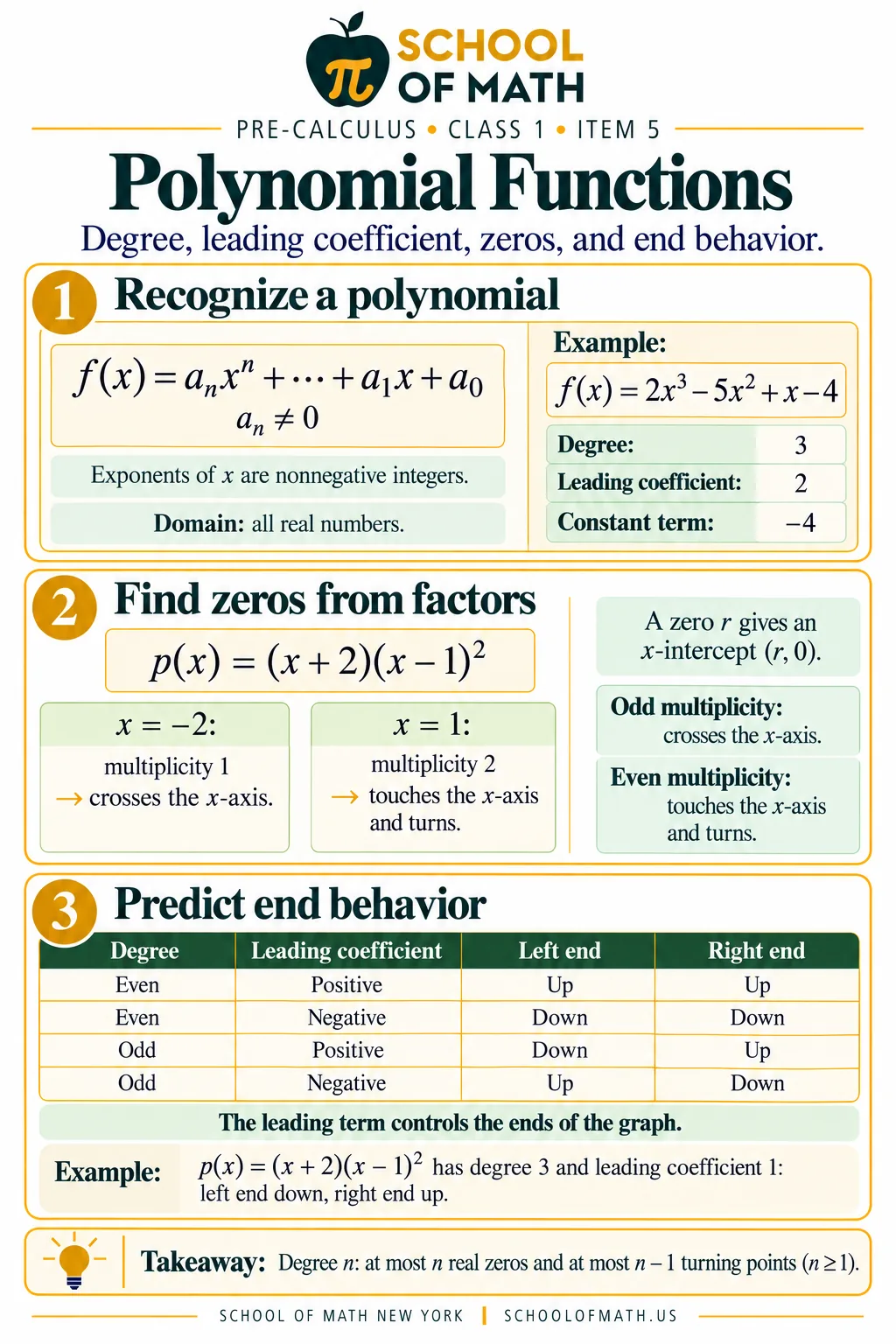
A polynomial function has the form \(f(x)=a_nx^n+\cdots+a_1x+a_0\) with \(a_n\ne0\), where every exponent of \(x\) is a nonnegative integer. Its domain is all real numbers. For \(f(x)=2x^3-5x^2+x-4\), the degree is 3, the leading coefficient is 2, and the constant term is \(-4\).
In factored form, each factor gives a zero and an \(x\)-intercept \((r,0)\). For \(p(x)=(x+2)(x-1)^2\), the zero \(x=-2\) has multiplicity 1, so the graph crosses the axis there; the zero \(x=1\) has multiplicity 2, so the graph touches the axis and turns. Odd multiplicity crosses; even multiplicity touches.
The leading term controls the ends of the graph. Even degree with a positive leading coefficient: both ends up. Even degree, negative: both ends down. Odd degree, positive: left end down, right end up. Odd degree, negative: left end up, right end down. The example \(p(x)=(x+2)(x-1)^2\) has degree 3 and leading coefficient 1, so its left end goes down and its right end goes up. A polynomial of degree \(n\ge1\) has at most \(n\) real zeros and at most \(n-1\) turning points.
Practice: try these five questions
Q21
State the degree, leading coefficient, and constant term. Describe the end behavior and give the domain.
Answer
Degree 4; leading coefficient \(-3\); constant \(7\); both ends go down; domain \((-\infty,\infty)\).
The highest power is \(x^4\), so the degree is 4 and the leading coefficient is its coefficient, \(-3\). The constant term is 7.
Even degree with a negative leading coefficient: left end down and right end down. The leading term \(-3x^4\) dominates for large \(|x|\).
Every polynomial accepts every real input.
\[\text{Domain}=(-\infty,\infty)\]
Check
Test \(x=10\): \(-3(10)^4=-30{,}000\) overwhelms the other terms, so the output is strongly negative on the right, as predicted.
Q22
List the zeros with their multiplicities and state whether the graph crosses or touches the \(x\)-axis at each. Then give the degree and end behavior.
Answer
Zeros: \(3\) (mult. 1, crosses), \(-1\) (mult. 2, touches), \(5\) (mult. 1, crosses). Degree 4, leading coefficient 1: both ends up.
Set each factor equal to zero. The exponent on the factor is the multiplicity.
\[x=3\;(1),\qquad x=-1\;(2),\qquad x=5\;(1)\]Odd multiplicity crosses the axis; even multiplicity touches and turns. So the graph crosses at 3 and 5 and touches at \(-1\).
Add the multiplicities for the degree: \(1+2+1=4\). Multiplying the leading terms gives \(x\cdot x^2\cdot x=x^4\), coefficient 1. Even degree, positive: both ends up.
Check
Sign test near \(x=-1\): \(p(-2)=(-5)(1)(-7)=35\gt0\) and \(p(0)=(-3)(1)(-5)=15\gt0\). The graph stays positive on both sides of \(-1\), which is what touching (not crossing) looks like.
Q23
Predict the end behavior of each polynomial from its leading term only.
Answer
\(q\): left end down, right end up. \(r\): left end up, right end down.
\(q(x)=2x^5-x^2+4\): degree 5 (odd), leading coefficient 2 (positive). Odd and positive means the graph falls on the left and rises on the right.
\(r(x)=-x^3+6x-1\): degree 3 (odd), leading coefficient \(-1\) (negative). Odd and negative means it rises on the left and falls on the right.
Only the leading term matters at the ends; the lower-degree terms become negligible for large \(|x|\).
Check
Plug in \(x=-10\): \(q(-10)\approx-200{,}000\) and \(r(-10)\approx1{,}000\). The signs match the predicted left ends.
Q24
Factor completely, find all real zeros, and state the maximum number of turning points and the end behavior.
Answer
\(f(x)=x(x-6)(x+2)\); zeros \(0,6,-2\); at most 2 turning points; left end down, right end up.
Factor out the common factor \(x\), then factor the quadratic.
\[f(x)=x(x^2-4x-12)\]\[f(x)=x(x-6)(x+2)\]Each factor appears once, so each zero has multiplicity 1 and the graph crosses the axis at \(x=-2,0,6\).
Degree 3 allows at most \(3-1=2\) turning points. Leading term \(x^3\): odd degree, positive coefficient, so left end down and right end up.
Check
Verify a zero: \(f(6)=216-144-72=0\). Expand to confirm the factoring: \(x(x^2-4x-12)=x^3-4x^2-12x\).
Q25
Write a polynomial of least degree with leading coefficient 1 whose only zeros are \(-2\) (multiplicity 2) and \(3\). Expand it, then state its degree, \(y\)-intercept, and end behavior.
Answer
\(f(x)=(x+2)^2(x-3)=x^3+x^2-8x-12\); degree 3; \(y\)-intercept \((0,-12)\); left end down, right end up.
Build the factors from the zeros, using the exponent for multiplicity.
\[f(x)=(x+2)^2(x-3)\]Expand the square, then multiply.
\[(x^2+4x+4)(x-3)\]\[x^3-3x^2+4x^2-12x+4x-12=x^3+x^2-8x-12\]Degree \(2+1=3\). The constant term \(-12\) is the \(y\)-intercept. Odd degree with positive leading coefficient: down on the left, up on the right.
Check
Check a zero in the expanded form: \(f(3)=27+9-24-12=0\). The graph touches at \(-2\) (even multiplicity) and crosses at 3.
Rational functions: holes and asymptotes
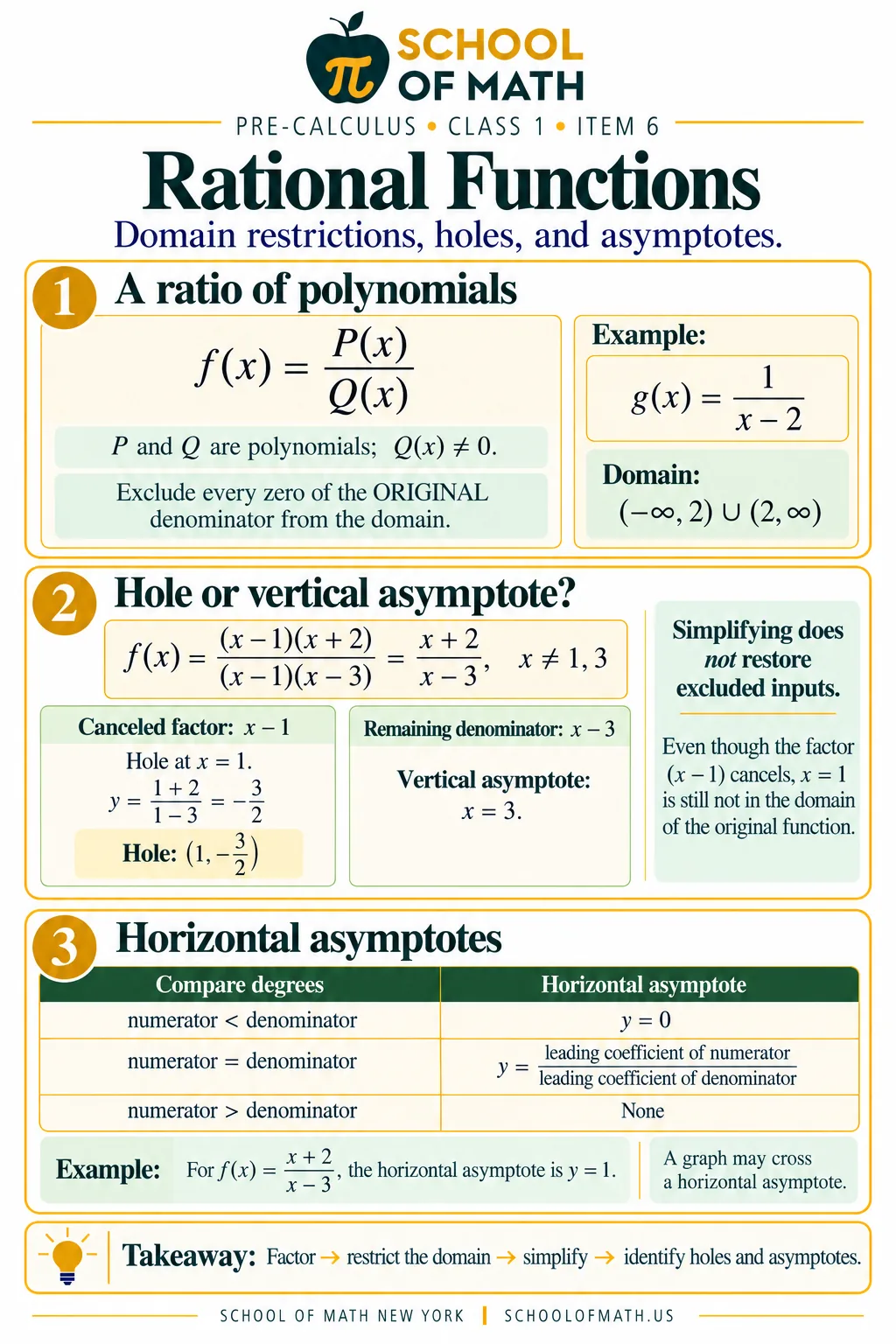
A rational function is a ratio of polynomials, \(f(x)=\dfrac{P(x)}{Q(x)}\) with \(Q(x)\ne0\). Exclude every zero of the original denominator from the domain. For \(g(x)=\dfrac{1}{x-2}\), the domain is \((-\infty,2)\cup(2,\infty)\).
Factor before simplifying. In \(f(x)=\dfrac{(x-1)(x+2)}{(x-1)(x-3)}\), the domain excludes \(x=1\) and \(x=3\). The canceled factor \(x-1\) creates a hole at \(x=1\); its height comes from the simplified form, \(y=\dfrac{1+2}{1-3}=-\dfrac32\), so the hole is \(\left(1,-\tfrac32\right)\). The remaining denominator \(x-3\) gives a vertical asymptote at \(x=3\). Simplifying does not restore excluded inputs: \(x=1\) is still outside the domain.
Horizontal asymptotes come from comparing degrees. Numerator degree less than denominator degree: \(y=0\). Equal degrees: \(y\) equals the ratio of leading coefficients. Numerator degree greater: no horizontal asymptote. For \(f(x)=\dfrac{x+2}{x-3}\), the horizontal asymptote is \(y=1\). A graph may cross a horizontal asymptote. The workflow: factor, restrict the domain, simplify, then identify holes and asymptotes.
Practice: try these five questions
Q26
State the domain, the vertical asymptote, and the horizontal asymptote.
Answer
Domain \((-\infty,-4)\cup(-4,\infty)\); vertical asymptote \(x=-4\); horizontal asymptote \(y=0\).
Exclude the zero of the denominator.
\[x+4\ne0\quad\Rightarrow\quad x\ne-4\]Nothing cancels, so the excluded value is a vertical asymptote, not a hole.
\[x=-4\]Numerator degree 0 is less than denominator degree 1, so the horizontal asymptote is \(y=0\).
Check
Behavior near the asymptote: \(g(-3.9)=30\) and \(g(-4.1)=-30\). Outputs blow up in opposite directions on each side of \(x=-4\).
Q27
Find the domain, any hole (with its coordinates), the vertical asymptote, and the horizontal asymptote.
Answer
Domain \(x\ne2,\,-1\); hole \(\left(2,\tfrac73\right)\); vertical asymptote \(x=-1\); horizontal asymptote \(y=1\).
Read the zeros of the original denominator before simplifying.
\[x\ne2,\qquad x\ne-1\]Cancel the common factor \(x-2\). The simplified form is valid for every \(x\) in the domain.
\[f(x)=\frac{x+5}{x+1},\qquad x\ne2,-1\]The canceled factor gives a hole at \(x=2\). Find its height from the simplified form.
\[y=\frac{2+5}{2+1}=\frac{7}{3}\;\Rightarrow\;\text{hole }\left(2,\tfrac73\right)\]The remaining denominator gives the vertical asymptote \(x=-1\). Equal degrees (1 and 1) with leading coefficients 1 and 1 give the horizontal asymptote \(y=1\).
Check
The original function is undefined at \(x=2\) even though the simplified form gives \(\tfrac73\). That gap is exactly what a hole means.
Q28
Find the horizontal asymptote of each function, if one exists. For (a), also give the vertical asymptotes.
Answer
(a) \(y=2\), vertical asymptotes \(x=3\) and \(x=-3\). (b) \(y=0\). (c) No horizontal asymptote.
(a) Degrees are equal (2 and 2). Divide leading coefficients: \(\frac21=2\). The denominator \(x^2-9=(x-3)(x+3)\) has zeros that do not cancel, so \(x=\pm3\) are vertical asymptotes.
(b) Numerator degree 1 is less than denominator degree 2, so the horizontal asymptote is \(y=0\).
(c) Numerator degree 3 exceeds denominator degree 1, so there is no horizontal asymptote; the graph grows without bound at the ends.
Check
Evaluate (a) at \(x=100\): \(\dfrac{20001}{9991}\approx2.002\), already close to 2.
Q29
Factor the numerator and denominator. Then state the domain, the hole, the vertical asymptote, and the horizontal asymptote.
Answer
Domain \(x\ne3,\,-2\); hole \(\left(3,\tfrac65\right)\); vertical asymptote \(x=-2\); horizontal asymptote \(y=1\).
Factor both parts.
\[h(x)=\frac{(x-3)(x+3)}{(x-3)(x+2)}\]Exclude both zeros of the original denominator.
\[x\ne3,\qquad x\ne-2\]Cancel \(x-3\) to locate the hole, and evaluate the simplified form there.
\[h(x)=\frac{x+3}{x+2},\quad x\ne3,-2\]\[y=\frac{3+3}{3+2}=\frac65\;\Rightarrow\;\left(3,\tfrac65\right)\]The remaining factor \(x+2\) gives the vertical asymptote \(x=-2\). Equal degrees with leading coefficients \(1/1\) give \(y=1\).
Check
Direct substitution of \(x=3\) into the original gives \(\frac00\), the signature of a hole; substituting \(x=-2\) gives \(\frac{-5}{0}\), the signature of a vertical asymptote.
Q30
Find the intercepts and asymptotes of the function. Then decide whether the graph ever crosses its horizontal asymptote.
Answer
\(x\)-intercept \((-3,0)\); \(y\)-intercept \((0,-6)\); vertical asymptote \(x=1\); horizontal asymptote \(y=2\); the graph never crosses \(y=2\).
\(x\)-intercept: set the numerator equal to zero (the denominator is nonzero there).
\[2x+6=0\quad\Rightarrow\quad x=-3\]\(y\)-intercept: evaluate at \(x=0\).
\[f(0)=\frac{6}{-1}=-6\]Vertical asymptote from the denominator, horizontal asymptote from equal degrees.
\[x=1,\qquad y=\frac21=2\]To test crossing, solve \(f(x)=2\).
\[\frac{2x+6}{x-1}=2\;\Rightarrow\;2x+6=2x-2\]\[6=-2\;\text{(false)}\]
Check
No solution means the graph never reaches \(y=2\). Crossing is possible for other rational functions, so always test rather than assume.
Function transformations: shifts, reflections, and scaling
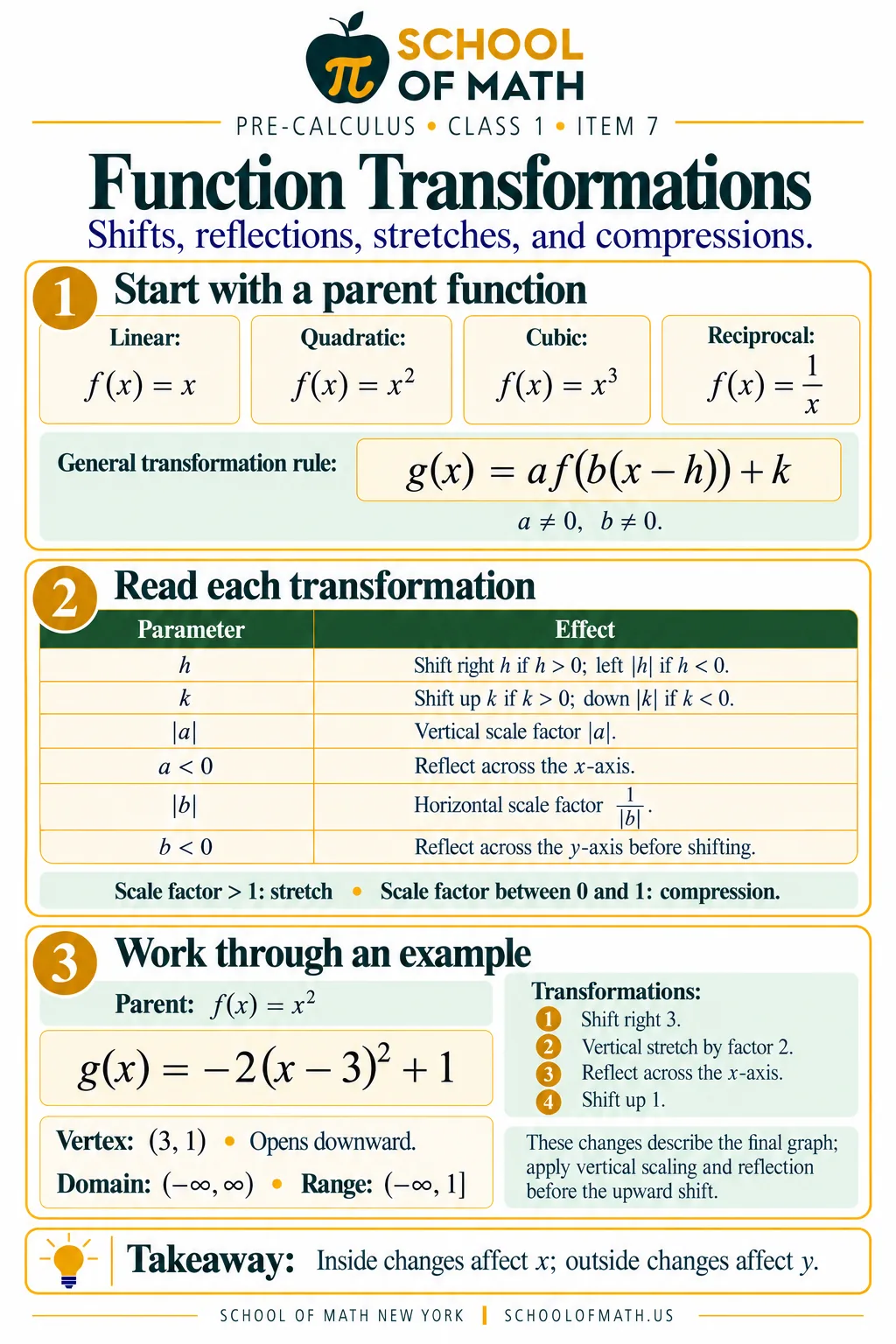
Start with a parent function: linear \(f(x)=x\), quadratic \(f(x)=x^2\), cubic \(f(x)=x^3\), or reciprocal \(f(x)=\dfrac1x\). The general transformation rule is \(g(x)=a\,f\big(b(x-h)\big)+k\) with \(a\ne0\) and \(b\ne0\).
Each parameter has one job. \(h\): shift right \(h\) if \(h\gt0\), left \(|h|\) if \(h\lt0\). \(k\): shift up \(k\) if \(k\gt0\), down \(|k|\) if \(k\lt0\). \(|a|\): vertical scale factor; \(a\lt0\) also reflects across the \(x\)-axis. \(|b|\): horizontal scale factor \(\dfrac{1}{|b|}\); \(b\lt0\) reflects across the \(y\)-axis before shifting. A scale factor greater than 1 is a stretch; a factor between 0 and 1 is a compression.
Example: \(g(x)=-2(x-3)^2+1\) from the parent \(x^2\) is a shift right 3, a vertical stretch by 2, a reflection across the \(x\)-axis, and a shift up 1. The vertex moves to \((3,1)\), the parabola opens downward, the domain is \((-\infty,\infty)\), and the range is \((-\infty,1]\). Apply vertical scaling and reflection before the vertical shift. Inside changes affect \(x\); outside changes affect \(y\).
Practice: try these five questions
Q31
Describe how the graph of \(g\) is obtained from the parent \(f(x)=x^2\). State the new vertex and the range.
Answer
Shift left 4 and down 3; vertex \((-4,-3)\); range \([-3,\infty)\).
Rewrite the inside as \(x-h\): \(x+4=x-(-4)\), so \(h=-4\) and the graph shifts left 4.
The outside \(-3\) is \(k\), a shift down 3. No scaling or reflection because \(a=1\).
The parent vertex \((0,0)\) moves to \((-4,-3)\). The parabola still opens upward, so the range starts at the new minimum.
\[\text{Range}=[-3,\infty)\]
Check
Test a point: the parent point \((1,1)\) should move to \((-3,-2)\). Indeed \(g(-3)=(1)^2-3=-2\).
Q32
List the transformations, in order, that take the parent \(f(x)=x^3\) to \(g\). Where does the parent point \((0,0)\) end up, and where does \((1,1)\) end up?
Answer
Shift right 2, reflect across the \(x\)-axis, shift up 5. \((0,0)\to(2,5)\) and \((1,1)\to(3,4)\).
Inside: \(x-2\) means \(h=2\), a shift right 2.
Outside: \(a=-1\) reflects across the \(x\)-axis (no stretch since \(|a|=1\)); then \(k=5\) shifts up 5. Apply the reflection before the vertical shift.
Track points: add 2 to \(x\), negate \(y\), then add 5 to \(y\).
\[(0,0)\to(2,0)\to(2,0)\to(2,5),\qquad (1,1)\to(3,1)\to(3,-1)\to(3,4)\]
Check
Verify: \(g(2)=-(0)^3+5=5\) and \(g(3)=-(1)^3+5=4\). Both tracked points lie on the graph.
Q33
The function \(g\) is a transformation of the reciprocal parent \(f(x)=\dfrac1x\). Describe the transformations and state the new asymptotes, domain, and range.
Answer
Shift right 3 and up 2; vertical asymptote \(x=3\); horizontal asymptote \(y=2\); domain \(x\ne3\); range \(y\ne2\).
The parent has asymptotes \(x=0\) and \(y=0\), domain \(x\ne0\), range \(y\ne0\).
\(x-3\) inside shifts right 3, carrying the vertical asymptote to \(x=3\). The \(+2\) outside shifts up 2, carrying the horizontal asymptote to \(y=2\).
The domain and range move with the asymptotes.
\[\text{Domain}=(-\infty,3)\cup(3,\infty),\qquad \text{Range}=(-\infty,2)\cup(2,\infty)\]
Check
Solve \(g(x)=2\): \(\dfrac{1}{x-3}=0\) has no solution, confirming that 2 is not in the range.
Q34
Write the equation of the function obtained from \(f(x)=x^2\) by reflecting across the \(x\)-axis, stretching vertically by a factor of 3, shifting left 1, and shifting up 4. Give the vertex and range.
Answer
\(g(x)=-3(x+1)^2+4\); vertex \((-1,4)\); range \((-\infty,4]\).
Reflection and vertical stretch by 3 combine into \(a=-3\).
Shift left 1 means \(h=-1\), so the inside is \(x-(-1)=x+1\). Shift up 4 means \(k=4\).
\[g(x)=-3(x+1)^2+4\]The vertex is \((h,k)=(-1,4)\). With \(a\lt0\) the parabola opens downward, so 4 is the maximum.
\[\text{Range}=(-\infty,4]\]
Check
Expanded form: \(-3x^2-6x+1\). The parent point \((1,1)\) maps to \((0,1)\), and \(g(0)=-3(1)+4=1\) agrees.
Q35
Compare \(g(x)=\left(\tfrac12x\right)^3\) with the parent \(f(x)=x^3\). Describe the horizontal transformation, find where the parent point \((2,8)\) lands, and show that the same graph can be described as a vertical change.
Answer
Horizontal stretch by factor 2; \((2,8)\to(4,8)\); equivalently \(g(x)=\tfrac18x^3\), a vertical compression by \(\tfrac18\).
Here \(b=\tfrac12\), so the horizontal scale factor is \(\dfrac{1}{|b|}=2\): every \(x\)-coordinate doubles.
The parent output 8 occurs when \(\tfrac12x=2\), that is \(x=4\).
\[g(4)=\left(2\right)^3=8\;\Rightarrow\;(4,8)\]Simplify the rule algebraically.
\[g(x)=\frac{x^3}{8}=\tfrac18x^3\]The factor \(\tfrac18\) outside is a vertical compression. For power functions, a horizontal scaling can always be rewritten as a vertical one.
Check
Check with another point: parent \((1,1)\) stretches to \((2,1)\), and \(\tfrac18(2)^3=1\).
Compare function families
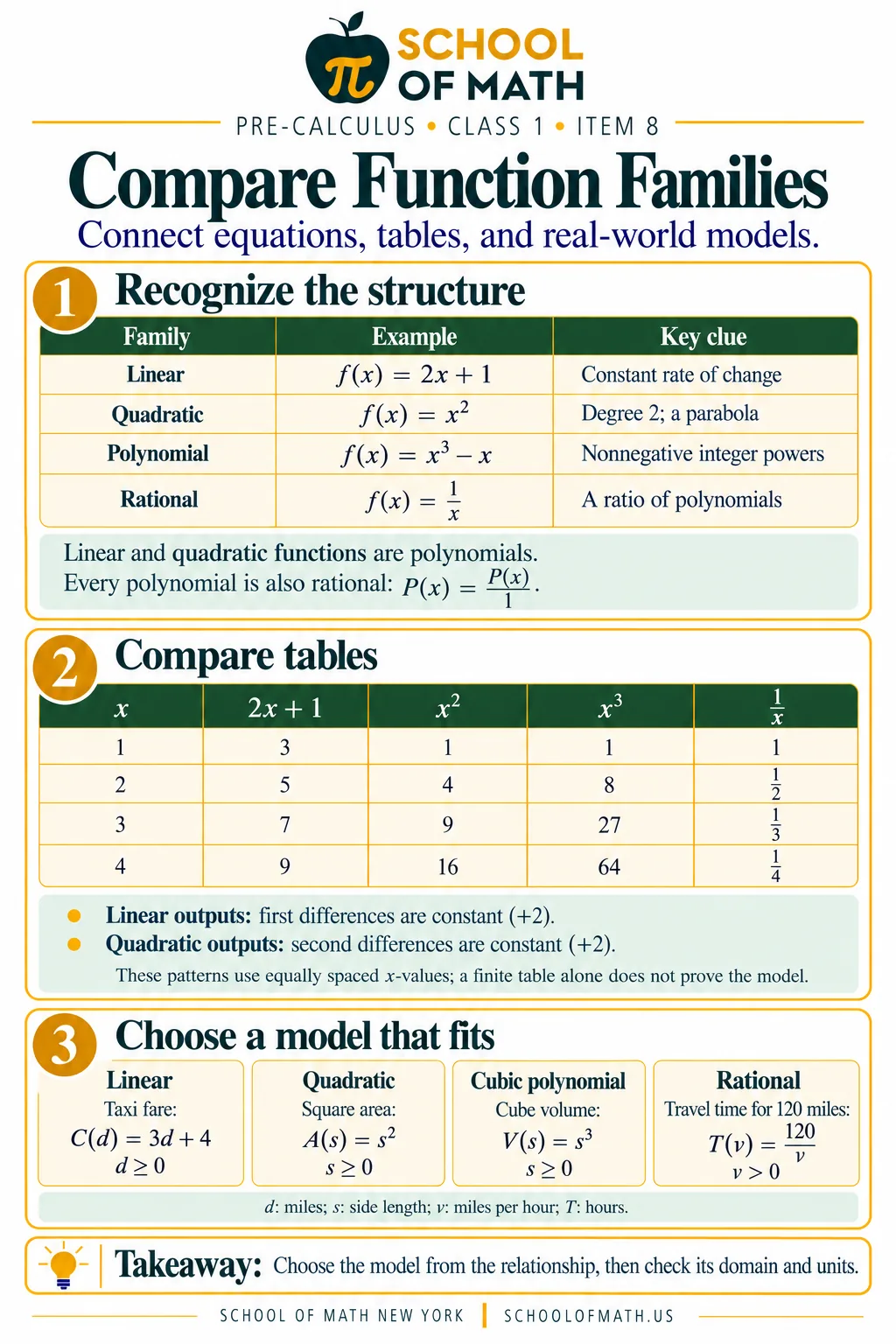
Recognize each family by its structure. Linear, such as \(f(x)=2x+1\): constant rate of change. Quadratic, such as \(f(x)=x^2\): degree 2, a parabola. Polynomial, such as \(f(x)=x^3-x\): nonnegative integer powers. Rational, such as \(f(x)=\dfrac1x\): a ratio of polynomials. The families nest: linear and quadratic functions are polynomials, and every polynomial is also rational because \(P(x)=\dfrac{P(x)}{1}\).
Tables reveal the family when the inputs are equally spaced. For \(2x+1\), the first differences are constant (\(+2\)). For \(x^2\), the first differences \(3,5,7\) are not constant but the second differences are (\(+2\)). For \(x^3\) the outputs \(1,8,27,64\) need third differences, and for \(\dfrac1x\) the outputs \(1,\tfrac12,\tfrac13,\tfrac14\) have a constant product with \(x\). A finite table alone does not prove the model; it suggests one to test.
Choose a model from the relationship, then check its domain and units. Taxi fare \(C(d)=3d+4\), \(d\ge0\), is linear. Square area \(A(s)=s^2\), \(s\ge0\), is quadratic. Cube volume \(V(s)=s^3\), \(s\ge0\), is a cubic polynomial. Travel time for 120 miles, \(T(v)=\dfrac{120}{v}\), \(v\gt0\), is rational.
Practice: try these five questions
Q36
Classify each function as linear, quadratic, polynomial (give the degree), or rational. Note any function that belongs to more than one family.
Answer
\(f\) linear (degree-1 polynomial); \(g\) cubic polynomial; \(h\) rational; \(k\) quadratic (degree-2 polynomial). All four are rational functions in the broad sense.
\(f(x)=5-2x\): highest power 1, constant rate of change \(-2\). Linear, and also a polynomial of degree 1.
\(g(x)=x^3-2x^2+1\): nonnegative integer powers, highest power 3. A cubic polynomial.
\(h(x)=\dfrac{x+1}{x^2-4}\): a ratio of polynomials with a variable in the denominator. Rational, not a polynomial; its domain excludes \(x=\pm2\).
\(k(x)=3x^2-x\): degree 2. Quadratic, which is a polynomial, which is also rational with denominator 1.
Check
The nesting matters for domains: polynomials (including \(f\), \(g\), \(k\)) accept all real inputs, while \(h\) must exclude denominator zeros.
Q37
Use first and second differences to identify the family suggested by the table. Then find a rule of the form \(y=x^2+c\) that fits every row.
| \(x\) | 1 | 2 | 3 | 4 |
|---|---|---|---|---|
| \(y\) | 4 | 7 | 12 | 19 |
Answer
Second differences are constant (2), suggesting a quadratic; \(y=x^2+3\) fits all four rows.
First differences.
\[7-4=3,\quad 12-7=5,\quad 19-12=7\]Second differences.
\[5-3=2,\quad 7-5=2\]Constant second differences with equally spaced inputs point to a quadratic. Compare with \(x^2\): \(1,4,9,16\). Each table value is 3 more.
\[y=x^2+3\]Verify every row.
\[1+3=4,\quad 4+3=7,\quad 9+3=12,\quad 16+3=19\]
Check
Four points fit, but a table never proves the model for inputs outside it. The rule is the best consistent description of the given data.
Q38
Decide whether the table is better described by a linear, quadratic, or rational model, and write the rule.
| \(x\) | 1 | 2 | 3 | 4 |
|---|---|---|---|---|
| \(y\) | 12 | 6 | 4 | 3 |
Answer
Rational: \(y=\dfrac{12}{x}\). The product \(x\cdot y\) is constant (12); the differences are not constant.
First differences are not constant, so the model is not linear.
\[6-12=-6,\quad 4-6=-2,\quad 3-4=-1\]Second differences \(4\) and \(1\) are not constant either, so a quadratic does not fit.
Try the product of each pair.
\[1\cdot12=2\cdot6=3\cdot4=4\cdot3=12\]A constant product means \(y\) is inversely proportional to \(x\).
\[y=\frac{12}{x},\qquad x\gt0\]
Check
Compare to the poster's column for \(\tfrac1x\): the same pattern scaled by 12. The outputs shrink toward 0 but never reach it, matching the horizontal asymptote \(y=0\).
Q39
Choose a function family for each situation, write the model, and state a sensible domain.
Answer
(a) linear \(C(n)=12n+5\), \(n\ge0\) whole numbers; (b) quadratic \(A(r)=\pi r^2\), \(r\ge0\); (c) cubic \(V(s)=s^3\), \(s\ge0\); (d) rational \(T(v)=\dfrac{300}{v}\), \(v\gt0\).
(a) \(n\) tickets at $12 each plus a $5 service fee: a constant rate per ticket, so linear. \(n\) counts tickets, so it is a whole number.
\[C(n)=12n+5\](b) The area of a circle depends on the square of the radius: quadratic in \(r\).
\[A(r)=\pi r^2,\qquad r\ge0\](c) The volume of a cube is the side length cubed: a degree-3 polynomial.
\[V(s)=s^3,\qquad s\ge0\](d) Time equals distance divided by speed, a ratio with the variable in the denominator: rational. Speed must be positive.
\[T(v)=\frac{300}{v},\qquad v\gt0\]
Check
Units check: dollars per ticket times tickets gives dollars; miles divided by miles per hour gives hours.
Q40
Compare \(f(x)=10x+5\) (linear) and \(g(x)=x^2\) (quadratic) for positive integers \(x\). Find the smallest integer \(x\) for which \(g(x)\gt f(x)\), and explain what this says about the two families in the long run.
Answer
At \(x=11\): \(g(11)=121\gt115=f(11)\), while at \(x=10\) the linear function is still ahead. Quadratic growth eventually overtakes any linear growth.
Compare values near the crossover.
\[f(10)=105,\;g(10)=100;\qquad f(11)=115,\;g(11)=121\]Solve the inequality exactly to confirm the crossover lies between 10 and 11.
\[x^2-10x-5\gt0\]\[x\gt5+\sqrt{30}\approx10.48\]For \(x\gt10.48\) the quadratic stays ahead forever, because its rate of change keeps growing while the linear rate is fixed at 10.
Check
Check \(x=12\): \(g(12)=144\) versus \(f(12)=125\). The gap widens, as expected when degree 2 competes with degree 1.
Homework review
Eight questions, one per image, in the order of the lesson. Show the notation, the restriction, or the structural clue that justifies each answer.
R1
Let \(f(x)=x^2+3x\). Find \(f(2)\), \(f(-4)\), and \(f(a)\). Then decide whether \(\{(2,5),(3,5),(4,7)\}\) is a function.
Answer
\(f(2)=10\); \(f(-4)=4\); \(f(a)=a^2+3a\). The set is a function.
Evaluate at 2 and at \(-4\).
\[f(2)=4+6=10\]\[f(-4)=16-12=4\]For a symbolic input, substitute \(a\) for \(x\).
\[f(a)=a^2+3a\]Inputs 2, 3, 4 are all different, so each has exactly one output even though 2 and 3 share the output 5.
Check
Shared outputs never disqualify a function; only a repeated input with different outputs does.
R2
Find the domain and range in interval notation.
Answer
Domain \((-\infty,3]\); range \([0,\infty)\).
Require a nonnegative radicand.
\[6-2x\ge0\]Solve, remembering to reverse the inequality when dividing by a negative.
\[-2x\ge-6\quad\Rightarrow\quad x\le3\]Include the endpoint since \(f(3)=0\). The square root is nonnegative and unbounded as \(x\) decreases.
\[\text{Domain}=(-\infty,3],\qquad\text{Range}=[0,\infty)\]
Check
\(f(1)=2\), \(f(-5)=4\), \(f(4)\) undefined. The graph lives to the left of 3, unlike the poster's \(\sqrt{x-3}\), which lives to the right.
R3
A line passes through \((-2,7)\) and \((3,-8)\). Find the slope, write the linear function, and find both intercepts.
Answer
\(m=-3\); \(f(x)=-3x+1\); \(y\)-intercept \((0,1)\); \(x\)-intercept \(\left(\tfrac13,0\right)\).
Slope from the two points.
\[m=\frac{-8-7}{3-(-2)}=\frac{-15}{5}=-3\]Solve for \(b\) using \((-2,7)\).
\[7=-3(-2)+b\]\[b=1\;\Rightarrow\;f(x)=-3x+1\]Intercepts.
\[f(0)=1\;\Rightarrow\;(0,1)\]\[-3x+1=0\;\Rightarrow\;x=\tfrac13\]
Check
\(f(3)=-9+1=-8\), matching the second point.
R4
Find the vertex, maximum or minimum value, zeros, \(y\)-intercept, and range.
Answer
Vertex \((4,4)\), a maximum; zeros \(x=2,6\); \(y\)-intercept \((0,-12)\); range \((-\infty,4]\).
Axis from the shortcut, then the vertex height.
\[x=-\frac{8}{2(-1)}=4\]\[f(4)=-16+32-12=4\]Since \(a=-1\lt0\), the parabola opens downward and 4 is the maximum, so the range is \((-\infty,4]\).
Zeros: factor out \(-1\) first.
\[-(x^2-8x+12)=-(x-2)(x-6)=0\]\[x=2\;\text{or}\;x=6\]\(y\)-intercept is the constant term.
\[f(0)=-12\]
Check
The zeros 2 and 6 average to 4, the axis. Vertex form: \(-(x-4)^2+4\), which expands to \(-x^2+8x-16+4\).
R5
State the degree, leading coefficient, zeros with multiplicity and behavior, end behavior, and \(y\)-intercept.
Answer
Degree 4; leading coefficient \(-2\); zeros \(-1\) (crosses), \(2\) (touches), \(4\) (crosses); both ends down; \(y\)-intercept \((0,32)\).
Degree is the sum of multiplicities \(1+2+1=4\). The leading term is \(-2\cdot x\cdot x^2\cdot x=-2x^4\).
Multiplicity 1 at \(-1\) and 4: the graph crosses. Multiplicity 2 at 2: the graph touches and turns.
Even degree, negative leading coefficient: left end down, right end down.
\(y\)-intercept.
\[p(0)=-2(1)(-2)^2(-4)=-2\cdot1\cdot4\cdot(-4)=32\]
Check
Sign check between zeros: \(p(3)=-2(4)(1)(-1)=8\gt0\) and \(p(1)=-2(2)(1)(-3)=12\gt0\). Positive on both sides of 2 confirms touching.
R6
Find the domain, hole, vertical asymptote, and horizontal asymptote.
Answer
Domain \(x\ne2,\,-3\); hole \(\left(2,\tfrac45\right)\); vertical asymptote \(x=-3\); horizontal asymptote \(y=1\).
Factor.
\[f(x)=\frac{(x-2)(x+2)}{(x+3)(x-2)}\]Restrict the domain using the original denominator.
\[x\ne2,\qquad x\ne-3\]Cancel \(x-2\) and evaluate the simplified form at the hole.
\[f(x)=\frac{x+2}{x+3},\quad x\ne2,-3\]\[y=\frac{4}{5}\;\Rightarrow\;\left(2,\tfrac45\right)\]Remaining denominator \(x+3\): vertical asymptote \(x=-3\). Equal degrees, leading coefficients 1 and 1: \(y=1\).
Check
Follow the poster's workflow: factor, restrict, simplify, identify. Skipping the restriction step would wrongly leave \(x=2\) in the domain.
R7
Describe the transformations from \(f(x)=x^2\) to \(g\), then give the vertex and range.
Answer
Shift right 5, vertical compression by \(\tfrac12\), shift down 2; vertex \((5,-2)\); range \([-2,\infty)\).
Inside \(x-5\): \(h=5\), shift right 5.
Outside \(a=\tfrac12\): a vertical scale factor between 0 and 1 is a compression; no reflection since \(a\gt0\).
Outside \(k=-2\): shift down 2. The vertex is \((5,-2)\) and, opening upward, the range is \([-2,\infty)\).
Check
Parent point \((2,4)\) maps to \((7,0)\): \(g(7)=\tfrac12(4)-2=0\).
R8
Two tables use the same inputs. Identify the family each table suggests and write a rule for each.
| \(x\) | 0 | 1 | 2 | 3 |
|---|---|---|---|---|
| Table A: \(y\) | 2 | 5 | 8 | 11 |
| Table B: \(y\) | 1 | 2 | 5 | 10 |
Answer
Table A: linear, \(y=3x+2\). Table B: quadratic, \(y=x^2+1\).
Table A first differences are all 3, so the model is linear with slope 3 and intercept 2 (the output at \(x=0\)).
\[y=3x+2\]Table B first differences are \(1,3,5\); second differences are \(2,2\), so the model is quadratic.
Compare Table B with \(x^2\): \(0,1,4,9\). Each output is 1 more.
\[y=x^2+1\]
Check
Check the last rows: \(3(3)+2=11\) and \(3^2+1=10\). Both rules reproduce their tables.
Homework word problems
Twelve problems progress from direct linear models to choosing and comparing families. Define the variable, write the model, state its domain, solve, and interpret the result with units.
W1
A plumber charges a $60 call-out fee plus $45 per hour. Write the cost function \(C(h)\), find the cost of a 3-hour job, and find how many hours produce a bill of $285.
Answer
\(C(h)=45h+60\); a 3-hour job costs $195; a $285 bill means 5 hours.
Rate per hour is the slope; the fixed fee is the intercept. Time cannot be negative.
\[C(h)=45h+60,\qquad h\ge0\]Evaluate at 3.
\[C(3)=135+60=195\]Solve for \(h\).
\[45h+60=285\]\[45h=225\quad\Rightarrow\quad h=5\]
Check
\(C(5)=225+60=285\). Dollars per hour times hours plus dollars gives dollars.
W2
A tank holds 500 gallons and drains at a constant 20 gallons per minute. Write \(V(t)\) for the volume after \(t\) minutes, give the domain in context, and find when the tank is empty.
Answer
\(V(t)=500-20t\), domain \(0\le t\le25\); the tank is empty at \(t=25\) minutes.
Draining lowers the volume, so the rate of change is \(-20\) gallons per minute and the initial value is 500.
\[V(t)=500-20t\]Set the volume to zero.
\[500-20t=0\quad\Rightarrow\quad t=25\]The model only makes sense while the volume is between 500 and 0, so restrict the domain.
\[0\le t\le25\]
Check
\(V(10)=300\): after 10 minutes, 200 gallons have drained, which is \(10\times20\).
W3
A trip is 240 miles. Write the travel time \(T(v)\) in hours as a function of average speed \(v\) in miles per hour. Find \(T(60)\) and \(T(80)\), state the domain, and explain the meaning of the horizontal asymptote.
Answer
\(T(v)=\dfrac{240}{v}\), \(v\gt0\); \(T(60)=4\) h, \(T(80)=3\) h; the asymptote \(T=0\) means time shrinks toward zero but never reaches it.
Time equals distance divided by speed. Speed must be positive for the trip to happen.
\[T(v)=\frac{240}{v},\qquad v\gt0\]Evaluate.
\[T(60)=4,\qquad T(80)=3\]Numerator degree 0 is less than denominator degree 1, so the horizontal asymptote is \(T=0\). Faster speeds give shorter times, approaching but never equaling zero.
Check
Miles divided by miles per hour gives hours. Doubling the speed halves the time: \(T(120)=2\).
W4
A ball is thrown upward from a height of 5 feet. Its height in feet after \(t\) seconds is modeled below. Find the maximum height and when it occurs, the starting height, and the time the ball reaches the ground (to the nearest hundredth).
Answer
Maximum 41 ft at \(t=1.5\) s; starting height 5 ft; ground at \(t=\dfrac{6+\sqrt{41}}{4}\approx3.10\) s.
The axis of symmetry gives the time of the maximum.
\[t=-\frac{48}{2(-16)}=1.5\]Evaluate the height at that time.
\[h(1.5)=-16(2.25)+48(1.5)+5\]\[h(1.5)=-36+72+5=41\]The starting height is \(h(0)=5\), the constant term.
Set \(h(t)=0\) and use the quadratic formula on \(16t^2-48t-5=0\).
\[t=\frac{48\pm\sqrt{2304+320}}{32}=\frac{48\pm8\sqrt{41}}{32}\]\[t=\frac{6\pm\sqrt{41}}{4}\approx3.10\;\text{(reject the negative root)}\]
Check
Domain in context: \(0\le t\le3.10\). The negative root \(t\approx-0.10\) is before the throw and has no physical meaning.
W5
A theater sells \(200-5p\) tickets when the price is \(p\) dollars. Write the revenue function \(R(p)\), give the domain in context, and find the price that maximizes revenue and the maximum revenue.
Answer
\(R(p)=-5p^2+200p\), \(0\le p\le40\); maximum revenue $2,000 at a price of $20.
Revenue is price times quantity.
\[R(p)=p(200-5p)=-5p^2+200p\]Quantity must be nonnegative: \(200-5p\ge0\) gives \(p\le40\); price is nonnegative too.
\[0\le p\le40\]The vertex of a downward parabola is the maximum.
\[p=-\frac{200}{2(-5)}=20\]\[R(20)=20(200-100)=2000\]
Check
Neighbors: \(R(19)=19(105)=1995\) and \(R(21)=21(95)=1995\). Both are below 2,000, confirming the maximum. Revenue is zero at \(p=0\) and \(p=40\).
W6
A rectangular garden is enclosed with 60 meters of fencing. Let \(w\) be the width. Write the area \(A(w)\), state the domain, and find the dimensions that give the largest area.
Answer
\(A(w)=w(30-w)=30w-w^2\), \(0\lt w\lt30\); maximum area 225 m\(^2\) when the garden is 15 m by 15 m.
The perimeter is 60, so width plus length is 30 and the length is \(30-w\).
\[A(w)=w(30-w)=30w-w^2\]Both dimensions must be positive.
\[0\lt w\lt30\]The zeros are 0 and 30; the vertex lies midway.
\[w=15\]\[A(15)=15\cdot15=225\]
Check
Compare \(A(10)=200\) and \(A(20)=200\): symmetric about \(w=15\), and both smaller than 225.
W7
An open box is made from a 12-inch square of cardboard by cutting an \(x\)-inch square from each corner and folding up the sides. Write the volume \(V(x)\) in factored and expanded form, state the degree and domain, and find \(V(2)\) and \(V(3)\).
Answer
\(V(x)=x(12-2x)^2=4x^3-48x^2+144x\); degree 3; domain \(0\lt x\lt6\); \(V(2)=128\) in\(^3\), \(V(3)=108\) in\(^3\).
The base is \((12-2x)\) by \((12-2x)\) and the height is \(x\).
\[V(x)=x(12-2x)^2\]Expand.
\[V(x)=x(144-48x+4x^2)=4x^3-48x^2+144x\]A cubic polynomial. The cut must be positive and leave a base: \(12-2x\gt0\) gives \(x\lt6\).
\[0\lt x\lt6\]Evaluate.
\[V(2)=2(8)^2=128\]\[V(3)=3(6)^2=108\]
Check
The zeros \(x=0\) and \(x=6\) (multiplicity 2) are the endpoints where the box collapses. The largest volume occurs between them, at a value of \(x\) you will locate exactly in calculus.
W8
The water level in a wave tank, in centimeters above the rest level, is modeled for \(0\le t\le5\) seconds by the function below. Factor it, find its zeros and their multiplicities, interpret what happens at each zero, and find \(h(1)\) and \(h(5)\).
Answer
\(h(t)=t(t-3)^2\); zeros \(t=0\) (mult. 1) and \(t=3\) (mult. 2); the level crosses the rest level at 0 and touches it at 3 without going below; \(h(1)=4\) cm, \(h(5)=20\) cm.
Factor out \(t\), then recognize a perfect square.
\[h(t)=t(t^2-6t+9)=t(t-3)^2\]At \(t=0\) the multiplicity is 1, so the level crosses the rest line as the wave begins. At \(t=3\) the multiplicity is 2, so the level dips to exactly the rest line and turns back up without crossing.
Evaluate.
\[h(1)=1\cdot(-2)^2=4\]\[h(5)=5\cdot(2)^2=20\]
Check
Between the zeros, \(h(2)=2\) and \(h(4)=4\) are both positive: the water stays at or above rest level for the whole interval, as the even multiplicity predicts.
W9
A workshop spends $2,000 on setup plus $50 per unit to produce \(x\) units. The average cost per unit is given below. State the domain, find the average cost for 100 and 400 units, find how many units give an average cost of $60, and interpret the horizontal asymptote.
Answer
Domain \(x\gt0\); \(\bar C(100)=\$70\), \(\bar C(400)=\$55\); 200 units give $60; the asymptote \(y=50\) is the per-unit cost that average cost approaches but never reaches.
Rewrite as a sum to see the structure. At least one unit must be produced.
\[\bar C(x)=50+\frac{2000}{x},\qquad x\gt0\]Evaluate.
\[\bar C(100)=50+20=70,\qquad \bar C(400)=50+5=55\]Set the average equal to 60.
\[50+\frac{2000}{x}=60\]\[\frac{2000}{x}=10\quad\Rightarrow\quad x=200\]Equal degrees with leading coefficients 50 and 1 give the horizontal asymptote \(y=50\). The setup cost is spread thinner as output grows, so the average cost falls toward $50.
Check
\(\bar C(200)=\dfrac{10000+2000}{200}=60\). Dollars divided by units gives dollars per unit.
W10
The concentration of a medicine in the bloodstream, in milligrams per liter, \(t\) hours after a dose is modeled below. Find \(C(0)\), \(C(2)\), and \(C(6)\); state the horizontal asymptote and its meaning; and show, without calculus, that the concentration never exceeds 1 mg/L.
Answer
\(C(0)=0\), \(C(2)=1\), \(C(6)=0.6\); horizontal asymptote \(C=0\) (the medicine washes out); \(C(t)\le1\) because \((t-2)^2\ge0\).
Evaluate the three times.
\[C(0)=0,\qquad C(2)=\frac{8}{8}=1,\qquad C(6)=\frac{24}{40}=0.6\]Numerator degree 1 is less than denominator degree 2, so the horizontal asymptote is \(C=0\): the concentration fades toward zero over time. The denominator \(t^2+4\) is never zero, so there is no vertical asymptote.
Bound the function with a perfect square.
\[(t-2)^2\ge0\;\Rightarrow\;t^2+4\ge4t\]\[\frac{4t}{t^2+4}\le1,\;\text{with equality only at }t=2\]
Check
The peak of 1 mg/L at 2 hours is consistent with the values: \(C(1)=0.8\) rising and \(C(6)=0.6\) falling.
W11
A lemonade stand's daily profit in dollars depends on the price \(p\) per cup. Identify the transformations of the parent \(p^2\), state the best price and maximum profit, find the prices that give zero profit, and give the domain over which the profit is nonnegative.
Answer
Shift right 3, vertical stretch by 2, reflection across the \(p\)-axis, shift up 18; best price $3 with maximum profit $18; zero profit at \(p=0\) and \(p=6\); nonnegative profit for \(0\le p\le6\).
Read the vertex form \(a(p-h)^2+k\): \(h=3\), \(a=-2\), \(k=18\). The negative \(a\) reflects the parabola so it opens downward and the vertex is a maximum.
\[\text{Vertex }(3,18)\]Set profit to zero.
\[-2(p-3)^2+18=0\]\[(p-3)^2=9\quad\Rightarrow\quad p=0\;\text{or}\;p=6\]Between the zeros the downward parabola is above the axis.
\[0\le p\le6\]
Check
Expanded form \(P(p)=-2p^2+12p\) confirms \(P(0)=0\). Test \(P(1)=10\): a $1 price earns less than the $18 earned at $3.
W12
A lab records a bacteria count \(N\) (in thousands) at equally spaced hours. Use differences to choose a family, write a rule in the form \(N(t)=t^2+c\), predict \(N(10)\), find when the count reaches 84 thousand, and explain why the table alone does not prove the model.
| \(t\) (hours) | 0 | 1 | 2 | 3 | 4 |
|---|---|---|---|---|---|
| \(N\) (thousands) | 3 | 4 | 7 | 12 | 19 |
Answer
Second differences are constant (2), so a quadratic fits: \(N(t)=t^2+3\); \(N(10)=103\) thousand; \(N=84\) at \(t=9\) hours; a finite table only suggests the model.
First differences, then second differences.
\[4-3=1,\;7-4=3,\;12-7=5,\;19-12=7\]\[3-1=2,\;5-3=2,\;7-5=2\]Constant second differences with equally spaced inputs suggest a quadratic. Compare with \(t^2\): \(0,1,4,9,16\). Each count is 3 more.
\[N(t)=t^2+3\]Predict and solve.
\[N(10)=100+3=103\]\[t^2+3=84\;\Rightarrow\;t^2=81\;\Rightarrow\;t=9\;(t\ge0)\]Five data points are consistent with this rule, but other functions also pass through the same five points. The table motivates the model; it does not prove how the count behaves at hour 10 or hour 20.
Check
Verify the last row: \(N(4)=16+3=19\). The negative root \(t=-9\) is rejected because time starts at 0.
Quick questions and answers
What makes a relation a function?
Each input has exactly one output. Different inputs may share an output, but one input can never produce two outputs. On a graph, every vertical line must meet the curve at most once.
How do I find a domain from an equation?
Look for operations that can fail: a denominator cannot be zero and the radicand of a square root cannot be negative. Exclude those inputs and write the remaining set in interval notation, using brackets for included endpoints and parentheses for excluded ones and for infinity.
What is the difference between standard form and vertex form?
Standard form is ax² + bx + c; vertex form is a(x − h)² + k. Vertex form shows the vertex (h, k) and the axis x = h directly. Convert by completing the square or by using the axis x = −b/(2a).
How does multiplicity change a graph?
A zero with odd multiplicity makes the graph cross the x-axis; a zero with even multiplicity makes it touch the axis and turn back. The degree bounds the real zeros (at most n) and the turning points (at most n − 1).
When is an excluded value a hole instead of an asymptote?
Factor first. If the factor that makes the denominator zero cancels with the numerator, the excluded value is a hole, with height found from the simplified form. If it does not cancel, it is a vertical asymptote. Either way the value stays out of the domain.
Which transformations happen inside and which outside?
Changes inside the parentheses affect x: horizontal shifts and horizontal scaling or reflection. Changes outside affect y: vertical scaling, reflection across the x-axis, and vertical shifts. Apply scaling and reflection before the vertical shift.
Do I need earlier class attendance?
No. This is an independent topic in a rolling course, with the explanations, practice, and worked answers included here.