Algebra 1 · NY Regents · Exam Prep · January 2026
NY Regents Algebra 1 — January 2026 Exam: Full Answers & Walkthrough of All 35 Questions
Looking for the answers, solutions, and full walkthrough for the January 21, 2026 New York State Regents Algebra 1 exam? You are in the right place. This is the complete exam — every one of the 35 questions transcribed verbatim, with step-by-step hidden solutions, theory refreshers between the parts, a video walkthrough, and a free PDF download of the original booklet released by NYSED.
Whether you are a student prepping for the next Regents administration, a parent looking for answer explanations, or a teacher building a review packet, this walkthrough is designed to be the most complete and student-friendly version of the January 2026 Algebra 1 exam on the internet.
Video walkthrough
Watch our full video solution below — every question, worked out on screen. Prefer to try each problem yourself first? Scroll past the video and use the “Show solution” buttons under each question.
What’s in this walkthrough
How the Regents Algebra 1 exam is graded
The Regents Algebra 1 exam is 3 hours long and has four parts, totaling 86 raw points across 35 questions:
- Part I — 24 multiple-choice questions, 2 points each (48 pts). No partial credit.
- Part II — 6 short-response questions, 2 points each (12 pts). Show work; a bare correct answer earns only 1 point.
- Part III — 4 extended-response questions, 4 points each (16 pts). Full work required.
- Part IV — 1 six-point question with multiple sub-parts.
The 86 raw points are converted to a scaled score out of 100 using a conversion chart published by the state each administration. Historically, a raw score in the low 30s scales to a passing 65, and a raw score around 60–64 scales to an 85 (the “mastery” level many high schools use for course credit).
If you also want to see the June sibling exam worked out the same way, we have the full June 2026 Regents Algebra 1 walkthrough too.
Theory: the 10 topic areas tested
Before diving into the problems, here is a refresher on each of the topic clusters this January 2026 exam covered. Students who are shaky on any of these should stop at the theory box and revisit the ideas before attempting the corresponding questions.
1. Arithmetic and geometric sequences
A sequence is a list of numbers following a pattern. Two patterns dominate the Regents:
- Arithmetic: add a common difference d each step. Formula: an = a1 + d(n − 1).
- Geometric: multiply by a common ratio r each step. Formula: an = a1 · rn−1.
Check the pattern: subtract consecutive terms — if the difference is constant, it is arithmetic. Divide consecutive terms — if the ratio is constant, it is geometric. On this January 2026 exam, Q24 is a classic geometric-sequence problem with a negative ratio, so signs matter.
2. Linear equations, inequalities, and literal equations
Standard playbook: distribute, combine like terms, move variables to one side and constants to the other, then divide by the coefficient. For inequalities, everything is the same except: if you multiply or divide by a negative number, flip the inequality sign.
Literal equations (like solving S = 2πr² + 2πrh for h, or A = ½bh for h) use the same steps as regular equations — you just leave letters where numbers usually go.
Also know your properties of equality: the addition property justifies adding the same number to both sides, the multiplication property justifies multiplying both sides by the same number, and the distributive property justifies expanding an expression like a(b + c) = ab + ac.
3. Polynomials: multiplying, factoring, and subtracting
Three moves show up nearly every year:
- FOIL / distribute to expand products of binomials: (a + b)(c + d) = ac + ad + bc + bd.
- Factoring: trinomials x² + bx + c factor as (x + p)(x + q) where p + q = b and pq = c.
- Subtracting polynomials: distribute the minus sign to every term inside the parentheses before combining like terms. This is where the most avoidable errors happen.
Also know terminology: degree is the highest exponent, leading coefficient is the number in front of that term, constant term is the term with no variable, and a trinomial has exactly three terms. Exponent rules: (ab)n = anbn and (am)n = amn.
4. Quadratics: solving four different ways
For an equation of the form ax2 + bx + c = 0, you have four methods and Regents can ask for any of them:
| Method | When to use it |
|---|---|
| Factoring | When it factors nicely with integer roots |
| Zero-product property | Whenever the equation is already in factored form — each factor set to 0 gives a root |
| Completing the square | When they ask you to convert to vertex form, or when factoring is hard |
| Quadratic formula | Always works: x = (−b ± √(b2 − 4ac)) / (2a) |
The axis of symmetry is x = −b / (2a), and the vertex sits on that line. For a projectile h(t) = −16t2 + v0t + h0, the maximum height occurs at the vertex, and the object hits the ground when h(t) = 0. Q31 and Q32 both hinge on these ideas.
5. Functions and transformations
A function is a rule that assigns exactly one output to each input. To evaluate f(3) when f(x) = √(x + 1) + 5, substitute 3 everywhere you see x and simplify.
Zeros of a function are the x-values where f(x) = 0. In factored form, apply the zero-product property to read them off.
Transformations of a base function f(x):
- f(x − h) shifts right by h; f(x + h) shifts left (sign opposite of what most students expect).
- f(x) + k shifts up by k; f(x) − k shifts down.
6. Exponential functions and growth
In an exponential model y = a · bt:
- a is the initial value (the value at t = 0).
- b is the growth factor. If b > 1 the function grows; if 0 < b < 1 it decays.
To recognize an exponential pattern in a table: consecutive outputs share the same ratio. If f(1)/f(0) = f(2)/f(1) = … and that common ratio is between 0 and 1, it is exponential decay.
7. Absolute value
|x| is the distance from zero, so |x| = a means x = a or x = −a. To solve |4x + 2| = 3x + 5, split into two cases:
- Case 1: 4x + 2 = 3x + 5 → solve.
- Case 2: 4x + 2 = −(3x + 5) → solve.
Always check both solutions in the original equation — extraneous roots are common.
8. Radicals and irrational numbers
Rules: √a · √b = √(ab). Simplify by pulling out perfect squares: √18 = √(9 · 2) = 3√2.
A number is rational if it can be written as a ratio of integers; otherwise it is irrational. The product of a nonzero rational and an irrational is always irrational. So 2 · √5 is irrational.
9. Systems of equations and inequalities
Two equations in two unknowns are solved by substitution (isolate one variable, plug into the other) or elimination (add or subtract to cancel a variable). Both methods appear on this exam — substitution in Q10, and full-blown elimination in Q35.
For inequalities: graph each boundary line (dashed if strict < or >, solid if ≤ or ≥), shade the correct side, and the solution is where the shaded regions overlap. Test points at the boundary carefully — if the line is dashed, points on the line are not in the solution set.
10. Statistics: box plots, regression, correlation, and rate of change
- Five-number summary & box plots: min, Q1 (median of lower half), median, Q3 (median of upper half), max.
- Two-way tables: the denominator matters — a “joint” relative frequency divides by the grand total, while a conditional divides by a row or column total.
- Linear regression: on a calculator, enter the data into two lists and run LinReg(ax + b). The r-value is the correlation coefficient; the closer to ±1, the stronger the linear fit.
- Average rate of change (ARC) between two x-values: (f(x2) − f(x1)) / (x2 − x1). Only the endpoints matter.
- Unit conversion: multiply by conversion factors equal to 1. Cancel units diagonally until only the target unit remains.
Part I — Multiple Choice (24 questions × 2 pts = 48 pts)
Answer all 24 questions in this part. Each correct answer will receive 2 credits. No partial credit will be allowed.
Question 1
A parabola is graphed on the set of axes below. What are the equation of the axis of symmetry and the coordinates of the vertex of this parabola?
- (1) x = 3 and (3, −4)
- (2) y = 3 and (3, −4)
- (3) x = −4 and (−4, 3)
- (4) y = −4 and (−4, 3)
Answer: (1) x = 3 and (3, −4)
Rules: the axis of symmetry of a parabola is a vertical line, so its equation has the form x = h — never y = …. That immediately eliminates (2) and (4).
The vertex lies on the axis of symmetry, so its x-coordinate matches the axis. Reading the graph, the lowest point of the parabola sits at (3, −4), so the axis is x = 3.
Question 2
The product of √25 and √2 will result in
- (1) an irrational number
- (2) a rational number
- (3) a natural number
- (4) an integer
Answer: (1) an irrational number
Simplify: √25 · √2 = 5 · √2 = 5√2.
Rule: a nonzero rational (5) times an irrational (√2) is always irrational. Since 5√2 ≈ 7.07… has a non-terminating, non-repeating decimal, it cannot be written as a ratio of integers.
Question 3
When f(x) = |4x + 2| and g(x) = 3x + 5 are graphed on the same set of axes, for which value of x is f(x) = g(x)?
- (1) 1
- (2) 2
- (3) 3
- (4) 14
Answer: (3) 3
Fastest method: test the choices. Plug each into both functions.
x = 3: f(3) = |4(3)+2| = |14| = 14 g(3) = 3(3) + 5 = 14 ✓Algebraic check: solving |4x + 2| = 3x + 5 gives two cases:
Case 1: 4x + 2 = 3x + 5 → x = 3 ✓ (check: |14|=14 = 14) Case 2: 4x + 2 = -(3x + 5) → 7x = -7 → x = -1 (check: |-2|=2 ≠ 2, actually 2 = 2 ✓ but -1 is not among the answer choices)Only x = 3 appears in the answer set.
Question 4
The expression x2 − 26x − 120 is equivalent to
- (1) (x + 4)(x − 30)
- (2) (x − 4)(x + 30)
- (3) (x − 20)(x + 6)
- (4) (x + 20)(x − 6)
Answer: (1) (x + 4)(x − 30)
Find two numbers whose product is −120 and whose sum is −26.
-30 · 4 = -120 ✓ -30 + 4 = -26 ✓ → (x - 30)(x + 4)Verify by FOILing: (x + 4)(x − 30) = x² − 30x + 4x − 120 = x² − 26x − 120. ✓
Question 5
The expression 3 − 2√5 + 6√5 is equivalent to
- (1) 7√5
- (2) 7√10
- (3) 3 + 4√5
- (4) 3 + 4√10
Answer: (3) 3 + 4√5
Combine like radical terms only:
3 - 2√5 + 6√5 = 3 + (-2 + 6)√5 = 3 + 4√5The rational term (3) and the radical term (4√5) are unlike — you cannot combine them into a single number, so the answer stays in two parts.
Question 6
Students were asked to write a polynomial given the following conditions: the degree of the expression is 3, the leading coefficient is 2, and the constant term is −6. Which expression satisfies all three conditions?
- (1) 4x − 6 + 3x2
- (2) 3x2 − 6x + 4
- (3) 4 − 6x + 2x3
- (4) 4x2 + 2x3 − 6
Answer: (4) 4x2 + 2x3 − 6
Rewrite each choice in standard form (highest degree first) and check three properties: degree, leading coefficient, and constant term.
(1) 4x - 6 + 3x² = 3x² + 4x - 6 degree 2 ✗ (2) 3x² - 6x + 4 degree 2 ✗ (3) 4 - 6x + 2x³ = 2x³ - 6x + 4 degree 3 ✓, LC 2 ✓, const 4 ✗ (4) 4x² + 2x³ - 6 = 2x³ + 4x² - 6 degree 3 ✓, LC 2 ✓, const -6 ✓Only (4) passes all three checks. Watch out for choice (3) — it’s a classic trap where the exponent and leading coefficient are right, but the constant is +4 instead of −6.
Question 7
Which graph below represents a function?
Answer: (1)
Vertical Line Test: a graph represents a function if and only if every vertical line crosses it at most once. Any graph where a vertical line hits two or more points is not a function.
In this problem, choice (1) — a set of discrete points where no two share the same x-coordinate — passes the test. The other three choices contain curves (circles, sideways parabolas, or vertical segments) where a single x-value maps to two y-values, breaking the definition of a function.
Question 8
The following function models the value of a diamond ring, in dollars, t years after it is purchased: v(t) = 500(1.08)t. What was the original price of the ring, in dollars?
- (1) $108
- (2) $460
- (3) $500
- (4) $540
Answer: (3) $500
Original price means t = 0 years after purchase.
v(0) = 500(1.08)⁰ = 500 · 1 = 500Any nonzero number raised to the 0 power equals 1, so the growth factor drops out and we’re left with the leading coefficient a = 500 — that’s always the initial value in an exponential model y = a · bt.
Question 9
The formula for the surface area of a cylinder can be expressed as S = 2πr2 + 2πrh. What is the height, h, expressed in terms of S, π, and r?
- (1) h = (S − 2πr2) / (2πr)
- (2) h = S − r
- (3) h = (2πr2 − S) / (2πr)
- (4) h = r2 − S
Answer: (1) h = (S − 2πr2) / (2πr)
Isolate h step by step:
S = 2πr² + 2πrh S - 2πr² = 2πrh (subtract 2πr² from both sides) (S - 2πr²) / (2πr) = h (divide both sides by 2πr)Choice (3) has the numerator reversed — that would give a negative height for realistic cylinders.
Question 10
When solving the following system of equations algebraically, Mason used the substitution method:
3x - y = 10 2x + 5y = 1Which equation could he have used?
- (1) 2(3x − 10) + 5x = 1
- (2) 2(−3x + 10) + 5x = 1
- (3) 2x + 5(3x − 10) = 1
- (4) 2x + 5(−3x + 10) = 1
Answer: (3) 2x + 5(3x − 10) = 1
Isolate y in the first equation:
3x - y = 10 -y = 10 - 3x y = 3x - 10Substitute that expression for y into the second equation:
2x + 5y = 1 2x + 5(3x - 10) = 1Choice (4) drops the correct sign after solving for y and would represent solving for the wrong intersection.
Question 11
Which graph represents the solution to the inequality 4 + 3x > 9 − 7x?
Answer: (3) — open circle at ½, shading to the right.
Solve algebraically:
4 + 3x > 9 - 7x 3x + 7x > 9 - 4 (move x's left, constants right) 10x > 5 x > 1/2 (divide by +10, don't flip)Since the inequality is strict (>), the endpoint ½ is not included — use an open circle. The arrow points to the right (all values larger than ½).
Question 12
When solving the equation 3(2x + 5) − 8 = 7x + 10, the first step could be 3(2x + 5) = 7x + 18. Which property justifies this step?
- (1) addition property of equality
- (2) commutative property of addition
- (3) multiplication property of equality
- (4) distributive property of multiplication over addition
Answer: (1) addition property of equality
What changed? The −8 on the left disappeared, and the right side went from 7x + 10 to 7x + 18 — that means +8 was added to both sides.
Whenever you add the same quantity to both sides of an equation, you are invoking the addition property of equality — the rule that keeps equations balanced. Distributive would have expanded 3(2x + 5), commutative would swap the order of terms, and multiplication property would multiply both sides.
Question 13
Which table of values best models an exponential decay function?
| x | f(x) | m | f(m) | n | f(n) | p | f(p) |
|---|---|---|---|---|---|---|---|
| −2 | 7 | 0 | 200 | 0 | 200 | −3 | −2 |
| −1 | 4 | 1 | 180 | 0.5 | 210 | −2 | −5 |
| 0 | 1 | 2 | 162 | 1 | 220 | −1 | −6 |
| 1 | −2 | 3 | 146 | 1.5 | 231 | 0 | −5 |
| 2 | −5 | 4 | 131 | 2 | 242 | 1 | −2 |
| 3 | −8 | 5 | 118 | 2.5 | 254 | 2 | 3 |
| column | (1) | (2) | (3) | (4) | |||
Answer: (2)
Test for exponential: consecutive outputs share a constant ratio. Check column (2):
180 / 200 = 0.9 162 / 180 = 0.9 146.0 / 162 = 0.9012... 131 / 146 = 0.897... (all ≈ 0.9 within rounding)The common ratio is 0.9, which is between 0 and 1 — that means exponential decay (values shrink by 10% each step).
Column (1) is linear (constant difference of −3), column (3) is linear with different rates — not exponential, and column (4) is neither linear nor exponential (it’s roughly quadratic).
Question 14
If f(x) = √(x + 1) + 5, then what is the value of f(3)?
- (1) 9
- (2) 7
- (3) 3
- (4) 10
Answer: (2) 7
Substitute x = 3:
f(3) = √(3 + 1) + 5 = √4 + 5 = 2 + 5 = 7Common trap: forgetting the square root and computing 3 + 1 + 5 = 9 (choice 1). The radical only applies to what’s under it.
Question 15
Isabella wants to shift the graph of the function f(x) = (x + 5)2 − 2 left 3 units. Which function represents the shifted graph?
- (1) g(x) = (x + 2)2 − 2
- (2) g(x) = (x + 8)2 − 2
- (3) g(x) = (x + 5)2 − 5
- (4) g(x) = (x + 5)2 + 1
Answer: (2) g(x) = (x + 8)2 − 2
Horizontal shift rule: to shift a graph left by 3, replace x with (x + 3) — the sign is opposite of what most students expect.
f(x) = (x + 5)² - 2 f(x + 3) = ((x + 3) + 5)² - 2 = (x + 8)² - 2A left shift bumps x-values down (the vertex moves from x = −5 to x = −8). Choice (3) confuses the constant term with a horizontal shift.
Question 16
What are the zeros of f(x) = x(x2 − 36)?
- (1) 0, only
- (2) 6, only
- (3) 6 and −6, only
- (4) 0, 6, and −6
Answer: (4) 0, 6, and −6
Factor completely: x2 − 36 is a difference of squares.
f(x) = x(x² - 36) = x(x - 6)(x + 6)Zero-product property: set each factor equal to 0:
x = 0 x - 6 = 0 → x = 6 x + 6 = 0 → x = -6Choice (3) forgets that x = 0 is also a factor.
Question 17
The point (x, 6) lies on the graph of a parabola whose equation is y = x2 + x − 6. The value of x can be
- (1) −3 or 2
- (2) −4 or 3
- (3) 3, only
- (4) −4, only
Answer: (2) −4 or 3
Substitute y = 6 into the equation:
6 = x² + x - 6 0 = x² + x - 12 (move 6 to right side) 0 = (x + 4)(x - 3) (factor: two numbers with product -12, sum +1) x = -4 or x = 3Both values are valid because a parabola can pass through the same y-height at two different x-values (once on each side of the vertex).
Question 18
The two-way frequency table below is a summary of concession stand sales for a football game.
| Soda | Water | Coffee | Total | |
|---|---|---|---|---|
| Hot Dogs | 50 | 62 | 46 | 158 |
| Pizza | 120 | 58 | 4 | 182 |
| No Food | 30 | 20 | 10 | 60 |
| Total | 200 | 140 | 60 | 400 |
Of the people making a purchase at the concession stand, what is the relative frequency of them buying pizza and a water?
- (1) 0.58
- (2) 0.35
- (3) 0.455
- (4) 0.145
Answer: (4) 0.145
Joint relative frequency = (the specific cell) ÷ (grand total). The cell for “pizza AND water” is 58; the grand total is 400.
58 / 400 = 0.145Choice (1) uses just the pizza row total (58/182 ≈ 0.32); (2) is 140/400 (just the water column); (3) is 182/400 (just pizza). Always identify whether the question wants a joint frequency (uses grand total) or a conditional frequency (uses a row or column total).
Question 19
When Theodore was driving in Canada, his speed was 104 kilometers per hour. He was asked to convert his metric speed using the following chain:
(104 km / 1 hr) · (1 hr / 60 min) · (1 min / 60 sec) · (0.6214 mi / 1 km) · (5280 ft / 1 mi)Assuming he did all the work correctly, what would the units be for Theodore’s rate?
- (1) feet per second
- (2) feet per minute
- (3) seconds per foot
- (4) minutes per foot
Answer: (1) feet per second
Track each unit as it cancels:
km cancels: km in num #1 cancels with km in denom #4 hr cancels: hr in denom #1 cancels with hr in num #2 min cancels: min in denom #2 cancels with min in num #3 mi cancels: mi in denom #5 cancels with mi in num #4 Left standing: ft (numerator of #5) and sec (denominator of #3) → Units are ft/secA quick sanity check: the original was distance per time, so the final rate must also be distance per time. That eliminates choices (3) and (4).
Question 20
Which expression is equivalent to (−2x2)3?
- (1) −2x5
- (2) −2x6
- (3) −8x5
- (4) −8x6
Answer: (4) −8x6
Rule: (ab)n = anbn and (am)n = amn. Distribute the exponent 3 to every factor inside the parentheses, including the −2:
(-2x²)³ = (-2)³ · (x²)³ = -8 · x⁶ = -8x⁶Choices (1) and (2) forget to cube the −2; choices (1) and (3) add exponents (2 + 3) instead of multiplying (2 · 3).
Question 21
The table below shows the amount of a radioactive substance that remained for selected years.
| Year | 2000 | 2001 | 2005 | 2010 | 2014 | 2017 | 2019 |
|---|---|---|---|---|---|---|---|
| Amount (g) | 750 | 450 | 219 | 85 | 25 | 12 | 8 |
To the nearest tenth, the average rate of change, in grams per year, from 2000 to 2014 is
- (1) 39.1
- (2) 51.8
- (3) −39.1
- (4) −51.8
Answer: (4) −51.8
Average rate of change = (change in output) ÷ (change in input). Only the endpoints of the interval matter.
ARC = (25 - 750) / (2014 - 2000) = -725 / 14 ≈ -51.786 ≈ -51.8 (nearest tenth)The sign matters — the substance is decaying, so the rate of change is negative. Choices (1) and (2) drop the sign.
Question 22
When 2x2 − 3x + 4 is subtracted from x2 + 2x − 5, the result is
- (1) x2 − 5x + 9
- (2) x2 − x + 1
- (3) −x2 + 5x − 9
- (4) −x2 − x − 1
Answer: (3) −x2 + 5x − 9
Rewrite carefully: “A is subtracted from B” means B − A.
(x² + 2x - 5) - (2x² - 3x + 4) = x² + 2x - 5 - 2x² + 3x - 4 (distribute the minus) = (1 - 2)x² + (2 + 3)x + (-5 - 4) = -x² + 5x - 9The most common error is forgetting to flip all three signs inside the second polynomial when distributing the subtraction.
Question 23
Which equation has the same solution as x2 − 6x = 24?
- (1) (x − 3)2 = 24
- (2) (x − 6)2 = 24
- (3) (x − 3)2 = 33
- (4) (x − 6)2 = 60
Answer: (3) (x − 3)2 = 33
Complete the square: take half of the middle coefficient, square it, and add to both sides.
x² - 6x = 24 (b/2)² = (-6/2)² = 9 x² - 6x + 9 = 24 + 9 (add 9 to both sides) (x - 3)² = 33The perfect-square trinomial x² − 6x + 9 factors as (x − 3)² — not (x − 6)². The half-coefficient becomes the constant inside the parentheses.
Question 24
In a sequence, the first term is −2 and the common ratio is −3. The fourth term in this sequence is
- (1) −162
- (2) −11
- (3) −4
- (4) 54
Answer: (4) 54
Geometric sequence formula: an = a1 · rn−1 with a1 = −2, r = −3, n = 4.
a₄ = (-2) · (-3)^(4-1) = (-2) · (-3)³ = (-2) · (-27) = 54Alternate check by listing terms: −2, 6, −18, 54. Multiply by −3 each step. The signs alternate because the ratio is negative.
Part II — Short Response (6 questions × 2 pts = 12 pts)
Show all work. A correct numerical answer with no work shown receives only 1 credit.
Question 25
Solve the equation for x:
14x = 3(1 + 2x) − 4x
Answer: x = 1/4
14x = 3(1 + 2x) - 4x 14x = 3 + 6x - 4x (distribute the 3) 14x = 3 + 2x (combine like terms on right) 14x - 2x = 3 (subtract 2x from both sides) 12x = 3 x = 3/12 x = 1/4Always show the distribution step; a bare final answer without work gets only 1 of the 2 credits.
Question 26
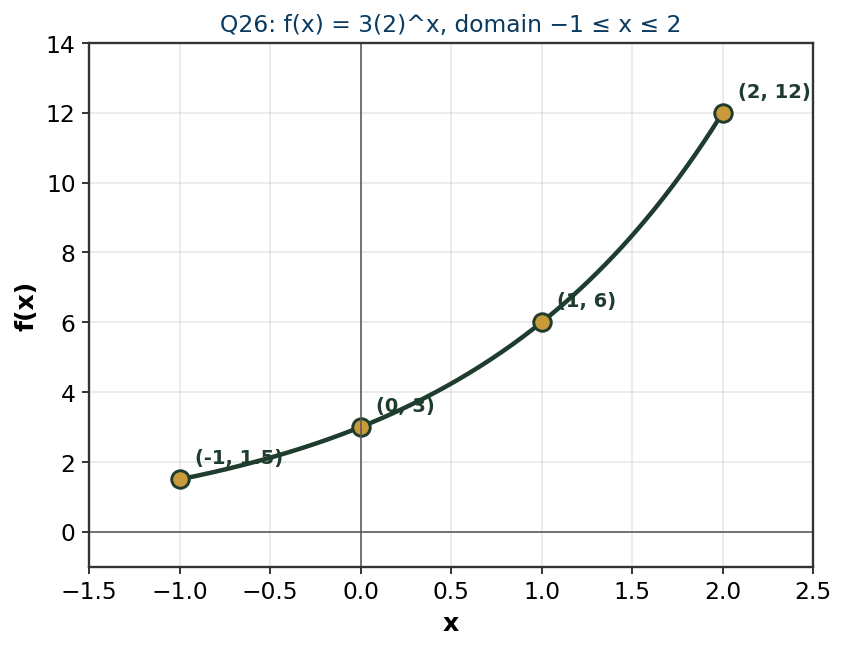
Graph f(x) = 3(2)x over the interval −1 ≤ x ≤ 2.
Answer: exponential growth curve passing through (−1, 1.5), (0, 3), (1, 6), and (2, 12).
Strategy: plug in the four integer inputs plus the left endpoint to get a clean set of plotting points.
x = -1 → f(-1) = 3 · 2^(-1) = 3 · (1/2) = 1.5 x = 0 → f(0) = 3 · 2^0 = 3 · 1 = 3 x = 1 → f(1) = 3 · 2^1 = 3 · 2 = 6 x = 2 → f(2) = 3 · 2^2 = 3 · 4 = 12The graph is a smooth, always-increasing curve. Because the base b = 2 > 1, values double each time x increases by 1 — a classic exponential growth pattern.
Question 27
Determine the product of (2x + 3) and (−6x2 + 5x − 1). Express the product in standard form.
Answer: −12x3 − 8x2 + 13x − 3
Distribute each term of the binomial across the trinomial:
(2x + 3)(-6x² + 5x - 1) 2x · (-6x²) + 2x · 5x + 2x · (-1) = -12x³ + 10x² - 2x 3 · (-6x²) + 3 · 5x + 3 · (-1) = -18x² + 15x - 3 Add: -12x³ + (10x² - 18x²) + (-2x + 15x) - 3 = -12x³ - 8x² + 13x - 3Standard form means highest-degree term first. The middle-term combinations are where students lose credit — keep them stacked in columns like above.
Question 28
A student’s test scores for the semester are listed below. Construct a box plot for this data set.
83, 87, 90, 94, 94, 93, 95, 70, 72, 83, 85, 88, 98
Answer: Five-number summary → min = 70, Q1 = 83, median = 88, Q3 = 94, max = 98.
Step 1 — sort:
70, 72, 83, 83, 85, 87, 88, 90, 93, 94, 94, 95, 98 ↑ median (7th of 13)Step 2 — median (middle value of 13 numbers is the 7th one): 88.
Step 3 — Q1 (median of the lower half 70, 72, 83, 83, 85, 87): the middle two are 83 and 83, so Q1 = 83.
Step 4 — Q3 (median of upper half 90, 93, 94, 94, 95, 98): the middle two are 94 and 94, so Q3 = 94.
Box plot: draw a box from 83 to 94 with a line inside at 88, then whiskers extending to 70 (minimum) and 98 (maximum) on the number line.
Question 29
Write an equation, in slope-intercept form, of a line that passes through the point (6, 3) and has a slope of ⅔.
Answer: y = (2/3)x − 1
Start with point-slope form and convert to y = mx + b:
y - y₁ = m(x - x₁) y - 3 = (2/3)(x - 6) y - 3 = (2/3)x - 4 (distribute 2/3) y = (2/3)x - 4 + 3 (add 3 to both sides) y = (2/3)x - 1Check by plugging in (6, 3): y = (2/3)(6) − 1 = 4 − 1 = 3. ✓
Question 30
Abby has $20 to spend at a community festival. She uses $8.50 to purchase food coupons for popcorn, a hot dog, and a soda. She can buy individual ride tickets for $2.25 each. Determine algebraically the maximum number of ride tickets Abby can buy.
Answer: 5 ride tickets (maximum).
Set up an inequality using n = number of tickets:
8.50 + 2.25n ≤ 20 (total spending can't exceed $20) 2.25n ≤ 20 - 8.50 (subtract 8.50 from both sides) 2.25n ≤ 11.50 n ≤ 11.50 / 2.25 n ≤ 5.111...Since Abby cannot buy a fractional ticket, we round down: the maximum is 5 tickets. Rounding up to 6 would put her over $20 — a common trap.
Part III — Extended Response (4 questions × 4 pts = 16 pts)
Show all work. A correct numerical answer with no work shown receives only 1 credit.
Question 31
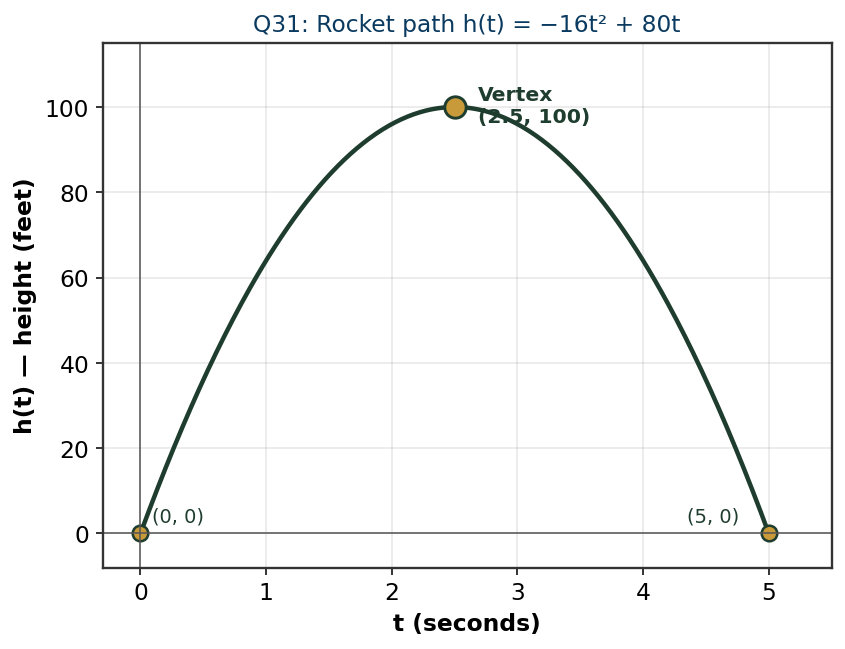
A rocket was launched from the ground into the air at an initial velocity of 80 feet per second. The path of the rocket can be modeled by h(t) = −16t2 + 80t, where t represents the time after launch and h(t) is the height in feet.
Sketch the function. State how many seconds it will take for the rocket to reach its maximum height. State the maximum height, in feet, of the rocket.
Answer: Reaches maximum height at t = 2.5 s. Maximum height = 100 ft.
Vertex (max height) — use t = −b / (2a) with a = −16, b = 80:
t = -80 / (2 · -16) = -80 / -32 = 2.5 secondsCompute the height at t = 2.5:
h(2.5) = -16(2.5)² + 80(2.5) = -16(6.25) + 200 = -100 + 200 = 100 feetZeros for the sketch: the rocket leaves the ground at t = 0 and returns to h = 0 when −16t(t − 5) = 0, giving t = 0 or t = 5. Parabola opens downward with vertex (2.5, 100) and roots (0, 0) and (5, 0).
Question 32
Use the quadratic formula to solve 2x2 − 4x − 3 = 0, and express the answer in simplest radical form.
Answer: x = (2 ± √10) / 2 (equivalently, x = 1 ± ½√10).
Identify: a = 2, b = −4, c = −3.
Apply the quadratic formula:
x = (-b ± √(b² - 4ac)) / (2a) -b = -(-4) = 4 b² - 4ac = (-4)² - 4(2)(-3) = 16 + 24 = 40 2a = 4 x = (4 ± √40) / 4Simplify the radical: √40 = √(4 · 10) = 2√10.
x = (4 ± 2√10) / 4 = 2(2 ± √10) / 4 (factor out 2) = (2 ± √10) / 2Common error: losing a sign on −4ac. Since both a and c multiply to a negative product, −4ac becomes positive 24, not negative.
Question 33
The table below shows the ages of drivers and the annual cost of their car insurance.
| Age (x, years) | 16 | 17 | 18 | 18 | 21 | 22 | 30 |
|---|---|---|---|---|---|---|---|
| Cost (y, $) | 1452 | 1332 | 1284 | 1320 | 1200 | 1188 | 600 |
Write the linear regression equation for this set of data. Round all values to the nearest hundredth. State the correlation coefficient of this line of best fit, to the nearest hundredth. State what this correlation coefficient indicates about the linear fit of the data set.
Answer: y = −56.97x + 2352.22; r ≈ −0.98; the data have a strong negative linear relationship.
On a TI-84:
- Press STAT → 1: Edit. Enter ages (16, 17, 18, 18, 21, 22, 30) into L1 and costs (1452, 1332, 1284, 1320, 1200, 1188, 600) into L2.
- Turn on diagnostics: 2nd → 0 (CATALOG) → scroll to DiagnosticOn → ENTER twice.
- Press STAT → CALC → 4: LinReg(ax+b) with Xlist: L1, Ylist: L2.
Calculator output: a ≈ −56.9688, b ≈ 2352.2245, r ≈ −0.9821. Rounded to hundredths: y = −56.97x + 2352.22 and r ≈ −0.98.
Interpretation: since r ≈ −0.98 is very close to −1, there is a strong negative linear correlation — as driver age increases, insurance cost tends to decrease, and a linear model fits the data very well.
Question 34
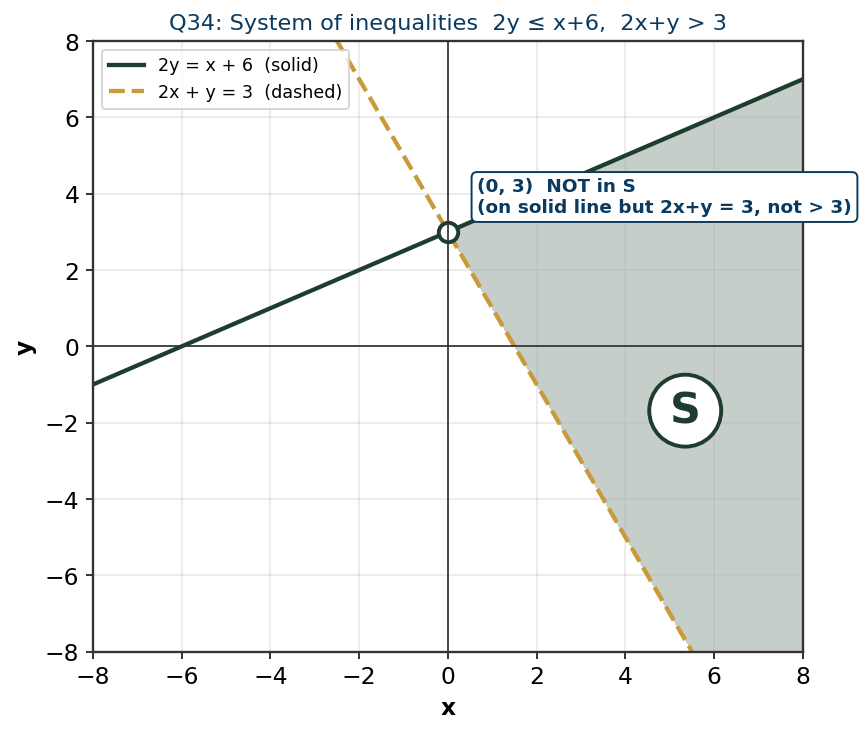
Solve the following system of inequalities graphically. Label the solution set S.
2y ≤ x + 6
2x + y > 3
Is the point (0, 3) in the solution set? Explain your answer.
Answer: No, (0, 3) is NOT in the solution set. It satisfies the first inequality but fails the second.
Rewrite each in slope-intercept form:
2y ≤ x + 6 → y ≤ (1/2)x + 3 boundary y = (1/2)x + 3, SOLID, shade below 2x + y > 3 → y > -2x + 3 boundary y = -2x + 3, DASHED, shade aboveTest the point (0, 3):
Inequality 1: 2(3) ≤ 0 + 6 → 6 ≤ 6 ✓ (equal — still on the SOLID line, allowed) Inequality 2: 2(0) + 3 > 3 → 3 > 3 ✗ (equal but strict — NOT allowed)The point (0, 3) lies exactly on the dashed line for the second inequality. Because the inequality is strict (>, not ≥), points on the boundary are excluded. So (0, 3) fails and is NOT in the solution set S.
Part IV — Six-Point Question (1 question × 6 pts = 6 pts)
Show all work. A correct numerical answer with no work shown receives only 1 credit.
Question 35
Acme Athletics purchases shoes from a supply company. In January the store bought 30 pairs of running shoes and 10 pairs of basketball shoes for $3700. In March they bought 15 pairs of running shoes and 20 pairs of basketball shoes for $3575. The supply company kept their prices constant.
If x represents the cost of one pair of running shoes and y represents the cost of one pair of basketball shoes, write a system of equations that models this situation.
Jacob says that a pair of running shoes costs the store $80 each, and a pair of basketball shoes costs the store $130 each. Is he correct? Justify your answer.
Solve your system of equations algebraically to find the exact cost, in dollars, of one pair of running shoes and the exact cost, in dollars, of one pair of basketball shoes.
Answer: System: 30x + 10y = 3700 and 15x + 20y = 3575. Jacob is NOT correct. Actual prices: running shoes = $85, basketball shoes = $115.
Part A — Write the system. Each purchase becomes one linear equation:
30 running shoes + 10 basketball shoes = $3700 → 30x + 10y = 3700 15 running shoes + 20 basketball shoes = $3575 → 15x + 20y = 3575Part B — Check Jacob’s claim (x = 80, y = 130):
Eq 1: 30(80) + 10(130) = 2400 + 1300 = 3700 ✓ Eq 2: 15(80) + 20(130) = 1200 + 2600 = 3800 ✗ (should be 3575)Jacob’s values satisfy the January purchase but fail the March purchase — they overshoot by $225. So Jacob is incorrect. A solution must satisfy both equations, not just one.
Part C — Solve algebraically (elimination is fastest). Multiply the second equation by 2:
30x + 10y = 3700 (equation 1) 30x + 40y = 7150 (equation 2 × 2) Subtract equation 1 from equation 2: 30x + 40y - (30x + 10y) = 7150 - 3700 30y = 3450 y = 115 Substitute back into equation 1: 30x + 10(115) = 3700 30x + 1150 = 3700 30x = 2550 x = 85Interpretation: a pair of running shoes costs $85 and a pair of basketball shoes costs $115. Verify both equations:
Eq 1: 30(85) + 10(115) = 2550 + 1150 = 3700 ✓ Eq 2: 15(85) + 20(115) = 1275 + 2300 = 3575 ✓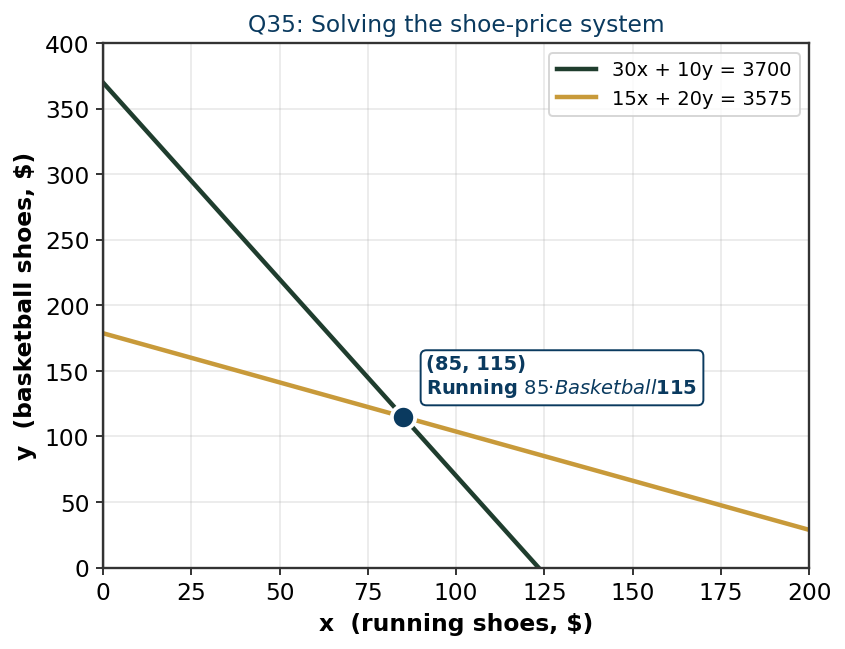
Answer key at a glance
| # | Part | Answer |
|---|---|---|
| 1 | I | (1) x = 3 and (3, −4) |
| 2 | I | (1) irrational |
| 3 | I | (3) 3 |
| 4 | I | (1) (x + 4)(x − 30) |
| 5 | I | (3) 3 + 4√5 |
| 6 | I | (4) 4x² + 2x³ − 6 |
| 7 | I | (1) — discrete points passing VLT |
| 8 | I | (3) $500 |
| 9 | I | (1) (S − 2πr²) / (2πr) |
| 10 | I | (3) 2x + 5(3x − 10) = 1 |
| 11 | I | (3) x > ½, open right |
| 12 | I | (1) addition property of equality |
| 13 | I | (2) table with ratio 0.9 |
| 14 | I | (2) 7 |
| 15 | I | (2) (x + 8)² − 2 |
| 16 | I | (4) 0, 6, and −6 |
| 17 | I | (2) −4 or 3 |
| 18 | I | (4) 0.145 |
| 19 | I | (1) feet per second |
| 20 | I | (4) −8x⁶ |
| 21 | I | (4) −51.8 |
| 22 | I | (3) −x² + 5x − 9 |
| 23 | I | (3) (x − 3)² = 33 |
| 24 | I | (4) 54 |
| 25 | II | x = 1/4 |
| 26 | II | Curve through (−1, 1.5), (0, 3), (1, 6), (2, 12) |
| 27 | II | −12x³ − 8x² + 13x − 3 |
| 28 | II | Min 70, Q1 83, med 88, Q3 94, max 98 |
| 29 | II | y = (2/3)x − 1 |
| 30 | II | 5 ride tickets |
| 31 | III | t = 2.5 s, h_max = 100 ft |
| 32 | III | x = (2 ± √10) / 2 |
| 33 | III | y = −56.97x + 2352.22; r ≈ −0.98 |
| 34 | III | (0, 3) NOT in S (fails strict >) |
| 35 | IV | Running $85, basketball $115 |