Regents Geometry · Algebra 2/Trig · Precalculus
Sine, Cosine & Tangent for NY Regents Geometry: Definitions, Identities & the Unit Circle
The complete SOMATH trigonometry cheat sheet — right-triangle definitions (SOH–CAH–TOA), the Pythagorean and reciprocal identities, exact values for 30°–45°–60°, the unit-circle view of every angle, and the sign of each function by quadrant. Everything a New York Regents Geometry, Algebra 2/Trig, precalculus, and SAT student needs on one page.

The short answer: in a right triangle, for an acute angle θ, sin θ = opposite / hypotenuse, cos θ = adjacent / hypotenuse, and tan θ = opposite / adjacent — that’s SOH–CAH–TOA. Every other trig fact flows from those three: the Pythagorean identity sin²θ + cos²θ = 1, the quotient identity tan θ = sin θ / cos θ, the reciprocal identities (csc, sec, cot), the exact values at 30°, 45°, and 60°, the unit-circle definition that extends everything past 90°, and the quadrant sign rule (All Students Take Calculus). This SOMATH guide walks through every piece with worked examples.
Trigonometry appears on the NY Regents Geometry exam, the Algebra 2/Trig course, the digital SAT, the ACT, and every AP Precalculus and AP Calculus problem that touches angles or periodic behavior. The definitions on this page never change — master them once, use them everywhere.
SOMATH — School of Math on the Upper West Side at 226 West 79th Street, first floor, phone (646) 668-6151 — teaches trigonometry across our Young Fermats (grades 5–8), high-school Geometry, Algebra 2/Trig, and Precalculus tracks. Every family starts with a free 30-minute in-person evaluation and a written diagnostic within 48 hours — yours to keep whether you enroll or not.
1. Right-triangle definitions (SOH–CAH–TOA)
Sine, cosine, and tangent are ratios of the sides of a right triangle.
Fix an acute angle θ. Label the three sides relative to that angle:
- Opposite — the leg across from θ.
- Adjacent — the leg next to θ (not the hypotenuse).
- Hypotenuse — the longest side, across from the right angle. Same side no matter which acute angle you pick.
Then:
sin θ = opposite / hypotenuse
cos θ = adjacent / hypotenuse
tan θ = opposite / adjacent
The classic mnemonic is SOH–CAH–TOA: Sine = Opposite/Hypotenuse, Cosine = Adjacent/Hypotenuse, Tangent = Opposite/Adjacent. We wrote a full post on the alternative mnemonic All Students Take Calculus, which we’ll return to for quadrant signs below.
Worked example. In a right triangle with legs 3 and 4 and hypotenuse 5, let θ be the angle opposite the leg of length 3. Find sin θ, cos θ, and tan θ.
Solution. The side opposite θ is 3, the side adjacent is 4, and the hypotenuse is 5. So:
sin θ = 3/5, cos θ = 4/5, tan θ = 3/4.
2. The trigonometric identities you actually need
sin²θ + cos²θ = 1
sin²θ + cos²θ = 1
Where it comes from: take any point on the unit circle at angle θ. Its coordinates are (cos θ, sin θ), and the point is exactly 1 unit from the origin. Apply the Pythagorean theorem to the right triangle formed by dropping a perpendicular: (cos θ)² + (sin θ)² = 1². The identity is the Pythagorean theorem applied to the unit circle.
How you use it: any time a problem gives you sin θ and asks for cos θ (or vice versa), rearrange to cos θ = ±√(1 − sin²θ). The sign is decided by the quadrant — more on that in section 6.
tan θ = sin θ / cos θ
tan θ = sin θ / cos θ (cos θ ≠ 0)
Derivation: in a right triangle, opposite/adjacent = (opposite/hypotenuse) / (adjacent/hypotenuse) = sin θ / cos θ. Tangent is a ratio of two ratios. On the unit circle, this is y / x.
Tangent is undefined at θ = 90° and θ = 270° because cos θ = 0 there — you cannot divide by zero.
Each of the other three trig functions is the reciprocal of one of sine, cosine, or tangent.
csc θ = 1 / sin θ (sin θ ≠ 0)
sec θ = 1 / cos θ (cos θ ≠ 0)
cot θ = 1 / tan θ (tan θ ≠ 0)
- Cosecant is the reciprocal of sine — note the “co” is in the reciprocal, not the base function.
- Secant is the reciprocal of cosine.
- Cotangent is the reciprocal of tangent; equivalently
cot θ = cos θ / sin θ.
3. The unit-circle view (why the definitions extend past 90°)
On the unit circle (radius 1), cosine is the x-coordinate and sine is the y-coordinate.
Let P = (x, y) be a point on the unit circle x² + y² = 1, and let θ be the angle measured counter-clockwise from the positive x-axis to the ray OP. Then:
cos θ = x sin θ = y tan θ = y / x = sin θ / cos θ
Why this matters: the right-triangle definitions only work for acute angles between 0° and 90°. The unit-circle definition works for every angle — 0°, 90°, 180°, 270°, angles greater than 360°, and negative angles — because you can always locate a point on the unit circle. This is how the Regents and AP Precalculus extend trigonometry into periodic functions.
4. Special right triangles — the values worth memorizing
Two triangles produce all the exact-value trig quantities you’ll ever see on a Regents, SAT, or AP exam. Memorize the side ratios once and every 30°, 45°, 60° question becomes a two-second lookup.
45°–45°–90° triangle (isosceles right)
Legs equal, hypotenuse is a leg times √2. In its simplest form:
legs = 1, 1 hypotenuse = √2
So the trig values at 45° are:
sin 45° = √2 / 2 cos 45° = √2 / 2 tan 45° = 1
30°–60°–90° triangle
Short leg opposite 30°, long leg opposite 60°, hypotenuse opposite 90°. Ratio:
short leg : long leg : hypotenuse = 1 : √3 : 2
So the trig values are:
sin 30° = 1/2 cos 30° = √3 / 2 tan 30° = √3 / 3
sin 60° = √3 / 2 cos 60° = 1/2 tan 60° = √3
5. Important values table (0° through 90°)
| Function | 0° | 30° | 45° | 60° | 90° |
|---|---|---|---|---|---|
| sin θ | 0 | 1/2 | √2 / 2 | √3 / 2 | 1 |
| cos θ | 1 | √3 / 2 | √2 / 2 | 1/2 | 0 |
| tan θ | 0 | √3 / 3 | 1 | √3 | undefined |
Pattern: sine goes 0, 1/2, √2/2, √3/2, 1 — think of it as √0/2, √1/2, √2/2, √3/2, √4/2. Cosine is the exact reverse. Tangent is sine divided by cosine at each column.
6. Sign of the trig functions by quadrant (“All Students Take Calculus”)
The unit-circle definition extends every trig function to all four quadrants. The sign depends only on the signs of x and y in that quadrant.
| Quadrant | Angle θ | sin θ | cos θ | tan θ | Mnemonic |
|---|---|---|---|---|---|
| I | 0° – 90° | + | + | + | All positive |
| II | 90° – 180° | + | − | − | Sine only |
| III | 180° – 270° | − | − | + | Tangent only |
| IV | 270° – 360° | − | + | − | Cosine only |
Read the boldface first letters counter-clockwise from Quadrant I: A, S, T, C — All Students Take Calculus. In each quadrant, the named function (and its reciprocal) is positive; the others are negative.
For a step-by-step Regents-style problem that uses this idea, see our worked example: given a Quadrant-II angle with a specific tan value, find cos. It combines the Pythagorean identity, the quotient identity, and the ASTC quadrant rule in a single problem — exactly the flavor of question that shows up on the New York State Algebra 2/Trigonometry Regents and the AP Precalculus exam.
Full worked example — putting all six pieces together
Problem. Angle θ is in Quadrant II, and sin θ = 3/5. Find cos θ, tan θ, csc θ, sec θ, and cot θ.
Solution.
- Use the Pythagorean identity to get cos θ. sin²θ + cos²θ = 1 → (3/5)² + cos²θ = 1 → cos²θ = 1 − 9/25 = 16/25 → cos θ = ±4/5.
- Pick the sign using the quadrant. In Quadrant II, cosine is negative. So
cos θ = −4/5. - Quotient identity for tan. tan θ = sin θ / cos θ = (3/5) / (−4/5) =
−3/4. Check the sign: tangent is negative in Q II — matches ASTC. - Reciprocals. csc θ = 1 / sin θ =
5/3. sec θ = 1 / cos θ =−5/4. cot θ = 1 / tan θ =−4/3.
Six trig values from one starting fact, using nothing but the identities and the quadrant sign rule. This is exactly the six-step template Regents and AP Precalculus problems reward.
Practice question: SOH–CAH–TOA on a right triangle
Here is a textbook Regents-style multiple-choice question that tests whether you can pick the right ratio (sin, cos, or tan) for the information you are given. The trap is choosing the wrong ratio — even one letter off (sine instead of cosine) and the answer becomes one of the distractors below. Work it out before revealing the solution.
Question — Regents Geometry, multiple choice
In triangle RJM below, m∠R = 90° and MR = 7.25 inches.
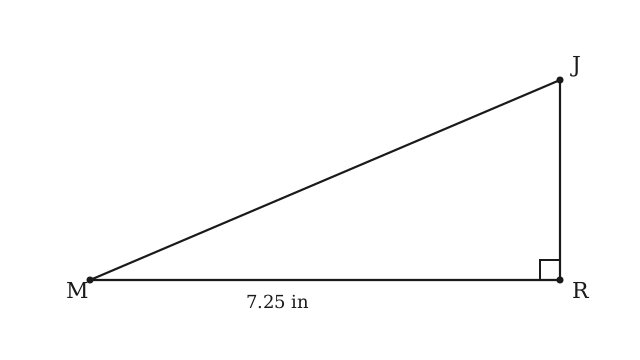
If the measure of angle M is 35°, what is the length of MJ, to the nearest hundredth of an inch?
- 4.16
- 5.94
- 8.85
- 12.64
Answer: (3) 8.85 inches.
Step 1 — Identify the sides relative to angle M. Angle M is the reference angle. The right angle is at R, so MJ (the side opposite the right angle) is the hypotenuse. Relative to angle M:
- MR = 7.25 is the side next to angle M and not the hypotenuse → adjacent.
- RJ is the side across from angle M → opposite.
- MJ is the side across from the right angle → hypotenuse.
Step 2 — Pick the trig ratio that connects what you know to what you want. You know the adjacent side (7.25) and want the hypotenuse (MJ). The ratio that connects adjacent and hypotenuse is cosine (the “CAH” in SOH–CAH–TOA):
cos(M) = adjacent / hypotenuse = MR / MJ
Step 3 — Substitute and solve. Plug in m∠M = 35° and MR = 7.25:
cos(35°) = 7.25 / MJ
Solve for MJ by multiplying both sides by MJ and then dividing by cos(35°):
MJ = 7.25 / cos(35°)
On the calculator (in degree mode): cos(35°) ≈ 0.81915. So MJ ≈ 7.25 / 0.81915 ≈ 8.8506, which rounds to 8.85 inches. That is choice (3). ✔
Sanity check. In a right triangle, the hypotenuse is always the longest side. MJ = 8.85 is longer than MR = 7.25 — the answer passes the “is my hypotenuse the biggest?” check. If you had gotten MJ = 5.94 or 4.16 (both shorter than 7.25), you would immediately know you picked the wrong ratio.
Why the other choices fail — each is the wrong ratio.
- (1) 4.16. This comes from 7.25 · sin(35°) ≈ 4.16. It is what you get if you use the wrong ratio and solve for the wrong side — mistakenly writing sin(35°) = RJ/7.25 as if 7.25 were the hypotenuse (it is not) and then reporting RJ instead of MJ. Note also that 4.16 is shorter than the given side 7.25, so it cannot be the hypotenuse.
- (2) 5.94. This comes from mixing up adjacent and opposite: 7.25 · cos(35°) ≈ 5.94. It is what you get if you write cos(35°) = MJ/7.25 (flipping the ratio upside down) and solve.
- (4) 12.64. This comes from using sine instead of cosine: MJ = 7.25 / sin(35°) ≈ 12.64. Cosine goes with adjacent; sine goes with opposite. Swapping them gives this too-large hypotenuse.
The 15-second template. On any right-triangle trig question:
- Label each side opp, adj, or hyp relative to the given angle.
- Cross off the side you do not use; the remaining two labels tell you which ratio to pick (opp+adj → tan, opp+hyp → sin, adj+hyp → cos).
- Write the ratio as an equation, put the unknown on top or bottom as needed, and solve in one step.
- Make sure your calculator is in degree mode.
Two rows of SOH–CAH–TOA and one calculator button — that is what a 2-credit Regents Part I trig question is worth in seconds, not minutes.
The three families of trig facts, side by side
| Family | What it’s about | Core formula | Where you use it |
|---|---|---|---|
| Right-triangle ratios (SOH–CAH–TOA) | Sine, cosine, tangent as leg ratios for an acute angle | sin θ = opp/hyp, cos θ = adj/hyp, tan θ = opp/adj |
Regents Geometry angle-of-elevation problems, right-triangle applications on the SAT |
| Trigonometric identities | Algebraic relations true for every angle | sin²θ + cos²θ = 1, tan θ = sin/cos, reciprocals |
Algebra 2/Trig identity proofs, Precalculus, AP Calculus derivative and integral problems |
| Unit-circle & quadrant signs (ASTC) | Extend trig functions beyond acute angles | cos θ = x, sin θ = y, sign follows quadrant |
Any problem beyond 90°: reference angles, periodic functions, graphing sine/cosine |
Where sine, cosine & tangent sit in the SOMATH curriculum
Trigonometry is not a one-course topic. Students meet the ideas earlier than they realize and reuse them for years:
- Middle school (Young Fermats, grades 6–8). The Pythagorean theorem and special right triangles show up in the 8th-grade Common Core standards. Students who understand 45°–45°–90° and 30°–60°–90° ratios before Geometry have a two-course head start on trig.
- Geometry. Right-triangle trig (SOH–CAH–TOA), angle-of-elevation/depression word problems, and the trig ratios in similar triangles are Regents Geometry staples. See our Parallel Lines & Midsegment Theorem post for the proportionality that underpins trig identities.
- Algebra 2 / Trigonometry. The unit-circle definition, Pythagorean identity, quotient identity, reciprocals, and all four-quadrant ASTC sign work. This is where trigonometry becomes an algebraic subject.
- Precalculus & AP Precalculus. Graphs of sine, cosine, and tangent; amplitude, period, phase shift; inverse trig functions; the addition and double-angle identities.
- AP Calculus AB / BC. Derivatives and integrals of trig functions; Taylor series of sin and cos; polar coordinates.
The SOMATH arc: we introduce the 45°–45°–90° and 30°–60°–90° ratios in Young Fermats geometry units, teach SOH–CAH–TOA in high-school Geometry, and layer on the identities, the unit circle, and ASTC across Algebra 2/Trig and Precalculus. By the time our students reach AP Calculus, the entire cheat sheet above is automatic — freeing them to focus on the harder ideas of calculus itself.
Common student mistakes we correct at SOMATH
- Mixing up “opposite” and “adjacent.” Both are relative to the angle you’re working with, not fixed to a side of the triangle. Change the angle, and opposite and adjacent swap.
- Forgetting that the hypotenuse is always the longest side. The hypotenuse is opposite the right angle, not opposite θ. It’s the same side no matter which acute angle you name.
- Writing sin²θ when they mean (sin θ)². Standard notation:
sin²θmeans the sine, then square. It does not mean sin(sin θ). - Dropping the ± sign after the Pythagorean identity.
cos²θ = 16/25givescos θ = ±4/5. Choose the sign using the quadrant — never assume positive. - Confusing reciprocal and inverse.
csc θis 1/sin θ, butsin&sup(−1)θis the inverse function — a different operation entirely.
Frequently asked questions
What is SOH–CAH–TOA?
A mnemonic for the three primary trig ratios: Sine = Opposite over Hypotenuse, Cosine = Adjacent over Hypotenuse, Tangent = Opposite over Adjacent. It applies to any acute angle in a right triangle.
Why is tan 90° undefined?
Because tan θ = sin θ / cos θ, and at θ = 90°, cos θ = 0. Division by zero is undefined, so tangent has vertical asymptotes at 90°, 270°, and every angle of the form 90° + 180°k.
Does the Pythagorean identity work for every angle?
Yes. sin²θ + cos²θ = 1 is true for every real number θ — positive, negative, obtuse, or greater than 360°. It follows from the unit-circle definition, which is why it holds beyond the acute range where SOH–CAH–TOA is defined.
What is the difference between csc, sec, cot and sin⁻¹, cos⁻¹, tan⁻¹?
csc, sec, cot are reciprocals: csc θ = 1/sin θ. sin⁻¹, cos⁻¹, tan⁻¹ are inverse functions that return an angle from a ratio: sin⁻¹(1/2) = 30°. Same “−1” superscript, completely different operation. Reciprocal and inverse are not the same idea.
How do I decide which trig ratio to use in a right-triangle word problem?
Identify the angle you know or want. Label the three sides relative to that angle (opposite, adjacent, hypotenuse). Look at which two sides the problem gives you or asks about: opposite & hypotenuse → sine; adjacent & hypotenuse → cosine; opposite & adjacent → tangent. Set up the ratio, then solve.
Does SOMATH tutor high-school trigonometry?
Yes. Our high-school track covers Geometry (right-triangle trig, Regents), Algebra 2/Trigonometry (identities, unit circle, graphing), Precalculus, and AP Precalculus & Calculus. Every student starts with a free 30-minute in-person evaluation and a written diagnostic within 48 hours. Book at /evaluation or call (646) 668-6151.
The SOMATH bottom line
The right-triangle definitions, the Pythagorean identity, the quotient identity, the reciprocal identities, the special-triangle values, the unit-circle view, and the quadrant sign rule — every trigonometry question on the New York Regents Geometry, Algebra 2/Trig, precalculus, and SAT exams is a rearrangement of the seven facts in the cheat sheet at the top of this page.
The students who master these seven facts as an integrated system — and not as seven unrelated things to memorize — are the students who finish trigonometry problems in seconds instead of minutes. That’s the SOMATH difference.
Ready to see how SOMATH teaches trigonometry?
Book a free 30-minute in-person evaluation at our Upper West Side classroom, 226 W 79th Street (1st floor). You’ll receive a written diagnostic within 48 hours — yours to keep whether or not you enroll.
About the author. School of Math is the educational voice of SOMATH — a K–12 math enrichment and test-prep program on the Upper West Side of Manhattan. Our teachers hold degrees from Harvard, Northwestern, Columbia, and NYU, and we specialize in Regents Geometry and Algebra 2/Trigonometry, AP Precalculus, AP Calculus, SHSAT, and SAT preparation.