Grades 10–12 · High School · AP Chemistry

Chemistry at SOMATH

Illustrated AP Chemistry unit guides for chemistry students and AP test takers, built the way SOMATH builds its math classes: complete theory after every teaching image, original practice questions, and worked answers hidden until you try. Written on the Upper West Side; free to use anywhere.

Book a Free Evaluation

FormatOnline unit guides · 60 questions each
Aligned toCollege Board AP Chemistry, 9 units
Location226 W 79th St, UWS
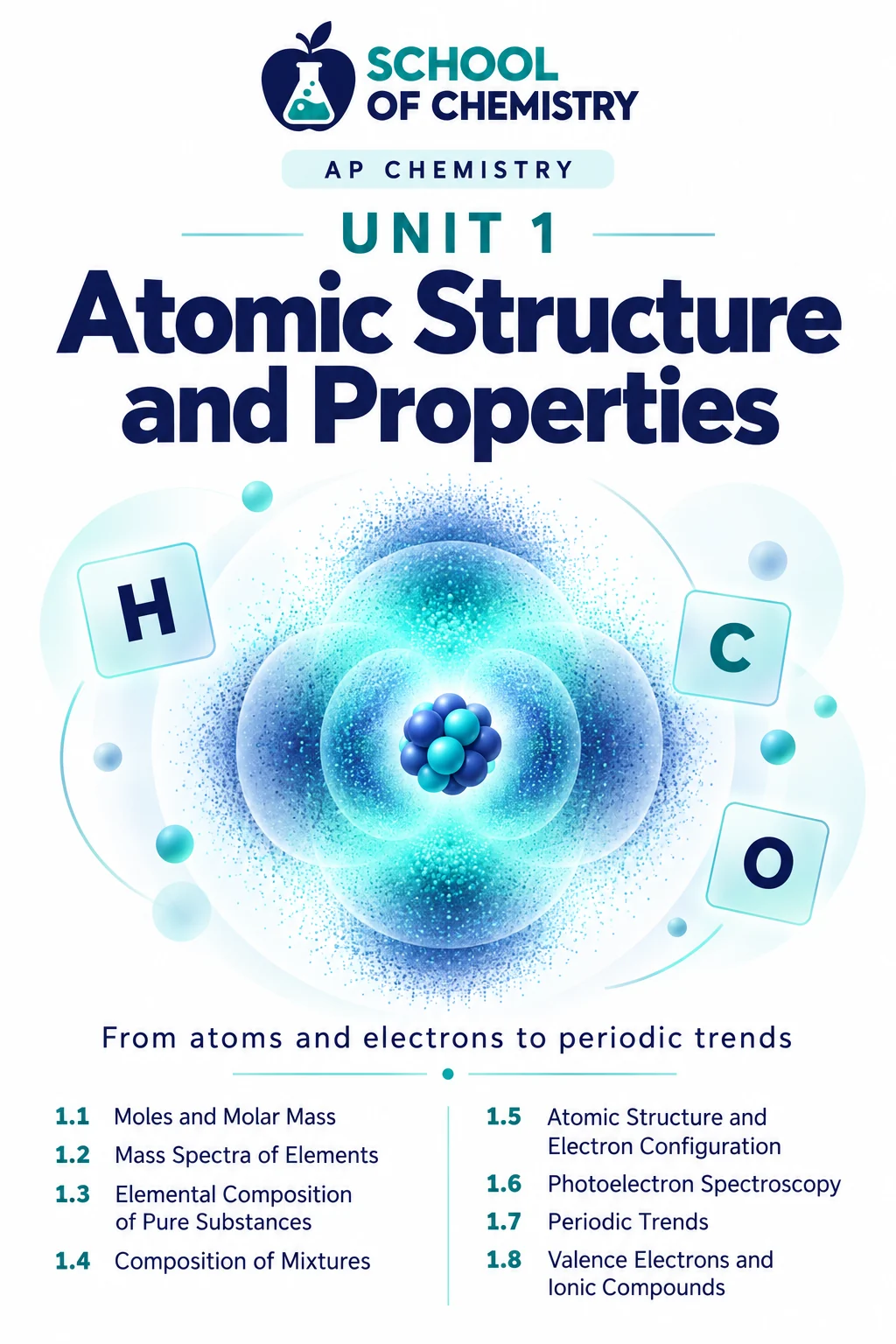
AP Chemistry Unit 1 cover: Atomic Structure and Properties

Published guides

Chemistry lessons

Each lesson covers one College Board unit with one teaching image per topic, five practice questions after each image, and a homework set of review questions and AP-style problems. New units are added here as they publish.

The AP Chemistry course

Nine units, one exam

College Board organizes AP Chemistry into nine units. The percentages are the weight of each unit on the multiple-choice section of the exam, which has 60 multiple-choice questions in 90 minutes and 7 free-response questions in 105 minutes. Units are independent study guides here; start with the unit your class is on or the one you find hardest.

Unit1Atomic Structure and Properties — 7–9% of the exam. Moles and molar mass, mass spectra, percent composition, mixtures, electron configuration, photoelectron spectroscopy, periodic trends, ionic compounds.
Unit2Compound Structure and Properties · guide coming soon — 7–9% of the exam. Types of bonds, ionic solids, metals and alloys, Lewis diagrams, resonance and formal charge, VSEPR and hybridization.
Unit3Properties of Substances and Mixtures · guide coming soon — 18–22% of the exam. Intermolecular forces, solids, liquids and gases, ideal gas law, kinetic molecular theory, solutions, solubility, spectroscopy and Beer–Lambert law.
Unit4Chemical Reactions · guide coming soon — 7–9% of the exam. Net ionic equations, physical and chemical changes, stoichiometry, titration, acid–base and redox reactions.
Unit5Kinetics · guide coming soon — 7–9% of the exam. Reaction rates, rate laws, concentration over time, collision model, energy profiles, mechanisms, catalysis.
Unit6Thermochemistry · guide coming soon — 7–9% of the exam. Endothermic and exothermic processes, calorimetry, phase changes, enthalpy of reaction, bond enthalpies, Hess's law.
Unit7Equilibrium · guide coming soon — 7–9% of the exam. Reaction quotient and K, calculating equilibrium concentrations, Le Châtelier's principle, solubility equilibria, common-ion effect.
Unit8Acids and Bases · guide coming soon — 11–15% of the exam. PH and pOH, weak acid and base equilibria, buffers, titration curves, pKa, buffer capacity.
Unit9Thermodynamics and Electrochemistry · guide coming soon — 7–9% of the exam. Entropy, Gibbs free energy, thermodynamic favorability, galvanic and electrolytic cells, cell potential, Faraday's law.
Who these guides are for

High school chemistry students in grades 10–12, AP Chemistry test takers preparing for the May exam, and families on the Upper West Side comparing study resources. The guides assume algebra fluency and a willingness to show units and significant figures; they do not assume a prior chemistry course.

How SOMATH teaches a science unit

The format mirrors our math classes: theory first, directly under the teaching image, then practice that moves from direct application to multi-step AP-style problems. Every trend is explained with a cause (nuclear charge, shielding, distance), every calculation carries its units, and every answer is hidden until the student commits to an attempt.

Students who take AP Chemistry alongside AP math can pair these guides with our AP Calculus AB/BC, AP Statistics, and AP Precalculus classes at 226 W 79th St, 1st Floor, New York, NY 10024. Call (646) 668-6151 or start with a free 30-minute evaluation.

Book a Free Evaluation

AP is a registered trademark of the College Board, which was not involved in the production of, and does not endorse, these study guides.

Frequently asked

Common questions from students and parents

Does SOMATH teach chemistry classes?

Chemistry at SOMATH begins as a free library of illustrated AP Chemistry unit guides written in the same format as our math classes: complete theory, original practice questions, and hidden worked answers. Families interested in small-group chemistry instruction on the Upper West Side can book a free evaluation and we will discuss current options.

Who are the chemistry guides for?

High school chemistry students in grades 10–12, AP Chemistry test takers reviewing for the May exam, and parents comparing study resources. Each guide follows College Board's unit and topic numbering so it matches any AP Chemistry classroom sequence.

How is each AP Chemistry guide organized?

Each guide pairs one teaching image per College Board topic with the full theory, five original practice questions, and a homework set of review questions and multi-part AP-style problems. Every answer is hidden behind a blue Answer control so students attempt the question first.

How much of the AP Chemistry exam does each unit cover?

College Board weights the multiple-choice section by unit: Unit 3 (Properties of Substances and Mixtures) is 18–22%, Unit 8 (Acids and Bases) is 11–15%, and each of the other seven units is 7–9%. The exam has 60 multiple-choice questions and 7 free-response questions.

Can my child use these guides without taking an AP course?

Yes. The guides teach from first principles, so a student in a regular or honors chemistry course can use them to go deeper. Units are independent, and no earlier guide is required.

Find the right starting point

Bring a recent assessment and your current school topics. We will help identify the next useful step.

Book a Free Evaluation