AP Chemistry · Unit 1 · Grades 10–12
Atomic Structure and Properties
From atoms and electrons to periodic trends: count particles with the mole, read mass and photoelectron spectra, write electron configurations, explain periodic trends with Coulomb's law, and build ionic formulas by balancing charge.
Explore eight illustrated topic guides, one for each topic in College Board's Unit 1, with complete theory and five original practice questions after each image. Finish with eight Homework review questions and twelve AP-style Homework problems: 40 practice questions, 20 homework questions, and 60 hidden worked answers. Try each problem before opening its blue Answer control.
This independent lesson is part of Chemistry at SOMATH, a growing library of AP Chemistry topic guides from the team behind our AP Calculus and AP Statistics classes. Each unit stands on its own; no earlier lesson is required. Students preparing for the AP Chemistry exam or a first-year chemistry course can book a free evaluation to plan their study path.
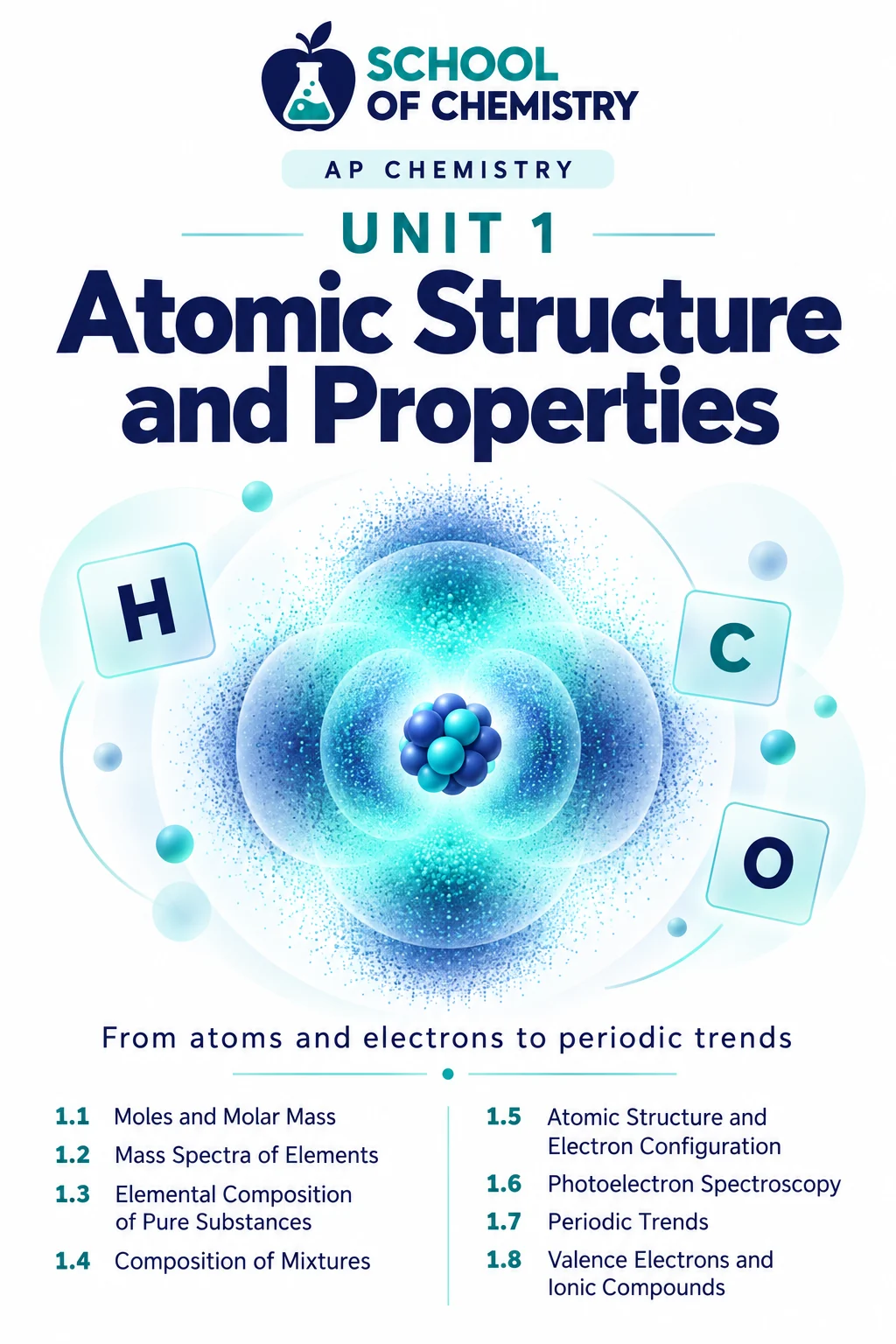
What Unit 1 asks you to do
College Board's framework places Unit 1 at 7–9% of the multiple-choice section. The questions reward three habits: converting between grams, moles, and particles without skipping units; reading spectra (mass and photoelectron) as evidence for isotopes and electron shells; and explaining every periodic trend with nuclear charge, shielding, and distance rather than memorized arrows. Every topic below ends with practice that builds those habits.
1. Moles and molar mass
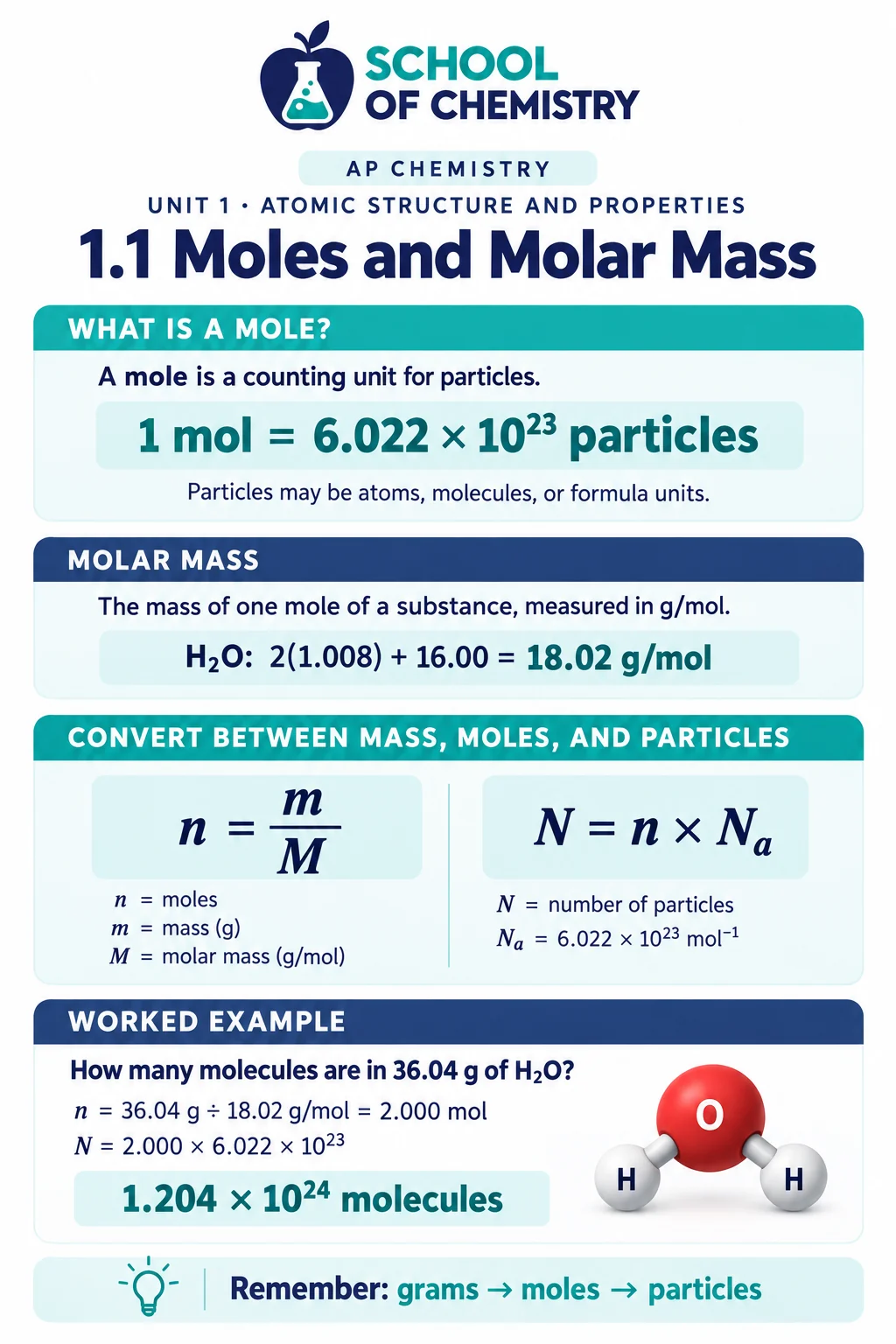
Chemists cannot count atoms one by one, so they count them in groups called moles. One mole is 6.022 × 10²³ particles; that number is Avogadro's number, NA. The particles can be atoms (Fe), molecules (H2O), or formula units of an ionic compound (NaCl). Writing the particle type is part of the answer.
The molar mass M of a substance is the mass of one mole in grams per mole (g/mol). Read it from the periodic table and add the contributions of every atom in the formula: H2O is 2(1.008) + 16.00 = 18.02 g/mol. Subscripts multiply, and a subscript outside parentheses multiplies everything inside.
Two relationships move between the quantities you can measure and the particles you cannot see: n = m / M converts mass in grams to moles, and N = n × NA converts moles to a number of particles. The pathway is always grams → moles → particles, or the reverse. Carry units through each step and keep the number of significant figures of the measured data; the Avogadro constant is treated as exact for sig-fig purposes.
Practice: try these five questions
Q1
Calculate the molar mass of carbon dioxide, CO2. Use C = 12.01 g/mol and O = 16.00 g/mol.
Answer
Add one carbon and two oxygens: 12.01 + 2(16.00) = 12.01 + 32.00 = 44.01 g/mol.
Check: the subscript 2 applies only to O, so oxygen contributes 32.00 g, not 16.00 g.
Q2
How many moles of CO2 are in an 11.0 g sample?
Answer
Use n = m / M = 11.0 g ÷ 44.01 g/mol = 0.2499 mol ≈ 0.250 mol CO2.
The data has three significant figures (11.0 g), so the answer is reported to three.
Q3
What is the mass of 0.750 mol of sodium chloride, NaCl? (Na = 22.99, Cl = 35.45 g/mol)
Answer
Molar mass: 22.99 + 35.45 = 58.44 g/mol.
Mass = n × M = 0.750 mol × 58.44 g/mol = 43.83 g ≈ 43.8 g NaCl.
Check: 0.75 of 58 is about 44, so the size is right.
Q4
How many iron atoms are in 0.400 mol of iron?
Answer
N = n × NA = 0.400 mol × 6.022 × 1023 atoms/mol = 2.409 × 10²³ ≈ 2.41 × 10²³ Fe atoms.
Iron is an element made of single atoms, so the particle is an atom, not a molecule.
Q5
A sample of CO2 has a mass of 8.80 g. (a) How many CO2 molecules does it contain? (b) How many oxygen atoms?
Answer
(a) Grams → moles: 8.80 g ÷ 44.01 g/mol = 0.2000 mol. Moles → molecules: 0.2000 × 6.022 × 1023 = 1.20 × 10²³ molecules of CO2.
(b) Each molecule has 2 oxygen atoms, so multiply by 2: 2 × 1.204 × 1023 = 2.41 × 10²³ O atoms.
Common error: forgetting to multiply by the subscript when the question asks about atoms inside a molecule.
2. Mass spectra of elements
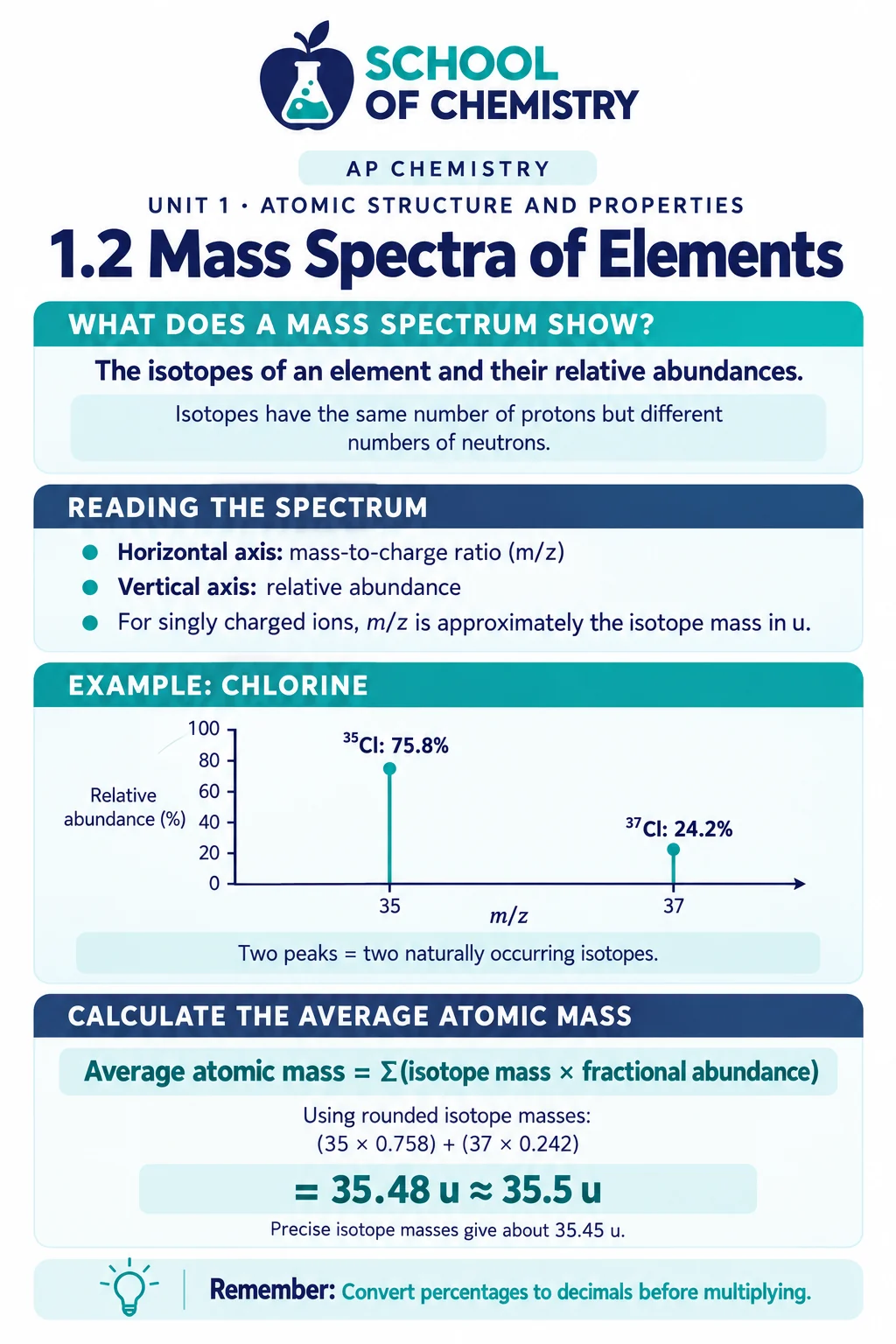
Atoms of the same element can have different numbers of neutrons. These isotopes share an atomic number but differ in mass number. A mass spectrometer separates ions by their mass-to-charge ratio and reports the result as a spectrum: the horizontal axis is m/z, and the vertical axis is relative abundance. For singly charged ions, m/z is approximately the isotope mass in atomic mass units (u).
Each peak is one isotope, and the peak height is its relative abundance. Chlorine shows two peaks, at 35 and 37, with abundances of 75.8% and 24.2%. The average atomic mass printed on the periodic table is the weighted average of the isotopes: multiply each isotope mass by its fractional abundance (percent ÷ 100) and add. For chlorine with rounded masses, (35 × 0.758) + (37 × 0.242) = 35.48 u, close to the tabulated 35.45 u.
Two skills appear on the AP exam. First, read a spectrum and compute or estimate the average mass, then identify the element from the periodic table. Second, reverse the process: given the average atomic mass and the isotope masses, solve for the abundances using x and (1 − x). Always check that the average lies between the isotope masses and closer to the more abundant one.
Practice: try these five questions
Q6
Boron has two isotopes: 10B with 19.9% abundance and 11B with 80.1% abundance. Using rounded isotope masses, calculate the average atomic mass of boron.
Answer
Convert percentages to decimals and compute the weighted average:
(10 × 0.199) + (11 × 0.801) = 1.99 + 8.81 = 10.80 u.
The periodic table lists 10.81 u. The average is near 11 because 11B is far more abundant.
Q7
Copper's mass spectrum shows peaks at m/z 63 (69.2%) and 65 (30.8%). Estimate copper's average atomic mass and explain why it is not 64.0, the simple midpoint.
Answer
(63 × 0.692) + (65 × 0.308) = 43.60 + 20.02 = 63.6 u (the table value is 63.55 u).
The midpoint 64.0 would be correct only if the two isotopes were equally abundant. Because 63Cu is more than twice as common, the weighted average is pulled toward 63.
Q8
An element's mass spectrum has three peaks: m/z 24 (79.0%), 25 (10.0%), and 26 (11.0%). Calculate the average atomic mass and identify the element.
Answer
(24 × 0.790) + (25 × 0.100) + (26 × 0.110) = 18.96 + 2.50 + 2.86 = 24.32 u.
The periodic table element with average mass 24.31 u is magnesium, Mg. Three peaks mean three naturally occurring isotopes: 24Mg, 25Mg, and 26Mg.
Q9
A spectrum shows a small peak at m/z 6 (relative abundance 7.6%) and a tall peak at m/z 7 (92.4%). (a) Which element is this? (b) Which isotope is more abundant? (c) Estimate the average atomic mass.
Answer
(a) Masses of 6 and 7 with an average near 7 point to lithium (6.94 u).
(b) 7Li is more abundant; its peak is taller (92.4%).
(c) (6 × 0.076) + (7 × 0.924) = 0.456 + 6.468 = 6.92 u, which matches the table value of 6.94 u within rounding.
Q10
Bromine has two isotopes, 79Br and 81Br, and an average atomic mass of 79.90 u. Using rounded isotope masses, find the percent abundance of each isotope.
Answer
Let x be the fractional abundance of 79Br, so (1 − x) is the abundance of 81Br.
79x + 81(1 − x) = 79.90 → 81 − 2x = 79.90 → 2x = 1.10 → x = 0.550.
79Br ≈ 55.0% and 81Br ≈ 45.0%. Check: the average 79.90 is a little below the midpoint 80, so the lighter isotope should be slightly more abundant. It is.
3. Elemental composition of pure substances
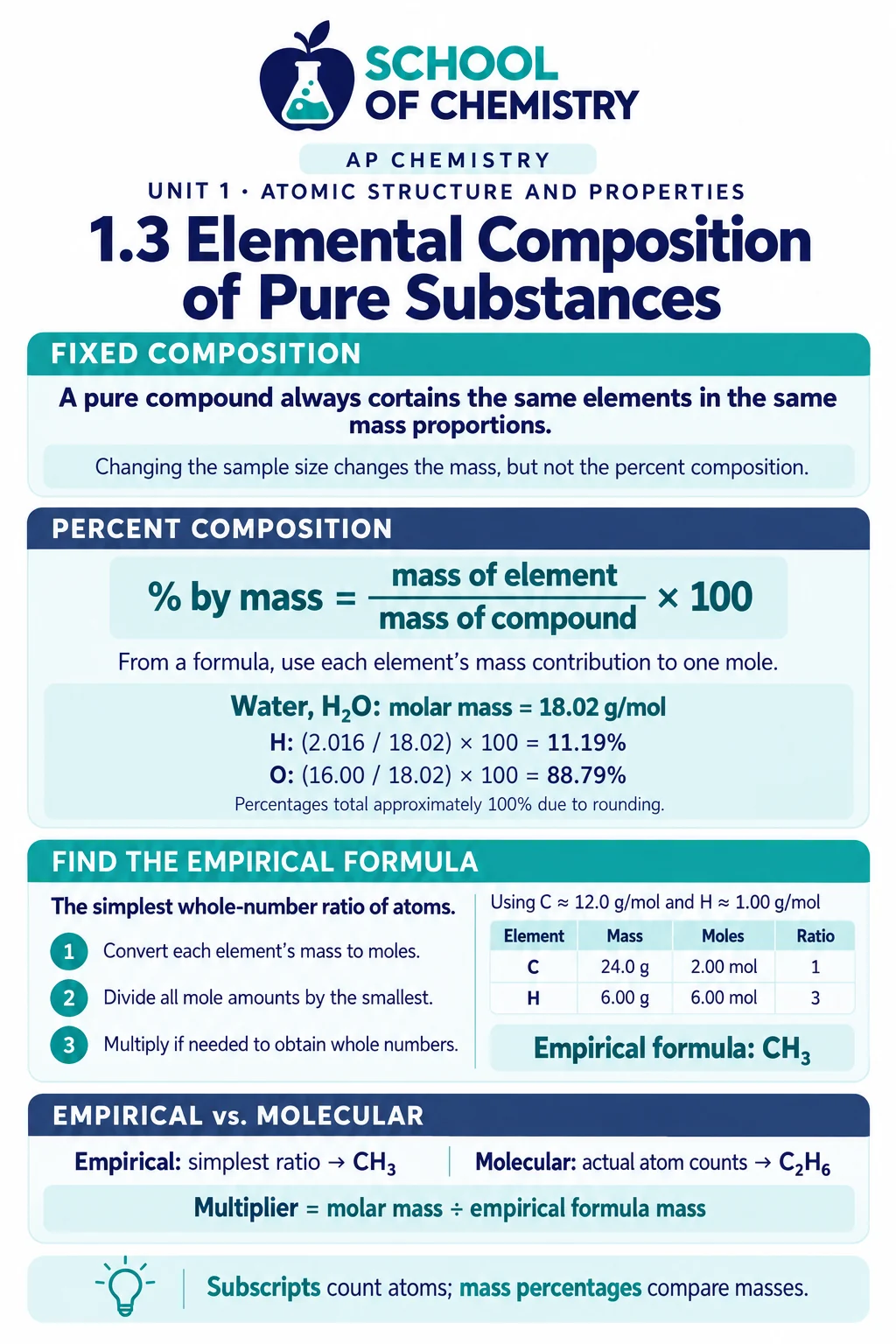
A pure compound has a fixed composition: the law of definite proportions says it always contains the same elements in the same mass ratio. Doubling the sample doubles every mass, but the percentages do not change. This is why percent composition identifies a compound while total mass does not.
Percent by mass of an element = (mass of that element in one mole ÷ molar mass of the compound) × 100. For water, hydrogen contributes 2(1.008) = 2.016 g of the 18.02 g molar mass, so %H = 11.19% and %O = 88.79%. The percentages add to about 100%, with small rounding differences.
An empirical formula is the simplest whole-number ratio of atoms. To find it from masses or percentages: (1) convert each element's mass to moles, (2) divide every mole amount by the smallest, and (3) multiply all ratios by a small integer if any is not close to a whole number (1.5 → ×2, 1.33 → ×3). The molecular formula gives the actual atom counts; it is a whole-number multiple of the empirical formula, and the multiplier equals molar mass ÷ empirical formula mass. CH3 (15.03 g/mol) with a molar mass of 30.07 g/mol gives a multiplier of 2 and the molecular formula C2H6.
Practice: try these five questions
Q11
Calculate the percent by mass of carbon and of oxygen in CO2 (molar mass 44.01 g/mol).
Answer
%C = (12.01 ÷ 44.01) × 100 = 27.29%.
%O = (32.00 ÷ 44.01) × 100 = 72.71%.
Check: 27.29 + 72.71 = 100.00%. Oxygen dominates by mass even though there are only two O atoms per C because each O atom is heavier.
Q12
Ammonium nitrate, NH4NO3, is a common fertilizer. What percent of its mass is nitrogen? (N = 14.01, H = 1.008, O = 16.00 g/mol)
Answer
Molar mass: 2(14.01) + 4(1.008) + 3(16.00) = 28.02 + 4.032 + 48.00 = 80.05 g/mol.
There are two N atoms per formula unit: %N = (28.02 ÷ 80.05) × 100 = 35.00%.
Count both nitrogens: one in NH4+ and one in NO3−.
Q13
A compound is 40.0% carbon, 6.71% hydrogen, and 53.3% oxygen by mass. Determine its empirical formula.
Answer
Assume a 100 g sample so percentages become grams.
- Moles: C = 40.0 ÷ 12.01 = 3.33 mol; H = 6.71 ÷ 1.008 = 6.66 mol; O = 53.3 ÷ 16.00 = 3.33 mol.
- Divide by the smallest (3.33): C = 1.00, H = 2.00, O = 1.00.
Empirical formula: CH2O.
Q14
The compound in the previous question has a molar mass of 180.16 g/mol. What is its molecular formula?
Answer
Empirical formula mass of CH2O: 12.01 + 2(1.008) + 16.00 = 30.03 g/mol.
Multiplier = 180.16 ÷ 30.03 = 6.00, so multiply every subscript by 6: C6H12O6 (glucose).
The percent composition of glucose is identical to that of CH2O; only the molar mass tells them apart.
Q15
When 5.60 g of iron reacts completely with oxygen, 8.00 g of an iron oxide forms. Find the empirical formula of the oxide. (Fe = 55.85, O = 16.00 g/mol)
Answer
Mass of oxygen = 8.00 − 5.60 = 2.40 g (conservation of mass).
- Moles: Fe = 5.60 ÷ 55.85 = 0.1003 mol; O = 2.40 ÷ 16.00 = 0.150 mol.
- Divide by the smallest: Fe = 1.00; O = 0.150 ÷ 0.1003 = 1.50.
- 1.50 is not a whole number, so multiply both by 2: Fe = 2, O = 3.
Empirical formula: Fe2O3, iron(III) oxide (rust).
4. Composition of mixtures
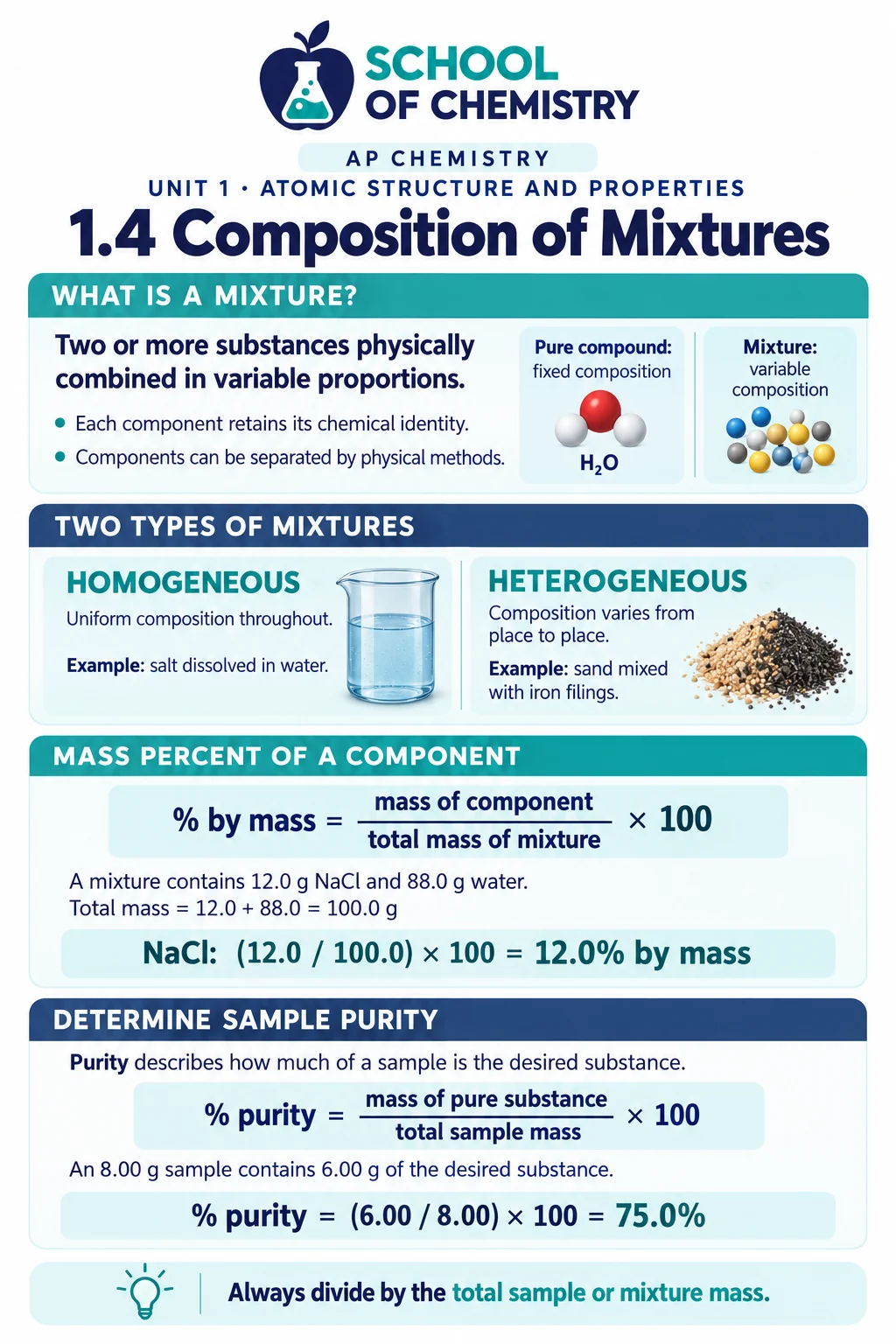
A mixture is two or more substances physically combined in variable proportions. Each component keeps its chemical identity, and the components can be separated by physical methods such as filtration, evaporation, distillation, or chromatography. Unlike a compound, a mixture has no fixed formula: salt water can be 2% or 20% salt.
A homogeneous mixture (a solution) is uniform throughout; salt dissolved in water, air, and brass look the same at every point. A heterogeneous mixture varies from place to place; sand mixed with iron filings or orange juice with pulp has visibly different regions.
The composition of a mixture is reported as mass percent of a component = (mass of component ÷ total mass of mixture) × 100. The denominator is the whole mixture, not the other component. Related is percent purity = (mass of the desired substance ÷ total sample mass) × 100; a sample of 8.00 g containing 6.00 g of the wanted compound is 75.0% pure. In lab problems, the pure mass is what you convert to moles; the impurity contributes mass but no moles of the substance.
Practice: try these five questions
Q16
Classify each as a homogeneous or heterogeneous mixture: (a) brass, (b) orange juice with pulp, (c) air, (d) granite, (e) sugar dissolved in water.
Answer
(a) Brass: homogeneous (a solid solution of copper and zinc). (b) Orange juice with pulp: heterogeneous (pulp settles and is visible). (c) Air: homogeneous (gases mix uniformly). (d) Granite: heterogeneous (visible grains of different minerals). (e) Sugar water: homogeneous (uniform solution).
Q17
A solution is prepared by dissolving 15.0 g of KCl in 185.0 g of water. What is the mass percent of KCl in the solution?
Answer
Total mass = 15.0 + 185.0 = 200.0 g.
% KCl = (15.0 ÷ 200.0) × 100 = 7.50%.
Dividing by 185.0 g (the water alone) would be wrong; the denominator is the whole solution.
Q18
A 25.0 g sample of copper ore is found to contain 4.75 g of copper. What is the mass percent of copper in the ore?
Answer
% Cu = (4.75 ÷ 25.0) × 100 = 19.0% copper by mass.
The remaining 81.0% (20.25 g) is rock and other minerals; because an ore is a mixture, another sample from the same mine could have a different percentage.
Q19
A 12.5 g sample of impure baking soda (NaHCO3) contains 11.2 g of NaHCO3. (a) What is the percent purity? (b) What mass of impurities is present?
Answer
(a) % purity = (11.2 ÷ 12.5) × 100 = 89.6%.
(b) Impurities = 12.5 − 11.2 = 1.3 g.
If the problem continued to moles, only the 11.2 g of pure NaHCO3 would be converted.
Q20
A 40.0 g mixture of sand and sodium chloride is 35.0% NaCl by mass. The mixture is stirred into water and filtered. (a) What mass of sand is collected on the filter paper? (b) What mass of NaCl is in the filtrate? (c) Why can this mixture be separated by filtration while NaCl itself cannot be separated into Na and Cl this way?
Answer
(a) Sand is 100.0 − 35.0 = 65.0% of the mixture: 0.650 × 40.0 g = 26.0 g of sand.
(b) NaCl: 0.350 × 40.0 g = 14.0 g, dissolved in the water that passes through the filter.
(c) Sand and salt are physically mixed and keep their identities, so a physical method (dissolving one, filtering the other) separates them. NaCl is a compound: sodium and chlorine are chemically bonded in a fixed ratio, and separating them requires a chemical change.
5. Atomic structure and electron configuration
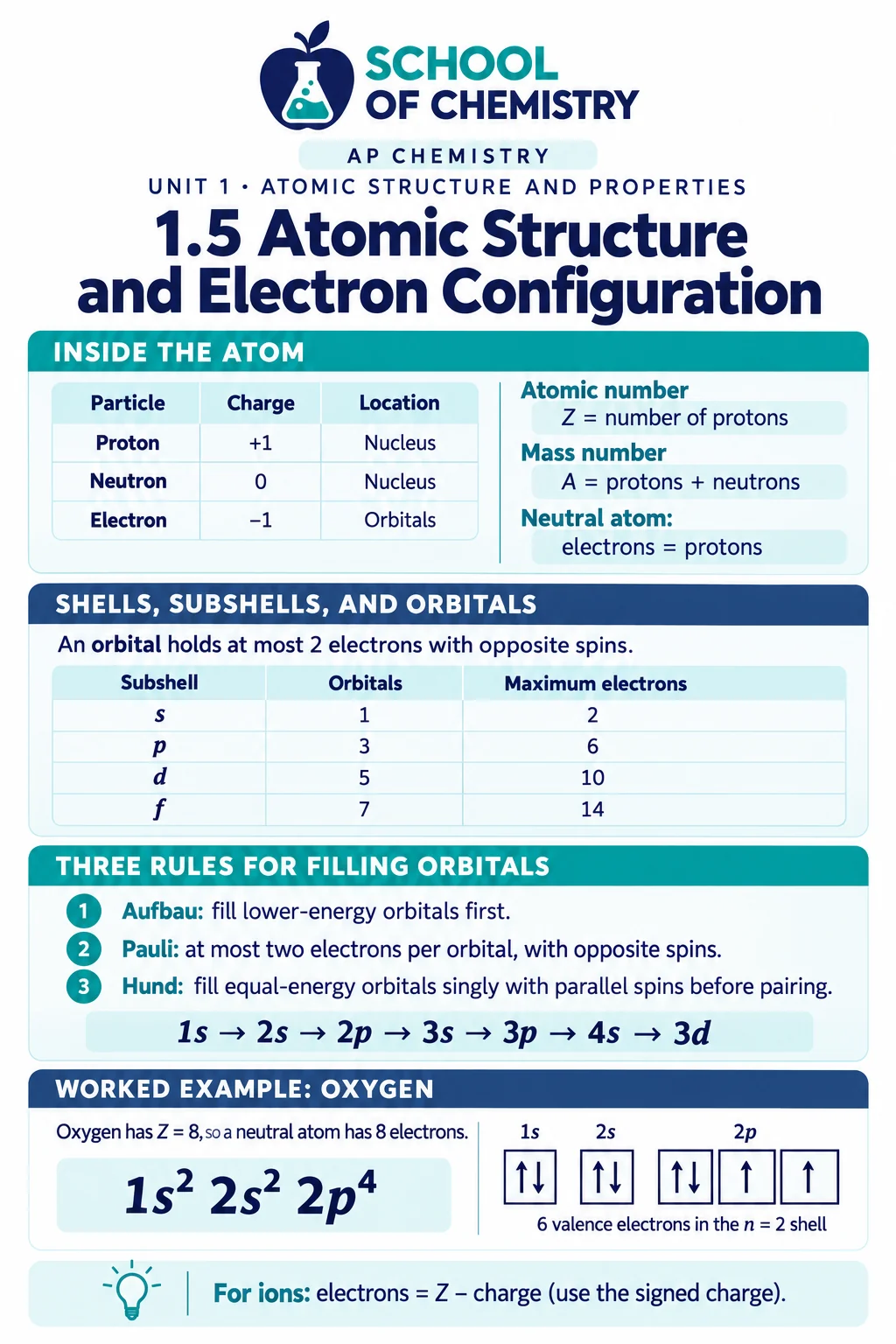
An atom has a tiny, dense nucleus of protons (+1) and neutrons (0) surrounded by electrons (−1) in orbitals. The atomic number Z is the number of protons and identifies the element. The mass number A is protons + neutrons, so neutrons = A − Z. A neutral atom has electrons = protons; an ion has electrons = Z − charge, using the signed charge (a 2− ion has two extra electrons).
Electrons occupy shells (n = 1, 2, 3, …), which contain subshells (s, p, d, f), which contain orbitals. Each orbital holds at most two electrons with opposite spins. An s subshell has 1 orbital (2 electrons), p has 3 (6), d has 5 (10), and f has 7 (14).
Three rules fill the orbitals. Aufbau: fill the lowest-energy subshell first, in the order 1s → 2s → 2p → 3s → 3p → 4s → 3d → 4p. Pauli exclusion: no more than two electrons per orbital, and they must have opposite spins. Hund's rule: within a subshell, place one electron in each orbital with parallel spins before pairing any. Oxygen (Z = 8) is 1s2 2s2 2p4: the 2p orbitals hold ↑↓ ↑ ↑, giving two unpaired electrons and six valence electrons in the n = 2 shell. The superscripts always add up to the number of electrons.
Practice: try these five questions
Q21
An atom has Z = 15 and A = 31. How many protons, neutrons, and electrons does the neutral atom have, and what element is it?
Answer
Protons = Z = 15. Neutrons = A − Z = 31 − 15 = 16. A neutral atom has electrons = protons = 15.
Element 15 is phosphorus, P. The isotope can be written 31P.
Q22
Write the full electron configuration of a sulfur atom (Z = 16). How many valence electrons does sulfur have?
Answer
Fill in Aufbau order: 1s2 2s2 2p6 3s2 3p4. Check: 2 + 2 + 6 + 2 + 4 = 16 electrons.
Valence electrons are in the outermost shell, n = 3: 3s2 3p4 gives 6 valence electrons, consistent with sulfur being in Group 16.
Q23
Write the electron configuration of (a) a calcium atom (Z = 20) and (b) a Ca2+ ion. Which noble gas has the same configuration as Ca2+?
Answer
(a) Ca: 1s2 2s2 2p6 3s2 3p6 4s2 (20 electrons). The 4s subshell fills before 3d.
(b) Ca2+ has lost 2 electrons, removed from the outermost 4s: 1s2 2s2 2p6 3s2 3p6 (18 electrons).
This is the configuration of argon, so Ca2+ is isoelectronic with Ar.
Q24
(a) How many electrons does a chloride ion, Cl−, have (Z = 17)? (b) Write its electron configuration. (c) How many orbitals are in the 3p subshell, and what is its maximum number of electrons?
Answer
(a) Electrons = Z − charge = 17 − (−1) = 18 electrons. A negative ion has gained electrons.
(b) 1s2 2s2 2p6 3s2 3p6, the same as argon.
(c) Any p subshell has 3 orbitals holding at most 6 electrons (2 per orbital).
Q25
A student draws the orbital diagram for nitrogen (Z = 7) as 1s ↑↓, 2s ↑↓, 2p ↑↓ ↑ __. (a) Which rule is violated? (b) Draw the correct 2p arrangement. (c) How many unpaired electrons does a nitrogen atom have?
Answer
(a) The diagram violates Hund's rule: electrons must occupy each equal-energy 2p orbital singly, with parallel spins, before any orbital gets a second electron. (The total of 7 electrons and the two-per-orbital limit are fine.)
(b) Correct 2p: ↑ ↑ ↑, one electron in each of the three orbitals, all spins parallel. Full configuration 1s2 2s2 2p3.
(c) 3 unpaired electrons, which is why nitrogen often forms three bonds.
6. Photoelectron spectroscopy
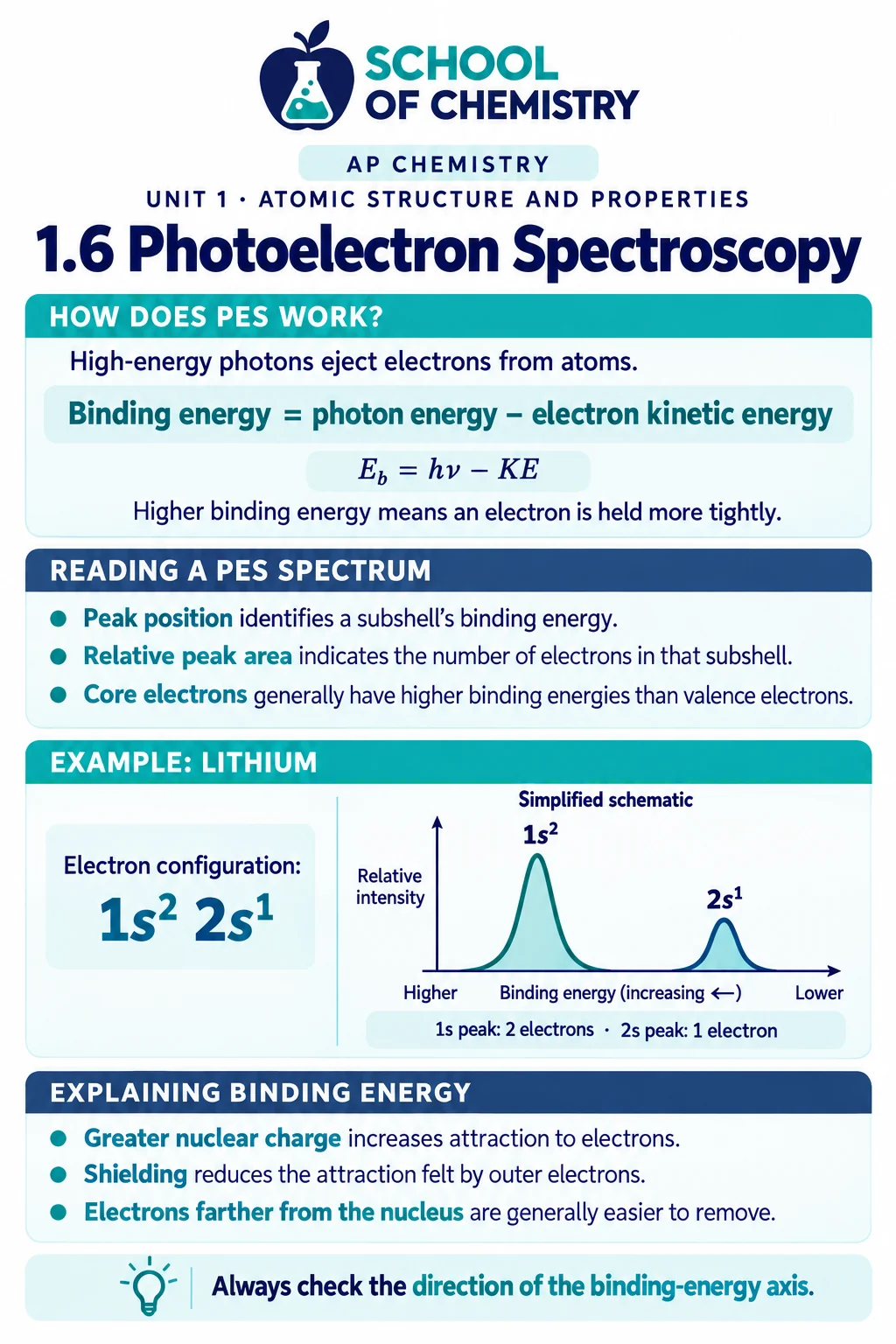
Photoelectron spectroscopy (PES) shines high-energy photons on a sample and measures the kinetic energy of the electrons ejected. Energy is conserved: binding energy = photon energy − kinetic energy, or Eb = hν − KE. An electron that leaves with little kinetic energy was held tightly and had a high binding energy.
A PES spectrum plots relative intensity against binding energy. Each peak is one subshell. The peak position tells you how tightly that subshell is bound, and the relative peak area (height, in simplified diagrams) tells you how many electrons it holds. Lithium, 1s2 2s1, shows a tall 1s peak at high binding energy and a half-as-tall 2s peak at low binding energy. Reading peak heights in order lets you write the electron configuration and identify the element.
Binding energies are explained with three ideas: nuclear charge (more protons pull every electron more strongly), shielding (inner electrons cancel part of the nuclear pull felt by outer electrons), and distance (electrons in higher shells are farther away and easier to remove). Core electrons therefore have much higher binding energies than valence electrons. Always check which direction the binding-energy axis increases; many spectra are drawn with the highest binding energy on the left.
Practice: try these five questions
Q26
A PES spectrum of an element shows five peaks. Listed from highest to lowest binding energy, their relative areas are 2, 2, 6, 2, 1. Write the electron configuration and identify the element.
Answer
Assign subshells in Aufbau order from the highest binding energy: 1s2, 2s2, 2p6, 3s2, 3p1.
Total electrons = 2 + 2 + 6 + 2 + 1 = 13, so the element is aluminum, Al, with configuration 1s2 2s2 2p6 3s2 3p1.
Q27
Neon has the configuration 1s2 2s2 2p6. (a) How many peaks appear in its PES spectrum? (b) What is the ratio of their areas? (c) Which peak appears at the highest binding energy, and why?
Answer
(a) Three peaks, one for each occupied subshell (1s, 2s, 2p).
(b) Areas are proportional to electron counts, 2 : 2 : 6, which simplifies to 1 : 1 : 3.
(c) The 1s peak is at the highest binding energy. Those electrons are closest to the nucleus and are not shielded by any inner electrons, so they feel the full attraction of the 10 protons.
Q28
Lithium (Z = 3) and beryllium (Z = 4) both have 1s2 core electrons. Which element's 1s peak appears at the higher binding energy? Explain using Coulomb's law.
Answer
Beryllium's 1s peak is at the higher binding energy.
Both 1s electrons sit at a similar distance from the nucleus with no inner electrons to shield them, so the main difference is nuclear charge: Be has 4 protons and Li has 3. A larger positive charge produces a stronger Coulombic attraction, so more energy is needed to remove a 1s electron from Be.
Q29
A photon with energy 1.50 × 10⁻¹⁷ J ejects an electron from an atom. The electron leaves with a kinetic energy of 1.08 × 10⁻¹⁷ J. What was the binding energy of the electron?
Answer
Eb = hν − KE = 1.50 × 10⁻¹⁷ J − 1.08 × 10⁻¹⁷ J = 0.42 × 10⁻¹⁷ J = 4.2 × 10⁻¹⁸ J.
Check: binding energy must be positive and smaller than the photon energy; otherwise the electron could not have escaped.
Q30
A PES spectrum has peaks (from highest to lowest binding energy) with relative areas 2, 2, 6, 1. (a) Identify the element. (b) Which peak has the lowest binding energy? (c) Explain why that peak's binding energy is far below the 2p peak even though the 2p and 3s electrons differ by only one shell.
Answer
(a) 1s2 2s2 2p6 3s1 has 11 electrons: sodium, Na.
(b) The 3s peak (area 1) has the lowest binding energy.
(c) The single 3s electron is in a new, more distant shell and is shielded by all ten inner electrons (1s, 2s, 2p), so it feels an effective nuclear charge of only about +1. The 2p electrons are closer and shielded only by the two 1s electrons. Greater distance plus much more shielding makes the 3s electron far easier to remove, which is why sodium readily forms Na+.
7. Periodic trends
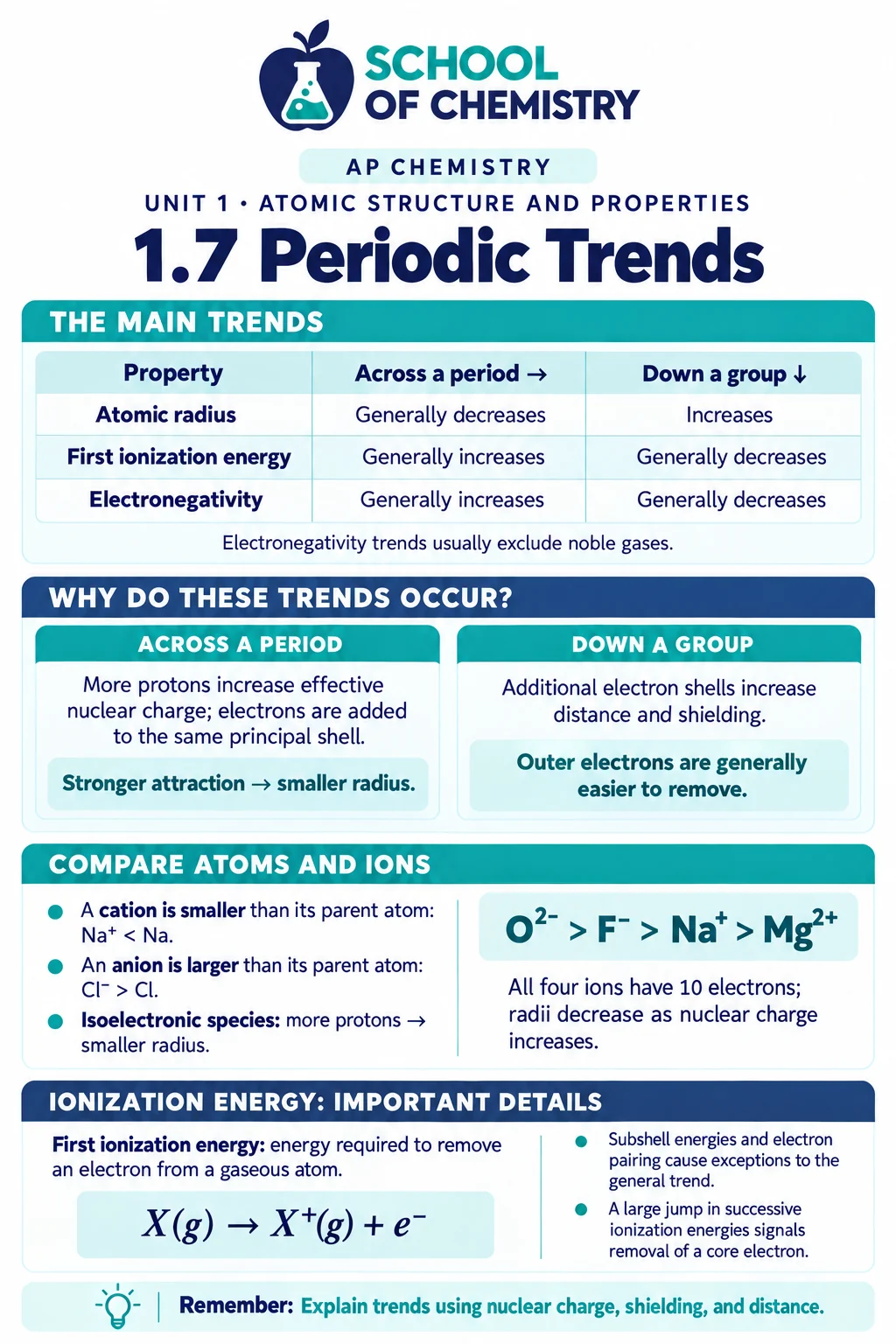
Three properties follow predictable patterns on the periodic table. Atomic radius generally decreases across a period and increases down a group. First ionization energy, the energy needed to remove one electron from a gaseous atom, X(g) → X+(g) + e−, generally increases across a period and decreases down a group. Electronegativity, an atom's pull on shared electrons, follows the same pattern as ionization energy; noble gases are usually excluded.
The explanations always come back to Coulomb's law. Across a period, protons are added while electrons enter the same principal shell, so the effective nuclear charge rises, the electron cloud is pulled in, and electrons are harder to remove. Down a group, each row adds a shell: outer electrons are farther away and shielded by more core electrons, so the atom is larger and its outer electron is easier to remove. On the AP exam, a full explanation names nuclear charge, shielding, or distance explicitly.
Ions follow the same logic. A cation is smaller than its parent atom (Na+ < Na) because it has lost its outer shell or has fewer electrons repelling each other. An anion is larger (Cl− > Cl) because added electrons increase repulsion. In an isoelectronic series (same electron count), the species with more protons is smaller: O2− > F− > Na+ > Mg2+, all with 10 electrons. Two details matter: subshell energies and electron pairing create small exceptions to the ionization trend, and a very large jump between successive ionization energies signals that the next electron must come from a core shell.
Practice: try these five questions
Q31
Rank Na, Mg, and Al from largest to smallest atomic radius and explain the order.
Answer
Na > Mg > Al.
All three are in Period 3, so their outer electrons are in the n = 3 shell with the same core (10 electrons) shielding them. Moving from Na (11 protons) to Al (13 protons) increases the effective nuclear charge, pulling the outer electrons closer and shrinking the radius.
Q32
(a) Which has the higher first ionization energy, K or Ca? (b) Which has the higher first ionization energy, K or Rb? Explain each choice.
Answer
(a) Ca. K and Ca are in the same period with outer electrons in 4s; Ca has one more proton and the same shielding, so its 4s electrons are held more tightly.
(b) K. K and Rb are in Group 1; Rb's outer electron is in n = 5, farther from the nucleus and shielded by an additional full shell, so it is easier to remove.
Q33
The ions S2−, Cl−, K+, and Ca2+ all have 18 electrons. Rank them from largest to smallest radius and justify your answer.
Answer
S2− > Cl− > K+ > Ca2+.
In an isoelectronic series the electron cloud is the same size in electron count, so the number of protons decides the radius: S has 16, Cl 17, K 19, Ca 20. More protons pull the same 18 electrons inward more strongly, so Ca2+ is the smallest.
Q34
An element has these successive ionization energies in kJ/mol: IE1 = 738, IE2 = 1451, IE3 = 7733, IE4 = 10,540. (a) In which group is the element? (b) Write the equation for its second ionization if the element is Mg.
Answer
(a) The energies rise moderately from IE1 to IE2, then jump by more than five times at IE3. The third electron comes from a core shell, so the element has 2 valence electrons and is in Group 2. (These are magnesium's values.)
(b) Mg+(g) → Mg2+(g) + e−. Note the gas-phase states and that the second ionization starts from the 1+ ion.
Q35
(a) Explain why chlorine is more electronegative than bromine. (b) Explain why fluorine is more electronegative than oxygen.
Answer
(a) Cl and Br are in Group 17. Bromine's valence electrons are in n = 4, one shell farther out and shielded by more core electrons, so bromine's nucleus attracts shared electrons less strongly. Chlorine, with its smaller radius, has the higher electronegativity.
(b) F and O are in Period 2 with valence electrons in the same n = 2 shell. Fluorine has 9 protons to oxygen's 8 with identical shielding, so its effective nuclear charge is larger and it pulls bonding electrons more strongly. Fluorine is the most electronegative element.
8. Valence electrons and ionic compounds
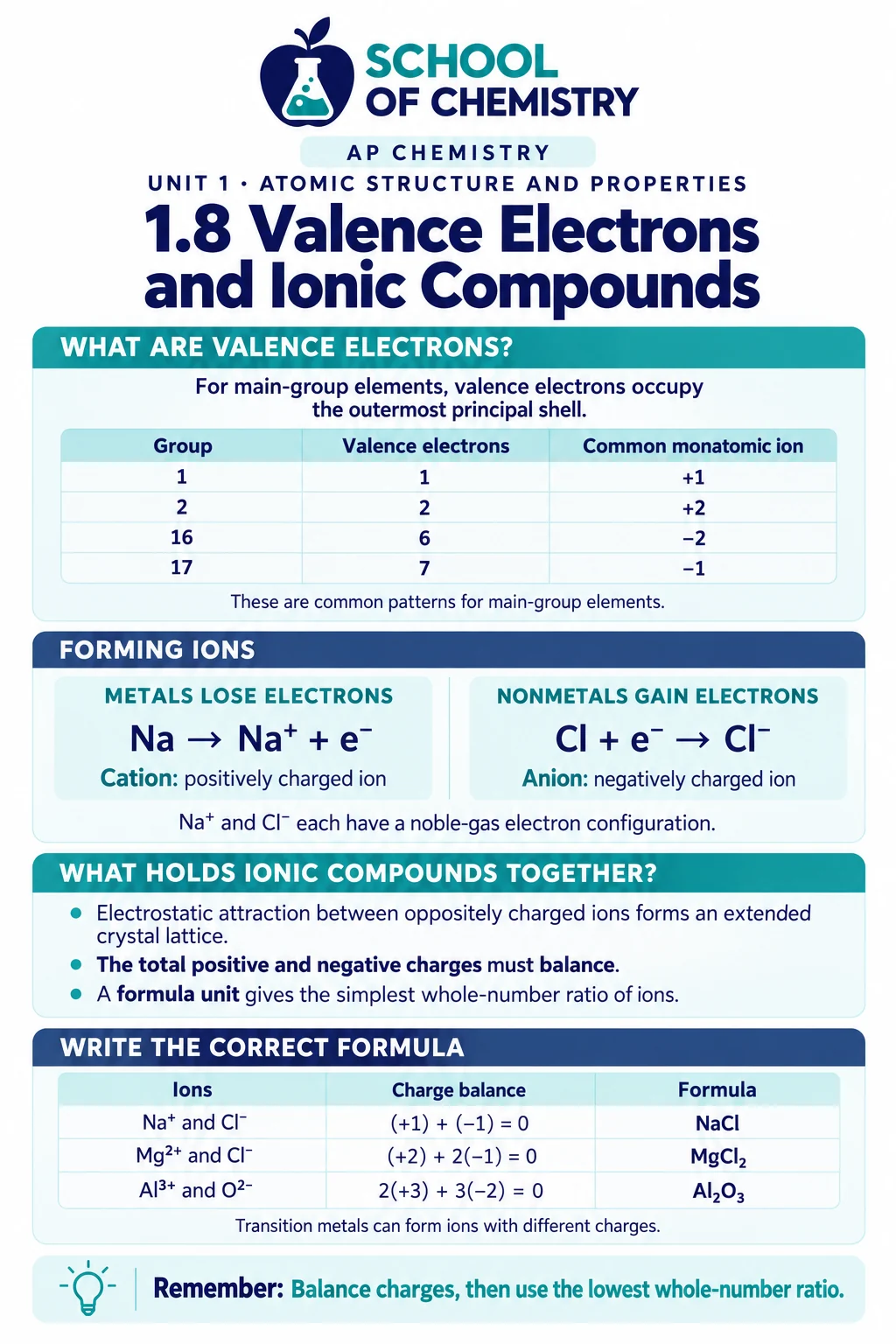
For main-group elements, valence electrons are the electrons in the outermost principal shell, and their count follows the group number: Group 1 has 1, Group 2 has 2, Group 16 has 6, and Group 17 has 7. Valence electrons determine the ion an element tends to form. Metals with few valence electrons lose them to form cations (Na → Na+ + e−); nonmetals with nearly full shells gain electrons to form anions (Cl + e− → Cl−). Both Na+ and Cl− end up with a noble-gas configuration.
An ionic compound is held together by the electrostatic attraction between oppositely charged ions, arranged in an extended three-dimensional crystal lattice. There are no separate molecules, so the formula is a formula unit: the simplest whole-number ratio of ions that makes the total charge zero.
To write a formula, balance the charges and then use the lowest whole-number ratio. Na+ and Cl− need one of each: NaCl. Mg2+ needs two Cl−: MgCl2. Al3+ and O2− balance with two Al and three O, 2(+3) + 3(−2) = 0: Al2O3. Transition metals can form ions with different charges, so their charge is given in the name with a Roman numeral, such as iron(III). Stronger attractions, from higher charges or smaller ions, give the lattice a higher melting point.
Practice: try these five questions
Q36
For each element, state the number of valence electrons and the charge of its common monatomic ion: (a) K, (b) Ba, (c) S, (d) Br.
Answer
(a) K, Group 1: 1 valence electron, forms K+. (b) Ba, Group 2: 2 valence electrons, forms Ba2+. (c) S, Group 16: 6 valence electrons, forms S2−. (d) Br, Group 17: 7 valence electrons, forms Br−.
Metals lose their valence electrons; nonmetals gain enough to reach eight.
Q37
Write the formula of the ionic compound formed by each pair of ions: (a) Ca2+ and Br−, (b) K+ and S2−, (c) Al3+ and S2−.
Answer
(a) One Ca2+ (+2) needs two Br− (2 × −1): CaBr2.
(b) Two K+ (2 × +1) balance one S2−: K2S.
(c) Two Al3+ (+6) balance three S2− (−6): Al2S3. Check: 2(+3) + 3(−2) = 0.
Q38
Magnesium reacts with oxygen to form an ionic compound. (a) Write the equation for the formation of each ion from its atom. (b) Give the formula of the compound. (c) Which noble gas do both ions resemble?
Answer
(a) Magnesium loses its two valence electrons: Mg → Mg2+ + 2e−. Oxygen gains two: O + 2e− → O2−.
(b) The charges are equal and opposite, so the ratio is 1 : 1: MgO.
(c) Mg2+ (1s2 2s2 2p6) and O2− (1s2 2s2 2p6) both have the configuration of neon.
Q39
Transition metals can form more than one ion. Write the formulas of (a) iron(III) oxide, (b) copper(II) chloride, and (c) iron(II) oxide.
Answer
(a) Fe3+ with O2−: 2(+3) + 3(−2) = 0 → Fe2O3.
(b) Cu2+ with Cl−: one copper needs two chlorides → CuCl2.
(c) Fe2+ with O2−: charges balance 1 : 1 → FeO.
The Roman numeral is the charge on the metal ion, which is why iron forms two different oxides.
Q40
Sodium chloride melts at 801 °C, while magnesium oxide melts at about 2852 °C. Both form crystal lattices. Use Coulomb's law to explain the difference.
Answer
The strength of the attraction between ions in a lattice depends on the product of the charges divided by the square of the distance between them.
In NaCl the ions are Na+ and Cl− (charges 1+ and 1−). In MgO the ions are Mg2+ and O2− (2+ and 2−), so the charge product is four times larger. Mg2+ and O2− are also smaller than Na+ and Cl−, which shortens the distance between the ion centers. Both factors make the electrostatic attraction in MgO much stronger, so far more thermal energy is needed to break the lattice apart.
Homework review: one question per topic
Eight review questions follow the order of the eight teaching images. Use them to confirm each skill before the longer problems.
R1
How many moles of aluminum atoms are in 5.40 g of aluminum (Al = 26.98 g/mol), and how many atoms is that?
Answer
n = 5.40 ÷ 26.98 = 0.2002 mol ≈ 0.200 mol Al.
N = 0.200 × 6.022 × 1023 = 1.20 × 10²³ Al atoms.
R2
Silver has two isotopes: 107Ag (51.8%) and 109Ag (48.2%). Using rounded isotope masses, estimate the average atomic mass of silver.
Answer
(107 × 0.518) + (109 × 0.482) = 55.43 + 52.54 = 108.0 u.
The periodic table gives 107.87 u; the small difference comes from using whole-number isotope masses. The average is just below 108 because 107Ag is slightly more abundant.
R3
What is the percent by mass of oxygen in calcium carbonate, CaCO3? (Ca = 40.08, C = 12.01, O = 16.00 g/mol)
Answer
Molar mass: 40.08 + 12.01 + 3(16.00) = 100.09 g/mol.
%O = (48.00 ÷ 100.09) × 100 = 47.96%.
R4
A solution is made by dissolving 2.50 g of salt in 47.5 g of water. What is the mass percent of salt?
Answer
Total mass = 2.50 + 47.5 = 50.0 g.
% salt = (2.50 ÷ 50.0) × 100 = 5.00%.
R5
Write the electron configuration of an aluminum atom (Z = 13) and of the Al3+ ion.
Answer
Al: 1s2 2s2 2p6 3s2 3p1 (13 electrons).
Al3+ loses the three n = 3 electrons (3s2 3p1): 1s2 2s2 2p6, the neon configuration with 10 electrons.
R6
In the PES spectrum of neon, why is the 2p peak three times the area of the 2s peak?
Answer
Peak area is proportional to the number of electrons in the subshell. Neon's 2p subshell holds 6 electrons and its 2s subshell holds 2; 6 ÷ 2 = 3, so the 2p peak has three times the area.
R7
Which is larger, a chlorine atom or a chloride ion, Cl−? Explain.
Answer
Cl− is larger. The ion has 18 electrons attracted by the same 17 protons as the atom. The extra electron increases electron–electron repulsion in the n = 3 shell, and each electron is held less tightly by the unchanged nuclear charge, so the electron cloud expands.
R8
Strontium (Group 2) and nitrogen (Group 15) form an ionic compound. Give the charge of each ion and the formula of the compound.
Answer
Strontium forms Sr2+ (loses 2 valence electrons); nitrogen forms N3− (gains 3 to reach 8).
Balance: 3(+2) + 2(−3) = 0, so the formula is Sr3N2.
Homework problems: AP-style practice
Twelve multi-part problems combine skills across the unit, in the style of AP Chemistry short free-response questions. Show your units and significant figures, and justify every trend with nuclear charge, shielding, or distance.
P1
A 4.90 g sample of sulfuric acid, H2SO4, is weighed out. (a) Calculate its molar mass (H = 1.008, S = 32.06, O = 16.00 g/mol). (b) How many moles of H2SO4 are present? (c) How many molecules? (d) How many hydrogen atoms?
Answer
(a) 2(1.008) + 32.06 + 4(16.00) = 2.016 + 32.06 + 64.00 = 98.08 g/mol.
(b) n = 4.90 ÷ 98.08 = 0.04996 ≈ 0.0500 mol.
(c) 0.0500 × 6.022 × 1023 = 3.01 × 10²² molecules.
(d) Two H atoms per molecule: 2 × 3.01 × 1022 = 6.02 × 10²² H atoms.
P2
A 1.500 g sample of a compound contains 0.600 g of carbon, 0.100 g of hydrogen, and 0.800 g of oxygen. (a) Find the empirical formula. (b) The molar mass is 60.05 g/mol. Find the molecular formula.
Answer
(a) Moles: C = 0.600 ÷ 12.01 = 0.0500 mol; H = 0.100 ÷ 1.008 = 0.0992 mol; O = 0.800 ÷ 16.00 = 0.0500 mol. Divide by 0.0500: C 1.00, H 1.98 ≈ 2, O 1.00. Empirical formula CH2O (mass 30.03 g/mol).
(b) Multiplier = 60.05 ÷ 30.03 = 2.00, so the molecular formula is C2H4O2 (acetic acid).
P3
A mass spectrum of a pure element shows peaks at m/z 28 (92.2%), 29 (4.7%), and 30 (3.1%). (a) How many naturally occurring isotopes does the element have? (b) Calculate the average atomic mass. (c) Identify the element and write the symbol of its most abundant isotope with its mass number.
Answer
(a) Three isotopes, one per peak.
(b) (28 × 0.922) + (29 × 0.047) + (30 × 0.031) = 25.82 + 1.36 + 0.93 = 28.11 u.
(c) The element with average atomic mass 28.09 u is silicon. Its most abundant isotope is 28Si, with 14 protons and 14 neutrons.
P4
A 50.0 g mixture of NaCl and KCl is 30.0% NaCl by mass. (a) Find the mass of each salt. (b) Calculate the moles of NaCl (58.44 g/mol) and of KCl (74.55 g/mol). (c) How many total moles of chloride ions are in the mixture?
Answer
(a) NaCl = 0.300 × 50.0 = 15.0 g; KCl = 50.0 − 15.0 = 35.0 g.
(b) NaCl: 15.0 ÷ 58.44 = 0.257 mol. KCl: 35.0 ÷ 74.55 = 0.469 mol.
(c) Each formula unit of either salt contains one Cl−, so total Cl− = 0.257 + 0.469 = 0.726 mol.
P5
A 20.0 g sample of limestone is 87.0% calcium carbonate, CaCO3, by mass; the rest is inert impurities. (a) What mass of CaCO3 is in the sample? (b) How many moles of CaCO3 is that (100.09 g/mol)? (c) Why would using 20.0 g in the mole calculation be a mistake?
Answer
(a) 0.870 × 20.0 g = 17.4 g CaCO3.
(b) 17.4 ÷ 100.09 = 0.174 mol CaCO3.
(c) The impurities add mass but are not CaCO3. Dividing 20.0 g by the molar mass of CaCO3 would count the impurities as if they were calcium carbonate, overstating the moles by about 15%.
P6
A PES spectrum has five peaks with relative areas 2, 2, 6, 2, 4, listed from highest to lowest binding energy. (a) Identify the element. (b) Which peak is at the lowest binding energy? (c) How would the spectrum of this element's 2− ion differ?
Answer
(a) 1s2 2s2 2p6 3s2 3p4 = 16 electrons: sulfur, S.
(b) The 3p peak (area 4). It is the outermost subshell, farthest from the nucleus and most shielded.
(c) S2− has gained two electrons, which enter the 3p subshell: the 3p peak's area grows from 4 to 6, so the spectrum ends 2, 2, 6, 2, 6 (the argon pattern). The extra repulsion also shifts the outer peaks to slightly lower binding energy.
P7
The ions N3−, O2−, F−, Na+, Mg2+, and Al3+ all have 10 electrons. (a) Rank them from largest to smallest radius. (b) Explain the ranking. (c) Which neutral atom is isoelectronic with all of them?
Answer
(a) N3− > O2− > F− > Na+ > Mg2+ > Al3+.
(b) All six have the same 1s2 2s2 2p6 electron cloud, so the only variable is nuclear charge: 7, 8, 9, 11, 12, and 13 protons respectively. More protons attract the same 10 electrons more strongly and pull the cloud inward, so the radius shrinks as Z increases.
(c) Neon (Z = 10).
P8
An element has successive ionization energies (kJ/mol) of 578, 1817, 2745, and 11,577. (a) How many valence electrons does it have, and which group is it in? (b) Explain the large jump between IE3 and IE4. (c) If the element is in Period 3, identify it and write the equation for its first ionization.
Answer
(a) The first three energies increase gradually, then IE4 is more than four times IE3. The element has 3 valence electrons and is in Group 13.
(b) After three electrons are removed, the next electron must come from the n = 2 core shell. Core electrons are closer to the nucleus, less shielded, and attracted by a now 3+ ion, so far more energy is required.
(c) The Period 3, Group 13 element is aluminum: Al(g) → Al+(g) + e−.
P9
Nitrogen (Z = 7) has a higher first ionization energy (1402 kJ/mol) than oxygen (Z = 8, 1314 kJ/mol), even though oxygen has more protons. (a) Write the valence configuration of each atom. (b) Explain this exception to the periodic trend.
Answer
(a) N: 2s2 2p3, with one electron in each 2p orbital (↑ ↑ ↑). O: 2s2 2p4, with one 2p orbital doubly occupied (↑↓ ↑ ↑).
(b) The electron removed from oxygen comes from the paired 2p orbital. The two electrons sharing that orbital repel each other, which raises the energy of that electron and makes it easier to remove than expected. Nitrogen's half-filled 2p subshell has no such pairing, so its electron is held more tightly. Electron–electron repulsion within the paired orbital outweighs oxygen's extra proton.
P10
Element X is in Group 2 and element Y is in Group 15. (a) Predict the charge on each ion and the formula of the compound they form. (b) If X is magnesium and Y is nitrogen, write the electron configuration of each ion. (c) Which ion is larger, and why?
Answer
(a) X forms X2+; Y forms Y3−. Balance 3(+2) + 2(−3) = 0: X3Y2.
(b) Mg2+: 1s2 2s2 2p6. N3−: 1s2 2s2 2p6. Both are isoelectronic with neon; the compound is Mg3N2.
(c) N3− is larger. Both ions hold 10 electrons, but nitrogen has only 7 protons compared with magnesium's 12, so N3−'s electrons are attracted far less strongly and its cloud extends farther.
P11
A compound of aluminum and oxygen is 52.9% Al and 47.1% O by mass. (a) Determine the empirical formula. (b) Calculate the molar mass of one formula unit. (c) How many moles of the compound are in a 25.5 g sample? (d) How many Al3+ ions does that sample contain?
Answer
(a) In 100 g: Al = 52.9 ÷ 26.98 = 1.961 mol; O = 47.1 ÷ 16.00 = 2.944 mol. Divide by 1.961: Al 1.00, O 1.50. Multiply by 2: Al2O3.
(b) 2(26.98) + 3(16.00) = 101.96 g/mol.
(c) 25.5 ÷ 101.96 = 0.250 mol Al2O3.
(d) Each formula unit has 2 Al3+: 2 × 0.250 = 0.500 mol of ions; 0.500 × 6.022 × 1023 = 3.01 × 10²³ Al3+ ions.
P12
Consider 0.500 mol of magnesium chloride. (a) Explain, using charge balance, why the formula is MgCl2 and not MgCl. (b) Calculate the mass of the sample (Mg = 24.31, Cl = 35.45 g/mol). (c) How many chloride ions does it contain? (d) Write the electron configuration of Mg2+, and state which ion in the compound is larger.
Answer
(a) Magnesium (Group 2) loses two electrons to form Mg2+; chlorine (Group 17) gains one to form Cl−. A neutral formula unit needs (+2) + 2(−1) = 0, so two chlorides are required: MgCl2. MgCl would carry a net +1 charge.
(b) Molar mass = 24.31 + 2(35.45) = 95.21 g/mol. Mass = 0.500 × 95.21 = 47.6 g.
(c) Each formula unit has 2 Cl−: 2 × 0.500 = 1.00 mol = 6.02 × 10²³ Cl− ions.
(d) Mg2+: 1s2 2s2 2p6 (neon configuration). Cl− is larger: it has 18 electrons in three shells held by 17 protons, while Mg2+ has only 10 electrons in two shells pulled by 12 protons.
Quick questions and answers
What does AP Chemistry Unit 1 cover?
Unit 1, Atomic Structure and Properties, covers moles and molar mass, mass spectra of elements, elemental composition of pure substances, composition of mixtures, atomic structure and electron configuration, photoelectron spectroscopy, periodic trends, and valence electrons and ionic compounds. It is worth about 7–9% of the multiple-choice section of the AP Chemistry exam.
How do I convert grams to moles to particles?
Divide the mass in grams by the molar mass in g/mol to get moles (n = m / M), then multiply moles by Avogadro's number, 6.022 × 10²³, to get the number of particles (N = n × N_A). Work in the reverse order to go from particles back to grams.
How do you read a mass spectrum of an element?
Each peak is one isotope. The horizontal position (m/z) is approximately the isotope mass, and the peak height is its relative abundance. Multiply each mass by its fractional abundance and add the products to find the average atomic mass, then match it to the periodic table to identify the element.
What is the difference between an empirical and a molecular formula?
An empirical formula gives the simplest whole-number ratio of atoms, such as CH₂O. A molecular formula gives the actual number of atoms in one molecule, such as C₆H₁₂O₆. The molecular formula is a whole-number multiple of the empirical formula, found by dividing the molar mass by the empirical formula mass.
What do the peaks in a photoelectron spectrum tell you?
Each peak is one subshell. Its position shows the binding energy of those electrons, and its relative area shows how many electrons are in the subshell. Reading the areas from the highest to the lowest binding energy gives the electron configuration and identifies the element.
How should I explain periodic trends on the AP exam?
Use Coulomb's law language: nuclear charge, shielding, and distance. Across a period, more protons with the same shielding increase the effective nuclear charge, shrinking the radius and raising ionization energy and electronegativity. Down a group, added shells increase distance and shielding, so atoms are larger and electrons are easier to remove.
How do I write the formula of an ionic compound?
Find the charge of each ion from its group, then choose the smallest whole numbers of each ion that make the total charge zero. For example, Al³⁺ and O²⁻ combine as Al₂O₃ because 2(+3) + 3(−2) = 0. For transition metals, the Roman numeral in the name gives the charge.
Who is this lesson for, and what is included?
It is written for high school chemistry students and AP Chemistry test takers in grades 10–12, and for parents comparing study resources. The lesson includes eight illustrated topic guides, 40 practice questions, eight homework review questions, and twelve multi-part homework problems. All 60 questions have hidden worked answers behind blue Answer controls.