Algebra 2 · Class 11 · Grades 7–10
Algebra 2 Class 11: Factoring Polynomials and the Remainder and Factor Theorems
Factoring rewrites a polynomial as a product that reveals its structure and zeros. The Remainder Theorem gives the remainder by substitution; the Factor Theorem identifies a factor when that remainder is zero.
Study the twelve images in order, with theory and five original practice questions after each image. Then complete twelve homework review questions and eight word problems: 20 homework questions and 80 questions altogether. The exercises use different examples from the images, with compact blue Answer controls for worked solutions.
For in-person Algebra 2 at SOMATH, book an evaluation or view the current schedule. This lesson prepares you for Class 12: polynomial zeros and end behavior and Class 13: rational expressions. Read the notes, attempt each question, then reveal its answer.
In this class: topics and homework
- What factoring polynomials means
- Greatest common factor
- Factoring trinomials
- Difference of squares
- Perfect-square trinomials
- Factoring by grouping
- Finding zeros from factors
- The Remainder Theorem
- The Factor Theorem
- Choosing the correct substitution sign
- Using a verified factor to finish a polynomial
- Connecting expressions, factors, zeros, and graphs
- Homework review
- Homework word problems
- Quick questions and answers
Download the student workbook (PDF)30 pages · Cover, twelve images with five practice questions each, twelve homework review questions, and eight homework word problems.Blank answer space throughout. Exercise answers are not included.
What factoring polynomials means
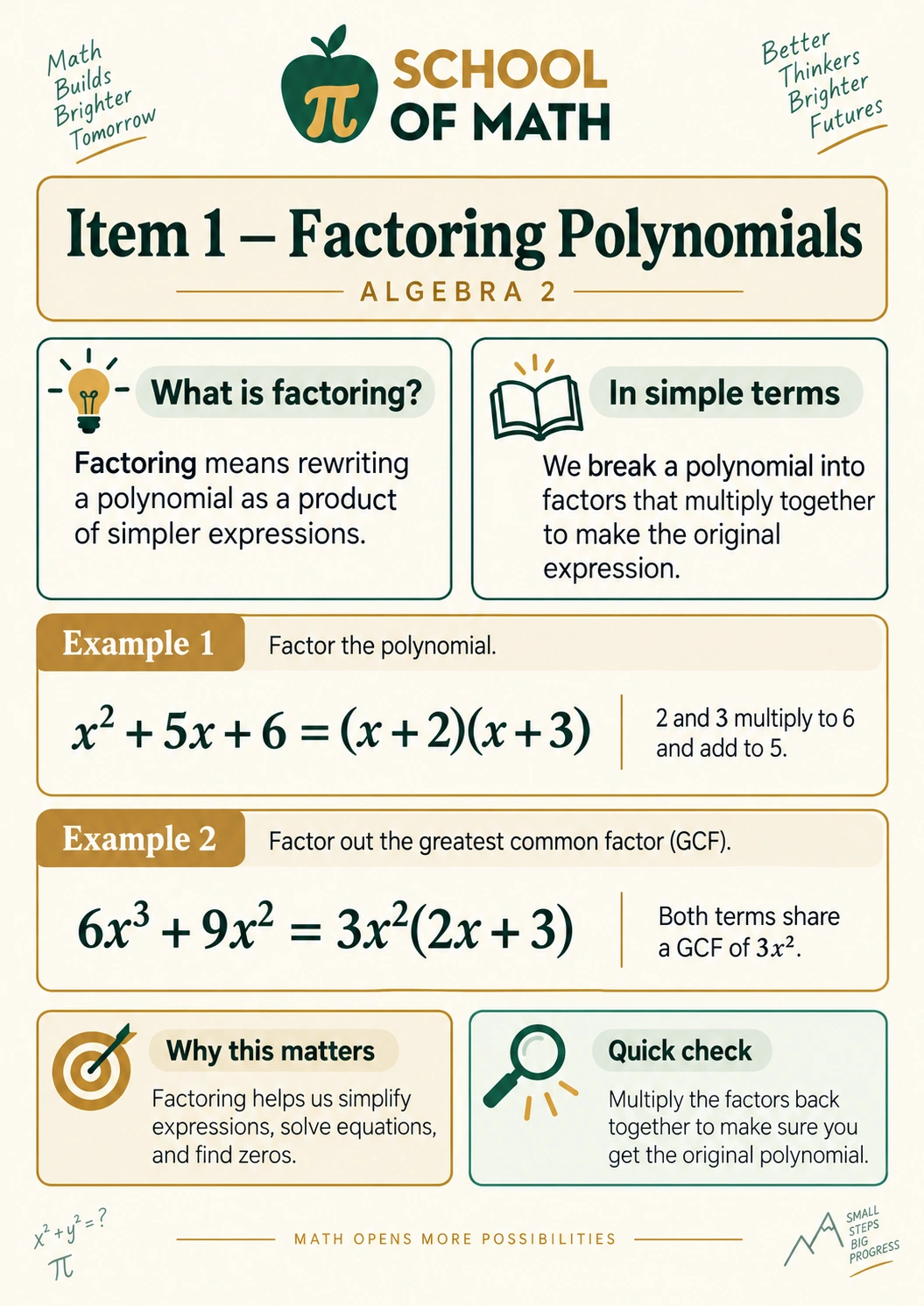
Factoring rewrites a sum or difference as a product with exactly the same value. Expanding and factoring are opposite directions: distribution opens a product, while factoring exposes the pieces being multiplied.
An expression and an equation are different. Factoring an expression does not mean setting its factors equal to zero. You may use the zero-product property only after an equation has been written with zero on one side.
Begin by checking for a greatest common factor. Then choose a pattern that fits the remaining terms. Finish by multiplying back: a convincing-looking factorization is not enough unless it expands to the original expression.
Practice: five questions, increasing difficulty
Q1
Factor completely over the integers: \(5 x + 35\).
Answer
\(5 \left(x + 7\right)\)
- Both terms are divisible by 5; divide each term by 5.
- The complete factorization is \(5 \left(x + 7\right)\).
- Expand the factors to check that they reproduce \(5 x + 35\).
Q2
Factor completely over the integers: \(x^{2} + 11 x + 28\).
Answer
\(\left(x + 4\right) \left(x + 7\right)\)
- For a monic trinomial, find numbers with product 28 and sum 11: 4 and 7.
- The complete factorization is \(\left(x + 4\right) \left(x + 7\right)\).
- Expand the factors to check that they reproduce \(x^{2} + 11 x + 28\).
Q3
Does \((x+2)(x+7)\) equal \(x^2+9x+12\)? Expand and, if needed, correct the constant term.
Answer
No. The correct expansion is \(x^2+9x+14\).
- Distribute to get \(x^2+7x+2x+14\).
- Combine the middle terms. The constant is \(2\cdot7=14\), not 12.
Q4
Factor completely over the integers: \(3 x^{2} - 27\).
Answer
\(3 \left(x - 3\right) \left(x + 3\right)\)
- First remove the GCF 3; then factor the difference of squares.
- The complete factorization is \(3 \left(x - 3\right) \left(x + 3\right)\).
- Expand the factors to check that they reproduce \(3 x^{2} - 27\).
Q5
Factor completely over the integers: \(2 x^{3} + 14 x^{2} + 24 x\).
Answer
\(2 x \left(x + 3\right) \left(x + 4\right)\)
- Remove 2x first, then factor the remaining monic quadratic.
- The remaining quadratic is \(x^2+7x+12\); the pair 3 and 4 has the needed sum and product.
- The complete factorization is \(2 x \left(x + 3\right) \left(x + 4\right)\).
- Expand the factors to check that they reproduce \(2 x^{3} + 14 x^{2} + 24 x\).
Greatest common factor
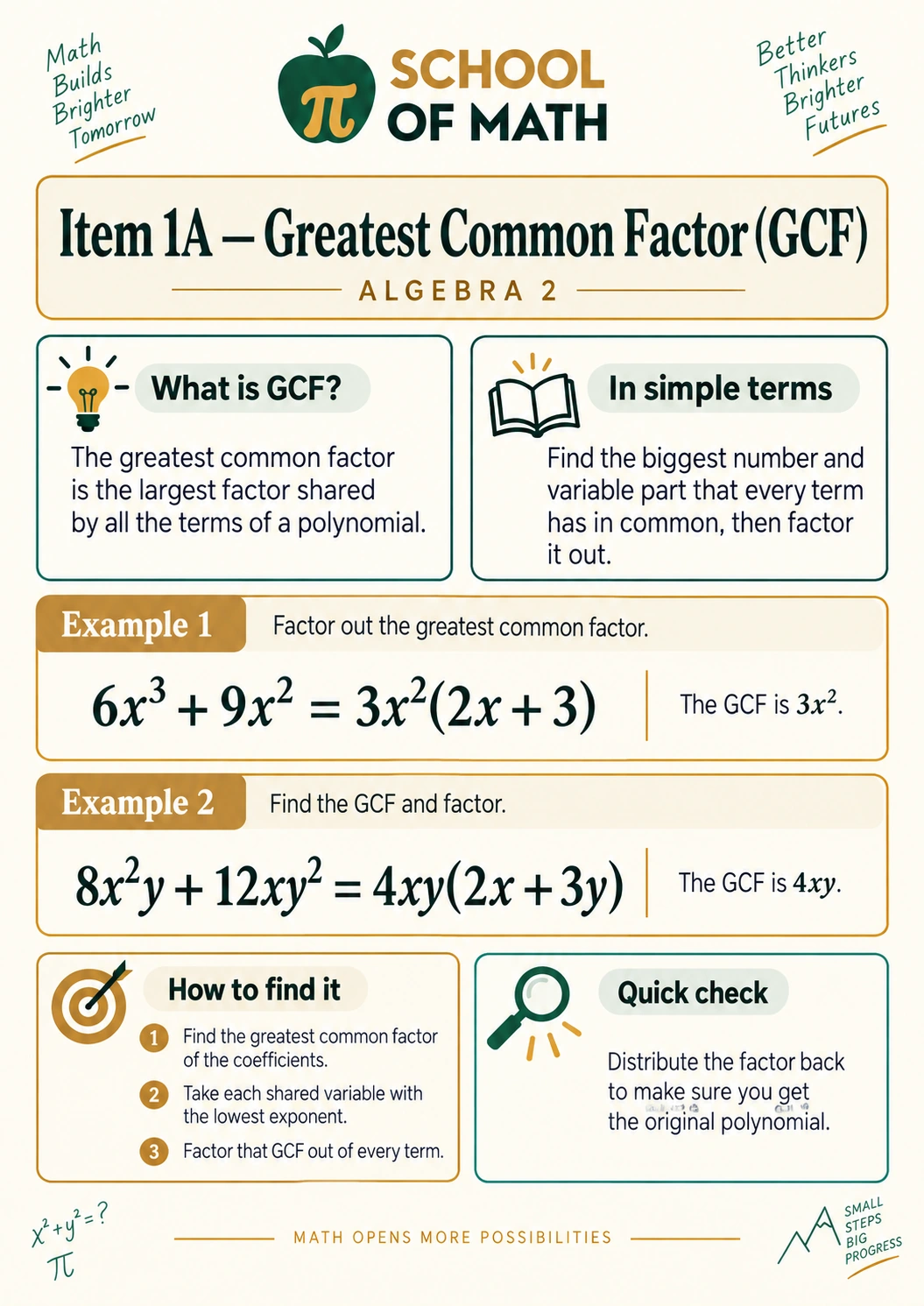
The GCF uses the greatest positive common divisor of the coefficients and the lowest exponent of each variable present in every term. If a variable is missing from one term, it is not part of the GCF.
Divide every term by the GCF to obtain the expression inside parentheses. A term equal to the GCF leaves 1 inside, not an empty space. Removing a negative common factor can also make the remaining leading coefficient positive.
Factoring out the GCF may only be the first step. Inspect the parentheses for another pattern, and keep the extracted factor attached to the final answer.
Practice: five questions, increasing difficulty
Q6
Factor completely over the integers: \(14 x + 42\).
Answer
\(14 \left(x + 3\right)\)
- The greatest common factor of the coefficients is 14.
- The complete factorization is \(14 \left(x + 3\right)\).
- Expand the factors to check that they reproduce \(14 x + 42\).
Q7
Factor completely over the integers: \(20 x^{3} - 30 x^{2}\).
Answer
\(10 x^{2} \left(2 x - 3\right)\)
- The coefficient GCF is 10 and the smallest shared power is x squared.
- The complete factorization is \(10 x^{2} \left(2 x - 3\right)\).
- Expand the factors to check that they reproduce \(20 x^{3} - 30 x^{2}\).
Q8
Factor completely over the integers: \(18 x^{2} y + 24 x y^{2}\).
Answer
\(6 x y \left(3 x + 4 y\right)\)
- Use coefficient GCF 6 and one copy of each shared variable.
- The complete factorization is \(6 x y \left(3 x + 4 y\right)\).
- Expand the factors to check that they reproduce \(18 x^{2} y + 24 x y^{2}\).
Q9
Factor completely over the integers: \(- 12 x^{3} + 20 x^{2} - 8 x\).
Answer
\(- 4 x \left(x - 1\right) \left(3 x - 2\right)\)
- Remove -4x so the remaining quadratic has a positive leading coefficient.
- The remaining factor is \(3x^2-5x+2=(3x-2)(x-1)\).
- The complete factorization is \(- 4 x \left(x - 1\right) \left(3 x - 2\right)\).
- Expand the factors to check that they reproduce \(- 12 x^{3} + 20 x^{2} - 8 x\).
Q10
Factor completely over the integers: \(15 x^{4} y^{2} - 25 x^{3} y^{3} + 10 x^{2} y^{4}\).
Answer
\(5 x^{2} y^{2} \left(x - y\right) \left(3 x - 2 y\right)\)
- Take out 5x squared y squared, then factor the remaining quadratic in x and y.
- The remaining expression is \(3x^2-5xy+2y^2=(3x-2y)(x-y)\).
- The complete factorization is \(5 x^{2} y^{2} \left(x - y\right) \left(3 x - 2 y\right)\).
- Expand the factors to check that they reproduce \(15 x^{4} y^{2} - 25 x^{3} y^{3} + 10 x^{2} y^{4}\).
Factoring trinomials
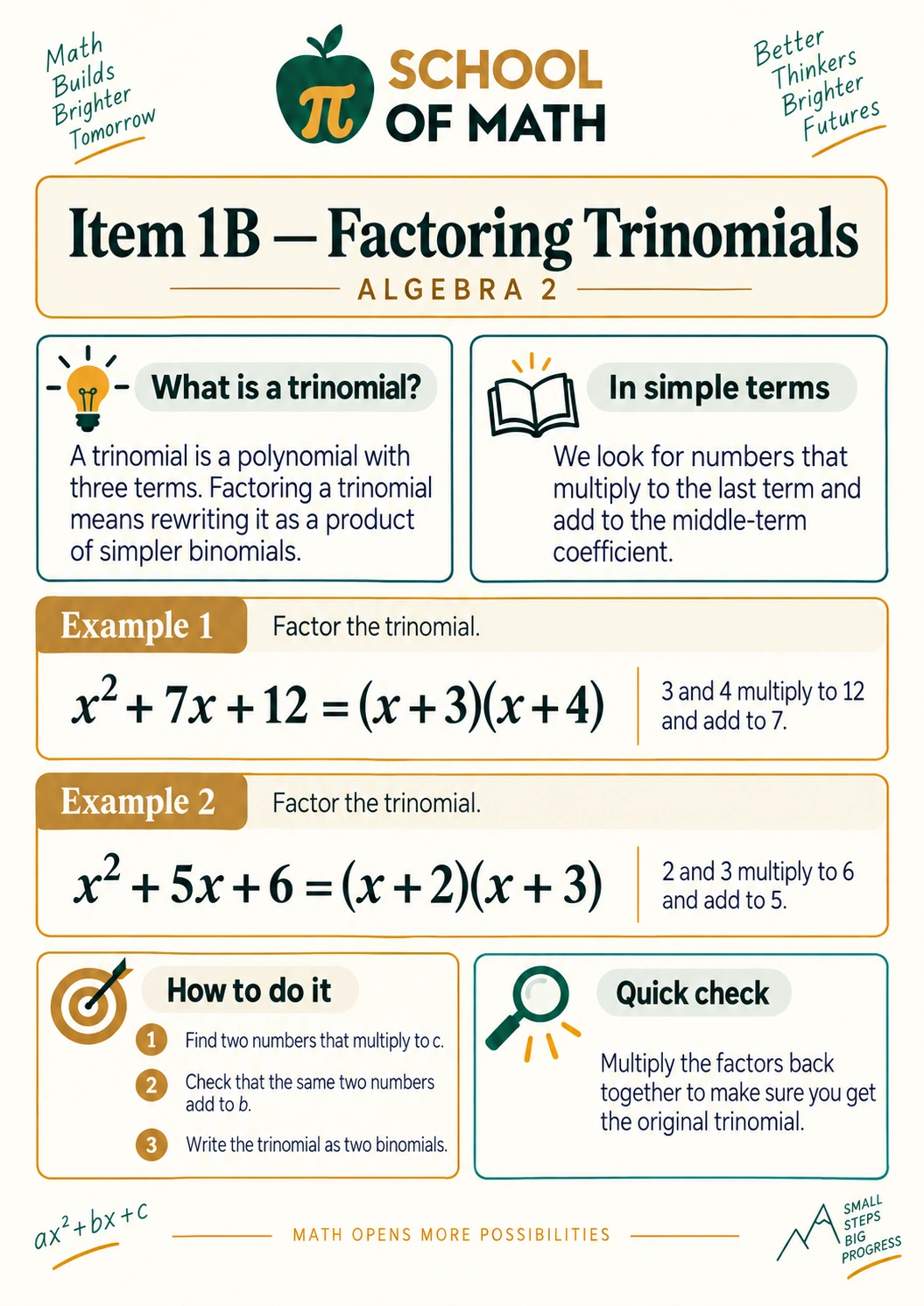
For a monic trinomial \(x^2+bx+c\), look for integers \(u,v\) satisfying \(u+v=b\) and \(uv=c\). Then the factors are \((x+u)(x+v)\). A positive product gives matching signs; a negative product gives opposite signs.
The simple sum-and-product rule printed in the image applies directly when the leading coefficient is 1. For \(ax^2+bx+c\) with \(a\ne1\), use the product \(ac\): split the middle term into two terms whose coefficients add to \(b\) and multiply to \(ac\), then group.
Not every trinomial factors into integer binomials. If no integer pair works, say it is irreducible over the integers rather than inventing factors. Always check for a GCF before applying a trinomial method.
Practice: five questions, increasing difficulty
Q11
Factor completely over the integers: \(x^{2} + 9 x + 18\).
Answer
\(\left(x + 3\right) \left(x + 6\right)\)
- Use the pair 3 and 6: their sum is 9 and their product is 18.
- The complete factorization is \(\left(x + 3\right) \left(x + 6\right)\).
- Expand the factors to check that they reproduce \(x^{2} + 9 x + 18\).
Q12
Factor completely over the integers: \(x^{2} - 11 x + 24\).
Answer
\(\left(x - 8\right) \left(x - 3\right)\)
- Use -3 and -8: their sum is -11 and their product is 24.
- The complete factorization is \(\left(x - 8\right) \left(x - 3\right)\).
- Expand the factors to check that they reproduce \(x^{2} - 11 x + 24\).
Q13
Factor completely over the integers: \(x^{2} + 2 x - 35\).
Answer
\(\left(x - 5\right) \left(x + 7\right)\)
- A negative constant needs opposite signs; 7 and -5 give the required sum.
- The complete factorization is \(\left(x - 5\right) \left(x + 7\right)\).
- Expand the factors to check that they reproduce \(x^{2} + 2 x - 35\).
Q14
Factor completely over the integers: \(2 x^{2} + 9 x + 10\).
Answer
\(\left(x + 2\right) \left(2 x + 5\right)\)
- Use ac = 20 and split 9x into 4x + 5x.
- Group \(2x^2+4x+5x+10=2x(x+2)+5(x+2)\).
- The complete factorization is \(\left(x + 2\right) \left(2 x + 5\right)\).
- Expand the factors to check that they reproduce \(2 x^{2} + 9 x + 10\).
Q15
Factor completely over the integers: \(6 x^{2} - x - 12\).
Answer
\(\left(2 x - 3\right) \left(3 x + 4\right)\)
- Use ac = -72 and split -x into 8x - 9x.
- Group \(6x^2+8x-9x-12=2x(3x+4)-3(3x+4)\).
- The complete factorization is \(\left(2 x - 3\right) \left(3 x + 4\right)\).
- Expand the factors to check that they reproduce \(6 x^{2} - x - 12\).
Difference of squares
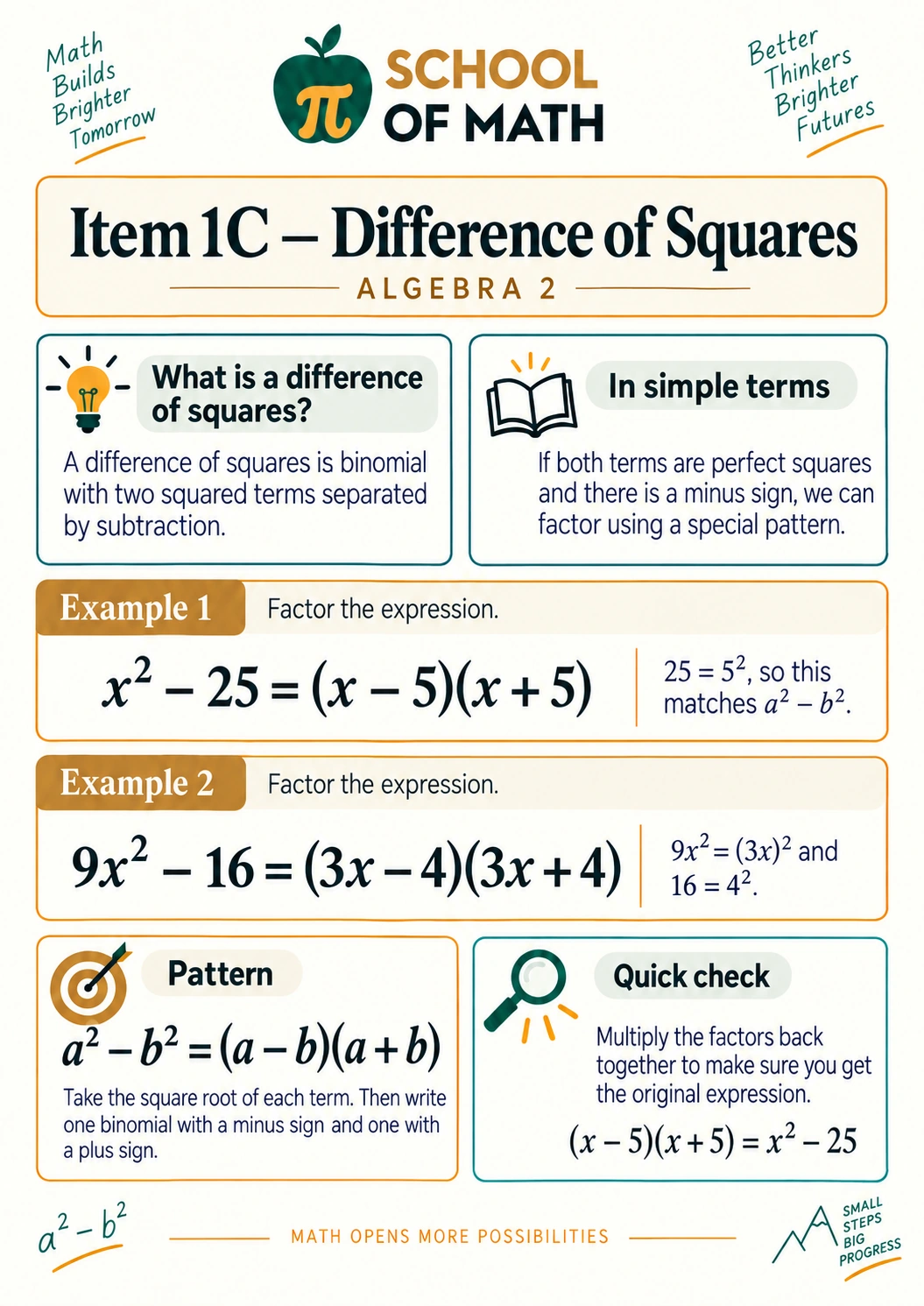
The identity \(A^2-B^2=(A-B)(A+B)\) works because the two middle terms cancel when the factors are expanded. Check for exactly two squared terms separated by subtraction after removing any GCF.
The square roots may be monomials rather than single variables. Take the square root of the coefficient and halve the even exponent of each variable.
A factor can itself be another difference of squares, so inspect your answer again. Do not apply this pattern to a sum of squares over the real numbers. In this class, factor over the integers unless a question asks otherwise.
Practice: five questions, increasing difficulty
Q16
Factor completely over the integers: \(x^{2} - 49\).
Answer
\(\left(x - 7\right) \left(x + 7\right)\)
- Recognize the squares of x and 7.
- The complete factorization is \(\left(x - 7\right) \left(x + 7\right)\).
- Expand the factors to check that they reproduce \(x^{2} - 49\).
Q17
Factor completely over the integers: \(16 x^{2} - 81\).
Answer
\(\left(4 x - 9\right) \left(4 x + 9\right)\)
- The square roots are 4x and 9.
- The complete factorization is \(\left(4 x - 9\right) \left(4 x + 9\right)\).
- Expand the factors to check that they reproduce \(16 x^{2} - 81\).
Q18
Factor completely over the integers: \(25 x^{2} - 36 y^{2}\).
Answer
\(\left(5 x - 6 y\right) \left(5 x + 6 y\right)\)
- The square roots are 5x and 6y.
- The complete factorization is \(\left(5 x - 6 y\right) \left(5 x + 6 y\right)\).
- Expand the factors to check that they reproduce \(25 x^{2} - 36 y^{2}\).
Q19
Factor completely over the integers: \(3 x^{2} - 147\).
Answer
\(3 \left(x - 7\right) \left(x + 7\right)\)
- First remove the GCF 3, then factor x squared minus 49.
- The complete factorization is \(3 \left(x - 7\right) \left(x + 7\right)\).
- Expand the factors to check that they reproduce \(3 x^{2} - 147\).
Q20
Factor completely over the integers: \(x^{4} - 256\).
Answer
\(\left(x - 4\right) \left(x + 4\right) \left(x^{2} + 16\right)\)
- Start with the squares of x squared and 16.
- \(x^4-256=(x^2-16)(x^2+16)\). Factor \(x^2-16\) again; \(x^2+16\) is irreducible over the integers.
- The complete factorization is \(\left(x - 4\right) \left(x + 4\right) \left(x^{2} + 16\right)\).
- Expand the factors to check that they reproduce \(x^{4} - 256\).
Perfect-square trinomials
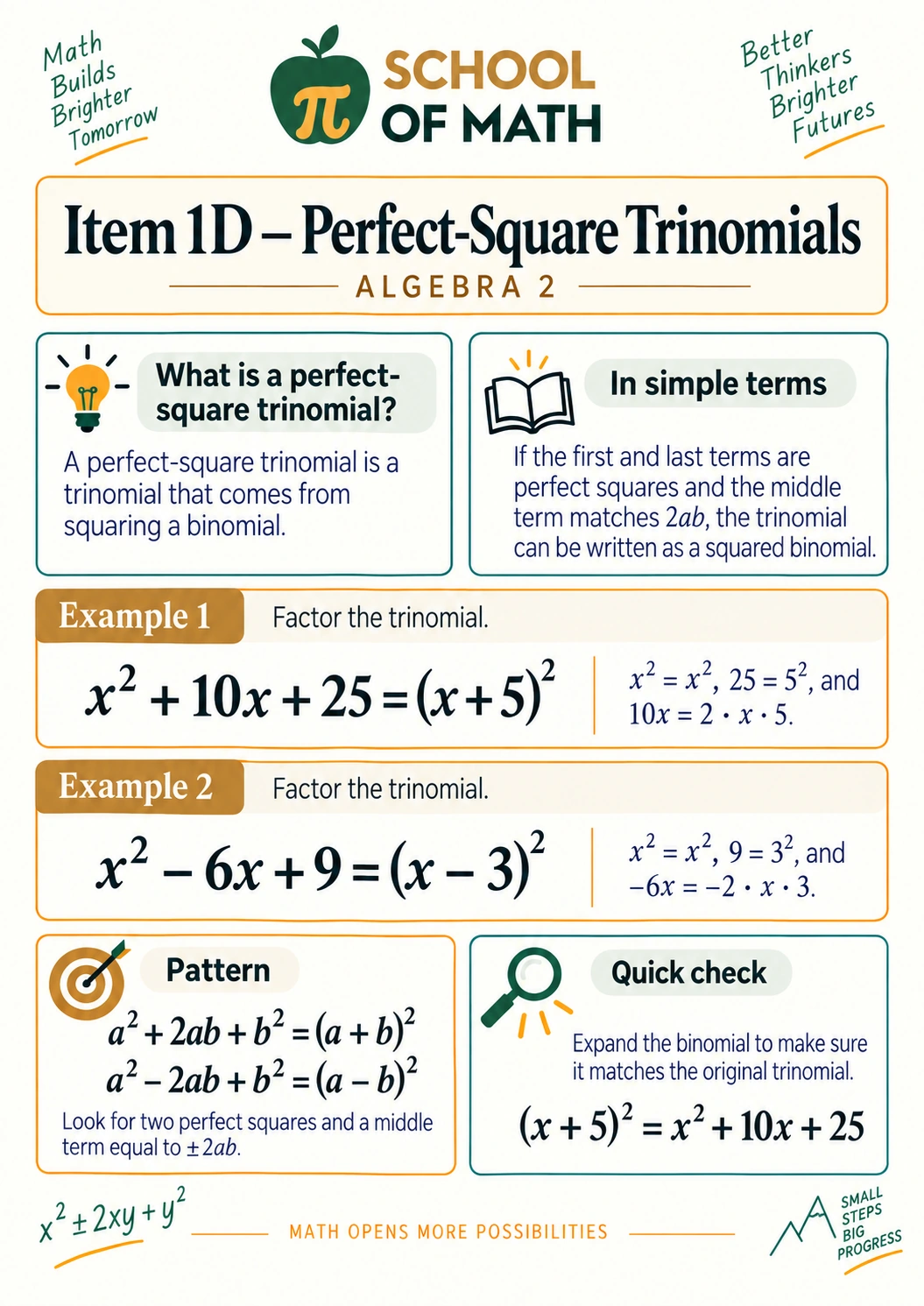
The patterns are \(A^2+2AB+B^2=(A+B)^2\) and \(A^2-2AB+B^2=(A-B)^2\). The first and last terms being squares is necessary but not sufficient: the middle term must be exactly twice their square-root product.
The sign of the middle term determines the sign inside the repeated binomial. The constant term in either perfect-square pattern is positive because it comes from squaring the second term.
Check for an outside GCF and for variables inside both square terms. When asked for an unknown coefficient, identify the two square roots first, then calculate the required middle term.
Practice: five questions, increasing difficulty
Q21
Factor completely over the integers: \(x^{2} + 14 x + 49\).
Answer
\(\left(x + 7\right)^{2}\)
- The square roots are x and 7; twice their product is 14x.
- The complete factorization is \(\left(x + 7\right)^{2}\).
- Expand the factors to check that they reproduce \(x^{2} + 14 x + 49\).
Q22
Factor completely over the integers: \(x^{2} - 16 x + 64\).
Answer
\(\left(x - 8\right)^{2}\)
- The square roots are x and 8; the middle term is negative twice their product.
- The complete factorization is \(\left(x - 8\right)^{2}\).
- Expand the factors to check that they reproduce \(x^{2} - 16 x + 64\).
Q23
Factor completely over the integers: \(9 x^{2} + 24 x + 16\).
Answer
\(\left(3 x + 4\right)^{2}\)
- The square roots are 3x and 4; twice their product is 24x.
- The complete factorization is \(\left(3 x + 4\right)^{2}\).
- Expand the factors to check that they reproduce \(9 x^{2} + 24 x + 16\).
Q24
Factor completely over the integers: \(12 x^{2} - 60 x + 75\).
Answer
\(3 \left(2 x - 5\right)^{2}\)
- First remove 3, leaving 4x squared minus 20x plus 25.
- The complete factorization is \(3 \left(2 x - 5\right)^{2}\).
- Expand the factors to check that they reproduce \(12 x^{2} - 60 x + 75\).
Q25
Find both values of \(k\) for which \(16x^2+kx+81\) is a perfect-square trinomial, and factor each version.
Answer
\(k=72\) gives \((4x+9)^2\); \(k=-72\) gives \((4x-9)^2\).
- The square roots of the first and last terms are \(4x\) and \(9\).
- The middle term must be \(\pm2(4x)(9)=\pm72x\).
Factoring by grouping
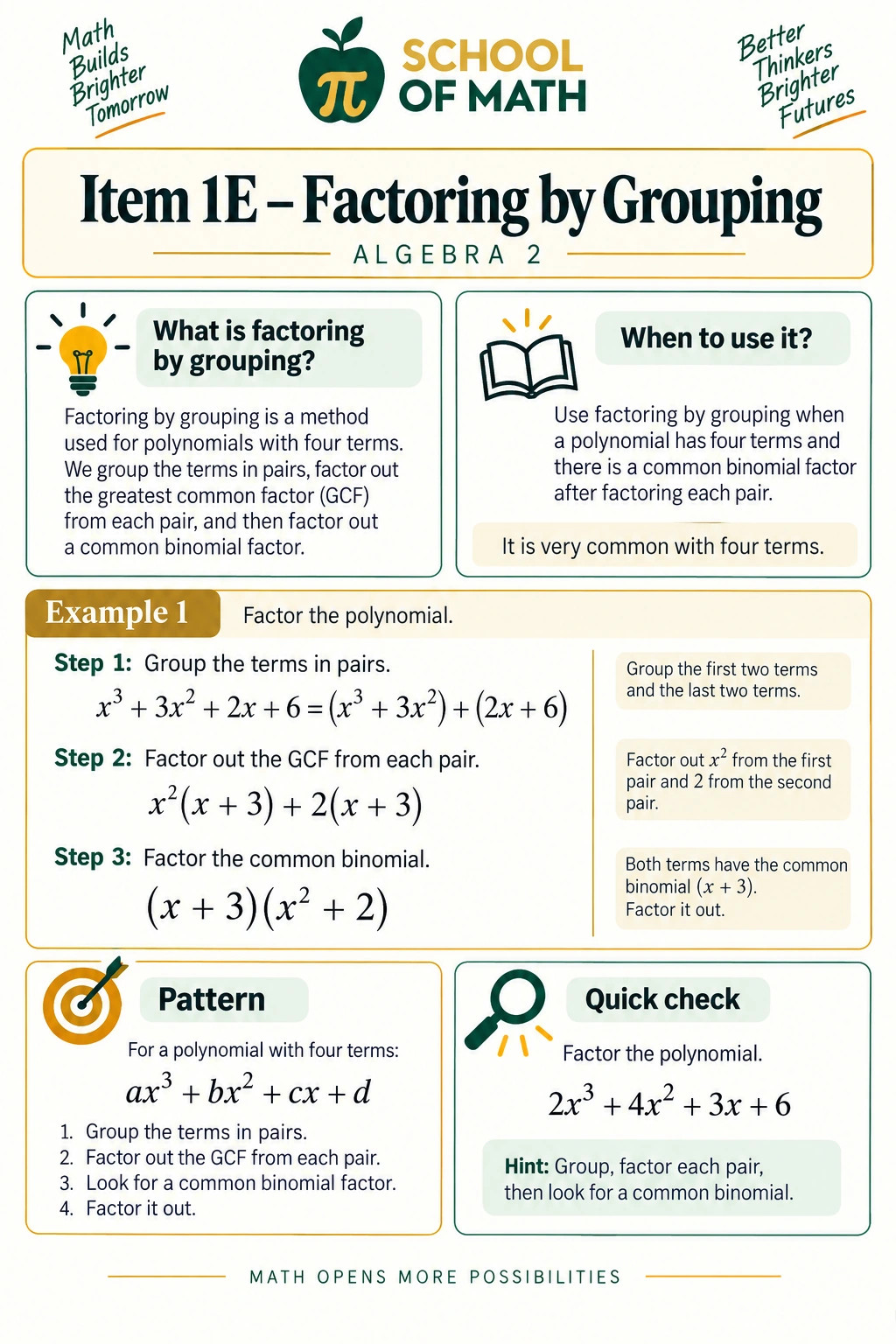
Grouping is useful when pairs of terms can produce the same remaining factor. For four terms, try two pairs, remove each pair’s GCF, and look for a shared binomial.
If the remaining binomials have opposite signs, factor a negative out of one group. Reordering terms can reveal a useful grouping, but keep each sign attached to its term.
After removing the common binomial, check the other factor too. It may be a difference of squares or another factorable expression. Grouping does not guarantee that every four-term polynomial factors.
Practice: five questions, increasing difficulty
Q26
Factor completely over the integers: \(x^{3} + 5 x^{2} + 3 x + 15\).
Answer
\(\left(x + 5\right) \left(x^{2} + 3\right)\)
- Group as \(x^2(x+5)+3(x+5)\).
- The complete factorization is \(\left(x + 5\right) \left(x^{2} + 3\right)\).
- Expand the factors to check that they reproduce \(x^{3} + 5 x^{2} + 3 x + 15\).
Q27
Factor completely over the integers: \(2 x^{3} + 8 x^{2} + 5 x + 20\).
Answer
\(\left(x + 4\right) \left(2 x^{2} + 5\right)\)
- Group as \(2x^2(x+4)+5(x+4)\).
- The complete factorization is \(\left(x + 4\right) \left(2 x^{2} + 5\right)\).
- Expand the factors to check that they reproduce \(2 x^{3} + 8 x^{2} + 5 x + 20\).
Q28
Factor completely over the integers: \(x^{3} - 4 x^{2} - 9 x + 36\).
Answer
\(\left(x - 4\right) \left(x - 3\right) \left(x + 3\right)\)
- Group as \(x^2(x-4)-9(x-4)\), then factor the difference of squares.
- The complete factorization is \(\left(x - 4\right) \left(x - 3\right) \left(x + 3\right)\).
- Expand the factors to check that they reproduce \(x^{3} - 4 x^{2} - 9 x + 36\).
Q29
Factor completely over the integers: \(3 x^{3} - 6 x^{2} - 12 x + 24\).
Answer
\(3 \left(x - 2\right)^{2} \left(x + 2\right)\)
- Remove 3, then group \(x^2(x-2)-4(x-2)\).
- The difference of squares gives another copy of x minus 2.
- The complete factorization is \(3 \left(x - 2\right)^{2} \left(x + 2\right)\).
- Expand the factors to check that they reproduce \(3 x^{3} - 6 x^{2} - 12 x + 24\).
Q30
Factor completely over the integers: \(2 x^{3} + 3 x^{2} - 8 x - 12\).
Answer
\(\left(x - 2\right) \left(x + 2\right) \left(2 x + 3\right)\)
- Group as \(x^2(2x+3)-4(2x+3)\), then factor \(x^2-4\).
- The complete factorization is \(\left(x - 2\right) \left(x + 2\right) \left(2 x + 3\right)\).
- Expand the factors to check that they reproduce \(2 x^{3} + 3 x^{2} - 8 x - 12\).
Finding zeros from factors
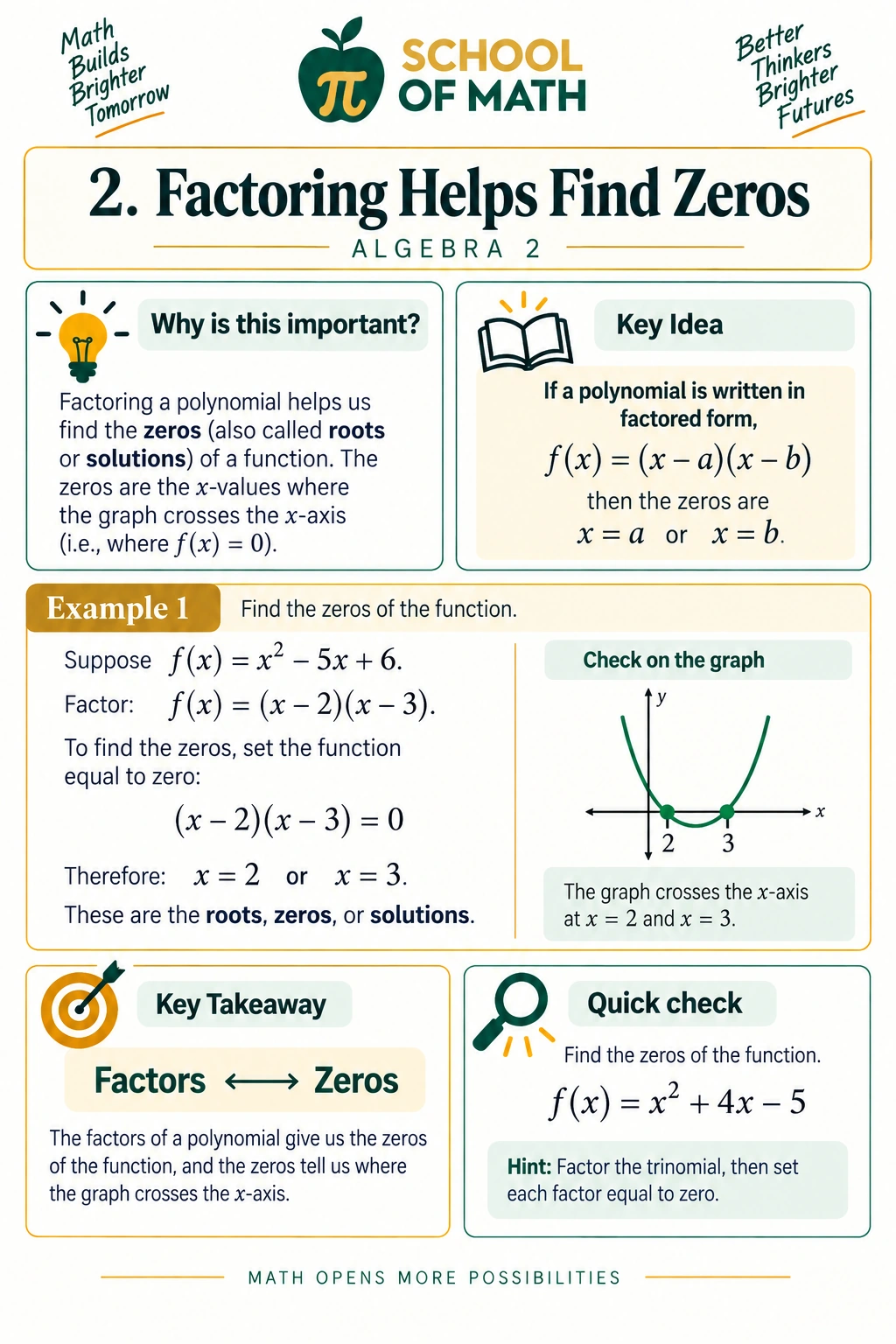
A zero is an input \(r\) with \(f(r)=0\). Factoring lets us use the zero-product property: a product equals zero only when at least one factor equals zero.
Zeros are numbers; x-intercepts are ordered pairs. A real zero r corresponds to the point (r,0). A nonzero constant multiplier affects the graph’s scale but does not add a zero.
A repeated linear factor still contributes a zero, but with multiplicity. Even multiplicity produces a touch-and-turn; odd multiplicity produces a crossing. Do not confuse a zero with the y-intercept, which is found by substituting x = 0.
Practice: five questions, increasing difficulty
Q31
Find all zeros of \(f(x)=x^{2} - 10 x + 21\).
Answer
\(x=3,\;7\)
- Find two numbers with product 21 and sum -10.
- Factor: \(f(x)=\left(x - 7\right) \left(x - 3\right)\).
- Set each factor equal to zero. Solve each equation separately, and include every distinct solution.
Q32
Find all zeros of \(f(x)=2 x^{2} - 7 x + 3\).
Answer
\(x=\frac{1}{2},\;3\)
- Factor the nonmonic quadratic before applying the zero-product property.
- Factor: \(f(x)=\left(x - 3\right) \left(2 x - 1\right)\).
- Set each factor equal to zero. Solve each equation separately, and include every distinct solution.
Q33
Find all zeros of \(f(x)=x^{3} - 16 x\).
Answer
\(x=-4,\;0,\;4\)
- Remove x first. Do not divide away the potential zero x = 0.
- Factor: \(f(x)=x \left(x - 4\right) \left(x + 4\right)\).
- Set each factor equal to zero. Solve each equation separately, and include every distinct solution.
Q34
Find all zeros of \(f(x)=x^{3} - 3 x^{2} - 4 x + 12\).
Answer
\(x=-2,\;2,\;3\)
- Group the terms, then use a difference of squares.
- Factor: \(f(x)=\left(x - 3\right) \left(x - 2\right) \left(x + 2\right)\).
- Set each factor equal to zero. Solve each equation separately, and include every distinct solution.
Q35
For \(f(x)=(x+5)^2(x-2)\), list the zeros with multiplicities, the x-intercepts, and whether the graph crosses or touches at each.
Answer
Zero \(-5\), multiplicity 2, touches at \((-5,0)\). Zero \(2\), multiplicity 1, crosses at \((2,0)\).
- Set \(x+5=0\) and \(x-2=0\). The exponents give multiplicities 2 and 1.
- Even multiplicity preserves the sign locally; odd multiplicity changes it.
The Remainder Theorem
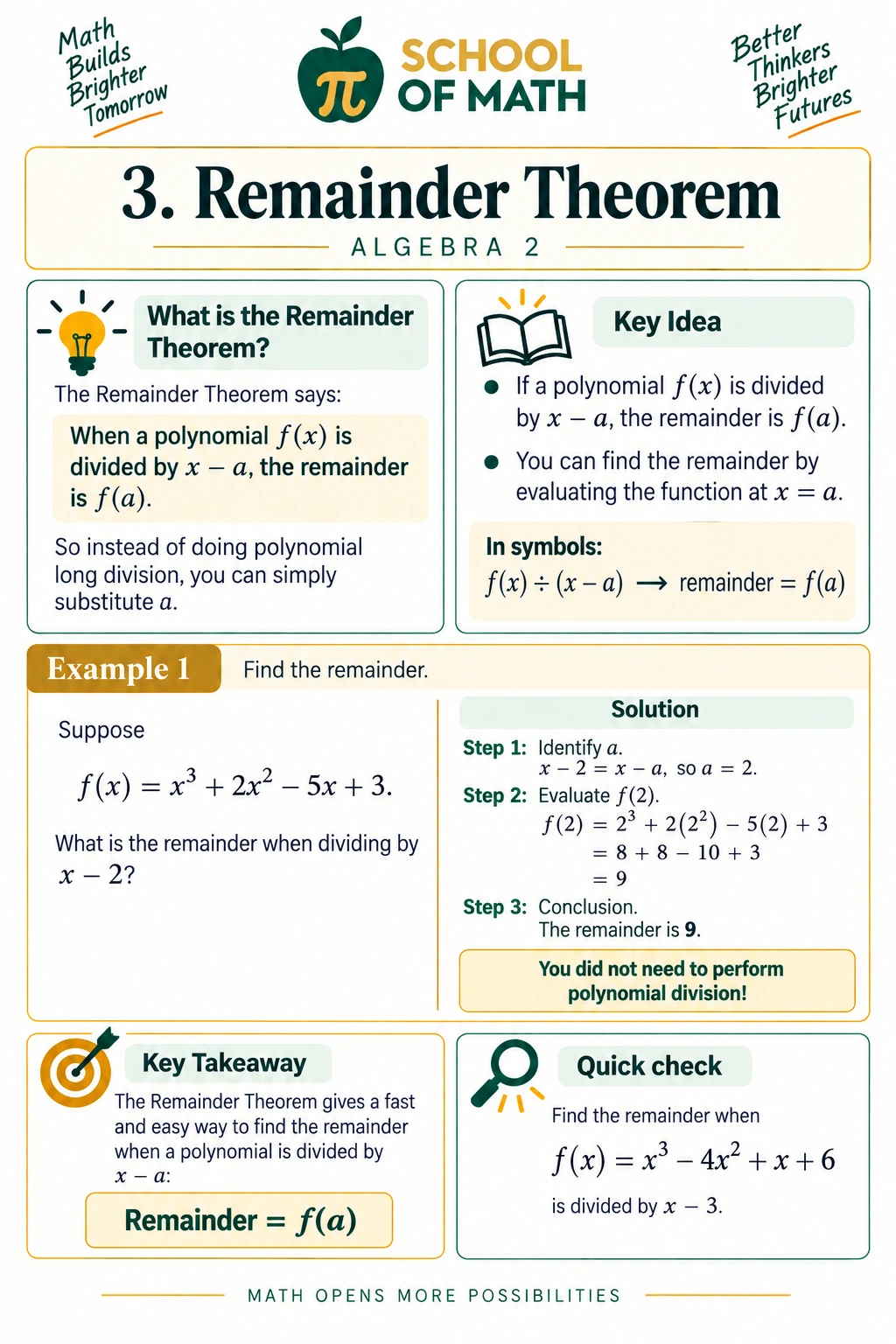
When \(P(x)\) is divided by \(x-a\), polynomial division gives \(P(x)=(x-a)Q(x)+R\), where the remainder \(R\) is a constant. Substitute \(x=a\): the product becomes zero, leaving \(P(a)=R\).
This gives a shortcut for the remainder, not for the entire quotient. Evaluate carefully with parentheses around negative substitutions and compute powers before multiplying.
For a nonmonic linear divisor, solve the divisor equal to zero to determine the substitution value. The remainder is still the polynomial evaluated there, but the quotient differs from the quotient for the corresponding monic divisor.
Practice: five questions, increasing difficulty
Q36
Find the remainder when \(P(x)=x^{2} + 4 x - 7\) is divided by \(x - 3\).
Answer
\(14\)
- Set the divisor equal to zero: \(x - 3=0\), so evaluate at \(x=3\).
- Substitute into the entire polynomial: \(P\left(3\right)=14\).
- By the Remainder Theorem, this value is the remainder. It need not be zero.
Q37
Find the remainder when \(P(x)=2 x^{3} - x^{2} + 5 x - 4\) is divided by \(x + 2\).
Answer
\(-34\)
- Set the divisor equal to zero: \(x + 2=0\), so evaluate at \(x=-2\).
- Substitute into the entire polynomial: \(P\left(-2\right)=-34\).
- By the Remainder Theorem, this value is the remainder. It need not be zero.
Q38
Find the remainder when \(P(x)=x^{4} - 3 x^{2} + 2 x - 5\) is divided by \(x + 1\).
Answer
\(-9\)
- Set the divisor equal to zero: \(x + 1=0\), so evaluate at \(x=-1\).
- Substitute into the entire polynomial: \(P\left(-1\right)=-9\).
- By the Remainder Theorem, this value is the remainder. It need not be zero.
Q39
Find the remainder when \(P(x)=4 x^{3} - 2 x + 7\) is divided by \(2 x - 1\).
Answer
\(\frac{13}{2}\)
- Set the divisor equal to zero: \(2 x - 1=0\), so evaluate at \(x=\frac{1}{2}\).
- Substitute into the entire polynomial: \(P\left(\frac{1}{2}\right)=\frac{13}{2}\).
- By the Remainder Theorem, this value is the remainder. It need not be zero.
Q40
When \(P(x)=x^3+kx^2-4x+6\) is divided by \(x-2\), the remainder is 10. Find \(k\).
Answer
\(k=1\).
- Use the Remainder Theorem: \(P(2)=10\).
- \(8+4k-8+6=10\), so \(4k+6=10\), and \(k=1\).
The Factor Theorem
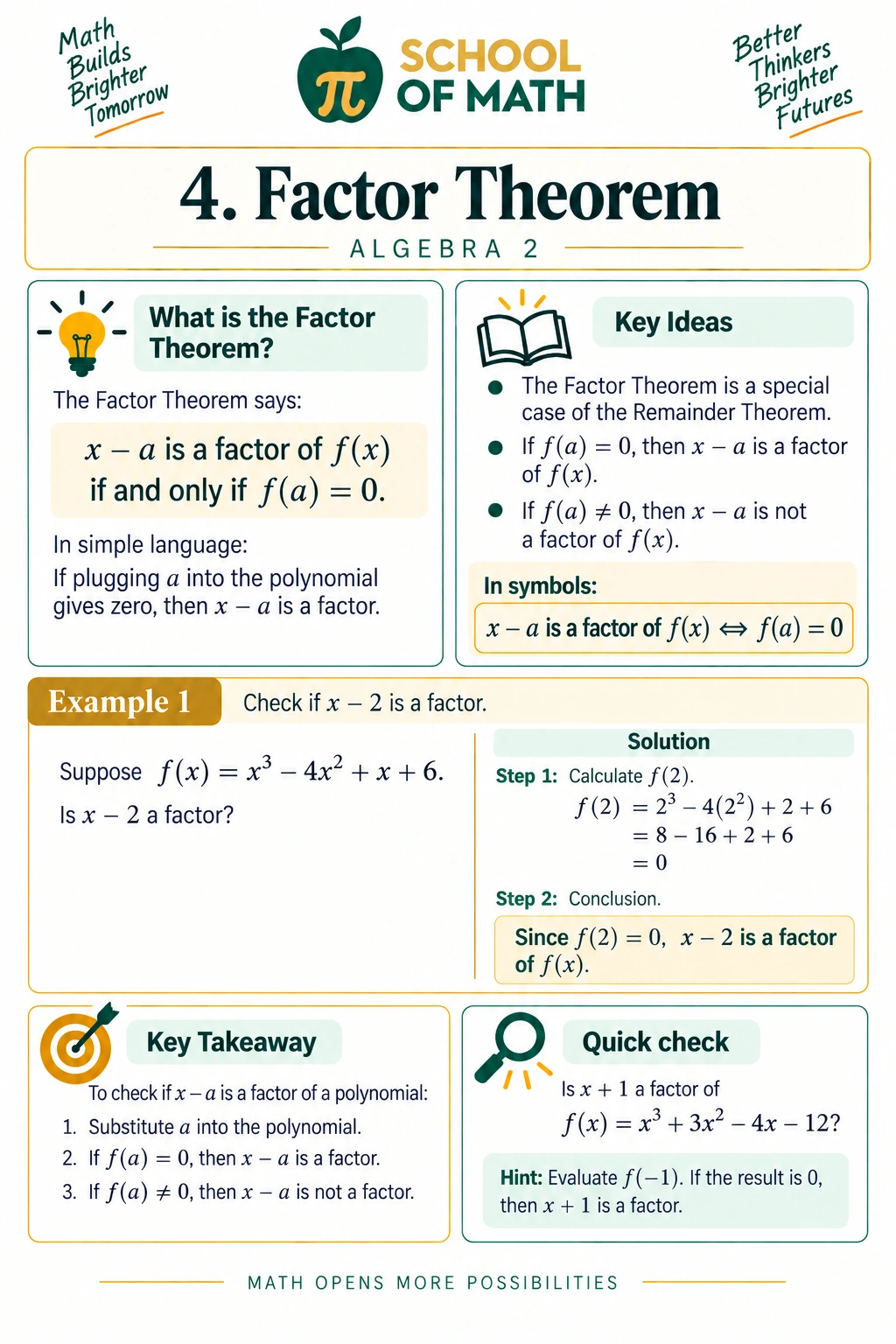
The Factor Theorem is the zero-remainder case: \(x-a\) is a factor of \(P(x)\) if and only if \(P(a)=0\). Either direction is useful: a verified zero gives a factor, and a known factor gives a zero.
A nonzero remainder is decisive: the tested expression is not a factor. Being close to zero is not sufficient when exact arithmetic is available.
If a polynomial contains an unknown coefficient, a given factor supplies an equation. Substitute the factor’s zero, set the resulting expression equal to zero, and solve for the coefficient. Then check your result.
Practice: five questions, increasing difficulty
Q41
Use the Factor Theorem to decide whether \(x - 3\) is a factor of \(P(x)=x^{2} - 8 x + 15\).
Answer
Yes. \(P\left(3\right)=0\).
- Set the divisor equal to zero: \(x - 3=0\), so evaluate at \(x=3\).
- Substitute into the entire polynomial: \(P\left(3\right)=0\).
- The Factor Theorem says a linear divisor is a factor exactly when the remainder is zero. Here the remainder is zero.
Q42
Use the Factor Theorem to decide whether \(x + 2\) is a factor of \(P(x)=x^{3} + 2 x^{2} - 5 x + 1\).
Answer
No. \(P\left(-2\right)=11\).
- Set the divisor equal to zero: \(x + 2=0\), so evaluate at \(x=-2\).
- Substitute into the entire polynomial: \(P\left(-2\right)=11\).
- The Factor Theorem says a linear divisor is a factor exactly when the remainder is zero. Here it is nonzero, so reject the proposed factor.
Q43
Use the Factor Theorem to decide whether \(x - 2\) is a factor of \(P(x)=2 x^{3} - x^{2} - 8 x + 4\).
Answer
Yes. \(P\left(2\right)=0\).
- Set the divisor equal to zero: \(x - 2=0\), so evaluate at \(x=2\).
- Substitute into the entire polynomial: \(P\left(2\right)=0\).
- The Factor Theorem says a linear divisor is a factor exactly when the remainder is zero. Here the remainder is zero.
Q44
Find \(k\) so that \(x+3\) is a factor of \(P(x)=x^2+kx-18\).
Answer
\(k=-3\).
- Set \(P(-3)=0\): \(9-3k-18=0\).
- Thus \(-3k=9\), giving \(k=-3\). Check: \(x^2-3x-18=(x+3)(x-6)\).
Q45
Find \(k\) so that \(2x-3\) is a factor of \(P(x)=2x^3+kx^2-5x+3\).
Answer
\(k=-1\).
- The divisor is zero at \(x=\frac32\). Set \(P(\frac32)=0\).
- \(\frac{27}{4}+\frac94k-\frac{15}{2}+3=0\).
- This simplifies to \(\frac94(k+1)=0\), so \(k=-1\).
Choosing the correct substitution sign
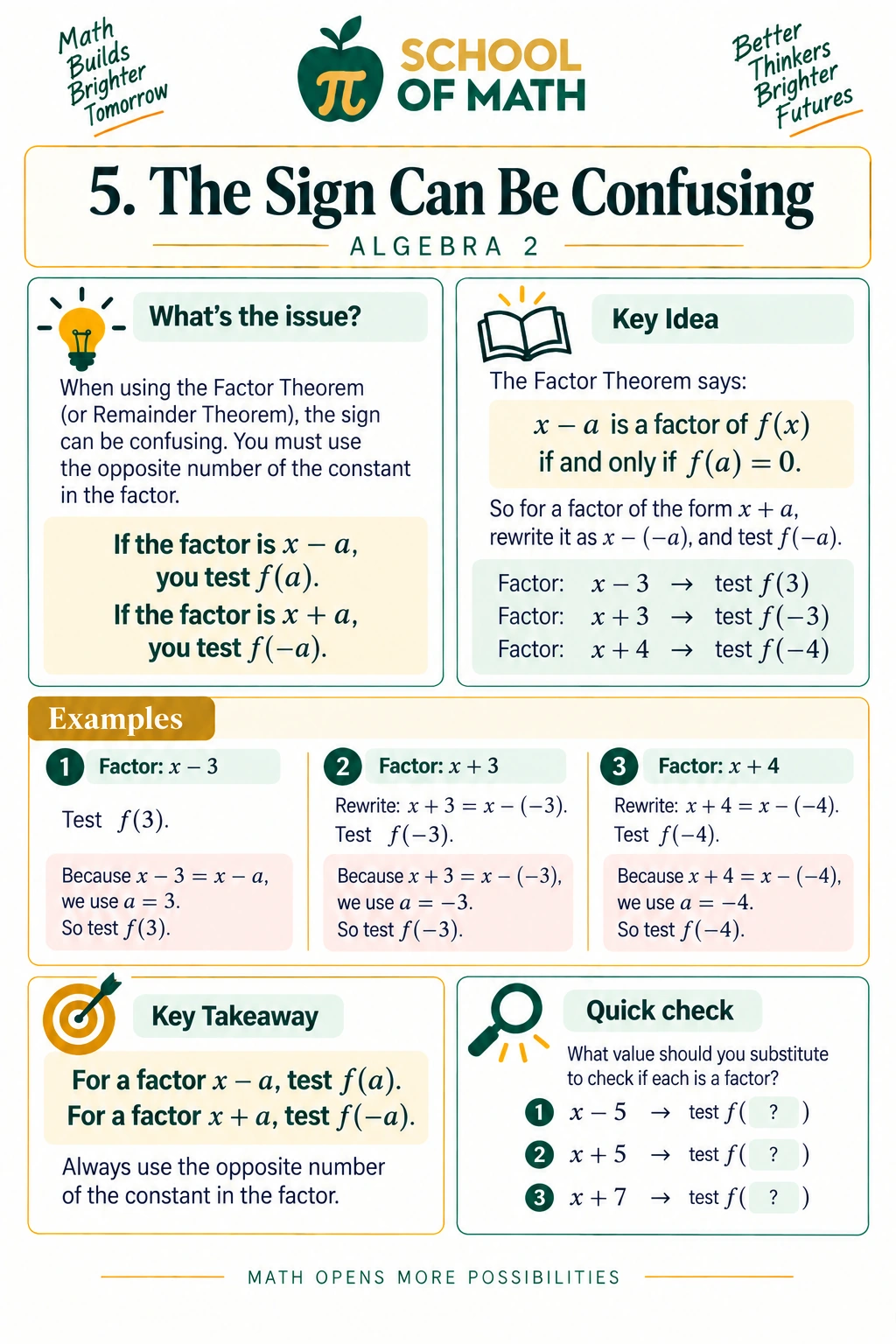
The safest rule is to solve the divisor equal to zero. For \(x-a\), use \(a\); for \(x+a\), use \(-a\). This explains the sign rather than relying on a memorized switch.
For a divisor such as \(3x+2\), simply reversing the sign of 2 is not enough: solve \(3x+2=0\), giving \(-\frac23\). Keep this extra division in mind for nonmonic factors.
Write parentheses around the substituted negative number. Odd powers stay negative and even powers become positive. A sign mistake in the first step can turn a real factor into a false rejection.
Practice: five questions, increasing difficulty
Q46
What value should you substitute to test whether \(x+6\) is a factor of \(P(x)\)? Explain.
Answer
Use \(P(-6)\).
- Solve \(x+6=0\), so \(x=-6\).
- The divisor is \(x-(-6)\), not \(x-6\).
Q47
Which values should you substitute for divisors \(x-8\), \(x+9\), and \(3x+2\), respectively?
Answer
\(8,\;-9,\;-\frac23\).
- Solve each divisor equal to zero: \(x=8\), \(x=-9\), and \(3x=-2\).
Q48
Find the remainder when \(P(x)=x^{3} - 2 x^{2} + 4 x + 5\) is divided by \(x + 3\).
Answer
\(-52\)
- Set the divisor equal to zero: \(x + 3=0\), so evaluate at \(x=-3\).
- Substitute into the entire polynomial: \(P\left(-3\right)=-52\).
- By the Remainder Theorem, this value is the remainder. It need not be zero.
Q49
A student tests \(P(4)\) to decide whether \(x+4\) is a factor of \(P(x)=x^2+3x-4\). Correct the test and decide.
Answer
Test \(P(-4)=0\); \(x+4\) is a factor.
- \(P(-4)=16-12-4=0\).
- The student tested the zero of \(x-4\), which is a different divisor.
Q50
Use the Factor Theorem to decide whether \(3 x + 2\) is a factor of \(P(x)=9 x^{2} + 3 x - 2\).
Answer
Yes. \(P\left(- \frac{2}{3}\right)=0\).
- Set the divisor equal to zero: \(3 x + 2=0\), so evaluate at \(x=- \frac{2}{3}\).
- Substitute into the entire polynomial: \(P\left(- \frac{2}{3}\right)=0\).
- The Factor Theorem says a linear divisor is a factor exactly when the remainder is zero. Here the remainder is zero.
Using a verified factor to finish a polynomial
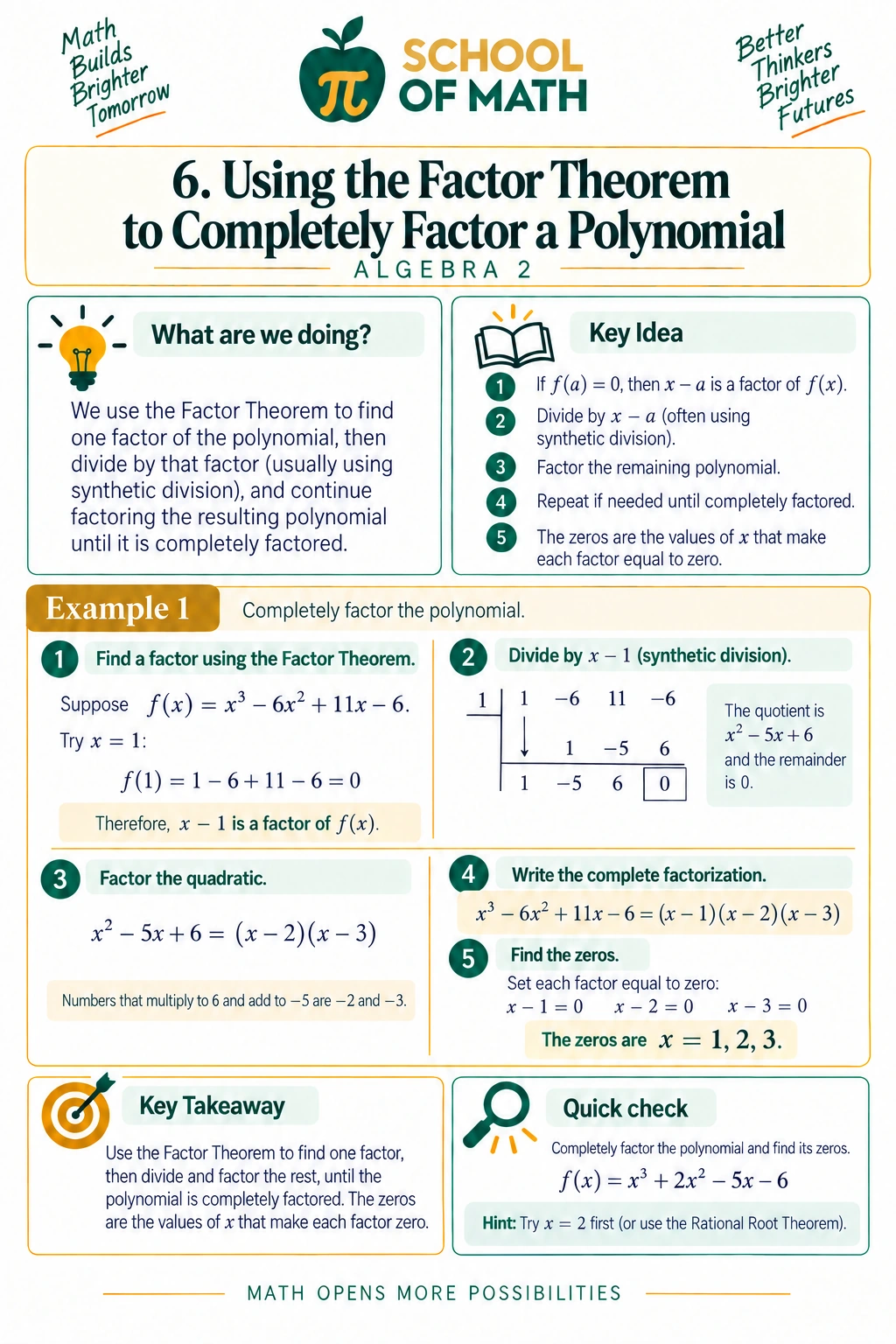
A verified zero is a starting point, not the end of a factoring problem. Divide out its corresponding factor to lower the degree, then apply familiar quadratic or special-product methods to the quotient.
For synthetic division, list every coefficient in descending powers. A missing power requires a zero placeholder. Bring down the first coefficient, multiply by the test value, add to the next coefficient, and repeat.
Only a zero remainder supports a factorization without a remainder term. Keep the original linear factor attached to the factored quotient, and list every zero, including repeated ones when relevant.
Practice: five questions, increasing difficulty
Q51
Verify that \(1\) is a zero of \(P(x)=x^{3} - 13 x + 12\). Divide by the corresponding linear factor, then factor completely and find every zero.
Answer
\(P(x)=\left(x - 3\right) \left(x - 1\right) \left(x + 4\right)\). Zeros: \(-4,\;1,\;3\).
- Substitution gives \(P\left(1\right)=0\), so \(x - 1\) is a factor.
- Synthetic division uses \(1\) with coefficients \(1,\;0,\;-13,\;12\).
- The bottom row is \(1,\;1,\;-12,\;0\). The last entry is the zero remainder.
- The quotient is \(x^{2} + x - 12\); factor it as \(\left(x - 3\right) \left(x + 4\right)\). Combine its factors with the first factor and solve each linear factor.
Q52
Verify that \(-2\) is a zero of \(P(x)=x^{3} - 4 x^{2} - 7 x + 10\). Divide by the corresponding linear factor, then factor completely and find every zero.
Answer
\(P(x)=\left(x - 5\right) \left(x - 1\right) \left(x + 2\right)\). Zeros: \(-2,\;1,\;5\).
- Substitution gives \(P\left(-2\right)=0\), so \(x + 2\) is a factor.
- Synthetic division uses \(-2\) with coefficients \(1,\;-4,\;-7,\;10\).
- The bottom row is \(1,\;-6,\;5,\;0\). The last entry is the zero remainder.
- The quotient is \(x^{2} - 6 x + 5\); factor it as \(\left(x - 5\right) \left(x - 1\right)\). Combine its factors with the first factor and solve each linear factor.
Q53
Verify that \(2\) is a zero of \(P(x)=x^{3} + 5 x^{2} - 2 x - 24\). Divide by the corresponding linear factor, then factor completely and find every zero.
Answer
\(P(x)=\left(x - 2\right) \left(x + 3\right) \left(x + 4\right)\). Zeros: \(-4,\;-3,\;2\).
- Substitution gives \(P\left(2\right)=0\), so \(x - 2\) is a factor.
- Synthetic division uses \(2\) with coefficients \(1,\;5,\;-2,\;-24\).
- The bottom row is \(1,\;7,\;12,\;0\). The last entry is the zero remainder.
- The quotient is \(x^{2} + 7 x + 12\); factor it as \(\left(x + 3\right) \left(x + 4\right)\). Combine its factors with the first factor and solve each linear factor.
Q54
Verify that \(-1\) is a zero of \(P(x)=x^{3} - x^{2} - 5 x - 3\). Divide by the corresponding linear factor, then factor completely and find every zero.
Answer
\(P(x)=\left(x - 3\right) \left(x + 1\right)^{2}\). Zeros: \(-1,\;3\).
- Substitution gives \(P\left(-1\right)=0\), so \(x + 1\) is a factor.
- Synthetic division uses \(-1\) with coefficients \(1,\;-1,\;-5,\;-3\).
- The bottom row is \(1,\;-2,\;-3,\;0\). The last entry is the zero remainder.
- The quotient is \(x^{2} - 2 x - 3\); factor it as \(\left(x - 3\right) \left(x + 1\right)\). Combine its factors with the first factor and solve each linear factor.
Q55
Verify that \(\frac{1}{2}\) is a zero of \(P(x)=2 x^{3} - 5 x^{2} - 14 x + 8\). Divide by the corresponding linear factor, then factor completely and find every zero.
Answer
\(P(x)=\left(x - 4\right) \left(x + 2\right) \left(2 x - 1\right)\). Zeros: \(-2,\;\frac{1}{2},\;4\).
- Substitution gives \(P\left(\frac{1}{2}\right)=0\), so \(x - \frac{1}{2}\) is a factor.
- Synthetic division uses \(\frac{1}{2}\) with coefficients \(2,\;-5,\;-14,\;8\).
- The bottom row is \(2,\;-4,\;-16,\;0\). The last entry is the zero remainder.
- The quotient is \(2 x^{2} - 4 x - 16\); factor it as \(2 \left(x - 4\right) \left(x + 2\right)\). Combine its factors with the first factor and solve each linear factor.
Connecting expressions, factors, zeros, and graphs
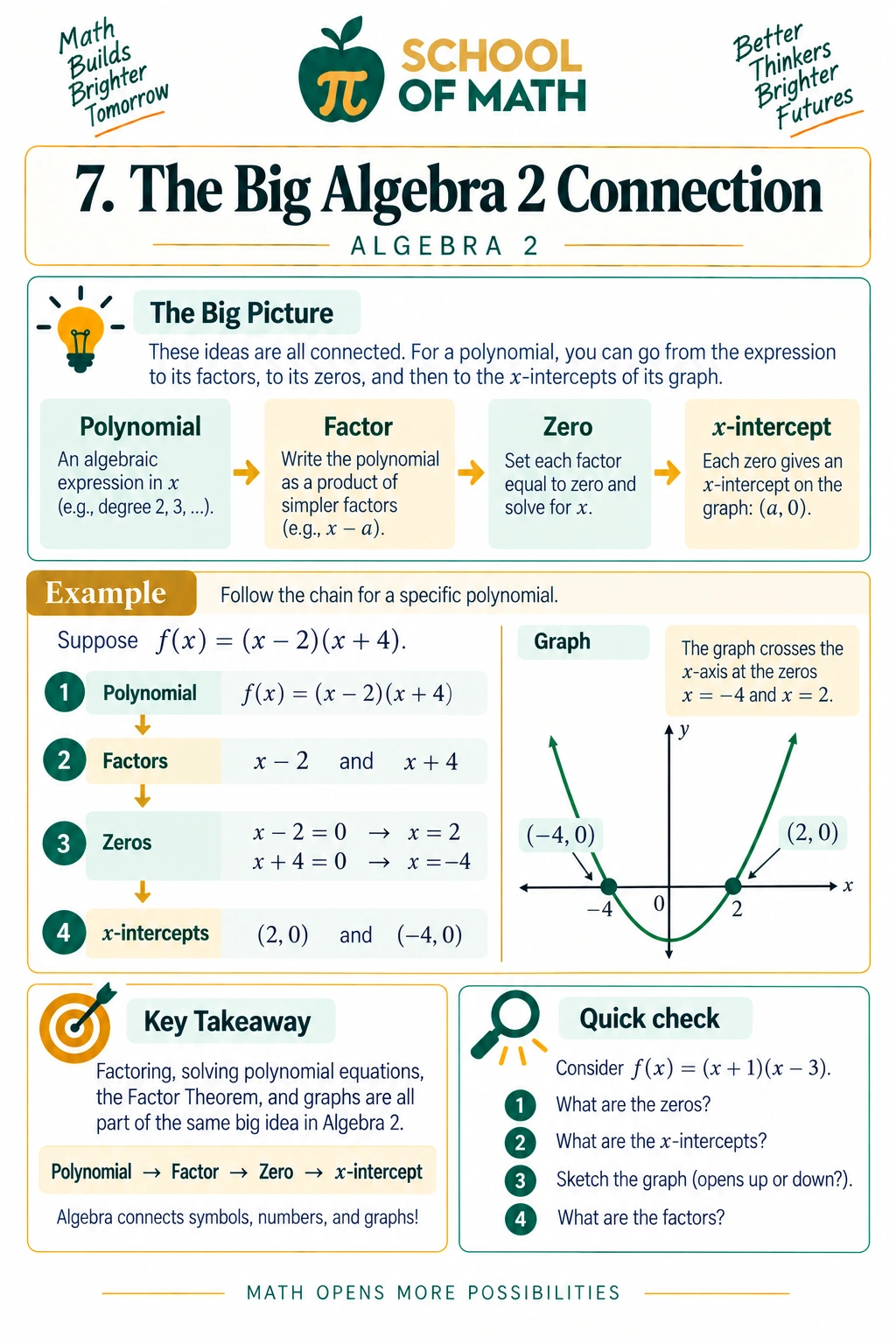
Expanded form, factored form, and a graph show different features of the same polynomial. Expanded form makes the leading term and y-intercept easy to identify; factored form reveals zeros and their multiplicities.
To build a polynomial from zeros, include a factor for each zero, with any required repeated power, and multiply by an unknown scale factor. A supplied point determines that scale factor. Zeros alone do not usually determine a unique polynomial.
For a sketch, label the real intercepts, calculate the y-intercept, identify crossing or touching, and use the leading term for the tails. In a word problem, also restrict the input to meaningful times, counts, or dimensions.
Practice: five questions, increasing difficulty
Q56
For \(f(x)=(x-5)(x+2)\), give the zeros and x-intercepts. Explain the difference between these two types of answers.
Answer
Zeros: \(5,-2\). Intercepts: \((5,0),(-2,0)\).
- Set each factor equal to zero. A zero is an input value; an intercept is a point on the graph.
Q57
Expand \(f(x)=(x-4)(x+6)\), then find its y-intercept and say whether the parabola opens up or down.
Answer
\(f(x)=x^2+2x-24\). The y-intercept is \((0,-24)\); it opens upward.
- Distribute and combine: \(x^2+6x-4x-24=x^2+2x-24\).
- The constant is \(f(0)=-24\), and the coefficient of \(x^2\) is positive.
Q58
A quadratic has zeros \(-2\) and \(6\) and passes through \((0,24)\). Find its factored form and say whether it opens up or down.
Answer
\(f(x)=-2(x+2)(x-6)\); it opens downward.
- Write \(f(x)=a(x+2)(x-6)\).
- Substitute the point: \(24=a(2)(-6)=-12a\), so \(a=-2\).
Q59
For \(f(x)=\left(x - 4\right) \left(x + 3\right)^{2}\), give every real zero, each x-intercept, the y-intercept, crossing or touching behavior, and end behavior.
Answer
Zeros and behavior: \(4\) (crosses), \(-3\) (touches and turns). The y-intercept is \((0,-36)\). Left end falls and right end rises.
- Set each factor equal to zero. Turn each real zero \(r\) into the point \((r,0)\).
- Find the y-intercept by substituting zero: \(f(0)=-36\).
- Odd multiplicity produces a crossing; even multiplicity produces a touch-and-turn.
- The degree is 3 and the leading coefficient is \(1\). Left end falls and right end rises.
Q60
For \(f(x)=\left(- 2 x - 2\right) \left(x - 3\right)^{2}\), give every real zero, each x-intercept, the y-intercept, crossing or touching behavior, and end behavior.
Answer
Zeros and behavior: \(-1\) (crosses), \(3\) (touches and turns). The y-intercept is \((0,-18)\). Left end rises and right end falls.
- Set each factor equal to zero. Turn each real zero \(r\) into the point \((r,0)\).
- Find the y-intercept by substituting zero: \(f(0)=-18\).
- Odd multiplicity produces a crossing; even multiplicity produces a touch-and-turn.
- The degree is 3 and the leading coefficient is \(-2\). Left end rises and right end falls.
Homework review
Review the twelve class topics with one question per image, in the same order. Connect factoring techniques to zeros, remainders, and graph behavior. Try each question before selecting Answer.
R1
A student factors \(x^2+8x+15\) as \((x+1)(x+15)\). Check the answer and give the correct factorization.
Answer
The correct answer is \((x+3)(x+5)\).
- The proposed factors expand to \(x^2+16x+15\), not the original.
- Use 3 and 5 because their sum is 8 and product is 15.
R2
Factor completely over the integers: \(28 x^{3} y - 42 x^{2} y^{2}\).
Answer
\(14 x^{2} y \left(2 x - 3 y\right)\)
- Remove the GCF 14x squared y.
- The complete factorization is \(14 x^{2} y \left(2 x - 3 y\right)\).
- Expand the factors to check that they reproduce \(28 x^{3} y - 42 x^{2} y^{2}\).
R3
Factor completely over the integers: \(3 x^{2} + 10 x + 8\).
Answer
\(\left(x + 2\right) \left(3 x + 4\right)\)
- Use ac = 24 and split \(10x\) into \(6x+4x\), then group.
- The complete factorization is \(\left(x + 2\right) \left(3 x + 4\right)\).
- Expand the factors to check that they reproduce \(3 x^{2} + 10 x + 8\).
R4
Factor completely over the integers: \(49 x^{2} - 100\).
Answer
\(\left(7 x - 10\right) \left(7 x + 10\right)\)
- Use the difference of squares with square roots 7x and 10.
- The complete factorization is \(\left(7 x - 10\right) \left(7 x + 10\right)\).
- Expand the factors to check that they reproduce \(49 x^{2} - 100\).
R5
Factor completely over the integers: \(25 x^{2} - 70 x + 49\).
Answer
\(\left(5 x - 7\right)^{2}\)
- The square roots are 5x and 7, and the middle term is negative twice their product.
- The complete factorization is \(\left(5 x - 7\right)^{2}\).
- Expand the factors to check that they reproduce \(25 x^{2} - 70 x + 49\).
R6
Factor completely over the integers: \(x^{3} + 6 x^{2} - 4 x - 24\).
Answer
\(\left(x - 2\right) \left(x + 2\right) \left(x + 6\right)\)
- Group as \(x^2(x+6)-4(x+6)\), then factor the difference of squares.
- The complete factorization is \(\left(x - 2\right) \left(x + 2\right) \left(x + 6\right)\).
- Expand the factors to check that they reproduce \(x^{3} + 6 x^{2} - 4 x - 24\).
R7
Find all zeros of \(f(x)=3 x^{2} - 15 x\).
Answer
\(x=0,\;5\)
- Remove 3x and retain the zero produced by the factor x.
- Factor: \(f(x)=3 x \left(x - 5\right)\).
- Set each factor equal to zero. Solve each equation separately, and include every distinct solution.
R8
Find the remainder when \(P(x)=2 x^{3} + 3 x^{2} - x + 8\) is divided by \(x + 2\).
Answer
\(6\)
- Set the divisor equal to zero: \(x + 2=0\), so evaluate at \(x=-2\).
- Substitute into the entire polynomial: \(P\left(-2\right)=6\).
- By the Remainder Theorem, this value is the remainder. It need not be zero.
R9
Find \(k\) so \(x-4\) is a factor of \(P(x)=x^2+kx-20\).
Answer
\(k=1\).
- Set \(P(4)=16+4k-20=0\), giving \(4k=4\).
R10
Which substitution tests the factor \(4x+3\)? For \(P(x)=16x^2-9\), carry out the test.
Answer
Use \(x=-\frac34\). Since \(P(-\frac34)=0\), \(4x+3\) is a factor.
- Solve \(4x+3=0\).
- \(16(\frac9{16})-9=0\), confirming a zero remainder.
R11
Verify that \(2\) is a zero of \(P(x)=x^{3} - 4 x^{2} + x + 6\). Divide by the corresponding linear factor, then factor completely and find every zero.
Answer
\(P(x)=\left(x - 3\right) \left(x - 2\right) \left(x + 1\right)\). Zeros: \(-1,\;2,\;3\).
- Substitution gives \(P\left(2\right)=0\), so \(x - 2\) is a factor.
- Synthetic division uses \(2\) with coefficients \(1,\;-4,\;1,\;6\).
- The bottom row is \(1,\;-2,\;-3,\;0\). The last entry is the zero remainder.
- The quotient is \(x^{2} - 2 x - 3\); factor it as \(\left(x - 3\right) \left(x + 1\right)\). Combine its factors with the first factor and solve each linear factor.
R12
For \(f(x)=\left(- x - 4\right) \left(x - 2\right)^{2}\), give every real zero, each x-intercept, the y-intercept, crossing or touching behavior, and end behavior.
Answer
Zeros and behavior: \(-4\) (crosses), \(2\) (touches and turns). The y-intercept is \((0,-16)\). Left end rises and right end falls.
- Set each factor equal to zero. Turn each real zero \(r\) into the point \((r,0)\).
- Find the y-intercept by substituting zero: \(f(0)=-16\).
- Odd multiplicity produces a crossing; even multiplicity produces a touch-and-turn.
- The degree is 3 and the leading coefficient is \(-1\). Left end rises and right end falls.
Homework word problems
Apply the ideas to dimensions, areas, profit, calibration, and motion. These eight problems build from choosing a factorization to combining several class topics. Together with the twelve review questions, they make 20 homework questions. Respect each situation’s domain and include units where appropriate.
W1
A rectangular display has area \(x^2+10x+21\) square meters and one side \(x+3\) meters, where \(x>0\). Factor the area to find the other side. Give both dimensions when \(x=2\).
Answer
The other side is \(x+7\) m. At \(x=2\), the dimensions are 5 m by 9 m.
- Factor \(x^2+10x+21=(x+3)(x+7)\).
- Divide by the given nonzero side, then substitute \(x=2\). The area is \(5\cdot9=45\) square meters.
W2
A square courtyard has side \(x\) meters. A square flower bed of side 6 meters is removed from its usable area. Factor the remaining area and find it when \(x=10\), assuming \(x>6\).
Answer
\(A(x)=x^2-36=(x-6)(x+6)\). At \(x=10\), the usable area is 64 square meters.
- Subtract the flower bed’s area \(6^2=36\) from the courtyard’s \(x^2\).
- Apply the difference of squares, then calculate \(4\cdot16=64\).
W3
A square art panel has area \(9x^2+30x+25\) square centimeters, where \(x\ge0\). Factor the expression to find the panel’s side length. What is its perimeter when \(x=3\)?
Answer
The side is \(3x+5\) cm, and the perimeter is 56 cm at \(x=3\).
- The area is \((3x+5)^2\). Since \(x\ge0\), \(3x+5\) is positive and is the physical side length.
- At \(x=3\), the side is \(14\) cm, so the perimeter is \(4(14)=56\) cm.
W4
A fundraiser models profit by \(P(n)=-n^2+18n-65\) dollars when \(n\) bundles are sold, where \(n\) is a whole number from 0 to 18. Find both break-even sales levels and the whole-number sales levels with positive profit.
Answer
Break-even occurs at 5 and 13 bundles. Profit is positive for 6 through 12 bundles.
- Factor \(P(n)=-(n-5)(n-13)\). Set each factor equal to zero for break-even.
- Between the zeros, the two factors have opposite signs. The leading negative makes profit positive. Whole-number counts give 6–12.
W5
A calibration model is \(E(s)=s^3-5s^2+2s+8\), where \(0\le s\le5\). A technician uses division by \(s-2\) to test whether setting 2 has zero error. Find the remainder, then factor the model to find every allowed zero-error setting.
Answer
The remainder is 0. The allowed settings are 2 and 4.
- \(E(2)=8-20+4+8=0\), so \(s-2\) is a factor.
- Division gives \(s^2-3s-4=(s-4)(s+1)\). Thus the mathematical zeros are \(2,4,-1\).
- Reject \(-1\) because it is outside the device’s permitted settings.
W6
A rectangular storage box has positive inside dimensions \(x\), \(x+2\), and \(x+4\) centimeters and volume 105 cubic centimeters. Form a polynomial equation, verify that \(x=3\) is a solution, and show why it is the only real solution.
Answer
\(x^3+6x^2+8x-105=0\). The dimensions are 3 cm by 5 cm by 7 cm.
- Use \(x(x+2)(x+4)=105\). At \(x=3\), \(3\cdot5\cdot7=105\).
- The volume-difference polynomial factors as \((x-3)(x^2+9x+35)\).
- The quadratic discriminant is \(81-140=-59<0\), so it contributes no real roots.
W7
Over \(0\le t\le6\) seconds, a moving marker’s signed displacement from a reference line is \(d(t)=t^3-7t^2+11t-5\) centimeters. Verify that \(t=1\) is a zero, then find all times it meets the line. Decide whether it crosses or only touches at each time, and find \(d(3)\).
Answer
It touches at 1 second and crosses at 5 seconds. At 3 seconds, it is 8 cm below the line.
- \(d(1)=1-7+11-5=0\). Divide by \(t-1\) to get \(t^2-6t+5=(t-1)(t-5)\).
- Thus \(d(t)=(t-1)^2(t-5)\). The double zero at 1 touches, and the simple zero at 5 crosses.
- \(d(3)=(2)^2(-2)=-8\). A negative displacement means below the reference line, not necessarily below the ground.
W8
A designer wants a least-degree polynomial profile that crosses a reference line at \(x=-2\) and \(x=5\), touches it at \(x=1\), and passes through \((0,20)\). Negative horizontal coordinates are allowed. Find its factored equation, its y-intercept, and its end behavior.
Answer
\(f(x)=-2(x+2)(x-1)^2(x-5)\). The y-intercept is \((0,20)\), and both mathematical ends fall.
- Use multiplicity 1 at each crossing and 2 at the touch: \(f(x)=a(x+2)(x-1)^2(x-5)\).
- Substitute \(x=0\): \(20=a(2)(1)(-5)=-10a\), so \(a=-2\).
- The degree is 4 with negative leading coefficient. Both ends fall, although the physical design uses only a finite part of the graph.
Quick questions and answers
What does factoring a polynomial mean?
Factoring rewrites a polynomial as a product of simpler expressions whose expansion reproduces the original polynomial.
What should I check first when factoring?
Look for a greatest common factor. After removing it, inspect the remaining expression for trinomial, difference-of-squares, perfect-square, or grouping patterns.
What is the difference between the Remainder and Factor Theorems?
The Remainder Theorem gives the remainder P(a) for division by x−a. The Factor Theorem says x−a is a factor exactly when that remainder is zero.
What value do I use for a divisor with a plus sign?
Solve the divisor equal to zero. For x+a, substitute −a. For a nonmonic divisor such as 3x+2, substitute −2/3.
Does every zero make a graph cross the x-axis?
No. Real zeros with odd multiplicity cross; real zeros with even multiplicity touch and turn. Nonreal zeros are not x-intercepts on a real graph.
How is the Class 11 homework organized?
The lesson has 60 image-by-image practice questions. Homework has 12 review questions, one per image, plus 8 progressively challenging word problems, for 20 homework questions.