Algebra 2 · Class 17
Exponential Functions: Growth, Decay, and Graphs
Learn to recognize repeated multiplication, build growth and decay models, and explain an exponential graph from its points to its asymptote.
Explore ten illustrated topics with 50 practice questions, eight Homework review questions, and twelve Homework word problems. Every question has a blue Answer control with detailed working. Try each question before revealing the solution; a calculator is useful for compound interest.
This is an independent topic in the Algebra 2 rolling syllabus, with no required earlier class attendance. Review the explanations here and work at your own pace. See the schedule or book an evaluation at SOMATH.
Download the student workbook (PDF)26 pages · Supplied cover, ten teaching images, all 70 questions · Blank working space · No exercise solutions
Recognizing exponential functions
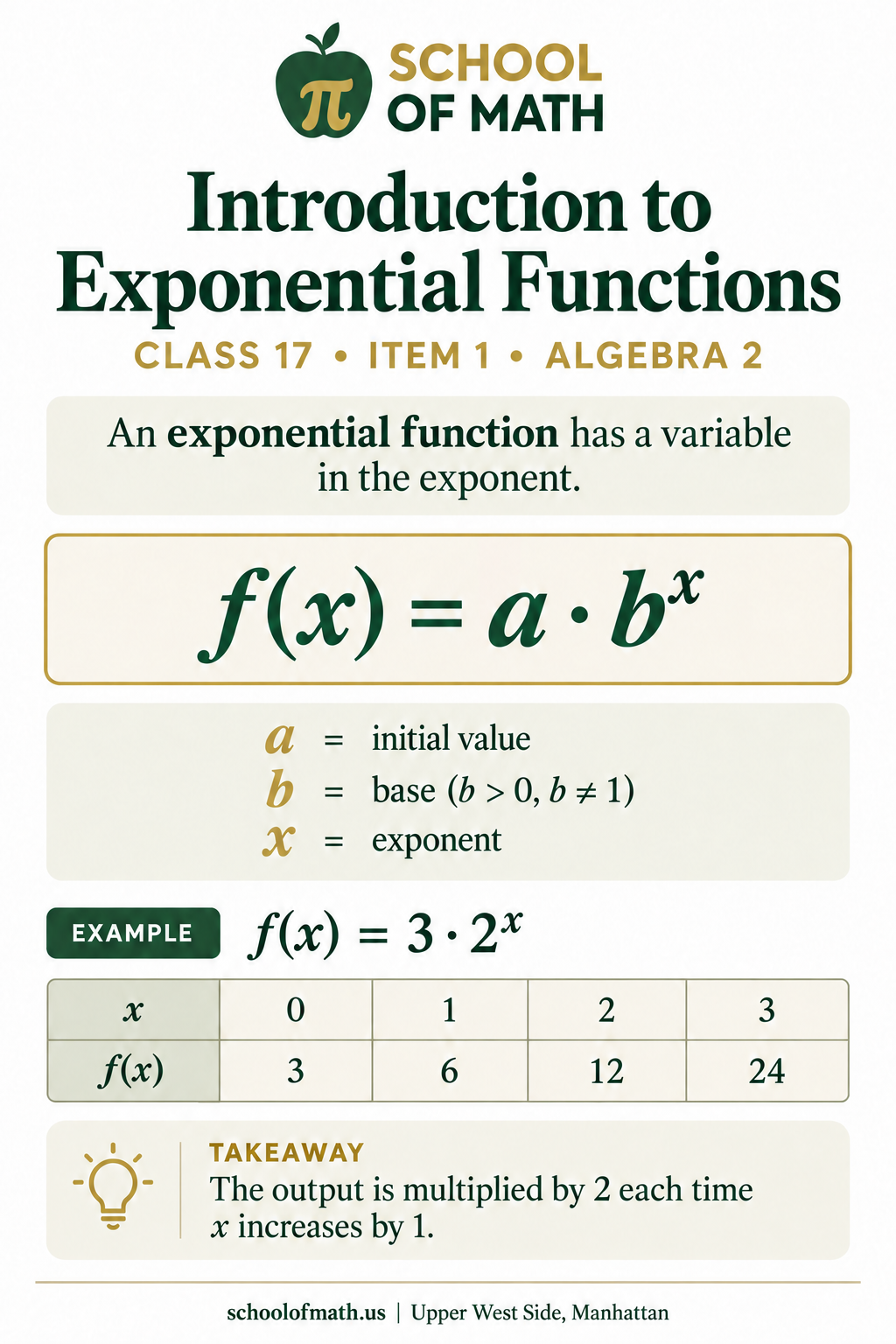
An exponential function has the variable in the exponent: \(f(x)=ab^x\), with \(b>0\), \(b\ne1\), and \(a\ne0\). Equal input increments give equal multiplicative ratios. A variable in the base, as in \(x^3\), is not exponential.
For the positive growth and decay models in this lesson, assume \(a>0\). A reflected graph with \(a<0\) still has an exponential form, but the increasing/decreasing direction reverses. Always read parentheses and negative exponents carefully.
Practice: try these five questions
Q1
Which functions are exponential? Explain each choice.
Answer
Only \(f(x)=7\cdot4^x\) is exponential.
In f, the base 4 is fixed and the input x is in the exponent. It has the form abˣ with a = 7 and b = 4.
In g, x is the base and 3 is the fixed exponent, so g is a polynomial power function, not an exponential.
Check and interpret
For f, increasing x by 1 multiplies the output by 4. For g, consecutive output ratios are not constant.
Q2
Outputs at inputs 0, 1, 2, 3 are 6, 18, 54, 162. Show that an exponential model fits and write it.
Answer
\(f(x)=6\cdot3^x\)
The output at x = 0 gives the initial value a = 6.
Divide consecutive outputs to test for a common ratio.
\[18/6=54/18=162/54=3\]Use the common ratio as the base.
\[f(x)=6\cdot3^x\]
Check and interpret
At x = 3, \(6\cdot3^3=6\cdot27=162\), matching the last entry.
Q3
Outputs at inputs 0, 1, 2, 3 are 8, 13, 18, 23. Are these values linear or exponential? Justify.
Answer
Linear, not exponential.
Compare consecutive differences.
\[13-8=18-13=23-18=5\]Compare ratios: they are not equal.
\[\frac{13}{8}\ne\frac{18}{13}\]A constant difference gives the linear model.
\[f(x)=8+5x\]
Check and interpret
The model yields 8 at x = 0 and 23 at x = 3. Equal differences, not equal ratios, identify this pattern.
Q4
Evaluate f(-1) exactly. Show the power before multiplying.
Answer
\(f(-1)=\frac{4}{3}\)
Substitute the requested input for x.
\[f(-1)=4\cdot\left(3\right)^{-1}\]Evaluate the power. For a negative exponent, take the reciprocal of the corresponding positive power.
\[\left(3\right)^{-1}=\frac{1}{3}\]Multiply by the coefficient.
\[4\cdot\frac{1}{3}=\frac{4}{3}\]
Check and interpret
Exponentiation happens before multiplication. The output one step later would be \(4\), which is \(3\) times this answer.
Q5
Explain why base 1 is excluded from a nonconstant exponential model.
Answer
\(f(x)=12\) for every real x.
Any real power of the positive number 1 equals 1.
\[1^x=1\]Multiply by the initial coefficient.
\[12\cdot1=12\]The output never changes, so this is constant rather than exponential growth or decay.
Check and interpret
The outputs at x = −2, 0, and 5 are all 12.
Initial value and repeated multiplier
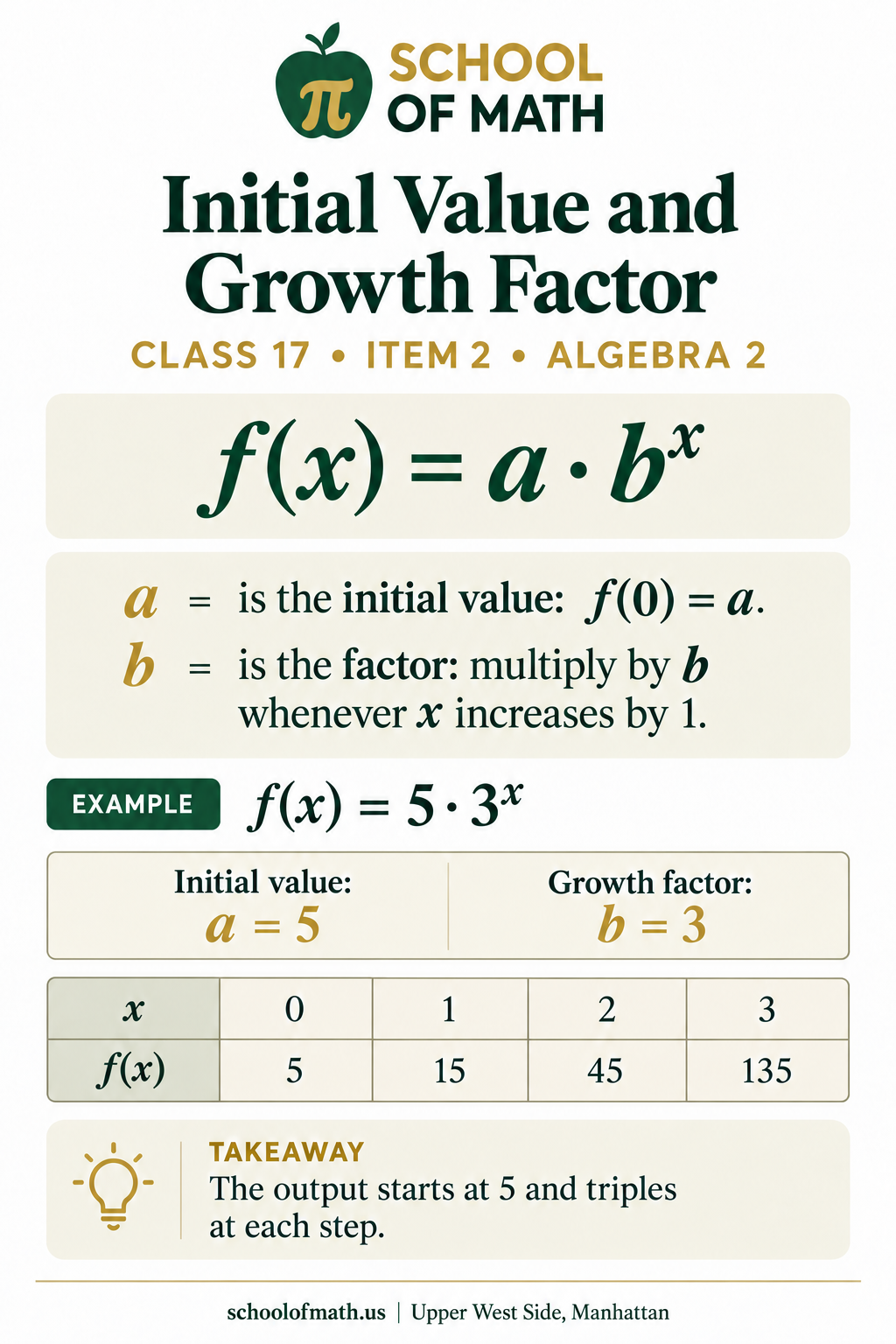
For \(f(x)=ab^x\), \(f(0)=a\), because \(b^0=1\). The base is also the ratio \(f(x+1)/f(x)=b\), provided the coefficient is nonzero.
If a vertical shift is present, \(a\) is not automatically the y-intercept. Substitute \(x=0\) in the whole function. The five questions here use the unshifted form so you can interpret \(a\) and \(b\) directly.
Practice: try these five questions
Q6
Identify the initial value and multiplier. State growth or decay and the percentage change per one-unit increase in x.
Answer
Initial value \(7\); factor \(2\); growth of \(100\)% per step.
Set x equal to zero; every positive base to the zero power equals 1.
\[f(0)=7\cdot1=7\]The base is the repeated multiplier, not the percentage rate.
\[b=2\]Subtract 1 from the base for growth; subtract the base from 1 for decay.
\[r=b-1=1\]
Check and interpret
The next output is \(f(1)=14\). Dividing by the initial output gives \(2\), the stated multiplier.
Q7
Identify the initial value and multiplier. State growth or decay and the percentage change per one-unit increase in x.
Answer
Initial value \(18\); factor \(\frac{3}{4}\); decay of \(25\)% per step.
Set x equal to zero; every positive base to the zero power equals 1.
\[f(0)=18\cdot1=18\]The base is the repeated multiplier, not the percentage rate.
\[b=\frac{3}{4}\]Subtract 1 from the base for growth; subtract the base from 1 for decay.
\[r=1-b=\frac{1}{4}\]
Check and interpret
The next output is \(f(1)=\frac{27}{2}\). Dividing by the initial output gives \(\frac{3}{4}\), the stated multiplier.
Q8
Identify the initial value and multiplier. State growth or decay and the percentage change per one-unit increase in x.
Answer
Initial value \(125\); factor \(\frac{26}{25}\); growth of \(4\)% per step.
Set x equal to zero; every positive base to the zero power equals 1.
\[f(0)=125\cdot1=125\]The base is the repeated multiplier, not the percentage rate.
\[b=\frac{26}{25}\]Subtract 1 from the base for growth; subtract the base from 1 for decay.
\[r=b-1=\frac{1}{25}\]
Check and interpret
The next output is \(f(1)=130\). Dividing by the initial output gives \(\frac{26}{25}\), the stated multiplier.
Q9
An exponential model has f(0) = 14 and f(1) = 35. Find the base and write the model.
Answer
\(f(x)=14(2.5)^x\)
Use the value at zero as the initial coefficient.
\[a=14\]Divide the next output by the first.
\[b=\frac{35}{14}=\frac52=2.5\]Substitute a and b in the exponential form.
\[f(x)=14(2.5)^x\]
Check and interpret
At x = 1, \(14(2.5)=35\). The factor 2.5 means 150% growth, not 250% growth.
Q10
A positive-base exponential function passes through (1, 12) and (3, 108). Find a and b.
Answer
\(f(x)=4\cdot3^x\)
Use the two given points.
\[ab=12,\quad ab^3=108\]Divide equations; the input gap is 2, so the ratio is b squared.
\[b^2=\frac{108}{12}=9\]The base must be positive, so b = 3. Recover a from the first equation.
\[a=\frac{12}{3}=4\]
Check and interpret
Both points work: \(4\cdot3=12\) and \(4\cdot27=108\).
Exponential growth
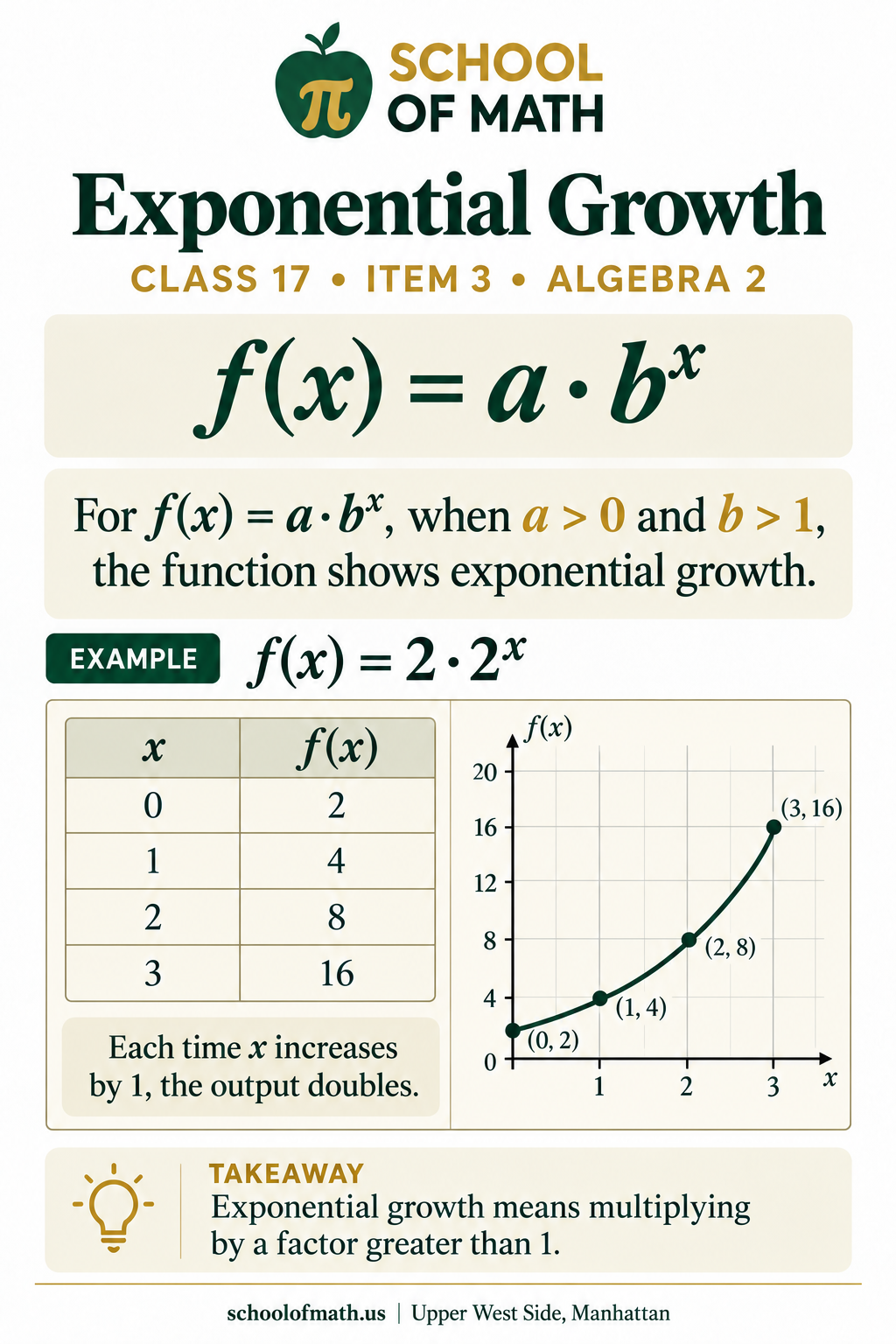
When \(a>0\) and \(b>1\), \(ab^x\) increases as \(x\) increases. Growth adds the same percentage to the current amount each period, not the same number of units.
For a growth rate \(r\) written as a decimal, use \(b=1+r\). Doubling is a factor of 2 and a 100% increase; tripling is a factor of 3 and a 200% increase.
Practice: try these five questions
Q11
Evaluate f(4) exactly. Show the power before multiplying.
Answer
\(f(4)=80\)
Substitute the requested input for x.
\[f(4)=5\cdot\left(2\right)^{4}\]Evaluate the power. For a negative exponent, take the reciprocal of the corresponding positive power.
\[\left(2\right)^{4}=16\]Multiply by the coefficient.
\[5\cdot16=80\]
Check and interpret
Exponentiation happens before multiplication. The output one step later would be \(160\), which is \(2\) times this answer.
Q12
Identify the initial value and multiplier. State growth or decay and the percentage change per one-unit increase in x.
Answer
Initial value \(40\); factor \(\frac{5}{4}\); growth of \(25\)% per step.
Set x equal to zero; every positive base to the zero power equals 1.
\[f(0)=40\cdot1=40\]The base is the repeated multiplier, not the percentage rate.
\[b=\frac{5}{4}\]Subtract 1 from the base for growth; subtract the base from 1 for decay.
\[r=b-1=\frac{1}{4}\]
Check and interpret
The next output is \(f(1)=50\). Dividing by the initial output gives \(\frac{5}{4}\), the stated multiplier.
Q13
A model starts at 200 units and grows by 10% per year. Write an exponential model and find the amount after 3 years.
Answer
\(A(t)=200\cdot \left(\frac{11}{10}\right)^{t}\); after 3 years: 266.2 units (model prediction).
Define t as the number of years since the starting measurement. The initial amount is 200 units.
Convert the rate to a decimal and form the repeated multiplier.
\[r=\frac{1}{10},\quad b=1+\frac{1}{10}=\frac{11}{10}\]Use the starting amount times the multiplier raised to the number of periods. The model uses t ≥ 0.
\[A(t)=200\cdot \left(\frac{11}{10}\right)^{t}\]Substitute the requested time. Keep full precision until the final answer.
\[A(3)=200\left(\frac{11}{10}\right)^{3}=\frac{1331}{5}\]
Check and interpret
The model gives \(A(0)=200\). Each new period multiplies the previous amount by \(\frac{11}{10}\), rather than adding or subtracting the same fixed amount.
Q14
Compare the outputs after 3 periods. Which is larger, and by how much?
Answer
A is larger by 71.25 units.
Evaluate the first model.
\[A(3)=30\cdot8=240\]Evaluate the second model.
\[B(3)=50(3.375)=168.75\]Subtract the smaller output from the larger.
\[240-168.75=71.25\]
Check and interpret
A starts smaller but has the larger multiplier. Initial size alone does not determine the larger future output.
Q15
A student models 20% growth from 80 units as 80(0.20)^t. Explain the error and give the correct amount after 2 periods.
Answer
\(A(t)=80(1.20)^t\); after 2 periods: 115.2 units.
A 20% increase keeps the original 100% and adds another 20%.
\[b=1+0.20=1.20\]Write the corrected model.
\[A(t)=80(1.20)^t\]Evaluate after two periods.
\[A(2)=80(1.44)=115.2\]
Check and interpret
A factor of 0.20 would keep only 20% each period, causing 80% decay. The correct outputs increase from 80 to 96 to 115.2.
Exponential decay
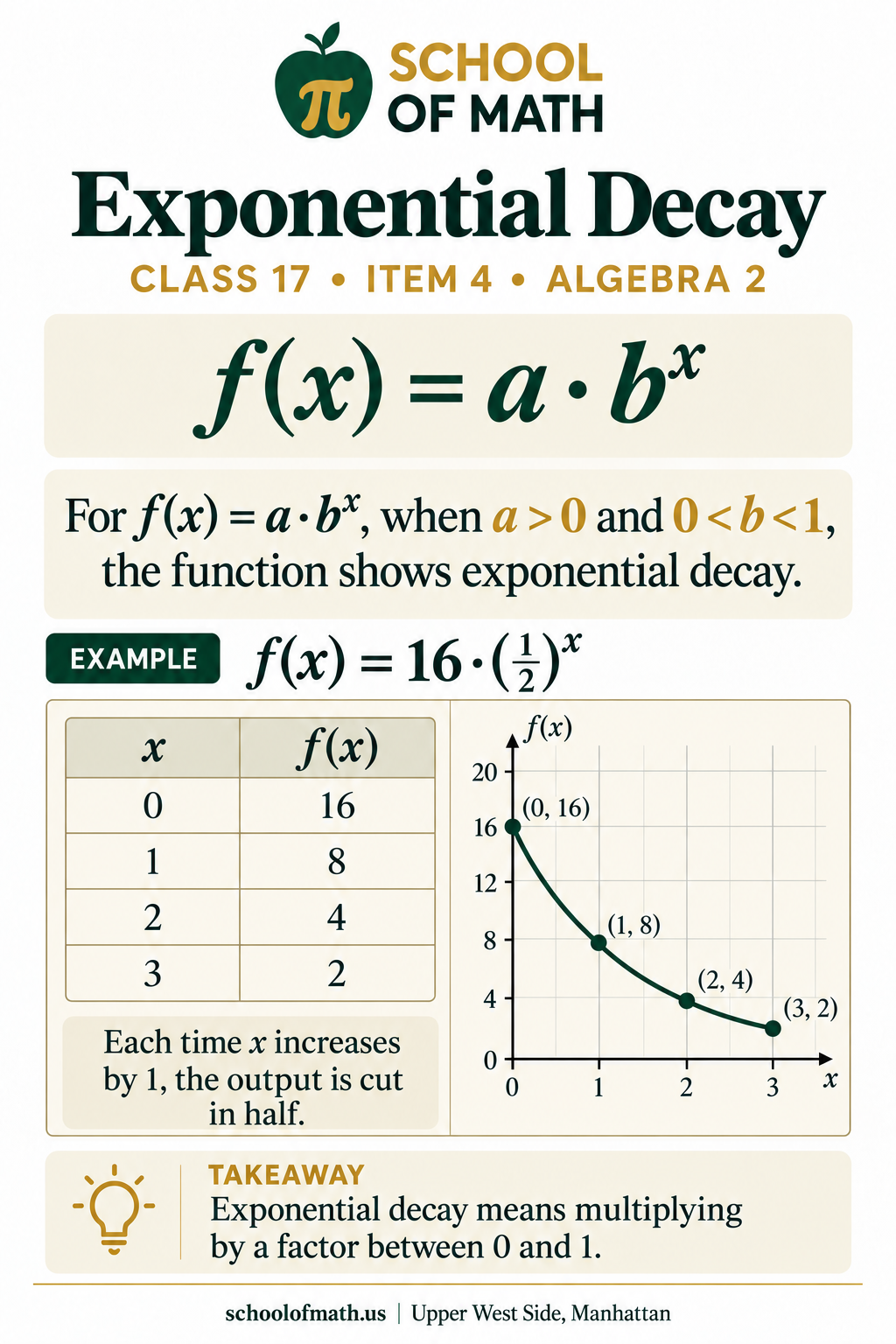
When \(a>0\) and \(0<b<1\), \(ab^x\) decreases while staying positive. A decay rate \(r\) uses the multiplier \(1-r\), the fraction that remains.
A quantity that loses 30% retains 70%, so its base is 0.70. A pure exponential decay model never becomes exactly zero at a finite input, although a real-world measurement may eventually round to zero.
Practice: try these five questions
Q16
Evaluate f(3) exactly. Show the power before multiplying.
Answer
\(f(3)=3\)
Substitute the requested input for x.
\[f(3)=81\cdot\left(\frac{1}{3}\right)^{3}\]Evaluate the power. For a negative exponent, take the reciprocal of the corresponding positive power.
\[\left(\frac{1}{3}\right)^{3}=\frac{1}{27}\]Multiply by the coefficient.
\[81\cdot\frac{1}{27}=3\]
Check and interpret
Exponentiation happens before multiplication. The output one step later would be \(1\), which is \(\frac{1}{3}\) times this answer.
Q17
Identify the initial value and multiplier. State growth or decay and the percentage change per one-unit increase in x.
Answer
Initial value \(500\); factor \(\frac{22}{25}\); decay of \(12\)% per step.
Set x equal to zero; every positive base to the zero power equals 1.
\[f(0)=500\cdot1=500\]The base is the repeated multiplier, not the percentage rate.
\[b=\frac{22}{25}\]Subtract 1 from the base for growth; subtract the base from 1 for decay.
\[r=1-b=\frac{3}{25}\]
Check and interpret
The next output is \(f(1)=440\). Dividing by the initial output gives \(\frac{22}{25}\), the stated multiplier.
Q18
A sample starts at 320 grams and loses 25% of its mass each hour. Write an exponential model and find the amount after 2 hours.
Answer
\(A(t)=320\cdot \left(\frac{3}{4}\right)^{t}\); after 2 hours: 180 grams (model prediction).
Define t as the number of hours since the starting measurement. The initial amount is 320 grams.
Convert the rate to a decimal and form the repeated multiplier.
\[r=\frac{1}{4},\quad b=1-\frac{1}{4}=\frac{3}{4}\]Use the starting amount times the multiplier raised to the number of periods. The model uses t ≥ 0.
\[A(t)=320\cdot \left(\frac{3}{4}\right)^{t}\]Substitute the requested time. Keep full precision until the final answer.
\[A(2)=320\left(\frac{3}{4}\right)^{2}=180\]
Check and interpret
The model gives \(A(0)=320\). Each new period multiplies the previous amount by \(\frac{3}{4}\), rather than adding or subtracting the same fixed amount.
Q19
A quantity halves every 3 hours, starting at 96 units. Write a model in hours and find the amount after 9 hours.
Answer
\(A(t)=96(1/2)^{t/3}\); after 9 hours: 12 units.
One factor of one-half is applied for each 3-hour interval. The number of intervals is t/3.
Write the model.
\[A(t)=96\left(\frac12\right)^{t/3}\]Nine hours contains three half-life intervals.
\[A(9)=96\left(\frac12\right)^3=12\]
Check and interpret
The sequence at 0, 3, 6, 9 hours is 96, 48, 24, 12. Using t instead of t/3 would halve the quantity too frequently.
Q20
Will this model ever equal zero at a finite real input? Explain using the factors.
Answer
No. The output is positive for every finite real x.
The base is positive, so every finite real power of it is positive.
\[(0.6)^x>0\]Multiplying by the positive coefficient keeps the result positive.
\[45(0.6)^x>0\]Because the base is less than 1, the output approaches 0 as x increases without bound.
Check and interpret
The line y = 0 is a horizontal asymptote, not a finite x-intercept.
Converting rates and factors
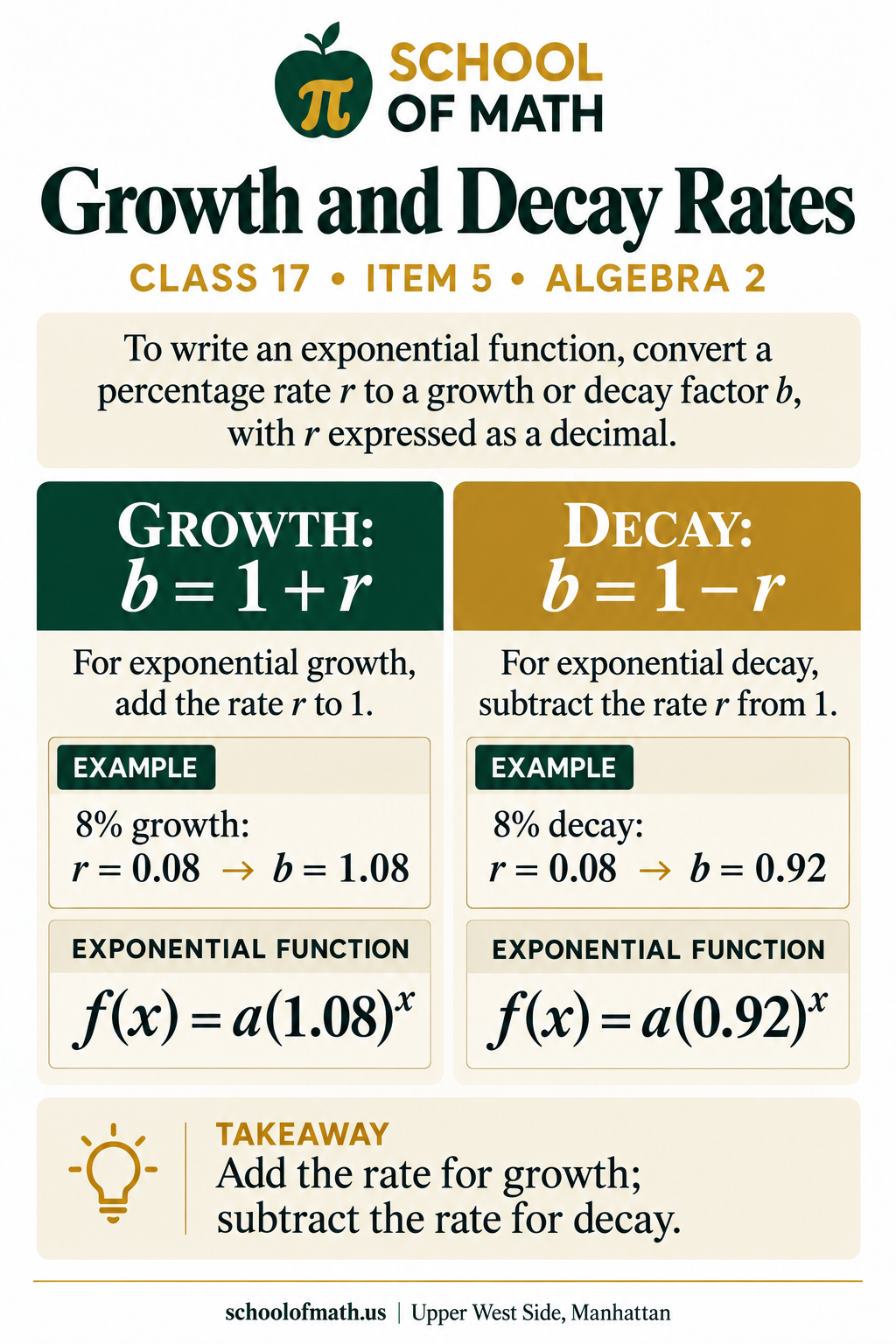
Convert a percentage to a decimal by dividing by 100. Growth uses \(b=1+r\); decay uses \(b=1-r\). Reverse the process with \(r=b-1\) for growth or \(r=1-b\) for decay.
The rate is tied to one unit of the exponent. If two models use different time units, convert the periods before comparing their factors. A 10% increase followed by a 10% decrease does not return to the starting amount.
Practice: try these five questions
Q21
A quantity increases by 12% each period. Find the multiplier and write a model with initial amount 240.
Answer
\(b=\frac{28}{25}\), \(A(t)=240\cdot \left(\frac{28}{25}\right)^{t}\)
Write the percent as a decimal.
\[r=\frac{12}{100}=\frac{3}{25}\]A growth multiplier adds the rate to 1; a decay multiplier subtracts it from 1.
\[b=1+\frac{3}{25}=\frac{28}{25}\]Multiply the initial value by one copy of the factor for each elapsed period.
\[A(t)=240\cdot \left(\frac{28}{25}\right)^{t}\]
Check and interpret
After one period the model gives \(\frac{1344}{5}\). The difference from 240 is \(\frac{144}{5}\), which is 12% of 240.
Q22
A quantity decreases by 18% each period. Find the multiplier and write a model with initial amount 240.
Answer
\(b=\frac{41}{50}\), \(A(t)=240\cdot \left(\frac{41}{50}\right)^{t}\)
Write the percent as a decimal.
\[r=\frac{18}{100}=\frac{9}{50}\]A growth multiplier adds the rate to 1; a decay multiplier subtracts it from 1.
\[b=1-\frac{9}{50}=\frac{41}{50}\]Multiply the initial value by one copy of the factor for each elapsed period.
\[A(t)=240\cdot \left(\frac{41}{50}\right)^{t}\]
Check and interpret
After one period the model gives \(\frac{984}{5}\). The difference from 240 is \(\frac{216}{5}\), which is 18% of 240.
Q23
Identify the initial value and multiplier. State growth or decay and the percentage change per one-unit increase in x.
Answer
Initial value \(240\); factor \(\frac{207}{200}\); growth of \(\frac{7}{2}\)% per step.
Set x equal to zero; every positive base to the zero power equals 1.
\[f(0)=240\cdot1=240\]The base is the repeated multiplier, not the percentage rate.
\[b=\frac{207}{200}\]Subtract 1 from the base for growth; subtract the base from 1 for decay.
\[r=b-1=\frac{7}{200}\]
Check and interpret
The next output is \(f(1)=\frac{1242}{5}\). Dividing by the initial output gives \(\frac{207}{200}\), the stated multiplier.
Q24
Identify the initial value and multiplier. State growth or decay and the percentage change per one-unit increase in x.
Answer
Initial value \(240\); factor \(\frac{37}{40}\); decay of \(\frac{15}{2}\)% per step.
Set x equal to zero; every positive base to the zero power equals 1.
\[f(0)=240\cdot1=240\]The base is the repeated multiplier, not the percentage rate.
\[b=\frac{37}{40}\]Subtract 1 from the base for growth; subtract the base from 1 for decay.
\[r=1-b=\frac{3}{40}\]
Check and interpret
The next output is \(f(1)=222\). Dividing by the initial output gives \(\frac{37}{40}\), the stated multiplier.
Q25
A quantity increases by 10% and then decreases by 10%. Find the overall multiplier and net percentage change.
Answer
Overall factor 0.99; net decrease 1%.
Translate each percentage change into its factor.
\[1+0.10=1.10,\quad1-0.10=0.90\]Multiply the factors; the second percentage applies to the changed amount.
\[1.10(0.90)=0.99\]Convert the remaining fraction to a net loss.
\[1-0.99=0.01=1\%\]
Check and interpret
Starting with 100 gives 110 and then 99. The 10% decrease is 11, not 10.
Tables of values and negative inputs
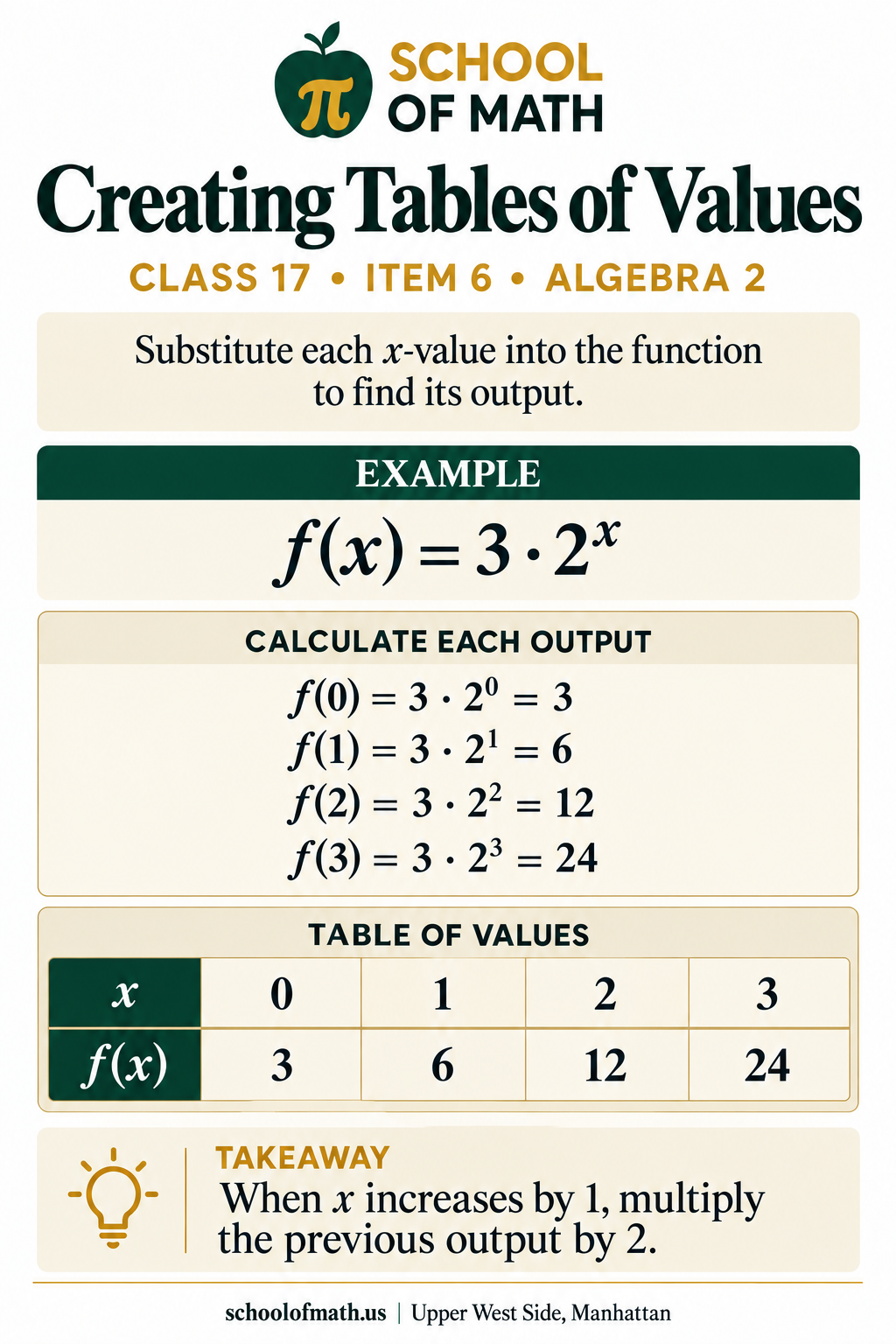
Evaluate exponents before multiplying. For a positive base, \(b^0=1\) and \(b^{-n}=1/b^n\). A negative exponent means a reciprocal, not a negative output.
For equally spaced inputs with step 1, unshifted exponential outputs have constant ratio \(b\). If the inputs are two units apart, the ratio is \(b^2\); unequal input steps cannot be compared with a single-step ratio.
Practice: try these five questions
Q26
Make a table for x = −2, −1, 0, 1, 2. Explain the pattern between consecutive outputs.
Answer
\((-2,\frac{2}{9})\), \((-1,\frac{2}{3})\), \((0,2)\), \((1,6)\), \((2,18)\)
Substitute x = -2. Evaluate the exponent, then multiply and apply any vertical shift.
\[f(-2)=2\cdot \left(3\right)^{(-2)}=\frac{2}{9}\]Substitute x = -1. Evaluate the exponent, then multiply and apply any vertical shift.
\[f(-1)=2\cdot \left(3\right)^{(-1)}=\frac{2}{3}\]Substitute x = 0. Evaluate the exponent, then multiply and apply any vertical shift.
\[f(0)=2\cdot \left(3\right)^{(0)}=2\]Substitute x = 1. Evaluate the exponent, then multiply and apply any vertical shift.
\[f(1)=2\cdot \left(3\right)^{(1)}=6\]Substitute x = 2. Evaluate the exponent, then multiply and apply any vertical shift.
\[f(2)=2\cdot \left(3\right)^{(2)}=18\]For equally spaced inputs, divide each output by the preceding output to recover the base.
\[\frac{\frac{2}{3}}{\frac{2}{9}}=3\]
Check and interpret
The ratio of consecutive nonzero outputs is \(3\). Negative inputs do not mean negative outputs when the coefficient is positive.
Q27
Make a table for x = −2, −1, 0, 1, 2. Explain the pattern between consecutive outputs.
Answer
\((-2,48)\), \((-1,24)\), \((0,12)\), \((1,6)\), \((2,3)\)
Substitute x = -2. Evaluate the exponent, then multiply and apply any vertical shift.
\[f(-2)=12\cdot \left(\frac{1}{2}\right)^{(-2)}=48\]Substitute x = -1. Evaluate the exponent, then multiply and apply any vertical shift.
\[f(-1)=12\cdot \left(\frac{1}{2}\right)^{(-1)}=24\]Substitute x = 0. Evaluate the exponent, then multiply and apply any vertical shift.
\[f(0)=12\cdot \left(\frac{1}{2}\right)^{(0)}=12\]Substitute x = 1. Evaluate the exponent, then multiply and apply any vertical shift.
\[f(1)=12\cdot \left(\frac{1}{2}\right)^{(1)}=6\]Substitute x = 2. Evaluate the exponent, then multiply and apply any vertical shift.
\[f(2)=12\cdot \left(\frac{1}{2}\right)^{(2)}=3\]For equally spaced inputs, divide each output by the preceding output to recover the base.
\[\frac{24}{48}=\frac{1}{2}\]
Check and interpret
The ratio of consecutive nonzero outputs is \(\frac{1}{2}\). Negative inputs do not mean negative outputs when the coefficient is positive.
Q28
Make a table for x = −2, −1, 0, 1, 2. Explain the pattern between consecutive outputs.
Answer
\((-2,\frac{3}{2})\), \((-1,3)\), \((0,6)\), \((1,12)\), \((2,24)\)
Substitute x = -2. Evaluate the exponent, then multiply and apply any vertical shift.
\[f(-2)=6\cdot \left(2\right)^{(-2)}=\frac{3}{2}\]Substitute x = -1. Evaluate the exponent, then multiply and apply any vertical shift.
\[f(-1)=6\cdot \left(2\right)^{(-1)}=3\]Substitute x = 0. Evaluate the exponent, then multiply and apply any vertical shift.
\[f(0)=6\cdot \left(2\right)^{(0)}=6\]Substitute x = 1. Evaluate the exponent, then multiply and apply any vertical shift.
\[f(1)=6\cdot \left(2\right)^{(1)}=12\]Substitute x = 2. Evaluate the exponent, then multiply and apply any vertical shift.
\[f(2)=6\cdot \left(2\right)^{(2)}=24\]For equally spaced inputs, divide each output by the preceding output to recover the base.
\[\frac{3}{\frac{3}{2}}=2\]
Check and interpret
The ratio of consecutive nonzero outputs is \(2\). Negative inputs do not mean negative outputs when the coefficient is positive.
Q29
Make a table for x = −2, −1, 0, 1, 2. Explain the pattern between consecutive outputs.
Answer
\((-2,81)\), \((-1,27)\), \((0,9)\), \((1,3)\), \((2,1)\)
Substitute x = -2. Evaluate the exponent, then multiply and apply any vertical shift.
\[f(-2)=9\cdot \left(\frac{1}{3}\right)^{(-2)}=81\]Substitute x = -1. Evaluate the exponent, then multiply and apply any vertical shift.
\[f(-1)=9\cdot \left(\frac{1}{3}\right)^{(-1)}=27\]Substitute x = 0. Evaluate the exponent, then multiply and apply any vertical shift.
\[f(0)=9\cdot \left(\frac{1}{3}\right)^{(0)}=9\]Substitute x = 1. Evaluate the exponent, then multiply and apply any vertical shift.
\[f(1)=9\cdot \left(\frac{1}{3}\right)^{(1)}=3\]Substitute x = 2. Evaluate the exponent, then multiply and apply any vertical shift.
\[f(2)=9\cdot \left(\frac{1}{3}\right)^{(2)}=1\]For equally spaced inputs, divide each output by the preceding output to recover the base.
\[\frac{27}{81}=\frac{1}{3}\]
Check and interpret
The ratio of consecutive nonzero outputs is \(\frac{1}{3}\). Negative inputs do not mean negative outputs when the coefficient is positive.
Q30
At inputs 0, 2, 4, the outputs are 5, 20, 80. Find the positive base per one-unit step and the missing outputs at x = 1 and x = 3.
Answer
\(f(x)=5\cdot2^x\); missing outputs: 10 and 40.
The ratio between adjacent listed outputs spans two input units.
\[b^2=20/5=80/20=4\]Take the positive square root to recover the one-step multiplier.
\[b=2\]Use initial value 5 and evaluate the missing inputs.
\[f(1)=5\cdot2=10,\quad f(3)=5\cdot8=40\]
Check and interpret
The full sequence at inputs 0, 1, 2, 3, 4 is 5, 10, 20, 40, 80.
Graphing from exact points
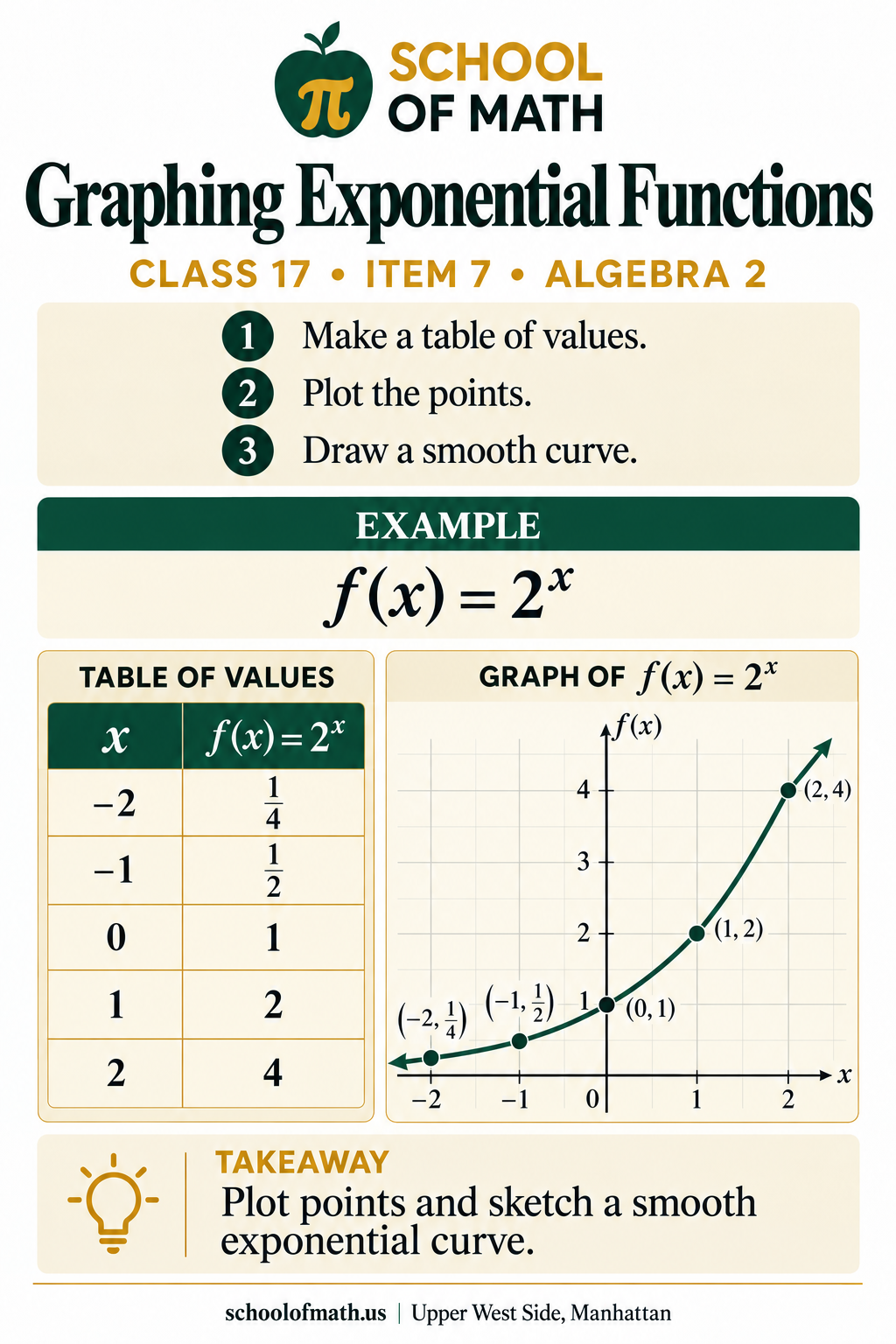
Build a table that includes zero, positive inputs, and negative inputs. Label a consistent scale on both axes, plot the points, and draw a smooth curve that approaches the horizontal asymptote.
For a positive unshifted exponential, the y-intercept is \((0,a)\), the range is positive, and the graph has no x-intercept. The plotted window is only part of an infinite curve; it does not restrict the function’s mathematical domain.
Practice: try these five questions
Q31
Sketch the graph and state its domain, range, y-intercept, horizontal asymptote, and increasing/decreasing behavior.
Answer
Domain: all real numbers; range: \(0<y\); y-intercept: \((0,1)\); asymptote: \(y=0\); increasing.
Substitute x = -2. Evaluate the exponent, then multiply and apply any vertical shift.
\[f(-2)=\left(3\right)^{(-2)}=\frac{1}{9}\]Substitute x = -1. Evaluate the exponent, then multiply and apply any vertical shift.
\[f(-1)=\left(3\right)^{(-1)}=\frac{1}{3}\]Substitute x = 0. Evaluate the exponent, then multiply and apply any vertical shift.
\[f(0)=\left(3\right)^{(0)}=1\]Substitute x = 1. Evaluate the exponent, then multiply and apply any vertical shift.
\[f(1)=\left(3\right)^{(1)}=3\]Substitute x = 2. Evaluate the exponent, then multiply and apply any vertical shift.
\[f(2)=\left(3\right)^{(2)}=9\]A positive base has a defined real exponential for every real input. Its exponential factor is always positive, so the coefficient determines which side of the shifted asymptote the graph occupies.
\[\text{Domain: }(-\infty,\infty)\]As the exponential factor approaches zero, only the vertical shift remains. The curve does not reach that horizontal asymptote.
\[y=0\]Set x = 0 to find the y-intercept.
\[f(0)=1\]Plot the calculated points and join them with a smooth curve, not straight line segments. Extend both tails consistently with the asymptote.
Check and interpret
The ratio of consecutive nonzero outputs is \(3\). Negative inputs do not mean negative outputs when the coefficient is positive.
Q32
Sketch the graph and state its domain, range, y-intercept, horizontal asymptote, and increasing/decreasing behavior.
Answer
Domain: all real numbers; range: \(0<y\); y-intercept: \((0,4)\); asymptote: \(y=0\); decreasing.
Substitute x = -2. Evaluate the exponent, then multiply and apply any vertical shift.
\[f(-2)=4\cdot \left(\frac{1}{2}\right)^{(-2)}=16\]Substitute x = -1. Evaluate the exponent, then multiply and apply any vertical shift.
\[f(-1)=4\cdot \left(\frac{1}{2}\right)^{(-1)}=8\]Substitute x = 0. Evaluate the exponent, then multiply and apply any vertical shift.
\[f(0)=4\cdot \left(\frac{1}{2}\right)^{(0)}=4\]Substitute x = 1. Evaluate the exponent, then multiply and apply any vertical shift.
\[f(1)=4\cdot \left(\frac{1}{2}\right)^{(1)}=2\]Substitute x = 2. Evaluate the exponent, then multiply and apply any vertical shift.
\[f(2)=4\cdot \left(\frac{1}{2}\right)^{(2)}=1\]A positive base has a defined real exponential for every real input. Its exponential factor is always positive, so the coefficient determines which side of the shifted asymptote the graph occupies.
\[\text{Domain: }(-\infty,\infty)\]As the exponential factor approaches zero, only the vertical shift remains. The curve does not reach that horizontal asymptote.
\[y=0\]Set x = 0 to find the y-intercept.
\[f(0)=4\]Plot the calculated points and join them with a smooth curve, not straight line segments. Extend both tails consistently with the asymptote.
Check and interpret
The ratio of consecutive nonzero outputs is \(\frac{1}{2}\). Negative inputs do not mean negative outputs when the coefficient is positive.
Q33
Sketch the graph and state its domain, range, y-intercept, horizontal asymptote, and increasing/decreasing behavior.
Answer
Domain: all real numbers; range: \(0<y\); y-intercept: \((0,4)\); asymptote: \(y=0\); increasing.
Substitute x = -2. Evaluate the exponent, then multiply and apply any vertical shift.
\[f(-2)=4\cdot \left(2\right)^{(-2)}=1\]Substitute x = -1. Evaluate the exponent, then multiply and apply any vertical shift.
\[f(-1)=4\cdot \left(2\right)^{(-1)}=2\]Substitute x = 0. Evaluate the exponent, then multiply and apply any vertical shift.
\[f(0)=4\cdot \left(2\right)^{(0)}=4\]Substitute x = 1. Evaluate the exponent, then multiply and apply any vertical shift.
\[f(1)=4\cdot \left(2\right)^{(1)}=8\]Substitute x = 2. Evaluate the exponent, then multiply and apply any vertical shift.
\[f(2)=4\cdot \left(2\right)^{(2)}=16\]A positive base has a defined real exponential for every real input. Its exponential factor is always positive, so the coefficient determines which side of the shifted asymptote the graph occupies.
\[\text{Domain: }(-\infty,\infty)\]As the exponential factor approaches zero, only the vertical shift remains. The curve does not reach that horizontal asymptote.
\[y=0\]Set x = 0 to find the y-intercept.
\[f(0)=4\]Plot the calculated points and join them with a smooth curve, not straight line segments. Extend both tails consistently with the asymptote.
Check and interpret
The ratio of consecutive nonzero outputs is \(2\). Negative inputs do not mean negative outputs when the coefficient is positive.
Q34
Sketch the graph and state its domain, range, y-intercept, horizontal asymptote, and increasing/decreasing behavior.
Answer
Domain: all real numbers; range: \(0<y\); y-intercept: \((0,3)\); asymptote: \(y=0\); decreasing.
Substitute x = -2. Evaluate the exponent, then multiply and apply any vertical shift.
\[f(-2)=3\cdot \left(\frac{1}{3}\right)^{(-2)}=27\]Substitute x = -1. Evaluate the exponent, then multiply and apply any vertical shift.
\[f(-1)=3\cdot \left(\frac{1}{3}\right)^{(-1)}=9\]Substitute x = 0. Evaluate the exponent, then multiply and apply any vertical shift.
\[f(0)=3\cdot \left(\frac{1}{3}\right)^{(0)}=3\]Substitute x = 1. Evaluate the exponent, then multiply and apply any vertical shift.
\[f(1)=3\cdot \left(\frac{1}{3}\right)^{(1)}=1\]Substitute x = 2. Evaluate the exponent, then multiply and apply any vertical shift.
\[f(2)=3\cdot \left(\frac{1}{3}\right)^{(2)}=\frac{1}{3}\]A positive base has a defined real exponential for every real input. Its exponential factor is always positive, so the coefficient determines which side of the shifted asymptote the graph occupies.
\[\text{Domain: }(-\infty,\infty)\]As the exponential factor approaches zero, only the vertical shift remains. The curve does not reach that horizontal asymptote.
\[y=0\]Set x = 0 to find the y-intercept.
\[f(0)=3\]Plot the calculated points and join them with a smooth curve, not straight line segments. Extend both tails consistently with the asymptote.
Check and interpret
The ratio of consecutive nonzero outputs is \(\frac{1}{3}\). Negative inputs do not mean negative outputs when the coefficient is positive.
Q35
Sketch the graph and state its domain, range, y-intercept, horizontal asymptote, and increasing/decreasing behavior.
Answer
Domain: all real numbers; range: \(0<y\); y-intercept: \((0,1)\); asymptote: \(y=0\); decreasing.
Substitute x = -2. Evaluate the exponent, then multiply and apply any vertical shift.
\[f(-2)=\left(\frac{1}{2}\right)^{(-2)}=4\]Substitute x = -1. Evaluate the exponent, then multiply and apply any vertical shift.
\[f(-1)=\left(\frac{1}{2}\right)^{(-1)}=2\]Substitute x = 0. Evaluate the exponent, then multiply and apply any vertical shift.
\[f(0)=\left(\frac{1}{2}\right)^{(0)}=1\]Substitute x = 1. Evaluate the exponent, then multiply and apply any vertical shift.
\[f(1)=\left(\frac{1}{2}\right)^{(1)}=\frac{1}{2}\]Substitute x = 2. Evaluate the exponent, then multiply and apply any vertical shift.
\[f(2)=\left(\frac{1}{2}\right)^{(2)}=\frac{1}{4}\]A positive base has a defined real exponential for every real input. Its exponential factor is always positive, so the coefficient determines which side of the shifted asymptote the graph occupies.
\[\text{Domain: }(-\infty,\infty)\]As the exponential factor approaches zero, only the vertical shift remains. The curve does not reach that horizontal asymptote.
\[y=0\]Set x = 0 to find the y-intercept.
\[f(0)=1\]Plot the calculated points and join them with a smooth curve, not straight line segments. Extend both tails consistently with the asymptote.
Check and interpret
The ratio of consecutive nonzero outputs is \(\frac{1}{2}\). Negative inputs do not mean negative outputs when the coefficient is positive.
Domain, range, and asymptotes
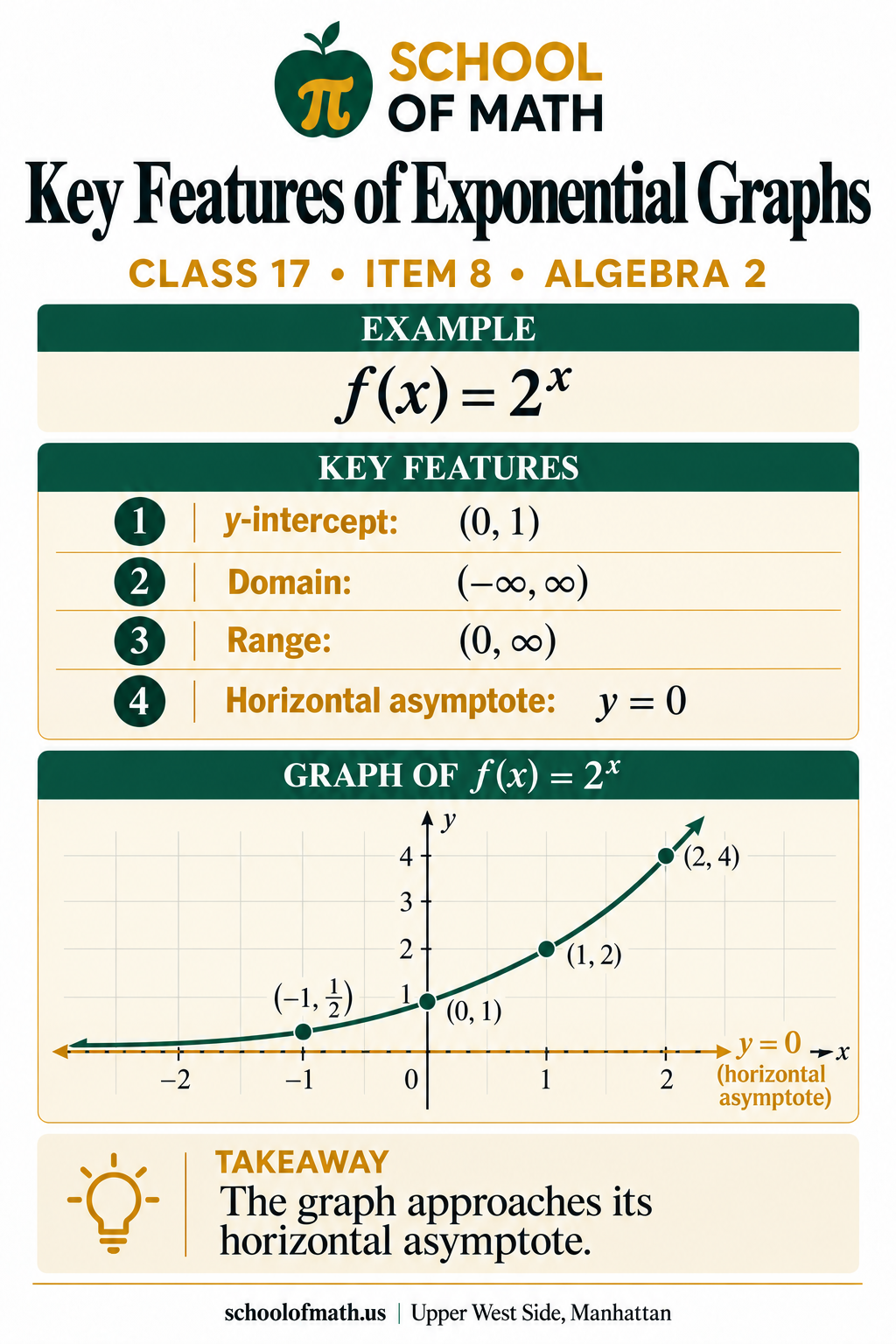
For \(ab^x+k\), the mathematical domain is all real numbers. The horizontal asymptote is \(y=k\). If \(a>0\), the range is \(y>k\); if \(a<0\), it is \(y<k\).
Find the y-intercept by substituting zero into the entire expression. If \(h\ne0\) in \(ab^{x-h}+k\), the y-intercept is \(ab^{-h}+k\), not simply \(a+k\). A vertical reflection reverses whether the curve is increasing or decreasing.
Practice: try these five questions
Q36
Sketch the graph and state its domain, range, y-intercept, horizontal asymptote, and increasing/decreasing behavior.
Answer
Domain: all real numbers; range: \(0<y\); y-intercept: \((0,5)\); asymptote: \(y=0\); increasing.
Substitute x = -2. Evaluate the exponent, then multiply and apply any vertical shift.
\[f(-2)=5\cdot \left(2\right)^{(-2)}=\frac{5}{4}\]Substitute x = -1. Evaluate the exponent, then multiply and apply any vertical shift.
\[f(-1)=5\cdot \left(2\right)^{(-1)}=\frac{5}{2}\]Substitute x = 0. Evaluate the exponent, then multiply and apply any vertical shift.
\[f(0)=5\cdot \left(2\right)^{(0)}=5\]Substitute x = 1. Evaluate the exponent, then multiply and apply any vertical shift.
\[f(1)=5\cdot \left(2\right)^{(1)}=10\]Substitute x = 2. Evaluate the exponent, then multiply and apply any vertical shift.
\[f(2)=5\cdot \left(2\right)^{(2)}=20\]A positive base has a defined real exponential for every real input. Its exponential factor is always positive, so the coefficient determines which side of the shifted asymptote the graph occupies.
\[\text{Domain: }(-\infty,\infty)\]As the exponential factor approaches zero, only the vertical shift remains. The curve does not reach that horizontal asymptote.
\[y=0\]Set x = 0 to find the y-intercept.
\[f(0)=5\]Plot the calculated points and join them with a smooth curve, not straight line segments. Extend both tails consistently with the asymptote.
Check and interpret
The ratio of consecutive nonzero outputs is \(2\). Negative inputs do not mean negative outputs when the coefficient is positive.
Q37
Sketch the graph and state its domain, range, y-intercept, horizontal asymptote, and increasing/decreasing behavior.
Answer
Domain: all real numbers; range: \(0<y\); y-intercept: \((0,8)\); asymptote: \(y=0\); decreasing.
Substitute x = -2. Evaluate the exponent, then multiply and apply any vertical shift.
\[f(-2)=8\cdot \left(\frac{1}{2}\right)^{(-2)}=32\]Substitute x = -1. Evaluate the exponent, then multiply and apply any vertical shift.
\[f(-1)=8\cdot \left(\frac{1}{2}\right)^{(-1)}=16\]Substitute x = 0. Evaluate the exponent, then multiply and apply any vertical shift.
\[f(0)=8\cdot \left(\frac{1}{2}\right)^{(0)}=8\]Substitute x = 1. Evaluate the exponent, then multiply and apply any vertical shift.
\[f(1)=8\cdot \left(\frac{1}{2}\right)^{(1)}=4\]Substitute x = 2. Evaluate the exponent, then multiply and apply any vertical shift.
\[f(2)=8\cdot \left(\frac{1}{2}\right)^{(2)}=2\]A positive base has a defined real exponential for every real input. Its exponential factor is always positive, so the coefficient determines which side of the shifted asymptote the graph occupies.
\[\text{Domain: }(-\infty,\infty)\]As the exponential factor approaches zero, only the vertical shift remains. The curve does not reach that horizontal asymptote.
\[y=0\]Set x = 0 to find the y-intercept.
\[f(0)=8\]Plot the calculated points and join them with a smooth curve, not straight line segments. Extend both tails consistently with the asymptote.
Check and interpret
The ratio of consecutive nonzero outputs is \(\frac{1}{2}\). Negative inputs do not mean negative outputs when the coefficient is positive.
Q38
Sketch the graph and state its domain, range, y-intercept, horizontal asymptote, and increasing/decreasing behavior.
Answer
Domain: all real numbers; range: \(2<y\); y-intercept: \((0,3)\); asymptote: \(y=2\); increasing.
Substitute x = -2. Evaluate the exponent, then multiply and apply any vertical shift.
\[f(-2)=\left(3\right)^{(-2)}+2=\frac{19}{9}\]Substitute x = -1. Evaluate the exponent, then multiply and apply any vertical shift.
\[f(-1)=\left(3\right)^{(-1)}+2=\frac{7}{3}\]Substitute x = 0. Evaluate the exponent, then multiply and apply any vertical shift.
\[f(0)=\left(3\right)^{(0)}+2=3\]Substitute x = 1. Evaluate the exponent, then multiply and apply any vertical shift.
\[f(1)=\left(3\right)^{(1)}+2=5\]Substitute x = 2. Evaluate the exponent, then multiply and apply any vertical shift.
\[f(2)=\left(3\right)^{(2)}+2=11\]A positive base has a defined real exponential for every real input. Its exponential factor is always positive, so the coefficient determines which side of the shifted asymptote the graph occupies.
\[\text{Domain: }(-\infty,\infty)\]As the exponential factor approaches zero, only the vertical shift remains. The curve does not reach that horizontal asymptote.
\[y=2\]Set x = 0 to find the y-intercept.
\[f(0)=3\]Plot the calculated points and join them with a smooth curve, not straight line segments. Extend both tails consistently with the asymptote.
Check and interpret
The shifted outputs satisfy \(\frac{f(x+1)-(2)}{f(x)-(2)}=3\). The graph stays strictly above y = 2.
Q39
Sketch the graph and state its domain, range, y-intercept, horizontal asymptote, and increasing/decreasing behavior.
Answer
Domain: all real numbers; range: \(y<0\); y-intercept: \((0,-2)\); asymptote: \(y=0\); decreasing.
Substitute x = -2. Evaluate the exponent, then multiply and apply any vertical shift.
\[f(-2)=-2\cdot \left(2\right)^{(-2)}=\frac{-1}{2}\]Substitute x = -1. Evaluate the exponent, then multiply and apply any vertical shift.
\[f(-1)=-2\cdot \left(2\right)^{(-1)}=-1\]Substitute x = 0. Evaluate the exponent, then multiply and apply any vertical shift.
\[f(0)=-2\cdot \left(2\right)^{(0)}=-2\]Substitute x = 1. Evaluate the exponent, then multiply and apply any vertical shift.
\[f(1)=-2\cdot \left(2\right)^{(1)}=-4\]Substitute x = 2. Evaluate the exponent, then multiply and apply any vertical shift.
\[f(2)=-2\cdot \left(2\right)^{(2)}=-8\]A positive base has a defined real exponential for every real input. Its exponential factor is always positive, so the coefficient determines which side of the shifted asymptote the graph occupies.
\[\text{Domain: }(-\infty,\infty)\]As the exponential factor approaches zero, only the vertical shift remains. The curve does not reach that horizontal asymptote.
\[y=0\]Set x = 0 to find the y-intercept.
\[f(0)=-2\]Plot the calculated points and join them with a smooth curve, not straight line segments. Extend both tails consistently with the asymptote.
Check and interpret
The ratio of consecutive nonzero outputs is \(2\). Negative inputs do not mean negative outputs when the coefficient is positive.
Q40
Sketch the graph and state its domain, range, y-intercept, horizontal asymptote, and increasing/decreasing behavior.
Answer
Domain: all real numbers; range: \(-1<y\); y-intercept: \((0,2)\); asymptote: \(y=-1\); decreasing.
Substitute x = -2. Evaluate the exponent, then multiply and apply any vertical shift.
\[f(-2)=3\cdot \left(\frac{1}{2}\right)^{(-2)}-1=11\]Substitute x = -1. Evaluate the exponent, then multiply and apply any vertical shift.
\[f(-1)=3\cdot \left(\frac{1}{2}\right)^{(-1)}-1=5\]Substitute x = 0. Evaluate the exponent, then multiply and apply any vertical shift.
\[f(0)=3\cdot \left(\frac{1}{2}\right)^{(0)}-1=2\]Substitute x = 1. Evaluate the exponent, then multiply and apply any vertical shift.
\[f(1)=3\cdot \left(\frac{1}{2}\right)^{(1)}-1=\frac{1}{2}\]Substitute x = 2. Evaluate the exponent, then multiply and apply any vertical shift.
\[f(2)=3\cdot \left(\frac{1}{2}\right)^{(2)}-1=\frac{-1}{4}\]A positive base has a defined real exponential for every real input. Its exponential factor is always positive, so the coefficient determines which side of the shifted asymptote the graph occupies.
\[\text{Domain: }(-\infty,\infty)\]As the exponential factor approaches zero, only the vertical shift remains. The curve does not reach that horizontal asymptote.
\[y=-1\]Set x = 0 to find the y-intercept.
\[f(0)=2\]Plot the calculated points and join them with a smooth curve, not straight line segments. Extend both tails consistently with the asymptote.
Check and interpret
The shifted outputs satisfy \(\frac{f(x+1)-(-1)}{f(x)-(-1)}=\frac{1}{2}\). The graph stays strictly above y = -1.
Transformations of exponential graphs
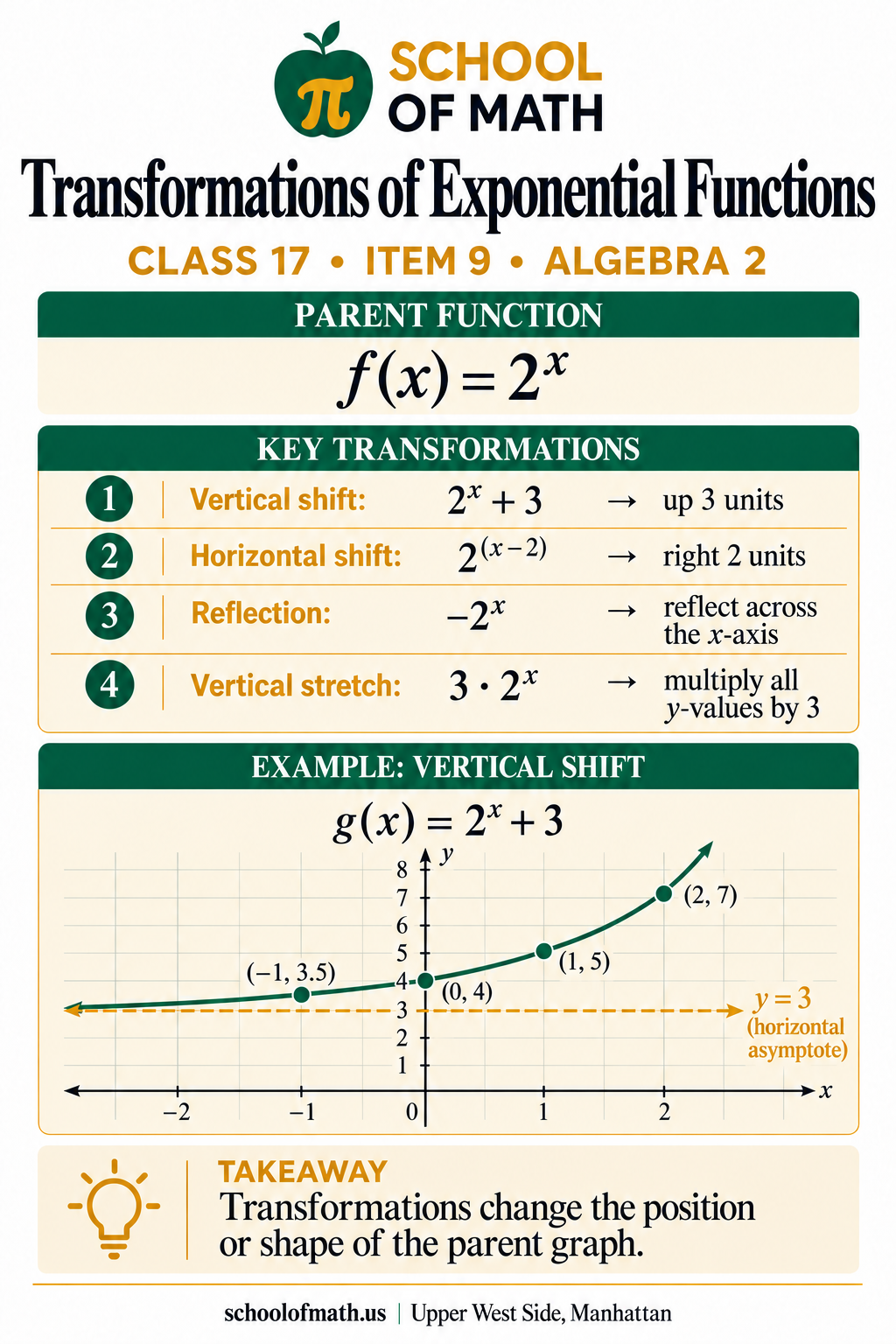
In \(g(x)=ab^{x-h}+k\), \(h\) shifts the graph horizontally, \(k\) shifts it vertically, and \(a\) scales its distance from the asymptote. A negative \(a\) reflects the parent graph across the x-axis before the vertical shift.
An input written \(x-2\) means right 2, while \(x+2\) means left 2. The expression \(-2^x\) means \(-(2^x)\), not \((-2)^x\). A negative base is excluded from this real-domain exponential family.
Practice: try these five questions
Q41
Describe the transformations of the parent exponential, then sketch the graph and state its domain, range, y-intercept, and horizontal asymptote.
Answer
Domain: all real numbers; range: \(4<y\); y-intercept: \((0,5)\); asymptote: \(y=4\); increasing.
Start with \(y=\left(2\right)^{x}\). Shift horizontally by 0 unit(s). Multiply outputs by \(1\), then shift vertically by 4 unit(s).
Substitute x = -2. Evaluate the exponent, then multiply and apply any vertical shift.
\[f(-2)=\left(2\right)^{(-2)}+4=\frac{17}{4}\]Substitute x = -1. Evaluate the exponent, then multiply and apply any vertical shift.
\[f(-1)=\left(2\right)^{(-1)}+4=\frac{9}{2}\]Substitute x = 0. Evaluate the exponent, then multiply and apply any vertical shift.
\[f(0)=\left(2\right)^{(0)}+4=5\]Substitute x = 1. Evaluate the exponent, then multiply and apply any vertical shift.
\[f(1)=\left(2\right)^{(1)}+4=6\]Substitute x = 2. Evaluate the exponent, then multiply and apply any vertical shift.
\[f(2)=\left(2\right)^{(2)}+4=8\]A positive base has a defined real exponential for every real input. Its exponential factor is always positive, so the coefficient determines which side of the shifted asymptote the graph occupies.
\[\text{Domain: }(-\infty,\infty)\]As the exponential factor approaches zero, only the vertical shift remains. The curve does not reach that horizontal asymptote.
\[y=4\]Set x = 0 to find the y-intercept.
\[f(0)=5\]Plot the calculated points and join them with a smooth curve, not straight line segments. Extend both tails consistently with the asymptote.
Check and interpret
The shifted outputs satisfy \(\frac{f(x+1)-(4)}{f(x)-(4)}=2\). The graph stays strictly above y = 4.
Q42
Describe the transformations of the parent exponential, then sketch the graph and state its domain, range, y-intercept, and horizontal asymptote.
Answer
Domain: all real numbers; range: \(0<y\); y-intercept: \((0,\frac{1}{2})\); asymptote: \(y=0\); increasing.
Start with \(y=\left(2\right)^{x}\). Shift right 1 unit(s). Multiply outputs by \(1\), then shift vertically by 0 unit(s).
Substitute x = -1. Evaluate the exponent, then multiply and apply any vertical shift.
\[f(-1)=\left(2\right)^{(-1)-1}=\frac{1}{4}\]Substitute x = 0. Evaluate the exponent, then multiply and apply any vertical shift.
\[f(0)=\left(2\right)^{(0)-1}=\frac{1}{2}\]Substitute x = 1. Evaluate the exponent, then multiply and apply any vertical shift.
\[f(1)=\left(2\right)^{(1)-1}=1\]Substitute x = 2. Evaluate the exponent, then multiply and apply any vertical shift.
\[f(2)=\left(2\right)^{(2)-1}=2\]Substitute x = 3. Evaluate the exponent, then multiply and apply any vertical shift.
\[f(3)=\left(2\right)^{(3)-1}=4\]A positive base has a defined real exponential for every real input. Its exponential factor is always positive, so the coefficient determines which side of the shifted asymptote the graph occupies.
\[\text{Domain: }(-\infty,\infty)\]As the exponential factor approaches zero, only the vertical shift remains. The curve does not reach that horizontal asymptote.
\[y=0\]Set x = 0 to find the y-intercept.
\[f(0)=\frac{1}{2}\]Plot the calculated points and join them with a smooth curve, not straight line segments. Extend both tails consistently with the asymptote.
Check and interpret
The ratio of consecutive nonzero outputs is \(2\). Negative inputs do not mean negative outputs when the coefficient is positive.
Q43
Describe the transformations of the parent exponential, then sketch the graph and state its domain, range, y-intercept, and horizontal asymptote.
Answer
Domain: all real numbers; range: \(y<3\); y-intercept: \((0,2)\); asymptote: \(y=3\); decreasing.
Start with \(y=\left(2\right)^{x}\). Shift horizontally by 0 unit(s). Multiply outputs by \(-1\) (reflect across the x-axis as well), then shift vertically by 3 unit(s).
Substitute x = -2. Evaluate the exponent, then multiply and apply any vertical shift.
\[f(-2)=-\left(2\right)^{(-2)}+3=\frac{11}{4}\]Substitute x = -1. Evaluate the exponent, then multiply and apply any vertical shift.
\[f(-1)=-\left(2\right)^{(-1)}+3=\frac{5}{2}\]Substitute x = 0. Evaluate the exponent, then multiply and apply any vertical shift.
\[f(0)=-\left(2\right)^{(0)}+3=2\]Substitute x = 1. Evaluate the exponent, then multiply and apply any vertical shift.
\[f(1)=-\left(2\right)^{(1)}+3=1\]Substitute x = 2. Evaluate the exponent, then multiply and apply any vertical shift.
\[f(2)=-\left(2\right)^{(2)}+3=-1\]A positive base has a defined real exponential for every real input. Its exponential factor is always positive, so the coefficient determines which side of the shifted asymptote the graph occupies.
\[\text{Domain: }(-\infty,\infty)\]As the exponential factor approaches zero, only the vertical shift remains. The curve does not reach that horizontal asymptote.
\[y=3\]Set x = 0 to find the y-intercept.
\[f(0)=2\]Plot the calculated points and join them with a smooth curve, not straight line segments. Extend both tails consistently with the asymptote.
Check and interpret
The shifted outputs satisfy \(\frac{f(x+1)-(3)}{f(x)-(3)}=2\). The graph stays strictly below y = 3.
Q44
Describe the transformations of the parent exponential, then sketch the graph and state its domain, range, y-intercept, and horizontal asymptote.
Answer
Domain: all real numbers; range: \(-2<y\); y-intercept: \((0,4)\); asymptote: \(y=-2\); increasing.
Start with \(y=\left(2\right)^{x}\). Shift left 1 unit(s). Multiply outputs by \(3\), then shift vertically by -2 unit(s).
Substitute x = -3. Evaluate the exponent, then multiply and apply any vertical shift.
\[f(-3)=3\cdot \left(2\right)^{(-3)+1}-2=\frac{-5}{4}\]Substitute x = -2. Evaluate the exponent, then multiply and apply any vertical shift.
\[f(-2)=3\cdot \left(2\right)^{(-2)+1}-2=\frac{-1}{2}\]Substitute x = -1. Evaluate the exponent, then multiply and apply any vertical shift.
\[f(-1)=3\cdot \left(2\right)^{(-1)+1}-2=1\]Substitute x = 0. Evaluate the exponent, then multiply and apply any vertical shift.
\[f(0)=3\cdot \left(2\right)^{(0)+1}-2=4\]Substitute x = 1. Evaluate the exponent, then multiply and apply any vertical shift.
\[f(1)=3\cdot \left(2\right)^{(1)+1}-2=10\]A positive base has a defined real exponential for every real input. Its exponential factor is always positive, so the coefficient determines which side of the shifted asymptote the graph occupies.
\[\text{Domain: }(-\infty,\infty)\]As the exponential factor approaches zero, only the vertical shift remains. The curve does not reach that horizontal asymptote.
\[y=-2\]Set x = 0 to find the y-intercept.
\[f(0)=4\]Plot the calculated points and join them with a smooth curve, not straight line segments. Extend both tails consistently with the asymptote.
Check and interpret
The shifted outputs satisfy \(\frac{f(x+1)-(-2)}{f(x)-(-2)}=2\). The graph stays strictly above y = -2.
Q45
Describe the transformations of the parent exponential, then sketch the graph and state its domain, range, y-intercept, and horizontal asymptote.
Answer
Domain: all real numbers; range: \(y<5\); y-intercept: \((0,1)\); asymptote: \(y=5\); increasing.
Start with \(y=\left(\frac{1}{2}\right)^{x}\). Shift right 1 unit(s). Multiply outputs by \(-2\) (reflect across the x-axis as well), then shift vertically by 5 unit(s).
Substitute x = -1. Evaluate the exponent, then multiply and apply any vertical shift.
\[f(-1)=-2\cdot \left(\frac{1}{2}\right)^{(-1)-1}+5=-3\]Substitute x = 0. Evaluate the exponent, then multiply and apply any vertical shift.
\[f(0)=-2\cdot \left(\frac{1}{2}\right)^{(0)-1}+5=1\]Substitute x = 1. Evaluate the exponent, then multiply and apply any vertical shift.
\[f(1)=-2\cdot \left(\frac{1}{2}\right)^{(1)-1}+5=3\]Substitute x = 2. Evaluate the exponent, then multiply and apply any vertical shift.
\[f(2)=-2\cdot \left(\frac{1}{2}\right)^{(2)-1}+5=4\]Substitute x = 3. Evaluate the exponent, then multiply and apply any vertical shift.
\[f(3)=-2\cdot \left(\frac{1}{2}\right)^{(3)-1}+5=\frac{9}{2}\]A positive base has a defined real exponential for every real input. Its exponential factor is always positive, so the coefficient determines which side of the shifted asymptote the graph occupies.
\[\text{Domain: }(-\infty,\infty)\]As the exponential factor approaches zero, only the vertical shift remains. The curve does not reach that horizontal asymptote.
\[y=5\]Set x = 0 to find the y-intercept.
\[f(0)=1\]Plot the calculated points and join them with a smooth curve, not straight line segments. Extend both tails consistently with the asymptote.
Check and interpret
The shifted outputs satisfy \(\frac{f(x+1)-(5)}{f(x)-(5)}=\frac{1}{2}\). The graph stays strictly below y = 5.
Applications and compound interest
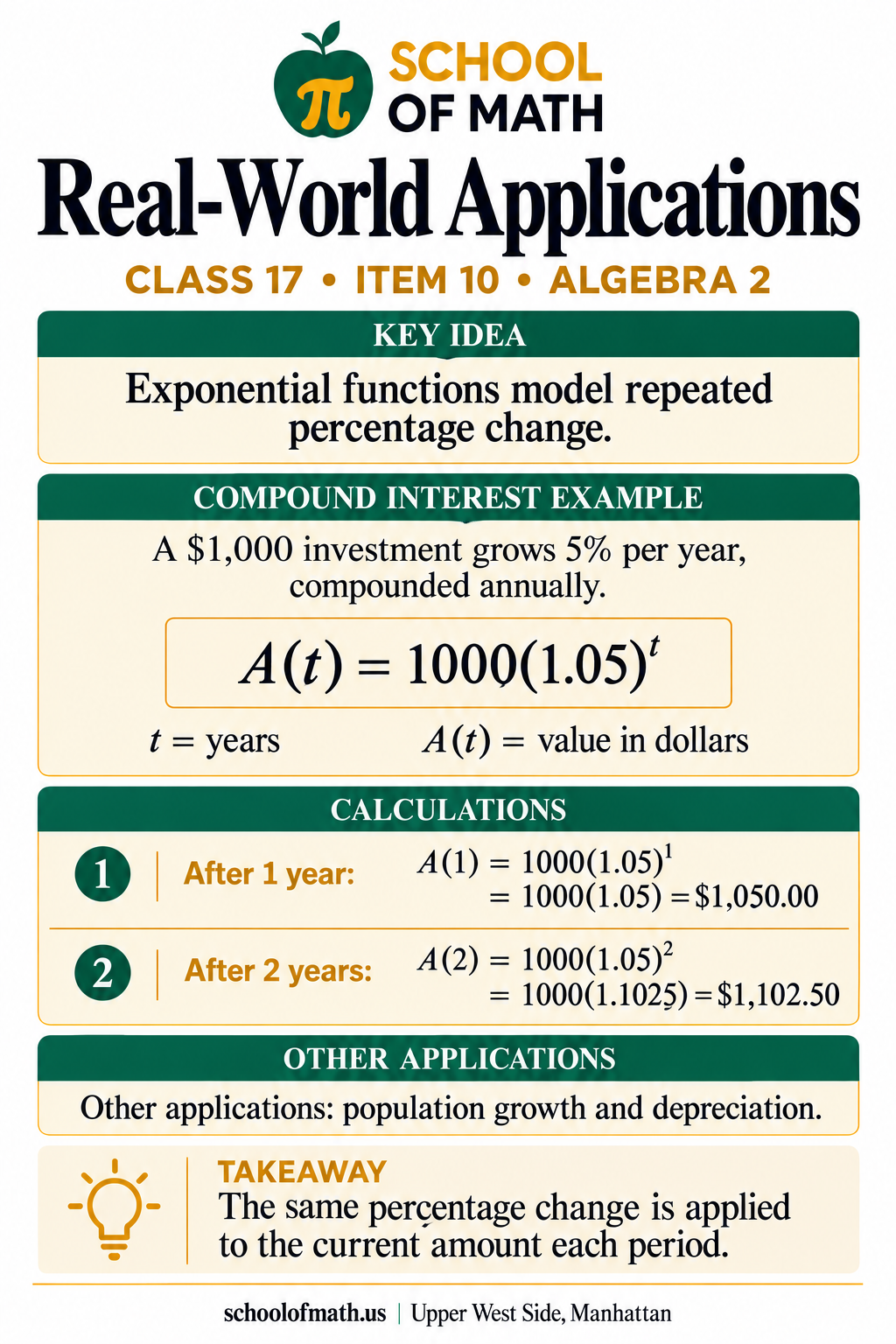
Choose units first: if \(t\) counts years, the base must represent one year. Repeated percent change follows \(A(t)=a(1\pm r)^t\), with \(r\) a decimal. Interpret both the starting amount and the time period in the story.
For nominal annual interest compounded \(n\) times per year, use \(A=P(1+r/n)^{nt}\). Divide the annual rate by \(n\) and multiply years by \(n\). Assume no extra deposits, withdrawals, or fees unless stated, and round money only at the end.
Practice: try these five questions
Q46
An account starts with $1,200 and earns 4% nominal annual interest compounded annually. With no deposits or withdrawals, find its balance and interest earned after 3 years. Round only the final dollar amounts to cents.
Answer
Balance: $1,349.84; interest earned: $149.84.
Use the compound-interest formula. P is principal, r is the annual decimal rate, n is the number of compounding periods per year, and t is years.
\[A=P\left(1+\frac{r}{n}\right)^{nt}\]Convert the annual rate and divide by the number of yearly compounding periods.
\[r=\frac{1}{25},\quad \frac{r}{n}=\frac{1}{25}\]Multiply periods per year by years; do not use years alone as the exponent.
\[nt=1\cdot3=3\]Substitute all values and calculate before rounding.
\[A=1200\left(1+\frac{\frac{1}{25}}{1}\right)^{3}\approx 1349.84\]Subtract the original principal to find the interest, using the unrounded balance before final rounding.
\[I=A-P\approx 149.84\]
Check and interpret
The per-period factor is \(\frac{26}{25}\). It is applied 3 times; the balance exceeds the $1,200 principal because the rate is positive.
Q47
A model population starts at 250 units and grows by 20% per day. Write an exponential model and find the amount after 2 days.
Answer
\(A(t)=250\cdot \left(\frac{6}{5}\right)^{t}\); after 2 days: 360 units (model prediction).
Define t as the number of days since the starting measurement. The initial amount is 250 units.
Convert the rate to a decimal and form the repeated multiplier.
\[r=\frac{1}{5},\quad b=1+\frac{1}{5}=\frac{6}{5}\]Use the starting amount times the multiplier raised to the number of periods. The model uses t ≥ 0.
\[A(t)=250\cdot \left(\frac{6}{5}\right)^{t}\]Substitute the requested time. Keep full precision until the final answer.
\[A(2)=250\left(\frac{6}{5}\right)^{2}=360\]
Check and interpret
The model gives \(A(0)=250\). Each new period multiplies the previous amount by \(\frac{6}{5}\), rather than adding or subtracting the same fixed amount.
Q48
A car starts at $18,000 and loses 15% of its value each year. Write an exponential model and find the amount after 2 years.
Answer
\(A(t)=18000\cdot \left(\frac{17}{20}\right)^{t}\); after 2 years: $13,005.00.
Define t as the number of years since the starting measurement. The initial amount is 18000 dollars.
Convert the rate to a decimal and form the repeated multiplier.
\[r=\frac{3}{20},\quad b=1-\frac{3}{20}=\frac{17}{20}\]Use the starting amount times the multiplier raised to the number of periods. The model uses t ≥ 0.
\[A(t)=18000\cdot \left(\frac{17}{20}\right)^{t}\]Substitute the requested time. Keep full precision until the final answer.
\[A(2)=18000\left(\frac{17}{20}\right)^{2}=13005\]
Check and interpret
The model gives \(A(0)=18000\). Each new period multiplies the previous amount by \(\frac{17}{20}\), rather than adding or subtracting the same fixed amount.
Q49
An account starts with $2,000 and earns 6% nominal annual interest compounded quarterly. With no deposits or withdrawals, find its balance and interest earned after 2 years. Round only the final dollar amounts to cents.
Answer
Balance: $2,252.99; interest earned: $252.99.
Use the compound-interest formula. P is principal, r is the annual decimal rate, n is the number of compounding periods per year, and t is years.
\[A=P\left(1+\frac{r}{n}\right)^{nt}\]Convert the annual rate and divide by the number of yearly compounding periods.
\[r=\frac{3}{50},\quad \frac{r}{n}=\frac{3}{200}\]Multiply periods per year by years; do not use years alone as the exponent.
\[nt=4\cdot2=8\]Substitute all values and calculate before rounding.
\[A=2000\left(1+\frac{\frac{3}{50}}{4}\right)^{8}\approx 2252.99\]Subtract the original principal to find the interest, using the unrounded balance before final rounding.
\[I=A-P\approx 252.99\]
Check and interpret
The per-period factor is \(\frac{203}{200}\). It is applied 8 times; the balance exceeds the $2,000 principal because the rate is positive.
Q50
An account starts with $1,500 and earns 4.8% nominal annual interest compounded monthly. With no deposits or withdrawals, find its balance and interest earned after 1 year. Round only the final dollar amounts to cents.
Answer
Balance: $1,573.61; interest earned: $73.61.
Use the compound-interest formula. P is principal, r is the annual decimal rate, n is the number of compounding periods per year, and t is years.
\[A=P\left(1+\frac{r}{n}\right)^{nt}\]Convert the annual rate and divide by the number of yearly compounding periods.
\[r=\frac{6}{125},\quad \frac{r}{n}=\frac{1}{250}\]Multiply periods per year by years; do not use years alone as the exponent.
\[nt=12\cdot1=12\]Substitute all values and calculate before rounding.
\[A=1500\left(1+\frac{\frac{6}{125}}{12}\right)^{12}\approx 1573.61\]Subtract the original principal to find the interest, using the unrounded balance before final rounding.
\[I=A-P\approx 73.61\]
Check and interpret
The per-period factor is \(\frac{251}{250}\). It is applied 12 times; the balance exceeds the $1,500 principal because the rate is positive.
Homework review
Review models, rates, tables, graph features, transformations, and compound interest. Show your reasoning.
R1
Identify the initial value and multiplier. State growth or decay and the percentage change per one-unit increase in x.
Answer
Initial value \(64\); factor \(\frac{3}{4}\); decay of \(25\)% per step.
Set x equal to zero; every positive base to the zero power equals 1.
\[f(0)=64\cdot1=64\]The base is the repeated multiplier, not the percentage rate.
\[b=\frac{3}{4}\]Subtract 1 from the base for growth; subtract the base from 1 for decay.
\[r=1-b=\frac{1}{4}\]
Check and interpret
The next output is \(f(1)=48\). Dividing by the initial output gives \(\frac{3}{4}\), the stated multiplier.
R2
Evaluate f(-3) exactly. Show the power before multiplying.
Answer
\(f(-3)=\frac{5}{4}\)
Substitute the requested input for x.
\[f(-3)=10\cdot\left(2\right)^{-3}\]Evaluate the power. For a negative exponent, take the reciprocal of the corresponding positive power.
\[\left(2\right)^{-3}=\frac{1}{8}\]Multiply by the coefficient.
\[10\cdot\frac{1}{8}=\frac{5}{4}\]
Check and interpret
Exponentiation happens before multiplication. The output one step later would be \(\frac{5}{2}\), which is \(2\) times this answer.
R3
A quantity increases by 2.5% each period. Find the multiplier and write a model with initial amount 240.
Answer
\(b=\frac{41}{40}\), \(A(t)=240\cdot \left(\frac{41}{40}\right)^{t}\)
Write the percent as a decimal.
\[r=\frac{2.5}{100}=\frac{1}{40}\]A growth multiplier adds the rate to 1; a decay multiplier subtracts it from 1.
\[b=1+\frac{1}{40}=\frac{41}{40}\]Multiply the initial value by one copy of the factor for each elapsed period.
\[A(t)=240\cdot \left(\frac{41}{40}\right)^{t}\]
Check and interpret
After one period the model gives \(246\). The difference from 240 is \(6\), which is 2.5% of 240.
R4
Make a table for x = −2, −1, 0, 1, 2. Explain the pattern between consecutive outputs.
Answer
\((-2,20)\), \((-1,10)\), \((0,5)\), \((1,\frac{5}{2})\), \((2,\frac{5}{4})\)
Substitute x = -2. Evaluate the exponent, then multiply and apply any vertical shift.
\[f(-2)=5\cdot \left(\frac{1}{2}\right)^{(-2)}=20\]Substitute x = -1. Evaluate the exponent, then multiply and apply any vertical shift.
\[f(-1)=5\cdot \left(\frac{1}{2}\right)^{(-1)}=10\]Substitute x = 0. Evaluate the exponent, then multiply and apply any vertical shift.
\[f(0)=5\cdot \left(\frac{1}{2}\right)^{(0)}=5\]Substitute x = 1. Evaluate the exponent, then multiply and apply any vertical shift.
\[f(1)=5\cdot \left(\frac{1}{2}\right)^{(1)}=\frac{5}{2}\]Substitute x = 2. Evaluate the exponent, then multiply and apply any vertical shift.
\[f(2)=5\cdot \left(\frac{1}{2}\right)^{(2)}=\frac{5}{4}\]For equally spaced inputs, divide each output by the preceding output to recover the base.
\[\frac{10}{20}=\frac{1}{2}\]
Check and interpret
The ratio of consecutive nonzero outputs is \(\frac{1}{2}\). Negative inputs do not mean negative outputs when the coefficient is positive.
R5
Sketch the graph and state its domain, range, y-intercept, horizontal asymptote, and increasing/decreasing behavior.
Answer
Domain: all real numbers; range: \(-4<y\); y-intercept: \((0,-2)\); asymptote: \(y=-4\); increasing.
Substitute x = -2. Evaluate the exponent, then multiply and apply any vertical shift.
\[f(-2)=2\cdot \left(3\right)^{(-2)}-4=\frac{-34}{9}\]Substitute x = -1. Evaluate the exponent, then multiply and apply any vertical shift.
\[f(-1)=2\cdot \left(3\right)^{(-1)}-4=\frac{-10}{3}\]Substitute x = 0. Evaluate the exponent, then multiply and apply any vertical shift.
\[f(0)=2\cdot \left(3\right)^{(0)}-4=-2\]Substitute x = 1. Evaluate the exponent, then multiply and apply any vertical shift.
\[f(1)=2\cdot \left(3\right)^{(1)}-4=2\]Substitute x = 2. Evaluate the exponent, then multiply and apply any vertical shift.
\[f(2)=2\cdot \left(3\right)^{(2)}-4=14\]A positive base has a defined real exponential for every real input. Its exponential factor is always positive, so the coefficient determines which side of the shifted asymptote the graph occupies.
\[\text{Domain: }(-\infty,\infty)\]As the exponential factor approaches zero, only the vertical shift remains. The curve does not reach that horizontal asymptote.
\[y=-4\]Set x = 0 to find the y-intercept.
\[f(0)=-2\]Plot the calculated points and join them with a smooth curve, not straight line segments. Extend both tails consistently with the asymptote.
Check and interpret
The shifted outputs satisfy \(\frac{f(x+1)-(-4)}{f(x)-(-4)}=3\). The graph stays strictly above y = -4.
R6
Describe the transformations of the parent exponential, then sketch the graph and state its domain, range, y-intercept, and horizontal asymptote.
Answer
Domain: all real numbers; range: \(y<1\); y-intercept: \((0,\frac{1}{4})\); asymptote: \(y=1\); decreasing.
Start with \(y=\left(2\right)^{x}\). Shift right 2 unit(s). Multiply outputs by \(-3\) (reflect across the x-axis as well), then shift vertically by 1 unit(s).
Substitute x = 0. Evaluate the exponent, then multiply and apply any vertical shift.
\[f(0)=-3\cdot \left(2\right)^{(0)-2}+1=\frac{1}{4}\]Substitute x = 1. Evaluate the exponent, then multiply and apply any vertical shift.
\[f(1)=-3\cdot \left(2\right)^{(1)-2}+1=\frac{-1}{2}\]Substitute x = 2. Evaluate the exponent, then multiply and apply any vertical shift.
\[f(2)=-3\cdot \left(2\right)^{(2)-2}+1=-2\]Substitute x = 3. Evaluate the exponent, then multiply and apply any vertical shift.
\[f(3)=-3\cdot \left(2\right)^{(3)-2}+1=-5\]Substitute x = 4. Evaluate the exponent, then multiply and apply any vertical shift.
\[f(4)=-3\cdot \left(2\right)^{(4)-2}+1=-11\]A positive base has a defined real exponential for every real input. Its exponential factor is always positive, so the coefficient determines which side of the shifted asymptote the graph occupies.
\[\text{Domain: }(-\infty,\infty)\]As the exponential factor approaches zero, only the vertical shift remains. The curve does not reach that horizontal asymptote.
\[y=1\]Set x = 0 to find the y-intercept.
\[f(0)=\frac{1}{4}\]Plot the calculated points and join them with a smooth curve, not straight line segments. Extend both tails consistently with the asymptote.
Check and interpret
The shifted outputs satisfy \(\frac{f(x+1)-(1)}{f(x)-(1)}=2\). The graph stays strictly below y = 1.
R7
An account starts with $800 and earns 5% nominal annual interest compounded quarterly. With no deposits or withdrawals, find its balance and interest earned after 2 years. Round only the final dollar amounts to cents.
Answer
Balance: $883.59; interest earned: $83.59.
Use the compound-interest formula. P is principal, r is the annual decimal rate, n is the number of compounding periods per year, and t is years.
\[A=P\left(1+\frac{r}{n}\right)^{nt}\]Convert the annual rate and divide by the number of yearly compounding periods.
\[r=\frac{1}{20},\quad \frac{r}{n}=\frac{1}{80}\]Multiply periods per year by years; do not use years alone as the exponent.
\[nt=4\cdot2=8\]Substitute all values and calculate before rounding.
\[A=800\left(1+\frac{\frac{1}{20}}{4}\right)^{8}\approx 883.59\]Subtract the original principal to find the interest, using the unrounded balance before final rounding.
\[I=A-P\approx 83.59\]
Check and interpret
The per-period factor is \(\frac{81}{80}\). It is applied 8 times; the balance exceeds the $800 principal because the rate is positive.
R8
An exponential model passes through (0, 20) and (2, 45). Find its equation and percentage growth per unit input.
Answer
\(f(x)=20(1.5)^x\); 50% growth.
The point at input zero gives the coefficient.
\[a=20\]The second point is two input units later.
\[20b^2=45\quad\Rightarrow\quad b^2=2.25\]Take the positive square root and convert the factor to a rate.
\[b=1.5,\quad r=1.5-1=0.5=50\%\]
Check and interpret
At x = 2, \(20(1.5)^2=20(2.25)=45\).
Homework word problems
Twelve problems progress from direct modeling to comparing plans and finding the first whole-period threshold. State units, interpret the result, and round only when requested.
W1
A pattern starts with 40 tiles and doubles the number of tiles each round. Write an exponential model and find the amount after 3 rounds.
Answer
\(A(t)=40\cdot \left(2\right)^{t}\); after 3 rounds: 320 tiles (model prediction).
Define t as the number of rounds since the starting measurement. The initial amount is 40 tiles.
Convert the rate to a decimal and form the repeated multiplier.
\[r=1,\quad b=1+1=2\]Use the starting amount times the multiplier raised to the number of periods. The model uses t ≥ 0.
\[A(t)=40\cdot \left(2\right)^{t}\]Substitute the requested time. Keep full precision until the final answer.
\[A(3)=40\left(2\right)^{3}=320\]
Check and interpret
The model gives \(A(0)=40\). Each new period multiplies the previous amount by \(2\), rather than adding or subtracting the same fixed amount.
W2
A container begins with 600 milliliters. It loses 10% of the remaining liquid each hour. Write an exponential model and find the amount after 2 hours.
Answer
\(A(t)=600\cdot \left(\frac{9}{10}\right)^{t}\); after 2 hours: 486 milliliters (model prediction).
Define t as the number of hours since the starting measurement. The initial amount is 600 milliliters.
Convert the rate to a decimal and form the repeated multiplier.
\[r=\frac{1}{10},\quad b=1-\frac{1}{10}=\frac{9}{10}\]Use the starting amount times the multiplier raised to the number of periods. The model uses t ≥ 0.
\[A(t)=600\cdot \left(\frac{9}{10}\right)^{t}\]Substitute the requested time. Keep full precision until the final answer.
\[A(2)=600\left(\frac{9}{10}\right)^{2}=486\]
Check and interpret
The model gives \(A(0)=600\). Each new period multiplies the previous amount by \(\frac{9}{10}\), rather than adding or subtracting the same fixed amount.
W3
A hypothetical account begins at $350 and earns 8% annual interest, compounded annually, with no deposits or withdrawals. Write an exponential model and find the amount after 2 years.
Answer
\(A(t)=350\cdot \left(\frac{27}{25}\right)^{t}\); after 2 years: $408.24.
Define t as the number of years since the starting measurement. The initial amount is 350 dollars.
Convert the rate to a decimal and form the repeated multiplier.
\[r=\frac{2}{25},\quad b=1+\frac{2}{25}=\frac{27}{25}\]Use the starting amount times the multiplier raised to the number of periods. The model uses t ≥ 0.
\[A(t)=350\cdot \left(\frac{27}{25}\right)^{t}\]Substitute the requested time. Keep full precision until the final answer.
\[A(2)=350\left(\frac{27}{25}\right)^{2}=\frac{10206}{25}\]
Check and interpret
The model gives \(A(0)=350\). Each new period multiplies the previous amount by \(\frac{27}{25}\), rather than adding or subtracting the same fixed amount.
W4
A laptop costs $2,400 and loses 25% of its current value each year. Write an exponential model and find the amount after 3 years.
Answer
\(A(t)=2400\cdot \left(\frac{3}{4}\right)^{t}\); after 3 years: $1,012.50.
Define t as the number of years since the starting measurement. The initial amount is 2400 dollars.
Convert the rate to a decimal and form the repeated multiplier.
\[r=\frac{1}{4},\quad b=1-\frac{1}{4}=\frac{3}{4}\]Use the starting amount times the multiplier raised to the number of periods. The model uses t ≥ 0.
\[A(t)=2400\cdot \left(\frac{3}{4}\right)^{t}\]Substitute the requested time. Keep full precision until the final answer.
\[A(3)=2400\left(\frac{3}{4}\right)^{3}=\frac{2025}{2}\]
Check and interpret
The model gives \(A(0)=2400\). Each new period multiplies the previous amount by \(\frac{3}{4}\), rather than adding or subtracting the same fixed amount.
W5
A culture has 150 cells at hour 0 and 600 cells at hour 2. Assuming constant exponential growth, find the hourly multiplier, a model, and the predicted count at hour 5.
Answer
\(N(t)=150\cdot2^t\); predicted count: 4,800 cells.
The two-hour ratio is 600/150 = 4, which equals the square of the hourly base.
\[b^2=4\]Use the positive root and initial amount.
\[b=2,\quad N(t)=150\cdot2^t\]Evaluate at hour 5.
\[N(5)=150\cdot32=4800\]
Check and interpret
The model predicts 150 cells at hour 0 and 600 at hour 2. In this context t is nonnegative elapsed time.
W6
An 80-milligram substance has a half-life of 6 hours. Write its remaining-mass model and find the mass after 18 hours.
Answer
\(M(t)=80(1/2)^{t/6}\); 10 milligrams.
Divide elapsed hours by the half-life to count halving periods.
\[\text{Number of half-lives}=t/6\]Use a factor of one-half for each period.
\[M(t)=80\left(\frac12\right)^{t/6}\]At 18 hours there are three halvings.
\[M(18)=80\left(\frac12\right)^3=10\]
Check and interpret
The masses at 0, 6, 12, 18 hours are 80, 40, 20, 10 milligrams. The context uses t ≥ 0.
W7
An account starts with $2,500 and earns 4% nominal annual interest compounded quarterly. With no deposits or withdrawals, find its balance and interest earned after 3 years. Round only the final dollar amounts to cents.
Answer
Balance: $2,817.06; interest earned: $317.06.
Use the compound-interest formula. P is principal, r is the annual decimal rate, n is the number of compounding periods per year, and t is years.
\[A=P\left(1+\frac{r}{n}\right)^{nt}\]Convert the annual rate and divide by the number of yearly compounding periods.
\[r=\frac{1}{25},\quad \frac{r}{n}=\frac{1}{100}\]Multiply periods per year by years; do not use years alone as the exponent.
\[nt=4\cdot3=12\]Substitute all values and calculate before rounding.
\[A=2500\left(1+\frac{\frac{1}{25}}{4}\right)^{12}\approx 2817.06\]Subtract the original principal to find the interest, using the unrounded balance before final rounding.
\[I=A-P\approx 317.06\]
Check and interpret
The per-period factor is \(\frac{101}{100}\). It is applied 12 times; the balance exceeds the $2,500 principal because the rate is positive.
W8
Two hypothetical savings plans start at $1,000. Plan A earns $50 simple interest each year. Plan B grows by 5% each year, compounded annually. Compare balances after 4 years, with no deposits or withdrawals.
Answer
Plan A: $1,200.00. Plan B: $1,215.51. Plan B is larger by $15.51.
Simple interest adds the same fixed amount each year.
\[A(t)=1000+50t,\quad A(4)=1200\]Compound growth multiplies the current balance each year.
\[B(t)=1000(1.05)^t\]Calculate using the power before rounding.
\[B(4)=1215.50625\approx1215.51\]Compare using unrounded amounts, then round the difference.
\[1215.50625-1200=15.50625\approx15.51\]
Check and interpret
Both plans reach $1,050 after one year. Later, Plan B earns interest on previous interest as well as on the original principal.
W9
A cup’s temperature in degrees Celsius follows the model below, where t is minutes after observation begins. Find its initial temperature, its predicted temperature after 3 minutes, and its long-run temperature.
Answer
Initially 80°C; after 3 minutes 51.696°C; long-run temperature approaches 22°C.
Substitute t = 0 into the entire model, including the vertical shift.
\[T(0)=22+58=80\]Evaluate the exponent first.
\[T(3)=22+58(0.512)=51.696\]The exponential term tends to zero as time increases, leaving the shift 22.
\[\text{Horizontal asymptote: }T=22\]
Check and interpret
The temperature stays above 22°C in this model. The 20% decay applies to the temperature difference from 22°C, not to the whole temperature.
W10
A town’s population model grows from 10,000 to 12,100 in 2 years. Find the annual growth rate and predict the population after a total of 3 years.
Answer
Annual growth rate: 10%; predicted population after 3 years: 13,310.
Use the initial population and the two-year observation.
\[10000b^2=12100\]Divide and take the positive square root.
\[b^2=1.21,\quad b=1.1\]Subtract 1 to find the annual growth rate.
\[r=1.1-1=0.1=10\%\]Use three total years, not three more years after the second observation.
\[P(3)=10000(1.1)^3=13310\]
Check and interpret
The two-year increase is 21%, not two independent additions of 10%. Compounding accounts for the extra 1%.
W11
Fund A starts at $200 and doubles every year. Fund B starts at $500 and grows by 25% per year. Assuming no deposits or withdrawals, determine the first whole year when Fund A exceeds Fund B.
Answer
The first whole year is year 2.
Write the two models.
\[A(t)=200\cdot2^t,\quad B(t)=500(1.25)^t\]Compare year 0 and year 1: A is still smaller.
\[A(0)=200<500=B(0)\]At year 1, A = 400 and B = 625, so no crossing yet.
At year 2, compare the calculated outputs.
\[A(2)=800>781.25=B(2)\]
Check and interpret
The ratio A(t)/B(t) equals 0.4(1.6)^t and increases with t. Checking years 0, 1, and 2 therefore identifies the first whole-year crossing.
W12
A $3,000 machine loses 20% of its value each year. What is the first whole year when its value is below $1,000? Show the two consecutive yearly values around the threshold.
Answer
Year 5 is the first whole year below $1,000.
Write the depreciation model.
\[V(t)=3000(0.8)^t\]At year 4 the value is still above the threshold.
\[V(4)=3000(0.4096)=1228.80\]At year 5 the value is below it.
\[V(5)=3000(0.32768)=983.04\]Because the positive model strictly decreases, all earlier years have larger values. These two consecutive years prove the first crossing.
Check and interpret
The factor 0.8 retains 80% each year. Do not subtract $600 repeatedly; each 20% loss is based on the current value.
Quick questions and answers
What makes a function exponential?
The variable is in the exponent of a fixed positive base other than 1. In an unshifted exponential, equal input steps produce a constant output ratio, not a constant difference.
How can I tell growth from decay?
For a positive initial value in abˣ, a base greater than 1 produces growth, while a base between 0 and 1 produces decay. A negative coefficient reflects the graph and reverses its increasing/decreasing direction.
Is the multiplier the percentage rate?
No. For growth, subtract 1 from the multiplier; for decay, subtract the multiplier from 1. Multiply the resulting decimal by 100 to express it as a percentage.
What does a negative exponent mean?
A negative exponent gives the reciprocal of the corresponding positive power. It does not make a positive-base exponential output negative.
How do shifts affect the asymptote and range?
For ab^(x−h)+k, the horizontal asymptote is y=k. The range lies above k when a is positive and below k when a is negative. Substitute zero into the entire formula for the y-intercept.
How does compounding more than once a year work?
Divide the nominal annual decimal rate by the number of compounding periods per year, then multiply the number of years by that same number for the exponent. Keep full precision until the final rounding.
Do I need to attend earlier classes?
No. This is an independent topic in a rolling course. The lesson includes explanations, practice, and worked answers for this topic.