Young Fermats — Algebra Ignite · Class 11 · Grades 7–8
Algebra 1 Class 11: Polynomials — Adding, Subtracting, Multiplying — 10 SOMATH Posters, Theory & 50 Practice Questions
The whole Algebra 1 polynomial-operations unit in one class. Ten SOMATH posters walk through what a polynomial is, how to identify terms, coefficients, and constants, how to classify polynomials, how to find the degree, combining like terms, adding, subtracting, multiplying monomials, distributive multiplication, and FOIL for two binomials. Under each poster you’ll find full theory notes and 5 practice questions with click-to-reveal step-by-step solutions — 50 questions total.
Class 11 of the SOMATH Algebra Ignite course
Enroll in Young Fermats — Algebra Ignite (Algebra 1)
This class pack is part of SOMATH’s 48-class Algebra Ignite rolling syllabus for grades 7–8, taught in small in-person groups on the Upper West Side. Join at any class number without losing the thread — students can start on Class 11 today. Book a free 30-minute evaluation at 226 W 79th St or call (646) 668-6151.
See the full Algebra Ignite course →What’s in this class
- Introduction to Polynomials
- Identifying Terms, Coefficients, and Constants
- Classifying Polynomials (Monomial, Binomial, Trinomial)
- Degree of a Polynomial
- Combining Like Terms
- Adding Polynomials
- Subtracting Polynomials
- Multiplying Monomials
- Multiplying a Monomial by a Polynomial (Distributive)
- Multiplying Two Binomials — The FOIL Method
1. Introduction to Polynomials
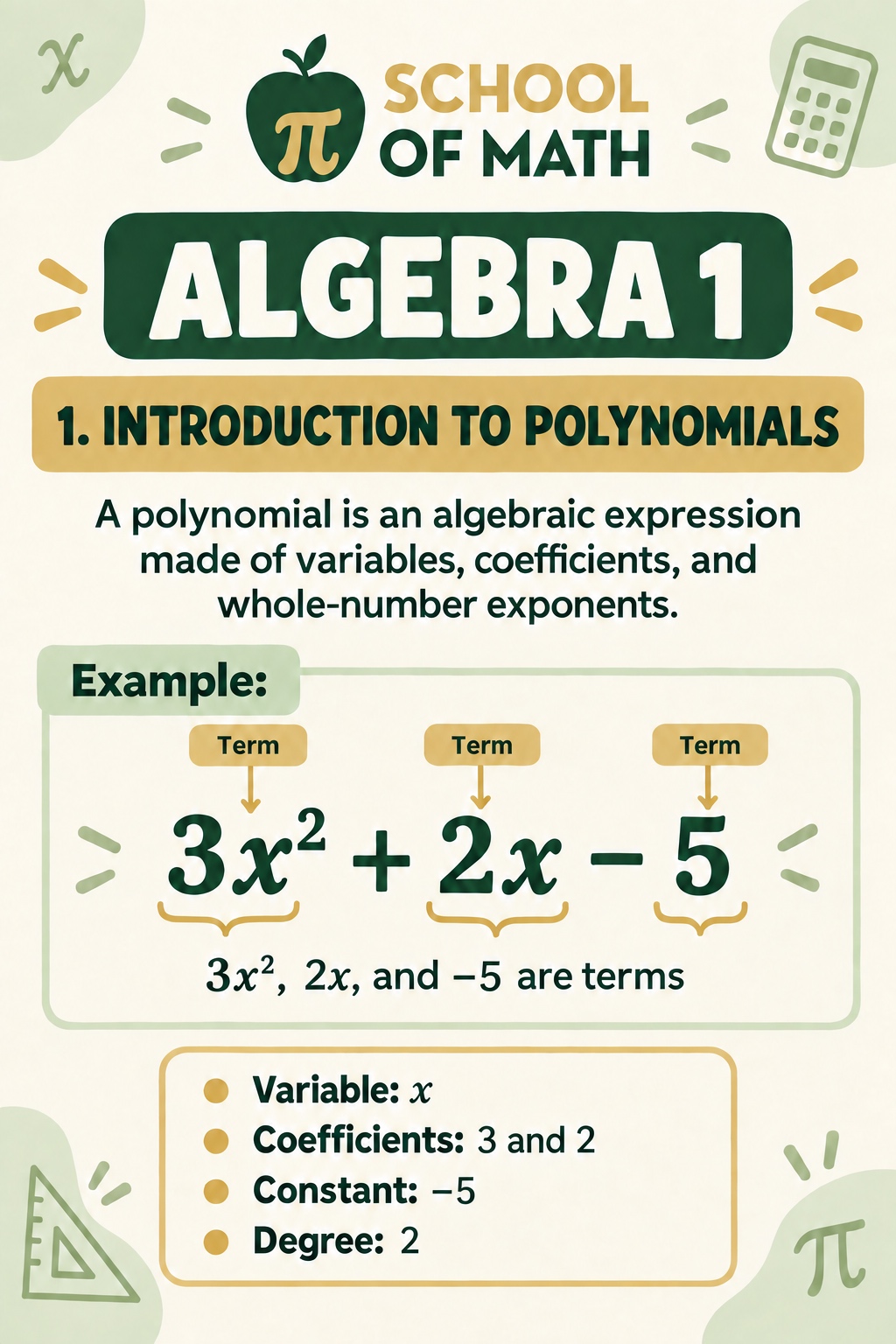
Definition
A polynomial is an algebraic expression made of variables, coefficients, and constants combined only by addition, subtraction, and multiplication — and every variable exponent is a whole number (0, 1, 2, 3, …).
Example
In 3x2 + 2x − 5:
- Variable: x.
- Coefficients: 3 (of x2) and 2 (of x).
- Constant: −5.
- Exponents: 2 and 1 — both whole numbers, so this is a polynomial.
What is NOT a polynomial
Expressions with variables in a denominator (1/x), under a radical (√x), or with negative or fractional exponents (x−2, x1/2) are not polynomials.
Why it matters
Every algebra topic that follows — factoring, quadratics, rational expressions, functions — starts with fluent polynomial operations.
5 Practice Questions — Introduction to Polynomials
2. Identifying Terms, Coefficients, and Constants
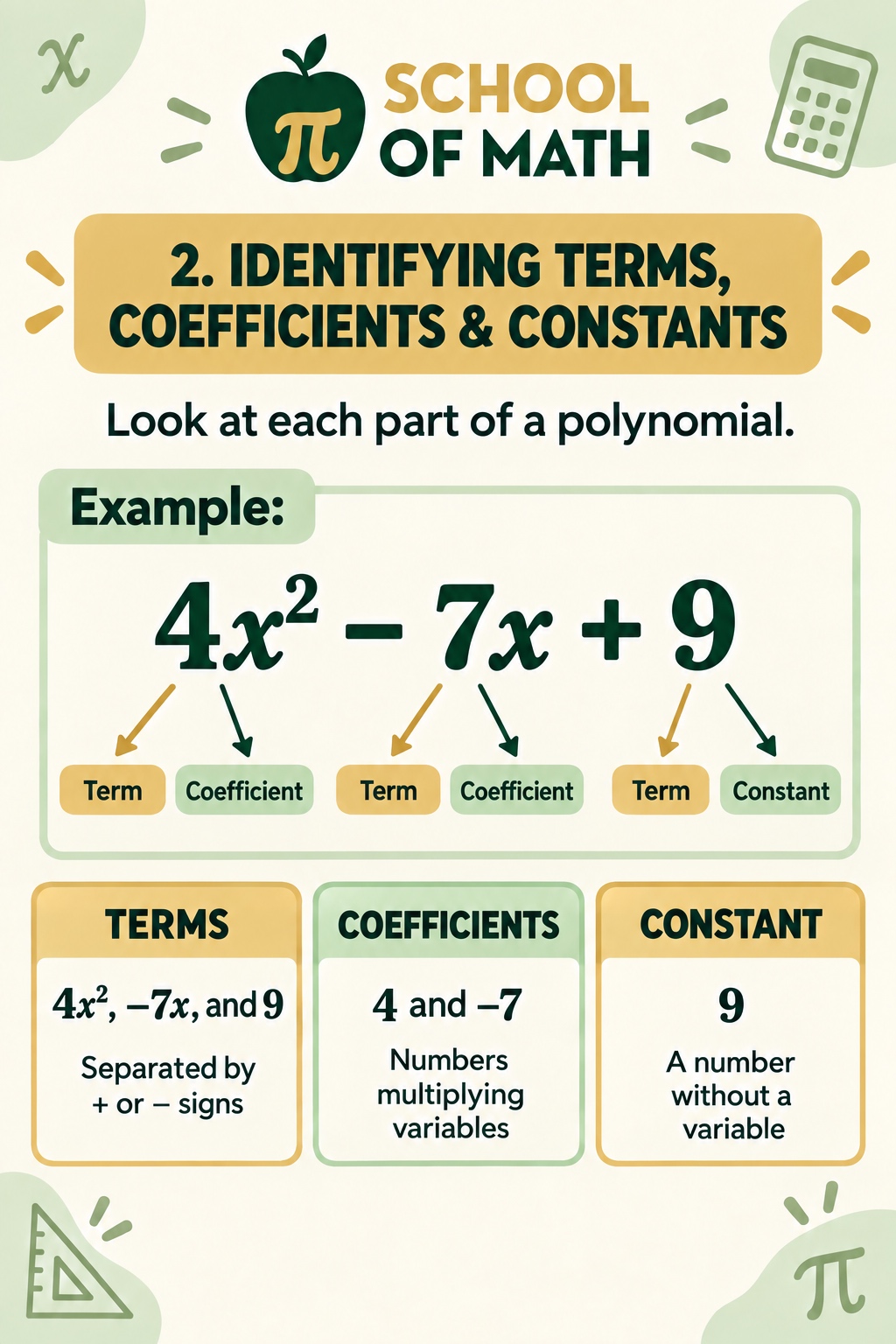
Terms
A term is a piece of a polynomial separated by + or − signs. The sign in front belongs to the term.
Coefficient
The coefficient is the number multiplying the variable in a term. If a variable has no visible number, the coefficient is 1 (or −1 if the term is negative).
Constant
The constant is the term with no variable at all.
Worked example: 4x2 − 7x + 9
- Terms: 4x2, −7x, 9.
- Coefficients: 4 (of x2) and −7 (of x).
- Constant: 9.
5 Practice Questions — Terms, Coefficients, and Constants
3. Classifying Polynomials by Number of Terms
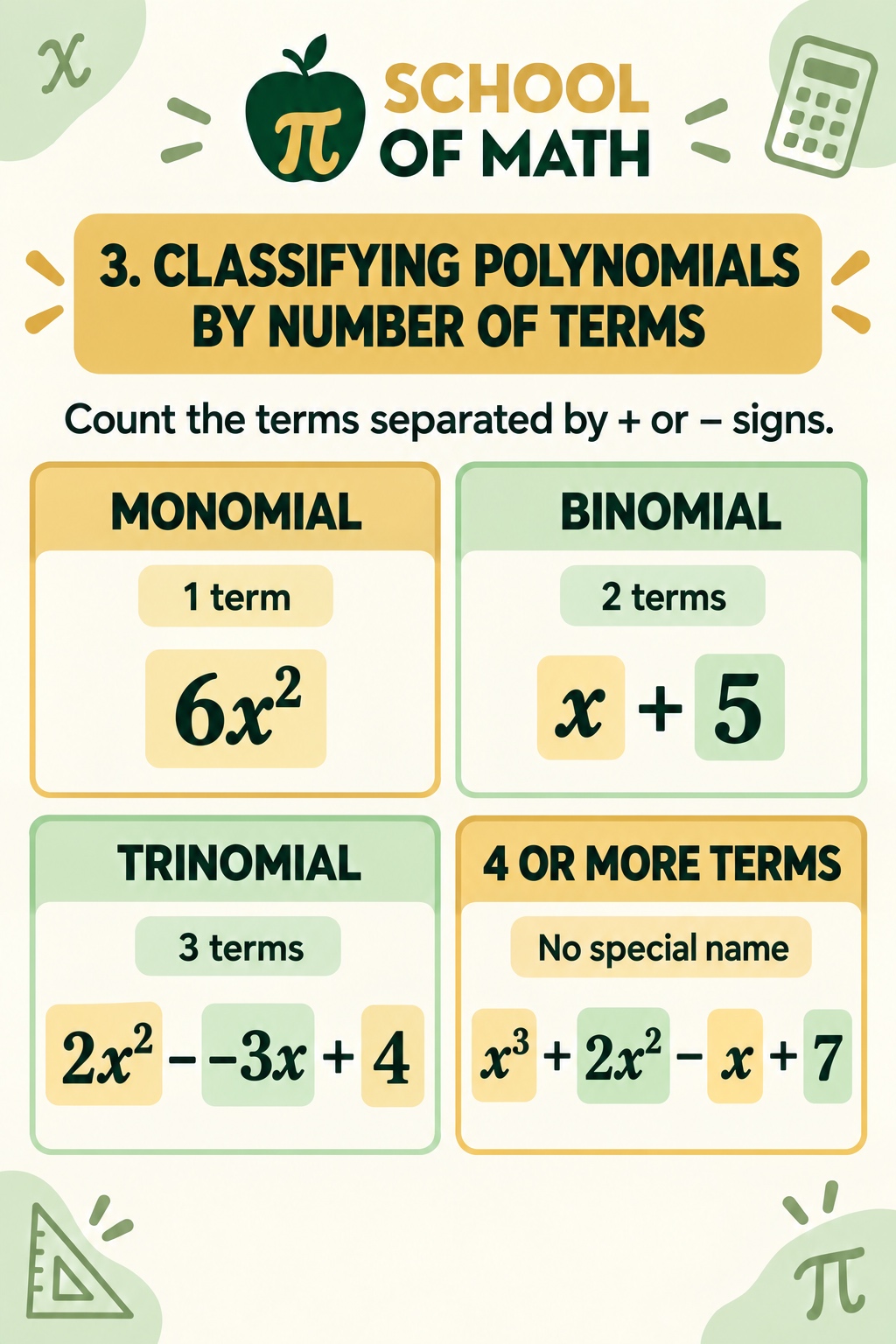
The three named types
| # of terms | Name | Example |
|---|---|---|
| 1 | Monomial | 6x2 |
| 2 | Binomial | x + 5 |
| 3 | Trinomial | 2x2 − 3x + 4 |
| 4+ | Polynomial (no special name) | x3 + 2x2 − x + 7 |
Simplify first
Always combine like terms before classifying. 3x + 5x + 2 looks like 3 terms but simplifies to 8x + 2 — a binomial.
5 Practice Questions — Classifying Polynomials
4. Degree of a Polynomial
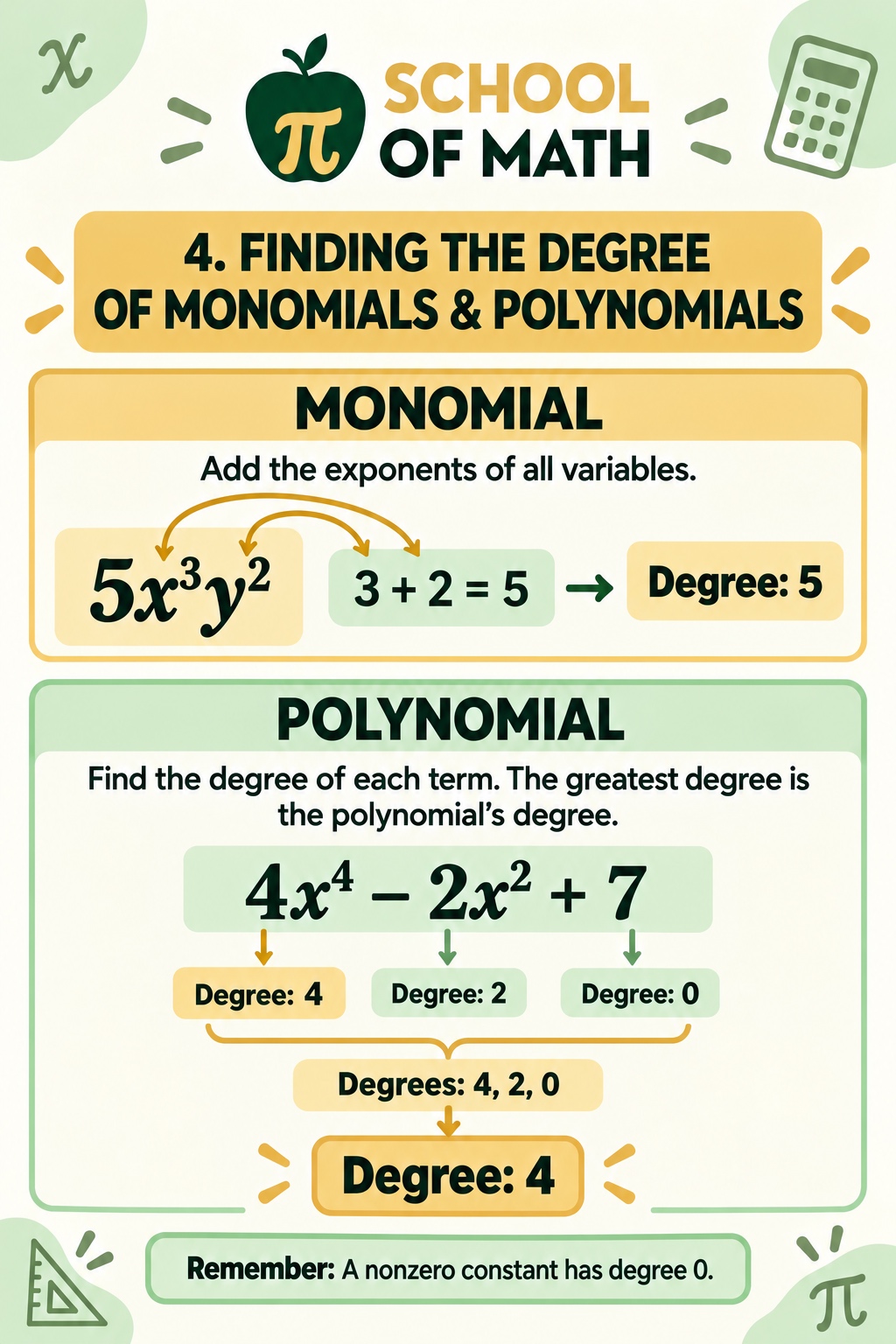
Degree of a monomial
Add the exponents of all variables in that term. 5x3y2 has degree 3 + 2 = 5.
Degree of a polynomial
The largest degree among all its terms. 4x4 − 2x2 + 7 has degree 4.
Special cases
- A nonzero constant has degree 0 (because c = c · x0).
- The zero polynomial (just 0) has an undefined degree — it’s a special case.
Why degree matters
Degree tells you how the polynomial behaves and how many roots it can have. Degree 1 = linear, 2 = quadratic, 3 = cubic, and so on.
5 Practice Questions — Degree of a Polynomial
5. Combining Like Terms
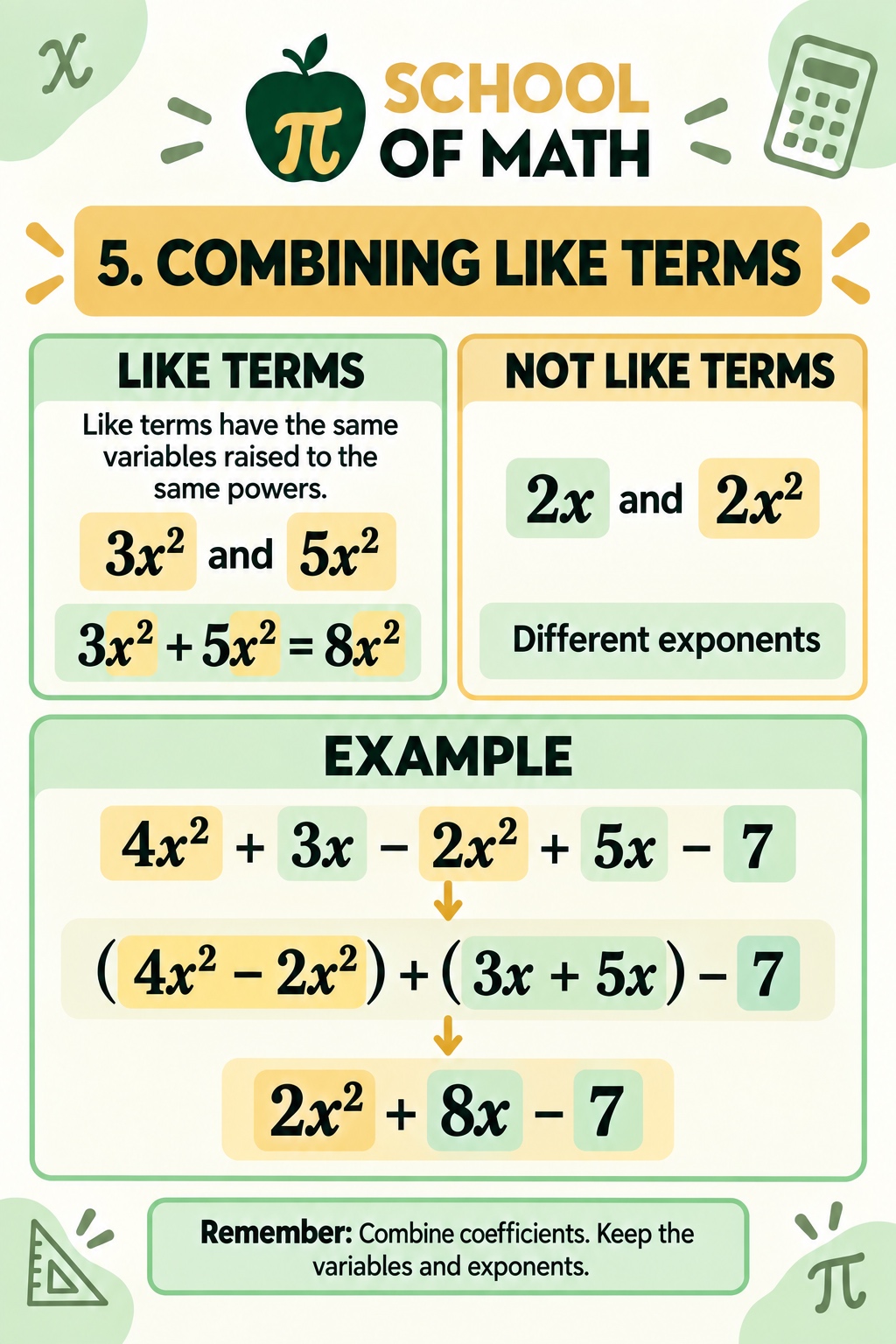
What are like terms?
Like terms have the same variables raised to the same powers. Only the coefficients can differ. Examples of like terms: 3x2 and 5x2. 2x and 2x2 are not like terms — the exponents differ.
How to combine
Add (or subtract) the coefficients. Keep the variable and exponent unchanged: 3x2 + 5x2 = 8x2.
Worked example
Simplify 4x2 + 3x − 2x2 + 5x − 7:
- Group: (4x2 − 2x2) + (3x + 5x) − 7.
- Combine: 2x2 + 8x − 7.
Common pitfalls
- Don’t add exponents when combining like terms — you only add coefficients.
- The sign in front belongs to the term. −2x2 stays negative when you group it.
5 Practice Questions — Combining Like Terms
6. Adding Polynomials
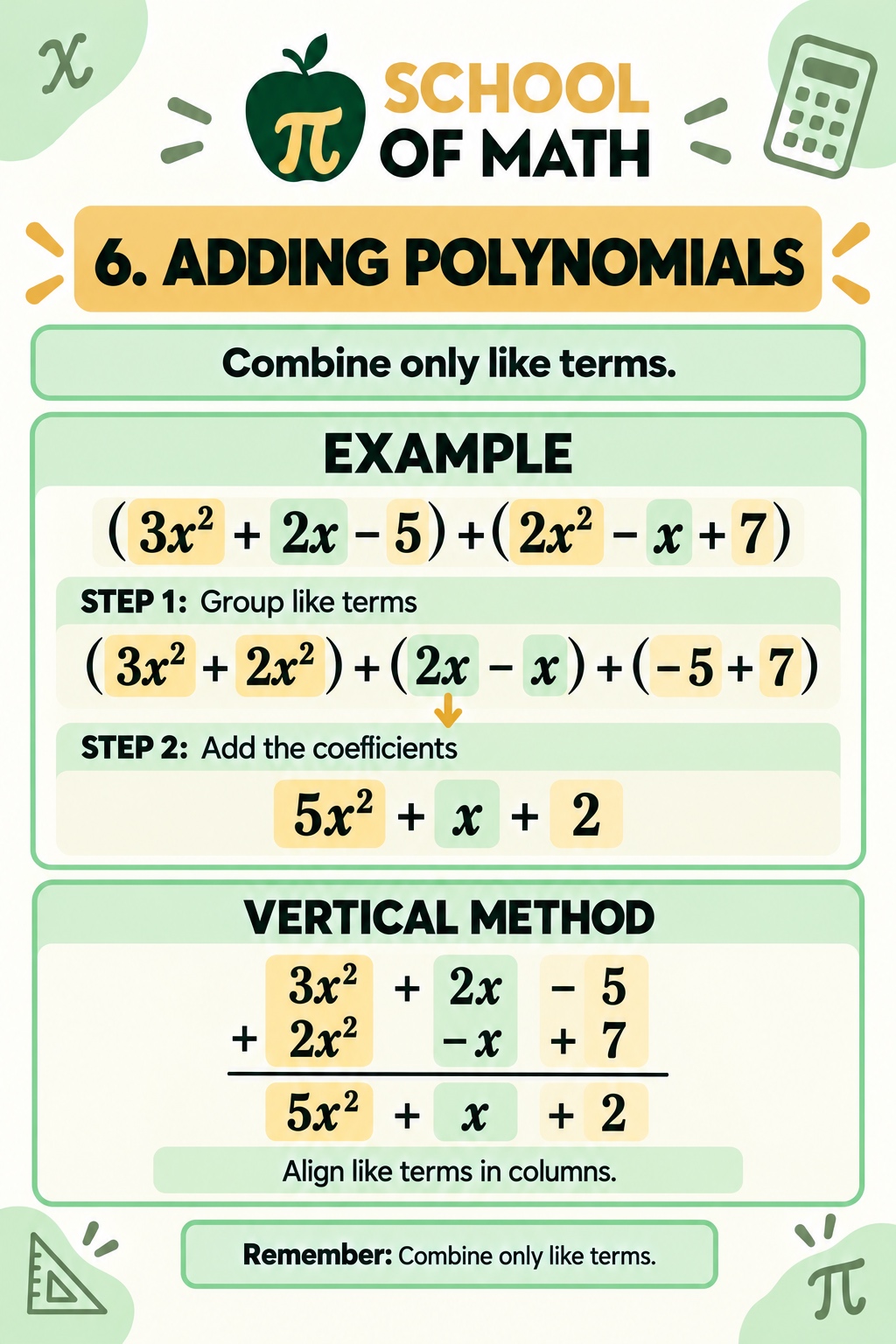
The rule
To add polynomials, combine only like terms. Signs stay the same — you’re just removing parentheses and grouping.
Worked example (horizontal)
Add (3x2 + 2x − 5) + (2x2 − x + 7):
- Group like terms: (3x2 + 2x2) + (2x − x) + (−5 + 7).
- Add coefficients: 5x2 + x + 2.
Vertical method
Line up like terms in columns, then add each column:
    3x² + 2x − 5
  + 2x² −  x + 7
  ————————
    5x² +  x + 2
Tip
Line up terms of the same degree even when a degree is missing — leave a blank space so the columns stay clean.
5 Practice Questions — Adding Polynomials
7. Subtracting Polynomials
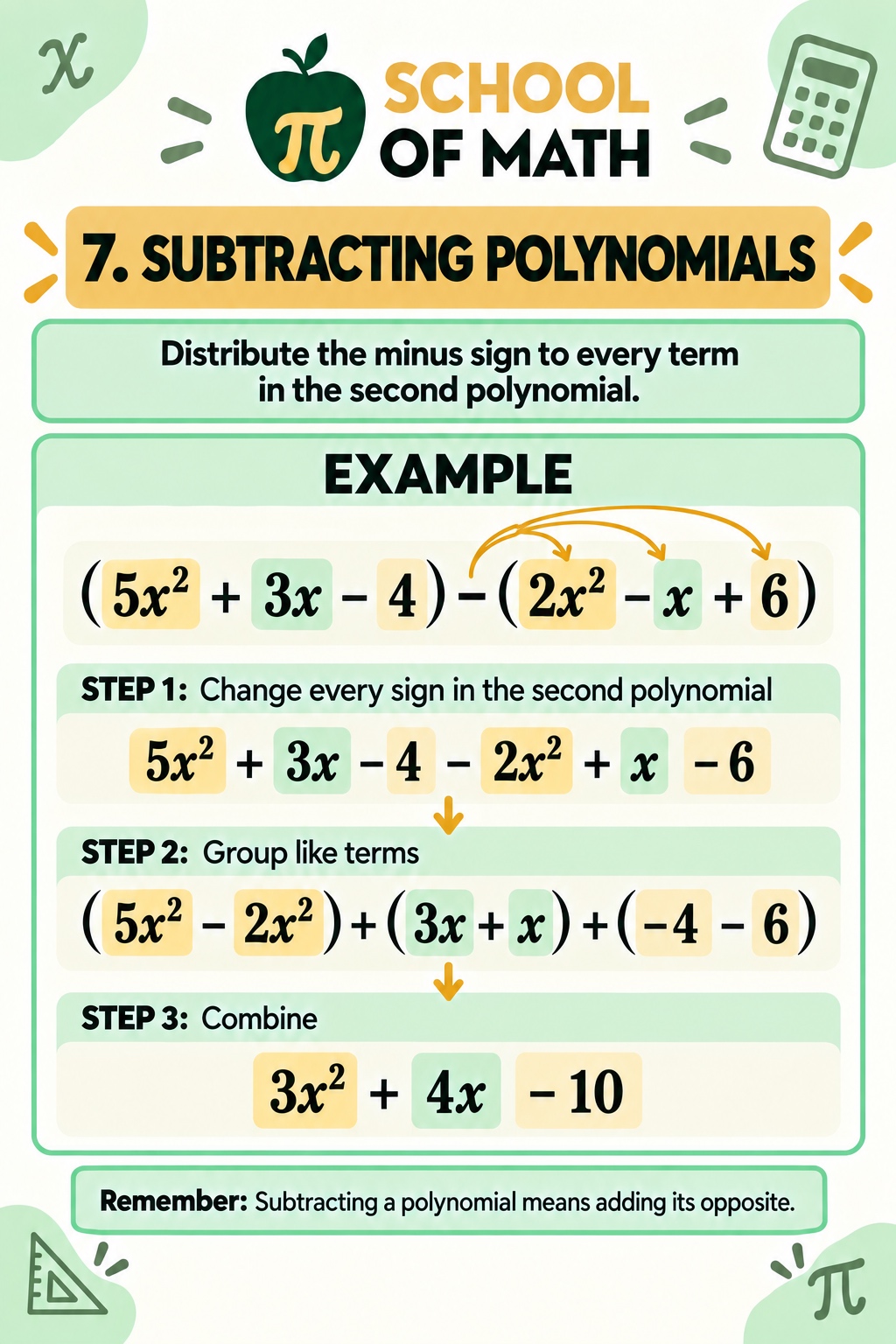
The rule
Subtracting = adding the opposite. Distribute the minus sign to every term in the second polynomial — flip every sign — then combine like terms.
Worked example
Compute (5x2 + 3x − 4) − (2x2 − x + 6):
- Distribute the minus: 5x2 + 3x − 4 − 2x2 + x − 6.
- Group like terms: (5x2 − 2x2) + (3x + x) + (−4 − 6).
- Combine: 3x2 + 4x − 10.
Common pitfall
Students flip only the first sign of the second polynomial. You must flip every sign inside those parentheses. Watch double negatives carefully: −(−x) = +x.
5 Practice Questions — Subtracting Polynomials
8. Multiplying Monomials
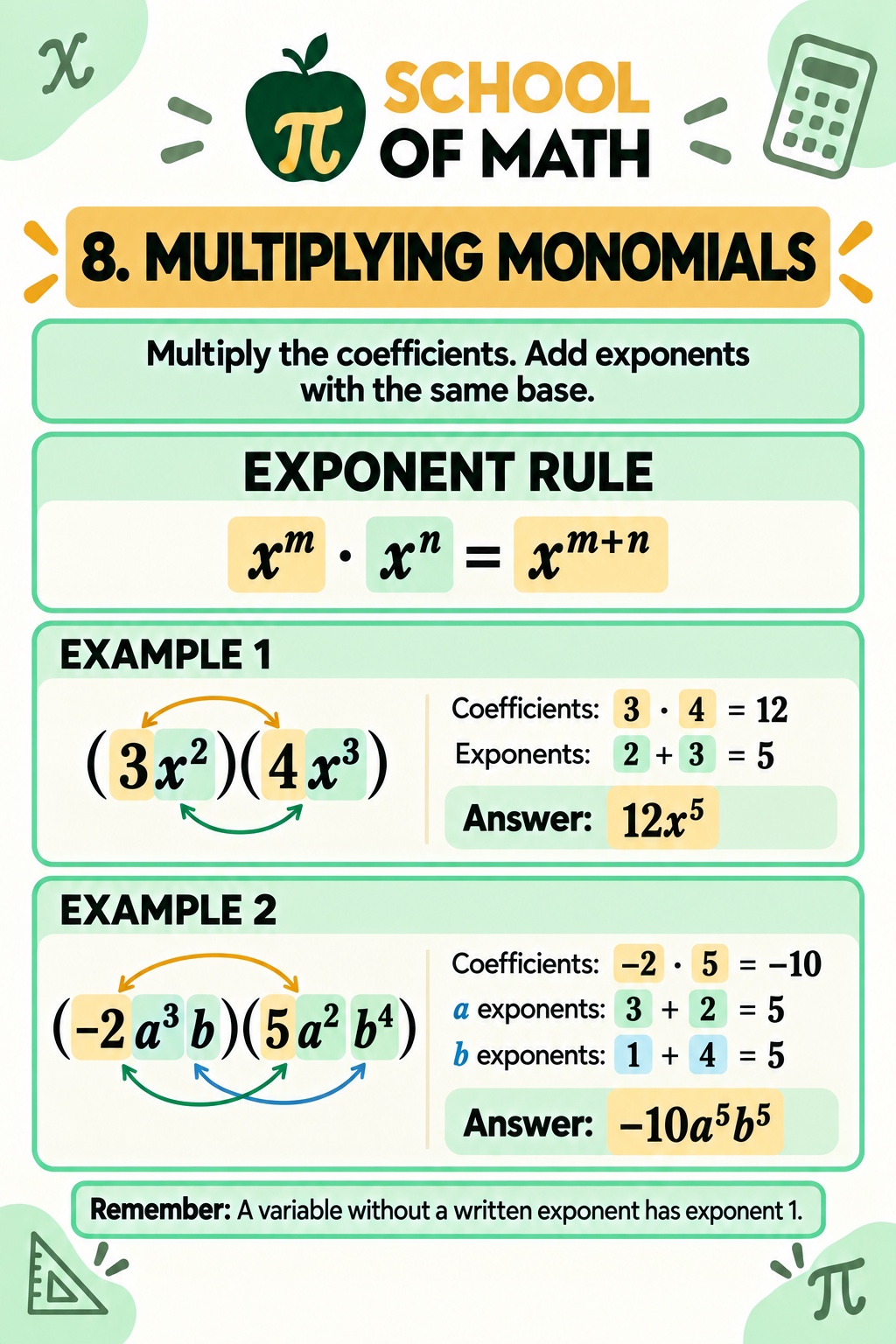
Two-step rule
- Multiply the coefficients (just numbers).
- Add the exponents of matching bases: xm · xn = xm+n.
Example 1
(3x2)(4x3) = (3 · 4)(x2+3) = 12x5.
Example 2 — two variables
(−2a3b)(5a2b4): Coefficients: (−2)(5) = −10. a-exponents: 3 + 2 = 5. b-exponents: 1 + 4 = 5. Answer: −10a5b5.
Remember
A variable with no visible exponent has exponent 1 (so b = b1). Only add exponents when the bases are the same.
5 Practice Questions — Multiplying Monomials
9. Multiplying a Monomial by a Polynomial (Distributive Property)
The rule
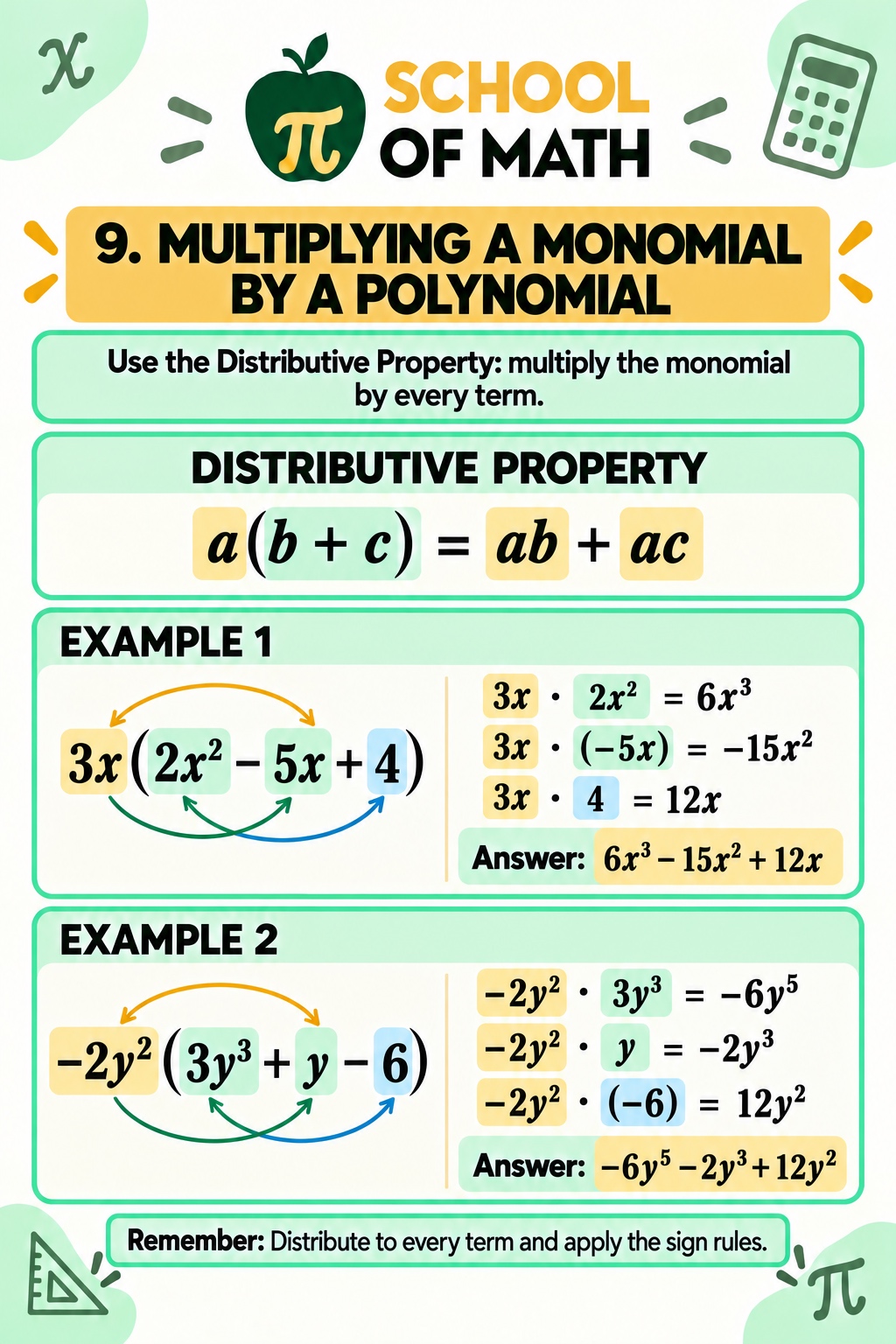
Use the distributive property: a(b + c) = ab + ac. Multiply the monomial by every term inside the parentheses.
Example 1
3x(2x2 − 5x + 4):
- 3x · 2x2 = 6x3
- 3x · (−5x) = −15x2
- 3x · 4 = 12x
Answer: 6x3 − 15x2 + 12x.
Example 2 — negative monomial
−2y2(3y3 + y − 6):
- −2y2 · 3y3 = −6y5
- −2y2 · y = −2y3
- −2y2 · (−6) = 12y2
Answer: −6y5 − 2y3 + 12y2.
Warning about signs
A negative monomial flips the sign of every term. Apply the sign rules of multiplication carefully — missing a sign is the #1 error on this topic.
5 Practice Questions — Monomial × Polynomial
10. Multiplying Two Binomials — The FOIL Method
FOIL — First, Outer, Inner, Last
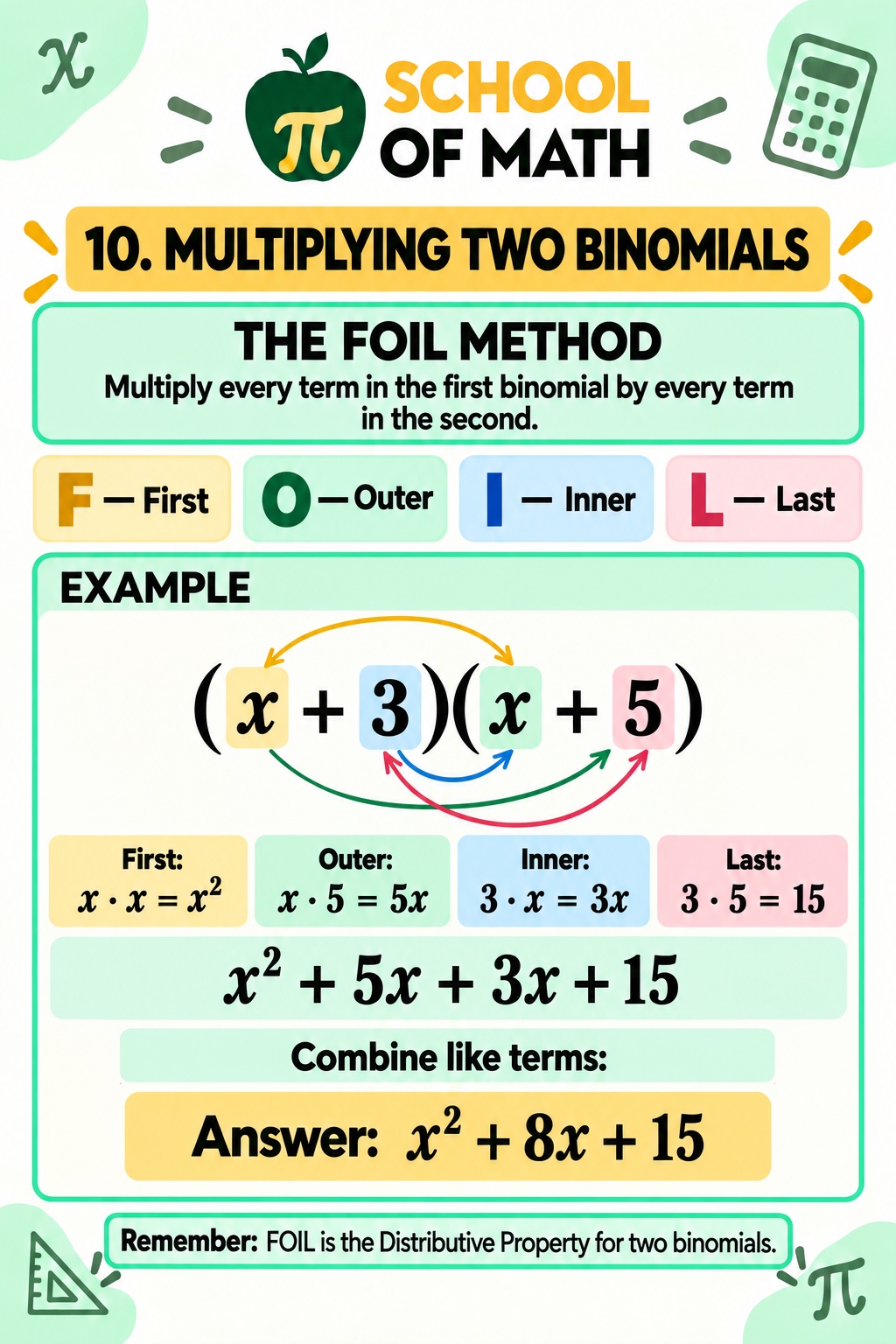
FOIL is a memory aid for the distributive property applied to two binomials. You get four products:
- First — the first term of each binomial.
- Outer — the two outer terms.
- Inner — the two inner terms.
- Last — the last term of each binomial.
Worked example: (x + 3)(x + 5)
- First: x · x = x2
- Outer: x · 5 = 5x
- Inner: 3 · x = 3x
- Last: 3 · 5 = 15
Sum: x2 + 5x + 3x + 15. Combine like terms: x2 + 8x + 15.
Why FOIL works
FOIL is just the distributive property in disguise. It only works for two binomials. For a binomial times a trinomial — or any bigger product — use the distributive property directly and multiply every term of the first by every term of the second.
Sign patterns worth memorizing
- (x + a)(x + b) = x2 + (a+b)x + ab
- (x + a)(x − a) = x2 − a2 — the difference of squares.
- (x + a)2 = x2 + 2ax + a2 — the perfect square.
5 Practice Questions — FOIL / Multiplying Binomials
Enroll in SOMATH Young Fermats — Algebra Ignite
Small groups of up to 6 students, taught by real teachers on the Upper West Side. A full Algebra I track for grades 7–8 — linear equations, systems, exponents, polynomials, factoring, and quadratics — taught over a 48-class rolling syllabus you can join at any point.
See the full Algebra Ignite course → · Book a free 30-minute evaluation · call (646) 668-6151 · 226 W 79th St, New York, NY 10024.
Related SOMATH classes and posts
- Young Fermats — Algebra Ignite (Grades 7–8) — course overview and enroll
- Class 0 — Placement diagnostic: real numbers, order of operations & simplifying
- Class 2 — Word problems modeled with linear equations
- Class 3 — Linear inequalities: solving & graphing
- Class 5 — Writing the equation of a line
- Class 10 — Scientific notation and applications
- Algebra II Class 11 — Factoring & the Remainder / Factor Theorems (next-year sequel)
- SOMATH class schedule — weekly small-group classes
- Free 30-minute evaluation