Young Fermats · Algebra Ignite · Class 13
Factoring Trinomials (x² + bx + c)
To factor x² + bx + c, find two numbers that add to b and multiply to c. Write them in the factors (x + m)(x + n), then expand to check. Look for a greatest common factor first, and remember that not every trinomial factors over the integers.
Study the ten images in order, then complete five original questions after each image. Homework includes ten review questions, one per image, and ten word problems in increasing difficulty. All 70 exercises have compact blue Answer controls with worked explanations.
Part of the rolling Young Fermats Algebra Ignite course at SOMATH. Book an evaluation for placement or view the current class schedule.
Download the student workbook (PDF)25 pages · Cover, each image followed by its five practice questions, then 10 homework review questions and 10 homework word problems.Generous blank answer space. No exercise answers, writing lines, or repeated name and date fields.
Recognizing a trinomial
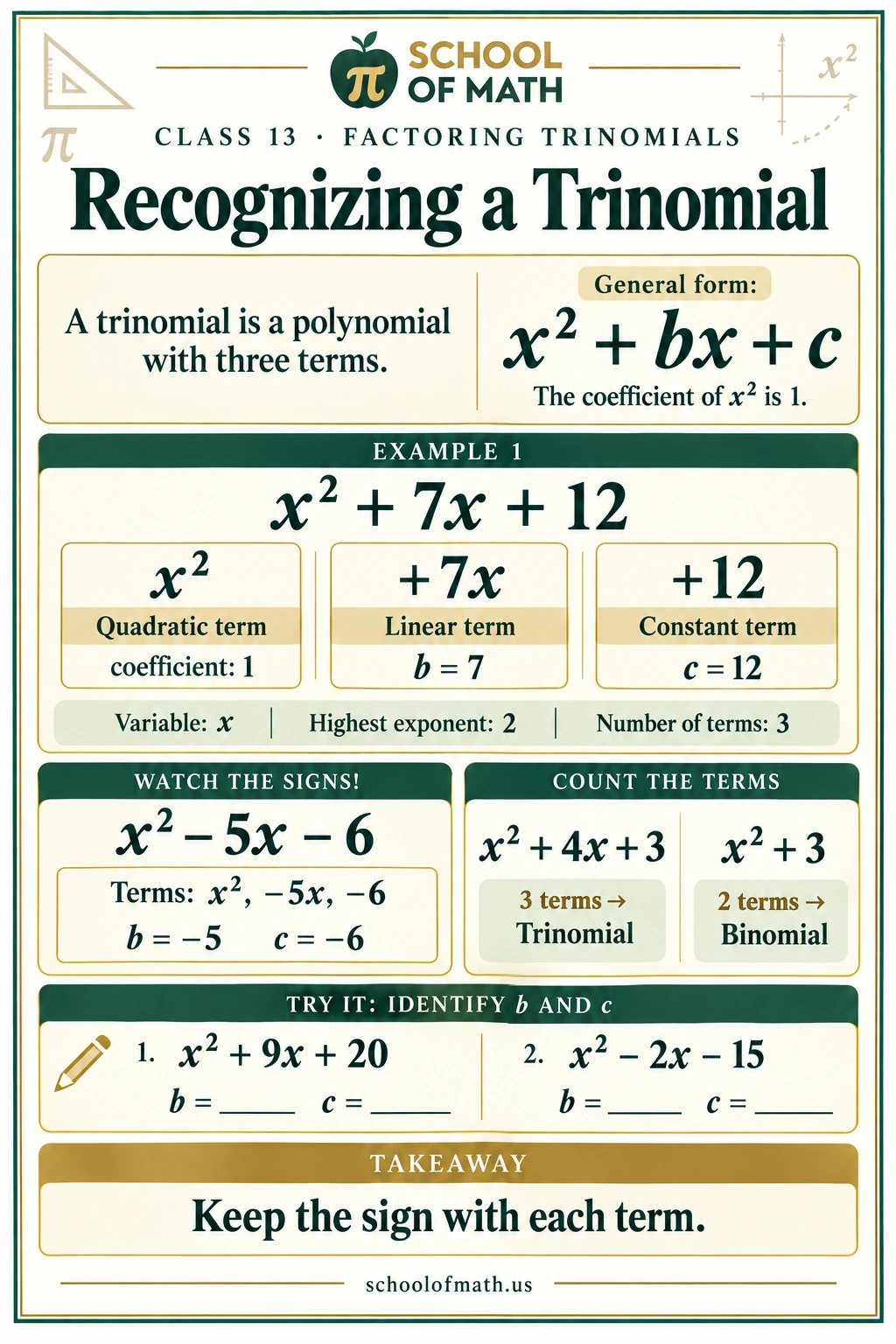
A trinomial has three nonzero terms after like terms have been combined. This class focuses on monic quadratics: the coefficient of x² is 1. In x² + bx + c, keep the sign attached to b and c. Not every trinomial has this particular form.
Try it yourself: five questions
Q1 Practice 1 of 5 · Start
In x² + 12x + 35, identify the quadratic term, linear term, constant term, b, and c.
Answer
Quadratic term: x²; linear term: 12x; constant: 35; b = 12 and c = 35.
- There are three terms. The coefficient of x² is 1, so this is in the form x² + bx + c.
Q2 Practice 2 of 5 · Build
For x² − 13x + 36, list all three terms and identify b and c.
Answer
Terms: x², −13x, and 36. b = −13 and c = 36.
- The minus sign belongs to the linear term. Its coefficient is −13, not 13.
Q3 Practice 3 of 5 · Apply
Rewrite 18 + x² − 9x in descending powers of x. Then identify b and c.
Answer
x² − 9x + 18; b = −9 and c = 18.
- Reordering terms does not change their signs. Put the quadratic term first, then the linear term, then the constant.
Q4 Practice 4 of 5 · Explain
Simplify x² + 4x + 6x + 16. Is the simplified result a trinomial? Identify b and c.
Answer
x² + 10x + 16; yes. b = 10 and c = 16.
- Combine 4x + 6x = 10x before counting terms. Three nonzero unlike terms remain.
Q5 Practice 5 of 5 · Challenge
Compare x² + 9x + 14 and 2x² + 9x + 14. Are both trinomials? Which has the form x² + bx + c, and how does it factor?
Answer
Both are trinomials. The first is monic and factors as (x + 2)(x + 7).
- Only the first expression has leading coefficient 1. Its factor numbers are 2 and 7: they add to 9 and multiply to 14. The second requires a method for a leading coefficient other than 1.
Connecting multiplication and factoring
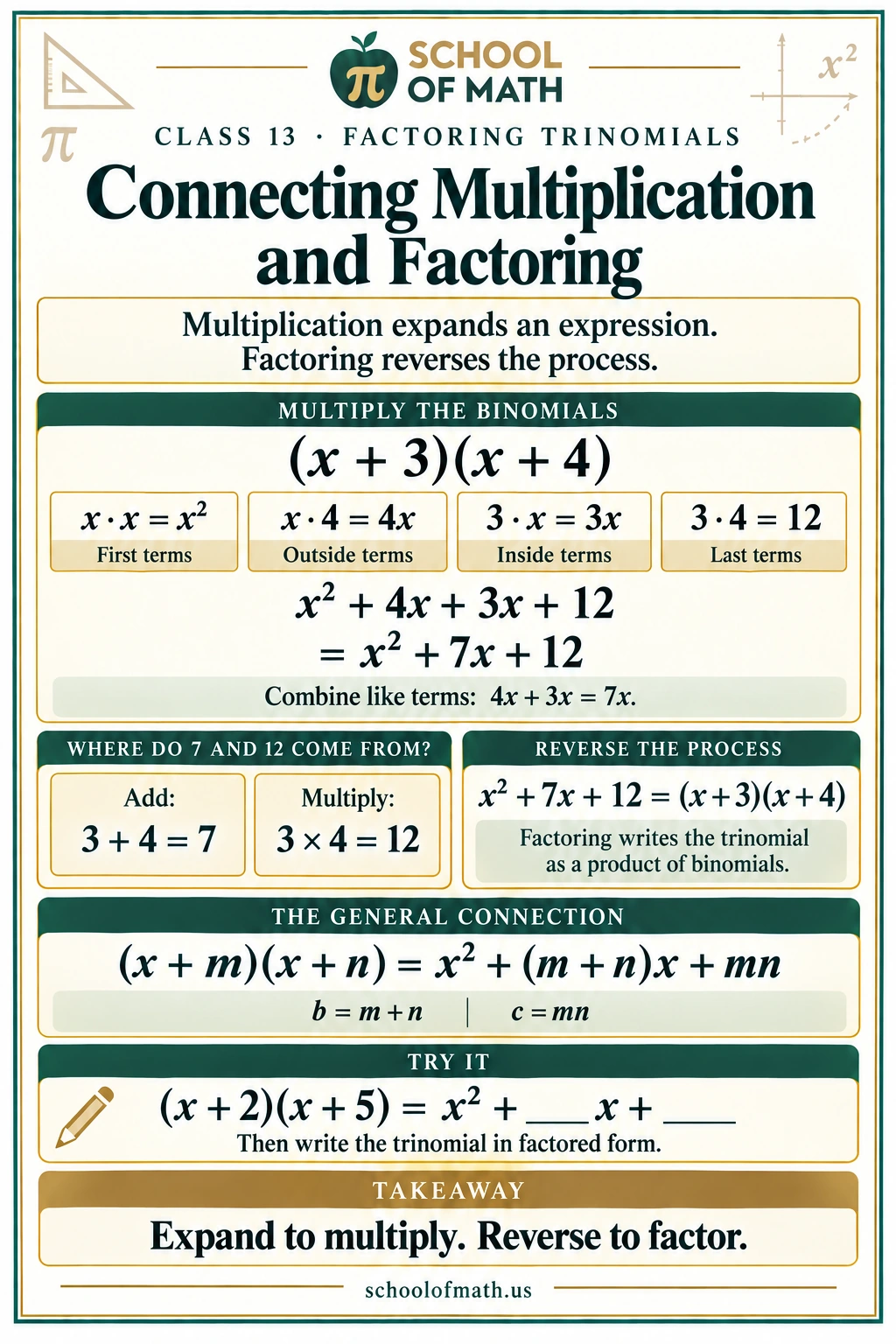
Factoring reverses multiplication. Expanding (x + m)(x + n) gives x² + mx + nx + mn = x² + (m + n)x + mn. The middle coefficient comes from a sum, while the constant comes from a product.
Try it yourself: five questions
Q6 Practice 1 of 5 · Start
Expand (x + 1)(x + 8), then write your trinomial in factored form again.
Answer
x² + 9x + 8 = (x + 1)(x + 8).
- Multiply every term: x² + 8x + x + 8. Combine 8x + x = 9x. Reversing this expansion gives the factors.
Q7 Practice 2 of 5 · Build
Expand (x + 2)(x + 9). Explain where the middle coefficient and constant come from.
Answer
x² + 11x + 18.
- The middle terms are 9x and 2x, totaling 11x. The constant is 2 × 9 = 18, not 2 + 9.
Q8 Practice 3 of 5 · Apply
Expand (x − 2)(x + 7), keeping track of the negative sign.
Answer
x² + 5x − 14.
- The four products are x², 7x, −2x, and −14. Combining the middle terms gives 5x.
Q9 Practice 4 of 5 · Explain
Expand (x − 4)(x − 8). Explain why the constant is positive but the linear term is negative.
Answer
x² − 12x + 32.
- The middle terms add to −8x − 4x = −12x. The constant is (−4)(−8) = 32 because two negative numbers have a positive product.
Q10 Practice 5 of 5 · Challenge
A rectangle has sides x + 3 and x + 9 units. Write its area in expanded and factored forms, then check both forms at x = 2.
Answer
Area: x² + 12x + 27 = (x + 3)(x + 9); at x = 2, the area is 55 square units.
- Expanding gives x² + 9x + 3x + 27. At x = 2, the sides are 5 and 11, so the area is 55.
- The expanded form gives 4 + 24 + 27 = 55, confirming the same area.
The sum-and-product rule
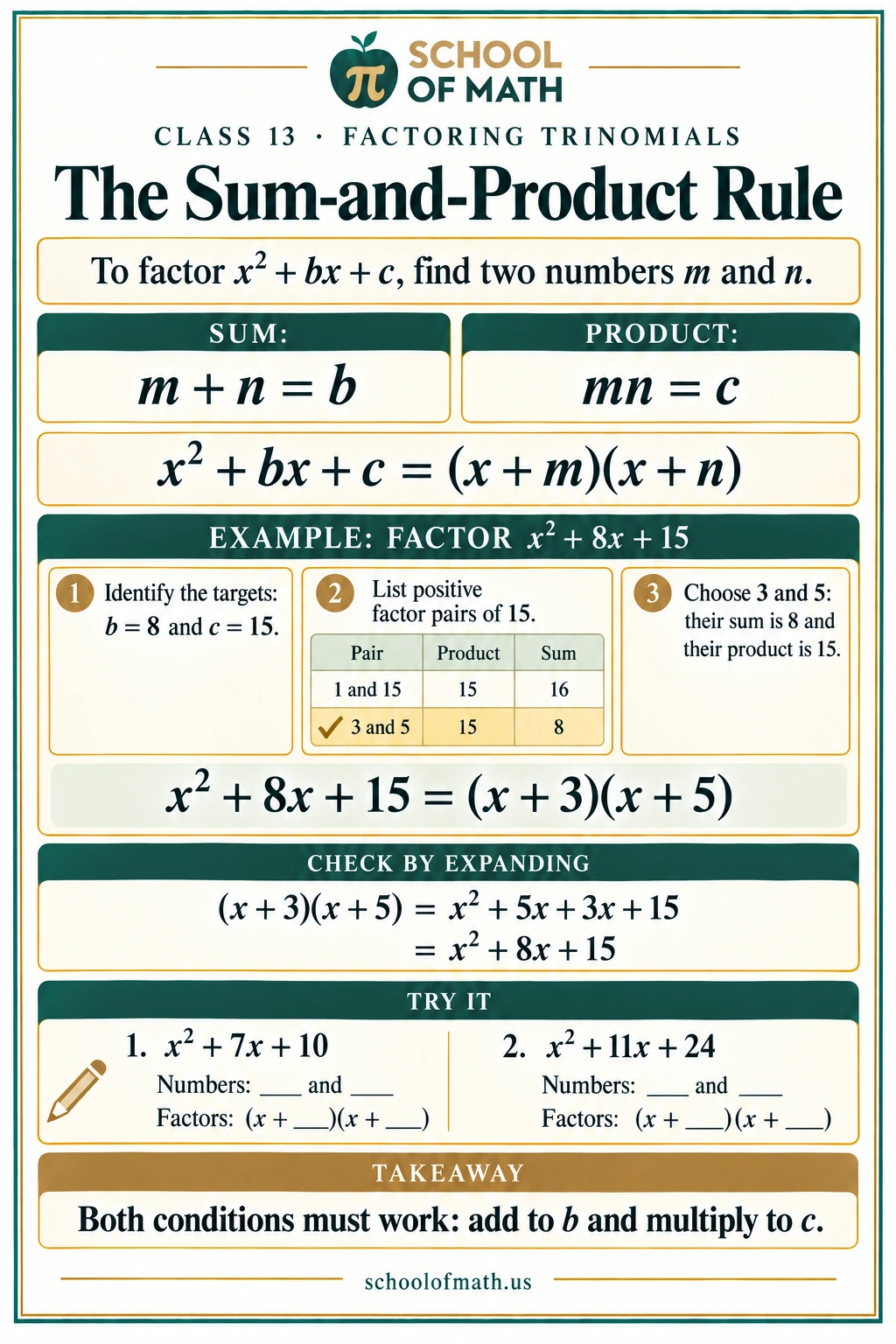
To factor x² + bx + c over the integers, look for integers m and n such that m + n = b and mn = c. List factor pairs of the constant, then test their sums. A pair must pass both tests.
Try it yourself: five questions
Q11 Practice 1 of 5 · Start
Find two positive integers with sum 12 and product 32. Use them to factor x² + 12x + 32.
Answer
4 and 8; (x + 4)(x + 8).
- The positive pairs for 32 are 1 and 32, 2 and 16, and 4 and 8. Their sums are 33, 18, and 12.
Q12 Practice 2 of 5 · Build
List all positive factor pairs of 40. Which pair factors x² + 13x + 40?
Answer
Pairs: 1 and 40, 2 and 20, 4 and 10, 5 and 8. Use 5 and 8: (x + 5)(x + 8).
- The sums are 41, 22, 14, and 13. Only 5 and 8 meet both targets.
Q13 Practice 3 of 5 · Apply
Find integers with sum −10 and product 21. Then factor x² − 10x + 21.
Answer
−3 and −7; (x − 3)(x − 7).
- A positive product requires matching signs. A negative sum requires both numbers to be negative: −3 − 7 = −10 and (−3)(−7) = 21.
Q14 Practice 4 of 5 · Explain
Factor x² + 5x − 24. Explain why the positive number must have the larger absolute value.
Answer
(x + 8)(x − 3).
- The product is negative, so signs differ. Since the sum is positive, the positive number has the greater magnitude. 8 + (−3) = 5 and 8(−3) = −24.
Q15 Practice 5 of 5 · Challenge
The trinomial x² + bx + 45 has a factor x + 5. Find its other factor and the value of b.
Answer
Other factor: x + 9; b = 14.
- The constants must multiply to 45. Since one is 5, the other is 9. Their sum is 14, so the expansion is x² + 14x + 45.
Factoring with positive signs
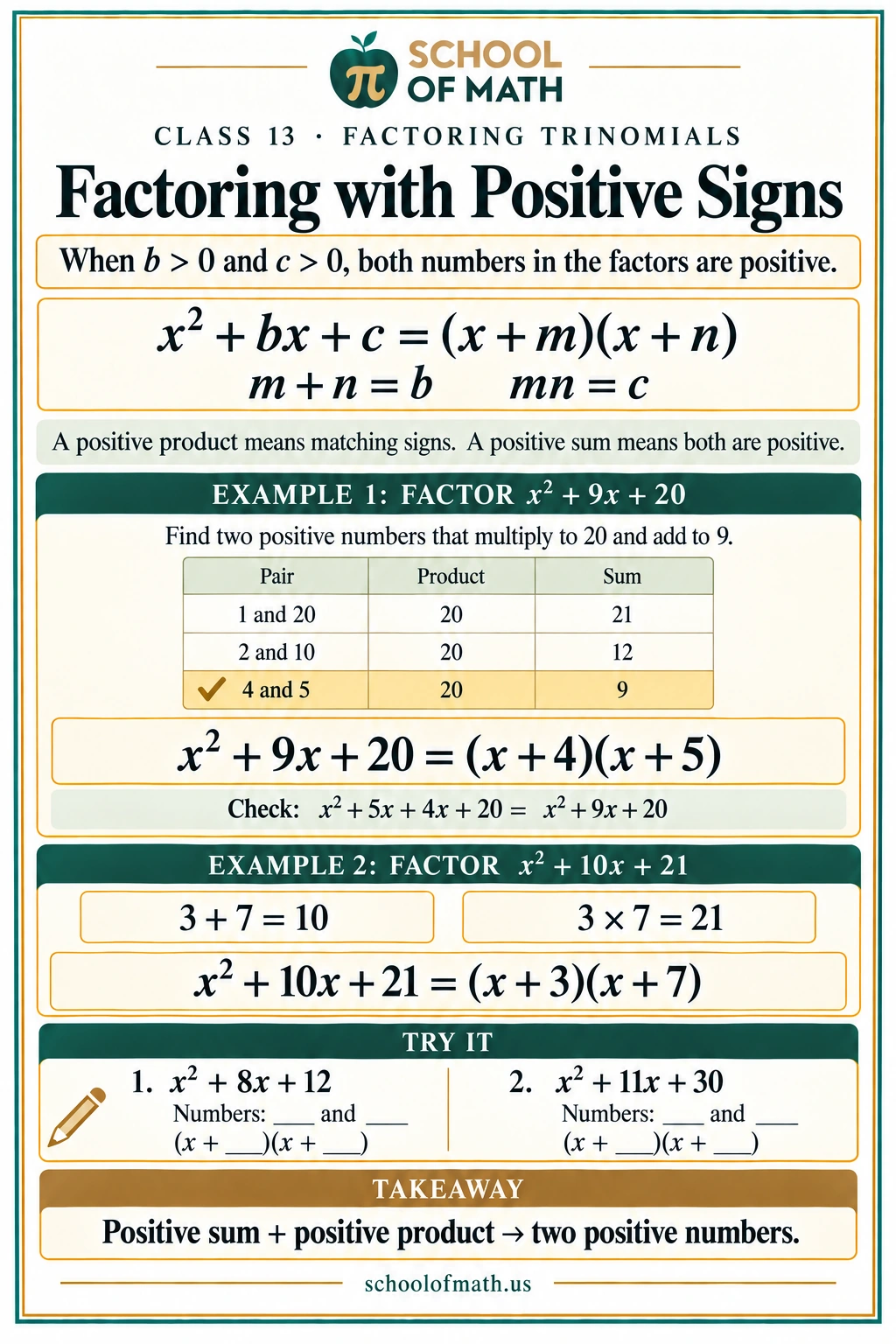
When b and c are positive, any integer pair used in the factors must be positive. Begin with the factor pairs of c, not arbitrary pairs that add to b. Expand to verify the middle and constant terms.
Try it yourself: five questions
Q16 Practice 1 of 5 · Start
Factor completely: x² + 12x + 20. Show the sum and product you use.
Answer
(x + 2)(x + 10).
- Find two numbers with sum 12 and product 20: 2 and 10. Their sum is 12, and their product is 20.
- Write (x + 2)(x + 10) for the trinomial. Expanding gives x² + 12x + 20; multiply by the outside factor too, if there is one.
Q17 Practice 2 of 5 · Build
Factor completely: x² + 13x + 30. Show the sum and product you use.
Answer
(x + 3)(x + 10).
- Find two numbers with sum 13 and product 30: 3 and 10. Their sum is 13, and their product is 30.
- Write (x + 3)(x + 10) for the trinomial. Expanding gives x² + 13x + 30; multiply by the outside factor too, if there is one.
Q18 Practice 3 of 5 · Apply
Factor completely: x² + 15x + 44. Show the sum and product you use.
Answer
(x + 4)(x + 11).
- Find two numbers with sum 15 and product 44: 4 and 11. Their sum is 15, and their product is 44.
- Write (x + 4)(x + 11) for the trinomial. Expanding gives x² + 15x + 44; multiply by the outside factor too, if there is one.
Q19 Practice 4 of 5 · Explain
Factor completely: x² + 17x + 60. Show the sum and product you use.
Answer
(x + 5)(x + 12).
- Find two numbers with sum 17 and product 60: 5 and 12. Their sum is 17, and their product is 60.
- Write (x + 5)(x + 12) for the trinomial. Expanding gives x² + 17x + 60; multiply by the outside factor too, if there is one.
Q20 Practice 5 of 5 · Challenge
Factor completely: x² + 19x + 88. Show the sum and product you use.
Answer
(x + 8)(x + 11).
- Find two numbers with sum 19 and product 88: 8 and 11. Their sum is 19, and their product is 88.
- Write (x + 8)(x + 11) for the trinomial. Expanding gives x² + 19x + 88; multiply by the outside factor too, if there is one.
Negative b, positive c
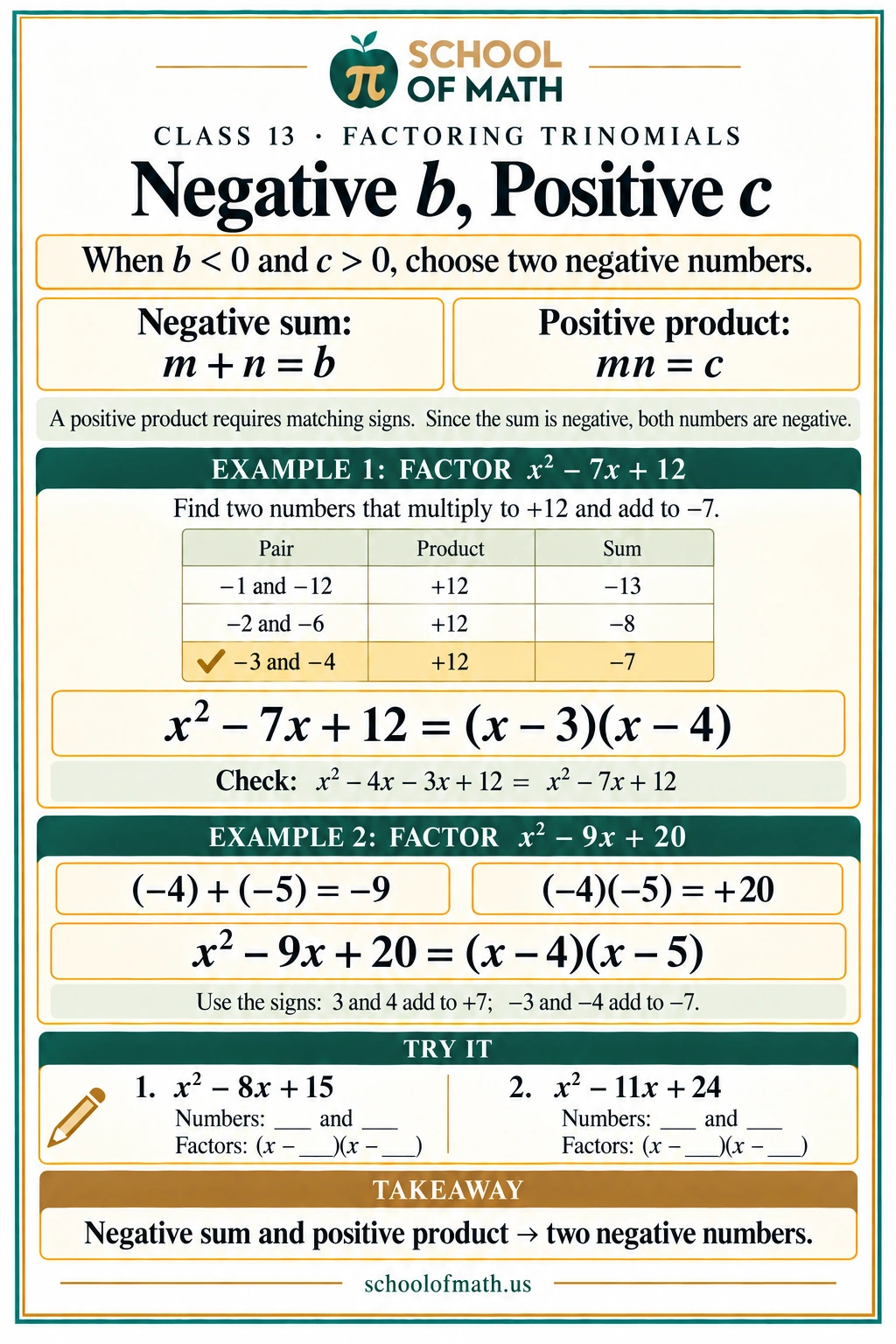
A positive constant requires matching signs. If the middle coefficient is negative, both numbers must be negative. Their absolute values multiply to c and add to the absolute value of b.
Try it yourself: five questions
Q21 Practice 1 of 5 · Start
Factor completely: x² − 9x + 14. Show the sum and product you use.
Answer
(x − 2)(x − 7).
- Find two numbers with sum -9 and product 14: -2 and -7. Their sum is -9, and their product is 14.
- Write (x − 2)(x − 7) for the trinomial. Expanding gives x² − 9x + 14; multiply by the outside factor too, if there is one.
Q22 Practice 2 of 5 · Build
Factor completely: x² − 13x + 30. Show the sum and product you use.
Answer
(x − 3)(x − 10).
- Find two numbers with sum -13 and product 30: -3 and -10. Their sum is -13, and their product is 30.
- Write (x − 3)(x − 10) for the trinomial. Expanding gives x² − 13x + 30; multiply by the outside factor too, if there is one.
Q23 Practice 3 of 5 · Apply
Factor completely: x² − 13x + 36. Show the sum and product you use.
Answer
(x − 4)(x − 9).
- Find two numbers with sum -13 and product 36: -4 and -9. Their sum is -13, and their product is 36.
- Write (x − 4)(x − 9) for the trinomial. Expanding gives x² − 13x + 36; multiply by the outside factor too, if there is one.
Q24 Practice 4 of 5 · Explain
Factor completely: x² − 16x + 55. Show the sum and product you use.
Answer
(x − 5)(x − 11).
- Find two numbers with sum -16 and product 55: -5 and -11. Their sum is -16, and their product is 55.
- Write (x − 5)(x − 11) for the trinomial. Expanding gives x² − 16x + 55; multiply by the outside factor too, if there is one.
Q25 Practice 5 of 5 · Challenge
Factor completely: x² − 20x + 96. Show the sum and product you use.
Answer
(x − 8)(x − 12).
- Find two numbers with sum -20 and product 96: -8 and -12. Their sum is -20, and their product is 96.
- Write (x − 8)(x − 12) for the trinomial. Expanding gives x² − 20x + 96; multiply by the outside factor too, if there is one.
Factoring when c is negative
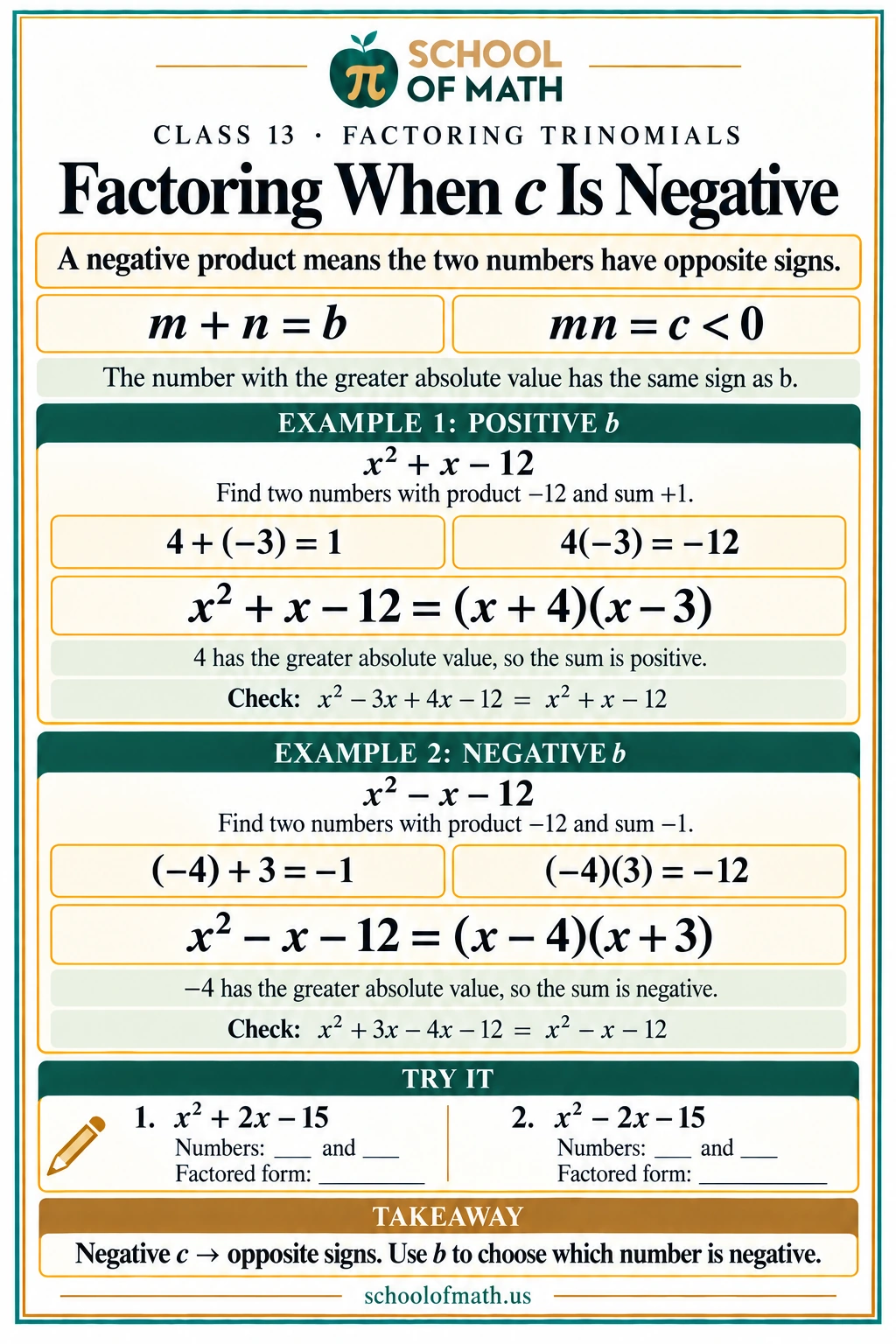
A negative constant requires opposite signs. The sign of b tells you which number has the greater absolute value. Check the signed sum carefully: finding the right magnitudes is only half the work.
Try it yourself: five questions
Q26 Practice 1 of 5 · Start
Factor completely: x² + 4x − 5. Show the sum and product you use.
Answer
(x + 5)(x − 1).
- Find two numbers with sum 4 and product -5: 5 and -1. Their sum is 4, and their product is -5.
- Write (x + 5)(x − 1) for the trinomial. Expanding gives x² + 4x − 5; multiply by the outside factor too, if there is one.
Q27 Practice 2 of 5 · Build
Factor completely: x² + 5x − 14. Show the sum and product you use.
Answer
(x + 7)(x − 2).
- Find two numbers with sum 5 and product -14: 7 and -2. Their sum is 5, and their product is -14.
- Write (x + 7)(x − 2) for the trinomial. Expanding gives x² + 5x − 14; multiply by the outside factor too, if there is one.
Q28 Practice 3 of 5 · Apply
Factor completely: x² − 5x − 24. Show the sum and product you use.
Answer
(x + 3)(x − 8).
- Find two numbers with sum -5 and product -24: 3 and -8. Their sum is -5, and their product is -24.
- Write (x + 3)(x − 8) for the trinomial. Expanding gives x² − 5x − 24; multiply by the outside factor too, if there is one.
Q29 Practice 4 of 5 · Explain
Factor completely: x² + 5x − 66. Show the sum and product you use.
Answer
(x + 11)(x − 6).
- Find two numbers with sum 5 and product -66: 11 and -6. Their sum is 5, and their product is -66.
- Write (x + 11)(x − 6) for the trinomial. Expanding gives x² + 5x − 66; multiply by the outside factor too, if there is one.
Q30 Practice 5 of 5 · Challenge
Factor completely: x² − 6x − 91. Show the sum and product you use.
Answer
(x + 7)(x − 13).
- Find two numbers with sum -6 and product -91: 7 and -13. Their sum is -6, and their product is -91.
- Write (x + 7)(x − 13) for the trinomial. Expanding gives x² − 6x − 91; multiply by the outside factor too, if there is one.
Special cases: squares and integer limits
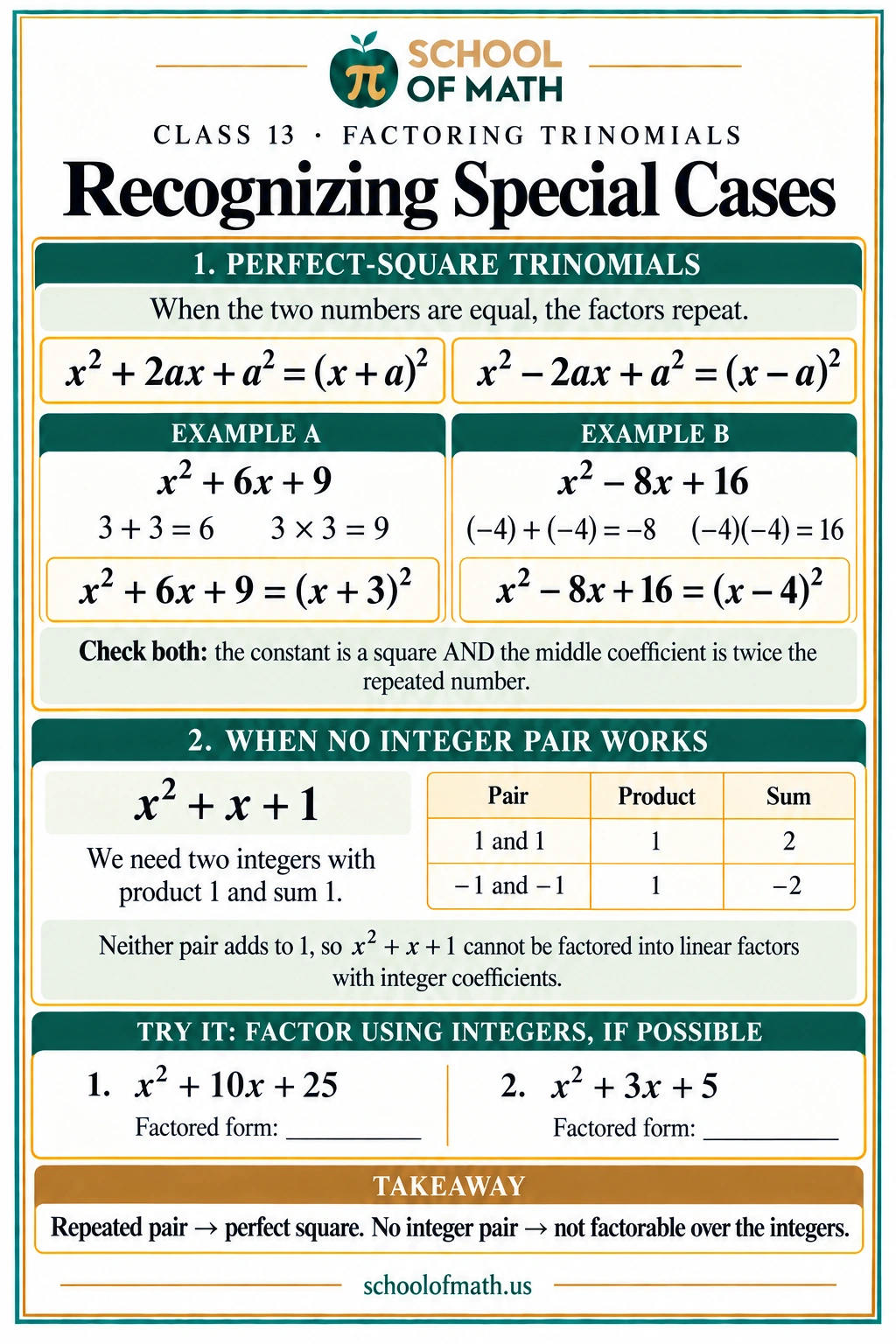
Equal factor numbers produce a perfect square: (x + a)² = x² + 2ax + a². A square constant alone is not enough; the middle coefficient must also match. If no integer pair meets both targets, say that the trinomial does not factor over the integers.
Try it yourself: five questions
Q31 Practice 1 of 5 · Start
Factor x² + 12x + 36 and write the result using an exponent.
Answer
(x + 6)².
- 6 + 6 = 12 and 6 × 6 = 36. The repeated factor (x + 6)(x + 6) is written (x + 6)².
Q32 Practice 2 of 5 · Build
Factor x² − 14x + 49. Explain the sign inside the squared factor.
Answer
(x − 7)².
- The two numbers are −7 and −7. They add to −14 and multiply to 49, so the repeated factor is x − 7.
Q33 Practice 3 of 5 · Apply
Can x² + 4x + 7 be factored into linear factors with integer coefficients? Justify your answer.
Answer
No; it does not factor over the integers.
- The only positive factor pair of 7 is 1 and 7, with sum 8. The negative pair sums to −8. Neither sum equals 4.
Q34 Practice 4 of 5 · Explain
A student calls x² + 7x + 16 a perfect square because 16 is a square. Is this correct? Can it factor over the integers?
Answer
No to both questions.
- (x + 4)² has middle term 8x, not 7x. The positive factor pairs of 16 have sums 17, 10, and 8. None gives 7; negative pairs have negative sums.
Q35 Practice 5 of 5 · Challenge
Find c so that x² − 18x + c is a perfect-square trinomial. Then factor it and verify the middle term.
Answer
c = 81; (x − 9)².
- Half the middle coefficient is −9. Squaring −9 gives 81. Expanding (x − 9)² gives x² − 9x − 9x + 81 = x² − 18x + 81.
Checking factors and solving equations
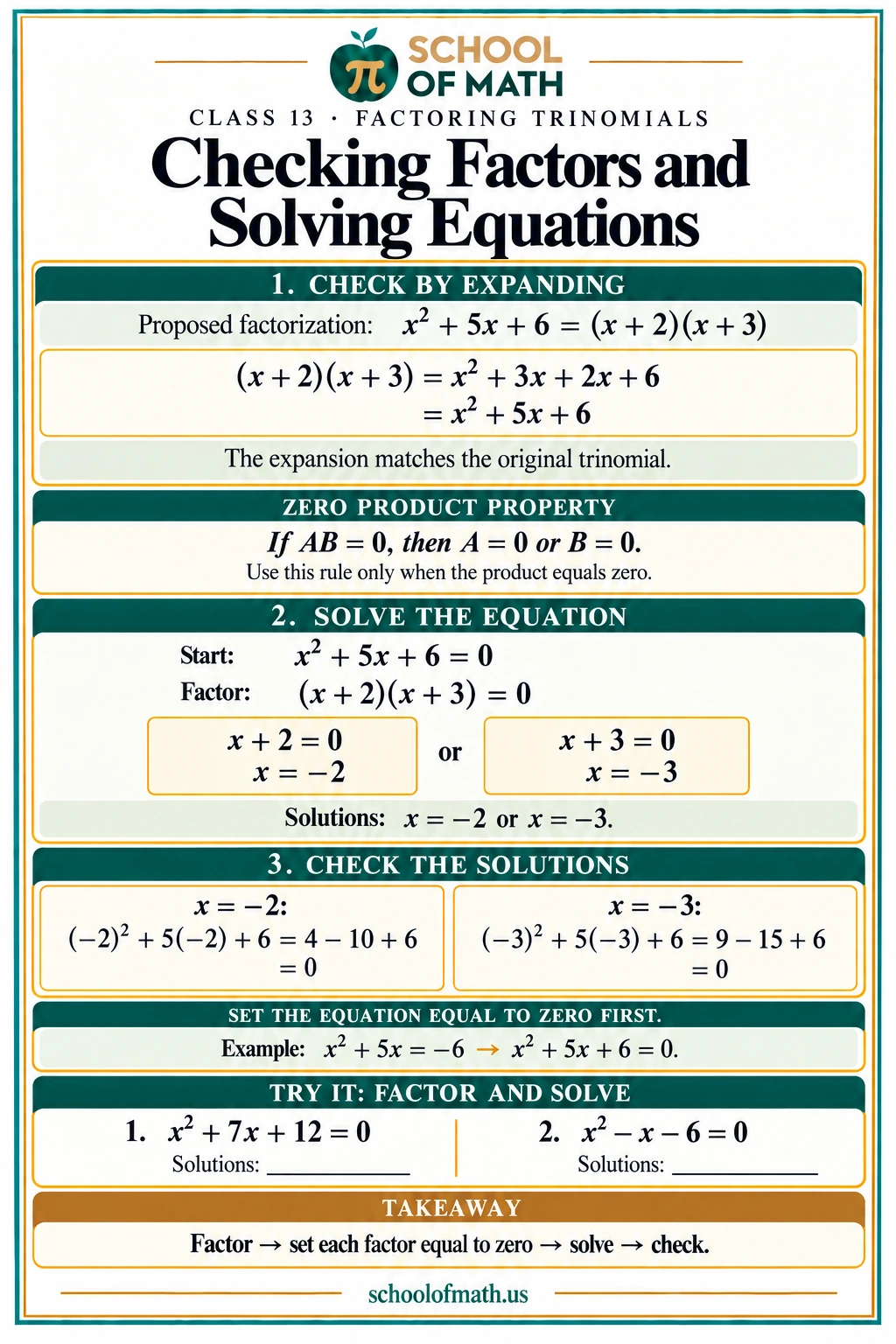
A factorization is an identity, so expanding it must reproduce every original term. To solve an equation by factoring, first make one side zero. Then use the zero-product property: if a product is zero, at least one factor must be zero.
Try it yourself: five questions
Q36 Practice 1 of 5 · Start
Check the claim x² + 14x + 24 = (x + 2)(x + 12) by expanding the right side.
Answer
The factorization is correct.
- Expansion gives x² + 12x + 2x + 24 = x² + 14x + 24. Every term matches.
Q37 Practice 2 of 5 · Build
Is (x − 7)(x − 4) a correct factorization of x² − 3x − 28? Expand, then correct it if needed.
Answer
No. The correct factors are (x − 7)(x + 4).
- The proposed factors give x² − 11x + 28. Instead, use −7 and 4: their sum is −3 and their product is −28.
Q38 Practice 3 of 5 · Apply
Factor and solve x² − 15x + 54 = 0. Check both solutions.
Answer
x = 6 or x = 9.
- −6 and −9 add to −15 and multiply to 54, so (x − 6)(x − 9) = 0.
- Set each factor equal to zero. Checks: 36 − 90 + 54 = 0 and 81 − 135 + 54 = 0.
Q39 Practice 4 of 5 · Explain
Solve x² + 4x = 45 by factoring. Explain the first step.
Answer
x = −9 or x = 5.
- Subtract 45 to get x² + 4x − 45 = 0. Factor as (x + 9)(x − 5) = 0.
- Set the factors equal to zero. Checks in the original: 81 − 36 = 45 and 25 + 20 = 45.
Q40 Practice 5 of 5 · Challenge
Solve x² − 6x = 40 by factoring, and explain why neither x = 0 nor x = 6 can be assumed.
Answer
x = −4 or x = 10.
- Subtract 40: x² − 6x − 40 = 0. The factorization is (x + 4)(x − 10) = 0.
- The original product x(x − 6) equals 40, not zero, so its factors cannot be set equal to zero. Checks: 16 + 24 = 40 and 100 − 60 = 40.
Taking out the greatest common factor
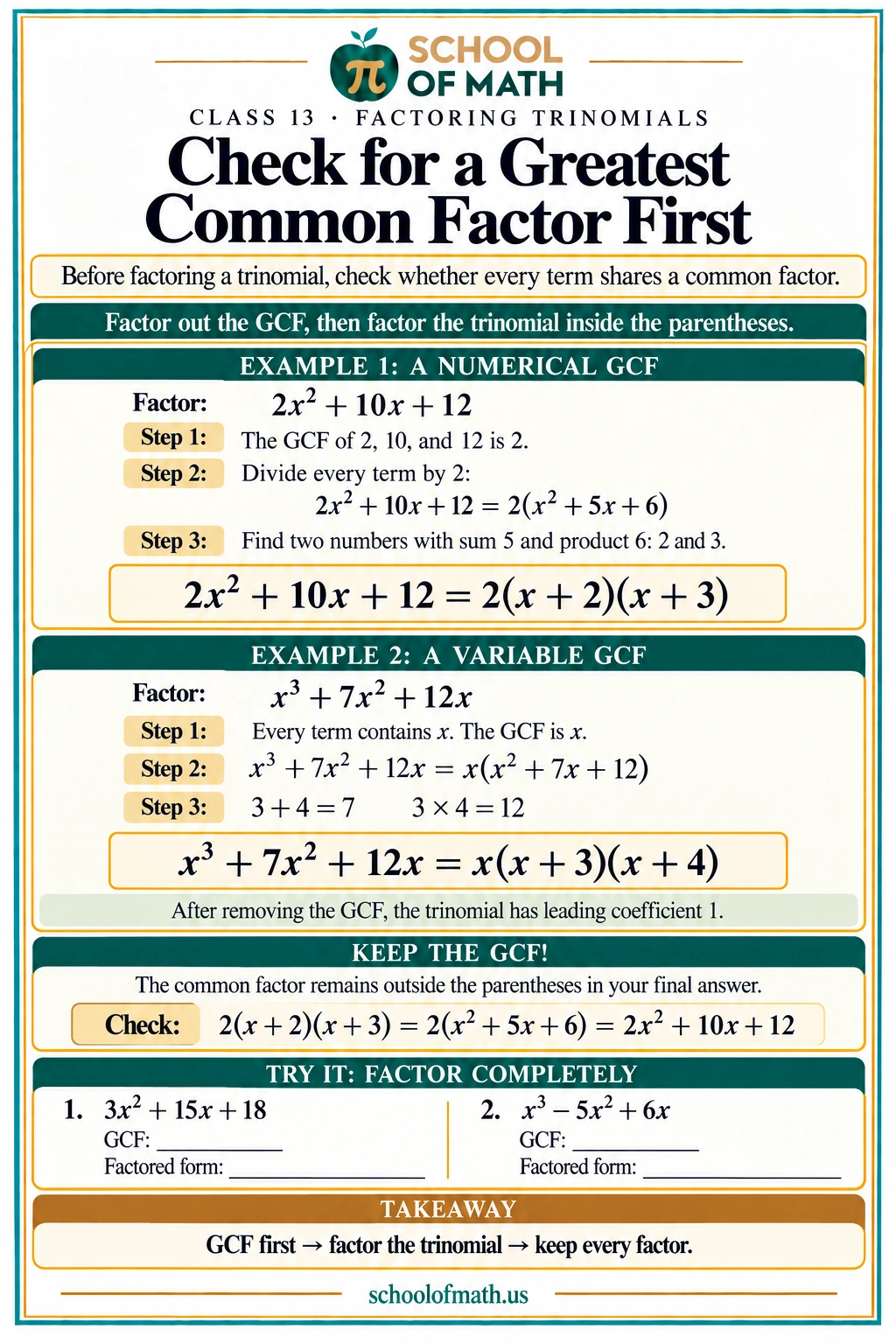
Check every term for a numerical or variable common factor before using the sum-and-product rule. After removing the GCF, factor the remaining monic trinomial. Keep the GCF in the complete factorization, and verify by multiplying everything back.
Try it yourself: five questions
Q41 Practice 1 of 5 · Start
Factor completely: 2x² + 26x + 80. Show the sum and product you use.
Answer
2(x + 5)(x + 8).
- First take out 2: 2x² + 26x + 80 = 2(x² + 13x + 40). Keep this factor in the final answer.
- Find two numbers with sum 13 and product 40: 5 and 8. Their sum is 13, and their product is 40.
- Write (x + 5)(x + 8) for the trinomial. Expanding gives x² + 13x + 40; multiply by the outside factor too, if there is one.
Q42 Practice 2 of 5 · Build
Factor completely: 3x² − 42x + 135. Show the sum and product you use.
Answer
3(x − 5)(x − 9).
- First take out 3: 3x² − 42x + 135 = 3(x² − 14x + 45). Keep this factor in the final answer.
- Find two numbers with sum -14 and product 45: -5 and -9. Their sum is -14, and their product is 45.
- Write (x − 5)(x − 9) for the trinomial. Expanding gives x² − 14x + 45; multiply by the outside factor too, if there is one.
Q43 Practice 3 of 5 · Apply
Factor completely: x³ + 3x² − 40x. Show the sum and product you use.
Answer
x(x + 8)(x − 5).
- First take out x: x³ + 3x² − 40x = x(x² + 3x − 40). Keep this factor in the final answer.
- Find two numbers with sum 3 and product -40: 8 and -5. Their sum is 3, and their product is -40.
- Write (x + 8)(x − 5) for the trinomial. Expanding gives x² + 3x − 40; multiply by the outside factor too, if there is one.
Q44 Practice 4 of 5 · Explain
Factor completely: 4x³ − 44x² + 112x. Show the sum and product you use.
Answer
4x(x − 4)(x − 7).
- First take out 4x: 4x³ − 44x² + 112x = 4x(x² − 11x + 28). Keep this factor in the final answer.
- Find two numbers with sum -11 and product 28: -4 and -7. Their sum is -11, and their product is 28.
- Write (x − 4)(x − 7) for the trinomial. Expanding gives x² − 11x + 28; multiply by the outside factor too, if there is one.
Q45 Practice 5 of 5 · Challenge
Factor completely: -2x² + 26x − 84. Show the sum and product you use.
Answer
-2(x − 6)(x − 7).
- First take out -2: -2x² + 26x − 84 = -2(x² − 13x + 42). Keep this factor in the final answer.
- Find two numbers with sum -13 and product 42: -6 and -7. Their sum is -13, and their product is 42.
- Write (x − 6)(x − 7) for the trinomial. Expanding gives x² − 13x + 42; multiply by the outside factor too, if there is one.
Recognizing and correcting common mistakes
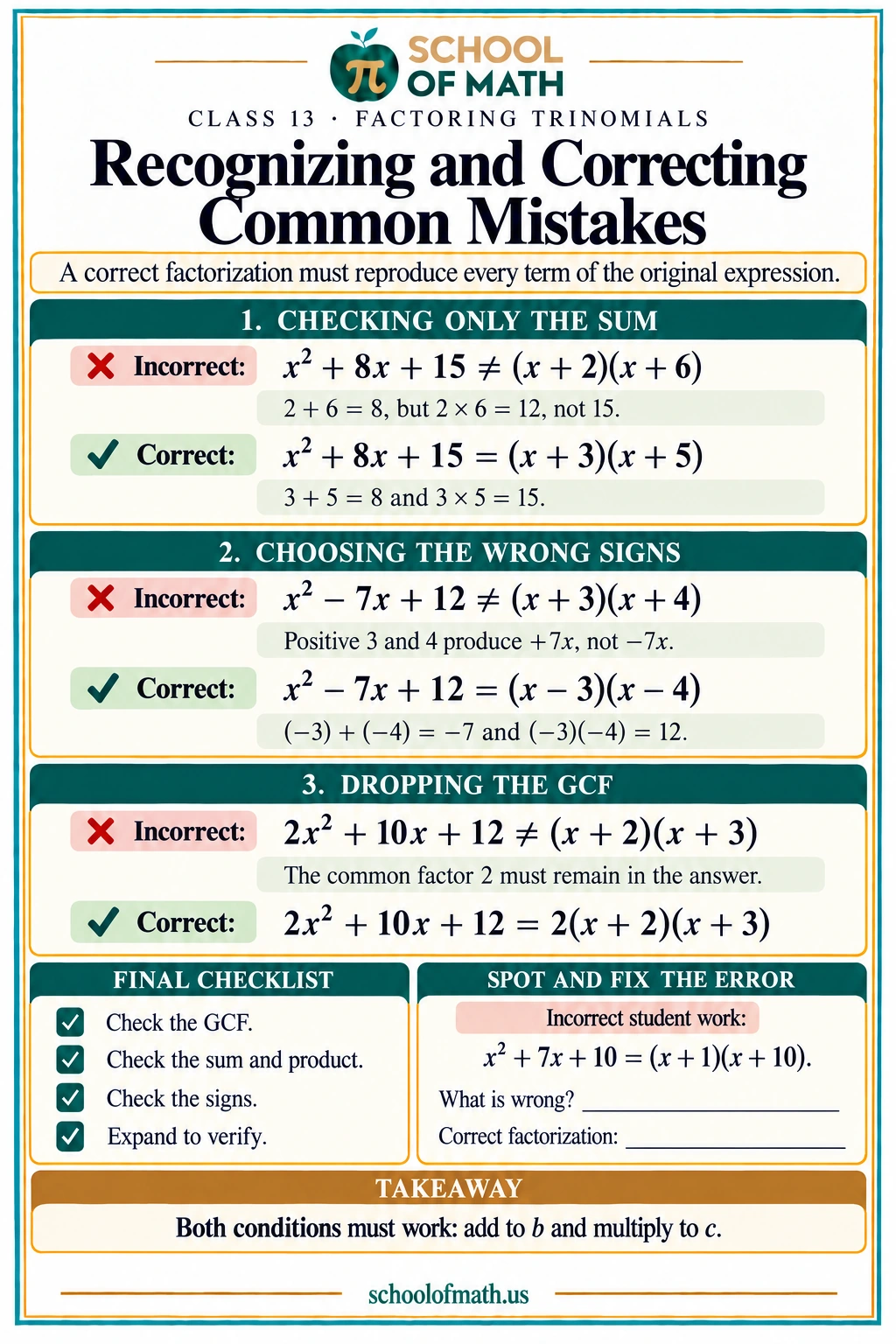
A factor pair must satisfy both the sum and the product. Keep signs, retain any GCF, and do not confuse factoring an expression with solving an equation. The zero-product property applies only after the equation has been set equal to zero.
Try it yourself: five questions
Q46 Practice 1 of 5 · Start
A student writes x² + 16x + 48 = (x + 6)(x + 10). Which test fails? Correct the factorization.
Answer
The product test fails. Correct answer: (x + 4)(x + 12).
- 6 + 10 = 16, but 6 × 10 = 60, not 48. The numbers 4 and 12 add to 16 and multiply to 48.
Q47 Practice 2 of 5 · Build
Correct x² − 17x + 72 = (x + 8)(x + 9). Explain the sign error.
Answer
(x − 8)(x − 9).
- The proposed factors produce +17x. Both numbers must be negative to have sum −17 and product +72.
Q48 Practice 3 of 5 · Apply
A student factors x² + 6x − 40 as (x − 10)(x + 4). Explain what went wrong and correct it.
Answer
Correct answer: (x + 10)(x − 4).
- −10 + 4 = −6, not +6. Because the desired sum is positive, the larger magnitude needs the positive sign: 10 − 4 = 6 and 10(−4) = −40.
Q49 Practice 4 of 5 · Explain
A student writes 5x² + 75x + 250 = (x + 5)(x + 10). Correct the work and verify the leading coefficient.
Answer
5(x + 5)(x + 10).
- First remove the GCF: 5(x² + 15x + 50). Then factor the trinomial. The outside 5 is essential: 5 · x · x = 5x².
Q50 Practice 5 of 5 · Challenge
For x² + 9x + 14 = 14, a student reports x = −2 or −7 after factoring the left side. Explain the error and solve correctly.
Answer
The correct solutions are x = 0 or x = −9.
- The product (x + 2)(x + 7) equals 14, not zero. Subtract 14 from both sides to get x² + 9x = 0, then factor x(x + 9) = 0.
- The zero-product property now applies. Both x = 0 and x = −9 make the original left side equal 14.
Homework review
Review the ten illustrated topics in order: recognizing trinomials, expanding, the sum-and-product rule, signs, special cases, checking and solving, the greatest common factor, and common mistakes. Complete one question for each image.
R1 Review image 1 of 10
Simplify 22 + x² − 5x − 8x, write it in standard form, and identify b and c.
Answer
x² − 13x + 22; b = −13 and c = 22.
- Combine −5x − 8x = −13x. Put the terms in descending powers. Keep the negative sign on b.
R2 Review image 2 of 10
Expand (x − 3)(x + 11), then explain how the sum and product of the constants appear in your result.
Answer
x² + 8x − 33.
- Expansion gives x² + 11x − 3x − 33. The constants add to 8 and multiply to −33.
R3 Review image 3 of 10
Find the integer pair for x² + 15x + 56, then factor it. Show both target checks.
Answer
7 and 8; (x + 7)(x + 8).
- 7 + 8 = 15 and 7 × 8 = 56. Both checks pass.
R4 Review image 4 of 10
Factor completely: x² + 17x + 66. Show the sum and product you use.
Answer
(x + 6)(x + 11).
- Find two numbers with sum 17 and product 66: 6 and 11. Their sum is 17, and their product is 66.
- Write (x + 6)(x + 11) for the trinomial. Expanding gives x² + 17x + 66; multiply by the outside factor too, if there is one.
R5 Review image 5 of 10
Factor completely: x² − 17x + 70. Show the sum and product you use.
Answer
(x − 7)(x − 10).
- Find two numbers with sum -17 and product 70: -7 and -10. Their sum is -17, and their product is 70.
- Write (x − 7)(x − 10) for the trinomial. Expanding gives x² − 17x + 70; multiply by the outside factor too, if there is one.
R6 Review image 6 of 10
Factor completely: x² + 4x − 45. Show the sum and product you use.
Answer
(x + 9)(x − 5).
- Find two numbers with sum 4 and product -45: 9 and -5. Their sum is 4, and their product is -45.
- Write (x + 9)(x − 5) for the trinomial. Expanding gives x² + 4x − 45; multiply by the outside factor too, if there is one.
R7 Review image 7 of 10
Factor x² − 22x + 121. Explain why it is a perfect square.
Answer
(x − 11)².
- The repeated number −11 has sum −22 with itself and square 121. Both the constant and middle coefficient fit.
R8 Review image 8 of 10
Solve x² + 2x = 63 by factoring. Check both values.
Answer
x = 7 or x = −9.
- Move 63 to the left: x² + 2x − 63 = (x + 9)(x − 7) = 0.
- Checks: 49 + 14 = 63 and 81 − 18 = 63.
R9 Review image 9 of 10
Factor completely: 6x³ + 30x² − 396x. Show the sum and product you use.
Answer
6x(x − 6)(x + 11).
- First take out 6x: 6x³ + 30x² − 396x = 6x(x² + 5x − 66). Keep this factor in the final answer.
- Find two numbers with sum 5 and product -66: -6 and 11. Their sum is 5, and their product is -66.
- Write (x − 6)(x + 11) for the trinomial. Expanding gives x² + 5x − 66; multiply by the outside factor too, if there is one.
R10 Review image 10 of 10
A student claims x² − 19x + 84 = (x − 6)(x − 14). Identify the failed check and correct the factors.
Answer
The sum check fails. Correct factors: (x − 7)(x − 12).
- (−6)(−14) = 84, but −6 − 14 = −20, not −19. Use −7 and −12: their sum is −19 and product is 84.
Homework word problems
These ten word problems increase in difficulty, from reading dimensions from an area expression to solving for an unknown measurement. Factor, show your reasoning, and keep only solutions that make sense in context. Together with the ten review questions, they make 20 homework questions.
W1 Homework word problem 1 of 10
A rectangular sign has area x² + 14x + 45 square centimeters. Its sides have the form x + m and x + n, with positive integer constants. Factor the area to find the two side expressions.
Answer
The sides can be x + 5 and x + 9 centimeters.
- The constants must add to 14 and multiply to 45. Use 5 and 9, giving (x + 5)(x + 9).
W2 Homework word problem 2 of 10
A garden has area x² + 16x + 63 square meters and length x + 9 meters. Find its width by factoring. Then find both dimensions when x = 2.
Answer
Width: x + 7 meters. At x = 2, width = 9 meters and length = 11 meters.
- Factor the area as (x + 7)(x + 9). The remaining factor is the width.
- Check at x = 2: 4 + 32 + 63 = 99 square meters, and 9 × 11 = 99.
W3 Homework word problem 3 of 10
A puzzle asks for two positive whole numbers whose sum is 17 and product is 70. Use factoring to find the numbers, and explain why a pair with only the correct sum is not enough.
Answer
The numbers are 7 and 10.
- The associated trinomial is x² + 17x + 70 = (x + 7)(x + 10). The constants satisfy both conditions.
- For example, 8 and 9 add to 17 but multiply to 72, so they do not solve the puzzle.
W4 Homework word problem 4 of 10
A rectangular print has area x² − 15x + 56 square inches, with x > 8. Its sides are x minus positive integers. Factor to find the dimensions, then calculate its perimeter when x = 12.
Answer
Sides: x − 7 and x − 8 inches. At x = 12, the perimeter is 18 inches.
- Use −7 and −8: their sum is −15 and product is 56. The restriction x > 8 makes both sides positive.
- At x = 12, the sides are 5 and 4 inches. Perimeter = 2(5 + 4) = 18 inches.
W5 Homework word problem 5 of 10
A rectangular stage has area x² + 3x − 54 square meters and length x + 9 meters. Find the width, state the restriction on x for positive dimensions, and calculate the area at x = 10.
Answer
Width: x − 6 meters; x > 6. At x = 10, area = 76 square meters.
- Factor as (x + 9)(x − 6), since 9 − 6 = 3 and 9(−6) = −54.
- Both dimensions are positive when x > 6. At x = 10, the stage measures 19 by 4 meters, so its area is 76 square meters.
W6 Homework word problem 6 of 10
A square mural has area x² + 18x + 81 square feet, where x is nonnegative. Factor the expression to find its side length. What is the perimeter when x = 4?
Answer
Side length: x + 9 feet. At x = 4, perimeter = 52 feet.
- The trinomial is (x + 9)² because 9 + 9 = 18 and 9² = 81. Since x is nonnegative, x + 9 is the positive side length.
- At x = 4 the side is 13 feet, so perimeter = 4 × 13 = 52 feet.
W7 Homework word problem 7 of 10
Three identical rectangular panels have total area 3x² + 57x + 270 square meters. Each panel has sides x plus positive integers. Factor the total area to find each panel's dimensions. Find the total area at x = 1.
Answer
Each panel can measure x + 9 by x + 10 meters. Total area at x = 1 is 330 square meters.
- Take out 3: 3(x² + 19x + 90) = 3(x + 9)(x + 10). The outside 3 counts the identical panels.
- At x = 1, each panel is 10 by 11 meters, with area 110 square meters. Three panels have area 330 square meters.
W8 Homework word problem 8 of 10
A rectangular tabletop has area 156 square inches. Its length is 1 inch more than its width. Let w be the width. Write an equation, solve by factoring, and give the physical dimensions.
Answer
Width = 12 inches; length = 13 inches.
- w(w + 1) = 156, so w² + w − 156 = 0. Factor: (w + 13)(w − 12) = 0.
- The algebraic possibilities are w = −13 or 12. A width cannot be negative, so w = 12 and the length is 13. Check: 12 × 13 = 156.
W9 Homework word problem 9 of 10
For a small fundraiser, the ticket price in dollars is 7 more than the number of tickets sold. Ticket revenue is $170. Let n be the number sold. Find n and the ticket price by factoring. If expenses are $50, what is the profit?
Answer
10 tickets at $17 each; profit = $120.
- Revenue is n(n + 7) = 170. Rearrange: n² + 7n − 170 = 0 = (n + 17)(n − 10).
- The solutions are n = −17 or 10; a ticket count must be positive, so n = 10. Price = 10 + 7 = $17. Profit = 170 − 50 = $120.
W10 Homework word problem 10 of 10
A 10-meter by 6-meter garden gets a uniform walkway of width x meters around all four sides. The total outer area, including the garden, is 140 square meters. Write an equation, remove the common factor, and solve by factoring for the walkway width.
Answer
The walkway is 2 meters wide.
- The outer dimensions are 10 + 2x and 6 + 2x because the walkway adds x on both ends. Thus (10 + 2x)(6 + 2x) = 140.
- Expand and rearrange: 4x² + 32x − 80 = 0. Divide by 4: x² + 8x − 20 = (x + 10)(x − 2) = 0.
- The solutions are −10 and 2; width must be positive, so x = 2. Check: outer dimensions 14 by 10 give area 140 square meters.
Quick questions and answers
How do you factor x² + bx + c?
Find two numbers whose sum is b and product is c, then write (x + m)(x + n). Check first for a greatest common factor and verify the factors by expanding.
How do you choose the signs when factoring trinomials?
If c is positive, the two numbers have matching signs: both positive for positive b, or both negative for negative b. If c is negative, their signs differ; the number with greater absolute value has the sign of b.
What makes a trinomial a perfect square?
The factor numbers must be equal. For example, x² − 14x + 49 = (x − 7)² because −7 + (−7) = −14 and (−7)(−7) = 49. A square constant by itself is not enough.
What if no integer pair has the required sum and product?
State that the trinomial does not factor into linear factors over the integers. Do not claim that it cannot factor over any number system. This class practices integer factoring.
When can you use the zero-product property?
Only when a product equals zero. Rearrange the equation to put zero on one side, factor the other side, then set each factor equal to zero and check the solutions.
What practice and homework does Algebra Ignite Class 13 include?
Ten images each have five original practice questions, for 50 class questions. Homework has ten review questions, one per image, plus ten word problems in increasing difficulty. All 70 exercises have hidden worked answers online. The 25-page workbook includes the images and questions with blank answer space, but no exercise answers.
Where does SOMATH teach Algebra Ignite?
Young Fermats Algebra Ignite is a rolling Algebra I course at School of Math, 226 W 79th St on Manhattan's Upper West Side. View the current schedule or book an evaluation for placement. Call (646) 668-6151.