Little Newtons · Class 10 · Measurement · Grades 1–2
Digital Time & Elapsed Time (Little Newtons Class 10, Grades 1–2) — 25 Practice Questions with Hidden Answers
Digital time is written h:mm — hours on the left, minutes on the right, always two-digit minutes (so 3:07, not 3:7). Elapsed time is a two-step calculation: count whole hours first, then the extra minutes. This Little Newtons Class 10 pack teaches grade 1–2 students how to read a digital clock, AM vs. PM, and how to solve elapsed-time word problems like “the movie starts at 3:15 and lasts 90 minutes — when does it end?” With 25 practice questions and click-to-reveal step-by-step answers.
This class is part of the Little Newtons arc at SOMATH — School of Math on the Upper West Side. Class 10 is the second “measurement” class in the year — after Class 9 (length in inches and centimeters). We used to teach analog clock reading here (hour hand and minute hand on a round face), but we swapped it for something more useful: digital time and elapsed time. Every digital device in a child’s life shows time as 3:15 PM, and every real-world question about time (“how long until pickup?”, “when does the movie end?”) is an elapsed-time problem. This is the math they actually use. Taught in-person at 226 W 79th St. Call (646) 668-6151 or book a free 30-minute evaluation to see if your grade 1–2 child is a fit.
What’s in this class pack
- Why digital time (and not analog clock faces)
- How to read a digital clock (the h:mm rule)
- AM vs. PM — the noon and midnight trick
- The three time facts every child should memorize
- Elapsed time — the two-step trick
- Hour crossings — when minutes hit 60
- The 5 most common grade 1–2 time mistakes
- 25 practice questions with hidden answers
- Answer key summary
- Frequently asked questions
Free class visual — 8 SOMATH slides for Little Newtons Class 10
The 8-slide teaching pack we use in class: reading a digital clock, hours vs. minutes, the h:mm rule, AM vs. PM, elapsed-time on a number line, and a fully worked word problem (school play starts 5:45 PM, ends 7:20 PM → 1 hr 35 min). Print it for the fridge or hand it to your grade 1–2 child.
Download the 8-slide PDF (Class 10)1. Why digital time (and not analog clock faces)
The shift we made
Most grade 1–2 math programs still spend weeks on analog clock reading — hour hand, minute hand, half past, quarter to. That made sense in 1985. In 2026, almost every clock a child sees is digital: the microwave, the tablet, the school laptop, the phone Grandma’s on, the pickup-time reminder in Mom’s calendar. Kids rarely encounter a round clock face — and when they do, they can figure it out in a few minutes if we’ve taught the underlying math (that time is a two-part quantity: hours and minutes, with 60 minutes per hour).
So we shifted the class. In Little Newtons Class 10, we spend most of the time on the two skills kids actually use:
- Reading digital time — understanding what 3:07 PM means, why the zero is there, and why 3:60 is never a real time.
- Elapsed time — the math of “starts at… lasts… ends at…” This is the version of time that shows up in word problems, in schedules, and in every “how long until?” question.
Analog reading isn’t hard to add later if a child needs it — a 10-minute lesson at home usually does it. But elapsed time is a skill kids build for years, and it’s the foundation for a huge amount of grade 3–5 word-problem math.
2. How to read a digital clock — the h:mm rule
The form
Every digital clock shows time in the same form:
h:mmThe number on the LEFT of the colon is the hour. The two numbers on the RIGHT are the minutes. Read the hour first, then the minutes.
Read this as “three fifteen” — 3 hours and 15 minutes. If it’s 3:15 in the afternoon we say “three fifteen PM.”
The two-digit minutes rule
Minutes are ALWAYS written as two digits. If the minutes number is under 10, we put a zero in front as a placeholder.
- 3:07 means 3 hours and 7 minutes — read “three-oh-seven.”
- 3:00 means exactly 3 hours and 0 minutes — read “three o’clock.”
- 3:15 means 3 hours and 15 minutes — read “three fifteen” (or “quarter past three” if you want the fraction name).
Why two digits? So the clock always looks the same width, and so you can never mix up the hour and the minutes. 3:7 is not a real digital time — the correct form is 3:07.
Minutes never reach 60
Minutes on a digital clock go from 00 to 59. When the minute counter would reach 60, it flips back to 00 and the hour goes up by 1. That’s because 60 minutes = 1 hour.
So the clock reads:
… 3:58 → 3:59 → 4:00 → 4:01 → 4:02 …You will NEVER see 3:60. That would be the same as 4:00, so the clock skips it.
3. AM vs. PM — the noon and midnight trick
The two halves of the day
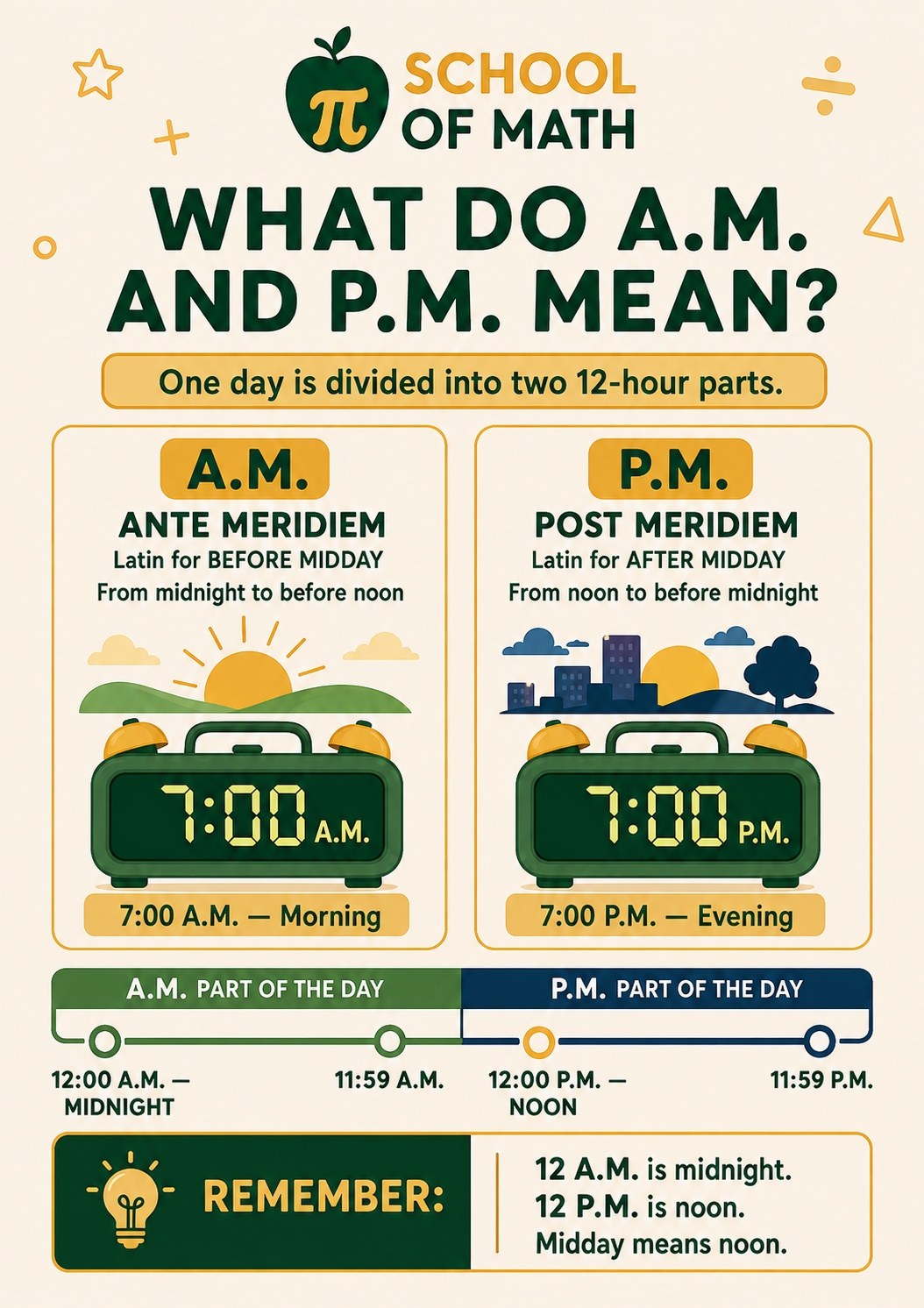
A day has 24 hours, but a digital clock only shows numbers 1–12. So we split the day in half and label each half:
- AM = morning half. From midnight (12:00 AM) through the morning up to just before noon (11:59 AM).
- PM = afternoon + evening half. From noon (12:00 PM) through the afternoon and evening up to just before midnight (11:59 PM).
“AM” comes from Latin ante meridiem (before noon). “PM” comes from Latin post meridiem (after noon). Kids don’t need the Latin — they need the picture: the sun is up in the AM (morning), the sun is coming down in the PM (afternoon and evening).
| Time | What’s happening | AM or PM? |
|---|---|---|
| 7:00 breakfast | getting up, cereal | 7:00 AM |
| 12:00 lunch at school | lunchtime, sun straight up | 12:00 PM (noon) |
| 3:15 school pickup | end of school day | 3:15 PM |
| 6:30 dinner | dinner with the family | 6:30 PM |
| 8:00 bedtime story | getting sleepy | 8:00 PM |
| 12:00 sound asleep | middle of the night | 12:00 AM (midnight) |
4. The three time facts every child should memorize
Every grade 1–2 child needs three facts locked in memory — the same way they memorize that 5 + 5 = 10 and that a triangle has 3 sides. All time math comes back to these.
| Time fact | Why it matters |
|---|---|
| 60 minutes = 1 hour | The rule for hour crossings in elapsed time (see part 6). |
| 24 hours = 1 day | Why we need AM and PM — the clock only shows 1–12, but a day has 24 hours. |
| 60 seconds = 1 minute | Comes back in grade 2 with stopwatches and grade 3 with sports word problems. |
5. Elapsed time — the two-step trick
What elapsed time means
Elapsed time is how much time passed between two moments. Three parts:
- Start time — when it began.
- Duration (or “elapsed”) — how long it lasted.
- End time — when it finished.
These three numbers always fit together: start + duration = end. If a word problem gives you any two, you can find the third.
The two-step trick (start + duration = end)
The easiest way to add a duration to a start time is to break the duration into whole hours and extra minutes. Then add them in that order.
Example: the movie starts at 3:15 and lasts 90 minutes. When does it end?
- Break 90 minutes into whole hours + extra: 90 min = 60 min + 30 min = 1 hr 30 min.
- Step 1 — add the whole hour first: 3:15 + 1 hr = 4:15. (The minutes don’t change; only the hour goes up.)
- Step 2 — add the extra minutes: 4:15 + 30 min = 4:45.
Answer: 4:45 PM. The movie ends at 4:45 PM.
The two-step trick (start + end = duration)
Same idea in reverse. Given a start time and an end time, count whole hours first, then the extra minutes.
Example: soccer practice starts at 4:00 and ends at 5:30. How long did practice last?
- Step 1 — count whole hours from start to the same minutes on or before the end: 4:00 → 5:00 = 1 hour.
- Step 2 — count the extra minutes from there to the end: 5:00 → 5:30 = 30 minutes.
- Add: 1 hr + 30 min = 1 hr 30 min.
Answer: 1 hour and 30 minutes.
6. Hour crossings — when minutes hit 60
The trap
The classic grade 2 mistake: adding minutes and forgetting that 60 minutes = 1 hour.
Example: it’s 3:45. Your show lasts 30 minutes. When does it end?
Wrong way: 3:45 + 30 = 3:75. Nope. There is no such time as 3:75.
Right way: add 30 to 45 minutes to get 75 minutes. That’s 60 + 15, so it becomes 1 hour and 15 extra minutes. Add the hour to bump 3 up to 4, and keep 15 as the new minutes.
3:45 + 0:30 = 4:15The show ends at 4:15. Whenever minutes would reach or pass 60, subtract 60 from the minutes and add 1 to the hour.
7. The 5 most common grade 1–2 time mistakes
- Confusing 12 AM and 12 PM. Kids often say 12:00 AM is noon. Rule: PM = sun up in the sky = noon. AM = middle of the night = midnight.
- Writing minutes without the leading zero. 3:7 is not a real time — write 3:07. Two-digit minutes, always.
- Adding minutes past 60. Writing 3:75 instead of 4:15. Whenever minutes hit 60, subtract 60 and add 1 to the hour.
- Forgetting the hour changes. When counting elapsed time across noon or midnight, kids sometimes ignore the AM/PM flip. From 11:30 AM to 1:00 PM is 1 hour 30 minutes — you have to cross noon.
- Reading the colon as a decimal point. 3:30 is NOT “three point thirty” and is NOT 3.5 in decimals. It’s 3 hours and 30 minutes. The colon is a separator, not a decimal point. This trap comes back hard in grade 5 when students first meet time in decimals.
8. Practice — 25 questions with hidden answers
Read the question with your child. Encourage them to say the answer out loud first, then click “Show answer & work” to check.
Printable worksheet — 25 questions with answer boxes
Same 25 practice questions, formatted as a 5-page SOMATH-branded worksheet with a work/answer box under each question and a name/date bar on page 1. Print at home for pencil-and-paper practice, then click “Show answer & work” below to check.
Download the 25-question worksheet (PDF, 5 pages)Question 1 — reading a digital clock
A digital clock shows 4:20. What time is it? Read it out loud.
Answer: 4:20 (“four twenty”) — 4 hours and 20 minutes.
Read the hour first (4), then the minutes (20). The colon separates them. If it’s in the afternoon, we’d say “four twenty PM.”
Question 2 — the leading-zero rule
Write in correct digital form: 3 hours and 5 minutes.
Answer: 3:05.
Minutes must be two digits. Since 5 is only one digit, we add a zero in front to make it 05. Read as “three-oh-five.”
Question 3 — is this a real time?
Emma writes 3:60. Is this a real time? If not, what should she write instead?
Answer: no, 3:60 is not a real time. It should be 4:00.
Minutes go from 00 to 59. When they would reach 60, they reset to 00 and the hour goes up by 1. So 60 minutes past 3:00 is 4:00, not 3:60.
Question 4 — the AM/PM trap
Sam is having lunch in the school cafeteria and the clock says 12:00. Is that 12:00 AM or 12:00 PM?
Answer: 12:00 PM (noon).
Lunch happens in the middle of the day when the sun is straight up. That’s noon = 12:00 PM. Midnight (12:00 AM) is when everyone is asleep in the middle of the night.
Question 5 — match the time to the activity
Which time goes with each activity? Times: 7:00 AM, 3:15 PM, 8:30 PM. Activities: (a) school pickup, (b) breakfast, (c) bedtime story.
Answer: (a) 3:15 PM, (b) 7:00 AM, (c) 8:30 PM.
Breakfast is in the morning (AM). School pickup is in the afternoon (PM). Bedtime is in the evening (PM, near sleep time).
Question 6 — elapsed time, same hour
Recess starts at 10:15 and ends at 10:35. How long is recess?
Answer: 20 minutes.
Both times are in the 10:00 hour, so no hour crossing. Just subtract the minutes: 35 − 15 = 20. Recess is 20 minutes long.
Question 7 — elapsed time, whole hour
Soccer practice starts at 4:00 PM and ends at 5:00 PM. How long is practice?
Answer: 1 hour.
From 4:00 to 5:00 is exactly one whole hour. Same minutes (00), one hour later.
Question 8 — elapsed time, hour + minutes
A show starts at 3:15 and lasts 1 hour and 30 minutes. When does it end?
Answer: 4:45.
Two steps. Step 1: add the whole hour — 3:15 + 1 hr = 4:15. Step 2: add the extra 30 minutes — 4:15 + 30 min = 4:45. The show ends at 4:45.
Question 9 — the 90-minute movie
The movie starts at 3:15 PM and lasts 90 minutes. When does it end?
Answer: 4:45 PM.
First convert: 90 min = 60 min + 30 min = 1 hr 30 min. Then two-step: 3:15 + 1 hr = 4:15, then 4:15 + 30 min = 4:45. Same as question 8 — converting minutes to hours-and-minutes first makes the arithmetic easy.
Question 10 — the hour crossing
It’s 3:45. Homework will take 30 minutes. What time will homework be done?
Answer: 4:15.
Adding 30 to 45 minutes gives 75 minutes. But minutes can’t be 75 — that’s 60 + 15, so it’s 1 hour plus 15 extra minutes. Add the hour to bump 3 up to 4, and keep 15 as the new minutes: 4:15. Homework ends at 4:15. (This is the hour-crossing trick.)
Question 11 — finding the start time
Class ends at 4:00 PM and lasted 1 hour. What time did class start?
Answer: 3:00 PM.
Working backward from end time: end − duration = start. So 4:00 − 1 hr = 3:00. Class started at 3:00 PM.
Question 12 — finding the duration
A math class starts at 3:15 and ends at 4:15. How long is the class?
Answer: 1 hour (60 minutes).
Same minutes (15) both times, so we’re measuring whole hours. From 3:15 to 4:15 is exactly 1 hour.
Question 13 — duration across an hour
A birthday party starts at 2:30 PM and ends at 5:00 PM. How long is the party?
Answer: 2 hours and 30 minutes.
Two-step. Step 1 (whole hours): from 2:30 to 4:30 = 2 hours. Step 2 (extra minutes): from 4:30 to 5:00 = 30 minutes. Total: 2 hours 30 minutes.
Question 14 — break at the hour mark
Grandma’s visit begins at 3:45 and ends at 5:20. How long did she stay?
Answer: 1 hour and 35 minutes.
Break at the hour marks. From 3:45 to 4:00 = 15 minutes. From 4:00 to 5:00 = 1 hour. From 5:00 to 5:20 = 20 minutes. Add: 15 + 60 + 20 = 95 min = 1 hr 35 min.
Question 15 — how long until pickup?
It’s 2:45 PM. Pickup is at 3:15 PM. How many minutes until pickup?
Answer: 30 minutes.
Break at the hour: from 2:45 to 3:00 = 15 minutes. From 3:00 to 3:15 = 15 minutes. Add: 15 + 15 = 30 min. Half an hour until pickup.
Question 16 — math with time facts
How many minutes are in 2 hours?
Answer: 120 minutes.
1 hour = 60 minutes. So 2 hours = 60 + 60 = 120 min. (This is also a first look at multiplication: 2 × 60.)
Question 17 — converting minutes to hours
How many hours are in 120 minutes?
Answer: 2 hours.
Every 60 minutes is 1 hour. 120 minutes is 60 + 60 = two groups of 60 = 2 hours. Same fact as question 16, in reverse.
Question 18 — half an hour
Half an hour is how many minutes?
Answer: 30 minutes.
1 hour is 60 minutes. Half of 60 is 30. That’s why 3:30 is called “half past three” — you’re halfway between 3:00 and 4:00.
Question 19 — a quarter of an hour
A quarter of an hour is how many minutes?
Answer: 15 minutes.
Quarter means “one out of four equal parts.” Split 60 minutes into 4 equal parts: 60 ÷ 4 = 15. That’s why 3:15 is called “quarter past three” and 3:45 is called “quarter to four.”
Question 20 — hours in a day
How many hours are in one whole day?
Answer: 24 hours.
One day = 24 hours. That’s why the clock uses AM (12 hours) and PM (12 hours) — two halves of 12 = 24. This is a core time fact to memorize.
Question 21 — crossing noon
A field trip leaves school at 11:30 AM and returns at 1:00 PM. How long was the field trip?
Answer: 1 hour and 30 minutes.
Break at noon (12:00 PM). From 11:30 AM to 12:00 PM = 30 minutes. From 12:00 PM to 1:00 PM = 1 hour. Add: 30 min + 1 hr = 1 hr 30 min. (The AM → PM flip doesn’t change the math; you still count minutes.)
Question 22 — the sneaky colon
Is 3:30 the same as the decimal number 3.30?
Answer: no. 3:30 means 3 hours and 30 MINUTES. The colon is not a decimal point.
In decimals, 3.30 would mean 3 and 30 hundredths (which is 3.3, or three and three-tenths). But 3:30 in time is 3 hours plus half an hour = 3.5 hours in decimal. The colon and the decimal point are two different symbols with different meanings.
Question 23 — two-step planning problem
A birthday party is at 2:00 PM. It takes 30 minutes to drive there. What time do you need to leave home?
Answer: 1:30 PM.
Work backward: arrive − drive time = leave time. So 2:00 − 30 min = 1:30 PM. Leave at 1:30 PM to arrive at 2:00 PM. Elapsed time backward is just as useful as elapsed time forward.
Question 24 — challenge: two-part duration
Homework has two parts. Reading takes 20 minutes and math takes 25 minutes. If Ella starts at 4:30 PM, what time will she finish?
Answer: 5:15 PM.
First add the two durations: 20 + 25 = 45 min. Then add to the start: 4:30 + 45 min = 4:75… but that’s not real. 75 = 60 + 15, so it’s 1 hour plus 15 extra minutes. 4:30 + 1 hr = 5:30… wait, let’s redo. Better: 4:30 + 45 min. From 4:30 to 5:00 is 30 min (uses up 30 of the 45). We have 15 min left. From 5:00 add 15 min = 5:15 PM. Ella finishes at 5:15 PM.
Question 25 — challenge: schedule check
A soccer practice is scheduled from 4:00 PM to 5:15 PM. Coach says practice is exactly 1 hour and 15 minutes. Does the schedule match?
Answer: yes, the schedule matches.
Compute elapsed time from the schedule: from 4:00 to 5:00 is 1 hour, from 5:00 to 5:15 is 15 minutes. Total = 1 hr 15 min. Coach said 1 hour and 15 minutes. They match — the schedule is correct. (Checking that a duration matches a schedule is a real-life adult skill.)
9. Answer key summary
| # | Answer | # | Answer | # | Answer |
|---|---|---|---|---|---|
| 1 | 4:20 (“four twenty”) | 10 | 4:15 | 19 | 15 min |
| 2 | 3:05 | 11 | 3:00 PM | 20 | 24 hr |
| 3 | Not real; use 4:00 | 12 | 1 hour | 21 | 1 hr 30 min |
| 4 | 12:00 PM (noon) | 13 | 2 hr 30 min | 22 | No — colon ≠ decimal |
| 5 | a=3:15 PM, b=7:00 AM, c=8:30 PM | 14 | 1 hr 35 min | 23 | 1:30 PM |
| 6 | 20 min | 15 | 30 min | 24 | 5:15 PM |
| 7 | 1 hour | 16 | 120 min | 25 | Yes, matches |
| 8 | 4:45 | 17 | 2 hr | ||
| 9 | 4:45 PM | 18 | 30 min |
10. Frequently asked questions
How do you read a digital clock?
Read the hour first (left of the colon), then the minutes (right of the colon). Minutes are always two digits — if the minutes number is under 10, put a zero in front (like 3:07). Minutes never reach 60; when they would, they reset to 00 and the hour goes up by 1. So the clock goes 3:59 → 4:00, never 3:60.
What is elapsed time and how do you calculate it?
Elapsed time is how much time PASSES between two moments. Three parts: start time, duration, end time. They always fit together as start + duration = end. The two-step trick: (1) count whole hours first, (2) then count the extra minutes. Example: from 3:15 to 4:45. From 3:15 to 4:15 is 1 hour. From 4:15 to 4:45 is 30 minutes. Total = 1 hr 30 min.
What does AM and PM mean?
AM (Latin: ante meridiem) means “before noon” — the morning half of the day. PM (Latin: post meridiem) means “after noon” — the afternoon and evening half. The tricky part: 12:00 AM is MIDNIGHT and 12:00 PM is NOON. Rule: PM = sun straight up = noon.
Why do we still teach kids to tell time if they have phones?
Reading the number 2:47 PM off a screen is easy. Understanding what that number MEANS is a math skill. When a parent says “we’re leaving in 20 minutes,” a child who understands time can compute the departure. When a soccer game starts at 4:30 and lasts an hour, elapsed-time math tells them it ends at 5:30 — which affects pickup, dinner, and homework. Elapsed time is the foundation for grade 3–5 word problems and for real-world time management. At SOMATH we skip weeks on analog clock faces and focus on the version kids actually use.
How many minutes are in an hour? How many hours in a day?
1 hour = 60 minutes. 1 day = 24 hours. 1 minute = 60 seconds. These are the three time facts every grade 1–2 child should have memorized. Because minutes reset at 60 (not 100), all time math — especially elapsed time — comes back to the number 60.
What’s the difference between telling time and elapsed time?
Telling time = reading a clock and saying what time it is right now (“it’s 3:15”). Elapsed time = a math calculation (“the movie starts at 3:15 and lasts 90 minutes — when does it end?”). Telling is a reading skill; elapsed is a math skill. Elapsed time is what shows up in real life: “how long until?”, “when will we get there?”, “how much time do I have to finish this?”
What comes after this class in the Little Newtons arc?
Class 10 (digital time and elapsed time) is the second of three measurement classes. Class 11 is money — counting pennies, nickels, dimes, and quarters. Class 12 is skip counting by 2s, 5s, and 10s — a first look at the multiplication that will show up in Kid Einsteins (grades 3–4). Elapsed time itself returns in grade 3 as multi-step word problems and in grade 4–5 as schedule and calendar math.
About SOMATH — School of Math
SOMATH — School of Math is a math-focused school on the Upper West Side of Manhattan for students in grades 1–12. Class 10 is part of the Little Newtons arc (grades 1–2), taught in small groups by cofounder Marcelo Ambrozio (Northwestern-trained, 15+ years teaching NYC math) and the SOMATH team.
Location: 226 W 79th St, 1st Floor, New York, NY 10024 · Upper West Side
Phone: (646) 668-6151 · Email: hello@schoolofmath.us
Book: Free evaluation · Schedule · Home
Related SOMATH posts
- Length Measurement — Inches and Centimeters (Little Newtons Class 9, Grades 1–2)
- Word Problems with Addition — Drawing the Picture (Little Newtons Class 6, Grade 1)
- Fractions on a Number Line (Little Newtons Class 35)
- Math Enrichment for K–2: The Little Newtons Approach
- Little Newtons course (grades 1–2) — full 48-class arc
- All SOMATH blog posts »