Grade 6 · Class 1 · Advanced
Factors, Multiples, and Prime Factorization: GCF and LCM
Every whole number greater than 1 is built from primes. Find a number’s factor pairs, list its multiples, break it into primes with a factor tree, and you can find the greatest common factor and the least common multiple of any set of numbers. Use the GCF to make identical groups and the LCM to predict when repeating events meet again.
Study eight illustrated topics with five advanced practice questions after each image. Finish with eight Homework review questions and twelve Homework word problems: 40 practice questions, 20 homework questions, and 60 hidden worked answers. The questions go beyond the examples in the images. Attempt each question before opening its blue Answer control.
This is an independent Grade 6 topic at SOMATH and the matching Pre-Algebra syllabus class on prime factorization, GCF, and LCM. Earlier-numbered classes are not attendance prerequisites. Show your prime factorizations, check every GCF by dividing and every LCM by multiplying back, and label story answers with their units. View the schedule or book an evaluation to find the appropriate course level.
Download the student workbook (PDF)22 pages · Cover, eight teaching images, and all 60 questions · Generous blank answer space · No exercise solutions
Finding factor pairs
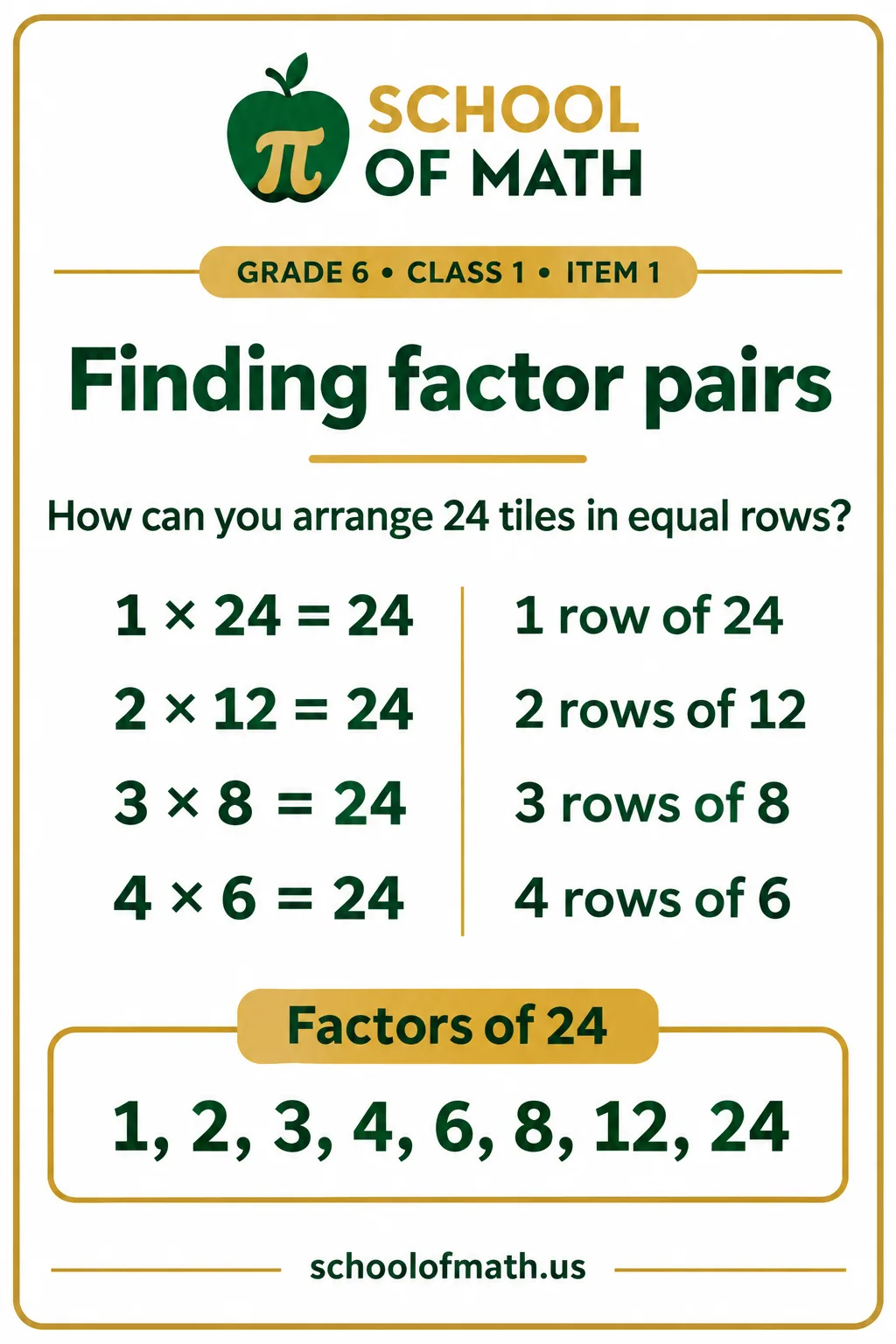
A factor of a whole number divides it evenly, with no remainder. Factors come in pairs: whenever a × b = n, both a and b are factors of n. The image arranges 24 tiles in equal rows. Each rectangle, such as 3 rows of 8, gives one factor pair, and together the pairs list every factor of 24: 1, 2, 3, 4, 6, 8, 12, 24.
To find every factor pair without missing any, test divisors in order, starting at 1. Stop as soon as the divisor multiplied by itself is larger than the number. Past that point, every new pair would just repeat an earlier pair in reverse. For 24, test 1, 2, 3 and 4; since 5 × 5 = 25 is already more than 24, the list is complete.
Advanced idea: a perfect square has one pair whose two factors are equal, such as 7 × 7 = 49. That factor counts only once, so perfect squares are the only whole numbers with an odd number of factors. Every other number has an even number of factors.
Practice: try these five advanced questions
Q1
List every factor pair of 180. How many positive factors does 180 have?
Answer
9 factor pairs and 18 factors
- Test divisors in order: 1 × 180, 2 × 90, 3 × 60, 4 × 45, 5 × 36, 6 × 30, 9 × 20, 10 × 18, 12 × 15.
- 7, 8, 11 and 13 do not divide 180 evenly. Stop after 13 because 14 × 14 = 196 is more than 180.
- There are 9 pairs, and no factor repeats, so 180 has 9 × 2 = 18 factors.
Q2
A floor design uses exactly 144 square tiles arranged as a solid rectangle. Count the different rectangles (a 2 × 72 and a 72 × 2 rectangle count as the same). Which rectangle has the smallest perimeter, and what is that perimeter in tile lengths?
Answer
8 rectangles; the 12 × 12 square, with perimeter 48
- Factor pairs of 144: 1 × 144, 2 × 72, 3 × 48, 4 × 36, 6 × 24, 8 × 18, 9 × 16, 12 × 12. That gives 8 rectangles.
- The closer the two sides are, the smaller the perimeter. The 12 × 12 square is closest.
- Perimeter = 2 × (12 + 12) = 48 tile lengths. For comparison, 1 × 144 has perimeter 2 × 145 = 290.
Q3
Explain why 100 has an odd number of factors but 98 has an even number. List the factors of each.
Answer
100 has 9 factors; 98 has 6 factors
- Factors of 100: 1, 2, 4, 5, 10, 20, 25, 50, 100. The pairs are 1 × 100, 2 × 50, 4 × 25, 5 × 20 and 10 × 10.
- The pair 10 × 10 uses the same factor twice, so it adds only one factor. That makes the total odd: 9.
- Factors of 98: 1, 2, 7, 14, 49, 98, from the pairs 1 × 98, 2 × 49, 7 × 14. 98 is not a perfect square, so every pair adds two different factors: 6.
Q4
What is the smallest whole number that has exactly 6 positive factors? Show how you know no smaller number works.
Answer
12
- Factors of 12: 1, 2, 3, 4, 6, 12, which is exactly 6 factors.
- Check the smaller numbers: the most factors any number from 1 to 11 has is 4 (6, 8 and 10 each have 4).
- So 12 is the smallest number with exactly 6 factors.
Q5
A school places 210 chairs in equal rows for an assembly. Every row must have at least 10 chairs, and there must be at least 10 rows. How many different arrangements are possible? (10 rows of 21 is different from 21 rows of 10.)
Answer
4 arrangements
- Factor pairs of 210: 1 × 210, 2 × 10⁵, 3 × 70, 5 × 42, 6 × 35, 7 × 30, 10 × 21, 14 × 15.
- Only 10 × 21 and 14 × 15 have both factors at least 10.
- Each pair gives two arrangements: 10 rows of 21, 21 rows of 10, 14 rows of 15 and 15 rows of 14. That is 4 arrangements.
Generating multiples
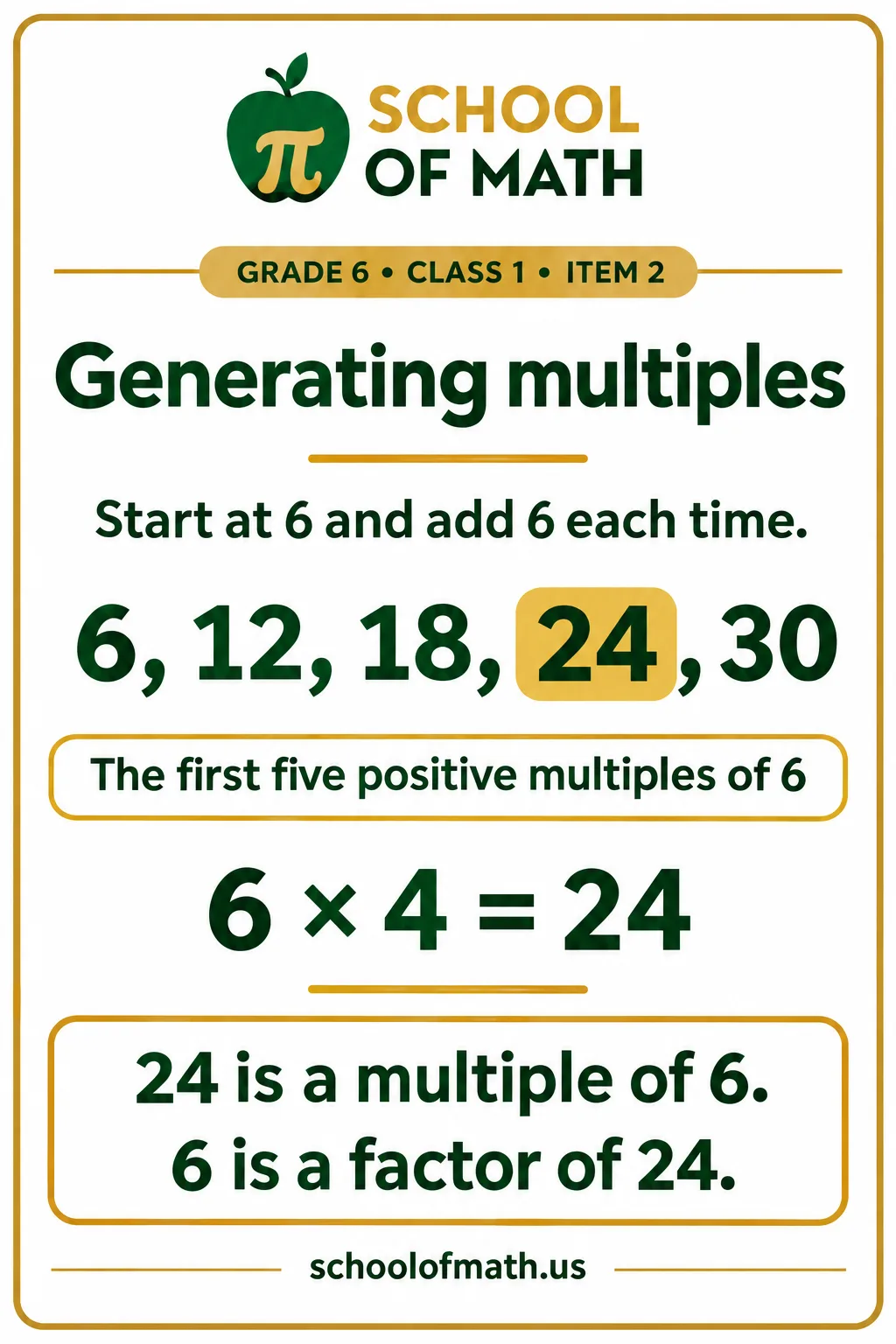
A multiple of a number is that number times a whole number. Start at 6 and keep adding 6: 6, 12, 18, 24, 30, and so on forever. A number has only a few factors but infinitely many multiples.
Factors and multiples describe the same fact from two directions. Since 6 × 4 = 24, the image says that 24 is a multiple of 6 and 6 is a factor of 24. In general, if a is a factor of b, then b is a multiple of a.
Advanced idea: to count the multiples of n between two numbers, find the first and last multiples in the range, write each as n × k, and subtract the k-values, then add 1. For example, the multiples of 5 from 20 to 50 are 5 × 4 through 5 × 10, which is 10 − 4 + 1 = 7 numbers.
Practice: try these five advanced questions
Q6
How many multiples of 7 are between 100 and 300?
Answer
28 multiples
- The first multiple of 7 above 100 is 105 = 7 × 15.
- The last multiple of 7 below 300 is 294 = 7 × 42 (7 × 43 = 301 is too big).
- Count the k-values from 15 to 42: 42 − 15 + 1 = 28.
Q7
How many three-digit whole numbers are multiples of 12?
Answer
75 numbers
- The smallest three-digit multiple of 12 is 108 = 12 × 9 (12 × 8 = 96 has only two digits).
- The largest is 996 = 12 × 83, because 12 × 84 = 1,008 has four digits.
- Count: 83 − 9 + 1 = 75.
Q8
Show that 1,001 is a multiple of 7, of 11 and of 13. Then explain why 345,345 must also be a multiple of 7.
Answer
1,001 = 7 × 11 × 13, and 345,345 = 345 × 1,001
- 7 × 11 = 77 and 77 × 13 = 1,001, so 1,001 is a multiple of all three numbers.
- 345 × 1,001 = 345 × 1,000 + 345 × 1 = 345,000 + 345 = 345,345.
- 345,345 = 345 × 7 × 11 × 13 = (345 × 11 × 13) × 7, so it is a multiple of 7. It is also a multiple of 11 and 13.
Q9
The sum of three consecutive multiples of 9 is 243. What are the three numbers?
Answer
72, 81 and 90
- Call the middle multiple m. The three numbers are m − 9, m and m + 9.
- Their sum is 3m, so 3m = 243 and m = 81.
- The numbers are 72, 81 and 90. Check: 72 + 81 + 90 = 243, and each is a multiple of 9.
Q10
Which of these is NOT always a multiple of 6?
- A. Any multiple of 12
- B. The sum of two multiples of 6
- C. An even multiple of 3
- D. A multiple of 2 plus a multiple of 3
- E. A multiple of 2 times a multiple of 3
Answer
D
- A: 12 = 6 × 2, so every multiple of 12 is a multiple of 6.
- B: 6a + 6b = 6(a + b), always a multiple of 6. C: a number divisible by both 2 and 3 is divisible by 6. E: 2a × 3b = 6ab, always a multiple of 6.
- D fails: 2 + 3 = 5, and 5 is not a multiple of 6. The answer is D.
Prime or composite?
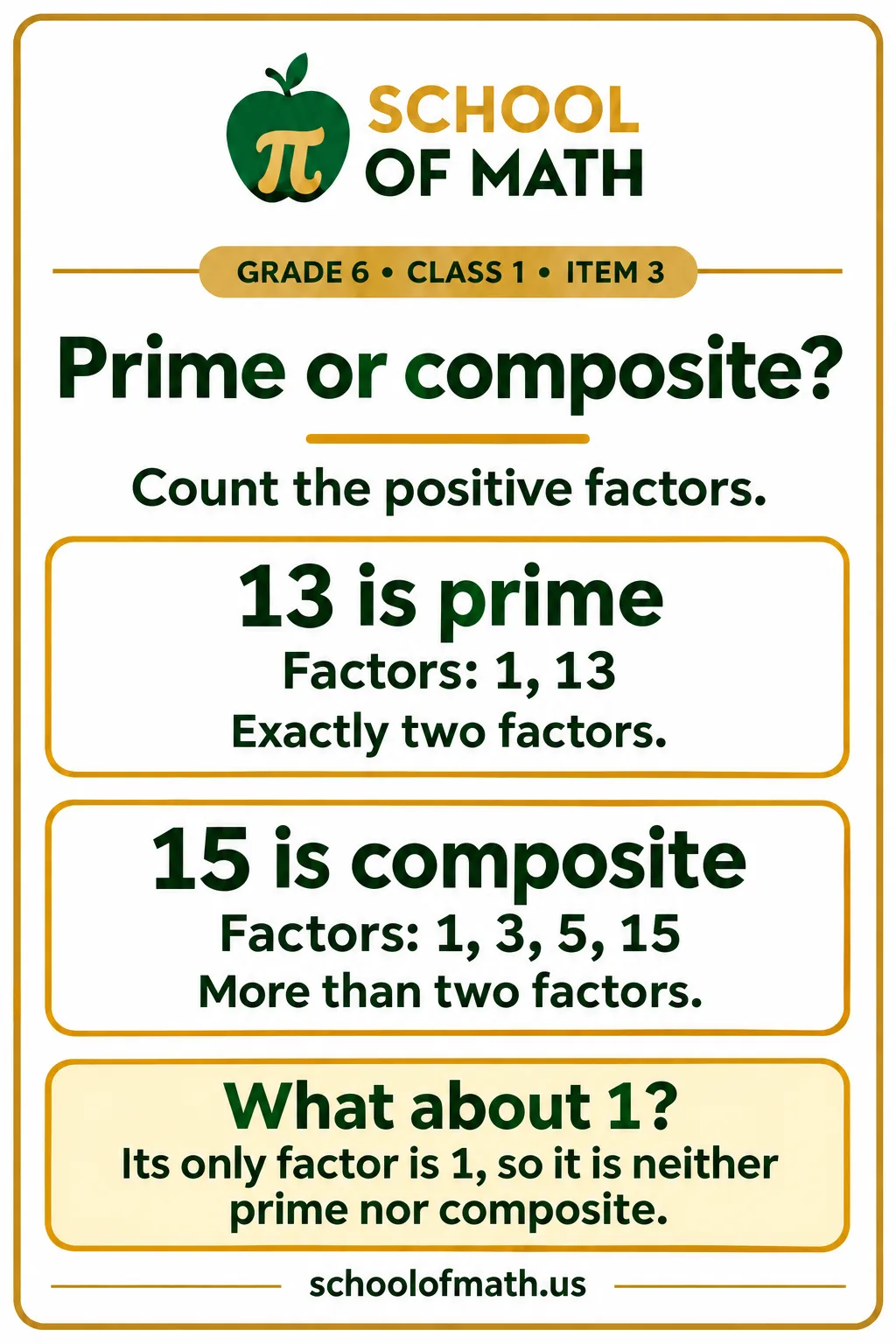
A prime number has exactly two positive factors: 1 and itself. A composite number has more than two factors. The image contrasts 13 (factors 1 and 13, prime) with 15 (factors 1, 3, 5 and 15, composite). The number 1 has only one factor, so it is neither prime nor composite.
To test whether a number is prime, try dividing it only by the primes up to its square root. If none divides evenly, the number is prime. For 97, the square root is a bit less than 10, so test 2, 3, 5 and 7. None works, so 97 is prime.
Advanced idea: 2 is the only even prime, because every other even number has 2 as a factor. So when two primes add to an odd number, one of them must be 2.
Practice: try these five advanced questions
Q11
Is 221 prime or composite? Show the tests you used.
Answer
Composite: 221 = 13 × 17
- 14 × 14 = 196 and 15 × 15 = 225, so test the primes up to 14: 2, 3, 5, 7, 11, 13.
- 221 is odd; its digit sum 5 is not a multiple of 3; it does not end in 0 or 5; 221 ÷ 7 and 221 ÷ 11 leave remainders.
- 221 ÷ 13 = 17 exactly, so 221 is composite.
Q12
Is 199 prime or composite? Explain why you can stop testing after 13.
Answer
Prime
- 14 × 14 = 196 is less than 199 but 15 × 15 = 225 is more, so any factor pair must include a number of 14 or less. Only the primes 2, 3, 5, 7, 11 and 13 need testing.
- 199 is odd, its digit sum 19 is not a multiple of 3, and it does not end in 0 or 5.
- 199 ÷ 7 = 28 R3, 199 ÷ 11 = 18 R1, 199 ÷ 13 = 15 R4. No prime works, so 199 is prime.
Q13
List every prime number between 80 and 110.
Answer
83, 89, 97, 101, 103, 107, 109
- Skip even numbers and numbers ending in 5. Test the rest with 3 and 7 (11 × 11 = 121 is past 110).
- Remove 81, 87, 93, 99 and 105 (multiples of 3) and 91 = 7 × 13.
- The primes left are 83, 89, 97, 101, 103, 107 and 109, which is 7 primes.
Q14
Two prime numbers add up to 85. What are they?
Answer
2 and 83
- Two odd numbers add to an even number. Since 85 is odd, one of the primes must be even.
- The only even prime is 2, so the other number is 85 − 2 = 83.
- 83 is prime (it is not divisible by 2, 3, 5 or 7), so the primes are 2 and 83.
Q15
Find the sum of all the prime numbers between 40 and 60.
Answer
243
- Check the odd numbers from 41 to 59 that do not end in 5: 41, 43, 47, 49, 51, 53, 57, 59.
- Remove 49 = 7 × 7, 51 = 3 × 17 and 57 = 3 × 19. The primes are 41, 43, 47, 53 and 59.
- Sum: 41 + 43 + 47 + 53 + 59 = 243.
Build a factor tree
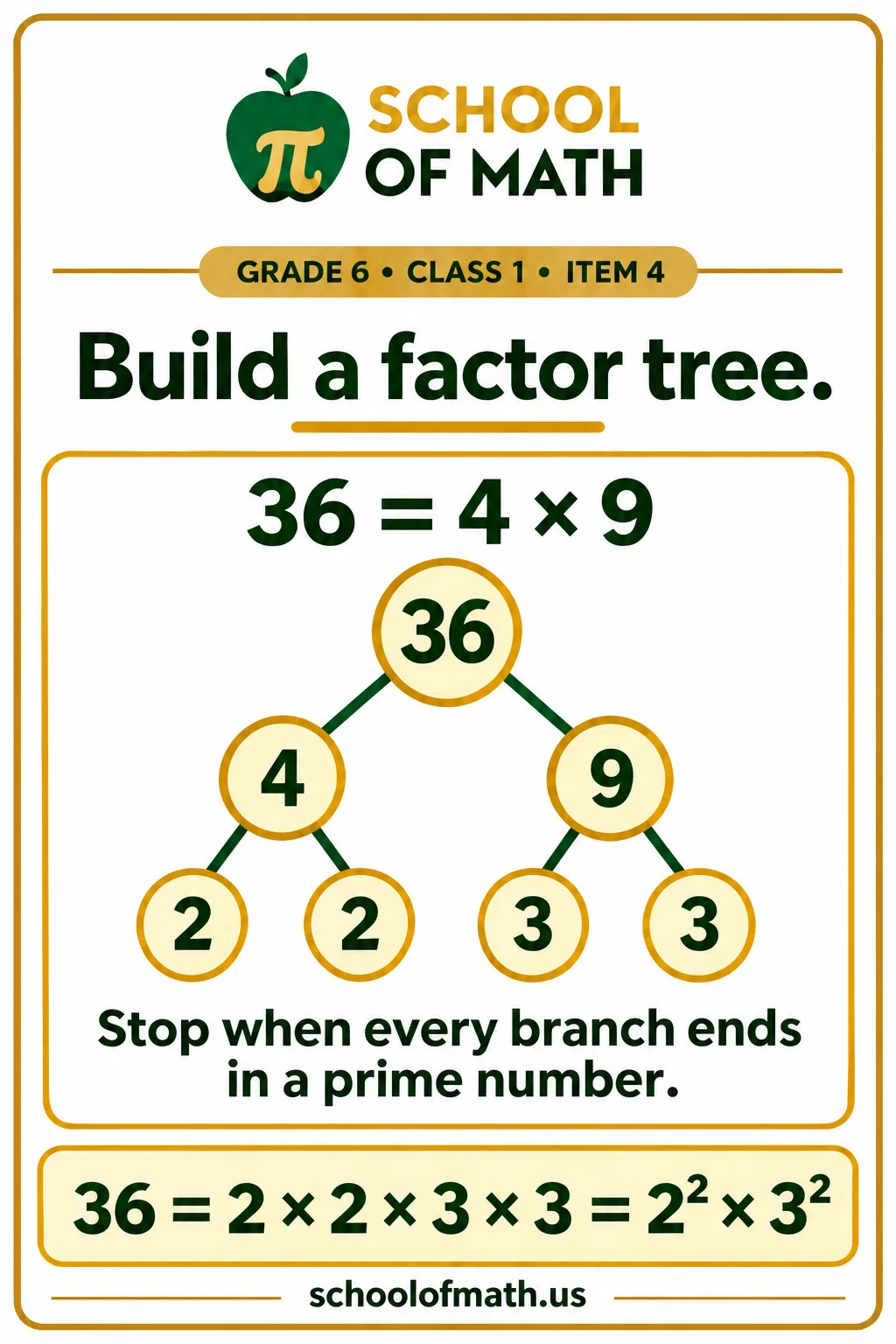
Prime factorization writes a number as a product of primes only. A factor tree finds it by splitting the number into any factor pair, then splitting each composite branch again. Stop when every branch ends in a prime. The image splits 36 into 4 × 9, then 4 into 2 × 2 and 9 into 3 × 3, so 36 = 2 × 2 × 3 × 3 = 22 × 32.
Different starting pairs always lead to the same primes. Starting 36 as 6 × 6 or as 2 × 18 still ends with two 2s and two 3s. This is why prime factorization is a reliable fingerprint for every whole number greater than 1. Exponents keep it short: 22 means 2 × 2.
Advanced ideas: if n = 2a × 3b × 5c…, then n has (a + 1) × (b + 1) × (c + 1)… factors. For 36 = 22 × 32, that is 3 × 3 = 9 factors. A number is a perfect square exactly when every exponent in its prime factorization is even.
Practice: try these five advanced questions
Q16
Write the prime factorization of 360 using exponents.
Answer
360 = 23 × 32 × 5
- Split 360 = 36 × 10.
- 36 = 2 × 2 × 3 × 3 and 10 = 2 × 5.
- Collect the primes: 2 × 2 × 2 × 3 × 3 × 5 = 23 × 32 × 5. Check: 8 × 9 × 5 = 360.
Q17
Write the prime factorization of 1,540 using exponents.
Answer
1,540 = 22 × 5 × 7 × 11
- 1,540 = 4 × 385.
- 4 = 2 × 2 and 385 = 5 × 77 = 5 × 7 × 11.
- So 1,540 = 22 × 5 × 7 × 11. Check: 4 × 5 × 7 × 11 = 20 × 77 = 1,540.
Q18
Build two different factor trees for 120: one that starts with 10 × 12 and one that starts with 8 × 15. Show that both end with the same prime factorization.
Answer
Both give 120 = 23 × 3 × 5
- Tree 1: 120 = 10 × 12; 10 = 2 × 5 and 12 = 2 × 2 × 3, giving 2 × 5 × 2 × 2 × 3.
- Tree 2: 120 = 8 × 15; 8 = 2 × 2 × 2 and 15 = 3 × 5, giving 2 × 2 × 2 × 3 × 5.
- Both trees end with three 2s, one 3 and one 5: 120 = 23 × 3 × 5.
Q19
Use the prime factorization of 720 to find how many positive factors it has, without listing them.
Answer
30 factors
- 720 = 24 × 32 × 5.
- A factor can use 0 to 4 twos (5 choices), 0 to 2 threes (3 choices) and 0 or 1 five (2 choices).
- Number of factors = 5 × 3 × 2 = 30.
Q20
What is the smallest whole number you can multiply 588 by so that the product is a perfect square? What is the perfect square?
Answer
Multiply by 3 to get 1,764 = 42 × 42
- 588 = 4 × 147 = 22 × 3 × 72.
- A perfect square needs every exponent even. The 3 has exponent 1, so one more 3 is needed.
- 588 × 3 = 1,764 = 22 × 32 × 72 = (2 × 3 × 7)2 = 422.
Greatest common factor
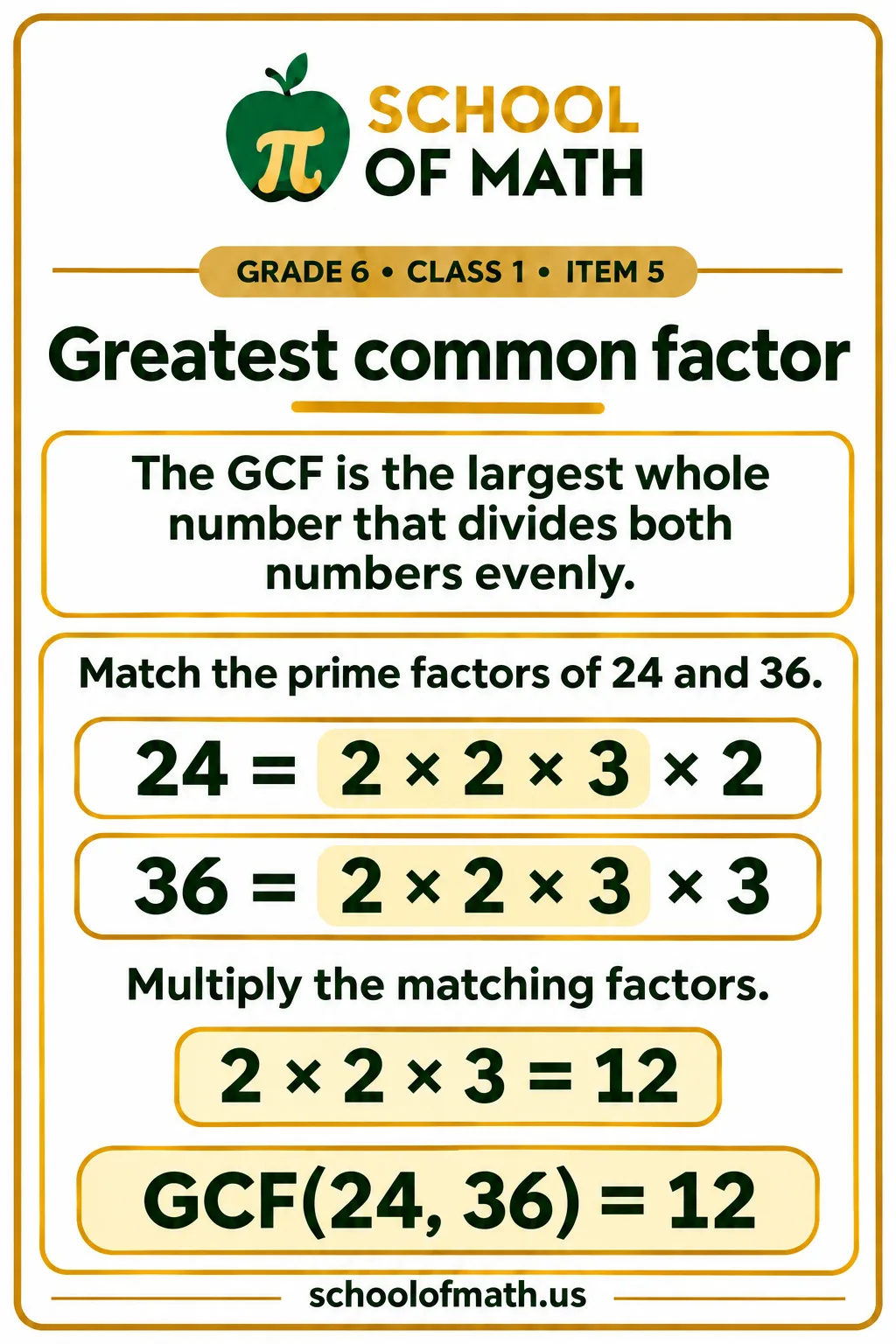
The greatest common factor (GCF) of two or more numbers is the largest whole number that divides all of them evenly. One way is to list the factors of each number and choose the largest one on every list.
The prime-factor method is faster for large numbers. Write each prime factorization, match the primes the numbers share, and multiply only the matching ones. The image matches 2 × 2 × 3 inside both 24 and 36, so GCF(24, 36) = 12. With exponents, take each shared prime with its smaller exponent.
Advanced ideas: numbers whose GCF is 1 are called relatively prime, even when neither is prime, like 8 and 9. Dividing a fraction's numerator and denominator by their GCF puts the fraction in lowest terms in one step.
Practice: try these five advanced questions
Q21
Find GCF(84, 126) using prime factorization.
Answer
42
- 84 = 22 × 3 × 7 and 126 = 2 × 32 × 7.
- Shared primes with the smaller exponents: 21, 31 and 71.
- GCF = 2 × 3 × 7 = 42. Check: 84 ÷ 42 = 2 and 126 ÷ 42 = 3.
Q22
Find GCF(180, 252, 324).
Answer
36
- 180 = 22 × 32 × 5, 252 = 22 × 32 × 7, 324 = 22 × 34.
- All three share 22 and 32. The 5 and the 7 are not shared by all three.
- GCF = 4 × 9 = 36. Check: 180 ÷ 36 = 5, 252 ÷ 36 = 7, 324 ÷ 36 = 9.
Q23
Write 168/420 in lowest terms in one step by dividing by the GCF.
Answer
2/5
- 168 = 23 × 3 × 7 and 420 = 22 × 3 × 5 × 7.
- GCF = 22 × 3 × 7 = 84.
- 168 ÷ 84 = 2 and 420 ÷ 84 = 5, so 168/420 = 2/5.
Q24
The GCF of 45 and a number n is 9. The number n is greater than 45 and less than 90. Find every possible value of n.
Answer
54, 63, 72 and 81
- n must be a multiple of 9: the choices between 45 and 90 are 54, 63, 72 and 81.
- 45 = 9 × 5, so n must not be a multiple of 5 as well, or the GCF would be 45. None of 54, 63, 72, 81 is a multiple of 5.
- Check: GCF(45, 54) = GCF(45, 63) = GCF(45, 72) = GCF(45, 81) = 9.
Q25
Which pair of numbers is relatively prime?
- A. 21 and 35
- B. 27 and 64
- C. 26 and 39
- D. 34 and 51
Answer
B
- A: both are multiples of 7. C: both are multiples of 13. D: both are multiples of 17.
- B: 27 = 33 and 64 = 26 share no prime factor.
- GCF(27, 64) = 1, so 27 and 64 are relatively prime. The answer is B.
Making identical kits
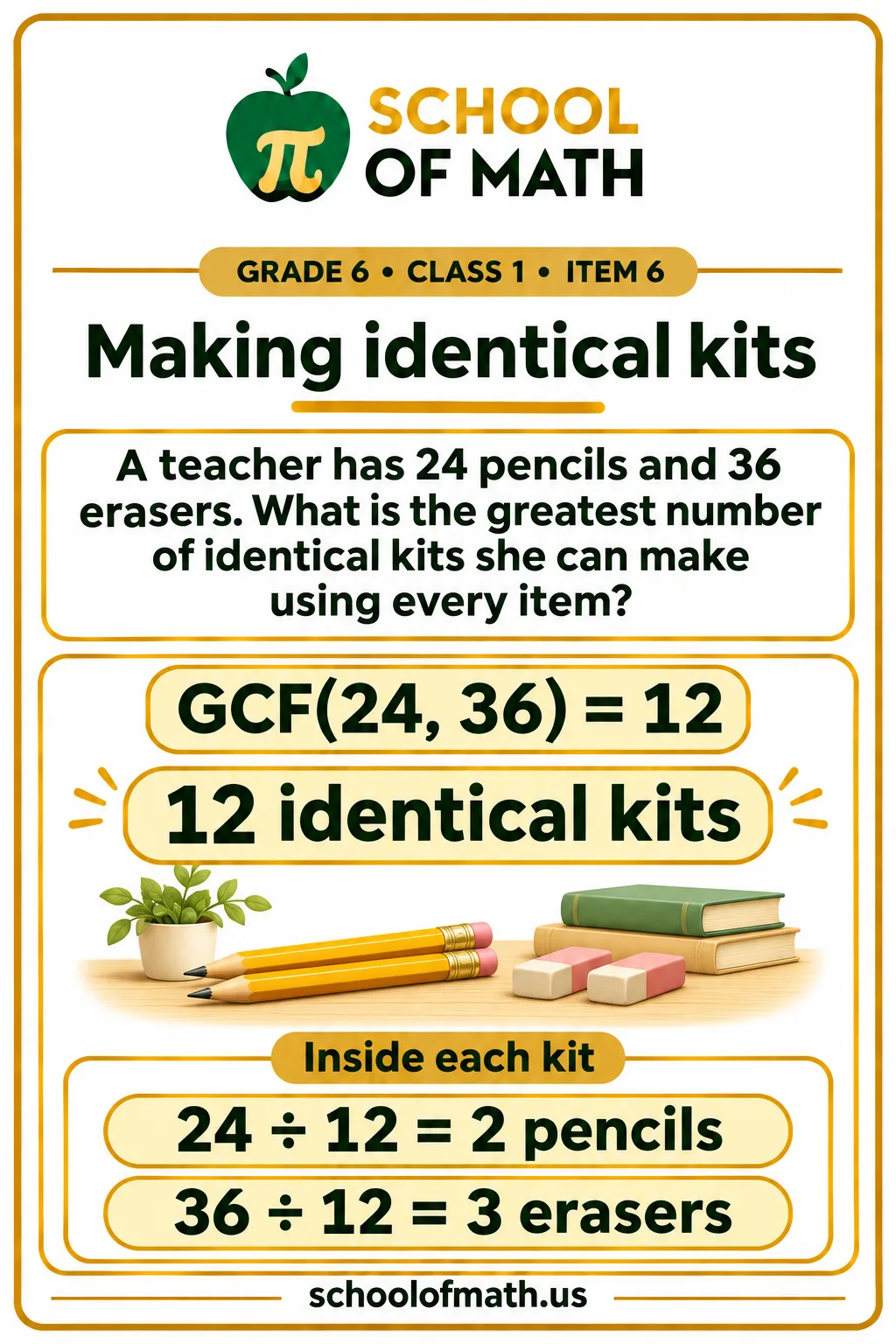
When you share several kinds of items into identical groups and use every item, the number of groups must divide each amount evenly. It must be a common factor. The greatest possible number of groups is the GCF. In the image, GCF(24, 36) = 12, so the teacher makes 12 kits.
To find what goes inside each group, divide each amount by the number of groups: 24 ÷ 12 = 2 pencils and 36 ÷ 12 = 3 erasers. A quick check: 12 kits × 2 pencils = 24 and 12 kits × 3 erasers = 36.
Advanced idea: the GCF also gives the largest equal length or size with no waste. Examples include cutting ribbons into the longest equal pieces, or covering a rectangle with the largest identical square tiles. Any common factor gives a smaller number of groups that still works.
Practice: try these five advanced questions
Q26
A club has 48 markers, 72 crayons and 120 stickers. What is the greatest number of identical kits it can make using every item, and what goes in each kit?
Answer
24 kits, each with 2 markers, 3 crayons and 5 stickers
- 48 = 24 × 3, 72 = 23 × 32, 120 = 23 × 3 × 5.
- GCF = 23 × 3 = 24 kits.
- Each kit: 48 ÷ 24 = 2 markers, 72 ÷ 24 = 3 crayons, 120 ÷ 24 = 5 stickers.
Q27
Two ribbons are 84 cm and 140 cm long. They must be cut into pieces that are all the same length, as long as possible, with nothing left over. How long is each piece, and how many pieces are there?
Answer
28 cm pieces; 8 pieces
- 84 = 22 × 3 × 7 and 140 = 22 × 5 × 7, so GCF = 22 × 7 = 28 cm.
- 84 ÷ 28 = 3 pieces and 140 ÷ 28 = 5 pieces.
- Total: 3 + 5 = 8 pieces, each 28 cm long.
Q28
A rectangular floor measures 270 cm by 450 cm. It will be covered exactly by identical square tiles, as large as possible. What is the side length of each tile, and how many tiles are needed?
Answer
90 cm tiles; 15 tiles
- The tile side must divide both 270 and 450. GCF(270, 450) = 90 cm, since 270 = 90 × 3 and 450 = 90 × 5 and 3 and 5 share no factor.
- Tiles along each side: 270 ÷ 90 = 3 and 450 ÷ 90 = 5.
- Number of tiles: 3 × 5 = 15.
Q29
A coach has 56 boys and 70 girls. She wants teams that all have the same number of boys and the same number of girls, using every child. List every possible number of teams greater than 1.
Answer
2, 7 or 14 teams
- The number of teams must be a common factor of 56 and 70.
- 56 = 23 × 7 and 70 = 2 × 5 × 7, so GCF = 14. The common factors are the factors of 14: 1, 2, 7 and 14.
- More than 1 team: 2 teams (28 boys, 35 girls each), 7 teams (8 boys, 10 girls) or 14 teams (4 boys, 5 girls).
Q30
A teacher made the greatest possible number of identical kits from all her pencils and erasers. She made 9 kits, each with 4 pencils and 7 erasers. How many pencils and erasers did she start with? Check that 9 really is the greatest number of kits.
Answer
36 pencils and 63 erasers
- Pencils: 9 × 4 = 36. Erasers: 9 × 7 = 63.
- GCF(36, 63): 36 = 22 × 32 and 63 = 32 × 7, so GCF = 9.
- The GCF matches the 9 kits. This works because 4 and 7 share no common factor, so the kits cannot be combined into fewer, larger groups that still match.
Least common multiple
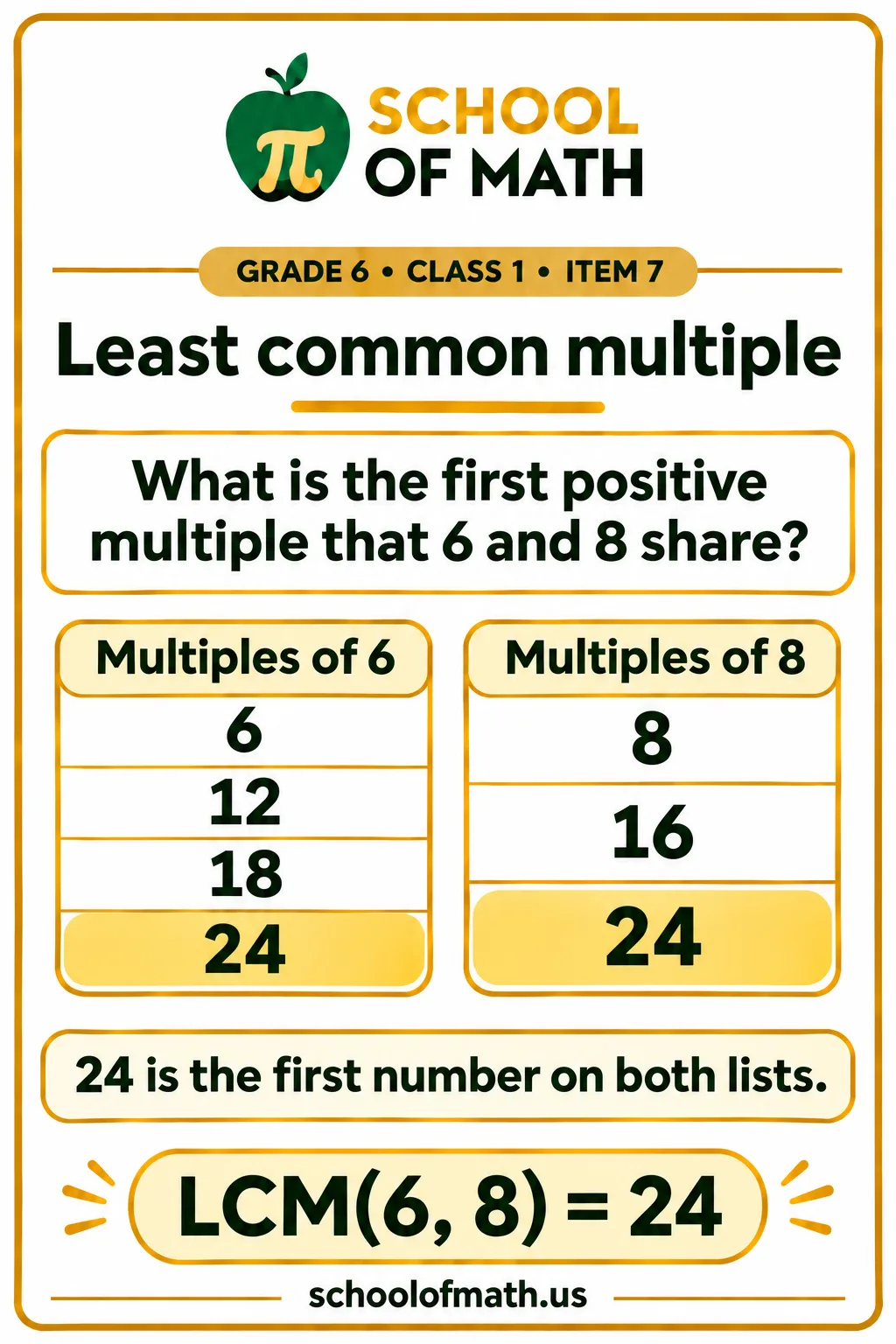
The least common multiple (LCM) of two or more numbers is the smallest positive number that is a multiple of each one. One way is to list multiples of each number until the same value appears on every list. The image lists multiples of 6 and 8; 24 is the first number on both lists, so LCM(6, 8) = 24.
The prime-factor method takes every prime that appears in any of the numbers, using its largest exponent. Since 6 = 2 × 3 and 8 = 23, LCM(6, 8) = 23 × 3 = 24. Compare with the GCF, which uses only shared primes with the smallest exponents.
Advanced ideas: for any two whole numbers, GCF × LCM = the product of the numbers. For 6 and 8, 2 × 24 = 48 = 6 × 8. When two numbers are relatively prime, their LCM is simply their product. The least common denominator for adding fractions is the LCM of the denominators.
Practice: try these five advanced questions
Q31
Find LCM(18, 30) using prime factorization.
Answer
90
- 18 = 2 × 32 and 30 = 2 × 3 × 5.
- Use each prime with its largest exponent: 21, 32, 51.
- LCM = 2 × 9 × 5 = 90. Check: 90 ÷ 18 = 5 and 90 ÷ 30 = 3.
Q32
Find LCM(12, 20, 45).
Answer
180
- 12 = 22 × 3, 20 = 22 × 5, 45 = 32 × 5.
- Largest exponents: 22, 32, 51.
- LCM = 4 × 9 × 5 = 180. Check: 180 ÷ 12 = 15, 180 ÷ 20 = 9, 180 ÷ 45 = 4.
Q33
Two numbers have GCF 6 and LCM 180. One of the numbers is 18. What is the other number?
Answer
60
- Use GCF × LCM = product of the two numbers: 6 × 180 = 1,080.
- Other number = 1,080 ÷ 18 = 60.
- Check: 18 = 2 × 32 and 60 = 22 × 3 × 5, so GCF = 2 × 3 = 6 and LCM = 22 × 32 × 5 = 180.
Q34
Use the least common denominator to add 5/12 + 7/18.
Answer
29/36
- LCM(12, 18): 12 = 22 × 3 and 18 = 2 × 32, so the LCD is 22 × 32 = 36.
- 5/12 = 15/36 and 7/18 = 14/36.
- 15/36 + 14/36 = 29/36, which is already in lowest terms because 29 is prime.
Q35
What is the smallest whole number greater than 1 that leaves a remainder of 1 when it is divided by 2, by 3, by 4, by 5 and by 6?
Answer
61
- If the number leaves remainder 1 each time, then the number minus 1 is a multiple of 2, 3, 4, 5 and 6.
- LCM(2, 3, 4, 5, 6) = 22 × 3 × 5 = 60.
- The smallest such number greater than 1 is 60 + 1 = 61. Check: 61 ÷ 4 = 15 R1 and 61 ÷ 6 = 10 R1.
When will both timers ring?
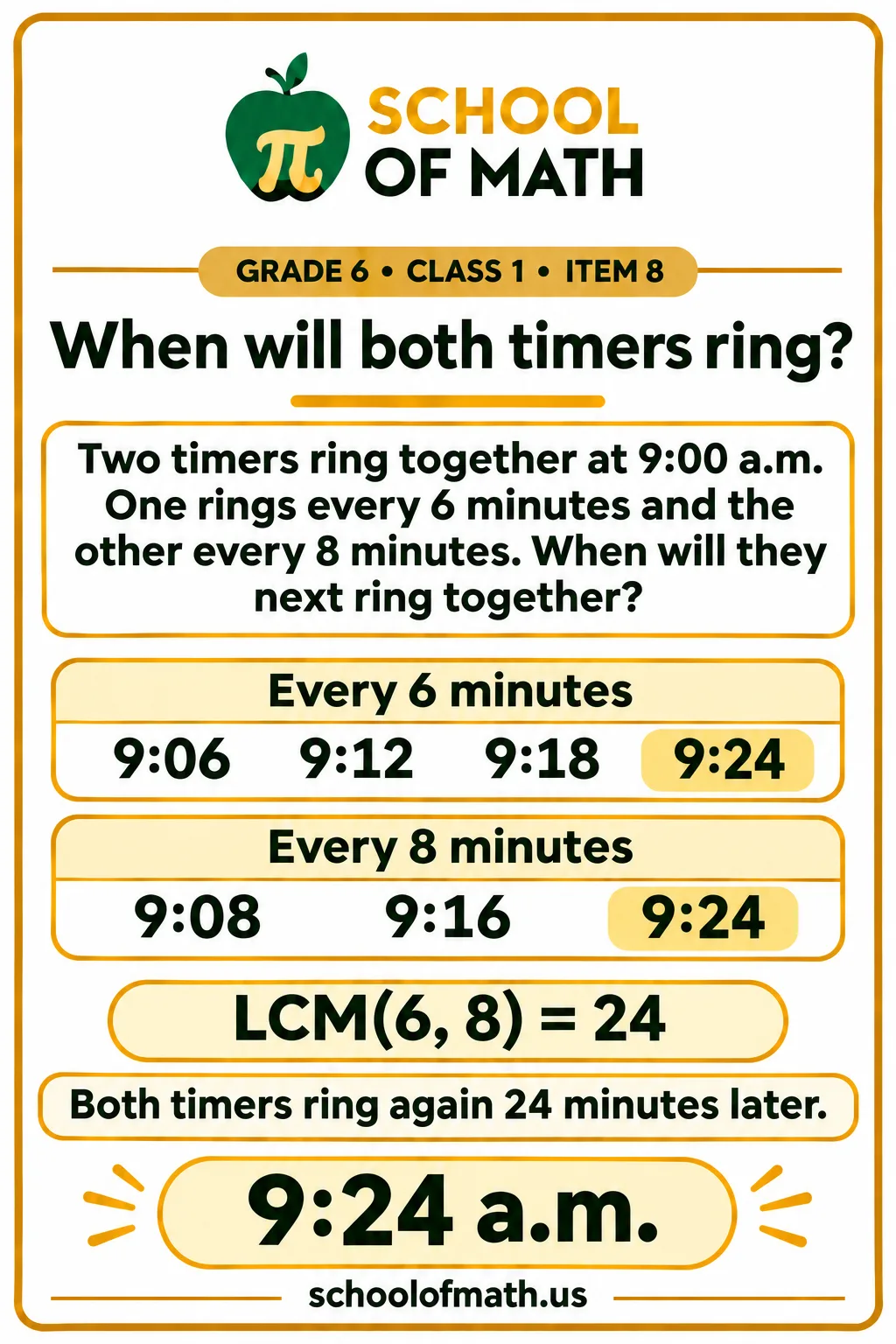
Repeating events that start together meet again after a number of minutes that is a multiple of both repeat times. They first meet again after the least common multiple. In the image, the timers repeat every 6 and 8 minutes, LCM(6, 8) = 24, so they ring together again 24 minutes after 9:00 a.m., at 9:24 a.m.
To answer a clock question, find the LCM, then add that many minutes to the starting time. Regroup 60 minutes as 1 hour. For example, 75 minutes after 6:30 a.m. is 1 hour 15 minutes later, at 7:45 a.m.
Advanced idea: after the first meeting, the events keep meeting every LCM. To count meetings in a time period, divide the length of the period by the LCM. The same thinking works for gears, laps on a track, flashing lights and calendar schedules.
Practice: try these five advanced questions
Q36
Two lights flash together, then one flashes every 12 seconds and the other every 18 seconds. How many more times do they flash together during the next 3 minutes?
Answer
5 times
- LCM(12, 18) = 36 seconds, so they flash together every 36 seconds.
- 3 minutes = 180 seconds.
- 180 ÷ 36 = 5, so they flash together 5 more times (at 36, 72, 108, 144 and 180 seconds).
Q37
Bus A leaves the station every 15 minutes and Bus B every 25 minutes. Both leave together at 6:30 a.m. When do they next leave together?
Answer
7:45 a.m.
- 15 = 3 × 5 and 25 = 52, so LCM = 3 × 52 = 75 minutes.
- 75 minutes = 1 hour 15 minutes.
- 6:30 a.m. + 1 hour 15 minutes = 7:45 a.m.
Q38
Three bells ring every 4, 6 and 10 minutes, and all three ring together at noon. When do all three next ring together? How many times do all three ring together after noon, up to and including 6:00 p.m.?
Answer
1:00 p.m.; 6 times
- LCM(4, 6, 10) = 22 × 3 × 5 = 60 minutes, so the next time is 1:00 p.m.
- They meet every hour: 1:00, 2:00, 3:00, 4:00, 5:00 and 6:00 p.m.
- That is 6 times after noon.
Q39
A gear with 28 teeth turns a gear with 42 teeth. A marked tooth on each gear is touching now. How many full turns does each gear make before the two marked teeth touch again for the first time?
Answer
Small gear: 3 turns; large gear: 2 turns
- The marked teeth meet again after a number of teeth that is a multiple of both 28 and 42.
- 28 = 22 × 7 and 42 = 2 × 3 × 7, so LCM = 22 × 3 × 7 = 84 teeth.
- Small gear: 84 ÷ 28 = 3 turns. Large gear: 84 ÷ 42 = 2 turns.
Q40
Runner A finishes a lap in 9 minutes and Runner B in 12 minutes. They start together at the starting line at 7:50 a.m. When are they next at the starting line together, and how many laps has each runner finished by then?
Answer
8:26 a.m.; A runs 4 laps and B runs 3 laps
- 9 = 32 and 12 = 22 × 3, so LCM = 22 × 32 = 36 minutes.
- 7:50 a.m. + 36 minutes = 8:26 a.m.
- Laps: Runner A 36 ÷ 9 = 4 and Runner B 36 ÷ 12 = 3.
Homework review
One question for each image, in the same order as the lesson.
R1Image 1 · Factor pairs
List the factor pairs of 196. How many positive factors does it have, and why is the count odd?
Answer
9 factors
- Pairs: 1 × 196, 2 × 98, 4 × 49, 7 × 28, 14 × 14.
- Four pairs give 2 factors each, and 14 × 14 gives only one: 4 × 2 + 1 = 9.
- The count is odd because 196 = 14 × 14 is a perfect square.
R2Image 2 · Multiples
How many multiples of 8 are there from 200 to 400, including both 200 and 400?
Answer
26
- 200 = 8 × 25 and 400 = 8 × 50.
- The multiples are 8 × 25, 8 × 26, …, 8 × 50.
- Count: 50 − 25 + 1 = 26.
R3Image 3 · Prime or composite
Is 323 prime or composite? Which primes do you need to test?
Answer
Composite: 323 = 17 × 19
- 17 × 17 = 289 and 18 × 18 = 324, so test the primes up to 17.
- 2, 3, 5, 7, 11 and 13 do not divide 323 evenly.
- 323 ÷ 17 = 19, so 323 is composite.
R4Image 4 · Factor tree
Write the prime factorization of 2,016 using exponents. How many factors does 2,016 have?
Answer
2,016 = 25 × 32 × 7; 36 factors
- 2,016 = 32 × 63, with 32 = 25 and 63 = 32 × 7.
- So 2,016 = 25 × 32 × 7.
- Number of factors = (5 + 1) × (2 + 1) × (1 + 1) = 6 × 3 × 2 = 36.
R5Image 5 · Greatest common factor
Find GCF(132, 198). Then use it to write 132/198 in lowest terms.
Answer
GCF = 66; 132/198 = 2/3
- 132 = 22 × 3 × 11 and 198 = 2 × 32 × 11.
- Shared primes with the smaller exponents: 2 × 3 × 11 = 66.
- 132 ÷ 66 = 2 and 198 ÷ 66 = 3, so 132/198 = 2/3.
R6Image 6 · Identical kits
A market packs 90 apples, 126 oranges and 162 bananas into identical baskets, using all the fruit. What is the greatest number of baskets, and what is in each one?
Answer
18 baskets with 5 apples, 7 oranges and 9 bananas each
- 90 = 2 × 32 × 5, 126 = 2 × 32 × 7, 162 = 2 × 34.
- GCF = 2 × 32 = 18 baskets.
- Each basket: 90 ÷ 18 = 5 apples, 126 ÷ 18 = 7 oranges, 162 ÷ 18 = 9 bananas.
R7Image 7 · Least common multiple
Find LCM(14, 21, 35).
Answer
210
- 14 = 2 × 7, 21 = 3 × 7, 35 = 5 × 7.
- Every prime that appears, with its largest exponent: 2, 3, 5 and 7.
- LCM = 2 × 3 × 5 × 7 = 210. Check: 210 ÷ 14 = 15, 210 ÷ 21 = 10, 210 ÷ 35 = 6.
R8Image 8 · Repeating events
One sprinkler turns on every 20 minutes and another every 45 minutes. Both turn on together at 5:15 a.m. When do they next turn on together?
Answer
8:15 a.m.
- 20 = 22 × 5 and 45 = 32 × 5, so LCM = 22 × 32 × 5 = 180 minutes.
- 180 minutes = 3 hours.
- 5:15 a.m. + 3 hours = 8:15 a.m.
Homework word problems
Twelve word problems that grow in difficulty. Decide first whether each one calls for the GCF, the LCM, or a factor count.
W1
Lucia has 64 red beads and 80 blue beads. She wants to make identical bracelets using every bead. What is the greatest number of bracelets she can make, and how many beads of each color go on each one?
Answer
16 bracelets, each with 4 red and 5 blue beads
- 64 = 26 and 80 = 24 × 5, so GCF = 24 = 16.
- Red beads per bracelet: 64 ÷ 16 = 4. Blue beads per bracelet: 80 ÷ 16 = 5.
- Check: 16 × 4 = 64 and 16 × 5 = 80.
W2
Veggie dogs come in packs of 10 and buns in packs of 8. What is the smallest number of each kind of pack you can buy to have exactly the same number of veggie dogs and buns?
Answer
4 packs of veggie dogs and 5 packs of buns (40 of each)
- The total must be a multiple of both 10 and 8. LCM(10, 8) = 40.
- Veggie dog packs: 40 ÷ 10 = 4. Bun packs: 40 ÷ 8 = 5.
- That gives 40 veggie dogs and 40 buns.
W3
A rectangular garden is 84 feet by 60 feet. Fence posts go around the edge with one at each corner and equal spacing everywhere. The spacing must be as large as possible. What is the spacing, and how many posts are needed?
Answer
12 feet apart; 24 posts
- The spacing must divide both 84 and 60. GCF(84, 60) = 12 feet.
- Perimeter = 2 × (84 + 60) = 288 feet.
- Around a closed loop, the number of posts equals the number of gaps: 288 ÷ 12 = 24 posts.
W4
Lia visits the library every 4 days and Omar every 10 days. They both visited on March 1. On what date will they next both visit on the same day?
Answer
March 21
- LCM(4, 10) = 20 days.
- March 1 + 20 days = March 21.
- Check: Lia visits on March 5, 9, 13, 17, 21 and Omar on March 11, 21.
W5
A group of students has between 100 and 150 members. When they line up in rows of 3, 4 or 5, there are always exactly 2 students left over. How many students are there?
Answer
122 students
- The number minus 2 must be a multiple of 3, 4 and 5. LCM(3, 4, 5) = 60.
- Numbers that are 2 more than a multiple of 60: 62, 122, 182, …
- The only one between 100 and 150 is 122. Check: 122 = 3 × 40 + 2 = 4 × 30 + 2 = 5 × 24 + 2.
W6
Maya picks a mystery number n. The GCF of n and 40 is 8, and the LCM of n and 40 is 120. What is n?
Answer
n = 24
- GCF × LCM = product: 8 × 120 = 960 = n × 40.
- n = 960 ÷ 40 = 24.
- Check: 24 = 23 × 3 and 40 = 23 × 5, so GCF = 8 and LCM = 23 × 3 × 5 = 120.
W7
A box measures 12 cm by 18 cm by 30 cm. It will be filled exactly with identical cubes that are as large as possible. What is the edge length of each cube, and how many cubes fit?
Answer
6 cm cubes; 30 cubes
- The cube edge must divide 12, 18 and 30. GCF(12, 18, 30) = 6 cm.
- Cubes along each edge: 12 ÷ 6 = 2, 18 ÷ 6 = 3, 30 ÷ 6 = 5.
- Number of cubes: 2 × 3 × 5 = 30.
W8
Rectangular tiles 15 cm by 20 cm are placed side by side, all facing the same way, to make the smallest possible square. What is the side of the square, and how many tiles are used?
Answer
60 cm square; 12 tiles
- The side must be a multiple of both 15 and 20. LCM(15, 20) = 60 cm.
- Tiles across: 60 ÷ 15 = 4. Tiles down: 60 ÷ 20 = 3.
- Total tiles: 4 × 3 = 12.
W9
A hallway has 50 closed lockers numbered 1 to 50. Student 1 opens every locker. Student 2 changes every 2nd locker (closing open ones and opening closed ones), student 3 changes every 3rd locker, and so on up to student 50. Which lockers are open at the end?
Answer
Lockers 1, 4, 9, 16, 25, 36 and 49 (7 lockers)
- Locker n is changed once by each student whose number is a factor of n.
- A locker ends open only if it is changed an odd number of times, so n must have an odd number of factors.
- Only perfect squares have an odd number of factors: 1, 4, 9, 16, 25, 36 and 49 stay open.
W10
Three lighthouses flash every 15, 20 and 24 seconds. They flash together at midnight. How often do all three flash together, and how many more times does that happen in the next hour?
Answer
Every 2 minutes; 30 times
- 15 = 3 × 5, 20 = 22 × 5, 24 = 23 × 3, so LCM = 23 × 3 × 5 = 120 seconds = 2 minutes.
- One hour = 60 minutes.
- 60 ÷ 2 = 30 more times.
W11
Find every whole number less than 100 that has exactly three positive factors. Explain why only these numbers work.
Answer
4, 9, 25 and 49
- An odd number of factors means the number is a perfect square, with a middle pair like k × k.
- Exactly three factors means the only factors are 1, k and k2, so k itself must be prime.
- Squares of primes less than 100: 22 = 4, 32 = 9, 52 = 25, 72 = 49. (112 = 121 is too large.)
W12
The product of two whole numbers is 1,620 and their GCF is 9. What is their LCM? Find two different pairs of numbers that fit.
Answer
LCM = 180; the pairs 9 and 180, or 36 and 45
- GCF × LCM = product, so LCM = 1,620 ÷ 9 = 180.
- Write the numbers as 9a and 9b with a and b relatively prime. Then 81ab = 1,620, so ab = 20.
- Relatively prime pairs with product 20: (1, 20) and (4, 5). The numbers are 9 and 180, or 36 and 45. Check: GCF(36, 45) = 9 and 36 × 45 = 1,620.
Quick questions and answers
What is the difference between a factor and a multiple?
A factor divides a number evenly; a multiple is the number times a whole number. Because 4 × 9 = 36, 4 and 9 are factors of 36, and 36 is a multiple of both 4 and 9. A number has only a few factors but infinitely many multiples.
How do you know when a number is prime?
A prime number has exactly two factors, 1 and itself. To test a number, divide it by the primes up to its square root. If none divides evenly, the number is prime. The number 1 is neither prime nor composite, and 2 is the only even prime.
How do you find the GCF and LCM with prime factorization?
Write each number as a product of primes. The GCF multiplies only the shared primes with their smaller exponents. The LCM multiplies every prime that appears with its largest exponent. For 18 = 2 × 3² and 30 = 2 × 3 × 5, GCF = 6 and LCM = 90.
When should a word problem use the GCF and when the LCM?
Use the GCF to split things into the greatest number of identical groups or the largest equal pieces with no leftovers. Use the LCM to find when repeating events will happen together again, or the smallest amount that several package sizes can match.
Why do perfect squares have an odd number of factors?
Factors come in pairs, but a perfect square has one pair made of the same number twice, like 7 × 7 = 49. That factor counts only once, so the total is odd. This idea solves the classic locker problem.
What does the advanced level add, and is an earlier class required?
No earlier attendance is required. This self-contained lesson has eight supplied images, forty advanced practice questions, eight Homework review questions and twelve Homework word problems. All sixty have hidden worked answers. The questions go beyond the basics with factor counting by exponents, prime tests, GCF × LCM = product, remainder puzzles, gears and the locker problem.