Kid Einsteins · Class 16 · Grades 3–4
Factors, Multiples, and Divisibility Rules for 2, 3, 5, 6, 9, 10
Factors divide a number exactly; multiples are the totals made by multiplying it by whole numbers. Divisibility rules tell you whether division by 2, 3, 5, 6, 9, or 10 leaves no remainder. Use these ideas to organize equal groups, share amounts fairly, and solve number puzzles.
Study all eight images and try five new questions after each image. Finish with eight homework review questions and twelve homework word problems: 20 homework questions and 60 questions altogether. Try each question before selecting its blue Answer control.
Part of Kid Einsteins at SOMATH. Book a free evaluation to find the right starting point, or view the class schedule. Write a multiplication fact, a digit sum, or a short explanation to show why your answer works.
Download the student workbook (PDF)22 pages · Supplied cover, eight teaching images, and all 60 questions. Each image is followed by five practice questions; homework follows with up to five questions per page.Numbered pages, generous blank answer space, and no exercise solutions or writing lines.
Understanding factors
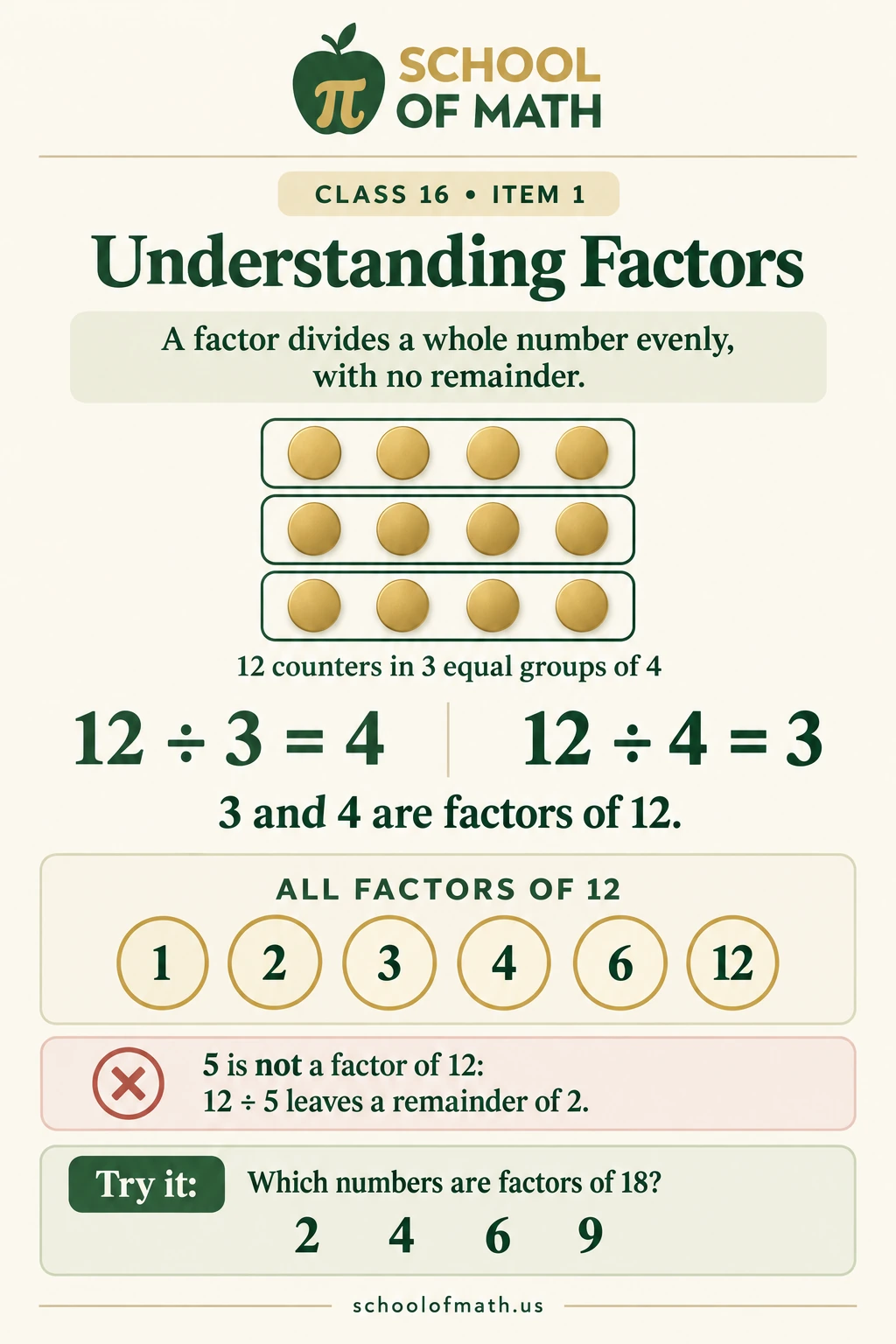
A positive factor divides a whole number exactly, with no remainder. If 24 ÷ 6 = 4, then 6 is a factor of 24. The matching multiplication fact, 6 × 4 = 24, also tells us that 4 is a factor of 24.
To test a possible factor, ask whether equal groups use the entire amount. If some objects remain, that group size is not a factor of the total. For example, 20 ÷ 6 leaves 2, so 6 is not a factor of 20.
In this class, “all factors” means all positive factors. Every positive whole number has 1 and itself as factors. Zero cannot be a divisor because division by zero is undefined.
Try it yourself: five questions
Q1 Practice 1 of 5
Which of 3, 5, 6, and 8 are factors of 24? Explain how you know.
Answer
3, 6, and 8.
24 ÷ 3 = 8, 24 ÷ 6 = 4, and 24 ÷ 8 = 3. Dividing 24 by 5 leaves a remainder of 4.
Q2 Practice 2 of 5
Is 7 a factor of 35? Write a multiplication fact to justify your answer.
Answer
Yes; 7 × 5 = 35.
Five equal groups of seven use all 35 objects. There is no remainder.
Q3 Practice 3 of 5
Is 4 a factor of 22? Use a division statement with a remainder.
Answer
No; 22 ÷ 4 = 5 remainder 2.
Five full groups use 20 objects, leaving 2. A factor must divide the whole amount exactly.
Q4 Practice 4 of 5
List all the positive factors of 16.
Answer
1, 2, 4, 8, 16.
The multiplication facts 1 × 16, 2 × 8, and 4 × 4 all make 16. List each distinct factor once.
Q5 Practice 5 of 5
A teacher puts 28 counters into 4 equal groups with none left over. How many counters are in each group, and which factor pair does this show?
Answer
7 counters per group; the pair is 4 and 7.
28 ÷ 4 = 7, so 4 × 7 = 28. Both 4 and 7 are factors of 28.
Finding factor pairs
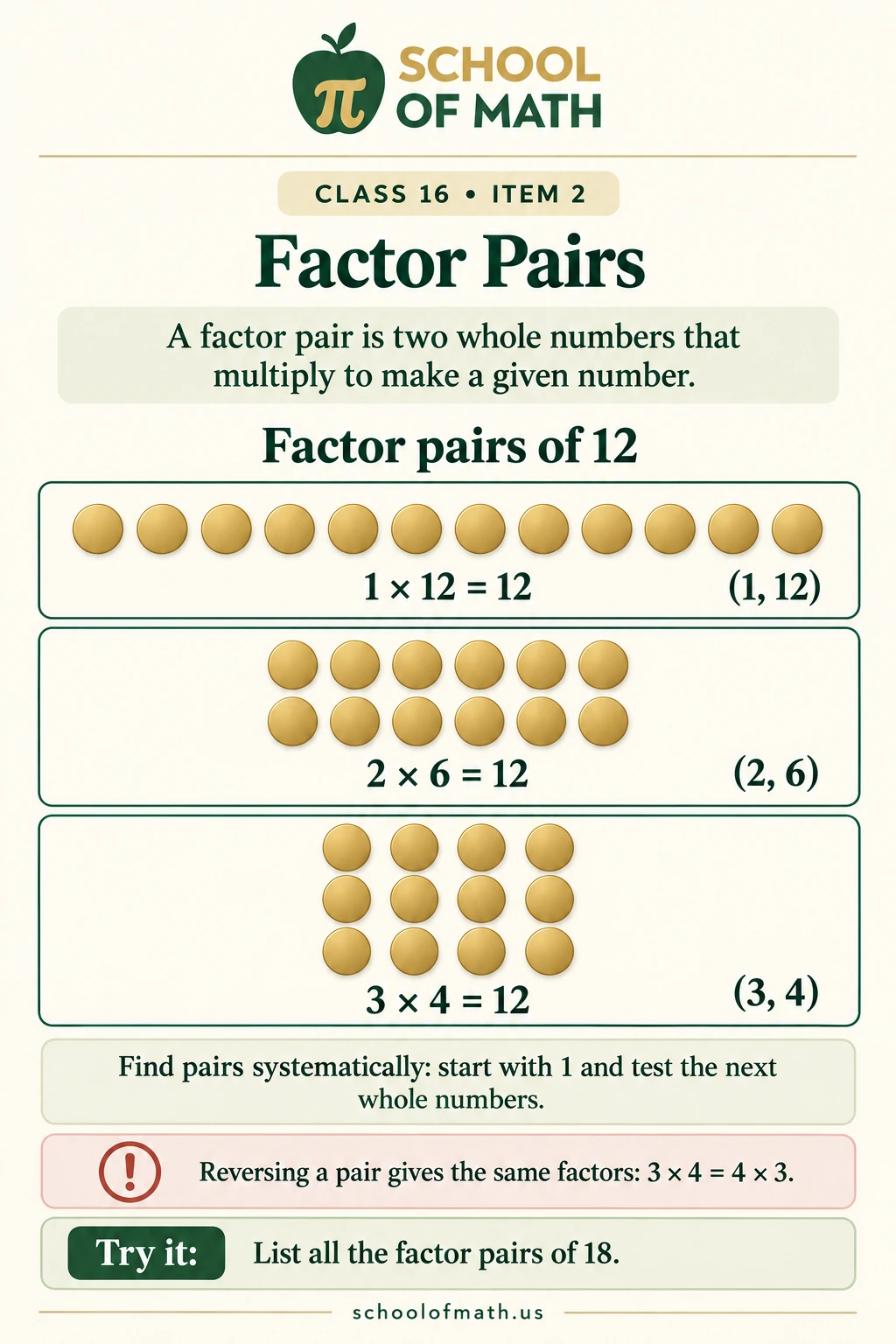
A factor pair is two positive whole numbers whose product is the given number. For 20, the pairs are 1 and 20, 2 and 10, and 4 and 5. Reversing a pair does not create a new pair.
Start with 1 and test the next whole numbers in order. If a division is exact, write the divisor and quotient together. Stop when the next possible pair would repeat a pair in the opposite order.
A square can have a pair with equal factors. For example, 5 × 5 = 25 gives the pair 5 and 5. Include that pair, but write 5 only once when listing the distinct factors.
Try it yourself: five questions
Q6 Practice 1 of 5
List all the factor pairs of 20. Do not count a reversed pair twice.
Answer
(1, 20), (2, 10), (4, 5).
Test 1, 2, 3, and 4. Three does not divide 20; four does. Five gives the reverse of the pair 4 and 5.
Q7 Practice 2 of 5
Complete the factor pairs of 28: (1, ___), (2, ___), (4, ___).
Answer
28, 14, and 7.
1 × 28 = 28, 2 × 14 = 28, and 4 × 7 = 28. No other positive factor pairs are missing.
Q8 Practice 3 of 5
List every factor pair of 36, including the pair with equal numbers.
Answer
(1, 36), (2, 18), (3, 12), (4, 9), (6, 6).
Five does not divide 36. Six pairs with itself, so include (6, 6) once and do not repeat the earlier pairs in reverse.
Q9 Practice 4 of 5
A student lists (1, 15), (3, 5), and (5, 3) as three different factor pairs of 15. Correct the list.
Answer
There are two different pairs: (1, 15) and (3, 5).
The pairs (3, 5) and (5, 3) contain the same factors. Switching the factors preserves the product.
Q10 Practice 5 of 5
Square tiles cover a rectangle with an area of 32 square units. The side lengths are whole numbers. List all possible side-length pairs, ignoring rotations.
Answer
(1, 32), (2, 16), and (4, 8) units.
Multiply length by width to find area. Each factor pair of 32 describes one rectangle; turning it does not create a new pair.
Understanding multiples
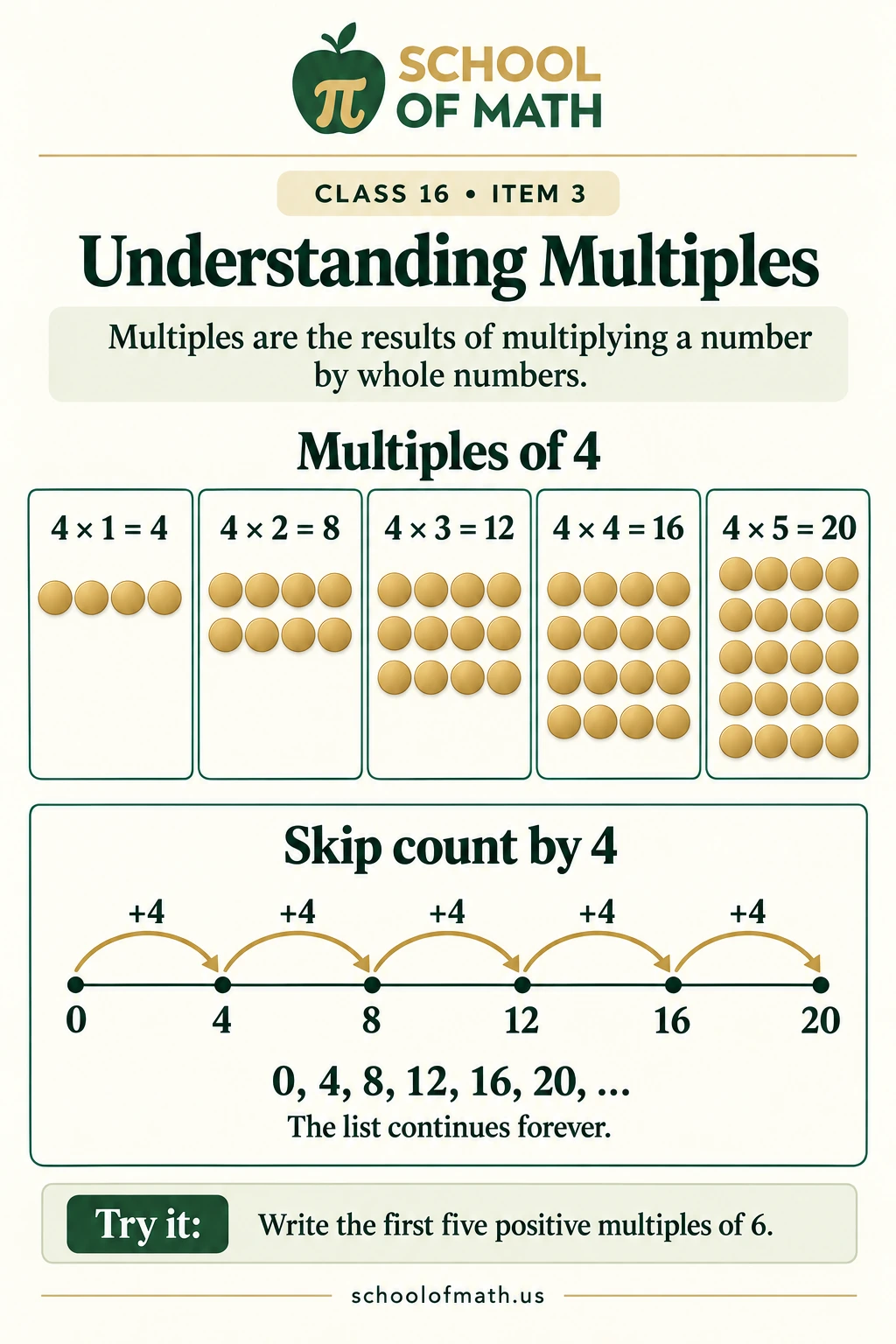
A multiple is a product obtained by multiplying a number by a whole number. The first five positive multiples of 7 are 7, 14, 21, 28, and 35. Each step adds another group of 7.
Zero is also a multiple: 7 × 0 = 0. When a question asks for positive multiples, start with the number itself, not zero. This wording prevents two different starting points.
A positive whole number has infinitely many multiples. You can always add one more group. To check whether a number is a multiple, see whether dividing it by the original number leaves no remainder.
Try it yourself: five questions
Q11 Practice 1 of 5
Write the first five positive multiples of 7.
Answer
7, 14, 21, 28, 35.
Multiply 7 by 1, 2, 3, 4, and 5. “Positive” means the list does not begin with zero.
Q12 Practice 2 of 5
Continue the multiples of 8: 8, 16, 24, ___, ___, ___.
Answer
32, 40, 48.
Add 8 each time: 24 + 8 = 32, then 40, then 48. These are 8 × 4, 8 × 5, and 8 × 6.
Q13 Practice 3 of 5
Which of 21, 30, 41, and 54 are multiples of 6?
Answer
30 and 54.
6 × 5 = 30 and 6 × 9 = 54. Neither 21 nor 41 can be written as 6 times a whole number.
Q14 Practice 4 of 5
Is 0 a multiple of 9? Explain with an equation.
Answer
Yes; 9 × 0 = 0.
Multiplying by the whole number zero produces zero. Zero is a multiple, but it is not a positive multiple.
Q15 Practice 5 of 5
A counter starts at 0 and makes equal jumps of 5. How many jumps land exactly on 45?
Answer
9 jumps.
The landing numbers are 5, 10, 15, 20, 25, 30, 35, 40, and 45. Zero is the starting point, not the first jump.
Factors versus multiples
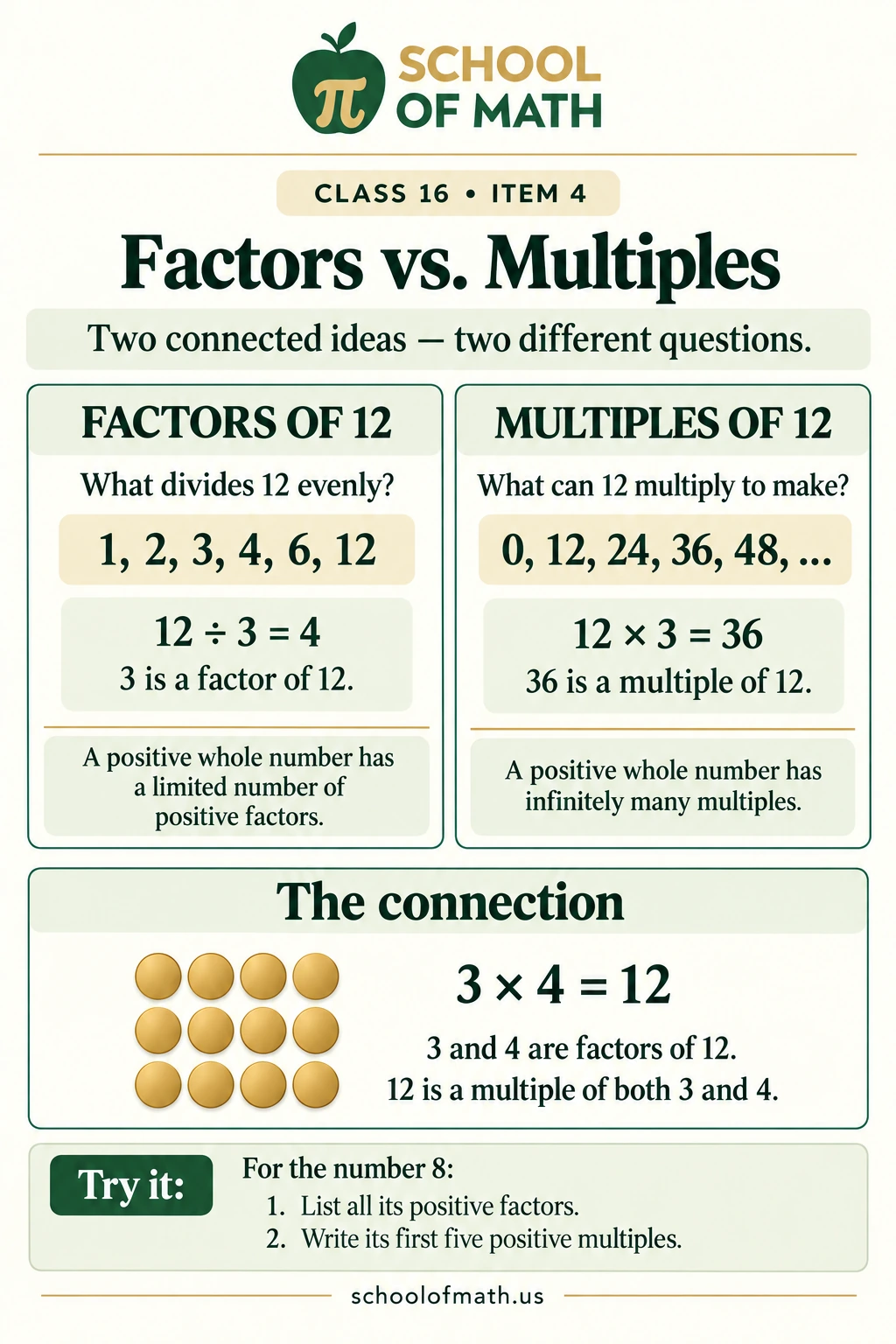
Factors answer “What divides this number exactly?” Multiples answer “What totals can this number make?” If 5 × 7 = 35, then 5 and 7 are factors of 35, while 35 is a multiple of both 5 and 7.
A positive factor cannot exceed the positive number it divides. Positive multiples start with the number and keep growing. The number itself is both a factor and a multiple of itself, so the two categories can overlap.
Read the direction carefully. “4 is a factor of 20” and “20 is a multiple of 4” express the same relationship. “20 is a factor of 4” reverses the relationship and is false.
Try it yourself: five questions
Q16 Practice 1 of 5
List all positive factors of 10 and its first five positive multiples.
Answer
Factors: 1, 2, 5, 10. Positive multiples: 10, 20, 30, 40, 50.
Use the pairs 1 × 10 and 2 × 5 for factors. Multiply 10 by 1 through 5 for the requested multiples.
Q17 Practice 2 of 5
Use 7 × 6 = 42 to complete both statements: 7 is a ___ of 42; 42 is a ___ of 7.
Answer
factor; multiple.
Seven divides 42 exactly, and 42 is the result of multiplying 7 by the whole number 6.
Q18 Practice 3 of 5
Relative to 15, classify each number as factor only, multiple only, both, or neither: 3, 15, 30, 8.
Answer
3: factor only. 15: both. 30: multiple only. 8: neither.
15 ÷ 3 = 5; 15 ÷ 15 = 1; 15 × 2 = 30. Eight neither divides 15 exactly nor equals a whole-number multiple of 15.
Q19 Practice 4 of 5
Correct this statement: “18 is a factor of 6 because 6 × 3 = 18.”
Answer
18 is a multiple of 6; 6 is a factor of 18.
The multiplication fact shows that three groups of 6 make 18. It does not show that 18 divides 6 exactly.
Q20 Practice 5 of 5
Which list can continue forever: the positive factors of 7 or the positive multiples of 7? Give three positive multiples.
Answer
The positive multiples continue forever; for example, 7, 14, 21.
The positive factors of 7 are only 1 and 7. Multiples keep growing because you can always add another 7.
Divisibility by 2, 5, and 10
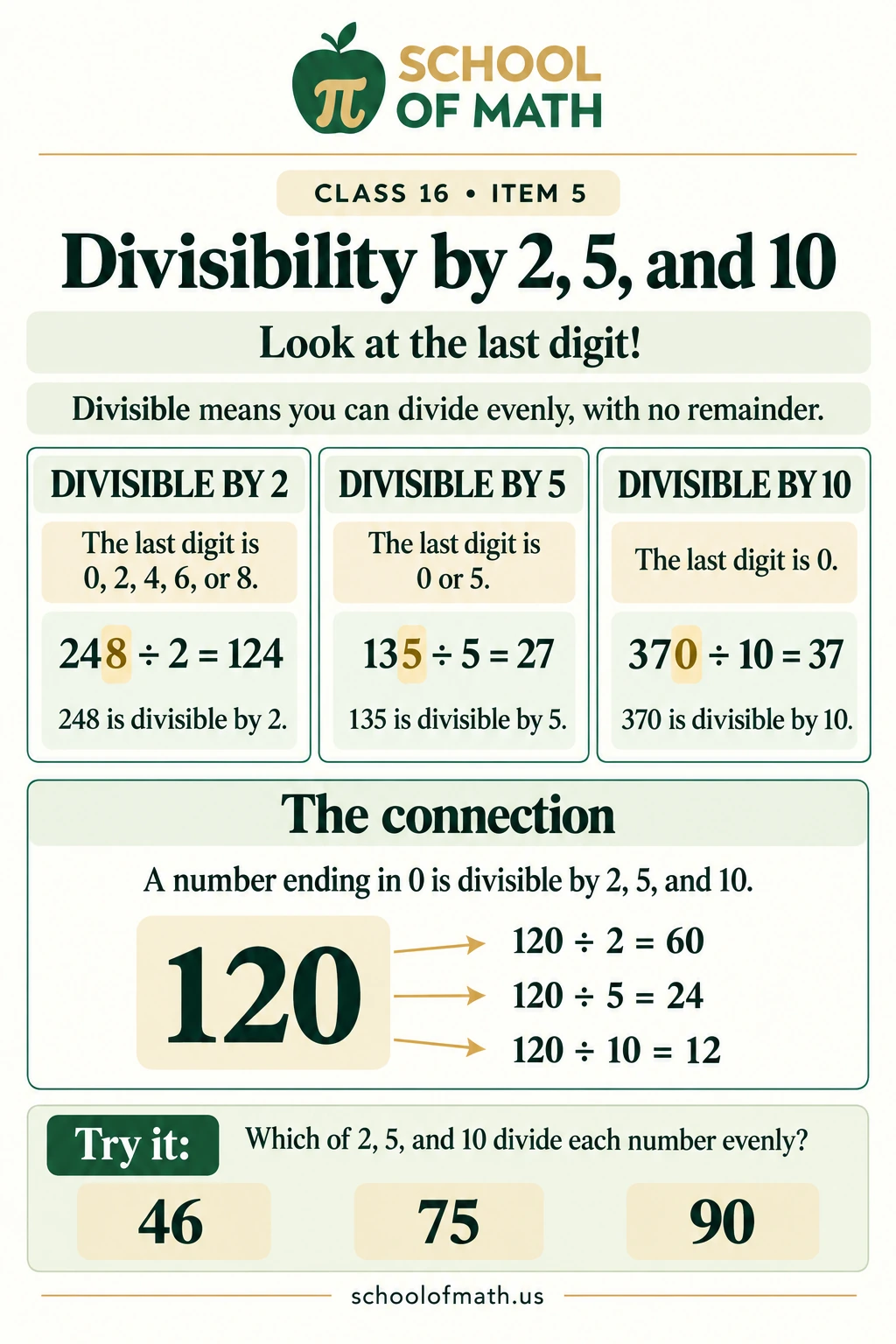
“Divisible” means division gives a whole-number answer with no remainder. For 2, 5, and 10, the last digit tells you what you need. A number is divisible by 2 when it ends in 0, 2, 4, 6, or 8; by 5 when it ends in 0 or 5; and by 10 when it ends in 0.
These tests work because every complete ten can be divided evenly into groups of 2, 5, or 10. Only the leftover ones need checking. In 384, the 38 tens pass the test for 2, and the remaining 4 ones do too.
A number ending in 0 passes all three tests. A number ending in 5 passes the test for 5, but not the tests for 2 or 10. Do not assume that a number divisible by 5 must also be divisible by 10.
Try it yourself: five questions
Q21 Practice 1 of 5
Which of 2, 5, and 10 divide 384 evenly?
Answer
2 only.
The last digit is 4, which is even. It is neither 0 nor 5, so 384 fails the tests for 5 and 10.
Q22 Practice 2 of 5
Which of 2, 5, and 10 divide 245 evenly?
Answer
5 only.
The number ends in 5. It is odd, so it fails the test for 2; it does not end in 0, so it fails the test for 10.
Q23 Practice 3 of 5
Which of 2, 5, and 10 divide 610 evenly?
Answer
All three: 2, 5, and 10.
The last digit is 0, which passes all three tests. For example, 610 ÷ 10 = 61.
Q24 Practice 4 of 5
Lena says 405 is divisible by 10 because it is divisible by 5. Is she correct?
Answer
No. It is divisible by 5, but not by 10.
405 ends in 5. The test for 10 requires a final digit of 0, not 5.
Q25 Practice 5 of 5
Replace the blank in 73_ with every possible digit that makes the number divisible by both 2 and 5.
Answer
Only 0, giving 730.
Divisibility by 5 permits a final digit of 0 or 5. Only 0 is also even, so only 730 passes both tests.
Divisibility by 3 and 9
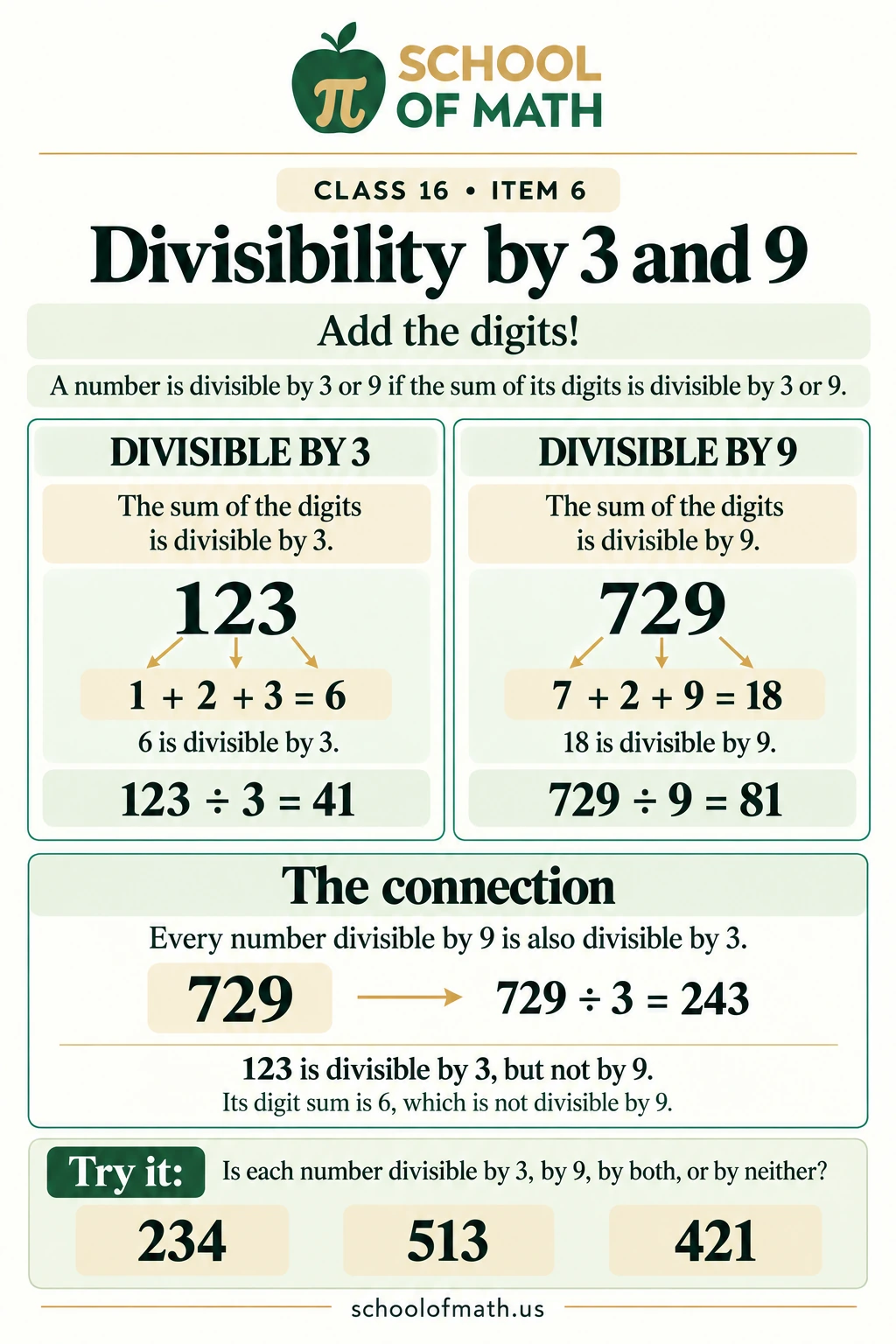
For divisibility by 3, add the digits and test whether that sum is divisible by 3. For divisibility by 9, add the digits and test whether the sum is divisible by 9. Use the sum of all the digits, not only the last digit.
For example, 312 has digit sum 3 + 1 + 2 = 6. Six is divisible by 3 but not by 9, so 312 is divisible by 3 but not by 9. Every multiple of 9 is a multiple of 3, but the reverse is not always true.
Why do digit sums help? Ten is one more than a multiple of 9, and 100 is also one more than a multiple of 9. Replacing each ten or hundred by one changes the total by a multiple of 9, and therefore by a multiple of 3 too. The divisibility result stays the same.
Try it yourself: five questions
Q26 Practice 1 of 5
Is 312 divisible by 3, by 9, by both, or by neither? Show the digit sum.
Answer
By 3 only; the digit sum is 6.
3 + 1 + 2 = 6. Six is divisible by 3, but not by 9.
Q27 Practice 2 of 5
Is 459 divisible by 3, by 9, by both, or by neither?
Answer
By both 3 and 9.
4 + 5 + 9 = 18. Eighteen is divisible by 9 and also by 3.
Q28 Practice 3 of 5
Is 527 divisible by 3 or 9? Explain without long division.
Answer
Neither.
5 + 2 + 7 = 14. Fourteen is not divisible by 3 or by 9, so 527 is not divisible by either number.
Q29 Practice 4 of 5
Find every digit that can replace the blank in 4_2 to make a number divisible by 3.
Answer
0, 3, 6, or 9.
The digit sum is 4 + blank + 2 = 6 + blank. The possible sums divisible by 3 are 6, 9, 12, and 15.
Q30 Practice 5 of 5
A student claims every number divisible by 3 is divisible by 9. Use 114 to test the claim.
Answer
The claim is false: 114 is divisible by 3 but not by 9.
1 + 1 + 4 = 6. Six passes the test for 3 but fails the test for 9. One counterexample is enough to disprove “every.”
Divisibility by 6: both tests must pass
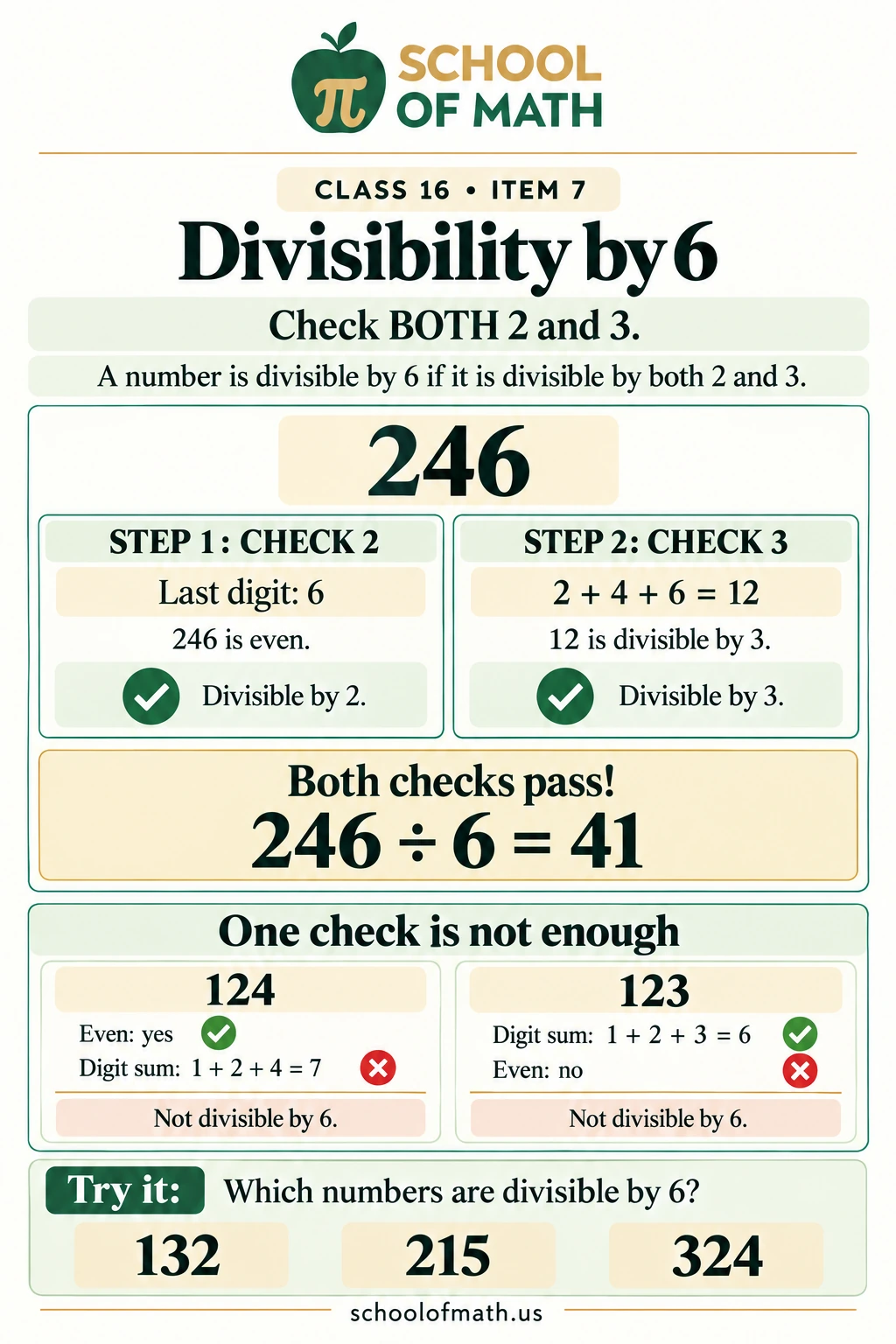
A number is divisible by 6 exactly when it is divisible by both 2 and 3. First check whether its last digit is even. Then check whether the sum of its digits is divisible by 3. You need both results, not just one.
For 138, the final digit 8 is even and the digit sum 1 + 3 + 8 = 12 is divisible by 3. Therefore 138 is divisible by 6. In contrast, 214 is even but its digit sum is 7, so it is not divisible by 6.
The rule uses 6 = 2 × 3. Equal groups of 3 can be paired to make groups of 6 when the total is also even. Merely ending in 6 is not enough: the digit-sum test still has to pass.
| Divide by | Test for no remainder |
|---|---|
| 2 | Last digit is 0, 2, 4, 6, or 8. |
| 3 | Sum of digits is divisible by 3. |
| 5 | Last digit is 0 or 5. |
| 6 | Both the rule for 2 and the rule for 3 pass. |
| 9 | Sum of digits is divisible by 9. |
| 10 | Last digit is 0. |
Try it yourself: five questions
Q31 Practice 1 of 5
Is 138 divisible by 6? Show both required checks.
Answer
Yes.
138 ends in 8, so it is divisible by 2. Its digit sum is 12, which is divisible by 3. Both tests pass; 138 ÷ 6 = 23.
Q32 Practice 2 of 5
Is 214 divisible by 6? Explain which check fails.
Answer
No; the test for 3 fails.
214 is even, but 2 + 1 + 4 = 7 is not divisible by 3. Passing only the even-number test is not enough.
Q33 Practice 3 of 5
Is 357 divisible by 6? Explain which check fails.
Answer
No; the test for 2 fails.
3 + 5 + 7 = 15 is divisible by 3, but 357 is odd. Both tests are required.
Q34 Practice 4 of 5
Which of 144, 250, 333, and 402 are divisible by 6?
Answer
144 and 402.
144 and 402 are even and have digit sums 9 and 6. The digit sum of 250 is 7; 333 is odd.
Q35 Practice 5 of 5
Find every digit that can replace the blank in 25_ to make a number divisible by 6.
Answer
2 or 8, giving 252 or 258.
The final digit must be even. The digit sum is 7 + blank; with an even final digit, only sums 9 and 15 pass the test for 3.
Applying divisibility rules
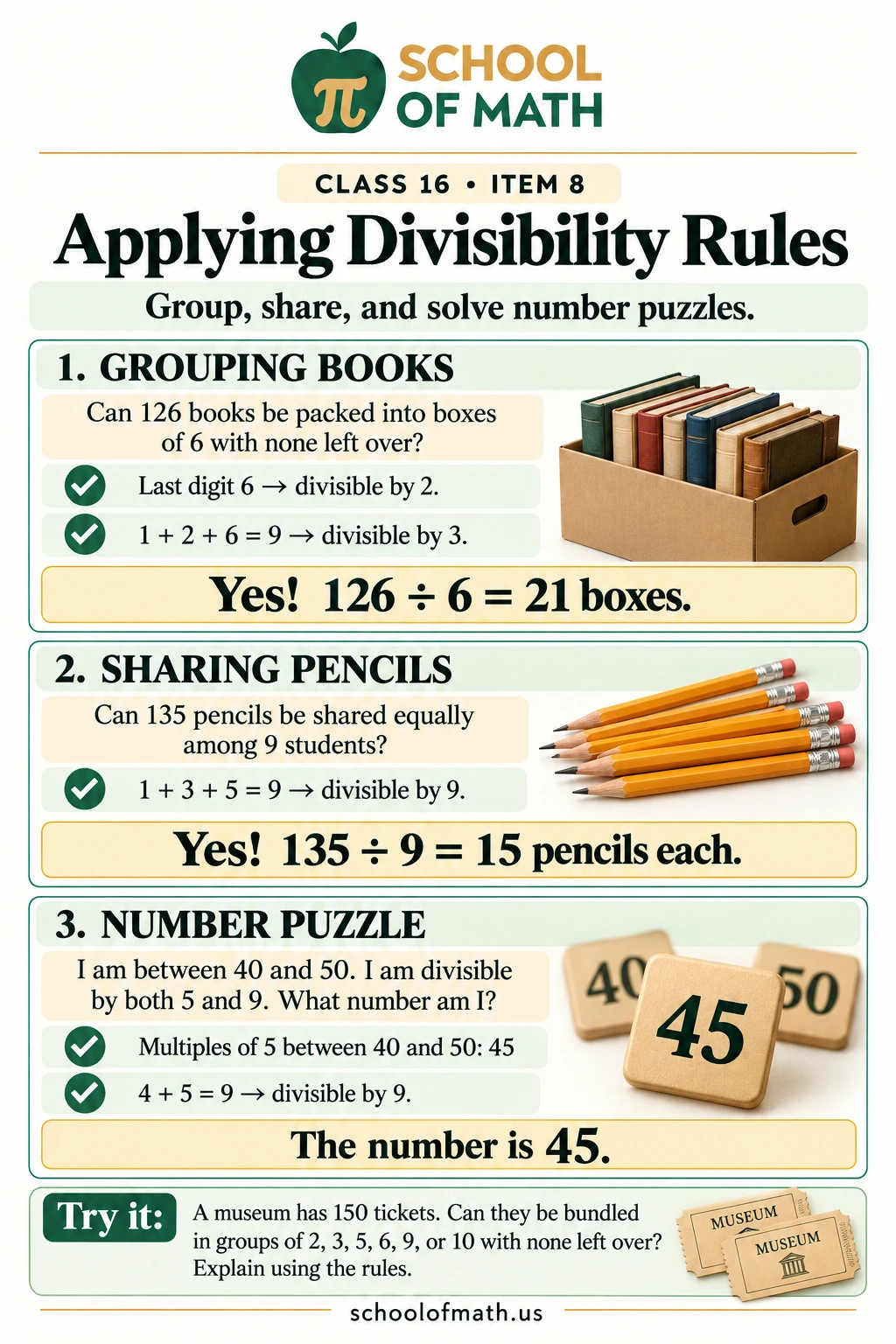
Choose the rule that matches the group size or number of recipients. Test divisibility first to decide whether an exact arrangement is possible. Then divide to find the number of groups or the amount in each share.
Pay attention to what is being counted. Packing 168 pencils into boxes of 6 asks for the number of boxes. Sharing 168 pencils among 6 children asks for the number of pencils per child. The calculation is the same, but the answer units differ.
For number puzzles, combine every clue. List a few candidates using an ending-digit rule, then narrow the list using a digit sum. If a question asks for every possible answer, keep all candidates that pass instead of stopping after the first.
Try it yourself: five questions
Q36 Practice 1 of 5
Can 168 pencils be packed into boxes of 6 with none left over? If so, how many boxes are needed?
Answer
Yes; 28 boxes.
168 is even and its digit sum is 15, which is divisible by 3. Therefore it is divisible by 6, and 168 ÷ 6 = 28.
Q37 Practice 2 of 5
Can 216 counters be shared equally among 9 children with none left over? How many does each child get?
Answer
Yes; 24 counters each.
2 + 1 + 6 = 9, so 216 is divisible by 9. Calculate 216 ÷ 9 = 24.
Q38 Practice 3 of 5
A shop has 235 stickers. Can it make full packs of 5? Can it make full packs of 10 with none left over?
Answer
Packs of 5: yes, 47 packs. Packs of 10: no.
The last digit 5 passes the rule for 5 but fails the rule for 10. Dividing by 10 gives 23 full packs and 5 stickers left.
Q39 Practice 4 of 5
A whole number is greater than 80 and less than 100. It is divisible by both 3 and 10. What is the number?
Answer
90.
Only 90 ends in 0 within the stated range. Its digit sum is 9, so it also passes the test for 3.
Q40 Practice 5 of 5
A museum has 270 tickets. Which group sizes from 2, 3, 5, 6, 9, and 10 use all tickets with none left over?
Answer
All six sizes: 2, 3, 5, 6, 9, and 10.
The final digit 0 passes the rules for 2, 5, and 10. The digit sum 9 passes the rules for 3 and 9. Passing both 2 and 3 also passes the rule for 6.
Homework review
Complete one review question for each image, in the same order. Explain your reasoning using factor pairs, equal jumps, or the appropriate divisibility rule.
R1 Review image 1 of 8
List all positive factors of 30.
Answer
1, 2, 3, 5, 6, 10, 15, 30.
The factor pairs are 1 × 30, 2 × 15, 3 × 10, and 5 × 6. Put the distinct factors in increasing order.
R2 Review image 2 of 8
List every factor pair of 40, without counting reversals twice.
Answer
(1, 40), (2, 20), (4, 10), (5, 8).
Each pair multiplies to 40. Three and six leave remainders; later successful tests repeat earlier pairs.
R3 Review image 3 of 8
Write the first five positive multiples of 9.
Answer
9, 18, 27, 36, 45.
Multiply 9 by 1 through 5, or start with 9 and add 9 four more times.
R4 Review image 4 of 8
Use 8 × 7 = 56 to write two factor statements and two multiple statements.
Answer
8 and 7 are each factors of 56. 56 is a multiple of 8 and a multiple of 7.
The exact multiplication fact shows that 56 can be divided by either 8 or 7 with no remainder.
R5 Review image 5 of 8
Which of 2, 5, and 10 divide 1,250 evenly?
Answer
2, 5, and 10.
The last digit is 0, so all three ending-digit tests pass.
R6 Review image 6 of 8
Which of 3 and 9 divide 642 evenly?
Answer
3 only.
6 + 4 + 2 = 12. Twelve is divisible by 3 but not by 9.
R7 Review image 7 of 8
Is 426 divisible by 6? Show both checks.
Answer
Yes.
It ends in 6, so it is even. Its digit sum is 4 + 2 + 6 = 12, which is divisible by 3. Both checks pass.
R8 Review image 8 of 8
Find every whole number greater than 100 and less than 130 that is divisible by both 5 and 6.
Answer
120 only.
A multiple of 6 is even, so a number divisible by both 5 and 6 must end in 0. Test 110 and 120: only 120 has a digit sum divisible by 3.
Homework word problems
These twelve problems complete the 20-question homework. Decide whether the arrangement is possible before calculating, include units, and give every possible answer when the question asks for all of them.
W1 Homework word problem 1 of 12
A gardener has 42 seedlings. Can she put exactly 6 seedlings in each tray with none left over? How many trays would she fill?
Answer
Yes; 7 trays.
42 is even and its digit sum is 6, so it is divisible by 6. Then 42 ÷ 6 = 7.
W2 Homework word problem 2 of 12
A craft club has 32 beads. Which of 2, 3, 5, or 8 children could share all the beads equally with none left over? Give the share for each possible group.
Answer
2 children: 16 each. 8 children: 4 each.
Two and eight are factors of 32. Dividing 32 by 3 or 5 leaves a remainder.
W3 Homework word problem 3 of 12
A teacher arranges 48 chairs in equal rows. List every pair of row counts and chairs per row, ignoring reversed arrangements.
Answer
(1, 48), (2, 24), (3, 16), (4, 12), (6, 8).
Each factor pair uses all 48 chairs. Reversing the numbers turns the array without changing its factor pair.
W4 Homework word problem 4 of 12
Each packet holds 7 seeds. Write the total numbers of seeds in 1, 2, 3, and 4 full packets. Is 31 seeds a possible total using only full packets?
Answer
7, 14, 21, 28; no, 31 is not possible.
Full packets make multiples of 7. After 28, the next possible total is 35, so 31 falls between two multiples.
W5 Homework word problem 5 of 12
A school has 284 gloves. Can they all be made into pairs? How many pairs are there?
Answer
Yes; 142 pairs.
284 ends in 4, so it is divisible by 2. Each pair has two gloves: 284 ÷ 2 = 142.
W6 Homework word problem 6 of 12
A baker has 365 cookies and uses bags holding exactly 5 cookies. Can all cookies be packed with no leftovers? How many bags are needed?
Answer
Yes; 73 bags.
The last digit is 5, so 365 is divisible by 5. Then 365 ÷ 5 = 73.
W7 Homework word problem 7 of 12
A shop packs 470 cards into bundles of 10. How many complete bundles can it make, and will any cards remain?
Answer
47 bundles, with no cards remaining.
470 ends in 0, so it is divisible by 10. 470 ÷ 10 = 47.
W8 Homework word problem 8 of 12
Three classes share 315 craft sticks equally. How many sticks does each class get? Could 9 groups also share that total equally?
Answer
105 sticks per class; yes, 9 groups would get 35 each.
3 + 1 + 5 = 9, so both 3 and 9 divide 315. Calculate 315 ÷ 3 = 105 and 315 ÷ 9 = 35.
W9 Homework word problem 9 of 12
A museum has 208 tickets and wants packs of 6. Can it pack every ticket with none left over? If not, how many full packs and leftover tickets are there?
Answer
No; 34 full packs and 4 tickets left over.
208 is even, but its digit sum is 10, so it fails the test for 3 and therefore for 6. 6 × 34 = 204, leaving 4.
W10 Homework word problem 10 of 12
A club has 1,134 stickers for 9 equal prize bags. Use a divisibility rule, then find the number in each bag.
Answer
126 stickers per bag.
1 + 1 + 3 + 4 = 9, so 1,134 is divisible by 9. Then 1,134 ÷ 9 = 126.
W11 Homework word problem 11 of 12
A box label says 5_4 marbles. The box can be shared equally among 6 students with no marbles left. Find every possible missing digit.
Answer
0, 3, 6, or 9.
The last digit 4 already passes the test for 2. The digit sum is 9 + blank, which is divisible by 3 for missing digits 0, 3, 6, or 9.
W12 Homework word problem 12 of 12
A teacher has more than 150 but fewer than 200 counters. They can be put into groups of 10 or into groups of 9 with none left over. How many counters are there, and how many groups would each arrangement make?
Answer
180 counters; 18 groups of 10 or 20 groups of 9.
Candidates ending in 0 are 160, 170, 180, and 190. Only 180 has a digit sum divisible by 9. Then divide 180 by 10 and by 9.
Quick questions and answers
What is the difference between a factor and a multiple?
A factor divides a number exactly. A multiple is the result of multiplying a number by a whole number. In 5 × 7 = 35, 5 and 7 are factors of 35, and 35 is a multiple of both 5 and 7.
How can I make sure I have found every factor pair?
Start with 1 and test whole numbers in order. Record a pair whenever division is exact. Stop when the pairs begin to repeat in reverse. Include a pair with equal factors, such as 6 and 6 for 36, once.
Is zero a multiple?
Yes. Multiplying any whole number by zero gives zero. When asked for positive multiples, do not include zero. Zero cannot be used as a divisor.
Which divisibility rules use the last digit?
For 2, check for a final digit of 0, 2, 4, 6, or 8. For 5, check for 0 or 5. For 10, check for 0. These tests determine whether division is exact.
How do the rules for 3 and 9 differ?
Both use the sum of the digits. Test whether that sum is divisible by 3 for the rule for 3, or by 9 for the rule for 9. A multiple of 9 is always a multiple of 3, but a multiple of 3 need not be a multiple of 9.
Is every even number divisible by 6?
No. A number must be divisible by both 2 and 3. Being even satisfies only the test for 2; its digit sum must also be divisible by 3.
What practice and homework are included in Class 16?
The lesson has eight teaching images, five new class questions per image, eight homework review questions, and twelve homework word problems. All 60 questions have hidden worked answers online. The 22-page student workbook includes the supplied cover, all eight teaching images, and the same 60 questions with blank answer space and no exercise solutions.