Kid Einsteins · Class 17 · Grades 3–4
Long Division with Single-Digit Divisors and Remainders
Long division organizes equal groups one place value at a time. Divide, multiply, subtract, and bring down; then check both the quotient and the remainder.
Study eight illustrated topics with five original practice questions after each image. Finish with eight Homework review questions and twelve Homework word problems: 40 practice questions, 20 homework questions, and 60 hidden worked answers. Attempt each question before opening its blue Answer control.
This is an independent Kid Einsteins topic at SOMATH. Earlier-numbered classes are not attendance prerequisites. Use counters, drawings, and multiplication facts to support the written method. View the schedule or book an evaluation to find the appropriate course level.
Download the student workbook (PDF)23 pages · Supplied cover, eight teaching images, all 60 questions, and the image 5 picture clarification · Generous blank answer space · No exercise solutions
Understanding division
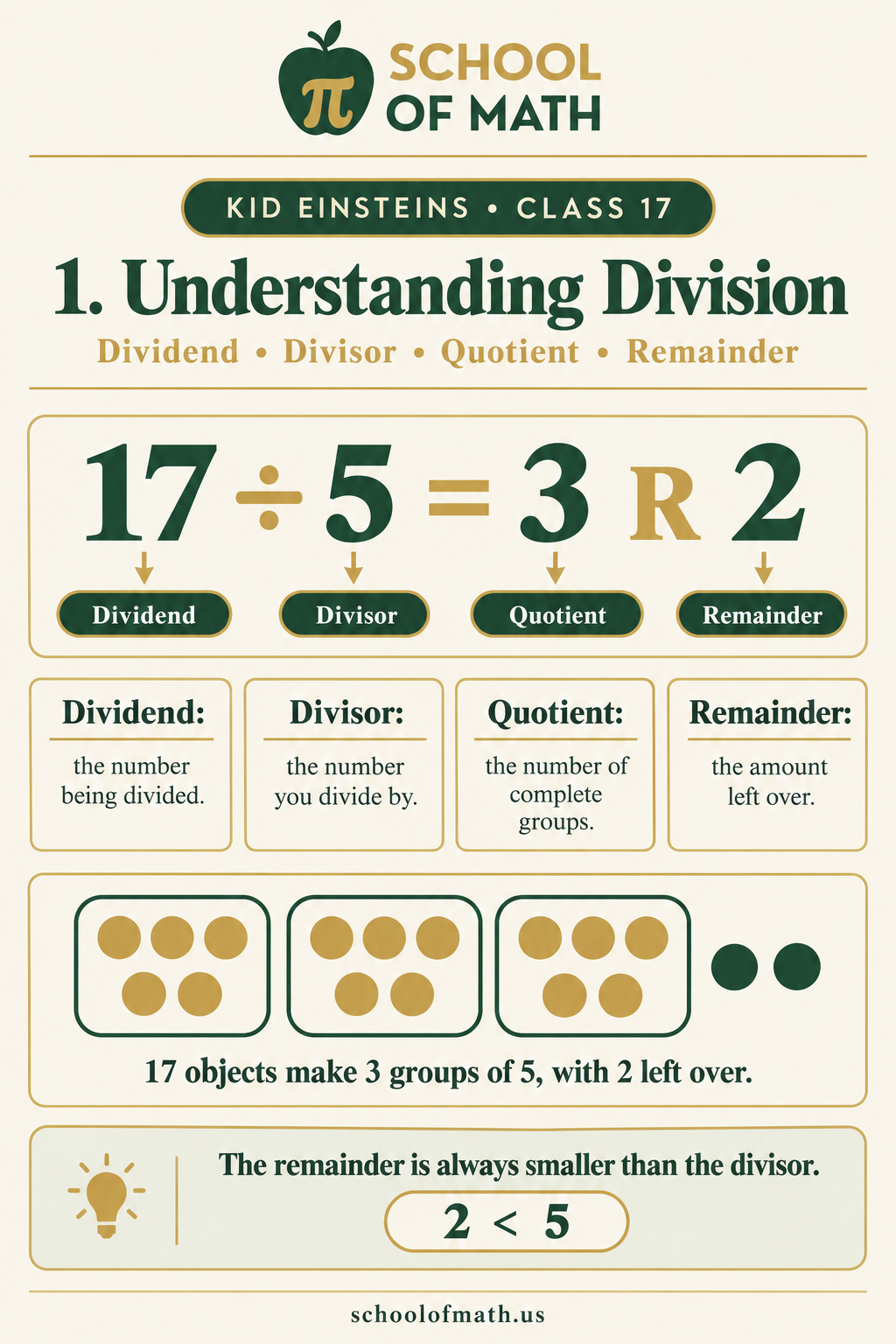
The dividend is the amount being divided, and the divisor is the number we divide by. The quotient can tell us the number of complete groups or the amount in each group, depending on the story. The remainder is what is left after making equal whole-number groups.
In this lesson, dividends are nonnegative whole numbers and divisors are positive single-digit numbers. A final remainder must be at least zero and smaller than the divisor. If enough objects remain to make another group, the division is not finished.
Practice: try these five questions
Q1
In 23 ÷ 4 = 5 R 3, name the dividend, divisor, quotient, and remainder.
Answer
Dividend 23; divisor 4; quotient 5; remainder 3
- We divide the 23 objects into groups of 4. Five complete groups use 4 × 5 = 20 objects, leaving 23 − 20 = 3. The remainder is valid because 3 < 4.
Q2
Make groups of 6 from 19 counters. How many complete groups can you make, and how many counters remain?
Answer
3 complete groups; 1 counter remains
- In the ones place, divide 19 by 6: write 3. Multiply 3 × 6 = 18, then subtract 19 − 18 = 1.
- No digits remain to bring down. The quotient is 3 and the remainder is 1. Check: 6 × 3 + 1 = 19, and 1 < 6.
Q3
Share 26 whole pencils equally among 4 children. How many does each child receive, and how many remain?
Answer
6 pencils each; 2 pencils remain
- In the ones place, divide 26 by 4: write 6. Multiply 6 × 4 = 24, then subtract 26 − 24 = 2.
- No digits remain to bring down. The quotient is 6 and the remainder is 2. Check: 4 × 6 + 2 = 26, and 2 < 4.
- Here the quotient means pencils per child, not the number of children. The divisor is the number of equal shares.
Q4
Can 7 objects make a complete group of 9? Give the quotient and remainder.
Answer
0 R 7
- No complete group of 9 can be made from only 7 objects. Therefore the quotient is 0 and all 7 objects remain. Check: 9 × 0 + 7 = 7, and 7 < 9.
Q5
A student writes 33 ÷ 5 = 5 R 8. Explain why this is not a finished answer, then correct it.
Answer
6 R 3
- Although 5 × 5 + 8 = 33, the remainder 8 is not smaller than 5. Make one more group from those 8 objects. This gives 6 groups and 3 remaining: 5 × 6 + 3 = 33.
Using multiplication to choose a quotient
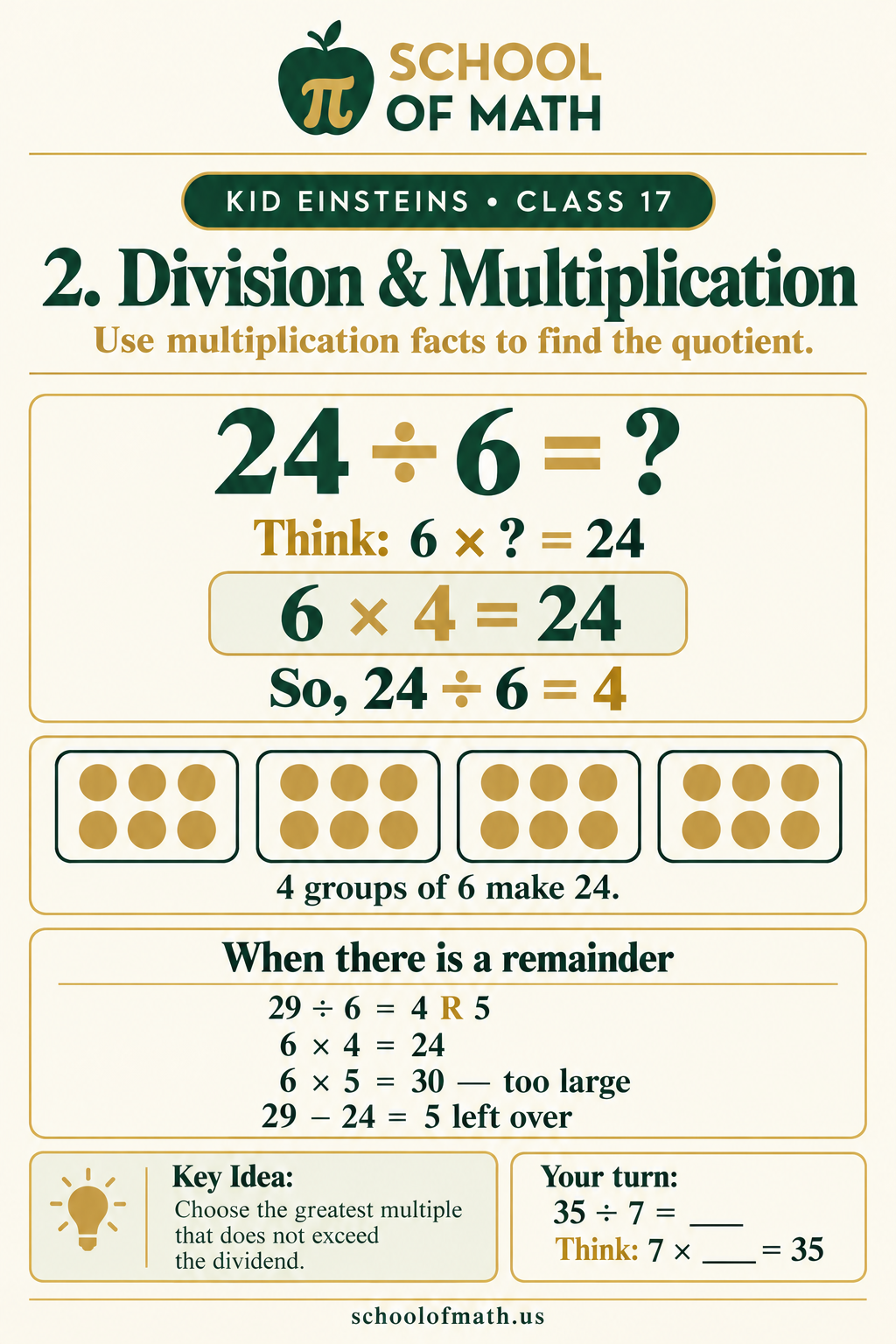
Ask which multiple of the divisor is the greatest one that does not go past the amount you are dividing. For an exact division, that multiple equals the dividend. Otherwise, subtract it to find the remainder.
The next multiple should be too large. This checks that you have made as many complete groups as possible. During long division, use this same idea for each partial dividend.
Practice: try these five questions
Q6
Use a multiplication fact to solve 32 ÷ 8.
Answer
4
- In the ones place, divide 32 by 8: write 4. Multiply 4 × 8 = 32, then subtract 32 − 32 = 0.
- No digits remain to bring down. The quotient is 4 and the remainder is 0. Check: 8 × 4 + 0 = 32, and 0 < 8.
- The helpful fact is 8 × 4 = 32. Nothing is left over.
Q7
Use multiplication to solve 45 ÷ 5.
Answer
9
- In the ones place, divide 45 by 5: write 9. Multiply 9 × 5 = 45, then subtract 45 − 45 = 0.
- No digits remain to bring down. The quotient is 9 and the remainder is 0. Check: 5 × 9 + 0 = 45, and 0 < 5.
- Since 5 × 9 = 45, nine groups fit exactly.
Q8
Use nearby multiples of 6 to solve 34 ÷ 6.
Answer
5 R 4
- In the ones place, divide 34 by 6: write 5. Multiply 5 × 6 = 30, then subtract 34 − 30 = 4.
- No digits remain to bring down. The quotient is 5 and the remainder is 4. Check: 6 × 5 + 4 = 34, and 4 < 6.
- Six groups would use 36, which is too many; five groups use 30, leaving 4.
Q9
Which two multiples of 7 surround 58? Use them to find the quotient and remainder.
Answer
8 R 2
- In the ones place, divide 58 by 7: write 8. Multiply 8 × 7 = 56, then subtract 58 − 56 = 2.
- No digits remain to bring down. The quotient is 8 and the remainder is 2. Check: 7 × 8 + 2 = 58, and 2 < 7.
- The nearby multiples are 7 × 8 = 56 and 7 × 9 = 63. Use 56, because 63 goes past 58.
Q10
Find the greatest multiple of 8 that does not exceed 67. Give the quotient and remainder.
Answer
8 R 3
- In the ones place, divide 67 by 8: write 8. Multiply 8 × 8 = 64, then subtract 67 − 64 = 3.
- No digits remain to bring down. The quotient is 8 and the remainder is 3. Check: 8 × 8 + 3 = 67, and 3 < 8.
- Use 8 × 8 = 64, not 8 × 9 = 72. The leftover amount is 67 − 64 = 3.
Following the long-division steps
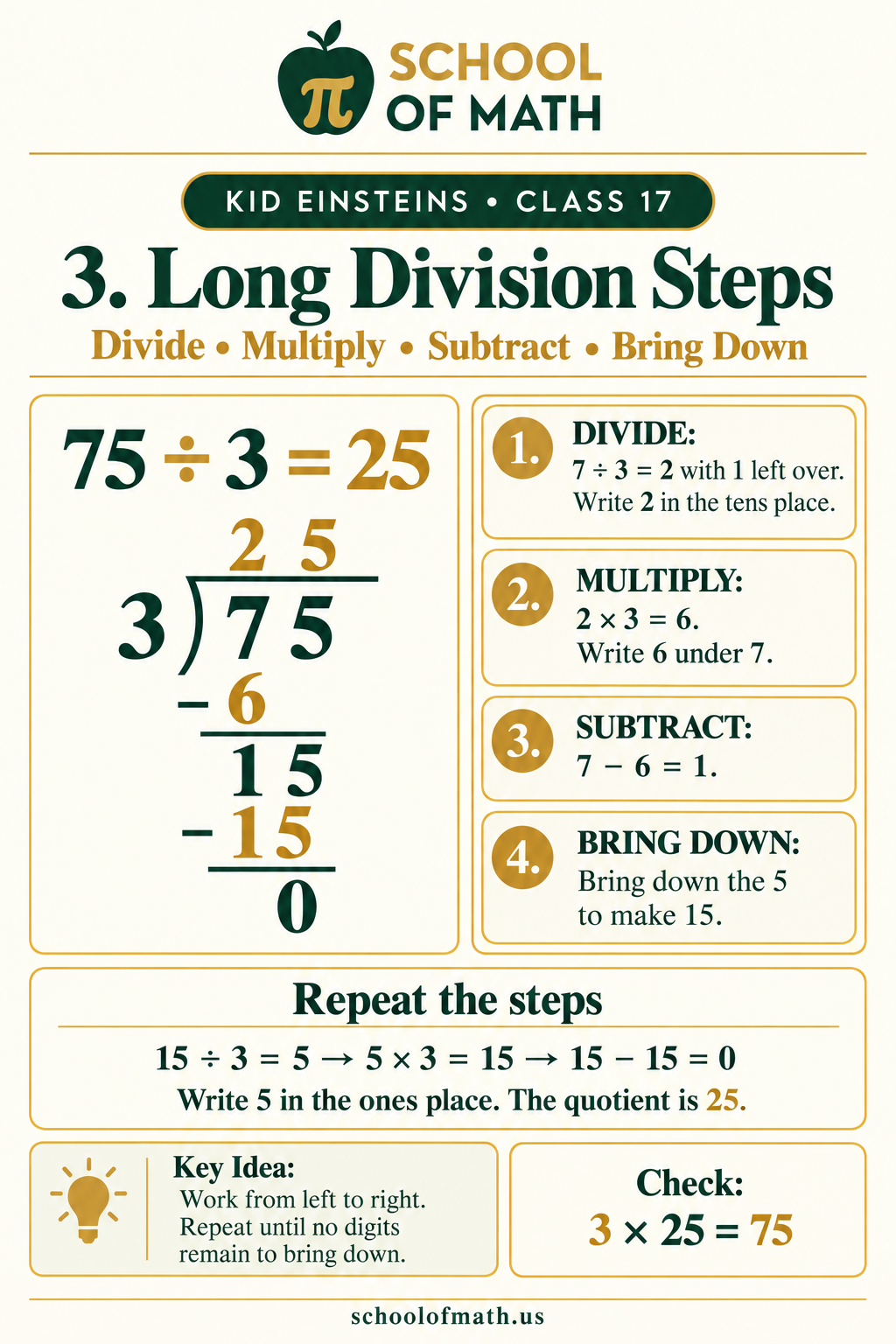
Work from left to right: divide, multiply, subtract, and bring down the next digit. Keep each quotient digit above the place value you are working with. If the first digit is smaller than the divisor, consider the first two digits together.
After subtracting, the amount left at that stage is smaller than the divisor, but you may still have digits to bring down. Only the amount left at the very end is the final remainder. Bringing down a digit means regrouping the amount left into the next smaller place value.
Practice: try these five questions
Q11
Solve 68 ÷ 2. Name the divide, multiply, subtract, and bring-down steps.
Answer
34
- In the tens place, divide 6 by 2: write 3. Multiply 3 × 2 = 6, then subtract 6 − 6 = 0.
- Bring down the next digit, 8, to make 8. Continue in the next place-value column.
- In the ones place, divide 8 by 2: write 4. Multiply 4 × 2 = 8, then subtract 8 − 8 = 0.
- No digits remain to bring down. The quotient is 34 and the remainder is 0. Check: 2 × 34 + 0 = 68, and 0 < 2.
Q12
Solve 78 ÷ 3. Explain how the amount left after dividing the tens joins the ones.
Answer
26
- In the tens place, divide 7 by 3: write 2. Multiply 2 × 3 = 6, then subtract 7 − 6 = 1.
- Bring down the next digit, 8, to make 18. Continue in the next place-value column.
- In the ones place, divide 18 by 3: write 6. Multiply 6 × 3 = 18, then subtract 18 − 18 = 0.
- No digits remain to bring down. The quotient is 26 and the remainder is 0. Check: 3 × 26 + 0 = 78, and 0 < 3.
Q13
Solve 86 ÷ 4, keeping the quotient digits in their correct places.
Answer
21 R 2
- In the tens place, divide 8 by 4: write 2. Multiply 2 × 4 = 8, then subtract 8 − 8 = 0.
- Bring down the next digit, 6, to make 6. Continue in the next place-value column.
- In the ones place, divide 6 by 4: write 1. Multiply 1 × 4 = 4, then subtract 6 − 4 = 2.
- No digits remain to bring down. The quotient is 21 and the remainder is 2. Check: 4 × 21 + 2 = 86, and 2 < 4.
Q14
Solve 73 ÷ 5. Do not stop at the first subtraction.
Answer
14 R 3
- In the tens place, divide 7 by 5: write 1. Multiply 1 × 5 = 5, then subtract 7 − 5 = 2.
- Bring down the next digit, 3, to make 23. Continue in the next place-value column.
- In the ones place, divide 23 by 5: write 4. Multiply 4 × 5 = 20, then subtract 23 − 20 = 3.
- No digits remain to bring down. The quotient is 14 and the remainder is 3. Check: 5 × 14 + 3 = 73, and 3 < 5.
Q15
In 92 ÷ 4, subtracting 8 from the first 9 leaves 1. What number is made when you bring down the 2? Finish the division.
Answer
23
- In the tens place, divide 9 by 4: write 2. Multiply 2 × 4 = 8, then subtract 9 − 8 = 1.
- Bring down the next digit, 2, to make 12. Continue in the next place-value column.
- In the ones place, divide 12 by 4: write 3. Multiply 3 × 4 = 12, then subtract 12 − 12 = 0.
- No digits remain to bring down. The quotient is 23 and the remainder is 0. Check: 4 × 23 + 0 = 92, and 0 < 4.
- The 1 left at the first stage means 1 ten. Regroup it as 10 ones and combine it with 2 ones to make 12, not 3.
Dividing two-digit numbers exactly
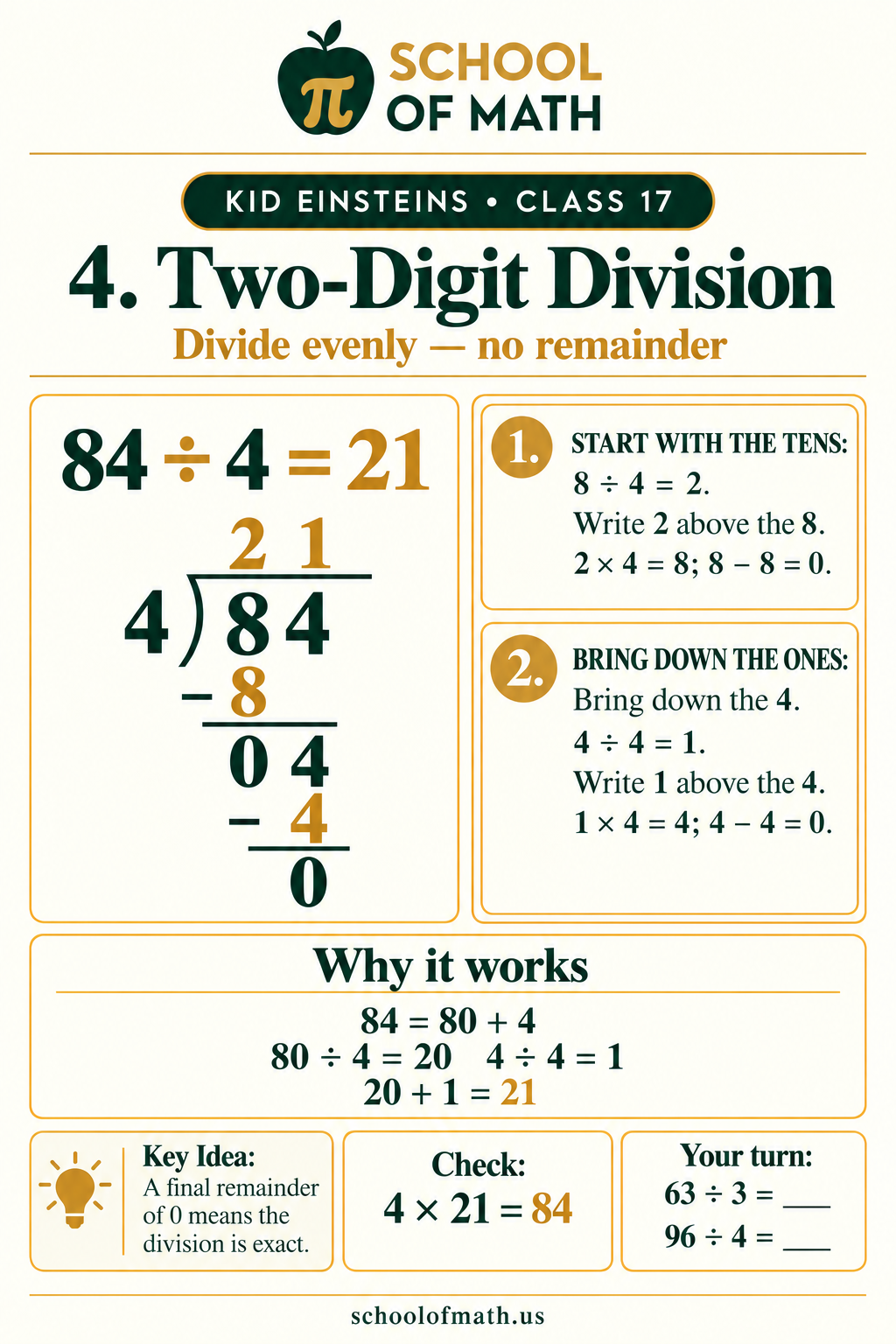
An exact division ends with zero left over. A zero remainder means all the objects have been placed into equal groups; you may write the quotient without “R 0.”
Some examples let you divide the tens and ones separately. Others require regrouping a leftover ten into ones before continuing. Follow the place values, even when you expect an exact answer.
Practice: try these five questions
Q16
Solve 48 ÷ 2 using long division. Check your answer.
Answer
24
- In the tens place, divide 4 by 2: write 2. Multiply 2 × 2 = 4, then subtract 4 − 4 = 0.
- Bring down the next digit, 8, to make 8. Continue in the next place-value column.
- In the ones place, divide 8 by 2: write 4. Multiply 4 × 2 = 8, then subtract 8 − 8 = 0.
- No digits remain to bring down. The quotient is 24 and the remainder is 0. Check: 2 × 24 + 0 = 48, and 0 < 2.
Q17
Solve 69 ÷ 3 using long division. Check your answer.
Answer
23
- In the tens place, divide 6 by 3: write 2. Multiply 2 × 3 = 6, then subtract 6 − 6 = 0.
- Bring down the next digit, 9, to make 9. Continue in the next place-value column.
- In the ones place, divide 9 by 3: write 3. Multiply 3 × 3 = 9, then subtract 9 − 9 = 0.
- No digits remain to bring down. The quotient is 23 and the remainder is 0. Check: 3 × 23 + 0 = 69, and 0 < 3.
Q18
Solve 88 ÷ 4 using long division. Check your answer.
Answer
22
- In the tens place, divide 8 by 4: write 2. Multiply 2 × 4 = 8, then subtract 8 − 8 = 0.
- Bring down the next digit, 8, to make 8. Continue in the next place-value column.
- In the ones place, divide 8 by 4: write 2. Multiply 2 × 4 = 8, then subtract 8 − 8 = 0.
- No digits remain to bring down. The quotient is 22 and the remainder is 0. Check: 4 × 22 + 0 = 88, and 0 < 4.
Q19
Solve 85 ÷ 5. Explain why the last division uses 35, not just 5.
Answer
17
- In the tens place, divide 8 by 5: write 1. Multiply 1 × 5 = 5, then subtract 8 − 5 = 3.
- Bring down the next digit, 5, to make 35. Continue in the next place-value column.
- In the ones place, divide 35 by 5: write 7. Multiply 7 × 5 = 35, then subtract 35 − 35 = 0.
- No digits remain to bring down. The quotient is 17 and the remainder is 0. Check: 5 × 17 + 0 = 85, and 0 < 5.
Q20
Solve 98 ÷ 7 and check the exact answer by multiplying.
Answer
14
- In the tens place, divide 9 by 7: write 1. Multiply 1 × 7 = 7, then subtract 9 − 7 = 2.
- Bring down the next digit, 8, to make 28. Continue in the next place-value column.
- In the ones place, divide 28 by 7: write 4. Multiply 4 × 7 = 28, then subtract 28 − 28 = 0.
- No digits remain to bring down. The quotient is 14 and the remainder is 0. Check: 7 × 14 + 0 = 98, and 0 < 7.
Finding a valid remainder
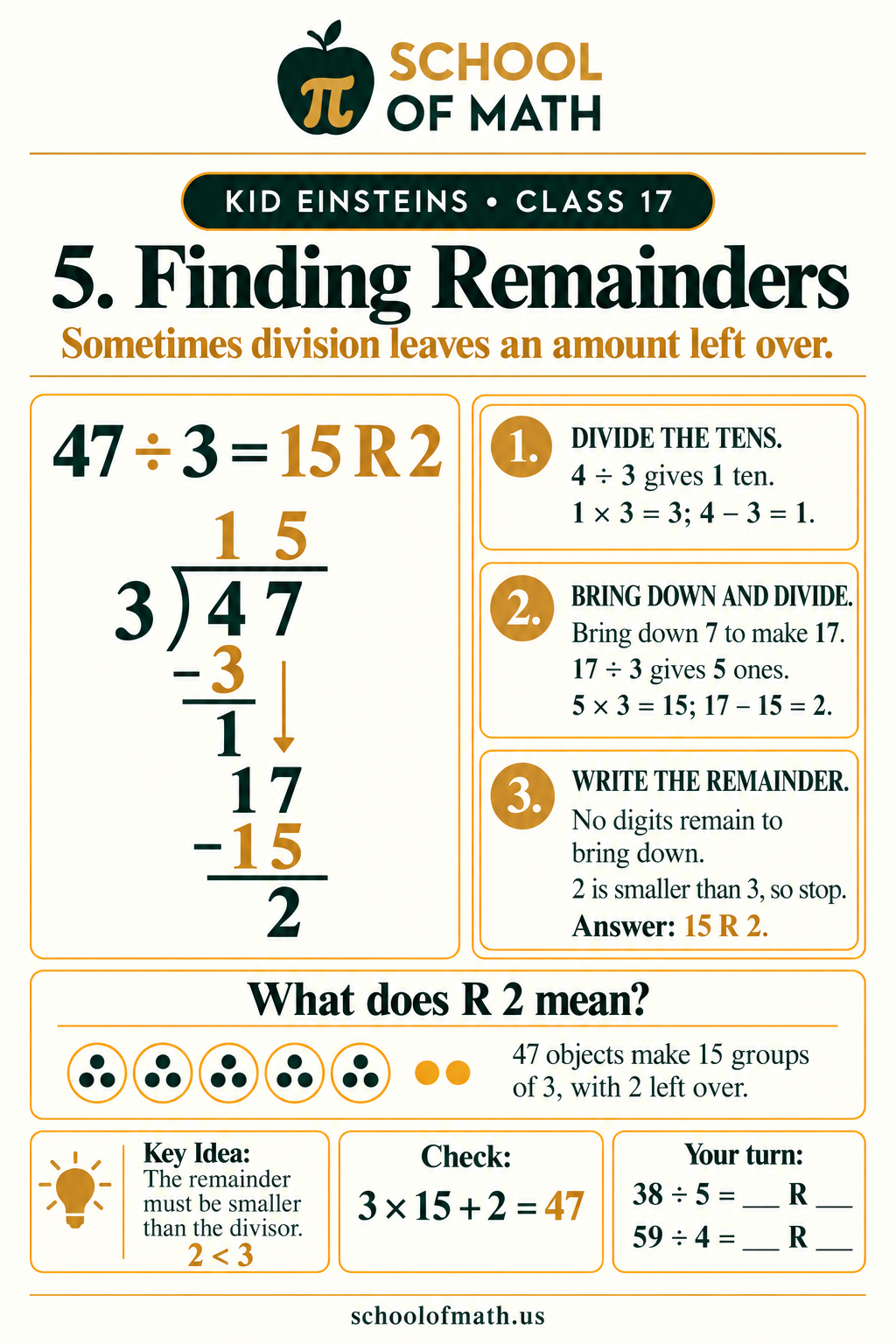
When no digits remain to bring down, record any amount left over as the remainder. The remainder must be smaller than the divisor; otherwise, one more complete group can still be made.
A correct answer passes two checks: divisor × quotient + remainder equals the dividend, and 0 ≤ remainder < divisor. Use both checks, not just multiplication.
Practice: try these five questions
Q21
Solve 53 ÷ 4 using long division. Check your answer.
Answer
13 R 1
- In the tens place, divide 5 by 4: write 1. Multiply 1 × 4 = 4, then subtract 5 − 4 = 1.
- Bring down the next digit, 3, to make 13. Continue in the next place-value column.
- In the ones place, divide 13 by 4: write 3. Multiply 3 × 4 = 12, then subtract 13 − 12 = 1.
- No digits remain to bring down. The quotient is 13 and the remainder is 1. Check: 4 × 13 + 1 = 53, and 1 < 4.
Q22
Solve 67 ÷ 3 using long division. Check your answer.
Answer
22 R 1
- In the tens place, divide 6 by 3: write 2. Multiply 2 × 3 = 6, then subtract 6 − 6 = 0.
- Bring down the next digit, 7, to make 7. Continue in the next place-value column.
- In the ones place, divide 7 by 3: write 2. Multiply 2 × 3 = 6, then subtract 7 − 6 = 1.
- No digits remain to bring down. The quotient is 22 and the remainder is 1. Check: 3 × 22 + 1 = 67, and 1 < 3.
Q23
Solve 82 ÷ 5 using long division. Check your answer.
Answer
16 R 2
- In the tens place, divide 8 by 5: write 1. Multiply 1 × 5 = 5, then subtract 8 − 5 = 3.
- Bring down the next digit, 2, to make 32. Continue in the next place-value column.
- In the ones place, divide 32 by 5: write 6. Multiply 6 × 5 = 30, then subtract 32 − 30 = 2.
- No digits remain to bring down. The quotient is 16 and the remainder is 2. Check: 5 × 16 + 2 = 82, and 2 < 5.
Q24
Solve 97 ÷ 6 using long division. Check your answer.
Answer
16 R 1
- In the tens place, divide 9 by 6: write 1. Multiply 1 × 6 = 6, then subtract 9 − 6 = 3.
- Bring down the next digit, 7, to make 37. Continue in the next place-value column.
- In the ones place, divide 37 by 6: write 6. Multiply 6 × 6 = 36, then subtract 37 − 36 = 1.
- No digits remain to bring down. The quotient is 16 and the remainder is 1. Check: 6 × 16 + 1 = 97, and 1 < 6.
Q25
Solve 94 ÷ 7. Show that the next larger quotient would be too large.
Answer
13 R 3
- In the tens place, divide 9 by 7: write 1. Multiply 1 × 7 = 7, then subtract 9 − 7 = 2.
- Bring down the next digit, 4, to make 24. Continue in the next place-value column.
- In the ones place, divide 24 by 7: write 3. Multiply 3 × 7 = 21, then subtract 24 − 21 = 3.
- No digits remain to bring down. The quotient is 13 and the remainder is 3. Check: 7 × 13 + 3 = 94, and 3 < 7.
- One more group would make 14 groups: 7 × 14 = 98, which is greater than 94.
Working across three-digit numbers
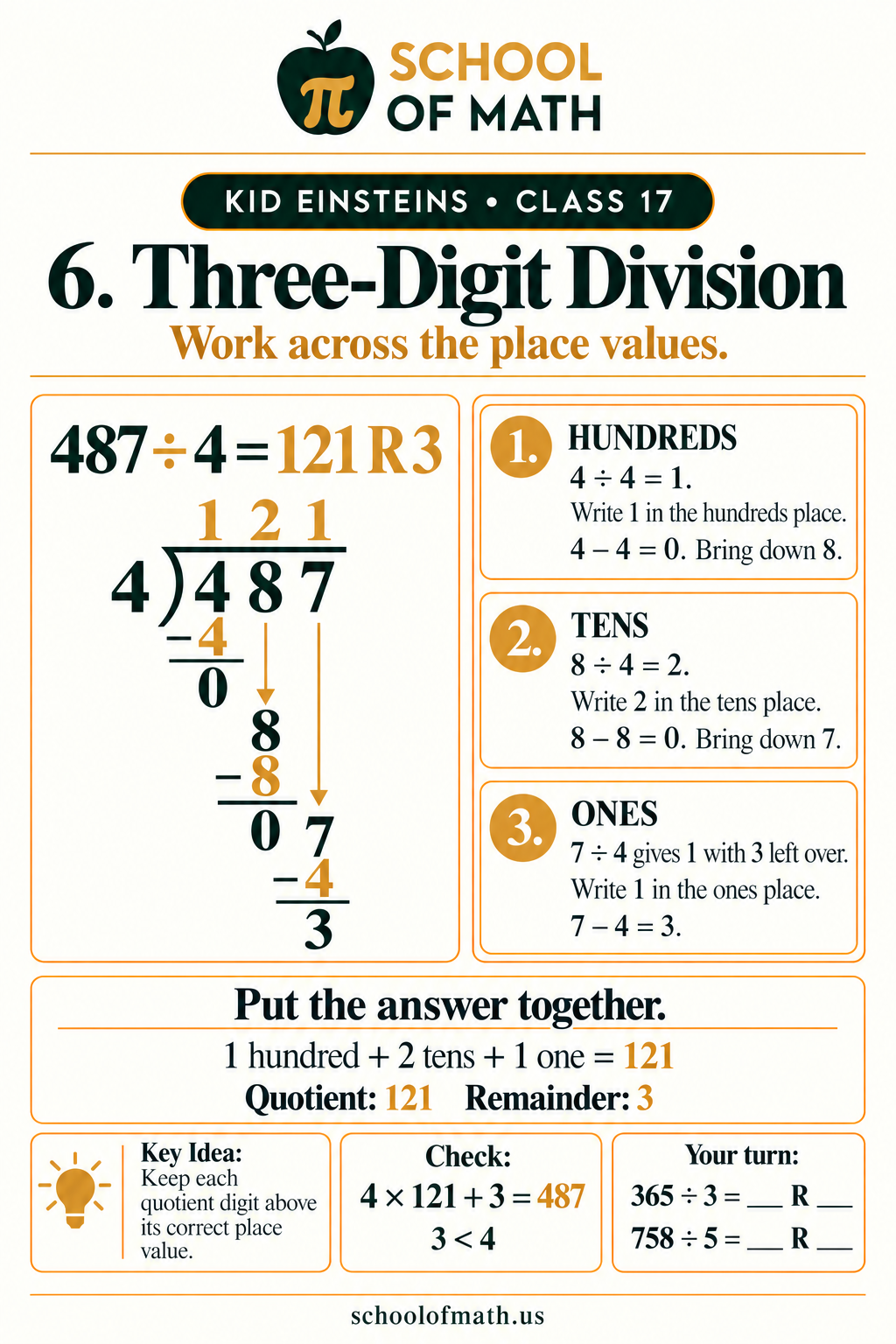
Use the same steps for hundreds, tens, and ones. A quotient digit belongs above the last digit of the partial dividend used at that step. Keep bringing down digits until every digit has been used.
A zero inside a quotient is important. If a place-value step makes no complete groups, write 0 in that position and continue. Leaving it out would move another digit into the wrong place and change the answer.
Practice: try these five questions
Q26
Solve 248 ÷ 2 using long division. Check your answer.
Answer
124
- In the hundreds place, divide 2 by 2: write 1. Multiply 1 × 2 = 2, then subtract 2 − 2 = 0.
- Bring down the next digit, 4, to make 4. Continue in the next place-value column.
- In the tens place, divide 4 by 2: write 2. Multiply 2 × 2 = 4, then subtract 4 − 4 = 0.
- Bring down the next digit, 8, to make 8. Continue in the next place-value column.
- In the ones place, divide 8 by 2: write 4. Multiply 4 × 2 = 8, then subtract 8 − 8 = 0.
- No digits remain to bring down. The quotient is 124 and the remainder is 0. Check: 2 × 124 + 0 = 248, and 0 < 2.
Q27
Solve 376 ÷ 3 using long division. Check your answer.
Answer
125 R 1
- In the hundreds place, divide 3 by 3: write 1. Multiply 1 × 3 = 3, then subtract 3 − 3 = 0.
- Bring down the next digit, 7, to make 7. Continue in the next place-value column.
- In the tens place, divide 7 by 3: write 2. Multiply 2 × 3 = 6, then subtract 7 − 6 = 1.
- Bring down the next digit, 6, to make 16. Continue in the next place-value column.
- In the ones place, divide 16 by 3: write 5. Multiply 5 × 3 = 15, then subtract 16 − 15 = 1.
- No digits remain to bring down. The quotient is 125 and the remainder is 1. Check: 3 × 125 + 1 = 376, and 1 < 3.
Q28
Solve 526 ÷ 4 using long division. Check your answer.
Answer
131 R 2
- In the hundreds place, divide 5 by 4: write 1. Multiply 1 × 4 = 4, then subtract 5 − 4 = 1.
- Bring down the next digit, 2, to make 12. Continue in the next place-value column.
- In the tens place, divide 12 by 4: write 3. Multiply 3 × 4 = 12, then subtract 12 − 12 = 0.
- Bring down the next digit, 6, to make 6. Continue in the next place-value column.
- In the ones place, divide 6 by 4: write 1. Multiply 1 × 4 = 4, then subtract 6 − 4 = 2.
- No digits remain to bring down. The quotient is 131 and the remainder is 2. Check: 4 × 131 + 2 = 526, and 2 < 4.
Q29
Solve 643 ÷ 5 using long division. Check your answer.
Answer
128 R 3
- In the hundreds place, divide 6 by 5: write 1. Multiply 1 × 5 = 5, then subtract 6 − 5 = 1.
- Bring down the next digit, 4, to make 14. Continue in the next place-value column.
- In the tens place, divide 14 by 5: write 2. Multiply 2 × 5 = 10, then subtract 14 − 10 = 4.
- Bring down the next digit, 3, to make 43. Continue in the next place-value column.
- In the ones place, divide 43 by 5: write 8. Multiply 8 × 5 = 40, then subtract 43 − 40 = 3.
- No digits remain to bring down. The quotient is 128 and the remainder is 3. Check: 5 × 128 + 3 = 643, and 3 < 5.
Q30
Solve 612 ÷ 3. Explain why the quotient needs a zero.
Answer
204
- In the hundreds place, divide 6 by 3: write 2. Multiply 2 × 3 = 6, then subtract 6 − 6 = 0.
- Bring down the next digit, 1, to make 1. Continue in the next place-value column.
- In the tens place, divide 1 by 3: write 0. Multiply 0 × 3 = 0, then subtract 1 − 0 = 1. Keep this zero in the quotient so the other digits stay in their correct places.
- Bring down the next digit, 2, to make 12. Continue in the next place-value column.
- In the ones place, divide 12 by 3: write 4. Multiply 4 × 3 = 12, then subtract 12 − 12 = 0.
- No digits remain to bring down. The quotient is 204 and the remainder is 0. Check: 3 × 204 + 0 = 612, and 0 < 3.
- The tens step uses 1 ten, which cannot make a complete group of 3 tens. Write 0 in the tens place, then bring down the 2 to make 12 ones. The answer is 204, not 24.
Checking and repairing an answer
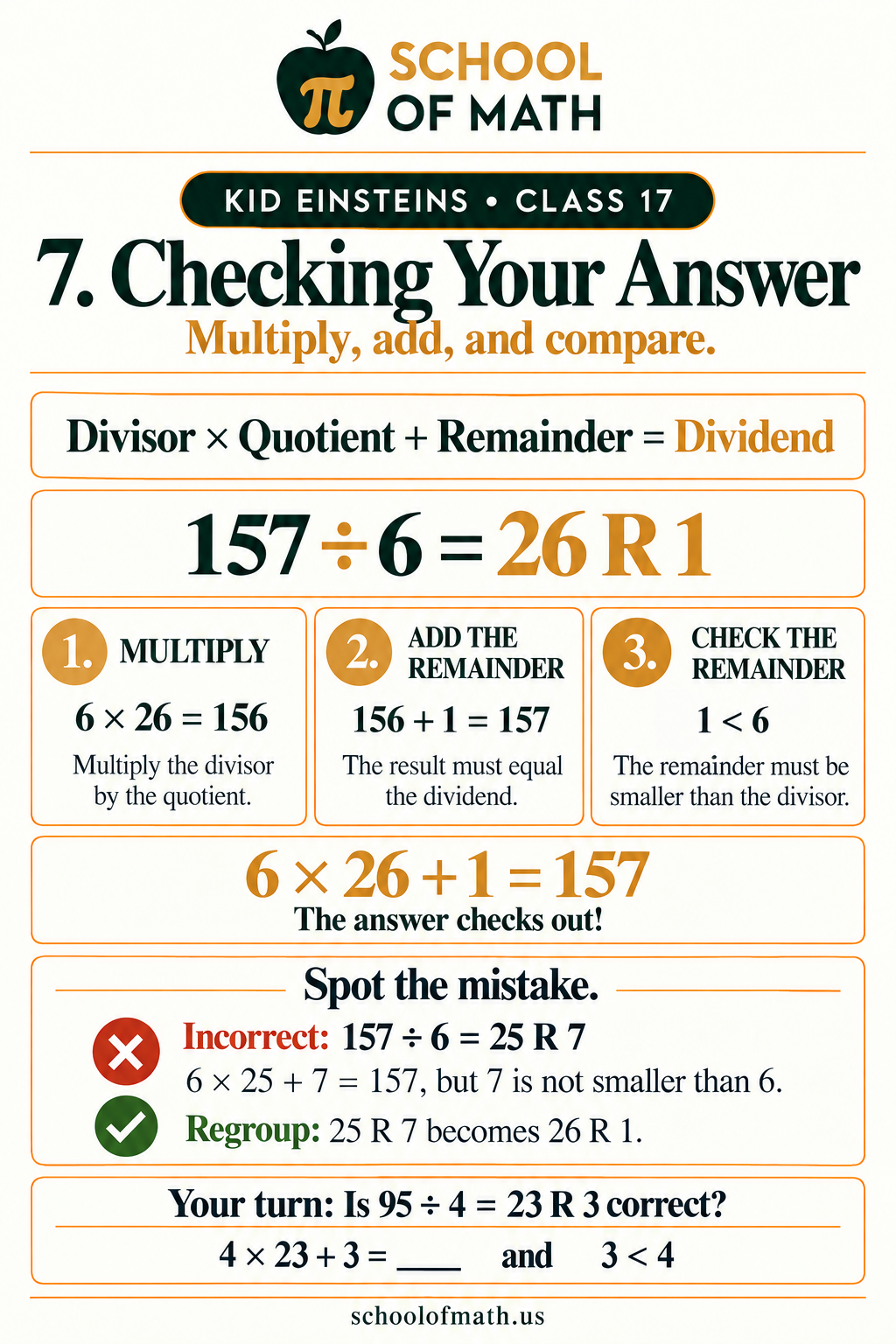
Multiply the divisor by the quotient, then add the remainder. The result must equal the original dividend. Also compare the remainder with the divisor.
An answer may pass the multiplication-and-addition check but still have a remainder that is too large. In that case, form another complete group from the remainder and adjust the quotient. Missing zero digits can also make an otherwise familiar-looking answer wrong.
Practice: try these five questions
Q31
Is 71 ÷ 4 = 17 R 3 correct? Show both checks.
Answer
Yes
- Multiply and add: 4 × 17 + 3 = 68 + 3 = 71. The remainder also satisfies 0 ≤ 3 < 4, so the answer is correct.
Q32
A student writes 86 ÷ 5 = 16 R 6. It adds back to 86. Is it finished? Correct it.
Answer
No; 17 R 1
- The remainder 6 is too large because 6 ≥ 5. Use 5 of those 6 to make one more group: the quotient increases from 16 to 17 and 1 remains. Check: 5 × 17 + 1 = 86.
Q33
Check the claim 137 ÷ 6 = 22 R 5.
Answer
Correct
- Calculate 6 × 22 = 132, then 132 + 5 = 137. Also 5 < 6. Both checks pass.
Q34
Repair 254 ÷ 7 = 35 R 9 and explain what happens to the leftover objects.
Answer
36 R 2
- The leftover 9 objects contain one more full group of 7 and 2 left over. Increase the quotient by 1 and reduce the remainder by 7. Check: 7 × 36 + 2 = 252 + 2 = 254, and 2 < 7.
Q35
A student writes 409 ÷ 4 = 12 R 1. Explain the place-value mistake and give the correct answer.
Answer
102 R 1
- In the hundreds place, divide 4 by 4: write 1. Multiply 1 × 4 = 4, then subtract 4 − 4 = 0.
- Bring down the next digit, 0, to make 0. Continue in the next place-value column.
- In the tens place, divide 0 by 4: write 0. Multiply 0 × 4 = 0, then subtract 0 − 0 = 0. Keep this zero in the quotient so the other digits stay in their correct places.
- Bring down the next digit, 9, to make 9. Continue in the next place-value column.
- In the ones place, divide 9 by 4: write 2. Multiply 2 × 4 = 8, then subtract 9 − 8 = 1.
- No digits remain to bring down. The quotient is 102 and the remainder is 1. Check: 4 × 10² + 1 = 409, and 1 < 4.
- The student omitted the zero in the tens place. The incorrect quotient gives 4 × 12 + 1 = 49, not 409. The correct quotient is 102.
Deciding what a remainder means
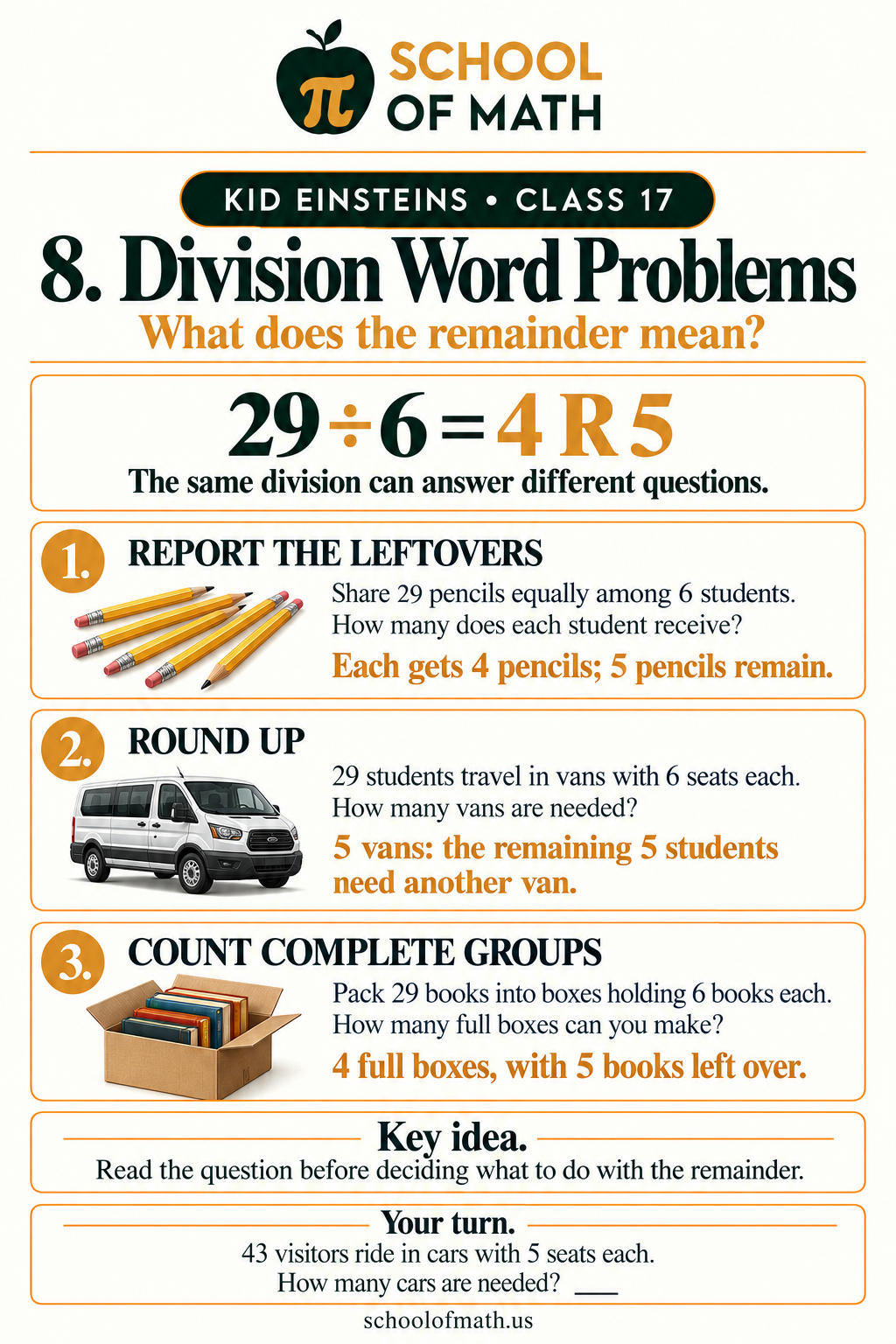
Read what the story asks before deciding what to do with the remainder. A sharing problem may ask for an amount per person and the leftovers. A packing problem may ask only for complete groups.
If every person or object needs a place, a nonzero remainder often requires one more container or vehicle. Do not change the arithmetic quotient; interpret it in the final sentence. State what the quotient and the remainder count, and use the correct units.
Practice: try these five questions
Q36
Share 31 whole pencils equally among 6 students. How many does each receive, and how many pencils remain?
Answer
5 pencils each; 1 pencil remains
- In the ones place, divide 31 by 6: write 5. Multiply 5 × 6 = 30, then subtract 31 − 30 = 1.
- No digits remain to bring down. The quotient is 5 and the remainder is 1. Check: 6 × 5 + 1 = 31, and 1 < 6.
Q37
There are 34 passengers. Each van has 5 passenger seats, not counting the driver. How many vans are needed for everyone?
Answer
7 vans
- In the ones place, divide 34 by 5: write 6. Multiply 6 × 5 = 30, then subtract 34 − 30 = 4.
- No digits remain to bring down. The quotient is 6 and the remainder is 4. Check: 5 × 6 + 4 = 34, and 4 < 5.
- Six vans seat 30 passengers, leaving 4 who still need seats. Add one van: 6 + 1 = 7.
Q38
A baker packs 52 cookies into bags of exactly 8. How many full bags can be sold, and how many cookies remain?
Answer
6 full bags; 4 cookies remain
- In the ones place, divide 52 by 8: write 6. Multiply 6 × 8 = 48, then subtract 52 − 48 = 4.
- No digits remain to bring down. The quotient is 6 and the remainder is 4. Check: 8 × 6 + 4 = 52, and 4 < 8.
- Only complete bags are counted for sale. Four leftover cookies do not make another full bag.
Q39
Divide 65 whole stickers equally among 7 children without cutting stickers. How many does each receive, and how many remain?
Answer
9 stickers each; 2 remain
- In the ones place, divide 65 by 7: write 9. Multiply 9 × 7 = 63, then subtract 65 − 63 = 2.
- No digits remain to bring down. The quotient is 9 and the remainder is 2. Check: 7 × 9 + 2 = 65, and 2 < 7.
Q40
Transport 118 visitors in vans with 9 passenger seats each. How many vans are needed, and how many passenger seats will be empty?
Answer
14 vans; 8 empty passenger seats
- In the tens place, divide 11 by 9: write 1. Multiply 1 × 9 = 9, then subtract 11 − 9 = 2.
- Bring down the next digit, 8, to make 28. Continue in the next place-value column.
- In the ones place, divide 28 by 9: write 3. Multiply 3 × 9 = 27, then subtract 28 − 27 = 1.
- No digits remain to bring down. The quotient is 13 and the remainder is 1. Check: 9 × 13 + 1 = 118, and 1 < 9.
- Thirteen vans seat 117 people, so one additional van is needed. Fourteen vans have 14 × 9 = 126 passenger seats. Empty seats: 126 − 118 = 8.
Homework review
One review question for each topic. Show your steps and check the final remainder.
R1
In 41 ÷ 6 = 6 R 5, identify the four division parts and explain the remainder.
Answer
Dividend 41; divisor 6; quotient 6; remainder 5
- Six groups of 6 use 36 objects; 41 − 36 = 5 objects remain. Since 5 < 6, they do not form another complete group.
R2
Use the greatest multiple of 7 that does not exceed 54 to find the quotient and remainder.
Answer
7 R 5
- In the ones place, divide 54 by 7: write 7. Multiply 7 × 7 = 49, then subtract 54 − 49 = 5.
- No digits remain to bring down. The quotient is 7 and the remainder is 5. Check: 7 × 7 + 5 = 54, and 5 < 7.
R3
Follow divide, multiply, subtract, and bring down to solve 83 ÷ 4.
Answer
20 R 3
- In the tens place, divide 8 by 4: write 2. Multiply 2 × 4 = 8, then subtract 8 − 8 = 0.
- Bring down the next digit, 3, to make 3. Continue in the next place-value column.
- In the ones place, divide 3 by 4: write 0. Multiply 0 × 4 = 0, then subtract 3 − 0 = 3. Keep this zero in the quotient so the other digits stay in their correct places.
- No digits remain to bring down. The quotient is 20 and the remainder is 3. Check: 4 × 20 + 3 = 83, and 3 < 4.
R4
Solve 72 ÷ 3 and explain why there is no remainder.
Answer
24
- In the tens place, divide 7 by 3: write 2. Multiply 2 × 3 = 6, then subtract 7 − 6 = 1.
- Bring down the next digit, 2, to make 12. Continue in the next place-value column.
- In the ones place, divide 12 by 3: write 4. Multiply 4 × 3 = 12, then subtract 12 − 12 = 0.
- No digits remain to bring down. The quotient is 24 and the remainder is 0. Check: 3 × 24 + 0 = 72, and 0 < 3.
R5
Solve 91 ÷ 8 and verify that the remainder is valid.
Answer
11 R 3
- In the tens place, divide 9 by 8: write 1. Multiply 1 × 8 = 8, then subtract 9 − 8 = 1.
- Bring down the next digit, 1, to make 11. Continue in the next place-value column.
- In the ones place, divide 11 by 8: write 1. Multiply 1 × 8 = 8, then subtract 11 − 8 = 3.
- No digits remain to bring down. The quotient is 11 and the remainder is 3. Check: 8 × 11 + 3 = 91, and 3 < 8.
R6
Solve 457 ÷ 4 using place-value columns.
Answer
114 R 1
- In the hundreds place, divide 4 by 4: write 1. Multiply 1 × 4 = 4, then subtract 4 − 4 = 0.
- Bring down the next digit, 5, to make 5. Continue in the next place-value column.
- In the tens place, divide 5 by 4: write 1. Multiply 1 × 4 = 4, then subtract 5 − 4 = 1.
- Bring down the next digit, 7, to make 17. Continue in the next place-value column.
- In the ones place, divide 17 by 4: write 4. Multiply 4 × 4 = 16, then subtract 17 − 16 = 1.
- No digits remain to bring down. The quotient is 114 and the remainder is 1. Check: 4 × 114 + 1 = 457, and 1 < 4.
R7
A student reports 173 ÷ 8 = 20 R 13. Correct the answer and show both checks.
Answer
21 R 5
- Use 8 of the 13 leftover objects to make one more group. Then 5 remain. Check: 8 × 21 + 5 = 168 + 5 = 173, and 5 < 8.
R8
Use 58 blocks to build towers of exactly 9 blocks. How many complete towers can you build, and how many blocks remain?
Answer
6 towers; 4 blocks remain
- In the ones place, divide 58 by 9: write 6. Multiply 6 × 9 = 54, then subtract 58 − 54 = 4.
- No digits remain to bring down. The quotient is 6 and the remainder is 4. Check: 9 × 6 + 4 = 58, and 4 < 9.
Homework word problems
Work from simpler stories toward multi-step challenges. Decide whether to report leftovers, count full groups, or add another container. Include units in your answer.
W1
Share 22 beads equally among 4 children, without splitting beads. How many beads does each child get, and how many remain?
Answer
5 beads each; 2 remain
- In the ones place, divide 22 by 4: write 5. Multiply 5 × 4 = 20, then subtract 22 − 20 = 2.
- No digits remain to bring down. The quotient is 5 and the remainder is 2. Check: 4 × 5 + 2 = 22, and 2 < 4.
W2
A florist has 39 flowers and puts exactly 5 in each bouquet. How many full bouquets can be made, and how many flowers remain?
Answer
7 bouquets; 4 flowers remain
- In the ones place, divide 39 by 5: write 7. Multiply 7 × 5 = 35, then subtract 39 − 35 = 4.
- No digits remain to bring down. The quotient is 7 and the remainder is 4. Check: 5 × 7 + 4 = 39, and 4 < 5.
W3
Share 46 snack packets equally among 6 tables. How many packets can each table receive, and how many remain?
Answer
7 packets per table; 4 remain
- In the ones place, divide 46 by 6: write 7. Multiply 7 × 6 = 42, then subtract 46 − 42 = 4.
- No digits remain to bring down. The quotient is 7 and the remainder is 4. Check: 6 × 7 + 4 = 46, and 4 < 6.
W4
There are 57 children to transport. Each minibus has 8 passenger seats, not counting the driver. How many minibuses are needed?
Answer
8 minibuses
- In the ones place, divide 57 by 8: write 7. Multiply 7 × 8 = 56, then subtract 57 − 56 = 1.
- No digits remain to bring down. The quotient is 7 and the remainder is 1. Check: 8 × 7 + 1 = 57, and 1 < 8.
- Seven minibuses seat 56 children. The remaining child needs another minibus, so use 8.
W5
A coach packs 74 balls into bags of exactly 9 balls each. How many full bags are there, and how many balls are unpacked?
Answer
8 full bags; 2 balls unpacked
- In the ones place, divide 74 by 9: write 8. Multiply 8 × 9 = 72, then subtract 74 − 72 = 2.
- No digits remain to bring down. The quotient is 8 and the remainder is 2. Check: 9 × 8 + 2 = 74, and 2 < 9.
W6
Seat 95 readers at tables with 6 seats each. How many tables are needed, and how many seats will be empty?
Answer
16 tables; 1 empty seat
- In the tens place, divide 9 by 6: write 1. Multiply 1 × 6 = 6, then subtract 9 − 6 = 3.
- Bring down the next digit, 5, to make 35. Continue in the next place-value column.
- In the ones place, divide 35 by 6: write 5. Multiply 5 × 6 = 30, then subtract 35 − 30 = 5.
- No digits remain to bring down. The quotient is 15 and the remainder is 5. Check: 6 × 15 + 5 = 95, and 5 < 6.
- Fifteen tables seat 90 readers. Five readers need another table. Sixteen tables provide 16 × 6 = 96 seats, so 96 − 95 = 1 seat is empty.
W7
Pack 128 eggs into cartons that hold exactly 5 eggs. How many full cartons can you make, and how many more eggs would complete one extra carton?
Answer
25 full cartons; 2 more eggs needed
- In the tens place, divide 12 by 5: write 2. Multiply 2 × 5 = 10, then subtract 12 − 10 = 2.
- Bring down the next digit, 8, to make 28. Continue in the next place-value column.
- In the ones place, divide 28 by 5: write 5. Multiply 5 × 5 = 25, then subtract 28 − 25 = 3.
- No digits remain to bring down. The quotient is 25 and the remainder is 3. Check: 5 × 25 + 3 = 128, and 3 < 5.
- The division leaves 3 eggs after filling 25 cartons. One carton needs 5 eggs, so the extra carton needs 5 − 3 = 2 more eggs.
W8
A club has 146 tickets. Each family pack must contain exactly 7 tickets. How many complete family packs can be sold, and how many tickets remain?
Answer
20 family packs; 6 tickets remain
- In the tens place, divide 14 by 7: write 2. Multiply 2 × 7 = 14, then subtract 14 − 14 = 0.
- Bring down the next digit, 6, to make 6. Continue in the next place-value column.
- In the ones place, divide 6 by 7: write 0. Multiply 0 × 7 = 0, then subtract 6 − 0 = 6. Keep this zero in the quotient so the other digits stay in their correct places.
- No digits remain to bring down. The quotient is 20 and the remainder is 6. Check: 7 × 20 + 6 = 146, and 6 < 7.
W9
A library must put all 203 books on shelves that hold at most 8 books each. How many shelves are needed, and how many spaces will remain?
Answer
26 shelves; 5 spaces remain
- In the tens place, divide 20 by 8: write 2. Multiply 2 × 8 = 16, then subtract 20 − 16 = 4.
- Bring down the next digit, 3, to make 43. Continue in the next place-value column.
- In the ones place, divide 43 by 8: write 5. Multiply 5 × 8 = 40, then subtract 43 − 40 = 3.
- No digits remain to bring down. The quotient is 25 and the remainder is 3. Check: 8 × 25 + 3 = 203, and 3 < 8.
- Twenty-five shelves hold 200 books, leaving 3 books for another shelf. Twenty-six shelves hold 26 × 8 = 208 books. Unused spaces: 208 − 203 = 5.
W10
Share 287 whole stickers equally among 9 students. How many stickers does each student receive, and how many remain for the teacher?
Answer
31 stickers each; 8 remain for the teacher
- In the tens place, divide 28 by 9: write 3. Multiply 3 × 9 = 27, then subtract 28 − 27 = 1.
- Bring down the next digit, 7, to make 17. Continue in the next place-value column.
- In the ones place, divide 17 by 9: write 1. Multiply 1 × 9 = 9, then subtract 17 − 9 = 8.
- No digits remain to bring down. The quotient is 31 and the remainder is 8. Check: 9 × 31 + 8 = 287, and 8 < 9.
W11
A school has 156 snack packets and receives 79 more. It packs exactly 6 packets into each picnic bag. How many full bags can be made, and how many packets remain?
Answer
39 full bags; 1 packet remains
- First combine the packets: 156 + 79 = 235. Then divide 235 by 6 using the steps below. Only full bags count.
- In the tens place, divide 23 by 6: write 3. Multiply 3 × 6 = 18, then subtract 23 − 18 = 5.
- Bring down the next digit, 5, to make 55. Continue in the next place-value column.
- In the ones place, divide 55 by 6: write 9. Multiply 9 × 6 = 54, then subtract 55 − 54 = 1.
- No digits remain to bring down. The quotient is 39 and the remainder is 1. Check: 6 × 39 + 1 = 235, and 1 < 6.
W12
A museum transports 249 visitors in vans with 8 passenger seats each. Each van costs 12 dollars to hire. How many vans are needed, what is the total hire cost, and how many passenger seats will be empty?
Answer
32 vans; 384 dollars; 7 empty passenger seats
- In the tens place, divide 24 by 8: write 3. Multiply 3 × 8 = 24, then subtract 24 − 24 = 0.
- Bring down the next digit, 9, to make 9. Continue in the next place-value column.
- In the ones place, divide 9 by 8: write 1. Multiply 1 × 8 = 8, then subtract 9 − 8 = 1.
- No digits remain to bring down. The quotient is 31 and the remainder is 1. Check: 8 × 31 + 1 = 249, and 1 < 8.
- Thirty-one vans seat 248 visitors, so use one more: 32 vans. The cost is 32 × 12 = 384 dollars. Capacity is 32 × 8 = 256 passenger seats, leaving 256 − 249 = 7 empty seats.
Quick questions and answers
What do dividend, divisor, quotient, and remainder mean?
The dividend is the amount divided, the divisor is the number divided by, the quotient counts complete groups or the amount in each equal share, and the remainder is the amount left over.
What are the long-division steps?
Divide, multiply, subtract, and bring down the next digit. Work from left to right and repeat until no digits remain to bring down.
Why must the remainder be smaller than the divisor?
If the remainder is as large as the divisor, it can make another complete group. For positive divisors and nonnegative whole-number dividends, a valid final remainder satisfies 0 ≤ remainder < divisor.
How do I check an answer?
Multiply the divisor by the quotient and add the remainder. The result must equal the dividend. Also check that the remainder is nonnegative and smaller than the divisor.
When should a word-problem answer round up?
When every person or object needs a place and a nonzero remainder needs an additional vehicle, shelf, or container, add one to the number of complete groups. If the question asks only for full groups, do not round up.
Why does a quotient sometimes need a zero?
A zero holds a place where no complete groups can be made at that stage. For example, 612 divided by 3 is 204, not 24; the tens digit is zero.
Is an earlier class required, and what homework is included?
No earlier attendance is required. This self-contained rolling lesson has eight supplied images, forty original practice questions, eight Homework review questions, and twelve Homework word problems. All sixty questions have hidden worked answers. The 23-page student workbook includes the supplied PDF-only cover, eight original teaching images, the same sixty questions with blank answer space and no exercise solutions, and a full-model clarification for image 5.