Young Fermats — Pre-Algebra · Class Pack · Class 11 · Grades 5–6
Pre-Algebra Class 11: Variables and Algebraic Expressions — Translating Words — 8 SOMATH Posters, Theory & 40 Practice Questions
A complete, illustrated grade 5–6 walk through variables vs constants, translating addition, subtraction, multiplication, and division words, multi-step phrases, and using parentheses to keep groups together. Eight SOMATH posters, full theory under each one, and 40 practice questions with click-to-reveal step-by-step solutions — plus a bonus set of 10 real-life word problems with hidden step-by-step answers in increasing difficulty. Class 11 of the SOMATH Young Fermats — Pre-Algebra rolling syllabus — Upper West Side, NYC.
Short answer
To translate words into an algebraic expression, use a variable (a letter like x, n, or y) for the unknown number and a constant for any specific number. Then match key words to operations: sum, plus, more than, increased by, total mean +; minus, difference, decreased by, less than, fewer than, subtracted from mean −; product, times, twice, triple, of mean ×; quotient, divided by, ratio, per, one-half of mean ÷. Watch the order-flip trap: less than and subtracted from put the second number first (so “5 less than n” is n − 5, not 5 − n). Use parentheses when words like the sum of, the difference of, the quantity group two things together (so “twice the sum of x and 4” is 2(x + 4), not 2x + 4).
SOMATH Young Fermats — Pre-Algebra · Grades 5–6 · Class 11 of 48
This is one class from our Pre-Algebra course
SOMATH's Young Fermats — Pre-Algebra course meets in person on the Upper West Side (226 W 79th St). It's a 48-class rolling syllabus for grades 5–6 covering integers, fractions, decimals, ratios, percent, and the transition into algebraic thinking. Small in-person groups of up to 6 students. Every family starts with a free in-person evaluation.
See the full Pre-Algebra course → Book a free evaluation · (646) 668-6151
What's inside this class
1. Variables and constants
Poster 1 of 8 — Young Fermats Pre-Algebra Class 11
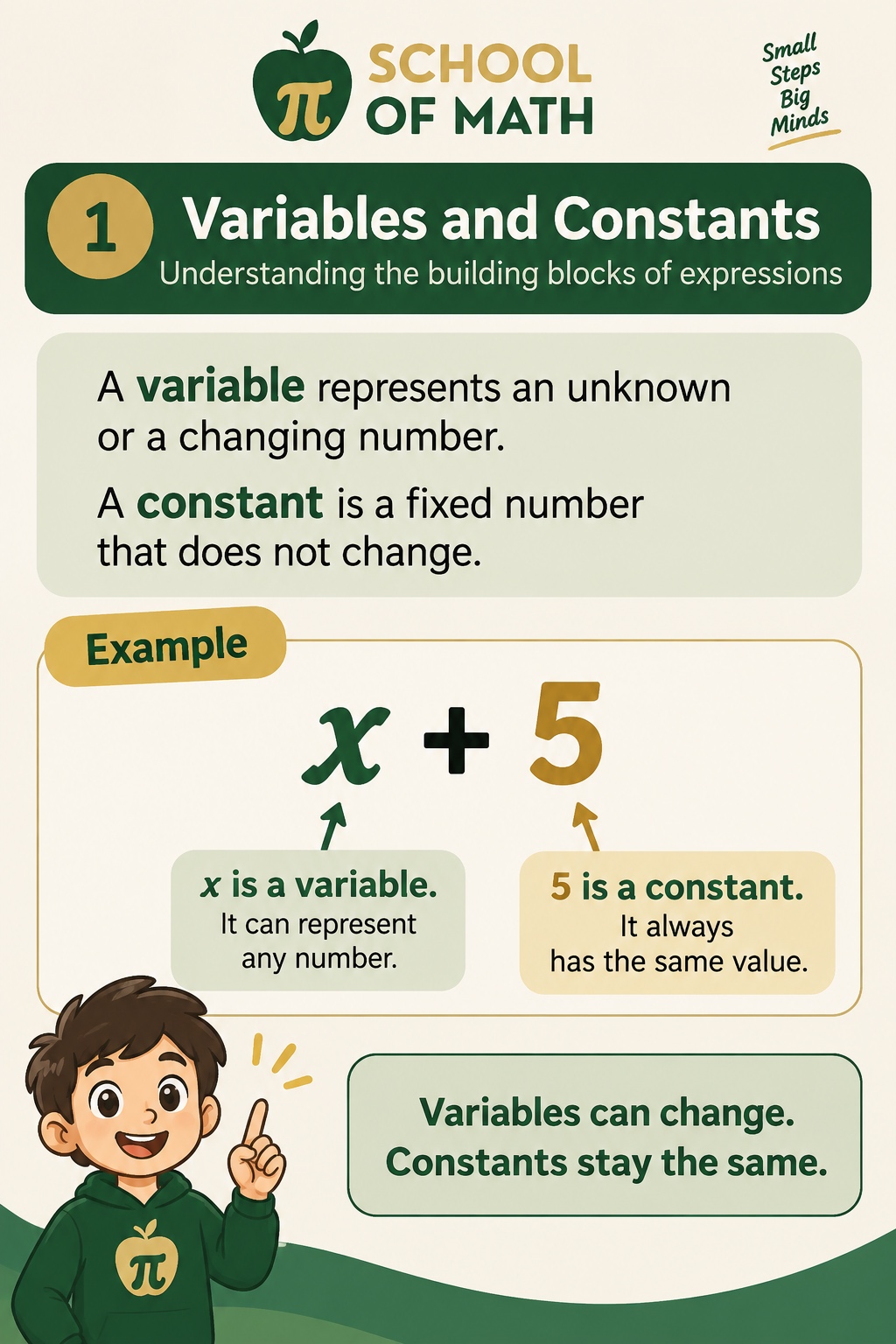
A variable stands for an unknown number. A constant is a fixed number.
Every algebraic expression is built from two kinds of pieces:
- A variable is a letter (usually x, y, n, a, m, or similar) that stands for an unknown or changing number. Its value can change — that's why we use a letter instead of a specific number.
- A constant is a specific, fixed number whose value never changes: 5, 12, 100, 3.14, 1/2.
In the expression x + 5:
- The x is a variable — it could be 1, 100, or any other number.
- The 5 is a constant — it is always exactly 5.
Two more names you'll hear in the same breath:
- Coefficient — the number multiplied by a variable, like the 3 in 3x. If a variable has no visible coefficient (like plain x), the coefficient is 1.
- Term — a single piece of an expression separated by + or −. In 3x + 5 there are two terms: 3x and 5.
5 practice questions with hidden solutions
2. Translating addition words
Poster 2 of 8 — Young Fermats Pre-Algebra Class 11
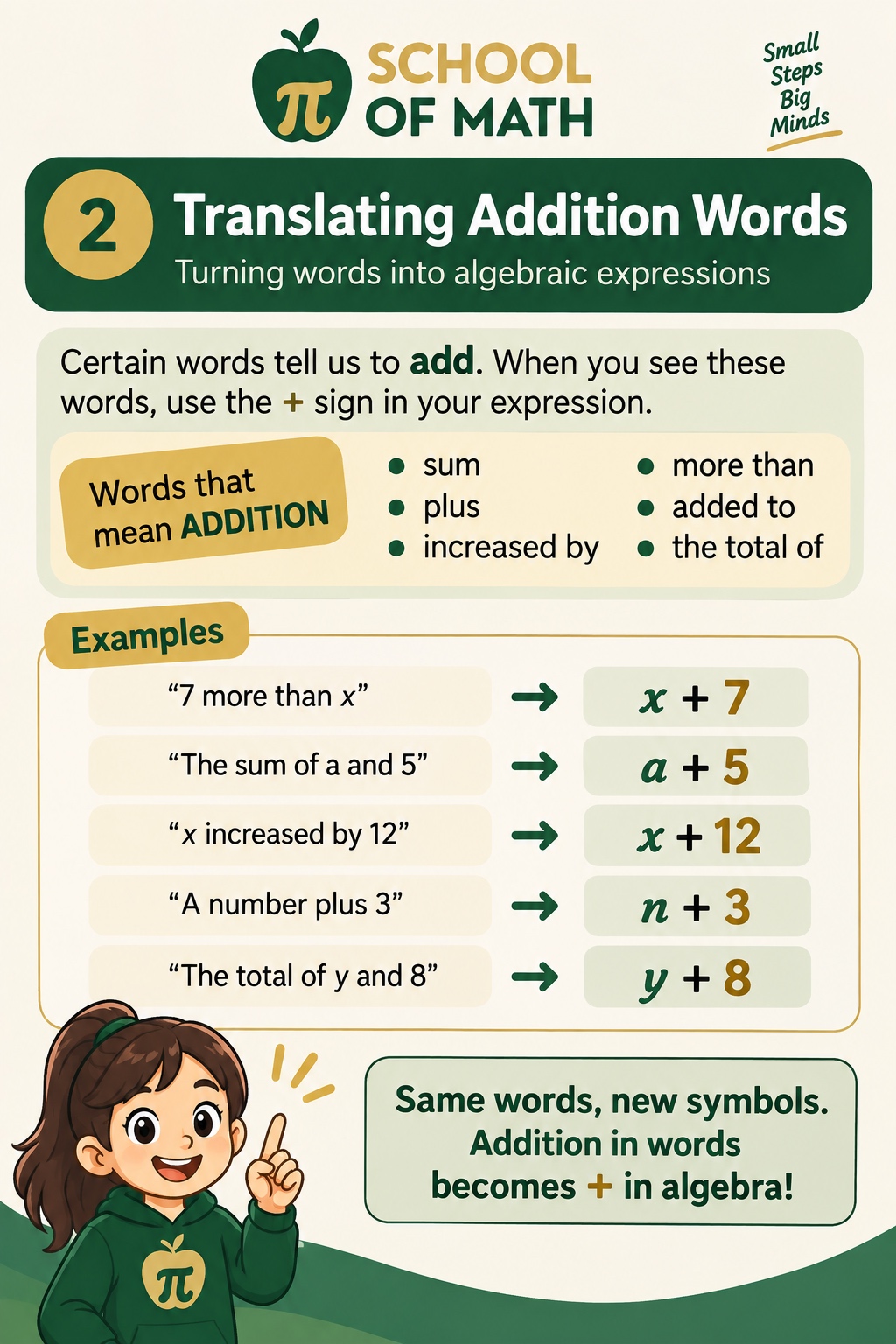
Words that mean + (addition)
When you see any of these words in a phrase, use a + sign in your expression:
| Word / phrase | Example phrase | Expression |
|---|---|---|
| sum of | the sum of a and 5 | a + 5 |
| plus | a number plus 3 | n + 3 |
| more than | 7 more than x | x + 7 |
| increased by | x increased by 12 | x + 12 |
| added to | 4 added to y | y + 4 |
| the total of | the total of y and 8 | y + 8 |
Good news about addition: the order doesn't matter. x + 7 and 7 + x represent the same number, so both are correct translations of “7 more than x.” That's the commutative property of addition. Order only matters for subtraction and division (coming up).
5 practice questions with hidden solutions
3. Translating subtraction words
Poster 3 of 8 — Young Fermats Pre-Algebra Class 11
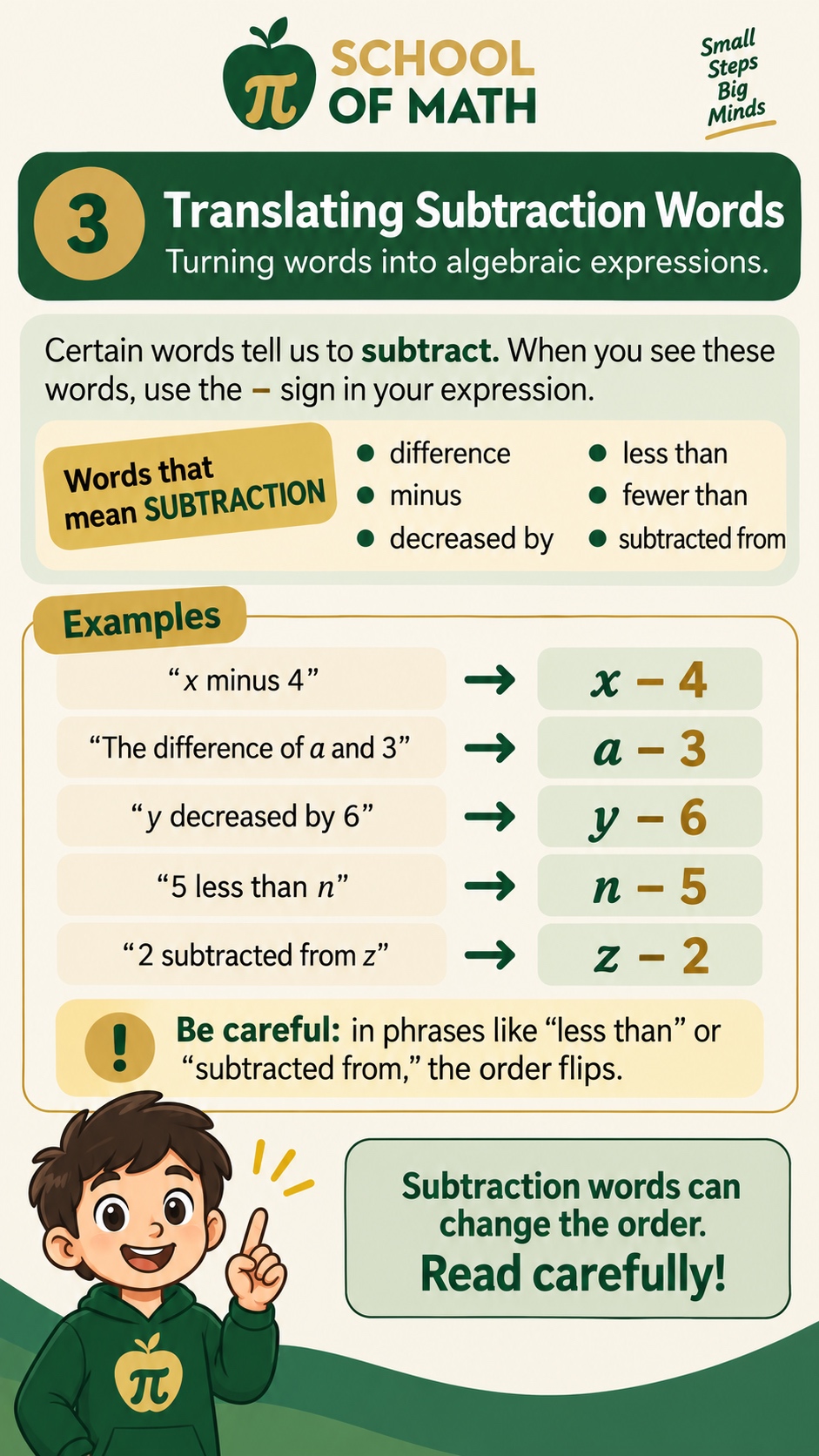
Words that mean − (subtraction)
These words all mean subtract — but some of them flip the order:
| Word / phrase | Example phrase | Expression | Order |
|---|---|---|---|
| minus | x minus 4 | x − 4 | Normal |
| difference of | the difference of a and 3 | a − 3 | Normal |
| decreased by | y decreased by 6 | y − 6 | Normal |
| less than | 5 less than n | n − 5 | Flipped! |
| fewer than | 3 fewer than x | x − 3 | Flipped! |
| subtracted from | 2 subtracted from z | z − 2 | Flipped! |
The order-flip trap. The phrases less than, fewer than, and subtracted from put the numbers in the opposite order from how they appear in the sentence. Read carefully:
- “5 less than n” means start with n, and take 5 away. So it's n − 5, NOT 5 − n.
- “2 subtracted from z” means start with z, subtract 2. So it's z − 2, NOT 2 − z.
Trick: the word than or from tells you what to start with. Whatever comes right after than or from goes first in the expression.
5 practice questions with hidden solutions
4. Translating multiplication words
Poster 4 of 8 — Young Fermats Pre-Algebra Class 11
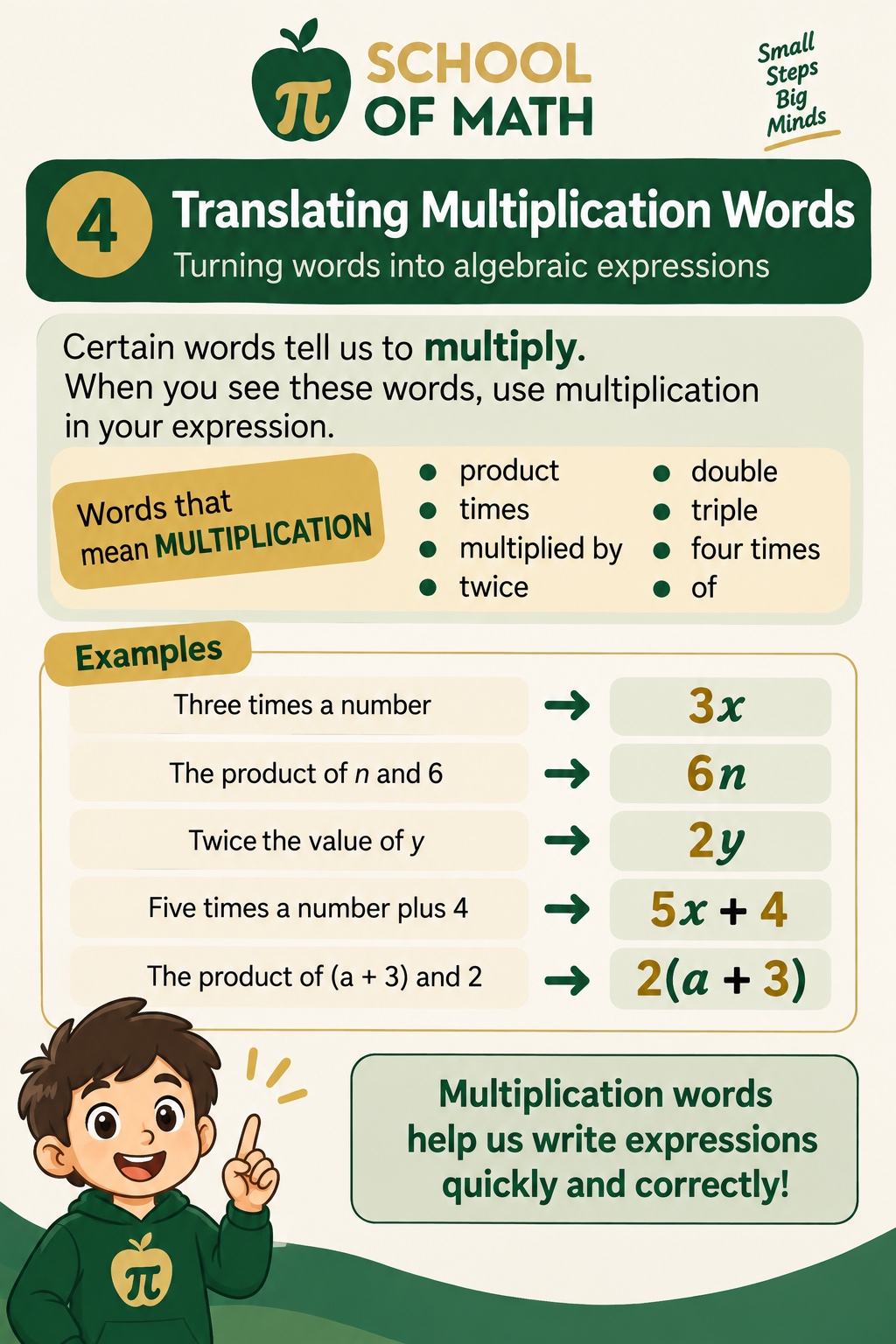
Words that mean × (multiplication)
| Word / phrase | Example phrase | Expression |
|---|---|---|
| product of | the product of n and 6 | 6n |
| times | three times a number | 3x |
| multiplied by | a multiplied by 5 | 5a |
| twice / double | twice the value of y | 2y |
| triple | triple a number | 3x |
| four times, five times… | four times b | 4b |
| of (with a fraction) | one-half of a number | (1/2)x or x/2 |
Algebra shorthand. Between a number and a variable, we drop the multiplication sign completely. We write 3x, not 3 × x or 3 · x. The number goes in front of the variable (called the coefficient).
Between two numbers, we cannot drop the sign (3 · 5 is not the same as 35). Between two variables, we can drop it (xy means x · y).
Watch: “the product of n and 6” is written 6n — the number goes first as the coefficient, even though it appeared second in the sentence. That's just a convention: x3 looks like a typo, so we always write 3x.
5 practice questions with hidden solutions
5. Translating division words
Poster 5 of 8 — Young Fermats Pre-Algebra Class 11
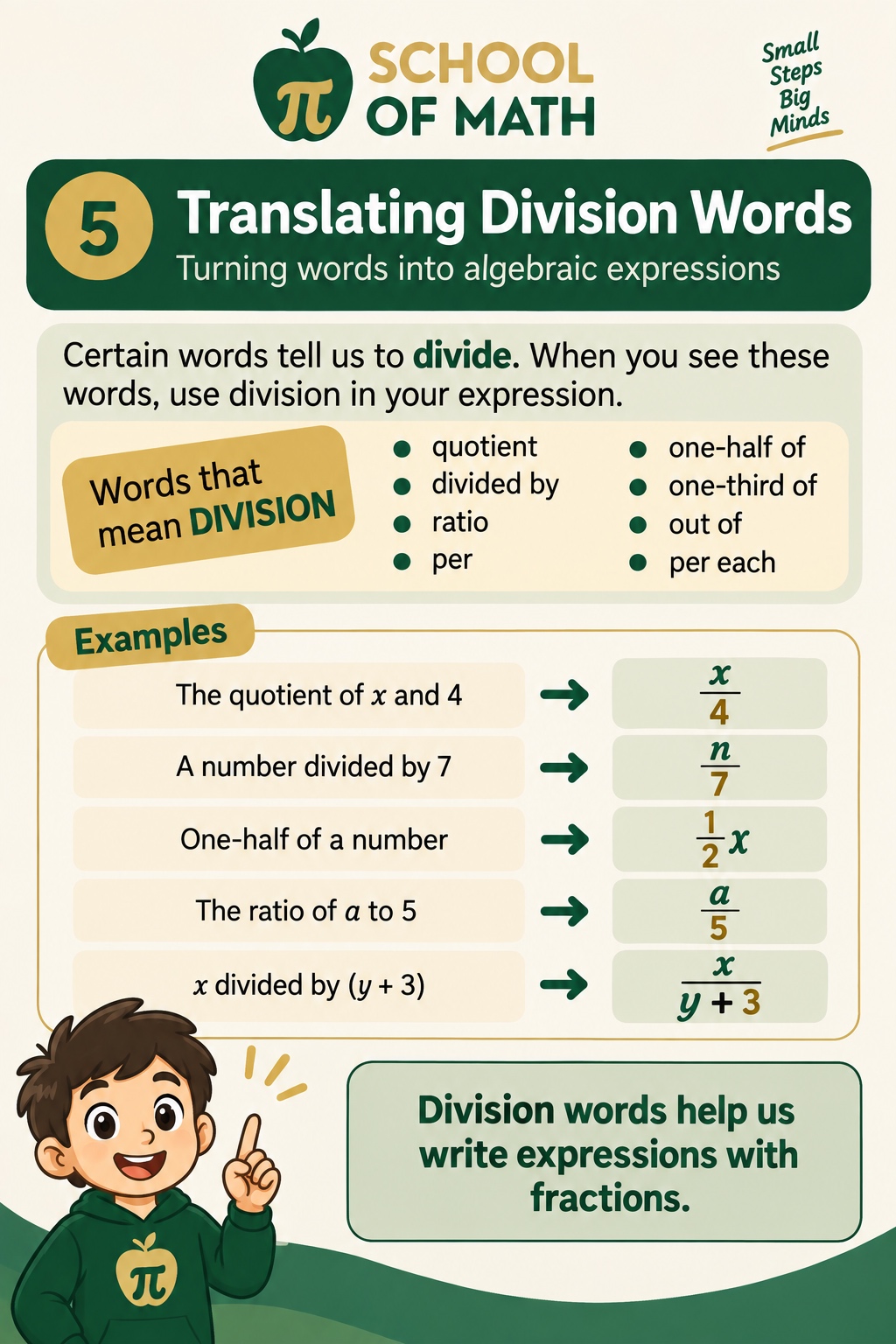
Words that mean ÷ (division)
| Word / phrase | Example phrase | Expression |
|---|---|---|
| quotient of | the quotient of x and 4 | x/4 |
| divided by | a number divided by 7 | n/7 |
| ratio of … to … | the ratio of a to 5 | a/5 |
| per, per each | miles per hour | m/h |
| one-half of, one-third of | one-half of a number | (1/2)x or x/2 |
| out of | 3 out of n | 3/n |
Algebra shorthand. Instead of the ÷ sign, we write division as a fraction. So “x divided by 4” is written x/4 — the first thing goes on top, the second goes on the bottom.
Order matters. Division is not commutative: 12/3 = 4 but 3/12 = 1/4. So “the quotient of x and 4” is x/4, not 4/x. Whatever is named first goes on top.
Grouping. When a phrase inside the division has its own operation, wrap it in parentheses so the whole thing goes together: “x divided by (y + 3)” is x / (y + 3), meaning add y and 3 first, then divide x by that result.
5 practice questions with hidden solutions
6. Translating multi-step phrases
Poster 6 of 8 — Young Fermats Pre-Algebra Class 11
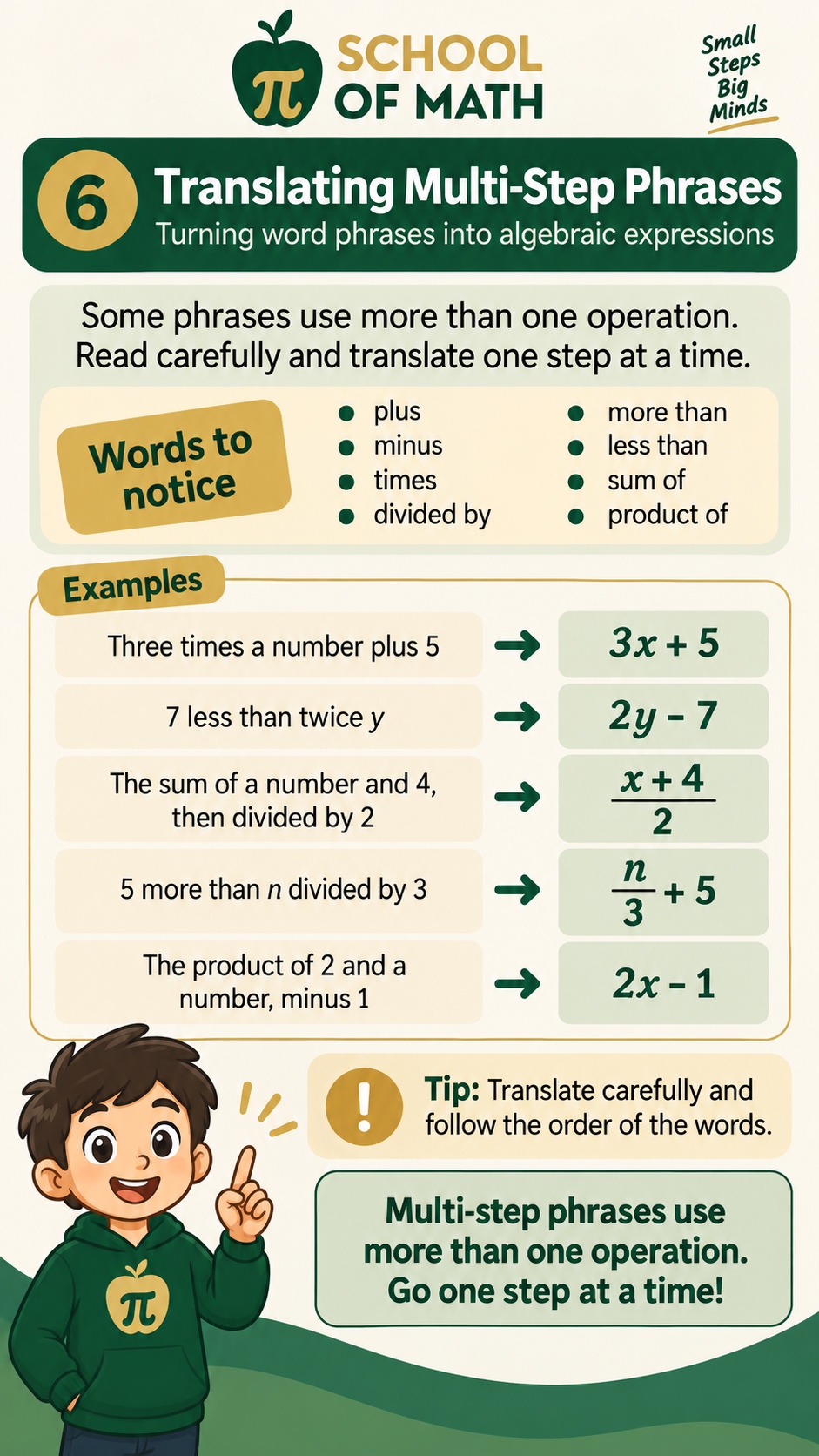
Multi-step phrases — go one step at a time
Some phrases use more than one operation. The trick is to slow down and read one step at a time. Follow the order the words appear, but pause on the two things that flip:
- “less than” and “subtracted from” still flip the order.
- “the sum of … and …”, “the difference of … and …”, “the product of … and …”, “the quantity …” group two things — do that operation first, in parentheses if needed.
Examples from the poster:
- “Three times a number plus 5”: first “three times a number” = 3x, then “plus 5” = + 5. Answer: 3x + 5.
- “7 less than twice y”: first “twice y” = 2y, then “7 less than” flips the order — subtract 7 from 2y. Answer: 2y − 7 (NOT 7 − 2y).
- “The sum of a number and 4, then divided by 2”: “the sum of” groups x + 4 in parentheses, then divide by 2. Answer: (x + 4)/2.
- “5 more than n divided by 3”: careful — this means “n divided by 3” first (n/3), then add 5. Answer: n/3 + 5. (If the sentence said “5 more than n, divided by 3” with a comma, it would be different.)
- “The product of 2 and a number, minus 1”: “product of 2 and x” = 2x, then “minus 1” = − 1. Answer: 2x − 1.
5 practice questions with hidden solutions
7. Using parentheses
Poster 7 of 8 — Young Fermats Pre-Algebra Class 11
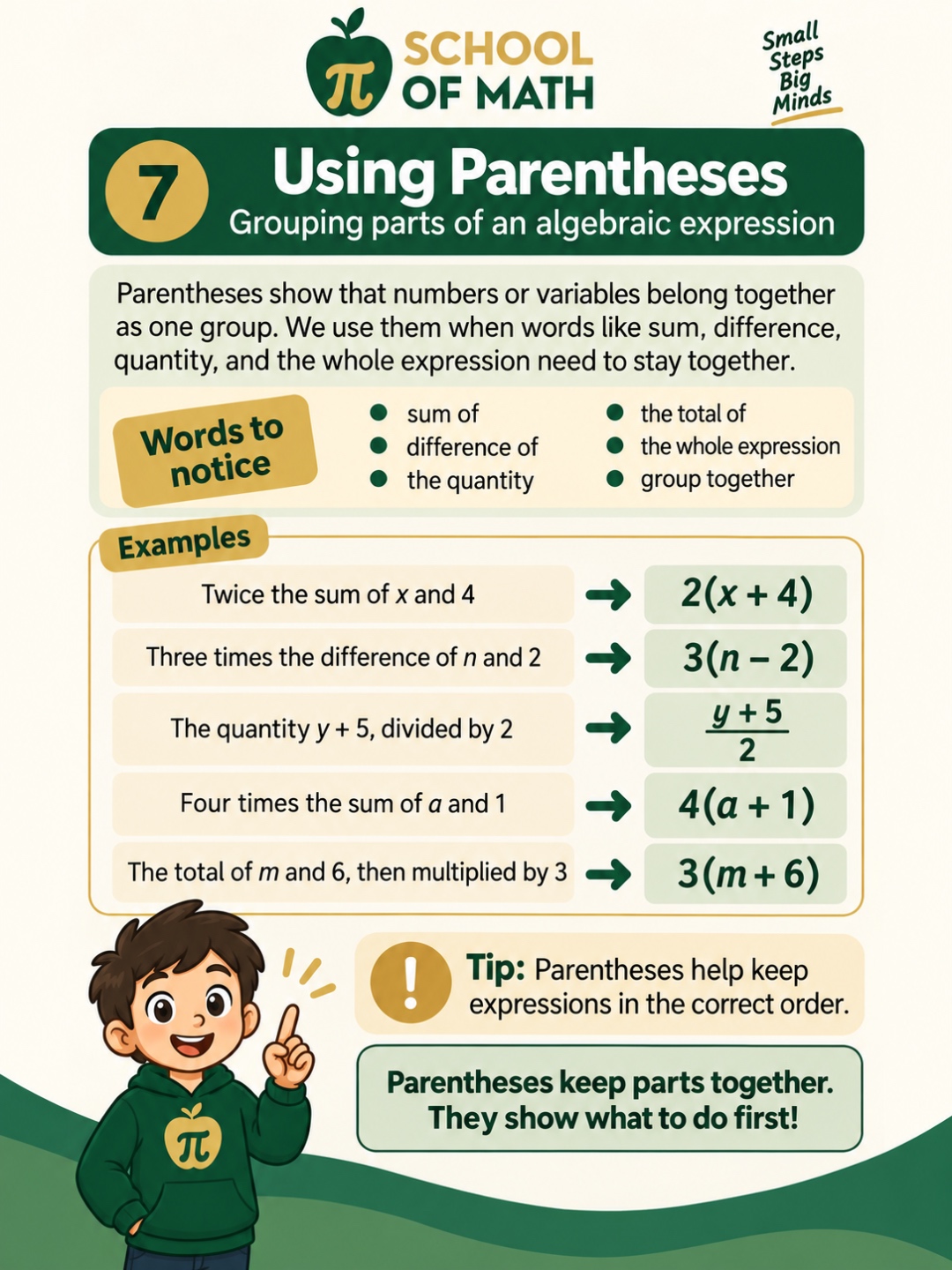
Parentheses = “keep these together, do them first”
Parentheses are the algebra way to say “this whole thing is one group.” They keep parts of an expression together and tell you what to do first under the order of operations.
Words that signal parentheses:
- the sum of … and …
- the difference of … and …
- the product of … and …
- the quantity …
- the total of …
- the whole expression, group together
Examples from the poster:
| Phrase | Expression |
|---|---|
| Twice the sum of x and 4 | 2(x + 4) |
| Three times the difference of n and 2 | 3(n − 2) |
| The quantity y + 5, divided by 2 | (y + 5) / 2 |
| Four times the sum of a and 1 | 4(a + 1) |
| The total of m and 6, then multiplied by 3 | 3(m + 6) |
Common mistake: writing “twice the sum of x and 4” as 2x + 4. That is WRONG. 2x + 4 doubles only the x. What the phrase actually asks for is to add first (x + 4), then double the whole thing — so 2(x + 4). Try x = 3: 2(3 + 4) = 14, but 2(3) + 4 = 10. Different answers.
5 practice questions with hidden solutions
8. Translating words into algebraic expressions
Poster 8 of 8 — Young Fermats Pre-Algebra Class 11
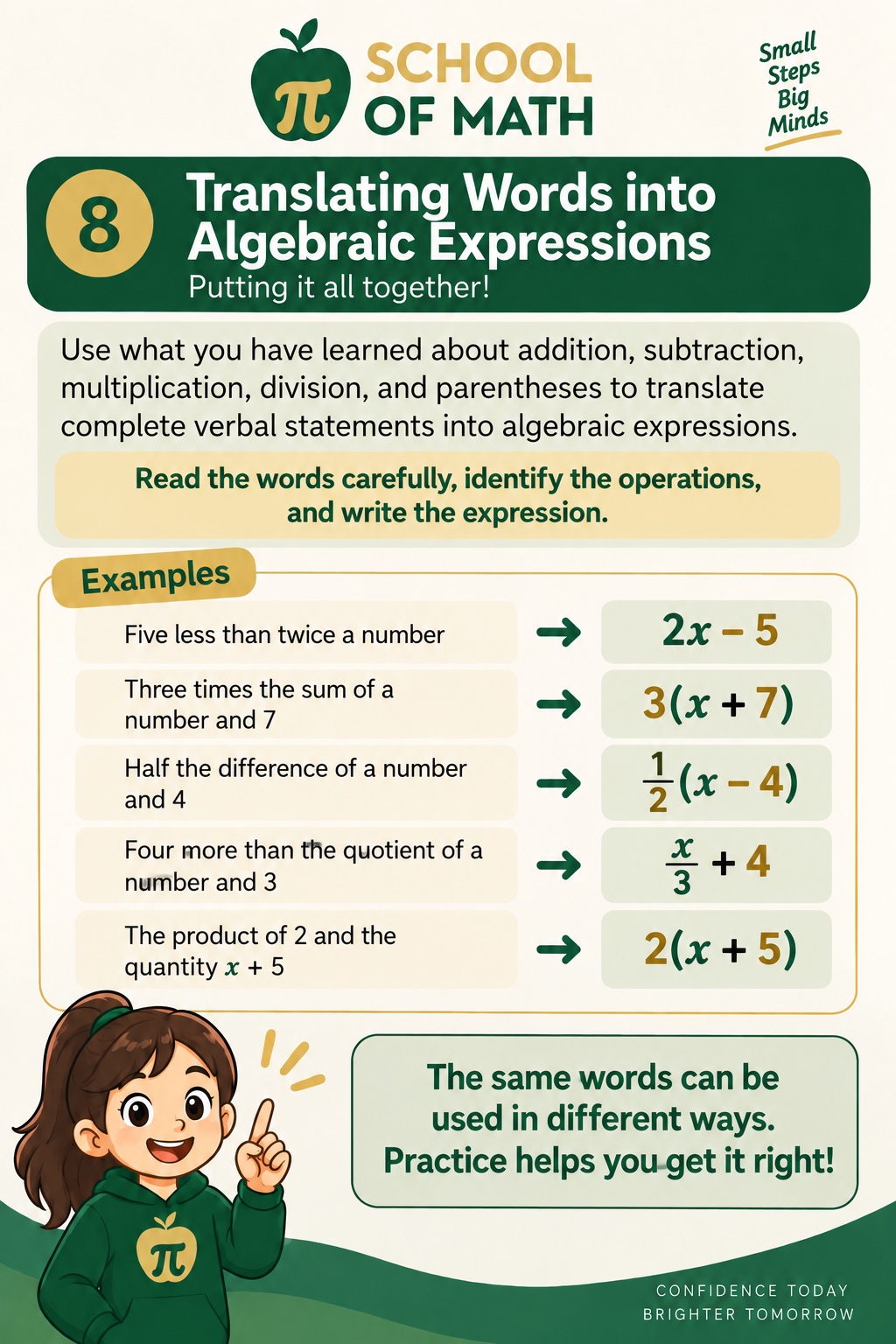
Putting it all together
Now you have every tool you need. The 4-step method works for any word phrase, no matter how long:
- Read the phrase. Look for the unknown — assign it a variable (usually x, n, or whatever makes sense).
- Identify the operations. Underline every key word: sum, plus, more than, minus, less than, times, divided by, product of, quotient of, twice, half of, the quantity…
- Watch for the two order-flippers — “less than” and “subtracted from” — and for grouping words that need parentheses.
- Write the expression one step at a time, left to right, honoring the flips and the parentheses.
Examples from the poster:
| Phrase | Expression |
|---|---|
| Five less than twice a number | 2x − 5 |
| The sum of three times a number and 7 | 3x + 7 |
| Half the difference of a number and 4 | (1/2)(x − 4) |
| Four more than the quotient of a number and 3 | x/3 + 4 |
| The product of (a number plus 5) and 2 | 2(x + 5) |
Sanity-check trick. When you're done, plug in a small number for the variable and check that the expression matches what the words describe. If “5 less than x” is supposed to be x − 5, try x = 10: x − 5 = 5. That matches “5 less than 10”. If you had written 5 − x, plugging in 10 gives −5 — a red flag.
Class 12 (next class) puts these expressions to work: evaluating expressions and combining like terms. Class 13 introduces equations — setting two expressions equal to each other and solving for the variable.
5 practice questions with hidden solutions
10 word problems — translate then solve
Bonus set — increasing difficulty. Read the words, name the unknown, write the expression, then answer the question.
How to attack a word problem
- Name the unknown. Pick a variable and write exactly what it means (“let x = number of pencils”).
- Translate the sentence into an expression. Use everything from Class 11: key words for operations, the order-flip on “less than”/“subtracted from”, parentheses for grouping.
- Set up an equation only if the problem tells you what the expression equals. Otherwise, just evaluate.
- Solve and check. Plug the answer back in and re-read the sentence to be sure it fits.
10 word problems with hidden step-by-step solutions
(b) Average cost per minute: total bill divided by minutes — the whole bill is one quantity, so wrap it in parentheses: (40 + 0.15m) / m dollars per minute.
(c) At m = 200: Total bill = 40 + 0.15(200) = 40 + 30 = $70. Average per minute = 70 / 200 = $0.35 per minute. Notice the average is more than $0.15 — that’s because the $40 flat fee gets spread over the 200 minutes. As m gets bigger, the average per minute drops toward $0.15.
Ready to see how SOMATH teaches this in class?
Young Fermats — Pre-Algebra meets in person on the Upper West Side. Small groups of up to 6 students. Real teachers, not tutors or apps. Every family starts with a free in-person evaluation so we can place your child at the right point in the 48-class syllabus.
SOMATH · 226 W 79th St, 1st Floor, New York, NY 10024 · (646) 668-6151 · See class schedule · Young Fermats — Pre-Algebra course page
Frequently asked questions
What is the difference between a variable and a constant?
How do you translate "less than" and "subtracted from" in algebra?
What words mean addition in algebra?
What words mean subtraction in algebra?
What words mean multiplication in algebra?
What words mean division in algebra?
When do you use parentheses in an algebraic expression?
How do you translate multi-step word phrases into algebra?
Related SOMATH class packs and posts
- Full Young Fermats — Pre-Algebra course page (48-class rolling syllabus)
- Pre-Algebra Class 10 — Percent: the three faces, tip, tax & discount (previous class)
- Pre-Algebra Class 12 — Evaluating expressions and combining like terms (next class)
- Pre-Algebra Class 9 — Proportional reasoning and simple proportions
- Pre-Algebra Class 7 — Decimals: all four operations
- Pre-Algebra Class 6 — Four operations on fractions and mixed numbers
- Pre-Algebra Class 1 — Integers, the number line, and absolute value
- Algebra 1 (Algebra Ignite) Class 11 — Polynomials: adding, subtracting, multiplying (next-year sequel)
- Book a free in-person evaluation
- See the class schedule