Young Fermats · Pre-Algebra · Class 13
One-Step Equations with Addition and Subtraction
Solve a one-step addition or subtraction equation by using the inverse operation on both sides. Subtract the added number, or add the subtracted number, to leave the variable alone. Then check your solution in the original equation.
Follow the eight images in order, with five original questions after every image. For homework, complete eight review questions, one per image, followed by twelve word problems in increasing difficulty: 20 homework questions in total. All 60 questions have compact blue Answer buttons with worked explanations.
Part of Young Fermats Pre-Algebra at SOMATH. Book an evaluation to discuss placement, or view the current class schedule.
Download the student workbook (PDF)22 pages · Cover, then each image followed by its five practice questions, then 8 homework review questions and 12 homework word problems.Blank answer space throughout. Exercise answers are not included.
What is an equation?
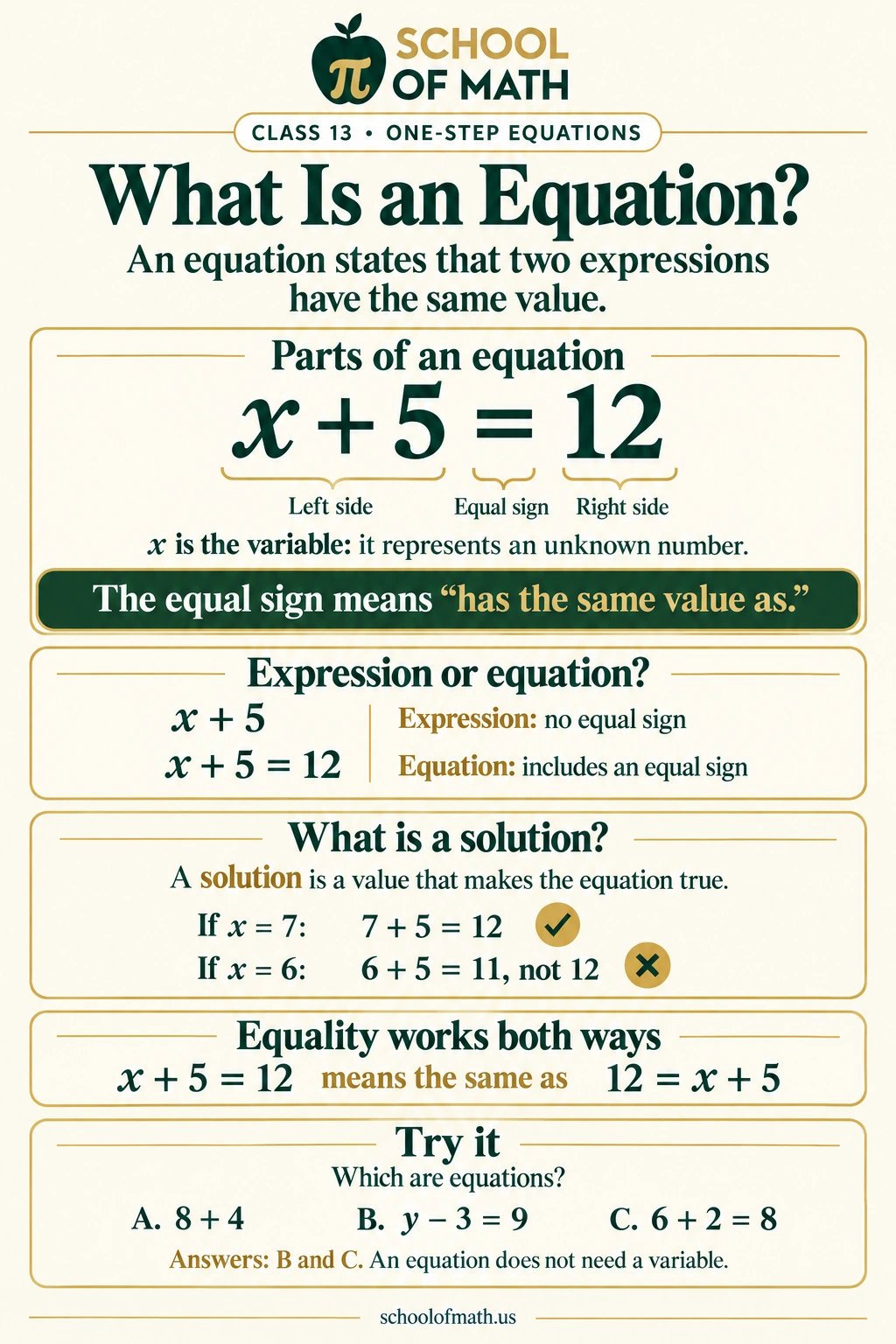
An equation states that two expressions have equal values. An expression names a value but does not make a claim of equality. A solution is a value of the variable that makes the original equation true; the variable can be on either side.
Try it yourself: five questions
Q1 Practice 1 of 5 · Start
Which is an equation: 14 − 6 or 14 − 6 = 8? Explain your choice.
Answer
14 − 6 = 8 is an equation.
- It includes an equal sign and states that the left and right sides have the same value. The expression 14 − 6 does not state an equality.
Q2 Practice 2 of 5 · Build
For t + 8 = 21, identify the variable, the left side, and the right side.
Answer
Variable: t; left side: t + 8; right side: 21.
- The unknown is t. The equal sign connects the entire expression t + 8 with the number 21.
Q3 Practice 3 of 5 · Apply
Is 17 = 10 + 7 a true equation? Does an equation have to contain a variable?
Answer
Yes, it is true. An equation does not need a variable.
- Evaluate the right side: 10 + 7 = 17. Both sides equal 17 even though there is no unknown.
Q4 Practice 4 of 5 · Explain
Which value makes a + 11 = 19 true: a = 7 or a = 8? Show both substitutions.
Answer
a = 8.
- With a = 7, the left side is 7 + 11 = 18, not 19. With a = 8, it is 8 + 11 = 19.
Q5 Practice 5 of 5 · Challenge
Write an equation for 'a number increased by 13 is 31.' Rewrite it with the sides reversed, then solve.
Answer
n + 13 = 31; 31 = n + 13; n = 18.
- Both equations state the same equality. Subtract 13 from both sides to get n = 31 − 13 = 18.
- Check: 18 + 13 = 31.
Understanding the unknown
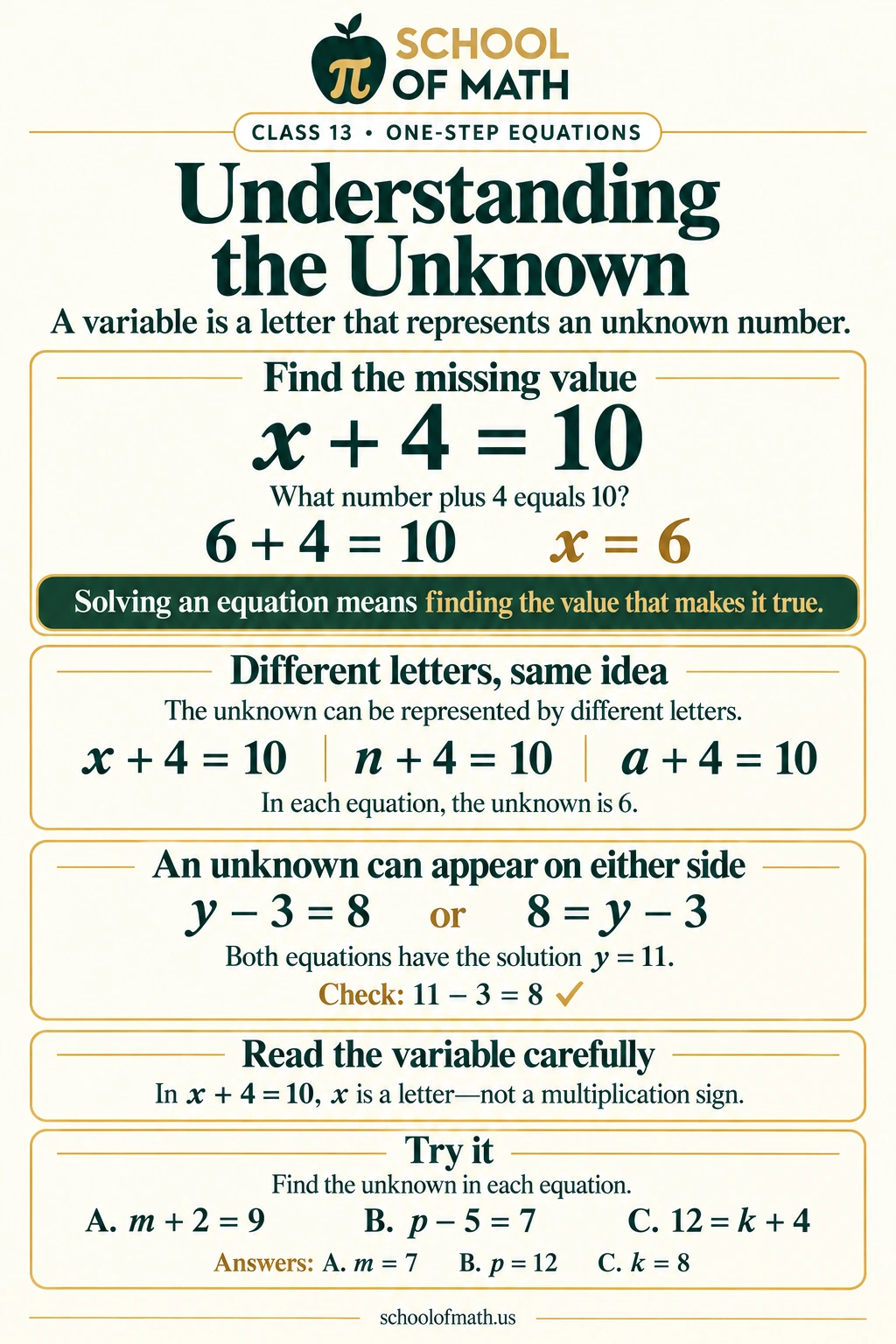
Define the variable before solving. Its letter does not change the method: n, t, and x can all represent an unknown number. Read the relationship first, including which amount is the starting value and which is the result.
Try it yourself: five questions
Q6 Practice 1 of 5 · Start
In b + 9 = 23, what number does b represent?
Answer
b = 14.
- The missing addend is 23 − 9 = 14. Check: 14 + 9 = 23.
Q7 Practice 2 of 5 · Build
Find the unknown in c − 8 = 16.
Answer
c = 24.
- Add 8 to both sides: c = 16 + 8 = 24. Check: 24 − 8 = 16.
Q8 Practice 3 of 5 · Apply
Solve 28 = 12 + m. Explain why m does not have to appear first.
Answer
m = 16.
- The sides can be reversed to give 12 + m = 28. Subtract 12 from each side: m = 16.
- Check: 28 = 12 + 16.
Q9 Practice 4 of 5 · Explain
Solve r + 15 = 9. Can an unknown represent a negative number?
Answer
r = −6; yes.
- Subtract 15 from both sides: r = 9 − 15 = −6. Check: −6 + 15 = 9.
Q10 Practice 5 of 5 · Challenge
A jar has an unknown number of marbles. After 18 are added, there are 43. Define a variable for the starting number, write an equation, and solve.
Answer
Let j be the starting number. j + 18 = 43, so j = 25 marbles.
- The unknown is the starting amount, not the final count. Subtract 18 from both sides: j = 43 − 18 = 25.
- Check: 25 + 18 = 43.
Keeping both sides balanced
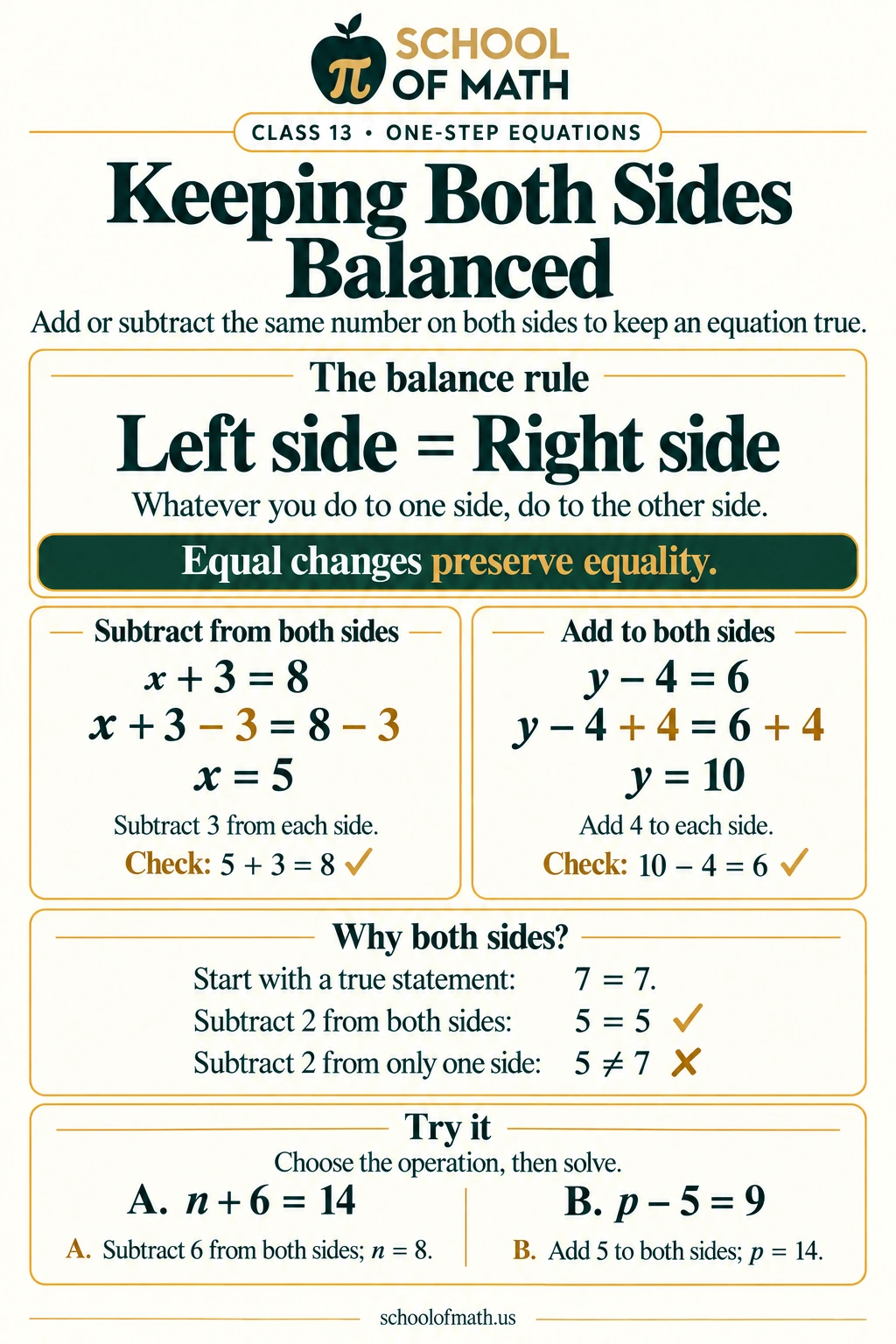
Adding or subtracting the same number on both sides preserves equality. Choose a change that cancels the number next to the variable. Showing the same operation on each side is more reliable than guessing or changing a sign without a reason.
Try it yourself: five questions
Q11 Practice 1 of 5 · Start
Starting with 18 = 18, subtract 7 from each side. What equation remains?
Answer
11 = 11.
- Both equal quantities decrease by 7. The equality remains true because 18 − 7 = 11 on each side.
Q12 Practice 2 of 5 · Build
Complete both blanks using the same number, then solve: x + 14 − ___ = 32 − ___.
Answer
Subtract 14 from both sides; x = 18.
- Use 14 in both blanks so +14 and −14 cancel. Then x = 32 − 14 = 18.
- Check: 18 + 14 = 32.
Q13 Practice 3 of 5 · Apply
Show the same operation on both sides to solve y − 12 = 23.
Answer
y = 35.
- Add 12: y − 12 + 12 = 23 + 12. Simplify to y = 35.
- Check: 35 − 12 = 23.
Q14 Practice 4 of 5 · Explain
A student changes z + 16 = 27 into z = 27 by subtracting 16 only on the left. Explain the error and correct it.
Answer
The student must subtract 16 on both sides. z = 11.
- Changing only the left side does not preserve equality. Correct work: z + 16 − 16 = 27 − 16.
- Check: 11 + 16 = 27.
Q15 Practice 5 of 5 · Challenge
Solve −9 = p − 17 by keeping the equation balanced. Show your check with the variable on the right.
Answer
p = 8.
- Add 17 to both sides: −9 + 17 = p − 17 + 17, so 8 = p.
- Check in the original order: −9 = 8 − 17.
Using inverse operations
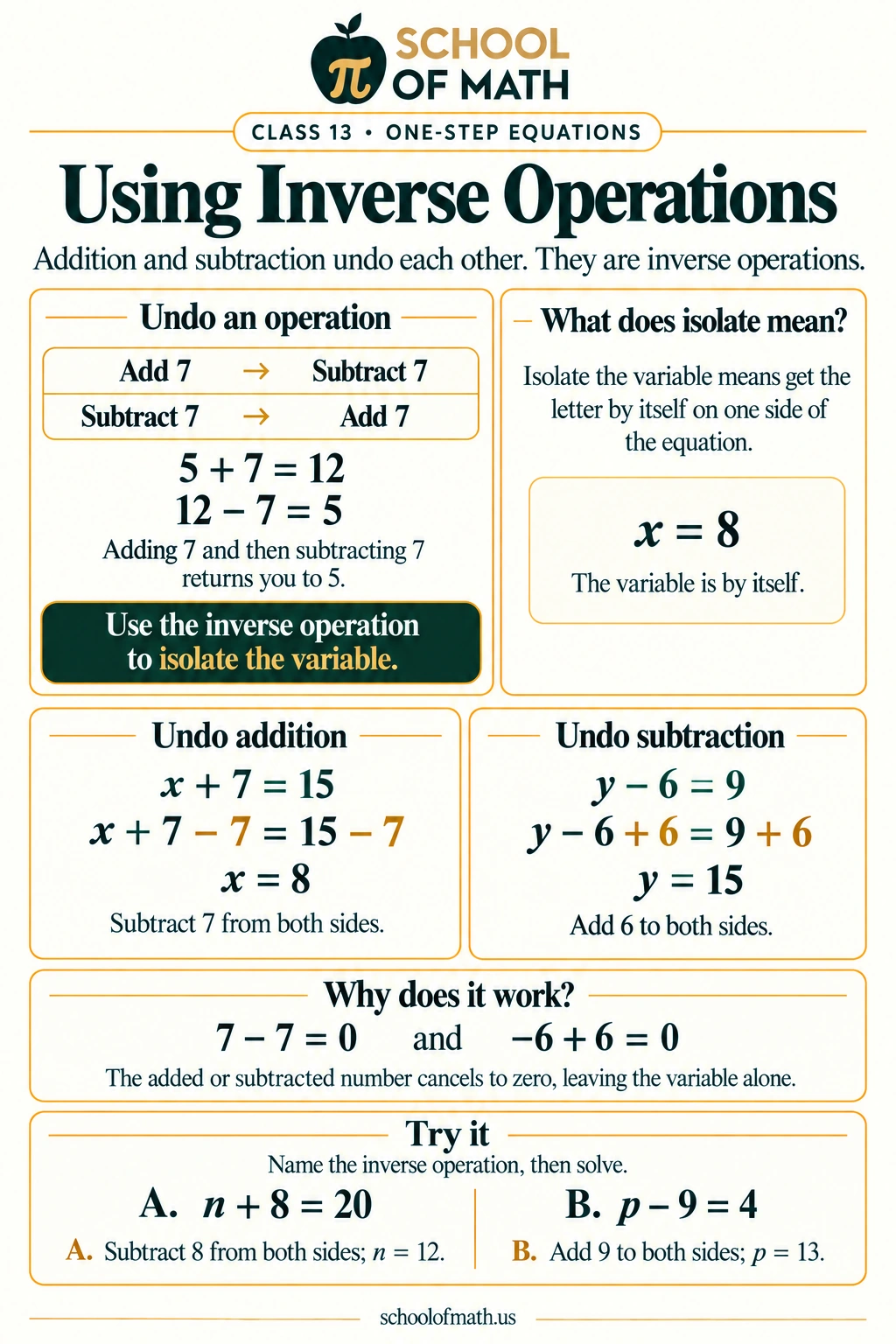
Addition and subtraction undo each other. To solve x + a = b, subtract a from both sides. To solve x − a = b, add a to both sides. Isolating the variable means leaving it alone, not merely moving it to a preferred side.
Try it yourself: five questions
Q16 Practice 1 of 5 · Start
What operation undoes adding 19? Use it to solve n + 19 = 44.
Answer
Subtract 19; n = 25.
- n + 19 − 19 = 44 − 19, so n = 25. Check: 25 + 19 = 44.
Q17 Practice 2 of 5 · Build
What operation undoes subtracting 13? Use it to solve a − 13 = 22.
Answer
Add 13; a = 35.
- a − 13 + 13 = 22 + 13, so a = 35. Check: 35 − 13 = 22.
Q18 Practice 3 of 5 · Apply
Solve 36 = k + 24. Name the inverse operation before calculating.
Answer
Subtract 24; k = 12.
- 36 − 24 = k + 24 − 24. This gives 12 = k. Check: 36 = 12 + 24.
Q19 Practice 4 of 5 · Explain
Solve v + 18 = −7. Explain why adding 18 would not isolate v.
Answer
v = −25.
- Undo +18 by subtracting 18: v = −7 − 18 = −25. Adding 18 would create v + 36 instead of v alone.
- Check: −25 + 18 = −7.
Q20 Practice 5 of 5 · Challenge
Compare the inverse operations needed for a + 3.5 = 10.2 and b − 3.5 = 10.2. Solve both.
Answer
a = 6.7; b = 13.7.
- For a, subtract 3.5: 10.2 − 3.5 = 6.7. For b, add 3.5: 10.2 + 3.5 = 13.7.
- Checks: 6.7 + 3.5 = 10.2 and 13.7 − 3.5 = 10.2.
Solving addition equations
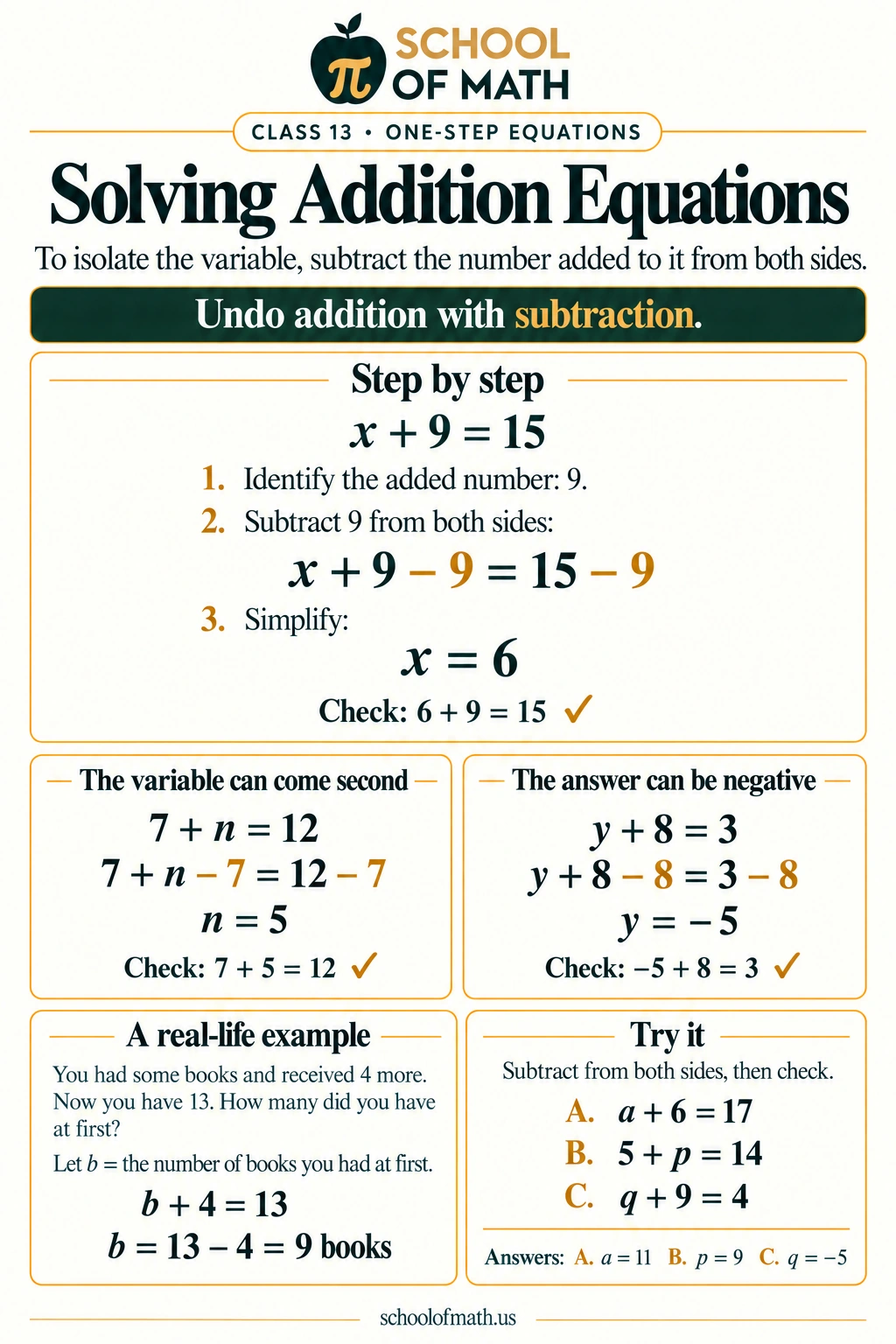
Subtract the added quantity from both sides, even when it is larger than the result. Negative solutions are valid when they satisfy the equation. Decimal places and fraction denominators change the arithmetic, not the balance rule.
Try it yourself: five questions
Q21 Practice 1 of 5 · Start
Solve x + 17 = 38 and check.
Answer
x = 21.
- Subtract 17 from both sides: x = 38 − 17 = 21. Check: 21 + 17 = 38.
Q22 Practice 2 of 5 · Build
Solve 26 + n = 61 and check.
Answer
n = 35.
- Subtract 26 from both sides: n = 61 − 26 = 35. Check: 26 + 35 = 61.
Q23 Practice 3 of 5 · Apply
Solve y + 23 = 8 and check.
Answer
y = −15.
- Subtract 23: y = 8 − 23 = −15. Check: −15 + 23 = 8.
Q24 Practice 4 of 5 · Explain
Solve t + 4.75 = 12.3. Show the decimal subtraction.
Answer
t = 7.55.
- Write 12.3 as 12.30 and subtract 4.75 from both sides. Then t = 12.30 − 4.75 = 7.55.
- Check: 7.55 + 4.75 = 12.30.
Q25 Practice 5 of 5 · Challenge
Solve p + 5/6 = 1/3 and check using a common denominator.
Answer
p = −1/2.
- Subtract 5/6 from both sides. Since 1/3 = 2/6, p = 2/6 − 5/6 = −3/6 = −1/2.
- Check: −1/2 + 5/6 = −3/6 + 5/6 = 2/6 = 1/3.
Solving subtraction equations
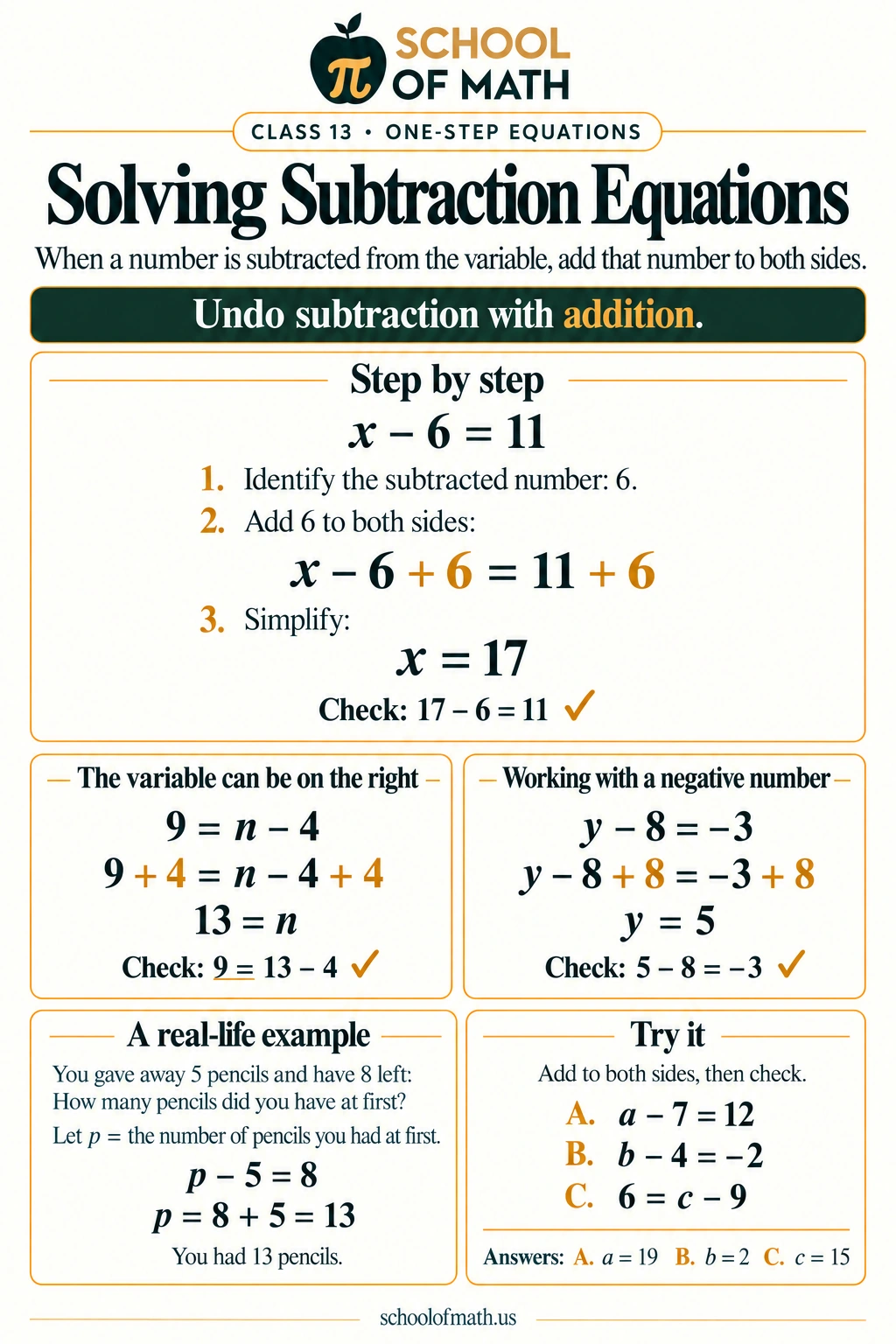
When a positive number is subtracted from the variable, add that number to both sides. Keep the order of subtraction: x − a and a − x do not mean the same thing. A negative result on one side does not automatically mean the solution is negative.
Try it yourself: five questions
Q26 Practice 1 of 5 · Start
Solve x − 15 = 26 and check.
Answer
x = 41.
- Add 15 to both sides: x = 26 + 15 = 41. Check: 41 − 15 = 26.
Q27 Practice 2 of 5 · Build
Solve 18 = n − 27 and check.
Answer
n = 45.
- Add 27 to both sides: 18 + 27 = n, so n = 45. Check: 18 = 45 − 27.
Q28 Practice 3 of 5 · Apply
Solve y − 14 = −22 and check.
Answer
y = −8.
- Add 14: y = −22 + 14 = −8. Check: −8 − 14 = −22.
Q29 Practice 4 of 5 · Explain
Solve r − 6.85 = −1.4. Show how you align decimal places.
Answer
r = 5.45.
- Write −1.4 as −1.40 and add 6.85 to both sides: r = −1.40 + 6.85 = 5.45.
- Check: 5.45 − 6.85 = −1.40.
Q30 Practice 5 of 5 · Challenge
Solve s − 7/8 = −1/4 and check using eighths.
Answer
s = 5/8.
- Add 7/8 to both sides. Since −1/4 = −2/8, s = −2/8 + 7/8 = 5/8.
- Check: 5/8 − 7/8 = −2/8 = −1/4.
Checking your solution
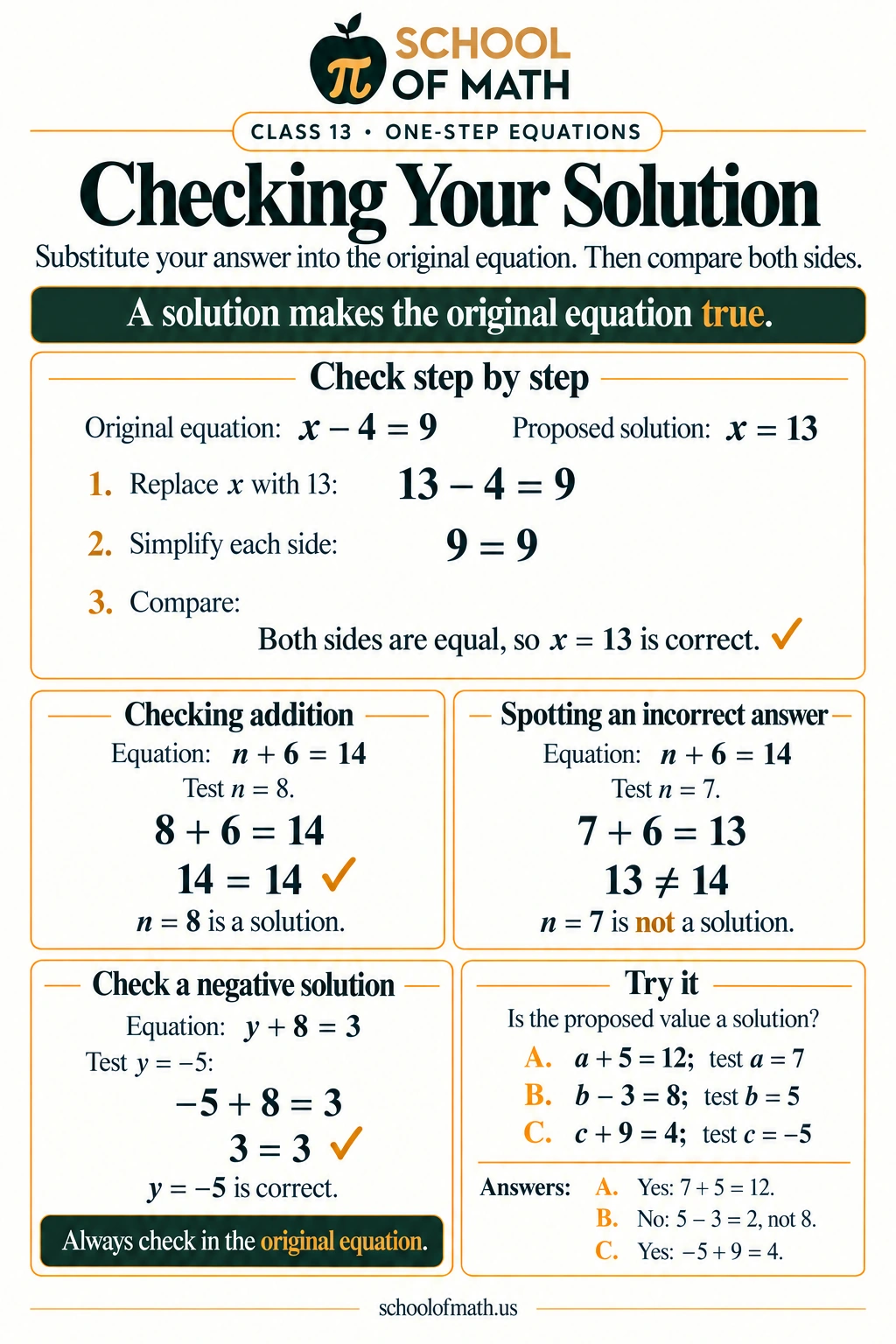
Substitute a proposed solution into the original equation, evaluate each side, and compare. A check must use the original relationship: an incorrect intermediate equation can hide an earlier mistake. A solution is correct only when the original sides agree.
Try it yourself: five questions
Q31 Practice 1 of 5 · Start
Is x = 15 a solution of x + 12 = 27? Show the substitution.
Answer
Yes.
- Replace x with 15: 15 + 12 = 27. Both sides are 27.
Q32 Practice 2 of 5 · Build
Is n = 19 a solution of n − 11 = 9? If not, find the correct value.
Answer
No; n = 20.
- The proposed value gives 19 − 11 = 8, not 9. Add 11 to both sides of the original equation: n = 20.
- Check: 20 − 11 = 9.
Q33 Practice 3 of 5 · Apply
Test y = −16 in y + 21 = 5. Explain why a negative value can be correct.
Answer
It is correct.
- Substitution gives −16 + 21 = 5. The equation is true, so the negative sign is not an error.
Q34 Practice 4 of 5 · Explain
A student says r = 7.4 solves r − 2.65 = 4.85. Check the claim, then correct it if needed.
Answer
The claim is false; r = 7.50.
- 7.40 − 2.65 = 4.75, not 4.85. Add 2.65 to 4.85 to get r = 7.50.
- Check: 7.50 − 2.65 = 4.85.
Q35 Practice 5 of 5 · Challenge
For u + 3/4 = 1/8, two students propose u = 7/8 and u = −5/8. Check both and identify the solution.
Answer
u = −5/8.
- Since 3/4 = 6/8, the first value gives 7/8 + 6/8 = 13/8, not 1/8.
- The second gives −5/8 + 6/8 = 1/8, so it satisfies the original equation.
Writing equations from word problems
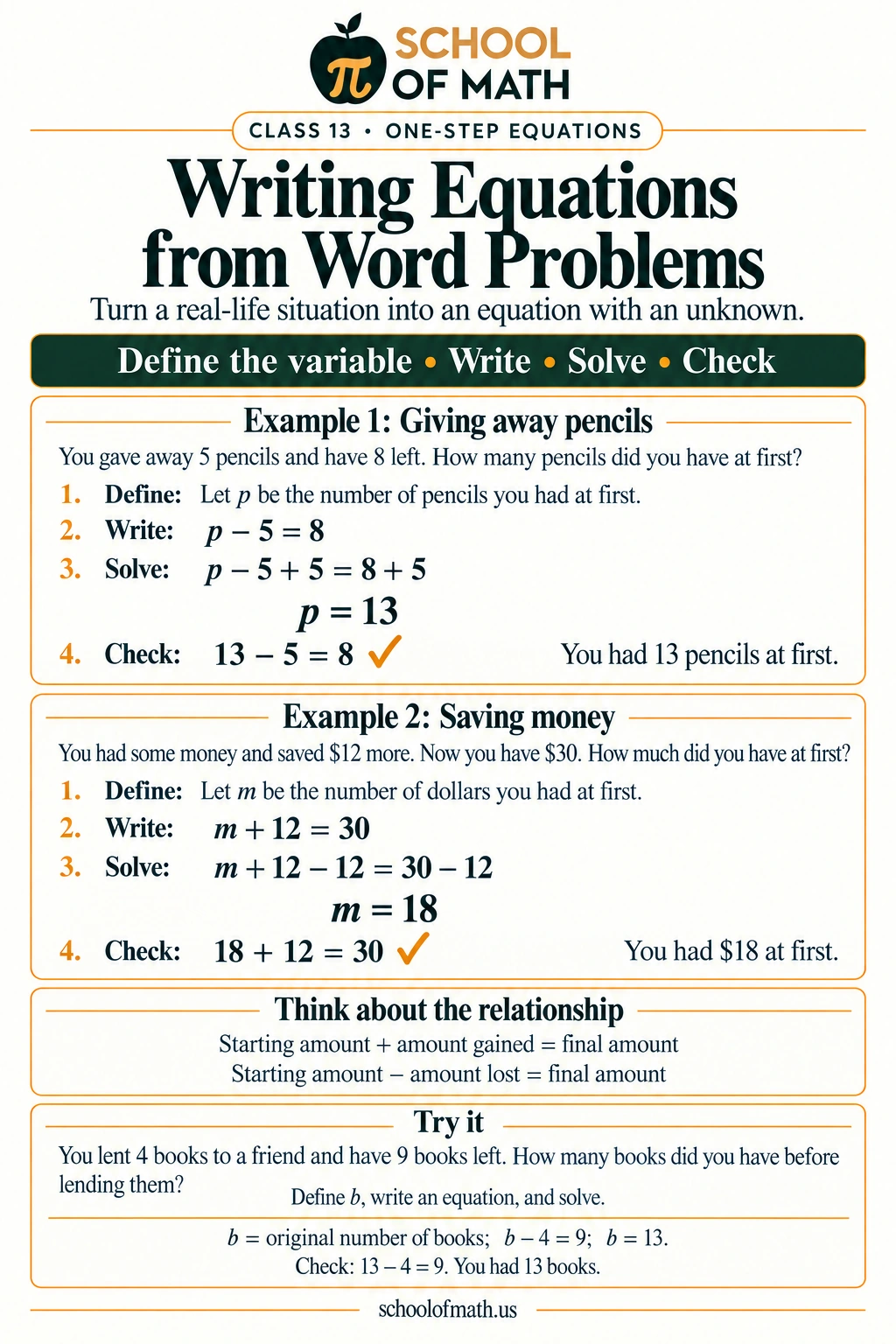
Define what the variable measures, then translate the relationship. Starting amount plus a gain equals the final amount; starting amount minus a loss equals the final amount. Solve with an inverse operation, check the equation, and include units in the answer.
Try it yourself: five questions
Q36 Practice 1 of 5 · Start
Leah receives 9 postcards and now has 34. How many did she have before? Define a variable, write an equation, and solve.
Answer
25 postcards; p + 9 = 34.
- Let p be the starting number. Subtract 9 from both sides: p = 34 − 9 = 25.
- Check: 25 + 9 = 34.
Q37 Practice 2 of 5 · Build
A theater sells 28 tickets, leaving 47 unsold. How many tickets were available at first? Write and solve an equation.
Answer
75 tickets; t − 28 = 47.
- Let t be the original number available. Add 28 to both sides: t = 47 + 28 = 75.
- Check: 75 − 28 = 47.
Q38 Practice 3 of 5 · Apply
A weather station records a temperature rise of 9°C. The new temperature is 2°C. What was the earlier temperature?
Answer
−7°C; t + 9 = 2.
- Let t be the earlier temperature in degrees Celsius. Subtract 9: t = 2 − 9 = −7.
- Check: −7 + 9 = 2.
Q39 Practice 4 of 5 · Explain
After paying $8.65 for supplies, Mina has $14.20 left. How much money did she have before paying? Write and solve an equation.
Answer
$22.85; m − 8.65 = 14.20.
- Let m be the starting number of dollars. Add 8.65: m = 14.20 + 8.65 = 22.85.
- Check: 22.85 − 8.65 = 14.20.
Q40 Practice 5 of 5 · Challenge
After a tank receives 3/8 liter of water, it contains 1 1/4 liters. How much water was in it before? Write an equation and check.
Answer
7/8 liter; w + 3/8 = 1 1/4.
- Let w be the starting volume in liters. Convert 1 1/4 to 10/8 and subtract 3/8: w = 7/8.
- Check: 7/8 + 3/8 = 10/8 = 1 1/4 liters.
Homework review
This homework reviews equations, unknowns, balance, inverse operations, addition and subtraction equations, checking solutions, and translating stories into equations. Complete one question for each image, in the same order.
R1 Review image 1 of 8
Explain why n − 18 is an expression but n − 18 = 29 is an equation. Find the solution of the equation.
Answer
An equation states an equality; n = 47.
- The equal sign states that n − 18 has the same value as 29. Add 18 to both sides: n = 47.
- Check: 47 − 18 = 29.
R2 Review image 2 of 8
A game score rises by 16 points to reach 45. Define a variable for the earlier score, write an equation, and solve.
Answer
Let s be the earlier score. s + 16 = 45, so s = 29 points.
- The unknown is the score before the gain. Subtract 16 from both sides and check: 29 + 16 = 45.
R3 Review image 3 of 8
Show the same operation on both sides to solve b − 24 = 13. Explain why changing only one side is not valid.
Answer
b = 37.
- Add 24 to both sides: b − 24 + 24 = 13 + 24. Equal changes preserve equality; a change on only one side does not.
- Check: 37 − 24 = 13.
R4 Review image 4 of 8
Name the inverse operation and solve −11 = r + 7.
Answer
Subtract 7; r = −18.
- Subtract 7 from each side: −11 − 7 = r, so r = −18.
- Check: −11 = −18 + 7.
R5 Review image 5 of 8
Solve a + 6.35 = 14.8 and check.
Answer
a = 8.45.
- Subtract 6.35 from 14.80: a = 8.45. Check: 8.45 + 6.35 = 14.80.
R6 Review image 6 of 8
Solve k − 5/6 = −1/2 and check.
Answer
k = 1/3.
- Add 5/6 to both sides: k = −3/6 + 5/6 = 2/6 = 1/3.
- Check: 1/3 − 5/6 = 2/6 − 5/6 = −3/6 = −1/2.
R7 Review image 7 of 8
A student proposes x = −12 for x + 19 = 6. Check the claim and find the correct solution.
Answer
The claim is false; x = −13.
- −12 + 19 = 7, not 6. Subtract 19 from both sides of the original equation: x = 6 − 19 = −13.
- Check: −13 + 19 = 6.
R8 Review image 8 of 8
A rope is shortened by 2.75 meters and is now 6.40 meters long. Define the unknown, write an equation, and find its original length.
Answer
9.15 meters; r − 2.75 = 6.40.
- Let r be the original length in meters. Add 2.75 to both sides: r = 9.15.
- Check: 9.15 − 2.75 = 6.40 meters.
Homework word problems
These twelve word problems progress from whole-number starting amounts to comparisons, decimals, signed quantities, fractions, and error analysis. Define the variable, write an equation, solve, and check. Together with the eight review questions, they make 20 homework questions.
W1 Homework word problem 1 of 12
Owen adds 6 shells to his collection and now has 22. How many shells did he have before? Write an equation and solve.
Answer
16 shells; s + 6 = 22.
- Let s be the starting count. Subtract 6 from both sides: s = 16.
- Check: 16 + 6 = 22.
W2 Homework word problem 2 of 12
A bakery sells 17 muffins and has 26 left. How many muffins did it have before the sale? Write an equation and solve.
Answer
43 muffins; m − 17 = 26.
- Let m be the starting count. Add 17 to both sides: m = 26 + 17 = 43.
- Check: 43 − 17 = 26.
W3 Homework word problem 3 of 12
A club needs 85 points for an award. It has 58 points now. How many more points does it need? Define the missing amount and solve an equation.
Answer
27 points; 58 + p = 85.
- Let p be the additional points. Subtract 58 from both sides: p = 27.
- Check: 58 + 27 = 85.
W4 Homework word problem 4 of 12
A blue ribbon is 14 centimeters longer than a red ribbon. The blue ribbon is 53 centimeters long. Find the red ribbon's length using an equation.
Answer
39 centimeters; r + 14 = 53.
- Let r be the red ribbon's length in centimeters. Subtract 14: r = 39.
- Check: 39 + 14 = 53.
W5 Homework word problem 5 of 12
Nina's new reading time is 38 minutes, which is 12 minutes less than her previous time. What was her previous time? Write an equation that matches 'less than.'
Answer
50 minutes; t − 12 = 38.
- Let t be the previous time in minutes. The new time is the previous time minus 12. Add 12 to both sides: t = 50.
- Check: 50 − 12 = 38.
W6 Homework word problem 6 of 12
A gift card has $24.50 after $9.75 is added. What was the balance before the addition? Write and solve an equation.
Answer
$14.75; b + 9.75 = 24.50.
- Let b be the earlier dollar balance. Subtract 9.75: b = 24.50 − 9.75 = 14.75.
- Check: 14.75 + 9.75 = 24.50.
W7 Homework word problem 7 of 12
A container loses 1.85 liters of water and now holds 3.60 liters. How much did it hold before the loss? Write and solve an equation.
Answer
5.45 liters; v − 1.85 = 3.60.
- Let v be the original volume in liters. Add 1.85: v = 3.60 + 1.85 = 5.45.
- Check: 5.45 − 1.85 = 3.60.
W8 Homework word problem 8 of 12
Overnight the temperature falls by 13°C and reaches −4°C. What was the temperature before the drop? Write an equation and check the sign.
Answer
9°C; t − 13 = −4.
- Let t be the earlier temperature in degrees Celsius. Add 13: t = −4 + 13 = 9.
- Check: 9 − 13 = −4.
W9 Homework word problem 9 of 12
A diver rises 8.5 meters to reach an elevation of −3.25 meters relative to the water surface. What was the starting elevation, and how far below the surface was that?
Answer
Starting elevation: −11.75 meters; 11.75 meters below the surface. e + 8.5 = −3.25.
- Let e be the starting signed elevation. Rising increases elevation, so subtract 8.50 from both sides: e = −3.25 − 8.50 = −11.75.
- Check: −11.75 + 8.50 = −3.25. The negative sign means below the surface.
W10 Homework word problem 10 of 12
A recipe bowl contains 1 1/6 cups of flour after 3/4 cup is added. How much flour was in the bowl before? Write and solve an equation using twelfths.
Answer
5/12 cup; f + 3/4 = 1 1/6.
- Let f be the starting amount in cups. Convert 1 1/6 to 14/12 and 3/4 to 9/12. Subtract: f = 14/12 − 9/12 = 5/12.
- Check: 5/12 + 9/12 = 14/12 = 1 1/6 cups.
W11 Homework word problem 11 of 12
A game deducts 5 1/2 points from a player's score, leaving −2 3/4 points. What was the score before the penalty? Write an equation, solve, and explain whether the earlier score was positive.
Answer
2 3/4 points; s − 5 1/2 = −2 3/4. The earlier score was positive.
- Let s be the earlier score. Add 5 1/2 to both sides. In fourths, s = −11/4 + 22/4 = 11/4 = 2 3/4.
- Check: 11/4 − 22/4 = −11/4 = −2 3/4.
W12 Homework word problem 12 of 12
A sensor reading is corrected by adding 1.75°C. The corrected reading is −0.60°C. Leo says the original reading was 1.15°C. Write the correction equation, test Leo's answer, and find the actual original reading.
Answer
The original reading was −2.35°C; t + 1.75 = −0.60. Leo's answer is incorrect.
- Let t be the original reading in degrees Celsius. Testing Leo gives 1.15 + 1.75 = 2.90, not −0.60.
- Subtract 1.75 from both sides: t = −0.60 − 1.75 = −2.35. Check: −2.35 + 1.75 = −0.60.
Quick questions and answers
How do you solve one-step equations with addition and subtraction?
Use the inverse operation on both sides to isolate the variable. Subtract an added number or add a subtracted number, then substitute the result into the original equation to check.
Why must you do the same thing to both sides?
The two sides represent equal values. Adding or subtracting the same quantity preserves that equality. Changing just one side can turn a true statement into a false one.
Can the variable be on the right side?
Yes. For example, 36 = k + 24 states the same relationship as k + 24 = 36. Subtracting 24 from both sides gives k = 12.
Can a one-step equation have a negative or fractional solution?
Yes. The value is a solution if it makes the original equation true. For example, p + 5/6 = 1/3 has the solution p = −1/2.
What homework is included in Class 13?
Eight homework review questions revisit the eight images in order. Twelve additional word problems increase in difficulty, for 20 homework questions total. The class also includes 40 practice questions with hidden worked answers.
What is in the printable student workbook?
The 22-page workbook has a title cover, eight image pages alternating with five-question practice pages, then eight review questions and twelve word problems grouped at most five per page. It provides blank, unruled answer space without exercise answers.
Where can students learn pre-algebra with SOMATH?
Young Fermats Pre-Algebra is part of School of Math (SOMATH) at 226 W 79th St on the Upper West Side. Families can view the current schedule, book an evaluation, or call (646) 668-6151.