SOMATH Journal · Opinion · Upper West Side, Manhattan
Why American Math Teaching Is Failing Our Kids — and Why Abandoning Standardized Tests Will Hurt Future Leaders
A mathematician and 20-year GMAT/GRE quant teacher on abstraction, rigorous proof, memorization, Algebra 1, the Regents phase-out, and why homework-only help leads families into a spiral.
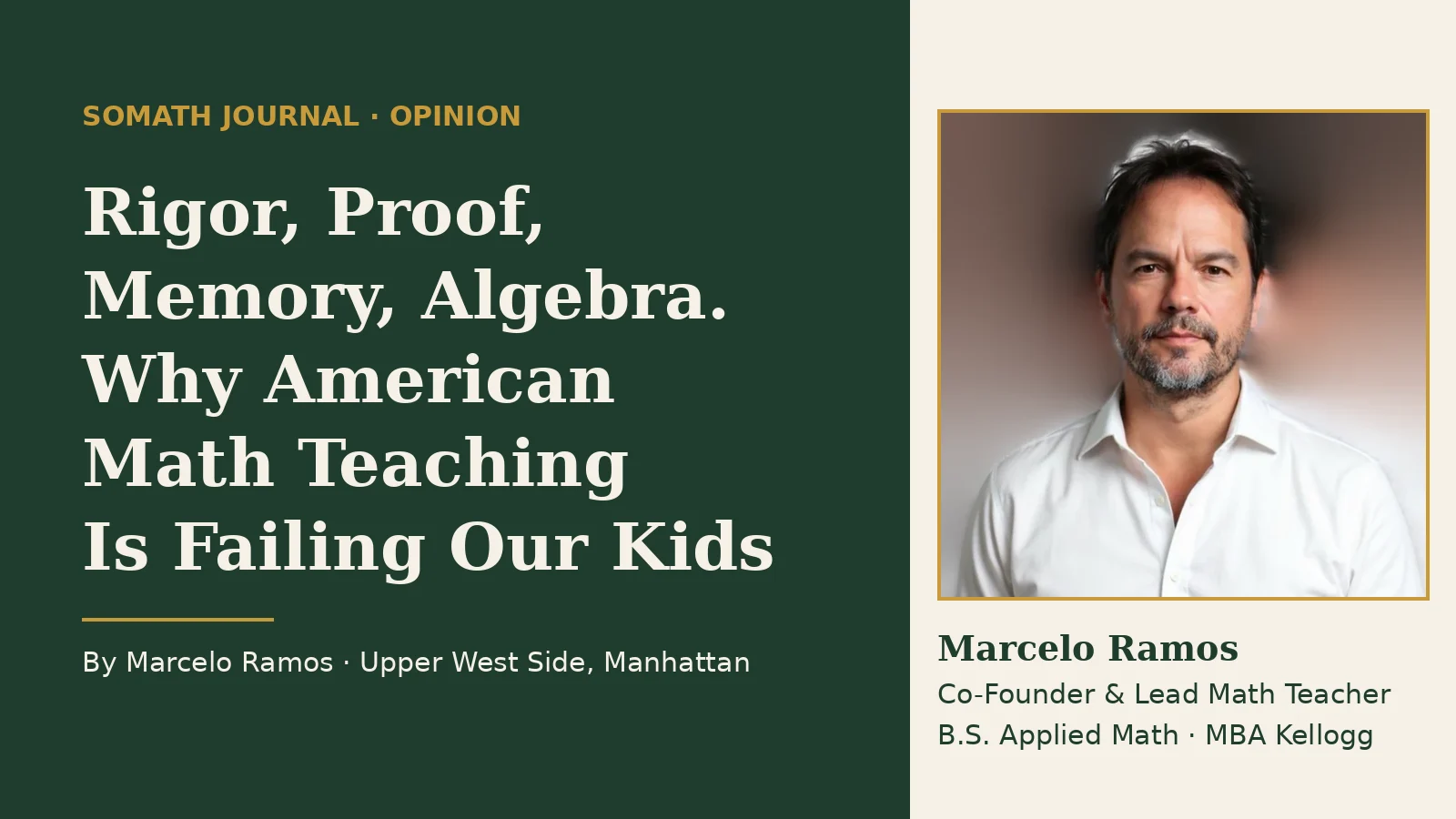
I believe the dominant way mathematics is taught in American classrooms is wrong for children who will one day have to lead, build, diagnose, design, or invest. Too much of it rests on visual understanding, cute demonstrations, and whatever the individual teacher decides to emphasize that day. Too little rests on what has always produced strong mathematicians: abstraction, rigorous demonstration, deliberate memorization, and constant connection to algebra. I also believe the gradual retreat from standardized tests such as the Regents, the SAT, and AP is a mistake for the students who will become tomorrow’s professionals.
I am not writing this as a critic from the outside. I write it as a mathematician by training and a teacher by profession, and as co-founder of School of Math (SOMATH) on West 79th Street. Parents on the Upper West Side ask me some version of the same question every week: “My child gets good grades, so why does math still feel fragile?” This essay is my full answer.
Why my view comes from evidence, not nostalgia
I trained in applied mathematics at Northwestern University and later earned my MBA at the Kellogg School of Management (SOMATH founders). For two decades, I have taught the quantitative sections of the GMAT and GRE to adults from many countries who were applying to the world’s most demanding business and graduate programs. That work gave me an unusual vantage point. I meet students not at age eight, when their problems are still small, but at twenty-six or thirty-two, when the consequences of how they were taught as children finally arrive.
The pattern is remarkably consistent. Candidates educated in systems that insisted on formal proof, fluent recall, and early algebra arrive ready to reason. Many candidates educated in classrooms that prized “seeing it” over proving it arrive with good intuition and very little structure. They recognize a diagram, but they cannot manipulate an expression they have never seen before. They remember that a rule exists, but not why it is true or when it fails. Their difficulty is rarely intelligence. It is the architecture of what they were taught.
When Vivianne Wright, our Head of Education and a Harvard-trained educator, and I designed SOMATH’s curriculum, we built it around that lesson (our story). We did not invent a new pedagogy. We returned to the one that the strongest mathematical traditions have always used, and we made it work for children on the Upper West Side.
What goes wrong in the American approach
Let me be precise, because precision is the point of mathematics. Visual models are not bad. Manipulatives are not bad. Discussion is not bad. Educational psychologists have long described a sensible progression from concrete objects, to pictures, to abstract symbols. The problem is that many American classrooms stop at the picture. The picture becomes the destination instead of the bridge.
New York City’s own description of its citywide math initiative makes the philosophy explicit. The NYC Solves page says that “rather than thinking of mathematics as memorization and procedures,” the framework “shifts towards making math fun, discoverable,” built around sense-making, open tasks, and discussion, with teachers “listening, asking questions, connecting ideas, and formalizing concepts” (NYC Public Schools). That rollout reached District 3 middle schools, the Upper West Side’s public middle schools, in the 2026–27 school year (NYC Solves timeline).
In fairness, Illustrative Mathematics, the curriculum most closely associated with NYC Solves, says its lessons also develop automaticity with foundational skills (Illustrative Mathematics). Some schools report real gains. My objection is not to any single publisher. It is to a classroom culture in which formalization becomes the last, optional step, and its quality depends almost entirely on what one teacher thinks matters in a given forty-five minutes. When rigor is delegated to individual judgment, children in the same grade receive very different mathematics.
The national results should make every parent pause. In 2024, eighth-grade math on the Nation’s Report Card was flat after the historic eight-point drop of 2022, and nearly 40 percent of eighth graders scored below NAEP Basic (National Assessment Governing Board). Twelfth-grade math scores in 2024 were the lowest ever reported on that assessment (NAGB). Internationally, American 15-year-olds scored 465 in PISA 2022 mathematics, against an OECD average of 472 and 575 for Singapore (NCES, OECD). Only 7 percent of American students were top performers in math, compared with an OECD average of 9 percent (OECD country note).
| Dimension | Visual-first classroom | Abstraction-first classroom (SOMATH) |
|---|---|---|
| Where a lesson ends | A picture, model, or shared discussion | A definition, a symbolic rule, and a written proof |
| Role of the teacher | Facilitator; formalizes when time permits | Mathematician who states, proves, and checks |
| Memorization | Treated as shallow or optional | Treated as the foundation of fluency and speed |
| Consistency | Varies with each teacher’s judgment | Fixed sequence and written standards of proof |
| Link to algebra | Often deferred to “later” | Built into every topic from first grade |
| Evidence of learning | Participation and explanation | Correct written work on unfamiliar problems |
The abstraction ladder we use at SOMATH
Abstraction is not a cold or advanced idea. It is the moment a child realizes that “three apples plus four apples” and “three weeks plus four weeks” are the same sentence. Mathematics is the discipline of removing what is accidental so that what is essential becomes visible and reusable. Every SOMATH lesson climbs the same ladder, and no step is optional.
- 1. Concrete caseOne specific example, briefly.
- 2. PatternSeveral cases. What stays the same?
- 3. DefinitionState it exactly in words.
- 4. SymbolWrite it with variables.
- 5. ProofShow why it must be true.
- 6. MemorizeDrill until recall is instant.
- 7. ConnectLink it to Algebra 1.
- 8. TransferSolve a problem never seen before.
Notice where the picture lives: on step one, for a few minutes. In many classrooms, it consumes the entire lesson. Children can then describe an area model beautifully and still freeze when the same idea appears as \(x^2 + 6x + 9\). The picture helped them begin. Only the symbol lets them continue.
What a rigorous demonstration looks like
Parents sometimes imagine that proof belongs in a university seminar. In reality, a fifth grader can follow a genuine proof if the teacher is honest about definitions. Here is one we use, because the rule it explains is usually taught as a chant: “keep, change, flip.”
Why dividing by a fraction means multiplying by its reciprocal
Definition. To divide \(A\) by \(B\) means to find the number \(Q\) such that \(B \times Q = A\). Division is the inverse of multiplication.
Claim. \(\dfrac{a}{b} \div \dfrac{c}{d} = \dfrac{a}{b} \times \dfrac{d}{c}\), when \(b, c, d \neq 0\).
Proof. Test the candidate \(Q = \dfrac{a}{b} \times \dfrac{d}{c}\) against the definition: \(\dfrac{c}{d} \times \dfrac{a}{b} \times \dfrac{d}{c} = \dfrac{a}{b} \times \dfrac{c \cdot d}{d \cdot c} = \dfrac{a}{b} \times 1 = \dfrac{a}{b}\). The candidate satisfies the definition, so it is the quotient. ∎
Algebra 1 connection. To solve \(\tfrac{2}{3}x = 8\), the student multiplies both sides by \(\tfrac{3}{2}\) and gets \(x = 12\). It is the same theorem. A child who proved it in fifth grade does not need a new trick in eighth.
Compare that with a typical demonstration: a pizza cut into slices, students asked how many half-slices fit into three slices, a lively discussion, and a rule announced at the end. The pizza is charming. It also collapses the moment the divisor is \(\tfrac{7}{5}\), or a variable, or negative. A rigorous demonstration works in every case because it rests on the definition, not on the drawing.
The same is true of the famous square picture for \((a+b)^2 = a^2 + 2ab + b^2\). The drawing only makes sense when \(a\) and \(b\) are positive lengths. The algebraic proof, which simply applies the distributive law twice, holds for every real number. It leads directly to factoring perfect-square trinomials, to completing the square, and to the quadratic formula. One proof opens three chapters. One picture opens none.
Memorization is not the enemy of understanding
American education has spent decades treating memorization as the opposite of understanding. Cognitive science points in the other direction. Working memory is small. A child who must compute \(7 \times 8\) while also tracking the steps of a multi-step equation is spending scarce attention on the wrong task. Instant recall of facts, identities, and formulas frees the mind to reason. Research on retrieval practice has also shown for years that the act of recalling information strengthens long-term memory more than simply rereading it.
At SOMATH we separate two things clearly. First, we prove a result so that the student understands why it is true. Then we drill it until the student no longer needs to think about it. Multiplication facts, fraction–decimal–percent equivalents, exponent laws, special products, and the unit circle are memorized on purpose. Understanding without fluency is fragile; fluency without understanding is blind. Strong students need both, in that order.
I see the result clearly with adult GMAT candidates. Those who memorized squares, primes, and common fractions as children solve problems in ninety seconds. Those who were told that memorizing was unnecessary must reconstruct each fact under time pressure, and the clock defeats them. The test did not create that gap. Their early education did.
Everything in elementary math should lead to Algebra 1
Algebra 1 is the hinge of a child’s mathematical life. It decides access to Geometry, Algebra 2, Pre-Calculus, AP Calculus, physics, economics, computer science, and eventually the quantitative sections of the SAT, GRE, and GMAT. Yet many schools still teach elementary arithmetic as a self-contained world and only introduce algebra as a sudden new subject in eighth or ninth grade.
We do the opposite. From our first-grade Little Newtons class onward, every topic is taught with its algebraic destination in mind, and our Algebra 1 program collects those threads deliberately.
| Elementary topic | Abstract idea behind it | Where it reappears in Algebra 1 |
|---|---|---|
| Missing-number problems (\(\square + 5 = 12\)) | An unknown is a number we have not named yet | Solving linear equations |
| Commutative and distributive properties | Operations obey laws, not habits | Simplifying expressions, factoring |
| Multiplication tables | Products and factors of integers | Factoring trinomials \(x^2 + bx + c\) |
| Equivalent fractions | Multiplying by a form of 1 | Rational expressions, common denominators |
| Fraction division | Division as inverse of multiplication | Isolating variables with coefficients |
| Area and perimeter | Formulas as relationships between variables | Literal equations and quadratic models |
| Input–output tables | A rule that maps each input to one output | Functions, slope, and linear graphs |
When interconnection is taught explicitly, Algebra 1 stops feeling like a wall. It feels like the place where everything a child already knows finally speaks the same language. That is why families from Upper West Side public schools such as PS 87, PS 9, PS 166, PS 199, PS 452, and The Anderson School, and from independent schools such as Trinity, Collegiate, Columbia Grammar & Prep, Dwight, Calhoun, Ethical Culture, and Heschel, can all start from the same place at SOMATH: a written diagnostic that shows exactly which threads are missing.
Why abandoning standardized tests hurts future leaders
The second half of my argument concerns measurement. Over the last several years, the institutions that shape New York children have stepped back from common external examinations. I believe this hurts precisely the students who need clear signals most.
| Exam | What changed | Where it stands now |
|---|---|---|
| NY Regents | Passing a set of Regents exams will no longer be required for a diploma, beginning with the Class of 2028 (WWNY / NYSED). | The exams remain as statewide measures; final regulations are expected in June 2027 (Chalkbeat). |
| SAT / ACT | Most selective colleges went test-optional during the pandemic. | Every Ivy has now announced a return to required scores; Columbia, next to the Upper West Side, will require them starting August 2027 (Columbia Admissions). |
| AP | Many New York independent schools moved beyond AP courses to in-house advanced classes, including Trinity, Dalton, Spence, Brearley, and Horace Mann (Hackley School). | Students can still sit AP exams, but courses are no longer built around a shared external standard. |
The Regents decision matters because it removes a common bar. In New York City, students in the Class of 2028 may only need to pass their required courses to graduate while new assessments are developed, according to a city Education Department official (Chalkbeat). A course grade reflects one teacher, one school, and one grading culture. A common exam reflects the same standard for every student in the state. When we remove the common bar, we do not remove inequality; we simply stop seeing it.
The colleges themselves learned this lesson. Columbia said a multi-year faculty review found that test scores, among other factors, were “a useful indicator of potential student success” (Higher Ed Dive). More than 2,300 University of California faculty members signed a letter urging the system to reinstate an SAT/ACT math requirement for STEM majors (Higher Ed Dive). When the institutions that train scientists and executives return to testing, parents should notice.
From my own work, I can add one more observation. Leaders are tested for their entire careers. MBA candidates take the GMAT or GRE. Physicians take board exams. Engineers, actuaries, accountants, and analysts all face licensing or certification examinations. A student protected from standardized assessment at sixteen meets it anyway at twenty-five, without the habits that make it manageable: preparation, time management, and composure under a fixed standard. Tests do not merely measure future professionals. They train them.
- Common standardRegents, SAT, AP
- Honest signalGaps become visible
- Targeted workPractice where it matters
- ComposurePerformance under time
- CredentialGMAT, boards, licenses
The homework-help trap: a path to disaster
This brings me to the decision I see Upper West Side parents make most often, and most painfully. A child struggles with tonight’s assignment, so the family finds an extra math activity whose only purpose is to help with school homework. It feels responsible. In my experience, it is the beginning of a long decline.
Homework help is reactive. Its curriculum is whatever the school sent home, in whatever order, at whatever depth the worksheet requires. It optimizes for a completed page, not for a constructed concept. When the next unit depends on an idea that was never truly built, the child needs more help, then more, and the family begins paying for a crutch the student can never set down. I have met that student as an adult, and the cost is always higher later.
Homework-only help
- Confusing assignment
- Helper completes it with the child
- Grade looks fine
- No concept or proof built
- Next unit depends on it
- More confusion → repeat ↺
SOMATH enrichment
- Written diagnostic
- Placement by readiness
- Definitions, proofs, drills
- Connected to Algebra 1
- School homework becomes easy
- Student moves ahead → compounds ↑
| Question | Homework helper | SOMATH |
|---|---|---|
| Who sets the curriculum? | Tonight’s worksheet | A planned grades 1–12 sequence (SOMATH courses) |
| What is the goal? | A finished assignment | A concept the student can prove and reuse |
| Is memorization trained? | Rarely | Deliberately, after proof |
| Does it prepare for exams? | Only by accident | Regents, SHSAT, SAT, and AP preparation are built in |
| Long-term effect | Dependence | Independence and acceleration |
The irony is that strong enrichment solves the homework problem as a side effect. A child who understands fractions as numbers, who knows the distributive law cold, and who has seen proofs does not need help with a sixth-grade worksheet. Homework becomes a confirmation of what the student already knows. That is the right relationship between school and enrichment. My colleague Vivianne has written more about this distinction in our guide to enrichment versus tutoring.
How SOMATH is different
SOMATH is an in-person math school at 226 West 79th Street for students in grades 1–12, taught in small groups of four to six students (SOMATH courses). Every element of our model follows from the argument above.
- Diagnostic before placement. Every family begins with a free 30-minute evaluation and a written diagnostic, so we teach the missing thread rather than the latest worksheet.
- Abstraction and proof in every class. Our published lessons, such as Algebra 1 Class 18, move from illustration to definition, symbolic method, and fully worked solutions.
- Deliberate fluency. Facts and identities are drilled after they are understood, because speed is a form of freedom.
- One written standard. The sequence and the standard of a correct answer do not change with the teacher’s mood. Vivianne and I teach the classes ourselves.
- Exams treated as allies. We prepare students for Regents Algebra 1, SHSAT, SAT Math, and AP Calculus because external standards make students stronger, whether or not a diploma requires them.
- Year-round continuity. Our rolling membership lets a child start any week and keep building, instead of restarting each semester.
Our line is “Old-School Math Classes. Infinite Aura.” Old-school means definitions, proofs, memory, and algebra. The aura is what happens when a ten-year-old proves something true for every number and realizes that mathematics belongs to them.
Give your child mathematics that lasts
If your child attends PS 87, PS 9, PS 199, MS 54, MS 245, Trinity, Collegiate, or any school on the Upper West Side, the first step is the same: find out exactly what is solid and what is fragile.
School of Math (SOMATH) · 226 W 79th St, New York, NY 10024 · (646) 668-6151
Questions parents ask me
Are visual models useless?
No. A picture is an excellent first step for a few minutes. The mistake is ending there. At SOMATH, visuals open a lesson; definitions, symbols, and proof finish it.
Isn’t memorization outdated now that students have calculators and AI?
No. Working memory is limited, and fluent recall frees it for reasoning. Calculators do not help a student see that \(x^2 - 9\) factors, and timed exams such as the SAT and GMAT reward the students who already know.
If Regents exams are no longer required, should my child still take them seriously?
Yes. New York says the Regents will continue as statewide measures of achievement (NYSED via WWNY), and they are among the clearest common signals a student can show. Our guide to the Regents phase-out explains the timeline.
My child’s school dropped AP. Is that a problem?
Not necessarily, but it removes an external benchmark. Many students at such schools still sit AP exams independently, and colleges increasingly require SAT or ACT scores. We help students prepare for both.
Is SOMATH only for advanced children?
No. Rigor is not a reward for talent; it is a method for building it. The evaluation places each student where the proofs and practice will genuinely stretch them.
— Marcelo Ramos, Co-Founder & Lead Math Teacher, School of Math (SOMATH), Upper West Side, Manhattan