Algebra 1 · Class 18
Solving Quadratic Equations by Factoring
Set it equal to zero, factor, solve, check. Write quadratics in standard form, use the zero-product property, factor out the GCF, factor trinomials with leading coefficient 1 or not 1, recognize special patterns, and model word problems whose solutions must make sense.
Work through eight illustrated topics with five fresh practice questions each, followed by Homework review and Homework word problems. There are 40 practice questions and 20 homework questions, all with hidden worked solutions and substitution checks. Try each problem before opening its blue Answer control.
This is an independent topic in the Algebra 1 rolling syllabus; earlier class attendance is not required. Review the factoring methods here and multiply back to check every factorization. See the schedule or book an evaluation at SOMATH.
Download the student workbook (PDF)22 pages · Supplied cover, eight teaching images, all 60 questions · Generous blank working space · No exercise solutions
Quadratic equations and standard form
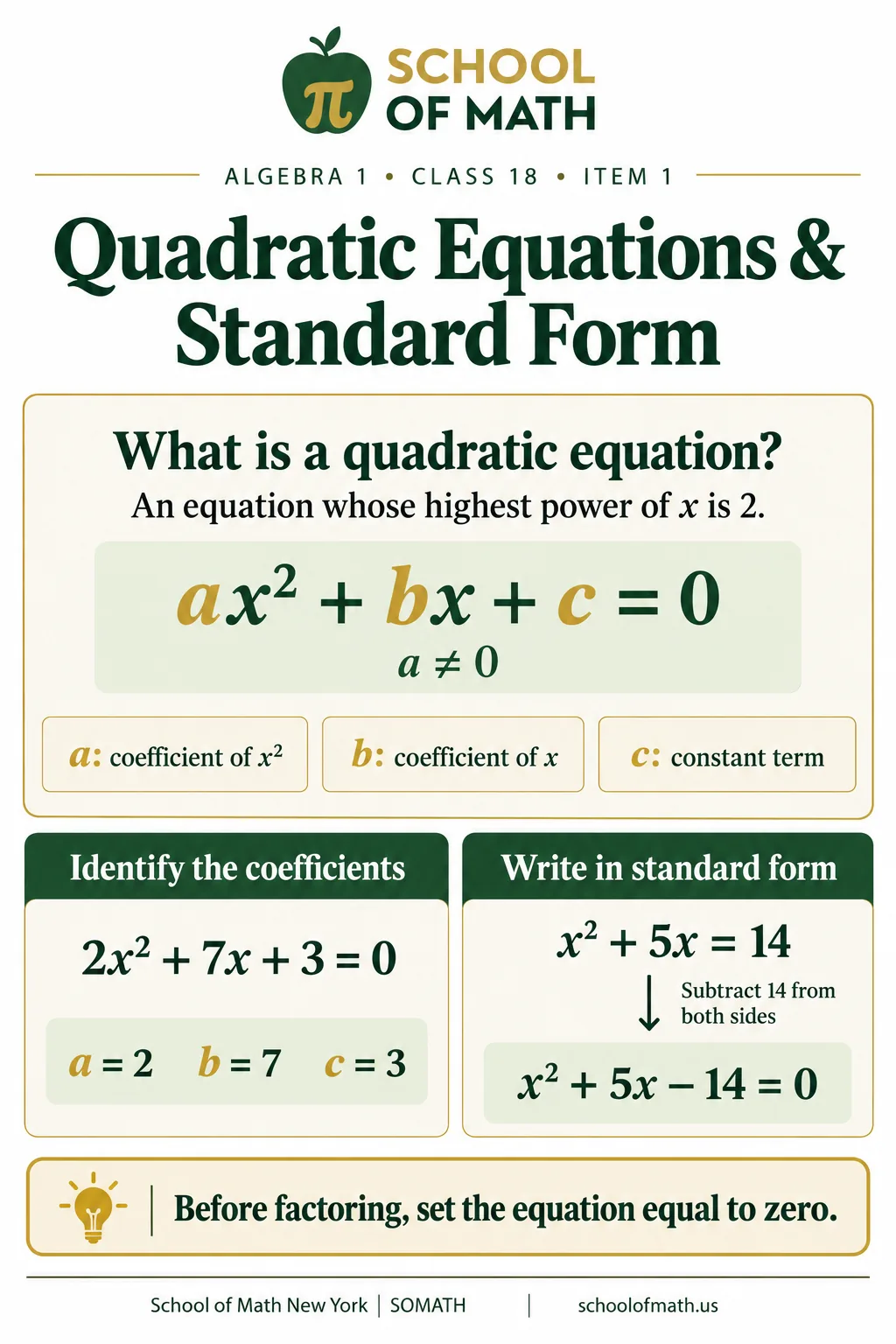
A quadratic equation is an equation whose highest power of the variable is 2. Its standard form is \(ax^2 + bx + c = 0\) with \(a \neq 0\): \(a\) is the coefficient of \(x^2\), \(b\) is the coefficient of \(x\), and \(c\) is the constant term. Signs belong to the coefficients, so in \(3x^2 - 8x + 5 = 0\) the value of \(b\) is \(-8\).
If an equation is not equal to zero, move every term to one side by adding or subtracting the same quantity on both sides. Factoring methods only tell us something useful when the product equals zero, so always set the equation equal to zero before factoring.
Practice: try these five questions
Q1
Identify \(a\), \(b\), and \(c\) in the quadratic equation.
Answer
\(a = 3, b = -8, c = 5\)
Match the equation to \(ax^2 + bx + c = 0\). The coefficient of \(x^2\) is \(a = 3\), the coefficient of \(x\) is \(b = -8\), and the constant term is \(c = 5\).
Q2
Identify \(a\), \(b\), and \(c\). Which term is missing?
Answer
\(a = 1, b = -9, c = 0\)
Match the equation to \(ax^2 + bx + c = 0\). The coefficient of \(x^2\) is \(a = 1\), the coefficient of \(x\) is \(b = -9\), and the constant term is \(c = 0\). A missing term has coefficient 0.
Q3
Write the equation in standard form, then identify \(a\), \(b\), and \(c\).
Answer
\(x^2 + 6x - 27 = 0\); \(a = 1, b = 6, c = -27\)
Subtract \(27\) on both sides so that one side is zero.
\[x^2 + 6x - 27 = 0\]Match the equation to \(ax^2 + bx + c = 0\). The coefficient of \(x^2\) is \(a = 1\), the coefficient of \(x\) is \(b = 6\), and the constant term is \(c = -27\).
Q4
Write the equation in standard form, then identify \(a\), \(b\), and \(c\).
Answer
\(2x^2 - 5x - 12 = 0\); \(a = 2, b = -5, c = -12\)
Subtract \(5x\) and Subtract \(12\) on both sides so that one side is zero.
\[2x^2 - 5x - 12 = 0\]Match the equation to \(ax^2 + bx + c = 0\). The coefficient of \(x^2\) is \(a = 2\), the coefficient of \(x\) is \(b = -5\), and the constant term is \(c = -12\).
Q5
Decide whether each equation is quadratic: \(4x - 7 = 0\) and \((x + 1)(x - 2) = 0\). Explain.
Answer
\(4x - 7 = 0\) is linear, not quadratic; \((x + 1)(x - 2) = 0\) is quadratic.
In \(4x - 7 = 0\) the highest power of \(x\) is 1, so \(a = 0\). It is a linear equation.
Multiply out \((x + 1)(x - 2)\): \(x^2 - 2x + x - 2 = x^2 - x - 2\). The highest power is 2, so the equation is quadratic with \(a = 1\), \(b = -1\), \(c = -2\).
\[x^2 - x - 2 = 0\]Because the second equation is already a product equal to zero, it is ready for the zero-product property without any further rearranging.
The zero-product property
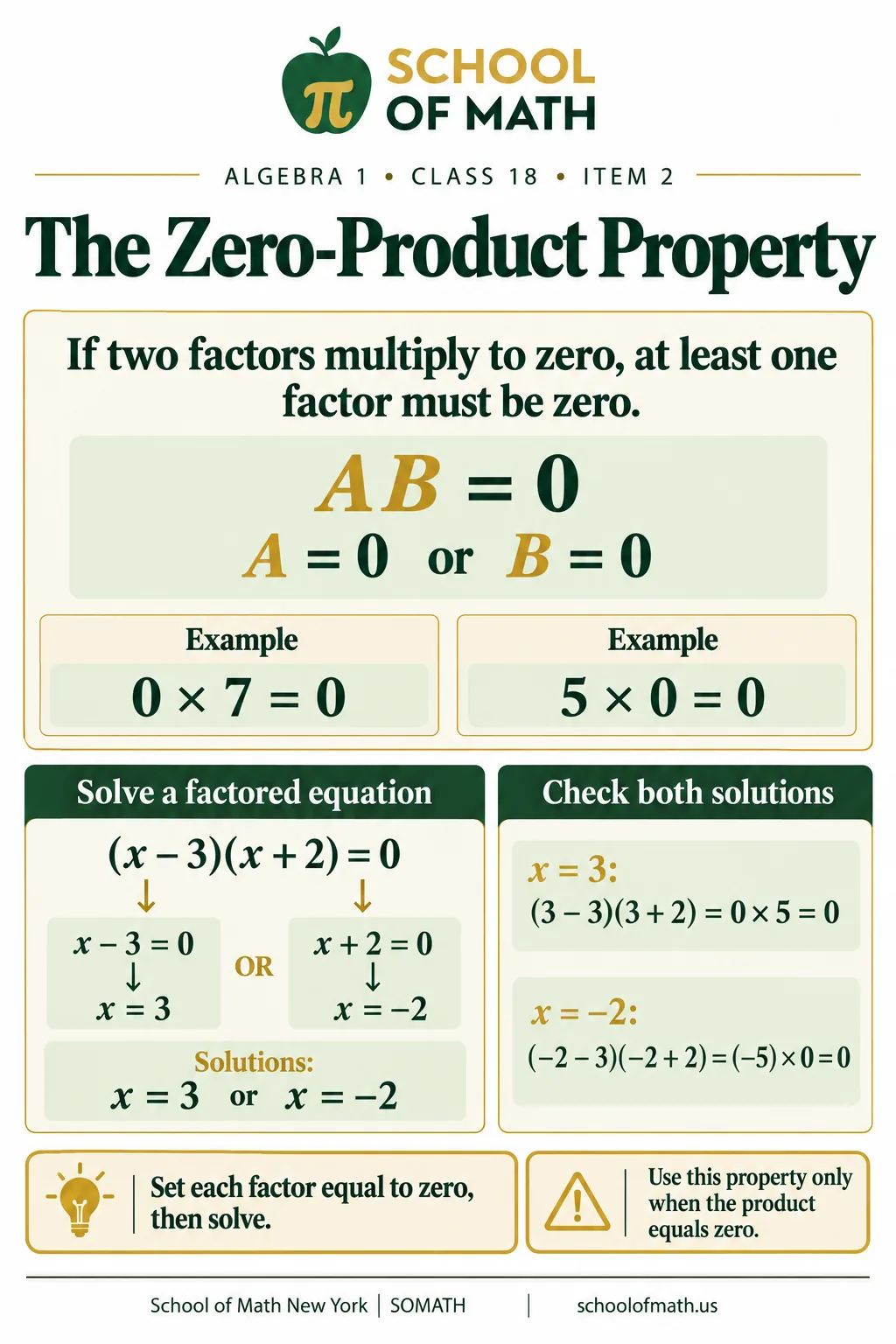
If two factors multiply to zero, at least one of them must be zero: \(AB = 0\) means \(A = 0\) or \(B = 0\). This is the key that turns a factored quadratic into two simple linear equations. For \((x - 6)(x + 4) = 0\), set \(x - 6 = 0\) and \(x + 4 = 0\) to get \(x = 6\) or \(x = -4\).
The property works only when the product equals zero. If \((x - 2)(x + 5) = 8\), you cannot set each factor equal to 8; first expand, subtract 8, and factor again. Always substitute each solution back into the original equation to check.
Practice: try these five questions
Q6
Solve the equation.
Answer
\(x = 6\) or \(x = -4\)
By the zero-product property, at least one factor must be zero. Set each factor equal to zero and solve.
\[x - 6 = 0 \Rightarrow x = 6 \quad\text{or}\quad x + 4 = 0 \Rightarrow x = -4\]Check \(x = 6\): \((0)(10) = 0\), because one factor is zero.
Check \(x = -4\): \((-10)(0) = 0\), because one factor is zero.
Q7
Solve the equation.
Answer
\(x = 0\) or \(x = -9\)
By the zero-product property, at least one factor must be zero. Set each factor equal to zero and solve.
\[x = 0 \quad\text{or}\quad x + 9 = 0 \Rightarrow x = -9\]Check \(x = 0\): \((0)(9) = 0\), because one factor is zero.
Check \(x = -9\): \((-9)(0) = 0\), because one factor is zero.
Q8
Solve the equation.
Answer
\(x = -1\) or \(x = \frac{5}{2}\)
By the zero-product property, at least one factor must be zero. Set each factor equal to zero and solve.
\[x + 1 = 0 \Rightarrow x = -1 \quad\text{or}\quad 2x - 5 = 0 \Rightarrow x = \frac{5}{2}\]Check \(x = -1\): \((-7)(0) = 0\), because one factor is zero.
Check \(x = \frac{5}{2}\): \((0)(\frac{7}{2}) = 0\), because one factor is zero.
Q9
Solve the equation.
Answer
\(x = \frac{1}{4}\) or \(x = -\frac{2}{3}\)
By the zero-product property, at least one factor must be zero. Set each factor equal to zero and solve.
\[4x - 1 = 0 \Rightarrow x = \frac{1}{4} \quad\text{or}\quad 3x + 2 = 0 \Rightarrow x = -\frac{2}{3}\]Check \(x = \frac{1}{4}\): \((\frac{11}{4})(0) = 0\), because one factor is zero.
Check \(x = -\frac{2}{3}\): \((0)(-\frac{11}{3}) = 0\), because one factor is zero.
Q10
A student writes \(x - 2 = 8\) or \(x + 5 = 8\) for this equation. Explain the error, then solve correctly.
Answer
\(x = -6\) or \(x = 3\)
The zero-product property applies only when the product is 0. The product here is 8, so the factors cannot be set equal to 8. Expand the left side: \((x - 2)(x + 5) = x^2 + 3x - 10\), so the equation is \(x^2 + 3x - 10 = 8\).
Subtract \(8\) on both sides so the equation equals zero (standard form).
\[x^2 + 3x - 18 = 0\]Find two numbers that multiply to \(-18\) and add to \(3\): \(6\) and \(-3\), because \((6)(-3) = -18\) and \(6 + (-3) = 3\).
\[(x + 6)(x - 3) = 0\]By the zero-product property, at least one factor must be zero. Set each factor equal to zero and solve.
\[x + 6 = 0 \Rightarrow x = -6 \quad\text{or}\quad x - 3 = 0 \Rightarrow x = 3\]Check \(x = -6\) in the original equation: left side \((-6)^2 + 3(-6) - 10 = 36 - 18 - 10 = 8\); right side \(8\). Both sides equal \(8\), so it checks.
Check \(x = 3\) in the original equation: left side \(3^2 + 3(3) - 10 = 9 + 9 - 10 = 8\); right side \(8\). Both sides equal \(8\), so it checks.
Factoring out the greatest common factor
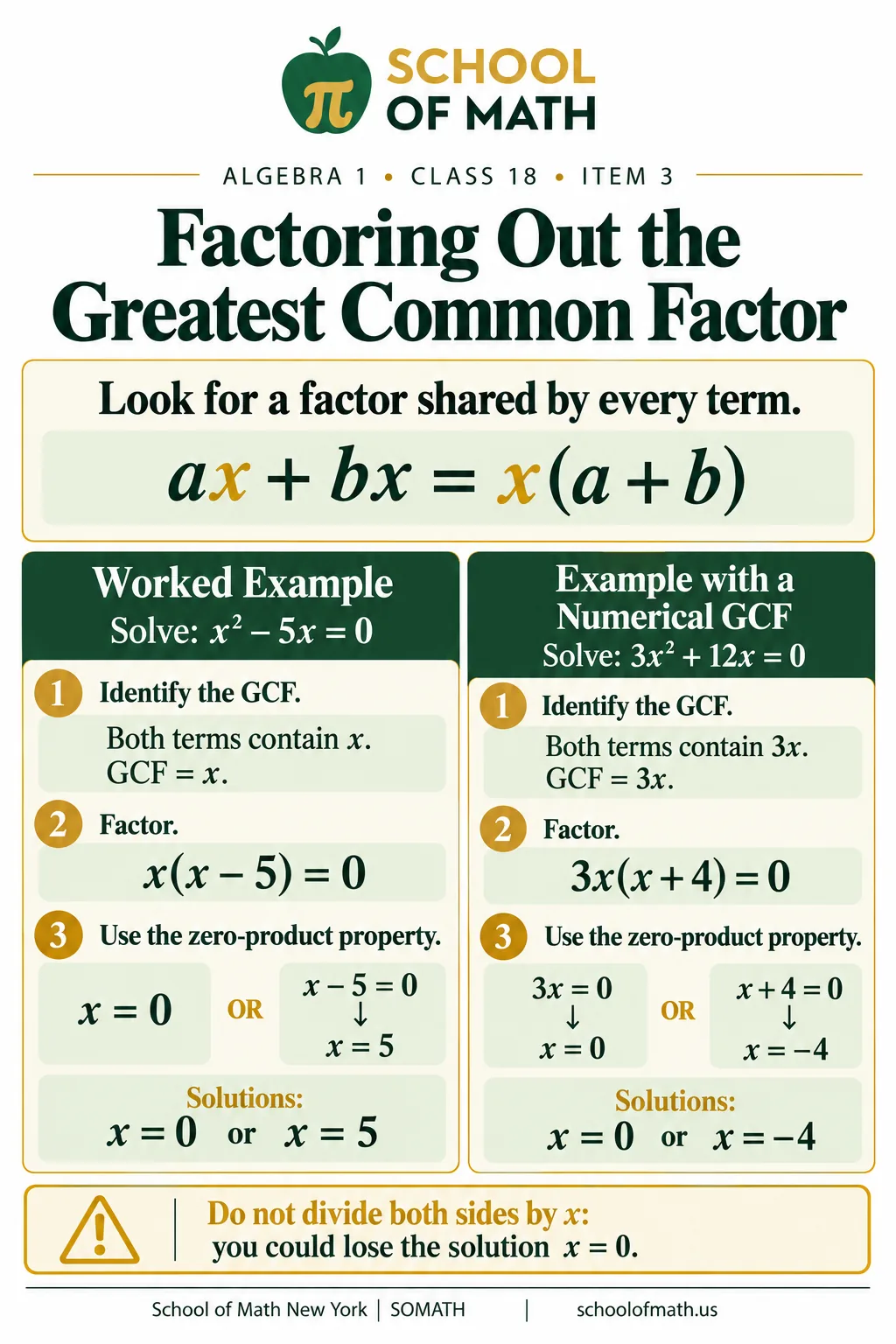
When every term shares a factor, pull it out first. For \(ax + bx = x(a + b)\), the shared factor is \(x\). In \(x^2 - 7x = 0\) both terms contain \(x\), giving \(x(x - 7) = 0\) and the solutions \(x = 0\) or \(x = 7\). In \(4x^2 + 20x = 0\) the GCF is \(4x\), giving \(4x(x + 5) = 0\).
Never divide both sides by \(x\) to simplify: that step throws away the solution \(x = 0\). Factor instead, and then the zero-product property finds every solution.
Practice: try these five questions
Q11
Solve by factoring out the greatest common factor.
Answer
\(x = 0\) or \(x = 7\)
Both terms contain \(x\), so the greatest common factor is \(x\). Do not divide both sides by \(x\), or the solution \(x = 0\) is lost.
\[x(x - 7) = 0\]By the zero-product property, at least one factor must be zero. Set each factor equal to zero and solve.
\[x = 0 \quad\text{or}\quad x - 7 = 0 \Rightarrow x = 7\]Check \(x = 0\) in the original equation: \(0^2 - 7(0) = 0 + 0 = 0\). The equation holds.
Check \(x = 7\) in the original equation: \(7^2 - 7(7) = 49 - 49 = 0\). The equation holds.
Q12
Solve by factoring out the greatest common factor.
Answer
\(x = 0\) or \(x = -5\)
Both terms contain \(4x\), so the greatest common factor is \(4x\). Do not divide both sides by \(x\), or the solution \(x = 0\) is lost.
\[4x(x + 5) = 0\]By the zero-product property, at least one factor must be zero. Set each factor equal to zero and solve.
\[x = 0 \quad\text{or}\quad x + 5 = 0 \Rightarrow x = -5\]Check \(x = 0\) in the original equation: \(4(0)^2 + 20(0) = 0 + 0 = 0\). The equation holds.
Check \(x = -5\) in the original equation: \(4(-5)^2 + 20(-5) = 100 - 100 = 0\). The equation holds.
Q13
Solve. Begin by writing the equation in standard form.
Answer
\(x = 0\) or \(x = \frac{3}{2}\)
Subtract \(9x\) on both sides so the equation equals zero (standard form).
\[6x^2 - 9x = 0\]Both terms contain \(3x\), so the greatest common factor is \(3x\). Do not divide both sides by \(x\), or the solution \(x = 0\) is lost.
\[3x(2x - 3) = 0\]By the zero-product property, at least one factor must be zero. Set each factor equal to zero and solve.
\[x = 0 \quad\text{or}\quad 2x - 3 = 0 \Rightarrow x = \frac{3}{2}\]Check \(x = 0\) in the original equation: left side \(6(0)^2 = 0\); right side \(9(0) = 0\). Both sides equal \(0\), so it checks.
Check \(x = \frac{3}{2}\) in the original equation: left side \(6(\frac{3}{2})^2 = \frac{27}{2}\); right side \(9(\frac{3}{2}) = \frac{27}{2}\). Both sides equal \(\frac{27}{2}\), so it checks.
Q14
A student divides both sides by \(x\) and reports the single answer \(x = 2\). Find all solutions and explain what the student missed.
Answer
\(x = 0\) or \(x = 2\)
Both terms contain \(5x\), so the greatest common factor is \(5x\). Do not divide both sides by \(x\), or the solution \(x = 0\) is lost.
\[5x(x - 2) = 0\]By the zero-product property, at least one factor must be zero. Set each factor equal to zero and solve.
\[x = 0 \quad\text{or}\quad x - 2 = 0 \Rightarrow x = 2\]Check \(x = 0\) in the original equation: \(5(0)^2 - 10(0) = 0 + 0 = 0\). The equation holds.
Check \(x = 2\) in the original equation: \(5(2)^2 - 10(2) = 20 - 20 = 0\). The equation holds.
Dividing by \(x\) assumes \(x \neq 0\), which discards the solution \(x = 0\). A quadratic equation can have two solutions; factoring keeps both.
Q15
Solve by factoring out the greatest common factor, including the negative sign.
Answer
\(x = 0\) or \(x = 6\)
Both terms contain \(3x\), so the greatest common factor is \(3x\). Factor out \(-3x\) so the binomial inside has a positive leading term. Do not divide both sides by \(x\), or the solution \(x = 0\) is lost.
\[-3x(x - 6) = 0\]By the zero-product property, at least one factor must be zero. Set each factor equal to zero and solve.
\[x = 0 \quad\text{or}\quad x - 6 = 0 \Rightarrow x = 6\]Check \(x = 0\) in the original equation: \(-3(0)^2 + 18(0) = 0 + 0 = 0\). The equation holds.
Check \(x = 6\) in the original equation: \(-3(6)^2 + 18(6) = -108 + 108 = 0\). The equation holds.
Factoring trinomials with leading coefficient 1
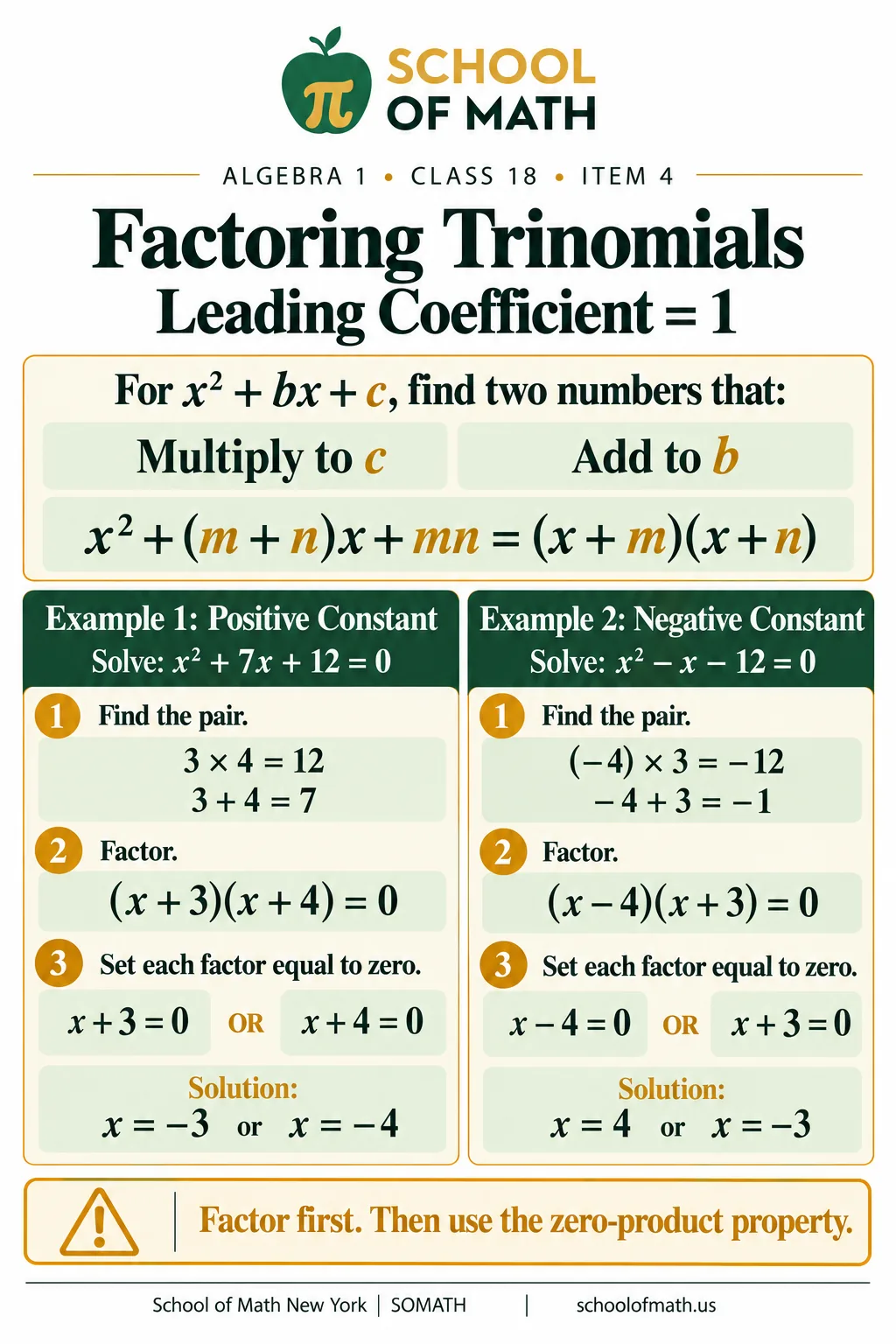
For \(x^2 + bx + c = 0\), find two numbers \(m\) and \(n\) that multiply to \(c\) and add to \(b\). Then \(x^2 + bx + c = (x + m)(x + n)\). A positive \(c\) means both numbers have the same sign (the sign of \(b\)); a negative \(c\) means one is positive and one is negative.
After factoring, set each factor equal to zero. For \(x^2 + 9x + 20 = 0\) the pair is 4 and 5, so \((x + 4)(x + 5) = 0\) and \(x = -4\) or \(x = -5\). Multiply the factors back out to be sure they match the original trinomial.
Practice: try these five questions
Q16
Solve by factoring.
Answer
\(x = -5\) or \(x = -4\)
Find two numbers that multiply to \(20\) and add to \(9\): \(5\) and \(4\), because \((5)(4) = 20\) and \(5 + (4) = 9\).
\[(x + 5)(x + 4) = 0\]By the zero-product property, at least one factor must be zero. Set each factor equal to zero and solve.
\[x + 5 = 0 \Rightarrow x = -5 \quad\text{or}\quad x + 4 = 0 \Rightarrow x = -4\]Check \(x = -5\) in the original equation: \((-5)^2 + 9(-5) + 20 = 25 - 45 + 20 = 0\). The equation holds.
Check \(x = -4\) in the original equation: \((-4)^2 + 9(-4) + 20 = 16 - 36 + 20 = 0\). The equation holds.
Q17
Solve by factoring.
Answer
\(x = 5\) or \(x = 3\)
Find two numbers that multiply to \(15\) and add to \(-8\): \(-5\) and \(-3\), because \((-5)(-3) = 15\) and \(-5 + (-3) = -8\).
\[(x - 5)(x - 3) = 0\]By the zero-product property, at least one factor must be zero. Set each factor equal to zero and solve.
\[x - 5 = 0 \Rightarrow x = 5 \quad\text{or}\quad x - 3 = 0 \Rightarrow x = 3\]Check \(x = 5\) in the original equation: \(5^2 - 8(5) + 15 = 25 - 40 + 15 = 0\). The equation holds.
Check \(x = 3\) in the original equation: \(3^2 - 8(3) + 15 = 9 - 24 + 15 = 0\). The equation holds.
Q18
Solve by factoring.
Answer
\(x = -7\) or \(x = 5\)
Find two numbers that multiply to \(-35\) and add to \(2\): \(7\) and \(-5\), because \((7)(-5) = -35\) and \(7 + (-5) = 2\).
\[(x + 7)(x - 5) = 0\]By the zero-product property, at least one factor must be zero. Set each factor equal to zero and solve.
\[x + 7 = 0 \Rightarrow x = -7 \quad\text{or}\quad x - 5 = 0 \Rightarrow x = 5\]Check \(x = -7\) in the original equation: \((-7)^2 + 2(-7) - 35 = 49 - 14 - 35 = 0\). The equation holds.
Check \(x = 5\) in the original equation: \(5^2 + 2(5) - 35 = 25 + 10 - 35 = 0\). The equation holds.
Q19
Solve by factoring.
Answer
\(x = 7\) or \(x = -4\)
Find two numbers that multiply to \(-28\) and add to \(-3\): \(-7\) and \(4\), because \((-7)(4) = -28\) and \(-7 + (4) = -3\).
\[(x - 7)(x + 4) = 0\]By the zero-product property, at least one factor must be zero. Set each factor equal to zero and solve.
\[x - 7 = 0 \Rightarrow x = 7 \quad\text{or}\quad x + 4 = 0 \Rightarrow x = -4\]Check \(x = 7\) in the original equation: \(7^2 - 3(7) - 28 = 49 - 21 - 28 = 0\). The equation holds.
Check \(x = -4\) in the original equation: \((-4)^2 - 3(-4) - 28 = 16 + 12 - 28 = 0\). The equation holds.
Q20
Solve by factoring.
Answer
\(x = 8\) or \(x = 3\)
Find two numbers that multiply to \(24\) and add to \(-11\): \(-8\) and \(-3\), because \((-8)(-3) = 24\) and \(-8 + (-3) = -11\).
\[(x - 8)(x - 3) = 0\]By the zero-product property, at least one factor must be zero. Set each factor equal to zero and solve.
\[x - 8 = 0 \Rightarrow x = 8 \quad\text{or}\quad x - 3 = 0 \Rightarrow x = 3\]Check \(x = 8\) in the original equation: \(8^2 - 11(8) + 24 = 64 - 88 + 24 = 0\). The equation holds.
Check \(x = 3\) in the original equation: \(3^2 - 11(3) + 24 = 9 - 33 + 24 = 0\). The equation holds.
Factoring trinomials with the ac method
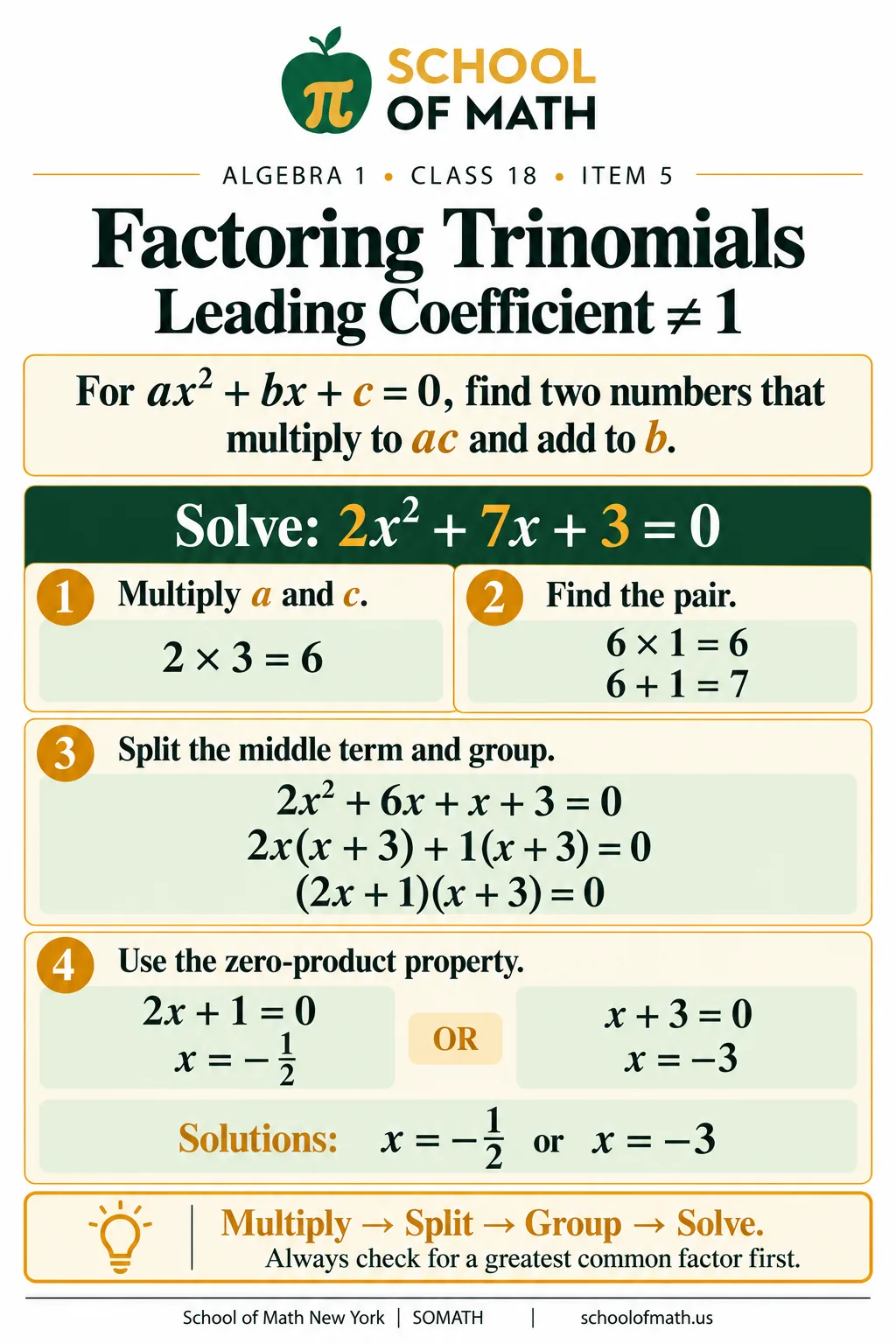
When the leading coefficient is not 1, multiply \(a\) and \(c\) and find two numbers with product \(ac\) and sum \(b\). Split the middle term using those numbers, group the four terms in pairs, factor each pair, and factor out the common binomial. For \(2x^2 + 9x + 4 = 0\): \(ac = 8\), the pair is 8 and 1, so \(2x^2 + 8x + x + 4 = 2x(x + 4) + 1(x + 4) = (2x + 1)(x + 4)\).
Multiply, split, group, solve. Always check for a greatest common factor first, and expect fraction solutions such as \(x = -\frac{1}{2}\) when a factor like \(2x + 1\) appears.
Practice: try these five questions
Q21
Solve using the ac method.
Answer
\(x = -\frac{1}{2}\) or \(x = -4\)
The leading coefficient is \(2\), so use the ac method. Multiply \(a \cdot c = (2)(4) = 8\). Find two numbers with product \(8\) and sum \(9\): \(8\) and \(1\).
Split the middle term using those two numbers.
\[2x^2 + 8x + x + 4 = 0\]Group in pairs and factor each pair; the same binomial appears in both groups.
\[2x(x + 4) + 1(x + 4) = 0\]Factor out the common binomial.
\[(2x + 1)(x + 4) = 0\]By the zero-product property, at least one factor must be zero. Set each factor equal to zero and solve.
\[2x + 1 = 0 \Rightarrow x = -\frac{1}{2} \quad\text{or}\quad x + 4 = 0 \Rightarrow x = -4\]Check \(x = -\frac{1}{2}\) in the original equation: \(2(-\frac{1}{2})^2 + 9(-\frac{1}{2}) + 4 = \frac{1}{2} - \frac{9}{2} + 4 = 0\). The equation holds.
Check \(x = -4\) in the original equation: \(2(-4)^2 + 9(-4) + 4 = 32 - 36 + 4 = 0\). The equation holds.
Q22
Solve using the ac method.
Answer
\(x = \frac{4}{3}\) or \(x = 2\)
The leading coefficient is \(3\), so use the ac method. Multiply \(a \cdot c = (3)(8) = 24\). Find two numbers with product \(24\) and sum \(-10\): \(-6\) and \(-4\).
Split the middle term using those two numbers.
\[3x^2 - 6x - 4x + 8 = 0\]Group in pairs and factor each pair; the same binomial appears in both groups.
\[3x(x - 2) - 4(x - 2) = 0\]Factor out the common binomial.
\[(3x - 4)(x - 2) = 0\]By the zero-product property, at least one factor must be zero. Set each factor equal to zero and solve.
\[3x - 4 = 0 \Rightarrow x = \frac{4}{3} \quad\text{or}\quad x - 2 = 0 \Rightarrow x = 2\]Check \(x = \frac{4}{3}\) in the original equation: \(3(\frac{4}{3})^2 - 10(\frac{4}{3}) + 8 = \frac{16}{3} - \frac{40}{3} + 8 = 0\). The equation holds.
Check \(x = 2\) in the original equation: \(3(2)^2 - 10(2) + 8 = 12 - 20 + 8 = 0\). The equation holds.
Q23
Solve using the ac method.
Answer
\(x = \frac{2}{5}\) or \(x = -3\)
The leading coefficient is \(5\), so use the ac method. Multiply \(a \cdot c = (5)(-6) = -30\). Find two numbers with product \(-30\) and sum \(13\): \(15\) and \(-2\).
Split the middle term using those two numbers.
\[5x^2 + 15x - 2x - 6 = 0\]Group in pairs and factor each pair; the same binomial appears in both groups.
\[5x(x + 3) - 2(x + 3) = 0\]Factor out the common binomial.
\[(5x - 2)(x + 3) = 0\]By the zero-product property, at least one factor must be zero. Set each factor equal to zero and solve.
\[5x - 2 = 0 \Rightarrow x = \frac{2}{5} \quad\text{or}\quad x + 3 = 0 \Rightarrow x = -3\]Check \(x = \frac{2}{5}\) in the original equation: \(5(\frac{2}{5})^2 + 13(\frac{2}{5}) - 6 = \frac{4}{5} + \frac{26}{5} - 6 = 0\). The equation holds.
Check \(x = -3\) in the original equation: \(5(-3)^2 + 13(-3) - 6 = 45 - 39 - 6 = 0\). The equation holds.
Q24
Solve using the ac method.
Answer
\(x = -\frac{3}{2}\) or \(x = \frac{5}{2}\)
The leading coefficient is \(4\), so use the ac method. Multiply \(a \cdot c = (4)(-15) = -60\). Find two numbers with product \(-60\) and sum \(-4\): \(-10\) and \(6\).
Split the middle term using those two numbers.
\[4x^2 - 10x + 6x - 15 = 0\]Group in pairs and factor each pair; the same binomial appears in both groups.
\[2x(2x - 5) + 3(2x - 5) = 0\]Factor out the common binomial.
\[(2x + 3)(2x - 5) = 0\]By the zero-product property, at least one factor must be zero. Set each factor equal to zero and solve.
\[2x + 3 = 0 \Rightarrow x = -\frac{3}{2} \quad\text{or}\quad 2x - 5 = 0 \Rightarrow x = \frac{5}{2}\]Check \(x = -\frac{3}{2}\) in the original equation: \(4(-\frac{3}{2})^2 - 4(-\frac{3}{2}) - 15 = 9 + 6 - 15 = 0\). The equation holds.
Check \(x = \frac{5}{2}\) in the original equation: \(4(\frac{5}{2})^2 - 4(\frac{5}{2}) - 15 = 25 - 10 - 15 = 0\). The equation holds.
Q25
Solve using the ac method.
Answer
\(x = \frac{1}{3}\) or \(x = -\frac{3}{2}\)
The leading coefficient is \(6\), so use the ac method. Multiply \(a \cdot c = (6)(-3) = -18\). Find two numbers with product \(-18\) and sum \(7\): \(9\) and \(-2\).
Split the middle term using those two numbers.
\[6x^2 + 9x - 2x - 3 = 0\]Group in pairs and factor each pair; the same binomial appears in both groups.
\[3x(2x + 3) - 1(2x + 3) = 0\]Factor out the common binomial.
\[(3x - 1)(2x + 3) = 0\]By the zero-product property, at least one factor must be zero. Set each factor equal to zero and solve.
\[3x - 1 = 0 \Rightarrow x = \frac{1}{3} \quad\text{or}\quad 2x + 3 = 0 \Rightarrow x = -\frac{3}{2}\]Check \(x = \frac{1}{3}\) in the original equation: \(6(\frac{1}{3})^2 + 7(\frac{1}{3}) - 3 = \frac{2}{3} + \frac{7}{3} - 3 = 0\). The equation holds.
Check \(x = -\frac{3}{2}\) in the original equation: \(6(-\frac{3}{2})^2 + 7(-\frac{3}{2}) - 3 = \frac{27}{2} - \frac{21}{2} - 3 = 0\). The equation holds.
Special factoring patterns
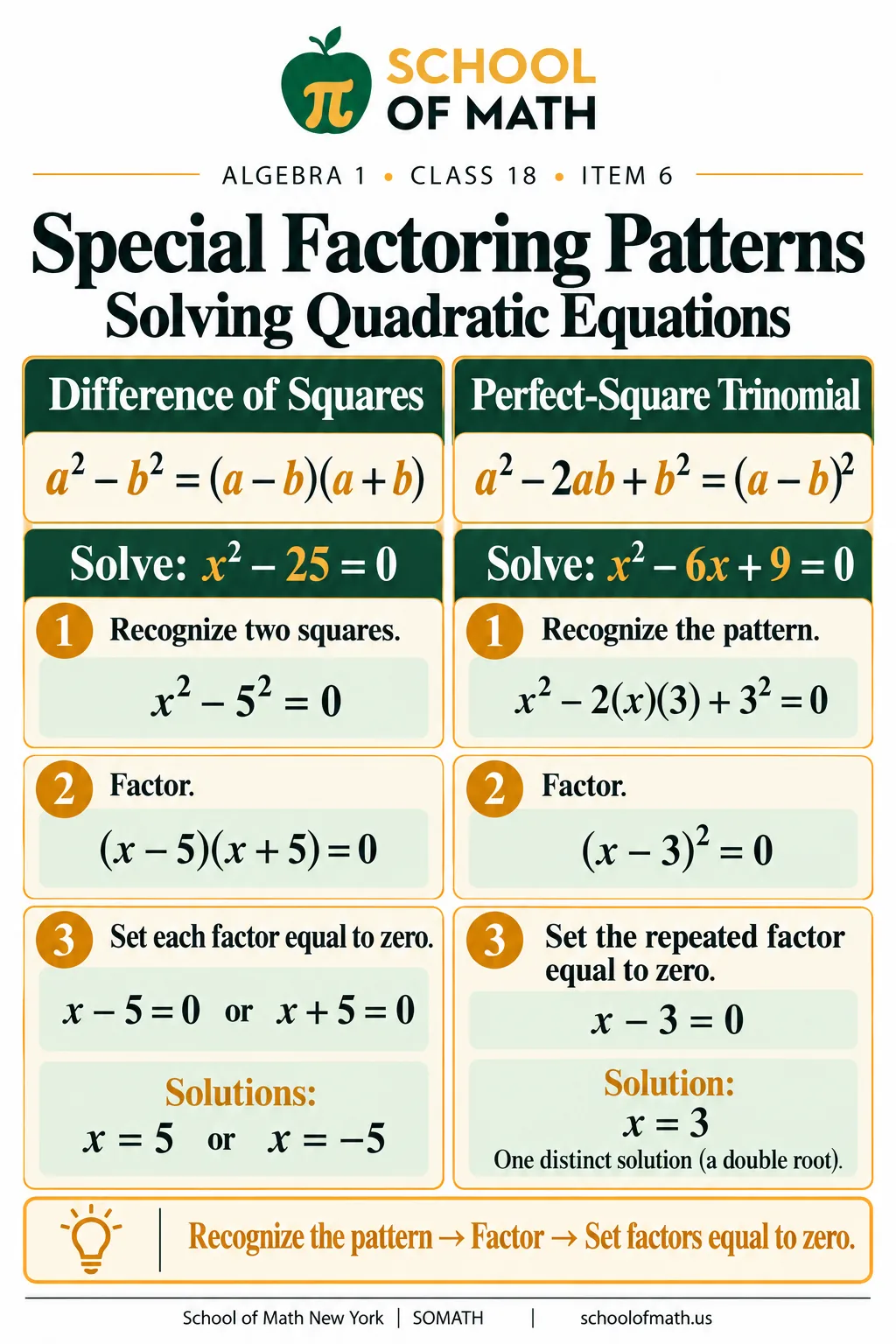
Two patterns save time. A difference of squares \(a^2 - b^2 = (a - b)(a + b)\) has no middle term: \(x^2 - 49 = 0\) becomes \((x - 7)(x + 7) = 0\), so \(x = 7\) or \(x = -7\). It also works with coefficients that are squares, such as \(4x^2 - 9 = (2x - 3)(2x + 3)\).
A perfect-square trinomial \(a^2 \pm 2ab + b^2 = (a \pm b)^2\) has a repeated factor, so the equation has one distinct solution, called a double root. For \(x^2 + 10x + 25 = 0\), \((x + 5)^2 = 0\) gives \(x = -5\). Recognize the pattern, factor, and set the factor equal to zero.
Practice: try these five questions
Q26
Solve using a special factoring pattern.
Answer
\(x = 7\) or \(x = -7\)
This is a difference of two squares: \(x^2 - 7^2\). Use \(a^2 - b^2 = (a - b)(a + b)\).
\[(x - 7)(x + 7) = 0\]By the zero-product property, at least one factor must be zero. Set each factor equal to zero and solve.
\[x - 7 = 0 \Rightarrow x = 7 \quad\text{or}\quad x + 7 = 0 \Rightarrow x = -7\]Check \(x = 7\) in the original equation: \(7^2 - 49 = 49 - 49 = 0\). The equation holds.
Check \(x = -7\) in the original equation: \((-7)^2 - 49 = 49 - 49 = 0\). The equation holds.
Q27
Solve using a special factoring pattern. How many distinct solutions are there?
Answer
\(x = -5\) (a double root)
The first and last terms are perfect squares, \(x^2\) and \(5^2\), and the middle term is \(+2(x)(5)\). This is a perfect-square trinomial.
\[(x + 5)^2 = 0\]The factor is repeated, so set it equal to zero once. Solve to find the single (double) root.
\[x + 5 = 0 \quad\Rightarrow\quad x = -5\]Check \(x = -5\) in the original equation: \((-5)^2 + 10(-5) + 25 = 25 - 50 + 25 = 0\). The equation holds.
Q28
Solve using a special factoring pattern.
Answer
\(x = \frac{3}{2}\) or \(x = -\frac{3}{2}\)
This is a difference of two squares: \((2x)^2 - 3^2\). Use \(a^2 - b^2 = (a - b)(a + b)\).
\[(2x - 3)(2x + 3) = 0\]By the zero-product property, at least one factor must be zero. Set each factor equal to zero and solve.
\[2x - 3 = 0 \Rightarrow x = \frac{3}{2} \quad\text{or}\quad 2x + 3 = 0 \Rightarrow x = -\frac{3}{2}\]Check \(x = \frac{3}{2}\) in the original equation: \(4(\frac{3}{2})^2 - 9 = 9 - 9 = 0\). The equation holds.
Check \(x = -\frac{3}{2}\) in the original equation: \(4(-\frac{3}{2})^2 - 9 = 9 - 9 = 0\). The equation holds.
Q29
Solve using a special factoring pattern.
Answer
\(x = \frac{2}{3}\) (a double root)
The first and last terms are perfect squares, \((3x)^2\) and \(2^2\), and the middle term is \(-2(3x)(2)\). This is a perfect-square trinomial.
\[(3x - 2)^2 = 0\]The factor is repeated, so set it equal to zero once. Solve to find the single (double) root.
\[3x - 2 = 0 \quad\Rightarrow\quad x = \frac{2}{3}\]Check \(x = \frac{2}{3}\) in the original equation: \(9(\frac{2}{3})^2 - 12(\frac{2}{3}) + 4 = 4 - 8 + 4 = 0\). The equation holds.
Q30
Solve. Look for a greatest common factor before using a pattern.
Answer
\(x = 4\) or \(x = -4\)
Every term is divisible by \(3\). Factor out the GCF first.
\[3(x^2 - 16) = 0\]This is a difference of two squares: \(x^2 - 4^2\). Use \(a^2 - b^2 = (a - b)(a + b)\).
\[3(x - 4)(x + 4) = 0\]By the zero-product property, at least one factor must be zero. Set each factor equal to zero and solve.
\[x - 4 = 0 \Rightarrow x = 4 \quad\text{or}\quad x + 4 = 0 \Rightarrow x = -4\]Check \(x = 4\) in the original equation: \(3(4)^2 - 48 = 48 - 48 = 0\). The equation holds.
Check \(x = -4\) in the original equation: \(3(-4)^2 - 48 = 48 - 48 = 0\). The equation holds.
Rearranging and checking solutions
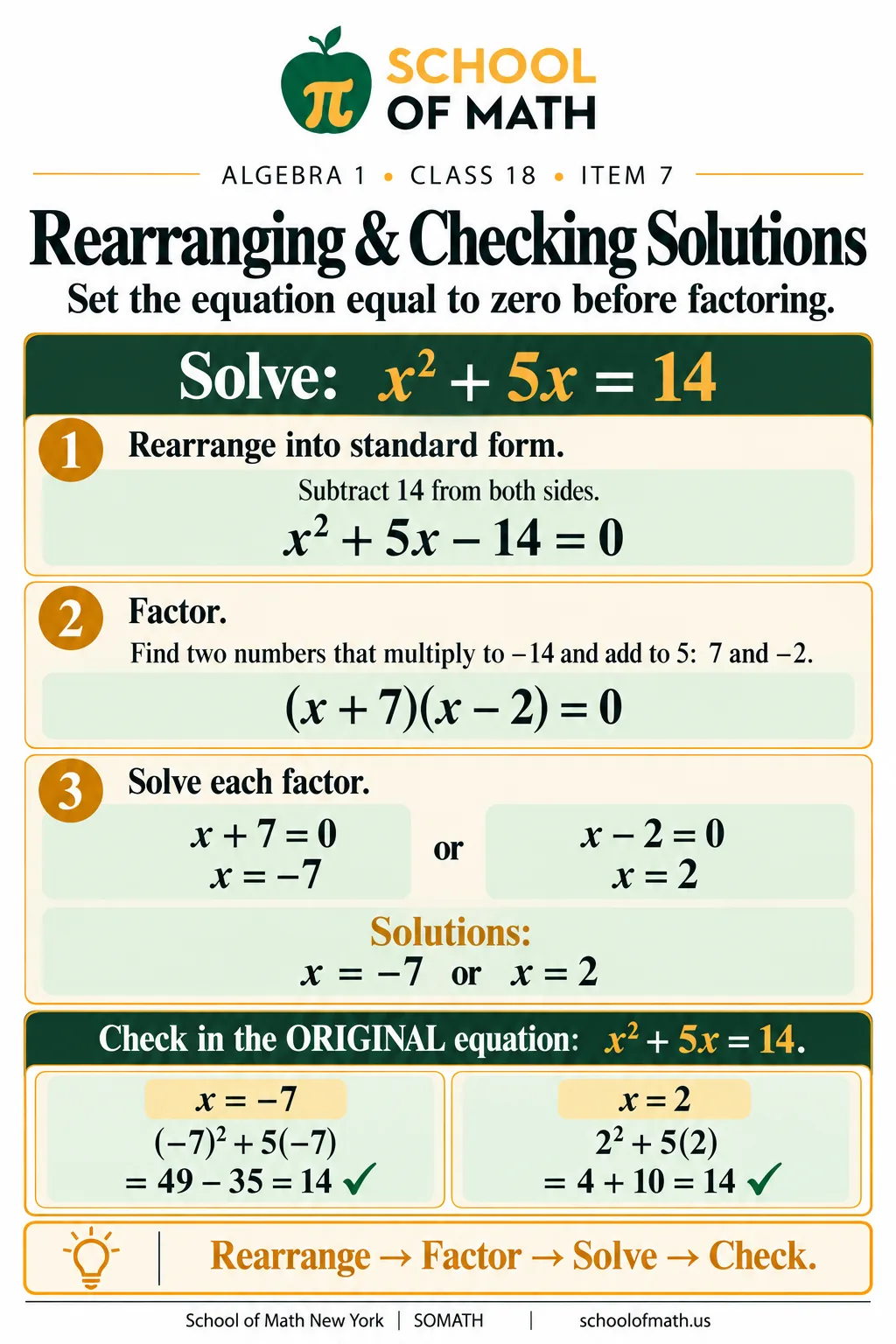
Many equations arrive with terms on both sides or as a product that does not equal zero. Rearrange first: add or subtract to bring everything to one side, combine like terms, and then factor. For \(x^2 - 4x = 21\), subtract 21 to get \(x^2 - 4x - 21 = 0 = (x - 7)(x + 3)\), so \(x = 7\) or \(x = -3\).
Check in the original equation, not in a rearranged version. Substituting \(x = -3\) gives \((-3)^2 - 4(-3) = 9 + 12 = 21\), which matches the right side. Rearrange, factor, solve, check.
Practice: try these five questions
Q31
Solve. Check both solutions in the original equation.
Answer
\(x = 7\) or \(x = -3\)
Subtract \(21\) on both sides so the equation equals zero (standard form).
\[x^2 - 4x - 21 = 0\]Find two numbers that multiply to \(-21\) and add to \(-4\): \(-7\) and \(3\), because \((-7)(3) = -21\) and \(-7 + (3) = -4\).
\[(x - 7)(x + 3) = 0\]By the zero-product property, at least one factor must be zero. Set each factor equal to zero and solve.
\[x - 7 = 0 \Rightarrow x = 7 \quad\text{or}\quad x + 3 = 0 \Rightarrow x = -3\]Check \(x = 7\) in the original equation: left side \(7^2 - 4(7) = 49 - 28 = 21\); right side \(21\). Both sides equal \(21\), so it checks.
Check \(x = -3\) in the original equation: left side \((-3)^2 - 4(-3) = 9 + 12 = 21\); right side \(21\). Both sides equal \(21\), so it checks.
Q32
Solve. Check both solutions in the original equation.
Answer
\(x = 4\) or \(x = 2\)
Subtract \(6x\) and Add \(8\) on both sides so the equation equals zero (standard form).
\[x^2 - 6x + 8 = 0\]Find two numbers that multiply to \(8\) and add to \(-6\): \(-4\) and \(-2\), because \((-4)(-2) = 8\) and \(-4 + (-2) = -6\).
\[(x - 4)(x - 2) = 0\]By the zero-product property, at least one factor must be zero. Set each factor equal to zero and solve.
\[x - 4 = 0 \Rightarrow x = 4 \quad\text{or}\quad x - 2 = 0 \Rightarrow x = 2\]Check \(x = 4\) in the original equation: left side \(4^2 = 16\); right side \(6(4) - 8 = 24 - 8 = 16\). Both sides equal \(16\), so it checks.
Check \(x = 2\) in the original equation: left side \(2^2 = 4\); right side \(6(2) - 8 = 12 - 8 = 4\). Both sides equal \(4\), so it checks.
Q33
Solve. Check both solutions in the original equation.
Answer
\(x = \frac{1}{2}\) or \(x = -3\)
Subtract \(3\) on both sides so the equation equals zero (standard form).
\[2x^2 + 5x - 3 = 0\]The leading coefficient is \(2\), so use the ac method. Multiply \(a \cdot c = (2)(-3) = -6\). Find two numbers with product \(-6\) and sum \(5\): \(6\) and \(-1\).
Split the middle term using those two numbers.
\[2x^2 + 6x - x - 3 = 0\]Group in pairs and factor each pair; the same binomial appears in both groups.
\[2x(x + 3) - 1(x + 3) = 0\]Factor out the common binomial.
\[(2x - 1)(x + 3) = 0\]By the zero-product property, at least one factor must be zero. Set each factor equal to zero and solve.
\[2x - 1 = 0 \Rightarrow x = \frac{1}{2} \quad\text{or}\quad x + 3 = 0 \Rightarrow x = -3\]Check \(x = \frac{1}{2}\) in the original equation: left side \(2(\frac{1}{2})^2 + 5(\frac{1}{2}) = \frac{1}{2} + \frac{5}{2} = 3\); right side \(3\). Both sides equal \(3\), so it checks.
Check \(x = -3\) in the original equation: left side \(2(-3)^2 + 5(-3) = 18 - 15 = 3\); right side \(3\). Both sides equal \(3\), so it checks.
Q34
Solve. Expand the left side first.
Answer
\(x = -6\) or \(x = 4\)
Expand \(x(x + 2)\) to get \(x^2 + 2x\). The product is 24, not 0, so the zero-product property cannot be used yet.
Subtract \(24\) on both sides so the equation equals zero (standard form).
\[x^2 + 2x - 24 = 0\]Find two numbers that multiply to \(-24\) and add to \(2\): \(6\) and \(-4\), because \((6)(-4) = -24\) and \(6 + (-4) = 2\).
\[(x + 6)(x - 4) = 0\]By the zero-product property, at least one factor must be zero. Set each factor equal to zero and solve.
\[x + 6 = 0 \Rightarrow x = -6 \quad\text{or}\quad x - 4 = 0 \Rightarrow x = 4\]Check \(x = -6\) in the original equation: left side \((-6)^2 + 2(-6) = 36 - 12 = 24\); right side \(24\). Both sides equal \(24\), so it checks.
Check \(x = 4\) in the original equation: left side \(4^2 + 2(4) = 16 + 8 = 24\); right side \(24\). Both sides equal \(24\), so it checks.
Q35
Solve. Expand the left side first.
Answer
\(x = -5\) or \(x = 3\)
Expand \((x - 1)(x + 3) = x^2 + 3x - x - 3 = x^2 + 2x - 3\). The equation becomes \(x^2 + 2x - 3 = 12\).
Subtract \(12\) on both sides so the equation equals zero (standard form).
\[x^2 + 2x - 15 = 0\]Find two numbers that multiply to \(-15\) and add to \(2\): \(5\) and \(-3\), because \((5)(-3) = -15\) and \(5 + (-3) = 2\).
\[(x + 5)(x - 3) = 0\]By the zero-product property, at least one factor must be zero. Set each factor equal to zero and solve.
\[x + 5 = 0 \Rightarrow x = -5 \quad\text{or}\quad x - 3 = 0 \Rightarrow x = 3\]Check \(x = -5\) in the original equation: left side \((-5)^2 + 2(-5) - 3 = 25 - 10 - 3 = 12\); right side \(12\). Both sides equal \(12\), so it checks.
Check \(x = 3\) in the original equation: left side \(3^2 + 2(3) - 3 = 9 + 6 - 3 = 12\); right side \(12\). Both sides equal \(12\), so it checks.
Quadratic word problems
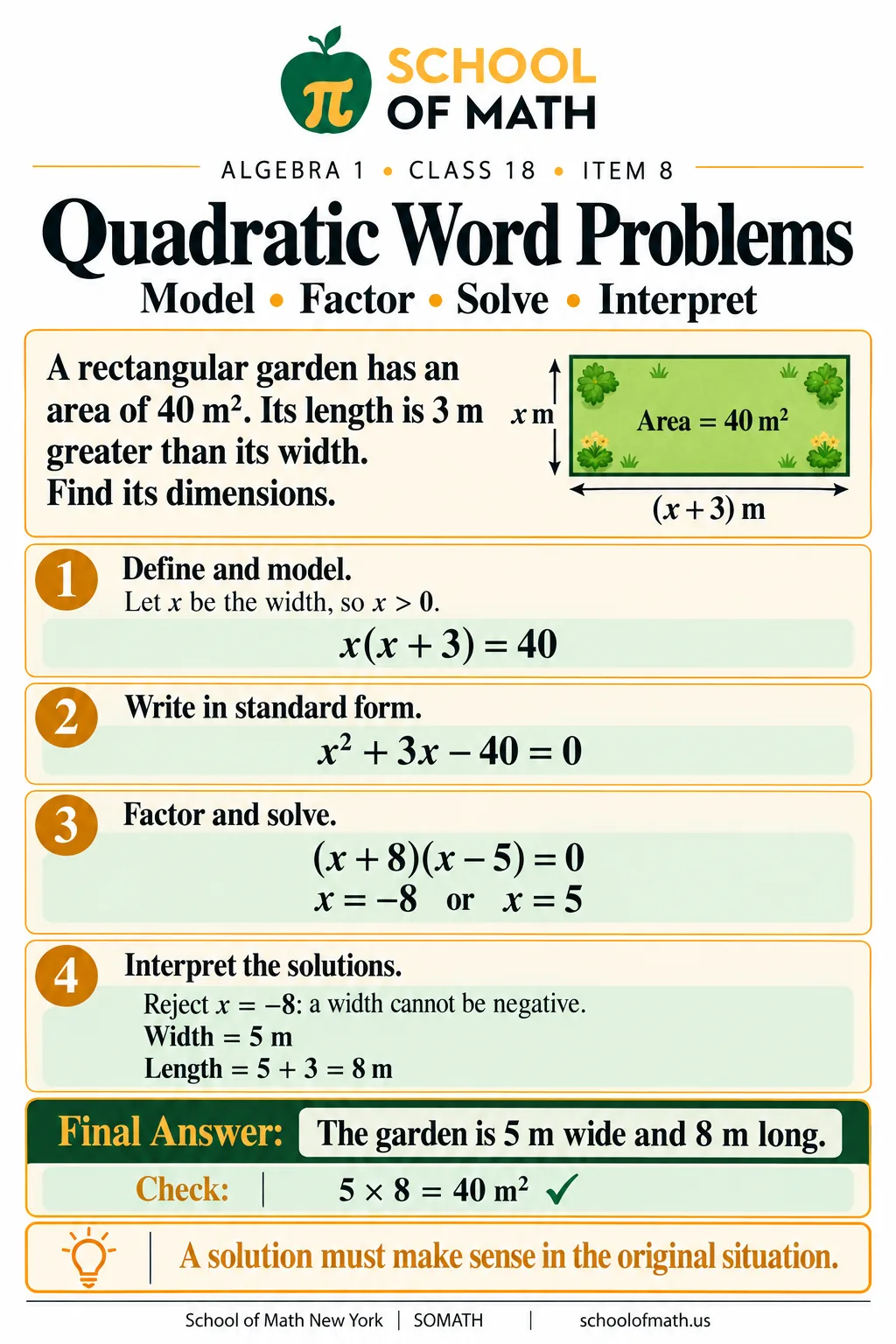
Define a variable, write an equation from the situation, put it in standard form, factor, and solve. Area problems multiply two dimensions, so they produce quadratics: a rectangle whose length is 5 m more than its width with area 84 m² gives \(w(w + 5) = 84\).
Interpret every solution in context. A negative width, a negative time, or a non-integer count is rejected even though it solves the equation. Then answer the question that was asked, often with a second quantity such as the length, and check with the original numbers.
Practice: try these five questions
Q36
A rectangle has an area of 84 m². Its length is 5 m more than its width. Find the dimensions.
Answer
The rectangle is 7 m wide and 12 m long.
Let \(w\) = the width in meters, so the length is \(w + 5\).
Model the situation with an equation.
\[w(w + 5) = 84\]Expand and write it in standard form.
\[w^2 + 5w - 84 = 0\]Find two numbers that multiply to \(-84\) and add to \(5\): \(12\) and \(-7\), because \((12)(-7) = -84\) and \(12 + (-7) = 5\).
\[(w + 12)(w - 7) = 0\]By the zero-product property, at least one factor must be zero. Set each factor equal to zero and solve.
\[w + 12 = 0 \Rightarrow w = -12 \quad\text{or}\quad w - 7 = 0 \Rightarrow w = 7\]Reject \(w = -12\): a width cannot be negative. So \(w = 7\) and the length is \(7 + 5 = 12\).
Check: \(7 \times 12 = 84\) m².
Interpretation: The rectangle is 7 m wide and 12 m long.
Q37
The product of two consecutive positive integers is 56. Find the integers.
Answer
The integers are 7 and 8.
Let \(n\) = the smaller integer, so the next integer is \(n + 1\).
Model the situation with an equation.
\[n(n + 1) = 56\]Expand and write it in standard form.
\[n^2 + n - 56 = 0\]Find two numbers that multiply to \(-56\) and add to \(1\): \(8\) and \(-7\), because \((8)(-7) = -56\) and \(8 + (-7) = 1\).
\[(n + 8)(n - 7) = 0\]By the zero-product property, at least one factor must be zero. Set each factor equal to zero and solve.
\[n + 8 = 0 \Rightarrow n = -8 \quad\text{or}\quad n - 7 = 0 \Rightarrow n = 7\]Reject \(n = -8\): the integers must be positive. So \(n = 7\) and \(n + 1 = 8\).
Check: \(7 \times 8 = 56\).
Interpretation: The integers are 7 and 8.
Q38
A ball is kicked from the ground. Its height in feet after \(t\) seconds is \(h = -16t^2 + 48t\). When does the ball hit the ground?
Answer
The ball hits the ground after 3 seconds.
Let \(t\) = the time in seconds; the ball is on the ground when \(h = 0\).
Model the situation with an equation.
\[-16t^2 + 48t = 0\]Expand and write it in standard form.
\[-16t^2 + 48t = 0\]Both terms contain \(16t\), so the greatest common factor is \(16t\). Factor out \(-16t\) so the binomial inside has a positive leading term. Do not divide both sides by \(t\), or the solution \(t = 0\) is lost.
\[-16t(t - 3) = 0\]By the zero-product property, at least one factor must be zero. Set each factor equal to zero and solve.
\[t = 0 \quad\text{or}\quad t - 3 = 0 \Rightarrow t = 3\]The solution \(t = 0\) is the moment the ball is kicked, so the landing time is \(t = 3\).
Check: \(-16(3)^2 + 48(3) = -144 + 144 = 0\).
Interpretation: The ball hits the ground after 3 seconds.
Q39
Each side of a square is increased by 4 cm, and the new square has an area of 100 cm². Find the side length of the original square.
Answer
The original square has sides of 6 cm.
Let \(s\) = the original side length in centimeters, so the new side is \(s + 4\).
Model the situation with an equation.
\[(s + 4)^2 = 100\]Expand: \((s + 4)^2 = s^2 + 8s + 16\).
Expand and write it in standard form.
\[s^2 + 8s - 84 = 0\]Find two numbers that multiply to \(-84\) and add to \(8\): \(14\) and \(-6\), because \((14)(-6) = -84\) and \(14 + (-6) = 8\).
\[(s + 14)(s - 6) = 0\]By the zero-product property, at least one factor must be zero. Set each factor equal to zero and solve.
\[s + 14 = 0 \Rightarrow s = -14 \quad\text{or}\quad s - 6 = 0 \Rightarrow s = 6\]Reject \(s = -14\): a length cannot be negative. So \(s = 6\).
Check: the new side is \(6 + 4 = 10\) cm and \(10^2 = 100\) cm².
Interpretation: The original square has sides of 6 cm.
Q40
A triangle has an area of 30 cm². Its height is 4 cm more than its base. Find the base and the height.
Answer
The base is 6 cm and the height is 10 cm.
Let \(b\) = the base in centimeters, so the height is \(b + 4\).
Model the situation with an equation.
\[\tfrac{1}{2}\,b(b + 4) = 30\]Multiply both sides by 2 to clear the fraction: \(b(b + 4) = 60\).
Expand and write it in standard form.
\[b^2 + 4b - 60 = 0\]Find two numbers that multiply to \(-60\) and add to \(4\): \(10\) and \(-6\), because \((10)(-6) = -60\) and \(10 + (-6) = 4\).
\[(b + 10)(b - 6) = 0\]By the zero-product property, at least one factor must be zero. Set each factor equal to zero and solve.
\[b + 10 = 0 \Rightarrow b = -10 \quad\text{or}\quad b - 6 = 0 \Rightarrow b = 6\]Reject \(b = -10\): a length cannot be negative. So \(b = 6\) and the height is \(6 + 4 = 10\).
Check: \(\tfrac{1}{2}(6)(10) = 30\) cm².
Interpretation: The base is 6 cm and the height is 10 cm.
Homework review
One review question for each topic. Write the equation in standard form, show the factoring, apply the zero-product property, and check each solution in the original equation.
R1
Write the equation in standard form and identify \(a\), \(b\), and \(c\).
Answer
\(3x^2 - 7x + 2 = 0\); \(a = 3, b = -7, c = 2\)
Subtract \(7x\) and Add \(2\) on both sides so that one side is zero.
\[3x^2 - 7x + 2 = 0\]Match the equation to \(ax^2 + bx + c = 0\). The coefficient of \(x^2\) is \(a = 3\), the coefficient of \(x\) is \(b = -7\), and the constant term is \(c = 2\).
R2
Solve the equation.
Answer
\(x = \frac{3}{2}\) or \(x = -8\)
By the zero-product property, at least one factor must be zero. Set each factor equal to zero and solve.
\[2x - 3 = 0 \Rightarrow x = \frac{3}{2} \quad\text{or}\quad x + 8 = 0 \Rightarrow x = -8\]Check \(x = \frac{3}{2}\): \((\frac{19}{2})(0) = 0\), because one factor is zero.
Check \(x = -8\): \((0)(-19) = 0\), because one factor is zero.
R3
Solve by factoring out the greatest common factor.
Answer
\(x = 0\) or \(x = -\frac{3}{2}\)
Both terms contain \(5x\), so the greatest common factor is \(5x\). Do not divide both sides by \(x\), or the solution \(x = 0\) is lost.
\[5x(2x + 3) = 0\]By the zero-product property, at least one factor must be zero. Set each factor equal to zero and solve.
\[x = 0 \quad\text{or}\quad 2x + 3 = 0 \Rightarrow x = -\frac{3}{2}\]Check \(x = 0\) in the original equation: \(10(0)^2 + 15(0) = 0 + 0 = 0\). The equation holds.
Check \(x = -\frac{3}{2}\) in the original equation: \(10(-\frac{3}{2})^2 + 15(-\frac{3}{2}) = \frac{45}{2} - \frac{45}{2} = 0\). The equation holds.
R4
Solve by factoring.
Answer
\(x = 9\) or \(x = -4\)
Find two numbers that multiply to \(-36\) and add to \(-5\): \(-9\) and \(4\), because \((-9)(4) = -36\) and \(-9 + (4) = -5\).
\[(x - 9)(x + 4) = 0\]By the zero-product property, at least one factor must be zero. Set each factor equal to zero and solve.
\[x - 9 = 0 \Rightarrow x = 9 \quad\text{or}\quad x + 4 = 0 \Rightarrow x = -4\]Check \(x = 9\) in the original equation: \(9^2 - 5(9) - 36 = 81 - 45 - 36 = 0\). The equation holds.
Check \(x = -4\) in the original equation: \((-4)^2 - 5(-4) - 36 = 16 + 20 - 36 = 0\). The equation holds.
R5
Solve using the ac method.
Answer
\(x = -\frac{2}{3}\) or \(x = -3\)
The leading coefficient is \(3\), so use the ac method. Multiply \(a \cdot c = (3)(6) = 18\). Find two numbers with product \(18\) and sum \(11\): \(9\) and \(2\).
Split the middle term using those two numbers.
\[3x^2 + 9x + 2x + 6 = 0\]Group in pairs and factor each pair; the same binomial appears in both groups.
\[3x(x + 3) + 2(x + 3) = 0\]Factor out the common binomial.
\[(3x + 2)(x + 3) = 0\]By the zero-product property, at least one factor must be zero. Set each factor equal to zero and solve.
\[3x + 2 = 0 \Rightarrow x = -\frac{2}{3} \quad\text{or}\quad x + 3 = 0 \Rightarrow x = -3\]Check \(x = -\frac{2}{3}\) in the original equation: \(3(-\frac{2}{3})^2 + 11(-\frac{2}{3}) + 6 = \frac{4}{3} - \frac{22}{3} + 6 = 0\). The equation holds.
Check \(x = -3\) in the original equation: \(3(-3)^2 + 11(-3) + 6 = 27 - 33 + 6 = 0\). The equation holds.
R6
Solve using a special factoring pattern.
Answer
\(x = \frac{5}{4}\) or \(x = -\frac{5}{4}\)
This is a difference of two squares: \((4x)^2 - 5^2\). Use \(a^2 - b^2 = (a - b)(a + b)\).
\[(4x - 5)(4x + 5) = 0\]By the zero-product property, at least one factor must be zero. Set each factor equal to zero and solve.
\[4x - 5 = 0 \Rightarrow x = \frac{5}{4} \quad\text{or}\quad 4x + 5 = 0 \Rightarrow x = -\frac{5}{4}\]Check \(x = \frac{5}{4}\) in the original equation: \(16(\frac{5}{4})^2 - 25 = 25 - 25 = 0\). The equation holds.
Check \(x = -\frac{5}{4}\) in the original equation: \(16(-\frac{5}{4})^2 - 25 = 25 - 25 = 0\). The equation holds.
R7
Solve. Check both solutions in the original equation.
Answer
\(x = -5\) or \(x = -2\)
Add \(10\) on both sides so the equation equals zero (standard form).
\[x^2 + 7x + 10 = 0\]Find two numbers that multiply to \(10\) and add to \(7\): \(5\) and \(2\), because \((5)(2) = 10\) and \(5 + (2) = 7\).
\[(x + 5)(x + 2) = 0\]By the zero-product property, at least one factor must be zero. Set each factor equal to zero and solve.
\[x + 5 = 0 \Rightarrow x = -5 \quad\text{or}\quad x + 2 = 0 \Rightarrow x = -2\]Check \(x = -5\) in the original equation: left side \((-5)^2 + 7(-5) = 25 - 35 = -10\); right side \(-10\). Both sides equal \(-10\), so it checks.
Check \(x = -2\) in the original equation: left side \((-2)^2 + 7(-2) = 4 - 14 = -10\); right side \(-10\). Both sides equal \(-10\), so it checks.
R8
A rectangular poster has an area of 70 square inches. Its length is 3 inches more than its width. Find the dimensions.
Answer
The poster is 7 inches wide and 10 inches long.
Let \(w\) = the width in inches, so the length is \(w + 3\).
Model the situation with an equation.
\[w(w + 3) = 70\]Expand and write it in standard form.
\[w^2 + 3w - 70 = 0\]Find two numbers that multiply to \(-70\) and add to \(3\): \(10\) and \(-7\), because \((10)(-7) = -70\) and \(10 + (-7) = 3\).
\[(w + 10)(w - 7) = 0\]By the zero-product property, at least one factor must be zero. Set each factor equal to zero and solve.
\[w + 10 = 0 \Rightarrow w = -10 \quad\text{or}\quad w - 7 = 0 \Rightarrow w = 7\]Reject \(w = -10\): a width cannot be negative. So \(w = 7\) and the length is 10.
Check: \(7 \times 10 = 70\) square inches.
Interpretation: The poster is 7 inches wide and 10 inches long.
Homework word problems
Define a variable, model each situation with a quadratic equation, solve by factoring, and interpret the solutions. Reject values that make no sense in context, such as negative lengths or times.
W1
A rectangular patio has an area of 60 m². Its length is 4 m more than its width. Find the dimensions.
Answer
The patio is 6 m wide and 10 m long.
Let \(w\) = the width in meters, so the length is \(w + 4\).
Model the situation with an equation.
\[w(w + 4) = 60\]Expand and write it in standard form.
\[w^2 + 4w - 60 = 0\]Find two numbers that multiply to \(-60\) and add to \(4\): \(10\) and \(-6\), because \((10)(-6) = -60\) and \(10 + (-6) = 4\).
\[(w + 10)(w - 6) = 0\]By the zero-product property, at least one factor must be zero. Set each factor equal to zero and solve.
\[w + 10 = 0 \Rightarrow w = -10 \quad\text{or}\quad w - 6 = 0 \Rightarrow w = 6\]Reject \(w = -10\): a width cannot be negative. So \(w = 6\) and the length is 10.
Check: \(6 \times 10 = 60\) m².
Interpretation: The patio is 6 m wide and 10 m long.
W2
The product of two consecutive positive odd integers is 99. Find the integers.
Answer
The integers are 9 and 11.
Let \(n\) = the smaller odd integer, so the next odd integer is \(n + 2\).
Model the situation with an equation.
\[n(n + 2) = 99\]Expand and write it in standard form.
\[n^2 + 2n - 99 = 0\]Find two numbers that multiply to \(-99\) and add to \(2\): \(11\) and \(-9\), because \((11)(-9) = -99\) and \(11 + (-9) = 2\).
\[(n + 11)(n - 9) = 0\]By the zero-product property, at least one factor must be zero. Set each factor equal to zero and solve.
\[n + 11 = 0 \Rightarrow n = -11 \quad\text{or}\quad n - 9 = 0 \Rightarrow n = 9\]Reject \(n = -11\): the integers must be positive. So \(n = 9\) and \(n + 2 = 11\).
Check: \(9 \times 11 = 99\).
Interpretation: The integers are 9 and 11.
W3
The square of a number is 5 more than 4 times the number. Find all possible numbers.
Answer
The number is 5 or −1; both values work.
Let \(n\) = the number.
Model the situation with an equation.
\[n^2 = 4n + 5\]Expand and write it in standard form.
\[n^2 - 4n - 5 = 0\]Find two numbers that multiply to \(-5\) and add to \(-4\): \(-5\) and \(1\), because \((-5)(1) = -5\) and \(-5 + (1) = -4\).
\[(n - 5)(n + 1) = 0\]By the zero-product property, at least one factor must be zero. Set each factor equal to zero and solve.
\[n - 5 = 0 \Rightarrow n = 5 \quad\text{or}\quad n + 1 = 0 \Rightarrow n = -1\]Both solutions are allowed because nothing in the problem rules out negative numbers. Check \(n = -1\): \((-1)^2 = 1\) and \(4(-1) + 5 = 1\).
Interpretation: The number is 5 or −1; both values work.
W4
A ball is thrown upward from the ground. Its height in feet after \(t\) seconds is \(h = -16t^2 + 64t\). When does the ball land?
Answer
The ball lands after 4 seconds.
Let \(t\) = the time in seconds; the ball lands when \(h = 0\).
Model the situation with an equation.
\[-16t^2 + 64t = 0\]Expand and write it in standard form.
\[-16t^2 + 64t = 0\]Both terms contain \(16t\), so the greatest common factor is \(16t\). Factor out \(-16t\) so the binomial inside has a positive leading term. Do not divide both sides by \(t\), or the solution \(t = 0\) is lost.
\[-16t(t - 4) = 0\]By the zero-product property, at least one factor must be zero. Set each factor equal to zero and solve.
\[t = 0 \quad\text{or}\quad t - 4 = 0 \Rightarrow t = 4\]The solution \(t = 0\) is the launch, so the landing time is \(t = 4\).
Check: \(-16(4)^2 + 64(4) = -256 + 256 = 0\).
Interpretation: The ball lands after 4 seconds.
W5
A model rocket's height in meters after \(t\) seconds is \(h = -5t^2 + 30t\). At what times is the rocket 40 m high?
Answer
The rocket is 40 m high at 2 seconds (on the way up) and at 4 seconds (on the way down).
Let \(t\) = the time in seconds; set \(h = 40\).
Model the situation with an equation.
\[-5t^2 + 30t = 40\]Expand and write it in standard form.
\[-5t^2 + 30t - 40 = 0\]Every term is divisible by \(-5\). Factor out the GCF first. Factoring out the negative makes the leading coefficient inside positive.
\[-5(t^2 - 6t + 8) = 0\]Find two numbers that multiply to \(8\) and add to \(-6\): \(-4\) and \(-2\), because \((-4)(-2) = 8\) and \(-4 + (-2) = -6\).
\[-5(t - 4)(t - 2) = 0\]By the zero-product property, at least one factor must be zero. Set each factor equal to zero and solve.
\[t - 4 = 0 \Rightarrow t = 4 \quad\text{or}\quad t - 2 = 0 \Rightarrow t = 2\]Both times are positive and make sense: the rocket passes 40 m twice. Check \(t = 2\): \(-5(4) + 60 = 40\); check \(t = 4\): \(-5(16) + 120 = 40\).
Interpretation: The rocket is 40 m high at 2 seconds (on the way up) and at 4 seconds (on the way down).
W6
An 8-inch by 10-inch photo is surrounded by a frame of uniform width. The total area of the photo and frame is 143 square inches. How wide is the frame?
Answer
The frame is 1.5 inches wide.
Let \(x\) = the width of the frame in inches, so the outer dimensions are \(8 + 2x\) and \(10 + 2x\).
Model the situation with an equation.
\[(8 + 2x)(10 + 2x) = 143\]Expand: \((8 + 2x)(10 + 2x) = 80 + 16x + 20x + 4x^2 = 4x^2 + 36x + 80\).
Expand and write it in standard form.
\[4x^2 + 36x - 63 = 0\]The leading coefficient is \(4\), so use the ac method. Multiply \(a \cdot c = (4)(-63) = -252\). Find two numbers with product \(-252\) and sum \(36\): \(42\) and \(-6\).
Split the middle term using those two numbers.
\[4x^2 + 42x - 6x - 63 = 0\]Group in pairs and factor each pair; the same binomial appears in both groups.
\[2x(2x + 21) - 3(2x + 21) = 0\]Factor out the common binomial.
\[(2x - 3)(2x + 21) = 0\]By the zero-product property, at least one factor must be zero. Set each factor equal to zero and solve.
\[2x - 3 = 0 \Rightarrow x = \frac{3}{2} \quad\text{or}\quad 2x + 21 = 0 \Rightarrow x = -\frac{21}{2}\]Reject \(x = -\frac{21}{2}\): a width cannot be negative. So \(x = \frac{3}{2} = 1.5\).
Check: the outer dimensions are \(8 + 3 = 11\) and \(10 + 3 = 13\), and \(11 \times 13 = 143\).
Interpretation: The frame is 1.5 inches wide.
W7
A triangle has an area of 36 cm². Its base is 6 cm more than its height. Find the base and the height.
Answer
The height is 6 cm and the base is 12 cm.
Let \(h\) = the height in centimeters, so the base is \(h + 6\).
Model the situation with an equation.
\[\tfrac{1}{2}\,h(h + 6) = 36\]Multiply both sides by 2: \(h(h + 6) = 72\).
Expand and write it in standard form.
\[h^2 + 6h - 72 = 0\]Find two numbers that multiply to \(-72\) and add to \(6\): \(12\) and \(-6\), because \((12)(-6) = -72\) and \(12 + (-6) = 6\).
\[(h + 12)(h - 6) = 0\]By the zero-product property, at least one factor must be zero. Set each factor equal to zero and solve.
\[h + 12 = 0 \Rightarrow h = -12 \quad\text{or}\quad h - 6 = 0 \Rightarrow h = 6\]Reject \(h = -12\): a length cannot be negative. So \(h = 6\) and the base is \(6 + 6 = 12\).
Check: \(\tfrac{1}{2}(12)(6) = 36\) cm².
Interpretation: The height is 6 cm and the base is 12 cm.
W8
The sum of a number and its square is 72. Find all possible numbers.
Answer
The number is 8 or −9; both values work.
Let \(n\) = the number.
Model the situation with an equation.
\[n + n^2 = 72\]Expand and write it in standard form.
\[n^2 + n - 72 = 0\]Find two numbers that multiply to \(-72\) and add to \(1\): \(9\) and \(-8\), because \((9)(-8) = -72\) and \(9 + (-8) = 1\).
\[(n + 9)(n - 8) = 0\]By the zero-product property, at least one factor must be zero. Set each factor equal to zero and solve.
\[n + 9 = 0 \Rightarrow n = -9 \quad\text{or}\quad n - 8 = 0 \Rightarrow n = 8\]Check \(n = 8\): \(8 + 64 = 72\). Check \(n = -9\): \(-9 + 81 = 72\). Nothing in the problem excludes a negative number.
Interpretation: The number is 8 or −9; both values work.
W9
A rectangular pool is 10 m by 16 m. A walkway of uniform width surrounds it, and the pool and walkway together cover 280 m². How wide is the walkway?
Answer
The walkway is 2 m wide.
Let \(w\) = the width of the walkway in meters, so the outer dimensions are \(10 + 2w\) and \(16 + 2w\).
Model the situation with an equation.
\[(10 + 2w)(16 + 2w) = 280\]Expand: \((10 + 2w)(16 + 2w) = 160 + 20w + 32w + 4w^2 = 4w^2 + 52w + 160\).
Expand and write it in standard form.
\[4w^2 + 52w - 120 = 0\]Every term is divisible by \(4\). Factor out the GCF first.
\[4(w^2 + 13w - 30) = 0\]Find two numbers that multiply to \(-30\) and add to \(13\): \(15\) and \(-2\), because \((15)(-2) = -30\) and \(15 + (-2) = 13\).
\[4(w + 15)(w - 2) = 0\]By the zero-product property, at least one factor must be zero. Set each factor equal to zero and solve.
\[w + 15 = 0 \Rightarrow w = -15 \quad\text{or}\quad w - 2 = 0 \Rightarrow w = 2\]Reject \(w = -15\): a width cannot be negative. So \(w = 2\).
Check: the outer dimensions are 14 m and 20 m, and \(14 \times 20 = 280\) m².
Interpretation: The walkway is 2 m wide.
W10
A club sells T-shirts. If the price is \(p\) dollars, it sells \(40 - p\) shirts, so the revenue is \(p(40 - p)\) dollars. What prices give a revenue of exactly $300?
Answer
A price of $10 or $30 gives revenue of $300.
Let \(p\) = the price in dollars.
Model the situation with an equation.
\[p(40 - p) = 300\]Expand and write it in standard form.
\[-p^2 + 40p - 300 = 0\]Factor out \(-1\) so the leading coefficient inside is positive.
\[-(p^2 - 40p + 300) = 0\]Find two numbers that multiply to \(300\) and add to \(-40\): \(-30\) and \(-10\), because \((-30)(-10) = 300\) and \(-30 + (-10) = -40\).
\[-(p - 30)(p - 10) = 0\]By the zero-product property, at least one factor must be zero. Set each factor equal to zero and solve.
\[p - 30 = 0 \Rightarrow p = 30 \quad\text{or}\quad p - 10 = 0 \Rightarrow p = 10\]Both prices are positive and sensible. Check: \(10(30) = 300\) and \(30(10) = 300\).
Interpretation: A price of $10 or $30 gives revenue of $300.
W11
A stone is thrown upward from a 48-foot cliff. Its height in feet after \(t\) seconds is \(h = -16t^2 + 32t + 48\). When does the stone reach the ground?
Answer
The stone reaches the ground after 3 seconds.
Let \(t\) = the time in seconds; the stone reaches the ground when \(h = 0\).
Model the situation with an equation.
\[-16t^2 + 32t + 48 = 0\]Expand and write it in standard form.
\[-16t^2 + 32t + 48 = 0\]Every term is divisible by \(-16\). Factor out the GCF first. Factoring out the negative makes the leading coefficient inside positive.
\[-16(t^2 - 2t - 3) = 0\]Find two numbers that multiply to \(-3\) and add to \(-2\): \(-3\) and \(1\), because \((-3)(1) = -3\) and \(-3 + (1) = -2\).
\[-16(t - 3)(t + 1) = 0\]By the zero-product property, at least one factor must be zero. Set each factor equal to zero and solve.
\[t - 3 = 0 \Rightarrow t = 3 \quad\text{or}\quad t + 1 = 0 \Rightarrow t = -1\]Reject \(t = -1\): time cannot be negative. So \(t = 3\).
Check: \(-16(9) + 32(3) + 48 = -144 + 96 + 48 = 0\).
Interpretation: The stone reaches the ground after 3 seconds.
W12
The legs of a right triangle differ by 7 cm, and the hypotenuse is 13 cm. Find the lengths of the legs.
Answer
The legs are 5 cm and 12 cm.
Let \(x\) = the shorter leg in centimeters, so the longer leg is \(x + 7\).
Model the situation with an equation.
\[x^2 + (x + 7)^2 = 13^2\]Use the Pythagorean theorem. Expand: \(x^2 + x^2 + 14x + 49 = 169\), so \(2x^2 + 14x + 49 = 169\).
Expand and write it in standard form.
\[2x^2 + 14x - 120 = 0\]Every term is divisible by \(2\). Factor out the GCF first.
\[2(x^2 + 7x - 60) = 0\]Find two numbers that multiply to \(-60\) and add to \(7\): \(12\) and \(-5\), because \((12)(-5) = -60\) and \(12 + (-5) = 7\).
\[2(x + 12)(x - 5) = 0\]By the zero-product property, at least one factor must be zero. Set each factor equal to zero and solve.
\[x + 12 = 0 \Rightarrow x = -12 \quad\text{or}\quad x - 5 = 0 \Rightarrow x = 5\]Reject \(x = -12\): a length cannot be negative. So \(x = 5\) and the longer leg is 12.
Check: \(5^2 + 12^2 = 25 + 144 = 169 = 13^2\).
Interpretation: The legs are 5 cm and 12 cm.
Quick questions and answers
Why must the equation equal zero before factoring?
The zero-product property says a product is zero only when a factor is zero. If the product equals any other number, such as 8, knowing the factors tells you nothing about their individual values. Move every term to one side first.
What is the zero-product property?
If \(AB = 0\), then \(A = 0\) or \(B = 0\). After factoring a quadratic into two linear factors, set each factor equal to zero and solve the two small equations.
Why can't I divide both sides by \(x\) in \(x^2 - 7x = 0\)?
Dividing by \(x\) assumes \(x \neq 0\), so the solution \(x = 0\) disappears. Factor instead: \(x(x - 7) = 0\) gives both \(x = 0\) and \(x = 7\).
How do I factor when the leading coefficient is not 1?
Use the ac method: multiply \(a\) and \(c\), find two numbers with that product and sum \(b\), split the middle term, group in pairs, and factor out the common binomial. Check for a GCF first.
What does a double root mean?
A perfect-square trinomial such as \(x^2 - 14x + 49 = (x - 7)^2\) has a repeated factor, so the equation has only one distinct solution, \(x = 7\). Graphically, the parabola touches the x-axis once.
How do I check a solution?
Substitute it into the original equation, not a rearranged one, and compute both sides. If they are equal, the solution is correct. In word problems also confirm the value makes sense; reject negative lengths or times.
What if a quadratic doesn't factor over the integers?
Then this class's method does not apply directly. Later classes solve such equations by completing the square and with the quadratic formula; factoring is the fastest route whenever an integer pair exists.