Young Fermats · Algebra 1 Ignite · Class 12 · Grades 7–9
Algebra 1 Ignite Class 12: Factoring — GCF and Difference of Squares (8 SOMATH Posters, Theory, 40 Practice Questions + 10 Word Problems with Hidden Answers)
Factoring is the reverse of multiplication. If distribution takes 3(x + 4) and expands it to 3x + 12, factoring takes 3x + 12 and writes it back as 3(x + 4). Class 12 of the SOMATH Young Fermats — Algebra 1 Ignite arc covers the two most important factoring tools grade 7–9 students meet first: factoring out the greatest common factor (GCF) and factoring a difference of squares. 8 illustrated SOMATH posters, theory under each poster, 5 practice questions per poster (40 total) with click-to-reveal step-by-step answers, plus 10 word problems of increasing difficulty at the end.
This class is part of the Young Fermats — Algebra 1 Ignite arc at SOMATH — School of Math on the Upper West Side of Manhattan. Class 12 sits between the polynomial-operations classes (Class 11 — add, subtract, multiply, FOIL) and trinomial factoring (Class 13). It is taught in-person at 226 W 79th St, one block from the 1 train at 79th Street and steps from Booker T. Washington MS 54, MS 245, Anderson (M334), Salk (M255), and Mott Hall II (M223). Call (646) 668-6151 or book a free 30-minute evaluation to place your grade 7, 8, or 9 student in the right Algebra 1 Ignite class.
What’s in this class pack
- Poster 1 — Introduction to factoring (5 questions)
- Poster 2 — Finding the greatest common factor (5 questions)
- Poster 3 — Factoring out the GCF (5 questions)
- Poster 4 — Factoring with negative GCFs (5 questions)
- Poster 5 — Recognizing perfect squares (5 questions)
- Poster 6 — The difference of squares (5 questions)
- Poster 7 — Factoring differences of squares (5 questions)
- Poster 8 — Factoring completely: GCF and difference of squares (5 questions)
- Bonus — 10 word problems, increasing difficulty
- Frequently asked questions
1. Introduction to factoring
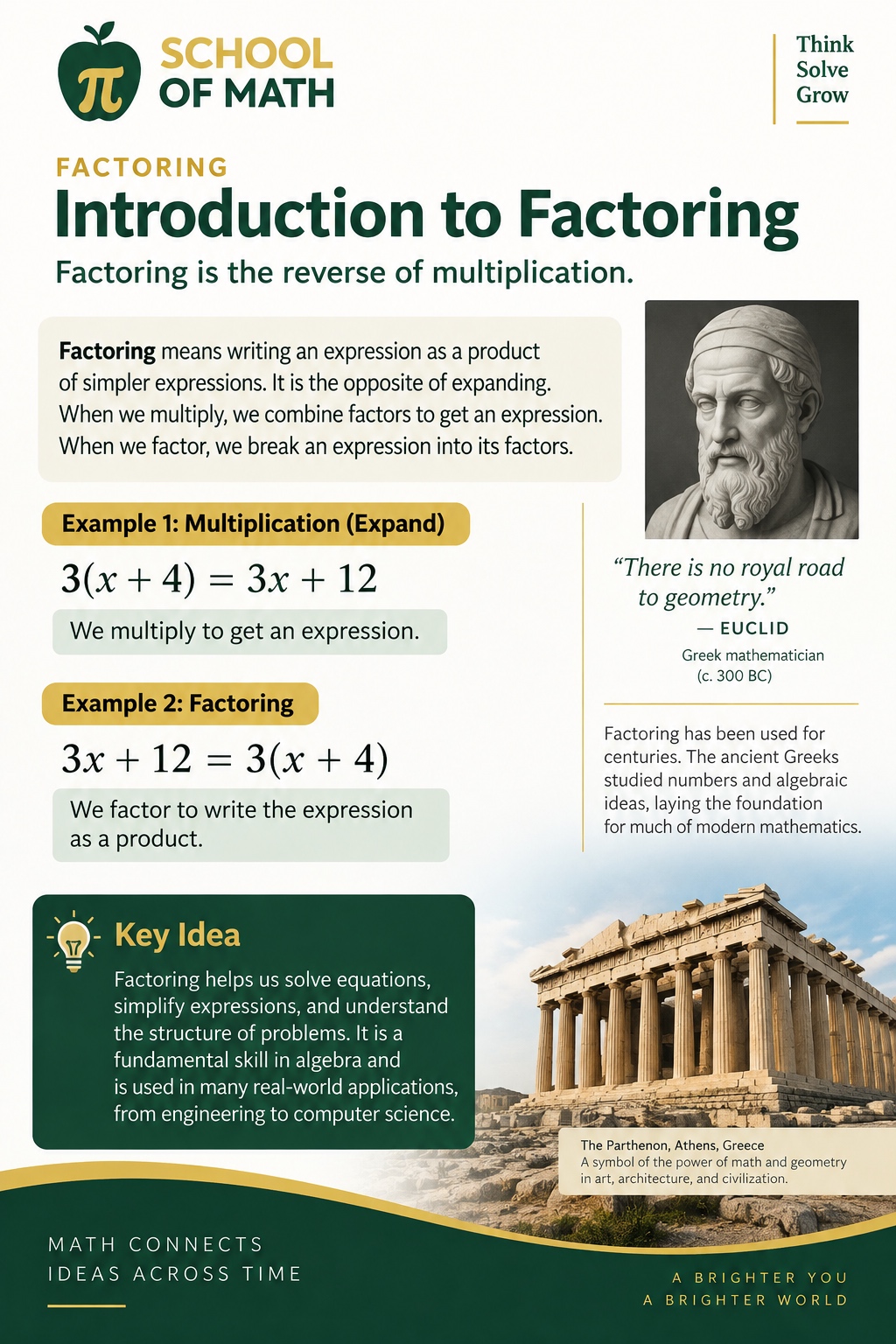
Theory — Factoring is the reverse of multiplication
Factoring means writing an expression as a product of simpler expressions. It is the opposite of expanding.
- When we multiply / expand, we combine factors to get an expression: 3(x + 4) = 3x + 12.
- When we factor, we break an expression into its factors: 3x + 12 = 3(x + 4).
The two operations undo each other. If you factor a polynomial and then re-distribute (or FOIL), you should get the original expression exactly. That is the built-in check for every factoring answer in Algebra 1.
Why we factor. Factoring lets us solve equations (Class 14 uses the zero-product property: if A · B = 0, then A = 0 or B = 0), simplify rational expressions, find x-intercepts of parabolas, and see the structure of a problem. It is the single most-used tool from Algebra 1 through Calculus.
Q1
Factoring is the reverse of which operation?
Answer: multiplication (also called expanding or distributing).
Multiplication takes factors and combines them into one expression: 3(x + 4) = 3x + 12. Factoring reverses this: 3x + 12 = 3(x + 4). If you distribute a factored answer, you should get the original expression back — that is how you check every factoring problem.
Q2
Expand 5(x + 2).
Answer: 5x + 10.
Distribute the 5 to each term inside the parentheses: 5 · x + 5 · 2 = 5x + 10. Notice that if we now go the other way and factor 5x + 10, we get 5(x + 2) back — the two operations are reverses.
Q3
Factor 5x + 10.
Answer: 5(x + 2).
The largest number that divides both 5 and 10 is 5. Pull 5 out of each term: 5x ÷ 5 = x and 10 ÷ 5 = 2. So 5x + 10 = 5(x + 2). Check: distribute the 5 back: 5(x + 2) = 5x + 10. Matches the original — done.
Q4
True or false: If you factor a polynomial correctly and then re-distribute, you should get the original expression back.
Answer: True.
Factoring and distributing are inverse operations, so distributing a correctly factored answer always returns the original expression. This is the built-in check for every factoring problem in Algebra 1: after you factor, FOIL or distribute the answer and confirm you got back what you started with. If you don’t, the factoring is wrong.
Q5
Write 4x + 20 as a product of two simpler expressions.
Answer: 4(x + 5).
The largest number that divides both 4 and 20 is 4. Divide each term by 4: 4x ÷ 4 = x and 20 ÷ 4 = 5. So 4x + 20 = 4(x + 5). Check: 4(x + 5) = 4x + 20. ✓ The two simpler expressions in the product are 4 and (x + 5).
2. Finding the greatest common factor (GCF)
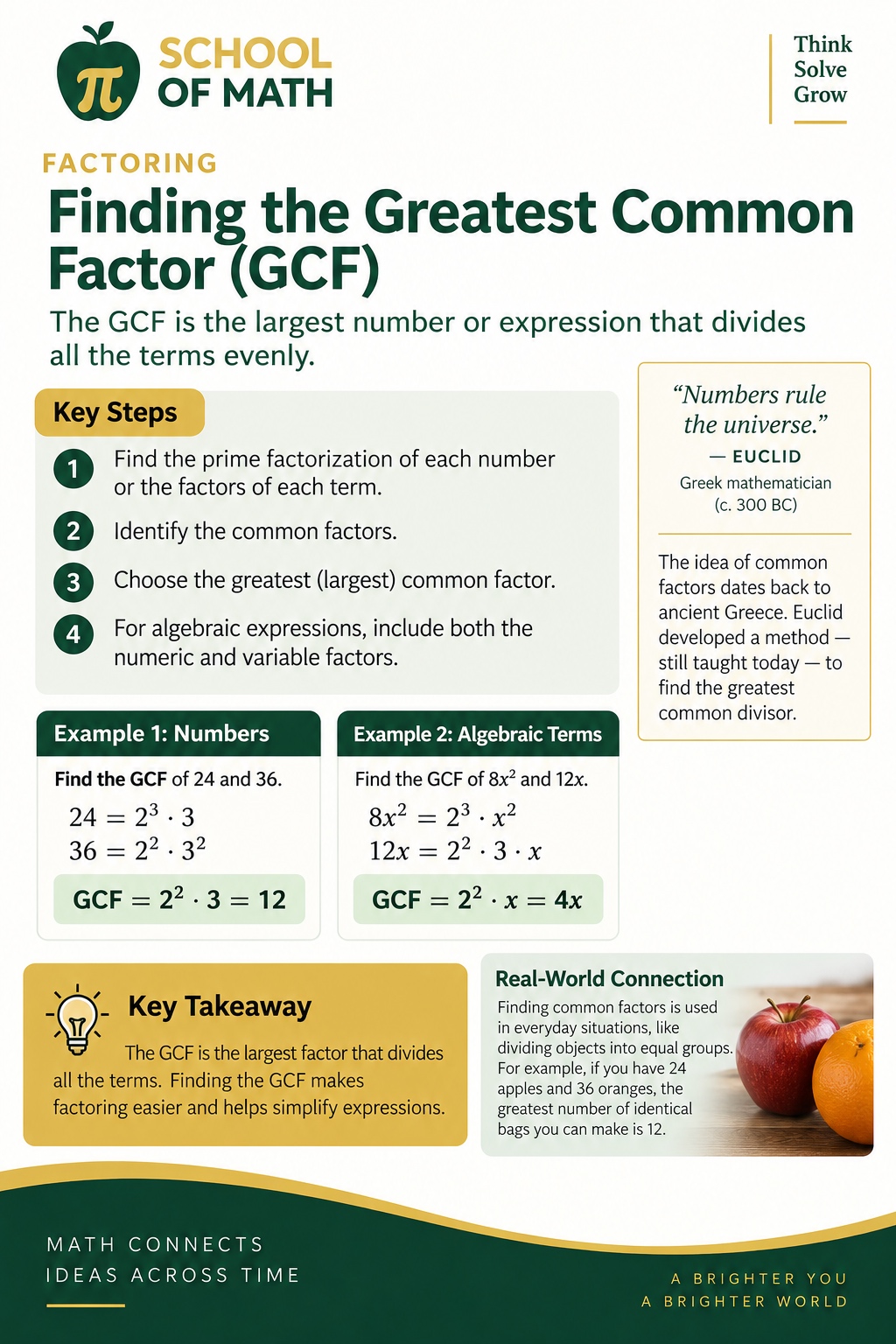
Theory — The GCF is the largest factor shared by every term
The greatest common factor (GCF) of a set of numbers or algebraic terms is the largest number or expression that divides every one of them evenly.
4-step method:
- Find the prime factorization of each numeric coefficient (or list the factors).
- Identify which prime factors appear in every term.
- Choose the greatest (largest power) of each shared prime.
- For algebraic terms, include the variable that appears in every term, using its smallest exponent.
Example 1 (numbers). GCF of 24 and 36:
24 = 2³ · 3 36 = 2² · 3² → GCF = 2² · 3 = 12Example 2 (algebraic terms). GCF of 8x² and 12x:
8x² = 2³ · x² 12x = 2² · 3 · x → GCF = 2² · x = 4xKey rule: if a variable is missing from any term, it cannot be part of the GCF. And for variables that appear in every term, take the smallest exponent (never the largest).
Q1
Find the GCF of 12 and 18.
Answer: 6.
Prime factor each: 12 = 2² · 3 and 18 = 2 · 3². Shared primes are 2 (smallest power = 2¹) and 3 (smallest power = 3¹). So GCF = 2 · 3 = 6.
Q2
Find the GCF of 15 and 25.
Answer: 5.
Prime factor: 15 = 3 · 5 and 25 = 5². The only shared prime is 5 (smallest power 5¹). GCF = 5. Notice: 3 is a factor of 15 but not 25, so 3 is not in the GCF.
Q3
Find the GCF of 6x³ and 9x².
Answer: 3x².
Numeric: 6 = 2 · 3, 9 = 3² → numeric GCF = 3. Variable: both have x; the smallest exponent is 2. So the variable part is x². Combine: GCF = 3x². Not 3x³ — you take the SMALLEST shared exponent, not the largest.
Q4
Find the GCF of 10a²b and 15ab³.
Answer: 5ab.
Numeric: 10 = 2 · 5, 15 = 3 · 5 → numeric GCF = 5. Variables: both have a (smallest exponent 1) and both have b (smallest exponent 1). So variable part = ab. Combine: GCF = 5ab.
Q5 Error analysis
A student claims the GCF of 4x²y and 6xy² is 2x²y². What did they get wrong, and what is the correct GCF?
Answer: they used the LARGEST exponent for each variable instead of the smallest. Correct GCF = 2xy.
Numeric GCF of 4 and 6 is 2 — that part is correct. But for variables, you take the smallest shared exponent, not the largest. Both terms have x (smallest = x¹) and both have y (smallest = y¹). So the variable part is xy, not x²y². Correct GCF = 2xy. Sanity check: 2xy divides 4x²y (gives 2x) and 6xy² (gives 3y) evenly, but 2x²y² does NOT divide 6xy² evenly. Smallest exponent wins.
3. Factoring out the GCF
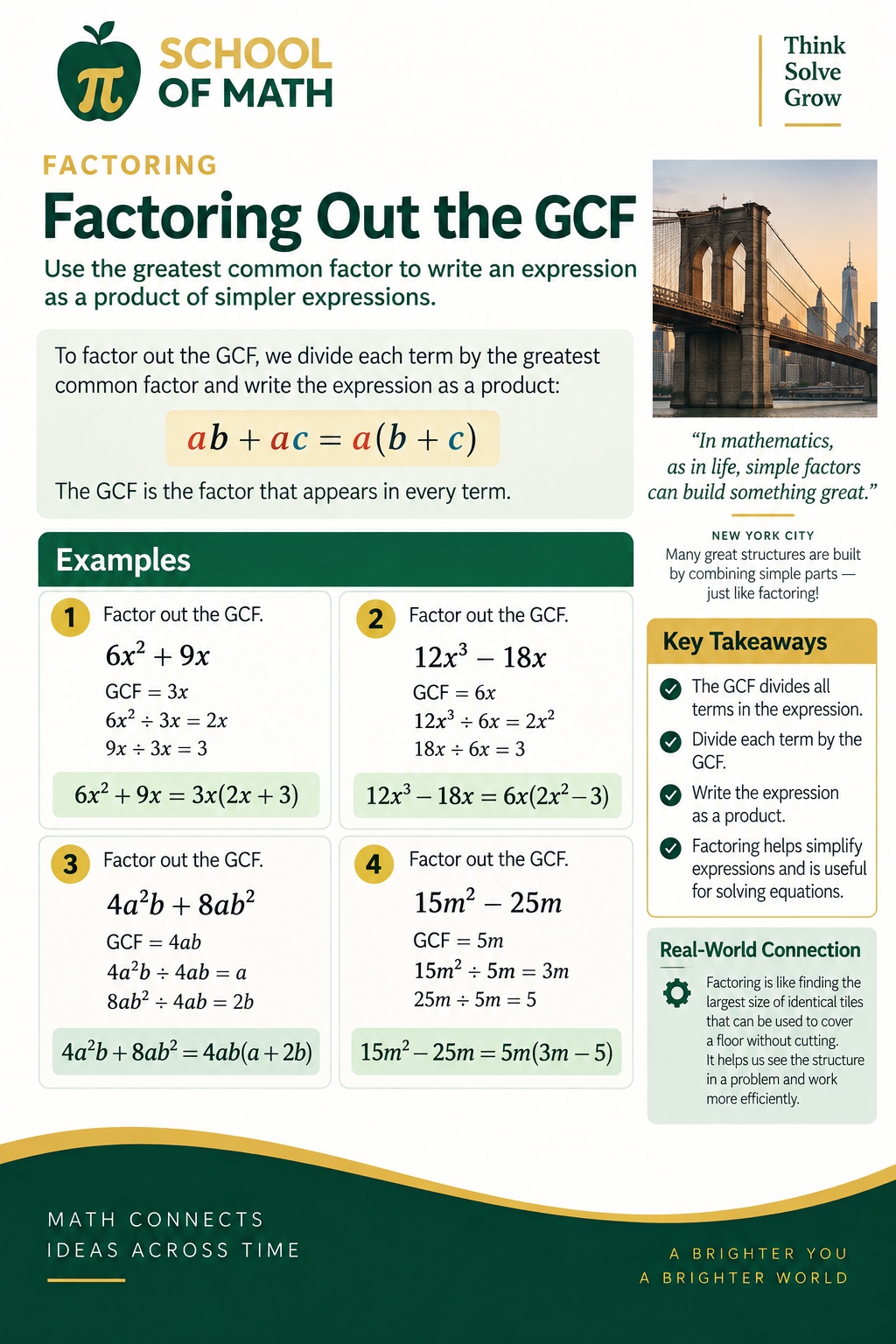
Theory — ab + ac = a(b + c)
Once you know the GCF, factoring it out is a 3-step move:
- Write the GCF outside a pair of parentheses.
- Divide every term of the original expression by the GCF.
- Write the quotients (in the same order, with their signs) inside the parentheses.
General pattern:
ab + ac = a(b + c)The a is the GCF; b and c are what is left in each term after dividing by the GCF.
Worked example. Factor 6x² + 9x.
- GCF = 3x (numeric GCF 3, variable GCF x).
- Divide each term: 6x² ÷ 3x = 2x and 9x ÷ 3x = 3.
- Write: 6x² + 9x = 3x(2x + 3).
Check by distributing: 3x(2x + 3) = 6x² + 9x. ✓
Q1
Factor 6x² + 9x.
Answer: 3x(2x + 3).
GCF = 3x. Divide each term: 6x² ÷ 3x = 2x and 9x ÷ 3x = 3. Write GCF outside, quotients inside: 3x(2x + 3). Check: 3x(2x + 3) = 6x² + 9x. ✓
Q2
Factor 12x³ − 18x.
Answer: 6x(2x² − 3).
Numeric GCF of 12 and 18 is 6. Variable GCF: smallest x-exponent is 1, so x. Overall GCF = 6x. Divide: 12x³ ÷ 6x = 2x² and 18x ÷ 6x = 3. Answer: 6x(2x² − 3) — keep the minus sign inside. Check: 6x(2x² − 3) = 12x³ − 18x. ✓
Q3
Factor 4a²b + 8ab².
Answer: 4ab(a + 2b).
Numeric GCF of 4 and 8 is 4. Variables: both have a (smallest exponent 1) and b (smallest exponent 1) → ab. Overall GCF = 4ab. Divide: 4a²b ÷ 4ab = a and 8ab² ÷ 4ab = 2b. Answer: 4ab(a + 2b). Check: 4ab(a + 2b) = 4a²b + 8ab². ✓
Q4
Factor 15m² − 25m.
Answer: 5m(3m − 5).
Numeric GCF of 15 and 25 is 5. Variable: both terms have m, smallest exponent 1 → m. Overall GCF = 5m. Divide: 15m² ÷ 5m = 3m and 25m ÷ 5m = 5. Answer: 5m(3m − 5). Check: 5m(3m − 5) = 15m² − 25m. ✓
Q5 Three terms
Factor 6x² + 9x + 12.
Answer: 3(2x² + 3x + 4).
Look at the numeric coefficients 6, 9, 12. GCF of {6, 9, 12} = 3. For variables: the constant term 12 has NO x, so x cannot be part of the GCF at all. Overall GCF = 3. Divide each term: 6x² ÷ 3 = 2x², 9x ÷ 3 = 3x, 12 ÷ 3 = 4. Answer: 3(2x² + 3x + 4). Check: 3(2x² + 3x + 4) = 6x² + 9x + 12. ✓ The inside trinomial does not factor further with integers, so this is fully factored.
4. Factoring with negative GCFs
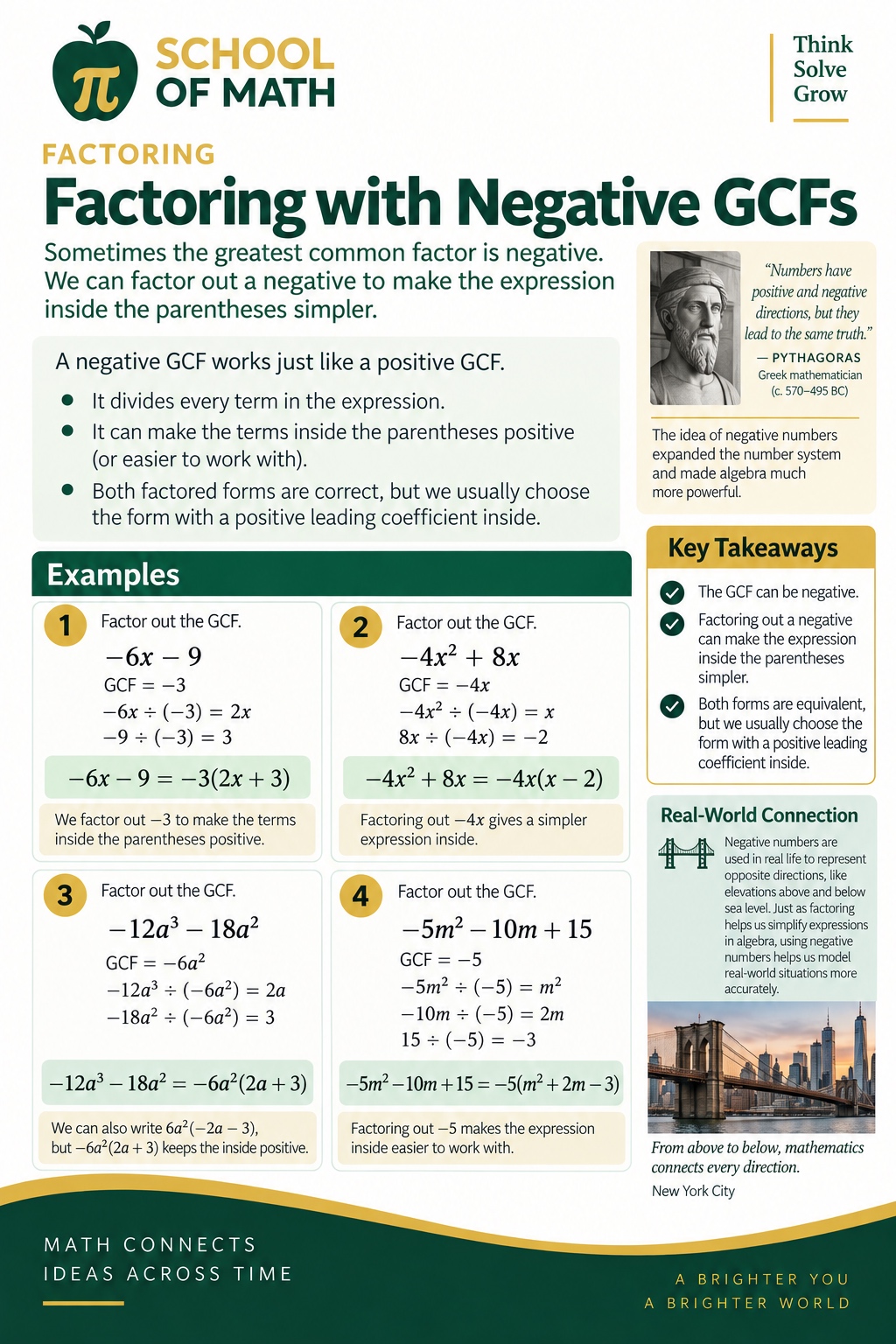
Theory — When and why to pull out a negative
A GCF can be negative. Both positive-GCF and negative-GCF factorings are algebraically correct and equivalent, but the negative-GCF form is preferred when it makes the leading coefficient inside the parentheses positive.
- A negative GCF works exactly like a positive GCF — it divides every term of the expression.
- It flips every sign inside the parentheses (dividing by a negative changes each sign).
- Both factored forms are correct, but the form with a positive leading coefficient inside is the convention.
Worked example. Factor −4x² + 8x.
- Choose GCF = −4x so the leading term inside will be positive.
- Divide: −4x² ÷ (−4x) = x and 8x ÷ (−4x) = −2.
- Write: −4x² + 8x = −4x(x − 2).
Check: −4x(x − 2) = −4x² + 8x. ✓
Q1
Factor −6x − 9 using a negative GCF.
Answer: −3(2x + 3).
Choose GCF = −3 so the leading term inside is positive. Divide: −6x ÷ (−3) = 2x and −9 ÷ (−3) = 3. Answer: −3(2x + 3). Check: −3(2x + 3) = −6x − 9. ✓
Q2
Factor −4x² + 8x.
Answer: −4x(x − 2).
Choose GCF = −4x. Divide: −4x² ÷ (−4x) = x and 8x ÷ (−4x) = −2. Answer: −4x(x − 2). Check: −4x(x − 2) = −4x² + 8x. ✓ Notice how the +8x flipped sign to become −2 inside — dividing by a negative always flips.
Q3
Factor −12a³ − 18a².
Answer: −6a²(2a + 3).
Numeric GCF of 12 and 18 is 6; take it negative to flip the leading sign. Variables: smallest a-exponent is 2. So GCF = −6a². Divide: −12a³ ÷ (−6a²) = 2a and −18a² ÷ (−6a²) = 3. Answer: −6a²(2a + 3). Check: −6a²(2a + 3) = −12a³ − 18a². ✓
Q4
Factor −5m² − 10m + 15.
Answer: −5(m² + 2m − 3).
Numeric GCF of 5, 10, 15 is 5; take it negative to flip the leading sign. The constant term 15 has no m, so no variable in the GCF. GCF = −5. Divide: −5m² ÷ (−5) = m², −10m ÷ (−5) = 2m, 15 ÷ (−5) = −3. Answer: −5(m² + 2m − 3). Check: −5(m² + 2m − 3) = −5m² − 10m + 15. ✓
Q5 Error analysis
A student factored −4x² + 8x as −4x(x + 2). What did they get wrong?
Answer: they forgot to flip the sign of the +8x when dividing by −4x. The correct factoring is −4x(x − 2).
Check by distributing their answer: −4x(x + 2) = −4x² − 8x — that gives minus 8x, not plus 8x. Dividing +8x by −4x gives −2, so the inside should be (x − 2). Correct answer: −4x(x − 2). This is the #1 sign mistake in Class 12 — always FOIL / distribute your answer at the end.
5. Recognizing perfect squares
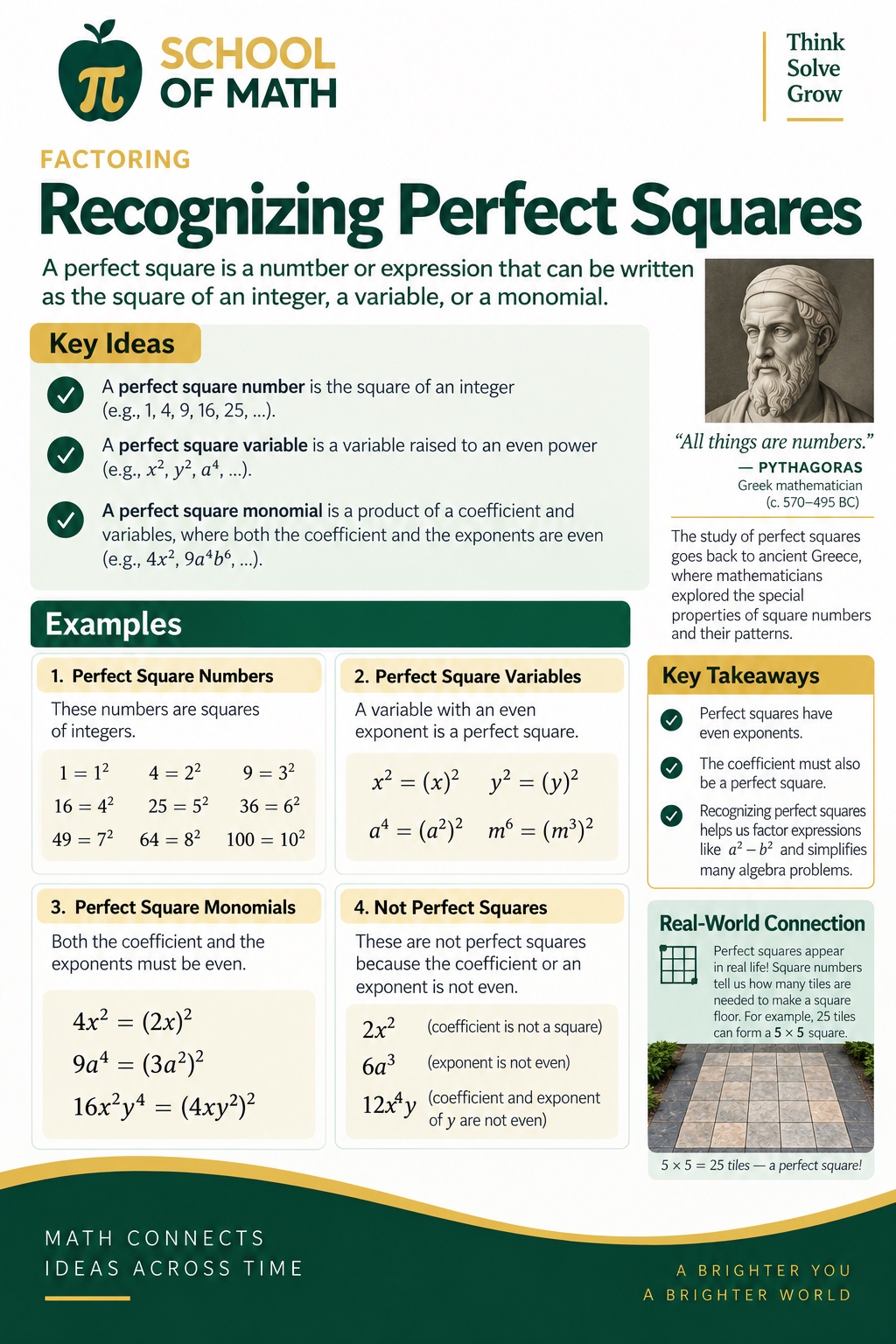
Theory — What makes an expression a perfect square?
A perfect square is a number, variable, or monomial that can be written as something squared.
- Perfect-square numbers are squares of integers: 1, 4, 9, 16, 25, 36, 49, 64, 81, 100, 121, 144, 169, 196, 225…. Memorize at least the first 15.
- Perfect-square variables are variables raised to an even power: x², y², a⁴, m⁶, x⁸…
- Perfect-square monomials have BOTH a perfect-square coefficient AND all exponents even: 4x² = (2x)², 9a⁴ = (3a²)², 16x²y⁴ = (4xy²)².
Not perfect squares:
- 2x² — coefficient 2 is not a square.
- 6a³ — exponent 3 is not even.
- 12x⁴y — coefficient 12 is not a square AND the y-exponent 1 is not even.
Why this matters: the difference of squares pattern (next poster) only works when both terms are perfect squares. Recognizing them at a glance is the whole game.
Q1
Is 49 a perfect square? If so, what is its square root?
Answer: yes. 49 = 7², so the square root is 7.
Perfect-square numbers you should memorize through 15² = 225: 1, 4, 9, 16, 25, 36, 49, 64, 81, 100, 121, 144, 169, 196, 225. Owning this list makes every difference-of-squares problem 3× faster.
Q2
Is x⁶ a perfect square? If so, write it as (something)².
Answer: yes. x⁶ = (x³)².
A variable raised to an even power is a perfect square, and the exponent inside the square is half the original. Here 6 ÷ 2 = 3, so x⁶ = (x³)². Check: (x³)² = x³ · x³ = x&sup6;. ✓
Q3
Is 9a⁴ a perfect square? If so, write it as (something)².
Answer: yes. 9a⁴ = (3a²)².
Coefficient: 9 = 3². Variable: a-exponent 4 is even, half is 2, so a⁴ = (a²)². Combine: 9a⁴ = (3a²)². Check: (3a²)² = 9a⁴. ✓
Q4
Is 6a³ a perfect square? Explain.
Answer: no.
Two reasons, either one enough. (1) 6 is not a perfect-square number: √6 is irrational. (2) The exponent 3 is odd, and a perfect-square variable must have an even exponent. Both problems together mean 6a³ is not a perfect square, so the difference-of-squares pattern will NOT work on any term containing 6a³.
Q5
Is 16x²y⁴ a perfect square? If so, write it as (something)².
Answer: yes. 16x²y⁴ = (4xy²)².
Coefficient: 16 = 4². Variables: x-exponent 2 is even (half = 1, so x¹ = x); y-exponent 4 is even (half = 2, so y²). Combine: (4xy²)². Check: (4xy²)² = 16x²y⁴. ✓
6. The difference of squares
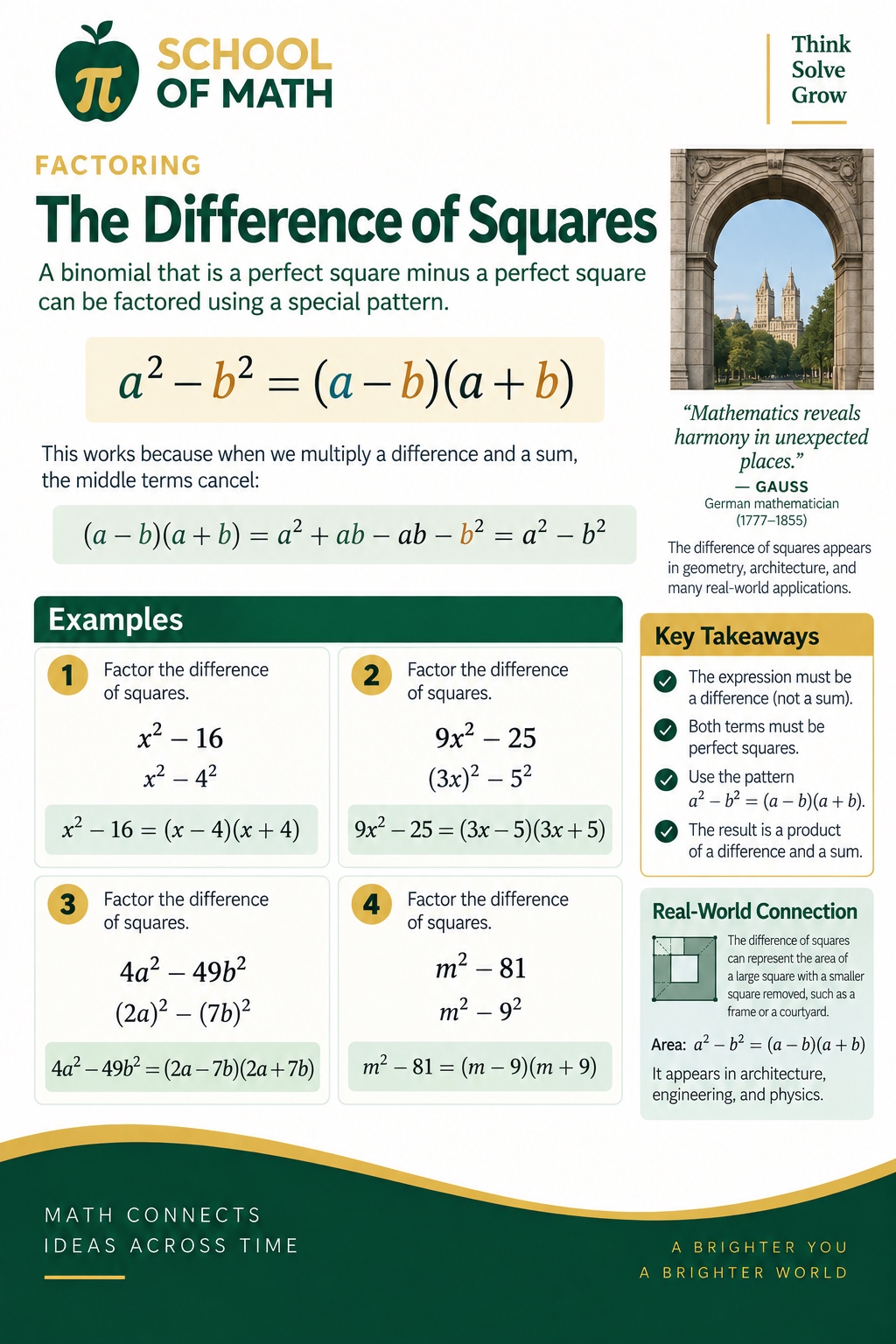
Theory — a² − b² = (a − b)(a + b)
A binomial that is a perfect square minus another perfect square factors using the difference-of-squares pattern:
a² − b² = (a − b)(a + b)Why it works. FOIL the right side:
(a − b)(a + b) = a² + ab − ab − b² = a² − b²The two middle terms (+ab and −ab) cancel, leaving a² − b².
Three requirements before you can use the pattern:
- The expression is a binomial (two terms).
- The two terms are connected by subtraction, not addition. A sum of squares a² + b² does NOT factor over the real numbers.
- Both terms are perfect squares — use Poster 5 to check.
Recipe: take the square root of each term to find a and b, then write (a − b)(a + b).
Q1
Is x² − 25 a difference of squares? If yes, name a and b.
Answer: yes. a = x, b = 5.
Binomial? Yes. Subtraction? Yes. Both perfect squares? x² = (x)² and 25 = 5². All three requirements met, so the pattern applies with a = x and b = 5. That means x² − 25 = (x − 5)(x + 5) (Q of Poster 7).
Q2
Is x² + 16 a difference of squares?
Answer: no.
Both terms ARE perfect squares (x² and 16 = 4²), but the expression is a sum, not a difference. The pattern a² − b² = (a − b)(a + b) requires a subtraction. A sum of squares a² + b² does NOT factor over the real numbers — it stays as it is.
Q3
Is 4x² − 9 a difference of squares? If yes, name a and b.
Answer: yes. a = 2x, b = 3.
Binomial with subtraction ✓. 4x² = (2x)² (coefficient 4 = 2², exponent 2 is even) ✓. 9 = 3² ✓. So a = 2x and b = 3. The factored form (Poster 7) will be (2x − 3)(2x + 3).
Q4
Is x² − 20 a difference of squares?
Answer: no.
Binomial with subtraction ✓. x² is a perfect square ✓. But 20 is NOT a perfect square (√20 ≈ 4.47, irrational). Both terms must be perfect squares, so the pattern does not apply and this binomial does not factor over the integers.
Q5 Two variables
Is 25a² − 49b² a difference of squares? If yes, name a and b.
Answer: yes. a = 5a and b = 7b (careful — two meanings of “a” and “b” here!).
The pattern letters a, b in a² − b² are placeholders, not the same as the variables a, b in the problem. Rewrite: 25a² = (5a)² and 49b² = (7b)². So the pattern letters are 5a and 7b. Factored form (Poster 7): (5a − 7b)(5a + 7b).
7. Factoring differences of squares
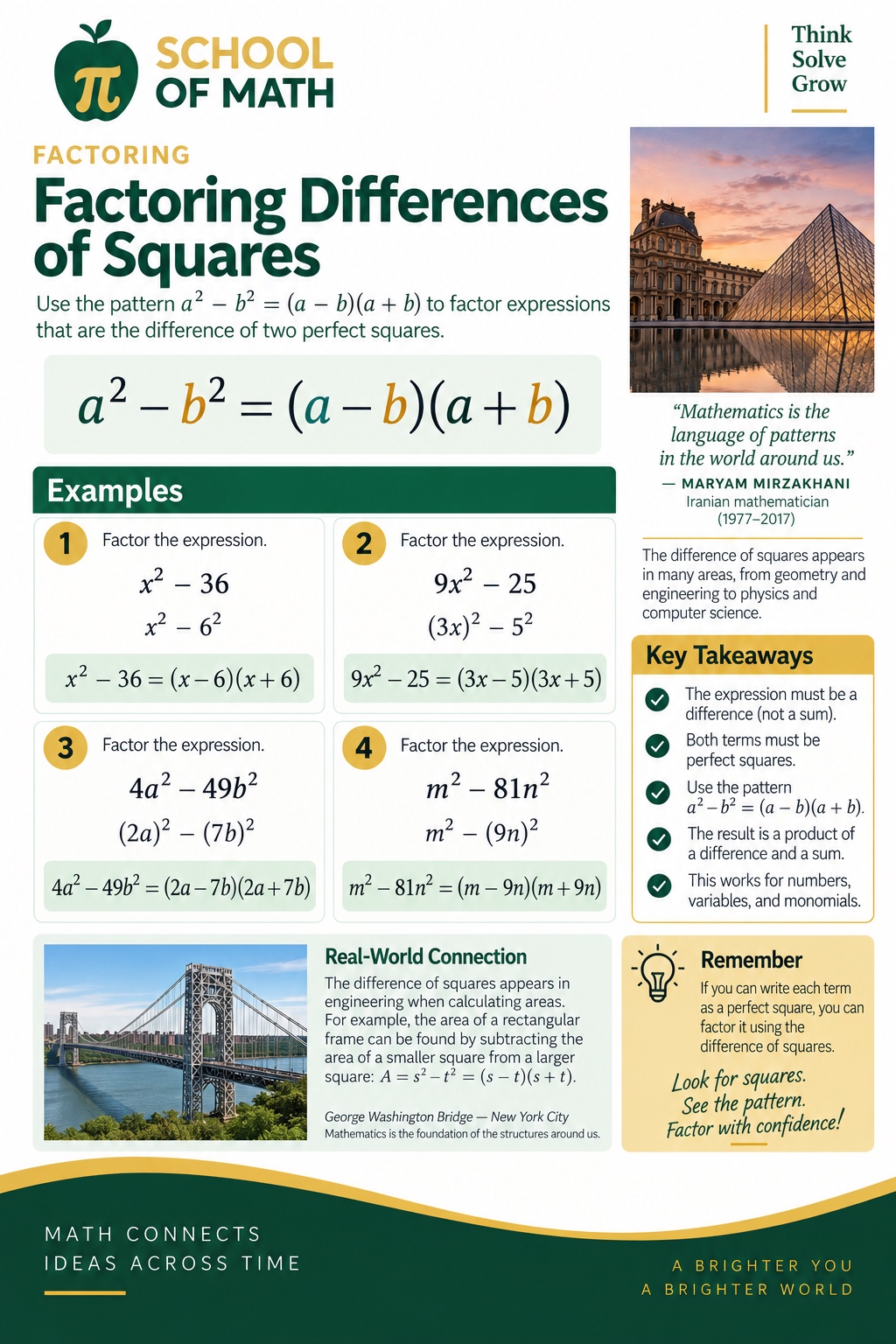
Theory — Using the pattern to factor
Once you have identified a and b (Poster 6), applying the pattern is a one-line move:
a² − b² = (a − b)(a + b)4-step recipe:
- Confirm both terms are perfect squares and the expression is a difference.
- Take the square root of the first term to get a.
- Take the square root of the second term to get b.
- Write (a − b)(a + b). Check by FOIL.
Order does not matter in the two factors — (a − b)(a + b) = (a + b)(a − b) — but write the subtraction first as a convention.
Q1
Factor x² − 36.
Answer: (x − 6)(x + 6).
x² = (x)² and 36 = 6². Apply pattern with a = x, b = 6: (x − 6)(x + 6). Check by FOIL: x² + 6x − 6x − 36 = x² − 36. ✓
Q2
Factor 9x² − 25.
Answer: (3x − 5)(3x + 5).
9x² = (3x)² (coefficient 9 = 3², variable exponent 2 is even) and 25 = 5². Apply pattern with a = 3x, b = 5: (3x − 5)(3x + 5). Check by FOIL: 9x² + 15x − 15x − 25 = 9x² − 25. ✓
Q3
Factor 4a² − 49b².
Answer: (2a − 7b)(2a + 7b).
4a² = (2a)² and 49b² = (7b)². Apply pattern with a = 2a, b = 7b: (2a − 7b)(2a + 7b). Check by FOIL: 4a² + 14ab − 14ab − 49b² = 4a² − 49b². ✓
Q4
Factor m² − 81n².
Answer: (m − 9n)(m + 9n).
m² = (m)² and 81n² = (9n)². Apply pattern with a = m, b = 9n: (m − 9n)(m + 9n). Check by FOIL: m² + 9mn − 9mn − 81n² = m² − 81n². ✓
Q5 Higher power
Factor x⁴ − 16. (Hint: apply the pattern twice.)
Answer: (x − 2)(x + 2)(x² + 4).
First pass: x⁴ = (x²)² and 16 = 4². Apply with a = x², b = 4: x⁴ − 16 = (x² − 4)(x² + 4). Second pass: x² − 4 is another difference of squares, a = x, b = 2 → (x − 2)(x + 2). The other factor x² + 4 is a SUM of squares and does not factor further over the reals. Full factoring: x⁴ − 16 = (x − 2)(x + 2)(x² + 4). Always check whether any factor can be factored again.
8. Factoring completely: GCF and difference of squares together
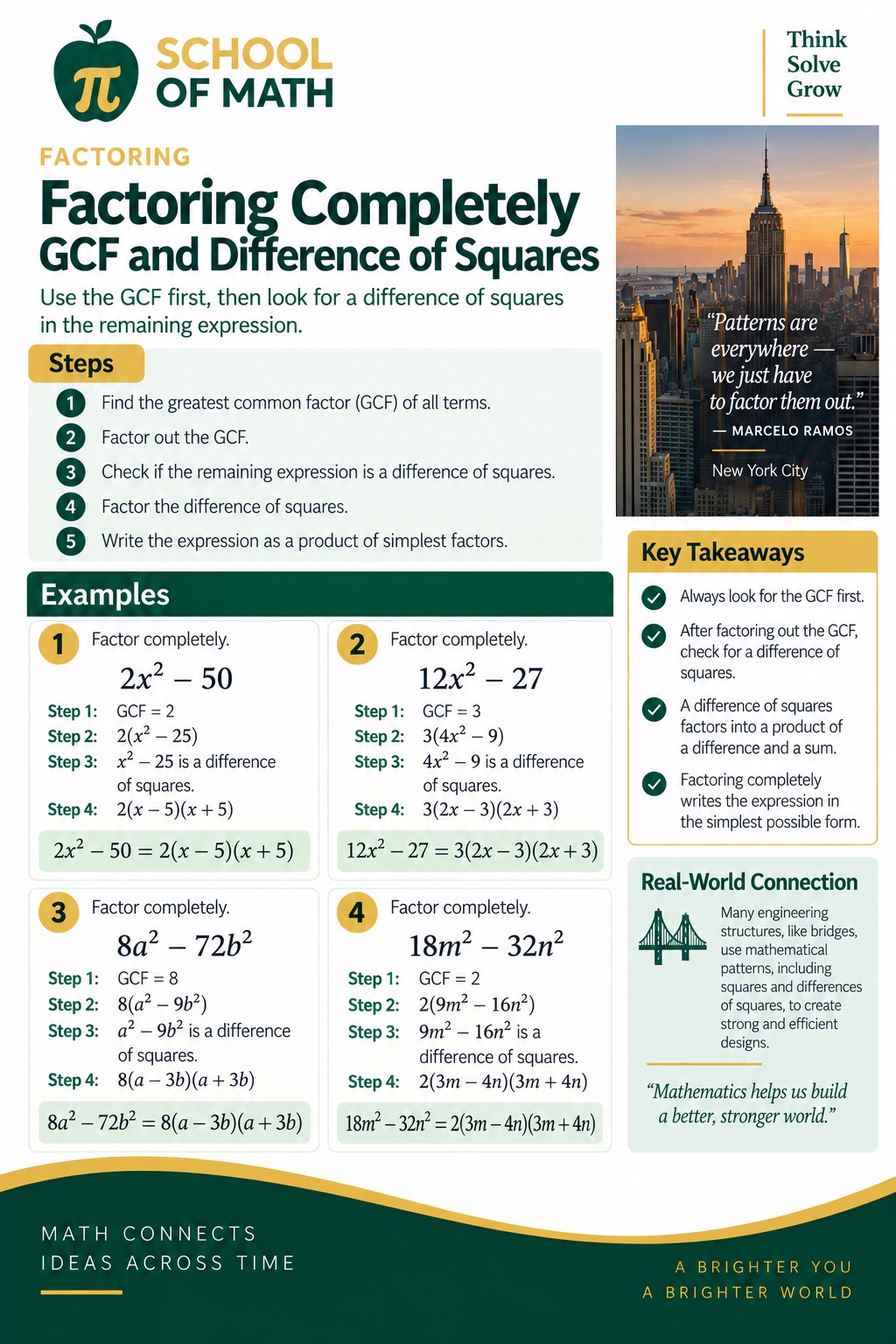
Theory — Always factor the GCF first, then look for the pattern
Many Algebra 1 problems combine both tools. Rule: always pull out the GCF first. If you skip this step, you can still get a “factored” answer, but it will not be completely factored.
5-step method:
- Find the GCF of all terms.
- Factor out the GCF.
- Look at what is left inside the parentheses — is it a difference of two perfect squares?
- If yes, apply the pattern to what is inside.
- Write the final answer as a product of the GCF and the fully-factored inside.
Worked example. Factor completely: 2x² − 50.
- GCF of {2, −50} = 2. No shared variable (the −50 has no x).
- Pull it out: 2x² − 50 = 2(x² − 25).
- Inside: x² − 25 is a difference of squares (a = x, b = 5).
- Apply the pattern: x² − 25 = (x − 5)(x + 5).
- Full answer: 2x² − 50 = 2(x − 5)(x + 5).
Why the GCF has to come first. If you tried the pattern directly on 2x² − 50, you would notice that 2x² is NOT a perfect square (coefficient 2 is not a square). The pattern fails. Pulling out the 2 first turns the inside into x² − 25, which IS a difference of squares.
Q1
Factor completely: 2x² − 50.
Answer: 2(x − 5)(x + 5).
Step 1: GCF = 2. Step 2: 2(x² − 25). Step 3: x² − 25 is a difference of squares with a = x, b = 5. Step 4: (x − 5)(x + 5). Step 5: full answer 2(x − 5)(x + 5). Check: 2(x − 5)(x + 5) = 2(x² − 25) = 2x² − 50. ✓
Q2
Factor completely: 12x² − 27.
Answer: 3(2x − 3)(2x + 3).
GCF of 12 and 27 is 3 (no shared variable). 12x² − 27 = 3(4x² − 9). Inside: 4x² = (2x)² and 9 = 3², difference of squares with a = 2x, b = 3 → (2x − 3)(2x + 3). Full answer: 3(2x − 3)(2x + 3). Check: 3(2x − 3)(2x + 3) = 3(4x² − 9) = 12x² − 27. ✓
Q3
Factor completely: 8a² − 72b².
Answer: 8(a − 3b)(a + 3b).
GCF of 8 and 72 is 8 (no shared variable — one term has a, the other has b). 8a² − 72b² = 8(a² − 9b²). Inside: a² = (a)² and 9b² = (3b)², difference of squares with pattern-a = a, pattern-b = 3b → (a − 3b)(a + 3b). Full answer: 8(a − 3b)(a + 3b).
Q4
Factor completely: 18m² − 32n².
Answer: 2(3m − 4n)(3m + 4n).
GCF of 18 and 32 is 2. 18m² − 32n² = 2(9m² − 16n²). Inside: 9m² = (3m)² and 16n² = (4n)², difference of squares with pattern-a = 3m, pattern-b = 4n → (3m − 4n)(3m + 4n). Full answer: 2(3m − 4n)(3m + 4n). Check: 2(3m − 4n)(3m + 4n) = 2(9m² − 16n²) = 18m² − 32n². ✓
Q5 Error analysis
A student factored 2x² − 50 as (2x − 10)(x + 5) by rewriting 2x² = (2x)(x) and 50 = 10 · 5. What did they get wrong?
Answer: they did not use the difference-of-squares pattern, and they did not factor out the GCF first. Correct: 2(x − 5)(x + 5).
Check their answer by FOIL: (2x − 10)(x + 5) = 2x² + 10x − 10x − 50 = 2x² − 50. Their factoring IS technically equivalent to the original, but it is not completely factored — the first factor still has a GCF of 2 (2x − 10 = 2(x − 5)). Pulling that out gives 2(x − 5)(x + 5), which is the fully factored form. Rule: always factor the GCF FIRST, then look for the pattern. Never skip step 1.
Bonus — 10 word problems, increasing difficulty
Ten original SOMATH word problems on GCF and difference-of-squares factoring, tagged Easy → Medium → Hard → Challenge. Every problem has a click-to-reveal step-by-step answer. Contexts include NYC rectangular gardens, sidewalk framing on the Upper West Side, physics distance formulas, and picture-frame area — the kind of setups the Regents Algebra 1 and SHSAT actually test.
W1 Easy
A rectangular UWS community garden bed has area 6x + 12 square feet. Its width is 6 feet. Write an expression for its length by factoring.
Answer: length = (x + 2) feet.
Area = length × width, so length = area ÷ width. Factor the area: GCF of 6 and 12 is 6, so 6x + 12 = 6(x + 2). Divide by the width 6: length = 6(x + 2) ÷ 6 = (x + 2) feet. Factoring turned a two-term expression into a product, which made the “undo multiplication” step obvious.
W2 Easy
A math teacher writes 8x² + 20x on the board and asks the class to factor it. What is the fully factored form?
Answer: 4x(2x + 5).
Numeric GCF of 8 and 20 is 4. Variable: both terms have x, smallest exponent 1. Overall GCF = 4x. Divide: 8x² ÷ 4x = 2x, 20x ÷ 4x = 5. Answer: 4x(2x + 5). Check: 4x(2x + 5) = 8x² + 20x. ✓
W3 Easy
A square backyard patio has side length x feet. A smaller square garden of side 4 feet is dug out of one corner. Write the remaining area as a difference of squares, then factor it.
Answer: remaining area = x² − 16 = (x − 4)(x + 4) square feet.
Big square area = x². Small square area = 4² = 16. Remaining = x² − 16, a difference of squares with a = x and b = 4. Factor: (x − 4)(x + 4). This is the classic geometry meaning of the difference-of-squares pattern.
W4 Medium
A rectangle has area 9x² − 25 square inches. Both its length and its width can be written as binomials in x. Find them.
Answer: length = (3x + 5) inches, width = (3x − 5) inches (or vice versa).
Recognize a difference of squares: 9x² = (3x)² and 25 = 5². Apply the pattern with a = 3x, b = 5: 9x² − 25 = (3x − 5)(3x + 5). Since area = length × width, the two dimensions are exactly these two factors. Check: (3x − 5)(3x + 5) = 9x² − 25. ✓
W5 Medium
A rectangular sidewalk in front of a UWS brownstone has area 2x² − 8 square feet. Factor the area completely to find its two dimensions.
Answer: dimensions 2(x − 2) ft and (x + 2) ft, or (x − 2) ft and 2(x + 2) ft.
Always GCF first: GCF of {2, −8} = 2. 2x² − 8 = 2(x² − 4). The inside is a difference of squares (a = x, b = 2): x² − 4 = (x − 2)(x + 2). Full: 2x² − 8 = 2(x − 2)(x + 2). Any of the three factors can be paired to be “length” and the rest “width”. Two natural groupings are shown in the answer.
W6 Medium
A physics distance formula gives distance as d = 16t² − 64, where t is time in seconds and d is in feet. Factor the expression on the right and find the value(s) of t that make d = 0.
Answer: d = 16(t − 2)(t + 2). d = 0 when t = 2 or t = −2.
GCF of 16 and 64 is 16: 16t² − 64 = 16(t² − 4). Inside is a difference of squares: t² − 4 = (t − 2)(t + 2). Full factoring: 16(t − 2)(t + 2). Set equal to zero and use the zero-product property (a product is zero iff at least one factor is zero): 16 is not zero, so t − 2 = 0 gives t = 2, and t + 2 = 0 gives t = −2. In physics t is a time and cannot be negative, so the only real-world solution is t = 2 seconds — but algebraically both roots exist.
W7 Hard
A picture frame is made by cutting a small square from the center of a larger square piece of cardboard. The large square has side 3x inches; the small (cutout) square has side 2 inches. Write the area of the frame (the leftover cardboard) as a factored expression.
Answer: frame area = (3x − 2)(3x + 2) square inches.
Frame area = big square area − small square area = (3x)² − 2² = 9x² − 4. This is a difference of squares with pattern-a = 3x and pattern-b = 2 → (3x − 2)(3x + 2). Check by FOIL: (3x − 2)(3x + 2) = 9x² + 6x − 6x − 4 = 9x² − 4. ✓
W8 Hard
A quadratic expression is 50 − 2x². Factor it completely. (Watch the order — is this really a difference of squares?)
Answer: −2(x − 5)(x + 5) (equivalently 2(5 − x)(5 + x)).
This is a difference of squares in disguise. Two clean paths.
Path A — factor out a positive GCF first. GCF of 50 and 2 is 2. 50 − 2x² = 2(25 − x²). The inside 25 − x² is a difference of squares with pattern-a = 5, pattern-b = x → (5 − x)(5 + x). So 50 − 2x² = 2(5 − x)(5 + x).
Path B — factor out a negative GCF first. Take −2: 50 − 2x² = −2(x² − 25). Now x² − 25 = (x − 5)(x + 5). So 50 − 2x² = −2(x − 5)(x + 5).
Both forms are correct and equivalent (multiply out both to see). Convention: many teachers prefer path B because the inside binomials both look like the standard difference-of-squares form (x − a)(x + a).
W9 Hard
A rectangle has length (2x + 3) and width (2x − 3). A second rectangle has area 4x² − 9. Are the two rectangles the same size? Explain using factoring.
Answer: yes — they have the same area.
Rectangle 1 area = length × width = (2x + 3)(2x − 3). This is a product of the form (a + b)(a − b), which expands to a² − b² with a = 2x and b = 3: (2x + 3)(2x − 3) = (2x)² − 3² = 4x² − 9. Rectangle 2 already has area 4x² − 9. Same expression, same area for every value of x. The difference-of-squares pattern works in BOTH directions — expand to check, factor to solve.
W10 Challenge · Word problem
A rectangular Central Park lawn has area 50x² − 200 square feet. The park department wants to know its two dimensions in terms of x so they can lay sod. Factor the area completely, then explain what the three factors mean for the shape of the lawn.
Answer: 50x² − 200 = 50(x − 2)(x + 2). Possible dimensions include 50 ft × (x − 2)(x + 2) ft, or 50(x − 2) ft × (x + 2) ft, or (x − 2) ft × 50(x + 2) ft.
Step 1: always GCF first. GCF of 50 and 200 is 50. 50x² − 200 = 50(x² − 4). Step 2: the inside x² − 4 is a difference of squares (a = x, b = 2): (x − 2)(x + 2). Step 3: full factoring 50(x − 2)(x + 2). Meaning: the area factors as a numeric scale (50) times a “shape factor” that depends on x. Any pairing of the three factors gives a valid length × width for the lawn. For the sod plan to be physical, x must be at least 3 (so that both x − 2 ≥ 1 and the width is positive). This problem uses BOTH tools from Class 12 in one story: GCF (Poster 3) then difference of squares (Poster 7), which is exactly the “factoring completely” pattern of Poster 8.
10. Frequently asked questions
What is factoring in Algebra 1 and why does my grade 7, 8, or 9 child need it?
Factoring means writing an expression as a product of simpler expressions — the reverse of multiplication (distributing / FOIL). If multiplication takes 3(x + 4) and expands it to 3x + 12, factoring takes 3x + 12 and rewrites it as 3(x + 4). Factoring is the single most-used tool in Algebra 1, Algebra 2, and beyond: it is how students solve quadratic equations, simplify rational expressions, find x-intercepts of parabolas, and set up problems for the quadratic formula. A student who cannot factor cannot solve most Algebra 1 word problems from Unit 6 onward.
How do I find the greatest common factor (GCF) of a polynomial?
Three steps. (1) Find the GCF of the numeric coefficients — use prime factorization if the numbers are big. (2) For each variable that appears in every term, take the smallest exponent. A variable missing from any term can’t be in the GCF at all. (3) Multiply the numeric GCF and the variable GCF together. Example: GCF of 8x² and 12x is 4x, because gcd(8, 12) = 4 and the smallest shared x-exponent is 1.
What is the difference of squares pattern?
The difference of squares pattern is a² − b² = (a − b)(a + b). It only works when (i) the expression is a subtraction and (ii) both terms are perfect squares. A perfect square is a number, variable, or monomial that is something squared — 25 is 5², x² is (x)², 4x² is (2x)². Warning: a² + b² (a SUM of squares) does NOT factor over the real numbers.
How do I know which factoring method to use?
Always look for the GCF first. Even if the problem looks like a difference of squares, factor the GCF out before you use the pattern — otherwise you will miss part of the answer. Example: 2x² − 50 looks like a difference of squares, but the GCF is 2. Factor it out: 2(x² − 25), then apply the pattern to the inside: 2(x − 5)(x + 5). Rule of thumb: (1) GCF first, always; (2) then check the remaining expression for a difference of squares; (3) if it is a trinomial, use trinomial factoring (Class 13).
Why do we sometimes factor out a negative GCF?
Factoring out a negative GCF is a stylistic choice that makes the expression inside the parentheses easier to work with — usually to force the leading coefficient inside to be positive. Example: −6x − 9 can be factored as 3(−2x − 3) OR −3(2x + 3). Both are correct, but −3(2x + 3) is preferred because everything inside is positive. This matters a lot in Algebra 2 when you set an expression equal to zero and use the zero-product property.
How does factoring in Algebra 1 connect to the SHSAT, SAT, and Regents Algebra 1?
Factoring is everywhere on all three exams. On the SHSAT and the Regents Algebra 1 (grades 8–9), factoring a difference of squares or pulling out a GCF appears throughout and is required to simplify most quadratic expressions. On the SAT (grades 10–12), factoring is how students solve quadratics in the Advanced Math section and simplify rational expressions in Problem Solving. A student who owns GCF and difference of squares in grade 8 walks into SHSAT prep with a real advantage — and into SAT prep two years later without a gap.
What are the most common factoring mistakes in Algebra 1?
Five mistakes we see every year at SOMATH. (1) Forgetting to factor out the GCF first. (2) Treating a SUM of squares like a difference of squares — x² + 16 does NOT factor over the reals. (3) Using the wrong smallest exponent when finding a variable GCF (thinking the GCF of x³ and x⁵ is x⁵ instead of x³). (4) Dropping a sign when factoring out a negative GCF (writing −4x² + 8x = −4x(x + 2) instead of −4x(x − 2)). (5) Not checking the factoring by re-multiplying (FOIL / distribute) at the end.
What Manhattan and Upper West Side algebra prep do you offer for grades 7–9?
SOMATH’s Young Fermats — Algebra 1 Ignite is a 48-class grade 7–9 algebra program taught in small in-person groups of 4–8 at 226 W 79th St on the Upper West Side of Manhattan, one block from the 1 train at 79th Street and steps from Booker T. Washington MS 54, MS 245, Anderson (M334), Salk (M255), and Mott Hall II (M223). Class 12 is factoring with the GCF and the difference of squares. The full arc builds toward Algebra II, SHSAT math, and eventually SAT math. Book a free 30-minute evaluation and we will send a written diagnostic within 48 hours.
What comes after Class 12 in the Algebra 1 Ignite arc?
Class 13 is trinomial factoring — x² + bx + c and ax² + bx + c — the third major factoring tool after GCF and difference of squares. Class 14 uses factoring plus the zero-product property to solve quadratic equations. Class 15 introduces the quadratic formula for the quadratics that will not factor. Later on, Algebra II Class 11 revisits factoring at a higher level with the Remainder and Factor Theorems. See our Algebra 1 Ignite course page for the full grade 7–9 arc.
About SOMATH — School of Math
SOMATH — School of Math is a math-focused school on the Upper West Side of Manhattan for students in grades 1–12. Class 12 is part of the Young Fermats — Algebra 1 Ignite arc (grades 7–9), taught in small groups by cofounder Marcelo Ambrozio (Northwestern-trained, 15+ years teaching NYC math and 20+ years preparing candidates for top MBA programs) and the SOMATH team, and led by cofounder Vivianne Wright (Harvard).
Location: 226 W 79th St, 1st Floor, New York, NY 10024 · Upper West Side · steps from Booker T. Washington MS 54, MS 245, Anderson, Salk, and Mott Hall II
Phone: (646) 668-6151 · Email: hello@schoolofmath.us
Book: Free evaluation · Schedule · Home
Related SOMATH posts
- Algebra 1 Class 11 — Polynomials: Adding, Subtracting, Multiplying (10 SOMATH Posters, Theory & 50 Practice Questions)
- Algebra II Class 11 — Factoring Polynomials & the Remainder and Factor Theorems (25 Practice Questions)
- Scientific Notation & Applications (Algebra 1 Ignite Class 10) — 25 Practice Questions
- Pre-Algebra Class 11 — Variables and Algebraic Expressions: Translating Words (8 Posters, 40 Practice Questions)
- Young Fermats — Algebra 1 Ignite course (grades 7–9) — full arc
- All SOMATH blog posts »