Algebra 1 · Class 19
Solving Quadratics by Completing the Square
Take half, square it, add it to both sides. Recognize perfect-square trinomials, find the missing constant, rewrite trinomials as squared binomials, and solve any quadratic by completing the square, including odd coefficients, leading coefficients other than 1, irrational answers and equations with no real solutions.
Work through eight illustrated topics with five fresh practice questions each, followed by Homework review and Homework word problems. There are 40 practice questions and 20 homework questions, all with hidden worked solutions and checks. Try each problem before opening its blue Answer control.
This is an independent topic in the Algebra 1 rolling syllabus; earlier class attendance is not required. Expand each squared binomial to check your work, and keep fractions and radicals exact. See the schedule or book an evaluation at SOMATH.
Download the student workbook (PDF)22 pages · Supplied cover, eight teaching images, all 60 questions · Generous blank working space · No exercise solutions
Recognizing perfect-square trinomials
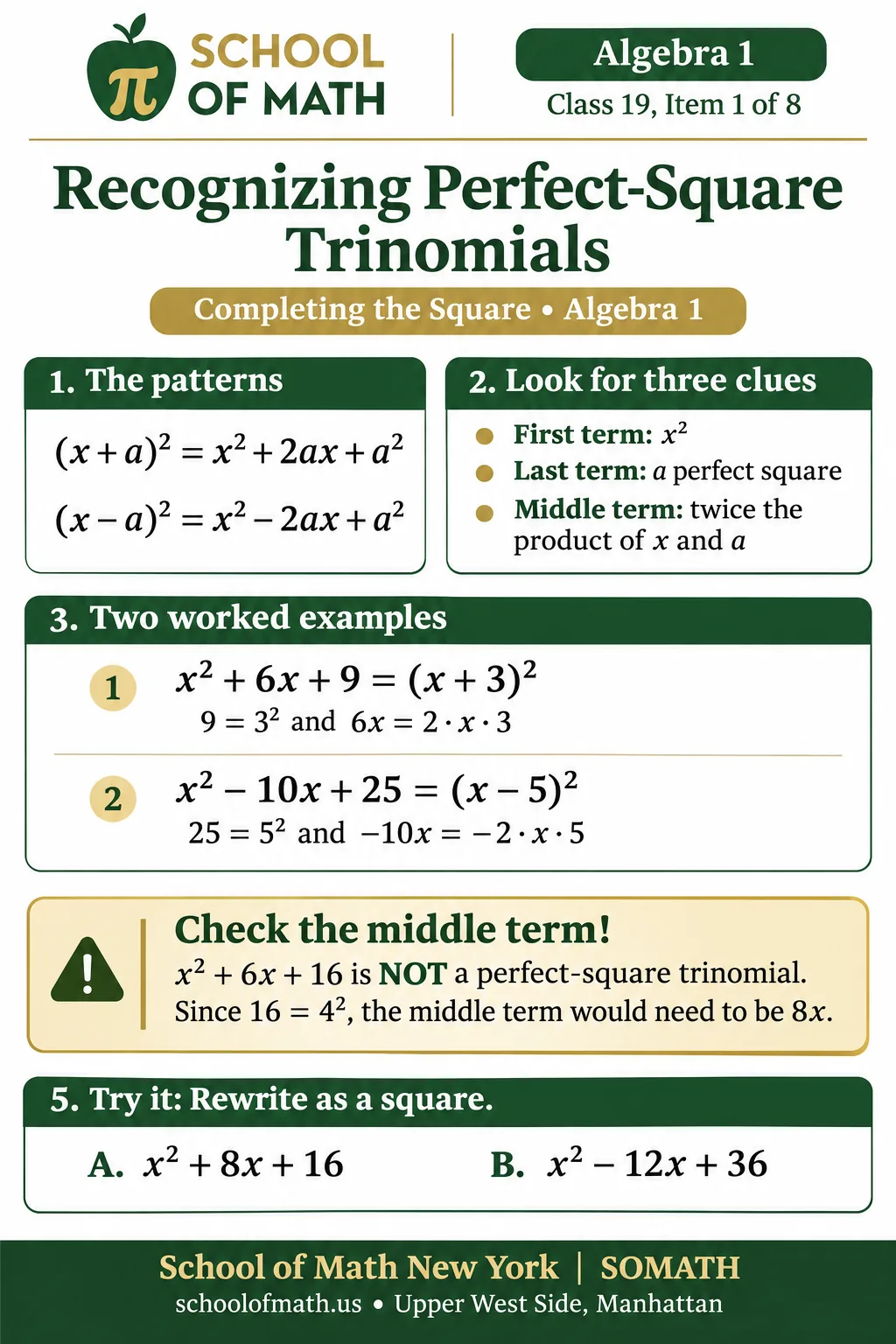
A perfect-square trinomial is what you get when you square a binomial. Multiplying out \((x + a)^2 = (x + a)(x + a)\) gives \(x^2 + ax + ax + a^2 = x^2 + 2ax + a^2\), and in the same way \((x - a)^2 = x^2 - 2ax + a^2\). Completing the square is the skill of building one of these on purpose, so the first step is learning to recognize them.
Check three clues. The first term is \(x^2\). The last term is a perfect square \(a^2\), and it is always positive. The middle term is exactly twice the product of \(x\) and \(a\), so its coefficient is \(2a\) or \(-2a\). The sign of the middle term tells you the sign inside the parentheses. If the constant is a perfect square but the middle term is not twice its square root, the trinomial is not a perfect square; that is the trap the poster warns about.
Practice: try these five questions
Q1
Is the trinomial a perfect square? If so, write it as a squared binomial.
Answer
\(\text{Yes: } (x + 9)^2\)
First term: \(x^2\). Last term: \(81 = 9^2\), a perfect square.
Middle term: \(2 \cdot x \cdot 9 = 18x\), which matches. The middle term is positive, so the sign inside is \(+\).
\[x^2 + 18x + 81 = (x + 9)^2\]
Q2
Is the trinomial a perfect square? If so, write it as a squared binomial.
Answer
\(\text{Yes: } (x - 11)^2\)
First term: \(x^2\). Last term: \(121 = 11^2\).
Middle term: \(-2 \cdot x \cdot 11 = -22x\), which matches. The middle term is negative, so the sign inside is \(-\).
\[x^2 - 22x + 121 = (x - 11)^2\]
Q3
Is the trinomial a perfect square? Explain.
Answer
\(\text{No}\)
The constant is a perfect square: \(36 = 6^2\).
For \((x + 6)^2\) the middle term would have to be \(2 \cdot x \cdot 6 = 12x\). The given middle term is \(10x\), so this is not a perfect-square trinomial.
\[(x + 6)^2 = x^2 + 12x + 36 \neq x^2 + 10x + 36\]
Q4
Is the trinomial a perfect square? Explain.
Answer
\(\text{No}\)
A perfect-square trinomial ends in \(+a^2\), which is always positive. Here the constant is \(-16\).
Compare: \((x - 4)^2 = x^2 - 8x + 16\). The sign of the constant does not match, so \(x^2 - 8x - 16\) is not a perfect square.
Q5
Find both values of \(b\) that make the trinomial a perfect square.
Answer
\(b = 24 \text{ or } b = -24\)
The constant is \(144 = 12^2\), so the binomial is \((x + 12)\) or \((x - 12)\).
Expand each one. The middle coefficient is \(2 \cdot 12 = 24\) or \(-24\).
\[(x + 12)^2 = x^2 + 24x + 144, \quad (x - 12)^2 = x^2 - 24x + 144\]
Finding the missing constant
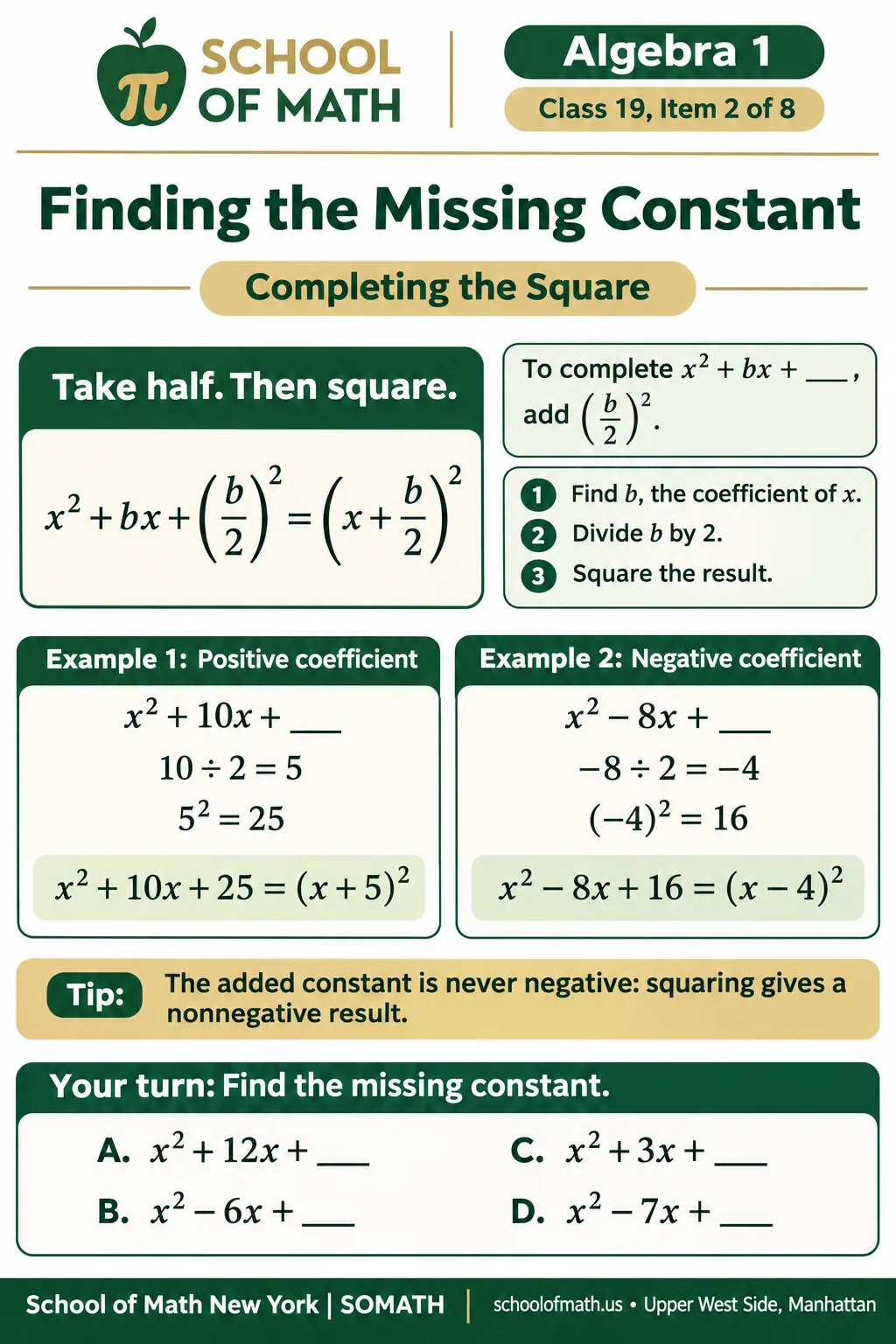
Comparing \(x^2 + bx + \underline{\quad}\) with \(x^2 + 2ax + a^2\) shows that \(b = 2a\), so \(a = \frac{b}{2}\). The constant that completes the square is therefore \(\left(\frac{b}{2}\right)^2\): find \(b\), divide it by 2, then square the result. The number \(\frac{b}{2}\) is also the number that goes inside the parentheses, so \(x^2 + bx + \left(\frac{b}{2}\right)^2 = \left(x + \frac{b}{2}\right)^2\).
Halving keeps the sign of \(b\), but squaring always gives a nonnegative number, so the constant you add is never negative. When \(b\) is odd, half of it is a fraction such as \(\frac{7}{2}\); keep it as an exact fraction and square the numerator and the denominator.
Practice: try these five questions
Q6
Find the constant that completes the square. Then write the result as a squared binomial.
Answer
\(64; \; x^2 + 16x + 64 = \left(x + 8\right)^2\)
Here \(b = 16\). Half of \(b\) is \(8\).
Square it: \(\left(8\right)^2 = 64\).
\[x^2 + 16x + 64 = \left(x + 8\right)^2\]
Q7
Find the constant that completes the square. Then write the result as a squared binomial.
Answer
\(49; \; x^2 - 14x + 49 = \left(x - 7\right)^2\)
Here \(b = -14\). Half of \(b\) is \(-7\).
Square it: \(\left(-7\right)^2 = 49\).
\[x^2 - 14x + 49 = \left(x - 7\right)^2\]
Q8
Find the constant that completes the square. Then write the result as a squared binomial.
Answer
\(\frac{25}{4}; \; x^2 + 5x + \frac{25}{4} = \left(x + \frac{5}{2}\right)^2\)
Here \(b = 5\). Half of \(b\) is \(\frac{5}{2}\).
Square it: \(\left(\frac{5}{2}\right)^2 = \frac{25}{4}\).
\[x^2 + 5x + \frac{25}{4} = \left(x + \frac{5}{2}\right)^2\]
Q9
Find the constant that completes the square. Then write the result as a squared binomial.
Answer
\(\frac{81}{4}; \; x^2 - 9x + \frac{81}{4} = \left(x - \frac{9}{2}\right)^2\)
Here \(b = -9\). Half of \(b\) is \(-\frac{9}{2}\).
Square it: \(\left(-\frac{9}{2}\right)^2 = \frac{81}{4}\).
\[x^2 - 9x + \frac{81}{4} = \left(x - \frac{9}{2}\right)^2\]
Q10
Find the constant that completes the square. Then write the result as a squared binomial.
Answer
\(\frac{1}{9}; \; x^2 + \frac{2}{3}x + \frac{1}{9} = \left(x + \frac{1}{3}\right)^2\)
Here \(b = \frac{2}{3}\). Half of \(b\) is \(\frac{1}{3}\).
Square it: \(\left(\frac{1}{3}\right)^2 = \frac{1}{9}\).
\[x^2 + \frac{2}{3}x + \frac{1}{9} = \left(x + \frac{1}{3}\right)^2\]
Rewriting expressions as perfect squares
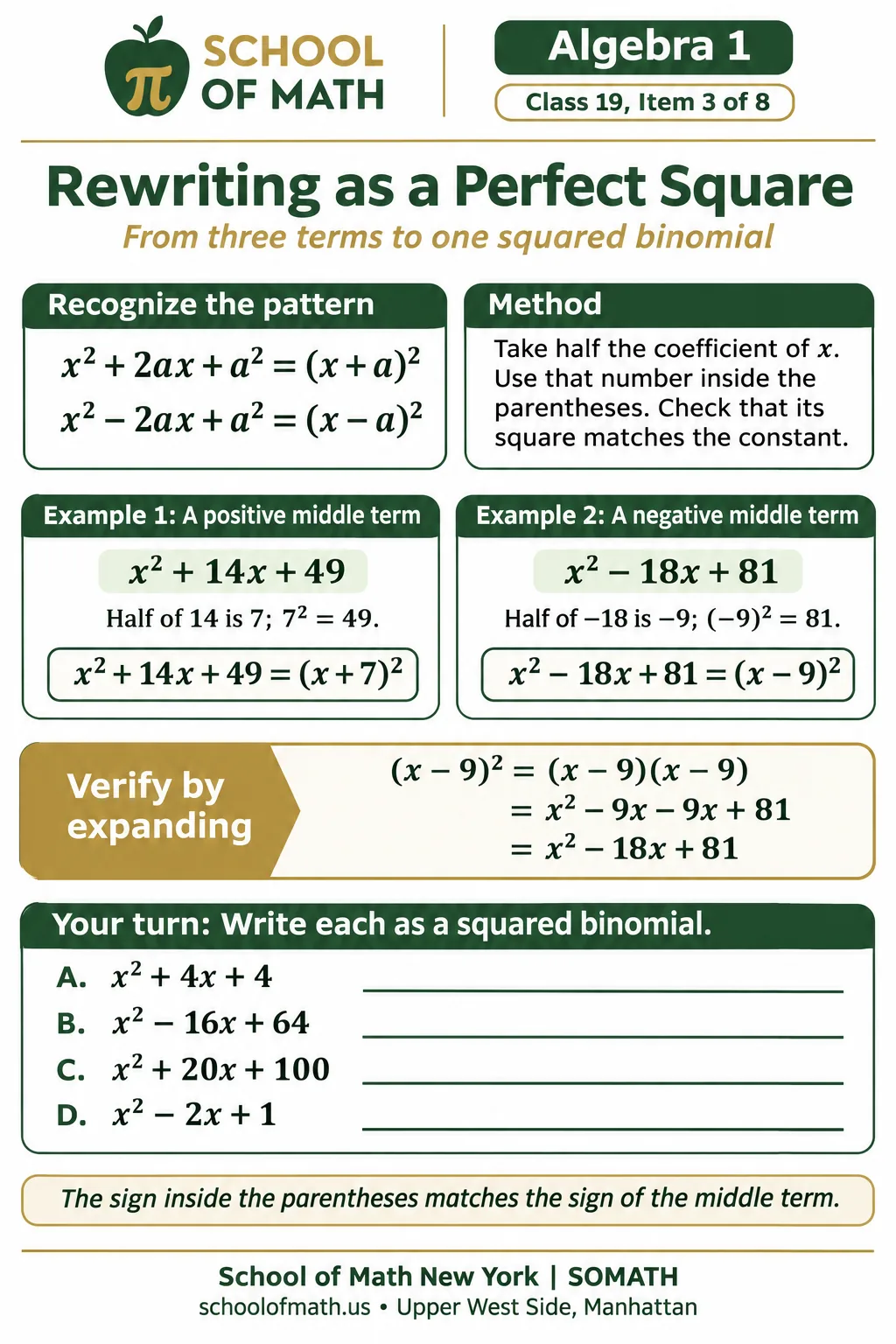
To write a perfect-square trinomial as a squared binomial, take half the coefficient of \(x\). That number, with its sign, goes inside the parentheses. Then confirm that its square equals the constant term. For example, in \(x^2 - 12x + 36\) half of \(-12\) is \(-6\) and \((-6)^2 = 36\), so the trinomial is \((x - 6)^2\).
Always verify by expanding: \((x - 6)^2 = (x - 6)(x - 6) = x^2 - 6x - 6x + 36 = x^2 - 12x + 36\). A common mistake is writing \((x - 6)^2 = x^2 + 36\); squaring a binomial always produces the middle term \(2ax\).
Practice: try these five questions
Q11
Write the trinomial as a squared binomial. Verify by expanding.
Answer
\(\left(x + 12\right)^2\)
Half of \(24\) is \(12\), and \(\left(12\right)^2 = 144\), which matches the constant.
\[x^2 + 24x + 144 = \left(x + 12\right)^2\]Verify by expanding.
\[\left(x + 12\right)\left(x + 12\right) = x^2 + 12x + 12x + 144 = x^2 + 24x + 144\]
Q12
Write the trinomial as a squared binomial. Verify by expanding.
Answer
\(\left(x - 13\right)^2\)
Half of \(-26\) is \(-13\), and \(\left(-13\right)^2 = 169\), which matches the constant.
\[x^2 - 26x + 169 = \left(x - 13\right)^2\]Verify by expanding.
\[\left(x - 13\right)\left(x - 13\right) = x^2 - 13x - 13x + 169 = x^2 - 26x + 169\]
Q13
Write the trinomial as a squared binomial. Verify by expanding.
Answer
\(\left(x + \frac{1}{2}\right)^2\)
Half of \(1\) is \(\frac{1}{2}\), and \(\left(\frac{1}{2}\right)^2 = \frac{1}{4}\), which matches the constant.
\[x^2 + x + \frac{1}{4} = \left(x + \frac{1}{2}\right)^2\]Verify by expanding.
\[\left(x + \frac{1}{2}\right)\left(x + \frac{1}{2}\right) = x^2 + \frac{1}{2}x + \frac{1}{2}x + \frac{1}{4} = x^2 + x + \frac{1}{4}\]
Q14
Write the trinomial as a squared binomial. Verify by expanding.
Answer
\(\left(x - \frac{11}{2}\right)^2\)
Half of \(-11\) is \(-\frac{11}{2}\), and \(\left(-\frac{11}{2}\right)^2 = \frac{121}{4}\), which matches the constant.
\[x^2 - 11x + \frac{121}{4} = \left(x - \frac{11}{2}\right)^2\]Verify by expanding.
\[\left(x - \frac{11}{2}\right)\left(x - \frac{11}{2}\right) = x^2 - \frac{11}{2}x - \frac{11}{2}x + \frac{121}{4} = x^2 - 11x + \frac{121}{4}\]
Q15
Fill in both blanks so the equation is true.
Answer
\(x^2 - 30x + 225 = (x - 15)^2\)
Half of \(-30\) is \(-15\), so the binomial is \(x - 15\).
Square it: \((-15)^2 = 225\).
\[x^2 - 30x + 225 = (x - 15)^2\]
Solving quadratics by completing the square
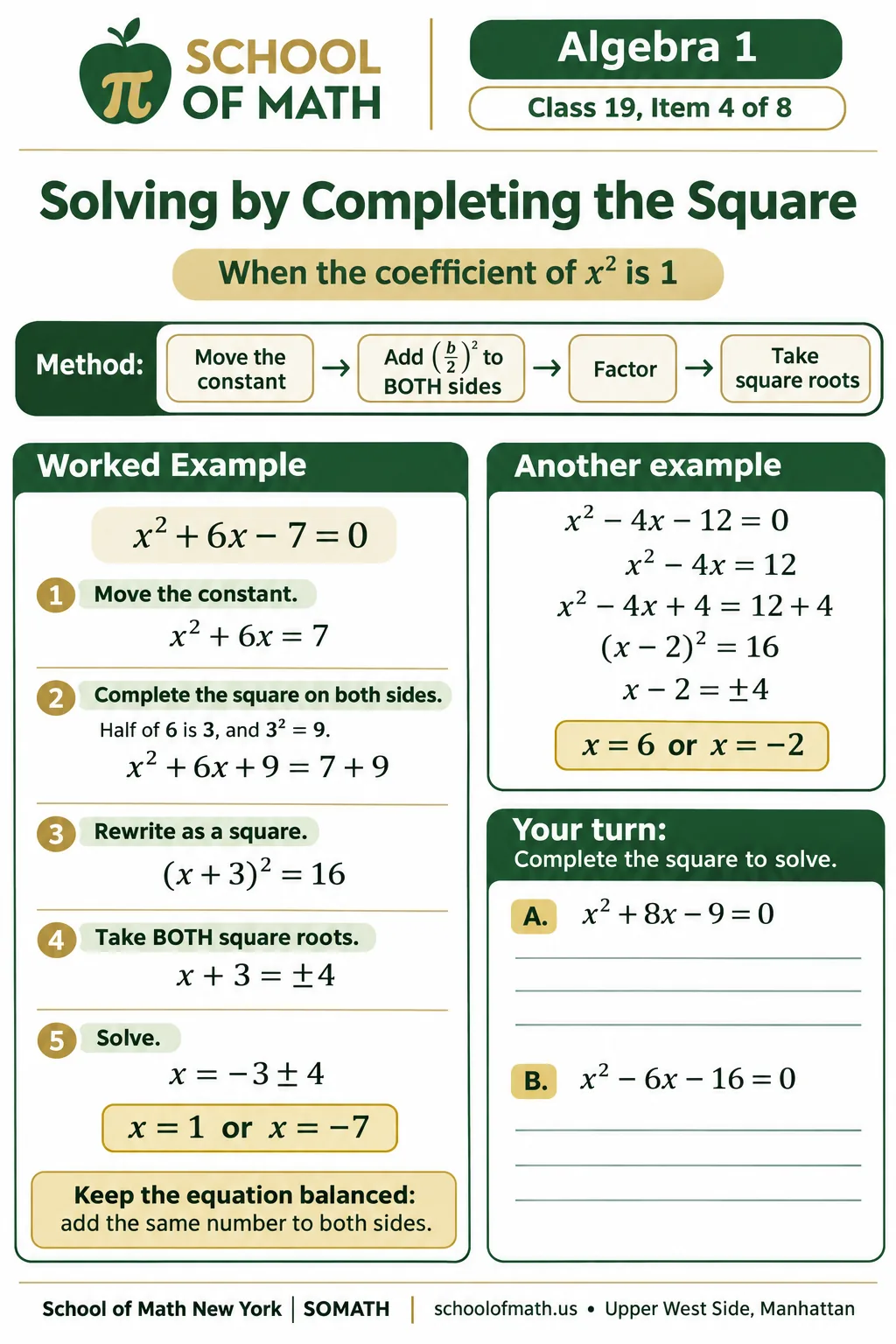
To solve \(x^2 + bx + c = 0\) when the coefficient of \(x^2\) is 1, follow four moves. Move the constant to the right side. Add \(\left(\frac{b}{2}\right)^2\) to both sides, which keeps the equation balanced. Factor the left side as \(\left(x + \frac{b}{2}\right)^2\) and simplify the right side. Then take both square roots and solve the two linear equations.
For example, \(x^2 + 10x + 21 = 0\) becomes \(x^2 + 10x = -21\). Adding 25 to both sides gives \((x + 5)^2 = 4\), so \(x + 5 = \pm 2\) and \(x = -3\) or \(x = -7\). This method works for every quadratic, including the ones that do not factor over the integers, which is why it is worth learning even when factoring would also work.
Practice: try these five questions
Q16
Solve by completing the square.
Answer
\(x = -2 \text{ or } x = -8\)
Move the constant to the right side.
\[x^2 + 10x = -16\]Take half of \(10\): \(5\). Square it: \(\left(5\right)^2 = 25\). Add \(25\) to both sides.
\[x^2 + 10x + 25 = -16 + 25\]Rewrite the left side as a squared binomial and simplify the right side.
\[\left(x + 5\right)^2 = 9\]Take both square roots. Remember \(\pm\).
\[x + 5 = \pm\sqrt{9} = \pm 3\]Solve each case.
\[x = -5 \pm 3 \;\Rightarrow\; x = -2 \quad\text{or}\quad x = -8\]Check \(x = -2\) in the original equation.
\[\left(-2\right)^2 + 10\left(-2\right) + 16 = 4 - 20 + 16 = 0\]Check \(x = -8\) in the original equation.
\[\left(-8\right)^2 + 10\left(-8\right) + 16 = 64 - 80 + 16 = 0\]
Q17
Solve by completing the square.
Answer
\(x = 6 \text{ or } x = 2\)
Move the constant to the right side.
\[x^2 - 8x = -12\]Take half of \(-8\): \(-4\). Square it: \(\left(-4\right)^2 = 16\). Add \(16\) to both sides.
\[x^2 - 8x + 16 = -12 + 16\]Rewrite the left side as a squared binomial and simplify the right side.
\[\left(x - 4\right)^2 = 4\]Take both square roots. Remember \(\pm\).
\[x - 4 = \pm\sqrt{4} = \pm 2\]Solve each case.
\[x = 4 \pm 2 \;\Rightarrow\; x = 6 \quad\text{or}\quad x = 2\]Check \(x = 6\) in the original equation.
\[\left(6\right)^2 - 8\left(6\right) + 12 = 36 - 48 + 12 = 0\]Check \(x = 2\) in the original equation.
\[\left(2\right)^2 - 8\left(2\right) + 12 = 4 - 16 + 12 = 0\]
Q18
Solve by completing the square.
Answer
\(x = 4 \text{ or } x = -6\)
Move the constant to the right side.
\[x^2 + 2x = 24\]Take half of \(2\): \(1\). Square it: \(\left(1\right)^2 = 1\). Add \(1\) to both sides.
\[x^2 + 2x + 1 = 24 + 1\]Rewrite the left side as a squared binomial and simplify the right side.
\[\left(x + 1\right)^2 = 25\]Take both square roots. Remember \(\pm\).
\[x + 1 = \pm\sqrt{25} = \pm 5\]Solve each case.
\[x = -1 \pm 5 \;\Rightarrow\; x = 4 \quad\text{or}\quad x = -6\]Check \(x = 4\) in the original equation.
\[\left(4\right)^2 + 2\left(4\right) - 24 = 16 + 8 - 24 = 0\]Check \(x = -6\) in the original equation.
\[\left(-6\right)^2 + 2\left(-6\right) - 24 = 36 - 12 - 24 = 0\]
Q19
Solve by completing the square.
Answer
\(x = 10 \text{ or } x = 2\)
Move the constant to the right side.
\[x^2 - 12x = -20\]Take half of \(-12\): \(-6\). Square it: \(\left(-6\right)^2 = 36\). Add \(36\) to both sides.
\[x^2 - 12x + 36 = -20 + 36\]Rewrite the left side as a squared binomial and simplify the right side.
\[\left(x - 6\right)^2 = 16\]Take both square roots. Remember \(\pm\).
\[x - 6 = \pm\sqrt{16} = \pm 4\]Solve each case.
\[x = 6 \pm 4 \;\Rightarrow\; x = 10 \quad\text{or}\quad x = 2\]Check \(x = 10\) in the original equation.
\[\left(10\right)^2 - 12\left(10\right) + 20 = 100 - 120 + 20 = 0\]Check \(x = 2\) in the original equation.
\[\left(2\right)^2 - 12\left(2\right) + 20 = 4 - 24 + 20 = 0\]
Q20
Solve by completing the square.
Answer
\(x = -3 \text{ or } x = -11\)
Take half of \(14\): \(7\). Square it: \(\left(7\right)^2 = 49\). Add \(49\) to both sides.
\[x^2 + 14x + 49 = -33 + 49\]Rewrite the left side as a squared binomial and simplify the right side.
\[\left(x + 7\right)^2 = 16\]Take both square roots. Remember \(\pm\).
\[x + 7 = \pm\sqrt{16} = \pm 4\]Solve each case.
\[x = -7 \pm 4 \;\Rightarrow\; x = -3 \quad\text{or}\quad x = -11\]Check \(x = -3\) in the original equation.
\[\left(-3\right)^2 + 14\left(-3\right) + 33 = 9 - 42 + 33 = 0\]Check \(x = -11\) in the original equation.
\[\left(-11\right)^2 + 14\left(-11\right) + 33 = 121 - 154 + 33 = 0\]
Completing the square with odd coefficients and fractions
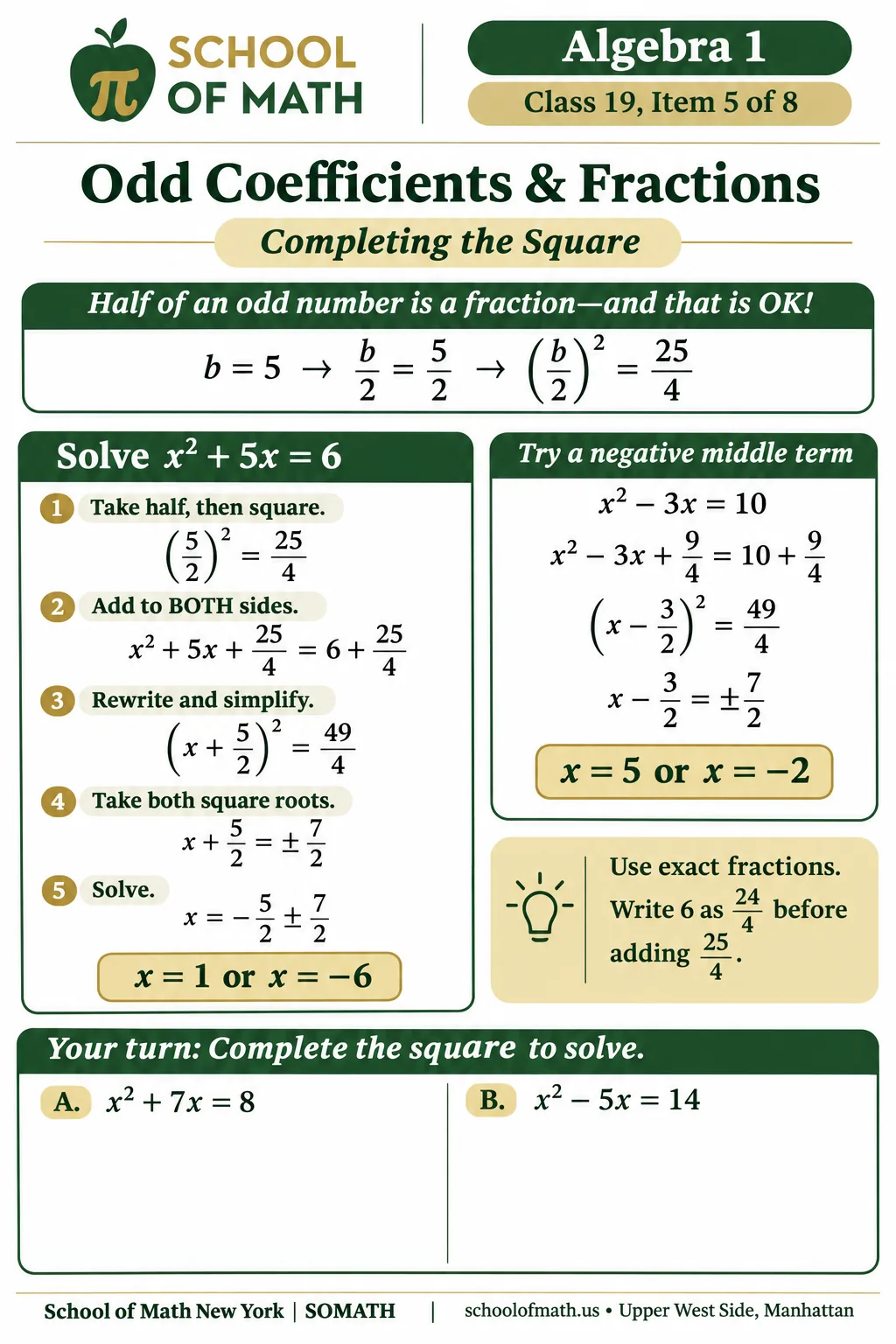
When \(b\) is odd, half of \(b\) is a fraction, and that is fine. For \(b = 9\), \(\frac{b}{2} = \frac{9}{2}\) and \(\left(\frac{b}{2}\right)^2 = \frac{81}{4}\). Add \(\frac{81}{4}\) to both sides, then rewrite the right side over the common denominator 4 before adding: for instance \(-14 = -\frac{56}{4}\).
Taking the square root of a fraction means taking the square root of the numerator and of the denominator: \(\sqrt{\frac{25}{4}} = \frac{5}{2}\). Keep every value as an exact fraction until the last step; decimals such as 2.25 hide the structure and invite rounding errors.
Practice: try these five questions
Q21
Solve by completing the square.
Answer
\(x = 2 \text{ or } x = -5\)
Take half of \(3\): \(\frac{3}{2}\). Square it: \(\left(\frac{3}{2}\right)^2 = \frac{9}{4}\). Add \(\frac{9}{4}\) to both sides.
\[x^2 + 3x + \frac{9}{4} = 10 + \frac{9}{4}\]Rewrite the left side as a squared binomial and simplify the right side.
\[\left(x + \frac{3}{2}\right)^2 = \frac{49}{4}\]Take both square roots. Remember \(\pm\).
\[x + \frac{3}{2} = \pm\sqrt{\frac{49}{4}} = \pm \frac{7}{2}\]Solve each case.
\[x = -\frac{3}{2} \pm \frac{7}{2} \;\Rightarrow\; x = 2 \quad\text{or}\quad x = -5\]Check \(x = 2\) in the original equation.
\[\left(2\right)^2 + 3\left(2\right) - 10 = 4 + 6 - 10 = 0\]Check \(x = -5\) in the original equation.
\[\left(-5\right)^2 + 3\left(-5\right) - 10 = 25 - 15 - 10 = 0\]
Q22
Solve by completing the square.
Answer
\(x = 5 \text{ or } x = 2\)
Take half of \(-7\): \(-\frac{7}{2}\). Square it: \(\left(-\frac{7}{2}\right)^2 = \frac{49}{4}\). Add \(\frac{49}{4}\) to both sides.
\[x^2 - 7x + \frac{49}{4} = -10 + \frac{49}{4}\]Rewrite the left side as a squared binomial and simplify the right side.
\[\left(x - \frac{7}{2}\right)^2 = \frac{9}{4}\]Take both square roots. Remember \(\pm\).
\[x - \frac{7}{2} = \pm\sqrt{\frac{9}{4}} = \pm \frac{3}{2}\]Solve each case.
\[x = \frac{7}{2} \pm \frac{3}{2} \;\Rightarrow\; x = 5 \quad\text{or}\quad x = 2\]Check \(x = 5\) in the original equation.
\[\left(5\right)^2 - 7\left(5\right) + 10 = 25 - 35 + 10 = 0\]Check \(x = 2\) in the original equation.
\[\left(2\right)^2 - 7\left(2\right) + 10 = 4 - 14 + 10 = 0\]
Q23
Solve by completing the square.
Answer
\(x = -2 \text{ or } x = -7\)
Move the constant to the right side.
\[x^2 + 9x = -14\]Take half of \(9\): \(\frac{9}{2}\). Square it: \(\left(\frac{9}{2}\right)^2 = \frac{81}{4}\). Add \(\frac{81}{4}\) to both sides.
\[x^2 + 9x + \frac{81}{4} = -14 + \frac{81}{4}\]Rewrite the left side as a squared binomial and simplify the right side.
\[\left(x + \frac{9}{2}\right)^2 = \frac{25}{4}\]Take both square roots. Remember \(\pm\).
\[x + \frac{9}{2} = \pm\sqrt{\frac{25}{4}} = \pm \frac{5}{2}\]Solve each case.
\[x = -\frac{9}{2} \pm \frac{5}{2} \;\Rightarrow\; x = -2 \quad\text{or}\quad x = -7\]Check \(x = -2\) in the original equation.
\[\left(-2\right)^2 + 9\left(-2\right) + 14 = 4 - 18 + 14 = 0\]Check \(x = -7\) in the original equation.
\[\left(-7\right)^2 + 9\left(-7\right) + 14 = 49 - 63 + 14 = 0\]
Q24
Solve by completing the square.
Answer
\(x = 4 \text{ or } x = -3\)
Take half of \(-1\): \(-\frac{1}{2}\). Square it: \(\left(-\frac{1}{2}\right)^2 = \frac{1}{4}\). Add \(\frac{1}{4}\) to both sides.
\[x^2 - x + \frac{1}{4} = 12 + \frac{1}{4}\]Rewrite the left side as a squared binomial and simplify the right side.
\[\left(x - \frac{1}{2}\right)^2 = \frac{49}{4}\]Take both square roots. Remember \(\pm\).
\[x - \frac{1}{2} = \pm\sqrt{\frac{49}{4}} = \pm \frac{7}{2}\]Solve each case.
\[x = \frac{1}{2} \pm \frac{7}{2} \;\Rightarrow\; x = 4 \quad\text{or}\quad x = -3\]Check \(x = 4\) in the original equation.
\[\left(4\right)^2 - \left(4\right) - 12 = 16 - 4 - 12 = 0\]Check \(x = -3\) in the original equation.
\[\left(-3\right)^2 - \left(-3\right) - 12 = 9 + 3 - 12 = 0\]
Q25
Solve by completing the square. Give exact answers.
Answer
\(x = \frac{-5 \pm \sqrt{33}}{2}\)
Move the constant to the right side.
\[x^2 + 5x = 2\]Take half of \(5\): \(\frac{5}{2}\). Square it: \(\left(\frac{5}{2}\right)^2 = \frac{25}{4}\). Add \(\frac{25}{4}\) to both sides.
\[x^2 + 5x + \frac{25}{4} = 2 + \frac{25}{4}\]Rewrite the left side as a squared binomial and simplify the right side.
\[\left(x + \frac{5}{2}\right)^2 = \frac{33}{4}\]Take both square roots. Remember \(\pm\). Simplify the radical.
\[x + \frac{5}{2} = \pm\sqrt{\frac{33}{4}} = \pm \frac{\sqrt{33}}{2}\]Isolate the variable. Keep the radical exact.
\[x = \frac{-5 \pm \sqrt{33}}{2}\]Check both: substituting \(x = \frac{-5 \pm \sqrt{33}}{2}\) makes \(x + \frac{5}{2} = \pm \frac{\sqrt{33}}{2}\), and \(\left(\pm \frac{\sqrt{33}}{2}\right)^2 = \frac{33}{4}\), matching the squared form. Decimal check: \(x \approx 0.372\) and \(x \approx -5.372\) each make the original left side approximately 0.
When the leading coefficient is not 1: divide first
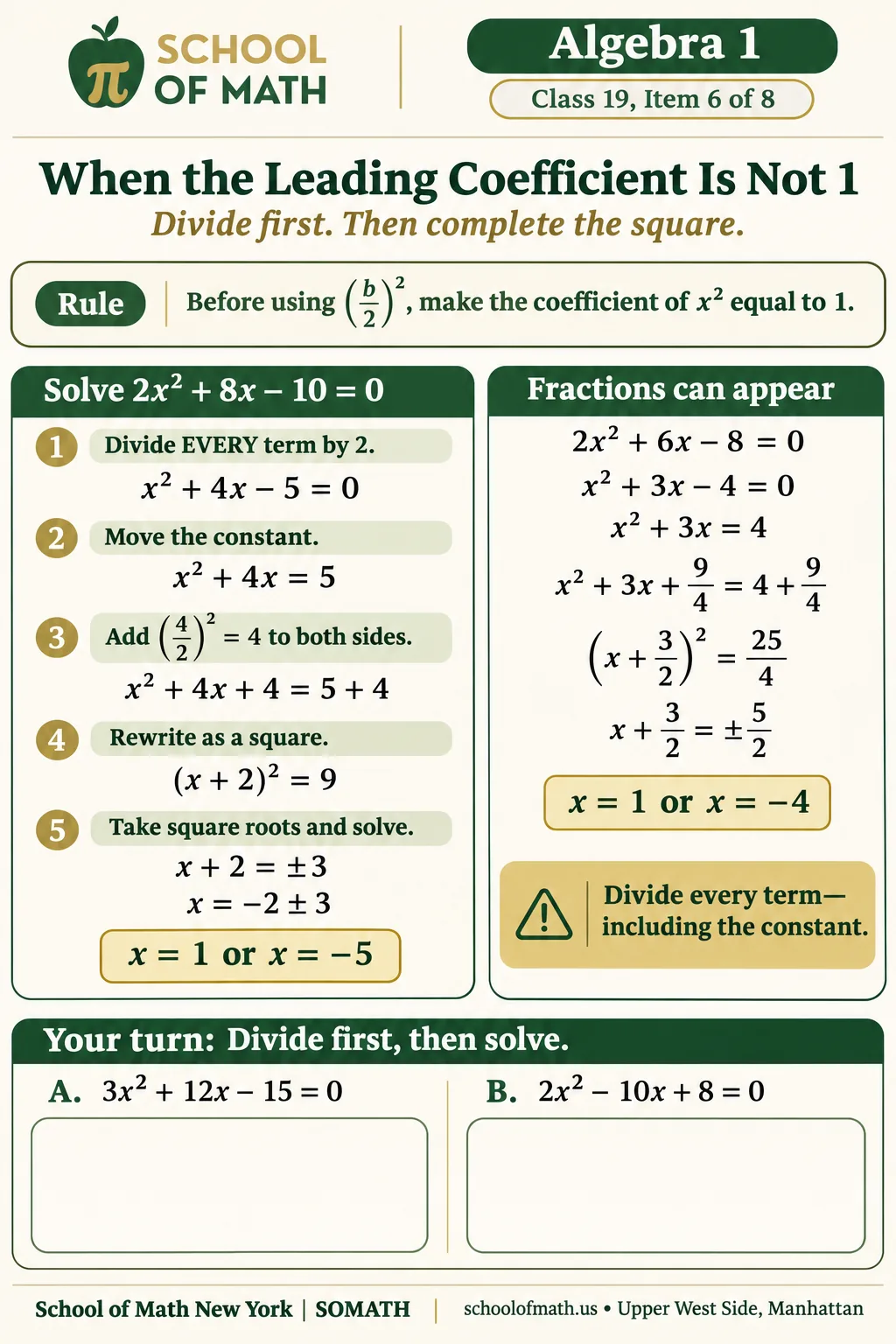
The rule \(\left(\frac{b}{2}\right)^2\) only works when the coefficient of \(x^2\) is 1. If the equation is \(ax^2 + bx + c = 0\) with \(a \neq 1\), divide every term by \(a\) first, including the constant. Dividing both sides of an equation by the same nonzero number does not change its solutions.
After dividing, fractions often appear. For example, \(2x^2 - 5x - 3 = 0\) becomes \(x^2 - \frac{5}{2}x - \frac{3}{2} = 0\). Half of \(-\frac{5}{2}\) is \(-\frac{5}{4}\), and its square is \(\frac{25}{16}\). The same four moves then finish the problem.
Practice: try these five questions
Q26
Divide first, then solve by completing the square.
Answer
\(x = -1 \text{ or } x = -5\)
Divide every term by \(3\) so the coefficient of \(x^2\) is 1. Divide the constant too.
\[x^2 + 6x + 5 = 0\]Move the constant to the right side.
\[x^2 + 6x = -5\]Take half of \(6\): \(3\). Square it: \(\left(3\right)^2 = 9\). Add \(9\) to both sides.
\[x^2 + 6x + 9 = -5 + 9\]Rewrite the left side as a squared binomial and simplify the right side.
\[\left(x + 3\right)^2 = 4\]Take both square roots. Remember \(\pm\).
\[x + 3 = \pm\sqrt{4} = \pm 2\]Solve each case.
\[x = -3 \pm 2 \;\Rightarrow\; x = -1 \quad\text{or}\quad x = -5\]Check \(x = -1\) in the original equation.
\[3\left(-1\right)^2 + 18\left(-1\right) + 15 = 3 - 18 + 15 = 0\]Check \(x = -5\) in the original equation.
\[3\left(-5\right)^2 + 18\left(-5\right) + 15 = 75 - 90 + 15 = 0\]
Q27
Divide first, then solve by completing the square.
Answer
\(x = 4 \text{ or } x = -2\)
Divide every term by \(4\) so the coefficient of \(x^2\) is 1. Divide the constant too.
\[x^2 - 2x - 8 = 0\]Move the constant to the right side.
\[x^2 - 2x = 8\]Take half of \(-2\): \(-1\). Square it: \(\left(-1\right)^2 = 1\). Add \(1\) to both sides.
\[x^2 - 2x + 1 = 8 + 1\]Rewrite the left side as a squared binomial and simplify the right side.
\[\left(x - 1\right)^2 = 9\]Take both square roots. Remember \(\pm\).
\[x - 1 = \pm\sqrt{9} = \pm 3\]Solve each case.
\[x = 1 \pm 3 \;\Rightarrow\; x = 4 \quad\text{or}\quad x = -2\]Check \(x = 4\) in the original equation.
\[4\left(4\right)^2 - 8\left(4\right) - 32 = 64 - 32 - 32 = 0\]Check \(x = -2\) in the original equation.
\[4\left(-2\right)^2 - 8\left(-2\right) - 32 = 16 + 16 - 32 = 0\]
Q28
Divide first, then solve by completing the square.
Answer
\(x = -2 \text{ or } x = -3\)
Divide every term by \(2\) so the coefficient of \(x^2\) is 1. Divide the constant too.
\[x^2 + 5x + 6 = 0\]Move the constant to the right side.
\[x^2 + 5x = -6\]Take half of \(5\): \(\frac{5}{2}\). Square it: \(\left(\frac{5}{2}\right)^2 = \frac{25}{4}\). Add \(\frac{25}{4}\) to both sides.
\[x^2 + 5x + \frac{25}{4} = -6 + \frac{25}{4}\]Rewrite the left side as a squared binomial and simplify the right side.
\[\left(x + \frac{5}{2}\right)^2 = \frac{1}{4}\]Take both square roots. Remember \(\pm\).
\[x + \frac{5}{2} = \pm\sqrt{\frac{1}{4}} = \pm \frac{1}{2}\]Solve each case.
\[x = -\frac{5}{2} \pm \frac{1}{2} \;\Rightarrow\; x = -2 \quad\text{or}\quad x = -3\]Check \(x = -2\) in the original equation.
\[2\left(-2\right)^2 + 10\left(-2\right) + 12 = 8 - 20 + 12 = 0\]Check \(x = -3\) in the original equation.
\[2\left(-3\right)^2 + 10\left(-3\right) + 12 = 18 - 30 + 12 = 0\]
Q29
Divide first, then solve by completing the square.
Answer
\(x = 2 \text{ or } x = -3\)
Divide every term by \(4\) so the coefficient of \(x^2\) is 1. Divide the constant too.
\[x^2 + x - 6 = 0\]Move the constant to the right side.
\[x^2 + x = 6\]Take half of \(1\): \(\frac{1}{2}\). Square it: \(\left(\frac{1}{2}\right)^2 = \frac{1}{4}\). Add \(\frac{1}{4}\) to both sides.
\[x^2 + x + \frac{1}{4} = 6 + \frac{1}{4}\]Rewrite the left side as a squared binomial and simplify the right side.
\[\left(x + \frac{1}{2}\right)^2 = \frac{25}{4}\]Take both square roots. Remember \(\pm\).
\[x + \frac{1}{2} = \pm\sqrt{\frac{25}{4}} = \pm \frac{5}{2}\]Solve each case.
\[x = -\frac{1}{2} \pm \frac{5}{2} \;\Rightarrow\; x = 2 \quad\text{or}\quad x = -3\]Check \(x = 2\) in the original equation.
\[4\left(2\right)^2 + 4\left(2\right) - 24 = 16 + 8 - 24 = 0\]Check \(x = -3\) in the original equation.
\[4\left(-3\right)^2 + 4\left(-3\right) - 24 = 36 - 12 - 24 = 0\]
Q30
Divide first, then solve by completing the square.
Answer
\(x = 3 \text{ or } x = -\frac{1}{2}\)
Divide every term by \(2\) so the coefficient of \(x^2\) is 1. Divide the constant too.
\[x^2 - \frac{5}{2}x - \frac{3}{2} = 0\]Move the constant to the right side.
\[x^2 - \frac{5}{2}x = \frac{3}{2}\]Take half of \(-\frac{5}{2}\): \(-\frac{5}{4}\). Square it: \(\left(-\frac{5}{4}\right)^2 = \frac{25}{16}\). Add \(\frac{25}{16}\) to both sides.
\[x^2 - \frac{5}{2}x + \frac{25}{16} = \frac{3}{2} + \frac{25}{16}\]Rewrite the left side as a squared binomial and simplify the right side.
\[\left(x - \frac{5}{4}\right)^2 = \frac{49}{16}\]Take both square roots. Remember \(\pm\).
\[x - \frac{5}{4} = \pm\sqrt{\frac{49}{16}} = \pm \frac{7}{4}\]Solve each case.
\[x = \frac{5}{4} \pm \frac{7}{4} \;\Rightarrow\; x = 3 \quad\text{or}\quad x = -\frac{1}{2}\]Check \(x = 3\) in the original equation.
\[2\left(3\right)^2 - 5\left(3\right) - 3 = 18 - 15 - 3 = 0\]Check \(x = -\frac{1}{2}\) in the original equation.
\[2\left(-\frac{1}{2}\right)^2 - 5\left(-\frac{1}{2}\right) - 3 = \frac{1}{2} + \frac{5}{2} - 3 = 0\]
Square roots and checking solutions
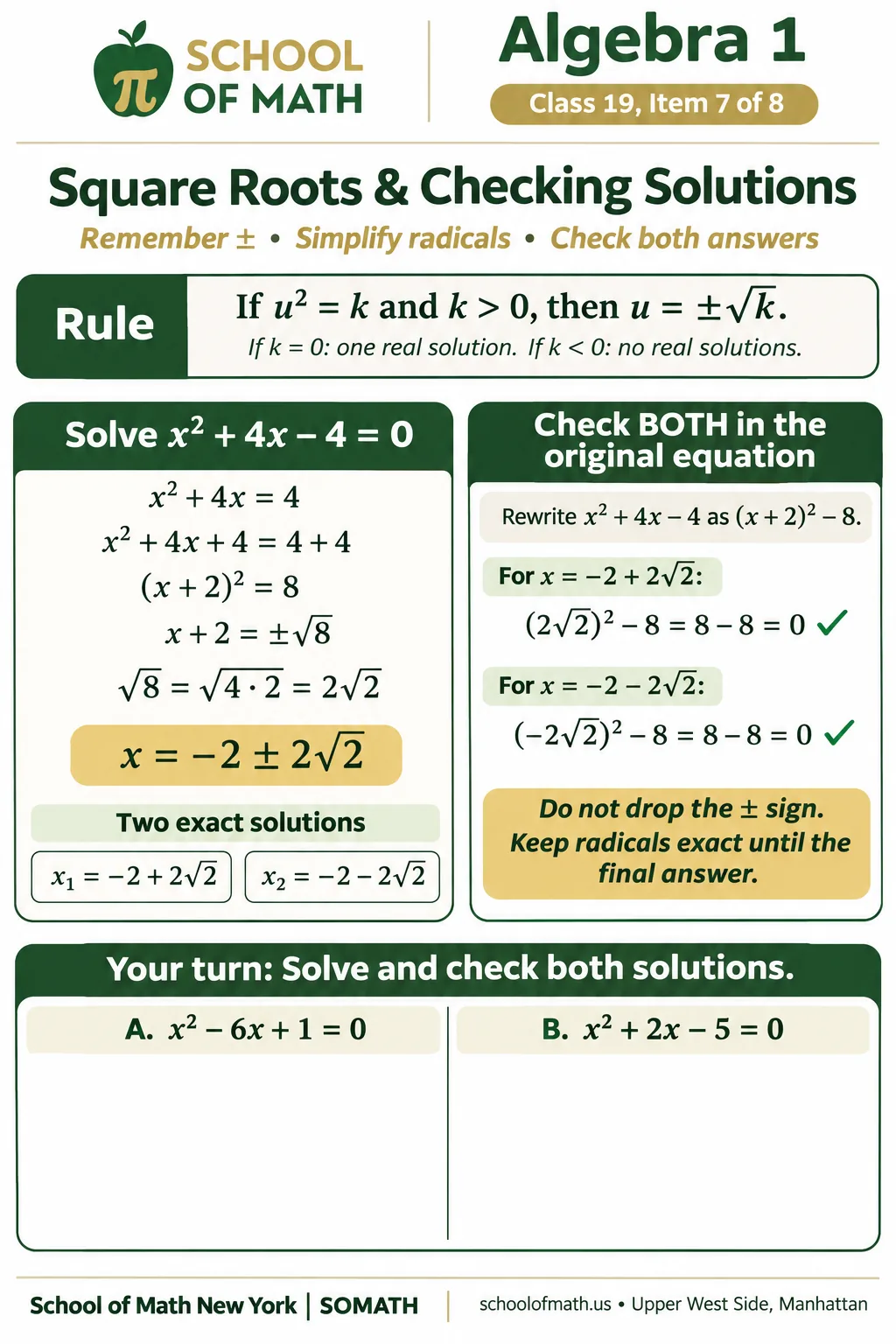
After completing the square, the equation has the form \((x + h)^2 = k\). The value of \(k\) decides what happens. If \(k > 0\), there are two solutions, \(x + h = \pm\sqrt{k}\). If \(k = 0\), there is one solution, \(x = -h\), called a double root. If \(k < 0\), there are no real solutions, because no real number squared is negative.
When \(k\) is not a perfect square, keep the answer exact and simplify the radical: \(\sqrt{12} = \sqrt{4 \cdot 3} = 2\sqrt{3}\). Never drop the \(\pm\). To check irrational solutions, substitute into the completed-square form: if \(x = 5 + 2\sqrt{3}\), then \(x - 5 = 2\sqrt{3}\) and \((2\sqrt{3})^2 = 12\). A decimal approximation in the original equation gives a second, quick check.
Practice: try these five questions
Q31
Solve by completing the square. Give exact answers and check both solutions.
Answer
\(x = -3 \pm \sqrt{7}\)
Move the constant to the right side.
\[x^2 + 6x = -2\]Take half of \(6\): \(3\). Square it: \(\left(3\right)^2 = 9\). Add \(9\) to both sides.
\[x^2 + 6x + 9 = -2 + 9\]Rewrite the left side as a squared binomial and simplify the right side.
\[\left(x + 3\right)^2 = 7\]Take both square roots. Remember \(\pm\).
\[x + 3 = \pm\sqrt{7}\]Isolate the variable. Keep the radical exact.
\[x = -3 \pm \sqrt{7}\]Check both: substituting \(x = -3 \pm \sqrt{7}\) makes \(x + 3 = \pm \sqrt{7}\), and \(\left(\pm \sqrt{7}\right)^2 = 7\), matching the squared form. Decimal check: \(x \approx -0.354\) and \(x \approx -5.646\) each make the original left side approximately 0.
Q32
Solve by completing the square. Give exact answers and check both solutions.
Answer
\(x = 5 \pm 2\sqrt{3}\)
Move the constant to the right side.
\[x^2 - 10x = -13\]Take half of \(-10\): \(-5\). Square it: \(\left(-5\right)^2 = 25\). Add \(25\) to both sides.
\[x^2 - 10x + 25 = -13 + 25\]Rewrite the left side as a squared binomial and simplify the right side.
\[\left(x - 5\right)^2 = 12\]Take both square roots. Remember \(\pm\). Simplify the radical.
\[x - 5 = \pm\sqrt{12} = \pm 2\sqrt{3}\]Isolate the variable. Keep the radical exact.
\[x = 5 \pm 2\sqrt{3}\]Check both: substituting \(x = 5 \pm 2\sqrt{3}\) makes \(x - 5 = \pm 2\sqrt{3}\), and \(\left(\pm 2\sqrt{3}\right)^2 = 12\), matching the squared form. Decimal check: \(x \approx 8.464\) and \(x \approx 1.536\) each make the original left side approximately 0.
Q33
Solve by completing the square. How many real solutions are there?
Answer
\(x = -8\)
Move the constant to the right side.
\[x^2 + 16x = -64\]Take half of \(16\): \(8\). Square it: \(\left(8\right)^2 = 64\). Add \(64\) to both sides.
\[x^2 + 16x + 64 = -64 + 64\]Rewrite the left side as a squared binomial and simplify the right side.
\[\left(x + 8\right)^2 = 0\]The right side is 0, so the binomial itself is 0.
\[x + 8 = 0\]Solve. There is one solution (a double root).
\[x = -8\]Check in the original equation.
\[\left(-8\right)^2 + 16\left(-8\right) + 64 = 64 - 128 + 64 = 0\]
Q34
Solve by completing the square, or explain why there are no real solutions.
Answer
\(\text{No real solutions}\)
Move the constant to the right side.
\[x^2 + 4x = -9\]Take half of \(4\): \(2\). Square it: \(\left(2\right)^2 = 4\). Add \(4\) to both sides.
\[x^2 + 4x + 4 = -9 + 4\]Rewrite the left side as a squared binomial and simplify the right side.
\[\left(x + 2\right)^2 = -5\]A square of a real number is never negative, but the right side is \(-5\). There is no real number whose square is negative.
Q35
Solve exactly, then approximate each solution to the nearest hundredth.
Answer
\(x = 1 \pm 2\sqrt{3} \approx 4.46 \text{ or } -2.46\)
Move the constant to the right side.
\[x^2 - 2x = 11\]Take half of \(-2\): \(-1\). Square it: \(\left(-1\right)^2 = 1\). Add \(1\) to both sides.
\[x^2 - 2x + 1 = 11 + 1\]Rewrite the left side as a squared binomial and simplify the right side.
\[\left(x - 1\right)^2 = 12\]Take both square roots. Remember \(\pm\). Simplify the radical.
\[x - 1 = \pm\sqrt{12} = \pm 2\sqrt{3}\]Isolate the variable. Keep the radical exact.
\[x = 1 \pm 2\sqrt{3}\]Check both: substituting \(x = 1 \pm 2\sqrt{3}\) makes \(x - 1 = \pm 2\sqrt{3}\), and \(\left(\pm 2\sqrt{3}\right)^2 = 12\), matching the squared form. Decimal check: \(x \approx 4.464\) and \(x \approx -2.464\) each make the original left side approximately 0.
Approximate: \(2\sqrt{3} \approx 3.464\), so \(x \approx 1 + 3.464 = 4.46\) and \(x \approx 1 - 3.464 = -2.46\).
Mixed practice and word problems
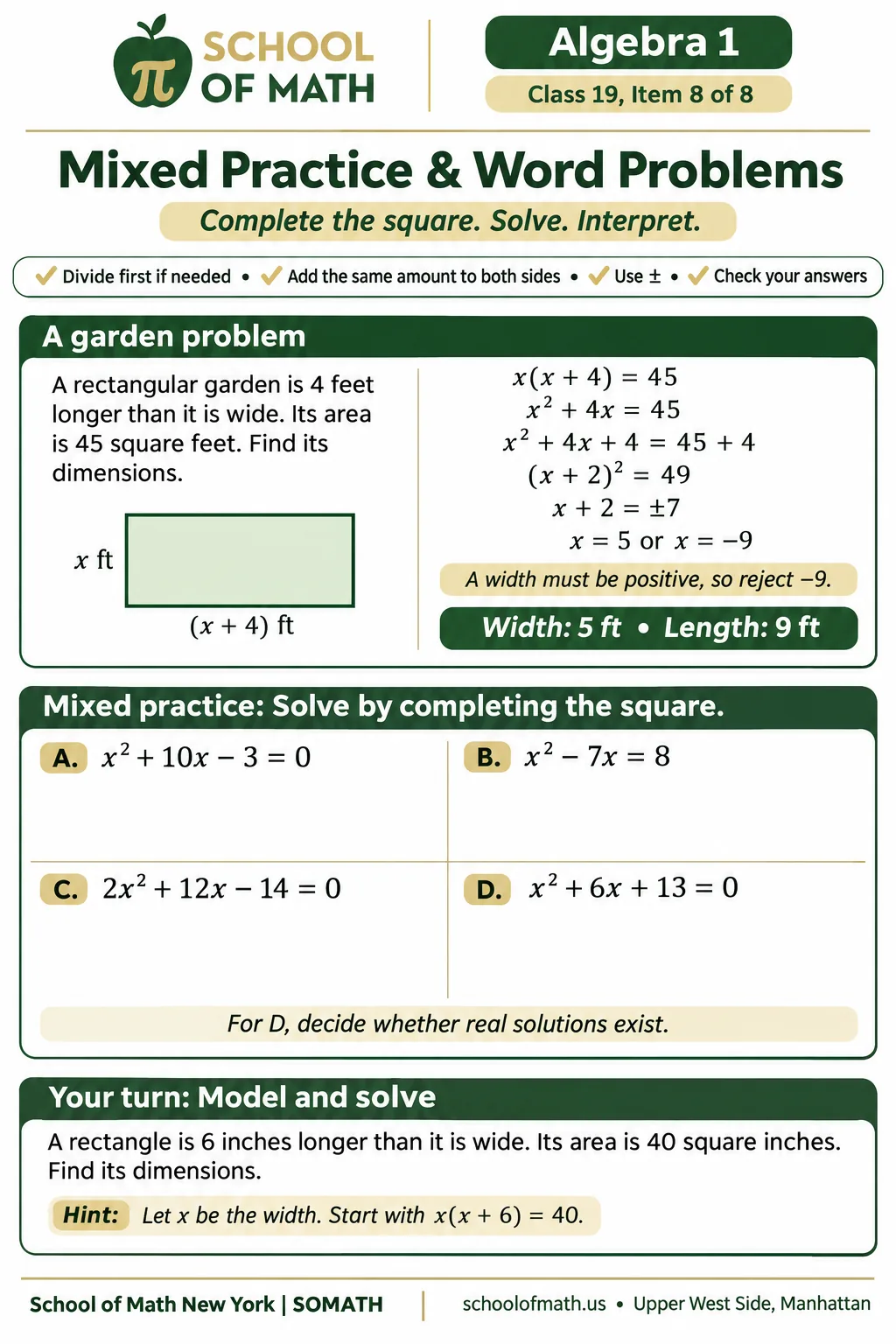
For word problems, define the variable in words, write an equation from the situation, and put it in the form \(x^2 + bx = c\) (divide first if needed). Complete the square, solve, and then interpret. Lengths, widths, times and counts cannot be negative, so reject any solution that does not fit the context, and say why.
In mixed practice, first look at the leading coefficient and the sign of the right side after completing the square. This tells you immediately whether to divide first and whether to expect two, one or no real solutions. Finish every problem with a check: substitute into the original equation or confirm the measurements in the story.
Practice: try these five questions
Q36
Solve by completing the square. Give exact answers.
Answer
\(x = -6 \pm \sqrt{41}\)
Move the constant to the right side.
\[x^2 + 12x = 5\]Take half of \(12\): \(6\). Square it: \(\left(6\right)^2 = 36\). Add \(36\) to both sides.
\[x^2 + 12x + 36 = 5 + 36\]Rewrite the left side as a squared binomial and simplify the right side.
\[\left(x + 6\right)^2 = 41\]Take both square roots. Remember \(\pm\).
\[x + 6 = \pm\sqrt{41}\]Isolate the variable. Keep the radical exact.
\[x = -6 \pm \sqrt{41}\]Check both: substituting \(x = -6 \pm \sqrt{41}\) makes \(x + 6 = \pm \sqrt{41}\), and \(\left(\pm \sqrt{41}\right)^2 = 41\), matching the squared form. Decimal check: \(x \approx 0.403\) and \(x \approx -12.403\) each make the original left side approximately 0.
Q37
Solve by completing the square. Give exact answers.
Answer
\(x = 2 \pm \sqrt{2}\)
Divide every term by \(3\) so the coefficient of \(x^2\) is 1. Divide the constant too.
\[x^2 - 4x + 2 = 0\]Move the constant to the right side.
\[x^2 - 4x = -2\]Take half of \(-4\): \(-2\). Square it: \(\left(-2\right)^2 = 4\). Add \(4\) to both sides.
\[x^2 - 4x + 4 = -2 + 4\]Rewrite the left side as a squared binomial and simplify the right side.
\[\left(x - 2\right)^2 = 2\]Take both square roots. Remember \(\pm\).
\[x - 2 = \pm\sqrt{2}\]Isolate the variable. Keep the radical exact.
\[x = 2 \pm \sqrt{2}\]Check both: substituting \(x = 2 \pm \sqrt{2}\) makes \(x - 2 = \pm \sqrt{2}\), and \(\left(\pm \sqrt{2}\right)^2 = 2\), matching the squared form. Decimal check: \(x \approx 3.414\) and \(x \approx 0.586\) each make the original left side approximately 0.
Q38
Decide whether real solutions exist. Solve if they do.
Answer
\(\text{No real solutions}\)
Move the constant to the right side.
\[x^2 + 2x = -10\]Take half of \(2\): \(1\). Square it: \(\left(1\right)^2 = 1\). Add \(1\) to both sides.
\[x^2 + 2x + 1 = -10 + 1\]Rewrite the left side as a squared binomial and simplify the right side.
\[\left(x + 1\right)^2 = -9\]A square of a real number is never negative, but the right side is \(-9\). There is no real number whose square is negative.
Q39
A rectangle is 8 meters longer than it is wide. Its area is 65 square meters. Find its dimensions.
Answer
\(\text{Width } 5 \text{ m, length } 13 \text{ m}\)
Let \(w\) be the width in meters. The length is \(w + 8\), so \(w(w + 8) = 65\).
\[w^2 + 8w = 65\]Take half of \(8\): \(4\). Square it: \(\left(4\right)^2 = 16\). Add \(16\) to both sides.
\[w^2 + 8w + 16 = 65 + 16\]Rewrite the left side as a squared binomial and simplify the right side.
\[\left(w + 4\right)^2 = 81\]Take both square roots. Remember \(\pm\).
\[w + 4 = \pm\sqrt{81} = \pm 9\]Solve each case.
\[w = -4 \pm 9 \;\Rightarrow\; w = 5 \quad\text{or}\quad w = -13\]Check \(w = 5\) in the original equation.
\[\left(5\right)^2 + 8\left(5\right) - 65 = 25 + 40 - 65 = 0\]Check \(w = -13\) in the original equation.
\[\left(-13\right)^2 + 8\left(-13\right) - 65 = 169 - 104 - 65 = 0\]A width cannot be negative, so reject \(w = -13\). The width is 5 m and the length is \(5 + 8 = 13\) m. Check: \(5 \times 13 = 65\) square meters.
Q40
Two positive numbers differ by 10, and their product is 56. Find the numbers.
Answer
\(4 \text{ and } 14\)
Let \(x\) be the smaller number. The larger is \(x + 10\), so \(x(x + 10) = 56\).
\[x^2 + 10x = 56\]Take half of \(10\): \(5\). Square it: \(\left(5\right)^2 = 25\). Add \(25\) to both sides.
\[x^2 + 10x + 25 = 56 + 25\]Rewrite the left side as a squared binomial and simplify the right side.
\[\left(x + 5\right)^2 = 81\]Take both square roots. Remember \(\pm\).
\[x + 5 = \pm\sqrt{81} = \pm 9\]Solve each case.
\[x = -5 \pm 9 \;\Rightarrow\; x = 4 \quad\text{or}\quad x = -14\]Check \(x = 4\) in the original equation.
\[\left(4\right)^2 + 10\left(4\right) - 56 = 16 + 40 - 56 = 0\]Check \(x = -14\) in the original equation.
\[\left(-14\right)^2 + 10\left(-14\right) - 56 = 196 - 140 - 56 = 0\]The numbers must be positive, so reject \(x = -14\). The numbers are 4 and \(4 + 10 = 14\). Check: \(14 - 4 = 10\) and \(4 \times 14 = 56\).
Homework review
One review question for each topic, in image order. Show each step: take half, square, add to both sides, rewrite as a square, take both roots, and check.
R1
Which trinomial is a perfect square: \(x^2 + 30x + 225\) or \(x^2 + 15x + 225\)? Write it as a squared binomial.
Answer
\(x^2 + 30x + 225 = (x + 15)^2\)
Both constants are \(225 = 15^2\), so a perfect square needs middle term \(2 \cdot 15 \cdot x = 30x\).
Only the first trinomial has \(30x\). The second, with \(15x\), is not a perfect square.
\[x^2 + 30x + 225 = (x + 15)^2\]
R2
Find the constant that completes the square. Then write the result as a squared binomial.
Answer
\(\frac{169}{4}; \; x^2 - 13x + \frac{169}{4} = \left(x - \frac{13}{2}\right)^2\)
Here \(b = -13\). Half of \(b\) is \(-\frac{13}{2}\).
Square it: \(\left(-\frac{13}{2}\right)^2 = \frac{169}{4}\).
\[x^2 - 13x + \frac{169}{4} = \left(x - \frac{13}{2}\right)^2\]
R3
Write the trinomial as a squared binomial. Verify by expanding.
Answer
\(\left(x - 14\right)^2\)
Half of \(-28\) is \(-14\), and \(\left(-14\right)^2 = 196\), which matches the constant.
\[x^2 - 28x + 196 = \left(x - 14\right)^2\]Verify by expanding.
\[\left(x - 14\right)\left(x - 14\right) = x^2 - 14x - 14x + 196 = x^2 - 28x + 196\]
R4
Solve by completing the square.
Answer
\(x = 2 \text{ or } x = -8\)
Move the constant to the right side.
\[x^2 + 6x = 16\]Take half of \(6\): \(3\). Square it: \(\left(3\right)^2 = 9\). Add \(9\) to both sides.
\[x^2 + 6x + 9 = 16 + 9\]Rewrite the left side as a squared binomial and simplify the right side.
\[\left(x + 3\right)^2 = 25\]Take both square roots. Remember \(\pm\).
\[x + 3 = \pm\sqrt{25} = \pm 5\]Solve each case.
\[x = -3 \pm 5 \;\Rightarrow\; x = 2 \quad\text{or}\quad x = -8\]Check \(x = 2\) in the original equation.
\[\left(2\right)^2 + 6\left(2\right) - 16 = 4 + 12 - 16 = 0\]Check \(x = -8\) in the original equation.
\[\left(-8\right)^2 + 6\left(-8\right) - 16 = 64 - 48 - 16 = 0\]
R5
Solve by completing the square.
Answer
\(x = -3 \text{ or } x = -8\)
Move the constant to the right side.
\[x^2 + 11x = -24\]Take half of \(11\): \(\frac{11}{2}\). Square it: \(\left(\frac{11}{2}\right)^2 = \frac{121}{4}\). Add \(\frac{121}{4}\) to both sides.
\[x^2 + 11x + \frac{121}{4} = -24 + \frac{121}{4}\]Rewrite the left side as a squared binomial and simplify the right side.
\[\left(x + \frac{11}{2}\right)^2 = \frac{25}{4}\]Take both square roots. Remember \(\pm\).
\[x + \frac{11}{2} = \pm\sqrt{\frac{25}{4}} = \pm \frac{5}{2}\]Solve each case.
\[x = -\frac{11}{2} \pm \frac{5}{2} \;\Rightarrow\; x = -3 \quad\text{or}\quad x = -8\]Check \(x = -3\) in the original equation.
\[\left(-3\right)^2 + 11\left(-3\right) + 24 = 9 - 33 + 24 = 0\]Check \(x = -8\) in the original equation.
\[\left(-8\right)^2 + 11\left(-8\right) + 24 = 64 - 88 + 24 = 0\]
R6
Divide first, then solve by completing the square.
Answer
\(x = 5 \text{ or } x = -3\)
Divide every term by \(3\) so the coefficient of \(x^2\) is 1. Divide the constant too.
\[x^2 - 2x - 15 = 0\]Move the constant to the right side.
\[x^2 - 2x = 15\]Take half of \(-2\): \(-1\). Square it: \(\left(-1\right)^2 = 1\). Add \(1\) to both sides.
\[x^2 - 2x + 1 = 15 + 1\]Rewrite the left side as a squared binomial and simplify the right side.
\[\left(x - 1\right)^2 = 16\]Take both square roots. Remember \(\pm\).
\[x - 1 = \pm\sqrt{16} = \pm 4\]Solve each case.
\[x = 1 \pm 4 \;\Rightarrow\; x = 5 \quad\text{or}\quad x = -3\]Check \(x = 5\) in the original equation.
\[3\left(5\right)^2 - 6\left(5\right) - 45 = 75 - 30 - 45 = 0\]Check \(x = -3\) in the original equation.
\[3\left(-3\right)^2 - 6\left(-3\right) - 45 = 27 + 18 - 45 = 0\]
R7
Solve by completing the square. Give exact answers and check both solutions.
Answer
\(x = 4 \pm \sqrt{5}\)
Move the constant to the right side.
\[x^2 - 8x = -11\]Take half of \(-8\): \(-4\). Square it: \(\left(-4\right)^2 = 16\). Add \(16\) to both sides.
\[x^2 - 8x + 16 = -11 + 16\]Rewrite the left side as a squared binomial and simplify the right side.
\[\left(x - 4\right)^2 = 5\]Take both square roots. Remember \(\pm\).
\[x - 4 = \pm\sqrt{5}\]Isolate the variable. Keep the radical exact.
\[x = 4 \pm \sqrt{5}\]Check both: substituting \(x = 4 \pm \sqrt{5}\) makes \(x - 4 = \pm \sqrt{5}\), and \(\left(\pm \sqrt{5}\right)^2 = 5\), matching the squared form. Decimal check: \(x \approx 6.236\) and \(x \approx 1.764\) each make the original left side approximately 0.
R8
Solve by completing the square. Give exact answers.
Answer
\(x = \frac{-4 \pm \sqrt{10}}{2}\)
Divide every term by \(2\) so the coefficient of \(x^2\) is 1. Divide the constant too.
\[x^2 + 4x + \frac{3}{2} = 0\]Move the constant to the right side.
\[x^2 + 4x = -\frac{3}{2}\]Take half of \(4\): \(2\). Square it: \(\left(2\right)^2 = 4\). Add \(4\) to both sides.
\[x^2 + 4x + 4 = -\frac{3}{2} + 4\]Rewrite the left side as a squared binomial and simplify the right side.
\[\left(x + 2\right)^2 = \frac{5}{2}\]Take both square roots. Remember \(\pm\). Simplify the radical.
\[x + 2 = \pm\sqrt{\frac{5}{2}} = \pm \frac{\sqrt{10}}{2}\]Isolate the variable. Keep the radical exact.
\[x = \frac{-4 \pm \sqrt{10}}{2}\]Check both: substituting \(x = \frac{-4 \pm \sqrt{10}}{2}\) makes \(x + 2 = \pm \frac{\sqrt{10}}{2}\), and \(\left(\pm \frac{\sqrt{10}}{2}\right)^2 = \frac{5}{2}\), matching the squared form. Decimal check: \(x \approx -0.419\) and \(x \approx -3.581\) each make the original left side approximately 0.
Homework word problems
Twelve problems that grow from one-step area models to projectiles, revenue, a vertex-form rewrite and a fencing challenge. Define the variable, solve by completing the square, reject answers that do not fit the story, and check.
W1
A rectangle is 2 inches longer than it is wide. Its area is 48 square inches. Find its dimensions.
Answer
\(6 \text{ in by } 8 \text{ in}\)
Let \(w\) be the width in inches. Then \(w(w + 2) = 48\).
\[w^2 + 2w = 48\]Take half of \(2\): \(1\). Square it: \(\left(1\right)^2 = 1\). Add \(1\) to both sides.
\[w^2 + 2w + 1 = 48 + 1\]Rewrite the left side as a squared binomial and simplify the right side.
\[\left(w + 1\right)^2 = 49\]Take both square roots. Remember \(\pm\).
\[w + 1 = \pm\sqrt{49} = \pm 7\]Solve each case.
\[w = -1 \pm 7 \;\Rightarrow\; w = 6 \quad\text{or}\quad w = -8\]Check \(w = 6\) in the original equation.
\[\left(6\right)^2 + 2\left(6\right) - 48 = 36 + 12 - 48 = 0\]Check \(w = -8\) in the original equation.
\[\left(-8\right)^2 + 2\left(-8\right) - 48 = 64 - 16 - 48 = 0\]Reject \(w = -8\), because a width cannot be negative. The rectangle is 6 in by 8 in. Check: \(6 \times 8 = 48\).
W2
If each side of a square patio is increased by 3 feet, its area becomes 64 square feet. How long is each side of the original patio?
Answer
\(5 \text{ ft}\)
Let \(s\) be the original side in feet. The new side is \(s + 3\), so the equation is already a perfect square.
\[(s + 3)^2 = 64\]Take both square roots.
\[s + 3 = \pm 8\]Solve each case.
\[s = 5 \quad\text{or}\quad s = -11\]A side cannot be negative, so the original side is 5 ft. Check: \((5 + 3)^2 = 64\).
W3
The square of a number plus 6 times the number equals 40. Find all possible numbers.
Answer
\(4 \text{ or } -10\)
Let \(x\) be the number.
\[x^2 + 6x = 40\]Take half of \(6\): \(3\). Square it: \(\left(3\right)^2 = 9\). Add \(9\) to both sides.
\[x^2 + 6x + 9 = 40 + 9\]Rewrite the left side as a squared binomial and simplify the right side.
\[\left(x + 3\right)^2 = 49\]Take both square roots. Remember \(\pm\).
\[x + 3 = \pm\sqrt{49} = \pm 7\]Solve each case.
\[x = -3 \pm 7 \;\Rightarrow\; x = 4 \quad\text{or}\quad x = -10\]Check \(x = 4\) in the original equation.
\[\left(4\right)^2 + 6\left(4\right) - 40 = 16 + 24 - 40 = 0\]Check \(x = -10\) in the original equation.
\[\left(-10\right)^2 + 6\left(-10\right) - 40 = 100 - 60 - 40 = 0\]Both values work, since the number can be negative. Check: \(16 + 24 = 40\) and \(100 - 60 = 40\).
W4
The product of two consecutive positive integers is 132. Find the integers.
Answer
\(11 \text{ and } 12\)
Let \(n\) be the smaller integer. Then \(n(n + 1) = 132\).
\[n^2 + n = 132\]Take half of \(1\): \(\frac{1}{2}\). Square it: \(\left(\frac{1}{2}\right)^2 = \frac{1}{4}\). Add \(\frac{1}{4}\) to both sides.
\[n^2 + n + \frac{1}{4} = 132 + \frac{1}{4}\]Rewrite the left side as a squared binomial and simplify the right side.
\[\left(n + \frac{1}{2}\right)^2 = \frac{529}{4}\]Take both square roots. Remember \(\pm\).
\[n + \frac{1}{2} = \pm\sqrt{\frac{529}{4}} = \pm \frac{23}{2}\]Solve each case.
\[n = -\frac{1}{2} \pm \frac{23}{2} \;\Rightarrow\; n = 11 \quad\text{or}\quad n = -12\]Check \(n = 11\) in the original equation.
\[\left(11\right)^2 + \left(11\right) - 132 = 121 + 11 - 132 = 0\]Check \(n = -12\) in the original equation.
\[\left(-12\right)^2 + \left(-12\right) - 132 = 144 - 12 - 132 = 0\]The integers are positive, so reject \(n = -12\). The integers are 11 and 12. Check: \(11 \times 12 = 132\).
W5
A rectangular classroom rug has an area of 91 square feet. Its length is 6 feet more than its width. Find its dimensions.
Answer
\(7 \text{ ft by } 13 \text{ ft}\)
Let \(w\) be the width in feet. Then \(w(w + 6) = 91\).
\[w^2 + 6w = 91\]Take half of \(6\): \(3\). Square it: \(\left(3\right)^2 = 9\). Add \(9\) to both sides.
\[w^2 + 6w + 9 = 91 + 9\]Rewrite the left side as a squared binomial and simplify the right side.
\[\left(w + 3\right)^2 = 100\]Take both square roots. Remember \(\pm\).
\[w + 3 = \pm\sqrt{100} = \pm 10\]Solve each case.
\[w = -3 \pm 10 \;\Rightarrow\; w = 7 \quad\text{or}\quad w = -13\]Check \(w = 7\) in the original equation.
\[\left(7\right)^2 + 6\left(7\right) - 91 = 49 + 42 - 91 = 0\]Check \(w = -13\) in the original equation.
\[\left(-13\right)^2 + 6\left(-13\right) - 91 = 169 - 78 - 91 = 0\]Reject \(w = -13\). The rug is 7 ft by 13 ft. Check: \(7 \times 13 = 91\).
W6
A ball is kicked upward. Its height in feet after \(t\) seconds is \(h = -16t^2 + 64t\). When is the ball 48 feet high?
Answer
\(t = 1 \text{ s and } t = 3 \text{ s}\)
Set \(h = 48\): \(-16t^2 + 64t = 48\). Write it in standard form.
\[-16t^2 + 64t - 48 = 0\]Divide every term by \(-16\) so the coefficient of \(t^2\) is 1. Divide the constant too.
\[t^2 - 4t + 3 = 0\]Move the constant to the right side.
\[t^2 - 4t = -3\]Take half of \(-4\): \(-2\). Square it: \(\left(-2\right)^2 = 4\). Add \(4\) to both sides.
\[t^2 - 4t + 4 = -3 + 4\]Rewrite the left side as a squared binomial and simplify the right side.
\[\left(t - 2\right)^2 = 1\]Take both square roots. Remember \(\pm\).
\[t - 2 = \pm\sqrt{1} = \pm 1\]Solve each case.
\[t = 2 \pm 1 \;\Rightarrow\; t = 3 \quad\text{or}\quad t = 1\]Check \(t = 3\) in the original equation.
\[-16\left(3\right)^2 + 64\left(3\right) - 48 = -144 + 192 - 48 = 0\]Check \(t = 1\) in the original equation.
\[-16\left(1\right)^2 + 64\left(1\right) - 48 = -16 + 64 - 48 = 0\]Both times make sense: the ball is 48 ft high at 1 second on the way up and at 3 seconds on the way down.
W7
An 8-inch by 10-inch photo is surrounded by a frame of uniform width. The photo and frame together cover 120 square inches. How wide is the frame?
Answer
\(1 \text{ inch}\)
Let \(x\) be the frame width in inches. The outer dimensions are \(8 + 2x\) and \(10 + 2x\).
\[(8 + 2x)(10 + 2x) = 120\]Expand and write in standard form.
\[4x^2 + 36x + 80 = 120 \;\Rightarrow\; 4x^2 + 36x - 40 = 0\]Divide every term by \(4\) so the coefficient of \(x^2\) is 1. Divide the constant too.
\[x^2 + 9x - 10 = 0\]Move the constant to the right side.
\[x^2 + 9x = 10\]Take half of \(9\): \(\frac{9}{2}\). Square it: \(\left(\frac{9}{2}\right)^2 = \frac{81}{4}\). Add \(\frac{81}{4}\) to both sides.
\[x^2 + 9x + \frac{81}{4} = 10 + \frac{81}{4}\]Rewrite the left side as a squared binomial and simplify the right side.
\[\left(x + \frac{9}{2}\right)^2 = \frac{121}{4}\]Take both square roots. Remember \(\pm\).
\[x + \frac{9}{2} = \pm\sqrt{\frac{121}{4}} = \pm \frac{11}{2}\]Solve each case.
\[x = -\frac{9}{2} \pm \frac{11}{2} \;\Rightarrow\; x = 1 \quad\text{or}\quad x = -10\]Check \(x = 1\) in the original equation.
\[4\left(1\right)^2 + 36\left(1\right) - 40 = 4 + 36 - 40 = 0\]Check \(x = -10\) in the original equation.
\[4\left(-10\right)^2 + 36\left(-10\right) - 40 = 400 - 360 - 40 = 0\]A width cannot be negative, so reject \(x = -10\). The frame is 1 inch wide. Check: \(10 \times 12 = 120\).
W8
One leg of a right triangle is 7 cm longer than the other leg. The hypotenuse is 13 cm. Find the legs.
Answer
\(5 \text{ cm and } 12 \text{ cm}\)
Let \(x\) be the shorter leg. By the Pythagorean theorem, \(x^2 + (x + 7)^2 = 169\).
\[2x^2 + 14x + 49 = 169 \;\Rightarrow\; 2x^2 + 14x - 120 = 0\]Divide every term by \(2\) so the coefficient of \(x^2\) is 1. Divide the constant too.
\[x^2 + 7x - 60 = 0\]Move the constant to the right side.
\[x^2 + 7x = 60\]Take half of \(7\): \(\frac{7}{2}\). Square it: \(\left(\frac{7}{2}\right)^2 = \frac{49}{4}\). Add \(\frac{49}{4}\) to both sides.
\[x^2 + 7x + \frac{49}{4} = 60 + \frac{49}{4}\]Rewrite the left side as a squared binomial and simplify the right side.
\[\left(x + \frac{7}{2}\right)^2 = \frac{289}{4}\]Take both square roots. Remember \(\pm\).
\[x + \frac{7}{2} = \pm\sqrt{\frac{289}{4}} = \pm \frac{17}{2}\]Solve each case.
\[x = -\frac{7}{2} \pm \frac{17}{2} \;\Rightarrow\; x = 5 \quad\text{or}\quad x = -12\]Check \(x = 5\) in the original equation.
\[2\left(5\right)^2 + 14\left(5\right) - 120 = 50 + 70 - 120 = 0\]Check \(x = -12\) in the original equation.
\[2\left(-12\right)^2 + 14\left(-12\right) - 120 = 288 - 168 - 120 = 0\]Reject \(x = -12\). The legs are 5 cm and 12 cm. Check: \(25 + 144 = 169 = 13^2\).
W9
A bakery sells \(100 - 5p\) cookie boxes per week when the price is \(p\) dollars. At what prices is weekly revenue $480?
Answer
\(p = \$8 \text{ or } p = \$12\)
Revenue is price times quantity: \(p(100 - 5p) = 480\).
\[-5p^2 + 100p - 480 = 0\]Divide every term by \(-5\) so the coefficient of \(p^2\) is 1. Divide the constant too.
\[p^2 - 20p + 96 = 0\]Move the constant to the right side.
\[p^2 - 20p = -96\]Take half of \(-20\): \(-10\). Square it: \(\left(-10\right)^2 = 100\). Add \(100\) to both sides.
\[p^2 - 20p + 100 = -96 + 100\]Rewrite the left side as a squared binomial and simplify the right side.
\[\left(p - 10\right)^2 = 4\]Take both square roots. Remember \(\pm\).
\[p - 10 = \pm\sqrt{4} = \pm 2\]Solve each case.
\[p = 10 \pm 2 \;\Rightarrow\; p = 12 \quad\text{or}\quad p = 8\]Check \(p = 12\) in the original equation.
\[-5\left(12\right)^2 + 100\left(12\right) - 480 = -720 + 1200 - 480 = 0\]Check \(p = 8\) in the original equation.
\[-5\left(8\right)^2 + 100\left(8\right) - 480 = -320 + 800 - 480 = 0\]Both prices are possible. Check: \(8 \times 60 = 480\) and \(12 \times 40 = 480\).
W10
A ball is thrown upward from 6 feet above the ground. Its height after \(t\) seconds is \(h = -16t^2 + 32t + 6\). When does it hit the ground? Give an exact answer and round to the nearest hundredth.
Answer
\(t = \frac{4 + \sqrt{22}}{4} \approx 2.17 \text{ s}\)
The ball hits the ground when \(h = 0\).
\[-16t^2 + 32t + 6 = 0\]Divide every term by \(-16\) so the coefficient of \(t^2\) is 1. Divide the constant too.
\[t^2 - 2t - \frac{3}{8} = 0\]Move the constant to the right side.
\[t^2 - 2t = \frac{3}{8}\]Take half of \(-2\): \(-1\). Square it: \(\left(-1\right)^2 = 1\). Add \(1\) to both sides.
\[t^2 - 2t + 1 = \frac{3}{8} + 1\]Rewrite the left side as a squared binomial and simplify the right side.
\[\left(t - 1\right)^2 = \frac{11}{8}\]Take both square roots. Remember \(\pm\). Simplify the radical.
\[t - 1 = \pm\sqrt{\frac{11}{8}} = \pm \frac{\sqrt{22}}{4}\]Isolate the variable. Keep the radical exact.
\[t = \frac{4 \pm \sqrt{22}}{4}\]Check both: substituting \(t = \frac{4 \pm \sqrt{22}}{4}\) makes \(t - 1 = \pm \frac{\sqrt{22}}{4}\), and \(\left(\pm \frac{\sqrt{22}}{4}\right)^2 = \frac{11}{8}\), matching the squared form. Decimal check: \(t \approx 2.173\) and \(t \approx -0.173\) each make the original left side approximately 0.
Time after the throw cannot be negative, so reject \(t = \frac{4 - \sqrt{22}}{4} \approx -0.17\). The ball lands at \(t = \frac{4 + \sqrt{22}}{4} \approx 2.17\) seconds.
W11
A rocket's height in feet after \(t\) seconds is \(h = -16t^2 + 96t + 4\). Complete the square to write \(h\) in the form \(h = -16(t - k)^2 + m\). What is the maximum height, and when is it reached?
Answer
\(h = -16(t - 3)^2 + 148; \text{ maximum } 148 \text{ ft at } t = 3 \text{ s}\)
Factor \(-16\) out of the two \(t\)-terms only.
\[h = -16(t^2 - 6t) + 4\]Inside the parentheses, half of \(-6\) is \(-3\) and \((-3)^2 = 9\). Add and subtract 9 inside.
\[h = -16(t^2 - 6t + 9 - 9) + 4\]Move the \(-9\) out of the parentheses: it is multiplied by \(-16\), giving \(+144\).
\[h = -16(t - 3)^2 + 144 + 4 = -16(t - 3)^2 + 148\]A square is never negative, so \(-16(t - 3)^2 \le 0\). The height is largest when \(t - 3 = 0\).
Check: \(-16(9) + 96(3) + 4 = -144 + 288 + 4 = 148\).
W12
Challenge: A farmer uses 40 meters of fencing for three sides of a rectangular pen; a barn wall forms the fourth side. The pen's area is 150 square meters. Find every possible set of dimensions.
Answer
\(15 \text{ m by } 10 \text{ m, or } 5 \text{ m by } 30 \text{ m}\)
Let \(x\) be the length of each side perpendicular to the barn. The side parallel to the barn is \(40 - 2x\), so \(x(40 - 2x) = 150\).
\[-2x^2 + 40x - 150 = 0\]Divide every term by \(-2\) so the coefficient of \(x^2\) is 1. Divide the constant too.
\[x^2 - 20x + 75 = 0\]Move the constant to the right side.
\[x^2 - 20x = -75\]Take half of \(-20\): \(-10\). Square it: \(\left(-10\right)^2 = 100\). Add \(100\) to both sides.
\[x^2 - 20x + 100 = -75 + 100\]Rewrite the left side as a squared binomial and simplify the right side.
\[\left(x - 10\right)^2 = 25\]Take both square roots. Remember \(\pm\).
\[x - 10 = \pm\sqrt{25} = \pm 5\]Solve each case.
\[x = 10 \pm 5 \;\Rightarrow\; x = 15 \quad\text{or}\quad x = 5\]Check \(x = 15\) in the original equation.
\[-2\left(15\right)^2 + 40\left(15\right) - 150 = -450 + 600 - 150 = 0\]Check \(x = 5\) in the original equation.
\[-2\left(5\right)^2 + 40\left(5\right) - 150 = -50 + 200 - 150 = 0\]Both values work. If \(x = 15\), the parallel side is \(40 - 30 = 10\) m. If \(x = 5\), it is \(40 - 10 = 30\) m. Check: \(15 \times 10 = 150\) and \(5 \times 30 = 150\).
Quick questions and answers
What does completing the square mean?
It means adding the constant that turns \(x^2 + bx\) into a perfect-square trinomial. That constant is \(\left(\frac{b}{2}\right)^2\), and the result factors as \(\left(x + \frac{b}{2}\right)^2\).
Why do I add the number to both sides?
An equation stays true only if both sides change by the same amount. Adding \(\left(\frac{b}{2}\right)^2\) to the left side alone would change the equation and its solutions.
What if the coefficient of x² is not 1?
Divide every term, including the constant, by that coefficient first. The rule \(\left(\frac{b}{2}\right)^2\) only works when the coefficient of \(x^2\) is 1.
What if b is odd?
Half of an odd number is a fraction, and that is fine. For \(b = 7\), add \(\frac{49}{4}\), then write the right side over the denominator 4 before adding.
Why do I need the ± sign?
Both a positive and a negative number square to the same positive value: \(4^2 = (-4)^2 = 16\). Dropping \(\pm\) loses one of the two solutions.
How do I know if there are no real solutions?
After completing the square you reach \((x + h)^2 = k\). If \(k\) is negative there are no real solutions, because no real number squared is negative. If \(k = 0\) there is exactly one solution.
When should I complete the square instead of factoring?
Factoring is fastest when an integer factor pair exists. Completing the square works for every quadratic, including those with irrational solutions, and it also reveals the vertex of a parabola, as in the rocket problem W11.