Young Fermats · Algebra II · Class 12 of 24 · Grades 7–10
Algebra II Class 12: Zeros of Polynomials, the Rational Root Theorem & End Behavior
A polynomial’s zeros are the inputs that make its output zero. The Rational Root Theorem narrows the rational candidates, synthetic division reduces the degree after a verified zero, and multiplicity plus the leading term explains how the graph meets the axis and behaves at its ends.
This SOMATH class follows Class 11: factoring and the Remainder and Factor Theorems. Study eight posters in sequence, work through five progressively harder questions beneath each image, for 40 original practice questions, then try 10 word problems that build from manageable applications to a challenging final synthesis. Every question has a compact blue Answer control with a worked explanation.
1. What is a zero of a polynomial?
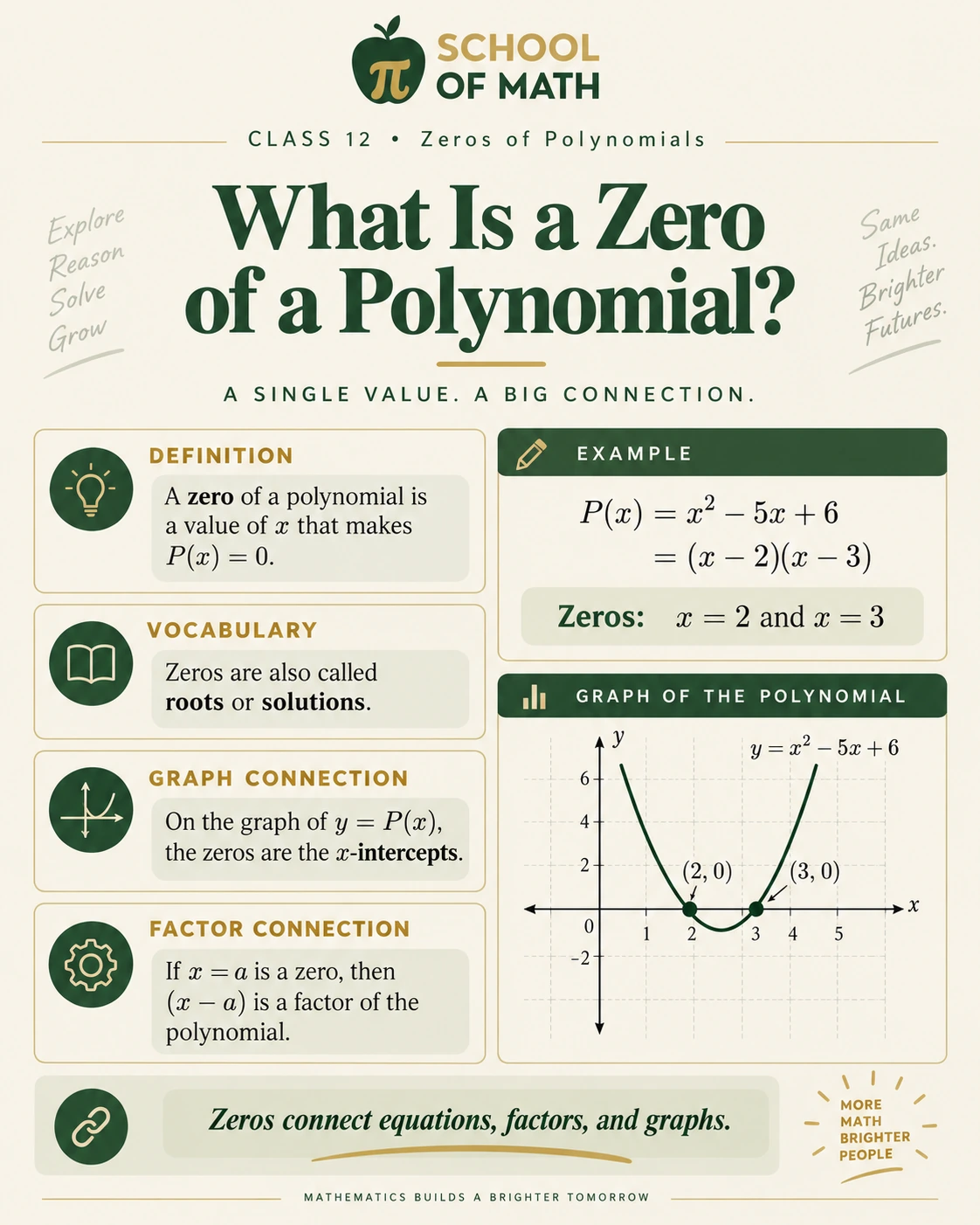
A zero is a value \(r\) for which \(P(r)=0\). Solving \(P(x)=0\) means finding those inputs, not finding where the graph meets the vertical axis. A real zero \(r\) gives the horizontal-axis point \((r,0)\); the vertical-axis intercept is \((0,P(0))\).
The Factor Theorem connects the algebra: \(P(r)=0\) exactly when \(x-r\) is a factor. Zeros can also be nonreal complex numbers; those do not appear as intercepts on a real coordinate graph.
Try it yourself: five questions, increasing difficulty
Q1 Practice 1 of 5 · Foundation
For \(P(x)=x^2+x-2\), decide whether \(x=-2\) is a zero.
Answer
\(-2\) is a zero.
- Substitute into the entire expression: \(P(-2)=4-2-2=0\).
- Because the output is zero, \(x+2\) is a factor and \((-2,0)\) is a real intercept.
Q2 Practice 2 of 5 · Build confidence
A polynomial has zeros at \(-4\) and \(5\). Write the corresponding linear factors and the two intercepts.
Answer
Factors: \(x+4\) and \(x-5\). Intercepts: \((-4,0)\) and \((5,0)\).
- A zero \(r\) produces \(x-r\). Thus \(x-(-4)=x+4\), while the other factor is \(x-5\).
- The intercepts are points, not just the two numbers.
Q3 Practice 3 of 5 · Apply
For \(R(x)=(x-6)(x+3)\), find the zeros and the \(y\)-intercept. Explain why the intercept is not another zero.
Answer
Zeros: \(6,-3\). The \(y\)-intercept is \((0,-18)\).
- A product is zero when one factor is zero, giving \(6\) and \(-3\).
- At \(x=0\), \(R(0)=(-6)(3)=-18\). A zero is an input with output zero; the output here is not zero.
Q4 Practice 4 of 5 · Reason
The polynomial \(P(x)=x^2+ax-12\) has a zero at \(3\). Find \(a\) and the other zero.
Answer
\(a=1\); the other zero is \(-4\).
- Set \(P(3)=9+3a-12=0\), so \(a=1\).
- Then \(P(x)=x^2+x-12=(x-3)(x+4)\).
Q5 Practice 5 of 5 · Challenge
A quadratic has zeros \(-2\) and \(7\), and its graph passes through \((0,28)\). Find the quadratic and verify both zeros.
Answer
\(P(x)=-2(x+2)(x-7)=-2x^2+10x+28\).
- Write \(P(x)=a(x+2)(x-7)\). At zero, \(28=-14a\), so \(a=-2\).
- Substituting \(-2\) or \(7\) makes one factor zero. Expanding gives the stated quadratic.
2. Find zeros by factoring
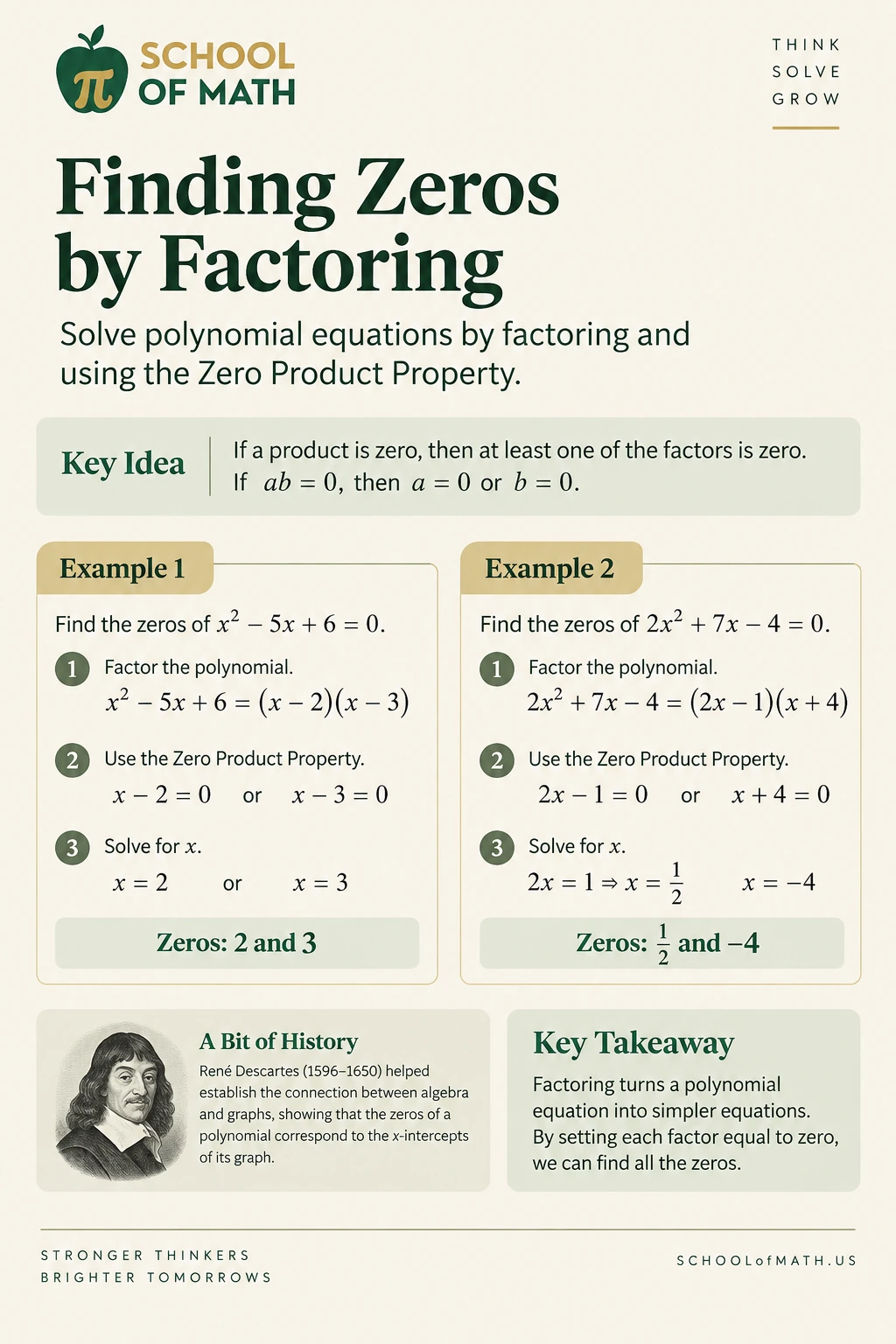
First move every term to one side so the equation equals zero. Then factor completely and use the Zero Product Property: a product is zero only if at least one factor is zero. A nonzero constant multiplier changes heights, but not the locations of the zeros.
Keep a factor of \(x\) if one appears. Dividing both sides by \(x\) without considering \(x=0\) can erase a valid solution. Check the signs when solving a factor such as \(3x+1=0\).
Try it yourself: five questions, increasing difficulty
Q6 Practice 1 of 5 · Foundation
Find all zeros of \(x^2-7x+10\).
Answer
\(x=2,5\).
- The numbers \(-2\) and \(-5\) multiply to \(10\) and add to \(-7\).
- Therefore \(x^2-7x+10=(x-2)(x-5)\). Set each factor equal to zero.
Q7 Practice 2 of 5 · Build confidence
Find all zeros of \(3x^2-5x-2\).
Answer
\(x=-\frac13,2\).
- Factor: \(3x^2-5x-2=(3x+1)(x-2)\).
- Solve \(3x+1=0\) to get \(-1/3\), and \(x-2=0\) to get \(2\).
Q8 Practice 3 of 5 · Apply
Find every zero of \(x^3+4x^2-16x-64\) by grouping.
Answer
\(x=-4\) (multiplicity two) and \(x=4\).
- Group: \(x^2(x+4)-16(x+4)=(x+4)(x^2-16)\).
- Factor again: \((x+4)^2(x-4)\).
Q9 Practice 4 of 5 · Reason
Find all zeros of \(2x^4-10x^2+8\), including multiplicities.
Answer
\(x=-2,-1,1,2\), each with multiplicity one.
- Factor out two, then treat \(x^2\) as a single quantity: \(2[(x^2)^2-5x^2+4]=2(x^2-1)(x^2-4)\).
- The complete factorization is \(2(x-1)(x+1)(x-2)(x+2)\).
Q10 Practice 5 of 5 · Challenge
Find all real and nonreal zeros of \(x^4+x^2-20\). Which are graph intercepts?
Answer
Zeros: \(2,-2,i\sqrt5,-i\sqrt5\). The real intercepts are \((2,0)\) and \((-2,0)\).
- Let \(u=x^2\). Then \(u^2+u-20=(u+5)(u-4)\).
- Thus \(x^2=4\) or \(x^2=-5\). Only the first equation produces real zeros.
3. Use the Rational Root Theorem
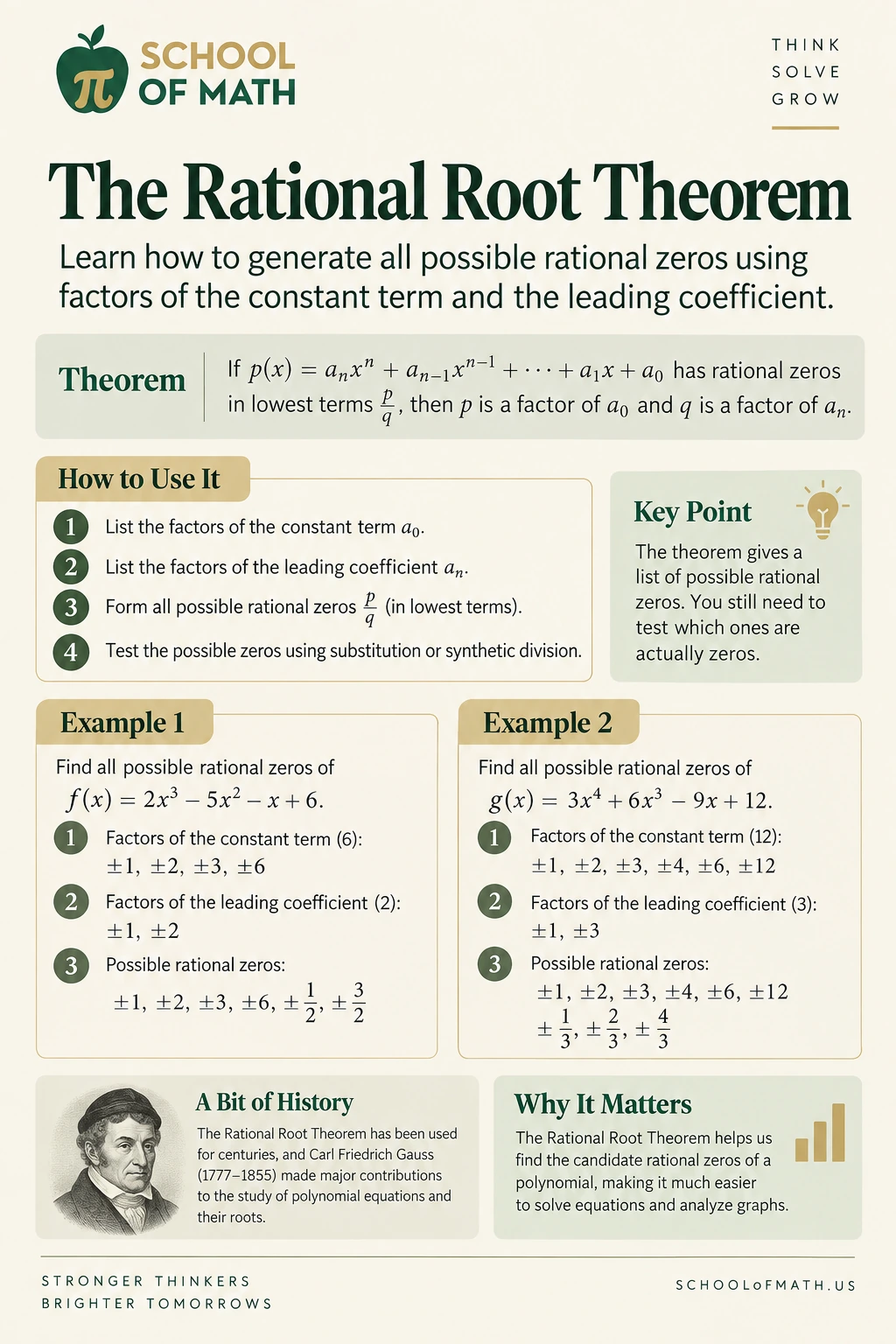
For a polynomial with integer coefficients, a rational zero written in lowest terms as \(p/q\) must have \(p\) dividing the constant term and \(q\) dividing the leading coefficient. Include positive and negative possibilities, reduce fractions, and remove duplicates.
This produces candidates, not guaranteed zeros. It does not list irrational or nonreal zeros. If the constant term is zero, factor out the appropriate power of \(x\) first; zero is already a root, and the theorem can then be applied to the remaining polynomial.
Try it yourself: five questions, increasing difficulty
Q11 Practice 1 of 5 · Foundation
List all possible rational zeros of \(x^3+2x^2-5x-10\). You do not need to solve the polynomial.
Answer
\(\pm1,\pm2,\pm5,\pm10\).
- The constant term is \(-10\), whose integer divisors are \(\pm1,\pm2,\pm5,\pm10\).
- The leading coefficient is \(1\), so there are no additional noninteger candidates.
Q12 Practice 2 of 5 · Build confidence
List all distinct rational-zero candidates for \(4x^3-3x^2-6x+2\).
Answer
\(\pm1,\pm2,\pm\frac12,\pm\frac14\).
- Use numerators dividing \(2\): \(1,2\), and denominators dividing \(4\): \(1,2,4\).
- Reduce and remove repeats: \(2/2=1\) and \(2/4=1/2\). Include both signs.
Q13 Practice 3 of 5 · Apply
List all distinct rational-zero candidates for \(6x^3-5x^2+2x-4\).
Answer
\(\pm1,\pm2,\pm4,\pm\frac12,\pm\frac13,\pm\frac23,\pm\frac43,\pm\frac16\).
- Possible numerators divide \(4\); denominators divide \(6\).
- Use numerators \(1,2,4\) and denominators \(1,2,3,6\), then reduce, remove repeats, and include both signs.
Q14 Practice 4 of 5 · Reason
Explain how to apply the Rational Root Theorem to \(3x^4-7x^3+2x^2\), then find all its zeros.
Answer
Zero has multiplicity two; the other zeros are \(\frac13\) and \(2\).
- First factor out \(x^2\): \(x^2(3x^2-7x+2)\). Do not try to build a finite candidate list from a zero constant term.
- For the remaining quadratic, candidates are \(\pm1,\pm2,\pm1/3,\pm2/3\).
- Factor \(3x^2-7x+2=(3x-1)(x-2)\).
Q15 Practice 5 of 5 · Challenge
List and test the rational candidates for \(x^3-3x^2-2x+6\). Then find the irrational zeros that the theorem does not list.
Answer
Candidates: \(\pm1,\pm2,\pm3,\pm6\). Zeros: \(3,\sqrt2,-\sqrt2\).
- The leading coefficient is one, so rational candidates are the divisors of six.
- In the order \(-6,-3,-2,-1,1,2,3,6\), the outputs are \(-306,-42,-10,4,2,-2,0,102\). Only \(3\) is a rational zero.
- Group: \(x^2(x-3)-2(x-3)=(x-3)(x^2-2)\). Solve the remaining quadratic to get \(\pm\sqrt2\).
4. Test possible zeros
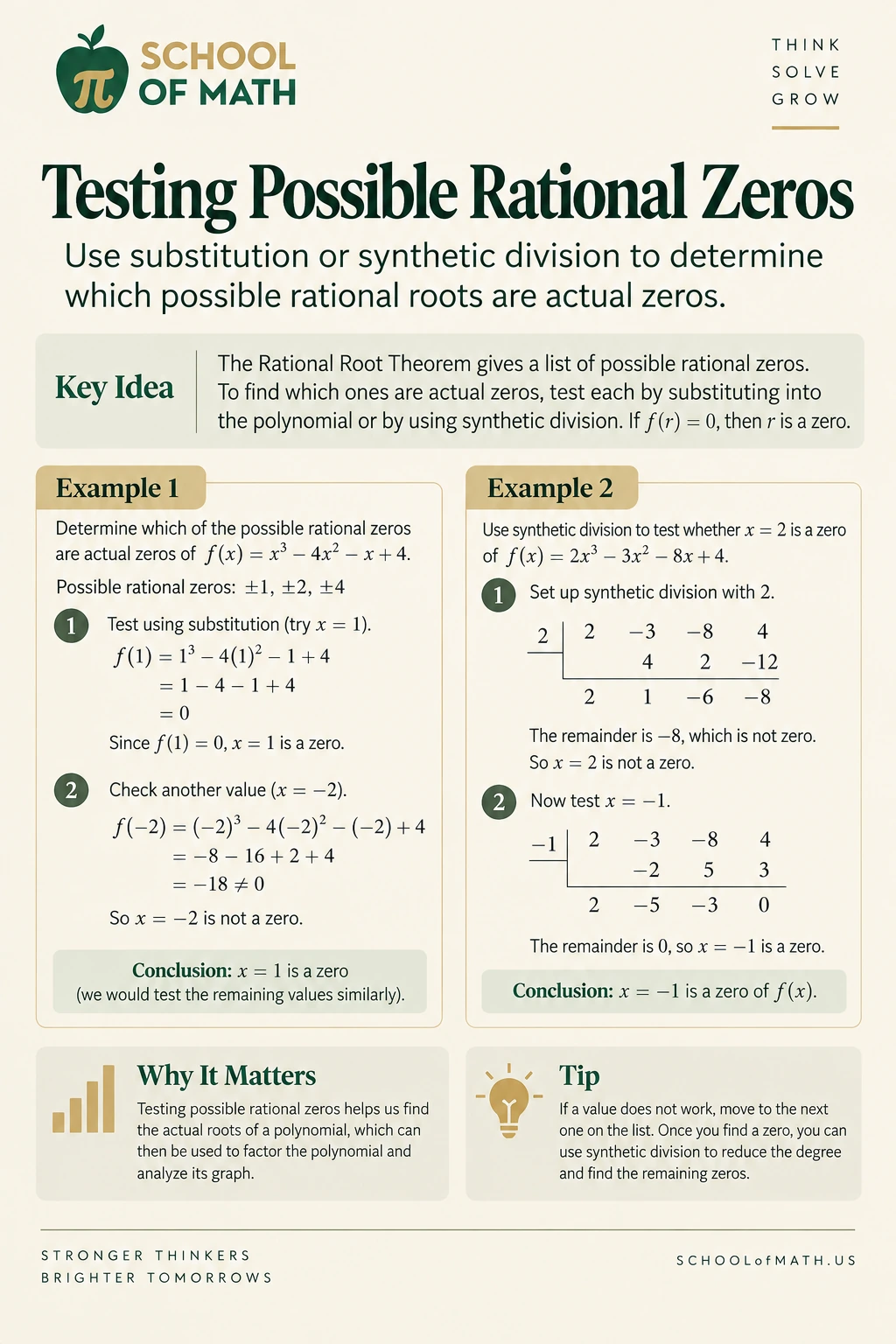
Substitute a candidate carefully, or use synthetic division to calculate the remainder. If the result is exactly zero, you have found a factor. If it is nonzero, reject that candidate and try another; being close to zero is not enough for an exact algebraic test.
Small integers are often efficient first choices. Testing a fraction can also work, but keep exact fractions rather than rounded decimals.
Try it yourself: five questions, increasing difficulty
Q16 Practice 1 of 5 · Foundation
For \(f(x)=x^3-2x^2-5x+6\), test \(x=1\) and \(x=2\). Which corresponding linear factor is valid?
Answer
\(f(1)=0\), \(f(2)=-4\); \(x-1\) is a factor, but \(x-2\) is not.
- \(f(1)=1-2-5+6=0\).
- \(f(2)=8-8-10+6=-4\). A nonzero remainder rules out the second factor.
Q17 Practice 2 of 5 · Build confidence
Test whether \(x=\frac12\) is a zero of \(2x^3+x^2-13x+6\).
Answer
Yes. The polynomial has the factor \(2x-1\).
- Substitution gives \(2(1/8)+1/4-13/2+6\).
- This simplifies to \(1/4+1/4-13/2+12/2=0\). The factor \(x-1/2\) can equivalently be represented by \(2x-1\), up to a nonzero multiplier.
Q18 Practice 3 of 5 · Apply
Find \(b\) so that dividing \(P(x)=2x^3+bx^2-7x+3\) by \(x-2\) leaves remainder \(5\). Is \(2\) a zero?
Answer
\(b=0\); \(2\) is not a zero.
- The Remainder Theorem gives \(P(2)=16+4b-14+3=5+4b\).
- Require \(5+4b=5\), giving \(b=0\). The remainder is five, not zero.
Q19 Practice 4 of 5 · Reason
For \(P(x)=x^3-6x^2+11x-6\), test \(1\), \(2\), and \(3\). Explain why these tests give a complete factorization, not just a guess.
Answer
\(P(x)=(x-1)(x-2)(x-3)\).
- The outputs are \(1-6+11-6=0\), \(8-24+22-6=0\), and \(27-54+33-6=0\).
- Each verified zero supplies a distinct linear factor. Their product has the same degree and leading coefficient as this cubic.
- Expanding the product confirms the original expression.
Q20 Practice 5 of 5 · Challenge
The polynomial \(P(x)=x^3+ax^2+bx+12\) has zeros at \(2\) and \(-3\). Find \(a\), \(b\), and its third zero.
Answer
\(a=-1,\ b=-8\); the third zero is \(2\), so \(2\) is repeated.
- From \(P(2)=0\), obtain \(4a+2b=-20\), or \(2a+b=-10\).
- From \(P(-3)=0\), obtain \(9a-3b=15\), or \(3a-b=5\). Adding gives \(5a=-5\), so \(a=-1\) and \(b=-8\).
- The polynomial is \((x-2)^2(x+3)\), which has constant term \(12\) and expands to \(x^3-x^2-8x+12\).
5. Reduce the polynomial with synthetic division
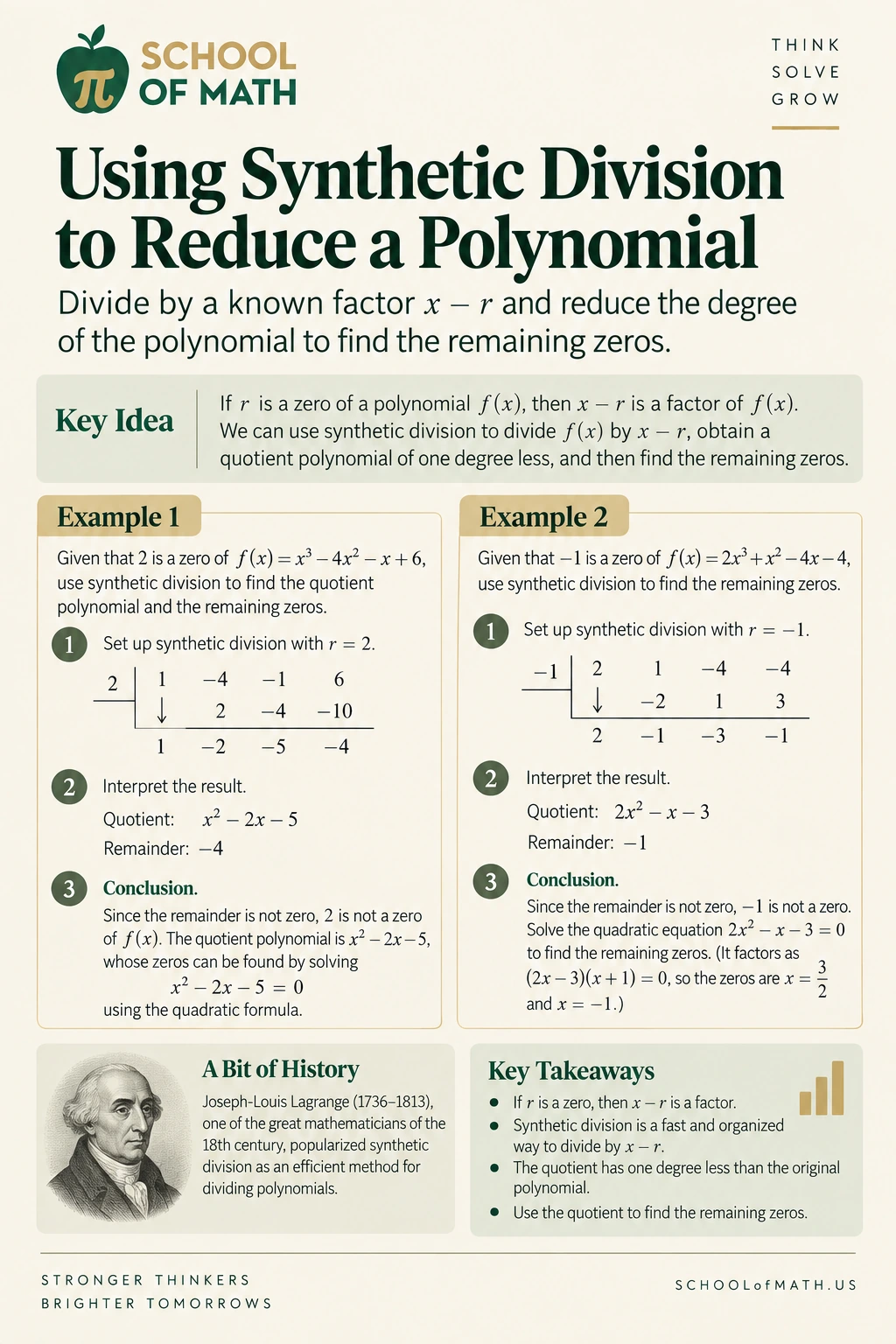
Arrange coefficients in descending powers, including a zero for every missing power. For division by \(x-r\), put \(r\), not \(-r\), outside the synthetic-division setup. Bring down, multiply, add, and repeat.
The last entry is the remainder. Only a zero remainder permits the factorization \(P(x)=(x-r)Q(x)\); then the zeros of the quotient supply the remaining roots. With a nonzero remainder, the identity is \(P(x)=(x-r)Q(x)+R\), and zeros of \(Q\) are not automatically zeros of \(P\).
Try it yourself: five questions, increasing difficulty
Q21 Practice 1 of 5 · Foundation
Given that \(1\) is a zero of \(x^3+2x^2-13x+10\), divide synthetically and find all zeros.
Answer
Quotient: \(x^2+3x-10\). Zeros: \(1,-5,2\).
- Use \(r=1\) and coefficients \(1,2,-13,10\). The bottom row is \(1,3,-10,0\).
- Factor the quotient: \(x^2+3x-10=(x+5)(x-2)\).
- The complete factorization is \((x-1)(x+5)(x-2)\).
Q22 Practice 2 of 5 · Build confidence
Divide \(x^3-4x^2-9x+36\) by \(x+3\), then find all zeros.
Answer
Quotient: \(x^2-7x+12\). Zeros: \(-3,3,4\).
- Use \(r=-3\), not \(3\). Starting with \(1,-4,-9,36\), the bottom row is \(1,-7,12,0\).
- The quotient factors as \((x-3)(x-4)\). Including \(x+3\) gives all three zeros.
Q23 Practice 3 of 5 · Apply
Use synthetic division with \(r=\frac12\) to factor \(2x^3-3x^2-5x+3\) completely.
Answer
\((2x-1)(x^2-x-3)\); zeros \(\frac12,\frac{1+\sqrt{13}}2,\frac{1-\sqrt{13}}2\).
- With coefficients \(2,-3,-5,3\), the synthetic bottom row is \(2,-2,-6,0\).
- Thus \(P(x)=(x-\tfrac12)(2x^2-2x-6)=(2x-1)(x^2-x-3)\).
- Apply the quadratic formula to \(x^2-x-3=0\).
Q24 Practice 4 of 5 · Reason
Given that \(2\) is a zero of \(x^4-2x^3+9x^2-18x\), divide by \(x-2\) and find all real and nonreal zeros.
Answer
Quotient: \(x^3+9x\). Zeros: \(2,0,3i,-3i\).
- Include the missing constant: coefficients \(1,-2,9,-18,0\). The bottom row is \(1,0,9,0,0\).
- Factor the quotient as \(x(x^2+9)\). This gives zero and the two nonreal zeros \(\pm3i\), in addition to the original zero two.
Q25 Practice 5 of 5 · Challenge
Use synthetic division twice to show that \(3\) is a repeated zero of \(x^4-5x^3+x^2+21x-18\). Then find all zeros and their multiplicities.
Answer
\(P(x)=(x-3)^2(x+2)(x-1)\). Zero \(3\) is double; \(-2\) and \(1\) are simple.
- The first division by \(x-3\) gives bottom row \(1,-2,-5,6,0\), so the quotient is \(x^3-2x^2-5x+6\).
- Divide again by \(x-3\): bottom row \(1,1,-2,0\), giving \(x^2+x-2=(x+2)(x-1)\).
- The two zero remainders establish the repeated factor. The remaining quadratic is nonzero at three, so the multiplicity is exactly two.
6. Read multiplicity at each zero
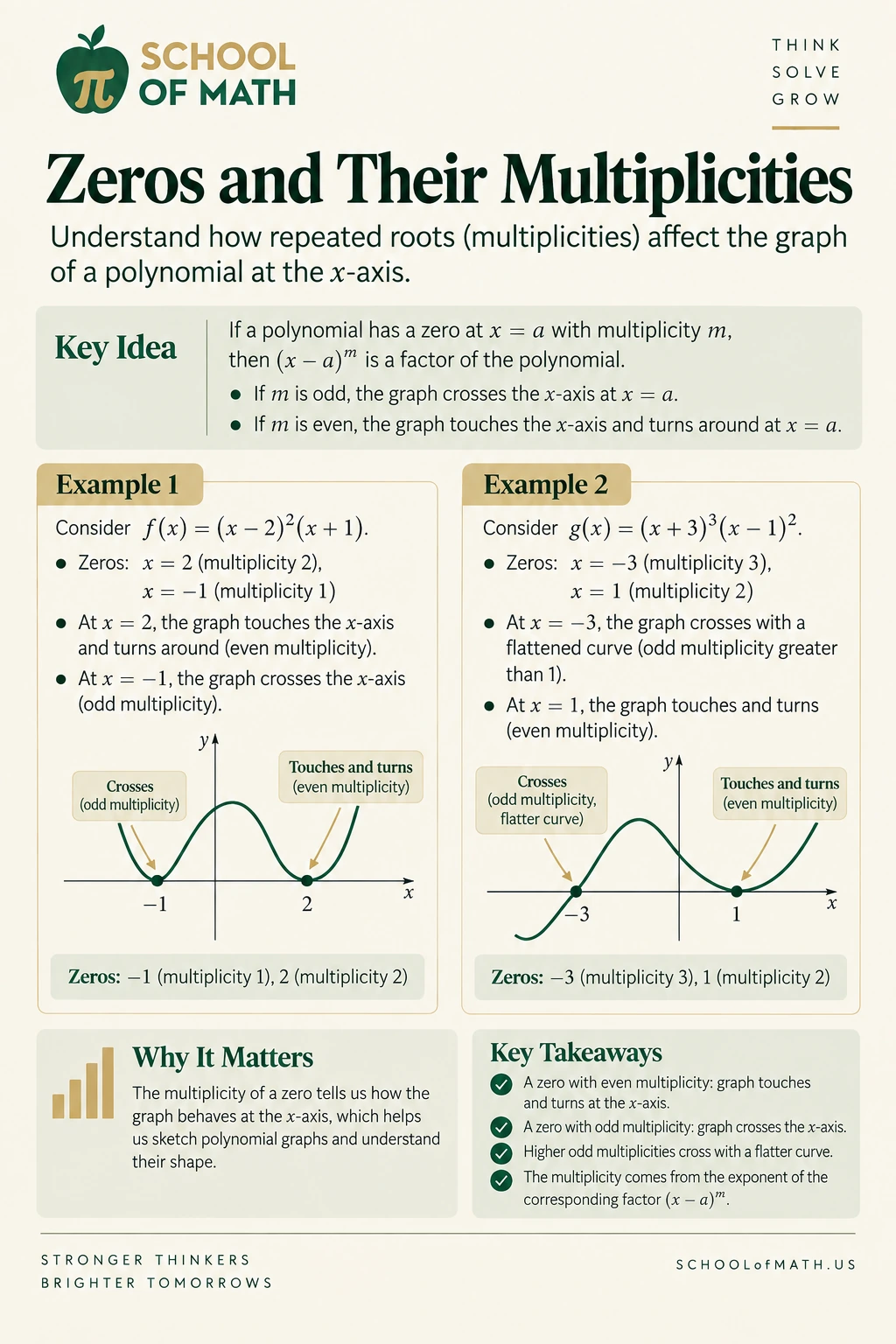
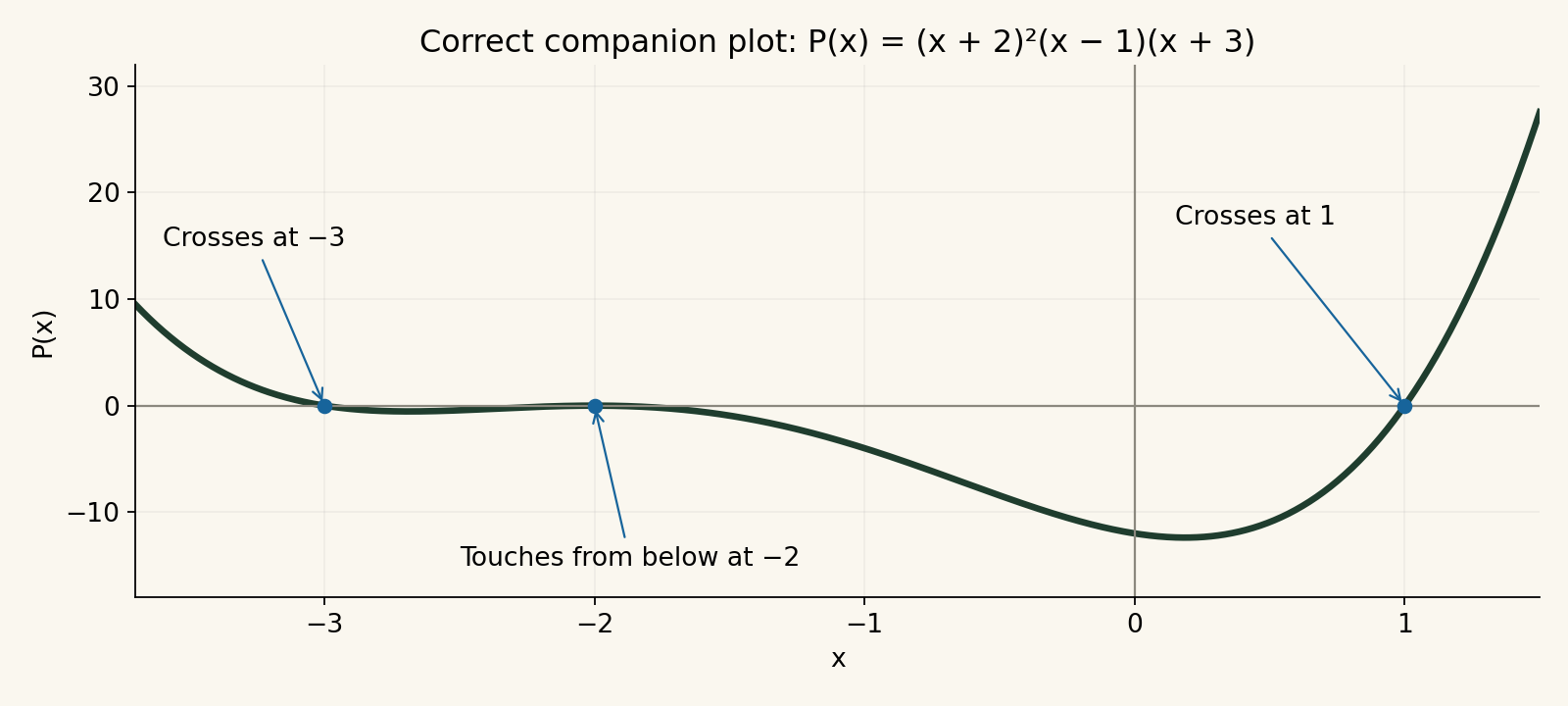
The exponent on a repeated linear factor gives the zero’s multiplicity. Odd multiplicity means the sign changes and the graph crosses the axis. Even multiplicity means the sign does not change and the graph touches the axis and turns back.
Multiplicity greater than one makes the graph flatter at the zero. An odd multiplicity such as three still crosses; an even multiplicity such as four still turns. Add all factor exponents to find the degree when the polynomial is completely expressed as linear factors.
Try it yourself: five questions, increasing difficulty
Q26 Practice 1 of 5 · Foundation
For \(f(x)=(x+4)^2(x-3)^3\), list each zero, its multiplicity, and whether the graph crosses or touches.
Answer
\(-4\): multiplicity \(2\), touches. \(3\): multiplicity \(3\), crosses with flattening.
- The zero from \(x+4\) is \(-4\), not \(4\). Its exponent is even.
- The zero from \(x-3\) is \(3\), and its exponent is odd. The degree is \(2+3=5\).
Q27 Practice 2 of 5 · Build confidence
Analyze the zeros of \(g(x)=-2(x-5)^4(x+2)\). Does the factor \(-2\) change their multiplicities?
Answer
\(5\): multiplicity \(4\), touches. \(-2\): multiplicity \(1\), crosses. The multiplier does not change multiplicity.
- A nonzero scalar cannot make a new zero or remove an existing one.
- The exponents are \(4\) and \(1\); the degree is five.
Q28 Practice 3 of 5 · Apply
For \(P(x)=-(x+6)^3(x-1)^2\), identify the sign immediately to the left and right of each zero.
Answer
At \(-6\): positive then negative. At \(1\): negative on both sides.
- Near \(-6\), the squared factor is positive and the cubic factor changes from negative to positive; the leading minus reverses these signs.
- Near \(1\), \(x+6\) is positive and the square is positive except at the zero. There is no sign change at the even-multiplicity zero.
Q29 Practice 4 of 5 · Reason
A polynomial crosses with multiplicity three at \(-2\), touches with multiplicity two at \(1\), and passes through \((0,16)\). Find the least-degree polynomial and its degree.
Answer
\(P(x)=2(x+2)^3(x-1)^2\), degree five.
- Write \(P(x)=a(x+2)^3(x-1)^2\).
- At zero, \(16=a(8)(1)\), so \(a=2\). The multiplicities add to five.
Q30 Practice 5 of 5 · Challenge
A real polynomial has exactly three distinct real zeros: it touches at \(-5\), crosses with flattening at \(0\), and touches at \(4\). What is its least possible degree? Construct one with leading coefficient \(-1\) and justify why degree six is impossible.
Answer
Least degree seven; one example is \(-x^3(x+5)^2(x-4)^2\).
- Each touch needs an even multiplicity of at least two. A flattened crossing needs an odd multiplicity of at least three.
- The minimum total is \(2+3+2=7\), so degree six cannot work.
- The proposed product has precisely those real zeros and leading coefficient \(-1\).
7. Determine end behavior
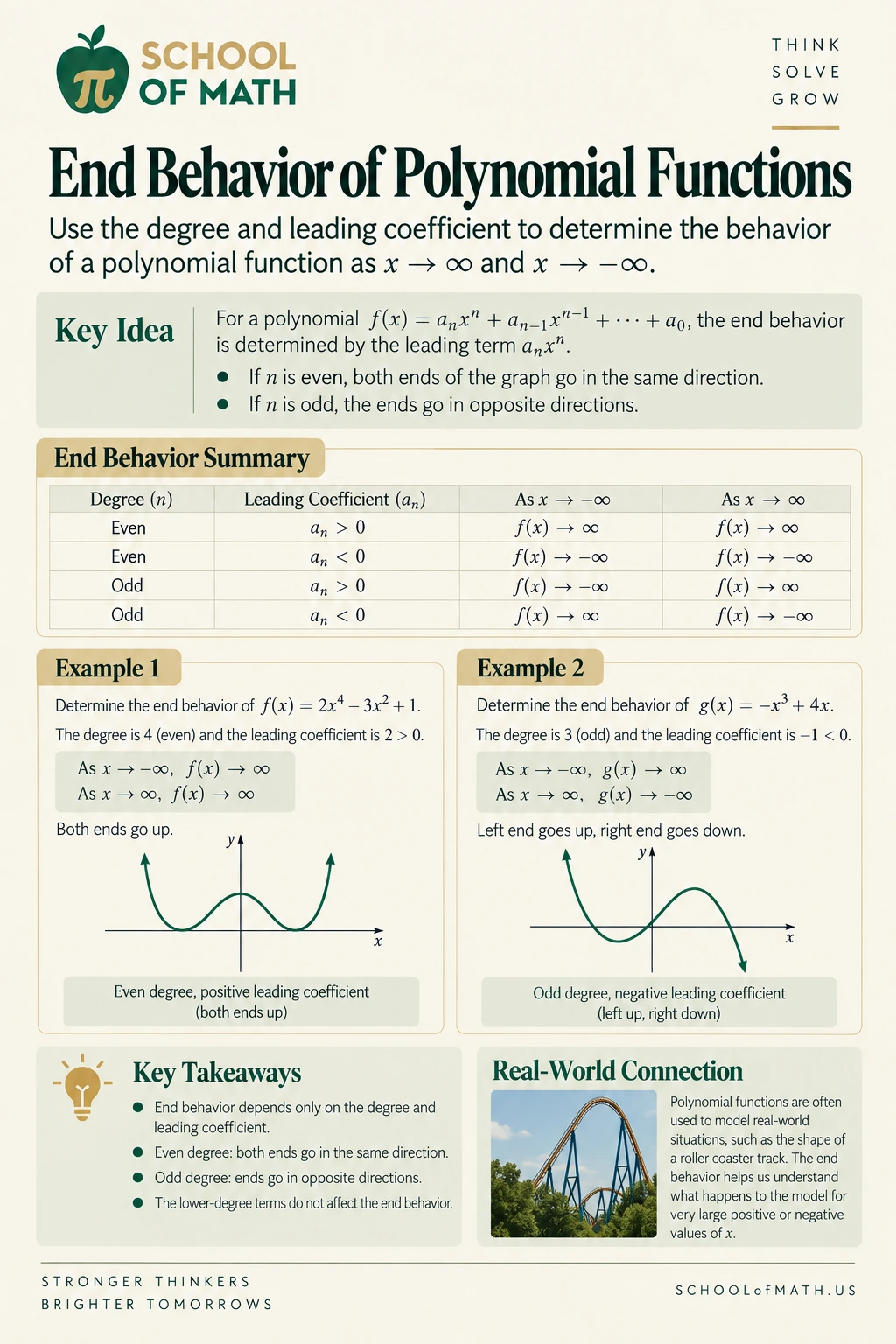
For large positive or negative \(x\), the highest-degree term determines the direction of the graph’s tails. Even degree gives matching tail directions; odd degree gives opposite directions. A positive leading coefficient makes the right tail rise, and a negative leading coefficient makes it fall.
You do not need to expand a factored polynomial completely. Add the factor degrees and multiply the leading coefficients. End behavior does not tell you every turn in the middle or make a real-world model valid outside its stated domain.
| Degree | Leading coefficient | Left tail | Right tail |
|---|---|---|---|
| Even | Positive | Up | Up |
| Even | Negative | Down | Down |
| Odd | Positive | Down | Up |
| Odd | Negative | Up | Down |
Try it yourself: five questions, increasing difficulty
Q31 Practice 1 of 5 · Foundation
Describe both tails of \(f(x)=-5x^6+2x^3-x+9\).
Answer
Both tails fall.
- The leading term is \(-5x^6\): even degree, negative coefficient.
- As \(x\to-\infty\), \(f(x)\to-\infty\); as \(x\to\infty\), \(f(x)\to-\infty\).
Q32 Practice 2 of 5 · Build confidence
Describe both tails of \(g(x)=3x^5-7x^2+4\).
Answer
The left tail falls and the right tail rises.
- The leading term is \(3x^5\): odd degree, positive coefficient.
- As \(x\to-\infty\), \(g(x)\to-\infty\); as \(x\to\infty\), \(g(x)\to\infty\).
Q33 Practice 3 of 5 · Apply
Without expanding, determine the degree, leading coefficient, and end behavior of \(-3(2x-1)^2(1-x)^3\).
Answer
Degree five, leading coefficient \(12\); left falls and right rises.
- The leading factors are \(-3\), \(4x^2\), and \(-x^3\). Their product is \(12x^5\).
- Do not assume that the outside minus alone determines the leading sign; the factor \(1-x\) contributes another minus.
Q34 Practice 4 of 5 · Reason
For \(P_a(x)=ax^4-2x^3+5\), describe both tails when \(a>0\), when \(a<0\), and when \(a=0\).
Answer
\(a>0\): both rise. \(a<0\): both fall. \(a=0\): left rises and right falls.
- When \(a\ne0\), the degree is four and the sign of \(a\) controls both tails.
- When \(a=0\), the quartic term disappears. The leading term becomes \(-2x^3\), so the degree and the tail pattern both change.
Q35 Practice 5 of 5 · Challenge
Determine the actual degree, leading coefficient, and end behavior of \(P(x)=(x^2+1)(x^2-4)-x^4+2x^3\). Explain why calling it a quartic would give the wrong tail pattern.
Answer
Degree three, leading coefficient \(2\); left falls and right rises.
- Expand the product: \(x^4-3x^2-4\). After subtraction and addition, \(P(x)=2x^3-3x^2-4\).
- The quartic terms cancel. Use the highest nonzero term after simplifying, not the largest power visible in the unsimplified expression.
8. Connect zeros, factors, and graphs
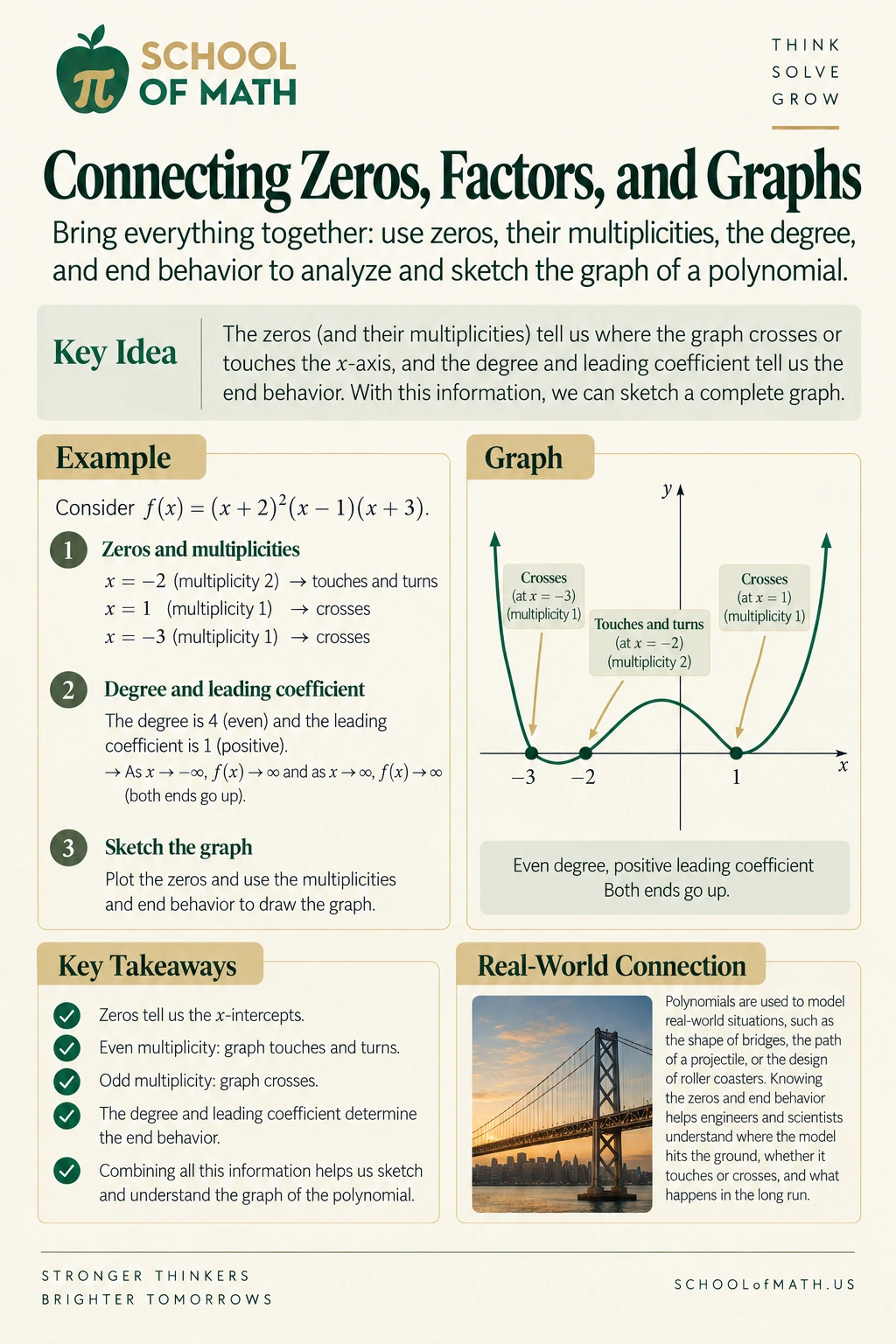
Build a reliable graph plan in this order: factor, locate the real zeros, label multiplicities, calculate the vertical intercept, identify the tail directions, and test signs between zeros. This gives a qualitative sketch, not exact turning-point coordinates.
Crossings change sign. Touches preserve sign. A claimed sketch that violates either rule needs correction, even if its end behavior looks right.
Try it yourself: five questions, increasing difficulty
Q36 Practice 1 of 5 · Foundation
For \(g(x)=(x-4)^2(x+2)\), find the zeros, multiplicities, \(y\)-intercept, and both tail directions.
Answer
Zeros: \(4\) (double) and \(-2\) (simple). \(y\)-intercept: \((0,32)\). Left falls, right rises.
- The graph touches at \(4\) and crosses at \(-2\).
- \(g(0)=(-4)^2(2)=32\). The leading term is \(x^3\), so the tails have the stated directions.
Q37 Practice 2 of 5 · Build confidence
Describe the key graph features of \(h(x)=-(x+5)(x-2)^2(x-1)\).
Answer
Crosses at \(-5\) and \(1\); touches at \(2\). \(y\)-intercept: \((0,20)\). Both tails fall.
- The multiplicities are \(1,2,1\), so the degree is four.
- The leading term is \(-x^4\). At zero, \(h(0)=-(5)(4)(-1)=20\).
Q38 Practice 3 of 5 · Apply
For \(P(x)=(x+4)(x-1)^2(x-5)\), find the sign on each interval separated by its zeros. State which zeros cause sign changes.
Answer
Positive on \((-\infty,-4)\) and \((5,\infty)\); negative on \((-4,1)\) and \((1,5)\). Sign changes occur at \(-4\) and \(5\), not at \(1\).
- Except at one, the squared factor is positive, so the sign comes from \((x+4)(x-5)\).
- These two factors have the same sign outside the outer roots and opposite signs between them. The double zero at one does not change sign.
Q39 Practice 4 of 5 · Reason
Find all zeros of \(P(x)=2x^3-7x^2-7x+12\), then give its intercepts and end behavior.
Answer
Zeros: \(1,4,-\frac32\), all simple. \(y\)-intercept: \((0,12)\). Left falls, right rises.
- Test \(1\): \(2-7-7+12=0\). Division by \(x-1\) gives \(2x^2-5x-12\).
- Factor the quotient: \(2x^2-5x-12=(2x+3)(x-4)\).
- The three \(x\)-intercepts are \((1,0),(4,0),(-3/2,0)\), and the graph crosses at each. The leading term is \(2x^3\).
Q40 Practice 5 of 5 · Challenge
A least-degree polynomial crosses at \(-4\), touches at \(1\), crosses at \(3\), and has \(P(0)=24\). Find it, state its end behavior, and identify all intervals on which it is positive.
Answer
\(P(x)=-2(x+4)(x-1)^2(x-3)\). Both tails fall. It is positive on \((-4,1)\) and \((1,3)\).
- The minimum multiplicities are one, two, and one. Write \(P(x)=a(x+4)(x-1)^2(x-3)\).
- Use \(24=a(4)(1)(-3)=-12a\), giving \(a=-2\).
- The degree is four and the leading coefficient is negative. Between \(-4\) and \(3\), the two simple factors have opposite signs, so the leading minus makes the polynomial positive, except at the zero one. Outside that range, it is negative.
Ten cumulative word problems
These are deliberately more approachable than the previous class’s hardest extensions, while still requiring algebra, interpretation, and domain checks. The early problems build confidence; the later ones combine rational zeros, multiplicity, sign analysis, and end behavior. Show an equation, solve it, and explain what each valid zero means in context.
W1 Craft-booth profit
A school-fair craft booth models its profit by \(P(n)=-n^2+26n-120\) dollars when it sells \(n\) bundles, where \(n\) is a whole number from \(0\) to \(26\). Find both break-even sales levels and the whole-number sales levels that produce a profit.
Answer
Break-even: \(6\) or \(20\) bundles. Profit: \(7\) through \(19\) bundles.
- Factor \(P(n)=-(n-6)(n-20)\). Break-even means profit equals zero, so \(n=6\) or \(20\).
- Between the zeros, the factors have opposite signs, and the leading minus makes their product positive. Since bundles are whole numbers, use \(7\le n\le19\).
W2 A ball above the ground
A ball tossed upward from a platform has modeled height \(h(t)=-5t^2+20t+25\) meters after \(t\) seconds. Use the model only from launch until the ball reaches the ground. Find when it lands and when it returns to its launch height.
Answer
It lands at \(5\) seconds and returns to its launch height at \(4\) seconds.
- For landing, solve \(h(t)=0\). Factor \(h(t)=-5(t-5)(t+1)\), giving \(t=5\) or \(-1\). Reject negative time.
- The launch height is \(h(0)=25\). For a return to that height, solve \(-5t^2+20t=0\), or \(-5t(t-4)=0\).
- The later solution is \(4\) seconds; \(t=0\) is the launch itself.
W3 A garden’s dimensions
A rectangular garden has width \(x+1\) meters and length \(x+5\) meters. Its area must be \(45\) square meters. Write a polynomial whose zero determines \(x\), solve it, and give the actual dimensions.
Answer
\(x=4\); width \(5\) m and length \(9\) m.
- The area condition is \((x+1)(x+5)=45\), so \(x^2+6x-40=0\).
- Factor \((x+10)(x-4)=0\), giving \(x=-10\) or \(4\).
- The first value gives negative dimensions and is invalid. The second gives \(5\cdot9=45\).
W4 A shipping box
A shipping box has inside dimensions \(x\), \(x+1\), and \(x+2\) centimeters and volume \(120\) cubic centimeters. Show that \(x=4\) is a rational zero of the volume-difference polynomial. Divide out that factor and explain why it gives the only real value of \(x\).
Answer
The dimensions are \(4\), \(5\), and \(6\) cm.
- Set \(x(x+1)(x+2)-120=0\), or \(x^3+3x^2+2x-120=0\). Substitution gives \(64+48+8-120=0\) at \(x=4\).
- Division yields \((x-4)(x^2+7x+30)=0\).
- The quadratic discriminant is \(49-120=-71<0\), so it has no real zeros. Only \(x=4\) gives real dimensions.
W5 Calibrating a sensor
A sensor’s calibration error is modeled by \(E(s)=2s^3-9s^2+7s+6\), where its control setting must satisfy \(0\le s\le4\). A zero error means the sensor is calibrated. Use the Rational Root Theorem to justify testing \(s=2\), then find every calibrated setting the device can actually use.
Answer
The usable settings are \(s=2\) and \(s=3\).
- The numerator \(2\) divides the constant \(6\), and denominator \(1\) divides the leading coefficient \(2\), so \(2\) is a candidate.
- \(E(2)=16-36+14+6=0\). Division by \(s-2\) gives \(2s^2-5s-3=(2s+1)(s-3)\).
- The full zero set is \(-1/2,2,3\). Reject \(-1/2\) because it is outside the allowed settings.
W6 A drone and a reference line
During a short inspection, a drone’s signed height relative to a horizontal reference line is \(d(t)=(t-2)^2(t-5)\) meters, for \(0\le t\le6\). Negative values mean below the line, not below the ground. When does it meet the line? At which meeting does it pass through the line, and where is it relative to the line at \(t=3\)?
Answer
It meets the line at \(2\) and \(5\) seconds, crosses only at \(5\), and is \(2\) m below the line at \(t=3\).
- The zero \(2\) has even multiplicity two, so the drone touches the reference line and stays on the same side immediately before and after.
- The zero \(5\) is simple, so the signed height changes sign there.
- \(d(3)=(1)^2(-2)=-2\), so the drone is two meters below the reference line.
W7 A museum ramp model
A designer models the height of a ramp above the floor by \(h(x)=a(x+1)(x-3)^2\), using only \(0\le x\le4\) meters. The height at \(x=0\) is \(9\) meters. Find \(a\), determine where the actual ramp meets the floor, and find its modeled height at \(x=4\).
Answer
\(a=1\). It meets the floor at \(x=3\) m, with height \(5\) m at \(x=4\).
- Use \(h(0)=a(1)(9)=9\), so \(a=1\).
- The mathematical zeros are \(-1\) and \(3\), but only \(3\) belongs to the physical domain. Its multiplicity is two, so the profile touches the floor and turns.
- \(h(4)=(5)(1)^2=5\). Do not treat the root at \(-1\) as a point on this ramp.
W8 Choosing a production range
For a limited production range \(1\le x\le7\), a factory models profit by \(P(x)=-x^3+12x^2-44x+48\), in thousands of dollars, where \(x\) is production in hundreds of units. Verify that \(x=2\) is a zero, find all break-even output levels, and identify the intervals with positive profit within the stated range.
Answer
Break-even: \(200\), \(400\), and \(600\) units. Profit is positive for \(1\le x<2\) and \(4<x<6\).
- \(P(2)=-8+48-88+48=0\). Division by \(x-2\) gives \(-x^2+10x-24=-(x-4)(x-6)\).
- Thus \(P(x)=-(x-2)(x-4)(x-6)\); the three simple zeros are \(2,4,6\). Multiply by 100 to convert to units.
- Test \(x=1,3,5,7\): the profits are \(15,-3,3,-15\) thousand dollars. The positive intervals follow. Break-even endpoints themselves are not positive-profit points.
W9 A temporary shop’s profit model
A temporary shop models weekly profit by \(P(w)=-10(w+1)(w-2)^2(w-6)\) dollars for \(0\le w\le8\) weeks. Find the break-even times in this interval, decide whether profit changes sign at each, and describe both mathematical tails of the polynomial. Explain why those tails are not a forecast for the shop forever.
Answer
Break-even at weeks \(2\) and \(6\). No sign change at \(2\); a change from profit to loss at \(6\). Both mathematical tails fall.
- The zero at \(-1\) is outside the time domain. Week \(2\) has multiplicity two and week \(6\) has multiplicity one.
- For nonnegative \(w\), \(w+1>0\) and the squared factor is nonnegative. Profit is positive before week \(6\), except at week \(2\), and negative after week \(6\).
- The degree is four and the leading coefficient is \(-10\). Both tails go to \(-\infty\), but the shop model was specified only for the first eight weeks.
W10 Designing a sculpture profile
A sculpture designer uses a polynomial \(F(x)\) for vertical displacement from a reference line. Horizontal position \(x\) is measured from a central marker, so negative positions are allowed. The profile crosses the line at \(x=-1\) and \(x=4\), touches it at \(x=2\), and passes through \((0,16)\). Find the least-degree polynomial with these properties, describe its end behavior, and determine whether its point at \(x=3\) is above or below the line.
Answer
\(F(x)=-(x+1)(x-2)^2(x-4)\). Both tails fall, and \(F(3)=4\), so the point is above the line.
- The least-degree form uses multiplicity one at each crossing and two at the touch: \(F(x)=a(x+1)(x-2)^2(x-4)\).
- Use \((0,16)\): \(16=a(1)(4)(-4)=-16a\), giving \(a=-1\).
- The degree is four with negative leading coefficient. Finally, \(F(3)=-(4)(1)(-1)=4\). These are properties of the mathematical profile; a physical sculpture uses only its designed finite section.
Quick questions and answers
What is a zero of a polynomial?
A zero is an input r that makes P(r)=0. A real zero gives an x-intercept (r,0); a nonreal complex zero does not give an intercept on a real graph.
What does the Rational Root Theorem tell you?
For a polynomial with integer coefficients, a rational zero p/q in lowest terms must have p dividing the constant term and q dividing the leading coefficient. It provides candidates, not guaranteed zeros.
Does the Rational Root Theorem find irrational zeros?
No. It restricts rational candidates. After finding a rational zero, factor the quotient or use another appropriate method to find remaining zeros, which may be irrational or nonreal.
Why must synthetic division have remainder zero?
Only a zero remainder makes the divisor a factor. A nonzero remainder means quotient zeros are not automatically zeros of the original polynomial.
How do multiplicities affect a polynomial graph?
An odd multiplicity causes a crossing and a sign change. An even multiplicity causes a touch and turn without a sign change. Multiplicities greater than one flatten the graph locally.
How do you determine end behavior?
Use the degree and leading coefficient. Even degree has matching tail directions; odd degree has opposite directions. A positive leading coefficient raises the right tail, while a negative one lowers it. Real-world models still have domain restrictions.