Algebra 2 · Class 18
Logarithms: Definition, Properties, and Change of Base
Read a logarithm as an exponent, move between exponential and logarithmic forms, apply the product, quotient, and power properties, and evaluate any base with the change-of-base formula.
Explore ten illustrated topics with 50 practice questions, eight Homework review questions, and twelve Homework word problems. Every question has a blue Answer control with detailed working. Try each question before revealing the solution; a calculator is useful only for the change-of-base approximations and the application problems.
This is an independent topic in the Algebra 2 rolling syllabus, with no required earlier class attendance. Review the explanations here and work at your own pace. See the schedule or book an evaluation at SOMATH.
Download the student workbook (PDF)26 pages · Supplied cover, ten teaching images, all 70 questions · Blank working space · No exercise solutions
What is a logarithm?
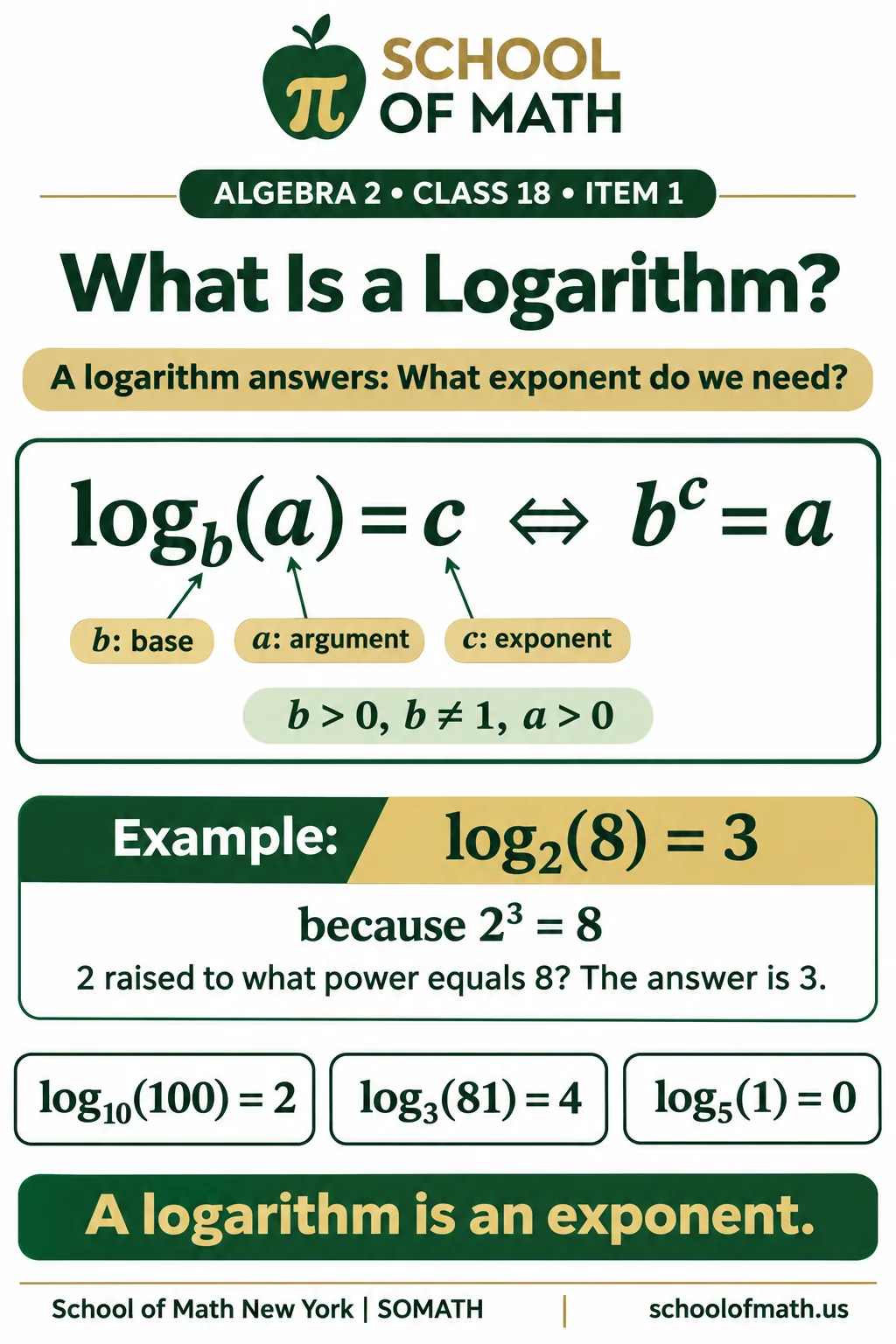
A logarithm is an exponent. The statement \(\log_b(a)=c\) means exactly the same thing as \(b^c=a\): the base \(b\) raised to the exponent \(c\) produces the argument \(a\). To evaluate a logarithm, ask the question in the image: the base raised to what power gives the argument?
The restrictions \(b>0\), \(b\neq1\), and \(a>0\) come from the exponential side. A positive base other than 1 produces every positive output exactly once, so the logarithm of a positive number is a single real value. Zero and negative arguments have no real logarithm, because a positive base never produces them.
Practice: try these five questions
Q1
Evaluate the logarithm by asking which exponent is needed. State the question in words first.
Answer
\(\log_3(243)=5\)
Ask: 3 raised to what power gives 243?
List powers of 3 until the argument appears.
\[3^1=3,\;3^2=9,\;3^3=27,\;3^4=81,\;3^5=243\]The exponent that works is the logarithm.
\[\log_3(243)=5\]
Check and interpret
Rewrite in exponential form: \(3^5=243\). The base, exponent, and argument all match the definition.
Q2
Evaluate the logarithm. Then explain why the answer would be the same for any allowed base.
Answer
\(\log_6(1)=0\); every allowed base gives 0.
Ask: 6 raised to what power gives 1?
Any nonzero number to the zero power equals 1.
\[6^0=1\]For any base \(b>0\), \(b\neq1\), the same equation holds, so the logarithm of 1 is always 0.
\[b^0=1\;\Longleftrightarrow\;\log_b(1)=0\]
Check and interpret
Test another base: \(\log_{11}(1)=0\) because \(11^0=1\). The argument 1 always corresponds to the exponent 0.
Q3
Evaluate the logarithm. Write the argument as a power of the base before answering.
Answer
\(\log_{10}(10{,}000)=4\)
Count the zeros to write the argument as a power of 10.
\[10{,}000=10^4\]Replace the argument by its power form.
\[\log_{10}(10^4)\]The logarithm is the exponent on the base.
\[\log_{10}(10^4)=4\]
Check and interpret
Exponential form: \(10^4=10{,}000\). Each additional zero in the argument adds 1 to the base-10 logarithm.
Q4
Explain why neither expression represents a real number. Use the exponential form in your reasoning.
Answer
Neither is defined: no real exponent makes \(2^c\) equal to 0 or to a negative number.
Translate each statement into exponential form with an unknown exponent c.
\[2^c=0\quad\text{or}\quad 2^c=-8\]For every real c, a positive base produces a positive output. Large negative exponents make the output small but still positive.
\[2^{-10}=\frac{1}{1024}>0\]The equations have no real solution, so the logarithms are undefined. The argument of a real logarithm must be positive.
Check and interpret
Compare with \(\log_2(8)=3\), which is defined because \(8>0\) and \(2^3=8\). Changing the sign of the argument removes the solution.
Q5
Find the base b. Explain why only one value is acceptable.
Answer
\(b=7\)
Rewrite in exponential form.
\[b^2=49\]Solve the equation; two real numbers square to 49.
\[b=7\quad\text{or}\quad b=-7\]The base of a logarithm must be positive and different from 1, so reject the negative value.
\[b=7\]
Check and interpret
Substitute: \(\log_7(49)=2\) because \(7^2=49\). A base of \(-7\) is not allowed in the definition.
Exponential and logarithmic forms
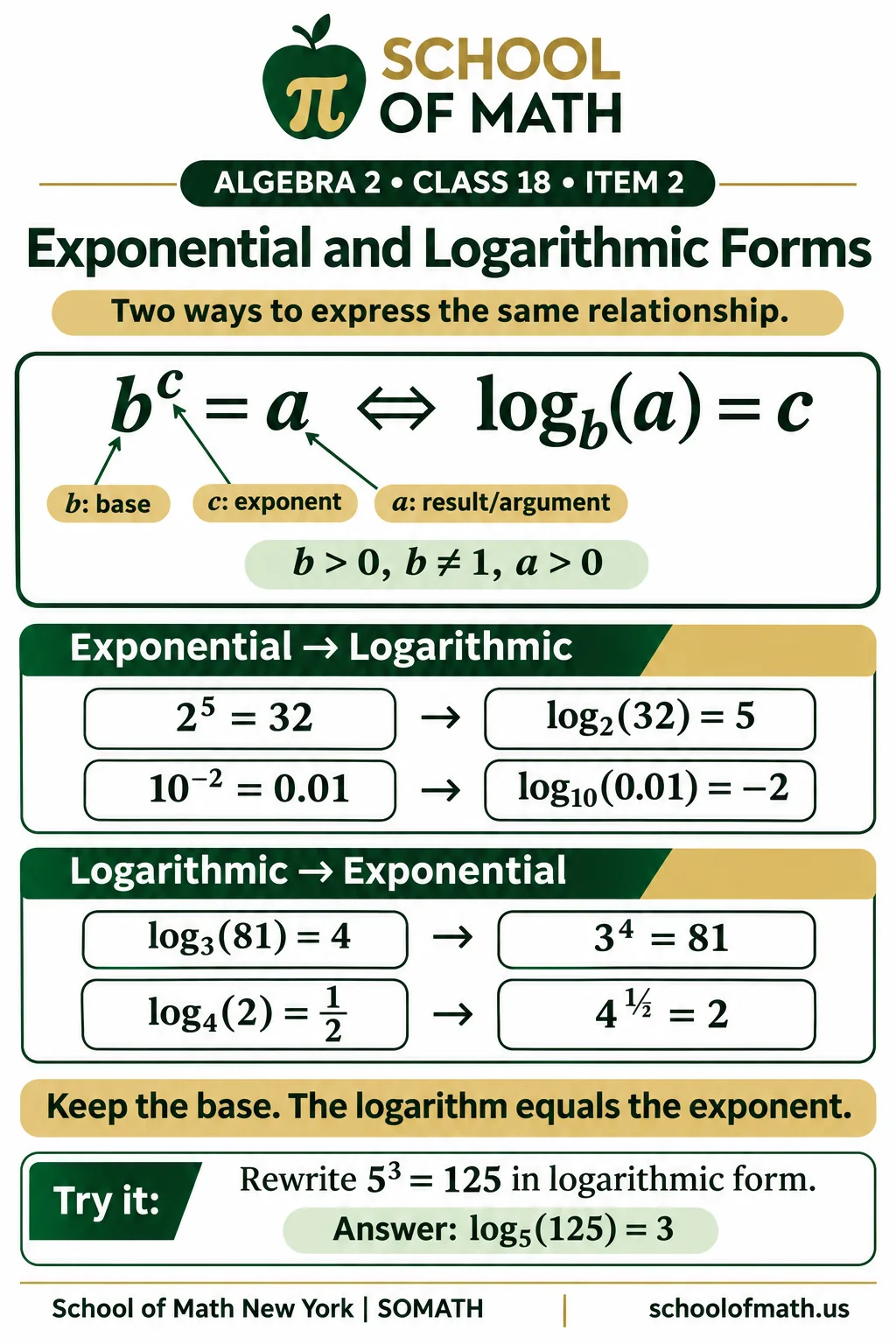
Every exponential statement has a logarithmic twin. In \(b^c=a\) the base is \(b\), the exponent is \(c\), and the result is \(a\). In \(\log_b(a)=c\) the base stays as the subscript, the result moves inside the parentheses as the argument, and the exponent becomes the value of the logarithm.
When converting, keep the base in its place and remember that the logarithm equals the exponent. This works for negative exponents, fractional exponents, and expressions with variables.
Practice: try these five questions
Q6
Rewrite the equation in logarithmic form. Identify the base, exponent, and argument.
Answer
\(\log_6(216)=3\)
Identify the parts: base 6, exponent 3, result 216.
Keep the base as the subscript, place the result inside, and set the logarithm equal to the exponent.
\[\log_6(216)=3\]
Check and interpret
Read it aloud: 6 raised to the power 3 gives 216. Both forms describe the same fact.
Q7
Rewrite the equation in logarithmic form. Keep the sign of the exponent.
Answer
\(\log_{10}(0.001)=-3\)
Identify the parts: base 10, exponent −3, result 0.001.
The logarithm equals the exponent, including its negative sign.
\[\log_{10}(0.001)=-3\]
Check and interpret
A negative logarithm means the argument is between 0 and 1. Indeed \(0<0.001<1\).
Q8
Rewrite the equation in exponential form.
Answer
\(7^3=343\)
Identify the parts: base 7, logarithm (exponent) 3, argument 343.
Raise the base to the exponent to obtain the argument.
\[7^3=343\]
Check and interpret
Compute: \(7\cdot7\cdot7=49\cdot7=343\). The exponential statement is true.
Q9
Rewrite the equation in exponential form. Then explain what the fractional exponent means.
Answer
\(8^{1/3}=2\)
Identify the parts: base 8, exponent 1/3, argument 2.
Raise the base to the exponent.
\[8^{1/3}=2\]An exponent of 1/3 is a cube root, so the statement says the cube root of 8 is 2.
\[\sqrt[3]{8}=2\]
Check and interpret
Cube the result: \(2^3=8\). The fractional exponent undoes the cube.
Q10
Rewrite the first equation in exponential form and the second in logarithmic form. Treat the variables as the exponent or argument they represent.
Answer
\(b^{x+1}=y\) and \(\log_5(w)=2t\)
In the first equation the whole expression x + 1 is the exponent, so it sits on the base b.
\[b^{x+1}=y\]In the second equation the base is 5, the exponent is 2t, and the result is w.
\[\log_5(w)=2t\]
Check and interpret
Each pair keeps the same base. The logarithm equals the entire exponent, whether it is a number or an expression.
Evaluating logarithms without a calculator
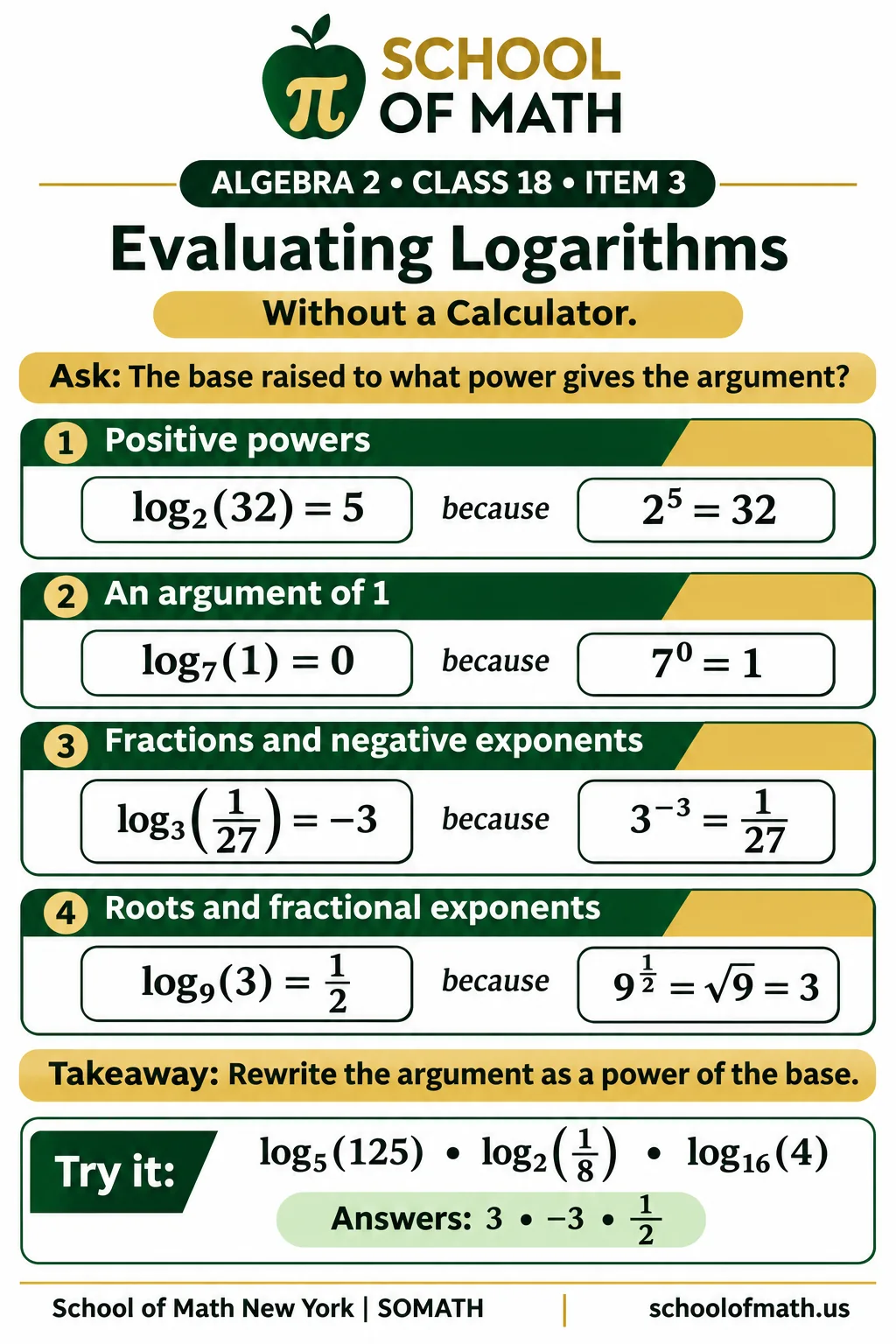
To evaluate \(\log_b(a)\) exactly, rewrite the argument as a power of the base. Positive powers give positive logarithms, an argument of 1 gives 0, fractions with the base in the denominator give negative logarithms, and roots give fractional logarithms.
When the argument is not an obvious power of the base, write both the base and the argument as powers of a smaller common number. Then set the exponents equal and solve for the unknown exponent.
Practice: try these five questions
Q11
Evaluate exactly.
Answer
\(\log_4(64)=3\)
Write the argument as a power of the base.
\[64=4\cdot4\cdot4=4^3\]The logarithm is the exponent.
\[\log_4(4^3)=3\]
Check and interpret
Exponential form: \(4^3=64\).
Q12
Evaluate exactly. Show the negative exponent.
Answer
\(\log_5\!\left(\frac{1}{125}\right)=-3\)
Write the denominator as a power of 5.
\[125=5^3\]A reciprocal is a negative exponent.
\[\frac{1}{125}=\frac{1}{5^3}=5^{-3}\]The logarithm is the exponent.
\[\log_5(5^{-3})=-3\]
Check and interpret
Exponential form: \(5^{-3}=\frac{1}{125}\). An argument between 0 and 1 gives a negative logarithm.
Q13
Evaluate exactly. Show the fractional exponent.
Answer
\(\log_{27}(3)=\frac{1}{3}\)
Ask: 27 raised to what power gives 3? Since \(3^3=27\), the cube root of 27 is 3.
\[27^{1/3}=\sqrt[3]{27}=3\]The logarithm is the exponent.
\[\log_{27}(3)=\frac{1}{3}\]
Check and interpret
Cube both sides of \(27^{1/3}=3\): \(27=27\). A fractional logarithm indicates a root.
Q14
Evaluate exactly by writing the base and the argument as powers of the same number.
Answer
\(\log_8(32)=\frac{5}{3}\)
Write both numbers as powers of 2.
\[8=2^3,\qquad 32=2^5\]Set up the exponential form with unknown exponent c.
\[(2^3)^c=2^5\;\Longrightarrow\;2^{3c}=2^5\]Equal bases require equal exponents.
\[3c=5\;\Longrightarrow\;c=\frac{5}{3}\]
Check and interpret
\(8^{5/3}=(8^{1/3})^5=2^5=32\). The answer is between 1 and 2, which fits because \(8<32<64\).
Q15
Evaluate exactly. The base is a fraction.
Answer
\(\log_{1/2}(16)=-4\)
Set up the exponential form.
\[\left(\frac{1}{2}\right)^c=16\]Write both sides as powers of 2.
\[2^{-c}=2^4\]Equal bases require equal exponents.
\[-c=4\;\Longrightarrow\;c=-4\]
Check and interpret
\(\left(\frac{1}{2}\right)^{-4}=2^4=16\). With a base between 0 and 1, an argument greater than 1 gives a negative logarithm.
Logarithmic functions: domain and graphs
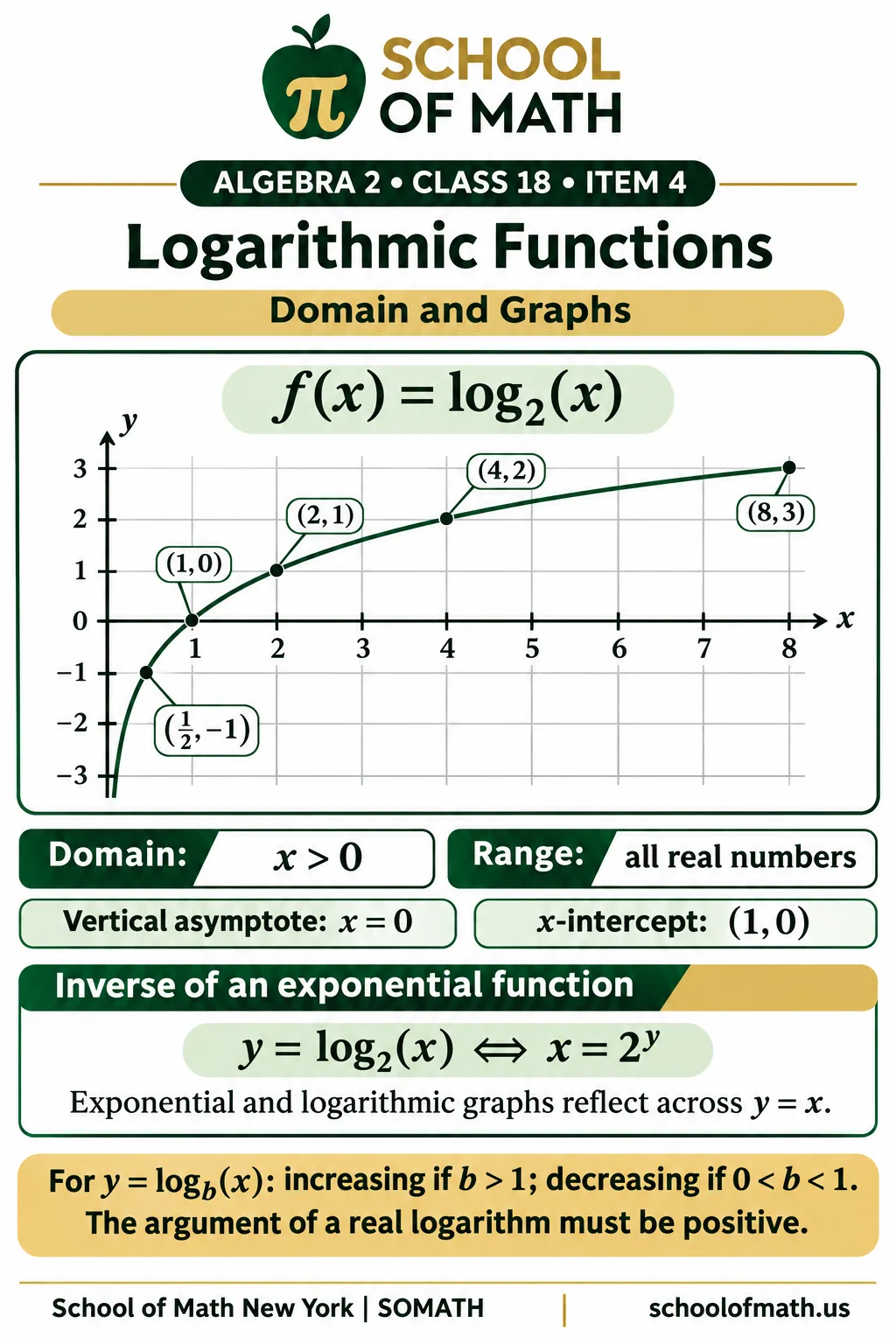
The function \(f(x)=\log_b(x)\) is the inverse of \(y=b^x\). Its domain is \(x>0\), its range is all real numbers, its graph passes through \((1,0)\) and \((b,1)\), and the y-axis \(x=0\) is a vertical asymptote. For \(b>1\) the graph increases; for \(0<b<1\) it decreases.
To find the domain of a logarithm with an expression inside, require the argument to be positive and solve that inequality. The vertical asymptote sits where the argument equals zero.
Practice: try these five questions
Q16
Make a table of values for x = 1/3, 1, 3, 9, and 27. Then state the x-intercept and the vertical asymptote, and sketch the graph.
Answer
Outputs \(-1,\,0,\,1,\,2,\,3\); x-intercept \((1,0)\); vertical asymptote \(x=0\).
Write each input as a power of 3; the logarithm is the exponent.
\[\tfrac{1}{3}=3^{-1},\;1=3^0,\;3=3^1,\;9=3^2,\;27=3^3\]Record the outputs in order.
\[f\!\left(\tfrac13\right)=-1,\;f(1)=0,\;f(3)=1,\;f(9)=2,\;f(27)=3\]The output is 0 at x = 1, so the x-intercept is (1, 0). As x approaches 0 from the right, the outputs decrease without bound, so x = 0 is the vertical asymptote.
Check and interpret
Each time x is multiplied by 3, the output increases by exactly 1. This constant step is the signature of a logarithm.
Q17
State the domain and the equation of the vertical asymptote.
Answer
Domain \(x>5\); vertical asymptote \(x=5\).
The argument of a logarithm must be positive.
\[x-5>0\]Solve the inequality.
\[x>5\]The asymptote is where the argument equals zero.
\[x-5=0\;\Longrightarrow\;x=5\]
Check and interpret
Test x = 6: \(g(6)=\log_2(1)=0\), defined. Test x = 5: \(\log_2(0)\) is undefined. The graph of \(\log_2(x)\) has shifted 5 units right.
Q18
State the domain in inequality form.
Answer
Domain \(x<\frac{7}{2}\)
Require a positive argument.
\[7-2x>0\]Subtract 7 from both sides.
\[-2x>-7\]Divide by −2 and reverse the inequality sign.
\[x<\frac{7}{2}\]
Check and interpret
Test x = 0: \(h(0)=\log(7)\), defined. Test x = 4: \(7-8=-1\), so \(\log(-1)\) is undefined. The domain lies to the left of the asymptote \(x=\frac72\).
Q19
The graph of y = 4ˣ passes through (3, 64). Name a point that must be on the graph of the inverse function, and explain the geometric relationship between the two graphs.
Answer
\((64,3)\) lies on \(y=\log_4(x)\); the two graphs are reflections across \(y=x\).
An inverse function swaps inputs and outputs. The point (3, 64) on the exponential becomes (64, 3) on the logarithm.
\[4^3=64\;\Longleftrightarrow\;\log_4(64)=3\]Swapping coordinates reflects every point across the line y = x, so the whole graph of the logarithm is the mirror image of the exponential graph.
Check and interpret
The exponential has horizontal asymptote \(y=0\) and y-intercept \((0,1)\); the logarithm has vertical asymptote \(x=0\) and x-intercept \((1,0)\). Each feature is the reflection of the other.
Q20
Compare the two functions: state whether each is increasing or decreasing, name a point they share, and explain how their outputs are related.
Answer
f increases, g decreases; both pass through \((1,0)\); \(g(x)=-f(x)\) for every \(x>0\).
The base of f is greater than 1, so f increases. The base of g is between 0 and 1, so g decreases.
Both give 0 at x = 1, because any allowed base to the zero power is 1.
\[f(1)=g(1)=0\]If \(g(x)=c\), then \((1/2)^c=x\), which is \(2^{-c}=x\). So \(-c=\log_2(x)\) and \(c=-\log_2(x)\).
\[\log_{1/2}(x)=-\log_2(x)\]
Check and interpret
At x = 8: \(f(8)=3\) and \(g(8)=-3\) because \(\left(\tfrac12\right)^{-3}=8\). The graphs are reflections of each other across the x-axis.
Common and natural logarithms
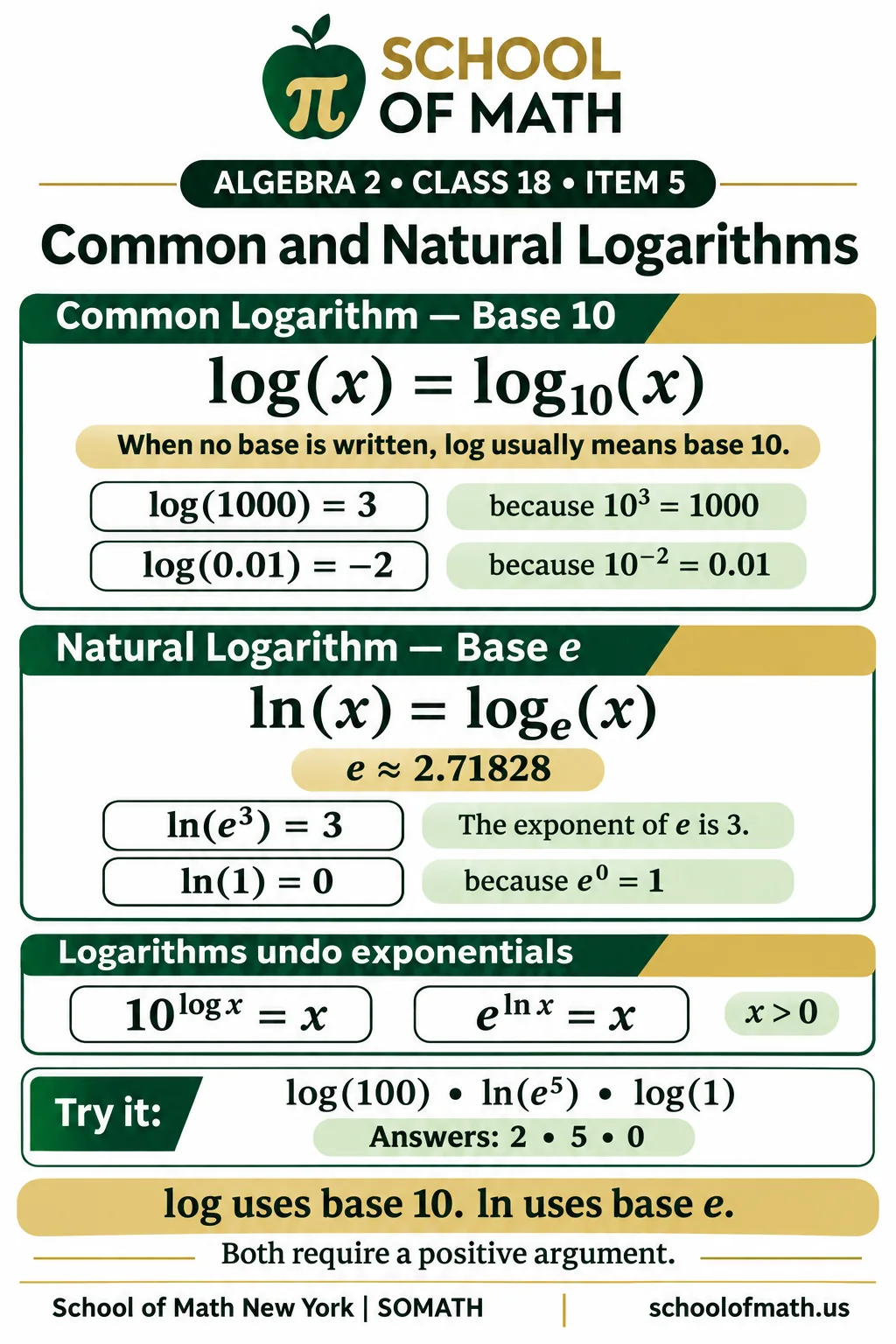
Two bases have their own notation. The common logarithm \(\log(x)\) uses base 10, and the natural logarithm \(\ln(x)\) uses base \(e\approx2.71828\). Both follow the same definition: \(\log(x)=c\) means \(10^c=x\), and \(\ln(x)=c\) means \(e^c=x\).
Because logarithms and exponentials are inverses, \(10^{\log x}=x\) and \(e^{\ln x}=x\) for \(x>0\), while \(\log(10^x)=x\) and \(\ln(e^x)=x\) for every real \(x\). Calculators have keys for both logarithms, which makes them the usual tools for the change-of-base formula.
Practice: try these five questions
Q21
Evaluate both common logarithms exactly.
Answer
\(\log(100{,}000)=5\) and \(\log(0.0001)=-4\)
Write each argument as a power of 10.
\[100{,}000=10^5,\qquad 0.0001=\frac{1}{10^4}=10^{-4}\]The common logarithm is the exponent on 10.
\[\log(10^5)=5,\qquad\log(10^{-4})=-4\]
Check and interpret
Five zeros after the 1 give 5; four decimal places give −4. Arguments above 1 have positive common logs, and arguments between 0 and 1 have negative ones.
Q22
Evaluate both natural logarithms exactly.
Answer
\(\ln(e^7)=7\) and \(\ln\!\left(\frac{1}{e^2}\right)=-2\)
The natural logarithm asks for the exponent on e.
\[\ln(e^7)=7\]Rewrite the reciprocal with a negative exponent, then read the exponent.
\[\frac{1}{e^2}=e^{-2}\;\Longrightarrow\;\ln(e^{-2})=-2\]
Check and interpret
No decimal approximation of e is needed, because each argument is already a power of e.
Q23
Simplify each expression without a calculator.
Answer
\(10^{\log 35}=35\) and \(e^{\ln 4.2}=4.2\)
\(\log 35\) is the exponent that 10 needs to produce 35. Raising 10 to that exponent returns 35.
\[10^{\log 35}=35\]Likewise \(\ln 4.2\) is the exponent e needs to produce 4.2.
\[e^{\ln 4.2}=4.2\]
Check and interpret
The exponential and the logarithm with the same base undo each other. Both arguments are positive, so each expression is defined.
Q24
Without a calculator, determine the two consecutive integers between which the value lies. Justify with powers of 10.
Answer
\(3<\log(4{,}500)<4\)
Find the powers of 10 on either side of the argument.
\[10^3=1{,}000<4{,}500<10{,}000=10^4\]Because the common logarithm is increasing, the logarithms keep the same order.
\[\log(10^3)<\log(4{,}500)<\log(10^4)\]Evaluate the outer logarithms.
\[3<\log(4{,}500)<4\]
Check and interpret
A calculator gives \(\log(4{,}500)\approx3.653\), which lies in the predicted interval. The number 4,500 has four digits, and its common log is between 3 and 4.
Q25
Rewrite the first equation in exponential form and the second in logarithmic form, then solve each for the variable.
Answer
\(x=e^5\) and \(y=\frac{\ln 9}{2}\)
The natural logarithm has base e, so the exponential form raises e to the given value.
\[\ln(x)=5\;\Longleftrightarrow\;x=e^5\]In the second equation the exponent is 2y and the result is 9.
\[e^{2y}=9\;\Longleftrightarrow\;\ln(9)=2y\]Divide by 2 to isolate y.
\[y=\frac{\ln 9}{2}\]
Check and interpret
Approximate: \(e^5\approx148.41\) and \(y\approx\frac{2.1972}{2}\approx1.099\). Then \(e^{2(1.099)}=e^{2.197}\approx9\).
Product and quotient properties
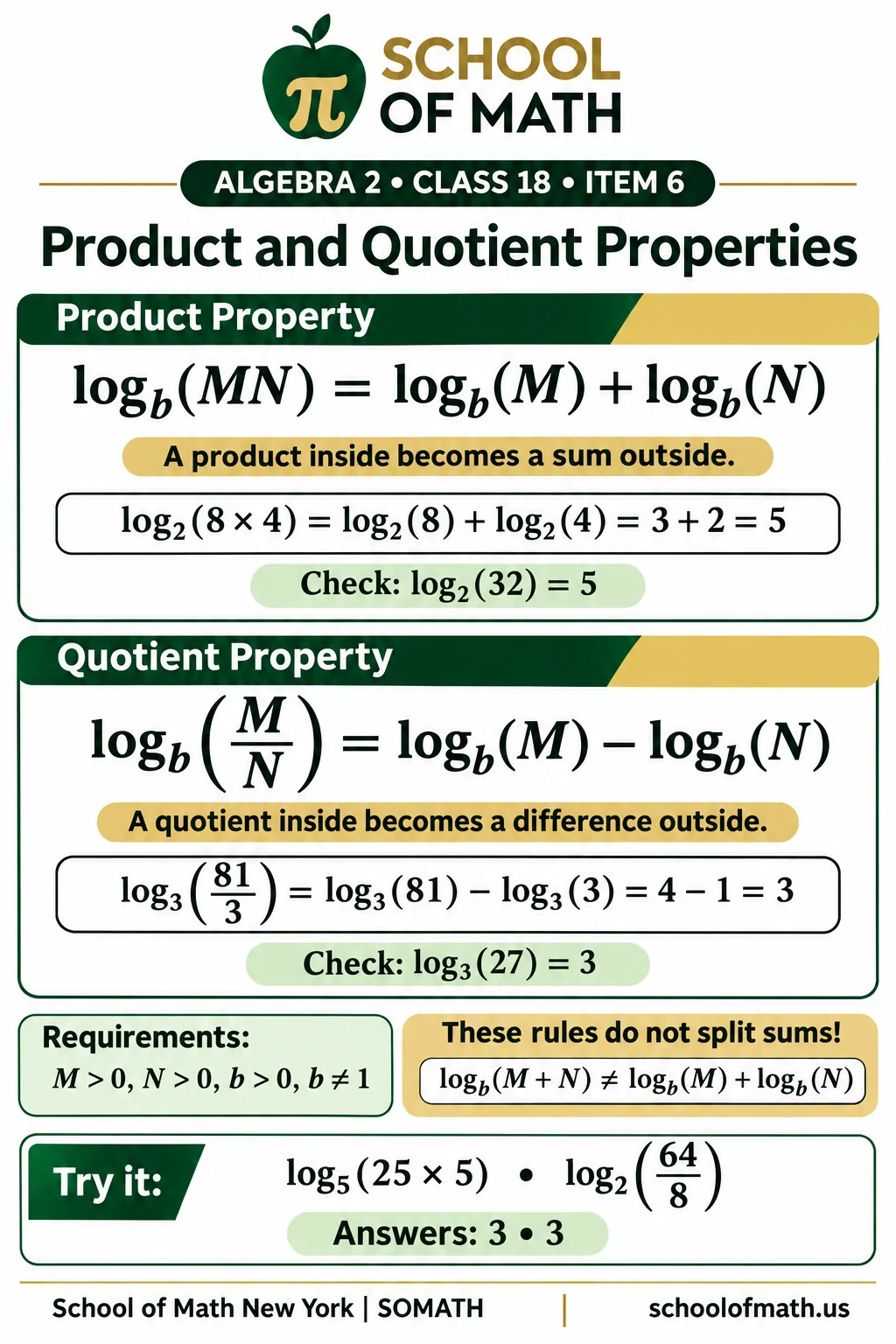
Because logarithms are exponents, they follow exponent rules. Multiplying powers adds exponents, so \(\log_b(MN)=\log_b(M)+\log_b(N)\). Dividing powers subtracts exponents, so \(\log_b\!\left(\frac{M}{N}\right)=\log_b(M)-\log_b(N)\). All arguments must be positive and the bases must match.
There is no rule for the logarithm of a sum or difference: \(\log_b(M+N)\) cannot be split. When a product is easier to evaluate in pieces, use the properties; when it is easier to multiply first, do that and evaluate once.
Practice: try these five questions
Q26
Evaluate using the product property, then confirm by multiplying first.
Answer
\(\log_3(27\cdot9)=5\)
Split the product into a sum of logarithms with the same base.
\[\log_3(27)+\log_3(9)\]Evaluate each logarithm.
\[3+2=5\]
Check and interpret
Multiply first: \(27\cdot9=243=3^5\), so \(\log_3(243)=5\). Both routes agree.
Q27
Evaluate using the quotient property, then confirm by dividing first.
Answer
\(\log_2\!\left(\frac{128}{4}\right)=5\)
Split the quotient into a difference of logarithms.
\[\log_2(128)-\log_2(4)\]Evaluate each logarithm.
\[7-2=5\]
Check and interpret
Divide first: \(\frac{128}{4}=32=2^5\), so \(\log_2(32)=5\).
Q28
Use the given approximations to find each value to three decimal places. Do not use a calculator logarithm key.
Answer
\(\log_b(6)\approx1.114\) and \(\log_b(1.5)\approx0.252\)
Write 6 as a product of the known arguments and apply the product property.
\[\log_b(6)=\log_b(2\cdot3)=\log_b(2)+\log_b(3)\approx0.431+0.683=1.114\]Write 1.5 as a quotient and apply the quotient property.
\[\log_b(1.5)=\log_b\!\left(\frac{3}{2}\right)=\log_b(3)-\log_b(2)\approx0.683-0.431=0.252\]
Check and interpret
The values are consistent with base 5, where \(\log_5(6)\approx1.113\) and \(\log_5(1.5)\approx0.252\). A product gives a larger logarithm than either factor, and a quotient near 1 gives a small logarithm.
Q29
Write the expression as a single logarithm. State the restrictions on the variables.
Answer
\(\log_4\!\left(\dfrac{5x}{y}\right)\), with \(x>0\) and \(y>0\)
Combine the sum into the logarithm of a product.
\[\log_4(5x)-\log_4(y)\]Combine the difference into the logarithm of a quotient.
\[\log_4\!\left(\frac{5x}{y}\right)\]Each original logarithm needs a positive argument, so x and y must both be positive.
Check and interpret
Test x = 4, y = 5: the original expression is \(\log_4(5)+1-\log_4(5)=1\), and the condensed form is \(\log_4(4)=1\).
Q30
Show by direct evaluation that the two expressions are not equal, and explain which property the mistake misuses.
Answer
\(\log_2(8+8)=4\) but \(\log_2(8)+\log_2(8)=6\); the product property does not apply to sums.
Evaluate the left side by adding first.
\[\log_2(16)=4\]Evaluate the right side term by term.
\[3+3=6\]A sum of logarithms equals the logarithm of a product, not of a sum.
\[\log_2(8)+\log_2(8)=\log_2(8\cdot8)=\log_2(64)=6\]
Check and interpret
The expression \(\log_b(M+N)\) has no splitting rule. Only products, quotients, and powers inside a logarithm can be rewritten.
The power property
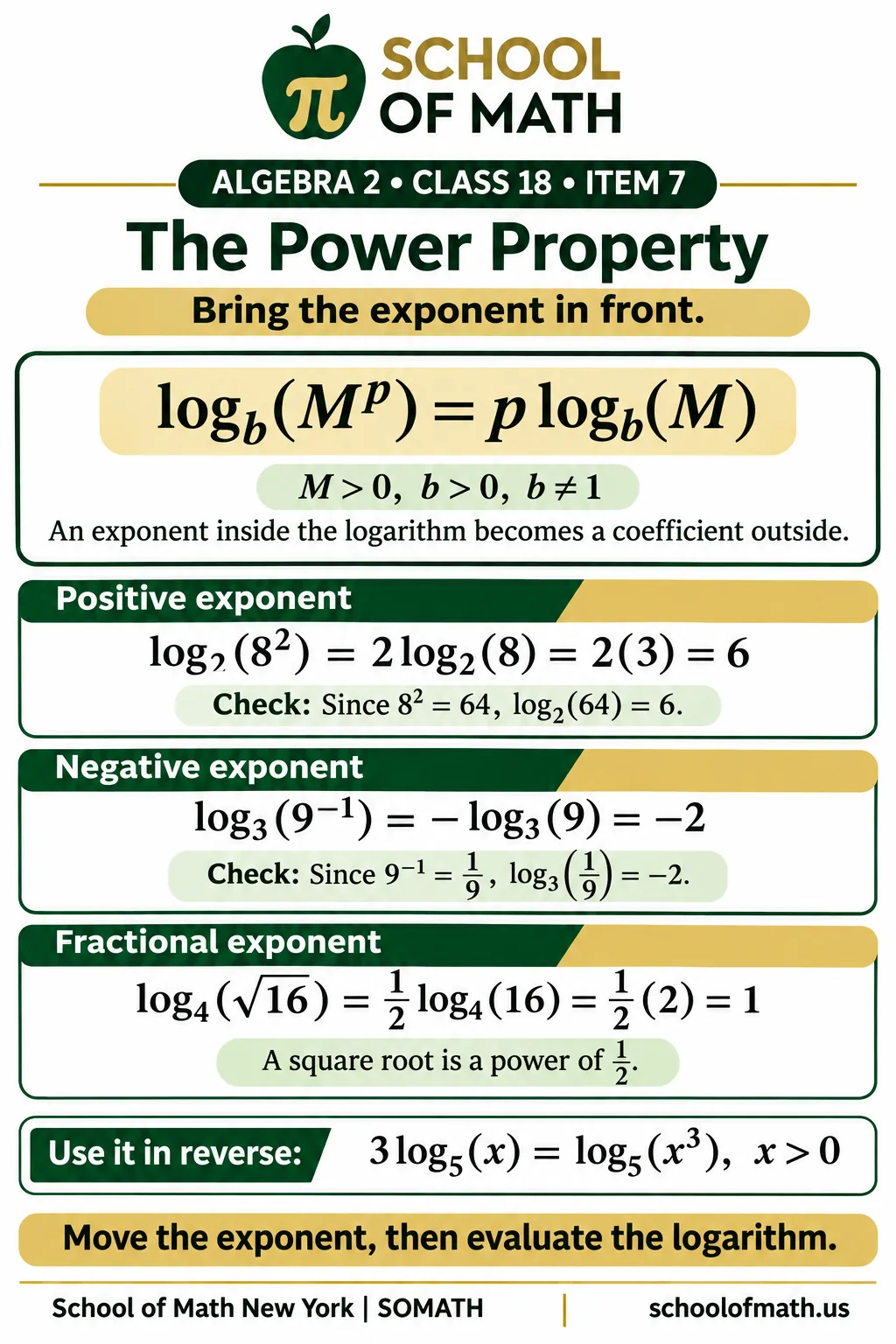
Raising to a power multiplies exponents, so \(\log_b(M^p)=p\log_b(M)\) for \(M>0\). An exponent inside the logarithm becomes a coefficient in front of it. The property works for negative exponents, which produce negative coefficients, and for roots, which are fractional exponents.
Used in reverse, a coefficient becomes an exponent: \(p\log_b(M)=\log_b(M^p)\). This is the key step when condensing expressions. Be careful: the property applies to a power of the whole argument, not to a power of the logarithm itself.
Practice: try these five questions
Q31
Evaluate using the power property, then confirm by computing the power first.
Answer
\(\log_5(25^4)=8\)
Bring the exponent in front.
\[4\log_5(25)\]Evaluate the remaining logarithm.
\[\log_5(25)=2\]Multiply.
\[4\cdot2=8\]
Check and interpret
Compute first: \(25^4=(5^2)^4=5^8\), so \(\log_5(5^8)=8\).
Q32
Evaluate using the power property.
Answer
\(\log_2(16^{-1})=-4\)
Bring the exponent in front; it is negative.
\[-\log_2(16)\]Evaluate the remaining logarithm.
\[\log_2(16)=4\]Attach the sign.
\[-4\]
Check and interpret
\(16^{-1}=\frac{1}{16}=2^{-4}\), so \(\log_2(2^{-4})=-4\).
Q33
Evaluate exactly. Write the root as a fractional exponent first.
Answer
\(\log_7\!\left(\sqrt[3]{49}\right)=\frac{2}{3}\)
A cube root is an exponent of 1/3.
\[\sqrt[3]{49}=49^{1/3}\]Bring the exponent in front.
\[\frac{1}{3}\log_7(49)\]Evaluate the logarithm and multiply.
\[\frac{1}{3}\cdot2=\frac{2}{3}\]
Check and interpret
\(7^{2/3}=(7^2)^{1/3}=49^{1/3}\), which matches the argument. The answer is between 0 and 1 because \(1<\sqrt[3]{49}<7\).
Q34
Use the power property in reverse to write each expression as a single logarithm with coefficient 1. Assume x > 0 and y > 0.
Answer
\(\log_2(x^5)\) and \(\ln(\sqrt{y})\)
Move the coefficient 5 into the exponent of the argument.
\[5\log_2(x)=\log_2(x^5)\]Move the coefficient 1/2 into the exponent; an exponent of 1/2 is a square root.
\[\frac{1}{2}\ln(y)=\ln(y^{1/2})=\ln(\sqrt{y})\]
Check and interpret
Test x = 2: \(5\log_2(2)=5\) and \(\log_2(2^5)=5\). Test y = e²: \(\frac12\ln(e^2)=1\) and \(\ln(e)=1\).
Q35
Use the given approximation to find each value to three decimal places.
Answer
\(\log_b(32)\approx2.155\) and \(\log_b\!\left(\frac{1}{4}\right)\approx-0.862\)
Write 32 as a power of 2 and bring the exponent in front.
\[\log_b(32)=\log_b(2^5)=5\log_b(2)\approx5(0.431)=2.155\]Write 1/4 as a power of 2 with a negative exponent.
\[\log_b\!\left(\frac{1}{4}\right)=\log_b(2^{-2})=-2\log_b(2)\approx-2(0.431)=-0.862\]
Check and interpret
Five copies of \(\log_b 2\) correspond to five factors of 2 in 32. The negative result fits an argument between 0 and 1.
Expanding and condensing logarithmic expressions
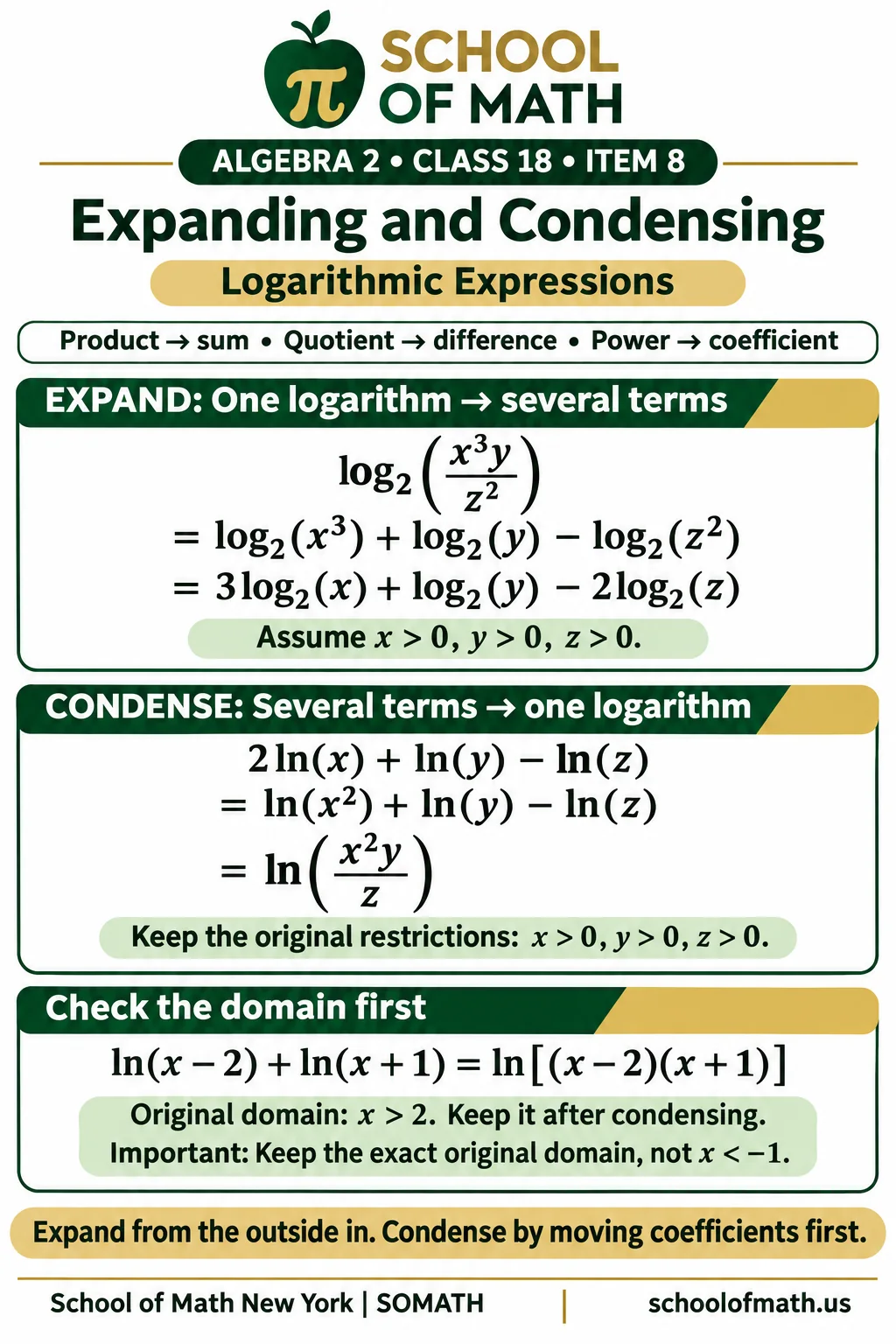
Expanding turns one logarithm into several terms: work from the outside in, splitting quotients into differences, products into sums, and finally moving exponents in front as coefficients. Condensing reverses the process: move coefficients back into exponents first, then combine sums into products and differences into quotients.
Always keep the restrictions from the original expression. Condensing \(\ln(x-2)+\ln(x+1)\) gives \(\ln[(x-2)(x+1)]\), but the domain stays \(x>2\), because each original argument had to be positive.
Practice: try these five questions
Q36
Expand completely. Assume all variables are positive.
Answer
\(4\log_3(x)+\log_3(y)-5\log_3(z)\)
Split the quotient into a difference.
\[\log_3(x^4y)-\log_3(z^5)\]Split the product into a sum.
\[\log_3(x^4)+\log_3(y)-\log_3(z^5)\]Move each exponent in front as a coefficient.
\[4\log_3(x)+\log_3(y)-5\log_3(z)\]
Check and interpret
Test x = 3, y = 9, z = 1: the original is \(\log_3(81\cdot9)=\log_3(729)=6\), and the expansion gives \(4+2-0=6\).
Q37
Expand completely. Assume all variables are positive.
Answer
\(\frac{1}{2}\ln(x)-2\ln(y)\)
Write the square root as a fractional exponent.
\[\ln\!\left(\frac{x^{1/2}}{y^2}\right)\]Split the quotient into a difference.
\[\ln(x^{1/2})-\ln(y^2)\]Move the exponents in front.
\[\frac{1}{2}\ln(x)-2\ln(y)\]
Check and interpret
Test x = e², y = e: the original is \(\ln(e/e^2)=\ln(e^{-1})=-1\), and the expansion gives \(\frac12(2)-2(1)=-1\).
Q38
Expand completely and simplify any numerical logarithm. Assume x > 0.
Answer
\(2+3\log(x)\)
Split the product into a sum.
\[\log(100)+\log(x^3)\]Evaluate the numerical logarithm, since 100 is a power of 10.
\[\log(100)=2\]Move the exponent in front.
\[2+3\log(x)\]
Check and interpret
Test x = 10: the original is \(\log(100{,}000)=5\), and the expansion gives \(2+3(1)=5\).
Q39
Condense into a single logarithm with coefficient 1. Assume all variables are positive.
Answer
\(\log_2\!\left(\dfrac{x^3y^2}{z}\right)\)
Move each coefficient into an exponent first.
\[\log_2(x^3)+\log_2(y^2)-\log_2(z)\]Combine the sum into a product.
\[\log_2(x^3y^2)-\log_2(z)\]Combine the difference into a quotient.
\[\log_2\!\left(\frac{x^3y^2}{z}\right)\]
Check and interpret
Test x = 2, y = 2, z = 4: the original is \(3+2-2=3\), and the condensed form is \(\log_2(8\cdot4/4)=\log_2(8)=3\).
Q40
Condense into a single logarithm and state the domain of the original expression. Explain why the domain is not simply where the condensed argument is positive.
Answer
\(\log\!\left((x+3)(x-3)\right)=\log(x^2-9)\), domain \(x>3\)
Each original argument must be positive.
\[x+3>0\;\text{and}\;x-3>0\;\Longrightarrow\;x>3\]Combine the sum into a product.
\[\log\!\left((x+3)(x-3)\right)=\log(x^2-9)\]The condensed argument \(x^2-9\) is also positive when \(x<-3\), but those inputs make the original logarithms undefined. Keep the original domain.
Check and interpret
Test x = −4: \(\log(x^2-9)=\log(7)\) is defined, but \(\log(-1)+\log(-7)\) is not. The condensed form has a larger natural domain than the original.
Change of base
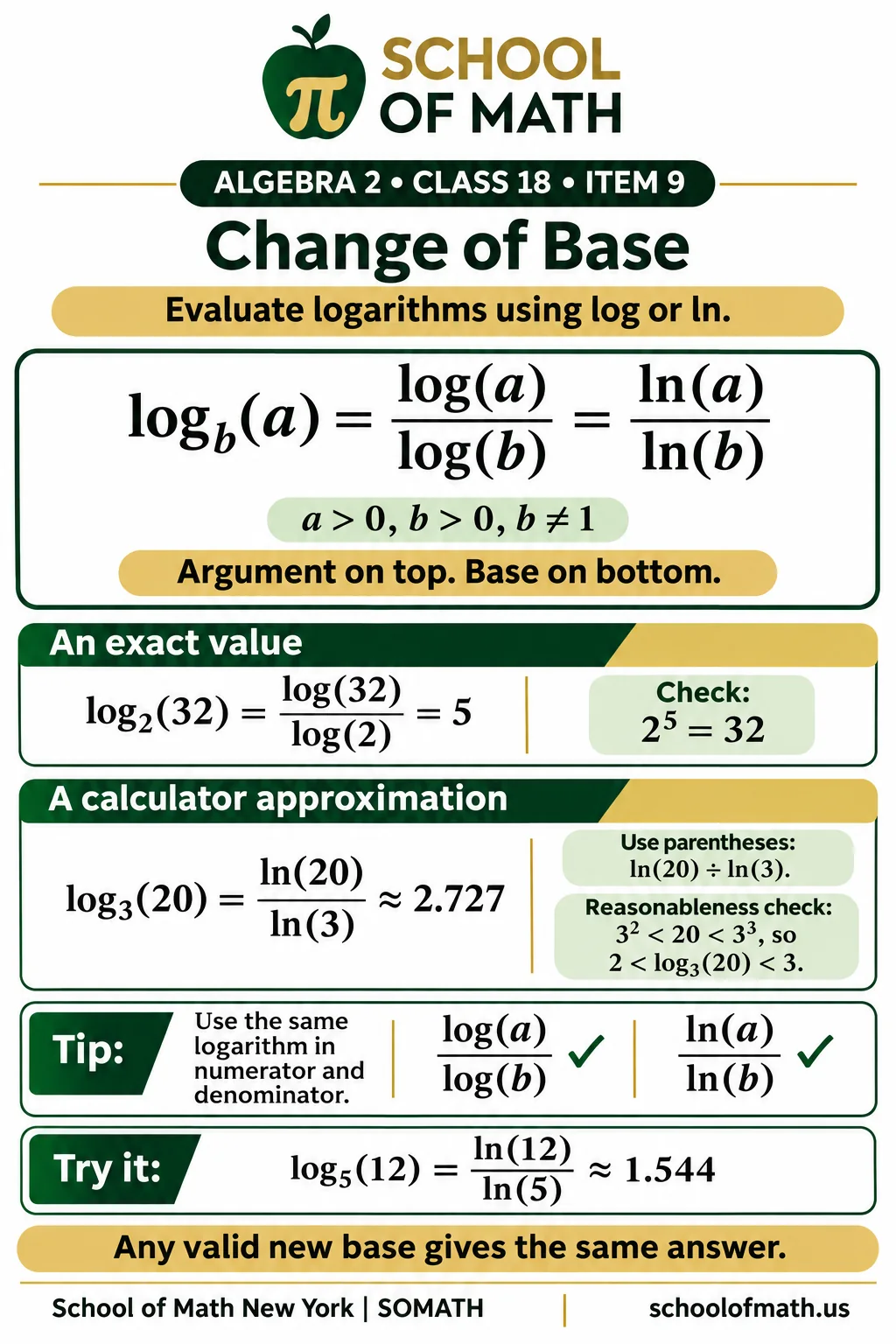
The change-of-base formula \(\log_b(a)=\dfrac{\log(a)}{\log(b)}=\dfrac{\ln(a)}{\ln(b)}\) rewrites any logarithm using a base a calculator has. The argument goes on top and the base on the bottom, and the same kind of logarithm must be used in both places.
Before trusting a decimal, check reasonableness by trapping the argument between two integer powers of the base. Change of base can also run in reverse: a quotient of two logarithms with the same base is a single logarithm.
Practice: try these five questions
Q41
Use the change-of-base formula with common logarithms and simplify to an exact value without a calculator.
Answer
\(\log_4(64)=3\)
Apply the formula: argument on top, base on the bottom.
\[\log_4(64)=\frac{\log(64)}{\log(4)}\]Write 64 as a power of 4 and use the power property.
\[\frac{\log(4^3)}{\log(4)}=\frac{3\log(4)}{\log(4)}\]Cancel the common factor.
\[=3\]
Check and interpret
Definition check: \(4^3=64\). The formula agrees with direct evaluation.
Q42
Approximate to three decimal places using natural logarithms. Then explain why the result is reasonable.
Answer
\(\log_7(50)\approx2.010\)
Apply the change-of-base formula.
\[\log_7(50)=\frac{\ln(50)}{\ln(7)}\]Evaluate each natural logarithm and divide, keeping extra digits.
\[\frac{3.91202}{1.94591}\approx2.0104\]Round to three decimal places.
\[\approx2.010\]
Check and interpret
Since \(7^2=49<50<343=7^3\), the value must be slightly more than 2. A result of 2.010 fits.
Q43
Approximate to three decimal places. State the two consecutive integers that trap the answer.
Answer
\(\log_2(10)\approx3.322\), between 3 and 4
Trap the argument between powers of 2.
\[2^3=8<10<16=2^4\;\Longrightarrow\;3<\log_2(10)<4\]Apply the change-of-base formula with either logarithm key.
\[\log_2(10)=\frac{\log(10)}{\log(2)}=\frac{1}{0.30103}\approx3.3219\]Round to three decimal places.
\[\approx3.322\]
Check and interpret
Using natural logs gives the same value: \(\frac{\ln 10}{\ln 2}=\frac{2.302585}{0.693147}\approx3.322\). Any valid base gives the same answer.
Q44
Approximate to three decimal places. Explain the sign of the answer before computing.
Answer
\(\log_{0.5}(7)\approx-2.807\)
Predict the sign: a base between 0 and 1 with an argument greater than 1 gives a negative logarithm, because \((0.5)^c>1\) requires \(c<0\).
Apply the change-of-base formula.
\[\log_{0.5}(7)=\frac{\ln(7)}{\ln(0.5)}=\frac{1.94591}{-0.69315}\approx-2.8074\]Round to three decimal places.
\[\approx-2.807\]
Check and interpret
Trap it: \((0.5)^{-2}=4<7<8=(0.5)^{-3}\), so the exponent is between −3 and −2. The decimal −2.807 fits.
Q45
Rewrite the first quotient as a single logarithm, then evaluate the second quotient exactly.
Answer
\(\dfrac{\log_3(x)}{\log_3(5)}=\log_5(x)\) and \(\dfrac{\log(8)}{\log(2)}=3\)
Read the change-of-base formula in reverse: the argument is on top and the base is on the bottom.
\[\frac{\log_3(x)}{\log_3(5)}=\log_5(x)\]Apply the same idea to the numerical quotient.
\[\frac{\log(8)}{\log(2)}=\log_2(8)\]Evaluate.
\[\log_2(8)=3\]
Check and interpret
Alternative route for the second quotient: \(\log(8)=\log(2^3)=3\log(2)\), so the quotient is \(\frac{3\log 2}{\log 2}=3\).
Solving logarithmic and exponential equations
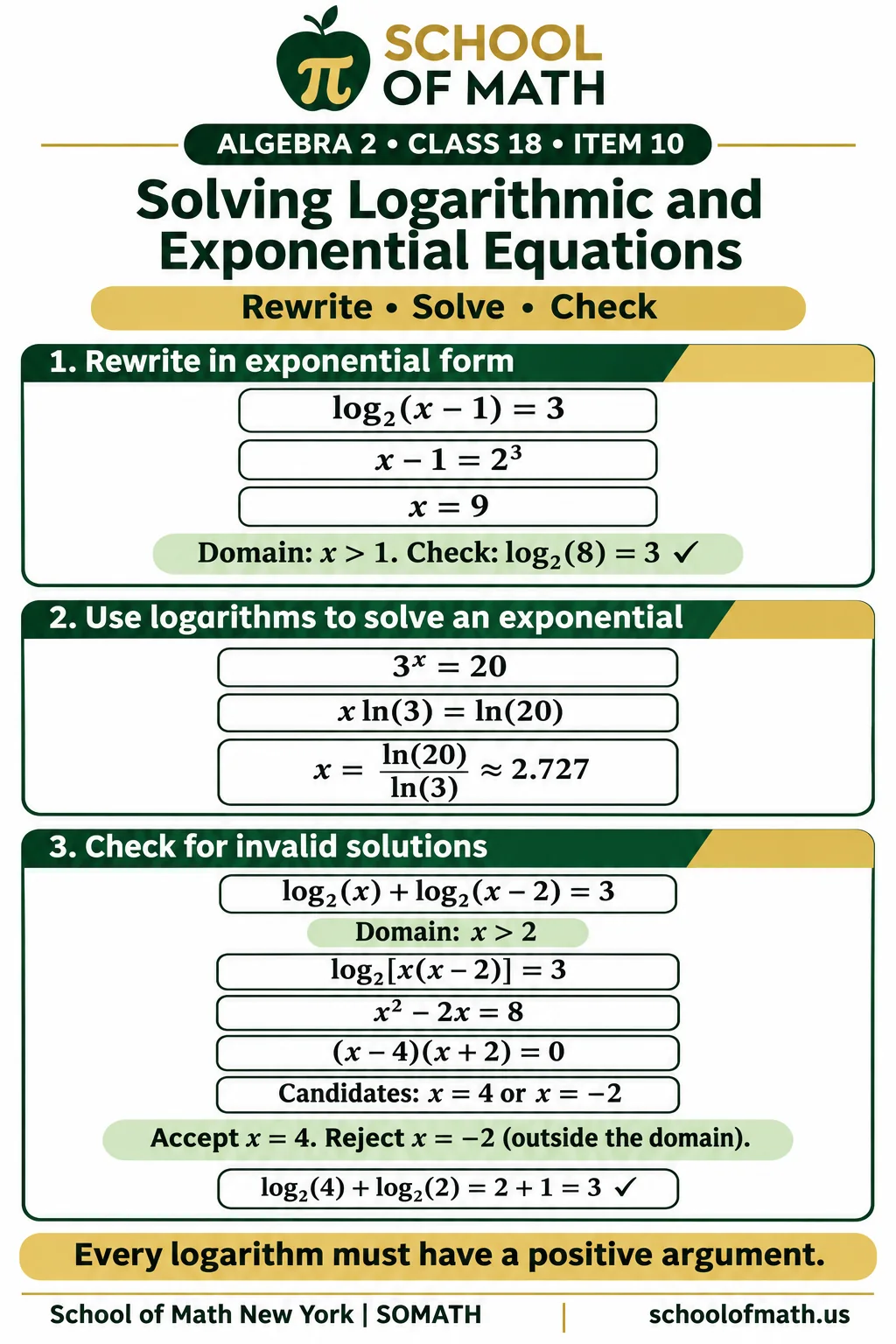
To solve a logarithmic equation, first state the domain, then rewrite a single logarithm in exponential form or combine several logarithms into one before rewriting. If both sides are single logarithms with the same base, set the arguments equal. Check every candidate in the original equation and reject any that make an argument zero or negative.
To solve an exponential equation, isolate the power, then take a logarithm of both sides. The power property brings the variable exponent down as a coefficient. When the answer is not exact, trap it between two integer exponents to confirm the decimal is reasonable.
Practice: try these five questions
Q46
Solve. State the domain before solving and check the solution.
Answer
\(x=5\)
State the domain: the argument must be positive.
\[x+4>0\;\Longrightarrow\;x>-4\]Rewrite in exponential form.
\[x+4=3^2=9\]Solve for x. The value satisfies the domain.
\[x=5\]
Check and interpret
Substitute: \(\log_3(5+4)=\log_3(9)=2\). The equation holds.
Q47
Solve. Give the exact answer and a three-decimal approximation.
Answer
\(x=\dfrac{\ln 40}{\ln 5}\approx2.292\)
Take the natural logarithm of both sides.
\[\ln(5^x)=\ln(40)\]Use the power property to bring x in front.
\[x\ln(5)=\ln(40)\]Divide to isolate x, then approximate.
\[x=\frac{\ln 40}{\ln 5}=\frac{3.68888}{1.60944}\approx2.292\]
Check and interpret
Trap it: \(5^2=25<40<125=5^3\), so x is between 2 and 3. Also \(5^{2.292}\approx40.0\).
Q48
Solve. State the domain, find all candidates, and reject any invalid values.
Answer
\(x=8\) (reject \(x=-2\))
State the domain: both arguments must be positive.
\[x>0\;\text{and}\;x-6>0\;\Longrightarrow\;x>6\]Combine the sum into one logarithm using the product property.
\[\log_2\!\left(x(x-6)\right)=4\]Rewrite in exponential form and expand.
\[x(x-6)=2^4=16\;\Longrightarrow\;x^2-6x-16=0\]Factor and find the candidates.
\[(x-8)(x+2)=0\;\Longrightarrow\;x=8\;\text{or}\;x=-2\]Only x = 8 is in the domain. Reject x = −2.
Check and interpret
Substitute x = 8: \(\log_2(8)+\log_2(2)=3+1=4\). Substituting \(x=-2\) would require \(\log_2(-2)\), which is undefined.
Q49
Solve. Both sides are single logarithms with the same base.
Answer
\(x=6\)
State the domain: both arguments positive.
\[2x-1>0\;\text{and}\;x+5>0\;\Longrightarrow\;x>\tfrac12\]Logarithms with the same base are equal only when their arguments are equal.
\[2x-1=x+5\]Solve. The value is in the domain.
\[x=6\]
Check and interpret
Substitute: \(\log_4(11)=\log_4(11)\). Both arguments equal 11, which is positive.
Q50
Solve. Isolate the power first. Give the exact answer and a three-decimal approximation.
Answer
\(x=\dfrac{\ln 7}{3}\approx0.649\)
Divide both sides by 2 to isolate the power.
\[e^{3x}=7\]Rewrite in logarithmic form, or take the natural log of both sides.
\[3x=\ln(7)\]Divide by 3, then approximate.
\[x=\frac{\ln 7}{3}\approx\frac{1.94591}{3}\approx0.649\]
Check and interpret
Substitute: \(2e^{3(0.6486)}=2e^{1.9459}\approx2(7.00)=14.0\). Also \(e^{1.5}\approx4.48<7<e^{2}\approx7.39\), so \(3x\) is just under 2.
Homework review
Review the definition, the two forms, exact evaluation, domains, common and natural logarithms, the three properties, expanding, and change of base. Show your reasoning.
R1
Evaluate exactly, and state the question the logarithm answers.
Answer
\(\log_2(64)=6\)
Ask: 2 raised to what power gives 64?
Write 64 as a power of 2.
\[64=2^6\]The logarithm is the exponent.
\[\log_2(64)=6\]
Check and interpret
Exponential form: \(2^6=64\).
R2
Rewrite the first equation in logarithmic form and the second in exponential form.
Answer
\(\log_3\!\left(\frac{1}{81}\right)=-4\) and \(12^2=144\)
In the first equation the base is 3, the exponent is −4, and the result is 1/81.
\[\log_3\!\left(\frac{1}{81}\right)=-4\]In the second equation the base is 12, the exponent is 2, and the argument is 144.
\[12^2=144\]
Check and interpret
\(3^4=81\) so \(3^{-4}=\frac{1}{81}\); and \(12\cdot12=144\). Both conversions keep the base in place.
R3
Evaluate exactly by writing the base and the argument as powers of the same number.
Answer
\(\log_{25}(125)=\frac{3}{2}\)
Write both numbers as powers of 5.
\[25=5^2,\qquad125=5^3\]Set up the exponential form with unknown exponent c.
\[(5^2)^c=5^3\;\Longrightarrow\;2c=3\]Solve.
\[c=\frac{3}{2}\]
Check and interpret
\(25^{3/2}=(\sqrt{25})^3=5^3=125\). The value is between 1 and 2 because \(25<125<625\).
R4
State the domain, the vertical asymptote, and the x-intercept.
Answer
Domain \(x>4\); asymptote \(x=4\); x-intercept \(\left(\frac{13}{3},0\right)\)
Require a positive argument.
\[3x-12>0\;\Longrightarrow\;x>4\]The asymptote is where the argument equals zero.
\[3x-12=0\;\Longrightarrow\;x=4\]The output is zero when the argument equals 1.
\[3x-12=1\;\Longrightarrow\;x=\frac{13}{3}\]
Check and interpret
\(\frac{13}{3}\approx4.33\) is just to the right of the asymptote, inside the domain. \(f\!\left(\frac{13}{3}\right)=\log_5(1)=0\).
R5
Evaluate exactly without a calculator.
Answer
\(\ln(e^{-3})+\log(1{,}000)=0\)
The natural logarithm of a power of e is the exponent.
\[\ln(e^{-3})=-3\]The common logarithm of a power of 10 is the exponent.
\[\log(1{,}000)=\log(10^3)=3\]Add.
\[-3+3=0\]
Check and interpret
The two terms use different bases, so they are evaluated separately before adding. Neither needs a decimal approximation.
R6
Use the given approximations to find each value to three decimal places.
Answer
\(\log_b(10)\approx2.096\) and \(\log_b(2.5)\approx0.834\)
Write 10 as a product and apply the product property.
\[\log_b(10)=\log_b(5)+\log_b(2)\approx1.465+0.631=2.096\]Write 2.5 as a quotient and apply the quotient property.
\[\log_b(2.5)=\log_b\!\left(\frac{5}{2}\right)=\log_b(5)-\log_b(2)\approx1.465-0.631=0.834\]
Check and interpret
The values are consistent with base 3, where \(\log_3(10)\approx2.096\) and \(\log_3(2.5)\approx0.834\).
R7
Expand completely and simplify any numerical logarithm. Assume x > 0 and y > 0.
Answer
\(2+2\log_5(x)-\frac{1}{2}\log_5(y)\)
Split the quotient into a difference and write the root as an exponent.
\[\log_5(25x^2)-\log_5(y^{1/2})\]Split the product into a sum.
\[\log_5(25)+\log_5(x^2)-\log_5(y^{1/2})\]Evaluate \(\log_5(25)=2\) and move the exponents in front.
\[2+2\log_5(x)-\frac{1}{2}\log_5(y)\]
Check and interpret
Test x = 5, y = 25: the original is \(\log_5(625/5)=\log_5(125)=3\), and the expansion gives \(2+2-1=3\).
R8
Approximate to three decimal places using the change-of-base formula. Then explain why the result is reasonable.
Answer
\(\log_6(200)\approx2.957\)
Apply the formula with natural logarithms.
\[\log_6(200)=\frac{\ln(200)}{\ln(6)}\]Evaluate and divide, keeping extra digits.
\[\frac{5.29832}{1.79176}\approx2.9571\]Round.
\[\approx2.957\]
Check and interpret
Since \(6^2=36<200<216=6^3\), the value is a little less than 3. A result of 2.957 fits.
Homework word problems
Twelve problems progress from reading logarithmic scales to solving exponential models for time. State units, interpret the result, and round only when requested.
W1
The magnitude of an earthquake is M = log(I / I₀), where I₀ is a reference intensity. One earthquake has intensity 100,000 times I₀. Find its magnitude, and then determine how many times more intense a magnitude 7 earthquake is than a magnitude 5 earthquake.
Answer
Magnitude 5; a magnitude 7 earthquake is 100 times as intense as a magnitude 5 earthquake.
Substitute the intensity ratio.
\[M=\log(100{,}000)=\log(10^5)=5\]For the comparison, each magnitude unit multiplies the intensity ratio by 10.
\[\frac{I_7}{I_5}=\frac{10^7I_0}{10^5I_0}=10^2=100\]
Check and interpret
Rewrite \(M=5\) in exponential form: \(I/I_0=10^5\). A difference of 2 in a base-10 logarithm is a factor of \(10^2\) in the quantity.
W2
The pH of a solution is pH = −log[H⁺], where [H⁺] is the hydrogen-ion concentration in moles per liter. A sample of lemon juice has [H⁺] = 10⁻²·⁴. Find its pH. Then find the hydrogen-ion concentration of a solution with pH 8.
Answer
pH \(=2.4\) for the lemon juice; \([\mathrm{H}^+]=10^{-8}\) moles per liter for pH 8.
Substitute the concentration; the logarithm of a power of 10 is its exponent.
\[\mathrm{pH}=-\log(10^{-2.4})=-(-2.4)=2.4\]For pH 8, solve for the concentration by rewriting in exponential form.
\[8=-\log[\mathrm{H}^+]\;\Longrightarrow\;\log[\mathrm{H}^+]=-8\;\Longrightarrow\;[\mathrm{H}^+]=10^{-8}\]
Check and interpret
Lower pH means a larger concentration: \(10^{-2.4}\) is much larger than \(10^{-8}\), so the lemon juice is far more acidic than the pH 8 solution.
W3
Sound level in decibels is L = 10 log(I / I₀), with I₀ = 10⁻¹² watts per square meter. A vacuum cleaner produces intensity I = 10⁻⁵ watts per square meter. Find its sound level.
Answer
\(L=70\) decibels
Form the intensity ratio using exponent rules.
\[\frac{I}{I_0}=\frac{10^{-5}}{10^{-12}}=10^{7}\]Take the common logarithm.
\[\log(10^7)=7\]Multiply by 10.
\[L=10(7)=70\]
Check and interpret
Every factor of 10 in intensity adds 10 decibels. Seven factors of 10 above the reference give 70 dB.
W4
A bacteria culture starts with 500 cells and doubles every hour, so N(t) = 500 · 2ᵗ with t in hours. After how many hours does the culture reach 32,000 cells? Solve exactly.
Answer
\(t=6\) hours
Set the model equal to the target and isolate the power.
\[500\cdot2^t=32{,}000\;\Longrightarrow\;2^t=64\]Rewrite in logarithmic form and evaluate exactly.
\[t=\log_2(64)=6\]
Check and interpret
Six doublings multiply by \(2^6=64\), and \(500\cdot64=32{,}000\). The model is exact here, so no rounding is needed.
W5
An account starts with $2,000 and earns 6% annual interest, compounded annually, with no deposits or withdrawals: A(t) = 2000(1.06)ᵗ. How many years does it take for the balance to reach $3,000? Give the answer to two decimal places, then state the first whole year in which the balance exceeds $3,000.
Answer
\(t\approx6.96\) years; the balance first exceeds $3,000 in year 7.
Isolate the power.
\[(1.06)^t=\frac{3000}{2000}=1.5\]Take the natural logarithm of both sides and bring t in front.
\[t\ln(1.06)=\ln(1.5)\]Divide and approximate.
\[t=\frac{\ln 1.5}{\ln 1.06}=\frac{0.405465}{0.058269}\approx6.96\]The balance is still below $3,000 at the end of year 6 and above it at the end of year 7.
\[A(6)\approx2837.04,\qquad A(7)\approx3007.26\]
Check and interpret
The two consecutive yearly balances bracket $3,000, which confirms both the decimal answer and the first whole year.
W6
A medication sample of 80 milligrams has a half-life of 10 days: m(t) = 80 · (1/2)^(t/10), with t in days. How long until 5 milligrams remain? Solve exactly.
Answer
\(t=40\) days
Set the model equal to 5 and isolate the power.
\[\left(\frac12\right)^{t/10}=\frac{5}{80}=\frac{1}{16}\]Write the right side as a power of 1/2.
\[\frac{1}{16}=\left(\frac12\right)^4\]Equal bases give equal exponents.
\[\frac{t}{10}=4\;\Longrightarrow\;t=40\]
Check and interpret
Four half-lives: \(80\to40\to20\to10\to5\). Each half-life is 10 days, so 40 days is correct.
W7
A car bought for $28,000 loses 15% of its value each year: V(t) = 28000(0.85)ᵗ. After how many years is the car worth half its purchase price? Round to two decimal places and state the two consecutive whole years that bracket the answer.
Answer
\(t\approx4.27\) years, between years 4 and 5
Half of the purchase price gives the equation; the 28,000 cancels.
\[28000(0.85)^t=14000\;\Longrightarrow\;(0.85)^t=0.5\]Take the natural logarithm of both sides.
\[t\ln(0.85)=\ln(0.5)\]Divide; both logarithms are negative, so t is positive.
\[t=\frac{\ln 0.5}{\ln 0.85}=\frac{-0.693147}{-0.162519}\approx4.27\]Bracket with whole years.
\[(0.85)^4\approx0.522,\qquad(0.85)^5\approx0.444\]
Check and interpret
At year 4 the car retains about 52% of its value and at year 5 about 44%, so the 50% mark is reached between them, closer to year 4.
W8
An investment of $5,000 grows with continuous compounding at 4.5% per year: A(t) = 5000e^(0.045t). How long does it take to reach $8,000? Round to two decimal places.
Answer
\(t\approx10.44\) years
Isolate the exponential.
\[e^{0.045t}=\frac{8000}{5000}=1.6\]Rewrite in logarithmic form with base e.
\[0.045t=\ln(1.6)\]Divide and approximate.
\[t=\frac{\ln 1.6}{0.045}=\frac{0.470004}{0.045}\approx10.44\]
Check and interpret
Substitute: \(5000e^{0.045(10.44)}=5000e^{0.4698}\approx5000(1.5997)\approx7998.4\), which rounds to $8,000.
W9
A concert measures 90 decibels and a normal conversation measures 60 decibels. Using L = 10 log(I / I₀), find how many times more intense the concert sound is than the conversation.
Answer
The concert is 1,000 times as intense.
Subtract the two decibel equations; the reference intensity cancels.
\[L_1-L_2=10\log\!\left(\frac{I_1}{I_0}\right)-10\log\!\left(\frac{I_2}{I_0}\right)=10\log\!\left(\frac{I_1}{I_2}\right)\]Substitute the difference of 30 decibels.
\[30=10\log\!\left(\frac{I_1}{I_2}\right)\;\Longrightarrow\;\log\!\left(\frac{I_1}{I_2}\right)=3\]Rewrite in exponential form.
\[\frac{I_1}{I_2}=10^3=1{,}000\]
Check and interpret
Each 10-decibel step is a factor of 10. Three steps give \(10\cdot10\cdot10=1{,}000\).
W10
Solution A has pH 3 and Solution B has pH 5.5. Using pH = −log[H⁺], find how many times greater the hydrogen-ion concentration of Solution A is than that of Solution B. Give an exact expression and a value rounded to the nearest whole number.
Answer
\(10^{2.5}\approx316\) times greater
Rewrite each pH in exponential form to find the concentrations.
\[[\mathrm{H}^+]_A=10^{-3},\qquad[\mathrm{H}^+]_B=10^{-5.5}\]Divide, subtracting exponents.
\[\frac{10^{-3}}{10^{-5.5}}=10^{-3-(-5.5)}=10^{2.5}\]Approximate using \(10^{2.5}=10^2\cdot10^{0.5}=100\sqrt{10}\).
\[100\sqrt{10}\approx100(3.1623)\approx316\]
Check and interpret
The pH difference of 2.5 is the logarithm of the concentration ratio, so the ratio is \(10^{2.5}\). It lies between \(10^2=100\) and \(10^3=1{,}000\).
W11
A town of 42,000 people grows 2.3% per year: P(t) = 42000(1.023)ᵗ. In how many years will the population reach 60,000? Round to one decimal place, then identify the first whole year in which the population exceeds 60,000 and show the two bracketing values.
Answer
\(t\approx15.7\) years; the population first exceeds 60,000 in year 16.
Isolate the power.
\[(1.023)^t=\frac{60000}{42000}=\frac{10}{7}\approx1.428571\]Take the natural logarithm of both sides.
\[t\ln(1.023)=\ln\!\left(\frac{10}{7}\right)\]Divide and approximate.
\[t=\frac{0.356675}{0.022739}\approx15.7\]Bracket with whole years.
\[P(15)\approx59{,}072,\qquad P(16)\approx60{,}431\]
Check and interpret
Year 15 is still below 60,000 and year 16 is above it, so the decimal answer of 15.7 years and the whole-year answer of 16 agree.
W12
A cup of tea cools according to T(t) = 20 + 70e^(−0.08t), where T is the temperature in degrees Celsius and t is minutes after it is poured. Find its initial temperature, then find when the tea reaches 45°C. Round the time to one decimal place.
Answer
Initial temperature 90°C; the tea reaches 45°C after about 12.9 minutes.
Substitute t = 0; the exponential equals 1.
\[T(0)=20+70(1)=90\]Set the model equal to 45 and isolate the exponential.
\[70e^{-0.08t}=25\;\Longrightarrow\;e^{-0.08t}=\frac{25}{70}=\frac{5}{14}\]Rewrite in logarithmic form with base e.
\[-0.08t=\ln\!\left(\frac{5}{14}\right)\approx-1.029619\]Divide by −0.08.
\[t\approx\frac{-1.029619}{-0.08}\approx12.9\]
Check and interpret
Substitute: \(20+70e^{-0.08(12.87)}=20+70e^{-1.0296}\approx20+70(0.357)\approx45.0\). The temperature falls toward the room temperature of 20°C, never below it.
Quick questions and answers
What is a logarithm?
A logarithm is an exponent. The statement log base b of a equals c means b raised to the power c equals a. To evaluate one, ask which exponent the base needs in order to produce the argument.
Why must the argument of a logarithm be positive?
A positive base raised to any real exponent is always positive. No exponent produces zero or a negative result, so those arguments have no real logarithm. The base must also be positive and different from 1.
What is the difference between log and ln?
The common logarithm log(x) uses base 10, and the natural logarithm ln(x) uses base e, which is about 2.71828. Both follow the same definition and the same properties, and both appear on calculators.
Can I split the logarithm of a sum?
No. The product property turns a product inside into a sum outside, and the quotient property turns a quotient into a difference. There is no property for log of (M + N); evaluate the sum inside first.
When do I use the change-of-base formula?
Use it when the base is not 10 or e and the argument is not an obvious power of the base. Divide the logarithm of the argument by the logarithm of the base, using the same kind of logarithm in both places.
Why do I have to check solutions of logarithmic equations?
Combining logarithms can create candidate solutions that make an original argument zero or negative. Those values are outside the domain and must be rejected, even though they satisfy the rewritten equation.
Do I need to attend earlier classes?
No. This is an independent topic in a rolling course. The lesson includes explanations, practice, and worked answers for this topic.