SOMATH Journal · Competition Math · Practice Test 8
AMC 8 Practice Test 8
All 25 questions, with the reasoning behind every answer. This SOMATH walkthrough preserves the supplied practice test’s question wording, answer choices, and diagrams, and adds original step-by-step explanations you can reveal after trying each problem.
Work on paper first: identify the idea, organize the information, solve, and check. For help choosing the right math challenge, book a SOMATH evaluation at 226 W 79th St, Upper West Side, or call (646) 668-6151.
Question source: the supplied American Math Competition 8 Practice, Test 8 worksheet (question pages 90–94). Minor grammatical inconsistencies are retained; spacing and mathematical notation are adapted for the web. This is a practice-sheet walkthrough, not a verified official contest from a specified year. The solutions below are newly written by SOMATH, not copied from the worksheet’s solution pages.
Unit conversionQuestion 1
Cathy’s shop class is making a golf trophy. She has to paint 600 dimples on a golf ball. If it takes him 4 seconds to paint one dimple, how many minutes will she need to do her job?
- (A) 40
- (B) 60
- (C) 80
- (D) 10
- (E) 12
Answer
Answer: A, 40 minutes. First find the total time in seconds; then change the unit to minutes.
- There are 600 dimples, each requiring 4 seconds: \(600\times4=2400\) seconds.
- Every minute contains 60 seconds, so \(2400\div60=40\) minutes.
Check: In one minute she paints \(60\div4=15\) dimples. Forty minutes gives \(40\times15=600\).
SOMATH takeaway: Write the units beside each result. A correct number in the wrong unit is not the answer.
Factor pairsQuestion 2
I’m thinking of two whole numbers. Their product is 132 and their sum is 23. What is the larger number?
- (A) 13
- (B) 14
- (C) 16
- (D) 12
- (E) 15
Answer
Answer: D, 12. We need a pair that passes two tests: multiplication gives 132 and addition gives 23.
- Try nearby factors around the square root of 132: \(11\times12=132\).
- Check their sum: \(11+12=23\).
- The larger number is 12, not 11.
Why factor pairs help: The other positive pairs are \((1,132),(2,66),(3,44),(4,33),(6,22)\); none adds to 23. Don’t stop after checking only the product.
Fractions of an amountQuestion 3
Gary has $126. Frank has $4 more than Emily and Emily has two-third as much as Gary. How many dollars does Frank have?
- (A) 70
- (B) 68
- (C) 79
- (D) 82
- (E) 88
Answer
Answer: E, 88 dollars. Follow the people in the correct order: Gary → Emily → Frank.
- One third of Gary’s money is \(126\div3=42\).
- Emily has two thirds, so she has \(42\times2=84\) dollars.
- Frank has 4 dollars more than Emily: \(84+4=88\).
Common mistake: Adding 4 to Gary’s money uses the wrong person as the starting amount.
Place value and parityQuestion 4
The digits 2, 3, 5, 6 and 9 are each used once to form the greatest possible odd five-digit number. The digit in the tens place is
- (A) 5
- (B) 9
- (C) 3
- (D) 6
- (E) 2
Answer
Answer: E, 2. A number is odd when its last digit is odd. To make the whole number as large as possible, protect the largest digits for the leftmost places.
- Put 9 first, then 6, then 5. These are the largest available digits, in order.
- The remaining digits are 2 and 3. The units digit must be odd, so put 3 last and 2 just before it.
- The greatest possible number is \(96523\). Its tens digit is 2.
Check: Ending in 5 would force the smaller digit 3 into an earlier place, giving at most 96325. Ending in 9 would lose the leading 9 entirely.
Counting spacesQuestion 5
Sixteen trees are equally spaced along one side of a straight road. The distance from the first tree to the fifth is 80 feet. What is the distance in feet between the first and last trees?
- (A) 90
- (B) 300
- (C) 305
- (D) 320
- (E) 240
Answer
Answer: B, 300 feet. Count the spaces between trees, not the trees themselves.
- From tree 1 to tree 5 there are \(5-1=4\) equal spaces.
- Each space is \(80\div4=20\) feet.
- From tree 1 to tree 16 there are \(16-1=15\) spaces.
- The distance is \(15\times20=300\) feet.
SOMATH takeaway: A straight row of \(n\) objects has \(n-1\) gaps between its first and last objects.
Successive percentage changesQuestion 6
James has 20% more money than Yao, and Bob has 20% less money than James. What percent less money does Bob have than Yao?
- (A) 3
- (B) 5
- (C) 7
- (D) 9
- (E) 4
Answer
Answer: E, 4%. Use a convenient starting amount of 100 dollars for Yao. Percent relationships do not depend on the size of that starting amount.
- James has \(100+20=120\) dollars.
- Bob has 20% less than 120. Since \(0.20\times120=24\), Bob has \(120-24=96\) dollars.
- Compared with Yao’s 100 dollars, Bob is short by 4 dollars, or 4%.
Algebra check: \(1.20\times0.80=0.96\). The increase and decrease do not cancel because they use different starting amounts.
A hidden right triangleQuestion 7
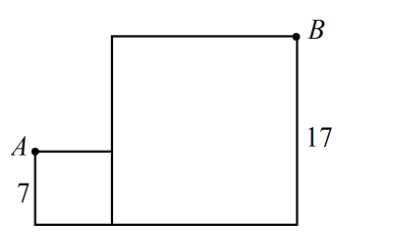
Two squares are positioned, as shown. The smaller square has side length 7 and the larger square has side length 17. The length of \(AB\) is
- (A) \(13\sqrt2\)
- (B) 25
- (C) 26
- (D) \(13\sqrt7\)
- (E) 24
Answer
Answer: C, 26. Segment \(AB\) is the diagonal of a right triangle we can imagine inside the diagram.
- The horizontal distance from \(A\) to \(B\) is the combined width of the two squares: \(7+17=24\).
- The vertical rise is the difference of their heights: \(17-7=10\).
- Apply the Pythagorean theorem: \(AB^2=24^2+10^2=576+100=676\).
- Take the positive square root: \(AB=26\).
Check: The side lengths \(10,24,26\) are twice the familiar \(5,12,13\) right triangle. The 17-unit square side is not the vertical rise from \(A\).
Probability with factorsQuestion 8
What is the probability that a randomly selected positive factor of 72 is less than 11?
- (A) \(1/2\)
- (B) \(7/11\)
- (C) \(2/5\)
- (D) \(3/4\)
- (E) \(7/12\)
Answer
Answer: E, \(\frac7{12}\). The sample space is the set of positive factors of 72, not the integers from 1 to 72.
- List the factors in order: \(1,2,3,4,6,8,9,12,18,24,36,72\). There are 12.
- The factors below 11 are \(1,2,3,4,6,8,9\). There are 7.
- Probability is favorable choices divided by all equally likely choices: \(\frac7{12}\).
Factor-count check: \(72=2^3\cdot3^2\), so it has \((3+1)(2+1)=12\) positive factors.
Ordering permutationsQuestion 9
There are 120 different five digit numbers that can be constructed by putting the digits 1, 2, 3, 4 and 5 in all possible different orders. If these numbers are placed in numerical order, from smallest to largest, what is the 73rd number in the list?
- (A) 12543
- (B) 23145
- (C) 32415
- (D) 41235
- (E) 51325
Answer
Answer: D, 41235. Sort the numbers into blocks according to their first digit.
- Once the first digit is chosen, the other four digits can be arranged in \(4\times3\times2\times1=24\) ways.
- Numbers beginning with 1 occupy positions 1–24. Those beginning with 2 occupy 25–48, and those beginning with 3 occupy 49–72.
- Position 73 is therefore the first number beginning with 4.
- Put the remaining digits in increasing order to make the smallest number in that block: \(4\,1235=41235\).
Source correction: The supplied solution prints \(3\times24=71\). The correct total is 72; the answer choice remains D.
Area on the coordinate planeQuestion 10
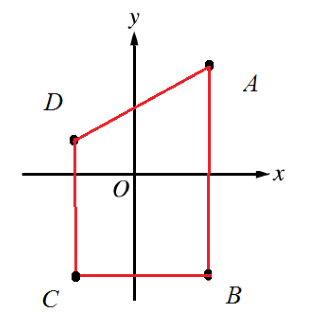
Points \(A\), \(B\), \(C\) and \(D\) have these coordinates: \(A(3,5)\), \(B(3,-5)\), \(C(-3,-5)\) and \(D(-3,2)\). The area of quadrilateral \(ABCD\) is
- (A) 42
- (B) 55
- (C) 51
- (D) 60
- (E) 24
Answer
Answer: C, 51 square units. The two vertical sides are parallel, so this is a trapezoid turned sideways.
- The right parallel side has length \(5-(-5)=10\).
- The left parallel side has length \(2-(-5)=7\).
- The perpendicular distance between them is \(3-(-3)=6\).
- Area is \(\frac{10+7}{2}\times6=51\).
Another way: Enclose the figure in a \(6\times10\) rectangle. Remove the top triangle of base 6 and height 3: \(60-\frac12(6)(3)=51\).
Pie-chart anglesQuestion 11
Of the 60 students in Robert’s class, 14 prefer chocolate pie, 18 prefer apple, and 8 prefer blueberry. Half of the remaining students prefer cherry pie and half prefer lemon. For Robert’s pie graph showing this data, how many degrees should she use for cherry pie?
- (A) 10
- (B) 20
- (C) 30
- (D) 60
- (E) 72
Answer
Answer: D, 60 degrees. First find the number of cherry votes; then convert that fraction of the class into a fraction of a full circle.
- The three named groups contain \(14+18+8=40\) students.
- That leaves \(60-40=20\), half of whom choose cherry: \(20\div2=10\).
- Cherry represents \(\frac{10}{60}=\frac16\) of the class.
- Its angle is \(\frac16\times360^\circ=60^\circ\).
Check: Each of the 60 students represents \(360\div60=6\) degrees, and \(10\times6=60\).
Combinations and the multiplication principleQuestion 12
Ted has entered a buffet line in which he chooses two kind of meat, three different vegetables and four desserts. If the order of food items is not important, how many different meals might he choose?
Meat: beef, chicken, pork, duck, fish
Vegetables: baked beans, corn, potatoes, tomatoes, broccoli, chives
Dessert: brownies, chocolate cake, chocolate pudding, ice cream, apricot pops
- (A) 400
- (B) 244
- (C) 1000
- (D) 800
- (E) 144
Answer
Answer: C, 1000. Treat each category as a selection of distinct menu items. Order does not matter, so beef–chicken and chicken–beef are the same meat choice.
- Choose 2 of 5 meats: \(\frac{5\times4}{2}=10\) selections.
- Choose 3 of 6 vegetables: \(\frac{6\times5\times4}{3\times2\times1}=20\) selections.
- Choose 4 of 5 desserts: there are 5 choices, because choosing the one dessert to leave out determines the other four.
- Combine independent category choices: \(10\times20\times5=1000\).
Why multiply? Every meat selection can be paired with every vegetable selection and every dessert selection. Adding would count individual choices, not complete meals.
Work rates with a head startQuestion 13
Helen began peeling a pile of 145 potatoes at the rate of 5 potatoes per minute. Five minutes later Charles joined her and peeled at the rate of 7 potatoes per minute. When they finished, how many potatoes had Charles peeled?
- (A) 70
- (B) 24
- (C) 32
- (D) 33
- (E) 60
Answer
Answer: A, 70 potatoes. Split the work into two periods: Helen alone, then both together.
- During her five-minute head start, Helen peels \(5\times5=25\) potatoes.
- There are \(145-25=120\) potatoes left.
- Together they peel \(5+7=12\) per minute, so the remaining work takes \(120\div12=10\) minutes.
- Charles works only those 10 minutes: \(7\times10=70\) potatoes.
Check: Helen works 15 minutes and peels 75. Charles peels 70, and \(75+70=145\).
Growing circle patternsQuestion 14
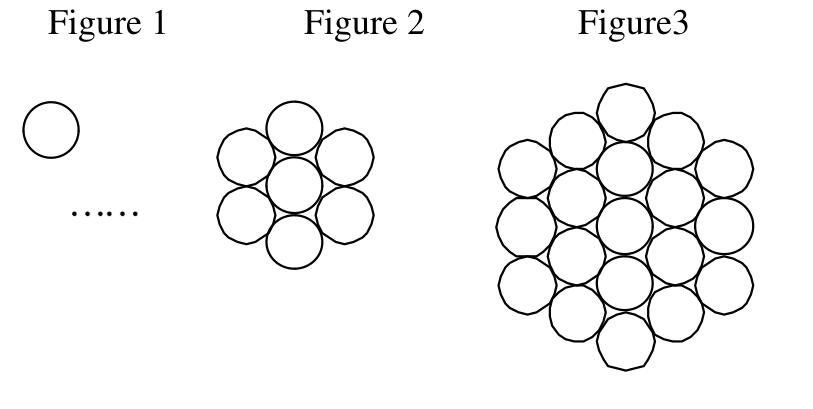
These circles have the same radius. If the pattern continues, how many circles are therein the 20th figure?
- (A) 1141
- (B) 1142
- (C) 2000
- (D) 1024
- (E) 1000
Answer
Answer: A, 1141 circles. See the figures as a center circle surrounded by larger hexagonal rings.
- Figure 1 has 1 circle. To make Figure 2, add a ring of 6 circles.
- The next ring adds 12, then the next would add 18. Ring \(k\) adds \(6k\) circles.
- Figure 20 has the center plus 19 rings: \(1+6(1+2+\cdots+19)\).
- Pair the sum or use its formula: \(1+2+\cdots+19=\frac{19\times20}{2}=190\).
- The total is \(1+6(190)=1141\).
Check the rule first: It gives 7 circles for Figure 2 and 19 for Figure 3, matching the drawing. The general total is \(1+3n(n-1)\) for Figure \(n\).
Recognizing a perfect squareQuestion 15
Find a positive integer \(a\) such that \(a=\sqrt{2013^2+2013+2014}\).
- (A) 1002
- (B) 2012
- (C) 2013
- (D) 2014
- (E) 1007
Answer
Answer: D, 2014. Avoid squaring 2013 by long multiplication. Make the expression fit \((n+1)^2=n^2+2n+1\).
- Write \(2014=2013+1\).
- The expression under the square root becomes \(2013^2+2(2013)+1\).
- This is \((2013+1)^2=2014^2\).
- The positive square root is \(a=2014\).
SOMATH takeaway: Before calculating a large expression, look for a familiar structure. Here the two final terms complete the square.
Using the complement in probabilityQuestion 16
Three dice are thrown. What is the probability that the product of the three numbers is a multiple of 5?
- (A) \(91/216\)
- (B) \(125/216\)
- (C) \(25/216\)
- (D) \(7/36\)
- (E) \(17/36\)
Answer
Answer: A, \(\frac{91}{216}\). For ordinary fair six-sided dice, only a face showing 5 contributes a factor of 5.
- The product is a multiple of 5 exactly when at least one die shows 5.
- The opposite event is that no die shows 5. Each die has probability \(\frac56\) of avoiding 5.
- For three independent dice, the probability of avoiding 5 every time is \((\frac56)^3=\frac{125}{216}\).
- Subtract from 1: \(1-\frac{125}{216}=\frac{91}{216}\).
Common mistake: \(3\times\frac16\) double-counts some outcomes with two or three fives. “At least one” often suggests using the complement.
Ordered sums of positive integersQuestion 17
How many ways can the number 10 be written as the sum of exactly three positive and not necessarily different integers if the order in which the sum is written matters? For example, \(10=1+4+5\) and is not the same as \(10=4+1+5\).
- (A) 10
- (B) 16
- (C) 27
- (D) 36
- (E) 30
Answer
Answer: D, 36. Imagine ten counters in a row. Two dividers split that row into three nonempty groups.
- There are 9 gaps between the 10 counters.
- Choose 2 different gaps for the dividers. The resulting group sizes are the first, second, and third numbers.
- The number of choices is \(\binom92=\frac{9\times8}{2}=36\).
Why this matches the wording: Choosing internal gaps keeps every group positive; reading the groups left to right preserves order.
Alternative check: If the first number is 1, there are 8 choices for the second; if it is 2, there are 7, and so on. Thus \(8+7+\cdots+1=36\).
Relative speed on a circular trackQuestion 18
Alex and Bob ride along a circular path whose circumference is 15 km. They start at the same time, from diametrically opposite positions. Alex goes at a constant speed of 35 km/h in the clockwise direction, while Bob goes at a constant speed of 25 km/h in the counter clockwise direction. They both cycle for 3 hours. How many times do they meet?
- (A) 12
- (B) 13
- (C) 14
- (D) 15
- (E) 10
Answer
Answer: A, 12 meetings. Their opposite directions mean their speeds add when measuring how quickly they close a gap.
- The initial gap is half the track: \(15\div2=7.5\) km.
- The relative speed is \(35+25=60\) km/h, so the first meeting occurs after \(7.5\div60=\frac18\) hour.
- Each later meeting requires another full track of relative travel: \(15\div60=\frac14\) hour.
- Meeting times are \(\frac18,\frac38,\frac58,\ldots,\frac{23}{8}\) hours. These are 12 times, ending at \(2\frac78\) hours.
- The next would be \(\frac{25}{8}=3\frac18\) hours, after they stop.
Important detail: They do not meet at time zero or exactly at 3 hours. Accounting for the initial half-lap avoids an off-by-one error.
Slant height and surface areaQuestion 19
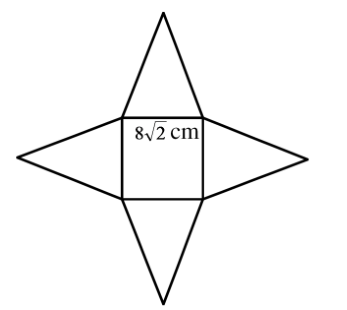
Four identical isosceles triangles border a square of side \(8\sqrt2\) cm, as shown. When the four triangles are folded up they meet at a point to form a pyramid with a square base. If the height of this pyramid is 6 cm, find the area of one triangles.
- (A) \(8\sqrt{34}\text{ cm}^2\)
- (B) \(4\sqrt{34}\text{ cm}^2\)
- (C) \(98\text{ cm}^2\)
- (D) \(18\sqrt3\text{ cm}^2\)
- (E) \(46\text{ cm}^2\)
Answer
Answer: A, \(8\sqrt{34}\) square centimeters. A triangular face needs its own perpendicular height along the sloping surface, not the pyramid’s vertical height.
- The apex is above the square’s center. The horizontal distance from that center to the midpoint of a side is half the side length: \(4\sqrt2\).
- The face’s slant height \(\ell\) is the hypotenuse of a right triangle with legs 6 and \(4\sqrt2\).
- Thus \(\ell^2=6^2+(4\sqrt2)^2=36+32=68\), giving \(\ell=2\sqrt{17}\).
- One face has area \(\frac12(8\sqrt2)(2\sqrt{17})=8\sqrt{34}\).
Common mistake: Using 6 as the height of the triangular face gives the wrong area. Six measures straight up from the base, not along the face.
The smallest possible overlapQuestion 20
There are 52 students in a class. 30 of them can swim. 35 can ride bicycle. 42 can play table tennis. At least how many students can do all three sports?
- (A) 3
- (B) 4
- (C) 12
- (D) 5
- (E) 7
Answer
Answer: A, at least 3 students. It is easier to count students who cannot do each sport.
- There are \(52-30=22\) who cannot swim, \(52-35=17\) who cannot ride, and \(52-42=10\) who cannot play table tennis.
- Even if these groups do not overlap, they cover only \(22+17+10=49\) students.
- At least \(52-49=3\) students are outside all three “cannot” groups. Those students can do all three sports.
Why the minimum is achievable: Let 22 students miss only swimming, 17 miss only cycling, 10 miss only table tennis, and 3 miss none. This produces exactly 30 swimmers, 35 cyclists, and 42 table-tennis players, so the lower bound really can occur.
Counting triangles without overcountingQuestion 21
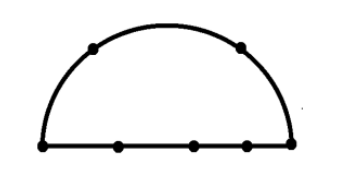
How many triangles can be formed by connecting three points of the figure?
- (A) 15
- (B) 20
- (C) 22
- (D) 25
- (E) 17
Answer
Answer: D, 25 triangles. There are five marked points on the diameter and two above it. A triangle cannot have all three vertices on the same straight line.
- Choose two diameter points and one upper point: \(\binom52\times2=10\times2=20\) triangles.
- Choose one diameter point and both upper points: \(5\times1=5\) triangles.
- These cases cannot overlap, so add them: \(20+5=25\).
Alternative check: Choose any three of the seven points, then remove the triples entirely on the diameter: \(\binom73-\binom53=35-10=25\).
Ordered stamp arrangementsQuestion 22
You have enough 2¢, 3¢, and 4 ¢ stamps and you want to stick them in a row. How many ways are there to get a total of 10¢?
- (A) 11
- (B) 15
- (C) 16
- (D) 17
- (E) 19
Answer
Answer: D, 17 arrangements. Because the stamps are placed in a row, changing the order can create a new arrangement.
- With no 4¢ stamp, the possibilities are five 2¢ stamps (1 order) or two 2¢ and two 3¢ stamps (\(\frac{4!}{2!2!}=6\) orders). Total: 7.
- With one 4¢ stamp, the remaining 6¢ is either three 2¢ stamps (4 positions for the 4¢ stamp) or two 3¢ stamps (3 positions for the 4¢ stamp). Total: 7.
- With two 4¢ stamps, the remaining 2¢ is one stamp, which can occupy any of 3 positions. Total: 3.
- Three 4¢ stamps would exceed 10¢. Therefore the full count is \(7+7+3=17\).
SOMATH takeaway: Organize by the number of largest stamps. This keeps the cases separate and makes it easy to see that nothing is missing.
A circle rolling around a circleQuestion 23
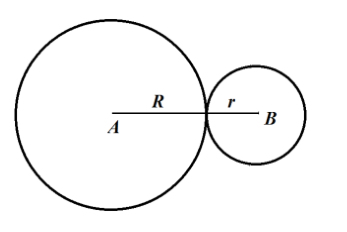
Circle \(B\) of radius 2 is rolling around a second circle \(A\) of radius 10 without slipping until it returns to its starting point. The number of revolutions the circle \(B\) makes is
- (A) 3
- (B) 4
- (C) 8
- (D) 6
- (E) 7
Answer
Answer: D, 6 revolutions. The diagram shows external rolling, with circle \(A\) fixed. Count the turns of \(B\) relative to a fixed observer, not relative to the moving line between the centers.
- Let the fixed radius be \(R=10\) and the rolling radius be \(r=2\). The moving center travels on a circle of radius \(R+r=12\).
- If that center moves at speed \(v\), no slipping means the contact point is instantaneously at rest. The rotational rim speed must cancel the center’s speed, so \(r\omega=v\).
- Over the full orbit, the center travels \(2\pi(R+r)\). The total rotation angle is therefore \(\frac{2\pi(R+r)}r\).
- Divide by \(2\pi\) radians per revolution: \(\frac{R+r}{r}=\frac{12}{2}=6\).
Why not 5? The ratio \(R/r=5\) misses the extra turn caused by going all the way around the curved path. For external rolling, the rule is \(R/r+1\).
A stopping-rule probabilityQuestion 24
A box contains exactly seven marbles, four red and three white. Marbles are randomly removed one at a time without replacement until all the red marbles are drawn or all the white marbles are drawn. What is the probability that the last marble drawn is white?
- (A) \(3/10\)
- (B) \(2/5\)
- (C) \(1/2\)
- (D) \(4/7\)
- (E) \(7/10\)
Answer
Answer: D, \(\frac47\). “Last marble drawn” means the marble at the stopping moment, not necessarily the seventh marble.
- Imagine secretly arranging all seven marbles in a random order before the drawing begins.
- If the seventh marble in that full order is red, all three whites must be exhausted before all four reds. The actual drawing stops on a white marble.
- If the seventh marble is white, the opposite happens: all reds are exhausted first, so the actual drawing stops on red.
- Thus stopping on white is exactly the event that the seventh marble in the full order is red. Four of the seven marbles are red, so its probability is \(\frac47\).
Counting check: There are \(\binom73=35\) equally likely choices of the white positions. To leave the final position red, choose all three white positions among the first six: \(\binom63=20\). Hence \(20/35=4/7\).
Source correction: The supplied solution labels D correctly but prints \(20/35=5/7\). The correct simplification is \(4/7\).
Inclusion–exclusion and conditional probabilityQuestion 25
A positive integer is randomly selected from all positive integers among 1 and 300 inclusive that are multiples of 3, 4, or 5. What is the probability that the positive integer selected is not divisible by 5?
- (A) \(2/3\)
- (B) \(25/37\)
- (C) \(5/9\)
- (D) \(1/3\)
- (E) \(4/9\)
Answer
Answer: A, \(\frac23\). The selection is made from the multiples of at least one of 3, 4, or 5. It is not made from all 300 integers.
- Count the multiples separately: \(300/3=100\), \(300/4=75\), and \(300/5=60\).
- Subtract the double-counted overlaps: multiples of 12 give 25, multiples of 15 give 20, and multiples of 20 give 15.
- Add back the triple overlap, the 5 multiples of 60. The separate counts sum to 235 and the pairwise overlaps sum to 60. The eligible total is \(235-60+5=180\).
- All 60 multiples of 5 are in this eligible set. Remove them to get \(180-60=120\) eligible numbers not divisible by 5.
- The desired probability is \(\frac{120}{180}=\frac23\).
Why add the triple overlap back? A number such as 60 was added three times and subtracted three times. It should be counted once, so add it back once.
Check: The complement is \(60/180=1/3\), and \(1-1/3=2/3\).
Class review: the ideas worth remembering
Do not memorize 25 isolated answers. Connect each problem to a reusable method, then explain when that method applies.
| Strategy | Questions | What to notice |
|---|---|---|
| Track units and reference amounts | 1, 3, 5, 6, 11, 13 | Convert at the right time; count gaps; identify what a percentage refers to. |
| Use structure before calculation | 2, 4, 14, 15 | Factor pairs, place value, growing rings, and perfect-square identities. |
| Draw the right lengths | 7, 10, 19 | Separate horizontal, vertical, perpendicular, and slant distances. |
| Count in organized cases | 9, 12, 17, 21, 22 | Decide whether order matters and avoid impossible or repeated arrangements. |
| Define the sample space | 8, 16, 24, 25 | Use equally likely outcomes, complements, and the actual stopping rule. |
| Change the viewpoint | 18, 20, 23 | Relative motion, missing activities, and rotation relative to a fixed observer. |
Complete answer key
Keep the key closed until you have attempted the problems. Return to any question to see why its answer works.
Quick questions and answers
What does this AMC 8 Practice Test 8 walkthrough include?
All 25 questions and their answer choices from the supplied practice worksheet, the six original problem diagrams, and newly written SOMATH step-by-step solutions hidden behind Answer buttons.
Are these original official AMC 8 contest questions?
This page follows the supplied document labeled American Math Competition 8 Practice, Test 8. It is presented as a practice worksheet walkthrough, not as a verified official contest from a specified year.
How should I use the hidden answers?
Attempt each problem on paper, choose an answer, and then open Answer to compare the reasoning. Explain the key idea aloud and redo any missed problem without looking.
Which problem-solving ideas does the test cover?
The problems cover arithmetic, fractions, percentages, factor pairs, geometry, area, combinations, ordered counting, probability, rates, patterns, and inclusion–exclusion.
Are there corrections to the supplied explanations?
Yes. For Question 9, three blocks of 24 numbers total 72, not 71. For Question 24, 20/35 simplifies to 4/7, not 5/7. The corresponding answer choices remain D.