AP Calculus · Class 1 · Grades 11–12
Limits: Graphical, Numerical, and Algebraic
A limit describes where a function is heading as its input gets close to a number. This class reads limits from tables and graphs, separates left-hand and right-hand behaviour, tests when a limit exists, distinguishes the limit from the function value, and then computes limits exactly with the limit laws, direct substitution, factoring and rationalizing.
Study ten illustrated topics with five original practice questions after each image. Finish with ten Homework review questions and ten Homework word problems: 50 practice questions, 20 homework questions, and 70 hidden worked answers. Attempt each question before opening its blue Answer control.
This is an independent AP Calculus topic at SOMATH. No earlier class is required. For every limit, ask “What value is the function approaching from each side?” before asking what happens at the point itself. View the schedule or book an evaluation to find the right course level.
Download the student workbook (PDF)25 pages · Cover, ten teaching images, and all 70 questions · Generous blank answer space · No exercise solutions
What is a limit?
The idea
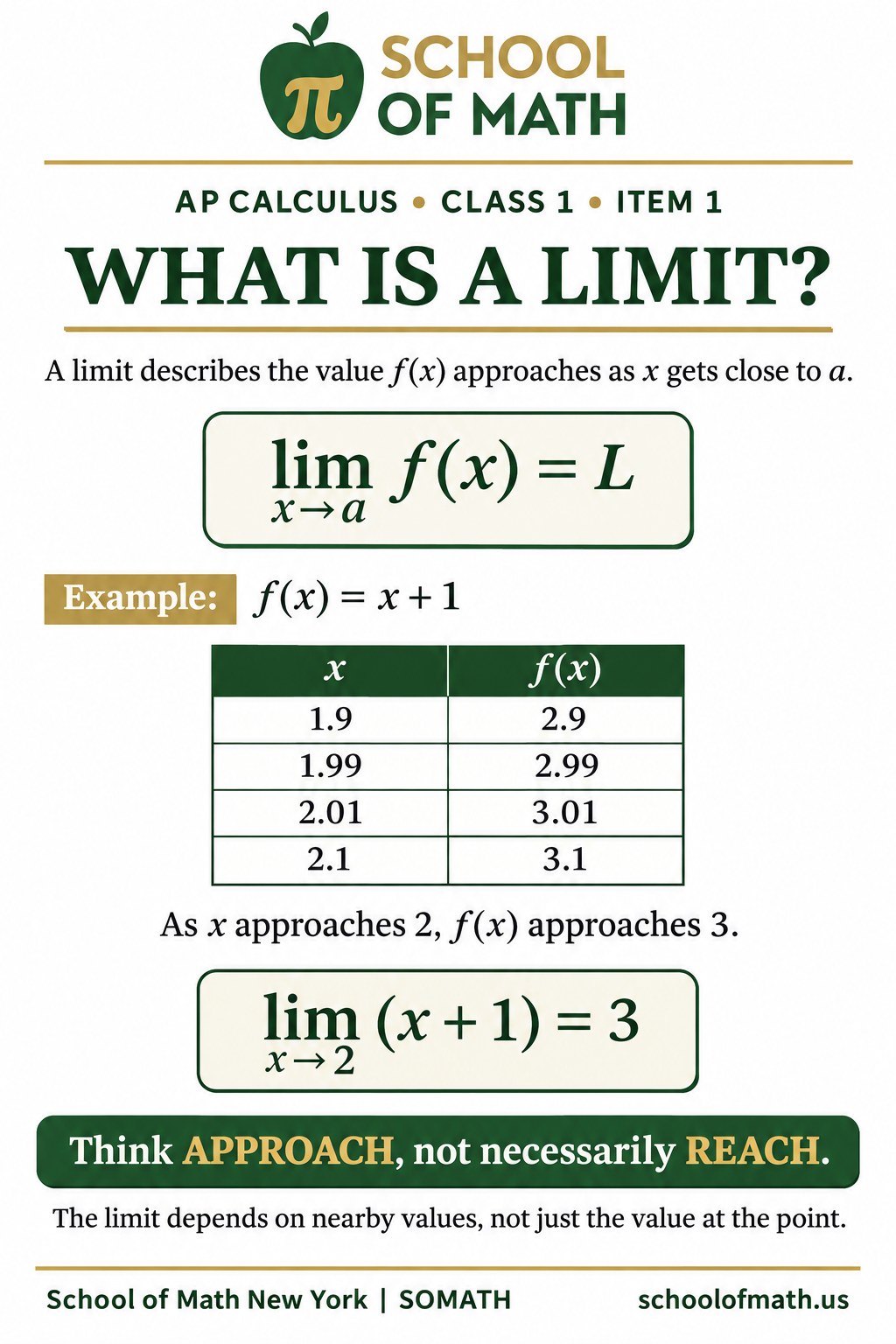
A limit describes the value that \(f(x)\) approaches as \(x\) gets closer and closer to a number \(a\). We write
and read it as “the limit of \(f(x)\) as \(x\) approaches \(a\) is \(L\).” The arrow tells us which input we approach; \(L\) is the output the function is heading toward.
Reading a table numerically
To estimate a limit numerically, choose inputs on both sides of \(a\) that get closer and closer to it, then look at the outputs. In the image, \(f(x) = x + 1\): the inputs \(1.9, 1.99\) approach 2 from below and \(2.1, 2.01\) approach 2 from above. The outputs \(2.9, 2.99, 3.01, 3.1\) close in on 3, so \(\lim_{x\to 2}(x+1) = 3\).
Approach, not necessarily reach
The limit is about nearby inputs, not the input \(x = a\) itself. The function may be undefined at \(a\), or have a different value there, and the limit can still exist. This is why calculus can describe instantaneous speed and slopes of curves: the formulas break at a single point, but the nearby behaviour is perfectly clear.
Common mistakes
- Checking only one side of \(a\). A two-sided limit needs both sides.
- Thinking the limit is the last number in the table. A table only suggests a value; algebra (later topics) confirms it.
- Assuming \(f(a)\) must equal the limit. Topic 6 shows why it need not.
Practice: try these five questions
Q1
The table shows values of \(f(x) = 2x - 1\) near \(x = 3\). Use it to estimate \(\displaystyle\lim_{x\to 3} f(x)\).
| \(x\) | \(f(x)\) |
|---|---|
| 2.9 | 4.8 |
| 2.99 | 4.98 |
| 3.01 | 5.02 |
| 3.1 | 5.2 |
Answer
\(\displaystyle\lim_{x\to 3}(2x-1) = 5\)
- From the left, the outputs are \(4.8\) and \(4.98\); from the right, \(5.2\) and \(5.02\).
- Both sides close in on 5, so the limit is 5.
Q2
Write the statement \(\displaystyle\lim_{x\to 4} g(x) = 7\) in words, and explain what it says about the graph of \(g\).
Answer
“As \(x\) approaches 4, \(g(x)\) approaches 7.”
- The limit is read: the limit of \(g(x)\) as \(x\) approaches 4 equals 7.
- On the graph, points with \(x\)-values close to 4 have \(y\)-values close to 7.
- It says nothing definite about \(g(4)\) itself.
Q3
Complete the table for \(f(x) = x^2\) near \(x = 1\). Then estimate \(\displaystyle\lim_{x\to 1} x^2\).
| \(x\) | \(f(x)\) |
|---|---|
| 0.9 | |
| 0.99 | |
| 1.01 | |
| 1.1 |
Answer
\(0.81,\ 0.9801,\ 1.0201,\ 1.21\); the limit is \(1\).
- Square each input: \(0.9^2 = 0.81\), \(0.99^2 = 0.9801\), \(1.01^2 = 1.0201\), \(1.1^2 = 1.21\).
- Values from both sides approach 1, so \(\displaystyle\lim_{x\to 1} x^2 = 1\).
Q4
Which statement must be true if \(\displaystyle\lim_{x\to 5} h(x) = 2\)?
- \(h(5)\) must equal 2.
- As \(x\) gets close to 5, \(h(x)\) gets close to 2.
- \(h(2) = 5\).
- \(h(x)\) never equals 2.
Answer
(B)
- (A) is not guaranteed: \(h(5)\) may be different from 2 or undefined.
- (B) is exactly the meaning of the limit.
- (C) swaps the roles of input and output. (D) is not implied: \(h\) may equal 2 at some inputs.
Q5
The function \(f(x) = \dfrac{x^3 - 8}{x - 2}\) is undefined at \(x = 2\). Use the table to estimate \(\displaystyle\lim_{x\to 2} f(x)\).
| \(x\) | \(f(x)\) |
|---|---|
| 1.9 | 11.41 |
| 1.99 | 11.9401 |
| 2.01 | 12.0601 |
| 2.1 | 12.61 |
Answer
About \(12\)
- Left of 2 the outputs are \(11.41\) and \(11.9401\); right of 2 they are \(12.61\) and \(12.0601\).
- Both sides approach 12, even though \(f(2)\) does not exist.
- Algebra confirms it later: \(x^3 - 8 = (x-2)(x^2+2x+4)\), so the limit is \(4 + 4 + 4 = 12\).
Estimating limits from graphs
Follow the curve from both sides
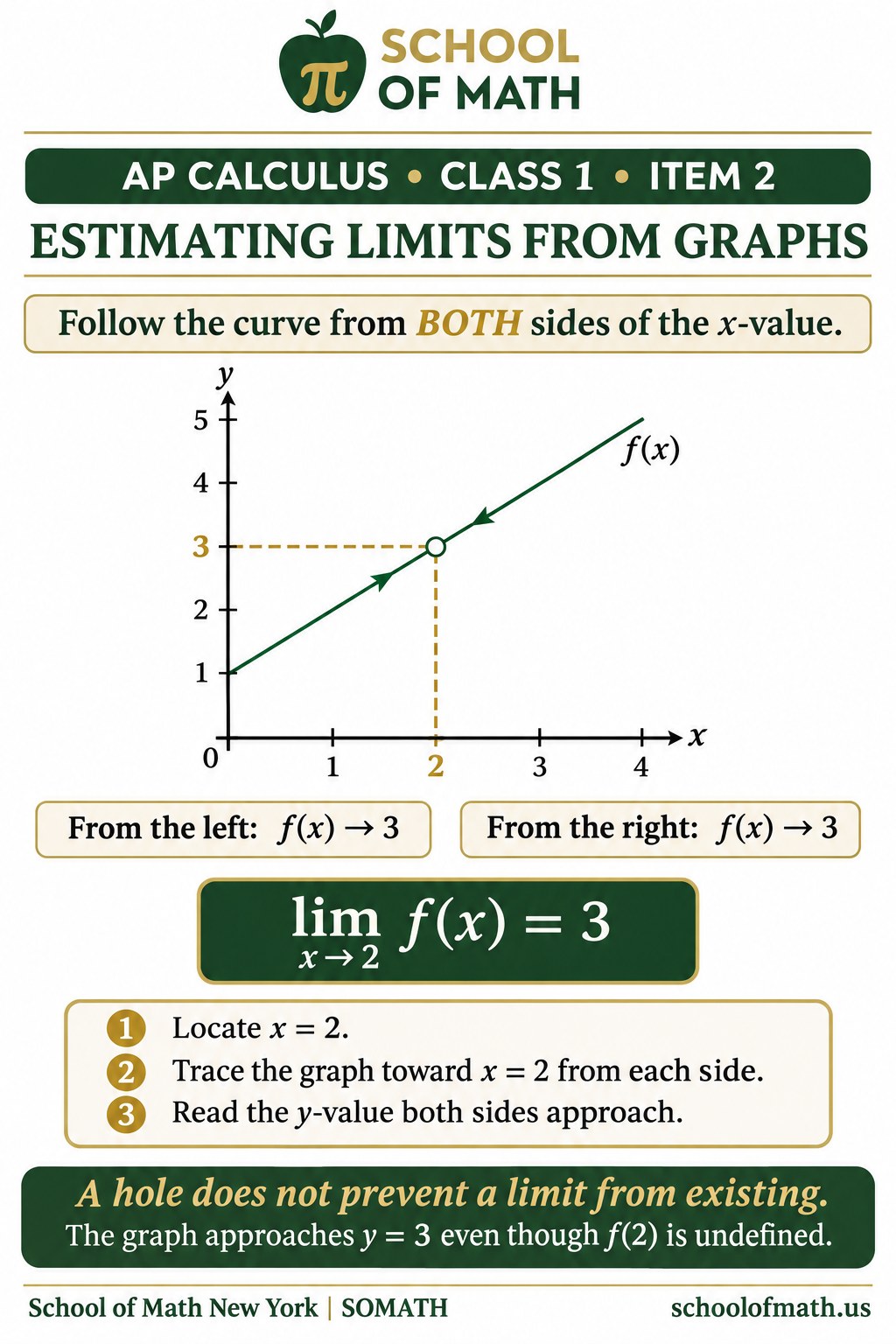
To estimate \(\displaystyle\lim_{x\to a} f(x)\) from a graph:
- Locate \(x = a\) on the horizontal axis.
- Trace the graph toward \(x = a\) from the left and from the right.
- Read the \(y\)-value that both sides approach.
In the image, the line approaches the height \(y = 3\) from both directions, so \(\displaystyle\lim_{x\to 2} f(x) = 3\).
Holes, filled dots and corners
- An open circle (hole) means the function has no value at that point on that piece of the graph. A hole does not prevent a limit from existing.
- A filled dot shows the actual function value \(f(a)\). It does not affect the limit, which depends only on nearby points.
- A sharp corner still has a limit when both sides reach the same height.
Reading carefully
Graph readings are estimates. When the curve heads to a point between grid lines, give your best reading and confirm with algebra or a table when a formula is available.
Practice: try these five questions
Q6
Use the graph to find \(\displaystyle\lim_{x\to 1} f(x)\).
Answer
\(\displaystyle\lim_{x\to 1} f(x) = 4\)
- Locate \(x = 1\). The graph has a hole there.
- From both sides the line approaches the height \(y = 4\).
- The hole does not stop the limit from existing; the limit is 4.
Q7
Use the graph of the parabola to find \(\displaystyle\lim_{x\to 3} f(x)\).
Answer
\(\displaystyle\lim_{x\to 3} f(x) = 5\)
- Trace the parabola toward \(x = 3\) from the left and the right.
- Both sides rise toward the hole at height 5.
- So the limit is 5 (the graph is \(y = (x-1)^2 + 1\), and \((3-1)^2 + 1 = 5\)).
Q8
The graph shows \(y = \tfrac{1}{2}x + 1\). Find \(\displaystyle\lim_{x\to 4} f(x)\).
Answer
\(\displaystyle\lim_{x\to 4} f(x) = 3\)
- At \(x\)-values near 4, the line is near height 3 on both sides.
- There is no break, so the limit equals the height of the line: \(\tfrac12(4) + 1 = 3\).
Q9
The graph has a corner at \(x = 2\). Find (a) \(\displaystyle\lim_{x\to 1} f(x)\), (b) \(\displaystyle\lim_{x\to 2} f(x)\), (c) \(\displaystyle\lim_{x\to 4} f(x)\).
Answer
(a) \(2\) (b) \(3\) (c) \(1\)
- (a) Near \(x = 1\) the rising piece is at height 2.
- (b) Both pieces meet at the corner \((2, 3)\); left and right both approach 3. A corner does not prevent a limit.
- (c) Near \(x = 4\) the falling piece is at height 1.
Q10
True or false: “If a graph has a hole at \(x = a\), then \(\displaystyle\lim_{x\to a} f(x)\) does not exist.” Explain.
Answer
False
- A limit depends on the \(y\)-values the graph approaches, not on the point at \(x = a\).
- If both sides head toward the same height, the limit exists and equals that height, hole or no hole.
- Example: the graph in Q6 has a hole at \(x = 1\) and its limit there is 4.
Approaching from the left and from the right
Notation for each side
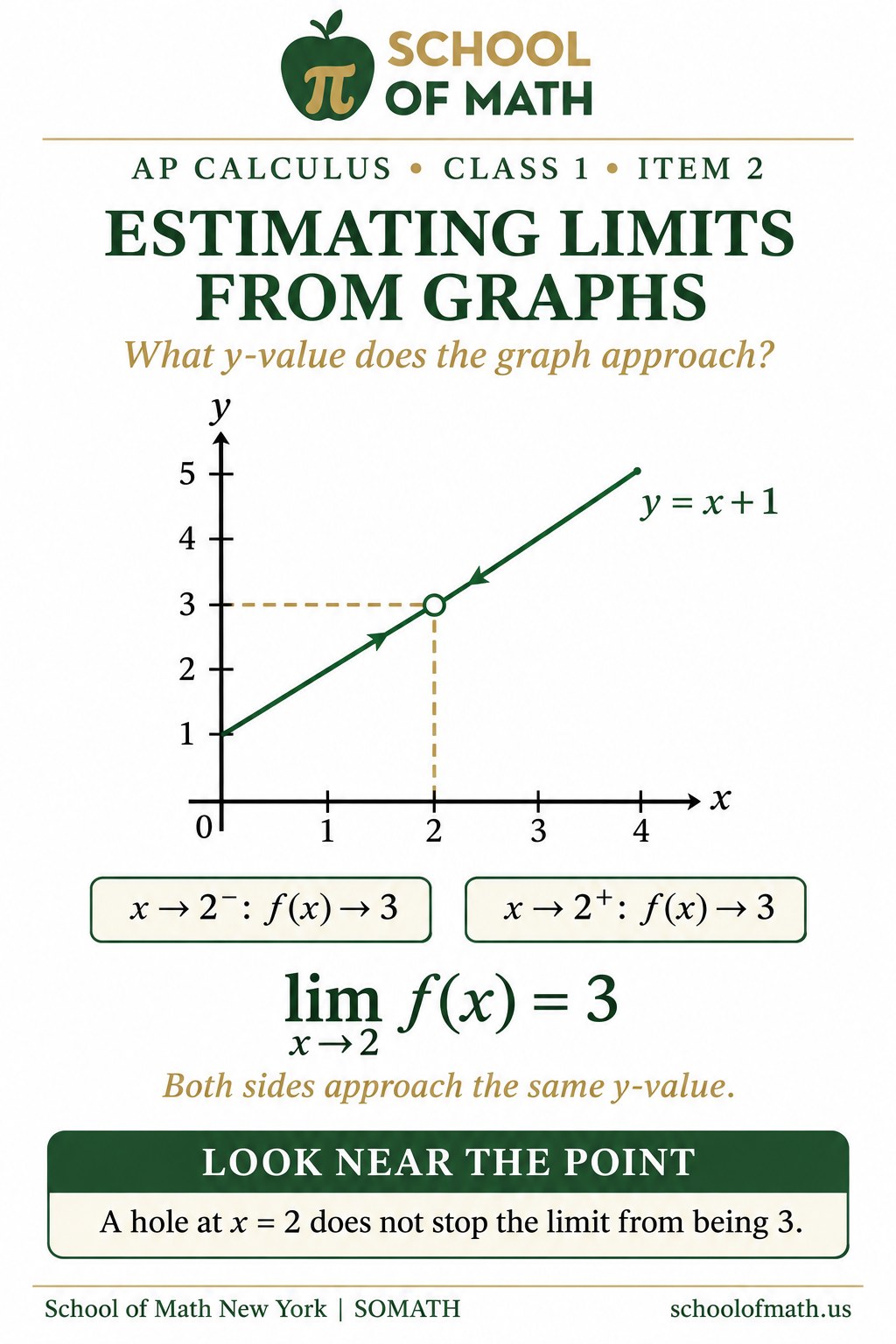
The image introduces the notation used throughout calculus for the direction of approach:
- \(x \to 2^-\) means \(x\) approaches 2 using values less than 2 (from the left): \(1.9, 1.99, 1.999, \dots\)
- \(x \to 2^+\) means \(x\) approaches 2 using values greater than 2 (from the right): \(2.1, 2.01, 2.001, \dots\)
The small sign is a direction, not a negative or positive number. \(2^-\) is still near 2, not near \(-2\).
Look near the point
On \(y = x + 1\) with a hole at \(x = 2\), the left side heads to 3 and the right side heads to 3. Because both sides approach the same \(y\)-value, \(\displaystyle\lim_{x\to 2} f(x) = 3\). The hole at \(x = 2\) changes nothing about the nearby heights.
Tables with both sides
A good numerical table uses inputs that get closer on each side, for example \(0.9, 0.99, 0.999\) and \(1.001, 1.01, 1.1\) when \(a = 1\). Read the left column of outputs and the right column of outputs separately, then compare.
Practice: try these five questions
Q11
Write each sentence in limit notation: (a) As \(x\) approaches 5 from the left, \(f(x)\) approaches 2. (b) As \(x\) approaches \(-1\) from the right, \(g(x)\) approaches 6.
Answer
(a) \(\displaystyle\lim_{x\to 5^-} f(x) = 2\) (b) \(\displaystyle\lim_{x\to -1^+} g(x) = 6\)
- “From the left” uses values less than the number, written with a superscript minus.
- “From the right” uses values greater than the number, written with a superscript plus.
- In (b), \(-1^+\) means values slightly greater than \(-1\), such as \(-0.99\).
Q12
Use the graph to complete: as \(x\to 3^-\), \(f(x)\to\) ___; as \(x\to 3^+\), \(f(x)\to\) ___; so \(\displaystyle\lim_{x\to 3} f(x) =\) ___.
Answer
\(4,\ 4,\ 4\)
- From the left, the line rises to the hole at height 4.
- From the right, the line comes down to the same hole at height 4.
- Both sides agree, so the limit is 4 (the line is \(y = 2x - 2\)).
Q13
Use the table to estimate \(\displaystyle\lim_{x\to 1^-} f(x)\), \(\displaystyle\lim_{x\to 1^+} f(x)\), and \(\displaystyle\lim_{x\to 1} f(x)\).
| \(x\) | \(f(x)\) |
|---|---|
| 0.9 | 6.7 |
| 0.99 | 6.97 |
| 0.999 | 6.997 |
| 1.001 | 7.003 |
| 1.01 | 7.03 |
| 1.1 | 7.3 |
Answer
All three equal \(7\).
- Left side: \(6.7, 6.97, 6.997\) approach 7.
- Right side: \(7.3, 7.03, 7.003\) approach 7.
- The two one-sided values agree, so the two-sided limit is 7.
Q14
Use the graph to find \(\displaystyle\lim_{x\to 1} f(x)\).
Answer
\(\displaystyle\lim_{x\to 1} f(x) = 3\)
- Trace the curve toward \(x = 1\) from the left: the height rises toward 3.
- From the right the curve also comes down toward the hole at height 3.
- Both sides approach 3 (the curve is \(y = 4 - (x-2)^2\), and \(4 - 1 = 3\)).
Q15
A student checks only \(x = 2.1, 2.01, 2.001\) and concludes \(\displaystyle\lim_{x\to 2} f(x) = 6\). What is missing from this reasoning?
Answer
The left side was never checked.
- Those inputs are all greater than 2, so they only estimate \(\displaystyle\lim_{x\to 2^+} f(x)\).
- A two-sided limit also needs inputs such as \(1.9, 1.99, 1.999\).
- Only if the left side also approaches 6 can we say \(\displaystyle\lim_{x\to 2} f(x) = 6\).
One-sided limits: the direction of approach matters
Left-hand and right-hand limits
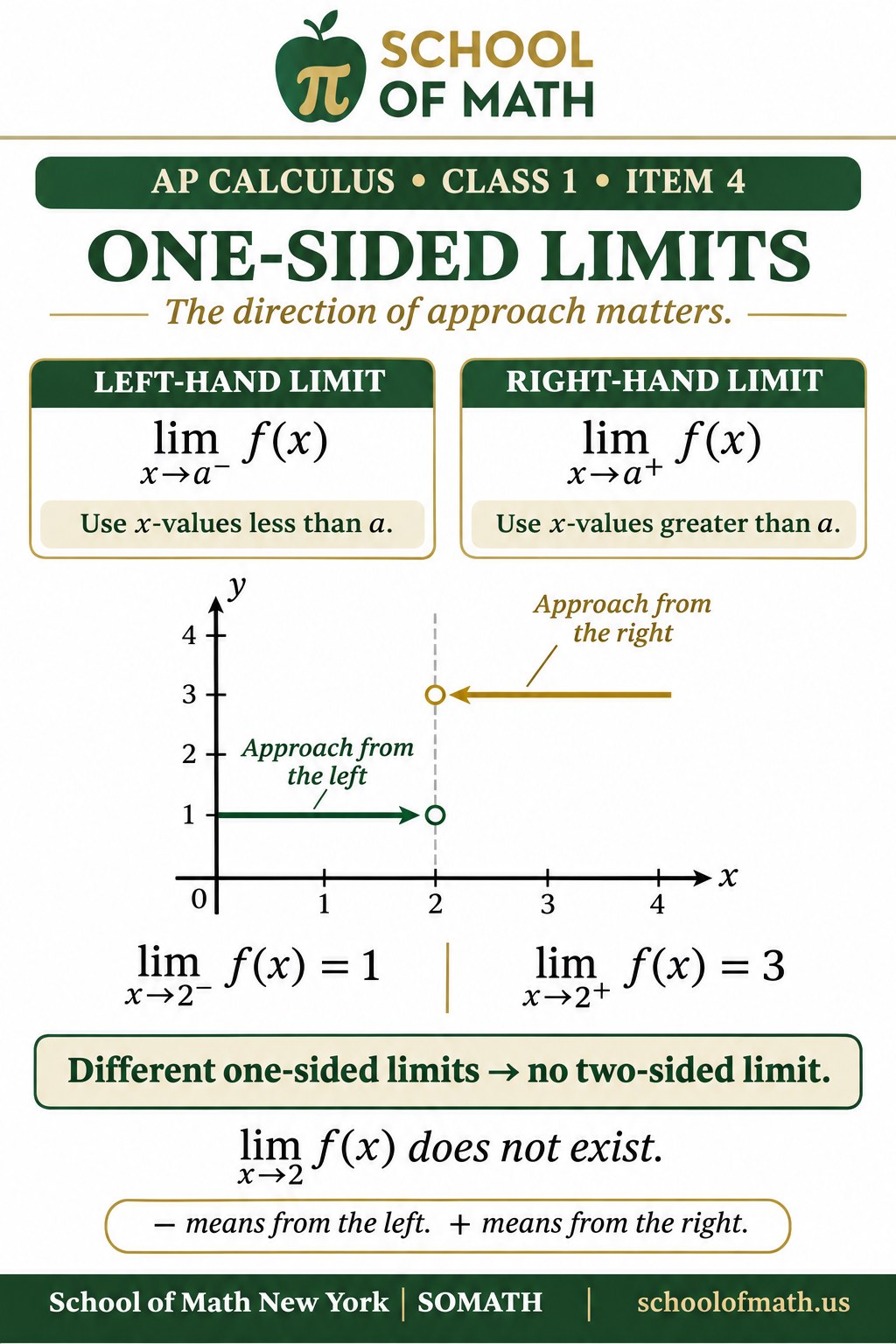
In the image, the graph approaches height 1 from the left of \(x = 2\) and height 3 from the right. So \(\displaystyle\lim_{x\to 2^-} f(x) = 1\) and \(\displaystyle\lim_{x\to 2^+} f(x) = 3\).
Jumps
A graph that breaks and restarts at a different height has a jump. Each side has its own one-sided limit, but because they differ, there is no single height the graph approaches. Therefore \(\displaystyle\lim_{x\to 2} f(x)\) does not exist (DNE).
Piecewise formulas
For a function defined by different rules on each side of \(a\), use the left rule for \(x \to a^-\) and the right rule for \(x \to a^+\). Substitute \(a\) into each rule that is a polynomial; the value at \(x = a\) itself is not needed.
Practice: try these five questions
Q16
Use the graph to find \(\displaystyle\lim_{x\to 3^-} f(x)\), \(\displaystyle\lim_{x\to 3^+} f(x)\), and \(\displaystyle\lim_{x\to 3} f(x)\).
Answer
\(3\); \(1\); does not exist
- From the left, the rising line heads to the open circle at height 3.
- From the right, the horizontal piece is at height 1 (the filled dot at \((3, 1)\) starts it).
- The one-sided limits differ, so the two-sided limit does not exist.
Q17
Let \(f(x) = \begin{cases} x^2, & x \lt 2 \\ 3x - 1, & x \ge 2 \end{cases}\). Find both one-sided limits at \(x = 2\) and decide whether \(\displaystyle\lim_{x\to 2} f(x)\) exists.
Answer
Left \(4\), right \(5\); the limit does not exist.
- Left rule: \(\displaystyle\lim_{x\to 2^-} x^2 = 4\).
- Right rule: \(\displaystyle\lim_{x\to 2^+}(3x - 1) = 5\).
- \(4 \ne 5\), so \(\displaystyle\lim_{x\to 2} f(x)\) does not exist.
Q18
Let \(g(x) = \dfrac{|x|}{x}\). Find \(\displaystyle\lim_{x\to 0^-} g(x)\) and \(\displaystyle\lim_{x\to 0^+} g(x)\).
Answer
\(-1\) and \(1\)
- For \(x \lt 0\), \(|x| = -x\), so \(g(x) = -x/x = -1\).
- For \(x \gt 0\), \(|x| = x\), so \(g(x) = 1\).
- The one-sided limits are \(-1\) and \(1\); the two-sided limit at 0 does not exist.
Q19
Use the table to estimate both one-sided limits at \(x = 2\). Does \(\displaystyle\lim_{x\to 2} f(x)\) exist?
| \(x\) | \(f(x)\) |
|---|---|
| 1.9 | 2.1 |
| 1.99 | 2.01 |
| 1.999 | 2.001 |
| 2.001 | 5.002 |
| 2.01 | 5.02 |
| 2.1 | 5.2 |
Answer
Left \(2\), right \(5\); the limit does not exist.
- Left values \(2.1, 2.01, 2.001\) approach 2.
- Right values \(5.2, 5.02, 5.002\) approach 5.
- The sides disagree, so there is no two-sided limit.
Q20
The floor function \(\lfloor x \rfloor\) gives the greatest integer less than or equal to \(x\). Find \(\displaystyle\lim_{x\to 2^-} \lfloor x \rfloor\) and \(\displaystyle\lim_{x\to 2^+} \lfloor x \rfloor\).
Answer
\(1\) and \(2\)
- Just left of 2 (e.g. \(1.99\)), \(\lfloor x \rfloor = 1\).
- Just right of 2 (e.g. \(2.01\)), \(\lfloor x \rfloor = 2\).
- The floor function jumps at every integer, so \(\displaystyle\lim_{x\to 2}\lfloor x \rfloor\) does not exist.
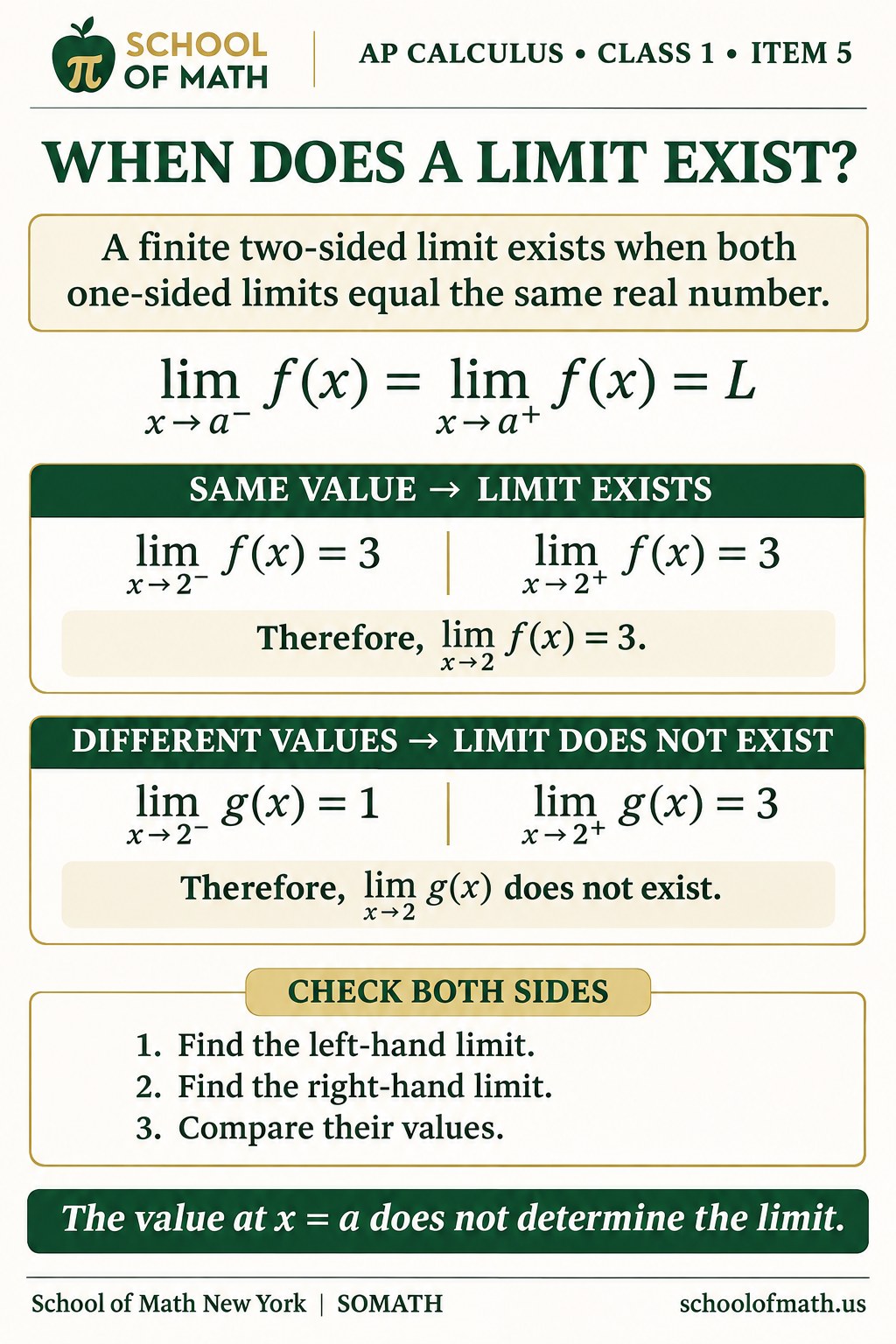
When does a limit exist?
The existence test
A finite two-sided limit exists exactly when both one-sided limits exist and equal the same real number:
Check both sides
- Find the left-hand limit.
- Find the right-hand limit.
- Compare. Same value: the limit exists and equals it. Different values: the limit does not exist.
Other ways a limit can fail
Besides a jump, a limit fails to be a finite number when the outputs grow without bound (for example \(1/x^2\) near 0) or oscillate without settling. Those cases are studied with limits at infinity and continuity in later classes.
The value at the point is irrelevant
The value \(f(a)\) does not determine the limit. A piecewise function can define \(f(a)\) as anything, or leave it undefined, and the limit depends only on the two sides.
Making a limit exist
When a piecewise function contains an unknown constant, set the two one-sided limits equal and solve for the constant.
Practice: try these five questions
Q21
Suppose \(\displaystyle\lim_{x\to 4^-} f(x) = 6\), \(\displaystyle\lim_{x\to 4^+} f(x) = 6\), and \(f(4) = -1\). Find \(\displaystyle\lim_{x\to 4} f(x)\).
Answer
\(\displaystyle\lim_{x\to 4} f(x) = 6\)
- Both one-sided limits equal 6, so the two-sided limit exists and equals 6.
- The value \(f(4) = -1\) does not affect the limit.
Q22
Let \(h(x) = \begin{cases} x + 4, & x \lt 1 \\ 0, & x = 1 \\ 2x + 3, & x \gt 1 \end{cases}\). Find \(\displaystyle\lim_{x\to 1} h(x)\).
Answer
\(\displaystyle\lim_{x\to 1} h(x) = 5\)
- Left: \(\displaystyle\lim_{x\to 1^-}(x+4) = 5\).
- Right: \(\displaystyle\lim_{x\to 1^+}(2x+3) = 5\).
- The sides agree, so the limit is 5. The value \(h(1) = 0\) is irrelevant.
Q23
Find the value of \(k\) that makes \(\displaystyle\lim_{x\to 2} f(x)\) exist, where \(f(x) = \begin{cases} kx + 1, & x \lt 2 \\ x^2 - 1, & x \ge 2 \end{cases}\).
Answer
\(k = 1\)
- Left-hand limit: \(2k + 1\). Right-hand limit: \(2^2 - 1 = 3\).
- Set them equal: \(2k + 1 = 3\), so \(k = 1\).
- Check: with \(k = 1\) both sides approach 3.
Q24
If \(\displaystyle\lim_{x\to a^-} f(x) = 4\) and \(\displaystyle\lim_{x\to a^+} f(x) = 4\), which statement must be true?
- \(f(a) = 4\)
- \(\displaystyle\lim_{x\to a} f(x) = 4\)
- \(f(a)\) is undefined
- \(f(a) \ne 4\)
Answer
(B)
- Equal one-sided limits guarantee that the two-sided limit exists and equals 4.
- Nothing is known about \(f(a)\): it could be 4, another number, or undefined, so (A), (C) and (D) are not guaranteed.
Q25
Use the graph. Decide whether each limit exists, and give its value if it does: (a) \(\displaystyle\lim_{x\to 1} f(x)\) (b) \(\displaystyle\lim_{x\to 3} f(x)\) (c) \(\displaystyle\lim_{x\to 4} f(x)\).
Answer
(a) \(2\) (b) does not exist (c) \(1\)
- (a) Both sides approach the hole at height 2, so the limit is 2.
- (b) Left side approaches 4, right side approaches 1: they differ, so no limit.
- (c) Near \(x = 4\) the graph is the horizontal piece at height 1.
The limit vs. the function value
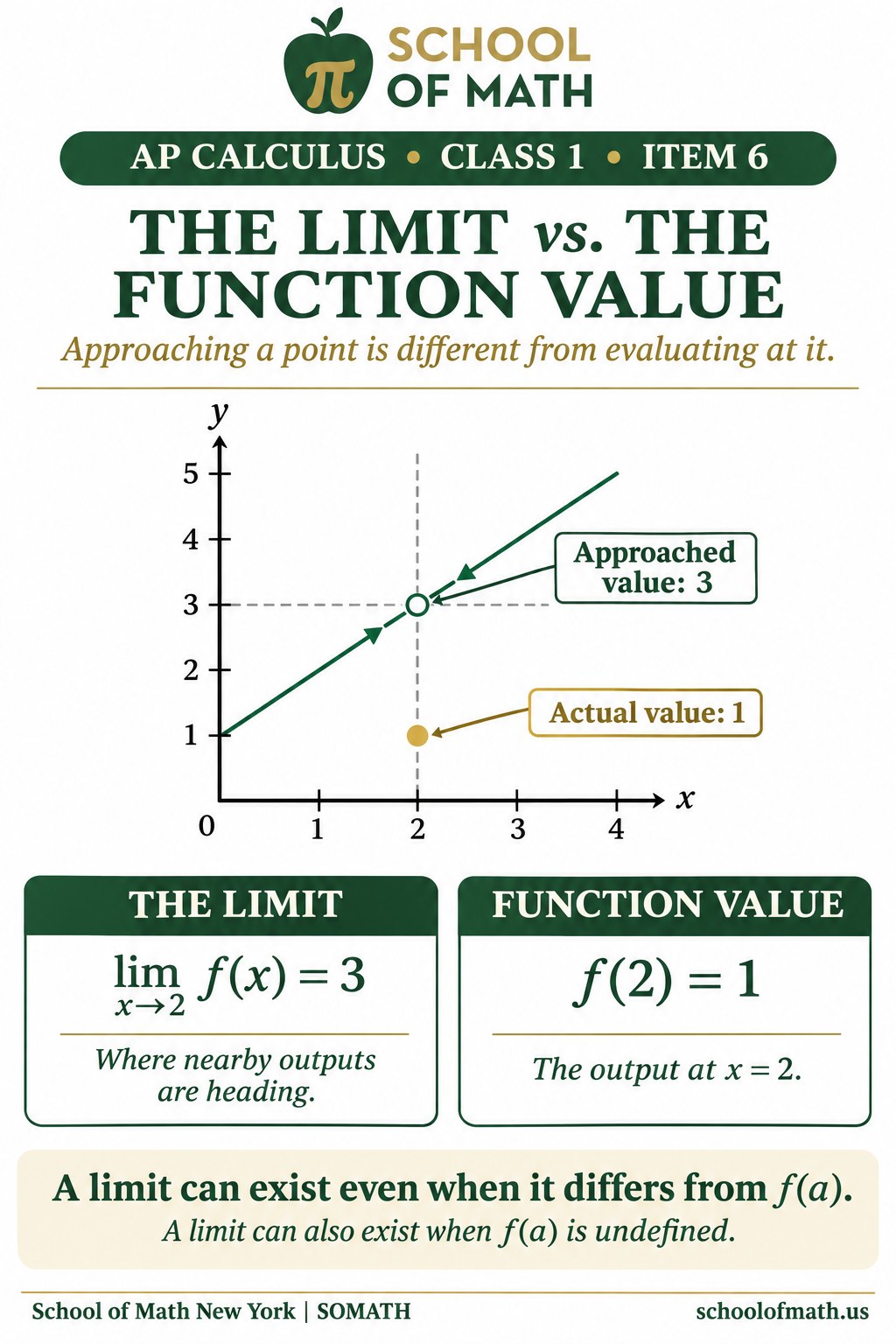
Two different questions
- The limit \(\displaystyle\lim_{x\to a} f(x)\) asks: where are the nearby outputs heading?
- The function value \(f(a)\) asks: what is the output exactly at \(x = a\)?
In the image, the line heads to the hole at height 3, so \(\displaystyle\lim_{x\to 2} f(x) = 3\), but the filled dot shows \(f(2) = 1\).
Three possible situations
- The limit and \(f(a)\) are equal (the graph is unbroken at \(a\)).
- The limit exists but \(f(a)\) is a different number (a hole with a displaced dot).
- The limit exists but \(f(a)\) is undefined (a hole with no dot).
The limit can also fail to exist while \(f(a)\) is defined, as at a jump. When the limit equals \(f(a)\), the function is called continuous at \(a\); that idea is the subject of a later class.
Practice: try these five questions
Q26
Use the graph to find \(\displaystyle\lim_{x\to 1} f(x)\) and \(f(1)\).
Answer
\(\displaystyle\lim_{x\to 1} f(x) = 3\); \(f(1) = 5\)
- The line approaches the hole at height 3 from both sides, so the limit is 3.
- The filled dot at \((1, 5)\) gives the actual value \(f(1) = 5\).
- The limit and the function value are different numbers.
Q27
Use the graph to find \(\displaystyle\lim_{x\to 2} f(x)\) and \(f(2)\).
Answer
\(\displaystyle\lim_{x\to 2} f(x) = 2\); \(f(2)\) is undefined
- Both sides of the curve approach the hole at height 2.
- There is no filled dot above \(x = 2\), so \(f(2)\) does not exist.
- A limit can exist even when the function value is undefined.
Q28
Let \(g(x) = \begin{cases} 3x - 1, & x \ne 2 \\ 10, & x = 2 \end{cases}\). Find \(\displaystyle\lim_{x\to 2} g(x)\) and \(g(2)\).
Answer
\(\displaystyle\lim_{x\to 2} g(x) = 5\); \(g(2) = 10\)
- Near \(x = 2\) (but not at it), \(g(x) = 3x - 1\), which approaches \(3(2) - 1 = 5\).
- At \(x = 2\) the rule says \(g(2) = 10\).
- They differ, so \(g\) is not continuous at 2.
Q29
True or false: “If \(f(4) = 7\), then \(\displaystyle\lim_{x\to 4} f(x) = 7\).” Give a reason.
Answer
False
- The value at one point does not control nearby values.
- Counterexample: \(f(x) = x\) for \(x \ne 4\) and \(f(4) = 7\). Then \(f(4) = 7\) but \(\displaystyle\lim_{x\to 4} f(x) = 4\).
- The statement is true only for functions continuous at 4.
Q30
The graph shows \(y = 4 - x\) with a filled dot at \((3, 1)\). Compare \(\displaystyle\lim_{x\to 3} f(x)\) and \(f(3)\).
Answer
Both equal \(1\).
- Near \(x = 3\) the line approaches height \(4 - 3 = 1\) from both sides.
- The dot is on the line, so \(f(3) = 1\).
- Limit and function value agree: this is the continuous case.
Limit laws and direct substitution
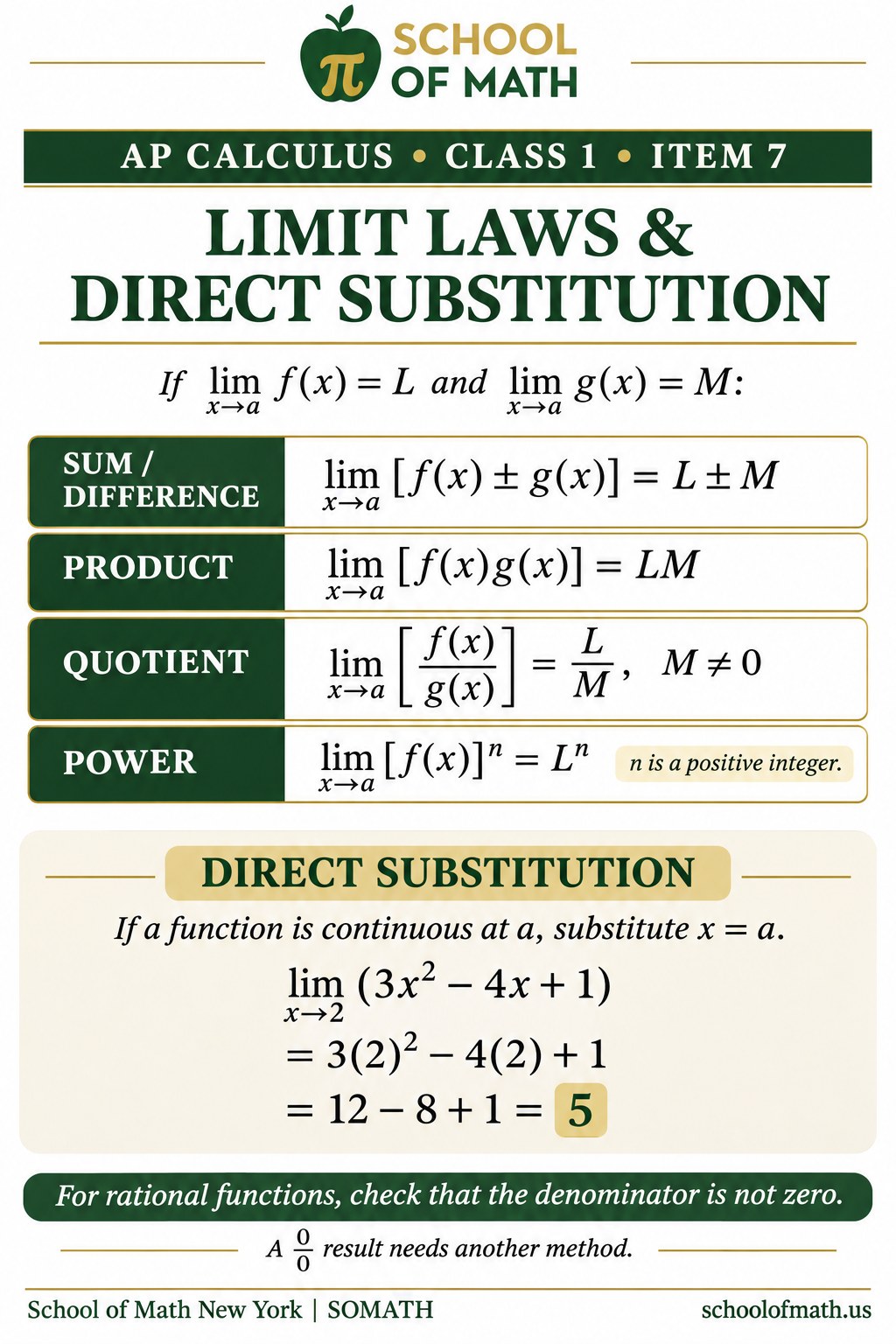
The limit laws
If \(\displaystyle\lim_{x\to a} f(x) = L\) and \(\displaystyle\lim_{x\to a} g(x) = M\), then
A constant multiple follows from the product law: \(\displaystyle\lim_{x\to a} c\,f(x) = cL\).
Direct substitution
Polynomials, and rational functions whose denominator is not zero at \(a\), are continuous there. For them, the limit equals the value: substitute \(x = a\).
When substitution is not enough
- If substitution gives a real number, that number is the limit (for continuous functions).
- If it gives \(\tfrac{0}{0}\), the form is indeterminate: factor or rationalize first (Topics 8 and 9).
- If it gives a nonzero number over 0, the limit is not a finite number; check one-sided behaviour.
Practice: try these five questions
Q31
Given \(\displaystyle\lim_{x\to 3} f(x) = 4\) and \(\displaystyle\lim_{x\to 3} g(x) = -2\), find \(\displaystyle\lim_{x\to 3}[2f(x) - 3g(x)]\).
Answer
\(14\)
- Difference and constant-multiple laws: \(2\displaystyle\lim f(x) - 3\lim g(x)\).
- \(2(4) - 3(-2) = 8 + 6 = 14\).
Q32
With the same limits as Q31, find (a) \(\displaystyle\lim_{x\to 3}[f(x)g(x)]\), (b) \(\displaystyle\lim_{x\to 3}\frac{f(x)}{g(x)}\), (c) \(\displaystyle\lim_{x\to 3}[g(x)]^3\).
Answer
(a) \(-8\) (b) \(-2\) (c) \(-8\)
- (a) Product law: \(4 \cdot (-2) = -8\).
- (b) Quotient law (denominator limit \(-2 \ne 0\)): \(4 / (-2) = -2\).
- (c) Power law: \((-2)^3 = -8\).
Q33
Evaluate \(\displaystyle\lim_{x\to -1}(2x^3 + x^2 - 5)\).
Answer
\(-6\)
- A polynomial is continuous, so substitute \(x = -1\).
- \(2(-1)^3 + (-1)^2 - 5 = -2 + 1 - 5 = -6\).
Q34
Evaluate \(\displaystyle\lim_{x\to 2}\frac{x^2 + 1}{x + 3}\).
Answer
\(1\)
- Check the denominator first: \(2 + 3 = 5 \ne 0\), so substitution is allowed.
- Numerator: \(2^2 + 1 = 5\). The limit is \(5/5 = 1\).
Q35
Try direct substitution on each limit. State the result, or say that another method is needed: (a) \(\displaystyle\lim_{x\to 3}\frac{x + 5}{x - 2}\) (b) \(\displaystyle\lim_{x\to 4}\frac{x^2 - 16}{x - 4}\).
Answer
(a) \(8\) (b) \(\tfrac{0}{0}\): another method is needed
- (a) Denominator \(3 - 2 = 1 \ne 0\); the value is \(8/1 = 8\).
- (b) Substitution gives \(\dfrac{16 - 16}{4 - 4} = \dfrac{0}{0}\), an indeterminate form.
- Factoring (Topic 8) finishes (b): \(\dfrac{(x-4)(x+4)}{x-4} = x + 4 \to 8\).
Limits by factoring
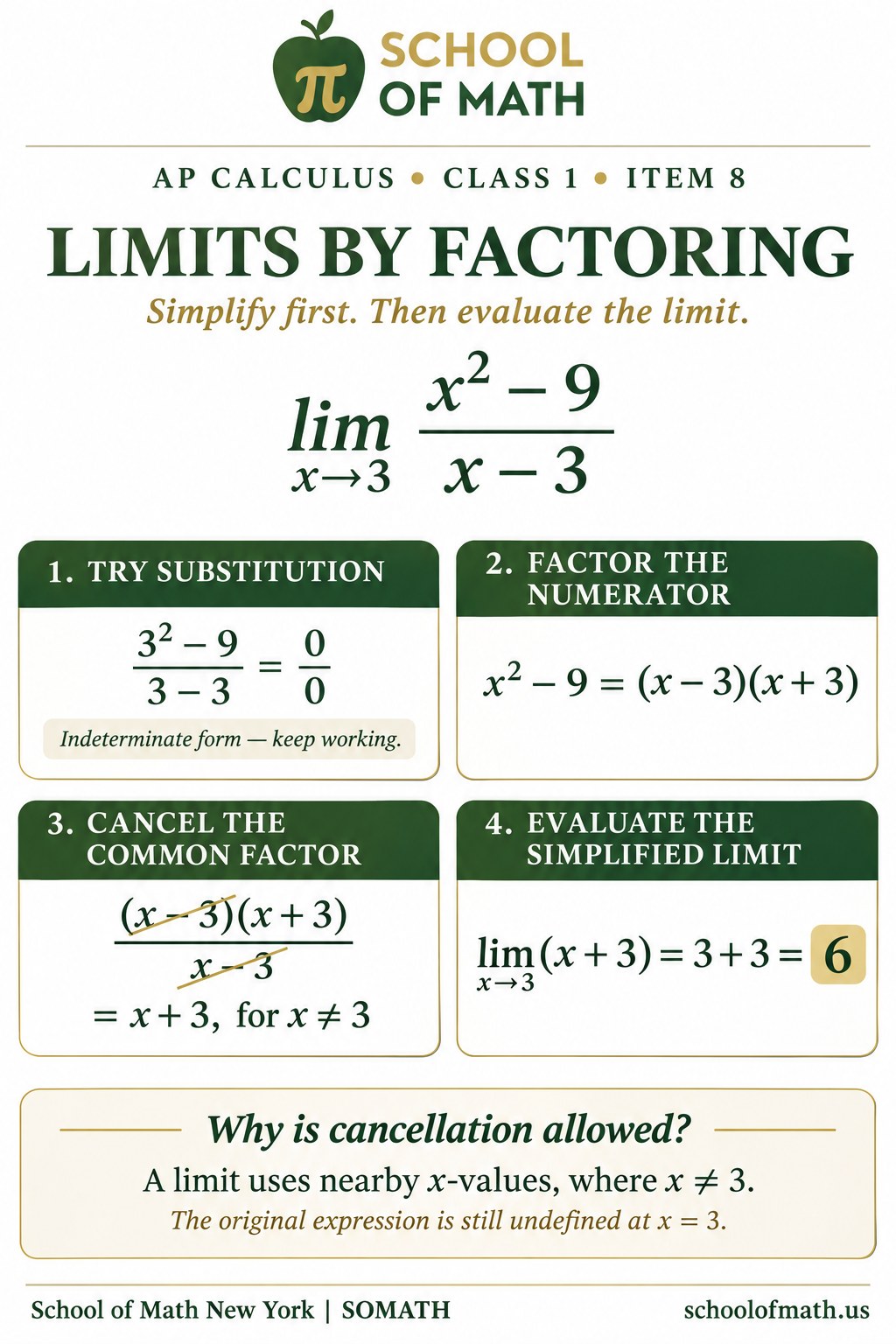
Simplify first, then evaluate
- Try substitution. For \(\displaystyle\lim_{x\to 3}\frac{x^2-9}{x-3}\), substitution gives \(\tfrac{0}{0}\): indeterminate, so keep working.
- Factor. \(x^2 - 9 = (x-3)(x+3)\).
- Cancel the common factor. \(\dfrac{(x-3)(x+3)}{x-3} = x + 3\) for \(x \ne 3\).
- Evaluate the simplified limit. \(\displaystyle\lim_{x\to 3}(x + 3) = 6\).
Why cancellation is allowed
A limit only uses \(x\)-values near 3, where \(x \ne 3\), so \(x - 3 \ne 0\) and dividing it out is legal. The original expression is still undefined at \(x = 3\); its graph is the line \(y = x + 3\) with a hole.
Useful factoring patterns
A \(\tfrac{0}{0}\) result at \(x = a\) means \((x - a)\) is a factor of both numerator and denominator, which tells you what to look for.
Practice: try these five questions
Q36
Evaluate \(\displaystyle\lim_{x\to 5}\frac{x^2 - 25}{x - 5}\).
Answer
\(10\)
- Substitution gives \(\tfrac{0}{0}\).
- Factor: \(\dfrac{(x-5)(x+5)}{x-5} = x + 5\) for \(x \ne 5\).
- \(\displaystyle\lim_{x\to 5}(x+5) = 10\).
Q37
Evaluate \(\displaystyle\lim_{x\to 2}\frac{x^2 + x - 6}{x - 2}\).
Answer
\(5\)
- Substitution: \(\dfrac{4 + 2 - 6}{0} = \dfrac{0}{0}\).
- Factor: \(x^2 + x - 6 = (x-2)(x+3)\).
- Cancel and substitute: \(\displaystyle\lim_{x\to 2}(x + 3) = 5\).
Q38
Evaluate \(\displaystyle\lim_{x\to -3}\frac{x^2 + 5x + 6}{x + 3}\).
Answer
\(-1\)
- Substitution: \(\dfrac{9 - 15 + 6}{0} = \dfrac{0}{0}\).
- Factor: \(x^2 + 5x + 6 = (x+2)(x+3)\).
- \(\displaystyle\lim_{x\to -3}(x + 2) = -1\).
Q39
Evaluate \(\displaystyle\lim_{x\to 1}\frac{x^3 - 1}{x - 1}\).
Answer
\(3\)
- Substitution gives \(\tfrac{0}{0}\).
- Difference of cubes: \(x^3 - 1 = (x-1)(x^2 + x + 1)\).
- \(\displaystyle\lim_{x\to 1}(x^2 + x + 1) = 1 + 1 + 1 = 3\).
Q40
Evaluate \(\displaystyle\lim_{x\to 4}\frac{x^2 - 16}{x^2 - 3x - 4}\).
Answer
\(\tfrac{8}{5}\)
- Substitution: \(\dfrac{0}{16 - 12 - 4} = \dfrac{0}{0}\).
- Factor both: \(\dfrac{(x-4)(x+4)}{(x-4)(x+1)} = \dfrac{x+4}{x+1}\) for \(x \ne 4\).
- Substitute: \(\dfrac{8}{5}\).
Limits by rationalizing
When a radical causes \(\tfrac{0}{0}\)
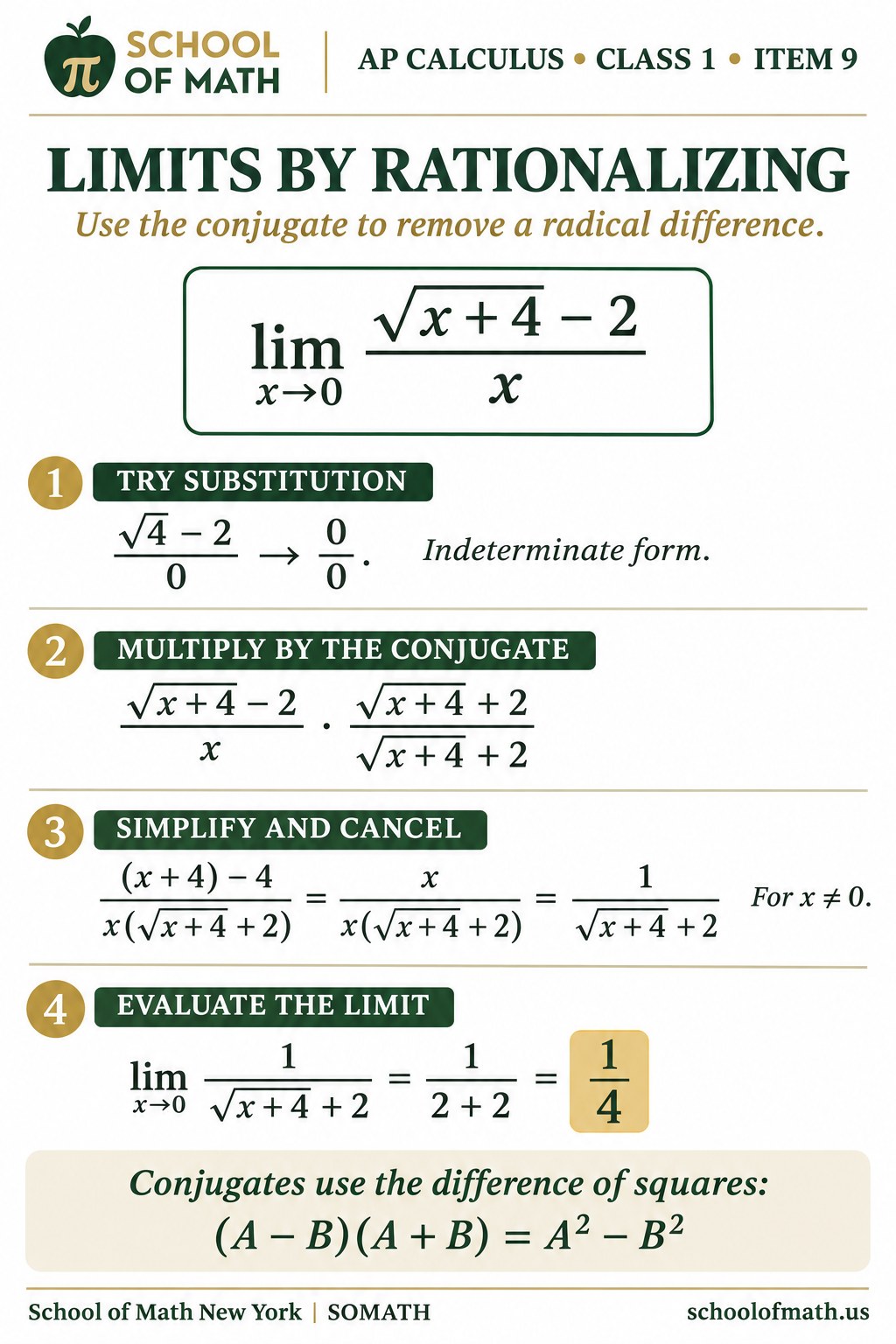
For \(\displaystyle\lim_{x\to 0}\frac{\sqrt{x+4} - 2}{x}\), substitution gives \(\dfrac{\sqrt4 - 2}{0} = \dfrac{0}{0}\). Factoring does not help directly, because the radical is a difference. Multiply by the conjugate.
The four steps
- Try substitution: \(\tfrac{0}{0}\), indeterminate.
- Multiply top and bottom by the conjugate \(\sqrt{x+4} + 2\).
- Simplify using \((A - B)(A + B) = A^2 - B^2\):
\[\frac{(x + 4) - 4}{x(\sqrt{x+4} + 2)} = \frac{x}{x(\sqrt{x+4} + 2)} = \frac{1}{\sqrt{x+4} + 2}, \quad x \ne 0.\]
- Evaluate: \(\dfrac{1}{\sqrt4 + 2} = \dfrac{1}{4}\).
Tips
- Leave the conjugate factor in the denominator unexpanded; it is what you substitute into at the end.
- The conjugate of \(\sqrt{u} - c\) is \(\sqrt{u} + c\); the conjugate of \(\sqrt{u} - \sqrt{v}\) is \(\sqrt{u} + \sqrt{v}\).
- If the radical is in the denominator, multiply by its conjugate in the same way.
Practice: try these five questions
Q41
Evaluate \(\displaystyle\lim_{x\to 0}\frac{\sqrt{x + 9} - 3}{x}\).
Answer
\(\tfrac{1}{6}\)
- Substitution gives \(\tfrac{0}{0}\).
- Multiply by \(\dfrac{\sqrt{x+9} + 3}{\sqrt{x+9} + 3}\): numerator becomes \((x + 9) - 9 = x\).
- Simplify to \(\dfrac{1}{\sqrt{x+9} + 3}\) and substitute: \(\dfrac{1}{3 + 3} = \dfrac16\).
Q42
Evaluate \(\displaystyle\lim_{x\to 4}\frac{\sqrt{x} - 2}{x - 4}\).
Answer
\(\tfrac{1}{4}\)
- Substitution gives \(\tfrac{0}{0}\).
- Multiply by \(\sqrt{x} + 2\): \(\dfrac{x - 4}{(x-4)(\sqrt{x} + 2)} = \dfrac{1}{\sqrt{x} + 2}\).
- Substitute: \(\dfrac{1}{2 + 2} = \dfrac14\).
Q43
Evaluate \(\displaystyle\lim_{x\to 0}\frac{\sqrt{x + 1} - 1}{x}\).
Answer
\(\tfrac{1}{2}\)
- Multiply by \(\sqrt{x+1} + 1\): numerator \((x + 1) - 1 = x\).
- Cancel \(x\): \(\dfrac{1}{\sqrt{x+1} + 1}\).
- Substitute: \(\dfrac{1}{1 + 1} = \dfrac12\).
Q44
The radical is in the denominator. Evaluate \(\displaystyle\lim_{x\to 3}\frac{x - 3}{\sqrt{x + 1} - 2}\).
Answer
\(4\)
- Substitution gives \(\dfrac{0}{\sqrt4 - 2} = \dfrac00\).
- Multiply by \(\sqrt{x+1} + 2\): the denominator becomes \((x + 1) - 4 = x - 3\).
- \(\dfrac{(x-3)(\sqrt{x+1} + 2)}{x - 3} = \sqrt{x+1} + 2 \to 2 + 2 = 4\).
Q45
Evaluate \(\displaystyle\lim_{x\to 0}\frac{\sqrt{4 + x} - \sqrt{4 - x}}{x}\).
Answer
\(\tfrac{1}{2}\)
- Multiply by the conjugate \(\sqrt{4+x} + \sqrt{4-x}\).
- Numerator: \((4 + x) - (4 - x) = 2x\). So the expression is \(\dfrac{2}{\sqrt{4+x} + \sqrt{4-x}}\) for \(x \ne 0\).
- Substitute: \(\dfrac{2}{2 + 2} = \dfrac12\).
One limit, three methods
Three views of the same limit
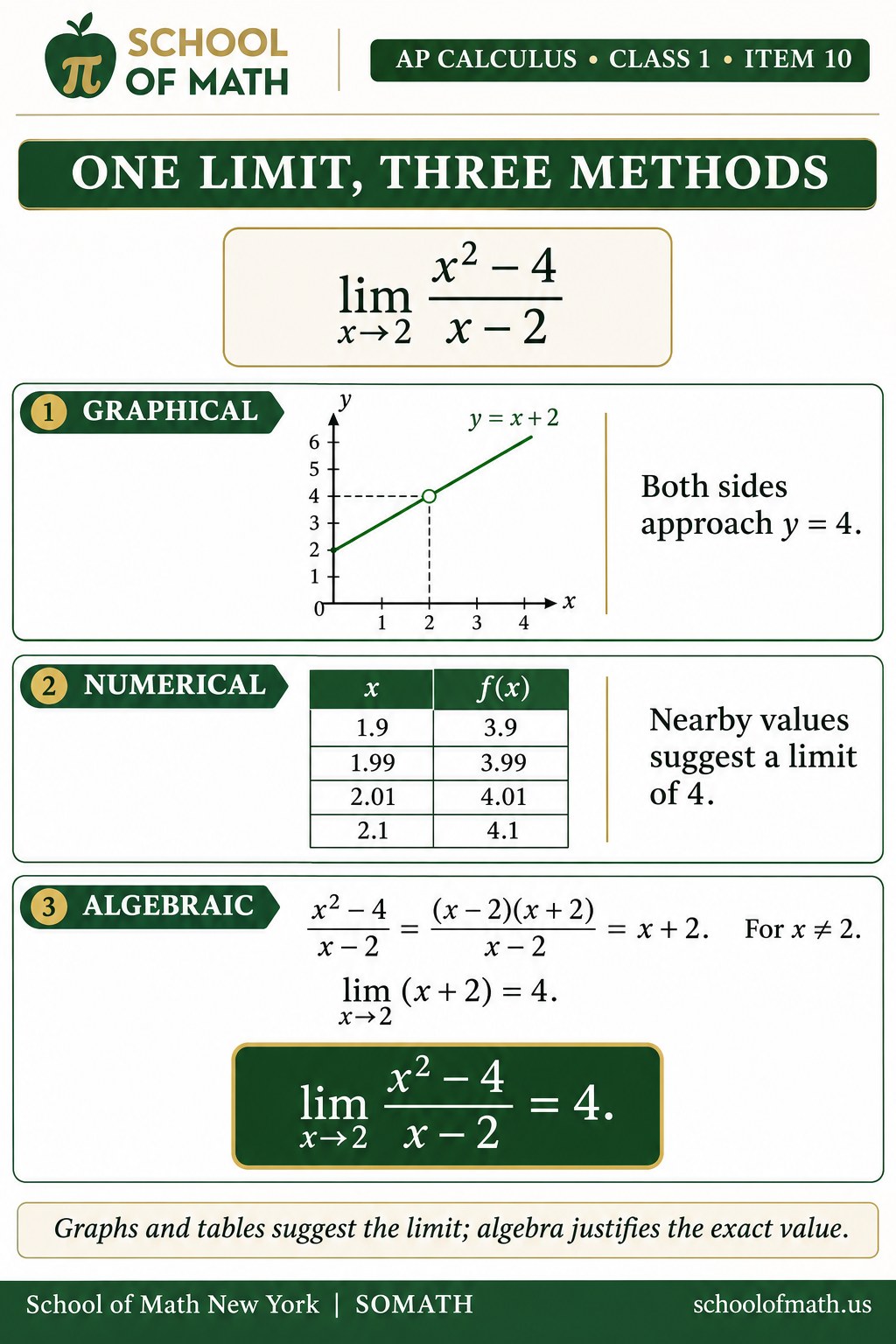
The image studies \(\displaystyle\lim_{x\to 2}\frac{x^2 - 4}{x - 2}\) in three ways:
- Graphical. The graph is the line \(y = x + 2\) with a hole at \((2, 4)\). Both sides approach \(y = 4\).
- Numerical. The table values \(3.9, 3.99, 4.01, 4.1\) suggest a limit of 4.
- Algebraic. \(\dfrac{(x-2)(x+2)}{x - 2} = x + 2\) for \(x \ne 2\), so the limit is \(2 + 2 = 4\).
Which method proves the answer?
Graphs and tables suggest a limit; algebra justifies the exact value. A table can be misleading if the chosen inputs are not close enough, and a graph can hide small details. On AP free-response questions, show the algebra whenever a formula is given.
Choosing a method
- Substitution gives a number: done (Topic 7).
- \(\tfrac00\) with polynomials: factor (Topic 8).
- \(\tfrac00\) with a square root: rationalize (Topic 9).
- Piecewise or absolute value: compute each one-sided limit (Topics 4 and 5).
- Only a graph or table given: read both sides (Topics 1 to 3).
Practice: try these five questions
Q46
Find \(\displaystyle\lim_{x\to 1}\frac{x^2 + 2x - 3}{x - 1}\) three ways: (a) from the graph, (b) by completing the table, (c) algebraically.
| \(x\) | \(f(x)\) |
|---|---|
| 0.9 | |
| 0.99 | |
| 1.01 | |
| 1.1 |
Answer
\(4\) by all three methods
- (a) The graph is \(y = x + 3\) with a hole at \((1, 4)\); both sides approach 4.
- (b) Table: \(3.9,\ 3.99,\ 4.01,\ 4.1\), which close in on 4.
- (c) \(\dfrac{(x-1)(x+3)}{x-1} = x + 3\) for \(x \ne 1\), and \(1 + 3 = 4\).
Q47
Complete the table for \(f(x) = \dfrac{x^2 - x - 2}{x - 2}\), estimate the limit as \(x\to 2\), then confirm it algebraically.
| \(x\) | \(f(x)\) |
|---|---|
| 1.9 | |
| 1.99 | |
| 2.01 | |
| 2.1 |
Answer
\(2.9,\ 2.99,\ 3.01,\ 3.1\); the limit is \(3\).
- Each table value equals \(x + 1\) because \(x^2 - x - 2 = (x-2)(x+1)\).
- The outputs approach 3 from both sides.
- Algebra: \(\displaystyle\lim_{x\to 2}(x + 1) = 3\).
Q48
The table shows \(f(x) = \dfrac{\sqrt{x + 16} - 4}{x}\) near 0 (rounded to five decimal places). Estimate the limit, then find its exact value.
| \(x\) | \(f(x)\) |
|---|---|
| −0.1 | 0.12520 |
| −0.01 | 0.12502 |
| 0.01 | 0.12498 |
| 0.1 | 0.12481 |
Answer
About \(0.125\); exactly \(\tfrac{1}{8}\)
- The outputs \(0.12520, 0.12502\) and \(0.12498, 0.12481\) approach \(0.125\).
- Rationalize: \(\dfrac{(x+16) - 16}{x(\sqrt{x+16} + 4)} = \dfrac{1}{\sqrt{x+16} + 4}\).
- Substitute: \(\dfrac{1}{4 + 4} = \dfrac18 = 0.125\).
Q49
Let \(f(x) = \dfrac{x^2 - 4}{|x - 2|}\). Use the graph and algebra to find both one-sided limits at \(x = 2\). Does \(\displaystyle\lim_{x\to 2} f(x)\) exist?
Answer
Left \(-4\), right \(4\); the limit does not exist.
- For \(x \gt 2\), \(|x - 2| = x - 2\), so \(f(x) = x + 2 \to 4\).
- For \(x \lt 2\), \(|x - 2| = -(x - 2)\), so \(f(x) = -(x + 2) \to -4\).
- The graph shows two rays with holes at \((2, -4)\) and \((2, 4)\). The sides differ, so no two-sided limit.
Q50
Name the best method for each limit, then evaluate it: (a) \(\displaystyle\lim_{x\to 2}\frac{x^3 - 8}{x - 2}\) (b) \(\displaystyle\lim_{x\to 9}\frac{\sqrt{x} - 3}{x - 9}\) (c) \(\displaystyle\lim_{x\to -1}(x^2 + 4x)\).
Answer
(a) factoring, \(12\) (b) rationalizing, \(\tfrac16\) (c) substitution, \(-3\)
- (a) \(\tfrac00\) with a polynomial: \(x^3 - 8 = (x-2)(x^2 + 2x + 4)\), giving \(4 + 4 + 4 = 12\).
- (b) \(\tfrac00\) with a root: multiply by \(\sqrt{x} + 3\) to get \(\dfrac{1}{\sqrt{x} + 3} \to \dfrac16\).
- (c) A polynomial: substitute, \(1 - 4 = -3\).
Homework review
One question per image, in image order.
R1
Use the table for \(f(x) = 3x + 2\) to estimate \(\displaystyle\lim_{x\to 1} f(x)\).
| \(x\) | \(f(x)\) |
|---|---|
| 0.9 | 4.7 |
| 0.99 | 4.97 |
| 1.01 | 5.03 |
| 1.1 | 5.3 |
Answer
\(5\)
- Outputs \(4.7, 4.97\) from the left and \(5.3, 5.03\) from the right.
- Both sides approach 5, so the limit is 5.
R2
Use the graph to find \(\displaystyle\lim_{x\to 2} f(x)\).
Answer
\(3\)
- Trace the line toward \(x = 2\) from both sides.
- Both sides approach the hole at height 3 (the line is \(y = -\tfrac12 x + 4\)).
R3
Use the graph to find \(\displaystyle\lim_{x\to 3^-} f(x)\), \(\displaystyle\lim_{x\to 3^+} f(x)\), and \(\displaystyle\lim_{x\to 3} f(x)\).
Answer
\(2,\ 2,\ 2\)
- From the left, the parabola rises toward the hole at height 2.
- From the right, it also approaches height 2.
- Both sides agree, so the limit is 2 (the curve is \(y = (x-2)^2 + 1\)).
R4
Let \(f(x) = \begin{cases} x + 2, & x \lt 1 \\ 5 - x, & x \ge 1 \end{cases}\). Find both one-sided limits at \(x = 1\) and decide whether the limit exists.
Answer
Left \(3\), right \(4\); the limit does not exist.
- Left: \(1 + 2 = 3\). Right: \(5 - 1 = 4\).
- \(3 \ne 4\), so \(\displaystyle\lim_{x\to 1} f(x)\) does not exist.
R5
Find \(c\) so that \(\displaystyle\lim_{x\to 3} f(x)\) exists, where \(f(x) = \begin{cases} x^2 + c, & x \lt 3 \\ 2x + 4, & x \ge 3 \end{cases}\).
Answer
\(c = 1\)
- Left limit: \(9 + c\). Right limit: \(2(3) + 4 = 10\).
- Set equal: \(9 + c = 10\), so \(c = 1\).
R6
Use the graph to find \(\displaystyle\lim_{x\to 2} f(x)\) and \(f(2)\).
Answer
\(\displaystyle\lim_{x\to 2} f(x) = 4\); \(f(2) = 1\)
- The line \(y = 2x\) approaches the hole at height 4 from both sides.
- The filled dot shows the actual value \(f(2) = 1\).
R7
Evaluate \(\displaystyle\lim_{x\to -2}\frac{x^3 - 3x + 4}{x^2 + 1}\).
Answer
\(\tfrac{2}{5}\)
- Denominator: \(4 + 1 = 5 \ne 0\), so substitute.
- Numerator: \(-8 + 6 + 4 = 2\). The limit is \(\tfrac25\).
R8
Evaluate \(\displaystyle\lim_{x\to -4}\frac{x^2 + x - 12}{x + 4}\).
Answer
\(-7\)
- Substitution gives \(\dfrac{16 - 4 - 12}{0} = \dfrac00\).
- Factor: \((x + 4)(x - 3)\); cancel to get \(x - 3\).
- \(-4 - 3 = -7\).
R9
Evaluate \(\displaystyle\lim_{x\to 0}\frac{\sqrt{25 + x} - 5}{x}\).
Answer
\(\tfrac{1}{10}\)
- Multiply by \(\sqrt{25 + x} + 5\); the numerator becomes \(x\).
- Simplify to \(\dfrac{1}{\sqrt{25+x} + 5}\) and substitute: \(\dfrac{1}{10}\).
R10
Find \(\displaystyle\lim_{x\to -1}\frac{x^2 - 1}{x + 1}\) graphically, numerically (complete the table), and algebraically.
| \(x\) | \(f(x)\) |
|---|---|
| −1.1 | |
| −1.01 | |
| −0.99 | |
| −0.9 |
Answer
\(-2\) by all three methods
- Graph: the line \(y = x - 1\) with a hole at \((-1, -2)\).
- Table: \(-2.1,\ -2.01,\ -1.99,\ -1.9\), approaching \(-2\).
- Algebra: \(\dfrac{(x-1)(x+1)}{x+1} = x - 1 \to -2\).
Homework word problems
Limits in context: speeds, prices, sensors and growth.
W1
A ball dropped from a tower falls \(s(t) = 16t^2\) feet in \(t\) seconds. Its average speed from \(t = 1\) to \(t = 1 + h\) is \(\dfrac{16(1+h)^2 - 16}{h}\). Find the limit as \(h \to 0\) and interpret it.
Answer
\(32\) feet per second, the ball's speed at \(t = 1\)
- Expand: \(16(1 + 2h + h^2) - 16 = 32h + 16h^2\).
- Divide by \(h\) (\(h \ne 0\)): \(32 + 16h\).
- Let \(h \to 0\): \(32\). The average speeds approach the instantaneous speed, 32 ft/s.
W2
A courier charges \(C(w) = 8\) dollars for packages up to and including 2 pounds and \(C(w) = 12\) dollars for packages over 2 pounds (up to 5). Find \(\displaystyle\lim_{w\to 2^-} C(w)\), \(\displaystyle\lim_{w\to 2^+} C(w)\), and \(C(2)\). Does \(\displaystyle\lim_{w\to 2} C(w)\) exist?
Answer
\(8\), \(12\), \(C(2) = 8\); the limit does not exist.
- Just under 2 lb the price is $8; just over 2 lb it is $12.
- At exactly 2 lb the first rule applies, so \(C(2) = 8\).
- The one-sided limits differ, so the two-sided limit does not exist: the price jumps.
W3
A greenhouse thermometer records the temperature \(T(t)\) (°F) near \(t = 3\) hours. Estimate \(\displaystyle\lim_{t\to 3} T(t)\).
| \(t\) | \(T(t)\) |
|---|---|
| 2.9 | 67.4 |
| 2.99 | 67.94 |
| 3.01 | 68.06 |
| 3.1 | 68.6 |
Answer
About \(68\)°F
- Before 3 hours the readings rise \(67.4 \to 67.94\); after, they fall \(68.6 \to 68.06\) toward 3.
- Both sides approach 68, so the temperature is heading to 68°F at \(t = 3\).
W4
A phone plan costs \(C(g) = 30\) dollars for \(g \le 5\) GB of data and \(C(g) = 30 + 10(g - 5)\) dollars for \(g \gt 5\). Find \(\displaystyle\lim_{g\to 5} C(g)\).
Answer
\(30\) dollars
- Left: \(\displaystyle\lim_{g\to 5^-} 30 = 30\).
- Right: \(30 + 10(5 - 5) = 30\).
- Both sides agree, so the limit is $30: the bill has no jump at 5 GB.
W5
The area of a square of side \(s\) cm is \(A(s) = s^2\). The average rate of change of area from \(s = 3\) to \(s = 3 + h\) is \(\dfrac{(3 + h)^2 - 9}{h}\). Find the limit as \(h \to 0\), with units.
Answer
\(6\) cm² per cm
- Expand: \(9 + 6h + h^2 - 9 = 6h + h^2\).
- Divide by \(h\): \(6 + h\).
- As \(h \to 0\) the rate approaches 6 cm² per cm of side length.
W6
A light sensor's output is modeled by \(I(d) = \dfrac{d^2 + 2d - 8}{d - 2}\), which shows an error at \(d = 2\) cm. What value do the readings approach as \(d \to 2\)?
Answer
\(6\)
- Substitution gives \(\tfrac00\), which is why the device errors.
- Factor: \(d^2 + 2d - 8 = (d - 2)(d + 4)\); cancel to get \(d + 4\).
- \(2 + 4 = 6\).
W7
A seedling's height is \(H(t) = \sqrt{t + 16}\) cm after \(t\) days. Its average growth rate over the first \(h\) days is \(\dfrac{\sqrt{16 + h} - 4}{h}\). Find the limit as \(h \to 0\) and interpret it.
Answer
\(\tfrac{1}{8}\) cm per day, the growth rate at \(t = 0\)
- Multiply by \(\sqrt{16+h} + 4\): \(\dfrac{h}{h(\sqrt{16+h} + 4)} = \dfrac{1}{\sqrt{16+h} + 4}\).
- Let \(h \to 0\): \(\dfrac{1}{4 + 4} = \dfrac18\).
- At the start the seedling grows at 0.125 cm per day.
W8
A library fine is $0.25 for each started day overdue: \(F(t) = 0.25\lceil t \rceil\) for \(t \gt 0\) days. Find \(\displaystyle\lim_{t\to 3^-} F(t)\) and \(\displaystyle\lim_{t\to 3^+} F(t)\).
Answer
$0.75 and $1.00
- Just under 3 days (e.g. 2.9), the ceiling is 3: \(F = 0.75\).
- Just over 3 days (e.g. 3.1), the ceiling is 4: \(F = 1.00\).
- The fine jumps at 3 days, so the two-sided limit does not exist.
W9
A bakery's price per loaf \(p(t)\) and daily loaves sold \(q(t)\) satisfy \(\displaystyle\lim_{t\to 6} p(t) = 12\) and \(\displaystyle\lim_{t\to 6} q(t) = 150\). Revenue is \(R(t) = p(t)q(t)\). Find \(\displaystyle\lim_{t\to 6} R(t)\).
Answer
$1800
- Product law: \(\displaystyle\lim R = (\lim p)(\lim q)\).
- \(12 \times 150 = 1800\) dollars.
W10
A drone's position is \(s(t) = t^3\) meters. Its average velocity from \(t = 2\) to \(t = 2 + h\) is \(\dfrac{(2 + h)^3 - 8}{h}\). Find the limit as \(h \to 0\).
Answer
\(12\) m/s
- Expand: \((2 + h)^3 = 8 + 12h + 6h^2 + h^3\).
- Subtract 8 and divide by \(h\): \(12 + 6h + h^2\).
- As \(h \to 0\), the average velocity approaches 12 m/s, the velocity at \(t = 2\).
Quick questions and answers
What is a limit in AP Calculus?
A limit describes the value that f(x) approaches as x gets closer to a number a, written lim f(x) = L as x approaches a. It depends on nearby inputs, not on the value at x = a itself.
How do you find a limit from a graph?
Locate x = a, trace the graph toward it from the left and from the right, and read the y-value both sides approach. A hole at the point does not prevent the limit from existing.
When does a limit not exist?
A two-sided limit fails to exist when the left-hand and right-hand limits are different, as at a jump. It also fails to be a finite number when the outputs grow without bound or oscillate.
Can a limit exist if f(a) is undefined?
Yes. The limit depends only on values near a. For example, (x² − 4)/(x − 2) is undefined at x = 2, but its limit there is 4.
What does 0/0 mean when evaluating a limit?
0/0 is an indeterminate form. It means direct substitution is not enough: factor and cancel, or multiply by a conjugate, then substitute into the simplified expression.
Which method should I use: graphical, numerical or algebraic?
Graphs and tables suggest a limit; algebra justifies the exact value. Use substitution when it gives a number, factoring or rationalizing for 0/0, and one-sided limits for piecewise or absolute-value functions.
Is an earlier class required, and what homework is included?
No earlier attendance is required. This self-contained lesson has ten teaching images, fifty original practice questions, ten Homework review questions and ten Homework word problems, all with hidden worked answers. The student workbook includes the cover, the ten images and the same seventy questions with blank answer space and no solutions.