Kid Einsteins · Class 1 · Grades 3–4
Multiplication Facts: ×2, ×5, and ×10
Multiplication counts equal groups. Use doubles to multiply by 2, count in fives to multiply by 5, and use groups of ten to multiply by 10. Connect these facts with number lines and patterns so you can explain your answer, not just remember it.
Follow eight images with five original practice questions after every image. Finish with eight homework review questions and twelve homework word problems: 20 homework questions and 60 questions overall. Try each question before opening its blue Answer control.
The first lesson in the Kid Einsteins syllabus at SOMATH. Book a free evaluation or see the class schedule.
Download the student workbook (PDF)22 pages · Cover, eight teaching images, and all 60 questions. Each image is followed by five practice questions; homework follows with up to five questions per page.Numbered pages, generous blank answer space, and no exercise solutions or writing lines.
Understanding multiplication
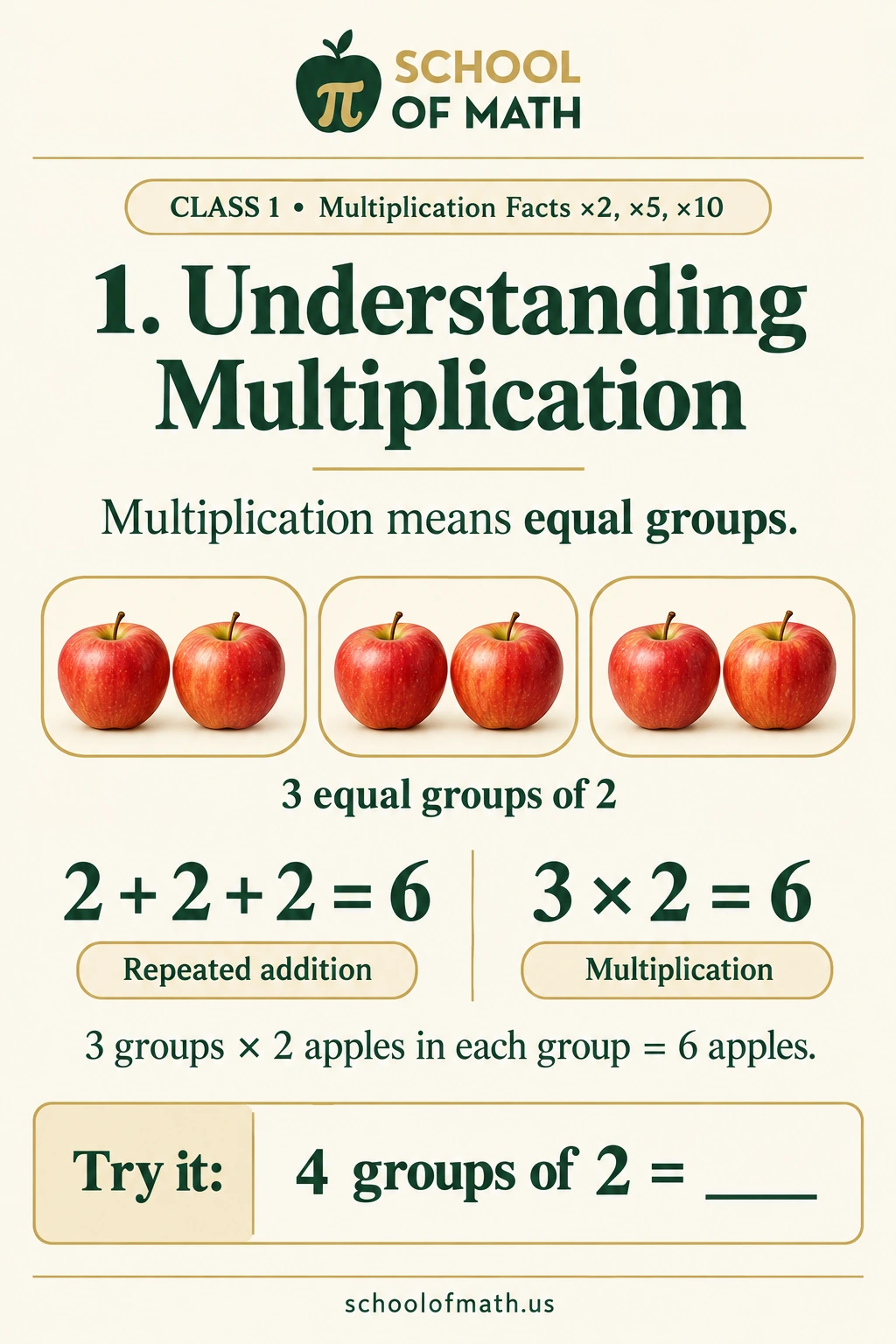
Multiplication helps us find the total in equal groups. First count the groups, then count how many objects are in each group. In this lesson, we write the number of groups first: groups × objects in each group = total objects.
Repeated addition shows the same total by adding the size of each group again and again. The groups must be equal to use one group size for all of them. The numbers being multiplied are called factors, and their answer is called the product.
Reversing the factors gives the same product. For example, 7 groups of 2 and 2 groups of 7 both total 14, although the pictures show different groupings. This explains why a doubles strategy can help with groups of 2.
Try it yourself: five questions
Q1 Practice 1 of 5
There are 7 small bowls with 2 beads in each bowl. Write a repeated-addition sentence and a multiplication sentence.
Answer
2 + 2 + 2 + 2 + 2 + 2 + 2 = 14; 7 × 2 = 14.
- Count 7 equal groups. Each group contains 2 beads.
- Add seven 2s, or multiply 7 by 2.
Q2 Practice 2 of 5
Draw 4 equal groups of 5 dots. How many dots are there? Label the number of groups and the number in each group.
Answer
20 dots; 4 groups, with 5 dots in each group.
- Write 5 + 5 + 5 + 5 = 20.
- The multiplication sentence is 4 × 5 = 20.
Q3 Practice 3 of 5
Which addition sentence matches 6 groups of 2: A: 6 + 2, or B: 2 + 2 + 2 + 2 + 2 + 2? Find the total.
Answer
B; the total is 12.
- Six groups of 2 means adding 2 six times.
- 6 + 2 adds two numbers but does not show six groups of 2.
Q4 Practice 4 of 5
Three boxes contain 2, 2, and 5 buttons. Can 3 × 2 describe all the buttons? Explain, then find the actual total.
Answer
No. The actual total is 9 buttons.
- The third box does not contain 2, so the groups are unequal.
- Add the actual amounts: 2 + 2 + 5 = 9.
Q5 Practice 5 of 5
There are 2 rows of 9 stars. Find the total and write a multiplication fact with the factors reversed.
Answer
18 stars; 2 × 9 = 18 and 9 × 2 = 18.
- Add 9 + 9 to count the two rows.
- Reversing the factors does not change the total.
Multiplying by 2
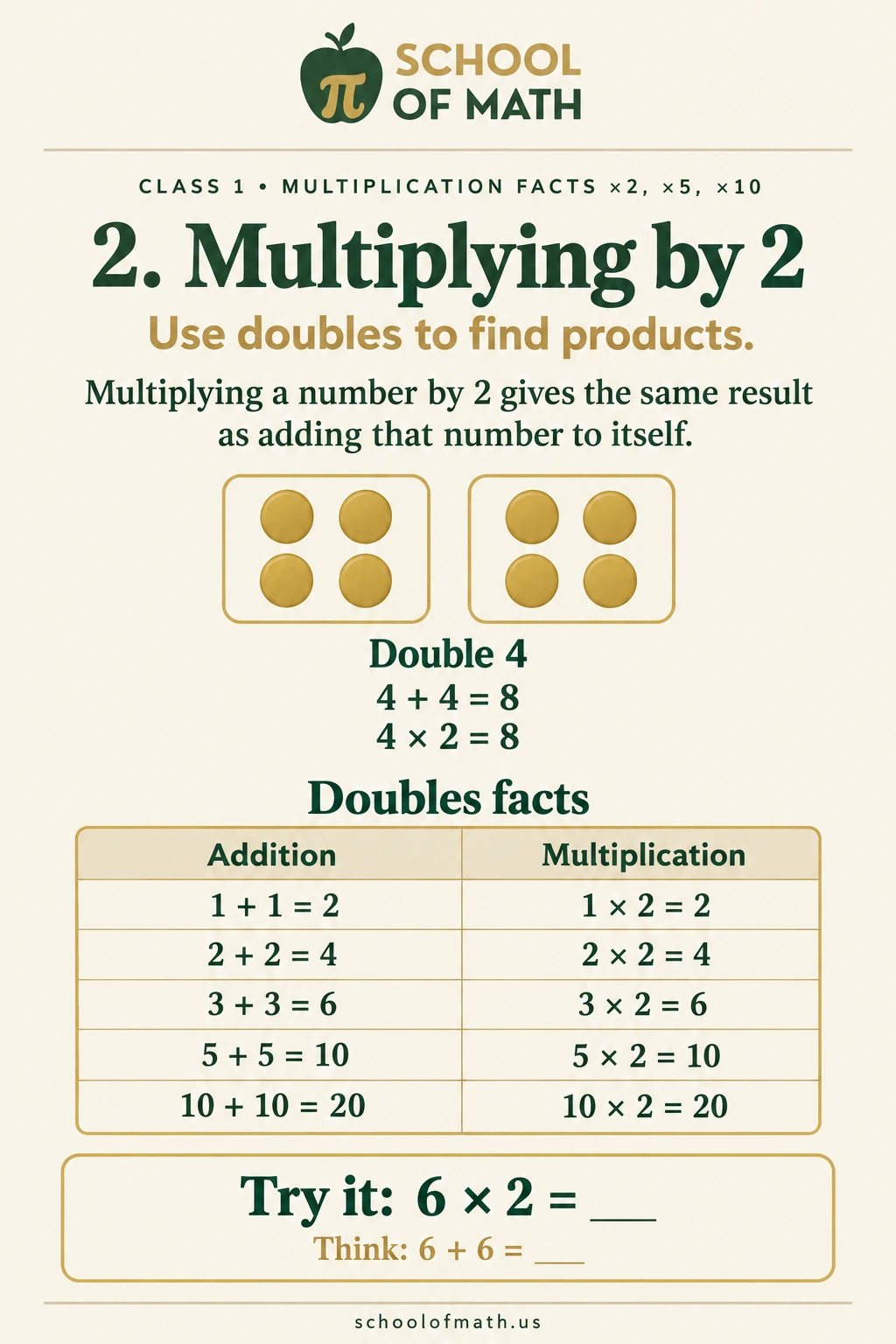
Multiplying a whole number by 2 gives its double. You can add the number to itself, count pairs, or skip count in 2s. Choose the strategy that helps you explain the fact rather than guessing.
If you know one ×2 fact, the next fact is 2 more because it adds one more group of 2. All the products in the whole-number ×2 facts are even, including 0. An even total can be arranged in pairs without an object left over.
Try it yourself: five questions
Q6 Practice 1 of 5
Find 7 × 2. Explain a strategy you used.
Answer
7 × 2 = 14.
- Double 7: 7 + 7 = 14.
- Check that the product matches the size and number of equal groups.
Q7 Practice 2 of 5
Find 8 × 2. Explain a strategy you used.
Answer
8 × 2 = 16.
- Double 8: 8 + 8 = 16.
- Check that the product matches the size and number of equal groups.
Q8 Practice 3 of 5
Find 9 × 2. Explain a strategy you used.
Answer
9 × 2 = 18.
- Double 9: 9 + 9 = 18.
- Check that the product matches the size and number of equal groups.
Q9 Practice 4 of 5
Find 11 × 2. Explain a strategy you used.
Answer
11 × 2 = 22.
- Double 11: 11 + 11 = 22.
- Check that the product matches the size and number of equal groups.
Q10 Practice 5 of 5
Find 12 × 2. Explain a strategy you used.
Answer
12 × 2 = 24.
- Double 12: 12 + 12 = 24.
- Check that the product matches the size and number of equal groups.
Multiplying by 5
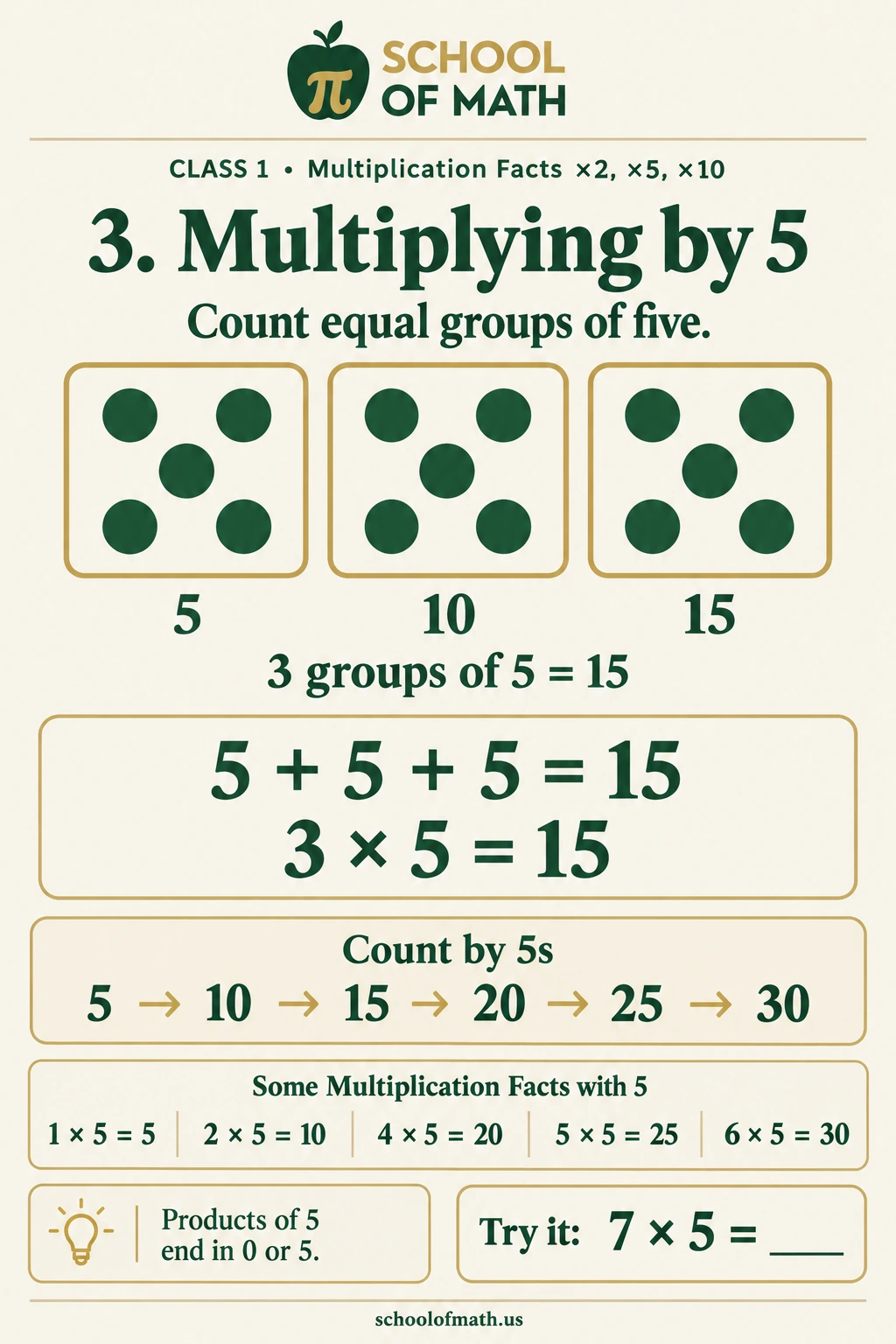
Each new group adds 5 more. Keep track of how many groups you have counted: the first group gives 5, the second gives 10, and so on. The last number you say after counting all the groups is the product.
Whole-number multiples of 5 end in 0 or 5. That pattern can help you catch a mistake, but the last digit alone does not tell you the full answer. To extend a fact you know, add 5 for one extra group or subtract 5 for one fewer group.
Try it yourself: five questions
Q11 Practice 1 of 5
Find 8 × 5. Explain a strategy you used.
Answer
8 × 5 = 40.
- Count by 5s 8 times: 5, 10, 15, 20, 25, 30, 35, 40.
- Check that the product matches the size and number of equal groups.
Q12 Practice 2 of 5
Find 9 × 5. Explain a strategy you used.
Answer
9 × 5 = 45.
- Count by 5s 9 times: 5, 10, 15, 20, 25, 30, 35, 40, 45.
- Check that the product matches the size and number of equal groups.
Q13 Practice 3 of 5
Find 10 × 5. Explain a strategy you used.
Answer
10 × 5 = 50.
- Count by 5s 10 times: 5, 10, 15, 20, 25, 30, 35, 40, 45, 50.
- Check that the product matches the size and number of equal groups.
Q14 Practice 4 of 5
Find 11 × 5. Explain a strategy you used.
Answer
11 × 5 = 55.
- Count by 5s 11 times: 5, 10, 15, 20, 25, 30, 35, 40, 45, 50, 55.
- Check that the product matches the size and number of equal groups.
Q15 Practice 5 of 5
Find 12 × 5. Explain a strategy you used.
Answer
12 × 5 = 60.
- Count by 5s 12 times: 5, 10, 15, 20, 25, 30, 35, 40, 45, 50, 55, 60.
- Check that the product matches the size and number of equal groups.
Multiplying by 10
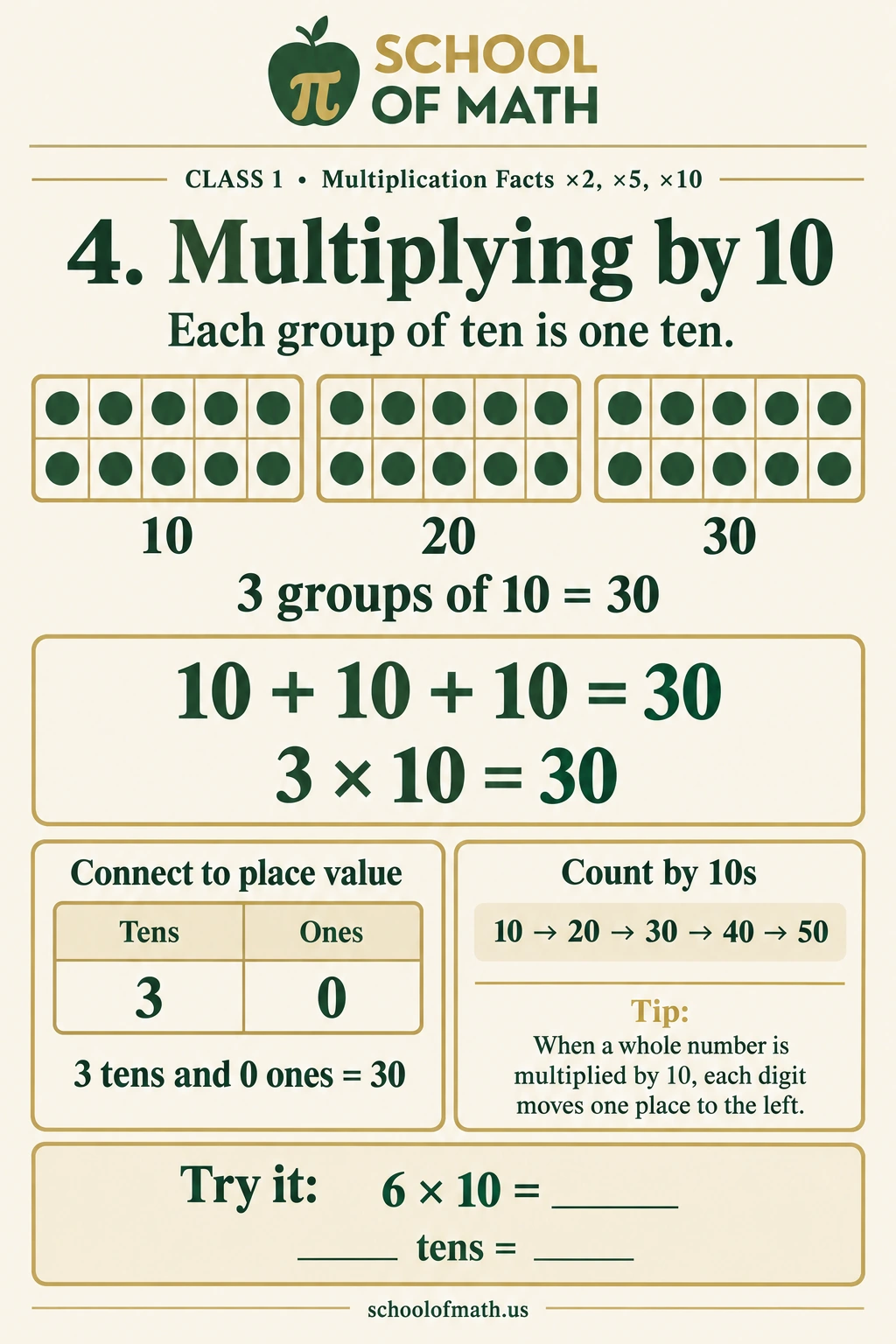
Each group of 10 is one ten. For example, 8 groups of 10 make 8 tens. In whole-number multiplication by 10, each digit has ten times its previous value and shifts one place to the left; the ones place is 0.
Use place value rather than only memorizing “add a zero.” For 12 × 10, twelve ones become twelve tens, which is 120. Zero groups still contain zero objects: 0 × 10 = 0.
Try it yourself: five questions
Q16 Practice 1 of 5
Find 8 × 10. Explain a strategy you used.
Answer
8 × 10 = 80.
- 8 groups of 10 make 8 tens, or 80.
- Check that the product matches the size and number of equal groups.
Q17 Practice 2 of 5
Find 9 × 10. Explain a strategy you used.
Answer
9 × 10 = 90.
- 9 groups of 10 make 9 tens, or 90.
- Check that the product matches the size and number of equal groups.
Q18 Practice 3 of 5
Find 11 × 10. Explain a strategy you used.
Answer
11 × 10 = 110.
- 11 groups of 10 make 11 tens, or 110.
- Check that the product matches the size and number of equal groups.
Q19 Practice 4 of 5
Find 12 × 10. Explain a strategy you used.
Answer
12 × 10 = 120.
- 12 groups of 10 make 12 tens, or 120.
- Check that the product matches the size and number of equal groups.
Q20 Practice 5 of 5
Fill in both blanks: 0 × 10 = __ and __ × 10 = 50.
Answer
0 × 10 = 0; 5 × 10 = 50.
- Zero groups have no objects.
- 50 contains 5 tens, so the missing group count is 5.
Skip counting on a number line
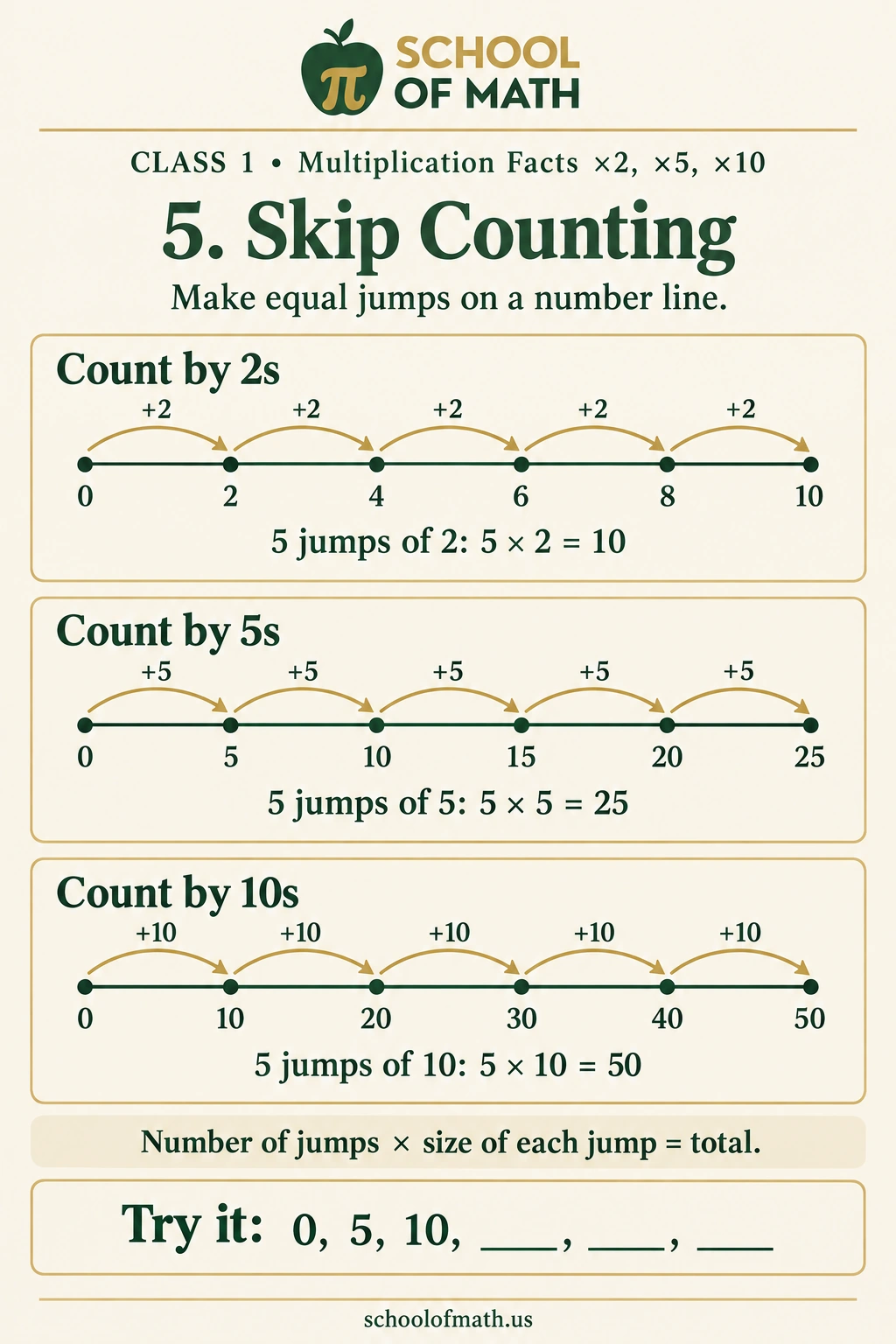
Start at 0 and make equal forward jumps. The number of jumps tells how many groups there are, and the jump size tells how many are in each group. The landing point gives the product.
Do not count the starting 0 as a jump. Six jumps have seven marked positions if you include the start. If you start somewhere other than 0, the distance traveled still equals jumps × jump size, but you must add the starting value to find the final position.
Try it yourself: five questions
Q21 Practice 1 of 5
Start at 0 and make 8 jumps of 2. List the landing numbers and write a multiplication sentence.
Answer
2, 4, 6, 8, 10, 12, 14, 16; 8 × 2 = 16.
- Add 2 for each jump.
- Count 8 landings after the starting 0.
Q22 Practice 2 of 5
Start at 0 and make 4 jumps of 5. Where do you land?
Answer
20.
- The landings are 5, 10, 15, and 20.
- 4 jumps × 5 per jump = 20.
Q23 Practice 3 of 5
Start at 0 and make 7 jumps of 10. Write the last two landing numbers.
Answer
60 and 70.
- The full sequence is 10, 20, 30, 40, 50, 60, 70.
- The seventh jump lands at 7 × 10 = 70.
Q24 Practice 4 of 5
Complete the counting-by-5s sequence: 20, 25, __, __, 40. How many jumps go from 20 to 40?
Answer
30 and 35; 4 jumps.
- The jumps are 20 → 25 → 30 → 35 → 40.
- There are 4 jumps of 5, covering a distance of 20.
Q25 Practice 5 of 5
A frog starts at 10 and makes 3 forward jumps of 5. Where does it land? Why is 3 × 5 not the final position?
Answer
It lands at 25.
- 3 × 5 = 15 is the distance traveled.
- Add the starting position: 10 + 15 = 25.
Recognizing multiplication patterns
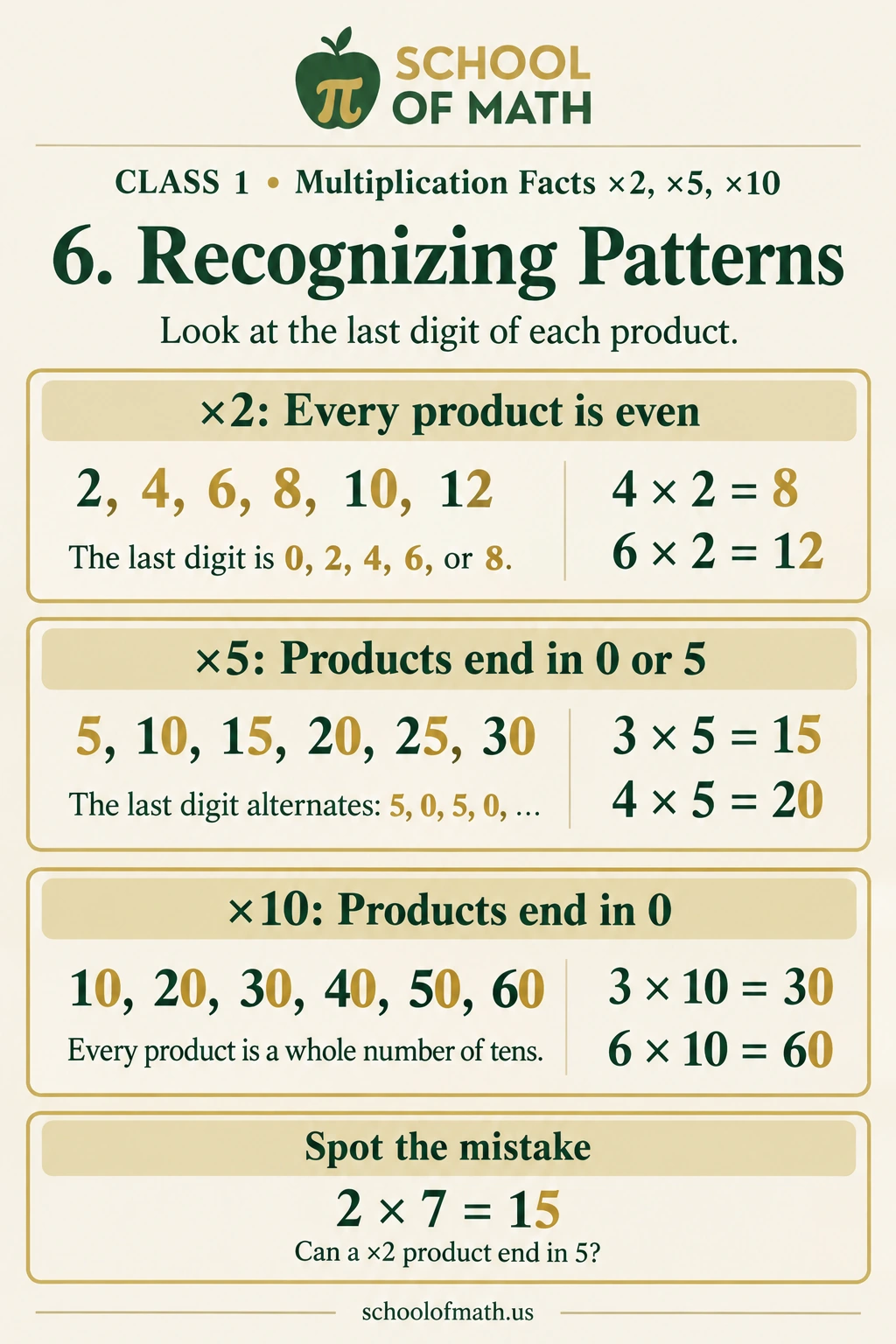
For whole-number inputs, ×2 products are even, ×5 products end in 0 or 5, and ×10 products end in 0. These statements describe patterns in the products, not rules for choosing the number of groups.
Patterns can show that an answer is impossible. An odd answer cannot be a whole-number ×2 product. However, an even answer is not automatically the correct answer to a particular ×2 question. Check the exact fact after using the pattern.
Some numbers belong to more than one pattern. Every multiple of 10 is also a multiple of 5 and of 2. A number ending in 5 is a multiple of 5 but not a multiple of 10.
Try it yourself: five questions
Q26 Practice 1 of 5
Which numbers could be products of a whole number and 2: 13, 18, 21, or 24?
Answer
18 and 24.
- Their ones digits are even.
- 18 = 9 × 2 and 24 = 12 × 2. The other two numbers are odd.
Q27 Practice 2 of 5
Which numbers could be products of a whole number and 5: 25, 32, 40, or 46?
Answer
25 and 40.
- Whole-number ×5 products end in 0 or 5.
- 25 = 5 × 5 and 40 = 8 × 5.
Q28 Practice 3 of 5
Which number is a multiple of both 5 and 10: 35, 45, or 60? Give both multiplication facts.
Answer
60; 12 × 5 = 60 and 6 × 10 = 60.
- A whole-number ×10 product ends in 0.
- 60 also forms 12 groups of 5.
Q29 Practice 4 of 5
A student writes 9 × 2 = 19. Use a pattern to show the answer is wrong, then correct it.
Answer
19 is odd, so it cannot be the product. 9 × 2 = 18.
- Whole-number ×2 products are even.
- Double 9: 9 + 9 = 18.
Q30 Practice 5 of 5
Mia says, “7 × 5 must be 40 because 40 ends in 0.” Is her reasoning enough? Find the correct product.
Answer
No. The correct product is 35.
- Ending in 0 or 5 is necessary for a ×5 product, but it does not choose the right fact.
- 6 × 5 = 30, so one more group of 5 gives 7 × 5 = 35.
Connecting ×5 and ×10 facts
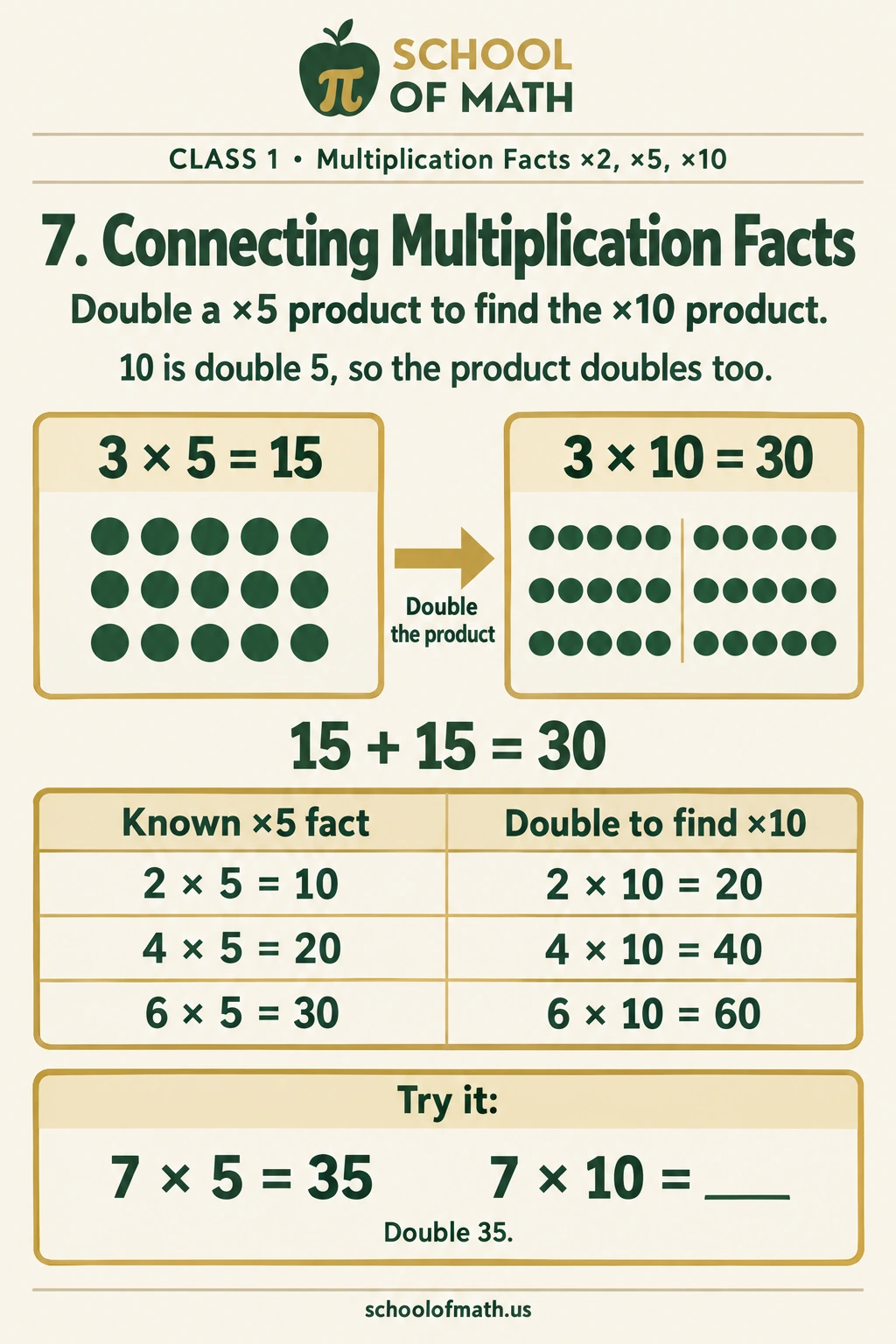
Ten is twice as much as five. With the same number of groups, changing from 5 objects in each group to 10 objects doubles the total. Double an ×5 product to find the matching ×10 product.
You can work backward too: half of an ×10 product gives the matching ×5 product. Keep the number of groups the same when making this comparison. We are doubling the size of each group, not doubling both factors.
Try it yourself: five questions
Q31 Practice 1 of 5
You know 8 × 5 = 40. Use that fact to find 8 × 10.
Answer
8 × 10 = 80.
- The number of groups stays 8, while each group doubles from 5 to 10.
- Double 40: 40 + 40 = 80.
Q32 Practice 2 of 5
You know 9 × 5 = 45. Find 9 × 10 without skip counting from 0.
Answer
9 × 10 = 90.
- Double the known ×5 product.
- 45 + 45 = 90.
Q33 Practice 3 of 5
Use 11 × 5 = 55 to find 11 × 10. Explain what doubles.
Answer
11 × 10 = 110.
- Each of the 11 groups has twice as many objects.
- The product doubles: 55 + 55 = 110.
Q34 Practice 4 of 5
You know 12 × 10 = 120. What is 12 × 5?
Answer
12 × 5 = 60.
- Groups of 5 have half as many objects as groups of 10.
- Half of 120 is 60, because 60 + 60 = 120.
Q35 Practice 5 of 5
A student changes 4 × 5 = 20 into 8 × 10 = 40 by doubling both factors. Find 8 × 10 and explain the mistake.
Answer
8 × 10 = 80.
- Doubling both factors doubles the product twice, not once.
- First, 8 × 5 = 40. Then double the group size: 8 × 10 = 80.
Solving multiplication word problems
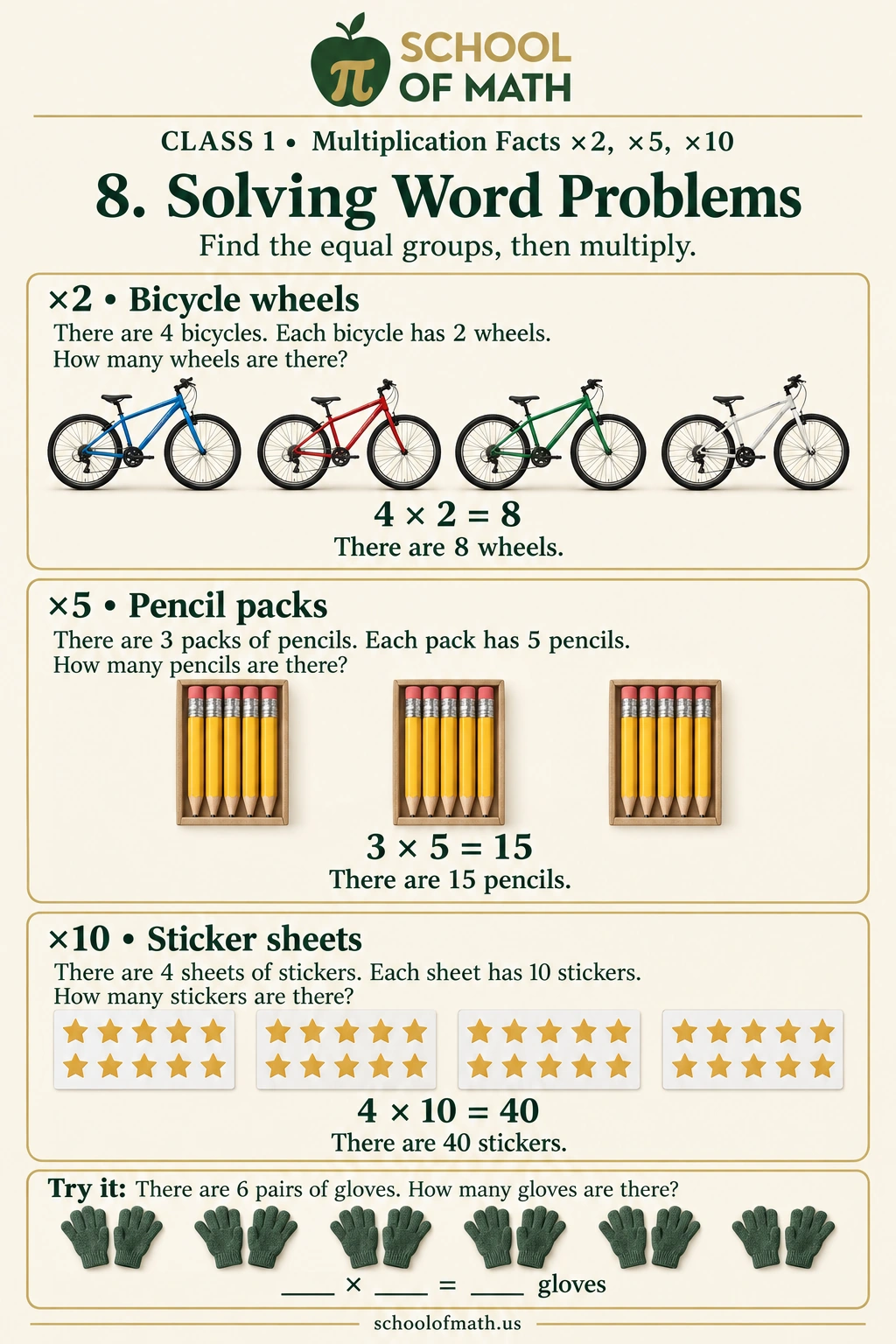
Read the story and identify the equal groups. Ask: how many groups are there, and how many objects are in each group? Write a multiplication sentence and include the unit, such as buttons, pencils, or dollars, in your answer.
If a story adds extra objects or gives some away, first find the total in the equal groups, then make the additional change. Choose the operation from what happens in the story, not from a single keyword.
Try it yourself: five questions
Q36 Practice 1 of 5
A shirt has 2 buttons. There are 8 identical shirts. How many buttons are there altogether?
Answer
16 buttons.
- There are 8 equal groups of 2 buttons.
- 8 × 2 = 16.
Q37 Practice 2 of 5
There are 9 boxes with 5 crayons in each box. How many crayons are there?
Answer
45 crayons.
- The number of boxes is 9; each box contains 5.
- 9 × 5 = 45.
Q38 Practice 3 of 5
A teacher has 7 envelopes, each holding 10 cards. How many cards does the teacher have?
Answer
70 cards.
- Each envelope is one group of 10.
- 7 × 10 = 70.
Q39 Practice 4 of 5
Five children each bring 2 markers. The teacher adds 3 more markers. How many markers are there now?
Answer
13 markers.
- First find the equal-group total: 5 × 2 = 10.
- Then add the teacher’s 3 markers: 10 + 3 = 13.
Q40 Practice 5 of 5
A class has 8 packs of 5 sheets of colored paper. It uses 10 sheets. How many sheets are left?
Answer
30 sheets.
- The class starts with 8 × 5 = 40 sheets.
- Subtract the 10 used: 40 − 10 = 30.
Homework review
Review equal groups, doubles, ×5 and ×10 facts, number-line jumps, number patterns, connected facts, and multiplication stories. Complete one review question for each image in order.
R1 Review image 1 of 8
Draw 5 equal groups of 2 triangles. Write a repeated-addition sentence and a multiplication sentence.
Answer
2 + 2 + 2 + 2 + 2 = 10; 5 × 2 = 10.
- Draw 5 groups with exactly 2 triangles in every group.
- Both sentences count the same 10 triangles.
R2 Review image 2 of 8
Find 13 × 2 using a double.
Answer
26.
- Double 13 means 13 + 13.
- 13 + 13 = 26.
R3 Review image 3 of 8
Find 12 × 5 by starting with 10 × 5 = 50 and adding two more groups.
Answer
60.
- Two extra groups of 5 add 10.
- 50 + 5 + 5 = 60.
R4 Review image 4 of 8
Find 7 × 10. How many tens are in the product?
Answer
70; 7 tens.
- Seven groups of 10 are seven tens.
- 7 × 10 = 70.
R5 Review image 5 of 8
Start at 0 and make 6 jumps of 5. Where do you land? Do you count 0 as a jump?
Answer
30. Do not count 0 as a jump.
- The landings are 5, 10, 15, 20, 25, 30.
- There are six jumps after the starting point.
R6 Review image 6 of 8
A student writes 8 × 5 = 42. Explain why the ones digit reveals a mistake, then correct the fact.
Answer
A whole-number ×5 product must end in 0 or 5. The correct answer is 40.
- 42 ends in 2, so it does not fit the pattern.
- 8 × 5 = 40.
R7 Review image 7 of 8
You know 13 × 5 = 65. Use doubling to find 13 × 10.
Answer
130.
- The same 13 groups double in size from 5 to 10.
- 65 + 65 = 130.
R8 Review image 8 of 8
A gardener plants 6 rows with 5 seedlings in each row. How many seedlings are planted?
Answer
30 seedlings.
- There are 6 equal groups of 5.
- 6 × 5 = 30.
Homework word problems
Start with one-step equal-group stories, then use your facts to add extras, find what remains, compare totals, and find missing groups. The questions gradually become more challenging. Include what your answer counts.
W1 Homework word problem 1 of 12
There are 3 pairs of socks. Each pair has 2 socks. How many socks are there?
Answer
6 socks.
- A pair is a group of 2.
- 3 × 2 = 6.
W2 Homework word problem 2 of 12
Four snack bags each contain 5 crackers. How many crackers are there?
Answer
20 crackers.
- There are 4 groups of 5.
- 4 × 5 = 20.
W3 Homework word problem 3 of 12
Six tubes each hold 10 beads. How many beads are there altogether?
Answer
60 beads.
- Each tube is one ten.
- 6 × 10 = 60.
W4 Homework word problem 4 of 12
Nine children each need 2 paper wings for a costume. How many paper wings are needed?
Answer
18 wings.
- Double 9 to count two wings per child.
- 9 + 9 = 18, so 9 × 2 = 18.
W5 Homework word problem 5 of 12
A club collects 5 cans each day for 8 days. How many cans does it collect?
Answer
40 cans.
- Each day is an equal group of 5 cans.
- 8 × 5 = 40.
W6 Homework word problem 6 of 12
There are 11 trays with 10 cups on each tray. How many cups are there?
Answer
110 cups.
- Ten trays would hold 100 cups.
- One more tray adds 10, so 11 × 10 = 110.
W7 Homework word problem 7 of 12
A florist makes 6 bunches with 5 flowers in each bunch. She adds 4 loose flowers to the order. How many flowers are in the order?
Answer
34 flowers.
- 6 × 5 = 30 flowers are in the bunches.
- Add the loose flowers: 30 + 4 = 34.
W8 Homework word problem 8 of 12
A teacher has 9 packs of 10 reward cards and gives away 20 cards. How many remain?
Answer
70 cards.
- 9 × 10 = 90 cards at the start.
- 90 − 20 = 70 cards remain.
W9 Homework word problem 9 of 12
Maya has 7 bags with 5 marbles in each. Leo has 4 bags with 10 marbles in each. Who has more marbles, and how many more?
Answer
Leo has 5 more marbles.
- Maya has 7 × 5 = 35. Leo has 4 × 10 = 40.
- Compare the totals: 40 − 35 = 5.
W10 Homework word problem 10 of 12
A game needs 45 counters. Each unopened bag contains 5 counters. Sam has 6 bags. How many additional bags does Sam need?
Answer
3 additional bags.
- 6 × 5 = 30, so Sam needs 45 − 30 = 15 more counters.
- Three groups of 5 make 15. Check: 9 bags × 5 = 45.
W11 Homework word problem 11 of 12
A prize table has 8 small packs with 2 stickers in each and 5 large packs with 10 stickers in each. How many stickers are there altogether?
Answer
66 stickers.
- The small packs hold 8 × 2 = 16; the large packs hold 5 × 10 = 50.
- Add the two totals: 16 + 50 = 66.
W12 Homework word problem 12 of 12
A class needs 80 craft sticks. It has 5 full boxes of 10 sticks and 4 full bundles of 5 sticks. How many more bundles of 5 does it need?
Answer
2 more bundles.
- The class has 5 × 10 + 4 × 5 = 50 + 20 = 70 sticks.
- It needs 80 − 70 = 10 more sticks. Two bundles of 5 give 10.
Quick questions and answers
How do children learn multiplication facts for 2, 5, and 10?
Start with equal groups and repeated addition. Use doubles for ×2, count in fives for ×5, and use groups of ten and place value for ×10. Then connect the strategies to word problems.
Why does multiplying by 2 give a double?
Multiplying a number by 2 gives the same total as adding that number to itself. Reversing the order of two factors preserves the product, so this also helps count groups of 2.
Why do multiples of 5 end in 0 or 5?
When counting from 0 in steps of 5, the ones digit alternates between 5 and 0. This applies to whole-number multiples and provides a useful check, but the exact product still needs to be calculated.
How are the ×5 and ×10 facts connected?
For the same number of groups, 10 items per group is twice as many as 5. Double the ×5 product to get the matching ×10 product, or halve the ×10 product to find the matching ×5 product.
Do you count zero as a jump on a number line?
No. Zero is the starting position. Count each move to a new landing point as one jump. If the start is not zero, add the distance traveled to the starting position.
What is included in Kid Einsteins Class 1?
Eight teaching images, five original practice questions per image, eight homework review questions, and twelve homework word problems. All 60 questions have hidden worked answers online. The 22-page printable workbook has a PDF-only cover, numbered pages, and blank answer space.