Little Newtons · Class 12 · Skip Counting · Grades 1–3
Skip Counting by 2s, 5s, and 10s (Little Newtons Class 12, Grades 1–3) — 8 Posters, Theory, 40 Practice Questions + 10 Word Problems with Hidden Answers
Skip counting by 2s, 5s, and 10s is the bridge between counting (grade 1) and multiplication (grade 3). A child who can skip count fluently already knows the easiest multiplication facts before they ever see the × sign. This Little Newtons Class 12 pack has 8 illustrated SOMATH posters, theory under each poster, 5 practice questions per poster (40 total) with click-to-reveal step-by-step answers, plus 10 word problems of increasing difficulty at the end.
This class is part of the Little Newtons arc at SOMATH — School of Math on the Upper West Side of Manhattan. Class 12 sits at the exact seam between the grade 1–2 counting classes and the grade 3 multiplication classes. It is taught in-person at 226 W 79th St, one block from the 1 train at 79th Street and steps from PS 87, PS 199, PS 452, and PS 9. Call (646) 668-6151 or book a free 30-minute evaluation to place your grade 1, 2, or 3 child in the right Little Newtons class.
What’s in this class pack
- Poster 1 — What is skip counting? (5 questions)
- Poster 2 — Skip counting by 2s (5 questions)
- Poster 3 — Skip counting by 5s (5 questions)
- Poster 4 — Skip counting by 10s (5 questions)
- Poster 5 — Skip counting on a number line (5 questions)
- Poster 6 — Finding missing numbers in patterns (5 questions)
- Poster 7 — Skip counting backward (5 questions)
- Poster 8 — Word problems with skip counting (5 questions)
- Bonus — 10 word problems, increasing difficulty
- Frequently asked questions
1. What is skip counting?
Theory — skip counting in one sentence
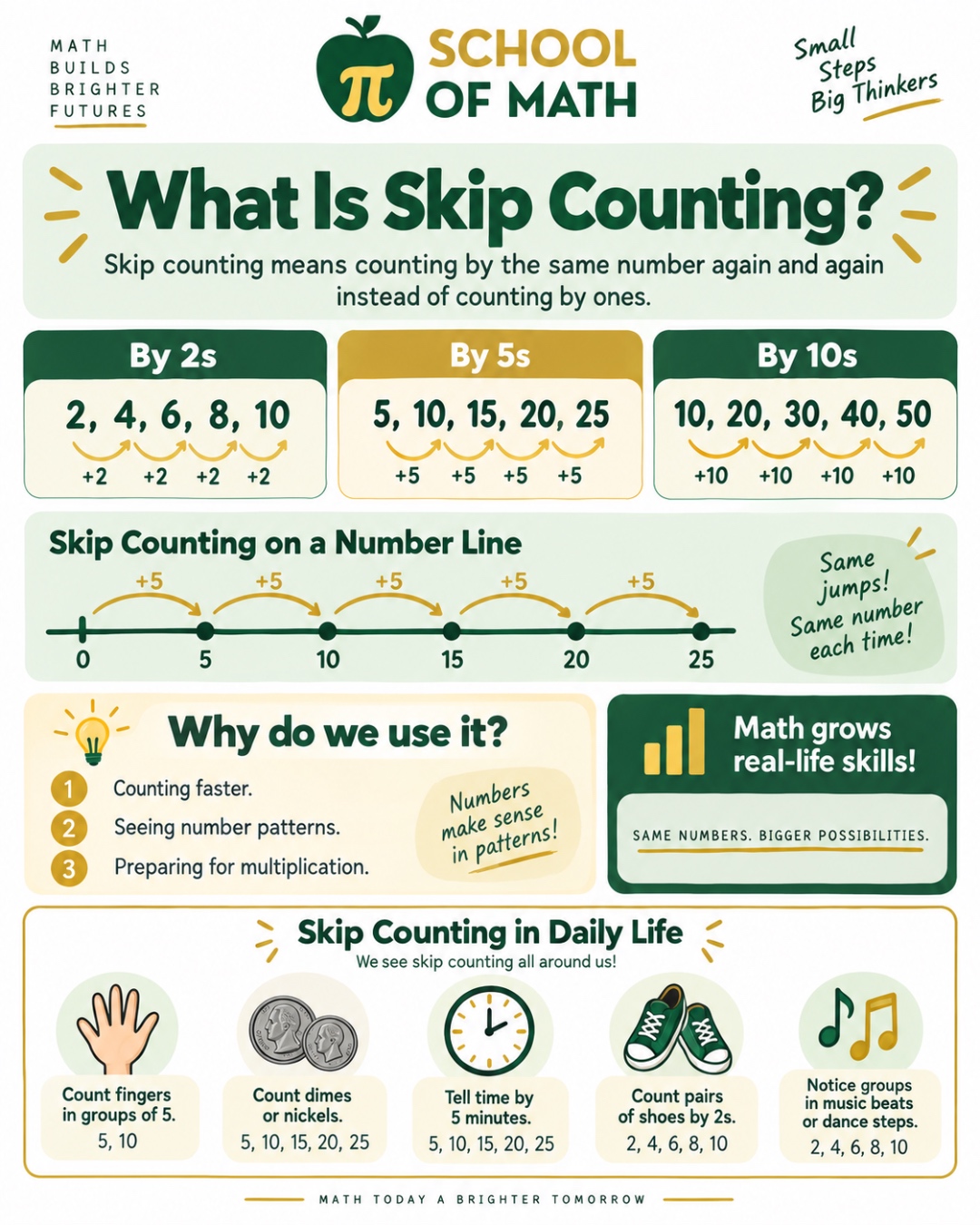
Skip counting means counting by the same number again and again instead of counting by ones. Instead of 1, 2, 3, 4, 5 we can jump: 2, 4, 6, 8, 10 (by 2s), 5, 10, 15, 20, 25 (by 5s), or 10, 20, 30, 40, 50 (by 10s). Each jump is the same size — that is the whole rule.
Why we use it: (1) it counts faster than counting by ones, (2) it makes number patterns visible, and (3) it prepares kids for multiplication. Skip counting by 5 four times is exactly 4 × 5 = 20, but a grade 1 child can see it long before they meet the × sign.
In daily life, Manhattan edition: counting shoes by 2s at the door, counting nickels by 5s at the corner store, counting dimes by 10s in a piggy bank, counting minutes on an analog clock by 5s, counting floors by 10s in an elevator.
Question 1.1 Easy
Say the missing number: 2, 4, 6, ___, 10.
Answer: 8.
Skip counting by 2s, each jump is +2. After 6 comes 6 + 2 = 8, then 10. So the pattern is 2, 4, 6, 8, 10.
Question 1.2 Easy
Say the missing number: 5, 10, ___, 20, 25.
Answer: 15.
Skip counting by 5s, each jump is +5. After 10 comes 10 + 5 = 15. Check: 15 + 5 = 20. ✓
Question 1.3 Easy
Say the missing number: 10, 20, 30, ___, 50.
Answer: 40.
Skip counting by 10s, each jump is +10. After 30 comes 30 + 10 = 40, then 50. Notice: the ones digit is ALWAYS 0 when we skip count by 10.
Question 1.4 Easy
Which is FASTER: counting to 20 by ones, or counting to 20 by twos? Why?
Answer: Counting by twos is faster.
By ones we say 20 numbers: 1, 2, 3, …, 20. By twos we say only 10 numbers: 2, 4, 6, 8, 10, 12, 14, 16, 18, 20. Skip counting reaches the same total using fewer number words — that is the whole point of it.
Question 1.5 Medium
Sam counts by 5s to 25. How many numbers did Sam say?
Answer: 5 numbers.
Skip counting by 5s to 25 gives: 5, 10, 15, 20, 25. That is five number words. This is also why 5 × 5 = 25 — five jumps of 5 land on 25.
2. Skip counting by 2s
Theory — the even-number pattern
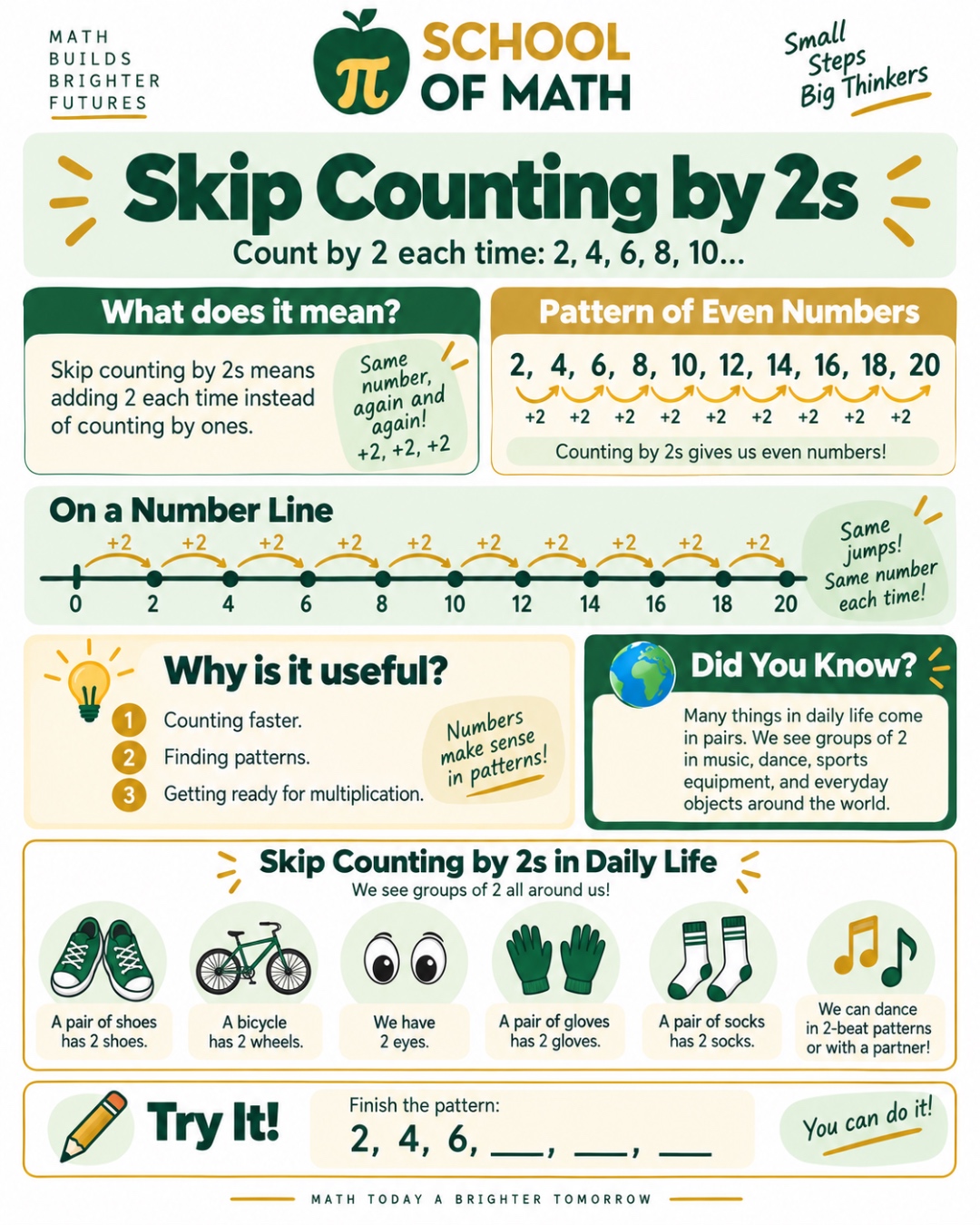
Skip counting by 2s starting at 2 gives the even numbers:
2, 4, 6, 8, 10, 12, 14, 16, 18, 20
How to spot an even number: the ones digit is 0, 2, 4, 6, or 8. Any bigger even number still follows this rule — 34 is even (ends in 4), 78 is even (ends in 8), 100 is even (ends in 0).
Why 2s show up everywhere: things come in pairs. A pair of shoes has 2 shoes, a bicycle has 2 wheels, we have 2 eyes, a pair of gloves has 2 gloves, a pair of socks has 2 socks. Counting things that come in pairs is a real reason to skip by 2 instead of by 1.
The +2 rule on a number line
Every jump is the same size (2). We say the number we land on. That is the whole game.
Question 2.1 Easy
Finish the pattern: 2, 4, 6, ___, ___, ___.
Answer: 8, 10, 12.
Add 2 each time: 6 + 2 = 8, 8 + 2 = 10, 10 + 2 = 12.
Question 2.2 Easy
Skip count by 2s from 8 to 18. Write every number you say.
Answer: 8, 10, 12, 14, 16, 18.
Start at 8. Add 2 each time until we reach 18. That is 6 numbers total.
Question 2.3 Easy
Circle the even numbers: 3, 6, 7, 10, 15, 18, 21, 24.
Answer: 6, 10, 18, 24.
Even numbers end in 0, 2, 4, 6, or 8. Check the ones digit: 3 (odd), 6 (even), 7 (odd), 10 (even), 15 (odd), 18 (even), 21 (odd), 24 (even).
Question 2.4 Medium
A pair of shoes has 2 shoes. How many shoes are in 4 pairs?
Answer: 8 shoes.
Skip count by 2s four times: 2, 4, 6, 8. So 4 pairs is 8 shoes. This is exactly 4 × 2 = 8 in disguise.
Question 2.5 Medium
Skip count by 2s from 30 to 40. How many jumps did you take?
Answer: 5 jumps.
Numbers landed on: 32, 34, 36, 38, 40. Count the arrows FROM 30: 30→32 (1), 32→34 (2), 34→36 (3), 36→38 (4), 38→40 (5). That is 5 jumps of 2. Check: 5 × 2 = 10 and 30 + 10 = 40. ✓
3. Skip counting by 5s
Theory — the “ends in 5 or 0” pattern
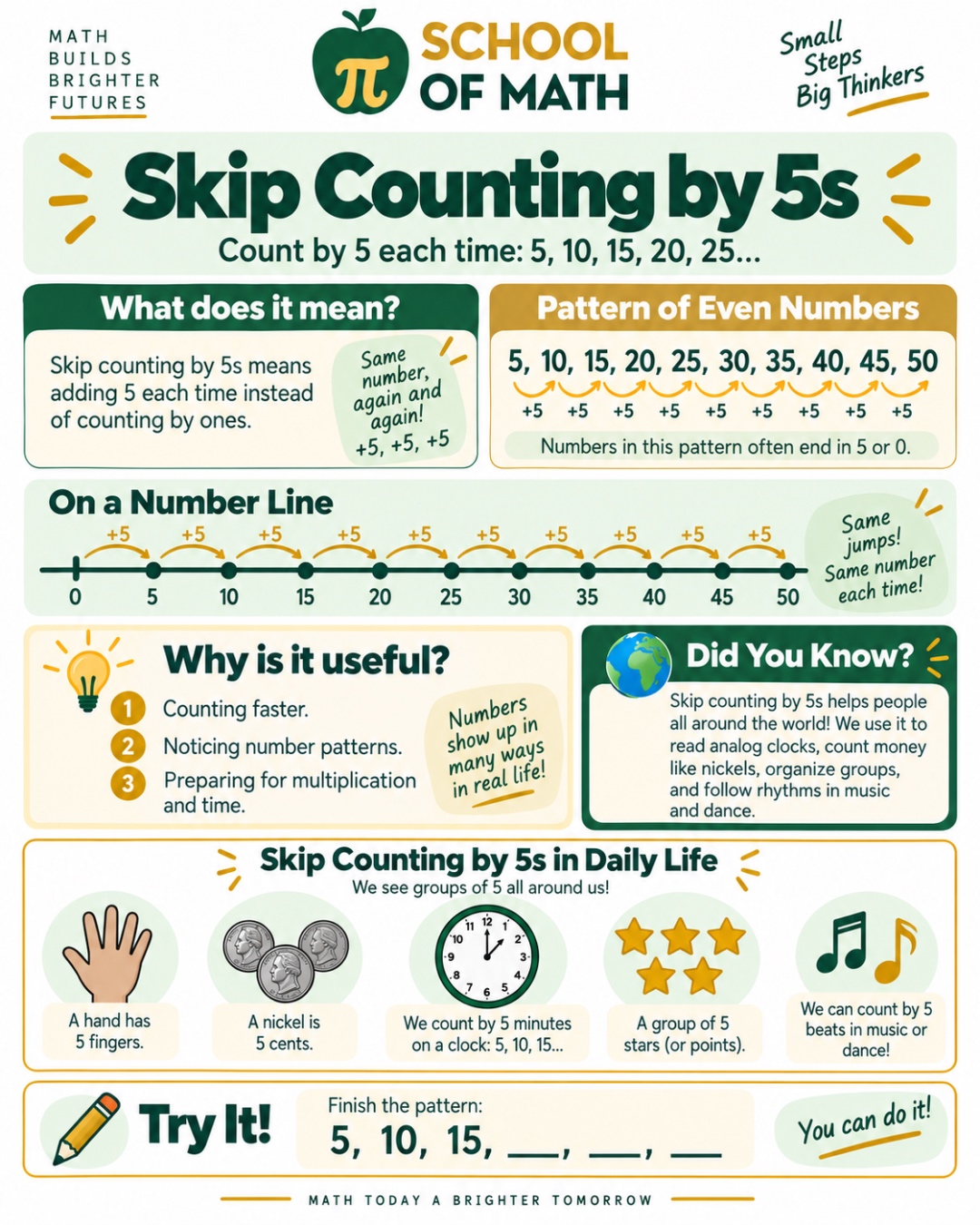
Skip counting by 5s starting at 5:
5, 10, 15, 20, 25, 30, 35, 40, 45, 50
The pattern to see: every number ends in either 5 or 0. This is the easiest pattern in grade 1–2 math to hear and see at the same time. If a child ever says a “skip counting by 5” number that ends in 3 or 7, they know instantly it’s wrong.
Why 5s matter for real life: a hand has 5 fingers, a nickel is 5 cents, an analog clock jumps by 5 minutes between the big numbers (12→1 is 5 minutes, 1→2 is 10 minutes, and so on). Counting minutes past the hour on a clock is skip counting by 5s.
Question 3.1 Easy
Finish the pattern: 5, 10, 15, ___, ___, ___.
Answer: 20, 25, 30.
Add 5 each time: 15 + 5 = 20, 20 + 5 = 25, 25 + 5 = 30.
Question 3.2 Easy
Which of these is NOT a “count by 5” number? 15, 20, 27, 35, 40.
Answer: 27.
Skip-by-5 numbers always end in 5 or 0. 27 ends in 7 — it is NOT in the pattern. 15 (ends in 5) ✓, 20 (ends in 0) ✓, 35 (ends in 5) ✓, 40 (ends in 0) ✓.
Question 3.3 Medium
Ana has 3 nickels. How many cents does she have?
Answer: 15 cents.
A nickel is 5 cents. Skip count by 5s three times: 5, 10, 15. So 3 nickels = 15 cents. This is 3 × 5 = 15.
Question 3.4 Medium
On an analog clock, the minute hand is pointing at the 6. How many minutes past the hour is that?
Answer: 30 minutes past the hour.
Between the big numbers on an analog clock, the minute hand moves 5 minutes. Skip count by 5 from the 12: 12→1 is 5, 1→2 is 10, 2→3 is 15, 3→4 is 20, 4→5 is 25, 5→6 is 30. So pointing at 6 means 30 minutes past. That is half past the hour.
Question 3.5 Hard
Skip count by 5s from 25 to 60. How many numbers did you say (not counting 25)?
Answer: 7 numbers.
Skip by 5s from 25: 30, 35, 40, 45, 50, 55, 60. Count them: 30 (1), 35 (2), 40 (3), 45 (4), 50 (5), 55 (6), 60 (7). Check with jumps: 60 - 25 = 35 and 35 ÷ 5 = 7. ✓
4. Skip counting by 10s
Theory — the doorway to place value
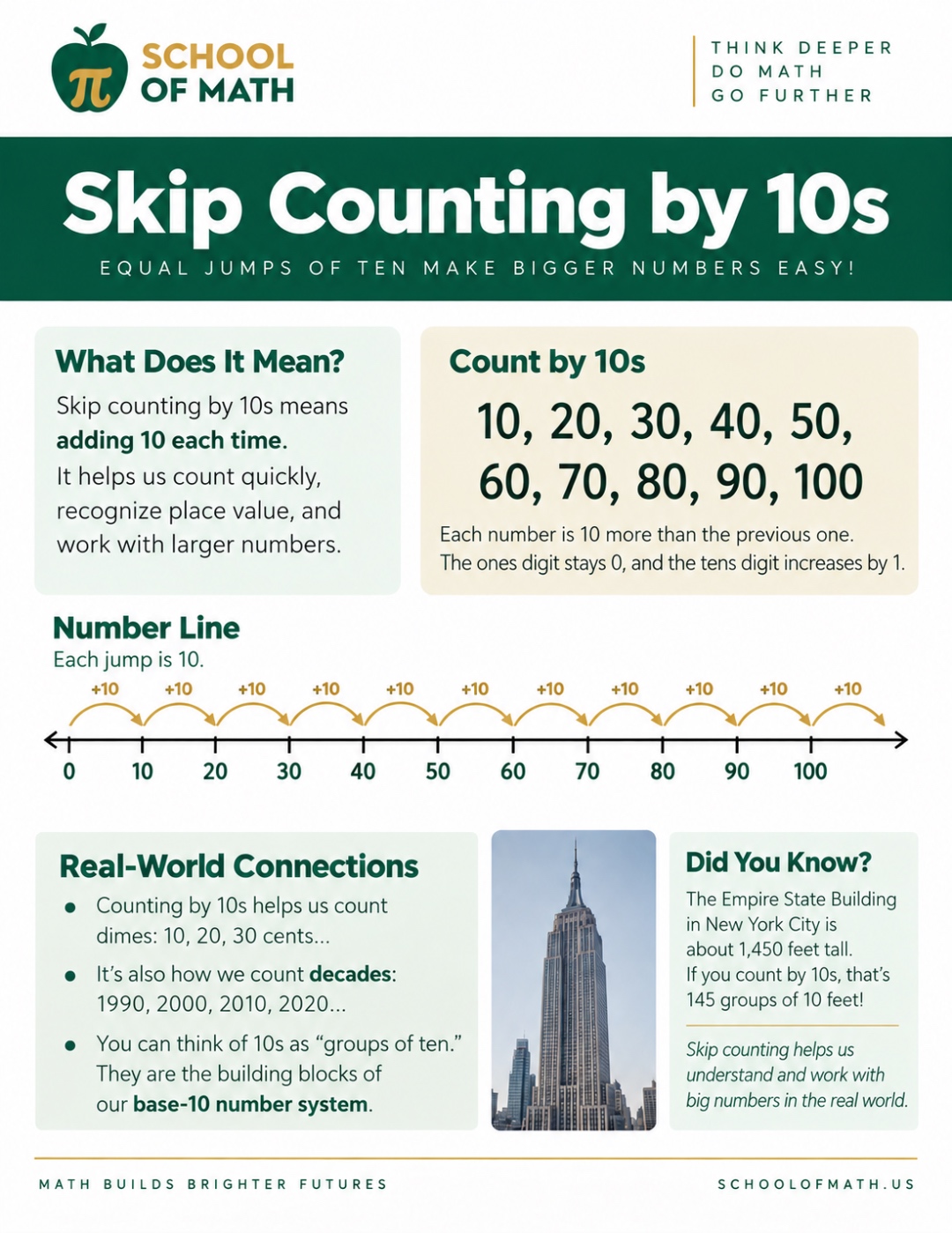
Skip counting by 10s starting at 10:
10, 20, 30, 40, 50, 60, 70, 80, 90, 100
The pattern to see: the ones digit is always 0. The tens digit goes up by 1 each time. That is the entire base-10 number system in one row.
Grade 2 place-value connection: 10 is 1 ten, 20 is 2 tens, 30 is 3 tens, …, 100 is 10 tens. Every skip-count-by-10 number is just “how many bundles of ten.”
Real life: dimes are 10 cents each — count dimes and you are skip counting by 10s. Decades (2010, 2020, 2030) are years counted by 10s. The Empire State Building is about 1,450 feet tall — that is 145 groups of 10 feet.
Question 4.1 Easy
Finish the pattern: 10, 20, 30, ___, ___, ___.
Answer: 40, 50, 60.
Add 10 each time. The tens digit goes 3, 4, 5, 6.
Question 4.2 Easy
What number is 10 more than 70?
Answer: 80.
One jump of 10 to the right of 70 lands on 80. On the number line: 70 + 10 = 80.
Question 4.3 Medium
Leo has 6 dimes in his pocket. How many cents does he have?
Answer: 60 cents.
A dime is 10 cents. Skip count by 10s six times: 10, 20, 30, 40, 50, 60. So 6 dimes = 60 cents. This is 6 × 10 = 60.
Question 4.4 Medium
Skip count by 10s from 40 to 100. Write every number you say.
Answer: 40, 50, 60, 70, 80, 90, 100.
Start at 40 and add 10 each time until we reach 100. That is 7 numbers (including 40 and 100).
Question 4.5 Hard
Sofia is on floor 20 of a Manhattan apartment building. She takes the elevator up 5 floors at a time, four times. What floor is she on now?
Answer: Floor 40.
Each trip is 5 floors, and she takes 4 trips: skip count by 5s four times: 5, 10, 15, 20 — that is 20 floors up. Add to the starting floor: 20 + 20 = 40. She is on floor 40. (Bonus: skip counting by 10s from 20 gives 30, 40 — two ten-floor trips would also work.)
5. Skip counting on a number line
Theory — equal jumps
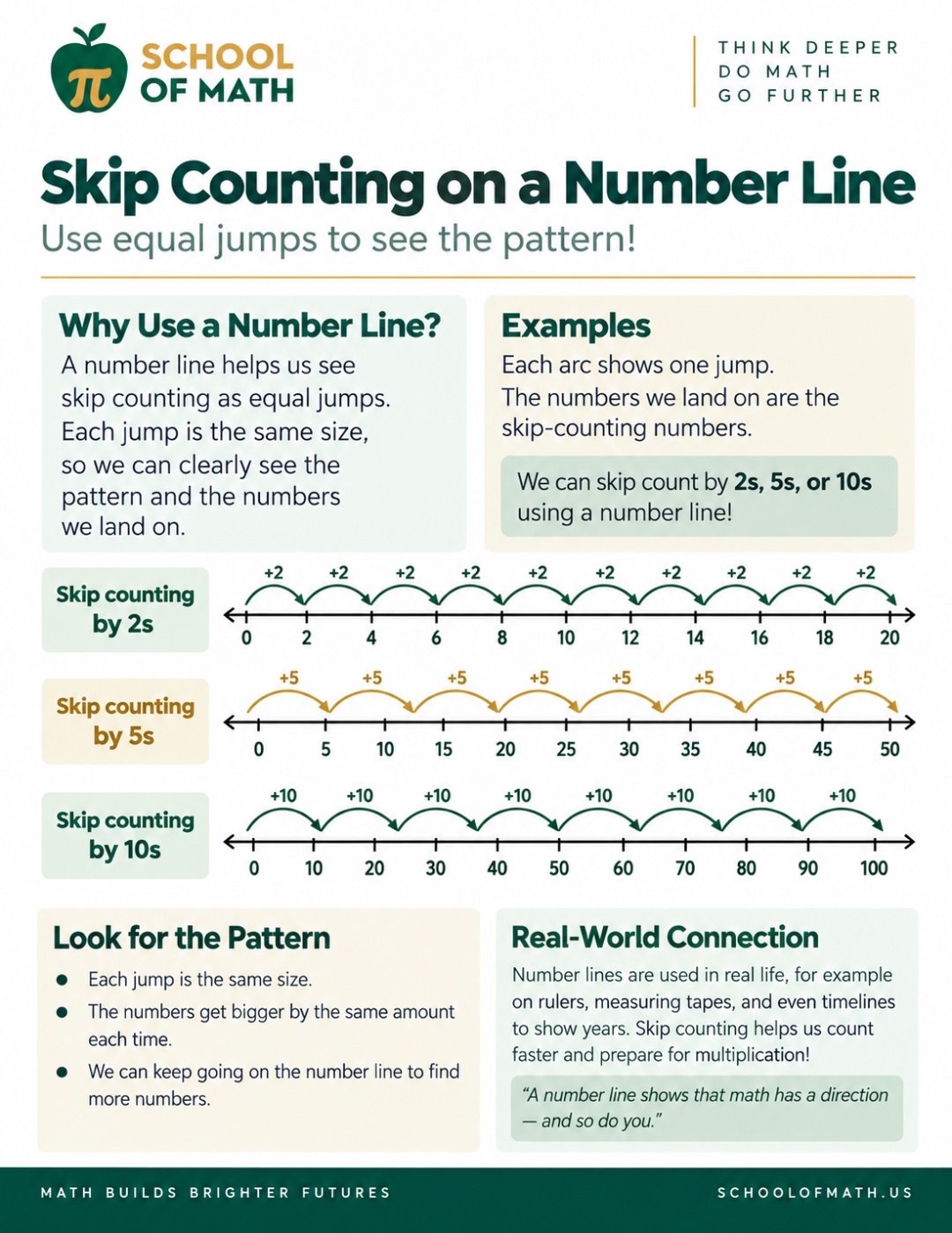
A number line is a picture of the numbers in order. On a number line, skip counting shows up as equal-size arcs: every arc is the same length as every other arc for that pattern.
- Skip counting by 2s: each arc jumps 2 units. From 0: 2, 4, 6, 8, 10…
- Skip counting by 5s: each arc jumps 5 units. From 0: 5, 10, 15, 20, 25…
- Skip counting by 10s: each arc jumps 10 units. From 0: 10, 20, 30, 40, 50…
Why the number line matters: it is the same picture we will use in Class 13 for addition, Class 14 for subtraction, and in grade 3 for multiplication. A child who can “hop” on a number line owns every operation for the next three years.
Real-life number lines: a ruler (inches or centimeters), a measuring tape, a timeline of years, the platform number at Penn Station.
Question 5.1 Easy
On a number line, you start at 0 and make 3 jumps of 5. Where do you land?
Answer: 15.
Skip count by 5s three times: 5, 10, 15. So you land on 15. This is 3 × 5 = 15.
Question 5.2 Easy
On a number line, you start at 0 and make 4 jumps of 2. Where do you land?
Answer: 8.
Skip count by 2s four times: 2, 4, 6, 8. You land on 8. This is 4 × 2 = 8.
Question 5.3 Medium
You start at 10 on a number line and make 5 jumps of 10. Where do you land?
Answer: 60.
Skip count by 10s from 10, five jumps: 20, 30, 40, 50, 60. Check: 5 × 10 = 50 and 10 + 50 = 60. ✓
Question 5.4 Medium
On a number line from 0 to 50, how many jumps of 5 does it take to get from 0 to 50?
Answer: 10 jumps.
Skip count by 5s: 5, 10, 15, 20, 25, 30, 35, 40, 45, 50. Count the numbers: that is 10. Check: 10 × 5 = 50. ✓
Question 5.5 Hard
On a number line, you start at 6 and make 4 equal jumps to land on 14. How big is each jump?
Answer: 2 (skip counting by 2s).
The total distance is 14 - 6 = 8. That 8 is split into 4 equal jumps: 8 ÷ 4 = 2. Check by skip counting from 6 by 2s: 8, 10, 12, 14 — four jumps, we land on 14. ✓
6. Finding missing numbers in patterns
Theory — find the rule, then fill the blanks
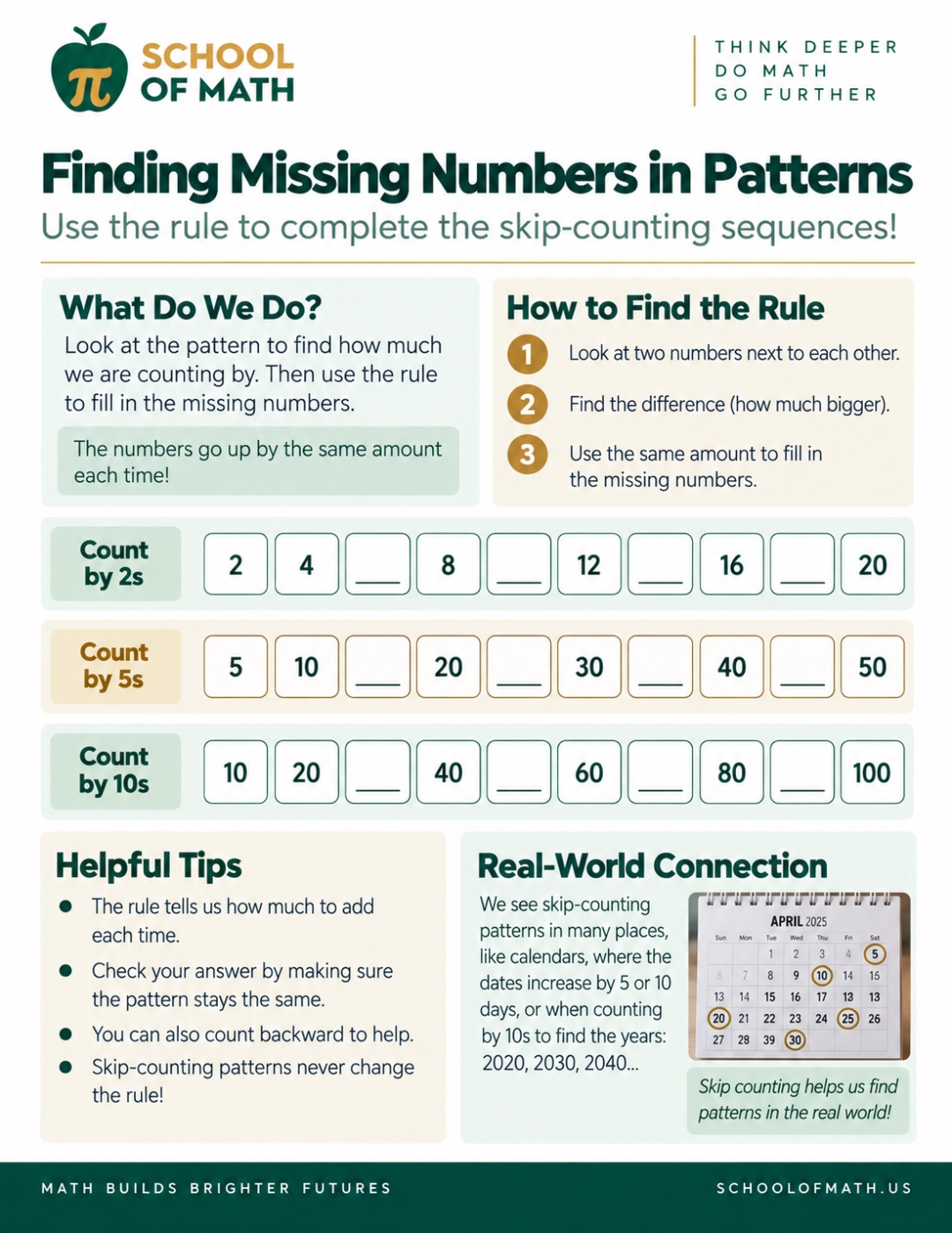
When a number pattern is missing some numbers, we do three steps:
- Look at two numbers next to each other in the pattern.
- Find the difference — how much bigger is the second one?
- Use that same difference to fill in the missing numbers.
The rule stays the same for the whole pattern — if the pattern goes up by 5 between two numbers, it goes up by 5 between EVERY two numbers.
Where kids get stuck: they see the blank and freeze. The fix is to always look at the two closest given numbers first — that pair tells you the rule.
Question 6.1 Easy
Find the missing number: 2, 4, ___, 8, 10.
Answer: 6.
Rule: 4 - 2 = 2, so the pattern goes up by 2. After 4 comes 4 + 2 = 6. Check: 6 + 2 = 8 ✓.
Question 6.2 Easy
Find the missing number: 5, ___, 15, 20, 25.
Answer: 10.
Rule: 20 - 15 = 5, so the pattern goes up by 5. Between 5 and 15 comes 5 + 5 = 10.
Question 6.3 Medium
Find the missing number: 10, 20, ___, 40, 50.
Answer: 30.
Rule: 20 - 10 = 10, so the pattern goes up by 10. After 20 comes 20 + 10 = 30. Check: 30 + 10 = 40 ✓.
Question 6.4 Medium
Find the TWO missing numbers: 2, ___, ___, 8, 10, 12.
Answer: 4 and 6.
Rule: use the given pair 10 and 12: 12 - 10 = 2, so the pattern goes up by 2. Fill in: 2 + 2 = 4, then 4 + 2 = 6. Check: 6 + 2 = 8 ✓.
Question 6.5 Hard
Find the missing numbers: 15, 20, 25, ___, ___, 40, 45.
Answer: 30 and 35.
Rule: 20 - 15 = 5, so the pattern goes up by 5. Fill in: 25 + 5 = 30, then 30 + 5 = 35. Check: 35 + 5 = 40 ✓.
7. Skip counting backward
Theory — skip counting backward is subtraction
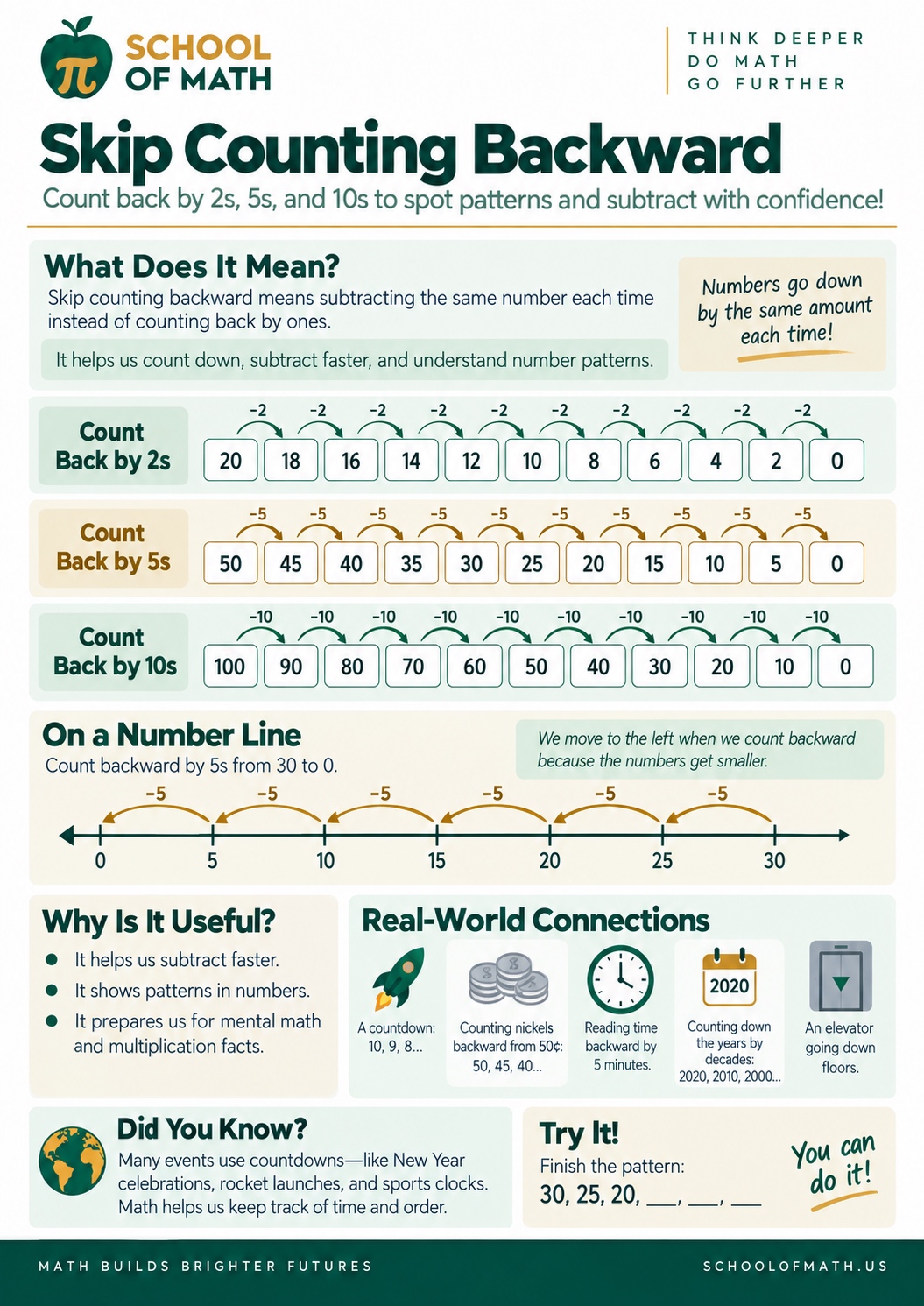
Skip counting backward means subtracting the same number each time instead of counting back by ones. On the number line, we move LEFT instead of RIGHT.
- Back by 2s from 20: 20, 18, 16, 14, 12, 10, 8, 6, 4, 2, 0.
- Back by 5s from 50: 50, 45, 40, 35, 30, 25, 20, 15, 10, 5, 0.
- Back by 10s from 100: 100, 90, 80, 70, 60, 50, 40, 30, 20, 10, 0.
Why it matters: backward skip counting is the picture for subtraction in equal groups. If you have 30 cents in nickels and spend one nickel at a time, you count 30, 25, 20, 15, 10, 5, 0 — that is 30 ÷ 5 = 6 nickels. This is where division starts, quietly, in grade 2.
Real life: a rocket launch countdown (10, 9, 8…), counting minutes left on a timer (30, 25, 20, 15, 10, 5), counting down years toward a new decade (2029, 2028, 2027…), or riding a Manhattan elevator down 10 floors at a time.
Question 7.1 Easy
Count back by 2s from 10 to 0. What comes right after 6?
Answer: 4.
Backward by 2s: 10, 8, 6, 4, 2, 0. After 6 comes 4. On the number line, 4 is one 2-jump to the LEFT of 6.
Question 7.2 Easy
Count back by 5s from 25 to 0. Write every number.
Answer: 25, 20, 15, 10, 5, 0.
Subtract 5 each time: 25 - 5 = 20, 20 - 5 = 15, 15 - 5 = 10, 10 - 5 = 5, 5 - 5 = 0.
Question 7.3 Medium
Count back by 10s from 100 to 40. Write every number.
Answer: 100, 90, 80, 70, 60, 50, 40.
Subtract 10 each time. That is 7 numbers total. The tens digit goes 10, 9, 8, 7, 6, 5, 4.
Question 7.4 Medium
Ana has 30 cents in nickels. She spends one nickel. How many cents does she have left, and how many nickels?
Answer: 25 cents left, in 5 nickels.
One nickel is 5 cents. Skip count back by 5: 30 - 5 = 25 cents. To count the nickels, skip count 30 by 5s to get the starting number: 5, 10, 15, 20, 25, 30 — that’s 6 nickels. After spending 1, she has 6 - 1 = 5 nickels.
Question 7.5 Hard
A rocket launches when the countdown reaches 0. It starts at 30 and counts down by 5 seconds. Write the countdown, and say how many “5-second steps” it takes to launch.
Answer: 30, 25, 20, 15, 10, 5, 0. It takes 6 steps.
Skip back by 5 from 30 until we reach 0. Numbers said: 30 (start), 25, 20, 15, 10, 5, 0. Steps (arrows) between them: 6. Check: 30 ÷ 5 = 6. ✓
8. Word problems with skip counting
Theory — look for equal groups
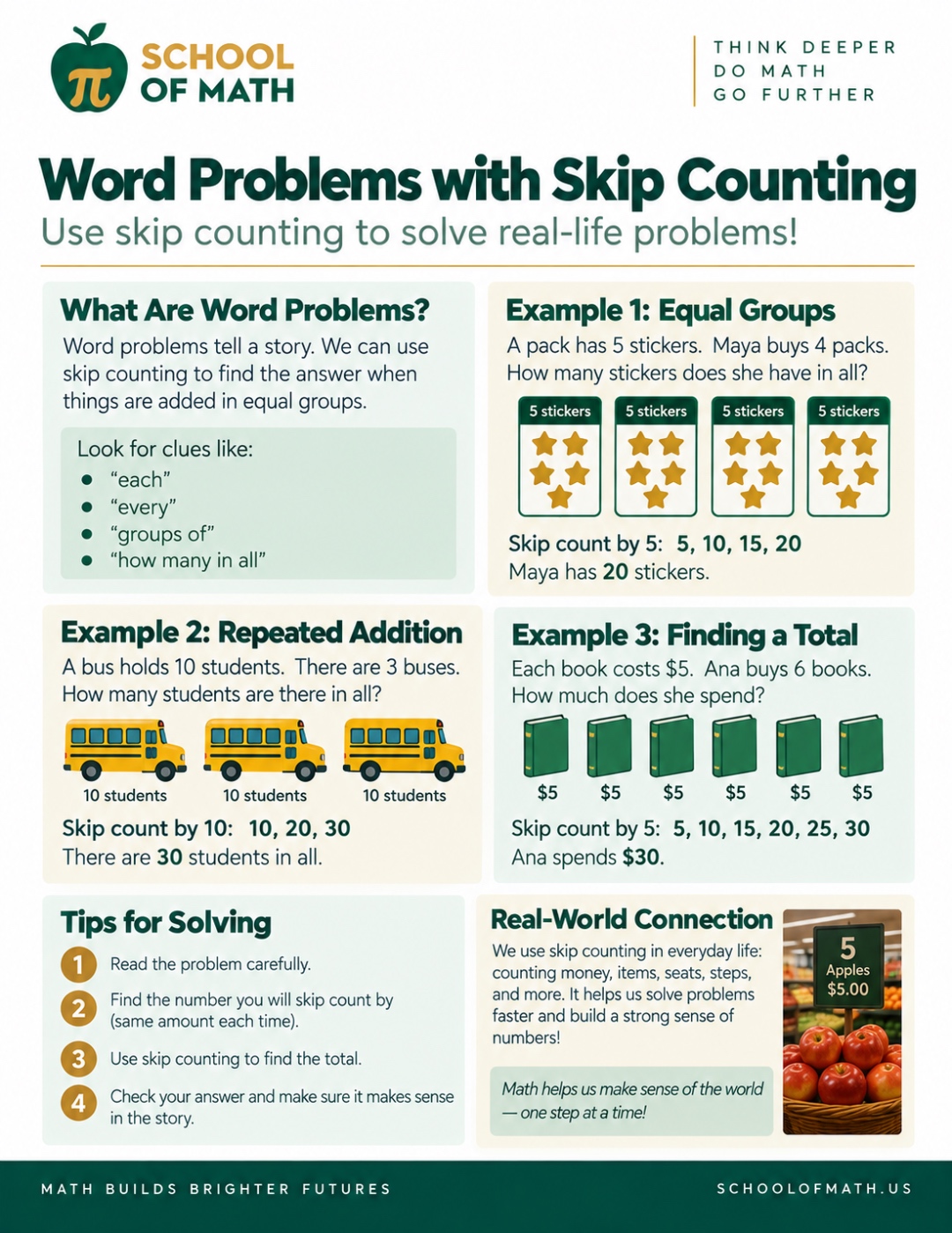
Word problems are stories. Skip counting solves the ones where things come in equal groups. Look for signal words: each, every, groups of, per, how many in all.
Four steps every time:
- Read the problem carefully — underline the numbers.
- Find the number to skip count by (the size of each group).
- Skip count that many times to find the total.
- Check — does the answer make sense in the story?
Three model problems from the poster: (1) 4 packs × 5 stickers each = skip count by 5s four times = 20 stickers. (2) 3 buses × 10 students each = skip count by 10s three times = 30 students. (3) 6 books × $5 each = skip count by 5s six times = $30. Same skill, three different stories.
Question 8.1 Easy
A pack has 5 stickers. Maya buys 4 packs. How many stickers does she have in all?
Answer: 20 stickers.
Equal groups: 4 packs of 5 each. Skip count by 5s four times: 5, 10, 15, 20. Maya has 20 stickers. This is 4 × 5 = 20.
Question 8.2 Easy
A bus holds 10 students. There are 3 buses. How many students are there in all?
Answer: 30 students.
Equal groups: 3 buses of 10 each. Skip count by 10s three times: 10, 20, 30. This is 3 × 10 = 30.
Question 8.3 Medium
Each book costs $5. Ana buys 6 books. How much does she spend?
Answer: $30.
Skip count by 5s six times: 5, 10, 15, 20, 25, 30. Ana spends $30. This is 6 × 5 = 30.
Question 8.4 Medium
Leo counts 4 pairs of shoes at the door. Then his sister leaves 2 more pairs. How many shoes are at the door now?
Answer: 12 shoes.
Total pairs = 4 + 2 = 6. Each pair is 2 shoes. Skip count by 2s six times: 2, 4, 6, 8, 10, 12. So 12 shoes. This is 6 × 2 = 12.
Question 8.5 Hard
Sofia has 7 dimes and 3 nickels. How many cents does she have in all?
Answer: 85 cents.
Dimes: skip count by 10s seven times: 10, 20, 30, 40, 50, 60, 70. That is 70 cents. Nickels: skip count by 5s three times: 5, 10, 15. That is 15 cents. Add: 70 + 15 = 85. Sofia has 85 cents.
9. Bonus — 10 word problems (increasing difficulty)
W1–W3 easy for grade 1. W4–W7 medium for grade 2. W8–W10 hard/challenge for grade 3. Click each to reveal the step-by-step solution.
W1 Easy · Grade 1
Ben has 5 pairs of socks in his drawer. How many socks does he have in all?
Answer: 10 socks.
Each pair is 2 socks. Skip count by 2s five times: 2, 4, 6, 8, 10. Ben has 10 socks. This is 5 × 2 = 10.
W2 Easy · Grade 1
Lia has 4 nickels in her piggy bank. How many cents does she have?
Answer: 20 cents.
A nickel is 5 cents. Skip count by 5s four times: 5, 10, 15, 20. Lia has 20 cents. This is 4 × 5 = 20.
W3 Easy · Grade 1
Mrs. Kim’s class has 5 tables. Each table seats 10 students. How many students are in the class in all?
Answer: 50 students.
Skip count by 10s five times: 10, 20, 30, 40, 50. There are 50 students. This is 5 × 10 = 50.
W4 Medium · Grade 2
The minute hand on an analog clock points at the 8. How many minutes past the hour is it?
Answer: 40 minutes past the hour.
Between the numbers on an analog clock, the minute hand moves 5 minutes. Skip count by 5 from the 12 to the 8: 5, 10, 15, 20, 25, 30, 35, 40. That is 8 skips of 5 = 40 minutes. This is 8 × 5 = 40.
W5 Medium · Grade 2
Marco walks up the stairs at the 79th Street subway station, 2 steps at a time. He takes 9 double-steps to reach the top. How many stair steps did he climb?
Answer: 18 steps.
Skip count by 2s nine times: 2, 4, 6, 8, 10, 12, 14, 16, 18. Marco climbed 18 stair steps. This is 9 × 2 = 18.
W6 Medium · Grade 2
Emma has 8 dimes. Her brother Tom has 3 nickels. Who has more money, and by how many cents?
Answer: Emma has more, by 65 cents.
Emma: skip count by 10s eight times: 10, 20, 30, 40, 50, 60, 70, 80. That’s 80 cents. Tom: skip count by 5s three times: 5, 10, 15. That’s 15 cents. Emma has more: 80 - 15 = 65 cents more.
W7 Medium · Grade 2
A pack of granola bars has 10 bars. Ms. Perez needs 40 bars for a class snack. How many packs must she buy?
Answer: 4 packs.
Skip count by 10s and count how many jumps it takes to reach 40: 10 (1 pack), 20 (2 packs), 30 (3 packs), 40 (4 packs). She needs 4 packs. This is 40 ÷ 10 = 4 — division is skip counting to a target.
W8 Hard · Grade 3
A concert ticket costs $5. Sofia’s family buys 7 tickets. How much do they spend in all? Show your skip-counting.
Answer: $35.
Skip count by 5s seven times: 5, 10, 15, 20, 25, 30, 35. They spend $35. This is exactly 7 × 5 = 35 — the 5 times table is skip counting by 5s.
W9 Hard · Grade 3
Mr. Lee bakes 45 cookies. He puts them in bags of 5 cookies each. How many bags does he fill?
Answer: 9 bags.
Skip count by 5s and count how many jumps it takes to reach 45: 5 (1 bag), 10 (2), 15 (3), 20 (4), 25 (5), 30 (6), 35 (7), 40 (8), 45 (9). He fills 9 bags. This is 45 ÷ 5 = 9 — division is skip counting to a target.
W10 Challenge · Grade 3
Ana has 3 dimes, 4 nickels, and 8 pairs of shoes to count. She wants to know: (a) how much money she has in cents, and (b) how many shoes are at the door. Show your skip-counting for both.
Answer: (a) 50 cents. (b) 16 shoes.
(a) Money. Dimes by 10s three times: 10, 20, 30 — that’s 30 cents. Nickels by 5s four times: 5, 10, 15, 20 — that’s 20 cents. Add: 30 + 20 = 50 cents. (b) Shoes. Each pair is 2 shoes. Skip count by 2s eight times: 2, 4, 6, 8, 10, 12, 14, 16 — 16 shoes. This problem uses ALL three skip-counting patterns from Class 12 (2s, 5s, 10s) in one story — that is the whole point of the class.
10. Frequently asked questions
What is skip counting and why does my grade 1, 2, or 3 child need it?
Skip counting means counting by the same number again and again instead of counting by ones — 2, 4, 6, 8… or 5, 10, 15, 20… or 10, 20, 30, 40. It is the bridge between counting (grade 1) and multiplication (grade 3). A child who can skip count by 2s, 5s, and 10s already knows the easiest multiplication facts before ever seeing the × sign. Skip counting also builds a feel for even numbers, place value, telling time on an analog clock, and counting money.
When should Manhattan kids learn skip counting by 2s, 5s, and 10s?
Most Upper West Side and Manhattan families see skip counting introduced in kindergarten (10s), extended in grade 1 (2s and 5s), and made fluent in grade 2. By end of grade 2, a child should skip count by 2s to at least 40, by 5s to at least 100, and by 10s to at least 200, forward and backward. Grade 3 uses that fluency to unlock the times tables.
What is the pattern of skip counting by 2s?
Starting at 2: 2, 4, 6, 8, 10, 12, 14, 16, 18, 20 — the even numbers. Every number ends in 0, 2, 4, 6, or 8. Starting at 1 gives the odd numbers instead: 1, 3, 5, 7, 9, 11…. Both are useful, but grade 1 sees the even pattern first because things in real life (shoes, wheels, eyes) come in pairs.
What is the pattern of skip counting by 5s?
Starting at 5: 5, 10, 15, 20, 25, 30, 35, 40, 45, 50. Every number ends in 5 or 0 — the easiest pattern to hear and see at the same time. Perfect for nickels, minute marks on an analog clock, and groups of 5 fingers.
What is the pattern of skip counting by 10s?
Starting at 10: 10, 20, 30, 40, 50, 60, 70, 80, 90, 100. The ones digit is always 0. The tens digit goes up by 1 each time. This is the direct doorway to place value in Class 2 (grade 2). Dimes and decades are the two most common real-life uses.
How is skip counting related to multiplication?
Skip counting IS multiplication with training wheels. Skip counting by 5 four times gives 5, 10, 15, 20 — which is exactly 4 × 5 = 20. Skip counting by 10 six times gives 10, 20, 30, 40, 50, 60 — which is 6 × 10 = 60. When a grade 3 student meets the multiplication table for 2, 5, or 10 for the first time, if they already skip count fluently, the table is not new information — it is a name for something they already know.
How can Upper West Side parents practice skip counting at home?
Five minutes a day. Skip count by 5s looking at the analog clock. Skip count by 10s while counting dimes into a jar. Skip count by 2s up the subway stairs. Skip count backward from 30 while waiting for the crosstown bus. Skip count by 2s counting shoes at the door. The subway, the clock, and pocket change are three built-in Manhattan skip-counting classrooms.
How does skip counting backward help with subtraction?
Skip counting backward — 20, 18, 16, 14 or 50, 45, 40, 35 or 100, 90, 80, 70 — is subtraction in equal jumps. It builds the foundation for repeated subtraction, which becomes division in grade 3. A child who can skip count in both directions has all four operations built in before they even meet the symbols.
What comes after Class 12 in the Little Newtons arc?
Class 13 uses skip counting to introduce repeated addition in grade 2. Class 14 uses skip counting backward to introduce repeated subtraction. In grade 3, the multiplication tables for 2, 5, and 10 come first because they are just skip counting the child already knows. See our Little Newtons course page for the full grade 1–3 arc.
About SOMATH — School of Math
SOMATH — School of Math is a math-focused school on the Upper West Side of Manhattan for students in grades 1–12. Class 12 is part of the Little Newtons arc (grades 1–3), taught in small groups by cofounder Marcelo Ambrozio (Northwestern-trained, 15+ years teaching NYC math) and the SOMATH team, and led by cofounder Vivianne Wright (Harvard).
Location: 226 W 79th St, 1st Floor, New York, NY 10024 · Upper West Side · steps from PS 87, PS 199, PS 452, PS 9
Phone: (646) 668-6151 · Email: hello@schoolofmath.us
Book: Free evaluation · Schedule · Home
Related SOMATH posts
- Number Sense to 20 — Counting Forward & Back and Comparing Quantities (Little Newtons Class 1)
- Word Problems with Addition — Drawing the Picture (Little Newtons Class 6)
- Length Measurement — Inches and Centimeters (Little Newtons Class 9)
- Digital Time & Elapsed Time (Little Newtons Class 10)
- Fractions on a Number Line (Little Newtons)
- Little Newtons course (grades 1–3) — full arc
- All SOMATH blog posts »