Kid Einsteins · Class 2 · Grades 3–4
Switching Factors: Why 3 × 4 = 4 × 3
Switching factors changes their order, not their product. Three rows of four dots and four rows of three dots both contain 12 dots, so 3 × 4 = 4 × 3. Use this idea to connect multiplication facts for 3, 4, and 6.
Study eight image sections with five original practice questions after each image. Finish with eight homework review questions and twelve homework word problems: 20 homework questions and 60 questions overall. Try each question before opening its blue Answer control.
Part of the Kid Einsteins syllabus at SOMATH. Revisit Class 1: ×2, ×5, and ×10, see the class schedule, or book a free evaluation.
Download the student workbook (PDF)22 pages · Cover, eight teaching images, and all 60 questions. Each image is followed by five practice questions; homework follows with up to five questions per page.Numbered pages, generous blank answer space, and no exercise solutions or writing lines.
Equal groups: name the factors
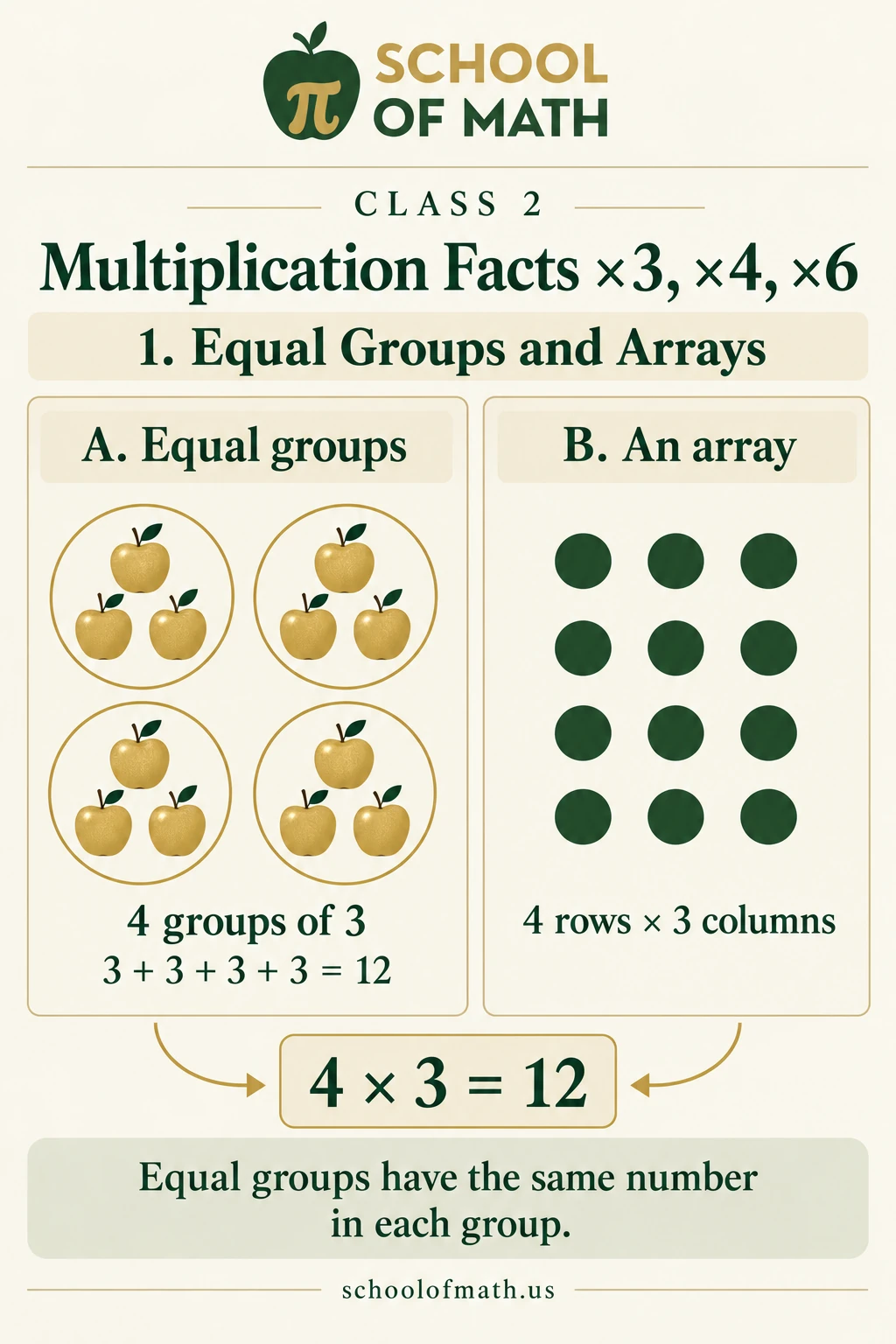
A factor is a number being multiplied. The product is the answer. In this lesson, we write number of groups × number in each group. Five boxes with three blocks each can be written as 5 × 3, and repeated addition gives 3 + 3 + 3 + 3 + 3 = 15.
The first poster connects equal groups to an array. Count the groups before you count the objects in a group. Multiplication with a single group size works only when every group has that same size.
Switching the factors will preserve the total. It will not preserve the meaning of each factor in the original story, so label your numbers before calculating.
Try it yourself: five questions
1.1 Classroom practice
There are 5 bowls with 3 grapes in each. Write a multiplication equation and a repeated-addition equation.
Answer
5 × 3 = 15; 3 + 3 + 3 + 3 + 3 = 15.
There are five equal groups. Add three five times to count all 15 grapes.
1.2 Classroom practice
Four boxes each hold 5 blocks. Name both factors and the product.
Answer
Factors: 4 and 5. Product: 20.
The factors describe four boxes and five blocks in each. Multiplying them counts 20 blocks.
1.3 Classroom practice
Rewrite 6 + 6 + 6 as a multiplication equation using number of groups first.
Answer
3 × 6 = 18.
There are three equal addends of six. Three groups of six make eighteen.
1.4 Classroom practice
Three bags contain 2, 3, and 4 stones. Can you use 3 × 3 to describe three equal bags? Explain and find the total.
Answer
No; the bags are unequal. The total is 9 stones.
Although 3 × 3 also equals 9, it describes three bags of three, not these bags. Use 2 + 3 + 4 = 9 for the actual groups.
1.5 Classroom practice
A tray holds 4 cookies. How many cookies are on 5 full trays?
Answer
20 cookies.
Write 5 × 4. Count 4, 8, 12, 16, 20 to check.
Skip counting by 3, 4, and 6
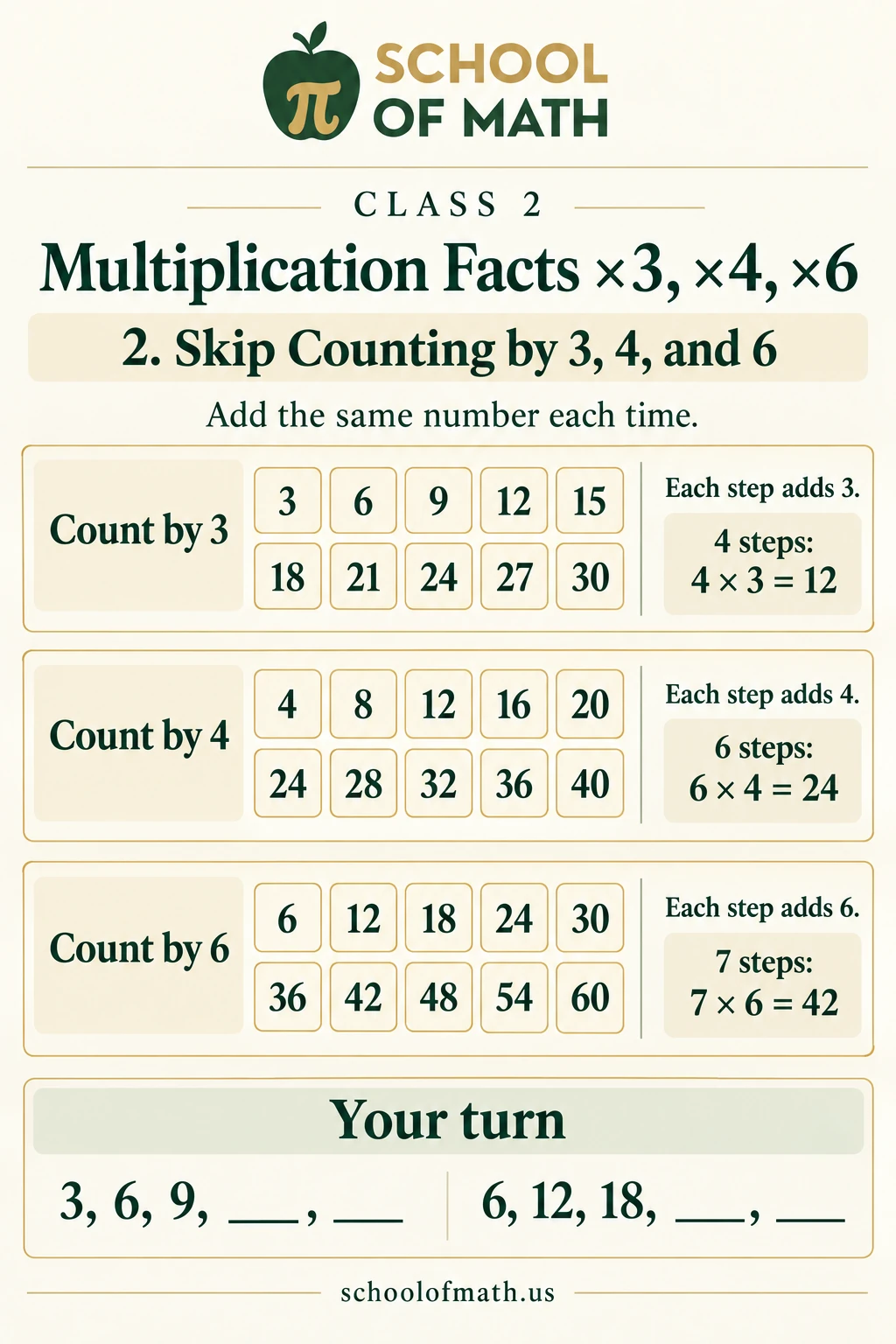
Skip counting means adding the same number each time. To count by 3, add 3 at every step; to count by 4, add 4; to count by 6, add 6. The size of the step stays the same even when the numbers become larger.
Starting at zero, each jump counts one equal group. Five jumps of 4 land on 20, so 5 × 4 = 20. Zero is the starting point, not the first jump. You can write the landing numbers and count them to check how many jumps you made.
The poster lists multiples of 3, 4, and 6. Read across the first row in each panel and continue on the next row. If you start somewhere other than zero, multiply to find the distance traveled, then add that distance to the starting number.
Skip counting also checks switched factors. Two jumps of 6 and six jumps of 2 both travel 12 from zero. The number of jumps and their size change places, but the total distance stays the same.
Try it yourself: five questions
2.1 Classroom practice
Continue the pattern: 15, 18, 21, ___, ___. State the size of each step.
Answer
24, 27; each step adds 3.
The differences 18 − 15 and 21 − 18 are both 3. Add 3 to 21 to get 24, then add 3 again to get 27.
2.2 Classroom practice
Fill the gaps while counting by 4: 8, 12, ___, 20, ___.
Answer
16 and 24.
Add 4 at every step: 8, 12, 16, 20, 24. Check that every pair of neighboring numbers differs by 4.
2.3 Classroom practice
Start at 0 and make 6 jumps of 6. List the landing numbers and write a multiplication equation.
Answer
6, 12, 18, 24, 30, 36; 6 × 6 = 36.
Each jump adds one group of six. The sixth landing number is 36; zero is the start, not a landing after a jump.
2.4 Classroom practice
Ben lists 0, 4, 8, 12 and says, 'Four jumps of 4 land on 12.' Explain his mistake and find the landing number after four jumps.
Answer
He counted zero as a jump. Four jumps of 4 land on 16.
The jumps are 0 to 4, 4 to 8, 8 to 12, and 12 to 16. There are four jumps but five numbers when you include the starting zero.
2.5 Classroom practice
A game token starts on 6 and moves forward 3 spaces on each turn. Where will it land after 5 turns? Show how you know.
Answer
21.
Five moves travel 5 × 3 = 15 spaces. Add the starting position: 6 + 15 = 21. The landing numbers are 9, 12, 15, 18, 21.
Multiply by 3: double and add
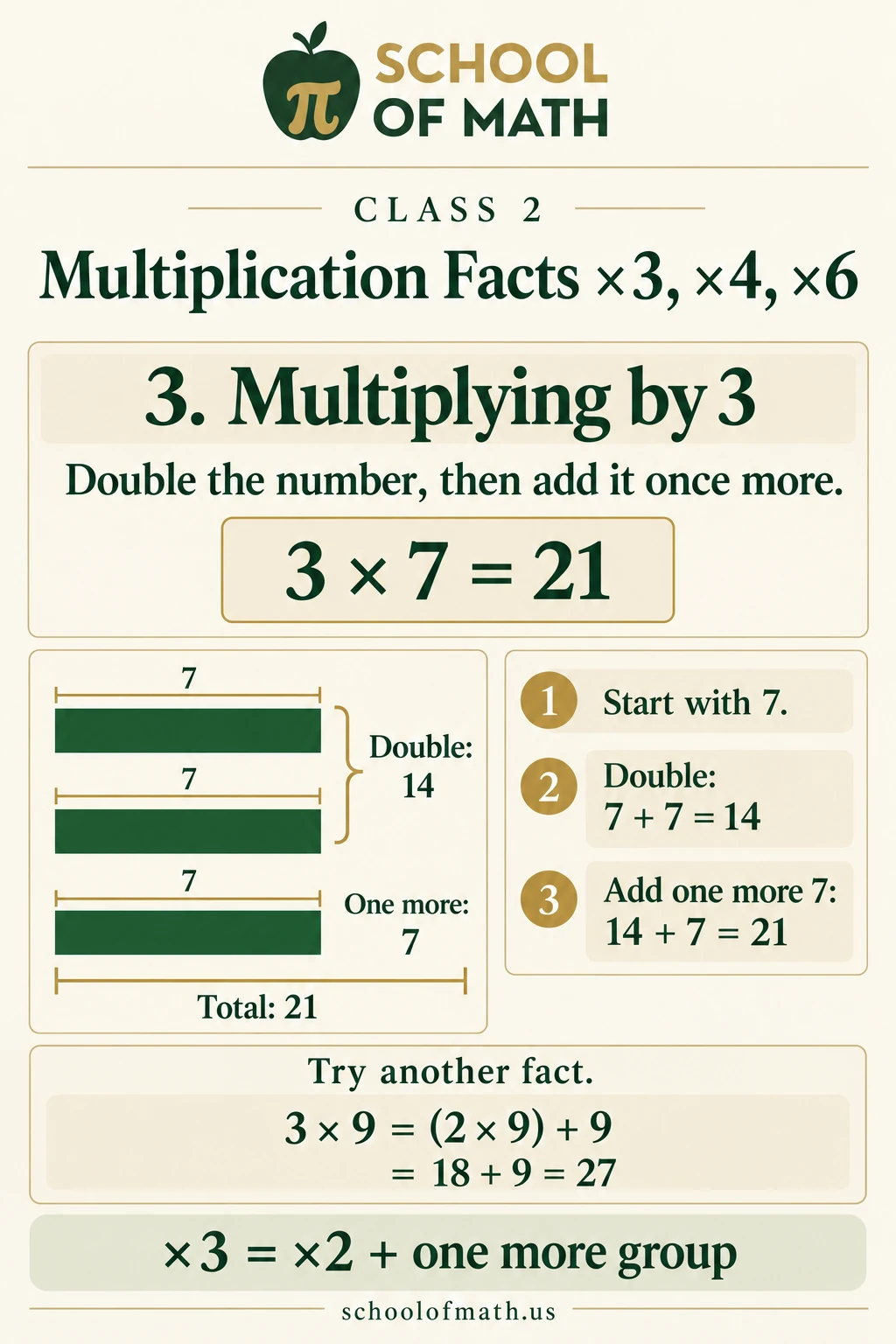
To make three equal groups, first make two groups and then add one more group of the same size. For example, 3 × 5 = (2 × 5) + 5 = 10 + 5 = 15.
The words 'one more group' matter. You add the original number, not the number 1. If you double 5 and then add 1, you have made 11, not three groups of five.
If a problem is written 5 × 3, switching factors lets you use 3 × 5. The product stays 15 even though the description of the groups changes.
Try it yourself: five questions
3.1 Classroom practice
Use double-and-add to find 3 × 2. Show the double and the extra group.
Answer
6.
Double 2 to get 4. Add one more 2: 4 + 2 = 6.
3.2 Classroom practice
Use double-and-add to find 3 × 11.
Answer
33.
Two groups of 11 make 22. Add one more 11: 22 + 11 = 33.
3.3 Classroom practice
Fill both blanks: 3 × 5 = (2 × 5) + ___ = ___.
Answer
5 and 15.
After two groups of five, you need a third group of five. Ten plus five equals fifteen.
3.4 Classroom practice
Mia says 3 × 6 = 12 + 1 = 13. What should she add instead, and why?
Answer
She should add 6; the product is 18.
Twelve represents two groups of six. The third group contains six, not one.
3.5 Classroom practice
You know 3 × 10 = 30. Find 3 × 12 by adding two more groups of 3.
Answer
36.
Switch to 12 × 3. Ten groups make 30, and two more groups add 6: 30 + 6 = 36.
Multiply by 4: double, then double again
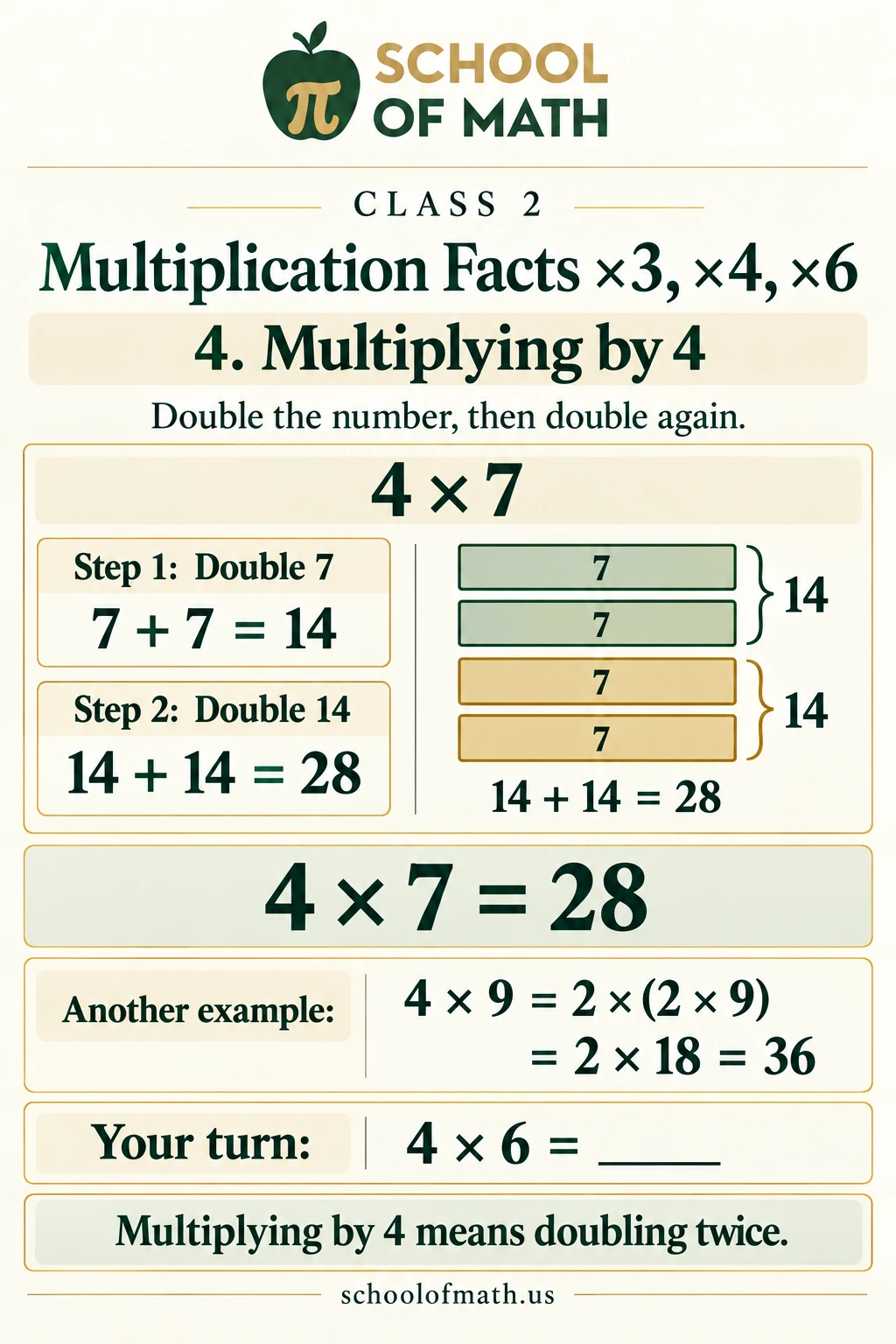
Multiplying by 4 means making four equal groups. Split those groups into two pairs. First double the number to count one pair; then double that result to count both pairs.
For example, to find 4 × 10, first calculate 10 + 10 = 20. Then calculate 20 + 20 = 40. The second doubling acts on the whole result of the first doubling, not on the original number again as a separate final answer.
The poster shows the same structure with four equal bars: two bars make one double, and another two bars make a second equal double. In symbols, 4 × n = 2 × (2 × n). Do not replace the second doubling with adding 2 or adding just one more original group.
You can use this strategy for a reversed fact too. To find 10 × 4, switch to 4 × 10, double 10 to get 20, then double 20 to get 40. Switching factors does not change the product.
Try it yourself: five questions
4.1 Classroom practice
Find 4 × 5 by doubling twice. Write both addition steps.
Answer
20.
First double 5: 5 + 5 = 10. Then double 10: 10 + 10 = 20.
4.2 Classroom practice
Complete the steps for 4 × 8: double 8 to get ___; double that result to get ___.
Answer
16 and 32.
8 + 8 = 16 counts two groups. Then 16 + 16 = 32 counts four groups.
4.3 Classroom practice
Find 11 × 4 by switching the factors and doubling twice. Show each step.
Answer
44.
Switch to 4 × 11. First 11 + 11 = 22, then 22 + 22 = 44.
4.4 Classroom practice
To find 4 × 3, Leo doubles 3 to get 6, then adds 3 to get 9. What should his second step be, and why?
Answer
He should double 6: 6 + 6 = 12.
Adding one more 3 makes only three groups of three. Doubling the first result adds two more groups, giving four groups and a total of 12.
4.5 Classroom practice
Four trays each hold 12 muffins. Find the total by doubling twice, and explain what each double counts.
Answer
48 muffins.
12 + 12 = 24 counts two trays. Then 24 + 24 = 48 counts all four trays.
Multiply by 6: double three groups
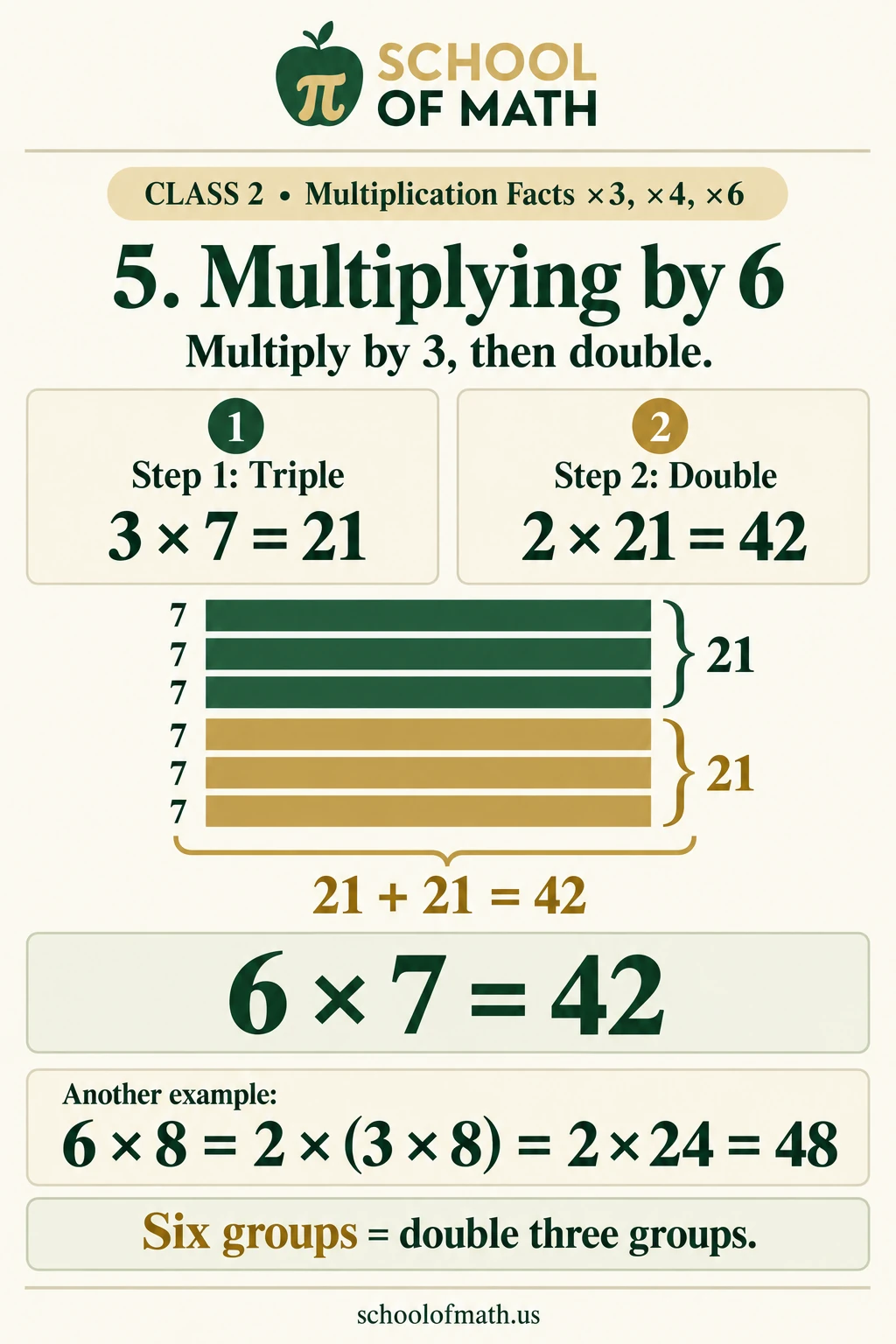
Six equal groups can be separated into two sets of three equal groups. Find the ×3 fact, then double its product. For example, 6 × 5 = 2 × (3 × 5) = 2 × 15 = 30.
When the equation is written 5 × 6, you can switch to 6 × 5 and use the same method. This shows how a known fact can help solve a new-looking problem.
Keep the group size unchanged. Doubling the product for three groups creates six groups; it does not mean multiplying both original factors by two.
Try it yourself: five questions
5.1 Classroom practice
Find 6 × 3 by first finding 3 × 3.
Answer
18.
Three groups of three make 9. Double 9 to count six groups: 18.
5.2 Classroom practice
Find 6 × 5 using triple-then-double.
Answer
30.
3 × 5 = 15. Double 15 to get 30.
5.3 Classroom practice
If 3 × 11 = 33, what is 6 × 11?
Answer
66.
Six groups are twice three groups. Double 33: 33 + 33 = 66.
5.4 Classroom practice
Nora says 6 × 4 is 3 × 4 plus 3. Find and fix her mistake.
Answer
6 × 4 = 24.
3 × 4 = 12 counts only three groups. Add another three groups, also 12: 12 + 12 = 24.
5.5 Classroom practice
Find the missing factor: 6 × ___ = 60. Check with a ×3 fact.
Answer
10.
3 × 10 = 30, and double 30 is 60. Therefore 6 × 10 = 60.
Switching factors: the same product
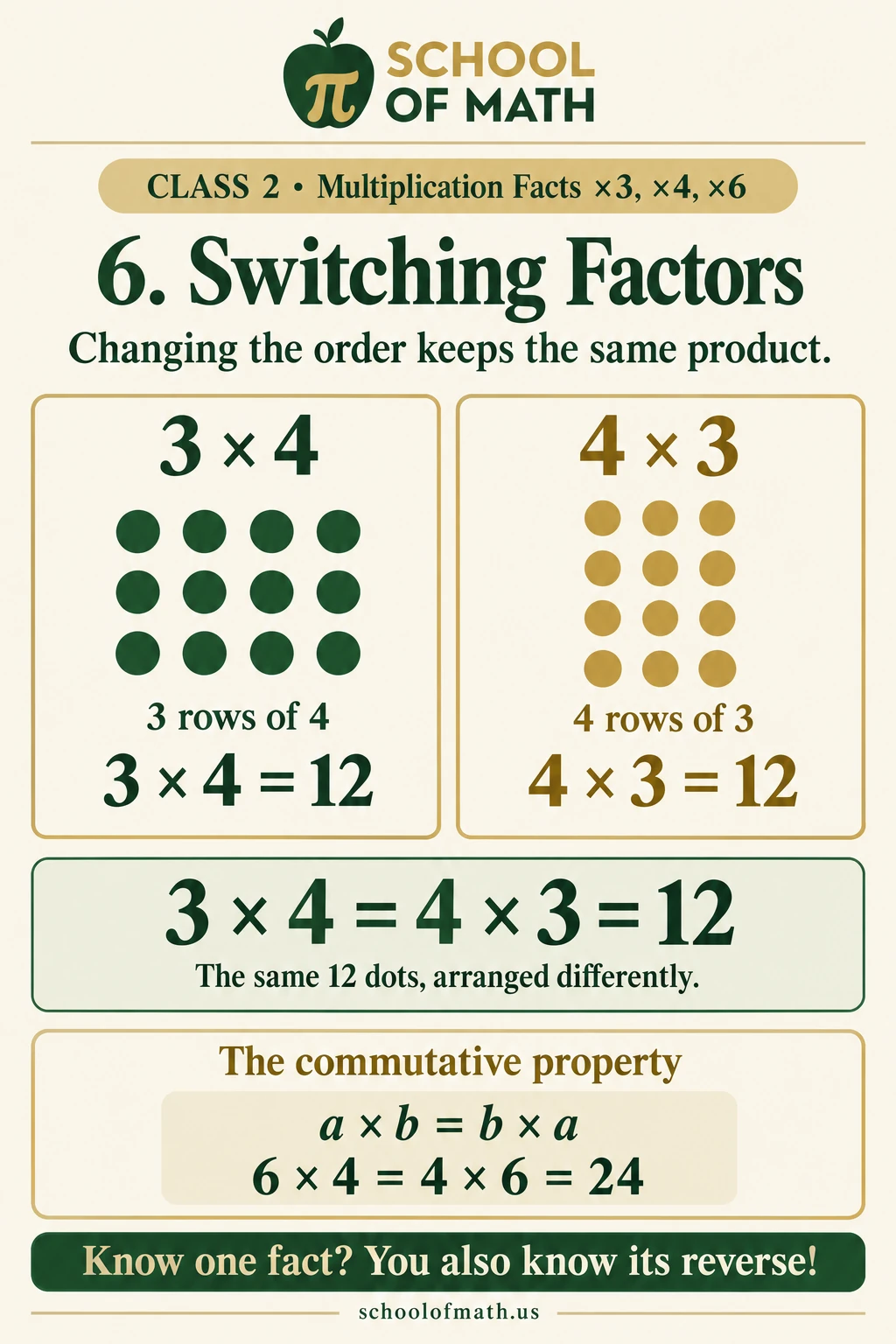
The commutative property of multiplication says a × b = b × a. The factors switch places, but their product does not change. An array makes the reason visible: every row-and-column position still contains the same object.
For 3 × 4, draw three rows with four dots in each row. Turn the drawing a quarter-turn to see four rows of three. Both drawings have 12 dots. You rearranged or re-read the objects; you did not make more of them.
The arrangements have the same total, not necessarily the same story. Three bags with four items each are different from four bags with three items each. Also, this switching rule does not generally work for subtraction or division: 12 ÷ 3 = 4, but 3 ÷ 12 is not 4.
Try it yourself: five questions
6.1 Classroom practice
Use 4 × 8 = 32 to find 8 × 4. Name the property.
Answer
32; the commutative property of multiplication.
The factors are the same two numbers in the opposite order. Reversing them preserves the product.
6.2 Classroom practice
Complete the switched pair: 6 × 9 = ___ × 6 = ___.
Answer
9 and 54.
Switch the factors 6 and 9. Both 6 × 9 and 9 × 6 equal 54.
6.3 Classroom practice
True or false: 3 × 5 = 5 × 3 means that both arrays have the same number of rows.
Answer
False.
The first array has three rows and the second has five. Their totals are equal: both contain 15 objects.
6.4 Classroom practice
Which equation shows switching factors? A: 4 × 5 = 5 × 4. B: 4 × 5 = 2 × 10. Explain.
Answer
A.
A reverses the same factors. B has the same product, 20, but changes the factors rather than switching them.
6.5 Classroom practice
Do 8 − 3 and 3 − 8 give the same answer? What does this tell you about switching?
Answer
No. 8 − 3 = 5, but 3 − 8 is not 5.
If you know negative numbers, 3 − 8 = −5. A rule for multiplication cannot simply be applied to subtraction.
Break apart a fact you do not know yet
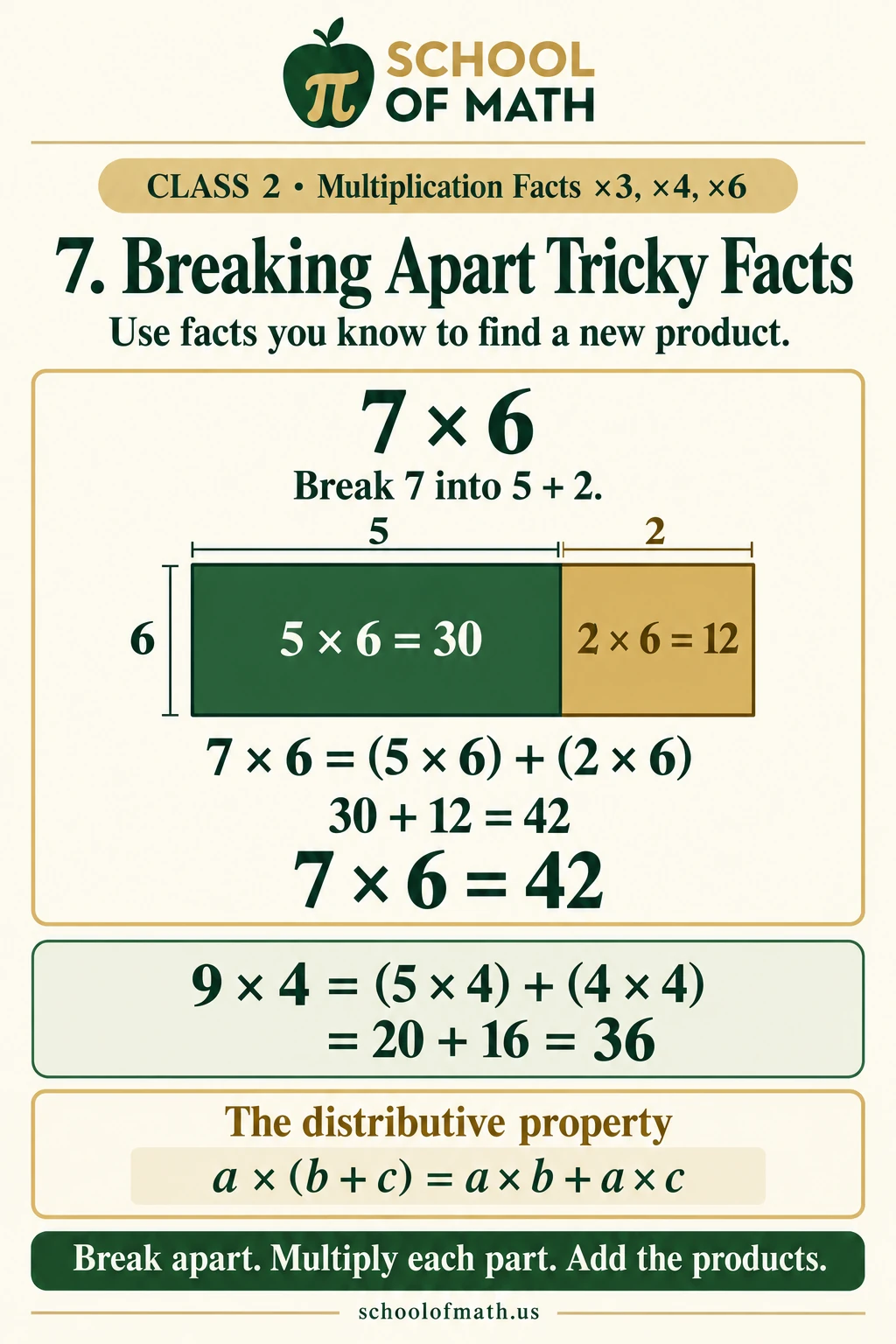
The distributive property lets you split one factor into easier parts, multiply each part by the other factor, and add the products. For example, 8 × 4 = (5 × 4) + (3 × 4) = 20 + 12 = 32.
An array can be cut into two smaller rectangles without losing or duplicating a tile. This is why the two smaller products add to the original total. Do not add the parts and then forget to multiply one of them.
Switching factors and breaking apart are different moves. You may use both: switch 4 × 8 to 8 × 4, split the eight groups into five groups and three groups, then add their totals.
Try it yourself: five questions
7.1 Classroom practice
Split 8 into 5 + 3 to find 8 × 3.
Answer
24.
5 × 3 = 15 and 3 × 3 = 9. Add 15 + 9 = 24.
7.2 Classroom practice
Split 11 into 10 + 1 to find 11 × 4.
Answer
44.
10 × 4 = 40 and 1 × 4 = 4. Add 40 + 4 = 44.
7.3 Classroom practice
Find 8 × 6 by splitting 8 into 4 + 4.
Answer
48.
Each half gives 4 × 6 = 24. Add the two equal parts: 24 + 24 = 48.
7.4 Classroom practice
A student writes 6 × 12 = (6 × 10) + 2. Correct the equation.
Answer
6 × 12 = (6 × 10) + (6 × 2) = 72.
The two extra items occur in each of the six groups. Add 12 to 60, not just 2.
7.5 Classroom practice
Find 9 × 3 using 10 × 3 minus one group of 3.
Answer
27.
Ten groups contain 30. Remove one group of three: 30 − 3 = 27.
Use multiplication in a story
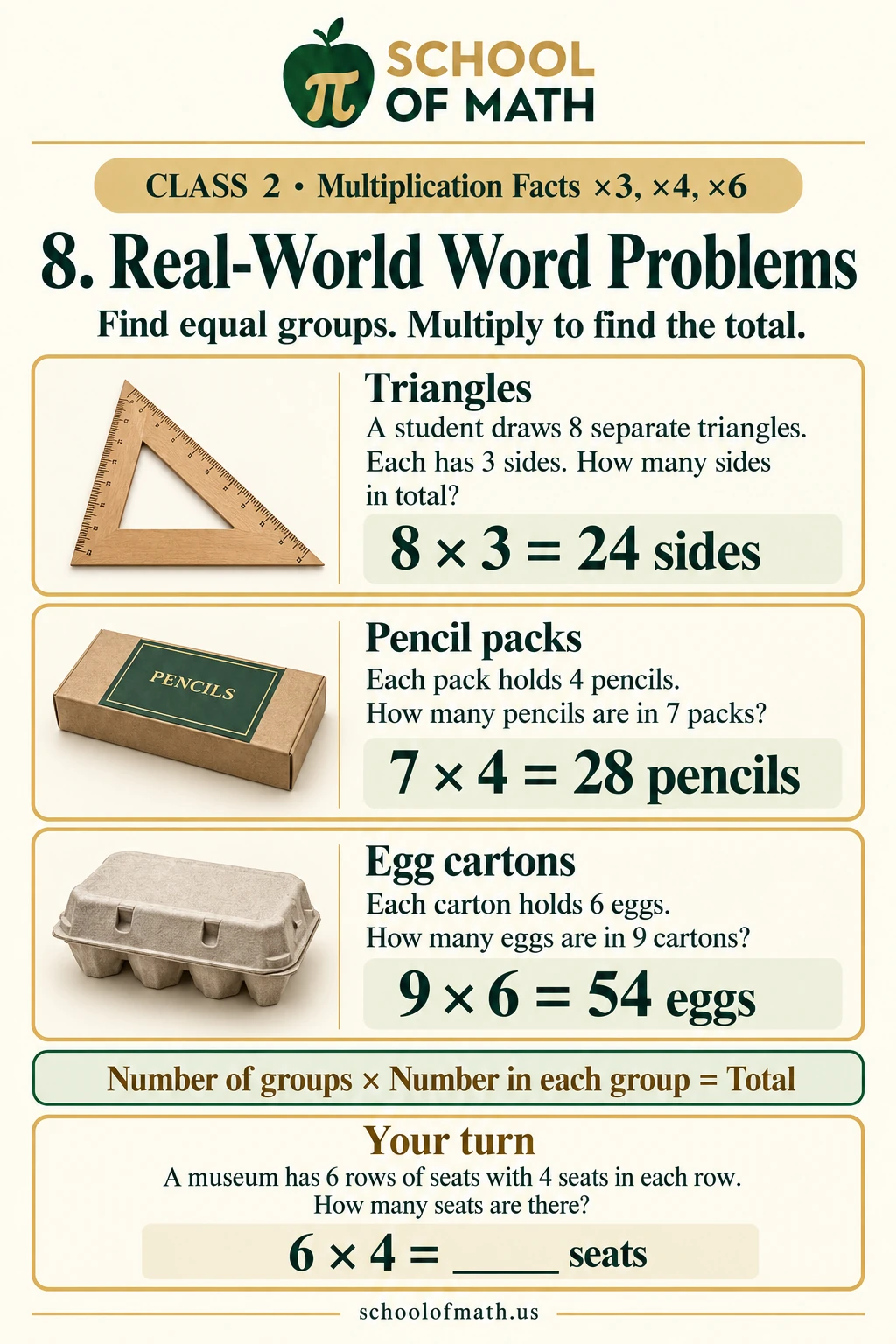
Read the question before choosing an operation. Identify the number of equal groups, the number in each group, and what you are counting. Then write an equation, solve it, and label the answer.
A reversed fact can make the arithmetic easier, but keep the original labels in your explanation. Five tables with six children at each table is 5 × 6 children. Computing 6 × 5 still gives 30 children; it does not change the story to six tables.
For a two-step story, finish the equal-groups calculation first. Add or subtract any extra or removed items afterwards. A useful check is to ask whether the final total should be greater or smaller than the multiplication result.
Try it yourself: five questions
8.1 Classroom practice
Four shelves each hold 9 books. How many books are there? Show a switched equation too.
Answer
36 books; 4 × 9 = 9 × 4 = 36.
There are four equal groups of nine books. Double 9 twice to check the product.
8.2 Classroom practice
Five tables each have 6 seats. How many seats are available?
Answer
30 seats.
5 × 6 counts the seats. Switching to 6 × 5 lets you count six groups of five.
8.3 Classroom practice
A baker fills 3 trays with 11 rolls each, then sells 5 rolls. How many remain?
Answer
28 rolls.
First find 3 × 11 = 33 rolls. Then subtract the 5 sold: 33 − 5 = 28.
8.4 Classroom practice
One display has 4 rows of 8 badges. Another has 8 rows of 4 badges. Which has more, or are they equal?
Answer
They are equal, with 32 badges each.
The two equations switch the same factors. Neither arrangement adds or removes a badge.
8.5 Classroom practice
A class needs 25 paintbrushes. Each pack holds 6. Are 4 packs enough? If not, how many brushes are missing?
Answer
No; 1 brush is missing.
4 × 6 = 24 brushes. Compare with 25: 25 − 24 = 1.
Homework review
Questions R1–R4 revisit the ×2, ×5, and ×10 facts from Class 1. Questions R5–R8 connect those foundations to today’s arrays and strategies.
R1 Homework review 1 of 8
Review Class 1: Find 2 × 8 using doubles.
Answer
16.
8 + 8 = 16, so two equal groups of eight contain sixteen.
R2 Homework review 2 of 8
Review Class 1: Find 5 × 7 by counting in fives.
Answer
35.
Count 5, 10, 15, 20, 25, 30, 35. Seven groups of five equal 35.
R3 Homework review 3 of 8
Review Class 1: A box holds 10 cards. How many cards are in 12 boxes?
Answer
120 cards.
Twelve tens make 120. Write 12 × 10 = 120.
R4 Homework review 4 of 8
Review Class 1: If 8 × 5 = 40, find 8 × 10.
Answer
80.
Each group is twice as large, so double the product: 40 + 40 = 80.
R5 Homework review 5 of 8
Draw or describe two arrays showing 3 × 5 = 5 × 3.
Answer
3 rows of 5 and 5 rows of 3; both have 15 dots.
Every dot is counted once in either arrangement. The rows and columns exchange roles.
R6 Homework review 6 of 8
Find 4 × 12 by doubling twice.
Answer
48.
Double 12 to get 24, then double 24 to get 48.
R7 Homework review 7 of 8
Use 3 × 9 = 27 to find 6 × 9.
Answer
54.
Six groups are double three groups. 27 + 27 = 54.
R8 Homework review 8 of 8
Explain why 4 × 6 = 6 × 4 but 4 × 6 is not 4 + 6.
Answer
The two products are 24; the sum is 10.
Switching factors keeps multiplication as multiplication. Adding the factors is a different operation.
Homework word problems
These twelve problems complete the 20-question homework. Label the factors, choose a strategy, and write a sentence with the answer and its units.
W1 Homework word problem 1 of 12
Three baskets each hold 5 pears. How many pears are there? Write the reversed fact too.
Answer
15 pears; 3 × 5 = 5 × 3 = 15.
Three equal groups of five give 15. Reversing the factors preserves this total.
W2 Homework word problem 2 of 12
Four children each make 6 paper stars. How many stars do they make altogether?
Answer
24 stars.
4 × 6 = 24. You can double 6 twice: 12, then 24.
W3 Homework word problem 3 of 12
A tray has 6 rows with 5 seed pots in each row. How many pots are there?
Answer
30 pots.
6 × 5 = 30. Reading the columns gives 5 × 6 = 30 too.
W4 Homework word problem 4 of 12
A shop packs 3 erasers in each bag. How many erasers are in 11 bags?
Answer
33 erasers.
Switch 11 × 3 to 3 × 11. Double 11, then add 11: 22 + 11 = 33.
W5 Homework word problem 5 of 12
A display holds 4 rows of 10 postcards. It is rearranged into 10 equal rows using every postcard. How many postcards are in each new row?
Answer
4 postcards.
The display has 40 postcards. Switching the array gives ten rows of four, still 40.
W6 Homework word problem 6 of 12
Six teams each receive 4 bibs. Two spare bibs are added. How many bibs are there in total?
Answer
26 bibs.
The teams receive 6 × 4 = 24 bibs. Add 2 spares: 24 + 2 = 26.
W7 Homework word problem 7 of 12
Four boxes each contain 11 beads. A student uses 9 beads. How many remain?
Answer
35 beads.
4 × 11 = 44 beads at the start. Subtract 9: 44 − 9 = 35.
W8 Homework word problem 8 of 12
One club sets out 3 tables with 8 places each. Another sets out 4 tables with 6 places each. Do the clubs have the same number of places? Is this a switched pair?
Answer
Both have 24 places, but this is not a switched pair.
3 × 8 = 24 and 4 × 6 = 24. The factors are different pairs, not the same two numbers reversed.
W9 Homework word problem 9 of 12
A library displays 8 rows of 3 books. Use 5 rows and 3 rows to find the total.
Answer
24 books.
5 × 3 = 15 and 3 × 3 = 9. The two parts give 15 + 9 = 24.
W10 Homework word problem 10 of 12
A class needs 30 counters. Each packet contains 4 counters. Are 7 packets enough, and how many full packets are needed?
Answer
Seven are not enough; 8 full packets are needed.
7 × 4 = 28, two short. The next whole packet raises the total to 32, so eight packets are enough.
W11 Homework word problem 11 of 12
A florist makes 6 bunches with 9 flowers in each. She sells 2 whole bunches. How many flowers remain?
Answer
36 flowers.
Six bunches minus two leaves four bunches. 4 × 9 = 36; alternatively, 54 − 18 = 36.
W12 Homework word problem 12 of 12
A museum has 5 rows of 6 seats. A guide says rearranging them into 6 rows of 5 will add one seat. Explain the mistake and state the total.
Answer
No seats are added; the total stays 30.
5 × 6 = 6 × 5 = 30. There is one more row, but fewer seats in each row.
Video walkthrough
Revisit the existing SOMATH walkthrough for multiplication facts ×3, ×4, and ×6. The video supports the topic; the refreshed question numbering above is specific to this page.
Quick questions and answers
Why does 3 × 4 equal 4 × 3?
Three rows of four objects and four rows of three objects both contain 12 objects. Turning an array exchanges rows and columns without changing its total.
What is the commutative property of multiplication?
It means that switching the order of the factors keeps the same product: a × b = b × a. For example, 5 × 6 = 6 × 5 = 30.
Do switched factors describe the same groups?
Not necessarily. Three bags of four and four bags of three describe different groups. They have the same total of 12 items.
How can I multiply by 3, 4, and 6?
For ×3, double the number and add one more copy. For ×4, double twice. For ×6, find three groups and double that product.
Can I switch numbers in subtraction or division?
Not in general. For example, 12 ÷ 3 = 4, but reversing the numbers does not give 4. Check which operation you are using before applying a property.
What is included in this Kid Einsteins lesson?
Eight image sections, five original classroom questions per section, eight homework review questions, and twelve homework word problems. All 60 questions have hidden worked answers online. The 22-page student workbook includes a PDF-only cover, numbered pages, and blank answer space without exercise solutions.