Kid Einsteins · Class Pack · Class 11 · Grades 3–4
Kid Einsteins Class 11: Adding Fractions with Like Denominators — 8 SOMATH Posters, Theory & 40 Practice Questions
A complete, illustrated grade 3–4 walk through what a fraction is, numerator vs denominator, like denominators, adding the numerators, keeping the denominator, adding with fraction-strip models, adding on a number line, and fraction word problems. Eight SOMATH posters, full theory under each one, and 40 practice questions with click-to-reveal solutions. Class 11 of the SOMATH Kid Einsteins 48-class rolling syllabus — Upper West Side, NYC.
Short answer
To add fractions with like denominators (same bottom number), add the numerators (top numbers) and keep the denominator the same. So 1/5 + 2/5 = 3/5 and 2/6 + 3/6 = 5/6. You never add the denominators — the denominator only names the piece size, and adding two pieces of the same size still leaves you with pieces of that size.
SOMATH Kid Einsteins · Grades 3–4 · Class 11 of 48
This is one class from our Kid Einsteins course
SOMATH's Kid Einsteins course meets in person on the Upper West Side (226 W 79th St). It's a 48-class rolling syllabus for grades 3–4 covering multiplication mastery, division, fractions & decimals, word problems, and area & perimeter. Small in-person groups of up to 6 students. Every family starts with a free in-person evaluation.
See the full Kid Einsteins course → Book a free evaluation · (646) 668-6151
What's inside this class
1. What is a fraction?
Poster 1 of 8 — Kid Einsteins Class 11
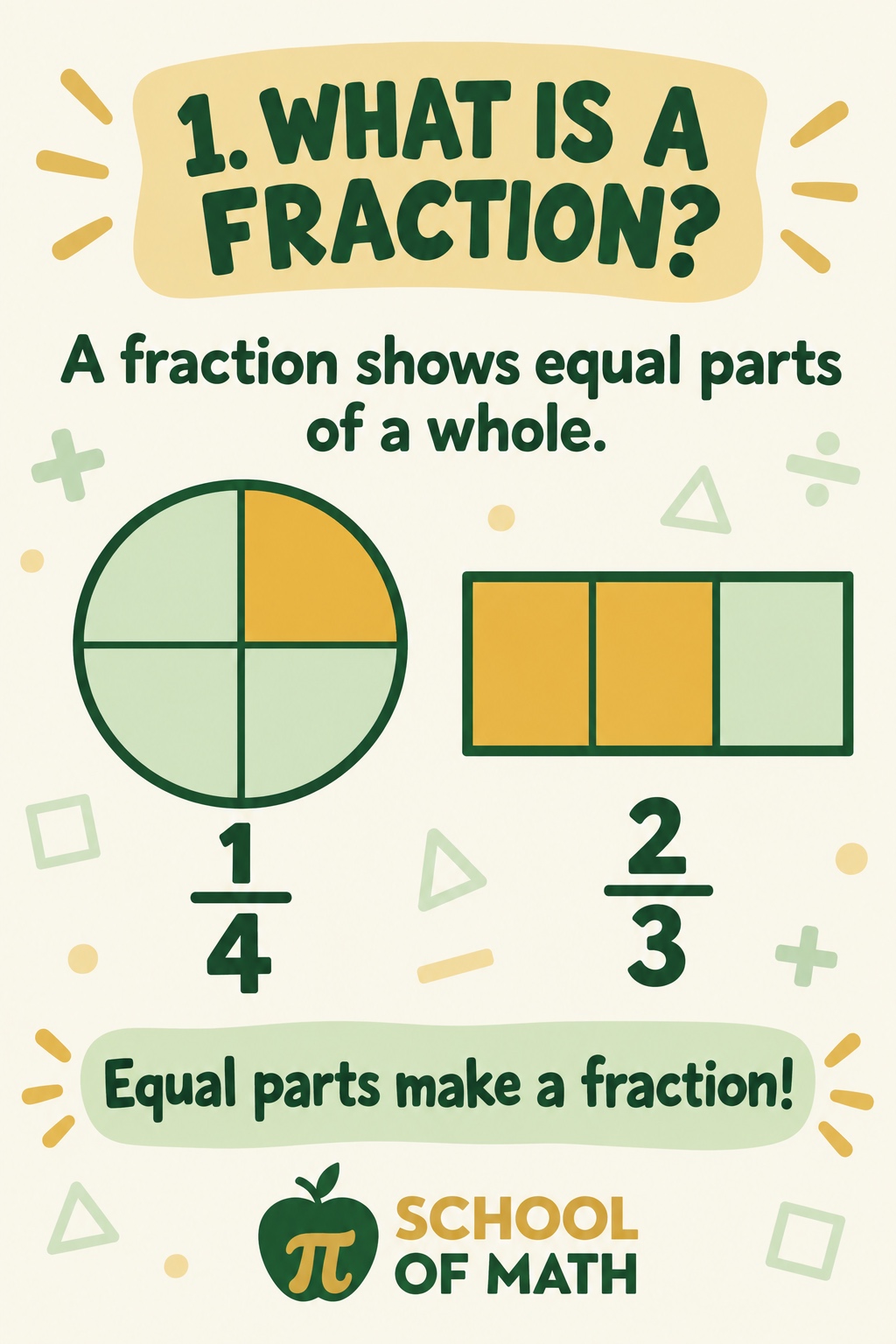
A fraction shows equal parts of a whole
A fraction is a way to write a part of a whole thing. The whole is first cut into equal parts, and then the fraction tells us how many of those equal parts we have.
In the poster:
- A circle is cut into 4 equal parts. One part is shaded. That shaded amount is 1/4.
- A rectangle is cut into 3 equal parts. Two parts are shaded. That shaded amount is 2/3.
The word to remember is equal. If the pieces are not the same size, we cannot use a fraction yet. Cutting a pizza into a tiny slice and a huge slice and calling the tiny one "one-half" is wrong — halves must be the same size.
5 practice questions with hidden solutions
2. Numerator and denominator
Poster 2 of 8 — Kid Einsteins Class 11
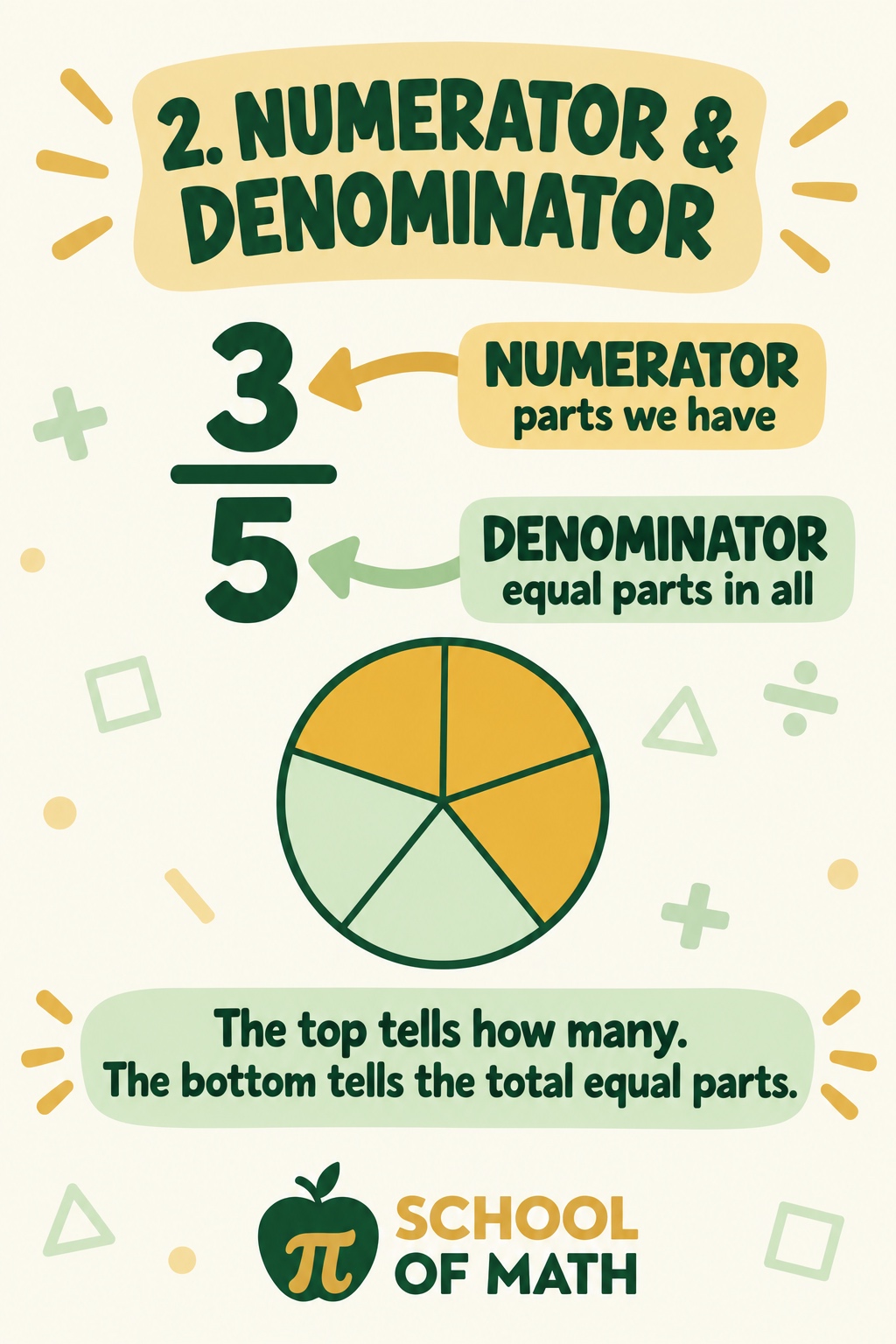
Top number = numerator. Bottom number = denominator.
Every fraction has two numbers stacked on top of each other. Each one has a job:
- Numerator (the top number) — how many equal parts we have.
- Denominator (the bottom number) — how many equal parts the whole was cut into.
In the poster the fraction is 3/5. The circle has been cut into 5 equal parts (that's the denominator, 5), and 3 of them are shaded (that's the numerator, 3).
A trick that sticks: D is for Down and D is for Denominator. So the denominator is the one down below.
5 practice questions with hidden solutions
3. Like denominators
Poster 3 of 8 — Kid Einsteins Class 11
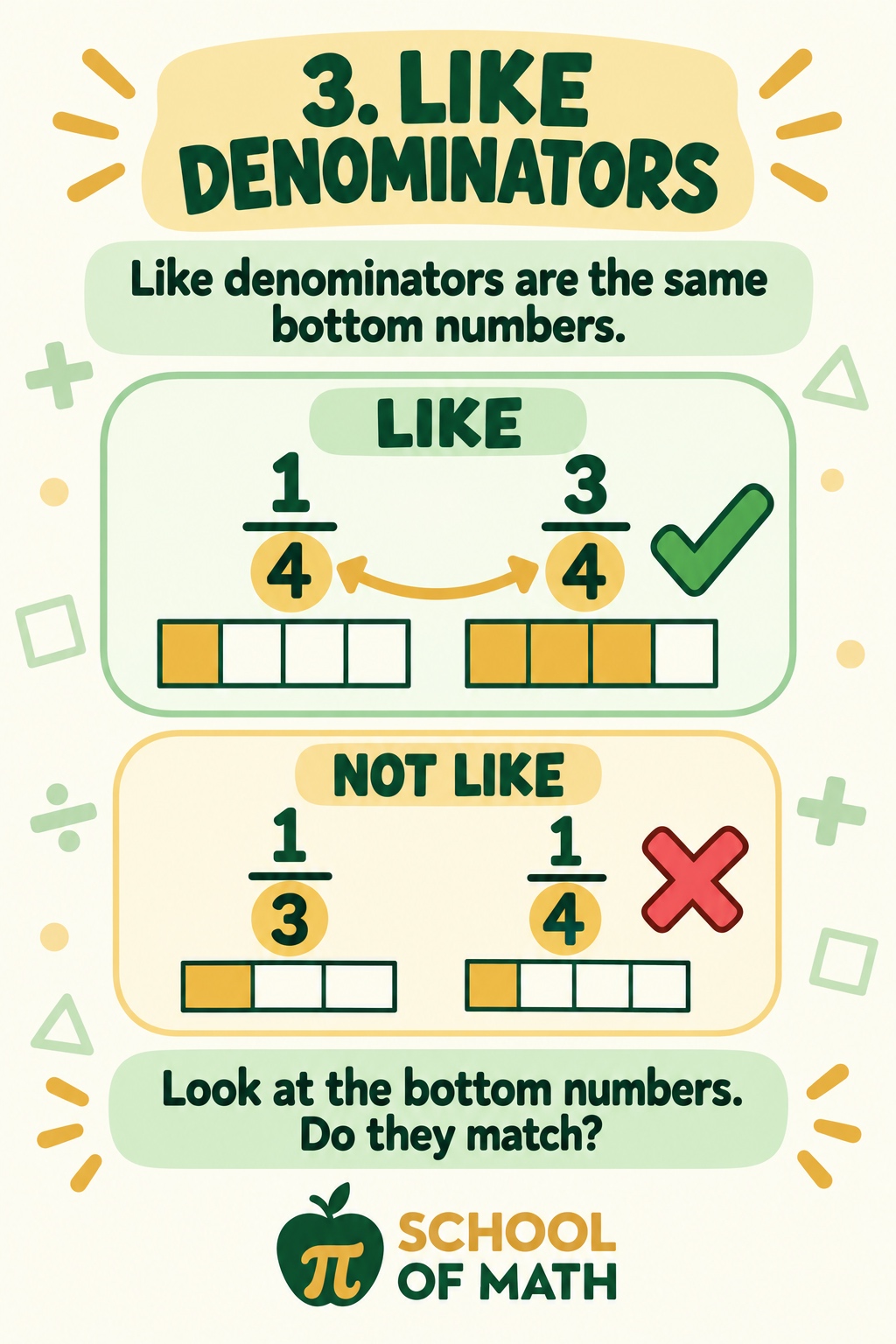
Like denominators = same bottom number
Two fractions have like denominators when their bottom numbers are the same. This means both wholes were cut into the same number of equal parts, so each little piece is the same size in both fractions.
From the poster:
- Like: 1/4 and 3/4. Both denominators are 4, so both wholes are cut into 4 equal pieces. Each little piece is a quarter in both fractions. ✓
- Not like: 1/3 and 1/4. Denominators are 3 and 4, so the pieces are different sizes (thirds vs quarters). ✗
Why it matters: we can only add or subtract fractions directly when their denominators are the same. If the pieces are different sizes, we would be trying to add apples to oranges. Making unlike denominators like is a Class 19 topic (equivalent fractions and common denominators).
First step of every addition problem in this class: look at the bottom numbers. Do they match?
5 practice questions with hidden solutions
4. Add the numerators
Poster 4 of 8 — Kid Einsteins Class 11
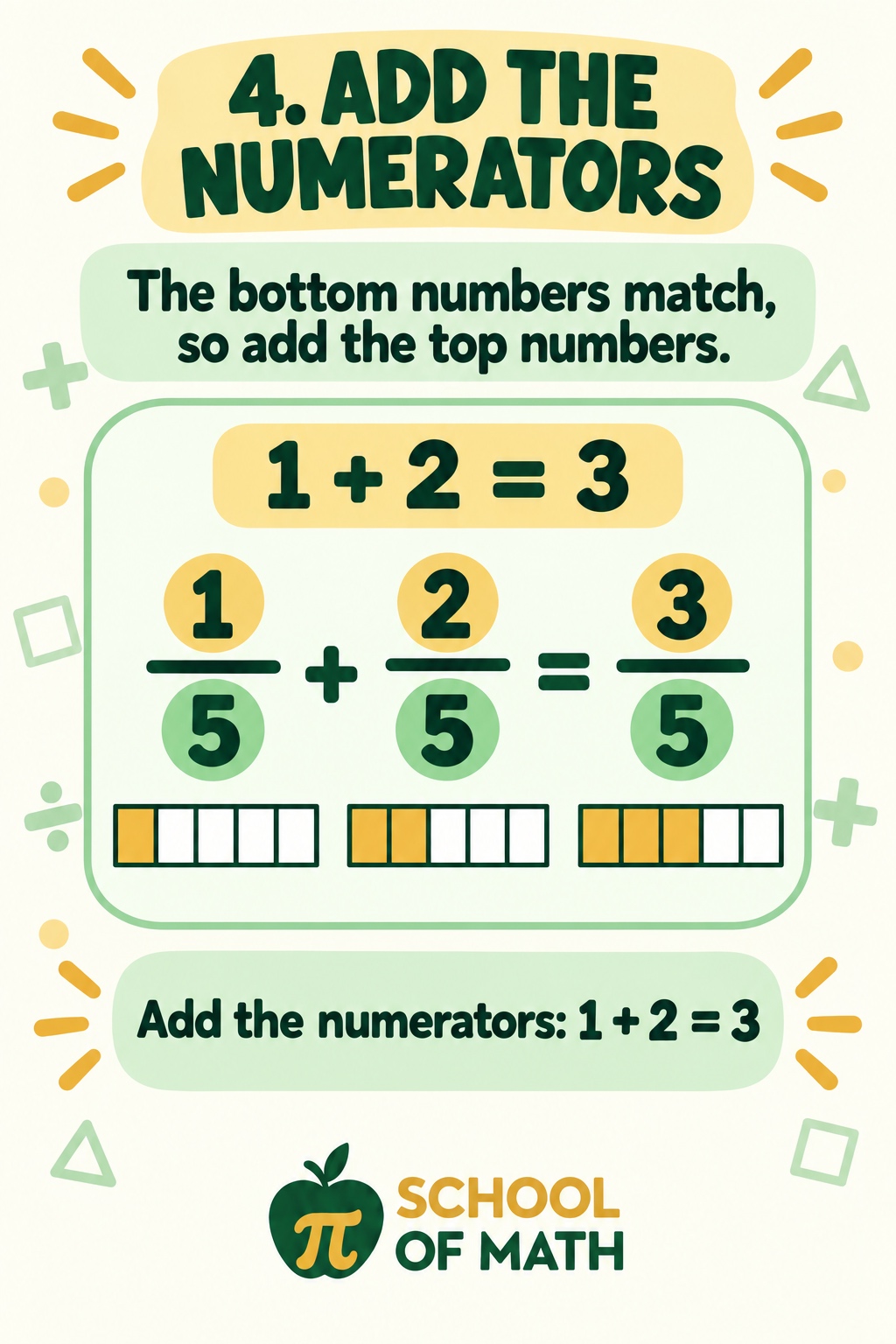
When the denominators match, add the numerators
Once you've checked that the denominators are the same, the rule is short:
1/5 + 2/5 → add the tops: 1 + 2 = 3 → answer: 3/5
The reason this works: fifths are all the same size. If you already have 1 fifth and someone gives you 2 more fifths, you now have 3 fifths. You're just counting how many of the same-sized pieces you have altogether.
The number of pieces changes (the numerator), but the name of the piece does not change (the denominator). Fifths + fifths = fifths.
5 practice questions with hidden solutions
5. Keep the denominator the same
Poster 5 of 8 — Kid Einsteins Class 11
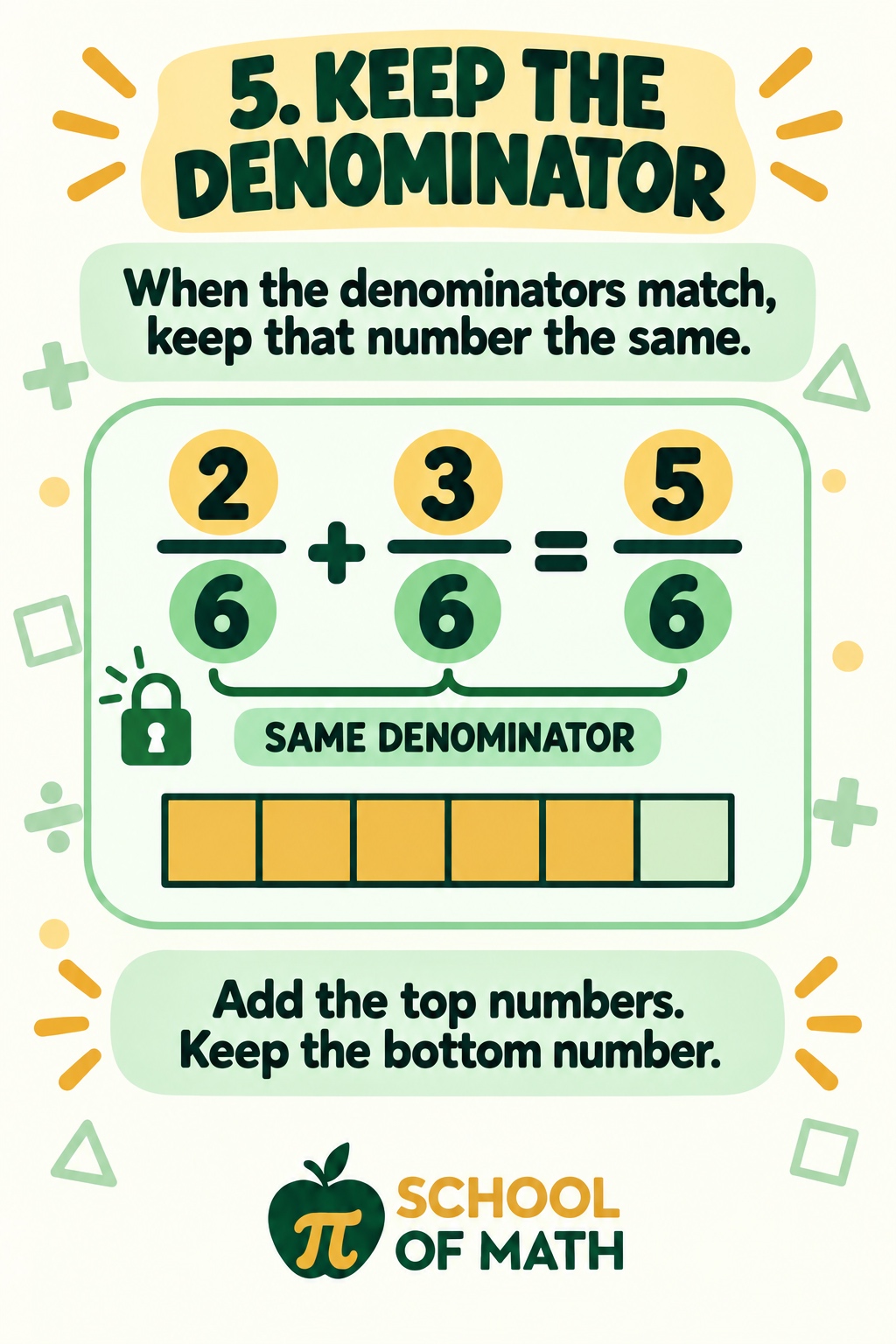
Why the denominator does not change
This is the rule kids most often forget in a hurry: when you add like fractions, the denominator stays the same. Only the numerator changes.
Look at the poster:
2/6 + 3/6 = 5/6
All three fractions in that equation are sixths. The 6 on the bottom is the name of the piece — "one-sixth of the whole." Adding two sixths and three sixths gives five sixths. The piece is still a sixth; there are just more of them.
Think of it like counting cookies. If you have 2 cookies and someone gives you 3 more cookies, you have 5 cookies. The word "cookies" doesn't turn into "brownies." In fractions, the denominator is the "cookies" — it's the name of what you're counting.
5 practice questions with hidden solutions
6. Add with fraction models
Poster 6 of 8 — Kid Einsteins Class 11
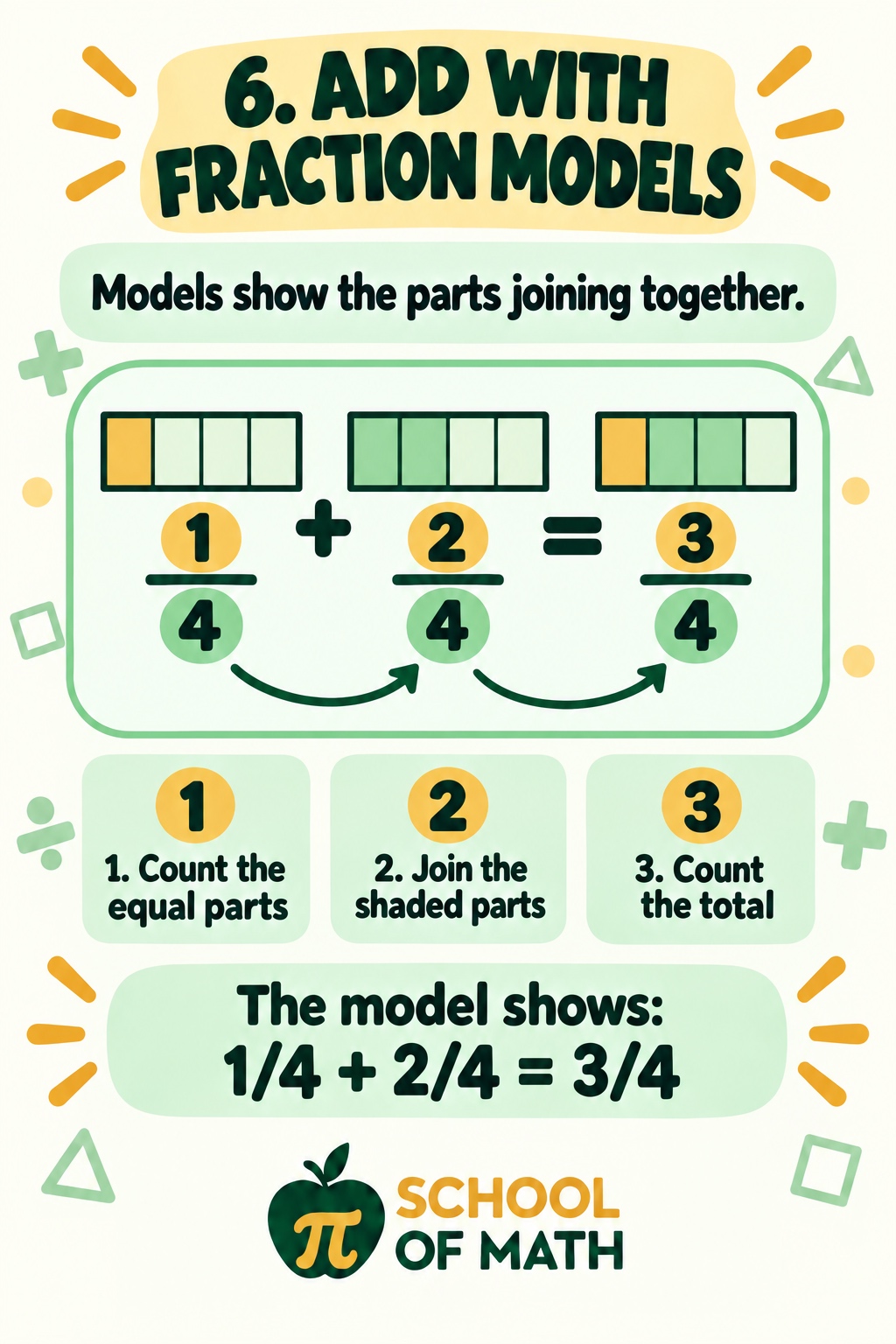
Using a fraction strip to see the addition
A fraction strip (also called an area model) is just a rectangle cut into equal parts. It lets us see the addition instead of only doing the arithmetic. The poster shows three clear steps:
- Count the equal parts. How many equal pieces is each strip cut into? That is the denominator. In the poster, each strip has 4 equal pieces, so the denominator is 4.
- Join the shaded parts. Line the two strips up together. The first strip has 1 shaded quarter; the second has 2 shaded quarters. Joined, we have 3 shaded quarters in a row.
- Count the total. Count how many shaded pieces there are altogether. That number becomes the new numerator. We see 3 shaded quarters, so the total is 3/4.
The picture matches the rule: 1/4 + 2/4 = 3/4. The denominator (piece size) never changed; only the number of shaded pieces changed.
5 practice questions with hidden solutions
7. Add on a number line
Poster 7 of 8 — Kid Einsteins Class 11
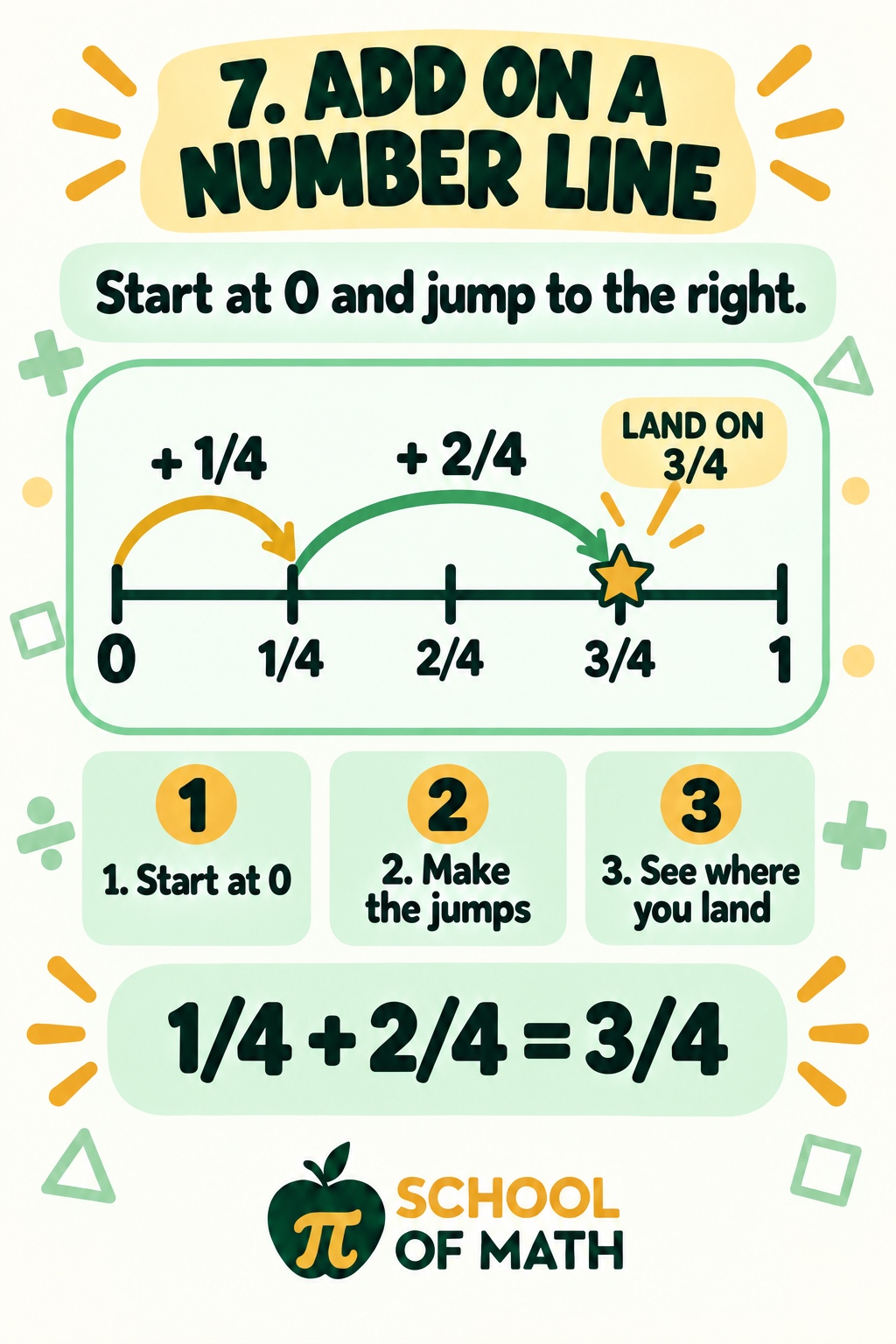
Adding fractions by jumping on a number line
A number line is one of the best ways to see fraction addition because it shows the starting fraction and the total in one picture. The steps in the poster are:
- Start at 0. The number line runs from 0 to 1 (and beyond). Divide the space from 0 to 1 into equal jumps that match the denominator. If the denominator is 4, the space is cut into 4 equal jumps of size 1/4.
- Make the jumps. To add 1/4 + 2/4, first jump 1/4 to the right (from 0 to 1/4). Then jump 2/4 more (two more quarters).
- See where you land. After both jumps you are at 3/4. That is the answer.
The rule and the picture agree: 1/4 + 2/4 = 3/4. The size of each jump (the denominator) stays the same; you just count how many jumps you made in total (the numerator).
This is also the first fraction picture we can extend past 1. If we kept jumping quarters we would pass 1 and end up at 5/4, 6/4, 7/4 … which is another way to see fractions greater than one whole.
5 practice questions with hidden solutions
8. Fraction word problems
Poster 8 of 8 — Kid Einsteins Class 11
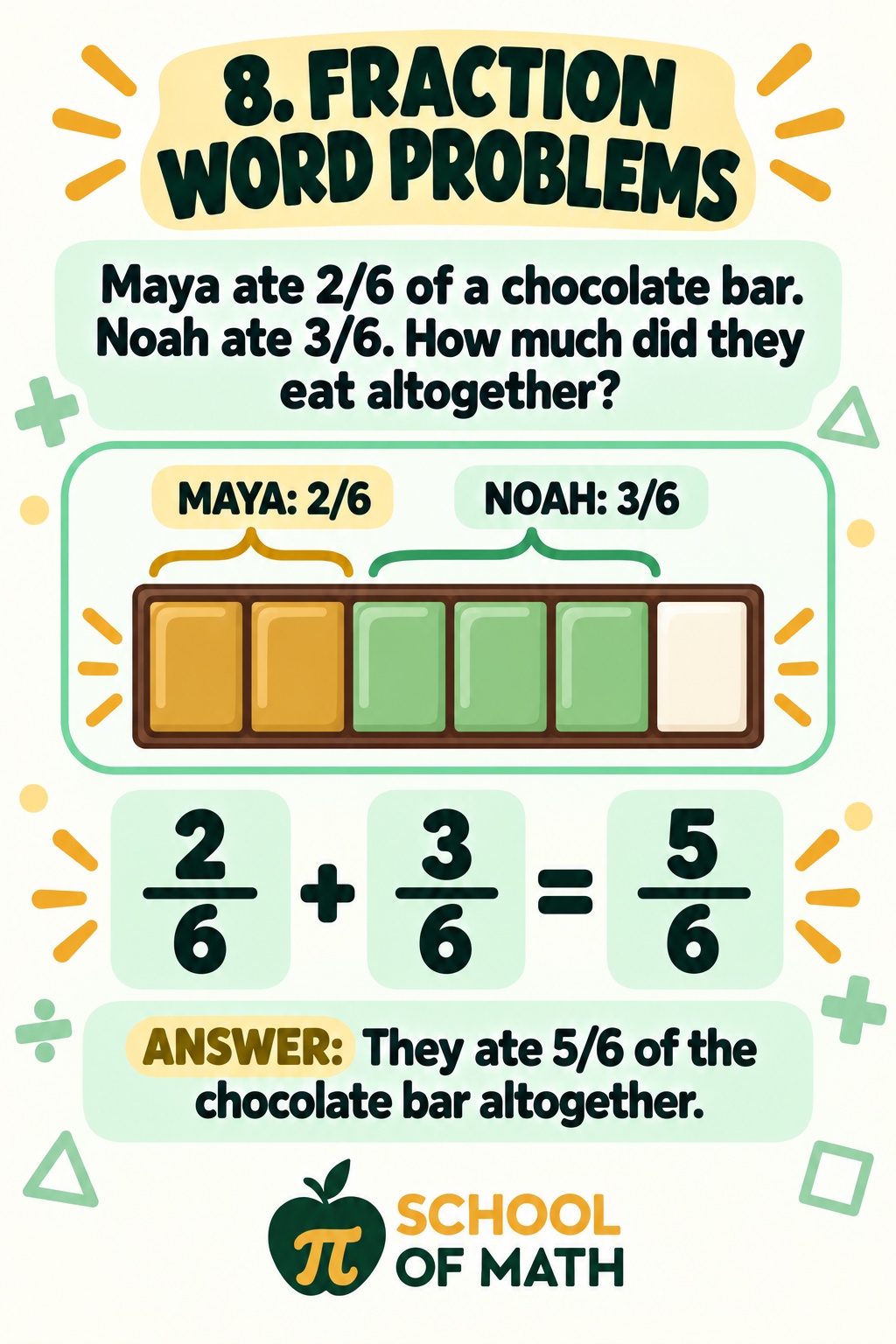
Turning a story into an addition of like fractions
Real math problems come as words, not just numbers. The trick is to identify the whole, then write each part as a fraction of that same whole. When both fractions share the same whole, they will have like denominators, and the rest of the work is Class 11 rules.
Poster problem: Maya ate 2/6 of a chocolate bar. Noah ate 3/6. How much did they eat altogether?
- Find the whole. The chocolate bar is cut into 6 equal squares — the whole is 1 bar with 6 sixths.
- Write each part. Maya ate 2 of the 6 squares = 2/6. Noah ate 3 of the 6 squares = 3/6.
- Same denominator? Yes — both are sixths.
- Add the numerators, keep the denominator. 2 + 3 = 5, denominator stays 6.
- Answer: 2/6 + 3/6 = 5/6 of the chocolate bar altogether.
The chocolate-bar picture on the poster shows this: Maya's 2 orange squares plus Noah's 3 green squares fill 5 of the 6 sections — exactly 5/6.
Watch for word-problem language that means "add": altogether, in all, combined, both, total, sum. And always double-check the whole is the same size in every fraction — if Maya ate part of one bar and Noah ate part of a different bar, we can't add them like this.
5 practice questions with hidden solutions
Ready to see how SOMATH teaches this in class?
Kid Einsteins meets in person on the Upper West Side. Small groups of up to 6 students. Real teachers, not tutors or apps. Every family starts with a free in-person evaluation so we can place your child at the right point in the 48-class syllabus.
SOMATH · 226 W 79th St, 1st Floor, New York, NY 10024 · (646) 668-6151 · See class schedule · Kid Einsteins course page
Frequently asked questions
How do you add fractions with like denominators?
What are like denominators?
Why do you keep the denominator the same?
What is the numerator and what is the denominator?
How do you add fractions on a number line?
Do you ever add the denominators?
What grade level is Kid Einsteins Class 11 for?
Related SOMATH class packs and posts
- Full Kid Einsteins course page (48-class rolling syllabus)
- Kid Einsteins Class 9 — Fraction concepts: parts of a whole and parts of a set (foundation for this class)
- Kid Einsteins Class 19 — Adding and subtracting fractions with unlike denominators (next step after mastering like denominators)
- Kid Einsteins Class 14 — Area, Perimeter & Word Problems
- Kid Einsteins Class 3 — Multiplication facts ×7, ×8, ×9 with area models
- Kid Einsteins Class 6 — Division facts and the inverse of multiplication
- Book a free in-person evaluation
- See the class schedule