Kid Einsteins · Class Pack · Grades 3–4 · September 14, 2026
Kid Einsteins Class 14: Area, Perimeter & Word Problems — 8 SOMATH Posters, Theory & 40 Practice Questions
A complete, illustrated grade 3–4 walk through perimeter, area, area vs perimeter units, area of a square, composite (L- and T-shaped) figures, missing sides, real-life fence-vs-paint word problems, and same-perimeter/different-area comparisons. Eight SOMATH posters, full theory under each one, and 40 practice questions with click-to-reveal solutions. Class 14 of the SOMATH Kid Einsteins 48-class rolling syllabus — Upper West Side, NYC.
Short answer
Perimeter is the distance around a shape — add every side, and the answer is in regular units (cm, in, ft, m). Area is the space inside — for a rectangle it's length × width, and the answer is in squared units (cm², in², ft², m²). In word problems: fence, ribbon, border, trim mean perimeter; paint, carpet, tile, grass mean area.
SOMATH Kid Einsteins · Grades 3–4 · Class 14 of 48
This is one class from our Kid Einsteins course
SOMATH's Kid Einsteins course meets in person on the Upper West Side (226 W 79th St). It's a 48-class rolling syllabus for grades 3–4 covering multiplication mastery, division, fractions & decimals, word problems, and area & perimeter. Small in-person groups of up to 6 students. Every family starts with a free in-person evaluation.
See the full Kid Einsteins course → Book a free evaluation · (646) 668-6151
What's inside this class
- 1. Perimeter — add every side
- 2. Area of a rectangle — length × width
- 3. Perimeter uses regular units. Area uses squared units.
- 4. Area of a square — side × side
- 5. Composite shapes — split into rectangles
- 6. Finding a missing side
- 7. Real-life word problems — fence vs paint
- 8. Same perimeter, different area
1. Perimeter — add every side
Poster 1 of 8 — Kid Einsteins Class 14
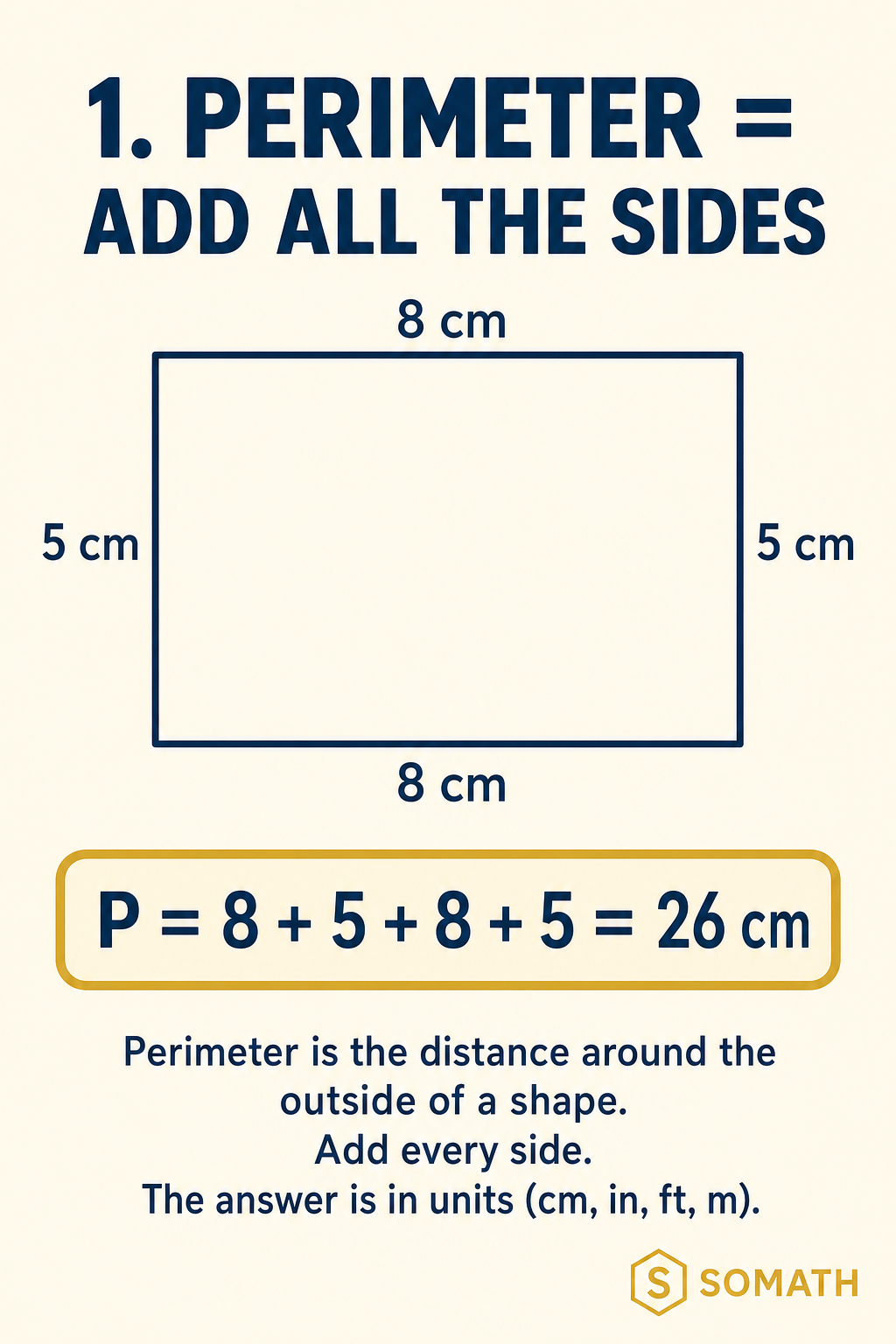
What is perimeter?
Perimeter is the total distance around the outside of a shape. It is a length. If you walked all the way around a rectangular playground, the perimeter is how far you walked.
To find perimeter, add every side. For a rectangle with length 8 cm and width 5 cm:
P = 8 + 5 + 8 + 5 = 26 cm
Two shortcuts for a rectangle:
- P = 2 × length + 2 × width (because both lengths are equal and both widths are equal)
- P = 2 × (length + width) (add first, then double)
The answer to a perimeter question is always in regular length units: cm, in, ft, m, km — never squared units.
5 practice questions with hidden solutions
2. Area of a rectangle — length × width
Poster 2 of 8 — Kid Einsteins Class 14
What is area?
Area is the amount of flat space inside a shape. It is measured by counting how many unit squares fit inside.
For a rectangle, you don't need to count every square — just multiply:
A = length × width
For a 6 cm × 4 cm rectangle: A = 6 × 4 = 24 cm². That's 24 unit squares fitting inside.
Why does the multiplication trick work? The rectangle is 6 squares across and 4 rows tall. That's 6 groups of 4 — a multiplication picture (an array). Kid Einsteins Class 3 (area models for ×7, ×8, ×9) is the same idea used for facts.
The answer is always in squared units: cm², in², ft², m². The little 2 tells you it is an area, not a length.
5 practice questions with hidden solutions
3. Perimeter uses regular units. Area uses squared units.
Poster 3 of 8 — Kid Einsteins Class 14
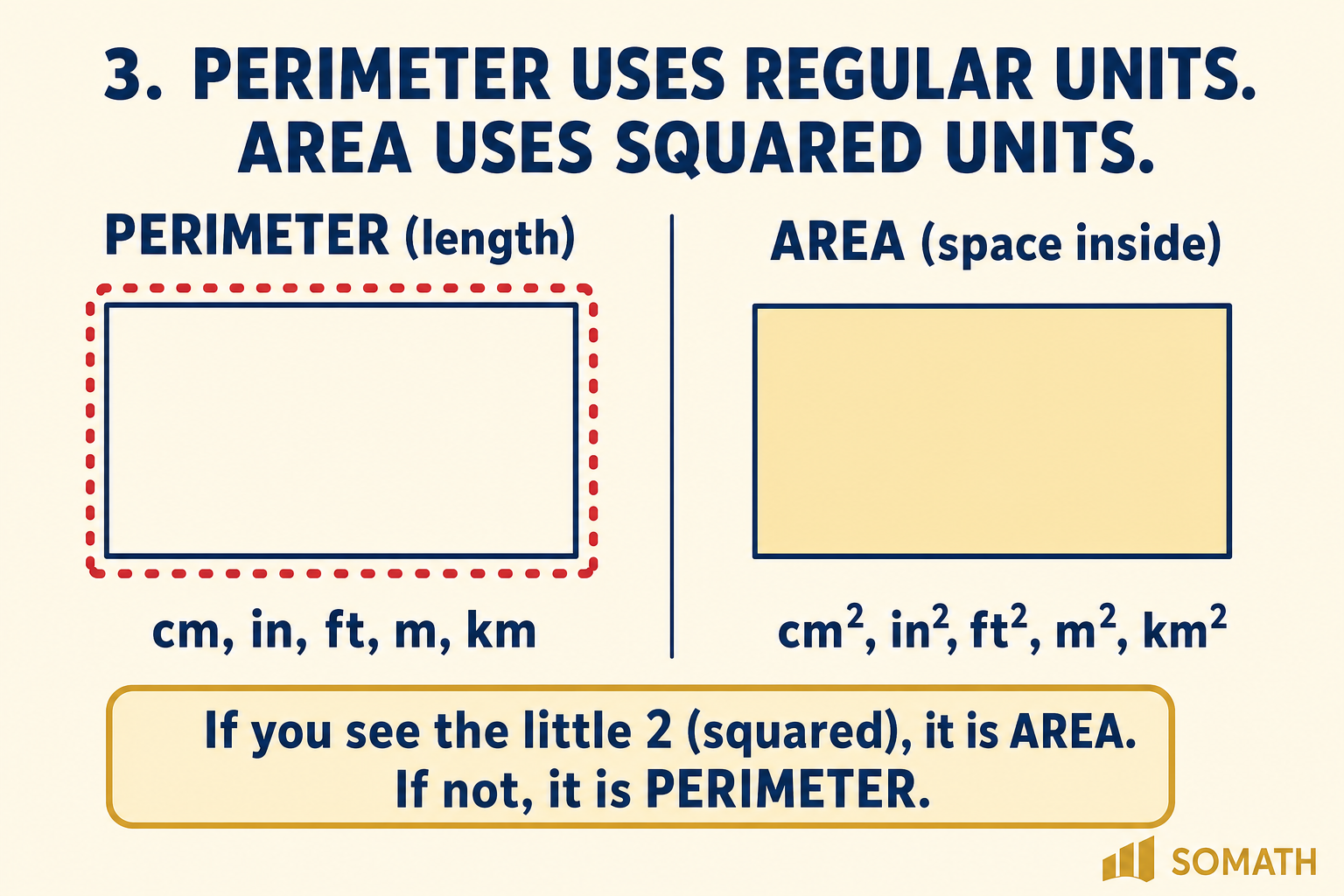
How do I know if a problem is asking for area or perimeter?
Look at the units in the answer — or the units the question expects.
- Perimeter is a length. Its units have no little 2: cm, in, ft, m, km.
- Area is a flat space. Its units always have a little 2 ("squared"): cm², in², ft², m², km².
The number 2 (called "squared") is a note that says two directions were multiplied — length × width. That's what makes it area.
The word-problem rule
Word problems rarely say "find the perimeter" or "find the area." Instead they ask a real question. Match the object to the idea:
- Perimeter (distance around): fence, ribbon, border, trim, molding, wire, walking track.
- Area (space inside): paint, carpet, grass, tile, wallpaper, wrapping paper, floor covering.
5 practice questions with hidden solutions
4. Area of a square — side × side
Poster 4 of 8 — Kid Einsteins Class 14
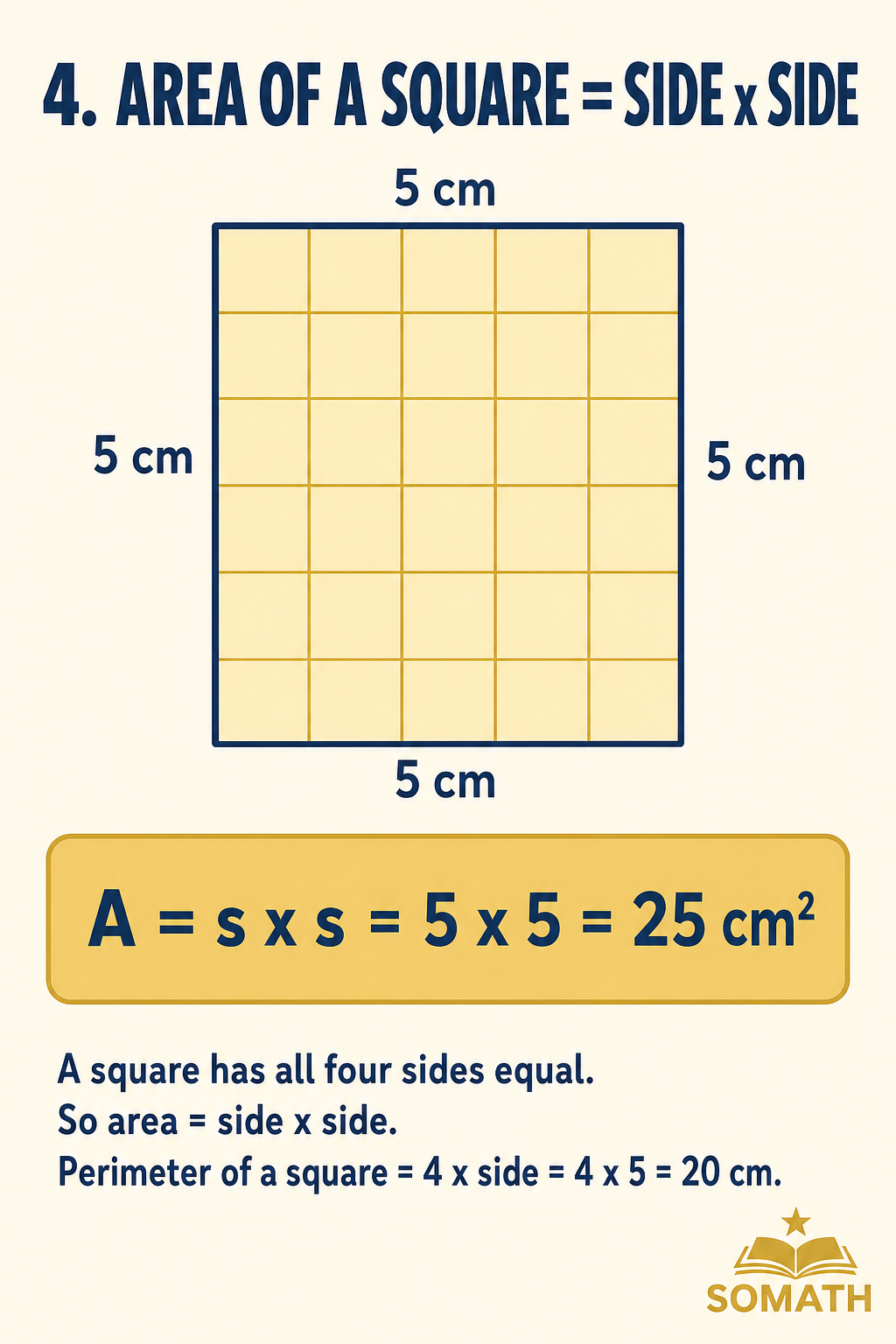
Why does a square get its own formula?
A square is a rectangle where all four sides are equal. So the same rectangle formula still works — it just gets shorter:
A = side × side = s²
For a square with a 5 cm side:
A = 5 × 5 = 25 cm²
The perimeter of a square is easy too, because all four sides are the same:
P = 4 × side = 4 × 5 = 20 cm
The word "squared"
Here's the connection Kid Einsteins should notice: the area of a square is called "side squared." That's where the little 2 in cm² and ft² comes from. Any area is basically "how many little squares fit inside."
5 practice questions with hidden solutions
5. Composite shapes — split into rectangles
Poster 5 of 8 — Kid Einsteins Class 14
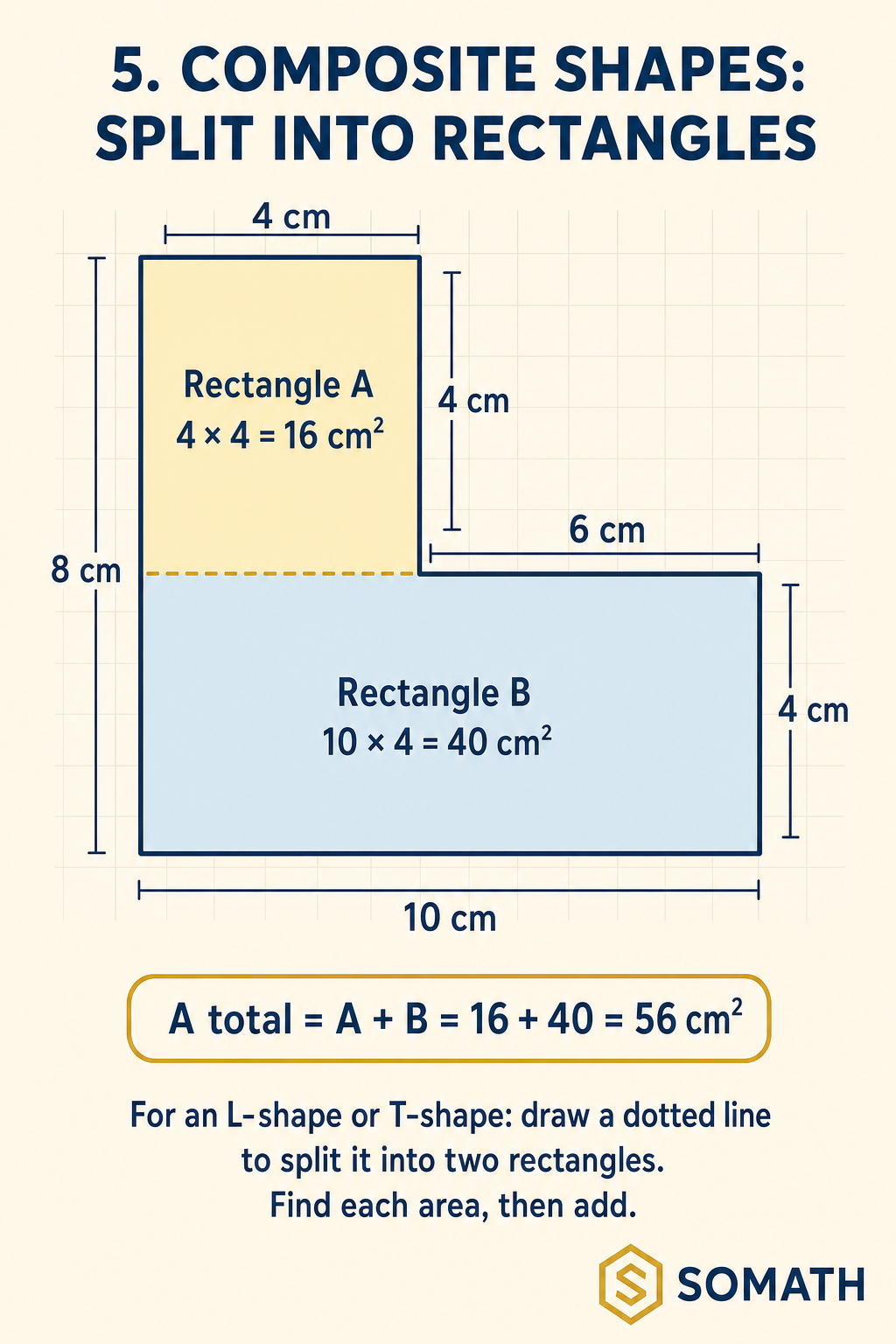
What if the shape isn't a rectangle?
Real rooms and yards are often L-shaped or T-shaped — not simple rectangles. The trick is to split them into rectangles you already know how to handle.
Steps for a composite area
- Draw a dotted line to split the shape into 2 (or more) rectangles.
- Label the sides of each rectangle. Sometimes you have to calculate a missing side by subtracting.
- Find each rectangle's area using length × width.
- Add the areas together.
For the L-shape on the poster:
- Rectangle A (top): 4 × 4 = 16 cm²
- Rectangle B (bottom): 10 × 4 = 40 cm²
- Total: 16 + 40 = 56 cm²
Perimeter of a composite shape
For perimeter, you still just add every outside side — but be careful not to include the dotted line you drew inside. The dotted line is only there to help you count area.
5 practice questions with hidden solutions
6. Finding a missing side
Poster 6 of 8 — Kid Einsteins Class 14
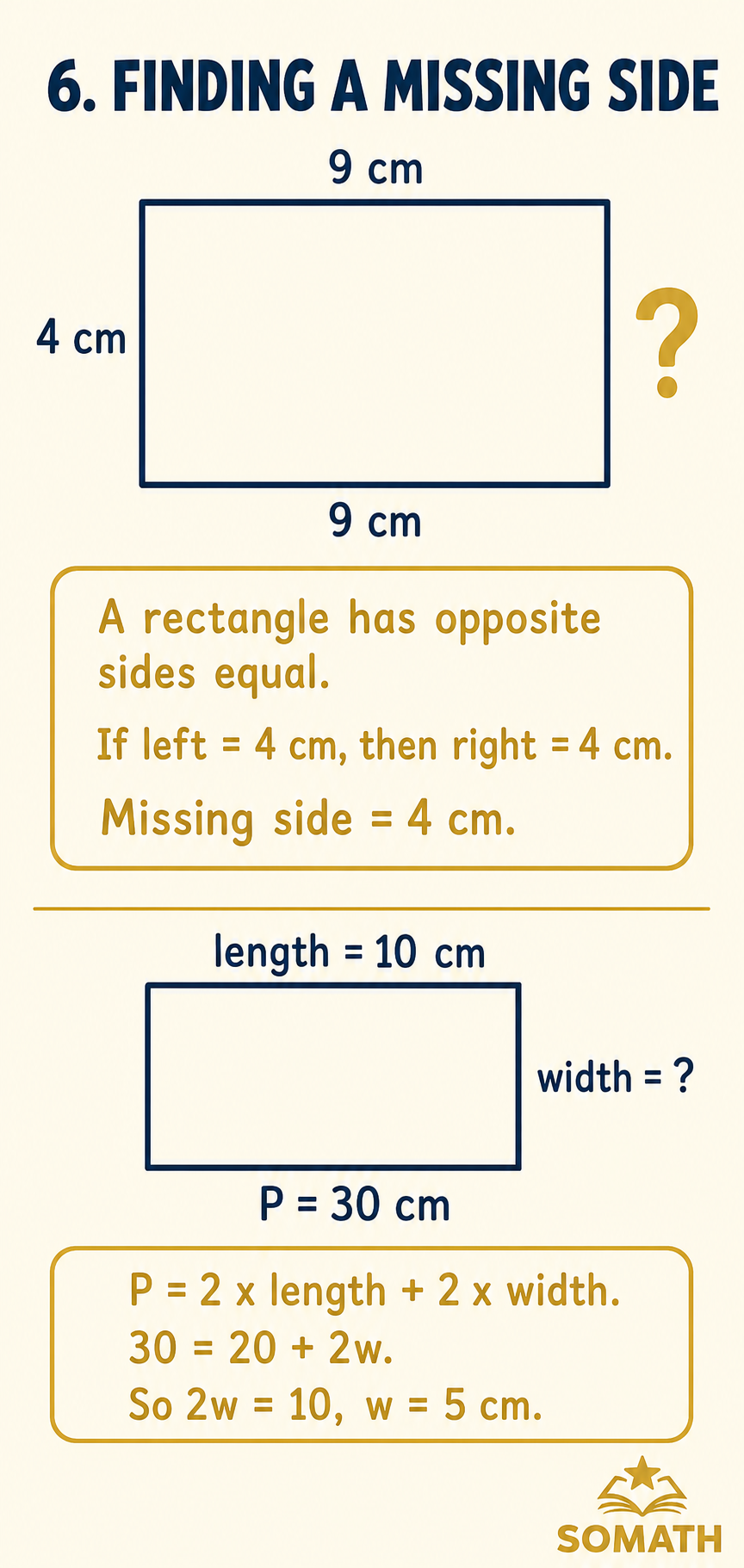
How do I find a side I'm not told?
Real problems often hide one of the sides. There are two everyday tricks.
Trick 1: use the shape's rule
In a rectangle, opposite sides are equal. So if the top is 9 cm, the bottom is also 9 cm. If the left is 4 cm, the right is also 4 cm.
In a square, all four sides are equal. So if you know one, you know all four.
Trick 2: work backwards from perimeter
If the problem tells you the perimeter and one side, use the formula in reverse.
Example: perimeter = 30 cm, length = 10 cm.
P = 2 × length + 2 × width
30 = 2 × 10 + 2 × width → 30 = 20 + 2w → 2w = 10 → w = 5 cm
Trick 3: work backwards from area
If the problem tells you the area and one side, divide.
Example: area = 60 ft², length = 12 ft. Then width = 60 ÷ 12 = 5 ft. This uses Kid Einsteins Class 6 — division is the inverse of multiplication.
5 practice questions with hidden solutions
7. Real-life word problems — fence vs paint
Poster 7 of 8 — Kid Einsteins Class 14
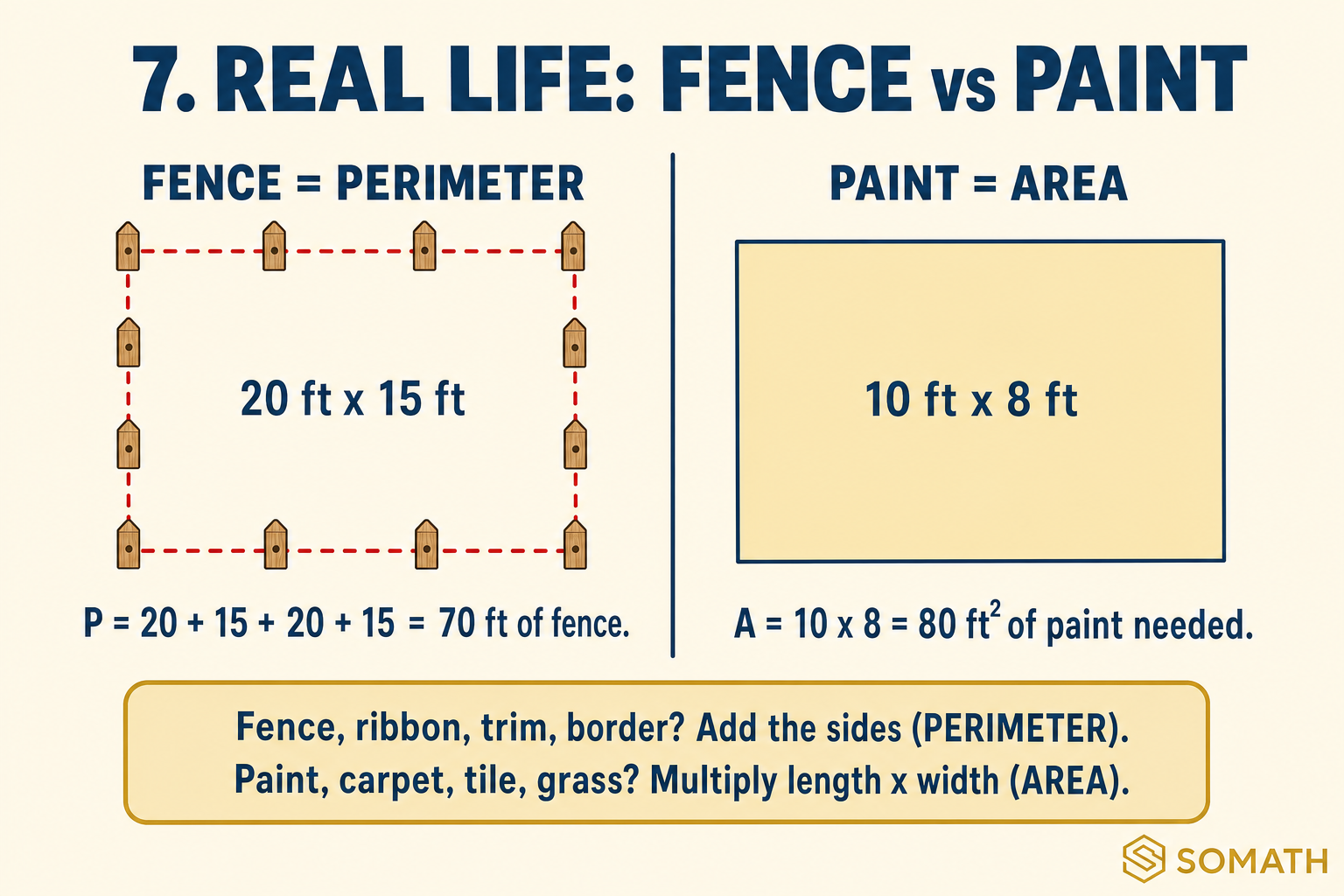
How do I turn a word problem into area vs perimeter?
Word problems rarely use the words "area" or "perimeter." You have to decide which one the problem is really asking for. Ask yourself: does the thing go AROUND the shape, or does it FILL the shape?
Around the shape → perimeter
- Fence for a yard
- Ribbon or lace or trim around a rectangle
- Border around a poster or bulletin board
- Baseboard or molding around a room
- Walking around the outside of a track
Fills the shape → area
- Paint for a wall
- Carpet or rug or tile for a floor
- Grass or sod for a yard
- Wallpaper for a wall
- Wrapping paper for a flat gift face
Poster example
- Fence around a 20 ft × 15 ft yard: P = 20 + 15 + 20 + 15 = 70 ft of fence.
- Paint for a 10 ft × 8 ft wall: A = 10 × 8 = 80 ft² of paint.
Notice how the units in your answer tell you which one you found: ft for a length (fence), ft² for a space (paint).
5 practice questions with hidden solutions
8. Same perimeter, different area
Poster 8 of 8 — Kid Einsteins Class 14
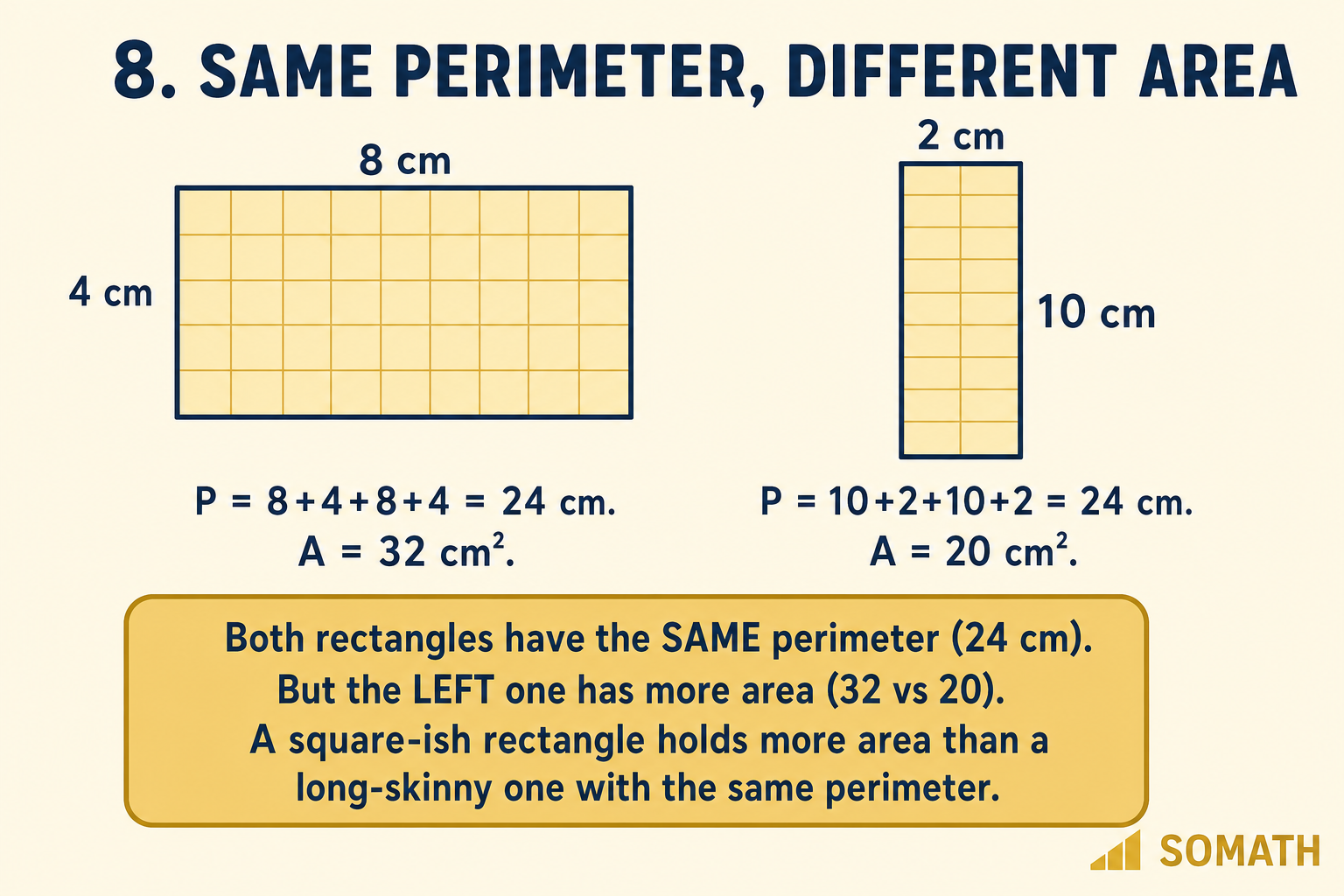
Do rectangles with the same perimeter have the same area?
Short answer: no. Two different rectangles can have the same perimeter and very different areas.
The poster's example
- Rectangle 1: 8 cm × 4 cm. P = 24 cm. A = 32 cm².
- Rectangle 2: 10 cm × 2 cm. P = 24 cm. A = 20 cm².
Same perimeter — but the more square-shaped rectangle holds more area. If you make the rectangle very long and skinny, it wastes area.
The big idea
For a fixed perimeter, the rectangle with the most area is the one closest to a square. This is why a square garden of 6 × 6 (P = 24, A = 36 cm²) beats every other rectangle with perimeter 24.
Where students go wrong
Many kids think "same perimeter means same area" or "same area means same perimeter." Both are false. Perimeter and area are different measurements. You have to compute each one separately.
5 practice questions with hidden solutions
Ready to see how SOMATH teaches this in class?
Kid Einsteins meets in person on the Upper West Side. Small groups of up to 6 students. Real teachers, not tutors or apps. Every family starts with a free in-person evaluation so we can place your child at the right point in the 48-class syllabus.
SOMATH · 226 W 79th St, 1st Floor, New York, NY 10024 · (646) 668-6151 · See class schedule · Kid Einsteins course page
Frequently asked questions
What's the difference between area and perimeter?
What is the formula for the area of a rectangle?
What is the formula for the perimeter of a rectangle?
How do I find the area of an L-shape or T-shape?
If two rectangles have the same perimeter, do they have the same area?
Which unit means area — cm or cm²?
What grade level is Kid Einsteins Class 14 for?
Related SOMATH class packs and posts
- Kid Einsteins Class 2 — Multiplication facts ×3, ×4, ×6 (times tables that power the area formula)
- Kid Einsteins Class 3 — Multiplication facts ×7, ×8, ×9 with area models
- Kid Einsteins Class 4 — Distributive thinking and partial products
- Kid Einsteins Class 5 — Multi-digit multiplication
- Kid Einsteins Class 6 — Division facts and the inverse of multiplication
- 3rd Grade Geometry — 20 questions on shapes and measurement
- 4th Grade Geometry — 30 practice questions
- Full Kid Einsteins course page (48-class syllabus)
- Book a free in-person evaluation
- See the class schedule
Published September 14, 2026 · SOMATH — School of Math · 226 W 79th St, Upper West Side, NYC · (646) 668-6151