Kid Einsteins · Class 13 · Decimals · Grades 3–4
Decimals to the Tenths and Hundredths (Kid Einsteins Class 13, Grades 3–4) — 8 Posters, Theory, 40 Practice Questions + 10 Word Problems with Hidden Answers
Decimals to the tenths and hundredths are how grade 3 and grade 4 students learn to write parts of a whole using base-ten place value. The same idea powers dollars and cents, the metric ruler, sports timing to the hundredth, and every fractions–decimals–percents bridge that comes after. This Kid Einsteins Class 13 pack has 8 illustrated SOMATH posters, theory under each poster, 5 practice questions per poster (40 total) with click-to-reveal step-by-step answers, plus 10 word problems of increasing difficulty at the end.
This class is part of the Kid Einsteins arc at SOMATH — School of Math on the Upper West Side of Manhattan. Class 13 is the entry gate to decimals: everything that follows — adding and subtracting decimals, dividing by a decimal, percent, and scientific notation — needs the tenths and hundredths place-value fluency taught here. Class 13 is taught in-person at 226 W 79th St, one block from the 1 train at 79th Street and steps from PS 87, PS 199, PS 452, and PS 9. Call (646) 668-6151 or book a free 30-minute evaluation to place your grade 3 or grade 4 child in the right Kid Einsteins class.
What’s in this class pack
- Poster 1 — Introduction to decimals (5 questions)
- Poster 2 — Tenths: dividing a whole into 10 equal parts (5 questions)
- Poster 3 — Hundredths: dividing a whole into 100 equal parts (5 questions)
- Poster 4 — Decimal place value (5 questions)
- Poster 5 — Reading and writing decimals (5 questions)
- Poster 6 — Comparing and ordering decimals (5 questions)
- Poster 7 — Decimals on a number line (5 questions)
- Poster 8 — Decimals in real life: money and measurement (5 questions)
- Bonus — 10 word problems of increasing difficulty
- FAQ — parent questions on decimals in grades 3–4
Poster 1 — Introduction to Decimals
What a decimal is, how base-ten place value extends past the decimal point, and where decimals show up in everyday life.
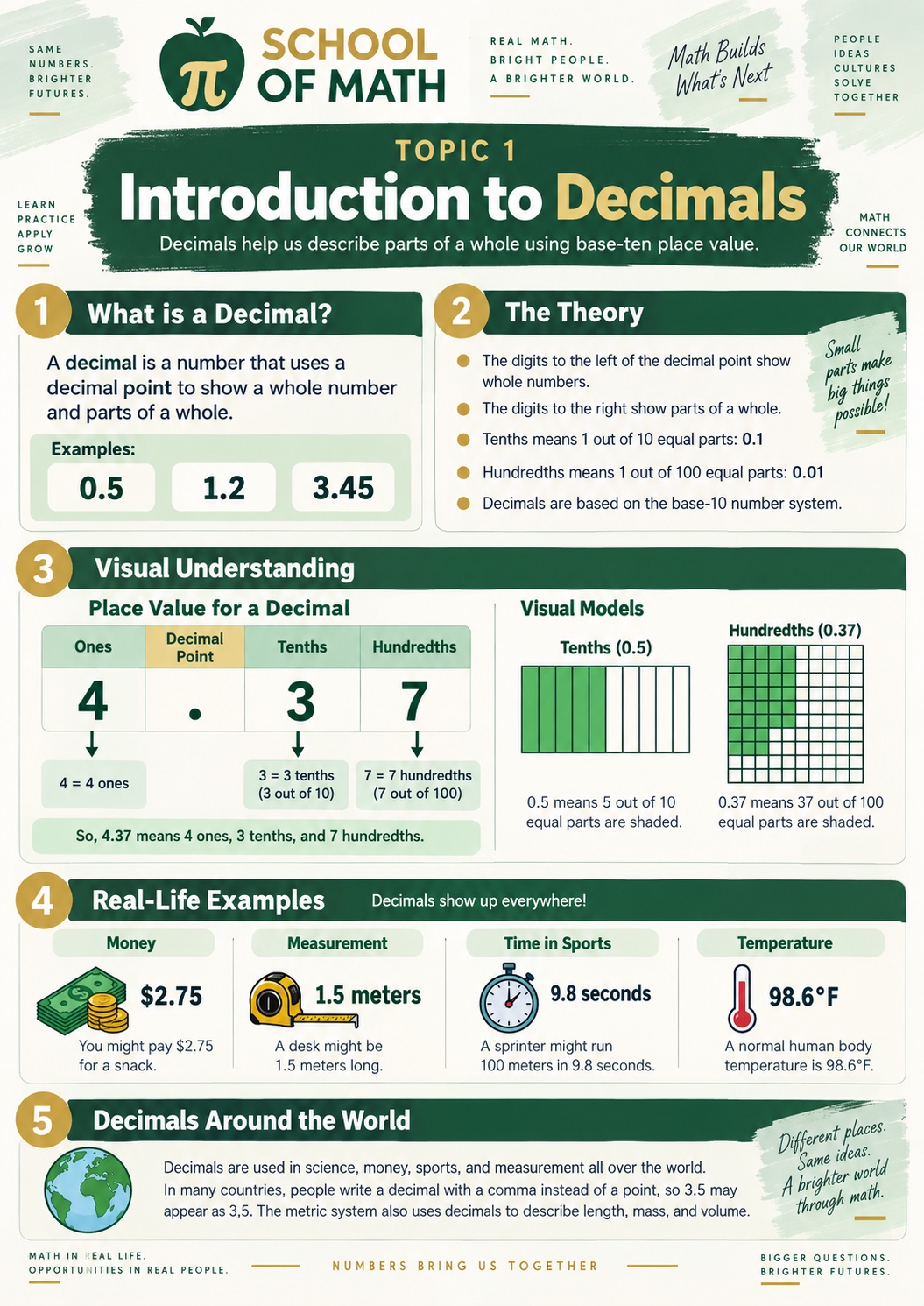
Theory — what a decimal is
A decimal is a number that uses a decimal point to show a whole number and parts of a whole. The digits to the left of the decimal point are whole numbers. The digits to the right of the decimal point are parts of a whole.
Decimals are built on the base-10 number system: just like the ones, tens, and hundreds places grow by ×10 to the left, the places to the right of the decimal point shrink by ÷10.
- The first place to the right of the decimal point is the tenths place. One tenth = 1/10 = 0.1.
- The second place to the right is the hundredths place. One hundredth = 1/100 = 0.01.
Example: in 4.37 the 4 is 4 ones, the 3 is 3 tenths, and the 7 is 7 hundredths. So 4.37 = 4 + 0.3 + 0.07.
Where decimals show up on the Upper West Side: money ($2.75 for a bagel), measurement (a 1.5 m desk), sports (a runner finishing 100 m in 9.8 seconds), science (98.6°F body temperature). If it needs to be precise, it uses a decimal.
Q1.1 easy
Which of these numbers is a decimal? 5 12 3.45 100
Answer: 3.45
A decimal is any number that uses a decimal point to show a whole part and a part of a whole. Only 3.45 has a decimal point — the other three are whole numbers.
Q1.2 easy
In the decimal 0.5, which place is the 5 in?
Answer: the tenths place.
The first digit to the right of the decimal point is always the tenths place. So the 5 in 0.5 means 5 tenths, which is the same as the fraction 5/10.
Q1.3 easy
Which fraction is the same as 0.1? 1/2 1/10 1/100
Answer: 1/10.
0.1 is one tenth — one of ten equal parts of a whole. That is exactly what the fraction 1/10 means.
Q1.4 medium
Break 3.45 into its whole part and its decimal part.
Answer: whole part = 3; decimal part = 0.45.
Everything to the left of the decimal point is the whole part. Everything to the right of the decimal point is the decimal part. 3.45 = 3 (whole) + 0.45 (parts of a whole).
Q1.5 medium
Circle the real-life examples that use decimals: a price of $2.75 · the number of students in a class (24) · a race time of 9.8 seconds · a temperature of 98.6°F.
Answer: $2.75, 9.8 seconds, and 98.6°F use decimals. The number of students (24) is a whole number.
Prices, sports timing, and temperatures all need to be more precise than whole numbers, so they use decimals. You cannot have half a student, so class size stays a whole number.
Poster 2 — Tenths: Dividing a Whole into 10 Equal Parts
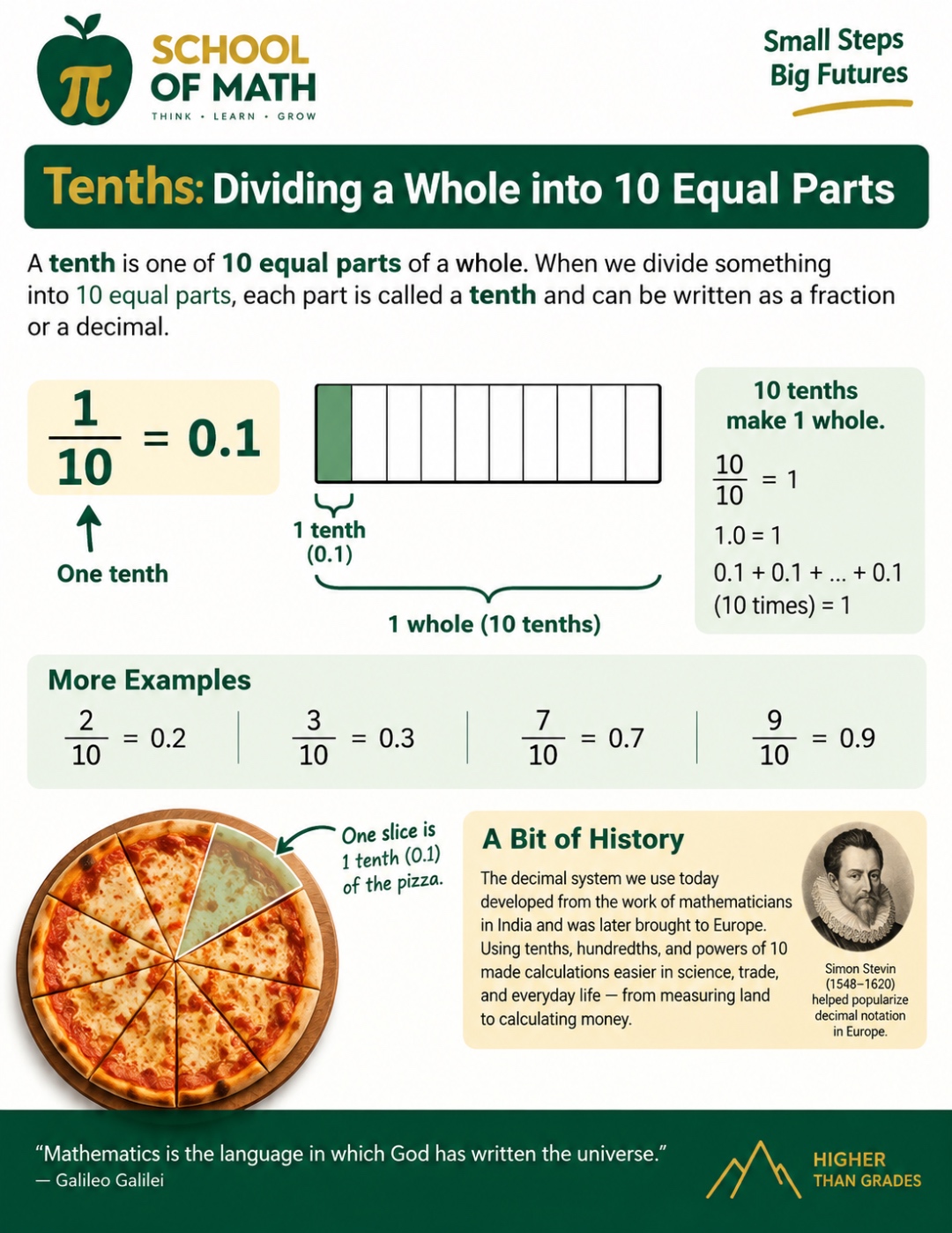
One tenth is one of ten equal parts of a whole; ten tenths make one whole.
Theory — tenths
A tenth is one of ten equal parts of a whole. When we divide something into 10 equal parts, each part is called a tenth and can be written as either a fraction or a decimal:
1/10 = 0.1
Ten tenths make one whole:
10/10 = 1 1.0 = 1 0.1 + 0.1 + … + 0.1 (10 times) = 1
More examples: 2/10 = 0.2, 3/10 = 0.3, 7/10 = 0.7, 9/10 = 0.9.
Pizza model: if you cut a pizza into 10 equal slices, one slice is one tenth (0.1) of the pizza. Three slices is three tenths (0.3). Ten slices is the whole pizza (1.0).
Q2.1 easy
Write 3/10 as a decimal.
Answer: 0.3.
Any fraction with denominator 10 becomes a decimal in the tenths place. 3/10 = three tenths = 0.3.
Q2.2 easy
Write 0.7 as a fraction.
Answer: 7/10.
0.7 is seven tenths. As a fraction with denominator 10, that is 7/10.
Q2.3 easy
A chocolate bar is divided into 10 equal pieces. You eat 4 pieces. What decimal of the chocolate bar did you eat?
Answer: 0.4.
4 pieces out of 10 equal pieces = 4/10 = 0.4 of the chocolate bar.
Q2.4 medium
How many tenths make one whole? Write your answer as both a fraction and a decimal.
Answer: 10 tenths make one whole; 10/10 = 1.0 = 1.
The whole is divided into 10 equal parts, so you need all 10 of them to have the whole back. 10/10 simplifies to 1, and 1.0 is another way to write 1.
Q2.5 medium
A pizza is cut into 10 equal slices. Maya eats 3 slices and Noah eats 2 slices. What decimal of the pizza is left?
Answer: 0.5 of the pizza is left.
Slices eaten: 3 + 2 = 5 slices Slices left: 10 - 5 = 5 slices Fraction left: 5/10 = 0.5
Poster 3 — Hundredths: Dividing a Whole into 100 Equal Parts
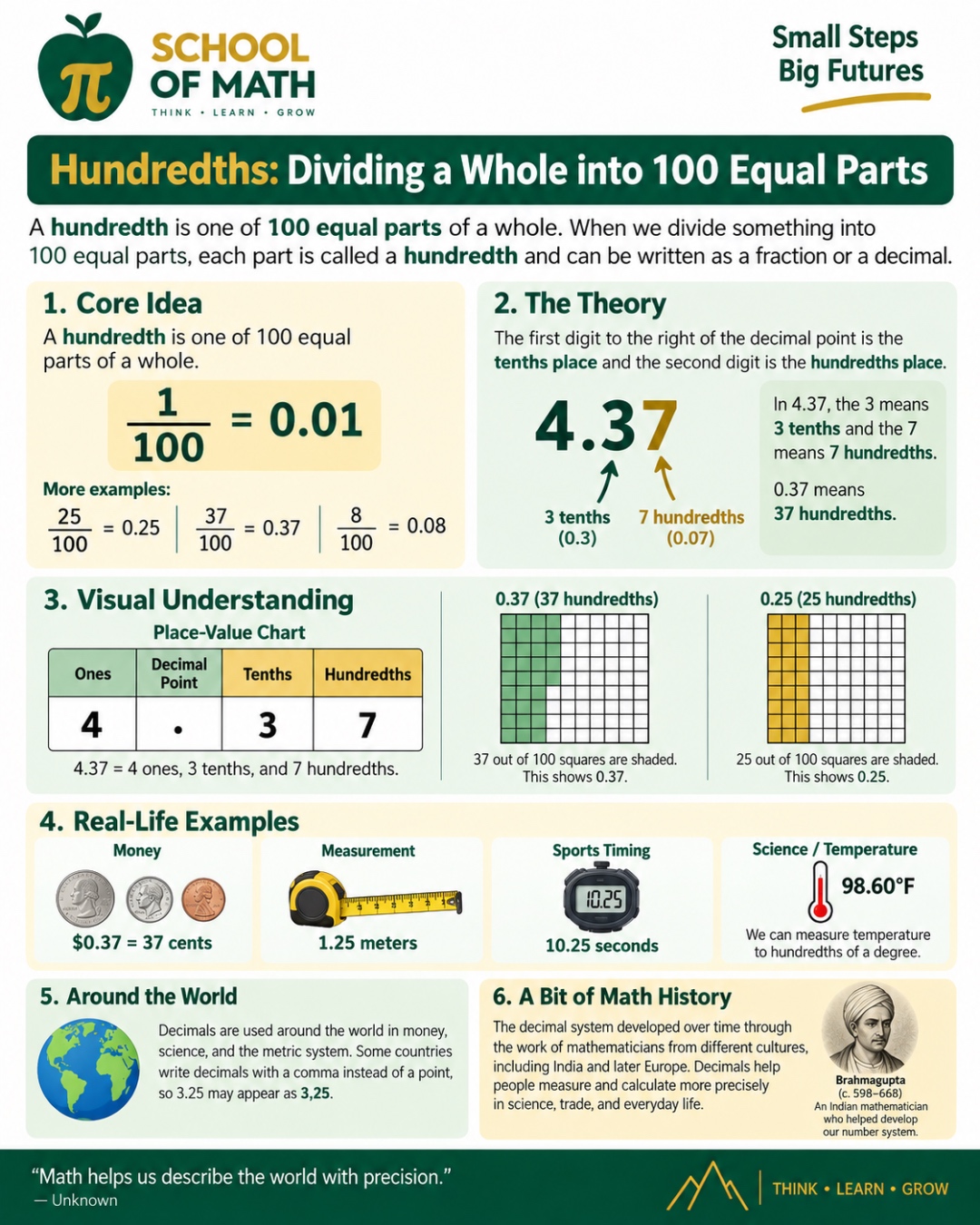
One hundredth is one of one hundred equal parts of a whole; the second digit after the decimal point is the hundredths place.
Theory — hundredths
A hundredth is one of one hundred equal parts of a whole. When we divide something into 100 equal parts, each part is a hundredth and can be written as either a fraction or a decimal:
1/100 = 0.01
The second digit to the right of the decimal point is the hundredths place. In 4.37:
- the 3 is in the tenths place (3 tenths = 0.3)
- the 7 is in the hundredths place (7 hundredths = 0.07)
- together, 0.37 means 37 hundredths
More examples: 25/100 = 0.25, 37/100 = 0.37, 8/100 = 0.08.
Watch out for 8/100. It is not 0.8. Eight hundredths must have a zero in the tenths place: 8/100 = 0.08. The zero is a placeholder that pushes the 8 into the hundredths place.
Q3.1 easy
Write 25/100 as a decimal.
Answer: 0.25.
Any fraction with denominator 100 becomes a decimal with two digits after the decimal point. 25/100 = 25 hundredths = 0.25.
Q3.2 easy
Write 0.68 as a fraction with denominator 100.
Answer: 68/100.
0.68 is sixty-eight hundredths. Written as a fraction with denominator 100, that is 68/100.
Q3.3 medium
Write 8/100 as a decimal. Be careful.
Answer: 0.08 (not 0.8).
0.8 means 8 tenths (8/10), which is much bigger. To get to the hundredths place, we need a zero to hold the tenths place: 8/100 = 0.08.
Q3.4 medium
In the decimal 4.37, name the place of each digit and its value.
Answer: 4 is in the ones place (value 4); 3 is in the tenths place (value 0.3); 7 is in the hundredths place (value 0.07).
Reading left to right past the decimal point, the places are tenths, then hundredths. 4.37 = 4 + 0.3 + 0.07.
Q3.5 medium
A hundredths grid has 100 tiny squares. 37 of them are shaded. Write the shaded amount as both a fraction and a decimal.
Answer: 37/100 = 0.37.
Each tiny square is one hundredth of the whole grid. 37 shaded squares = 37 hundredths = 37/100 = 0.37.
Poster 4 — Decimal Place Value
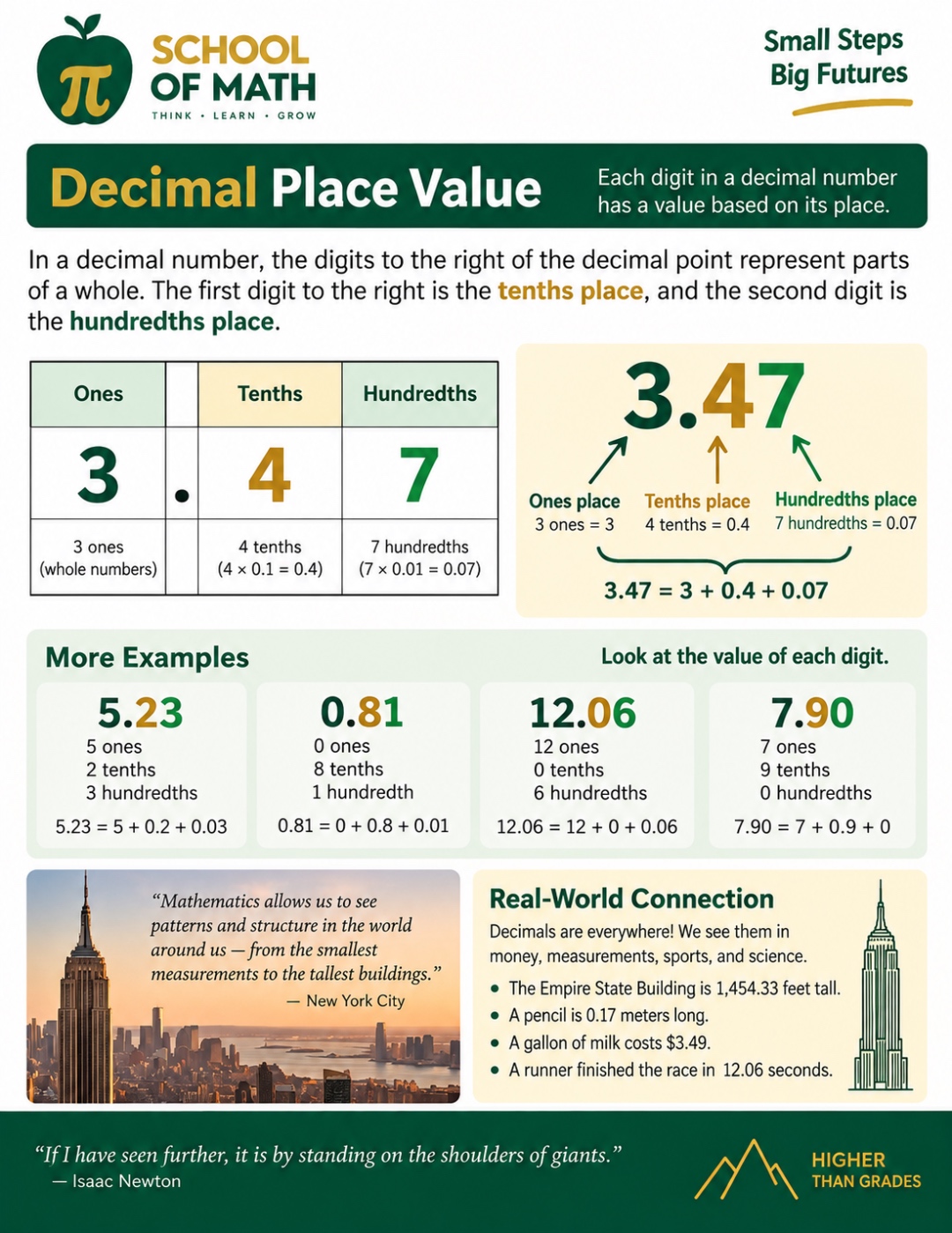
Each digit in a decimal has a value based on its place: ones, tenths, and hundredths.
Theory — decimal place value and expanded form
Each digit in a decimal has a value based on its place. The place-value chart runs, from left of the decimal point outward:
Ones . Tenths Hundredths
To find the value of a digit, multiply the digit by its place value:
- ones digit × 1
- tenths digit × 0.1
- hundredths digit × 0.01
Example — 3.47 in expanded form:
3.47 = 3×1 + 4×0.1 + 7×0.01 = 3 + 0.4 + 0.07
| Decimal | Expanded form |
|---|---|
| 5.23 | 5 + 0.2 + 0.03 |
| 0.81 | 0 + 0.8 + 0.01 |
| 12.06 | 12 + 0 + 0.06 |
| 7.90 | 7 + 0.9 + 0 |
The zero rule. A zero in a decimal is not just decoration — it holds the place value. In 12.06 the 0 shows that there are 0 tenths, which is why the 6 is a hundredth, not a tenth. In 7.90 the trailing zero shows that we measured all the way to the hundredths and there were none there — 7.9 and 7.90 are equal in value but 7.90 signals more precise measurement.
Q4.1 easy
What is the value of the underlined digit in 5.23?
Answer: 0.2 (2 tenths).
The 2 sits in the tenths place, so its value is 2 tenths = 0.2.
Q4.2 easy
Write 0.81 in expanded form.
Answer: 0 + 0.8 + 0.01.
0 ones + 8 tenths + 1 hundredth = 0 + 0.8 + 0.01.
Q4.3 medium
Write 12.06 in expanded form.
Answer: 12 + 0 + 0.06 (or 10 + 2 + 0 + 0.06).
There are 12 ones (10 + 2), 0 tenths, and 6 hundredths. The 0 in the tenths place matters: it is what pushes the 6 into the hundredths place.
Q4.4 medium
Are 7.9 and 7.90 equal? Explain.
Answer: Yes, 7.9 = 7.90.
The trailing zero in 7.90 does not add value — it just says there are 0 hundredths. 7.9 = 7 + 0.9 + 0 = 7.90. In measurement, writing 7.90 signals that you measured all the way to the hundredths and there were none there.
Q4.5 medium
The Empire State Building is 1,454.33 feet tall. Name the value of each digit after the decimal point.
Answer: the first 3 is in the tenths place (value 0.3, meaning 3 tenths of a foot); the second 3 is in the hundredths place (value 0.03, meaning 3 hundredths of a foot).
1,454.33 feet = 1,454 whole feet plus 33 hundredths of a foot. The digits after the decimal point tell us the height is precise to about a third of a foot.
Poster 5 — Reading and Writing Decimals
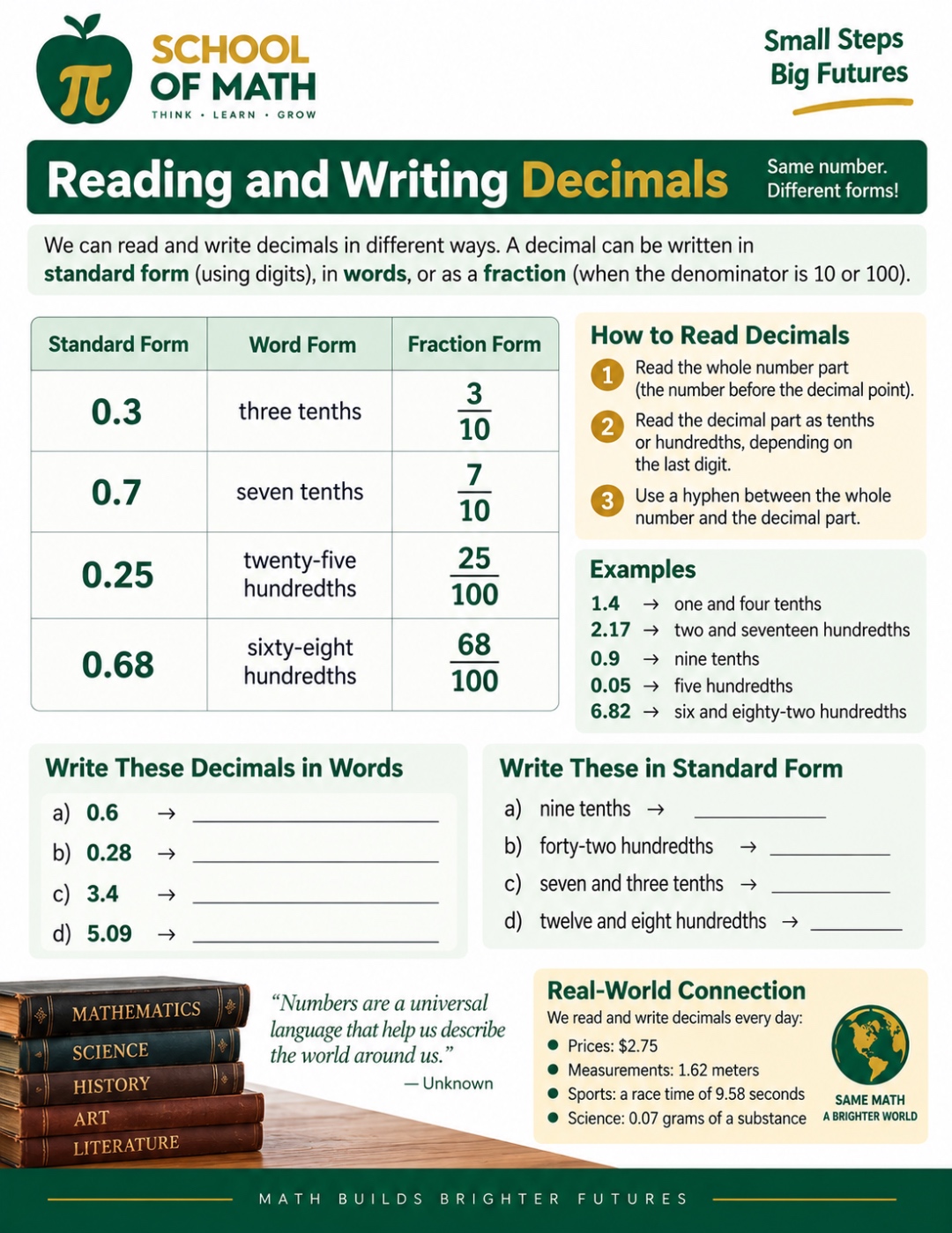
Standard form (digits), word form (in English), and fraction form (with denominator 10 or 100).
Theory — reading and writing decimals in three forms
Every decimal can be written in three ways:
- Standard form — the digits with a decimal point (0.25).
- Word form — in English words (twenty-five hundredths).
- Fraction form — with denominator 10 or 100 (25/100).
How to read a decimal (3-step rule):
- Read the whole-number part (the number before the decimal point).
- Say “and” for the decimal point.
- Read the decimal part as if it were a whole number, then say the place-value name of the last digit (tenths or hundredths).
| Standard | Word form | Fraction |
|---|---|---|
| 0.3 | three tenths | 3/10 |
| 0.7 | seven tenths | 7/10 |
| 0.25 | twenty-five hundredths | 25/100 |
| 0.68 | sixty-eight hundredths | 68/100 |
| 1.4 | one and four tenths | 1 and 4/10 |
| 2.17 | two and seventeen hundredths | 2 and 17/100 |
| 0.05 | five hundredths | 5/100 |
| 6.82 | six and eighty-two hundredths | 6 and 82/100 |
Common mistake: reading 0.37 as “zero point three seven.” That is how people say it out loud in a hurry, but in a math class the answer we want is “thirty-seven hundredths” — because that is the answer that tells us the place value of the last digit.
Q5.1 easy
Write 0.6 in word form.
Answer: six tenths.
The last digit (6) is in the tenths place, so 0.6 = six tenths.
Q5.2 easy
Write 0.28 in word form.
Answer: twenty-eight hundredths.
The last digit (8) is in the hundredths place, so we read the decimal part as if it were a whole number (28) and add the place-value name of the last digit (hundredths).
Q5.3 medium
Write 3.4 in word form.
Answer: three and four tenths.
Read the whole part (three), say “and” for the decimal point, then read the decimal part with its place name: four tenths.
Q5.4 medium
Write 5.09 in word form.
Answer: five and nine hundredths.
The 0 in the tenths place means we have zero tenths, and the 9 in the hundredths place gives us nine hundredths. Together with the whole part (5), we say “five and nine hundredths.”
Q5.5 medium
Write in standard form: (a) nine tenths (b) forty-two hundredths (c) seven and three tenths (d) twelve and eight hundredths.
Answer: (a) 0.9 (b) 0.42 (c) 7.3 (d) 12.08.
(a) nine tenths → last digit in tenths → 0.9 (b) forty-two hundredths → last digit in hundredths → 0.42 (c) seven and three tenths → whole 7, then 3 tenths → 7.3 (d) twelve and eight hundredths → whole 12, 0 tenths, 8 hundredths → 12.08 (NOT 12.8)
Poster 6 — Comparing and Ordering Decimals
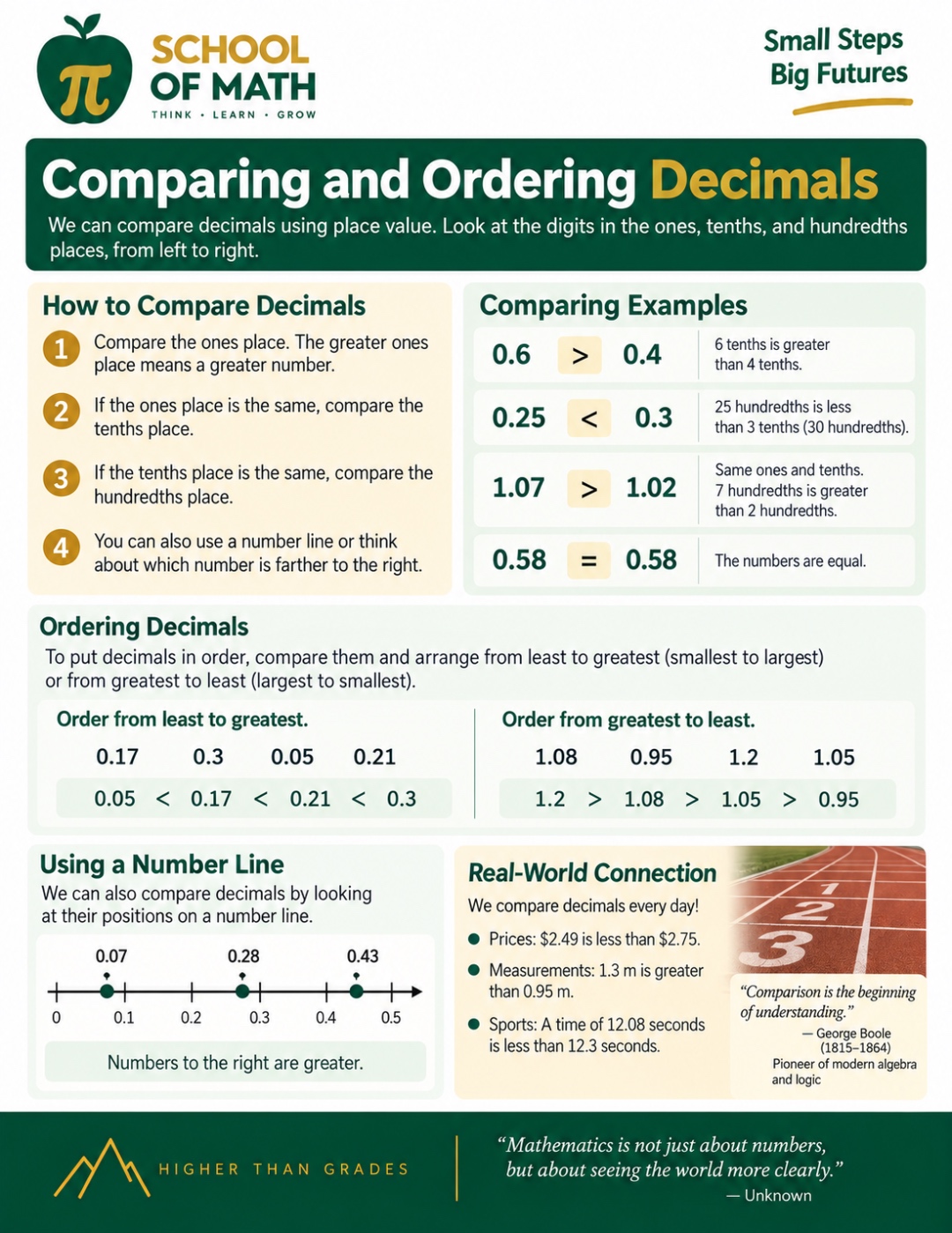
Compare place by place from left to right: ones, then tenths, then hundredths.
Theory — comparing and ordering decimals
The 4-step compare rule — work left to right, place by place:
- Compare the ones place. The bigger ones digit wins.
- If the ones are equal, compare the tenths place.
- If the tenths are also equal, compare the hundredths place.
- You can also use a number line: numbers farther to the right are greater.
| Compare | Answer | Why |
|---|---|---|
| 0.6 vs 0.4 | 0.6 > 0.4 | 6 tenths > 4 tenths |
| 0.25 vs 0.3 | 0.25 < 0.3 | 25 hundredths < 30 hundredths (compare tenths: 2 < 3) |
| 1.07 vs 1.02 | 1.07 > 1.02 | Same ones and tenths; 7 hundredths > 2 hundredths |
| 0.58 vs 0.58 | 0.58 = 0.58 | Every digit matches |
The classic trap: thinking 0.25 is bigger than 0.3 because “25 is bigger than 3.” Not true — the digits after the decimal point are not read as whole numbers.
Same-length trick. Give both decimals the same number of decimal places by adding zeros on the right (this does not change the value): 0.3 = 0.30, so 0.30 vs 0.25 is easy — 30 hundredths > 25 hundredths, so 0.3 > 0.25.
Ordering examples:
- Least to greatest: 0.05, 0.17, 0.21, 0.3 → 0.05 < 0.17 < 0.21 < 0.3
- Greatest to least: 1.2, 1.08, 1.05, 0.95 → 1.2 > 1.08 > 1.05 > 0.95
Q6.1 easy
Compare using >, <, or =: 0.6 __ 0.4.
Answer: 0.6 > 0.4.
Ones are equal (0 = 0). Tenths: 6 > 4, so 0.6 is greater.
Q6.2 easy
Compare using >, <, or =: 0.25 __ 0.3.
Answer: 0.25 < 0.3.
Ones are equal. Tenths: 2 < 3, so 0.25 is smaller. (Trick: give both the same length → 0.25 vs 0.30 → 25 hundredths < 30 hundredths.)
Q6.3 medium
Compare using >, <, or =: 1.07 __ 1.02.
Answer: 1.07 > 1.02.
Ones are equal (1 = 1). Tenths are equal (0 = 0). Hundredths: 7 > 2, so 1.07 > 1.02.
Q6.4 medium
Order from least to greatest: 0.17, 0.3, 0.05, 0.21.
Answer: 0.05 < 0.17 < 0.21 < 0.3.
Give them all two decimal places: 0.17, 0.30, 0.05, 0.21 Now think in hundredths: 17, 30, 5, 21 Sort smallest to largest: 5, 17, 21, 30 So: 0.05 < 0.17 < 0.21 < 0.3
Q6.5 medium
Order from greatest to least: 1.2, 0.95, 1.08, 1.05.
Answer: 1.2 > 1.08 > 1.05 > 0.95.
Ones first: 1.2, 1.08, 1.05 all have 1 in the ones; 0.95 has 0 — so 0.95 is smallest. Now sort the three with 1 in the ones by tenths, then hundredths: 1.2 = 1.20, so tenths = 2 — that is the largest. 1.08 vs 1.05: same ones, same tenths (0 = 0). Hundredths: 8 > 5, so 1.08 > 1.05. Final order: 1.2 > 1.08 > 1.05 > 0.95.
Poster 7 — Decimals on a Number Line
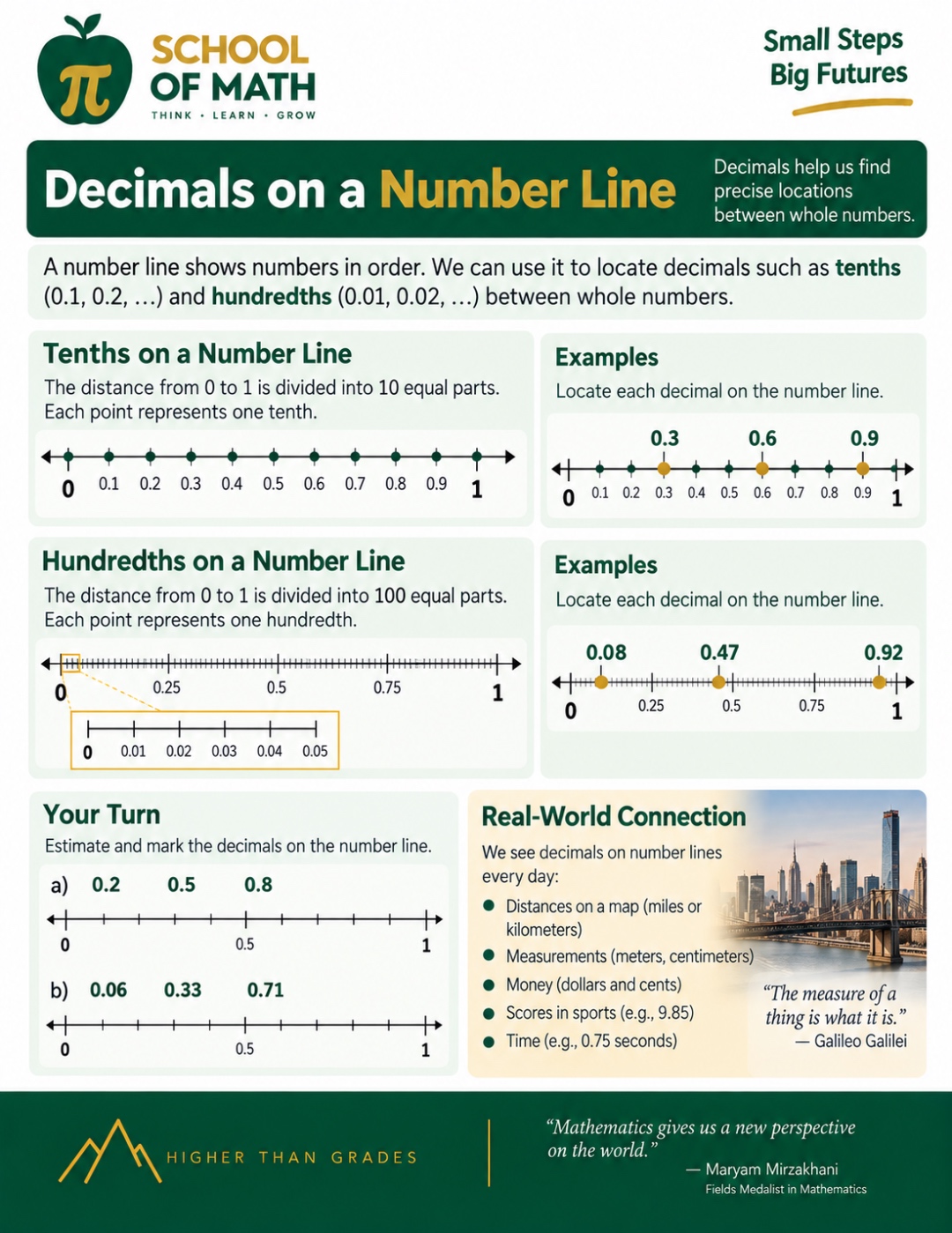
Tenths divide 0 to 1 into 10 equal jumps; hundredths divide 0 to 1 into 100 equal jumps.
Theory — decimals on a number line
A number line shows numbers in order, with distance = value. To locate a decimal:
- Tenths: divide the distance from 0 to 1 into 10 equal jumps. Each jump is one tenth (0.1). 0.3 is 3 jumps to the right of 0.
- Hundredths: divide the distance from 0 to 1 into 100 equal jumps. Each jump is one hundredth (0.01). Or zoom in: divide the space between two tenths into 10 more equal jumps.
- Which is bigger? The number farther to the right is greater.
Examples:
Landmark trick. Half of 1 is 0.5. Quarter of 1 is 0.25. Three-quarters is 0.75. If you can place 0, 0.25, 0.5, 0.75, and 1 first, every other hundredth is easier.
Q7.1 easy
On a number line from 0 to 1 divided into 10 equal jumps, how many jumps to the right of 0 is 0.4?
Answer: 4 jumps.
Each jump is one tenth (0.1). 0.4 is four tenths, so 0.4 sits 4 jumps to the right of 0.
Q7.2 easy
On a number line from 0 to 1, which is farther to the right: 0.7 or 0.9?
Answer: 0.9 is farther to the right, so 0.9 > 0.7.
Numbers get bigger as we move right on the number line. 0.9 is 9 tenths — farther right than 0.7 (7 tenths).
Q7.3 medium
On a hundredths number line from 0 to 1, between which two consecutive tenths does 0.47 sit? Is it closer to the lower tenth or the higher tenth?
Answer: 0.47 sits between 0.4 and 0.5, and it is closer to 0.5.
0.47 is 7 hundredths past 0.4 out of the 10 hundredths between 0.4 and 0.5. Seven of ten is more than halfway, so 0.47 is closer to 0.5 than to 0.4.
Q7.4 medium
Estimate the position of 0.06 on a 0-to-1 number line: closer to 0 or closer to 1?
Answer: much closer to 0.
0.06 is only 6 hundredths — less than 1 tenth. On a 0-to-1 number line, 0.06 sits between 0 and 0.1, barely to the right of 0.
Q7.5 medium
Place these three decimals in order on the number line from 0 to 1, from left to right: 0.71, 0.06, 0.33.
Answer: 0.06, then 0.33, then 0.71.
Think in hundredths: 6, 33, 71. Order left to right (least to greatest): 6, 33, 71. So on the number line: 0.06 is closest to 0, 0.33 is around one third of the way, 0.71 is between 0.7 and 0.75.
Poster 8 — Decimals in Real Life: Money and Measurement
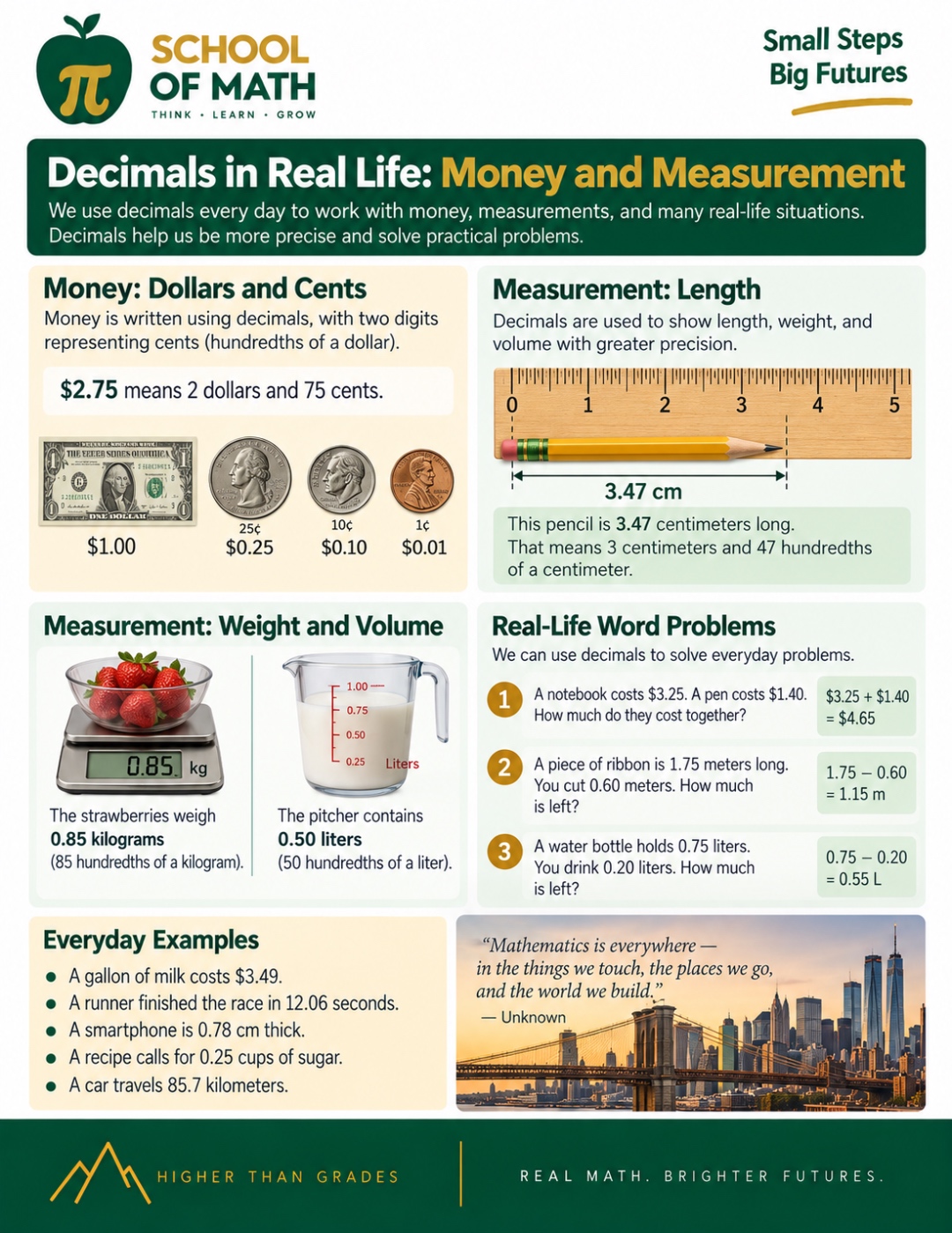
Money uses two decimal places for cents; measurement uses decimals for precise lengths, weights, and volumes.
Theory — decimals in real life
Money. Money is written with two decimal places because one cent is one hundredth of a dollar: $0.01 = 1¢. That is why every price tag on the Upper West Side is written to the hundredth.
| Coin/bill | Value in decimals |
|---|---|
| $1 bill | $1.00 |
| quarter | $0.25 |
| dime | $0.10 |
| penny | $0.01 |
Example: $2.75 = 2 whole dollars + 75 hundredths of a dollar = 2 dollars and 75 cents.
Measurement. When a length, weight, or volume is not a whole unit, we use a decimal to be more precise:
- A pencil that is 3.47 cm long is 3 whole centimeters and 47 hundredths of a centimeter.
- A bowl of strawberries that weighs 0.85 kg weighs 85 hundredths of a kilogram.
- A pitcher that holds 0.50 L holds 50 hundredths of a liter (which is half a liter).
Adding and subtracting decimals in a word problem: line up the decimal points and add or subtract as usual. A pen is $1.40 and a notebook is $3.25: total = $3.25 + $1.40 = $4.65. A ribbon 1.75 m long, cut 0.60 m: left = 1.75 − 0.60 = 1.15 m.
Q8.1 easy
Write “two dollars and seventy-five cents” as a decimal amount of dollars.
Answer: $2.75.
2 whole dollars + 75 hundredths of a dollar = $2.75.
Q8.2 easy
A pencil is 3.47 cm long. How many whole centimeters is that, and how many hundredths of a centimeter more?
Answer: 3 whole centimeters, plus 47 hundredths of a centimeter more.
The 3 is in the ones place (whole centimeters). The 4 and the 7 are in the tenths and hundredths places, together making 47 hundredths of a centimeter.
Q8.3 easy
A notebook costs $3.25 and a pen costs $1.40. How much do they cost together?
Answer: $4.65.
Line up the decimal points: $3.25 + $1.40 ------- $4.65
Q8.4 medium
A piece of ribbon is 1.75 m long. You cut off 0.60 m. How much ribbon is left?
Answer: 1.15 m.
Line up the decimal points: 1.75 - 0.60 ------ 1.15 → 1.15 m left
Q8.5 medium
A water bottle holds 0.75 L. You drink 0.20 L. How much is left?
Answer: 0.55 L.
Line up the decimal points: 0.75 - 0.20 ------ 0.55 → 0.55 L left
Bonus — 10 Word Problems of Increasing Difficulty
Grade 3 easy → grade 4 challenge. Upper West Side Manhattan contexts: bodega and Fairway prices, MetroCard swipes, the 1 train at 79th Street, Central Park picnic supplies, and a Riverside Park race.
W1 — Bagel and orange juice easy
At the bodega near PS 87, a bagel costs $1.25 and a small orange juice costs $2.10. How much do they cost together?
Answer: $3.35.
$1.25 + $2.10 ------- $3.35Total for bagel and orange juice = $3.35.
W2 — Change from $5 easy
You buy a slice of pizza for $3.75 and pay with a $5 bill. How much change do you get?
Answer: $1.25 change.
Write $5 as $5.00 so the decimals line up: $5.00 - $3.75 ------- $1.25Change = $1.25 (one dollar and twenty-five cents = one dollar and a quarter).
W3 — The 1 train at 79th Street easy
The 1 train arrives at the 79th Street station in 3.5 minutes. Write “3.5” in word form and say which digit is in the tenths place.
Answer: “three and five tenths.” The 5 is in the tenths place.
The last digit after the decimal point is in the tenths place, so we read it as “three and five tenths” of a minute (that is 30 seconds past 3 minutes).
W4 — MetroCard swipes medium
A single MetroCard ride costs $2.90. You take the 1 train twice today (there and back home). How much did the two rides cost together?
Answer: $5.80.
$2.90 + $2.90 ------- $5.80Two rides at $2.90 each = $5.80 in total.
W5 — Riverside Park race medium
Two grade-4 runners race the same distance in Riverside Park. Emma finishes in 12.08 seconds. Zoe finishes in 12.3 seconds. Who is faster, and by how much (in seconds)?
Answer: Emma is faster, by 0.22 seconds.
Faster = smaller time. Give both the same length: 12.08 vs 12.30. Compare: ones equal (12 = 12), tenths 0 vs 3 → 0 < 3, so 12.08 < 12.30. Emma is faster. Difference: 12.30 - 12.08 = 0.22 seconds.Emma beat Zoe by twenty-two hundredths of a second.
W6 — Fairway strawberries medium
At Fairway on Broadway, a small bowl of strawberries weighs 0.85 kg and a large bowl weighs 1.4 kg. What is the total weight if you buy one of each?
Answer: 2.25 kg.
Line up decimals (write 1.4 as 1.40): 0.85 + 1.40 ------ 2.25Total weight = 2.25 kg.
W7 — Central Park picnic budget hard
For a Central Park picnic you buy a sandwich for $6.75, a bottle of water for $1.50, and a bag of chips for $2.25. You pay with a $20 bill. How much change do you get?
Answer: $9.50 change.
Step 1 — total the food: $6.75 + $1.50 + $2.25 ------- $10.50 Step 2 — change from $20: $20.00 - $10.50 -------- $9.50Change = $9.50 (nine dollars and fifty cents = nine dollars and two quarters).
W8 — Ordering desks hard
Four Kid Einsteins desks are measured for a new classroom on West 79th Street. Their widths are 0.7 m, 0.68 m, 0.75 m, and 0.6 m. Order them from narrowest to widest.
Answer: 0.6 m < 0.68 m < 0.7 m < 0.75 m.
Give all widths two decimal places (add trailing zeros — value does not change): 0.70, 0.68, 0.75, 0.60 Now think in hundredths: 70, 68, 75, 60. Sort smallest to largest: 60, 68, 70, 75. So: 0.6 < 0.68 < 0.7 < 0.75.Watch the classic trap: 0.68 is NOT bigger than 0.7 just because 68 > 7 — remember to compare place by place.
W9 — Locker penny jar hard
A grade-4 class collects pennies for a book drive. They count 375 pennies. Write the total value (a) as a fraction of a dollar with denominator 100, and (b) as a decimal amount of dollars.
Answer: (a) 375/100 of a dollar (b) $3.75.
Each penny = 1/100 of a dollar = $0.01. 375 pennies = 375 × 1/100 = 375/100 of a dollar. 375/100 = 3 whole dollars + 75/100 of a dollar = $3.75.The place-value connection: 375 hundredths → 3 in the ones (= 300 hundredths), 7 in the tenths (= 70 hundredths), 5 in the hundredths (= 5 hundredths). 300 + 70 + 5 = 375. That is why 375/100 = 3.75.
W10 — A day of MetroCard rides challenge
A weekly MetroCard costs $34.00. A single ride costs $2.90. If a Kid Einsteins student takes exactly 12 single rides in one week, would a weekly card save money, and by how much?
Answer: Yes, a weekly card saves $0.80 (eighty cents).
Step 1 — cost of 12 single rides: 12 × $2.90 = ? Break it up: 10 × $2.90 = $29.00; 2 × $2.90 = $5.80. $29.00 + $5.80 = $34.80 Step 2 — compare to the weekly card: Weekly card: $34.00. 12 singles: $34.80. Savings: $34.80 - $34.00 = $0.80.The weekly card saves 80 hundredths of a dollar — eighty cents. Comparing decimals here is what tells us the weekly card wins.
FAQ — parent questions on decimals in grades 3–4
The same questions Upper West Side parents ask us at 226 W 79th St.
What are decimals to the tenths and hundredths, and when does my grade 3 or 4 child need them?
A decimal is a number that uses a decimal point to show a whole number and parts of a whole. The first digit to the right of the decimal point is the tenths place (one of ten equal parts of a whole; 0.1 = 1/10) and the second digit is the hundredths place (one of one hundred equal parts of a whole; 0.01 = 1/100). Most Upper West Side and Manhattan grade 3 students meet tenths through measurement and money; grade 4 makes tenths and hundredths fluent — reading them, writing them in words and fractions, placing them on a number line, and comparing them. Kid Einsteins Class 13 is the class where a grade 3–4 student stops guessing and starts reading a decimal the same way they read $2.75.
How do I read a decimal like 4.37?
Read the whole-number part first (four), then say “and” for the decimal point, then read the decimal part as if it were a whole number and finish with the place-value name of the last digit. 4.37 → “four and thirty-seven hundredths” because the last digit (7) is in the hundredths place. 4.3 → “four and three tenths” because the last digit (3) is in the tenths place. 0.05 → “five hundredths” (no whole part, and there is a 0 holding the tenths place). The place name of the last digit is the whole rule.
How do I compare decimals like 0.25 and 0.3?
Compare place by place from left to right — ones, then tenths, then hundredths. 0.25 vs 0.3: ones are equal (0 = 0), so compare tenths. 2 tenths vs 3 tenths → 3 tenths is greater, so 0.3 > 0.25. The classic grade 3–4 mistake is thinking 0.25 is bigger because “25 is more than 3.” That is wrong — the digits after the decimal point are NOT read as whole numbers. A useful trick: give both decimals the same number of decimal places by adding zeros on the right. 0.3 = 0.30, and now 0.30 vs 0.25 is easy: 30 hundredths > 25 hundredths.
How are decimals connected to fractions?
A decimal is just another way to write a fraction whose denominator is 10, 100, 1,000, and so on. 0.1 = 1/10, 0.3 = 3/10, 0.7 = 7/10. 0.01 = 1/100, 0.25 = 25/100, 0.68 = 68/100. This is the same idea Kid Einsteins used in Class 11 (adding fractions with like denominators) — a decimal is a fraction with an especially friendly denominator that lets us use place value instead of drawing bars.
How are decimals used in money and measurement?
Money uses two decimal places because one cent is one hundredth of a dollar (0.01 = 1¢). $2.75 means 2 dollars and 75 hundredths of a dollar = 2 dollars and 75 cents. Measurement uses decimals when a length is not a whole unit: a pencil that is 3.47 cm long is 3 whole centimeters plus 47 hundredths of a centimeter. Every grocery-store price tag, MetroCard balance, and metric ruler on the Upper West Side is decimal practice.
How do I place a decimal on a number line?
For tenths, divide the distance from 0 to 1 into 10 equal jumps — each jump is one tenth. 0.3 sits three jumps to the right of 0. For hundredths, divide the distance from 0 to 1 into 100 equal jumps — each jump is one hundredth — or zoom in between two tenths and divide that shorter distance into 10 more equal jumps. 0.47 sits between 0.4 and 0.5, closer to 0.5 (seven of the ten little jumps past 0.4). Numbers farther to the right are greater.
Why do some countries write a decimal comma instead of a decimal point?
The value is the same — the punctuation is different. Much of continental Europe and Latin America uses a comma as the decimal separator (3,5 = three and five tenths), while the United States, United Kingdom, and most of Asia use a decimal point (3.5). Great real-world example for grade 3–4 students: the mathematics of decimals is universal, even when the notation is not. On any American SHSAT, SAT, or Regents exam, use the decimal point.
How does SOMATH teach decimals to the tenths and hundredths?
In-person, in small groups of 4–8 grade 3–4 students, at 226 W 79th St on the Upper West Side. Every Kid Einsteins Class 13 session opens with the decimal place-value chart (ones, decimal point, tenths, hundredths), moves through tenths and hundredths grids, then reads and writes decimals in three forms (standard, word, fraction), then compares and orders, then places on a number line, and closes with real-life money and measurement word problems. Class 13 is the direct prerequisite for the fractions–decimals–percents bridge used in Pre-Algebra Class 7 (decimals four operations) and Pre-Algebra Class 10 (percent). Call (646) 668-6151 or book a free 30-minute evaluation.