Kid Einsteins · Class 18 · Grades 3–4
Long Division: Introducing Two-Digit Divisors
A two-digit divisor is any whole number from 10 to 99. Build its multiples, estimate each quotient digit with friendly numbers, then divide, multiply, subtract, and bring down; test every digit and check the remainder.
Study eight illustrated topics with five original practice questions after each image. Finish with eight Homework review questions and twelve Homework word problems: 40 practice questions, 20 homework questions, and 60 hidden worked answers. Attempt each question before opening its blue Answer control.
This is an independent Kid Einsteins topic at SOMATH. Earlier-numbered classes are not attendance prerequisites. Keep a list of the divisor's multiples beside your work and check every answer with multiplication. View the schedule or book an evaluation to find the appropriate course level.
Download the student workbook (PDF)22 pages · Supplied cover, eight teaching images, and all 60 questions · Generous blank answer space · No exercise solutions
Understanding two-digit divisors
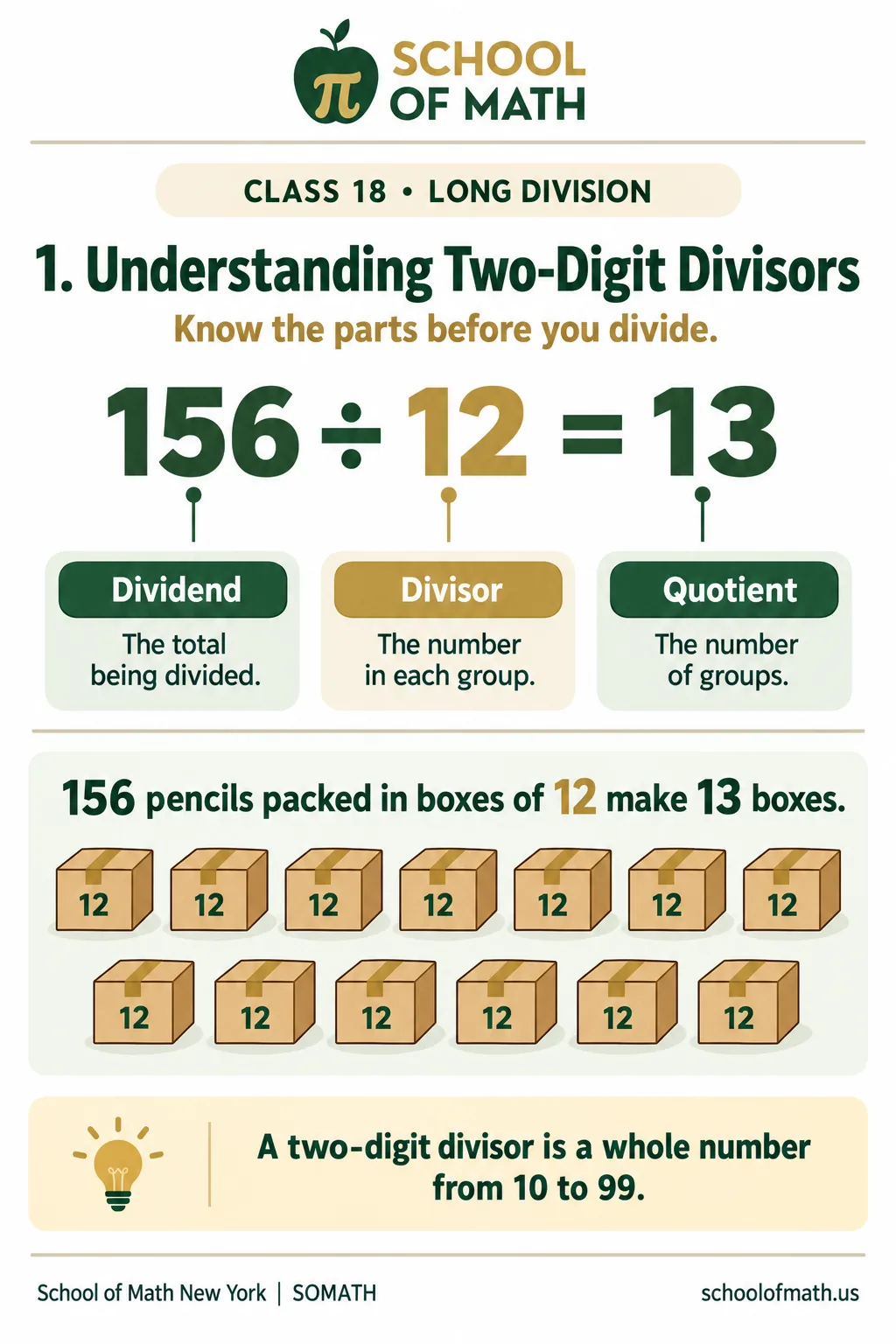
A division sentence has three parts. The dividend is the total being divided, the divisor is the size of each group, and the quotient is the number of groups. In 156 ÷ 12 = 13, the 156 pencils are packed in boxes of 12, so the quotient 13 counts the boxes.
A two-digit divisor is any whole number from 10 to 99. The method is the same as dividing by a single digit; the only difference is that the multiplication facts are larger, so we lean on multiples, estimation, and checking. In a sharing story the divisor can instead be the number of equal shares, and the quotient then tells the amount in each share.
Practice: try these five questions
Q1
In 132 ÷ 11 = 12, name the dividend, the divisor, and the quotient.
Answer
Dividend 132; divisor 11; quotient 12
- The dividend 132 is the total being divided. The divisor 11 is the size of each group. The quotient 12 counts the groups: 11 × 12 = 132.
Q2
A store packs 144 crayons into boxes of 12. Write the division sentence and tell how many boxes are filled.
Answer
144 ÷ 12 = 12; 12 boxes
- The total 144 is the dividend and the box size 12 is the divisor. Count by 12s: 12, 24, 36, 48, 60, 72, 84, 96, 108, 120, 132, 144. That is twelve 12s.
- So 144 ÷ 12 = 12. Check: 12 × 12 = 144.
Q3
Which of these numbers can be a two-digit divisor: 9, 10, 45, 99, 100? Explain.
Answer
10, 45, and 99
- A two-digit divisor is a whole number from 10 to 99. The numbers 10, 45, and 99 are in that range.
- 9 has only one digit, and 100 has three digits, so neither is a two-digit divisor.
Q4
Ninety stickers are shared so that each pack gets 15 stickers, and exactly 6 packs are filled. Write the division sentence and label each part.
Answer
90 ÷ 15 = 6; dividend 90, divisor 15, quotient 6
- The total of 90 stickers is the dividend. The 15 stickers in each pack is the divisor. The 6 packs is the quotient.
- Check: 15 × 6 = 90.
Q5
A student says that in 195 ÷ 13 = 15 the divisor is 195. Correct the student and explain what each number means.
Answer
The divisor is 13, not 195
- 195 is the dividend, the total being divided. 13 is the divisor, the number in each group. 15 is the quotient, the number of groups.
- Check: 13 × 15 = 195, so the sentence is true once the parts are named correctly.
Using multiples to prepare for division
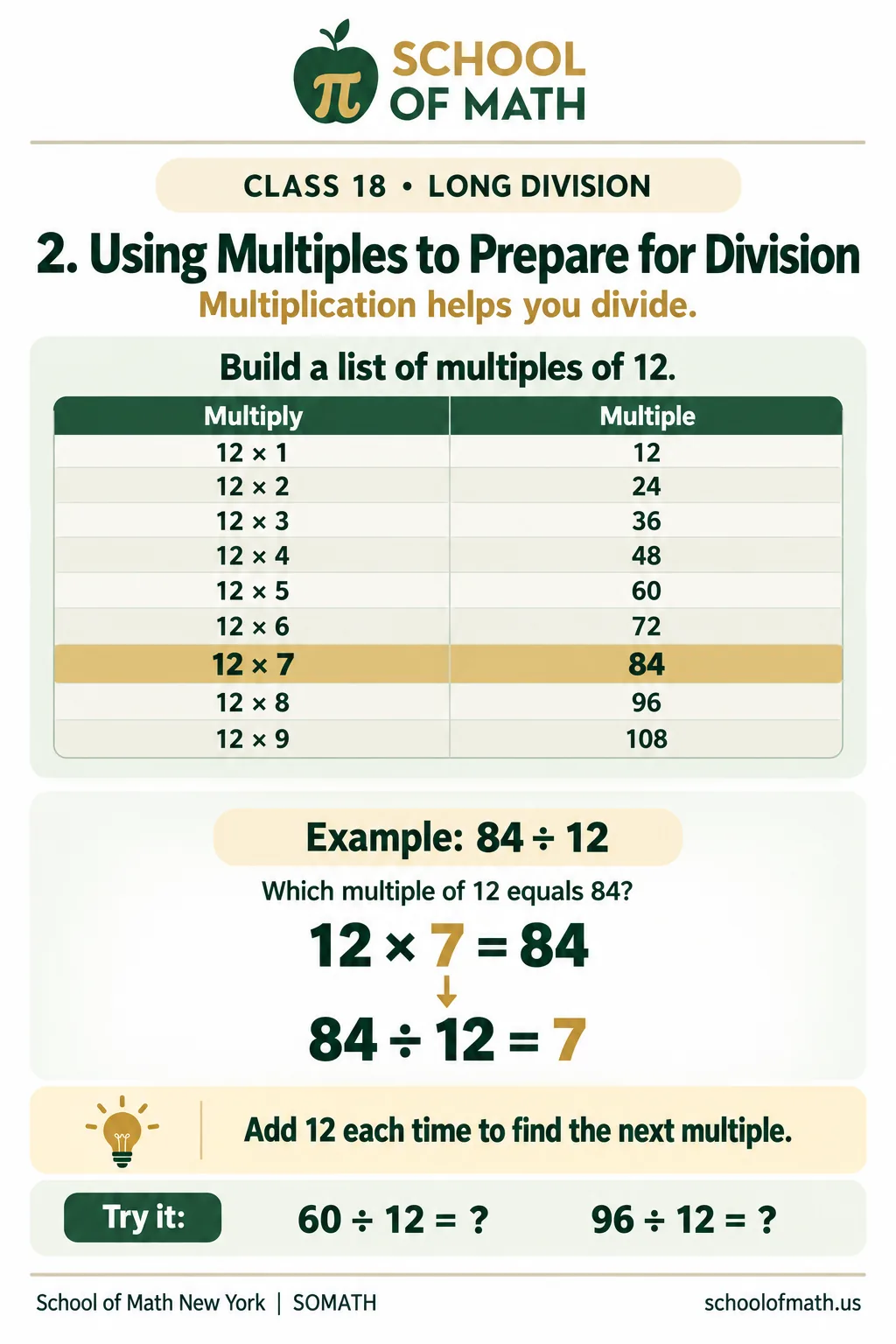
Multiplication helps you divide. Before dividing by a two-digit number, build a short list of its multiples by adding the divisor each time: 12, 24, 36, 48, 60, 72, 84, 96, 108. Each multiple answers a division question; because 12 × 7 = 84, we know 84 ÷ 12 = 7.
When the dividend is not on the list, find the greatest multiple that does not go past it. That multiple gives the quotient, and the difference gives the remainder. Keeping the list beside your work turns every long-division step into a quick look-up.
Practice: try these five questions
Q6
List the first six multiples of 15.
Answer
15, 30, 45, 60, 75, 90
- Start at 15 and add 15 each time: 15, 30, 45, 60, 75, 90.
- These are 15 × 1 through 15 × 6.
Q7
Use multiples of 11 to find 77 ÷ 11.
Answer
7
- Multiples of 11: 11, 22, 33, 44, 55, 66, 77. The seventh multiple is 77, so 11 × 7 = 77.
- Therefore 77 ÷ 11 = 7.
Q8
Which multiple of 14 equals 98? Then write the matching division sentence.
Answer
14 × 7 = 98, so 98 ÷ 14 = 7
- Multiples of 14: 14, 28, 42, 56, 70, 84, 98. The seventh multiple is 98.
- Because 14 × 7 = 98, the division sentence is 98 ÷ 14 = 7.
Q9
Use multiples of 13 to find 65 ÷ 13 and 117 ÷ 13.
Answer
65 ÷ 13 = 5 and 117 ÷ 13 = 9
- Multiples of 13: 13, 26, 39, 52, 65, 78, 91, 104, 117.
- 65 is the fifth multiple, so 65 ÷ 13 = 5. 117 is the ninth multiple, so 117 ÷ 13 = 9.
Q10
Build multiples of 12 to find the greatest multiple of 12 that is not more than 100. Then give the quotient and remainder for 100 ÷ 12.
Answer
96; 100 ÷ 12 = 8 R 4
- Multiples of 12: 12, 24, 36, 48, 60, 72, 84, 96, 108. The multiple 108 is past 100, so the greatest multiple that fits is 96 = 12 × 8.
- 100 − 96 = 4, so 100 ÷ 12 = 8 R 4. Check: 12 × 8 + 4 = 100, and 4 < 12.
Estimating quotient digits
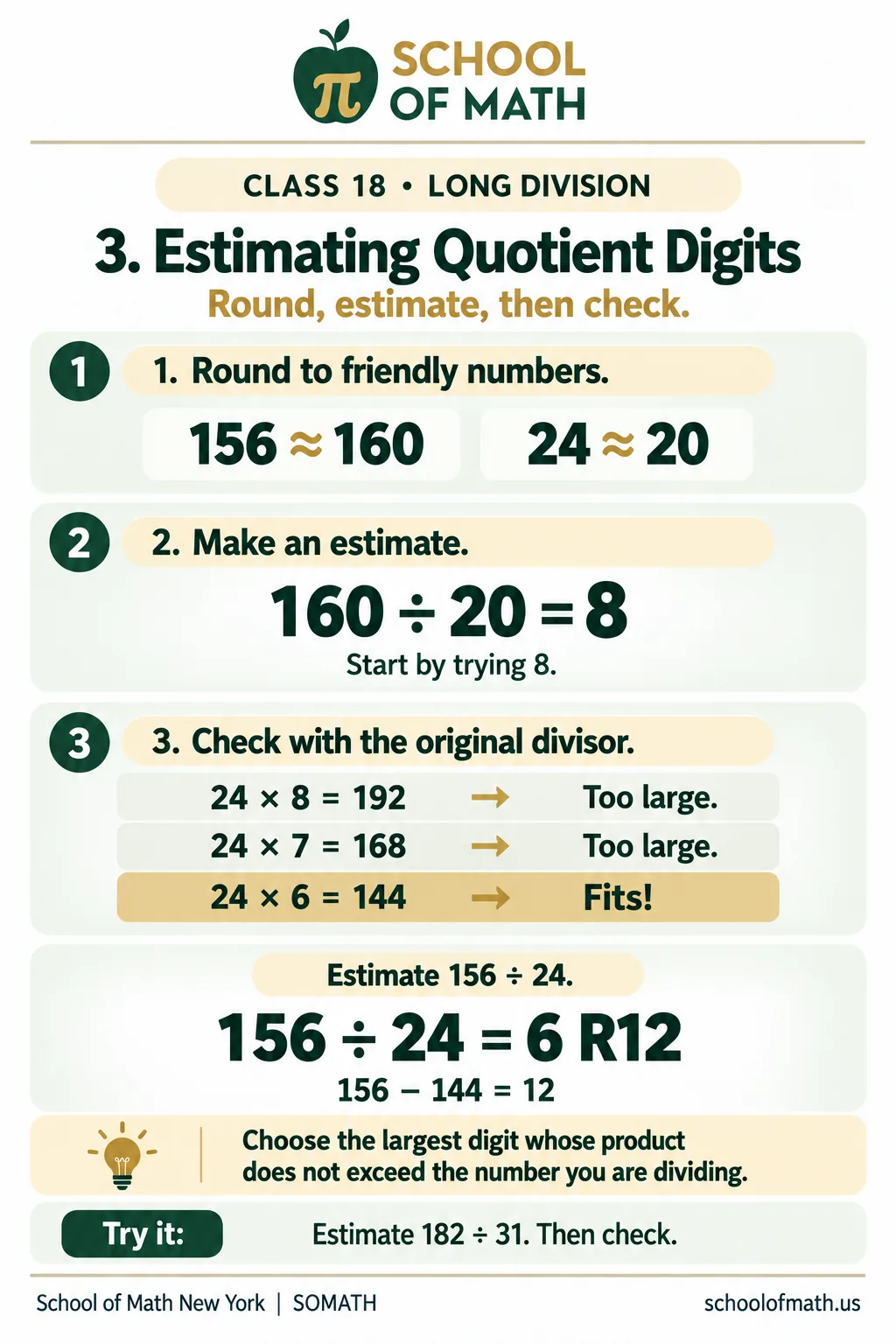
Round, estimate, then check. Round the dividend and the divisor to friendly numbers, such as 156 ≈ 160 and 24 ≈ 20, and divide the friendly numbers in your head: 160 ÷ 20 = 8. That estimate is only a starting digit, so always test it with the original divisor.
Multiply the divisor by the estimate. If the product is larger than the number you are dividing, lower the digit; if the leftover is as large as the divisor, raise the digit. For 156 ÷ 24, the products 192 and 168 are too large, but 24 × 6 = 144 fits, leaving 156 − 144 = 12. Choose the largest digit whose product does not exceed the number you are dividing.
Practice: try these five questions
Q11
Round 189 and 31 to friendly numbers, estimate 189 ÷ 31, and then check your estimate.
Answer
6 R 3
- Round to friendly numbers: 189 ≈ 190 and 31 ≈ 30. Estimate 190 ÷ 30 = 6, so start by trying 6.
- Check 31 × 6 = 186. It fits: 189 − 186 = 3, and 3 < 31.
- So 189 ÷ 31 = 6 R 3. Check: 31 × 6 + 3 = 189.
Q12
Estimate 248 ÷ 42 with friendly numbers. Then check, and adjust if needed.
Answer
5 R 38
- Round to friendly numbers: 248 ≈ 250 and 42 ≈ 40. Estimate 250 ÷ 40 = 6, so start by trying 6.
- Check 42 × 6 = 252. Since 252 > 248, 6 is too large.
- Check 42 × 5 = 210. It fits: 248 − 210 = 38, and 38 < 42.
- So 248 ÷ 42 = 5 R 38. Check: 42 × 5 + 38 = 248.
Q13
Estimate 136 ÷ 19 and check with the original divisor.
Answer
7 R 3
- Round to friendly numbers: 136 ≈ 140 and 19 ≈ 20. Estimate 140 ÷ 20 = 7, so start by trying 7.
- Check 19 × 7 = 133. It fits: 136 − 133 = 3, and 3 < 19.
- So 136 ÷ 19 = 7 R 3. Check: 19 × 7 + 3 = 136.
Q14
Estimate 232 ÷ 38 and check with the original divisor.
Answer
6 R 4
- Round to friendly numbers: 232 ≈ 240 and 38 ≈ 40. Estimate 240 ÷ 40 = 6, so start by trying 6.
- Check 38 × 6 = 228. It fits: 232 − 228 = 4, and 4 < 38.
- So 232 ÷ 38 = 6 R 4. Check: 38 × 6 + 4 = 232.
Q15
A student tries 9 for 158 ÷ 21. Explain why 9 does not work, then find the correct quotient digit and remainder.
Answer
7 R 11
- Check 21 × 9 = 189. Since 189 > 158, the digit 9 is too large.
- Try 8: 21 × 8 = 168, which is still larger than 158. Try 7: 21 × 7 = 147, and 158 − 147 = 11.
- Because 11 < 21, the digit 7 fits. So 158 ÷ 21 = 7 R 11. Check: 21 × 7 + 11 = 158.
Setting up long division
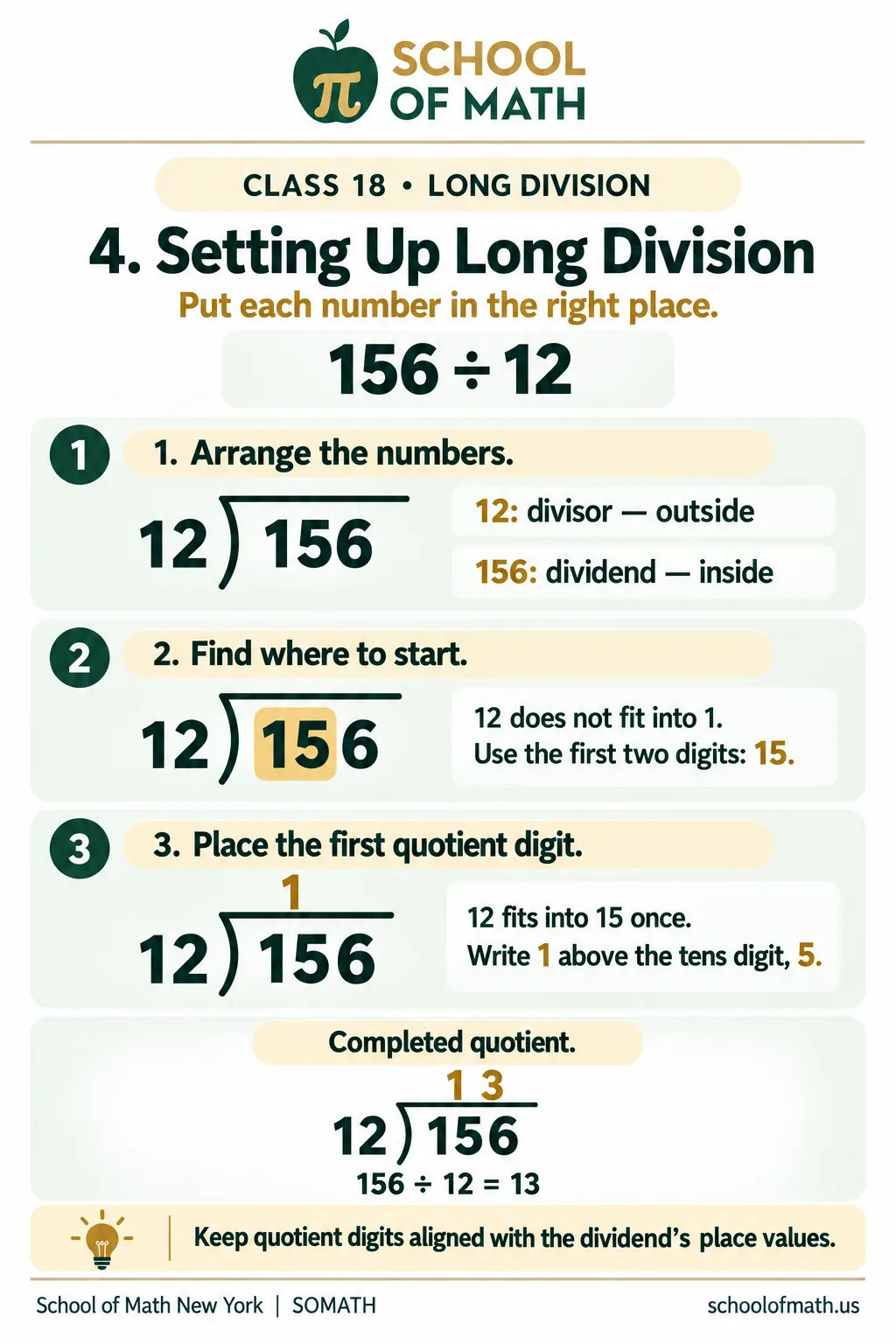
Put each number in the right place. The divisor goes outside the bracket and the dividend goes inside. Then find where to start: look at the first digit of the dividend. If the divisor does not fit into it, use the first two digits. In 156 ÷ 12, 12 does not fit into 1, so we start with 15.
The first quotient digit sits above the last digit of the group you used. Since 12 fits into 15 once, write 1 above the tens digit, 5. Keeping each quotient digit aligned with the dividend's place values prevents answers that are ten times too large or too small.
Practice: try these five questions
Q16
Write 182 ÷ 14 in long-division form. Which number goes outside the bracket, which digits do you start with, and where does the first quotient digit go? Then finish the division.
Answer
14 outside; start with 18; first digit 1 above the tens digit; 182 ÷ 14 = 13
- The divisor 14 goes outside the bracket and the dividend 182 goes inside. 14 does not fit into 1, so start with the first two digits, 18.
- Divide 18 by 14: write 1 in the tens place. Multiply 1 × 14 = 14, then subtract 18 − 14 = 4. Bring down the 2 to make 42.
- Divide 42 by 14: write 3 in the ones place. Multiply 3 × 14 = 42, then subtract 42 − 42 = 0.
- No digits remain to bring down. The quotient is 13 and the remainder is 0. Check: 14 × 13 = 182.
Q17
In 225 ÷ 15, which digits do you use first, and what is the first quotient digit? Complete the division.
Answer
Use 22 first; the first quotient digit is 1; 225 ÷ 15 = 15
- 15 does not fit into 2, so use the first two digits, 22. Divide 22 by 15: write 1 in the tens place. Multiply 1 × 15 = 15, then subtract 22 − 15 = 7. Bring down the 5 to make 75.
- Divide 75 by 15: write 5 in the ones place. Multiply 5 × 15 = 75, then subtract 75 − 75 = 0.
- No digits remain to bring down. The quotient is 15 and the remainder is 0. Check: 15 × 15 = 225.
Q18
For 96 ÷ 16, does 16 fit into 9? Explain where the quotient digit goes, then solve.
Answer
No; the quotient digit goes above the ones digit; 96 ÷ 16 = 6
- 16 does not fit into 9, so use both digits, 96. The quotient will have only one digit, written above the ones digit, 6.
- Divide 96 by 16: multiples of 16 are 16, 32, 48, 64, 80, 96, so 16 × 6 = 96. Write 6 in the ones place. Subtract 96 − 96 = 0.
- The quotient is 6 and the remainder is 0. Check: 16 × 6 = 96.
Q19
Set up 364 ÷ 26 and find the first quotient digit. Then complete the division.
Answer
First digit 1 above the tens digit; 364 ÷ 26 = 14
- 26 does not fit into 3, so use the first two digits, 36. Divide 36 by 26: write 1 in the tens place. Multiply 1 × 26 = 26, then subtract 36 − 26 = 10. Bring down the 4 to make 104.
- Divide 104 by 26: write 4 in the ones place. Multiply 4 × 26 = 104, then subtract 104 − 104 = 0.
- No digits remain to bring down. The quotient is 14 and the remainder is 0. Check: 26 × 14 = 364.
Q20
A student writes the first quotient digit of 168 ÷ 12 above the hundreds digit, 1. Explain the mistake and give the correct quotient.
Answer
The first digit belongs above the tens digit, 6; 168 ÷ 12 = 14
- 12 does not fit into 1, so no quotient digit goes above the hundreds place. The first group used is 16, so the first quotient digit belongs above the tens digit, 6.
- Divide 16 by 12: write 1 in the tens place. Multiply 1 × 12 = 12, then subtract 16 − 12 = 4. Bring down the 8 to make 48.
- Divide 48 by 12: write 4 in the ones place. Multiply 4 × 12 = 48, then subtract 48 − 48 = 0.
- No digits remain to bring down. The quotient is 14 and the remainder is 0. Check: 12 × 14 = 168.
Divide, multiply, subtract, bring down
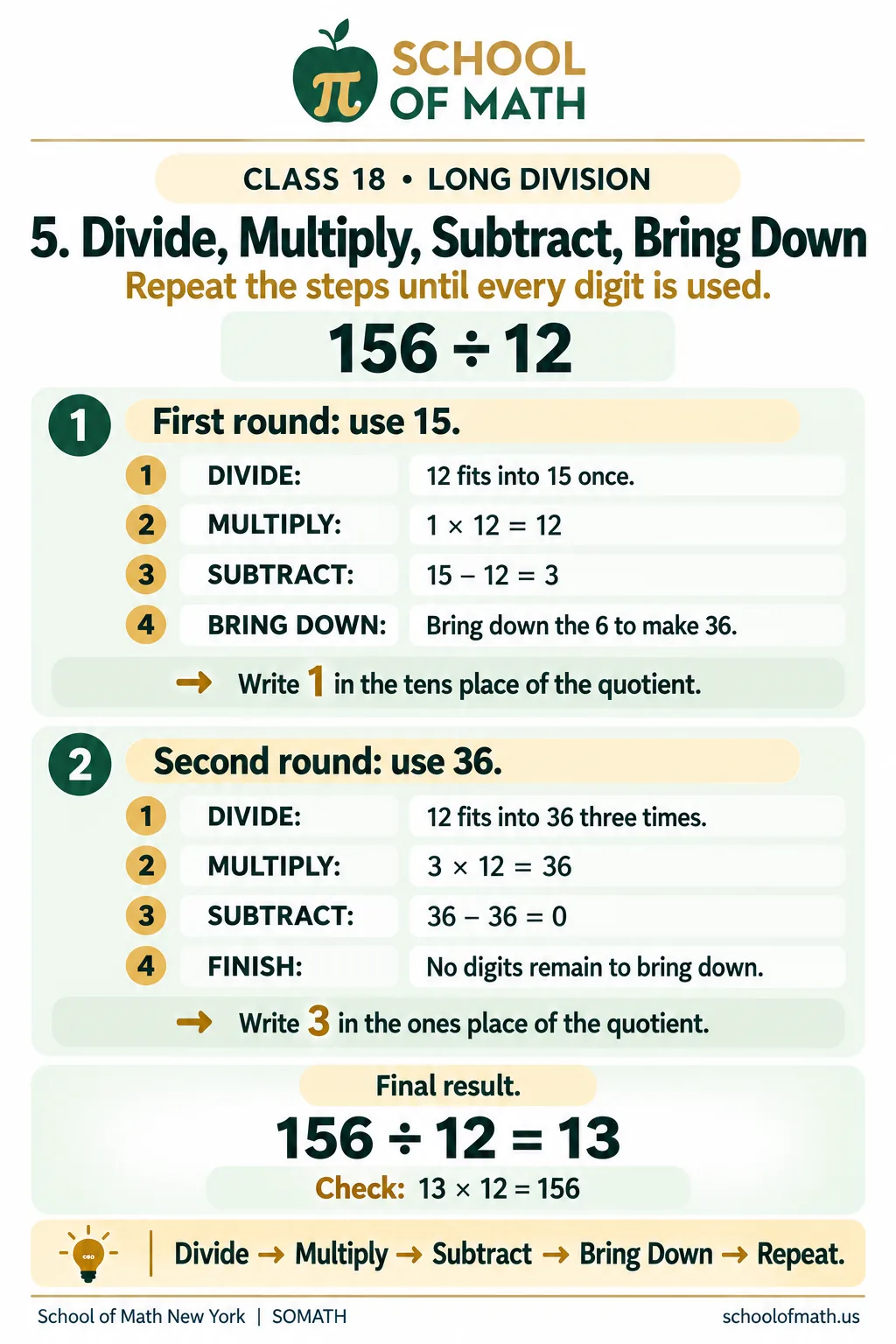
Repeat the steps until every digit is used. In each round, divide to choose a quotient digit, multiply that digit by the divisor, subtract to find what is left, and bring down the next digit of the dividend. For 156 ÷ 12, the first round uses 15: 12 fits once, 1 × 12 = 12, 15 − 12 = 3, and bringing down the 6 makes 36.
The second round uses 36: 12 fits three times, 3 × 12 = 36, and 36 − 36 = 0. No digits remain, so the quotient is 13. Finish with a multiplication check, 13 × 12 = 156. Divide, multiply, subtract, bring down, repeat.
Practice: try these five questions
Q21
Solve 192 ÷ 16 using divide, multiply, subtract, and bring down. Check your answer.
Answer
12
- 16 does not fit into 1, so use the first two digits, 19. Divide 19 by 16: write 1 in the tens place. Multiply 1 × 16 = 16, then subtract 19 − 16 = 3. Bring down the 2 to make 32.
- Divide 32 by 16: write 2 in the ones place. Multiply 2 × 16 = 32, then subtract 32 − 32 = 0.
- No digits remain to bring down. The quotient is 12 and the remainder is 0. Check: 16 × 12 = 192.
Q22
Solve 221 ÷ 13 and check with multiplication.
Answer
17
- 13 does not fit into 2, so use the first two digits, 22. Divide 22 by 13: write 1 in the tens place. Multiply 1 × 13 = 13, then subtract 22 − 13 = 9. Bring down the 1 to make 91.
- Divide 91 by 13: write 7 in the ones place. Multiply 7 × 13 = 91, then subtract 91 − 91 = 0.
- No digits remain to bring down. The quotient is 17 and the remainder is 0. Check: 13 × 17 = 221.
Q23
Solve 345 ÷ 15. Show both rounds of the steps.
Answer
23
- 15 does not fit into 3, so use the first two digits, 34. Divide 34 by 15: write 2 in the tens place. Multiply 2 × 15 = 30, then subtract 34 − 30 = 4. Bring down the 5 to make 45.
- Divide 45 by 15: write 3 in the ones place. Multiply 3 × 15 = 45, then subtract 45 − 45 = 0.
- No digits remain to bring down. The quotient is 23 and the remainder is 0. Check: 15 × 23 = 345.
Q24
Solve 374 ÷ 22 and check your answer.
Answer
17
- 22 does not fit into 3, so use the first two digits, 37. Divide 37 by 22: write 1 in the tens place. Multiply 1 × 22 = 22, then subtract 37 − 22 = 15. Bring down the 4 to make 154.
- Divide 154 by 22: write 7 in the ones place. Multiply 7 × 22 = 154, then subtract 154 − 154 = 0.
- No digits remain to bring down. The quotient is 17 and the remainder is 0. Check: 22 × 17 = 374.
Q25
Solve 468 ÷ 18. Which digit do you bring down, and what number does it make?
Answer
26; bring down the 8 to make 108
- 18 does not fit into 4, so use the first two digits, 46. Divide 46 by 18: write 2 in the tens place. Multiply 2 × 18 = 36, then subtract 46 − 36 = 10. Bring down the 8 to make 108.
- Divide 108 by 18: write 6 in the ones place. Multiply 6 × 18 = 108, then subtract 108 − 108 = 0.
- No digits remain to bring down. The quotient is 26 and the remainder is 0. Check: 18 × 26 = 468.
Checking and adjusting estimates
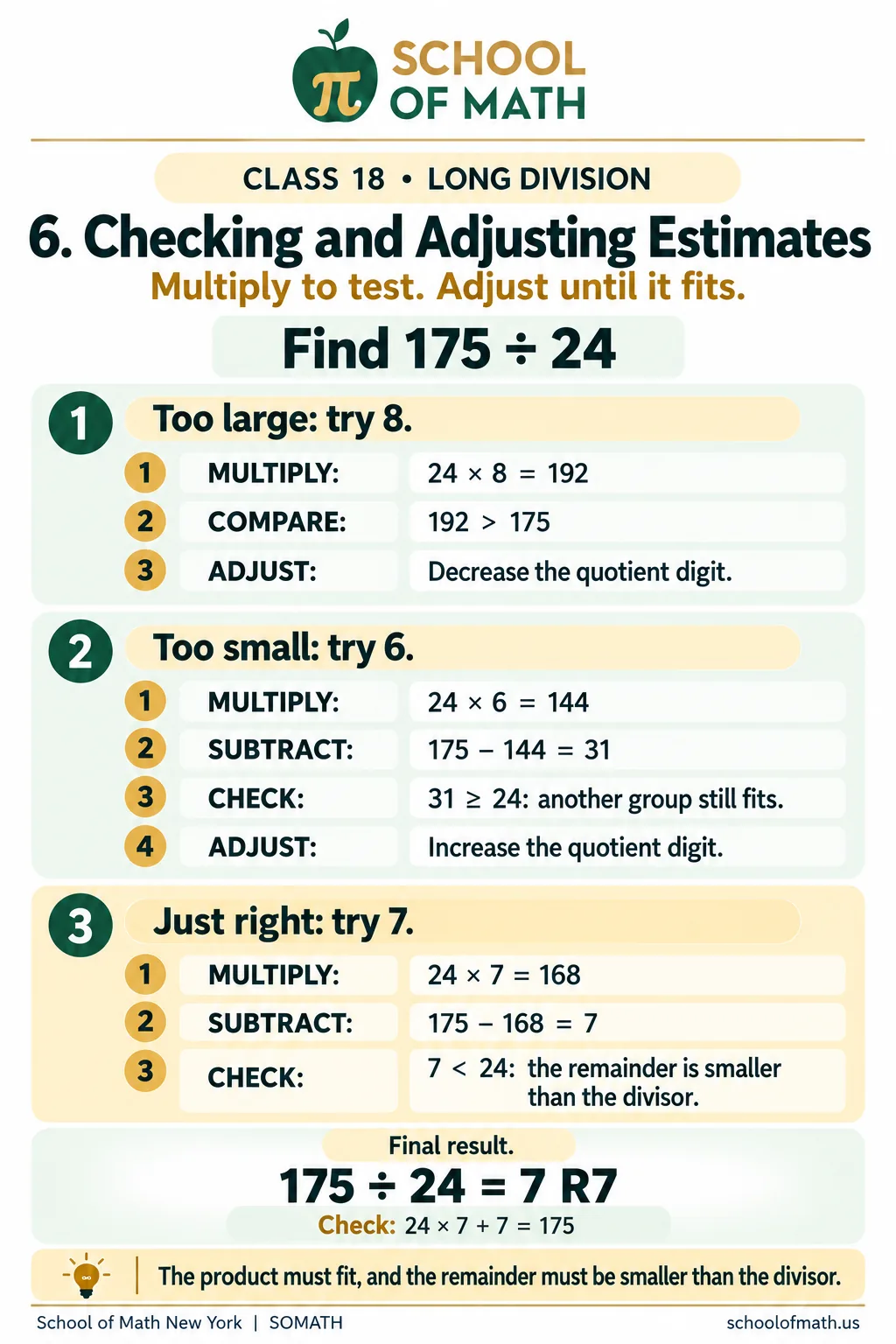
Multiply to test; adjust until it fits. An estimate can be too large or too small. For 175 ÷ 24, trying 8 gives 24 × 8 = 192, which is more than 175, so decrease the digit. Trying 6 gives 24 × 6 = 144 and 175 − 144 = 31; since 31 is at least 24, another group still fits, so increase the digit.
Trying 7 gives 24 × 7 = 168 and 175 − 168 = 7. Because 7 is smaller than 24, the digit is just right: 175 ÷ 24 = 7 R 7, and 24 × 7 + 7 = 175. Two tests decide every digit: the product must fit, and the leftover must be smaller than the divisor.
Practice: try these five questions
Q26
Try 8 for 183 ÷ 23. Is 8 too large, too small, or just right? Adjust until it fits.
Answer
8 is too large; 183 ÷ 23 = 7 R 22
- Multiply 23 × 8 = 184. Since 184 > 183, the digit 8 is too large. Decrease the digit.
- Try 7: 23 × 7 = 161, and 183 − 161 = 22. Since 22 < 23, the digit 7 fits.
- So 183 ÷ 23 = 7 R 22. Check: 23 × 7 + 22 = 183.
Q27
A student tries 5 for 207 ÷ 32 and writes 5 R 47. What is wrong? Fix the answer.
Answer
The remainder 47 is larger than 32; 207 ÷ 32 = 6 R 15
- Multiply 32 × 5 = 160, and 207 − 160 = 47. Since 47 ≥ 32, another group of 32 still fits, so 5 is too small.
- Increase the digit to 6: 32 × 6 = 192, and 207 − 192 = 15. Since 15 < 32, the digit 6 fits.
- So 207 ÷ 32 = 6 R 15. Check: 32 × 6 + 15 = 207.
Q28
Estimate 250 ÷ 41, test your digit, and adjust if needed.
Answer
6 R 4
- Round to friendly numbers: 250 ≈ 240 and 41 ≈ 40. Estimate 240 ÷ 40 = 6, so try 6.
- Multiply 41 × 6 = 246, and 250 − 246 = 4. Since 4 < 41, the digit 6 is just right; no adjustment is needed.
- So 250 ÷ 41 = 6 R 4. Check: 41 × 6 + 4 = 250.
Q29
Try 9 for 143 ÷ 17. Adjust until the digit fits, then state the quotient and remainder.
Answer
9 is too large; 143 ÷ 17 = 8 R 7
- Multiply 17 × 9 = 153. Since 153 > 143, the digit 9 is too large. Decrease the digit.
- Try 8: 17 × 8 = 136, and 143 − 136 = 7. Since 7 < 17, the digit 8 fits.
- So 143 ÷ 17 = 8 R 7. Check: 17 × 8 + 7 = 143.
Q30
Estimate 170 ÷ 28 by rounding 28 to 30. Test the estimate and adjust.
Answer
The estimate 5 is too small; 170 ÷ 28 = 6 R 2
- Round 28 to 30. Since 30 × 5 = 150 fits in 170 but 30 × 6 = 180 does not, estimate 5 and try 5.
- Multiply 28 × 5 = 140, and 170 − 140 = 30. Since 30 ≥ 28, another group still fits, so 5 is too small. Increase the digit.
- Try 6: 28 × 6 = 168, and 170 − 168 = 2. Since 2 < 28, the digit 6 fits. So 170 ÷ 28 = 6 R 2. Check: 28 × 6 + 2 = 170.
Solving problems with remainders
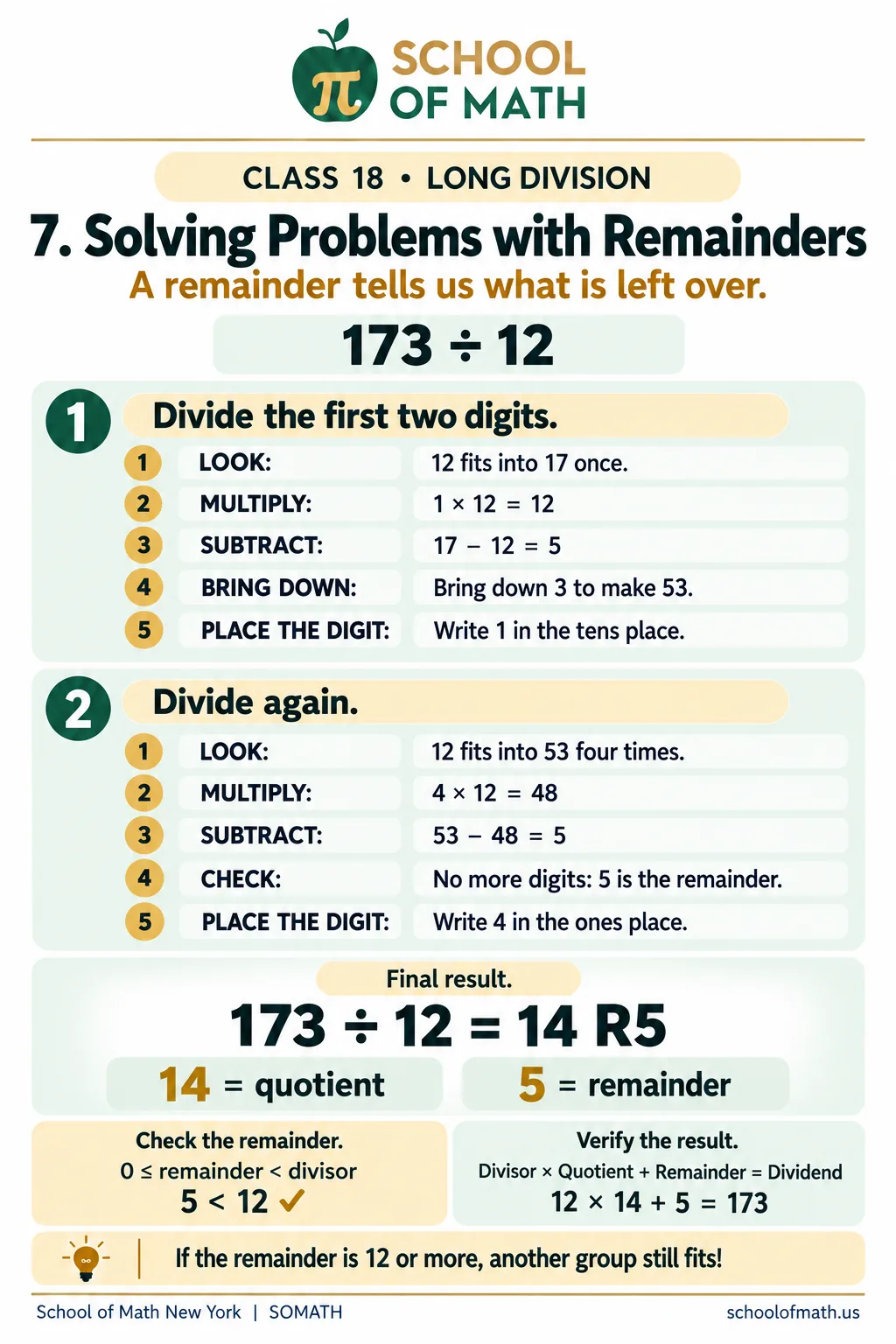
A remainder tells us what is left over. For 173 ÷ 12, divide the first two digits: 12 fits into 17 once, 1 × 12 = 12, 17 − 12 = 5, and bringing down the 3 makes 53. Divide again: 12 fits into 53 four times, 4 × 12 = 48, and 53 − 48 = 5. No digits remain, so 5 is the remainder and the quotient is 14.
Every final answer passes two checks. The remainder must satisfy 0 ≤ remainder < divisor; if the remainder is 12 or more, another group still fits. Then verify with multiplication: divisor × quotient + remainder = dividend, so 12 × 14 + 5 = 173.
Practice: try these five questions
Q31
Solve 185 ÷ 12. State the quotient and the remainder, and verify your answer.
Answer
15 R 5
- 12 does not fit into 1, so use the first two digits, 18. Divide 18 by 12: write 1 in the tens place. Multiply 1 × 12 = 12, then subtract 18 − 12 = 6. Bring down the 5 to make 65.
- Divide 65 by 12: write 5 in the ones place. Multiply 5 × 12 = 60, then subtract 65 − 60 = 5.
- No digits remain to bring down. The quotient is 15 and the remainder is 5. Check: 12 × 15 + 5 = 185, and 5 < 12.
Q32
Solve 230 ÷ 14 and check that the remainder is smaller than the divisor.
Answer
16 R 6
- 14 does not fit into 2, so use the first two digits, 23. Divide 23 by 14: write 1 in the tens place. Multiply 1 × 14 = 14, then subtract 23 − 14 = 9. Bring down the 0 to make 90.
- Divide 90 by 14: write 6 in the ones place. Multiply 6 × 14 = 84, then subtract 90 − 84 = 6.
- No digits remain to bring down. The quotient is 16 and the remainder is 6. Check: 14 × 16 + 6 = 230, and 6 < 14.
Q33
Solve 347 ÷ 21 and verify with divisor × quotient + remainder.
Answer
16 R 11
- 21 does not fit into 3, so use the first two digits, 34. Divide 34 by 21: write 1 in the tens place. Multiply 1 × 21 = 21, then subtract 34 − 21 = 13. Bring down the 7 to make 137.
- Divide 137 by 21: write 6 in the ones place. Multiply 6 × 21 = 126, then subtract 137 − 126 = 11.
- No digits remain to bring down. The quotient is 16 and the remainder is 11. Check: 21 × 16 + 11 = 347, and 11 < 21.
Q34
Solve 509 ÷ 25. Be careful with the ones place of the quotient.
Answer
20 R 9
- 25 does not fit into 5, so use the first two digits, 50. Divide 50 by 25: write 2 in the tens place. Multiply 2 × 25 = 50, then subtract 50 − 50 = 0. Bring down the 9 to make 9.
- Divide 9 by 25: 25 does not fit into 9, so write 0 in the ones place.
- No digits remain to bring down. The quotient is 20 and the remainder is 9. Check: 25 × 20 + 9 = 509, and 9 < 25.
Q35
A student writes 200 ÷ 15 = 12 R 20. Explain why the answer is not finished, then correct it.
Answer
13 R 5
- Although 15 × 12 + 20 = 200, the remainder 20 is not smaller than 15. Another group of 15 still fits inside the 20.
- Make one more group: 13 × 15 = 195, and 200 − 195 = 5. Since 5 < 15, the answer is 200 ÷ 15 = 13 R 5. Check: 15 × 13 + 5 = 200.
Applying division to word problems
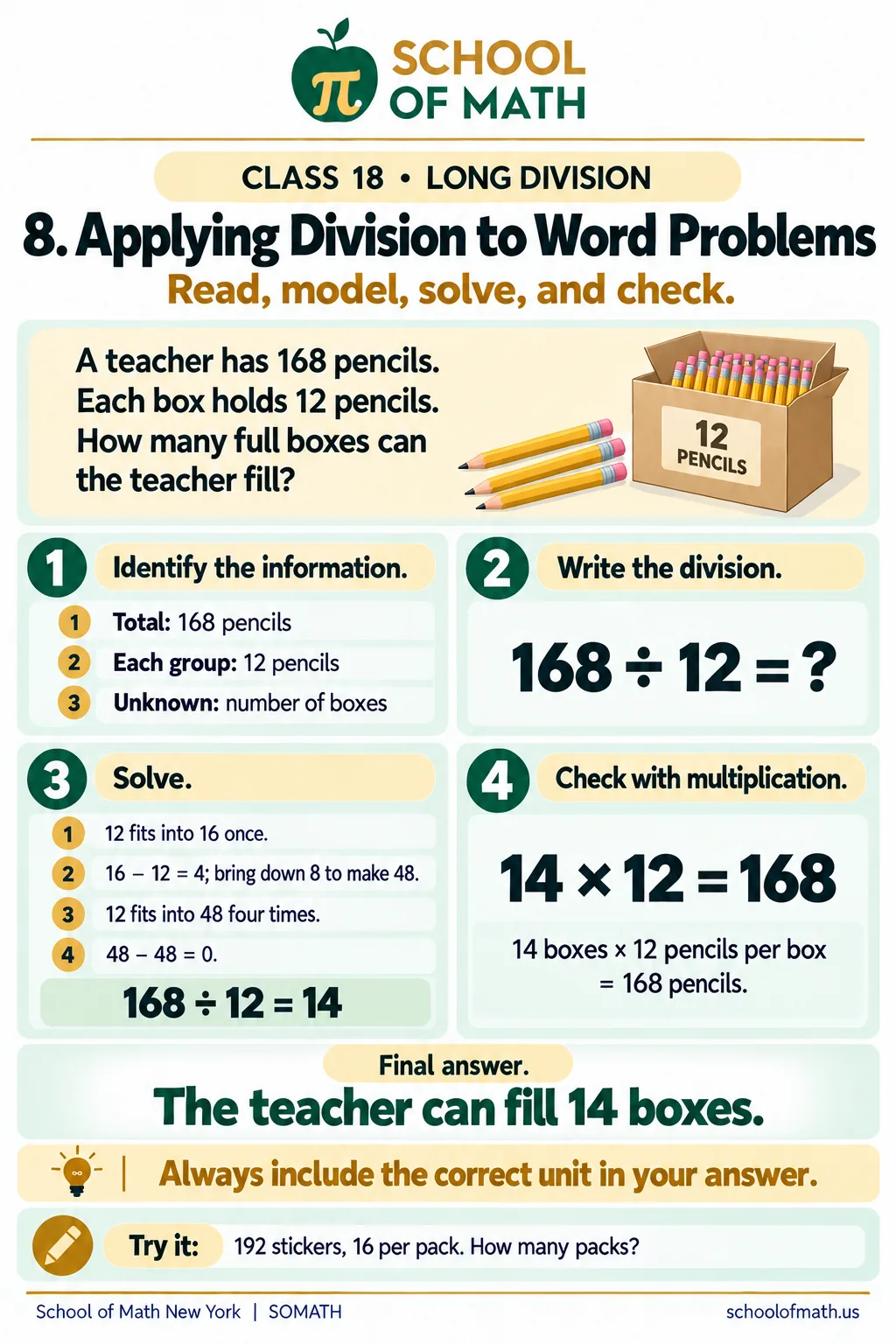
Read, model, solve, and check. First identify the information: the total, the size of each group, and the unknown. A teacher with 168 pencils and boxes of 12 wants the number of boxes, so the division is 168 ÷ 12. Solve with the long-division steps to get 14, then check with multiplication: 14 × 12 = 168.
Finish with a sentence that answers the question and includes the correct unit: the teacher can fill 14 boxes. When a remainder appears, decide what it means. Count only full groups if the question asks for full groups; add one more group if every person or object must have a place; or report the leftovers if the story asks what remains.
Practice: try these five questions
Q36
A craft store has 204 stickers and puts 17 stickers in each pack. How many packs can be made?
Answer
12 packs
- Total 204 stickers; each pack holds 17; the unknown is the number of packs. Write 204 ÷ 17.
- 17 does not fit into 2, so use the first two digits, 20. Divide 20 by 17: write 1 in the tens place. Multiply 1 × 17 = 17, then subtract 20 − 17 = 3. Bring down the 4 to make 34.
- Divide 34 by 17: write 2 in the ones place. Multiply 2 × 17 = 34, then subtract 34 − 34 = 0.
- No digits remain to bring down. The quotient is 12 and the remainder is 0. Check: 17 × 12 = 204.
- The store can make 12 packs. Check: 12 × 17 = 204 stickers.
Q37
There are 150 students going on a trip. Each bus seats 12 students. How many buses are needed so that everyone has a seat?
Answer
13 buses
- Total 150 students; each bus seats 12; the unknown is the number of buses. Write 150 ÷ 12.
- 12 does not fit into 1, so use the first two digits, 15. Divide 15 by 12: write 1 in the tens place. Multiply 1 × 12 = 12, then subtract 15 − 12 = 3. Bring down the 0 to make 30.
- Divide 30 by 12: write 2 in the ones place. Multiply 2 × 12 = 24, then subtract 30 − 24 = 6.
- No digits remain to bring down. The quotient is 12 and the remainder is 6. Check: 12 × 12 + 6 = 150, and 6 < 12.
- Twelve buses seat 144 students, leaving 6 students who still need seats. Add one more bus: 12 + 1 = 13 buses.
Q38
A bakery has 196 cookies and packs exactly 15 in each bag. How many full bags can be packed, and how many cookies are left over?
Answer
13 full bags; 1 cookie left over
- Total 196 cookies; each bag holds 15; the unknown is the number of full bags. Write 196 ÷ 15.
- 15 does not fit into 1, so use the first two digits, 19. Divide 19 by 15: write 1 in the tens place. Multiply 1 × 15 = 15, then subtract 19 − 15 = 4. Bring down the 6 to make 46.
- Divide 46 by 15: write 3 in the ones place. Multiply 3 × 15 = 45, then subtract 46 − 45 = 1.
- No digits remain to bring down. The quotient is 13 and the remainder is 1. Check: 15 × 13 + 1 = 196, and 1 < 15.
- Only full bags are counted: 13 bags. The remainder tells the leftover: 1 cookie.
Q39
A gym sets up 288 chairs in rows of 24. How many rows are there?
Answer
12 rows
- Total 288 chairs; each row has 24; the unknown is the number of rows. Write 288 ÷ 24.
- 24 does not fit into 2, so use the first two digits, 28. Divide 28 by 24: write 1 in the tens place. Multiply 1 × 24 = 24, then subtract 28 − 24 = 4. Bring down the 8 to make 48.
- Divide 48 by 24: write 2 in the ones place. Multiply 2 × 24 = 48, then subtract 48 − 48 = 0.
- No digits remain to bring down. The quotient is 12 and the remainder is 0. Check: 24 × 12 = 288.
- There are 12 rows. Check: 12 × 24 = 288 chairs.
Q40
A class earns $250 and shares it equally among 18 students, giving whole dollars only. How many dollars does each student receive, and how much money is left over?
Answer
$13 each; $16 left over
- Total $250; 18 equal shares; the unknown is the amount in each share. Here the divisor is the number of students, and the quotient tells the dollars per student. Write 250 ÷ 18.
- 18 does not fit into 2, so use the first two digits, 25. Divide 25 by 18: write 1 in the tens place. Multiply 1 × 18 = 18, then subtract 25 − 18 = 7. Bring down the 0 to make 70.
- Divide 70 by 18: write 3 in the ones place. Multiply 3 × 18 = 54, then subtract 70 − 54 = 16.
- No digits remain to bring down. The quotient is 13 and the remainder is 16. Check: 18 × 13 + 16 = 250, and 16 < 18.
- Each student receives $13, and $16 remains. Since 16 < 18, there is not enough for another dollar each.
Homework review
One review question for each topic. Show your steps, test each quotient digit, and check the final remainder.
R1
In 169 ÷ 13 = 13, name the dividend, the divisor, and the quotient.
Answer
Dividend 169; divisor 13; quotient 13
- The dividend 169 is the total being divided, the divisor 13 is the size of each group, and the quotient 13 is the number of groups. Check: 13 × 13 = 169.
R2
Use multiples of 16 to find 112 ÷ 16.
Answer
7
- Multiples of 16: 16, 32, 48, 64, 80, 96, 112. The seventh multiple is 112, so 16 × 7 = 112.
- Therefore 112 ÷ 16 = 7.
R3
Estimate 215 ÷ 34 with friendly numbers, then check and adjust.
Answer
6 R 11
- Round to friendly numbers: 215 ≈ 210 and 34 ≈ 30. Estimate 210 ÷ 30 = 7, so start by trying 7.
- Check 34 × 7 = 238. Since 238 > 215, 7 is too large.
- Check 34 × 6 = 204. It fits: 215 − 204 = 11, and 11 < 34.
- So 215 ÷ 34 = 6 R 11. Check: 34 × 6 + 11 = 215.
R4
Set up 198 ÷ 11. Which digits do you start with, and where does the first quotient digit go? Then finish the division.
Answer
Start with 19; the first digit goes above the tens digit; 198 ÷ 11 = 18
- The divisor 11 goes outside the bracket and 198 goes inside. 11 does not fit into 1, so start with 19 and place the first quotient digit above the tens digit, 9.
- Divide 19 by 11: write 1 in the tens place. Multiply 1 × 11 = 11, then subtract 19 − 11 = 8. Bring down the 8 to make 88.
- Divide 88 by 11: write 8 in the ones place. Multiply 8 × 11 = 88, then subtract 88 − 88 = 0.
- No digits remain to bring down. The quotient is 18 and the remainder is 0. Check: 11 × 18 = 198.
R5
Solve 352 ÷ 16 using divide, multiply, subtract, and bring down.
Answer
22
- 16 does not fit into 3, so use the first two digits, 35. Divide 35 by 16: write 2 in the tens place. Multiply 2 × 16 = 32, then subtract 35 − 32 = 3. Bring down the 2 to make 32.
- Divide 32 by 16: write 2 in the ones place. Multiply 2 × 16 = 32, then subtract 32 − 32 = 0.
- No digits remain to bring down. The quotient is 22 and the remainder is 0. Check: 16 × 22 = 352.
R6
Try 4 for 165 ÷ 33. Test the digit and adjust until it fits.
Answer
4 is too small; 165 ÷ 33 = 5
- Multiply 33 × 4 = 132, and 165 − 132 = 33. Since 33 ≥ 33, another group still fits, so 4 is too small. Increase the digit.
- Try 5: 33 × 5 = 165, and 165 − 165 = 0. The digit fits exactly, so 165 ÷ 33 = 5. Check: 33 × 5 = 165.
R7
Solve 275 ÷ 13. Check that the remainder is valid and verify with multiplication.
Answer
21 R 2
- 13 does not fit into 2, so use the first two digits, 27. Divide 27 by 13: write 2 in the tens place. Multiply 2 × 13 = 26, then subtract 27 − 26 = 1. Bring down the 5 to make 15.
- Divide 15 by 13: write 1 in the ones place. Multiply 1 × 13 = 13, then subtract 15 − 13 = 2.
- No digits remain to bring down. The quotient is 21 and the remainder is 2. Check: 13 × 21 + 2 = 275, and 2 < 13.
R8
A teacher has 180 markers and puts 14 markers in each box. How many full boxes can be filled, and how many markers are left over?
Answer
12 full boxes; 12 markers left over
- Total 180 markers; each box holds 14; the unknown is the number of full boxes. Write 180 ÷ 14.
- 14 does not fit into 1, so use the first two digits, 18. Divide 18 by 14: write 1 in the tens place. Multiply 1 × 14 = 14, then subtract 18 − 14 = 4. Bring down the 0 to make 40.
- Divide 40 by 14: write 2 in the ones place. Multiply 2 × 14 = 28, then subtract 40 − 28 = 12.
- No digits remain to bring down. The quotient is 12 and the remainder is 12. Check: 14 × 12 + 12 = 180, and 12 < 14.
- Twelve full boxes can be filled, and 12 markers remain. The leftover 12 is smaller than 14, so it does not fill another box.
Homework word problems
Work from simpler stories toward two-step challenges. Decide whether to report leftovers, count full groups, or add another container. Include units in your answer.
W1
A farm packs 132 eggs into cartons of 12. How many cartons are filled?
Answer
11 cartons
- Total 132 eggs; each carton holds 12; find the number of cartons. Write 132 ÷ 12.
- 12 does not fit into 1, so use the first two digits, 13. Divide 13 by 12: write 1 in the tens place. Multiply 1 × 12 = 12, then subtract 13 − 12 = 1. Bring down the 2 to make 12.
- Divide 12 by 12: write 1 in the ones place. Multiply 1 × 12 = 12, then subtract 12 − 12 = 0.
- No digits remain to bring down. The quotient is 11 and the remainder is 0. Check: 12 × 11 = 132.
- The farm fills 11 cartons.
W2
A grocer has 125 apples and puts 11 apples in each bag. How many full bags can be made, and how many apples are left?
Answer
11 full bags; 4 apples left
- Total 125 apples; each bag holds 11; find the number of full bags. Write 125 ÷ 11.
- 11 does not fit into 1, so use the first two digits, 12. Divide 12 by 11: write 1 in the tens place. Multiply 1 × 11 = 11, then subtract 12 − 11 = 1. Bring down the 5 to make 15.
- Divide 15 by 11: write 1 in the ones place. Multiply 1 × 11 = 11, then subtract 15 − 11 = 4.
- No digits remain to bring down. The quotient is 11 and the remainder is 4. Check: 11 × 11 + 4 = 125, and 4 < 11.
- Eleven full bags can be made, with 4 apples left over.
W3
A coach divides 210 students into teams of 15. How many teams are there?
Answer
14 teams
- Total 210 students; each team has 15; find the number of teams. Write 210 ÷ 15.
- 15 does not fit into 2, so use the first two digits, 21. Divide 21 by 15: write 1 in the tens place. Multiply 1 × 15 = 15, then subtract 21 − 15 = 6. Bring down the 0 to make 60.
- Divide 60 by 15: write 4 in the ones place. Multiply 4 × 15 = 60, then subtract 60 − 60 = 0.
- No digits remain to bring down. The quotient is 14 and the remainder is 0. Check: 15 × 14 = 210.
- There are 14 teams. Check: 14 × 15 = 210 students.
W4
There are 190 passengers. Each van carries 12 passengers. How many vans are needed for everyone?
Answer
16 vans
- Total 190 passengers; each van carries 12; find the number of vans. Write 190 ÷ 12.
- 12 does not fit into 1, so use the first two digits, 19. Divide 19 by 12: write 1 in the tens place. Multiply 1 × 12 = 12, then subtract 19 − 12 = 7. Bring down the 0 to make 70.
- Divide 70 by 12: write 5 in the ones place. Multiply 5 × 12 = 60, then subtract 70 − 60 = 10.
- No digits remain to bring down. The quotient is 15 and the remainder is 10. Check: 12 × 15 + 10 = 190, and 10 < 12.
- Fifteen vans carry 180 passengers, leaving 10 passengers who still need a ride. Add one more van: 15 + 1 = 16 vans.
W5
A book has 364 pages. If Maya reads 14 pages each day, how many days will it take to finish the book?
Answer
26 days
- Total 364 pages; 14 pages each day; find the number of days. Write 364 ÷ 14.
- 14 does not fit into 3, so use the first two digits, 36. Divide 36 by 14: write 2 in the tens place. Multiply 2 × 14 = 28, then subtract 36 − 28 = 8. Bring down the 4 to make 84.
- Divide 84 by 14: write 6 in the ones place. Multiply 6 × 14 = 84, then subtract 84 − 84 = 0.
- No digits remain to bring down. The quotient is 26 and the remainder is 0. Check: 14 × 26 = 364.
- Maya finishes in 26 days. Check: 26 × 14 = 364 pages.
W6
A class raised $255 and shares it equally among 17 students. How many dollars does each student receive?
Answer
$15 each
- Total $255; 17 equal shares; find the amount in each share. The divisor is the number of students. Write 255 ÷ 17.
- 17 does not fit into 2, so use the first two digits, 25. Divide 25 by 17: write 1 in the tens place. Multiply 1 × 17 = 17, then subtract 25 − 17 = 8. Bring down the 5 to make 85.
- Divide 85 by 17: write 5 in the ones place. Multiply 5 × 17 = 85, then subtract 85 − 85 = 0.
- No digits remain to bring down. The quotient is 15 and the remainder is 0. Check: 17 × 15 = 255.
- Each student receives $15. Check: 17 × 15 = 255.
W7
A photographer has 300 photos and fills albums that hold 24 photos each. How many albums are completely full, and how many photos are left over?
Answer
12 full albums; 12 photos left over
- Total 300 photos; each album holds 24; find the number of full albums. Write 300 ÷ 24.
- 24 does not fit into 3, so use the first two digits, 30. Divide 30 by 24: write 1 in the tens place. Multiply 1 × 24 = 24, then subtract 30 − 24 = 6. Bring down the 0 to make 60.
- Divide 60 by 24: write 2 in the ones place. Multiply 2 × 24 = 48, then subtract 60 − 48 = 12.
- No digits remain to bring down. The quotient is 12 and the remainder is 12. Check: 24 × 12 + 12 = 300, and 12 < 24.
- Twelve albums are full, and 12 photos remain. Since 12 < 24, they do not fill another album.
W8
An auditorium has 416 seats arranged in rows of 32. How many rows are there?
Answer
13 rows
- Total 416 seats; each row has 32; find the number of rows. Write 416 ÷ 32.
- 32 does not fit into 4, so use the first two digits, 41. Divide 41 by 32: write 1 in the tens place. Multiply 1 × 32 = 32, then subtract 41 − 32 = 9. Bring down the 6 to make 96.
- Divide 96 by 32: write 3 in the ones place. Multiply 3 × 32 = 96, then subtract 96 − 96 = 0.
- No digits remain to bring down. The quotient is 13 and the remainder is 0. Check: 32 × 13 = 416.
- There are 13 rows. Check: 13 × 32 = 416 seats.
W9
Lena has 126 blue beads and 54 white beads. She uses 15 beads for each bracelet. How many bracelets can she make?
Answer
12 bracelets
- First find the total: 126 + 54 = 180 beads. Each bracelet uses 15 beads, so write 180 ÷ 15.
- 15 does not fit into 1, so use the first two digits, 18. Divide 18 by 15: write 1 in the tens place. Multiply 1 × 15 = 15, then subtract 18 − 15 = 3. Bring down the 0 to make 30.
- Divide 30 by 15: write 2 in the ones place. Multiply 2 × 15 = 30, then subtract 30 − 30 = 0.
- No digits remain to bring down. The quotient is 12 and the remainder is 0. Check: 15 × 12 = 180.
- Lena can make 12 bracelets. Check: 12 × 15 = 180 beads.
W10
A toy shop receives 3 boxes with 85 marbles in each box. The marbles are repacked into bags of 20. How many full bags are made, and how many marbles are left over?
Answer
12 full bags; 15 marbles left over
- First find the total: 3 × 85 = 255 marbles. Each bag holds 20, so write 255 ÷ 20.
- 20 does not fit into 2, so use the first two digits, 25. Divide 25 by 20: write 1 in the tens place. Multiply 1 × 20 = 20, then subtract 25 − 20 = 5. Bring down the 5 to make 55.
- Divide 55 by 20: write 2 in the ones place. Multiply 2 × 20 = 40, then subtract 55 − 40 = 15.
- No digits remain to bring down. The quotient is 12 and the remainder is 15. Check: 20 × 12 + 15 = 255, and 15 < 20.
- Twelve full bags are made, with 15 marbles left over. Since 15 < 20, they do not fill another bag.
W11
A theater prints 500 tickets and staples them into booklets of 24. How many full booklets are made, and how many tickets are left over?
Answer
20 full booklets; 20 tickets left over
- Total 500 tickets; each booklet holds 24; find the number of full booklets. Write 500 ÷ 24.
- 24 does not fit into 5, so use the first two digits, 50. Divide 50 by 24: write 2 in the tens place. Multiply 2 × 24 = 48, then subtract 50 − 48 = 2. Bring down the 0 to make 20.
- Divide 20 by 24: 24 does not fit into 20, so write 0 in the ones place.
- No digits remain to bring down. The quotient is 20 and the remainder is 20. Check: 24 × 20 + 20 = 500, and 20 < 24.
- Twenty full booklets are made, and 20 tickets remain. Notice the zero in the ones place of the quotient: 24 does not fit into 20.
W12
A school orders 648 pencils packed in boxes of 24. The boxes are then shared equally among 9 classrooms. How many boxes does each classroom receive?
Answer
3 boxes each
- First find the number of boxes: 648 ÷ 24.
- 24 does not fit into 6, so use the first two digits, 64. Divide 64 by 24: write 2 in the tens place. Multiply 2 × 24 = 48, then subtract 64 − 48 = 16. Bring down the 8 to make 168.
- Divide 168 by 24: write 7 in the ones place. Multiply 7 × 24 = 168, then subtract 168 − 168 = 0.
- No digits remain to bring down. The quotient is 27 and the remainder is 0. Check: 24 × 27 = 648.
- There are 27 boxes. Share them among 9 classrooms: 27 ÷ 9 = 3. Each classroom receives 3 boxes. Check: 9 × 3 = 27 boxes, and 27 × 24 = 648 pencils.
Quick questions and answers
What is a two-digit divisor?
A two-digit divisor is any whole number from 10 to 99. Dividing by it uses the same long-division steps as a single-digit divisor, with larger multiplication facts.
How do multiples help with long division?
A short list of the divisor's multiples shows which quotient digit fits. The greatest multiple that does not go past the number you are dividing gives the digit, and the difference gives what is left.
How do I estimate a quotient digit?
Round the dividend and the divisor to friendly numbers, divide them in your head, and use the result as a trial digit. Then multiply the trial digit by the original divisor and adjust up or down until it fits.
Where does the first quotient digit go?
Above the last digit of the first group you divide. If the divisor does not fit into the first digit of the dividend, use the first two digits and write the quotient digit above the second one.
How do I know when an estimate needs adjusting?
If the product is larger than the number you are dividing, the digit is too large. If the leftover after subtracting is as large as the divisor, the digit is too small. A correct digit leaves a remainder smaller than the divisor.
How do I check an answer with a remainder?
Confirm that 0 ≤ remainder < divisor, then multiply the divisor by the quotient and add the remainder. The result must equal the dividend.
Is an earlier class required, and what homework is included?
No earlier attendance is required. This self-contained rolling lesson has eight supplied images, forty original practice questions, eight Homework review questions, and twelve Homework word problems. All sixty questions have hidden worked answers. The 22-page student workbook includes the supplied PDF-only cover, the eight teaching images, and the same sixty questions with blank answer space and no exercise solutions.