Little Newtons · Class 14 · Grades 1–2
Two-Digit Subtraction Without Regrouping
To subtract two-digit numbers without regrouping, line up the tens and ones, subtract the ones, then subtract the tens. Keep each answer in its own place. Check by adding the difference to the amount you took away.
Study the eight images in order and try five new questions after each image. Homework includes eight review questions and twelve word problems: 20 homework questions and 60 questions altogether. Select the compact blue Answer button only after you have tried a question.
Part of Little Newtons at SOMATH. Book an evaluation to discuss placement or see the class schedule. Review Class 13: two-digit addition for the skill we use to check our answers.
Download the student workbook (PDF)22 pages · Each teaching image is followed by its five practice questions. Homework review and word problems follow, with up to five questions per page.Generous blank answer space. No exercise answers, writing lines, name fields, or date fields.
Understanding subtraction
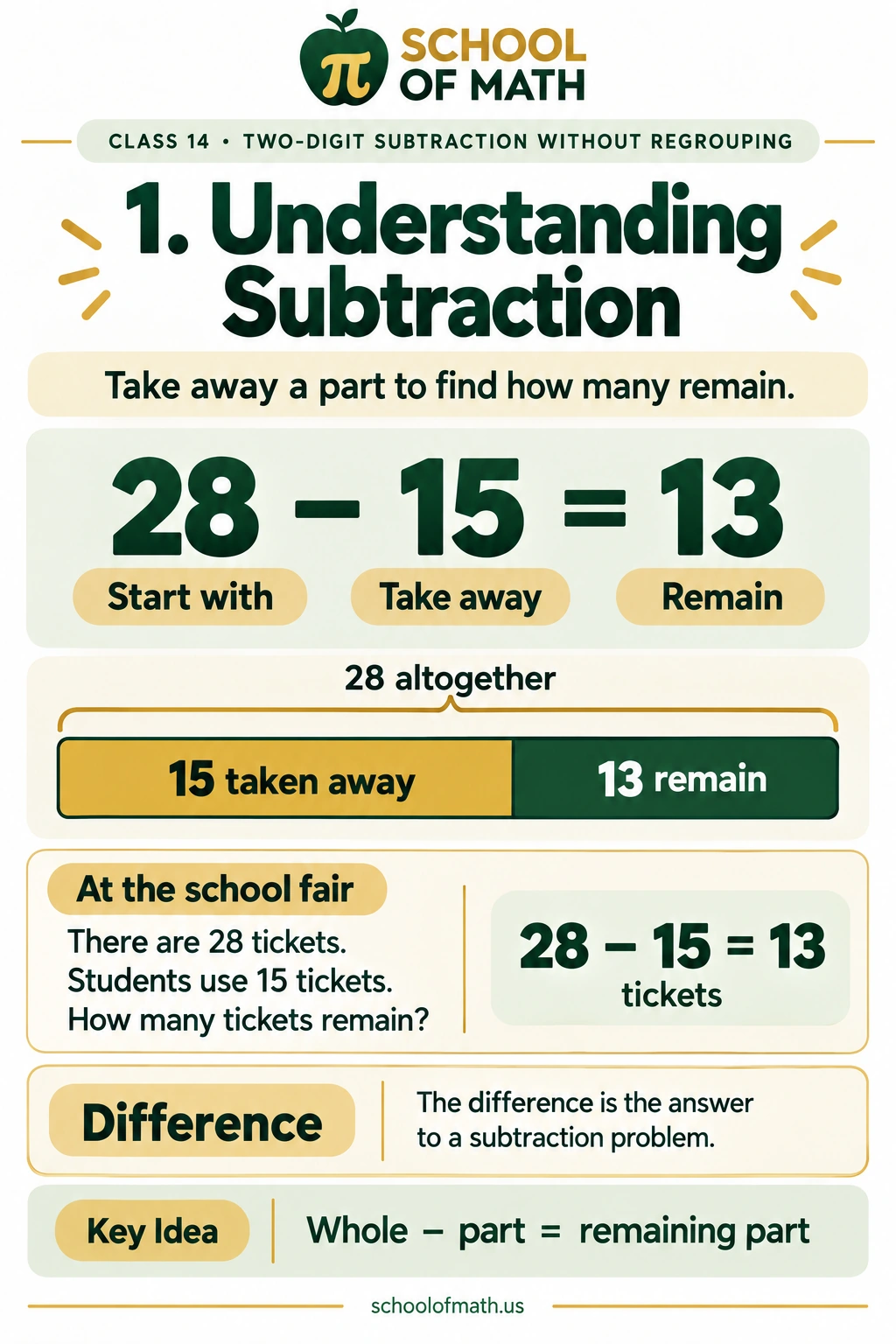
Subtraction can tell us how many are left after we take some away. Start with the whole amount, subtract the part taken away, and find the remaining part. The answer to a subtraction question is called the difference.
Read the subtraction sign as “minus” or “take away.” Keep the numbers in the order the story gives: starting amount minus amount taken away. You can draw a picture to show what stays and what is removed.
Try it yourself: five questions
Q1 Practice 1 of 5
Start with 25 counters and take away 12. How many counters remain?
Answer
13 counters.
- Ones: 5 − 2 = 3.
- Tens: 2 − 1 = 1. That means 1 tens and 3 ones, or 13.
Q2 Practice 2 of 5
Write and solve a subtraction sentence for “37 take away 14.”
Answer
23.
- Ones: 7 − 4 = 3.
- Tens: 3 − 1 = 2. That means 2 tens and 3 ones, or 23.
Q3 Practice 3 of 5
A tray holds 48 beads. You remove 26 beads. How many stay on the tray?
Answer
22 beads.
- Ones: 8 − 6 = 2.
- Tens: 4 − 2 = 2. That means 2 tens and 2 ones, or 22.
Q4 Practice 4 of 5
In 69 − 35, what is the starting amount, what is taken away, and what remains?
Answer
Start with 69; take away 35; 34 remain.
- Ones: 9 − 5 = 4.
- Tens: 6 − 3 = 3. That means 3 tens and 4 ones, or 34.
Q5 Practice 5 of 5
A box holds 87 blocks. After 43 are taken out, is the number left greater than 40? Find the difference to explain.
Answer
Yes. 44 blocks remain, and 44 is greater than 40.
- Ones: 7 − 3 = 4.
- Tens: 8 − 4 = 4. That means 4 tens and 4 ones, or 44.
Reviewing tens and ones
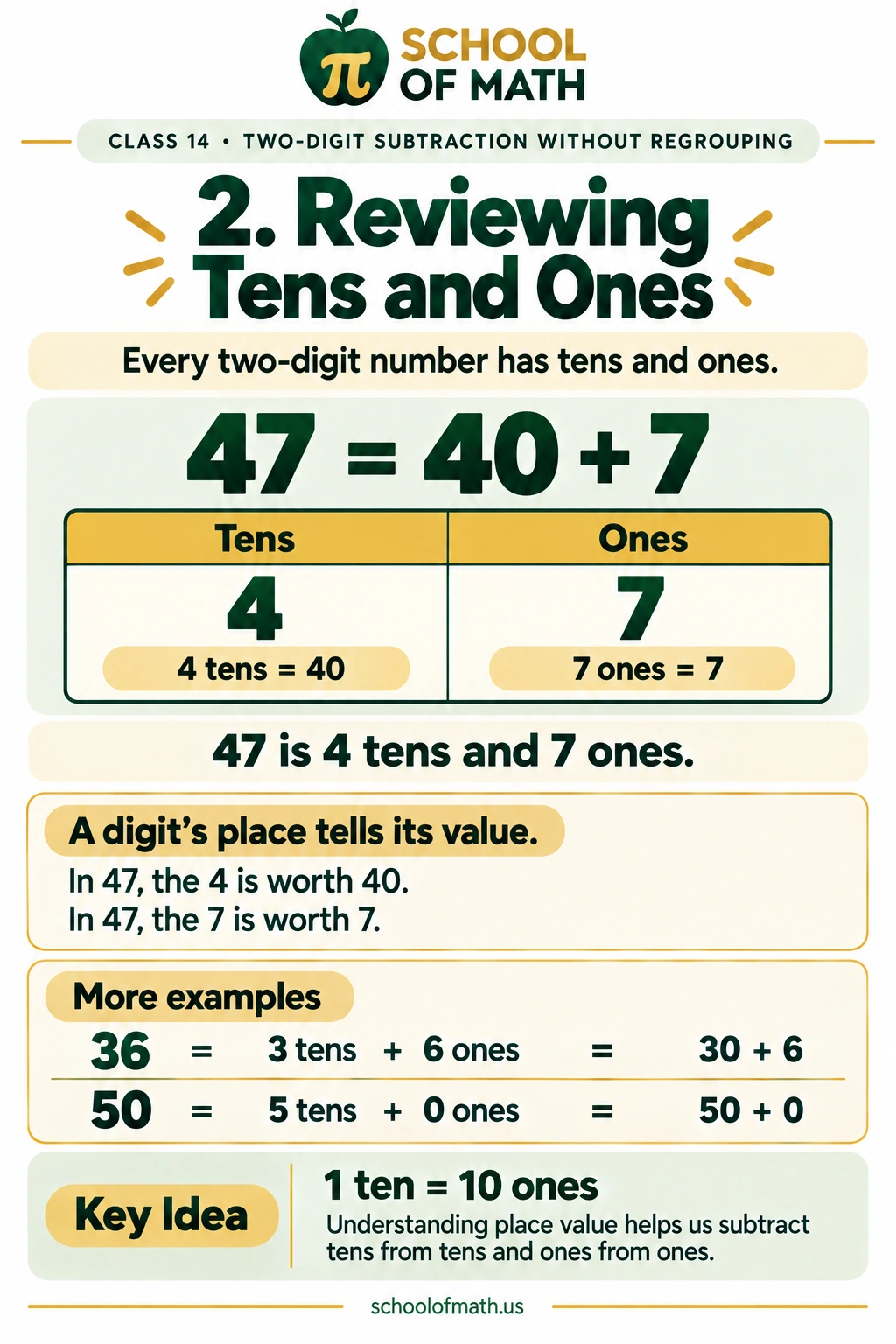
A two-digit number has a tens digit on the left and a ones digit on the right. For example, 62 is 6 tens and 2 ones. The 6 is worth 60, not 6.
Subtract tens from tens and ones from ones. Saying the place values aloud helps: “tens minus tens” and “ones minus ones.” We will not trade a ten for ten ones in this lesson.
Try it yourself: five questions
Q6 Practice 1 of 5
How many tens and ones are in 64?
Answer
6 tens and 4 ones.
- The 6 is in the tens place and is worth 60. The 4 is in the ones place.
Q7 Practice 2 of 5
Write 82 as tens and ones, then as an addition sentence.
Answer
8 tens and 2 ones; 82 = 80 + 2.
- The tens digit gives 80 and the ones digit gives 2.
Q8 Practice 3 of 5
In 73 and 37, what is the value of the digit 7 in each number?
Answer
In 73, it is 70. In 37, it is 7.
- A digit’s position determines its value. The 7 is a tens digit in 73 and a ones digit in 37.
Q9 Practice 4 of 5
Start with 8 tens and 6 ones. Take away 3 tens and 1 one. What number remains?
Answer
55.
- Ones: 6 − 1 = 5.
- Tens: 8 − 3 = 5. That means 5 tens and 5 ones, or 55.
Q10 Practice 5 of 5
A student writes 92 − 41 = 15 after mixing up the tens and ones. What is the correct answer?
Answer
51.
- Ones: 2 − 1 = 1.
- Tens: 9 − 4 = 5. That means 5 tens and 1 ones, or 51.
Subtracting with models
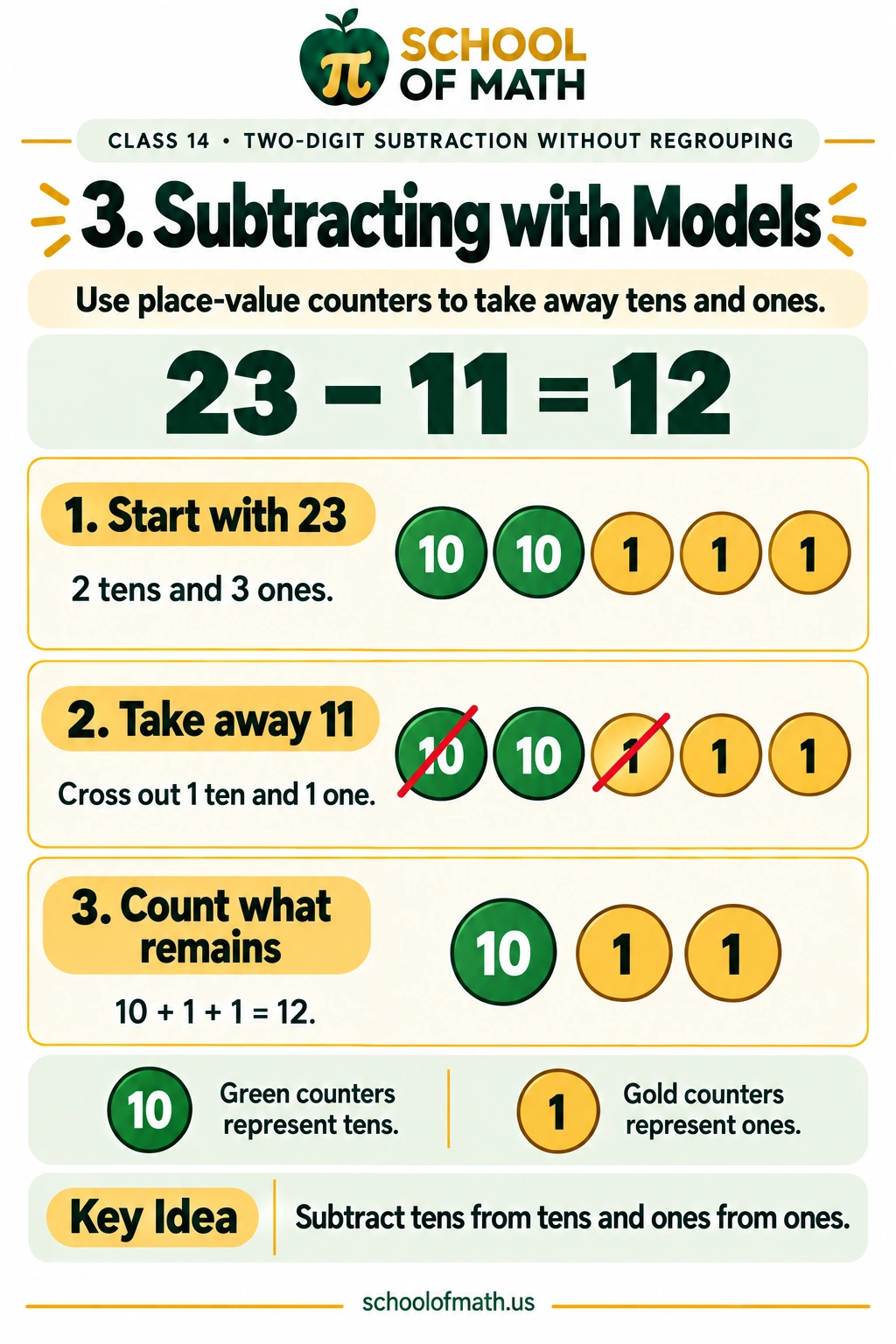
A tens counter represents 10 and a ones counter represents 1. Draw the starting number with these two kinds of counters. Cross out the tens and ones you are taking away, then count what remains.
A picture and a subtraction sentence should describe the same action. Keep the tens counters separate from the ones counters so you do not count a ten as a single one.
Try it yourself: five questions
Q11 Practice 1 of 5
Draw tens and ones to show 34 − 12. Cross out what you take away and write the difference.
Answer
22.
- Draw 3 tens counters and 4 ones counters. Cross out 1 tens counters and 2 ones counters.
- Ones: 4 − 2 = 2.
- Tens: 3 − 1 = 2. That means 2 tens and 2 ones, or 22.
Q12 Practice 2 of 5
Draw tens and ones to show 45 − 21. Cross out what you take away and write the difference.
Answer
24.
- Draw 4 tens counters and 5 ones counters. Cross out 2 tens counters and 1 ones counters.
- Ones: 5 − 1 = 4.
- Tens: 4 − 2 = 2. That means 2 tens and 4 ones, or 24.
Q13 Practice 3 of 5
Draw tens and ones to show 57 − 34. Cross out what you take away and write the difference.
Answer
23.
- Draw 5 tens counters and 7 ones counters. Cross out 3 tens counters and 4 ones counters.
- Ones: 7 − 4 = 3.
- Tens: 5 − 3 = 2. That means 2 tens and 3 ones, or 23.
Q14 Practice 4 of 5
Draw tens and ones to show 68 − 45. Cross out what you take away and write the difference.
Answer
23.
- Draw 6 tens counters and 8 ones counters. Cross out 4 tens counters and 5 ones counters.
- Ones: 8 − 5 = 3.
- Tens: 6 − 4 = 2. That means 2 tens and 3 ones, or 23.
Q15 Practice 5 of 5
Draw tens and ones to show 96 − 52. Cross out what you take away and write the difference.
Answer
44.
- Draw 9 tens counters and 6 ones counters. Cross out 5 tens counters and 2 ones counters.
- Ones: 6 − 2 = 4.
- Tens: 9 − 5 = 4. That means 4 tens and 4 ones, or 44.
Aligning numbers
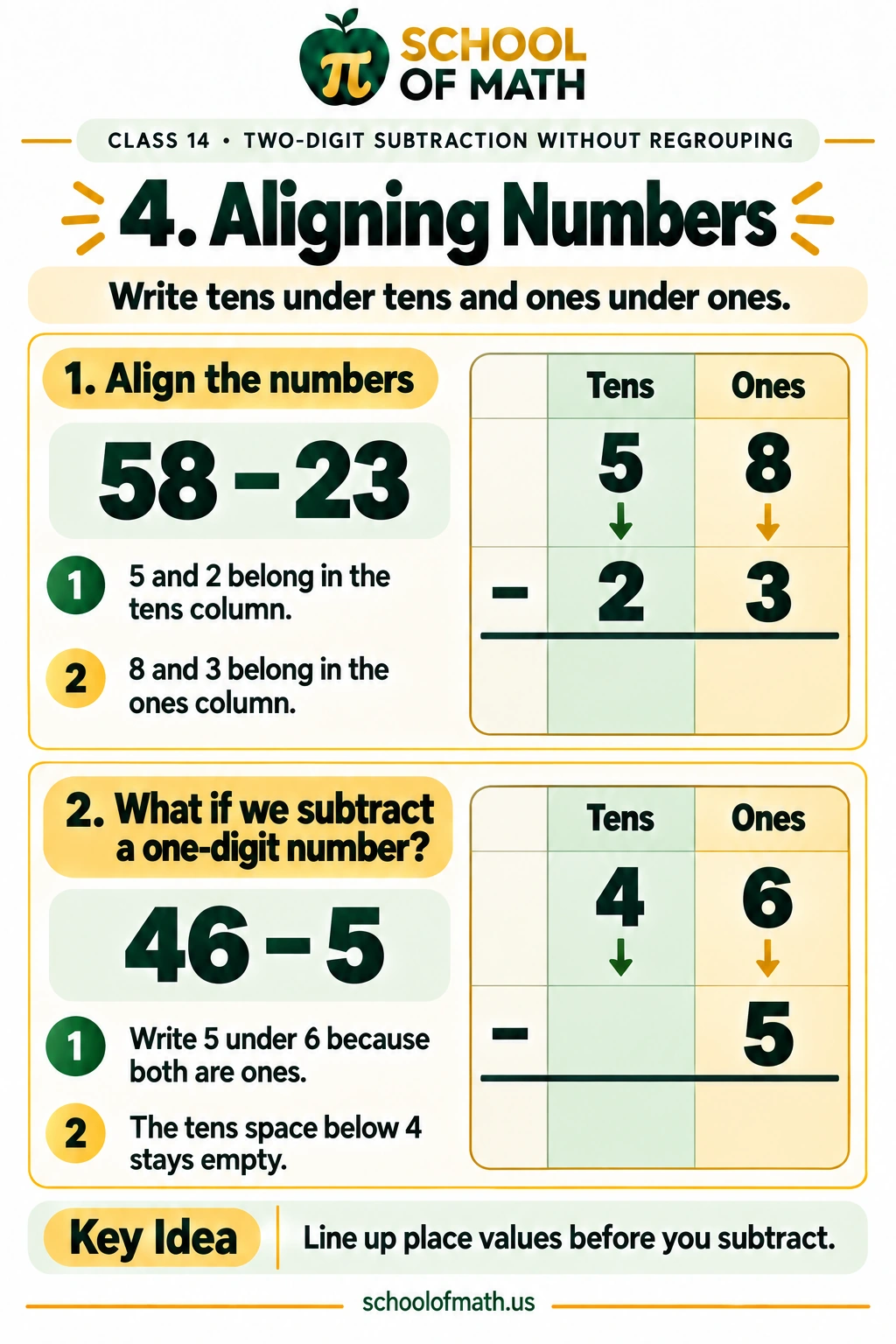
When you write subtraction vertically, keep the place values lined up. The ones digit of the bottom number goes below the ones digit of the top number. The tens digits belong in the tens column.
A one-digit number has no tens. If you subtract 7, place the 7 in the ones column, not the tens column. You may think of it as 0 tens and 7 ones.
Try it yourself: five questions
Q16 Practice 1 of 5
Write 49 − 7 vertically. Which digit should the 7 go under? Then subtract.
Answer
Put the 7 under the 9. The difference is 42.
- Ones: 9 − 7 = 2.
- Tens: 4 − 0 = 4. That means 4 tens and 2 ones, or 42.
Q17 Practice 2 of 5
Write 65 − 24 in tens and ones columns, then solve it.
Answer
41.
- Ones: 5 − 4 = 1.
- Tens: 6 − 2 = 4. That means 4 tens and 1 ones, or 41.
Q18 Practice 3 of 5
Write 78 − 43 vertically. Name the two digits in the tens column, then solve.
Answer
The tens-column digits are 7 and 4. The difference is 35.
- Ones: 8 − 3 = 5.
- Tens: 7 − 4 = 3. That means 3 tens and 5 ones, or 35.
Q19 Practice 4 of 5
A student puts the 5 in 56 under the 9 in 89. Explain the alignment mistake, then solve 89 − 56.
Answer
The 5 belongs under the 8 because both are tens digits. Put the 6 under the 9. The difference is 33.
- Ones: 9 − 6 = 3.
- Tens: 8 − 5 = 3. That means 3 tens and 3 ones, or 33.
Q20 Practice 5 of 5
Set up 97 − 62 vertically. Explain where each digit of 62 belongs, then find the difference.
Answer
Put 6 under 9 and 2 under 7. The difference is 35.
- Ones: 7 − 2 = 5.
- Tens: 9 − 6 = 3. That means 3 tens and 5 ones, or 35.
Subtracting the ones
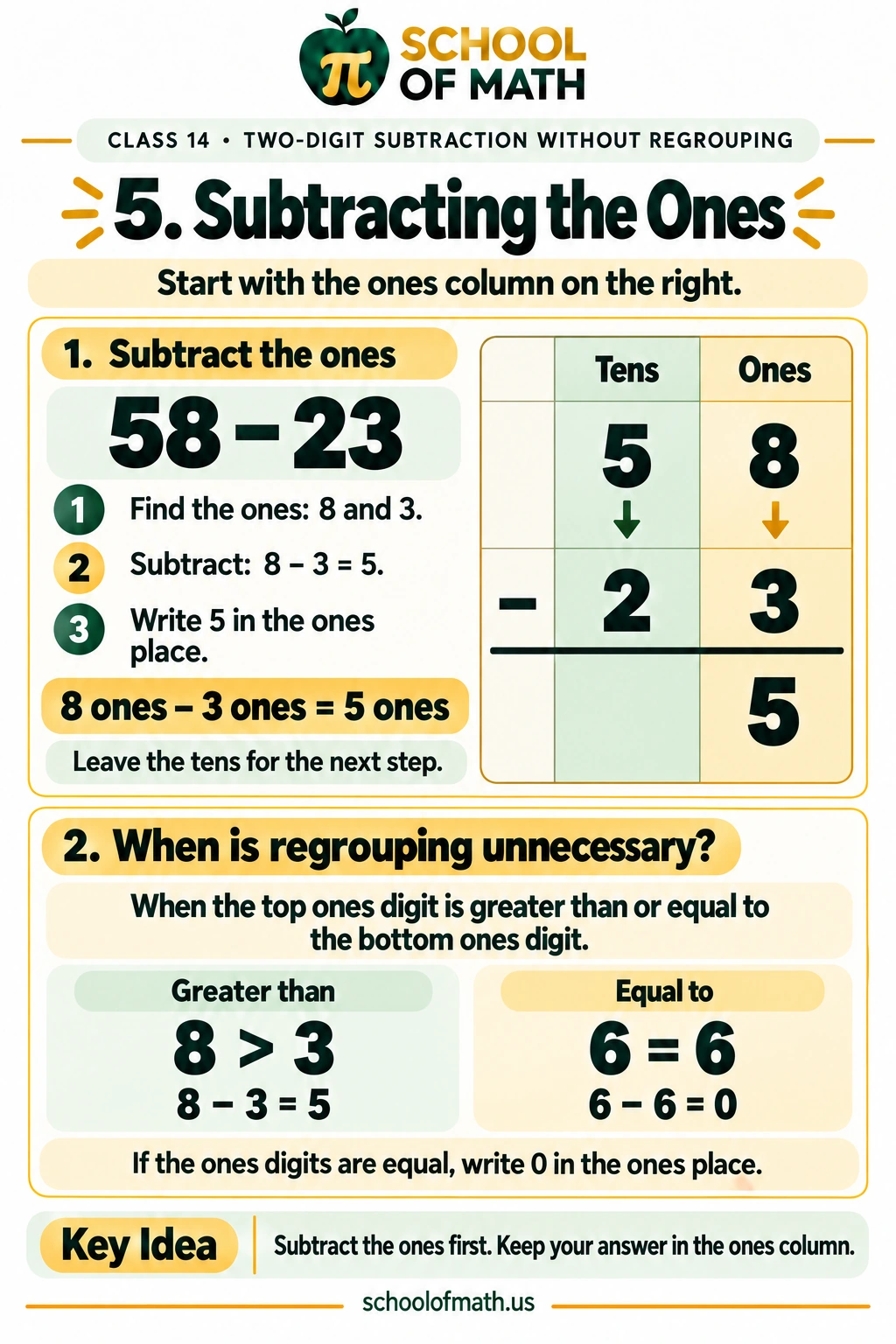
Start in the ones column on the right. Subtract the bottom ones digit from the top ones digit and write that result in the ones place. Leave the tens in their own column.
Every subtraction in this class has enough ones in the starting number. If the ones digits are equal, the answer has zero ones. Keep that zero when you write a number such as 30.
Try it yourself: five questions
Q21 Practice 1 of 5
For 56 − 13, write the ones subtraction first. Then finish the problem.
Answer
43.
- Ones: 6 − 3 = 3.
- Tens: 5 − 1 = 4. That means 4 tens and 3 ones, or 43.
Q22 Practice 2 of 5
For 77 − 25, how many ones remain? Then find the whole difference.
Answer
2 ones remain. The whole difference is 52.
- Ones: 7 − 5 = 2.
- Tens: 7 − 2 = 5. That means 5 tens and 2 ones, or 52.
Q23 Practice 3 of 5
Subtract 68 − 38. Explain why the answer needs a zero in the ones place.
Answer
30. Since 8 − 8 = 0, there are no ones left; the 3 means 3 tens.
- Ones: 8 − 8 = 0.
- Tens: 6 − 3 = 3. That means 3 tens and 0 ones, or 30.
Q24 Practice 4 of 5
A student writes 84 − 42 = 24. Subtract the ones and tens separately to correct the answer.
Answer
42.
- Ones: 4 − 2 = 2.
- Tens: 8 − 4 = 4. That means 4 tens and 2 ones, or 42.
Q25 Practice 5 of 5
Fill in the missing ones digit: 9? − 54 = 42. What is the starting number?
Answer
The missing digit is 6. The starting number is 96.
- The ones must satisfy ? − 4 = 2, so ? = 6. The tens check is 9 − 5 = 4. Thus 96 − 54 = 42.
Subtracting the tens
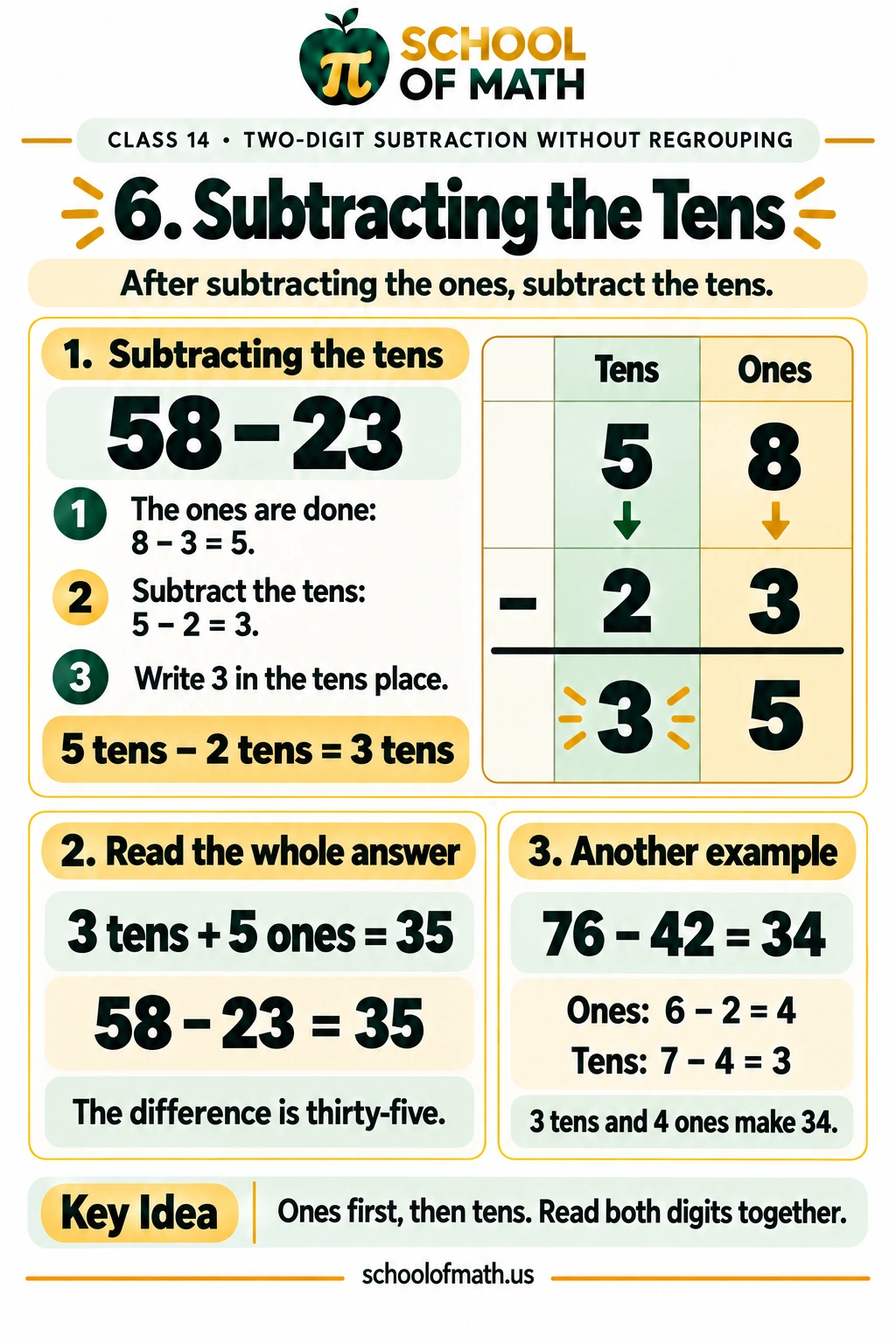
After the ones, subtract the tens. A result of 4 in the tens column means 4 tens, or 40. Read the tens and ones together to name the whole answer.
If you take away a number ending in zero, you take away whole tens and no ones. The ones digit stays the same. If the tens digits are equal, no tens remain.
Try it yourself: five questions
Q26 Practice 1 of 5
Subtract 63 − 20. Why does the ones digit stay the same?
Answer
43. No ones are taken away, so the 3 ones remain.
- Ones: 3 − 0 = 3.
- Tens: 6 − 2 = 4. That means 4 tens and 3 ones, or 43.
Q27 Practice 2 of 5
Subtract 75 − 31. How many tens and ones are in the answer?
Answer
44: 4 tens and 4 ones.
- Ones: 5 − 1 = 4.
- Tens: 7 − 3 = 4. That means 4 tens and 4 ones, or 44.
Q28 Practice 3 of 5
Subtract 88 − 46. Explain what the tens digit in your answer is worth.
Answer
42. Its tens digit is 4, which is worth 40.
- Ones: 8 − 6 = 2.
- Tens: 8 − 4 = 4. That means 4 tens and 2 ones, or 42.
Q29 Practice 4 of 5
Subtract 94 − 70. Write the answer as tens and ones.
Answer
24: 2 tens and 4 ones.
- Ones: 4 − 0 = 4.
- Tens: 9 − 7 = 2. That means 2 tens and 4 ones, or 24.
Q30 Practice 5 of 5
Fill in the missing tens digit: ?7 − 32 = 45. What is the starting number?
Answer
The missing digit is 7. The starting number is 77.
- The ones already work: 7 − 2 = 5. The tens must satisfy ? − 3 = 4, so ? = 7. Check: 77 − 32 = 45.
Checking with addition
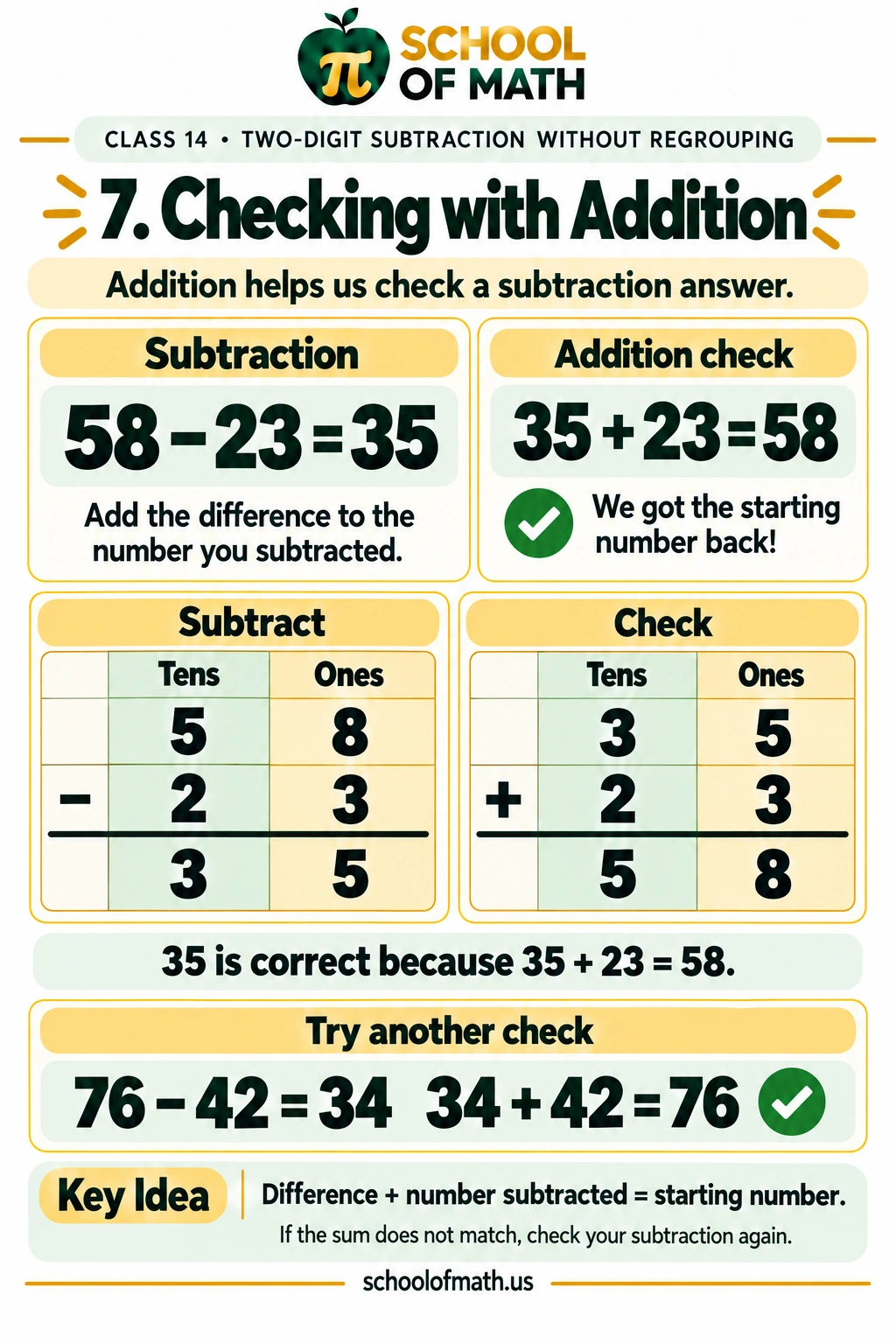
To check subtraction, add the difference to the amount you took away. The sum should equal the starting amount. This works because subtraction takes a part away and addition puts that part back.
If your check does not return to the starting amount, look at the columns again. Check the ones, then the tens. An incorrect check is a clue to revise your answer, not a reason to guess.
Try it yourself: five questions
Q31 Practice 1 of 5
Solve 42 − 11 and write an addition sentence to check your answer.
Answer
31.
- Ones: 2 − 1 = 1.
- Tens: 4 − 1 = 3. That means 3 tens and 1 ones, or 31.
- Check: 31 + 11 = 42, so the starting number is restored.
Q32 Practice 2 of 5
Is 64 − 22 = 42 correct? Use addition to explain.
Answer
Yes. 42 + 22 = 64.
- Ones: 4 − 2 = 2.
- Tens: 6 − 2 = 4. That means 4 tens and 2 ones, or 42.
- Check: 42 + 22 = 64, so the starting number is restored.
Q33 Practice 3 of 5
A student says 86 − 53 = 43. Check with addition and find the correct difference.
Answer
No. 43 + 53 = 96, not 86. The correct difference is 33.
- The proposed answer fails the check: 43 + 53 = 96. Try the subtraction again.
- Ones: 6 − 3 = 3.
- Tens: 8 − 5 = 3. That means 3 tens and 3 ones, or 33.
- Check: 33 + 53 = 86, so the starting number is restored.
Q34 Practice 4 of 5
Find 95 − 64. Then check the answer with addition.
Answer
31.
- Ones: 5 − 4 = 1.
- Tens: 9 − 6 = 3. That means 3 tens and 1 ones, or 31.
- Check: 31 + 64 = 95, so the starting number is restored.
Q35 Practice 5 of 5
Complete 47 + ? = 89. Use the addition sentence to write a matching subtraction sentence.
Answer
The missing number is 42. A matching subtraction is 89 − 47 = 42.
- Subtract 89 − 47: 9 − 7 = 2 ones and 8 − 4 = 4 tens. Check: 47 + 42 = 89.
Solving word problems
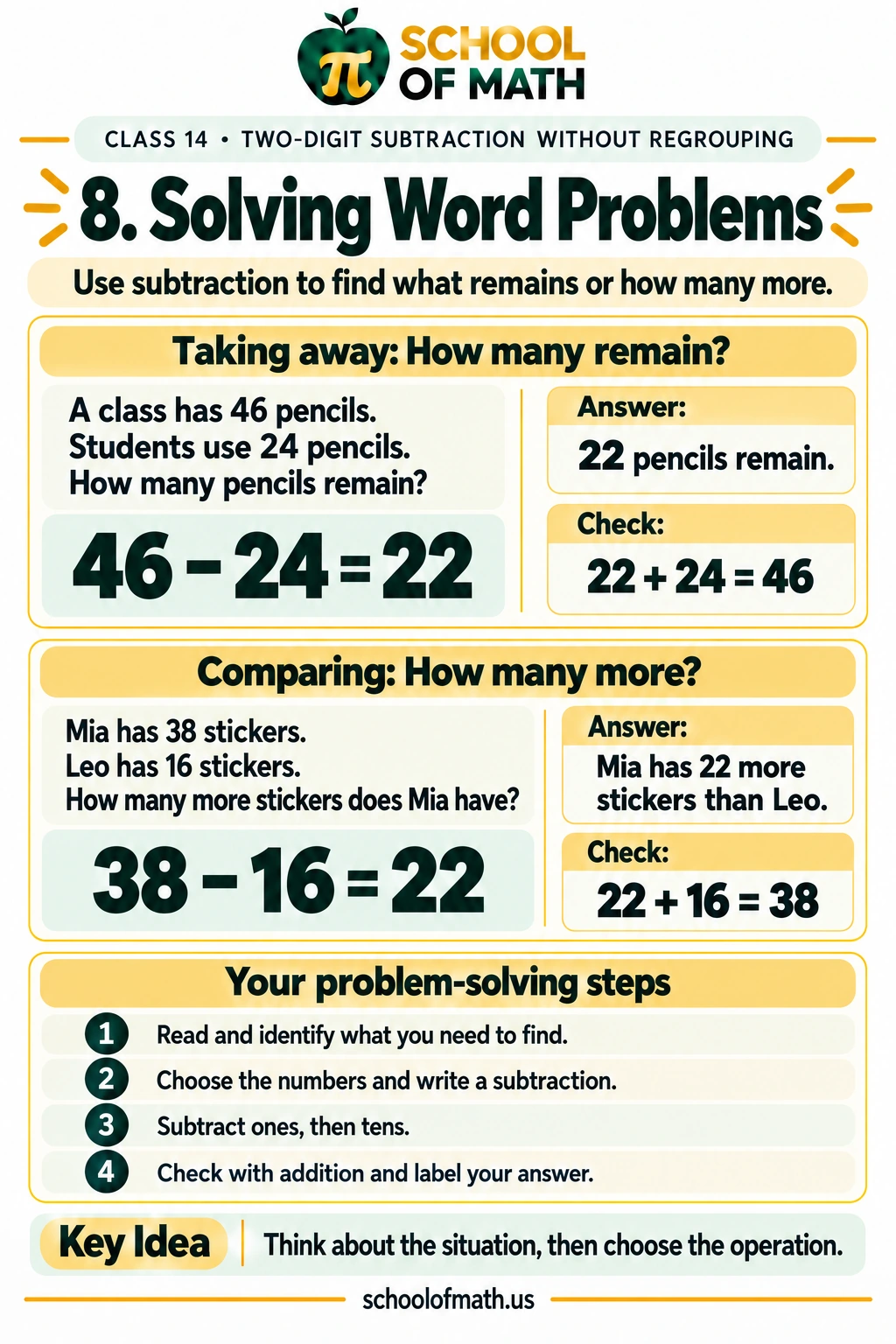
Before choosing an operation, decide what the question asks. Taking away can mean finding what is left. Comparing can mean finding how many more one group has than another. Both situations can use subtraction.
Write a number sentence and label the answer with the thing you counted. A question asking “how many more” needs the difference, not the larger total. For a two-step story, work through one action at a time.
Try it yourself: five questions
Q36 Practice 1 of 5
A shelf has 55 books. Children borrow 23. How many books stay on the shelf?
Answer
32 books.
- Ones: 5 − 3 = 2.
- Tens: 5 − 2 = 3. That means 3 tens and 2 ones, or 32.
- Check: 32 + 23 = 55, so the starting number is restored.
Q37 Practice 2 of 5
There are 67 paper stars. A class uses 42 to decorate a window. How many stars are unused?
Answer
25 stars.
- Ones: 7 − 2 = 5.
- Tens: 6 − 4 = 2. That means 2 tens and 5 ones, or 25.
- Check: 25 + 42 = 67, so the starting number is restored.
Q38 Practice 3 of 5
One team collects 78 leaves and another collects 35. How many more leaves does the first team collect?
Answer
43 more leaves.
- Ones: 8 − 5 = 3.
- Tens: 7 − 3 = 4. That means 4 tens and 3 ones, or 43.
- Check: 43 + 35 = 78, so the starting number is restored.
Q39 Practice 4 of 5
A puzzle has 88 pieces. Mia has placed 26 pieces. How many more pieces must she place to finish?
Answer
62 pieces.
- Ones: 8 − 6 = 2.
- Tens: 8 − 2 = 6. That means 6 tens and 2 ones, or 62.
- Check: 62 + 26 = 88, so the starting number is restored.
Q40 Practice 5 of 5
A class has 99 craft sticks. It uses 34 in the morning and 22 in the afternoon. How many craft sticks remain?
Answer
43 craft sticks.
- First subtract 99 − 34 = 65. Then subtract 65 − 22 = 43.
- Check by putting both groups back: 43 + 22 = 65 and 65 + 34 = 99.
Homework review
Review taking away, tens and ones, models, aligned columns, subtracting ones and tens, addition checks, and word problems. Complete one review question for each image in order.
R1 Review image 1 of 8
Start with 46 shells and take away 13. Write a subtraction sentence and find how many remain.
Answer
33 shells.
- Ones: 6 − 3 = 3.
- Tens: 4 − 1 = 3. That means 3 tens and 3 ones, or 33.
R2 Review image 2 of 8
Write 72 as tens and ones. What is the value of the digit 7?
Answer
7 tens and 2 ones; the 7 is worth 70.
- 72 = 70 + 2. A digit in the tens place counts groups of ten.
R3 Review image 3 of 8
Draw tens and ones for 59 − 27. Cross out the amount taken away and write the difference.
Answer
32.
- Draw 5 tens counters and 9 ones counters. Cross out 2 tens counters and 7 ones counters.
- Ones: 9 − 7 = 2.
- Tens: 5 − 2 = 3. That means 3 tens and 2 ones, or 32.
R4 Review image 4 of 8
Write 83 − 61 vertically with the columns aligned, then solve.
Answer
22.
- Ones: 3 − 1 = 2.
- Tens: 8 − 6 = 2. That means 2 tens and 2 ones, or 22.
R5 Review image 5 of 8
Subtract 77 − 47. Explain the zero in the ones place.
Answer
30. The ones cancel: 7 − 7 = 0, leaving 3 tens and no ones.
- Ones: 7 − 7 = 0.
- Tens: 7 − 4 = 3. That means 3 tens and 0 ones, or 30.
R6 Review image 6 of 8
Subtract 96 − 63. Name the tens and ones in the answer.
Answer
33: 3 tens and 3 ones.
- Ones: 6 − 3 = 3.
- Tens: 9 − 6 = 3. That means 3 tens and 3 ones, or 33.
R7 Review image 7 of 8
Solve 85 − 32 and check your answer with addition.
Answer
53.
- Ones: 5 − 2 = 3.
- Tens: 8 − 3 = 5. That means 5 tens and 3 ones, or 53.
- Check: 53 + 32 = 85, so the starting number is restored.
R8 Review image 8 of 8
A baker makes 94 rolls and sells 51. How many rolls remain?
Answer
43 rolls.
- Ones: 4 − 1 = 3.
- Tens: 9 − 5 = 4. That means 4 tens and 3 ones, or 43.
- Check: 43 + 51 = 94, so the starting number is restored.
Homework word problems
These twelve stories increase in difficulty, from taking away to comparing, finding a missing part, and solving two- or three-step problems. Label your answers and check each subtraction. None of the steps needs regrouping.
W1 Homework word problem 1 of 12
A basket holds 32 oranges. Ten oranges are used for juice. How many are left?
Answer
22 oranges.
- Ones: 2 − 0 = 2.
- Tens: 3 − 1 = 2. That means 2 tens and 2 ones, or 22.
- Check: 22 + 10 = 32, so the starting number is restored.
W2 Homework word problem 2 of 12
A class has 44 crayons. Twelve are put into a travel box. How many crayons stay in the classroom?
Answer
32 crayons.
- Ones: 4 − 2 = 2.
- Tens: 4 − 1 = 3. That means 3 tens and 2 ones, or 32.
- Check: 32 + 12 = 44, so the starting number is restored.
W3 Homework word problem 3 of 12
A garden has 57 flowers. A gardener picks 25 for a bouquet. How many flowers remain?
Answer
32 flowers.
- Ones: 7 − 5 = 2.
- Tens: 5 − 2 = 3. That means 3 tens and 2 ones, or 32.
- Check: 32 + 25 = 57, so the starting number is restored.
W4 Homework word problem 4 of 12
A store has 68 toy cars and sells 34. How many toy cars are still in the store?
Answer
34 toy cars.
- Ones: 8 − 4 = 4.
- Tens: 6 − 3 = 3. That means 3 tens and 4 ones, or 34.
- Check: 34 + 34 = 68, so the starting number is restored.
W5 Homework word problem 5 of 12
A library display has 79 books. Forty-six have blue covers. All the others have green covers. How many have green covers?
Answer
33 green-covered books.
- Ones: 9 − 6 = 3.
- Tens: 7 − 4 = 3. That means 3 tens and 3 ones, or 33.
- Check: 33 + 46 = 79, so the starting number is restored.
W6 Homework word problem 6 of 12
Sam has 86 trading cards. Ava has 51. How many fewer cards does Ava have than Sam?
Answer
35 fewer cards.
- Ones: 6 − 1 = 5.
- Tens: 8 − 5 = 3. That means 3 tens and 5 ones, or 35.
- Check: 35 + 51 = 86, so the starting number is restored.
W7 Homework word problem 7 of 12
There were 89 balloons before a party. After some are used, 43 remain. How many balloons were used?
Answer
46 balloons.
- Ones: 9 − 3 = 6.
- Tens: 8 − 4 = 4. That means 4 tens and 6 ones, or 46.
- Check: 46 + 43 = 89, so the starting number is restored.
W8 Homework word problem 8 of 12
A book has 96 pages. Nora has read 52 pages. She then reads 13 more. How many pages does she still need to read?
Answer
31 pages.
- After the first reading, 96 − 52 = 44 pages remain. After 13 more pages, 44 − 13 = 31 remain.
- Check: 31 + 13 = 44, and 44 + 52 = 96.
W9 Homework word problem 9 of 12
Ben has 98 cents. He spends 35 cents on a pencil and 22 cents on an eraser. How many cents does he have left?
Answer
41 cents.
- After the pencil: 98 − 35 = 63. After the eraser: 63 − 22 = 41.
- Check: 41 + 22 = 63, and 63 + 35 = 98.
W10 Homework word problem 10 of 12
A bus carries 87 passengers. At the first stop, 24 get off. At the next stop, 11 get off. No one gets on. Are more than 50 passengers still on the bus? Explain.
Answer
Yes. 52 passengers remain, which is 2 more than 50.
- First: 87 − 24 = 63. Next: 63 − 11 = 52. Compare 52 with 50: 52 − 50 = 2.
W11 Homework word problem 11 of 12
One stand starts with 78 apples and sells 23. Another starts with 96 apples and sells 42. Which stand has more apples left, and how many more?
Answer
The first stand has 1 more apple.
- The first stand has 78 − 23 = 55 apples left. The second has 96 − 42 = 54.
- Compare what remains: 55 − 54 = 1.
W12 Homework word problem 12 of 12
A club has 99 beads. It uses 32 for bracelets and 24 for necklaces. It needs 41 beads for its next project. Are enough beads left, and how many would remain after that project?
Answer
Yes. There are 43 beads left before the next project and 2 afterward.
- After the bracelets: 99 − 32 = 67. After the necklaces: 67 − 24 = 43.
- There are enough because 43 is greater than 41. After the next project: 43 − 41 = 2.
Quick questions and answers
How do you subtract two-digit numbers without regrouping?
Line up tens and ones. Subtract the ones, then subtract the tens. Read the two place values together and check by adding the difference to the amount subtracted.
What does “without regrouping” mean?
You already have enough ones and tens to take away the required amount. You do not need to exchange a ten for ten ones. Every subtraction in this lesson stays within that rule.
What if the ones digits are the same?
Their difference is zero. Write 0 in the ones place; for example, three tens and no ones is written 30, not 3.
Where does a one-digit number go in vertical subtraction?
It goes in the ones column, under the top number’s ones digit. It represents zero tens and that many ones.
How can addition check a subtraction answer?
Add the difference to the number subtracted. If you get the starting number, the subtraction checks. If not, inspect the ones and tens again.
What practice and homework are included?
There are eight teaching images, five practice questions after each image, eight homework review questions, and twelve homework word problems. All 60 questions have hidden worked answers online. The 22-page student workbook has no exercise answers and includes blank answer space.