Little Newtons · Class 13 · Grades 1–2
Two-Digit Addition Without Regrouping
To add two-digit numbers without regrouping, add the ones to the ones and the tens to the tens. Each column in this lesson totals less than ten, so you do not need to carry. Blocks, expanded form, vertical columns, and number-line jumps all show the same place-value idea.
Follow the eleven images in order, with five original questions after every image. Finish with ten word problems that grow from one-step stories to short two-step challenges. All 65 questions include a compact blue Answer button with a worked explanation.
Part of the Little Newtons program at SOMATH. Book an evaluation to discuss placement, or view the current class schedule.
Tens and ones: read each place
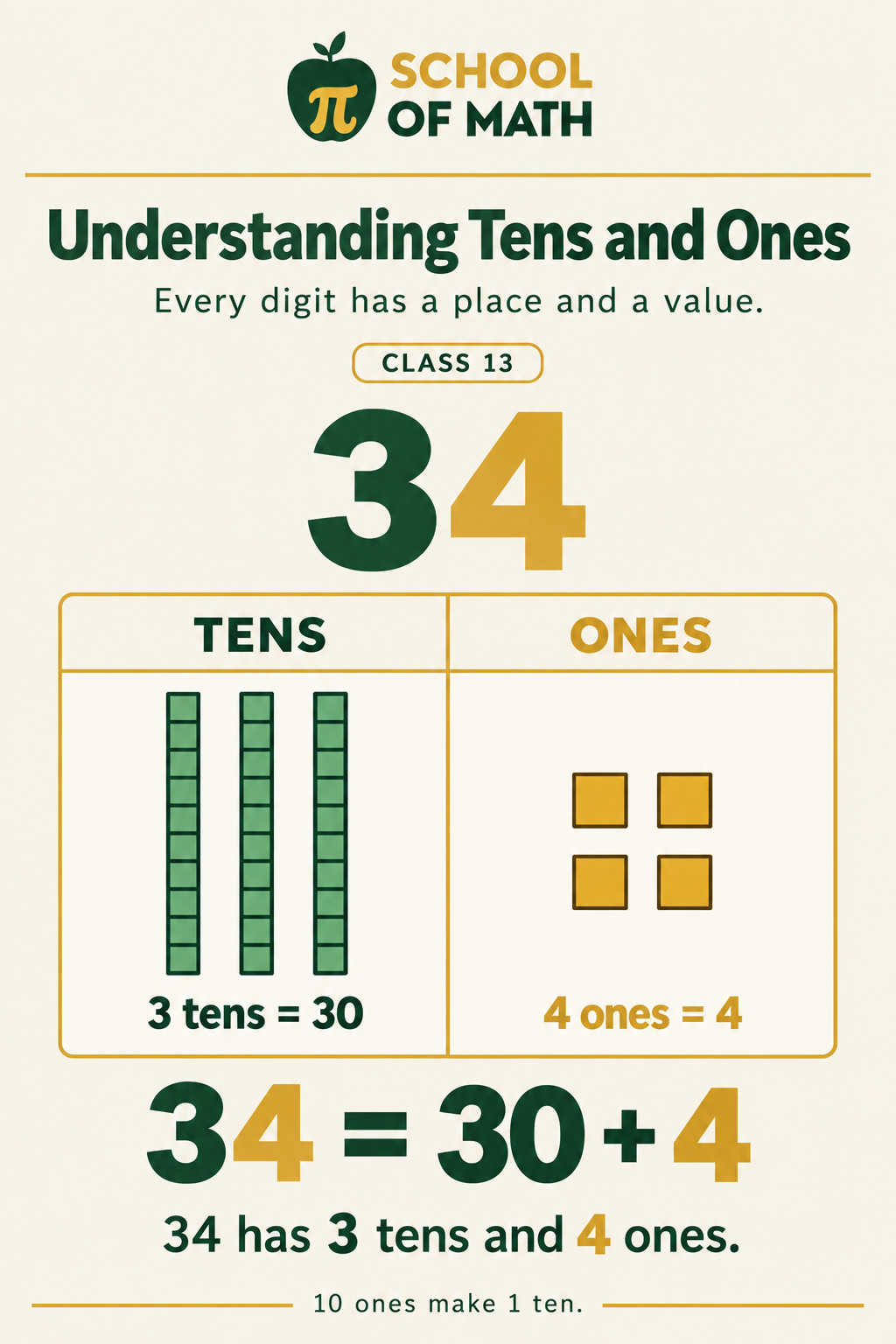
A two-digit number has a tens place on the left and a ones place on the right. One ten is a group of ten ones. The position of a digit tells you its value, so a 4 in the tens place means 40, not 4.
Try it yourself: five questions
Q1 Practice 1 of 5 · Start
In 17, which digit is in the tens place?
Answer
1.
- The left-hand digit is 1. It represents one ten, or 10.
Q2 Practice 2 of 5 · Build
How many tens and ones are in 41?
Answer
4 tens and 1 one.
- Four tens are 40. One more makes 41.
Q3 Practice 3 of 5 · Apply
What is the value of the 6 in 63?
Answer
60.
- The 6 is in the tens place. Six groups of ten make 60.
Q4 Practice 4 of 5 · Explain
Write 80 as tens and ones. Why do we write the zero?
Answer
8 tens and 0 ones.
- The zero holds the ones place and tells us there are no extra ones. Without it, 8 would mean eight ones.
Q5 Practice 5 of 5 · Challenge
A number has 9 tens and 5 ones. Write the number and explain both digits.
Answer
95.
- Nine tens make 90 and five ones make 5. Together, 90 + 5 = 95.
Tens and ones: break a number apart
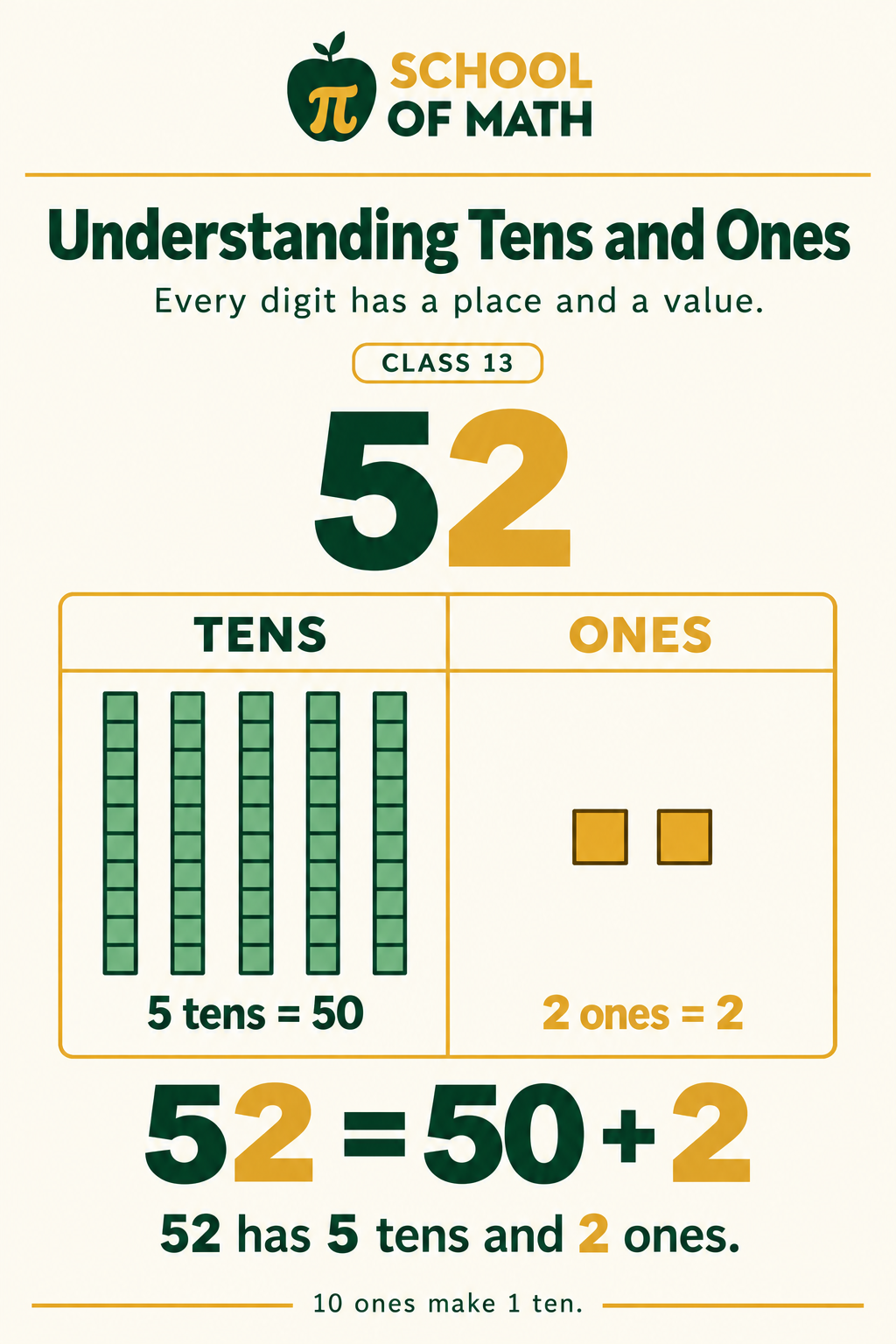
Writing a number as a tens part plus a ones part is called expanded form. Keep the value of each part: seven tens means 70. A plus sign shows that the parts join to make the whole number.
Try it yourself: five questions
Q6 Practice 1 of 5 · Start
Complete: 28 = 20 + __.
Answer
8.
- Twenty is two tens. The remaining eight are ones.
Q7 Practice 2 of 5 · Build
Write 45 as a tens value plus a ones value.
Answer
45 = 40 + 5.
- The 4 represents 40. The 5 represents five ones.
Q8 Practice 3 of 5 · Apply
Which matches 61: 6 + 1 or 60 + 1? Explain.
Answer
60 + 1.
- The 6 in 61 means six tens. Six plus one would make only seven.
Q9 Practice 4 of 5 · Explain
A child writes 73 = 7 + 3. Correct the mistake.
Answer
73 = 70 + 3.
- The child used the tens digit as if it meant ones. Seven tens are worth 70.
Q10 Practice 5 of 5 · Challenge
A mystery number has a tens part of 90 and a ones part that is 2 more than 4. What is it?
Answer
96.
- The ones part is 4 + 2 = 6. Join 90 and 6 to make 96.
Tens and ones: build and explain
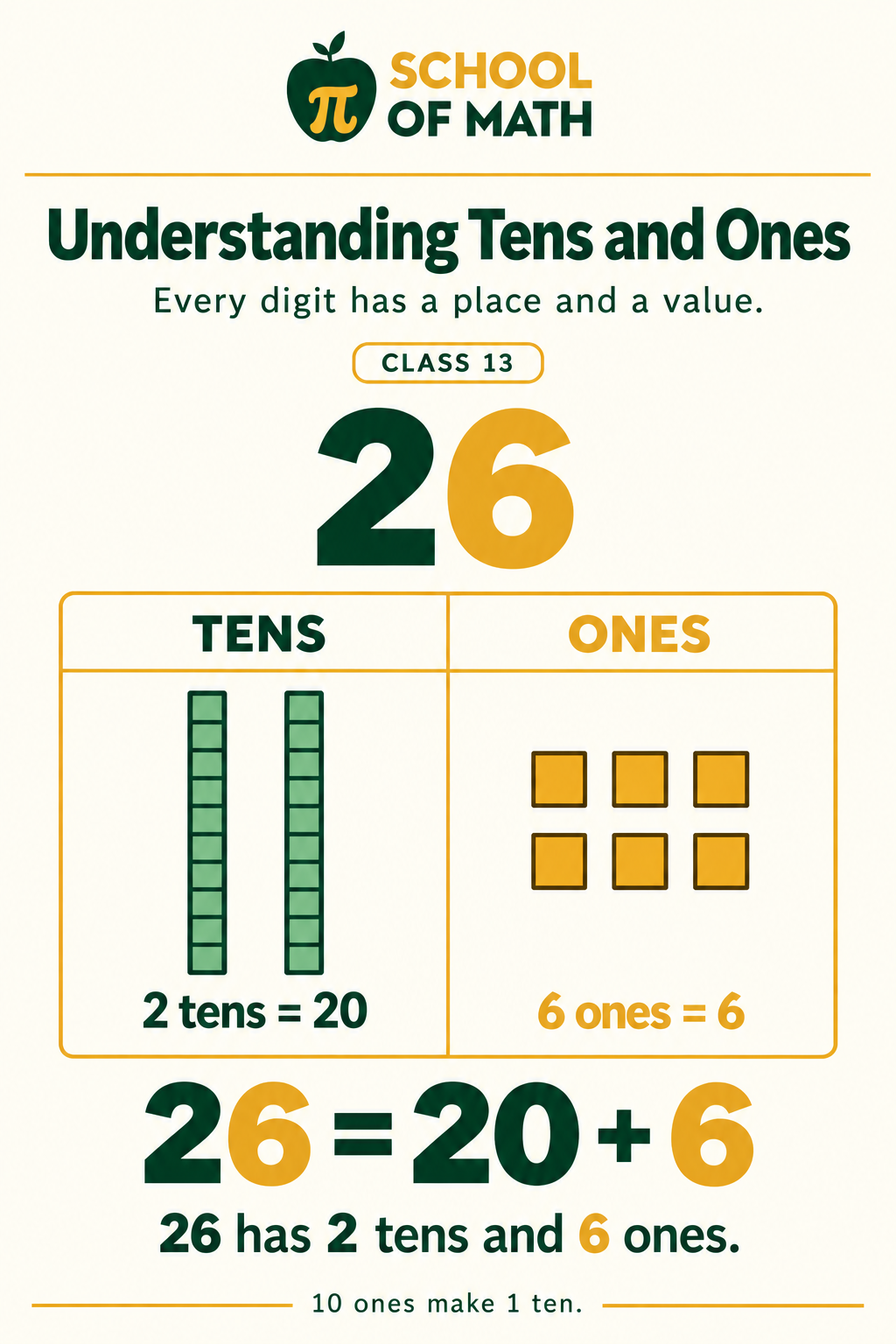
You can build a number with bundles of ten and loose ones. A drawing can use a long line for a ten and a small dot for a one. Count the tens and ones separately, then say the whole number.
Try it yourself: five questions
Q11 Practice 1 of 5 · Start
What number is 1 ten and 8 ones?
Answer
18.
- One ten is 10. Add eight ones: 10 + 8 = 18.
Q12 Practice 2 of 5 · Build
Draw a model for 43 using a line for each ten and a dot for each one.
Answer
4 tens lines and 3 ones dots.
- Four tens represent 40. Three dots represent 3, so the model shows 43.
Q13 Practice 3 of 5 · Apply
A model has 6 tens rods and no ones cubes. What number does it show?
Answer
60.
- The rods show 60. The ones digit is 0 because there are no loose cubes.
Q14 Practice 4 of 5 · Explain
Maya draws 5 tens rods and 9 ones cubes but writes 95. What should she write?
Answer
59.
- The tens digit must be 5 and the ones digit must be 9. The number 95 would need 9 rods and 5 cubes.
Q15 Practice 5 of 5 · Challenge
Which model shows the greater number: 7 tens and 2 ones, or 2 tens and 7 ones? Explain.
Answer
7 tens and 2 ones: 72 is greater than 27.
- Compare the tens first. Seven tens are more than two tens, even though the second model has more loose ones.
Join numbers with models
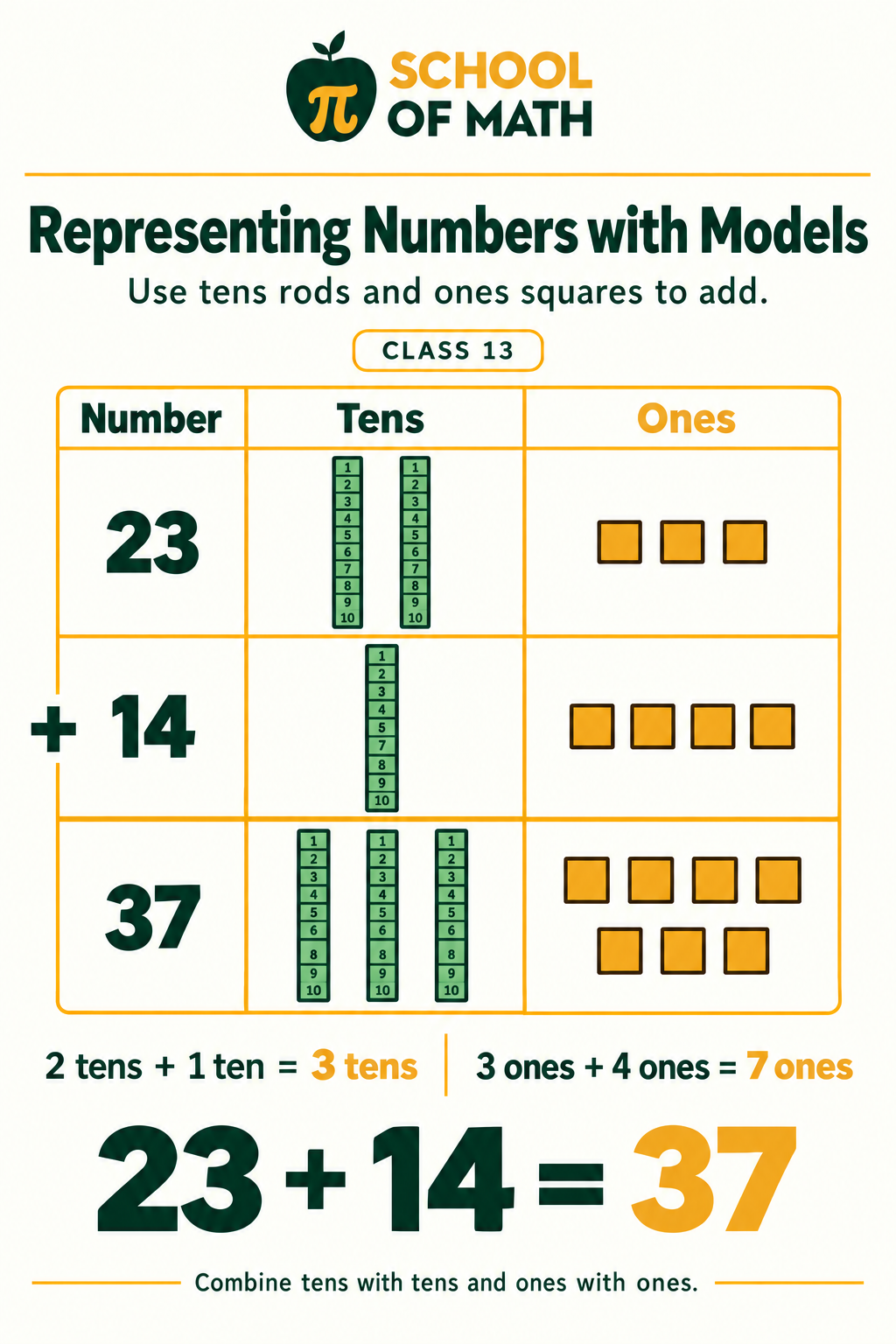
Model each addend, which is a number being added. Slide the tens rods together and collect the ones cubes together. When the ones total is less than ten and the tens total is less than ten, you can read the answer without trading any pieces.
Try it yourself: five questions
Q16 Practice 1 of 5 · Start
Model 11 + 12 with tens rods and ones cubes. How many are there altogether?
Answer
23.
- Add the ones: 1 + 2 = 3. There are fewer than 10 ones, so no new ten is needed.
- Add the tens: 1 tens + 1 tens = 2 tens.
- Put the parts together: 20 + 3 = 23.
Q17 Practice 2 of 5 · Build
Draw a model for 22 + 15. State the total number of rods and loose cubes.
Answer
37.
- Add the ones: 2 + 5 = 7. There are fewer than 10 ones, so no new ten is needed.
- Add the tens: 2 tens + 1 tens = 3 tens.
- Put the parts together: 30 + 7 = 37.
Q18 Practice 3 of 5 · Apply
Join a model of 31 to a model of 24. Write the addition sentence.
Answer
55.
- Add the ones: 1 + 4 = 5. There are fewer than 10 ones, so no new ten is needed.
- Add the tens: 3 tens + 2 tens = 5 tens.
- Put the parts together: 50 + 5 = 55.
Q19 Practice 4 of 5 · Explain
Two models show 42 and 26. After joining them, explain why you do not need to trade any ones.
Answer
68.
- Add the ones: 2 + 6 = 8. There are fewer than 10 ones, so no new ten is needed.
- Add the tens: 4 tens + 2 tens = 6 tens.
- Put the parts together: 60 + 8 = 68.
Q20 Practice 5 of 5 · Challenge
A child joins models of 53 and 14 but counts each tens rod as just one. Find the correct total and explain what each rod is worth.
Answer
67.
- Add the ones: 3 + 4 = 7. There are fewer than 10 ones, so no new ten is needed.
- Add the tens: 5 tens + 1 tens = 6 tens.
- Put the parts together: 60 + 7 = 67.
Add tens and ones separately
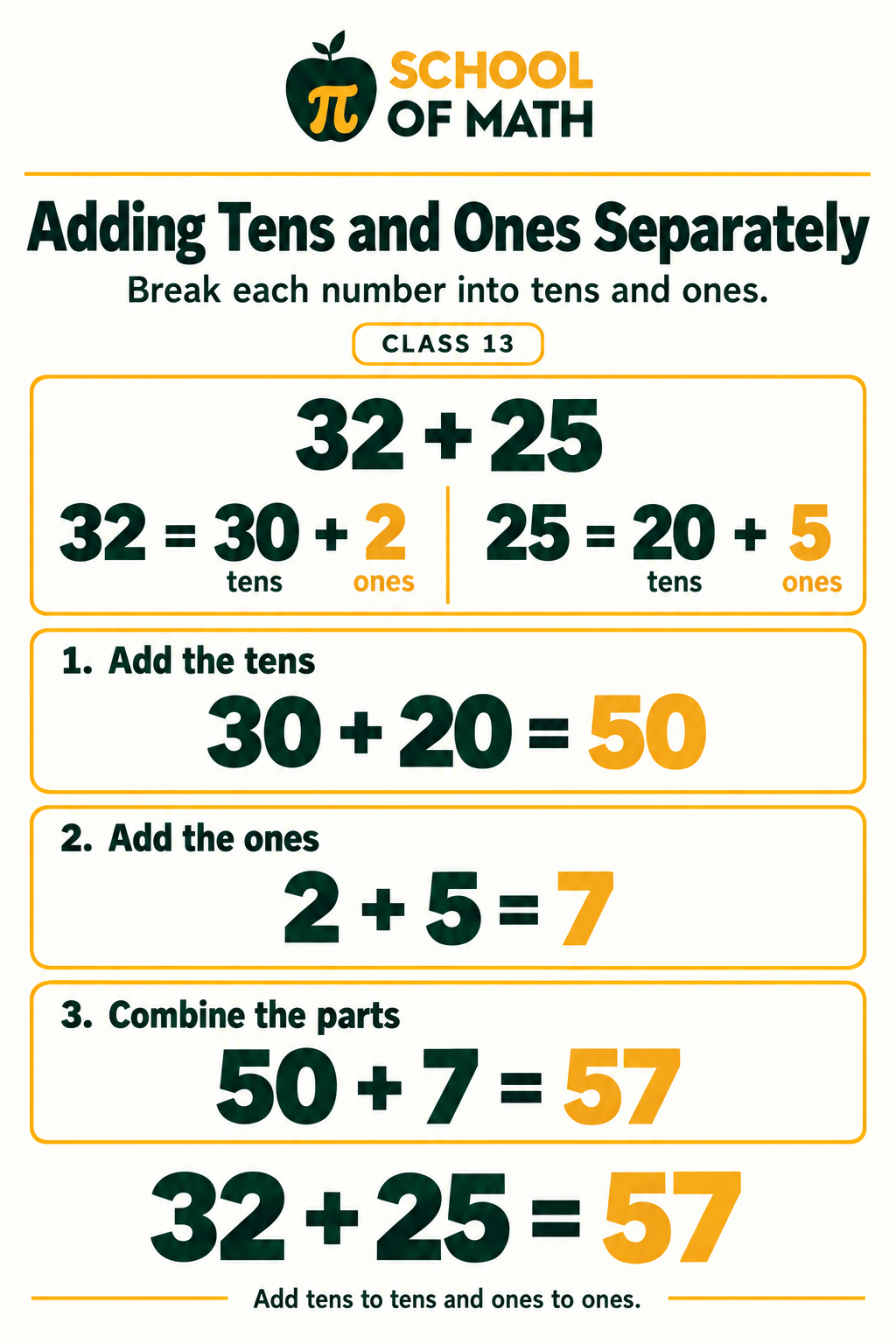
Split both numbers into tens and ones. Add the tens values, add the ones values, and join the two results. This is the same addition shown by the blocks, written with numbers instead of pictures.
Try it yourself: five questions
Q21 Practice 1 of 5 · Start
Break 20 and 13 into tens and ones, then add.
Answer
33.
- Add the ones: 0 + 3 = 3. There are fewer than 10 ones, so no new ten is needed.
- Add the tens: 2 tens + 1 tens = 3 tens.
- Put the parts together: 30 + 3 = 33.
Q22 Practice 2 of 5 · Build
Use expanded form to find 21 + 17.
Answer
38.
- Add the ones: 1 + 7 = 8. There are fewer than 10 ones, so no new ten is needed.
- Add the tens: 2 tens + 1 tens = 3 tens.
- Put the parts together: 30 + 8 = 38.
Q23 Practice 3 of 5 · Apply
Find 34 + 22 by adding the tens values first and the ones values next.
Answer
56.
- Add the ones: 4 + 2 = 6. There are fewer than 10 ones, so no new ten is needed.
- Add the tens: 3 tens + 2 tens = 5 tens.
- Put the parts together: 50 + 6 = 56.
Q24 Practice 4 of 5 · Explain
Complete the parts for 45 + 31: tens __ + __; ones __ + __; total __.
Answer
76.
- Add the ones: 5 + 1 = 6. There are fewer than 10 ones, so no new ten is needed.
- Add the tens: 4 tens + 3 tens = 7 tens.
- Put the parts together: 70 + 6 = 76.
Q25 Practice 5 of 5 · Challenge
A student says 62 + 27 = 17 because 6 + 2 + 2 + 7 = 17. Explain the place-value mistake and find the sum.
Answer
89.
- Add the ones: 2 + 7 = 9. There are fewer than 10 ones, so no new ten is needed.
- Add the tens: 6 tens + 2 tens = 8 tens.
- Put the parts together: 80 + 9 = 89.
Line up tens under tens
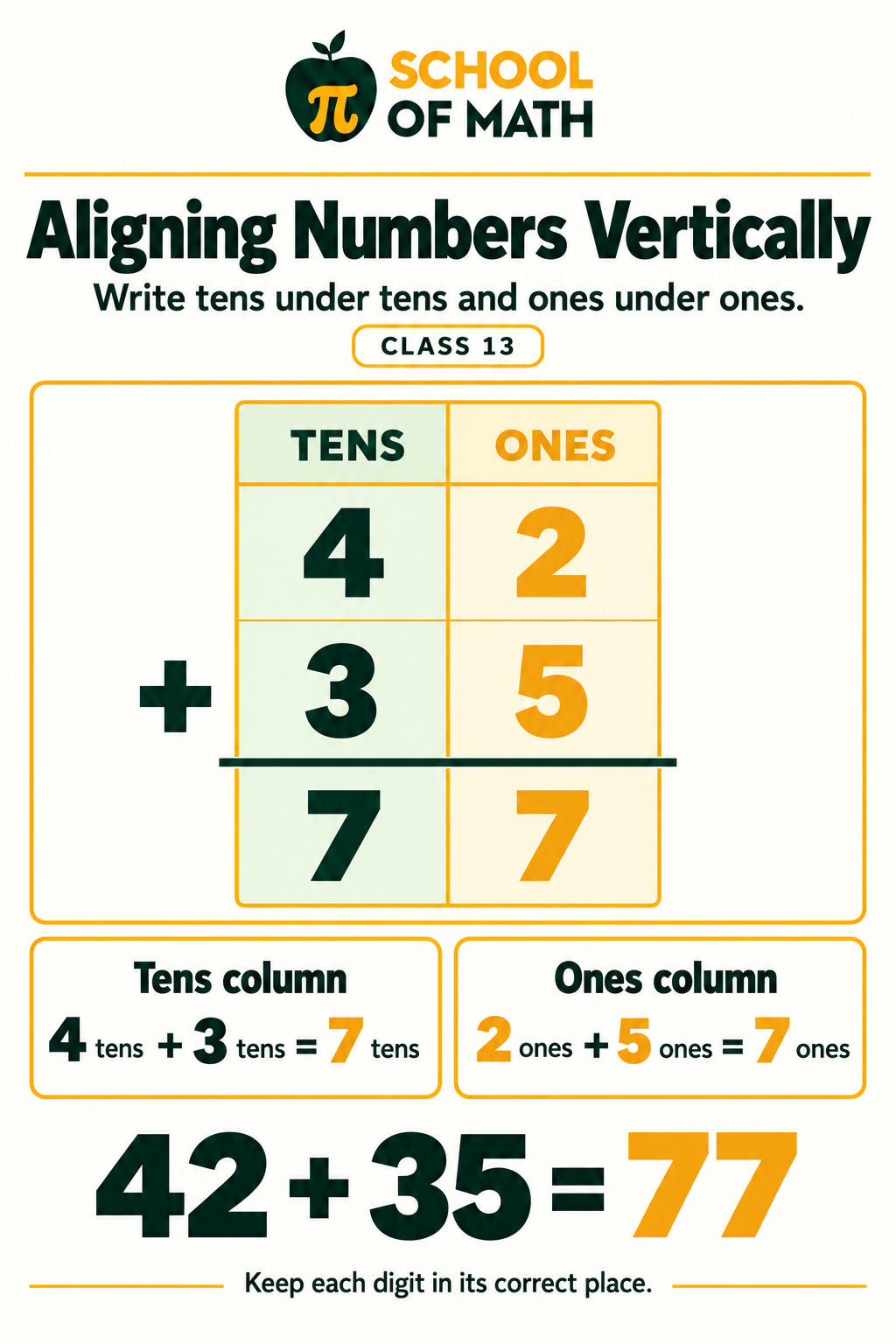
In vertical addition, digits with the same place value must share a column. Put ones under ones and tens under tens. Start with the ones column and write each part of the answer in its correct place.
Try it yourself: five questions
Q26 Practice 1 of 5 · Start
Write 13 + 15 vertically, keeping tens under tens and ones under ones. Solve.
Answer
28.
- Add the ones: 3 + 5 = 8. There are fewer than 10 ones, so no new ten is needed.
- Add the tens: 1 tens + 1 tens = 2 tens.
- Put the parts together: 20 + 8 = 28.
Q27 Practice 2 of 5 · Build
Set up 24 + 21 in two columns. Which digits belong in the ones column? Then add.
Answer
45.
- Add the ones: 4 + 1 = 5. There are fewer than 10 ones, so no new ten is needed.
- Add the tens: 2 tens + 2 tens = 4 tens.
- Put the parts together: 40 + 5 = 45.
Q28 Practice 3 of 5 · Apply
Solve 36 + 12 vertically. Explain where you write the 8 in your answer.
Answer
48.
- Add the ones: 6 + 2 = 8. There are fewer than 10 ones, so no new ten is needed.
- Add the tens: 3 tens + 1 tens = 4 tens.
- Put the parts together: 40 + 8 = 48.
Q29 Practice 4 of 5 · Explain
Add 40 + 37 vertically. Explain what the 0 does in the ones column.
Answer
77.
- Add the ones: 0 + 7 = 7. There are fewer than 10 ones, so no new ten is needed.
- Add the tens: 4 tens + 3 tens = 7 tens.
- Put the parts together: 70 + 7 = 77.
Q30 Practice 5 of 5 · Challenge
A child puts the 2 of 23 under the 4 of 54. Fix the alignment and solve 54 + 23.
Answer
77.
- Add the ones: 4 + 3 = 7. There are fewer than 10 ones, so no new ten is needed.
- Add the tens: 5 tens + 2 tens = 7 tens.
- Put the parts together: 70 + 7 = 77.
Comparison: what regrouping would mean
Comparison only. This supplied poster shows addition with regrouping. It is a comparison, not the method being practiced in Class 13. Our questions below do not require carrying. The Little Newtons syllabus studies two-digit addition with regrouping later, in Class 17.
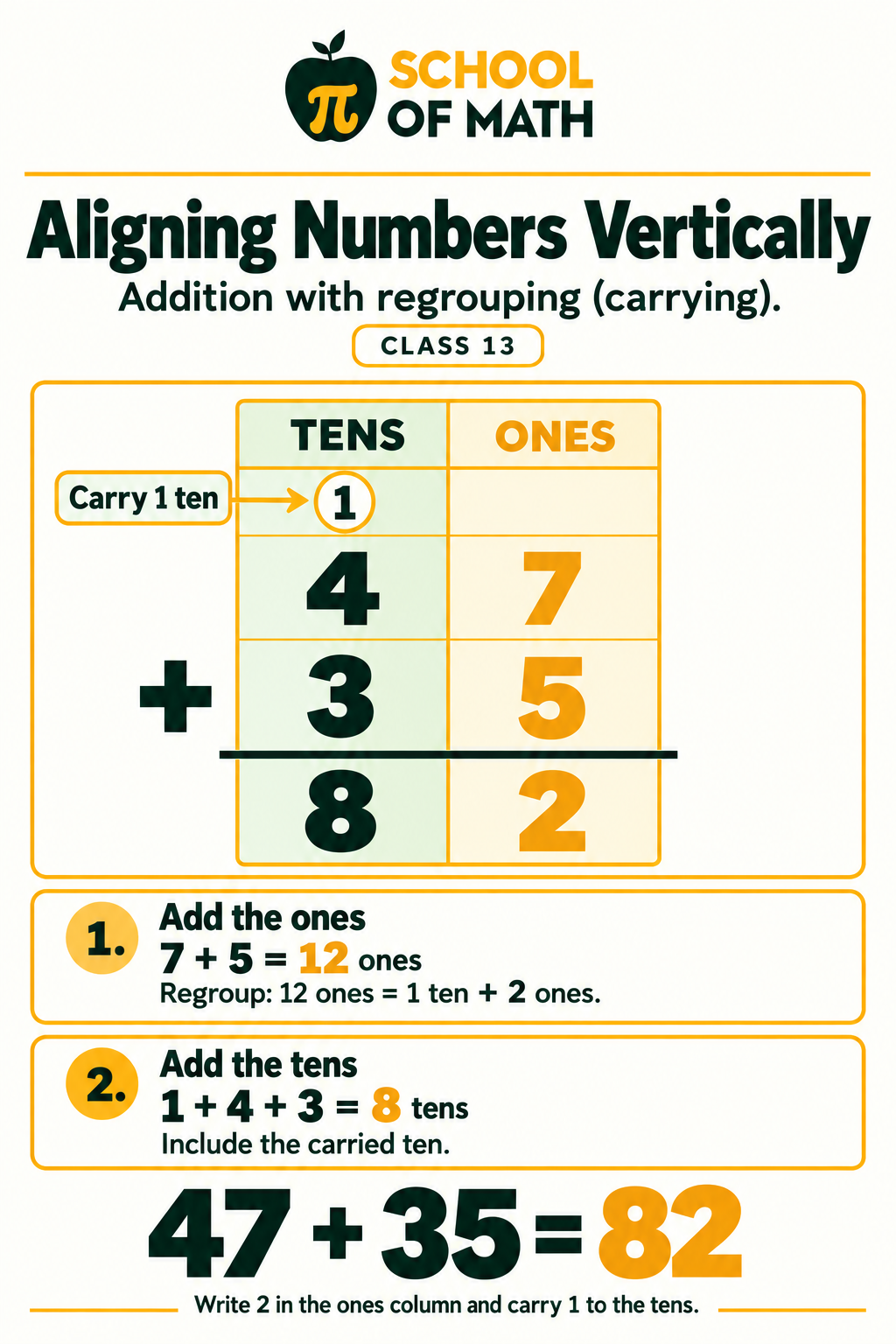
Regrouping means trading ten ones for one ten. To decide whether a trade is needed, check the ones before you begin. If their sum is less than ten, keep them as ones; do not add an extra ten. In this class, totals also stay below 100, so no group of ten tens needs trading for a hundred.
Try it yourself: five questions
Q31 Practice 1 of 5 · Start
Look only at the ones in 21 + 16 first. Do they make a new ten? Explain, then solve.
Answer
37.
- Add the ones: 1 + 6 = 7. There are fewer than 10 ones, so no new ten is needed.
- Add the tens: 2 tens + 1 tens = 3 tens.
- Put the parts together: 30 + 7 = 37.
Q32 Practice 2 of 5 · Build
For 33 + 25, how many ones are there altogether? Explain why no carrying is needed.
Answer
58.
- Add the ones: 3 + 5 = 8. There are fewer than 10 ones, so no new ten is needed.
- Add the tens: 3 tens + 2 tens = 5 tens.
- Put the parts together: 50 + 8 = 58.
Q33 Practice 3 of 5 · Apply
Find 41 + 18. Does a total of 9 ones require a trade?
Answer
59.
- Add the ones: 1 + 8 = 9. There are fewer than 10 ones, so no new ten is needed.
- Add the tens: 4 tens + 1 tens = 5 tens.
- Put the parts together: 50 + 9 = 59.
Q34 Practice 4 of 5 · Explain
A student wants to carry an extra ten when adding 56 + 22. Explain why that is unnecessary and find the correct sum.
Answer
78.
- Add the ones: 6 + 2 = 8. There are fewer than 10 ones, so no new ten is needed.
- Add the tens: 5 tens + 2 tens = 7 tens.
- Put the parts together: 70 + 8 = 78.
Q35 Practice 5 of 5 · Challenge
Complete 64 + 2□ with the largest possible ones digit that does not require regrouping. Then solve the addition.
Answer
The missing digit is 5; 64 + 25 = 89.
- Add the ones: 4 + 5 = 9. There are fewer than 10 ones, so no new ten is needed.
- Add the tens: 6 tens + 2 tens = 8 tens.
- Put the parts together: 80 + 9 = 89.
- Four ones plus five ones make nine. A larger digit would make at least ten ones, which would need regrouping.
Add the ones first
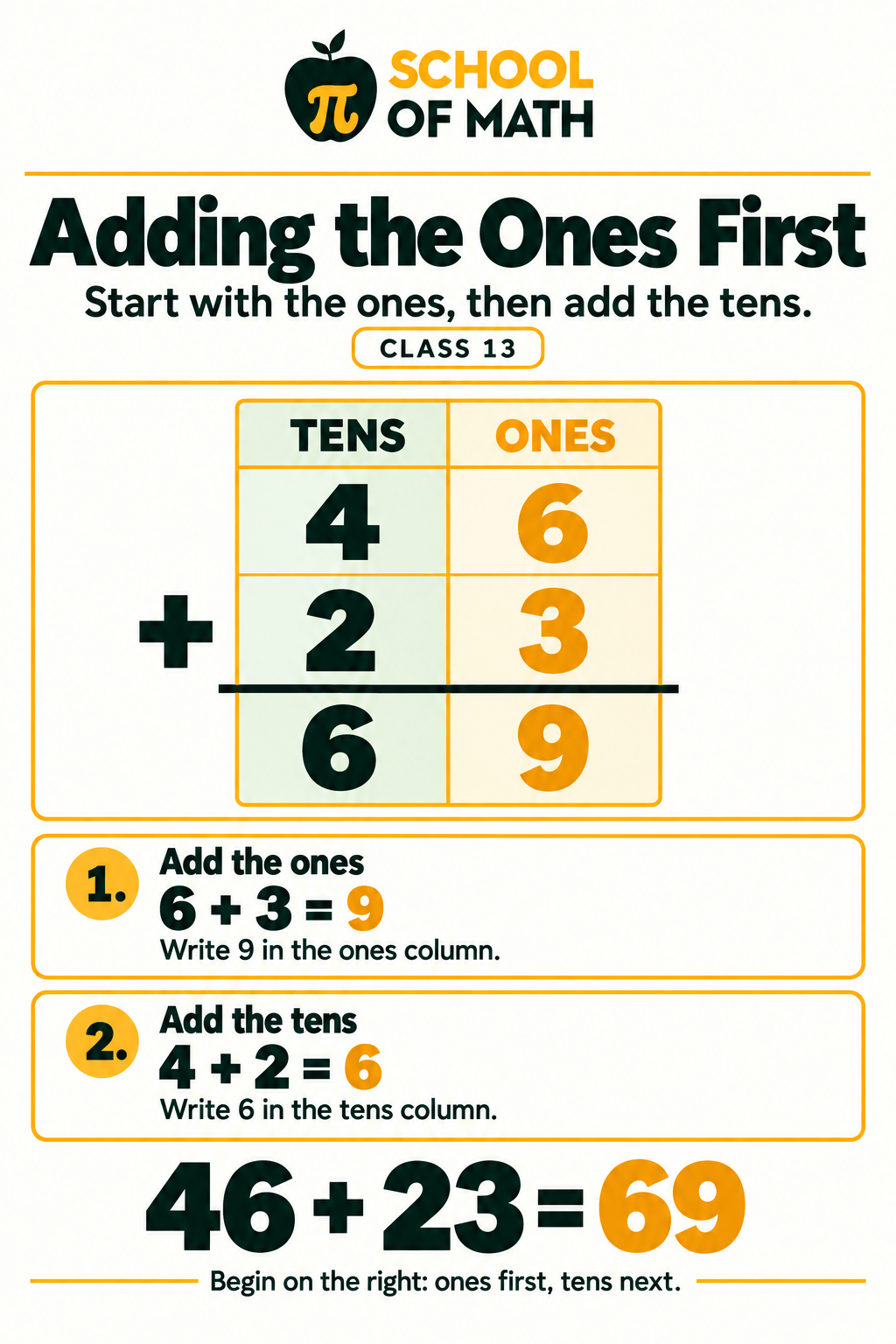
For the written column method, start on the right with the ones. Then move left to add the tens. Say “tens” when you add the left column so you remember that a result of 6 there means 60.
Try it yourself: five questions
Q36 Practice 1 of 5 · Start
Add 12 + 16. Say the ones fact before the tens fact.
Answer
28.
- Add the ones: 2 + 6 = 8. There are fewer than 10 ones, so no new ten is needed.
- Add the tens: 1 tens + 1 tens = 2 tens.
- Put the parts together: 20 + 8 = 28.
Q37 Practice 2 of 5 · Build
Find 25 + 23, starting with the ones.
Answer
48.
- Add the ones: 5 + 3 = 8. There are fewer than 10 ones, so no new ten is needed.
- Add the tens: 2 tens + 2 tens = 4 tens.
- Put the parts together: 40 + 8 = 48.
Q38 Practice 3 of 5 · Apply
Find 43 + 15. Explain why the tens digit of the answer is 5.
Answer
58.
- Add the ones: 3 + 5 = 8. There are fewer than 10 ones, so no new ten is needed.
- Add the tens: 4 tens + 1 tens = 5 tens.
- Put the parts together: 50 + 8 = 58.
Q39 Practice 4 of 5 · Explain
Solve 61 + 28. Write how many tens and how many ones are in the answer.
Answer
89.
- Add the ones: 1 + 8 = 9. There are fewer than 10 ones, so no new ten is needed.
- Add the tens: 6 tens + 2 tens = 8 tens.
- Put the parts together: 80 + 9 = 89.
Q40 Practice 5 of 5 · Challenge
Complete the missing ones digit: 72 + 1□ = 89. Explain how the ones column helps.
Answer
The missing digit is 7; the second number is 17.
- Add the ones: 2 + 7 = 9. There are fewer than 10 ones, so no new ten is needed.
- Add the tens: 7 tens + 1 tens = 8 tens.
- Put the parts together: 80 + 9 = 89.
- The tens already give 8 tens. To make 9 ones from 2 ones, you need 7 more ones.
Check that no regrouping is needed
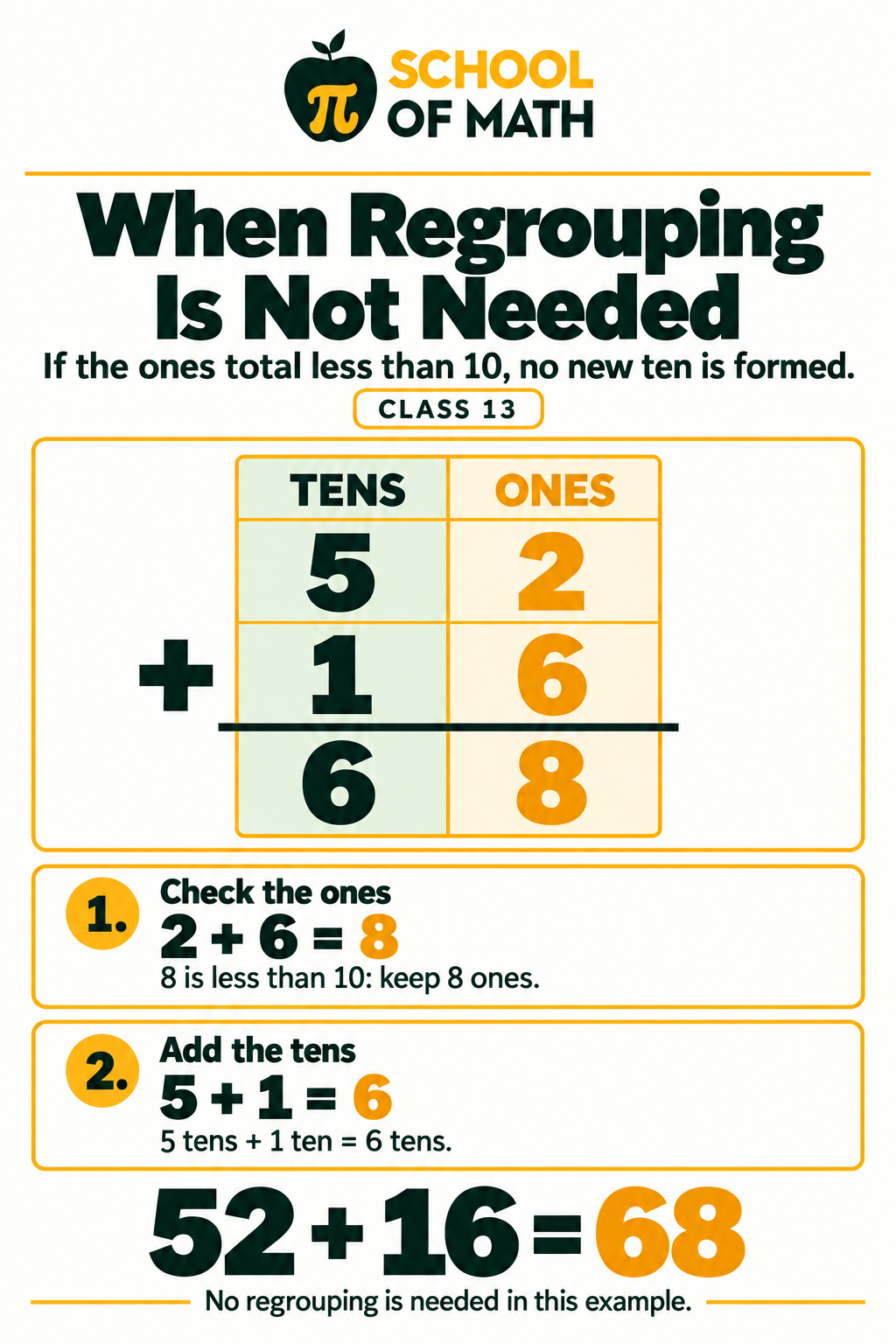
A no-regrouping check protects you from adding a carry that does not belong. For the two-digit answers in this lesson, both column totals must be less than ten. Zero ones are allowed; zero means there are no extra ones to add in that number.
Try it yourself: five questions
Q41 Practice 1 of 5 · Start
Before solving 30 + 24, check whether either column needs regrouping.
Answer
54.
- Add the ones: 0 + 4 = 4. There are fewer than 10 ones, so no new ten is needed.
- Add the tens: 3 tens + 2 tens = 5 tens.
- Put the parts together: 50 + 4 = 54.
Q42 Practice 2 of 5 · Build
Explain why 42 + 17 can be solved without regrouping. Then find the sum.
Answer
59.
- Add the ones: 2 + 7 = 9. There are fewer than 10 ones, so no new ten is needed.
- Add the tens: 4 tens + 1 tens = 5 tens.
- Put the parts together: 50 + 9 = 59.
Q43 Practice 3 of 5 · Apply
Find 50 + 36. Explain why the zero does not change the number of ones.
Answer
86.
- Add the ones: 0 + 6 = 6. There are fewer than 10 ones, so no new ten is needed.
- Add the tens: 5 tens + 3 tens = 8 tens.
- Put the parts together: 80 + 6 = 86.
Q44 Practice 4 of 5 · Explain
A child gets 89 for 65 + 14 after adding an extra ten. Find the correct sum and explain the error.
Answer
79.
- Add the ones: 5 + 4 = 9. There are fewer than 10 ones, so no new ten is needed.
- Add the tens: 6 tens + 1 tens = 7 tens.
- Put the parts together: 70 + 9 = 79.
Q45 Practice 5 of 5 · Challenge
Find two different two-digit numbers that add to 98 without regrouping. Neither number may end in 0. Show one possible answer.
Answer
One possible answer is 61 + 37 = 98.
- Add the ones: 1 + 7 = 8. There are fewer than 10 ones, so no new ten is needed.
- Add the tens: 6 tens + 3 tens = 9 tens.
- Put the parts together: 90 + 8 = 98.
- Other answers are possible. The ones digits must add to 8, and the tens digits must add to 9.
Make tens jumps and ones jumps
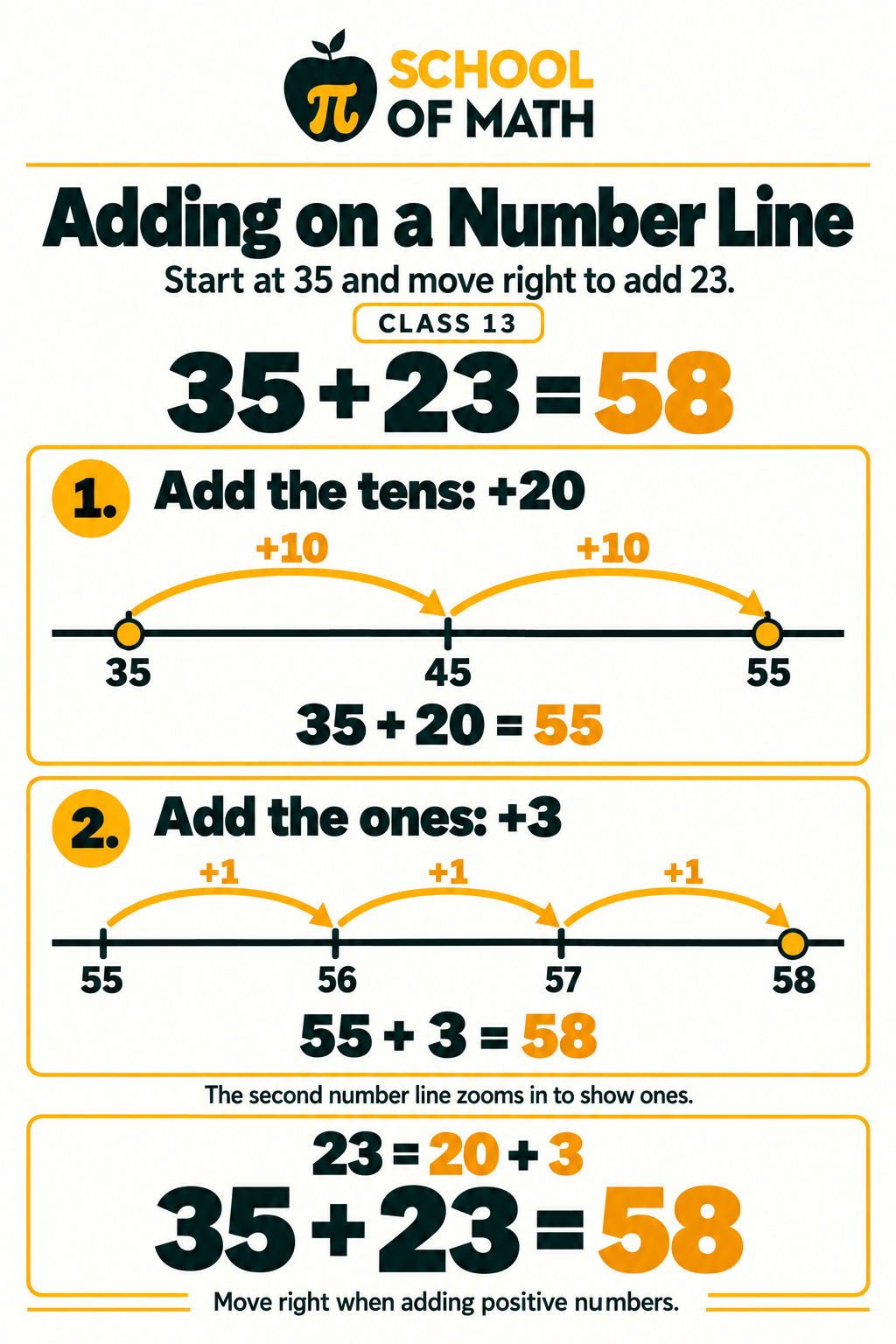
On a number line, adding a positive amount means moving right. Start at the first number, split the second number into tens and ones, and make labeled jumps. A jump of ten is worth ten steps of one; a drawn open number line can label only the landing points.
Try it yourself: five questions
Q46 Practice 1 of 5 · Start
Start at 14 and make one jump of 10 to the right. Where do you land?
Answer
24.
- Add the ones: 4 + 0 = 4. There are fewer than 10 ones, so no new ten is needed.
- Add the tens: 1 tens + 1 tens = 2 tens.
- Put the parts together: 20 + 4 = 24.
Q47 Practice 2 of 5 · Build
Use a number line for 22 + 16. Show one jump of 10 and six jumps of 1.
Answer
38.
- Add the ones: 2 + 6 = 8. There are fewer than 10 ones, so no new ten is needed.
- Add the tens: 2 tens + 1 tens = 3 tens.
- Put the parts together: 30 + 8 = 38.
Q48 Practice 3 of 5 · Apply
For 31 + 27, fill the landing points: 31 → __ → __ → 58. The first two jumps are +10 each. What is the last jump?
Answer
31 → 41 → 51 → 58; the last jump is +7.
- Add the ones: 1 + 7 = 8. There are fewer than 10 ones, so no new ten is needed.
- Add the tens: 3 tens + 2 tens = 5 tens.
- Put the parts together: 50 + 8 = 58.
- The two tens jumps add 20. The final seven ones finish adding 27.
Q49 Practice 4 of 5 · Explain
Show the landing points when adding 24 to 45 with two tens jumps and then four ones.
Answer
69.
- Add the ones: 5 + 4 = 9. There are fewer than 10 ones, so no new ten is needed.
- Add the tens: 4 tens + 2 tens = 6 tens.
- Put the parts together: 60 + 9 = 69.
Q50 Practice 5 of 5 · Challenge
A number-line path begins at 63, lands at 73, then 83, and ends at 89. What number was added? Write the full addition sentence.
Answer
26 was added; 63 + 26 = 89.
- Add the ones: 3 + 6 = 9. There are fewer than 10 ones, so no new ten is needed.
- Add the tens: 6 tens + 2 tens = 8 tens.
- Put the parts together: 80 + 9 = 89.
- Two jumps of 10 and one jump of 6 make 20 + 6 = 26.
Turn a story into addition
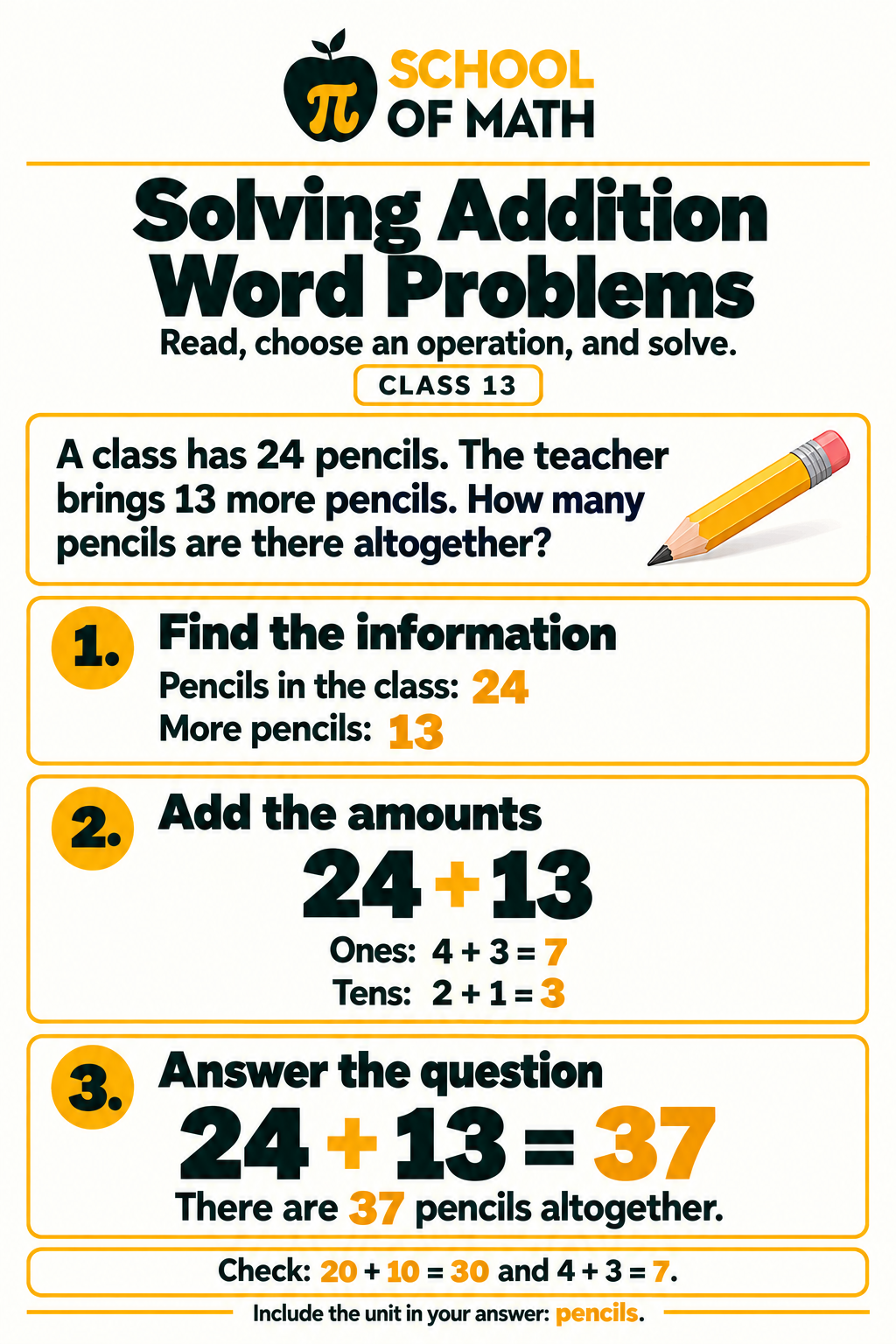
First decide what the story is asking. When two groups join and you need the total, add their amounts. A phrase such as “more than” can also ask for a larger amount. Write an addition sentence and include the object or unit in your answer.
Try it yourself: five questions
Q51 Practice 1 of 5 · Start
Nora has 12 red beads and 14 blue beads. How many beads does she have altogether?
Answer
26 beads.
- Add the ones: 2 + 4 = 6. There are fewer than 10 ones, so no new ten is needed.
- Add the tens: 1 tens + 1 tens = 2 tens.
- Put the parts together: 20 + 6 = 26.
Q52 Practice 2 of 5 · Build
A basket holds 23 apples. A farmer puts in 15 more. How many apples are in the basket now?
Answer
38 apples.
- Add the ones: 3 + 5 = 8. There are fewer than 10 ones, so no new ten is needed.
- Add the tens: 2 tens + 1 tens = 3 tens.
- Put the parts together: 30 + 8 = 38.
Q53 Practice 3 of 5 · Apply
A library shelf has 41 books. A second shelf has 26 books. How many books are on the two shelves?
Answer
67 books.
- Add the ones: 1 + 6 = 7. There are fewer than 10 ones, so no new ten is needed.
- Add the tens: 4 tens + 2 tens = 6 tens.
- Put the parts together: 60 + 7 = 67.
Q54 Practice 4 of 5 · Explain
A toy car travels 32 centimeters on one path and 16 centimeters on the next. How far does it travel in all?
Answer
48 centimeters.
- Add the ones: 2 + 6 = 8. There are fewer than 10 ones, so no new ten is needed.
- Add the tens: 3 tens + 1 tens = 4 tens.
- Put the parts together: 40 + 8 = 48.
Q55 Practice 5 of 5 · Challenge
Leo has 35 cards. Ana has 12 more cards than Leo. How many cards does Ana have? Explain why the answer is not 12.
Answer
47 cards.
- The 12 describes the extra cards. Add those to Leo’s 35 to find Ana’s whole collection.
- Add the ones: 5 + 2 = 7. There are fewer than 10 ones, so no new ten is needed.
- Add the tens: 3 tens + 1 tens = 4 tens.
- Put the parts together: 40 + 7 = 47.
Ten final word problems
Choose a model, a number line, expanded form, or vertical addition. Show your thinking and include the correct unit. The last four stories require more planning, but none of their addition steps needs regrouping.
W1 Final word problem 1 of 10
A child puts 10 shells in a bucket, then adds 18 more. How many shells are in the bucket?
Answer
28 shells.
- Add the ones: 0 + 8 = 8. There are fewer than 10 ones, so no new ten is needed.
- Add the tens: 1 tens + 1 tens = 2 tens.
- Put the parts together: 20 + 8 = 28.
W2 Final word problem 2 of 10
A classroom has 21 green counters and 13 yellow counters. How many counters are there in all?
Answer
34 counters.
- Add the ones: 1 + 3 = 4. There are fewer than 10 ones, so no new ten is needed.
- Add the tens: 2 tens + 1 tens = 3 tens.
- Put the parts together: 30 + 4 = 34.
W3 Final word problem 3 of 10
Zoe reads 32 pages on Saturday and 14 on Sunday. How many pages does she read over the two days?
Answer
46 pages.
- Add the ones: 2 + 4 = 6. There are fewer than 10 ones, so no new ten is needed.
- Add the tens: 3 tens + 1 tens = 4 tens.
- Put the parts together: 40 + 6 = 46.
W4 Final word problem 4 of 10
There are 44 people in one part of a park and 23 in another part. How many people are in both parts altogether?
Answer
67 people.
- Add the ones: 4 + 3 = 7. There are fewer than 10 ones, so no new ten is needed.
- Add the tens: 4 tens + 2 tens = 6 tens.
- Put the parts together: 60 + 7 = 67.
W5 Final word problem 5 of 10
A shop has 53 postcards and receives a delivery of 25 more. How many postcards does the shop have now?
Answer
78 postcards.
- Add the ones: 3 + 5 = 8. There are fewer than 10 ones, so no new ten is needed.
- Add the tens: 5 tens + 2 tens = 7 tens.
- Put the parts together: 70 + 8 = 78.
W6 Final word problem 6 of 10
A ribbon is 42 centimeters long. A second ribbon is 16 centimeters longer than the first. How long is the second ribbon?
Answer
58 centimeters.
- Add the ones: 2 + 6 = 8. There are fewer than 10 ones, so no new ten is needed.
- Add the tens: 4 tens + 1 tens = 5 tens.
- Put the parts together: 50 + 8 = 58.
W7 Final word problem 7 of 10
A club collects 12 cans on Monday, 23 on Tuesday, and 14 on Wednesday. How many cans does it collect in all?
Answer
49 cans.
- Add the ones: 2 + 3 = 5. There are fewer than 10 ones, so no new ten is needed.
- Add the tens: 1 tens + 2 tens = 3 tens.
- Put the parts together: 30 + 5 = 35.
- The first two days give 35 cans.
- Add the ones: 5 + 4 = 9. There are fewer than 10 ones, so no new ten is needed.
- Add the tens: 3 tens + 1 tens = 4 tens.
- Put the parts together: 40 + 9 = 49.
W8 Final word problem 8 of 10
One table has 21 crayons and a second table has 16 crayons. The teacher brings 12 more crayons. How many crayons do they have now?
Answer
49 crayons.
- Add the ones: 1 + 6 = 7. There are fewer than 10 ones, so no new ten is needed.
- Add the tens: 2 tens + 1 tens = 3 tens.
- Put the parts together: 30 + 7 = 37.
- The two tables begin with 37 crayons.
- Add the ones: 7 + 2 = 9. There are fewer than 10 ones, so no new ten is needed.
- Add the tens: 3 tens + 1 tens = 4 tens.
- Put the parts together: 40 + 9 = 49.
W9 Final word problem 9 of 10
Mina has 22 stickers. Owen has 11 more stickers than Mina. How many stickers do Mina and Owen have altogether?
Answer
55 stickers altogether.
- First find Owen’s stickers, not the final total.
- Add the ones: 2 + 1 = 3. There are fewer than 10 ones, so no new ten is needed.
- Add the tens: 2 tens + 1 tens = 3 tens.
- Put the parts together: 30 + 3 = 33.
- Owen has 33 stickers. Now combine both children’s collections.
- Add the ones: 2 + 3 = 5. There are fewer than 10 ones, so no new ten is needed.
- Add the tens: 2 tens + 3 tens = 5 tens.
- Put the parts together: 50 + 5 = 55.
W10 Final word problem 10 of 10
Two groups make paper flowers. The first makes 31 flowers and the second makes 22. They receive 14 more flowers as a gift. They want at least 65 flowers for a display. How many do they have, and do they meet their goal?
Answer
67 flowers; yes, they meet the goal.
- Add the ones: 1 + 2 = 3. There are fewer than 10 ones, so no new ten is needed.
- Add the tens: 3 tens + 2 tens = 5 tens.
- Put the parts together: 50 + 3 = 53.
- The two groups make 53 flowers.
- Add the ones: 3 + 4 = 7. There are fewer than 10 ones, so no new ten is needed.
- Add the tens: 5 tens + 1 tens = 6 tens.
- Put the parts together: 60 + 7 = 67.
- Compare 67 with 65. Both have 6 tens, and 7 ones is greater than 5 ones, so 67 is more than 65.
Quick questions and answers
How do you add two-digit numbers without regrouping?
Add ones to ones and tens to tens. For the problems in this lesson, each column totals less than ten, so no carrying is needed. You can show the same addition with blocks, expanded form, columns, or number-line jumps.
What does without regrouping mean?
It means you do not need to trade ten ones for a ten or ten tens for a hundred. All addition practice here has a ones total below ten and an overall total below one hundred.
Do you always have to add the ones first?
Start with the ones when using the standard vertical method. When adding separate tens and ones values or making number-line jumps, you may add the tens first and then the ones. Keep the place values correct either way.
Why is there a regrouping image in this class?
One of the supplied images shows carrying as a contrast. It is clearly labeled as a comparison. The questions beneath it ask students to recognize when carrying is not needed; the class does not require solving regrouping problems.
How many practice questions are included?
Little Newtons Class 13 includes eleven images in order, five original questions after each image, and ten final word problems. There are sixty-five questions, each with a hidden worked answer.
How can a parent help without giving away the answer?
Ask the child to name the tens and ones, draw a model, or explain each number-line jump. Read a word problem aloud if needed, but let the child choose the operation and try a solution before opening the Answer button.