Little Newtons · Class 18 · Grades 1–2
Two-Digit Subtraction with Regrouping
Borrowing without confusion: when there are not enough ones, trade one ten for ten ones. Build the number, trade a ten, subtract each column, and check the answer with addition.
Explore eight teaching images and five original questions after each image. Finish with eight Homework review questions and twelve Homework word problems: 40 practice questions, 20 homework questions, and 60 hidden worked answers. Try each problem before opening its blue Answer control.
This independent lesson is part of Little Newtons at SOMATH. Use blocks, drawings, or spoken explanations; an adult may read the questions aloud. Earlier-numbered classes are not required. See the class schedule or book an evaluation for the right course level.
Download the student workbook (PDF)22 pages · Supplied cover, eight teaching images, and all 60 questions · Generous blank answer space · No exercise solutions
Reviewing tens and ones
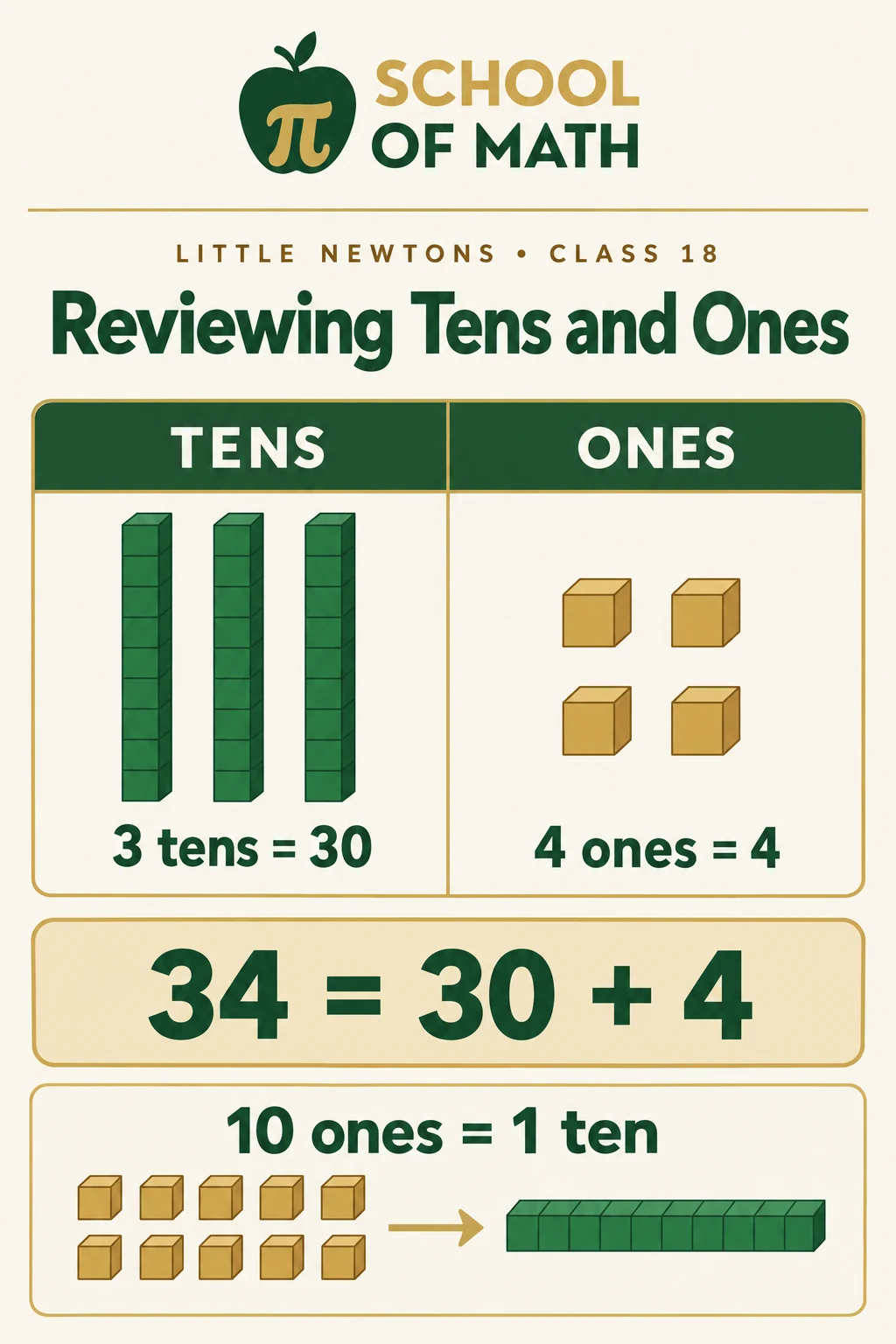
Every two-digit number is made of tens and ones. A tens rod is worth ten, and a small cube is worth one. The image shows 34 as 3 tens rods and 4 cubes, so 34 = 30 + 4.
Ten loose ones have the same value as one ten. This fact is the key to subtraction with regrouping: when we do not have enough ones, we can open a ten and turn it into ten ones without changing the value of the number.
Practice: try these five questions
Q1
A model has 5 tens rods and 7 ones cubes. What number does it show?
Answer
57
Five tens are 50. Add the 7 ones: 50 + 7 = 57.
Q2
Write 83 as tens plus ones.
Answer
83 = 80 + 3 (8 tens and 3 ones)
The 8 is in the tens place, so it is worth 80. The 3 is in the ones place, so it is worth 3. Together, 80 + 3 = 83.
Q3
How many ones are in 4 tens?
Answer
40 ones
Each ten is worth 10 ones. Four tens are 10 + 10 + 10 + 10 = 40 ones.
Q4
A model shows 6 tens rods and no loose cubes. What number is it, and why do we write a 0?
Answer
60
Six tens are 60. There are no loose ones, so we write 0 in the ones place to show that the ones place is empty.
Q5
Mateo has 2 tens rods and 15 ones cubes. He says his model shows 35. Is he right? Use 10 ones = 1 ten to explain.
Answer
Yes, it shows 35
Two tens are 20, and 20 + 15 = 35. You can also trade 10 of the 15 cubes for 1 rod. Then there are 3 tens and 5 ones, which is 35. The value did not change.
When do we regroup?
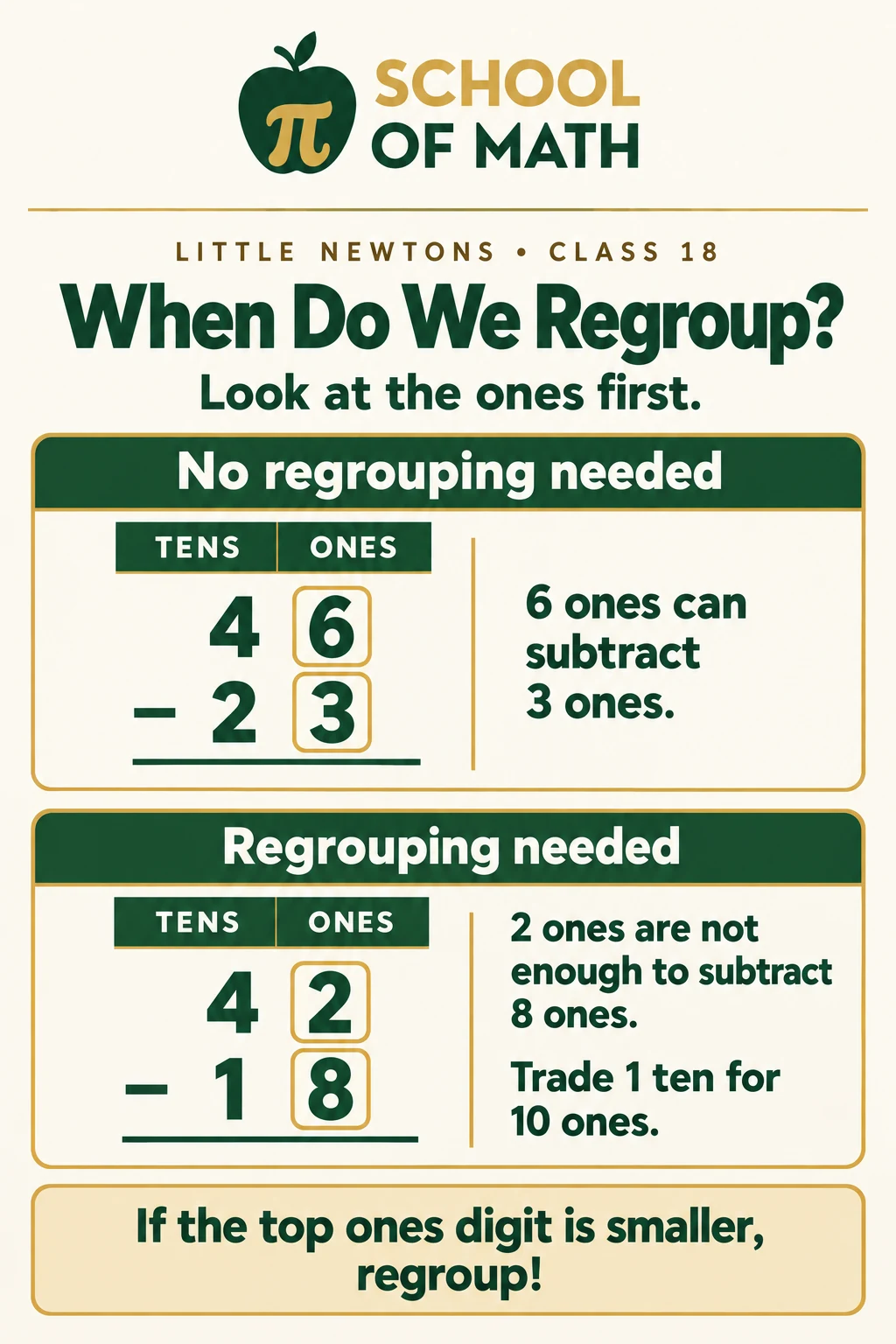
Before subtracting, look at the ones column. Compare the top ones digit with the bottom ones digit. If the top ones digit is the same or larger, subtract right away: in 46 − 23, 6 ones can take away 3 ones.
If the top ones digit is smaller, there are not enough ones. In 42 − 18, 2 ones cannot take away 8 ones, so we trade 1 ten for 10 ones first. Comparing the tens is not enough: always check the ones.
Practice: try these five questions
Q6
Look at 57 − 24. Do you need to regroup? Then solve.
Answer
No regrouping; 33
Look at the ones: 7 is not smaller than 4, so no trade is needed. Ones: 7 − 4 = 3. Tens: 5 − 2 = 3. The answer is 3 tens and 3 ones, or 33. Check: 33 + 24 = 57.
Q7
Look at 63 − 27. Do you need to regroup? Then solve.
Answer
Yes, regroup; 36
Look at the ones: 3 is less than 7, so regroup. Trade 1 ten for 10 ones: 6 tens become 5 tens, and 3 ones become 13 ones. Ones: 13 − 7 = 6. Tens: 5 − 2 = 3. The answer is 3 tens and 6 ones, or 36. Check: 36 + 27 = 63.
Q8
Which of these need regrouping: 85 − 41, 72 − 36, 94 − 58, 68 − 35?
Answer
72 − 36 and 94 − 58
Compare the ones. In 85 − 41, 5 is not less than 1, so no trade. In 72 − 36, 2 is less than 6, so regroup. In 94 − 58, 4 is less than 8, so regroup. In 68 − 35, 8 is not less than 5, so no trade. (The answers are 44, 36, 36, and 33.)
Q9
Look at 50 − 13. Do you need to regroup? Why?
Answer
Yes; 0 ones cannot take away 3 ones
The top ones digit is 0, which is smaller than 3. Trade 1 ten for 10 ones: 5 tens become 4 tens and 0 ones become 10 ones. Then 10 − 3 = 7 and 4 − 1 = 3, so 50 − 13 = 37.
Q10
Lily says 44 − 19 does not need regrouping because 4 tens is more than 1 ten. Is she right? Explain.
Answer
No; regroup because 4 ones are fewer than 9 ones
We decide by looking at the ones, not the tens. There are 4 ones, and we must take away 9 ones, so we need to regroup. Look at the ones: 4 is less than 9, so regroup. Trade 1 ten for 10 ones: 4 tens become 3 tens, and 4 ones become 14 ones. Ones: 14 − 9 = 5. Tens: 3 − 1 = 2. The answer is 2 tens and 5 ones, or 25. Check: 25 + 19 = 44.
Trading one ten for ten ones
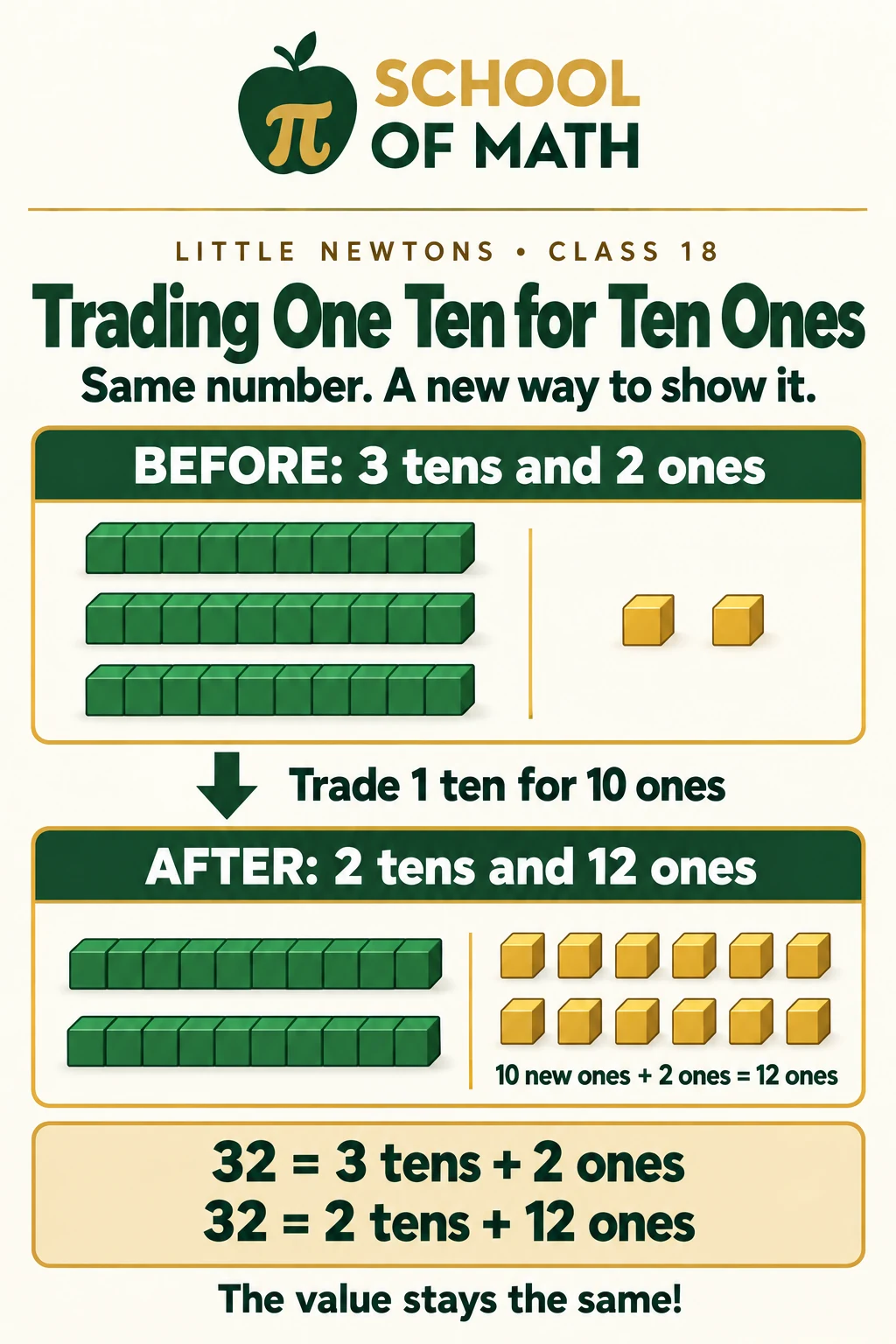
Regrouping in subtraction is a fair trade. Take one tens rod and exchange it for ten ones cubes. The image shows 32 first as 3 tens and 2 ones, then as 2 tens and 12 ones.
After the trade there is one fewer ten and ten more ones. Add the 10 new ones to the ones already there: 10 + 2 = 12. The number is still 32; we are only showing it a new way, so there are now enough ones to subtract.
Practice: try these five questions
Q11
Trade one ten in 45. How many tens and ones do you have afterward?
Answer
3 tens and 15 ones
45 is 4 tens and 5 ones. One ten becomes 10 ones, so 4 tens become 3 tens, and 10 + 5 = 15 ones. Check: 30 + 15 = 45.
Q12
Fill in the blank: 53 = 4 tens + ___ ones.
Answer
13
53 is 5 tens and 3 ones. Trading one ten leaves 4 tens and gives 10 + 3 = 13 ones. Check: 40 + 13 = 53.
Q13
After a trade, a model shows 6 tens and 11 ones. What number is it, and what did the model look like before the trade?
Answer
71; 7 tens and 1 one
Six tens are 60, and 60 + 11 = 71. Before the trade there was one more ten and ten fewer ones: 7 tens and 1 one.
Q14
Trade one ten in 80. How many tens and ones do you have now?
Answer
7 tens and 10 ones
80 is 8 tens and 0 ones. Trading one ten leaves 7 tens and gives 0 + 10 = 10 ones. Check: 70 + 10 = 80.
Q15
Ben trades one ten in 37 and says he now has 2 tens and 7 ones. What did he forget? Show the correct model.
Answer
He forgot the 10 new ones; 2 tens and 17 ones
Ben's model, 2 tens and 7 ones, is only 27, so it lost ten. When a ten is opened, its 10 ones must be added to the 7 ones already there: 10 + 7 = 17. The correct model is 2 tens and 17 ones, which still equals 37.
Subtracting with base-ten blocks
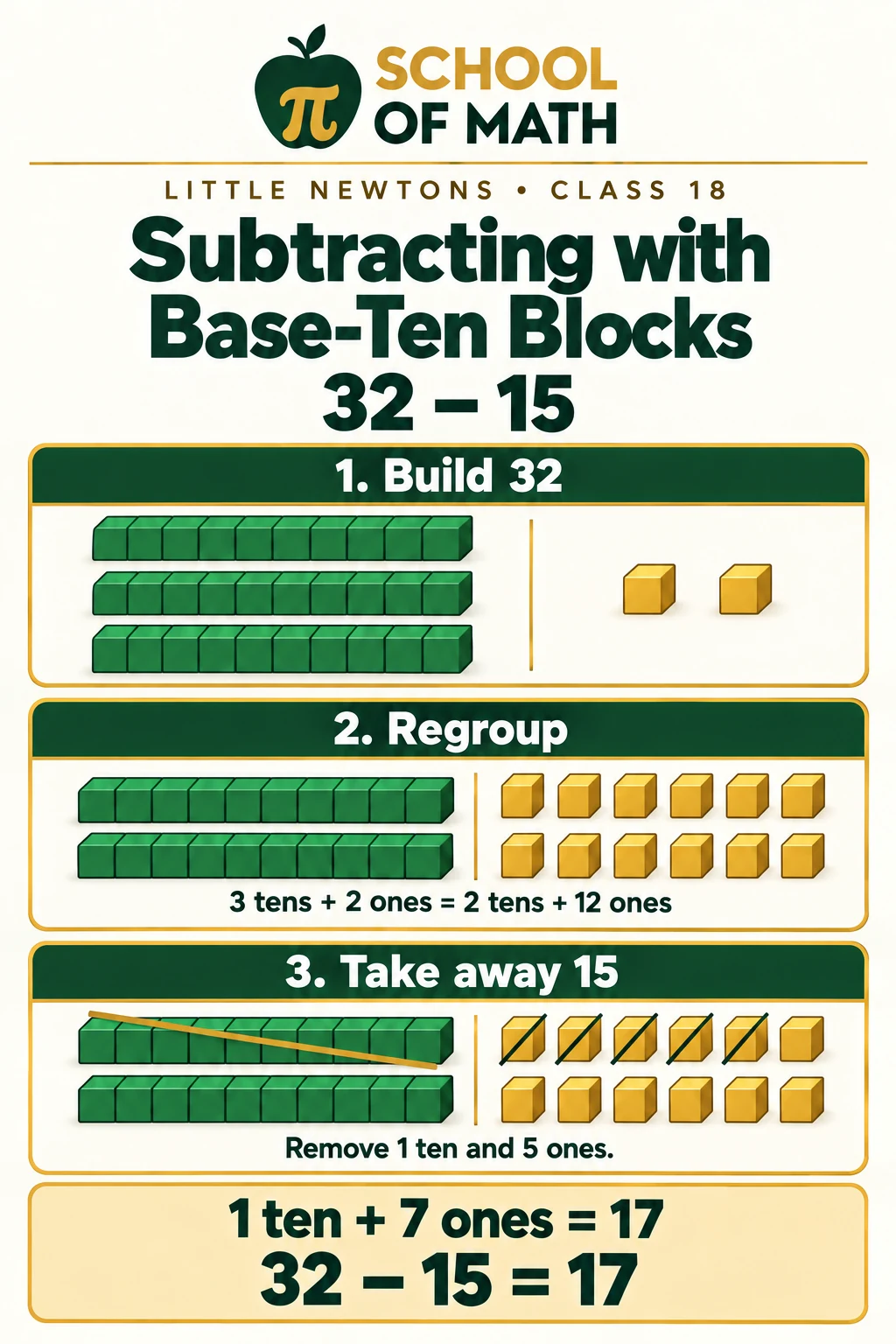
Blocks show exactly what happens in subtraction with regrouping. For 32 − 15, build 32 with 3 rods and 2 cubes. Taking away 5 ones is impossible with only 2 cubes, so trade one rod for ten cubes: now there are 2 tens and 12 ones.
Next take away the second number: remove 1 rod and 5 cubes. Count what is left: 1 ten and 7 ones, or 17. Only the first number is built; the second number tells us how much to remove.
Practice: try these five questions
Q16
Use blocks to solve 41 − 16. Tell what you build, trade, and take away.
Answer
25
Build 41 with 4 rods and 1 cube. One cube cannot take away 6, so trade a rod: 3 tens and 11 ones. Remove 1 rod and 6 cubes. Left: 2 rods and 5 cubes, which is 25. Check: 25 + 16 = 41.
Q17
Use blocks to solve 52 − 27.
Answer
25
Build 52 with 5 rods and 2 cubes. Two cubes cannot take away 7, so trade a rod: 4 tens and 12 ones. Remove 2 rods and 7 cubes. Left: 2 rods and 5 cubes, which is 25. Check: 25 + 27 = 52.
Q18
After a trade, a model of 64 shows 5 tens and 14 ones. Take away 2 tens and 8 ones. What is left, and what subtraction did you do?
Answer
36; 64 − 28 = 36
Ones: 14 − 8 = 6. Tens: 5 − 2 = 3. Three tens and 6 ones make 36. Taking away 2 tens and 8 ones means taking away 28, so 64 − 28 = 36. Check: 36 + 28 = 64.
Q19
To solve 33 − 17, a student builds 33, removes 1 rod and all 3 cubes, and says she cannot take away more. What should she do instead?
Answer
Trade a ten first; 33 − 17 = 16
She needs to remove 7 ones, but only has 3. Before removing anything, trade one rod for ten cubes: 2 tens and 13 ones. Then remove 1 rod and 7 cubes. Left: 1 rod and 6 cubes, which is 16. Check: 16 + 17 = 33.
Q20
Draw a quick sketch for 75 − 48, using a line for each ten and a dot for each one. Show the trade and the answer.
Answer
27
Draw 7 lines and 5 dots. Five dots cannot lose 8, so cross out one line and draw 10 more dots: 6 lines and 15 dots. Cross out 4 lines and 8 dots. Left: 2 lines and 7 dots, which is 27. Check: 27 + 48 = 75.
Writing regrouping clearly in columns
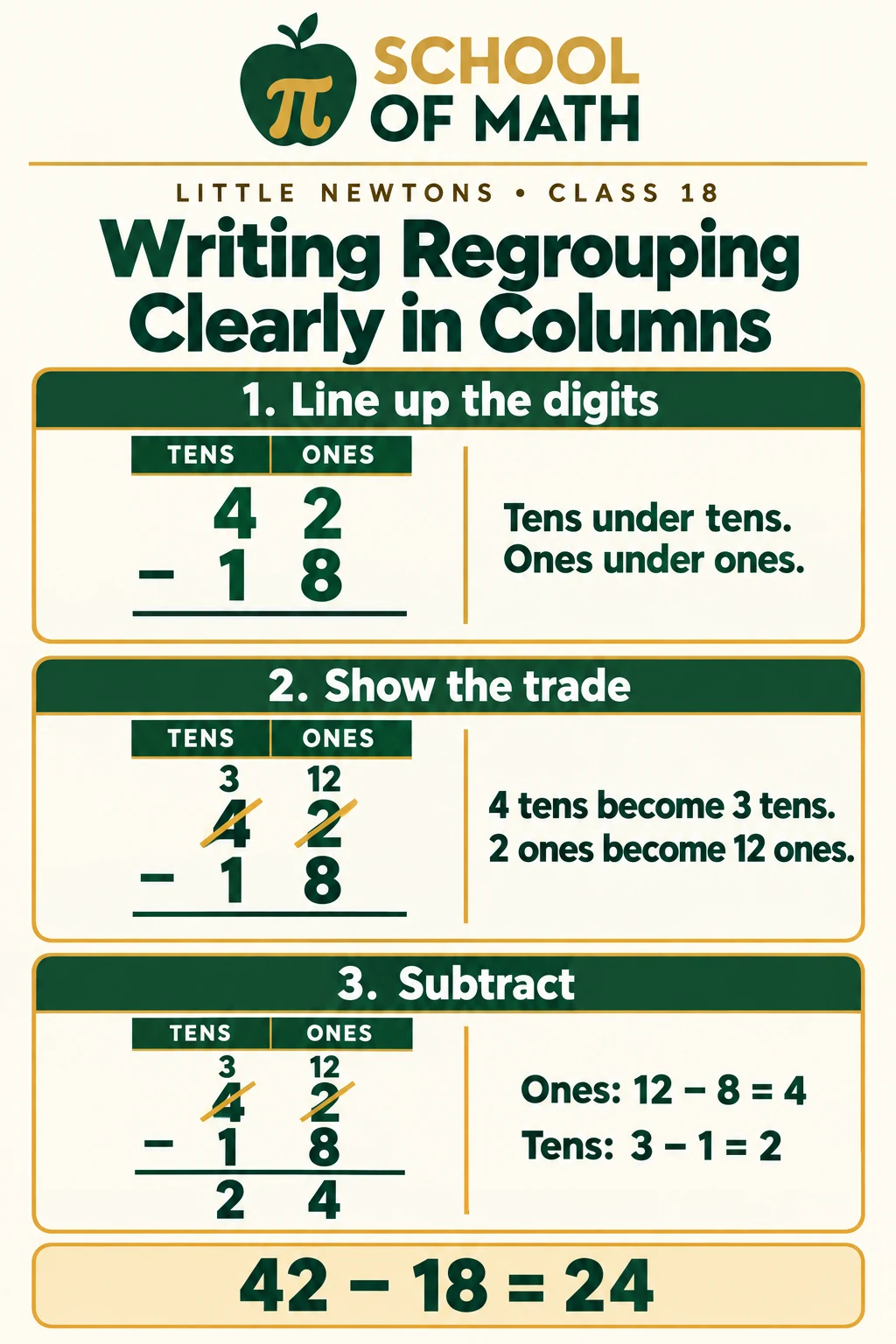
Written subtraction records the block trade. First line up the digits: tens under tens, ones under ones. When the top ones digit is too small, cross out the tens digit and write one less above it. Cross out the ones digit and write ten more above it.
For 42 − 18, the 4 becomes 3 and the 2 becomes 12. Then subtract the ones (12 − 8 = 4) and the tens (3 − 1 = 2). Neat, small numbers above the columns show exactly what was traded, so nothing is counted twice or forgotten.
Practice: try these five questions
Q21
Write 53 − 26 in columns. Show the trade with crossed-out digits, then subtract.
Answer
27
Cross out 5 and write 4 above it; cross out 3 and write 13 above it. Look at the ones: 3 is less than 6, so regroup. Trade 1 ten for 10 ones: 5 tens become 4 tens, and 3 ones become 13 ones. Ones: 13 − 6 = 7. Tens: 4 − 2 = 2. The answer is 2 tens and 7 ones, or 27. Check: 27 + 26 = 53.
Q22
Solve 81 − 35 in columns, showing the trade.
Answer
46
Cross out 8 and write 7; cross out 1 and write 11. Look at the ones: 1 is less than 5, so regroup. Trade 1 ten for 10 ones: 8 tens become 7 tens, and 1 one become 11 ones. Ones: 11 − 5 = 6. Tens: 7 − 3 = 4. The answer is 4 tens and 6 ones, or 46. Check: 46 + 35 = 81.
Q23
In 74 − 39, what small numbers do you write above the tens and ones after trading? What is the answer?
Answer
6 above the tens, 14 above the ones; 35
Four ones cannot take away 9, so the 7 tens become 6 tens and the 4 ones become 14 ones. Ones: 14 − 9 = 5. Tens: 6 − 3 = 3. The answer is 35. Check: 35 + 39 = 74.
Q24
A student wrote 62 − 28 = 46. He found 8 − 2 = 6 in the ones column. What went wrong? Find the correct answer.
Answer
He subtracted bottom minus top; 62 − 28 = 34
In subtraction we always take the bottom number away from the top number. The top ones digit is 2, so we must regroup instead of flipping the digits. Look at the ones: 2 is less than 8, so regroup. Trade 1 ten for 10 ones: 6 tens become 5 tens, and 2 ones become 12 ones. Ones: 12 − 8 = 4. Tens: 5 − 2 = 3. The answer is 3 tens and 4 ones, or 34. Check: 34 + 28 = 62.
Q25
Solve 92 − 57 in columns, showing the trade.
Answer
35
Cross out 9 and write 8; cross out 2 and write 12. Look at the ones: 2 is less than 7, so regroup. Trade 1 ten for 10 ones: 9 tens become 8 tens, and 2 ones become 12 ones. Ones: 12 − 7 = 5. Tens: 8 − 5 = 3. The answer is 3 tens and 5 ones, or 35. Check: 35 + 57 = 92.
Subtracting across zero
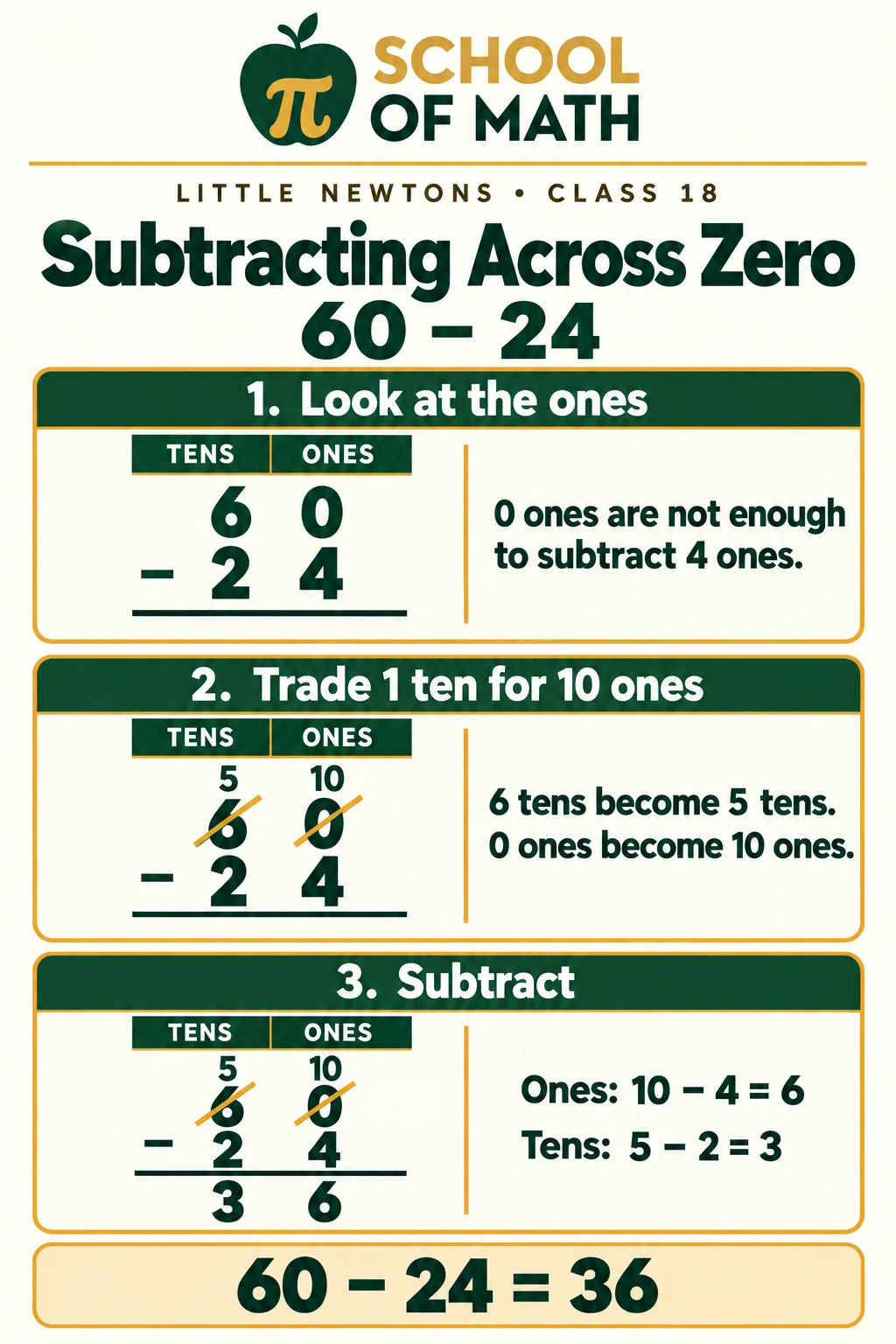
A zero in the ones place means there are no loose ones. In 60 − 24, 0 ones cannot take away 4 ones, so we must regroup. Trade 1 ten: 6 tens become 5 tens, and 0 ones become 10 ones.
Now subtract: 10 − 4 = 6 ones and 5 − 2 = 3 tens, so 60 − 24 = 36. A common mistake is writing 4 in the ones place because “0 minus 4 is 4.” Zero ones cannot give away 4 ones; always trade a ten first.
Practice: try these five questions
Q26
Solve 40 − 17.
Answer
23
Look at the ones: 0 is less than 7, so regroup. Trade 1 ten for 10 ones: 4 tens become 3 tens, and 0 ones become 10 ones. Ones: 10 − 7 = 3. Tens: 3 − 1 = 2. The answer is 2 tens and 3 ones, or 23. Check: 23 + 17 = 40.
Q27
Solve 70 − 38.
Answer
32
Look at the ones: 0 is less than 8, so regroup. Trade 1 ten for 10 ones: 7 tens become 6 tens, and 0 ones become 10 ones. Ones: 10 − 8 = 2. Tens: 6 − 3 = 3. The answer is 3 tens and 2 ones, or 32. Check: 32 + 38 = 70.
Q28
In 90 − 46, what are the new tens and ones after the trade? Finish the subtraction.
Answer
8 tens and 10 ones; 44
Look at the ones: 0 is less than 6, so regroup. Trade 1 ten for 10 ones: 9 tens become 8 tens, and 0 ones become 10 ones. Ones: 10 − 6 = 4. Tens: 8 − 4 = 4. The answer is 4 tens and 4 ones, or 44. Check: 44 + 46 = 90.
Q29
A student says 50 − 23 = 33 because “0 take away 3 is 3.” Explain the mistake and find the correct answer.
Answer
Zero ones cannot give away 3; 50 − 23 = 27
The student subtracted 3 − 0 instead of 0 − 3. Since there are 0 ones, trade a ten first. Look at the ones: 0 is less than 3, so regroup. Trade 1 ten for 10 ones: 5 tens become 4 tens, and 0 ones become 10 ones. Ones: 10 − 3 = 7. Tens: 4 − 2 = 2. The answer is 2 tens and 7 ones, or 27. Check: 27 + 23 = 50.
Q30
Solve 80 − 52 and check your answer.
Answer
28
Look at the ones: 0 is less than 2, so regroup. Trade 1 ten for 10 ones: 8 tens become 7 tens, and 0 ones become 10 ones. Ones: 10 − 2 = 8. Tens: 7 − 5 = 2. The answer is 2 tens and 8 ones, or 28. Check: 28 + 52 = 80.
Solving subtraction word problems
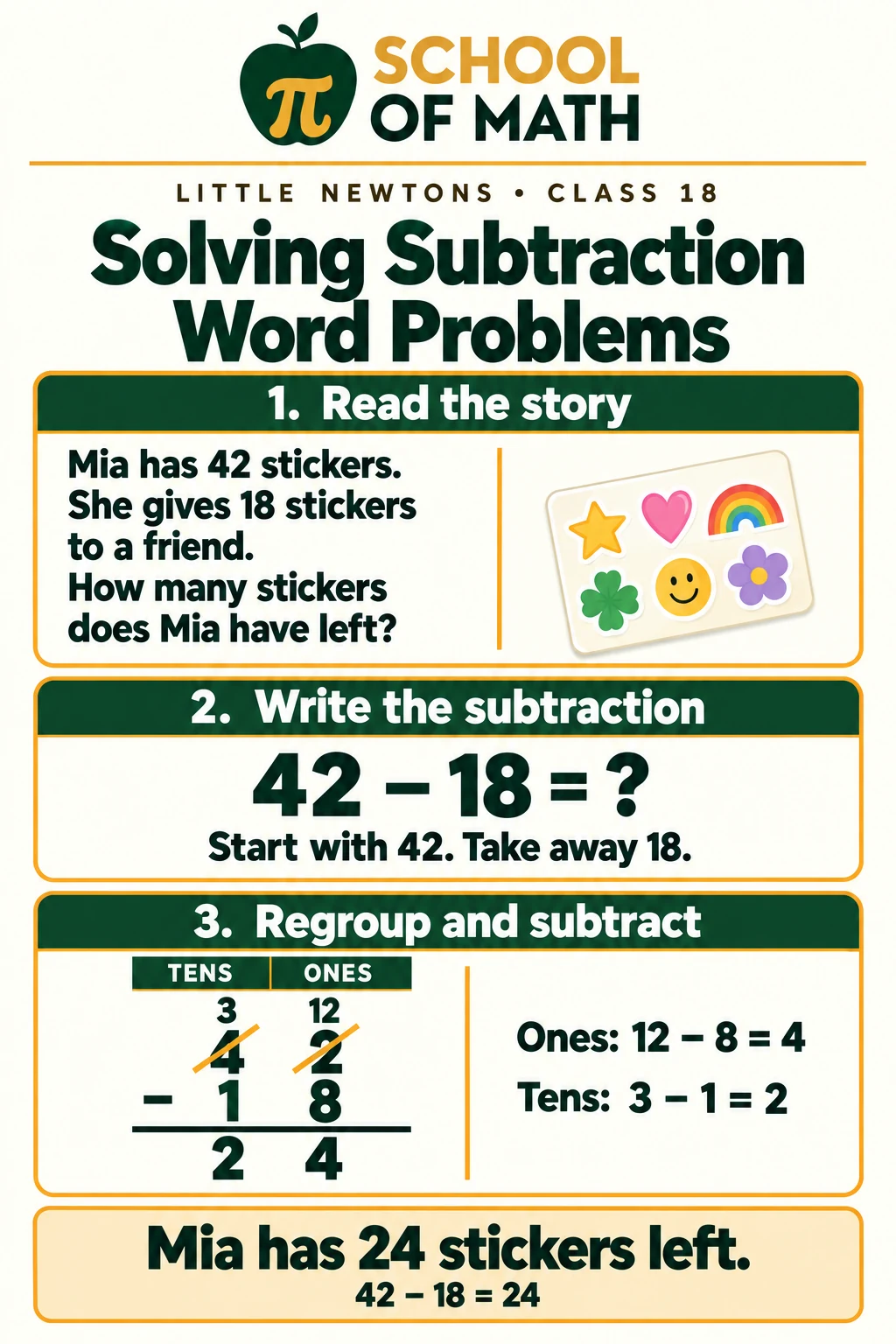
Read the story carefully and ask: what is the starting amount, and how much is taken away or compared? Words such as left, gives away, fewer, how many more, and how many are still often signal subtraction.
Write the subtraction with the starting amount first, then regroup and subtract in columns. Finish with a sentence that answers the question, using the right label, such as “Mia has 24 stickers left.”
Practice: try these five questions
Q31
Noah has 51 marbles. He gives 26 marbles to his cousin. How many marbles does Noah have left?
Answer
25 marbles
Start with 51 and take away 26: 51 − 26. Look at the ones: 1 is less than 6, so regroup. Trade 1 ten for 10 ones: 5 tens become 4 tens, and 1 one become 11 ones. Ones: 11 − 6 = 5. Tens: 4 − 2 = 2. The answer is 2 tens and 5 ones, or 25. Check: 25 + 26 = 51. Noah has 25 marbles left.
Q32
A bakery made 70 muffins. It sold 43 of them. How many muffins are left?
Answer
27 muffins
Write 70 − 43. Look at the ones: 0 is less than 3, so regroup. Trade 1 ten for 10 ones: 7 tens become 6 tens, and 0 ones become 10 ones. Ones: 10 − 3 = 7. Tens: 6 − 4 = 2. The answer is 2 tens and 7 ones, or 27. Check: 27 + 43 = 70. There are 27 muffins left.
Q33
There are 63 children at the park. Then 29 children go home. How many children are still at the park?
Answer
34 children
Write 63 − 29. Look at the ones: 3 is less than 9, so regroup. Trade 1 ten for 10 ones: 6 tens become 5 tens, and 3 ones become 13 ones. Ones: 13 − 9 = 4. Tens: 5 − 2 = 3. The answer is 3 tens and 4 ones, or 34. Check: 34 + 29 = 63. There are 34 children still at the park.
Q34
A book has 85 pages. Ava has read 47 pages. How many pages does she still have to read?
Answer
38 pages
The pages left are the total minus the pages read: 85 − 47. Look at the ones: 5 is less than 7, so regroup. Trade 1 ten for 10 ones: 8 tens become 7 tens, and 5 ones become 15 ones. Ones: 15 − 7 = 8. Tens: 7 − 4 = 3. The answer is 3 tens and 8 ones, or 38. Check: 38 + 47 = 85. Ava has 38 pages left to read.
Q35
Leo has 34 stamps. Emma has 52 stamps. How many more stamps does Emma have than Leo?
Answer
18 more stamps
To compare, subtract the smaller amount from the larger: 52 − 34. Look at the ones: 2 is less than 4, so regroup. Trade 1 ten for 10 ones: 5 tens become 4 tens, and 2 ones become 12 ones. Ones: 12 − 4 = 8. Tens: 4 − 3 = 1. The answer is 1 ten and 8 ones, or 18. Check: 18 + 34 = 52. Emma has 18 more stamps than Leo.
Checking subtraction with addition
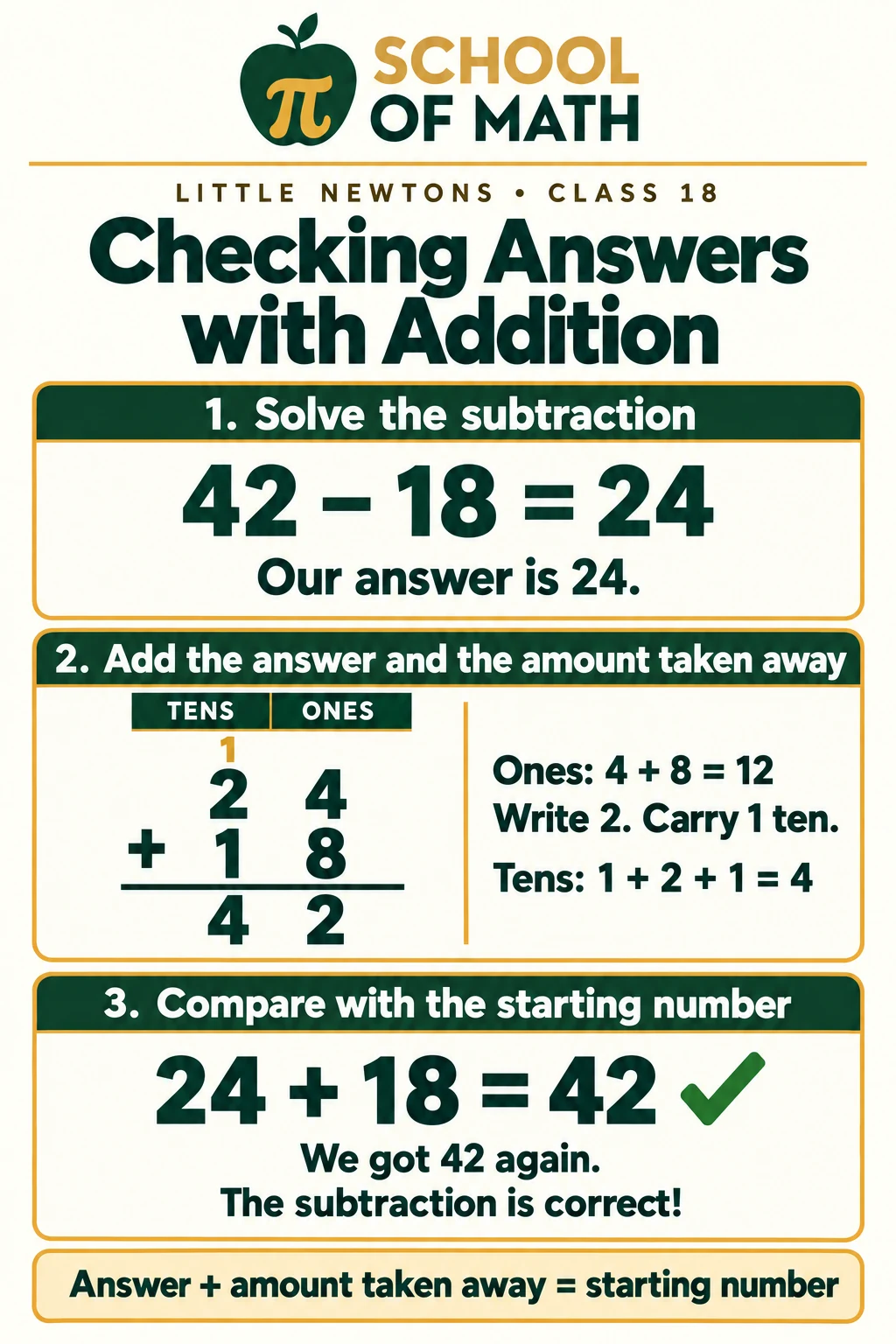
Subtraction and addition undo each other. To check a subtraction, add the answer to the amount taken away. If the sum is the starting number, the subtraction is correct: 42 − 18 = 24 because 24 + 18 = 42.
If the check does not give the starting number, look for a mistake, often a missed trade or a ones digit subtracted the wrong way. Fix it and check again. Remember: answer + amount taken away = starting number.
Practice: try these five questions
Q36
Check 71 − 45 = 26 using addition. Is it correct?
Answer
Yes, 26 + 45 = 71
Add the answer and the amount taken away. Ones: 6 + 5 = 11; write 1 and carry 1 ten. Tens: 2 + 4 + 1 = 7. The sum is 71, the starting number, so the subtraction is correct.
Q37
Sam says 54 − 18 = 44. Check with addition. If he is wrong, find the correct answer.
Answer
Wrong; 54 − 18 = 36
Check: 44 + 18 = 62, not 54, so there is a mistake. Sam found 8 − 4 instead of regrouping. Look at the ones: 4 is less than 8, so regroup. Trade 1 ten for 10 ones: 5 tens become 4 tens, and 4 ones become 14 ones. Ones: 14 − 8 = 6. Tens: 4 − 1 = 3. The answer is 3 tens and 6 ones, or 36. Check: 36 + 18 = 54.
Q38
Solve 83 − 57, then check with addition.
Answer
26
Look at the ones: 3 is less than 7, so regroup. Trade 1 ten for 10 ones: 8 tens become 7 tens, and 3 ones become 13 ones. Ones: 13 − 7 = 6. Tens: 7 − 5 = 2. The answer is 2 tens and 6 ones, or 26. Check: 26 + 57 = 83.
Q39
Solve 60 − 33, then check with addition.
Answer
27
Look at the ones: 0 is less than 3, so regroup. Trade 1 ten for 10 ones: 6 tens become 5 tens, and 0 ones become 10 ones. Ones: 10 − 3 = 7. Tens: 5 − 3 = 2. The answer is 2 tens and 7 ones, or 27. Check: 27 + 33 = 60.
Q40
Complete the addition that checks 92 − 64 = 28: 28 + ___ = ___.
Answer
28 + 64 = 92
Add the answer, 28, to the amount taken away, 64. Ones: 8 + 4 = 12; write 2 and carry 1 ten. Tens: 2 + 6 + 1 = 9. The sum is 92, the starting number, so 92 − 64 = 28 is correct.
Homework review
These eight questions revisit the eight ideas in this lesson. Use blocks or a quick sketch to explain each trade, and keep the answers closed until you have tried.
R1
Write 76 as tens plus ones. How many ones are in 7 tens?
Answer
76 = 70 + 6; 70 ones
The 7 means 7 tens, or 70, and the 6 means 6 ones. Each ten is 10 ones, so 7 tens are 70 ones.
R2
Which needs regrouping, 58 − 34 or 52 − 34? Explain, then solve both.
Answer
52 − 34 needs regrouping; 24 and 18
In 58 − 34, 8 ones can take away 4 ones, so 58 − 34 = 24. In 52 − 34, 2 ones cannot take away 4 ones, so regroup. Look at the ones: 2 is less than 4, so regroup. Trade 1 ten for 10 ones: 5 tens become 4 tens, and 2 ones become 12 ones. Ones: 12 − 4 = 8. Tens: 4 − 3 = 1. The answer is 1 ten and 8 ones, or 18. Check: 18 + 34 = 52.
R3
Trade one ten in 61. How many tens and ones do you have?
Answer
5 tens and 11 ones
61 is 6 tens and 1 one. Trading one ten leaves 5 tens and gives 10 + 1 = 11 ones. Check: 50 + 11 = 61.
R4
Use blocks or a sketch to solve 43 − 25.
Answer
18
Build 43 with 4 rods and 3 cubes. Trade a rod: 3 tens and 13 ones. Remove 2 rods and 5 cubes. Left: 1 rod and 8 cubes, which is 18. Check: 18 + 25 = 43.
R5
Solve 95 − 68 in columns. Show the crossed-out digits and the new numbers.
Answer
27
Cross out 9 and write 8; cross out 5 and write 15. Look at the ones: 5 is less than 8, so regroup. Trade 1 ten for 10 ones: 9 tens become 8 tens, and 5 ones become 15 ones. Ones: 15 − 8 = 7. Tens: 8 − 6 = 2. The answer is 2 tens and 7 ones, or 27. Check: 27 + 68 = 95.
R6
Solve 30 − 14.
Answer
16
Look at the ones: 0 is less than 4, so regroup. Trade 1 ten for 10 ones: 3 tens become 2 tens, and 0 ones become 10 ones. Ones: 10 − 4 = 6. Tens: 2 − 1 = 1. The answer is 1 ten and 6 ones, or 16. Check: 16 + 14 = 30.
R7
A jar holds 56 crayons. The class uses 29 of them. How many crayons are left in the jar?
Answer
27 crayons
Write 56 − 29. Look at the ones: 6 is less than 9, so regroup. Trade 1 ten for 10 ones: 5 tens become 4 tens, and 6 ones become 16 ones. Ones: 16 − 9 = 7. Tens: 4 − 2 = 2. The answer is 2 tens and 7 ones, or 27. Check: 27 + 29 = 56. There are 27 crayons left.
R8
Solve 82 − 47, then check your answer with addition.
Answer
35
Look at the ones: 2 is less than 7, so regroup. Trade 1 ten for 10 ones: 8 tens become 7 tens, and 2 ones become 12 ones. Ones: 12 − 7 = 5. Tens: 7 − 4 = 3. The answer is 3 tens and 5 ones, or 35. Check: 35 + 47 = 82.
Homework word problems
Work from the easier stories toward the two-step challenges. Write the subtraction, show any trade of one ten for ten ones, check with addition, and answer in a sentence with the correct unit.
W1
Sara picked 45 apples. She gave 17 apples to her neighbors. How many apples does she have now?
Answer
28 apples
Write 45 − 17. Look at the ones: 5 is less than 7, so regroup. Trade 1 ten for 10 ones: 4 tens become 3 tens, and 5 ones become 15 ones. Ones: 15 − 7 = 8. Tens: 3 − 1 = 2. The answer is 2 tens and 8 ones, or 28. Check: 28 + 17 = 45. Sara has 28 apples.
W2
A parking lot has 62 cars. Then 35 cars drive away. How many cars are still in the lot?
Answer
27 cars
Write 62 − 35. Look at the ones: 2 is less than 5, so regroup. Trade 1 ten for 10 ones: 6 tens become 5 tens, and 2 ones become 12 ones. Ones: 12 − 5 = 7. Tens: 5 − 3 = 2. The answer is 2 tens and 7 ones, or 27. Check: 27 + 35 = 62. There are 27 cars still in the lot.
W3
A pet shop had 80 goldfish. It sold 26 of them. How many goldfish are left?
Answer
54 goldfish
Write 80 − 26. Look at the ones: 0 is less than 6, so regroup. Trade 1 ten for 10 ones: 8 tens become 7 tens, and 0 ones become 10 ones. Ones: 10 − 6 = 4. Tens: 7 − 2 = 5. The answer is 5 tens and 4 ones, or 54. Check: 54 + 26 = 80. There are 54 goldfish left.
W4
Jake scored 73 points in a game. Mia scored 48 points. How many more points did Jake score?
Answer
25 more points
Compare by subtracting: 73 − 48. Look at the ones: 3 is less than 8, so regroup. Trade 1 ten for 10 ones: 7 tens become 6 tens, and 3 ones become 13 ones. Ones: 13 − 8 = 5. Tens: 6 − 4 = 2. The answer is 2 tens and 5 ones, or 25. Check: 25 + 48 = 73. Jake scored 25 more points.
W5
A class needs 50 tickets for a show. It has 32 tickets. How many more tickets does it need?
Answer
18 more tickets
The tickets still needed are 50 − 32. Look at the ones: 0 is less than 2, so regroup. Trade 1 ten for 10 ones: 5 tens become 4 tens, and 0 ones become 10 ones. Ones: 10 − 2 = 8. Tens: 4 − 3 = 1. The answer is 1 ten and 8 ones, or 18. Check: 18 + 32 = 50. The class needs 18 more tickets.
W6
A train has 91 seats. There are 64 people sitting, one in each seat. How many seats are empty?
Answer
27 seats
Write 91 − 64. Look at the ones: 1 is less than 4, so regroup. Trade 1 ten for 10 ones: 9 tens become 8 tens, and 1 one become 11 ones. Ones: 11 − 4 = 7. Tens: 8 − 6 = 2. The answer is 2 tens and 7 ones, or 27. Check: 27 + 64 = 91. There are 27 empty seats.
W7
Grandma baked 64 cookies. The family ate 27 cookies, and then she gave 18 cookies to friends. How many cookies are left?
Answer
19 cookies
Step 1: 64 − 27. Look at the ones: 4 is less than 7, so regroup. Trade 1 ten for 10 ones: 6 tens become 5 tens, and 4 ones become 14 ones. Ones: 14 − 7 = 7. Tens: 5 − 2 = 3. The answer is 3 tens and 7 ones, or 37. Step 2: 37 − 18. Look at the ones: 7 is less than 8, so regroup. Trade 1 ten for 10 ones: 3 tens become 2 tens, and 7 ones become 17 ones. Ones: 17 − 8 = 9. Tens: 2 − 1 = 1. The answer is 1 ten and 9 ones, or 19. Check: 19 + 18 = 37 and 37 + 27 = 64. There are 19 cookies left.
W8
A shelf had 54 library books. Then 29 books were borrowed, and later 15 books were returned to the shelf. How many books are on the shelf now?
Answer
40 books
Step 1: books still on the shelf after borrowing: 54 − 29. Look at the ones: 4 is less than 9, so regroup. Trade 1 ten for 10 ones: 5 tens become 4 tens, and 4 ones become 14 ones. Ones: 14 − 9 = 5. Tens: 4 − 2 = 2. The answer is 2 tens and 5 ones, or 25. Step 2: add the returned books: 25 + 15 = 40. There are 40 books on the shelf now.
W9
Ella had 90 cents. She bought a pencil for 35 cents and an eraser for 28 cents. How many cents does she have left?
Answer
27 cents
Step 1: 90 − 35. Look at the ones: 0 is less than 5, so regroup. Trade 1 ten for 10 ones: 9 tens become 8 tens, and 0 ones become 10 ones. Ones: 10 − 5 = 5. Tens: 8 − 3 = 5. The answer is 5 tens and 5 ones, or 55. Step 2: 55 − 28. Look at the ones: 5 is less than 8, so regroup. Trade 1 ten for 10 ones: 5 tens become 4 tens, and 5 ones become 15 ones. Ones: 15 − 8 = 7. Tens: 4 − 2 = 2. The answer is 2 tens and 7 ones, or 27. Check: 35 + 28 + 27 = 90. Ella has 27 cents left.
W10
Ravi has 43 baseball cards. His brother has 71 cards. How many more cards does Ravi need to have as many as his brother?
Answer
28 more cards
Find the difference: 71 − 43. Look at the ones: 1 is less than 3, so regroup. Trade 1 ten for 10 ones: 7 tens become 6 tens, and 1 one become 11 ones. Ones: 11 − 3 = 8. Tens: 6 − 4 = 2. The answer is 2 tens and 8 ones, or 28. Check: 28 + 43 = 71. Ravi needs 28 more cards.
W11
Maya gave away 26 stickers and has 37 stickers left. How many stickers did she have at the start?
Answer
63 stickers
The starting number is the amount left plus the amount given away: 37 + 26. Ones: 7 + 6 = 13; write 3 and carry 1 ten. Tens: 3 + 2 + 1 = 6. So she started with 63. Check with subtraction: Look at the ones: 3 is less than 6, so regroup. Trade 1 ten for 10 ones: 6 tens become 5 tens, and 3 ones become 13 ones. Ones: 13 − 6 = 7. Tens: 5 − 2 = 3. The answer is 3 tens and 7 ones, or 37. Maya had 63 stickers at the start.
W12
Tom says 72 − 45 = 37. Check his answer with addition. If it is wrong, find and check the correct answer.
Answer
Wrong; 72 − 45 = 27
Check: 37 + 45 = 82, not 72, so Tom is wrong; he forgot that one ten was traded away. Look at the ones: 2 is less than 5, so regroup. Trade 1 ten for 10 ones: 7 tens become 6 tens, and 2 ones become 12 ones. Ones: 12 − 5 = 7. Tens: 6 − 4 = 2. The answer is 2 tens and 7 ones, or 27. Check: 27 + 45 = 72.
Quick questions and answers
What does regrouping mean in subtraction?
Regrouping means trading one ten for ten ones so there are enough ones to subtract. The number keeps the same value; for example, 32 is both 3 tens and 2 ones and 2 tens and 12 ones.
How do I know when to regroup?
Look at the ones column first. If the top ones digit is smaller than the bottom ones digit, trade one ten for ten ones before subtracting. If it is the same or larger, subtract without regrouping.
Is borrowing the same as regrouping?
Yes. Many families learned the word borrowing. Regrouping or trading describes the idea more accurately: nothing is borrowed and paid back; one ten is simply exchanged for ten ones.
How do you subtract from a number ending in zero?
A zero in the ones place means there are no loose ones, so trade one ten for ten ones. In 60 − 24, 6 tens become 5 tens and 0 ones become 10 ones; then 10 − 4 = 6 and 5 − 2 = 3, so the answer is 36.
What is the most common subtraction mistake?
Subtracting the smaller ones digit from the larger one no matter which is on top, such as writing 8 − 2 for 42 − 18. Always take the bottom number away from the top number, and regroup when the top ones digit is too small.
How can a child check a subtraction answer?
Add the answer to the amount taken away. If the sum equals the starting number, the subtraction is correct: 42 − 18 = 24 because 24 + 18 = 42.
Does a student need to attend an earlier class first?
No. This is a self-contained Little Newtons lesson in a rolling rotation. It reviews the tens-and-ones ideas needed here; class numbers identify topics, not attendance prerequisites.
What practice and homework are included?
There are eight supplied teaching images, forty original practice questions, eight Homework review questions, and twelve Homework word problems. All sixty questions have hidden worked explanations. The 22-page student workbook contains the supplied PDF-only cover, eight teaching images, and the same sixty questions with blank answer space and no exercise solutions.