Little Newtons · Class 17 · Grades 1–2
Two-Digit Addition with Regrouping
Carrying is not a mystery: it records an exchange of ten ones for one ten. Build the numbers, combine the ones, regroup when needed, and add every ten to find the total.
Explore eight teaching images and five original questions after each image. Finish with eight Homework review questions and twelve Homework word problems: 40 practice questions, 20 homework questions, and 60 hidden worked answers. Try each problem before opening its blue Answer control.
This independent lesson is part of Little Newtons at SOMATH. Use blocks, drawings, or spoken explanations; an adult may read the questions aloud. Earlier-numbered classes are not required. See the class schedule or book an evaluation for the right course level.
Download the student workbook (PDF)22 pages · Supplied cover, eight teaching images, and all 60 questions · Generous blank answer space · No exercise solutions
Understanding tens and ones
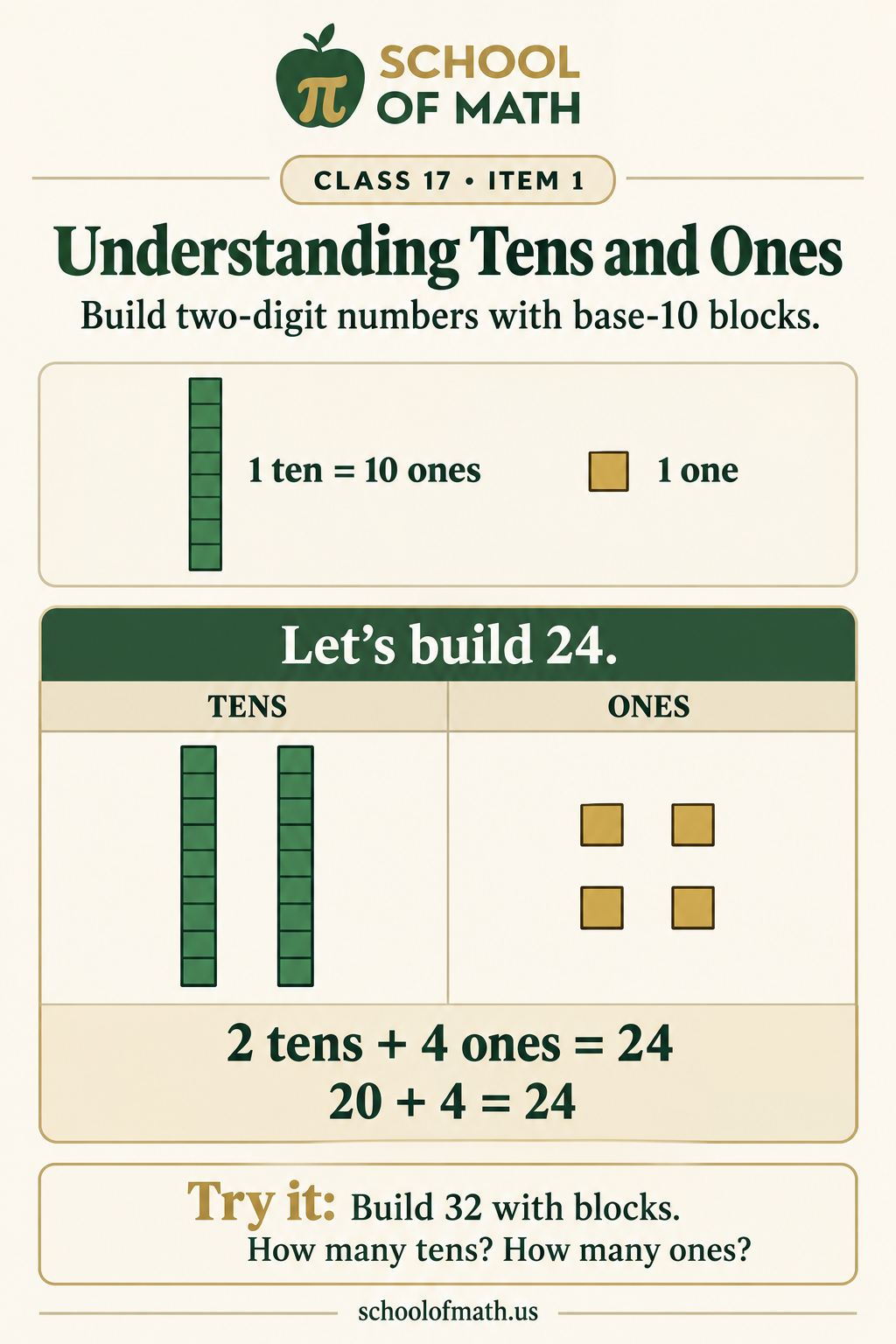
A tens rod represents ten ones, and a small cube represents one. The number of rods tells us how many tens we have; the number of loose cubes tells us how many ones we have. For example, 43 is 4 tens and 3 ones.
Different arrangements can have the same value. If there are ten or more loose cubes, exchange a group of ten cubes for a rod. Nothing is added or taken away: only the way we show the number changes.
Practice: try these five questions
Q1
A model has 4 tens rods and 3 ones cubes. What number does it show?
Answer
43
Four tens are 40. Add the 3 ones: 40 + 3 = 43.
Q2
Build 60 with tens rods and ones cubes. How many of each do you need?
Answer
6 tens rods and 0 ones cubes
Six tens make 60. There are no loose ones, so write 0 in the ones place.
Q3
Draw a base-10 model for 76. Explain what each digit means.
Answer
7 rods and 6 cubes
The 7 is in the tens place, so it represents 70. The 6 is in the ones place, so it represents 6. Together, 70 + 6 = 76.
Q4
A model has 5 tens rods and 13 loose cubes. What number is it, and how can you show it with fewer loose cubes?
Answer
63; 6 rods and 3 cubes
Five tens and 13 ones make 50 + 13 = 63. Exchange 10 of the cubes for one rod. You then have 6 rods and 3 loose cubes.
Q5
You use exactly 7 pieces: 5 tens rods and the rest ones cubes. What number have you built?
Answer
52
There are 7 − 5 = 2 cubes. Five rods are worth 50, not 5, so the value is 50 + 2 = 52.
Building addition problems
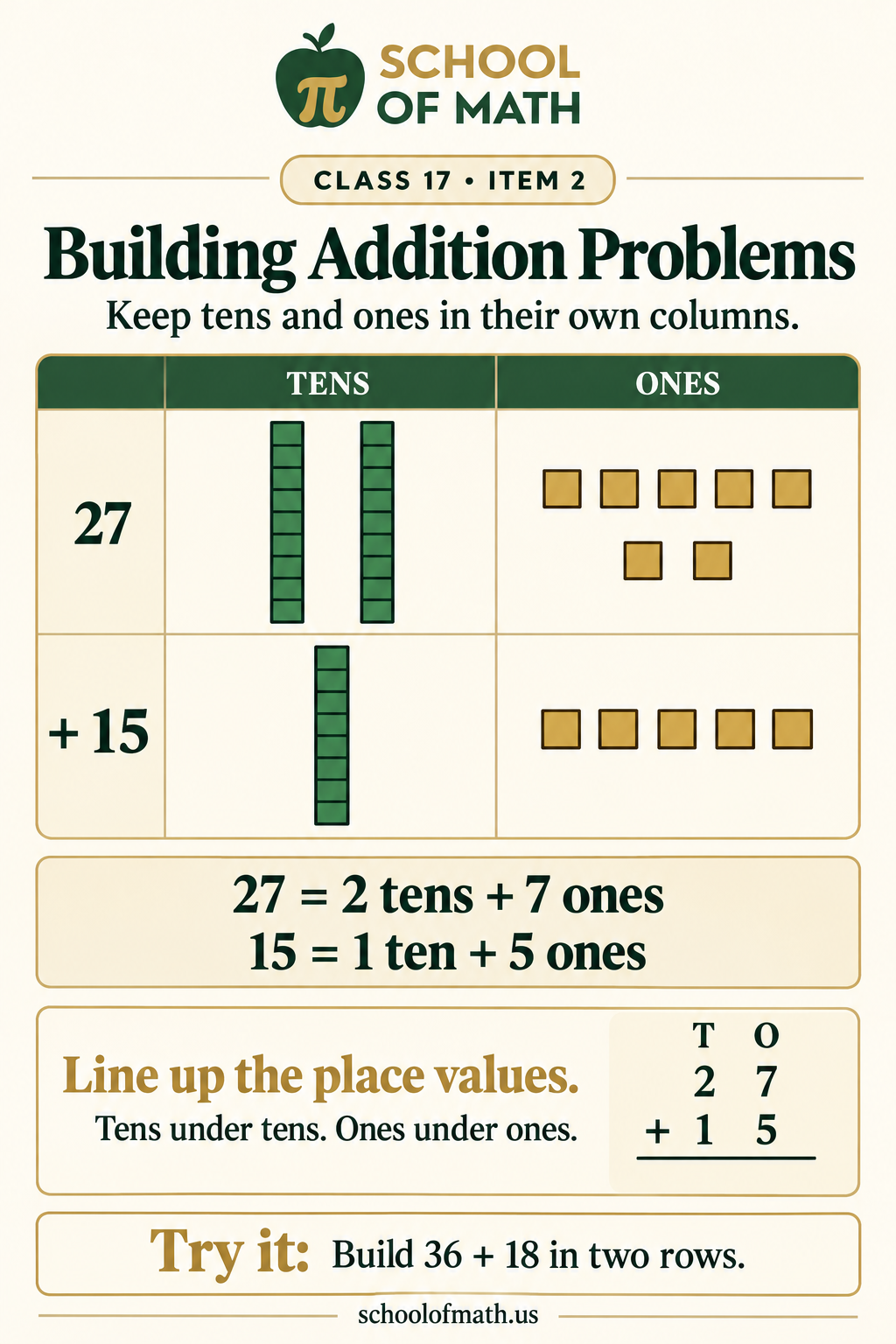
Build each addend in its own row. Put rods in the tens column and cubes in the ones column. In written addition, align tens under tens and ones under ones.
The plus sign asks us to combine the two amounts. Keeping the place values lined up helps us avoid treating tens as ones. You may prepare the model first and then combine the cubes and rods.
Practice: try these five questions
Q6
Build 21 + 34 in two rows. Tell how many rods and cubes belong in each row.
Answer
21: 2 rods and 1 cube; 34: 3 rods and 4 cubes
Split each number by place value: 21 = 20 + 1 and 34 = 30 + 4. Put both sets of rods in the tens column and both sets of cubes in the ones column.
Q7
Set up 32 + 45 in tens and ones columns, then find the total.
Answer
77
Add the ones: 2 + 5 = 7. Keep the 7 ones; no exchange is needed. Add the tens: 3 + 4 = 7 tens. The result is 7 tens and 7 ones, or 77. Check by counting the rods as tens and the cubes as ones.
Q8
For 44 + 28, how many rods and loose cubes are there altogether before you exchange any cubes?
Answer
6 rods and 12 cubes
Combine rods: 4 + 2 = 6. Combine cubes: 4 + 8 = 12. This is a correct unregrouped model; it represents 60 + 12 = 72.
Q9
Draw the two rows for 56 + 17, then combine and regroup.
Answer
73
Add the ones: 6 + 7 = 13. Exchange 10 ones for 1 ten, leaving 3 ones. Add the tens: 5 + 1 + 1 = 7 tens. The result is 7 tens and 3 ones, or 73. Check by counting the rods as tens and the cubes as ones.
Q10
For 61 + 18, a student puts the 8 underneath the 6 and the 1 underneath the 1. What is wrong? Show the correct setup and total.
Answer
The digits of 18 are reversed; the total is 79
The 1 in 18 means one ten, so it belongs under the 6 tens. The 8 ones belong under the 1 one. Then 1 + 8 = 9 ones and 6 + 1 = 7 tens, giving 79.
Adding the ones first
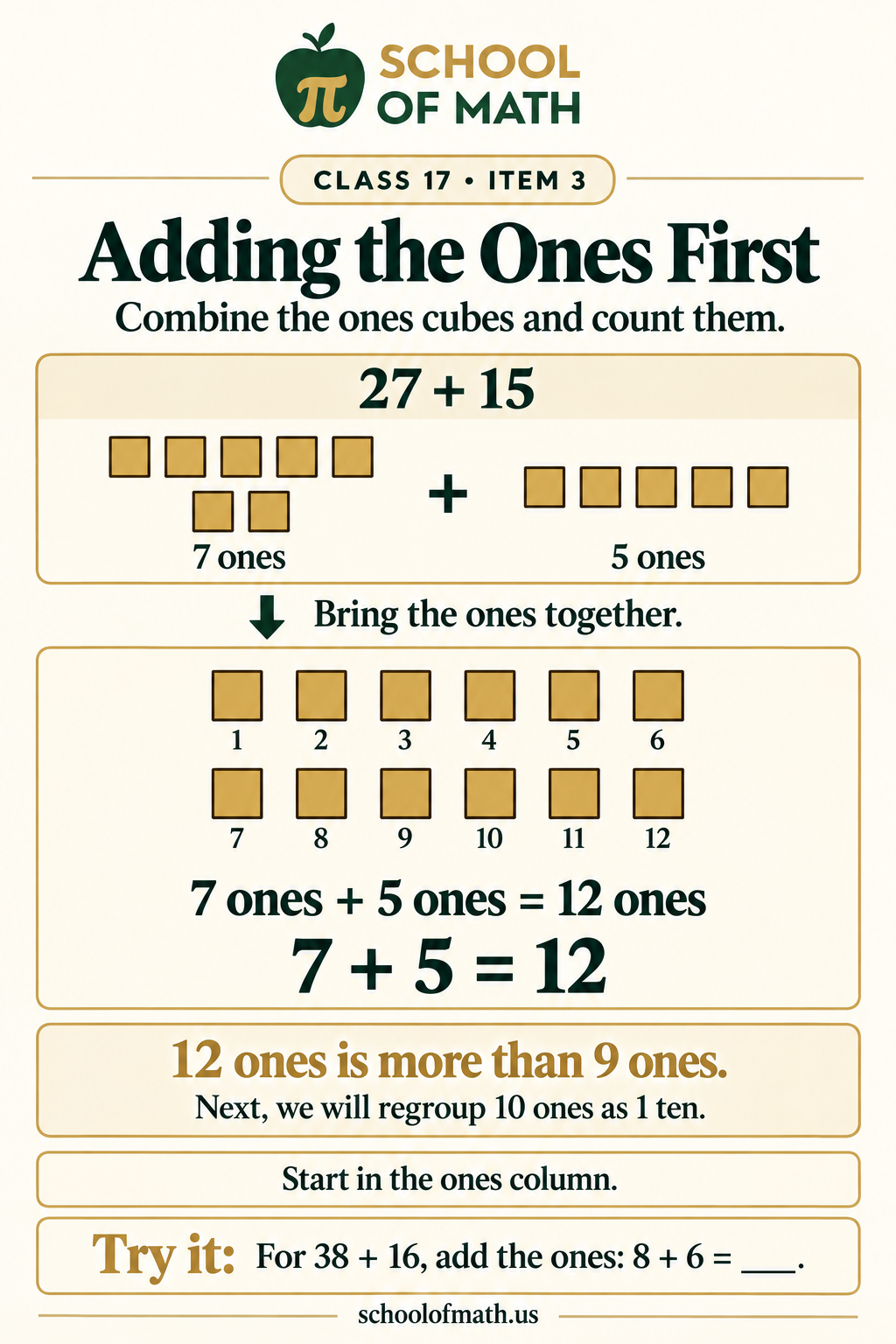
In this written method, start in the ones column. Combine only the ones cubes, not the tens rods. A ones total from 0 through 9 can stay in the ones column.
A ones total of 10 or more needs regrouping. Make one group of ten, move its value into the tens column, and leave the remaining loose cubes in the ones column. Adding the ones first helps us know whether a new ten is coming.
Practice: try these five questions
Q11
In 24 + 13, add only the ones. Will you need to regroup?
Answer
7 ones; no regrouping
The ones are 4 and 3. Since 4 + 3 = 7, fewer than ten cubes are present. Keep all 7 in the ones column.
Q12
In 25 + 16, add only the ones. Can they all remain as a single ones digit?
Answer
11 ones; no
The ones total is 5 + 6 = 11. A place-value digit cannot be 11. Exchange 10 ones for one ten and leave 1 one.
Q13
In 48 + 23, how many ones are there before regrouping, and how many remain afterward?
Answer
11 before; 1 afterward
Add 8 + 3 = 11. Ten cubes become a tens rod, so 11 − 10 = 1 cube remains.
Q14
In 57 + 26, explain why the ones digit of the answer will be 3 rather than 13.
Answer
Because 13 ones become 1 ten and 3 ones
Add 7 + 6 = 13. Record the 3 loose ones in the ones place and include the new ten when adding the tens. The value of 13 has not disappeared.
Q15
In 34 + 2□, which digit makes the ones add to exactly 10? What stays in the ones column?
Answer
□ = 6; 0 ones remain
We need 4 + □ = 10, so the missing digit is 6. All 10 cubes become one rod. Write 0 in the ones place; the full sum is 34 + 26 = 60.
Exchanging ten ones for one ten
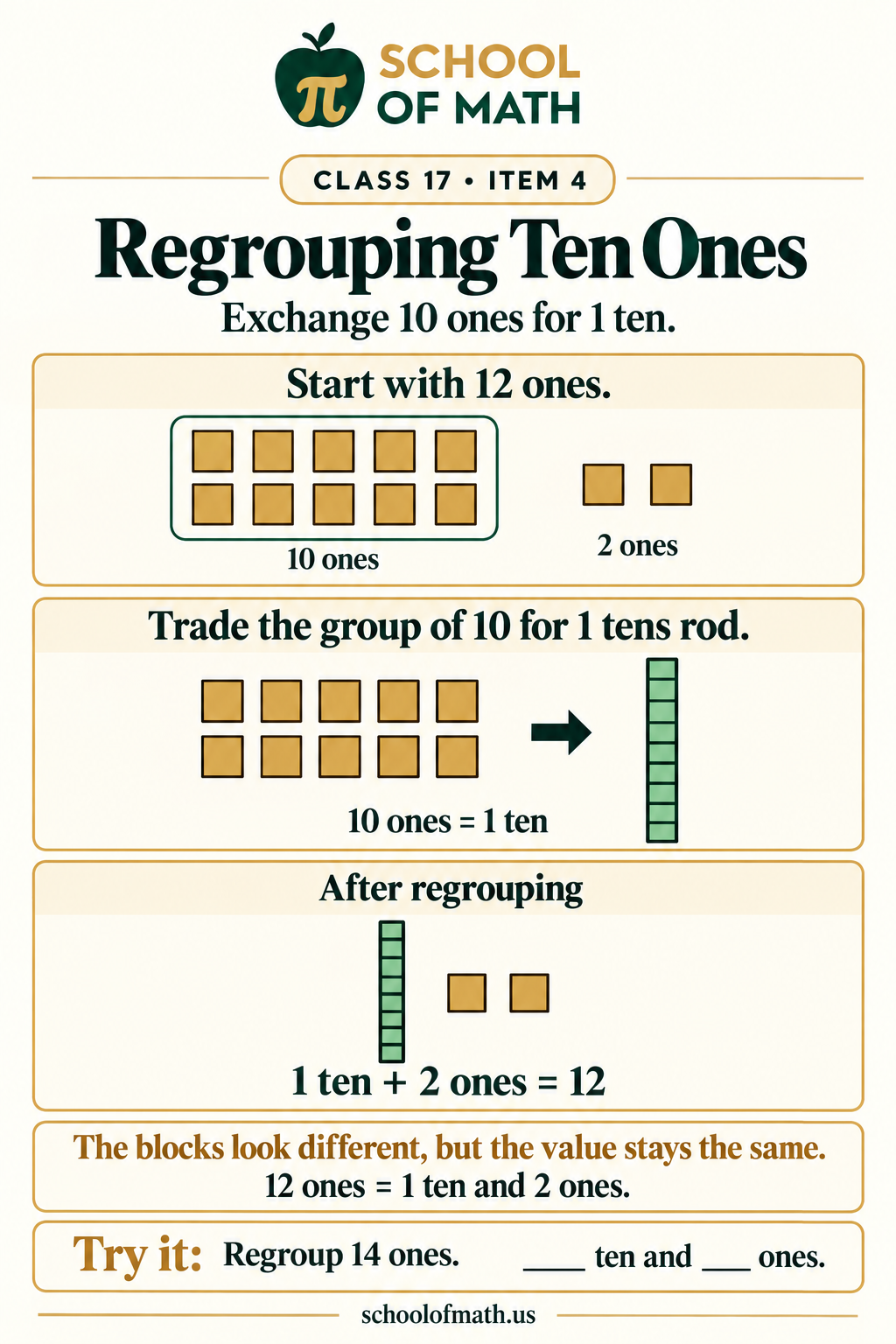
Regrouping is a fair exchange: ten ones have exactly the same value as one ten. Circle ten cubes, exchange them for one rod, and count the cubes left over.
Do not keep the ten exchanged cubes and also add a new rod. That would count the same ten twice. Keep the new rod, remove the exchanged cubes, and leave the other cubes alone.
Practice: try these five questions
Q16
Exchange 10 loose cubes for tens rods. How many rods and loose cubes do you have afterward?
Answer
1 rod and 0 loose cubes
All ten cubes are traded for one rod worth ten. No cubes are left outside the group. The value is still 10.
Q17
Regroup 13 ones into tens and ones.
Answer
1 ten and 3 ones
Make a group of 10 and exchange it for a rod. There are 13 − 10 = 3 loose cubes left. Thus 13 = 10 + 3.
Q18
Regroup 18 ones. Explain why you cannot make two tens.
Answer
1 ten and 8 ones
One group of ten leaves 8 cubes. Two tens would require 20 cubes, but there are only 18.
Q19
A model has 3 tens rods and 16 ones cubes. Regroup it and state its value.
Answer
4 tens and 6 ones; 46
Exchange 10 of the 16 cubes for one rod. Add that rod to the 3 original rods: 3 + 1 = 4. Six cubes remain, so the number is 46.
Q20
A model has 4 tens and 19 ones. A student trades 10 cubes for a rod but keeps all 19 cubes too. Explain the error and give the correct model.
Answer
Correct model: 5 tens and 9 ones, or 59
The ten cubes used in the exchange must be removed. Keeping them would count ten twice. Start with 40 + 19 = 59; after the exchange, 50 + 9 = 59.
Connecting regrouping to carrying
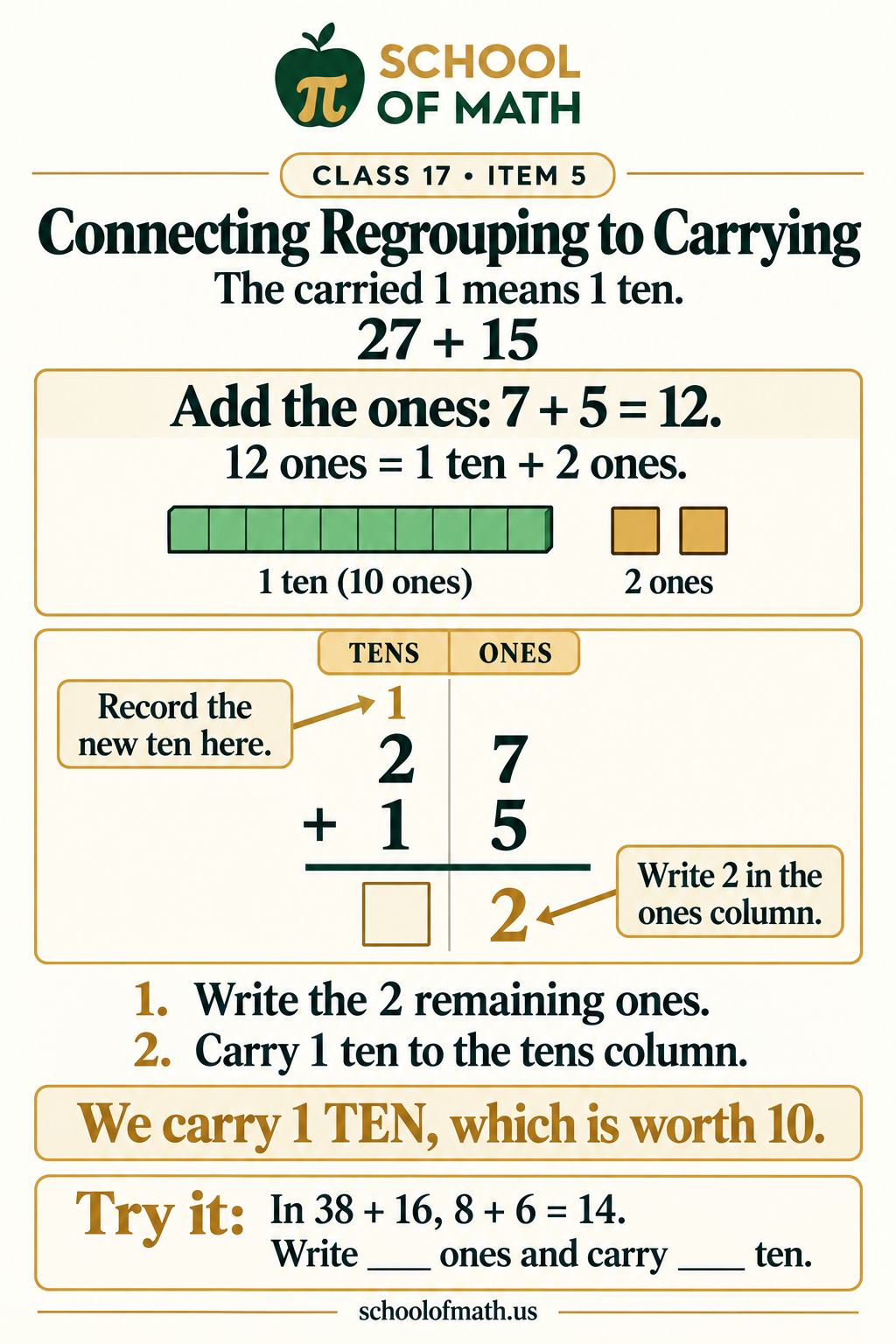
The small carried 1 is written above the tens column because it represents one new ten. It does not mean one extra loose cube. This is a written record of the exchange you made with the blocks.
Write the remaining ones in the answer and place the carried 1 above the tens. When you add the tens, include that carried ten exactly once. If no ones remain, write a zero in the ones place.
Practice: try these five questions
Q21
In 37 + 18, the ones add to 15. What does the carried 1 stand for?
Answer
1 ten, worth 10
The 15 ones are regrouped as 1 ten and 5 ones. The small 1 records the new tens rod; the 5 is written in the ones place.
Q22
In 48 + 17, what do you write in the answer’s ones place, and what do you carry?
Answer
Write 5 ones and carry 1 ten
The ones make 8 + 7 = 15. Exchange ten ones for a rod, leaving 5 cubes. Record 1 above the tens column and 5 below the ones column.
Q23
Solve 29 + 31. Explain why the answer needs a zero.
Answer
60
Add the ones: 9 + 1 = 10. Exchange 10 ones for 1 ten, leaving 0 ones. Add the tens: 2 + 3 + 1 = 6 tens. The result is 6 tens and 0 ones, or 60. Check by counting the rods as tens and the cubes as ones.
Q24
A student says 39 + 24 = 53 after writing 3 ones. Which step was missed? What is the correct sum?
Answer
The carried ten was missed; 63
Nine plus four gives 13 ones, or 1 ten and 3 ones. Add 3 tens + 2 tens + 1 carried ten = 6 tens. The correct answer is 63, ten more than 53.
Q25
In 46 + 2□, the ones leave 3 cubes after making one new ten. Find the missing digit and the sum.
Answer
□ = 7; the sum is 73
One new ten and 3 remaining ones mean the ones total is 13. Since 6 + □ = 13, □ = 7. Then 4 + 2 + 1 = 7 tens, so 46 + 27 = 73.
Adding all the tens
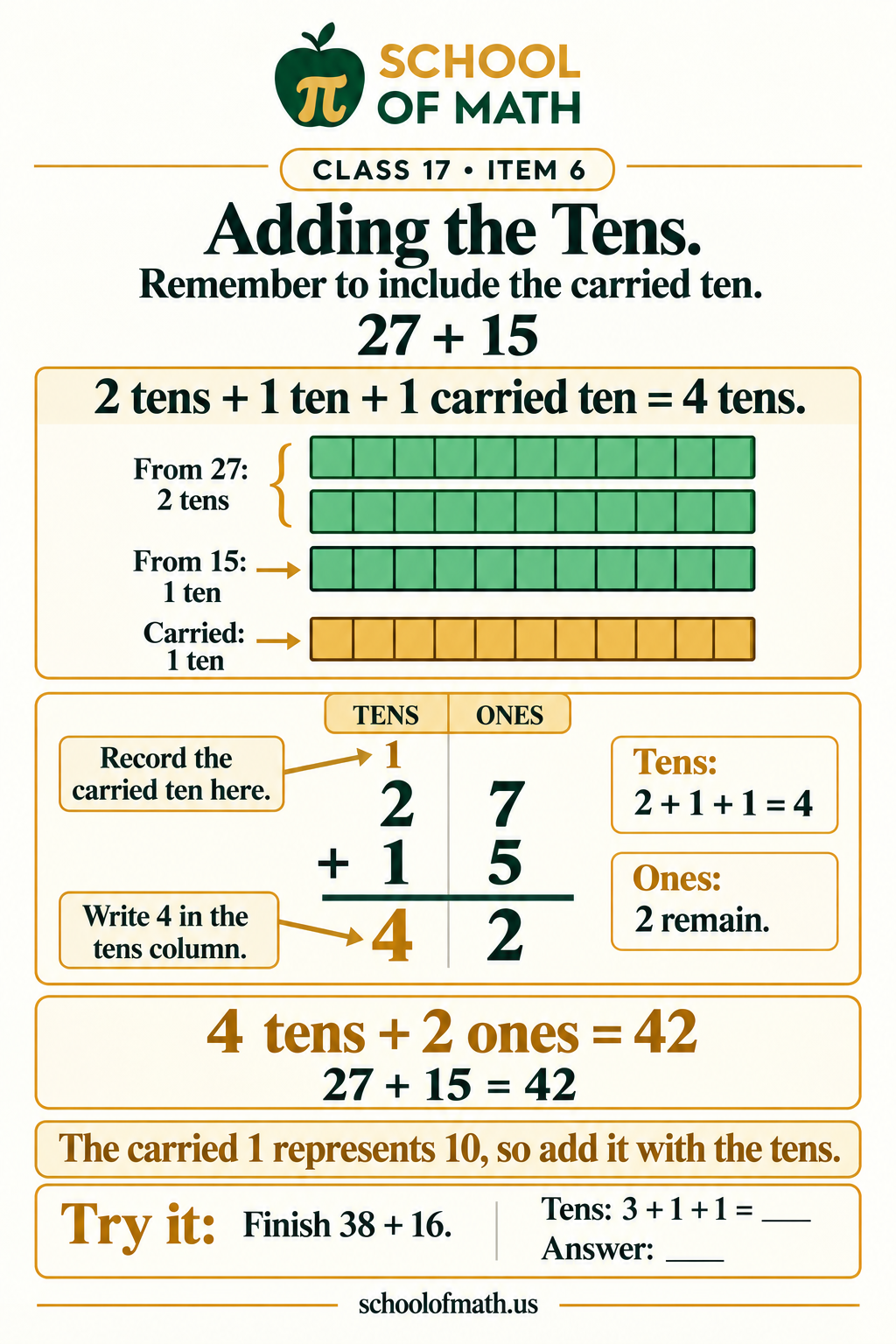
After regrouping the ones, add the original tens rods and the new rod. Each rod is one ten, so the answer to this step tells you the number of tens, not the number of loose cubes.
Finish by reading the tens and ones together. For instance, 7 tens and 3 ones make 73. Check that you have included every original rod and included the exchanged rod once.
Practice: try these five questions
Q26
There are 2 original tens in one row, 4 original tens in another, and 1 new ten from regrouping. If 3 ones remain, what is the total?
Answer
73
Count 2 + 4 + 1 = 7 rods. Seven rods are 70; 3 cubes are 3. The total is 70 + 3 = 73.
Q27
Solve 24 + 38. Name every ten you include.
Answer
62
Add the ones: 4 + 8 = 12. Exchange 10 ones for 1 ten, leaving 2 ones. Add the tens: 2 + 3 + 1 = 6 tens. The result is 6 tens and 2 ones, or 62. Check by counting the rods as tens and the cubes as ones.
Q28
Solve 47 + 25 and describe the final block model.
Answer
72
Add the ones: 7 + 5 = 12. Exchange 10 ones for 1 ten, leaving 2 ones. Add the tens: 4 + 2 + 1 = 7 tens. The result is 7 tens and 2 ones, or 72. Check by counting the rods as tens and the cubes as ones.
Q29
Solve 58 + 34. Explain why adding only 5 + 3 tens would not be enough.
Answer
92
Add the ones: 8 + 4 = 12. Exchange 10 ones for 1 ten, leaving 2 ones. Add the tens: 5 + 3 + 1 = 9 tens. The result is 9 tens and 2 ones, or 92. Check by counting the rods as tens and the cubes as ones.
Q30
Solve 68 + 12. How many tens and ones should the final model show?
Answer
80
Add the ones: 8 + 2 = 10. Exchange 10 ones for 1 ten, leaving 0 ones. Add the tens: 6 + 1 + 1 = 8 tens. The result is 8 tens and 0 ones, or 80. Check by counting the rods as tens and the cubes as ones.
Solving and checking a complete sum
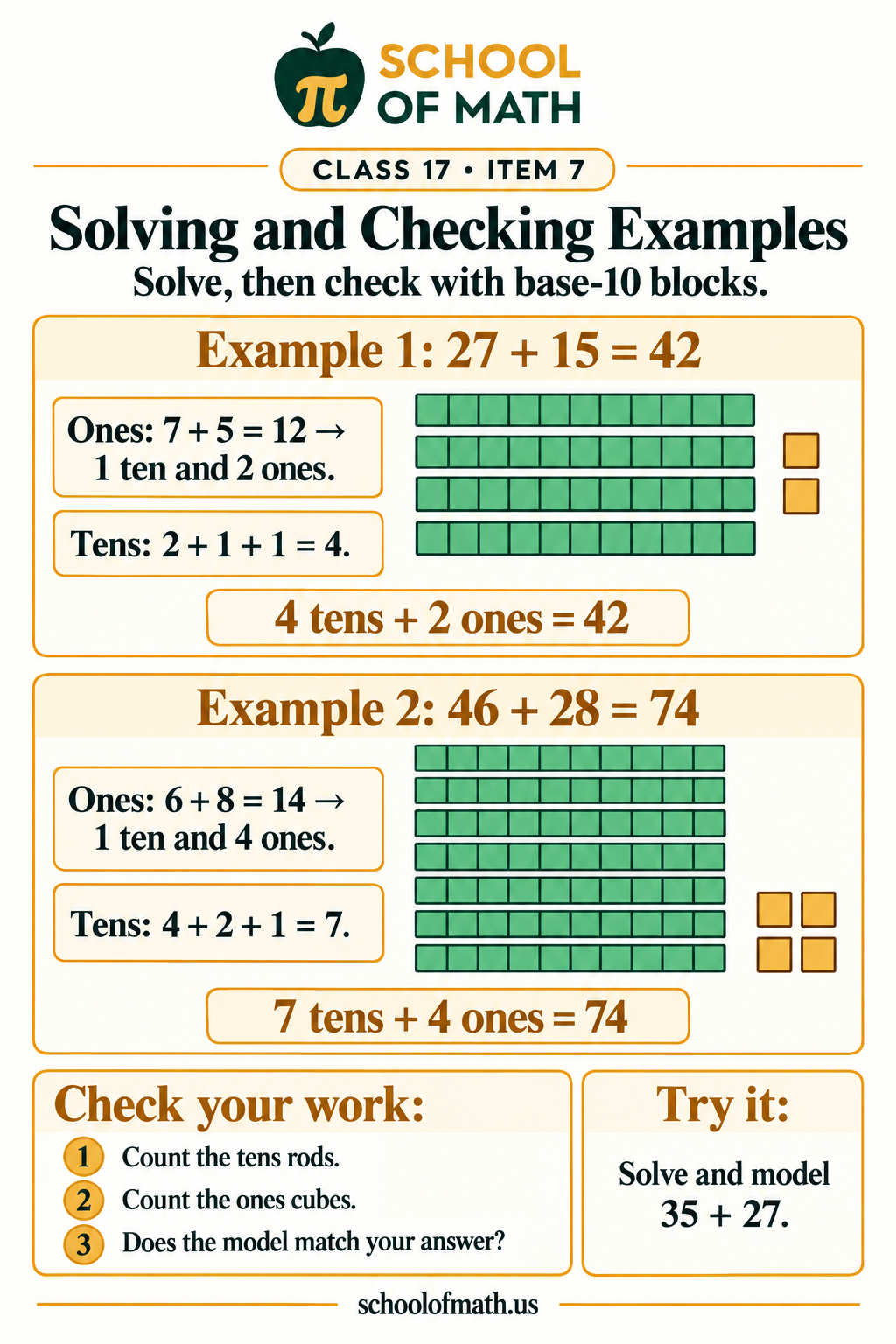
Use the whole routine: build the addends, combine the ones, exchange a group of ten when needed, and add all the tens. A model and a written calculation should tell the same story.
Check by counting the final rods in tens and then adding the loose ones. You can also break an addend into tens and ones and add those parts in a different order. If the checks disagree, look for an omitted or double-counted ten.
Practice: try these five questions
Q31
Solve 16 + 25 and check the answer with rods and cubes.
Answer
41
Add the ones: 6 + 5 = 11. Exchange 10 ones for 1 ten, leaving 1 ones. Add the tens: 1 + 2 + 1 = 4 tens. The result is 4 tens and 1 ones, or 41. Check by counting the rods as tens and the cubes as ones.
Q32
Solve 33 + 29. Check by adding 20 first, then 9.
Answer
62
Add the ones: 3 + 9 = 12. Exchange 10 ones for 1 ten, leaving 2 ones. Add the tens: 3 + 2 + 1 = 6 tens. The result is 6 tens and 2 ones, or 62. Check by counting the rods as tens and the cubes as ones. A second check is 33 + 20 = 53, then 53 + 9 = 62.
Q33
Solve 49 + 18. Check by adding 10 first, then 8.
Answer
67
Add the ones: 9 + 8 = 17. Exchange 10 ones for 1 ten, leaving 7 ones. Add the tens: 4 + 1 + 1 = 6 tens. The result is 6 tens and 7 ones, or 67. Check by counting the rods as tens and the cubes as ones. A second check is 49 + 10 = 59, then 59 + 8 = 67.
Q34
Solve 54 + 37. Explain how your model proves the sum.
Answer
91
Add the ones: 4 + 7 = 11. Exchange 10 ones for 1 ten, leaving 1 ones. Add the tens: 5 + 3 + 1 = 9 tens. The result is 9 tens and 1 ones, or 91. Check by counting the rods as tens and the cubes as ones.
Q35
A student writes 68 + 24 = 82. Use the ones exchange and the tens count to find and fix the error.
Answer
The correct sum is 92
The ones make 8 + 4 = 12, so 2 ones remain and one new ten is made. Add 6 + 2 + 1 = 9 tens. The incorrect answer 82 is missing the carried ten.
Regrouping in word problems
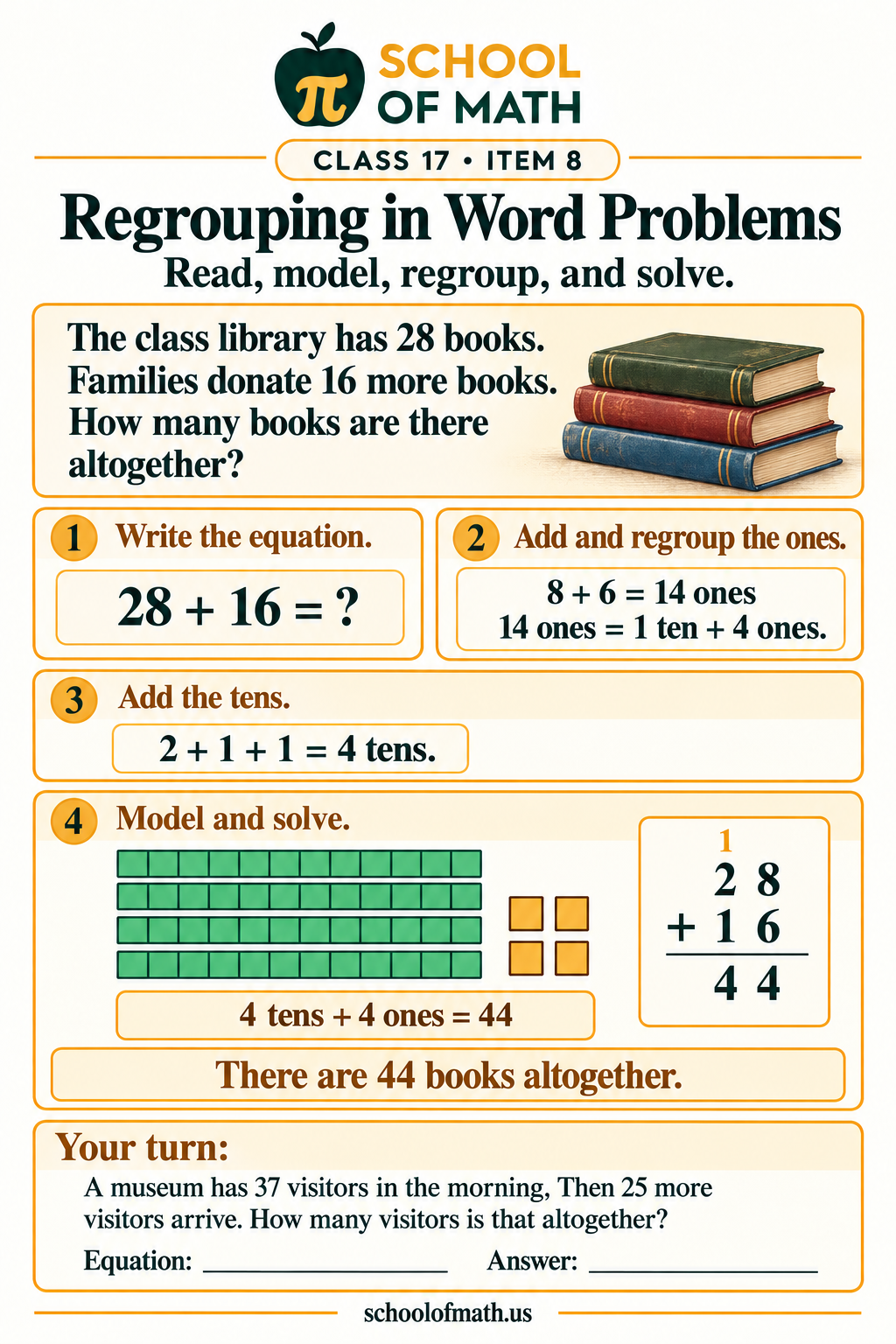
Read the story and decide what the numbers count. When two amounts are joined, write an addition equation. Use the same ones-exchange and tens-counting routine that you used with bare numbers.
Finish with a sentence and a unit such as books, beads, or tickets. For a question with two steps, explain what the first total means before using it in the next step. A drawing, spoken explanation, or block model can show your reasoning.
Practice: try these five questions
Q36
A tray holds 18 red counters and 14 blue counters. How many counters are on the tray?
Answer
32 counters
Add the ones: 8 + 4 = 12. Exchange 10 ones for 1 ten, leaving 2 ones. Add the tens: 1 + 1 + 1 = 3 tens. The result is 3 tens and 2 ones, or 32. Check by counting the rods as tens and the cubes as ones.
Q37
A class has 26 crayons. A family donates 19 more. How many crayons does the class have now?
Answer
45 crayons
Add the ones: 6 + 9 = 15. Exchange 10 ones for 1 ten, leaving 5 ones. Add the tens: 2 + 1 + 1 = 4 tens. The result is 4 tens and 5 ones, or 45. Check by counting the rods as tens and the cubes as ones.
Q38
A garden has 37 yellow flowers and 28 purple flowers. How many flowers are there altogether?
Answer
65 flowers
Add the ones: 7 + 8 = 15. Exchange 10 ones for 1 ten, leaving 5 ones. Add the tens: 3 + 2 + 1 = 6 tens. The result is 6 tens and 5 ones, or 65. Check by counting the rods as tens and the cubes as ones.
Q39
A school collects 46 cans in the morning and 39 in the afternoon. How many cans are collected in all?
Answer
85 cans
Add the ones: 6 + 9 = 15. Exchange 10 ones for 1 ten, leaving 5 ones. Add the tens: 4 + 3 + 1 = 8 tens. The result is 8 tens and 5 ones, or 85. Check by counting the rods as tens and the cubes as ones.
Q40
A reading club earns 48 points on Monday and 27 on Tuesday. Its goal is 80 points. How many points has it earned, and how many more does it need?
Answer
75 earned; 5 more needed
Add the ones: 8 + 7 = 15. Exchange 10 ones for 1 ten, leaving 5 ones. Add the tens: 4 + 2 + 1 = 7 tens. The result is 7 tens and 5 ones, or 75. Check by counting the rods as tens and the cubes as ones. The club has 75 points. Count on from 75 to 80: five more points reach the goal.
Homework review
These eight questions revisit the eight ideas in this lesson. Use a drawing or blocks to explain your thinking, and keep the answers closed until you have tried.
R1
Build 64 with base-10 blocks. State the value of each digit.
Answer
6 tens and 4 ones
The 6 means 60, and the 4 means 4. Six rods and four cubes show 60 + 4 = 64.
R2
Set up 31 + 26 in two rows. What goes in the tens column and the ones column?
Answer
Tens: 3 and 2; ones: 1 and 6
Align each place value with the same place below it. Three rods and one cube represent 31; two rods and six cubes represent 26. The total is 57.
R3
For 39 + 13, add just the ones and describe the exchange.
Answer
12 ones become 1 ten and 2 ones
The ones are 9 and 3, so 9 + 3 = 12. Exchange ten cubes for one rod and leave two cubes.
R4
Regroup 4 tens and 15 ones. What number is represented?
Answer
5 tens and 5 ones; 55
Fifteen ones become one ten and five ones. The new ten joins the original four tens, giving 50 + 5 = 55.
R5
In 58 + 13, what does the carried 1 mean, and where does it belong?
Answer
One ten; above the tens column
Eight plus three is 11 ones. Ten of those ones become a tens rod. The carried 1 records that ten, and the remaining one stays in the ones place.
R6
Solve 26 + 37. Show the original tens and the carried ten separately.
Answer
63
Add the ones: 6 + 7 = 13. Exchange 10 ones for 1 ten, leaving 3 ones. Add the tens: 2 + 3 + 1 = 6 tens. The result is 6 tens and 3 ones, or 63. Check by counting the rods as tens and the cubes as ones.
R7
Solve 65 + 18, then describe a block model that checks your answer.
Answer
83
Add the ones: 5 + 8 = 13. Exchange 10 ones for 1 ten, leaving 3 ones. Add the tens: 6 + 1 + 1 = 8 tens. The result is 8 tens and 3 ones, or 83. Check by counting the rods as tens and the cubes as ones.
R8
A shelf has 47 books. A teacher adds 16 more. How many books are on the shelf now?
Answer
63 books
Add the ones: 7 + 6 = 13. Exchange 10 ones for 1 ten, leaving 3 ones. Add the tens: 4 + 1 + 1 = 6 tens. The result is 6 tens and 3 ones, or 63. Check by counting the rods as tens and the cubes as ones.
Homework word problems
Work from the easier stories toward the two-step challenges. Write an equation, explain each exchange of ten ones, and answer in a sentence with the correct unit.
W1
Lena has 17 stickers. Her friend gives her 15 more. How many stickers does Lena have now?
Answer
32 stickers
Add the ones: 7 + 5 = 12. Exchange 10 ones for 1 ten, leaving 2 ones. Add the tens: 1 + 1 + 1 = 3 tens. The result is 3 tens and 2 ones, or 32. Check by counting the rods as tens and the cubes as ones.
W2
A basket contains 24 apples and 19 pears. How many pieces of fruit are in the basket?
Answer
43 pieces of fruit
Add the ones: 4 + 9 = 13. Exchange 10 ones for 1 ten, leaving 3 ones. Add the tens: 2 + 1 + 1 = 4 tens. The result is 4 tens and 3 ones, or 43. Check by counting the rods as tens and the cubes as ones.
W3
A class makes 36 paper stars on Monday and 17 on Tuesday. How many stars does it make altogether?
Answer
53 stars
Add the ones: 6 + 7 = 13. Exchange 10 ones for 1 ten, leaving 3 ones. Add the tens: 3 + 1 + 1 = 5 tens. The result is 5 tens and 3 ones, or 53. Check by counting the rods as tens and the cubes as ones.
W4
A library shelf holds 45 storybooks and 28 fact books. How many books are on the shelf?
Answer
73 books
Add the ones: 5 + 8 = 13. Exchange 10 ones for 1 ten, leaving 3 ones. Add the tens: 4 + 2 + 1 = 7 tens. The result is 7 tens and 3 ones, or 73. Check by counting the rods as tens and the cubes as ones.
W5
A team collects 56 bottle caps. Another team adds 27 caps to the collection. How many caps are collected in all?
Answer
83 bottle caps
Add the ones: 6 + 7 = 13. Exchange 10 ones for 1 ten, leaving 3 ones. Add the tens: 5 + 2 + 1 = 8 tens. The result is 8 tens and 3 ones, or 83. Check by counting the rods as tens and the cubes as ones.
W6
A bus has 75 seats. There are 38 children and 24 adults on the bus. How many people are aboard, and how many seats are empty?
Answer
62 people; 13 empty seats
Add the ones: 8 + 4 = 12. Exchange 10 ones for 1 ten, leaving 2 ones. Add the tens: 3 + 2 + 1 = 6 tens. The result is 6 tens and 2 ones, or 62. Check by counting the rods as tens and the cubes as ones. There are 62 people. Count from 62 to 72 (10 seats), then to 75 (3 more): 13 seats are empty.
W7
A class sells 29 tickets before lunch and 46 after lunch. Its goal is 80 tickets. How many tickets has it sold, and how many more are needed?
Answer
75 sold; 5 more needed
Add the ones: 9 + 6 = 15. Exchange 10 ones for 1 ten, leaving 5 ones. Add the tens: 2 + 4 + 1 = 7 tens. The result is 7 tens and 5 ones, or 75. Check by counting the rods as tens and the cubes as ones. The class has sold 75 tickets. Five more reach 80.
W8
Three jars hold 16, 27, and 18 marbles. How many marbles are there altogether?
Answer
61 marbles
Add the ones: 6 + 7 = 13. Exchange 10 ones for 1 ten, leaving 3 ones. Add the tens: 1 + 2 + 1 = 4 tens. The result is 4 tens and 3 ones, or 43. Check by counting the rods as tens and the cubes as ones. First combine the first two jars to get 43 marbles. Add the ones: 3 + 8 = 11. Exchange 10 ones for 1 ten, leaving 1 ones. Add the tens: 4 + 1 + 1 = 6 tens. The result is 6 tens and 1 ones, or 61. Check by counting the rods as tens and the cubes as ones. All three jars contain 61 marbles.
W9
A museum admits 24 visitors in the morning, 18 at midday, and 29 in the afternoon. How many visitors arrive during the day?
Answer
71 visitors
Add the ones: 4 + 8 = 12. Exchange 10 ones for 1 ten, leaving 2 ones. Add the tens: 2 + 1 + 1 = 4 tens. The result is 4 tens and 2 ones, or 42. Check by counting the rods as tens and the cubes as ones. The first two groups total 42 visitors. Add the ones: 2 + 9 = 11. Exchange 10 ones for 1 ten, leaving 1 ones. Add the tens: 4 + 2 + 1 = 7 tens. The result is 7 tens and 1 ones, or 71. Check by counting the rods as tens and the cubes as ones. There are 71 visitors altogether.
W10
A class collects 47 pencils and then receives 26 donated pencils. Later it finds another box of 18 pencils. How many pencils does it have altogether?
Answer
91 pencils
Add the ones: 7 + 6 = 13. Exchange 10 ones for 1 ten, leaving 3 ones. Add the tens: 4 + 2 + 1 = 7 tens. The result is 7 tens and 3 ones, or 73. Check by counting the rods as tens and the cubes as ones. After the donation there are 73 pencils. Add the ones: 3 + 8 = 11. Exchange 10 ones for 1 ten, leaving 1 ones. Add the tens: 7 + 1 + 1 = 9 tens. The result is 9 tens and 1 ones, or 91. Check by counting the rods as tens and the cubes as ones. The final total is 91 pencils.
W11
Three children have 27, 18, and 26 beads. They combine all their beads. Find the total and describe the regrouping in both additions.
Answer
71 beads
Add the ones: 7 + 8 = 15. Exchange 10 ones for 1 ten, leaving 5 ones. Add the tens: 2 + 1 + 1 = 4 tens. The result is 4 tens and 5 ones, or 45. Check by counting the rods as tens and the cubes as ones. The first two amounts make 45 beads. Add the ones: 5 + 6 = 11. Exchange 10 ones for 1 ten, leaving 1 ones. Add the tens: 4 + 2 + 1 = 7 tens. The result is 7 tens and 1 ones, or 71. Check by counting the rods as tens and the cubes as ones. Both additions require an exchange of ten ones. The final total is 71 beads.
W12
A school needs 90 cups for a celebration. It has one box of 35 cups and another of 28 cups. How many cups does it already have, and how many more must it get?
Answer
63 cups already; 27 more needed
Add the ones: 5 + 8 = 13. Exchange 10 ones for 1 ten, leaving 3 ones. Add the tens: 3 + 2 + 1 = 6 tens. The result is 6 tens and 3 ones, or 63. Check by counting the rods as tens and the cubes as ones. There are 63 cups. Count on: 63 to 70 needs 7, and 70 to 90 needs 20. So 7 + 20 = 27 more cups are needed. Check: 63 + 27 = 90.
Quick questions and answers
What does regrouping mean?
Regrouping means showing the same amount in a different place-value form. In this lesson, ten ones are exchanged for one ten. The value stays the same.
Why do we add the ones first?
In the written carrying method, adding the ones first tells us whether a new ten needs to join the tens column. Other addition methods can start with tens, but they must still account for all the ones and any exchange.
What does the carried 1 represent?
It represents one ten, worth ten ones. It is written above the tens column because it belongs with the tens, not the loose ones.
When is regrouping needed?
Regroup the ones when their total is ten or more. If the ones total is less than ten, keep those ones and do not carry a new ten.
What if exactly ten ones are made?
Exchange all ten ones for a tens rod and write zero in the ones place. The zero shows that no loose ones remain.
Does a student need to attend an earlier class first?
No. This is a self-contained Little Newtons lesson in a rolling rotation. It introduces the tens-and-ones ideas needed here; class numbers identify topics, not attendance prerequisites.
What practice and homework are included?
There are eight supplied teaching images, forty original practice questions, eight Homework review questions, and twelve Homework word problems. All sixty questions have hidden worked explanations. The 22-page student workbook contains the supplied PDF-only cover, eight teaching images, and the same sixty questions with blank answer space and no exercise solutions.