Pre-Algebra · Grades 5–8 · Foundational Math
Pre-Algebra in 6 Concepts: Whole Numbers, Operations, Properties, Factors, Integers & Equivalent Fractions
The whole pre-algebra foundation on one page. Six SOMATH posters walk through the six concepts every middle-school student needs to master before algebra. Under each poster you’ll find the full theory expanded from the poster and 10 practice questions with click-to-reveal solutions — 60 questions total, plus a free class-pack PDF and a teacher answer key.
What’s in this class
1. Whole Numbers & Place Value
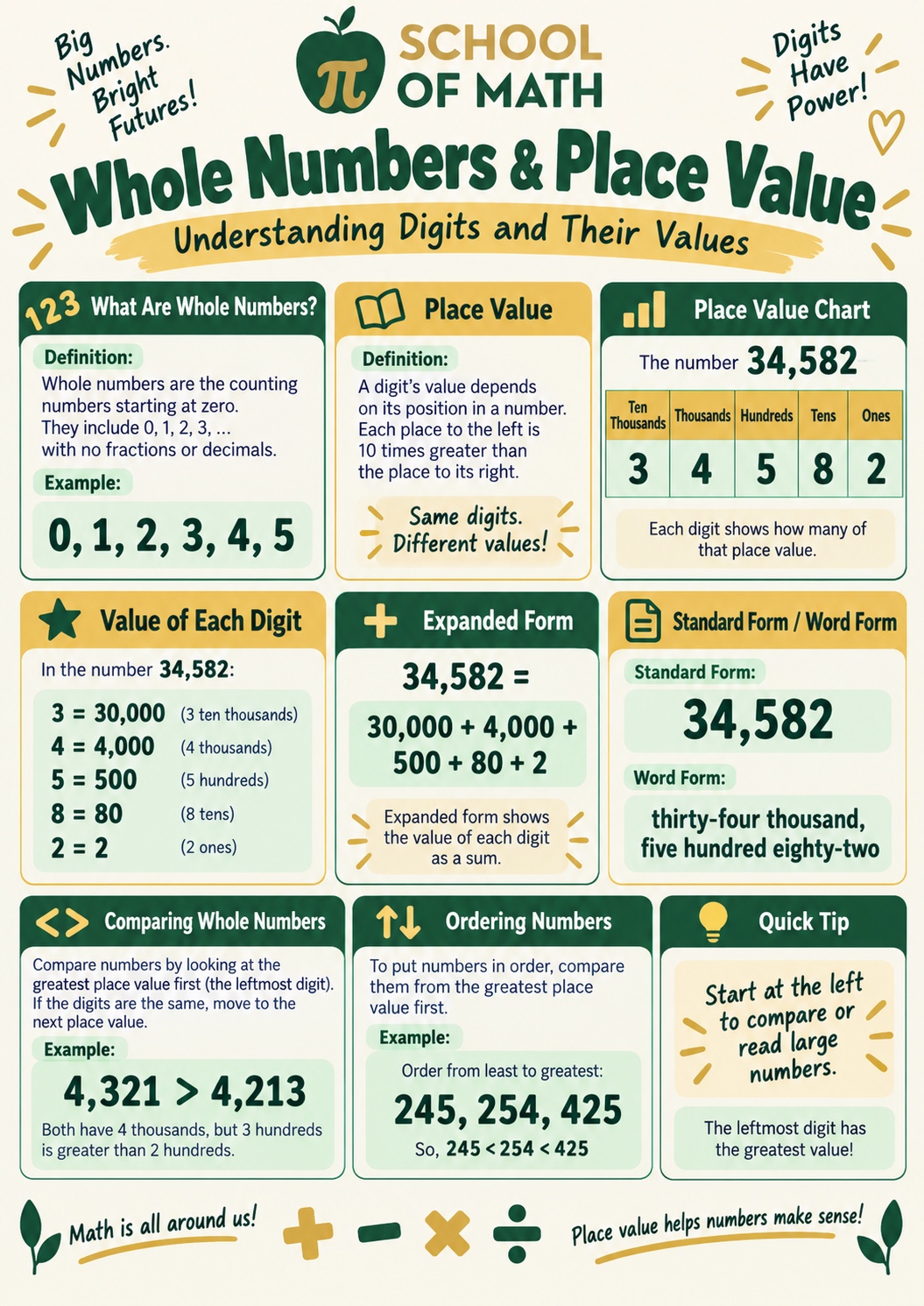
Place value tells us what a digit is worth based on its position. In 34,582 the 5 means 500, not 5.
What are whole numbers?
The whole numbers are the counting numbers starting at zero: 0, 1, 2, 3, 4, 5, …. Whole numbers have no fractions, decimals, or negatives.
Place value
The place value of a digit depends on where it sits in the number. Each place to the left is 10 times greater than the place to its right. In 522, the two 2s are not the same — one is 2 tens (20), the other is 2 ones (2).
Place value chart for 34,582
| Ten Thousands | Thousands | Hundreds | Tens | Ones |
|---|---|---|---|---|
| 3 | 4 | 5 | 8 | 2 |
Standard, expanded, and word form
- Standard form: 34,582
- Expanded form: 30,000 + 4,000 + 500 + 80 + 2
- Word form: thirty-four thousand, five hundred eighty-two
Comparing and ordering
Compare from the leftmost place first. If those digits match, move one place right. Example: 4,321 > 4,213 because both have 4 thousands, but 3 hundreds > 2 hundreds. Ordering least → greatest: 245 < 254 < 425.
10 Practice Questions — Whole Numbers & Place Value
2. Operations with Whole Numbers
Every whole-number algorithm is the same idea: line up place values and operate one column at a time.
The four operations, one place-value system
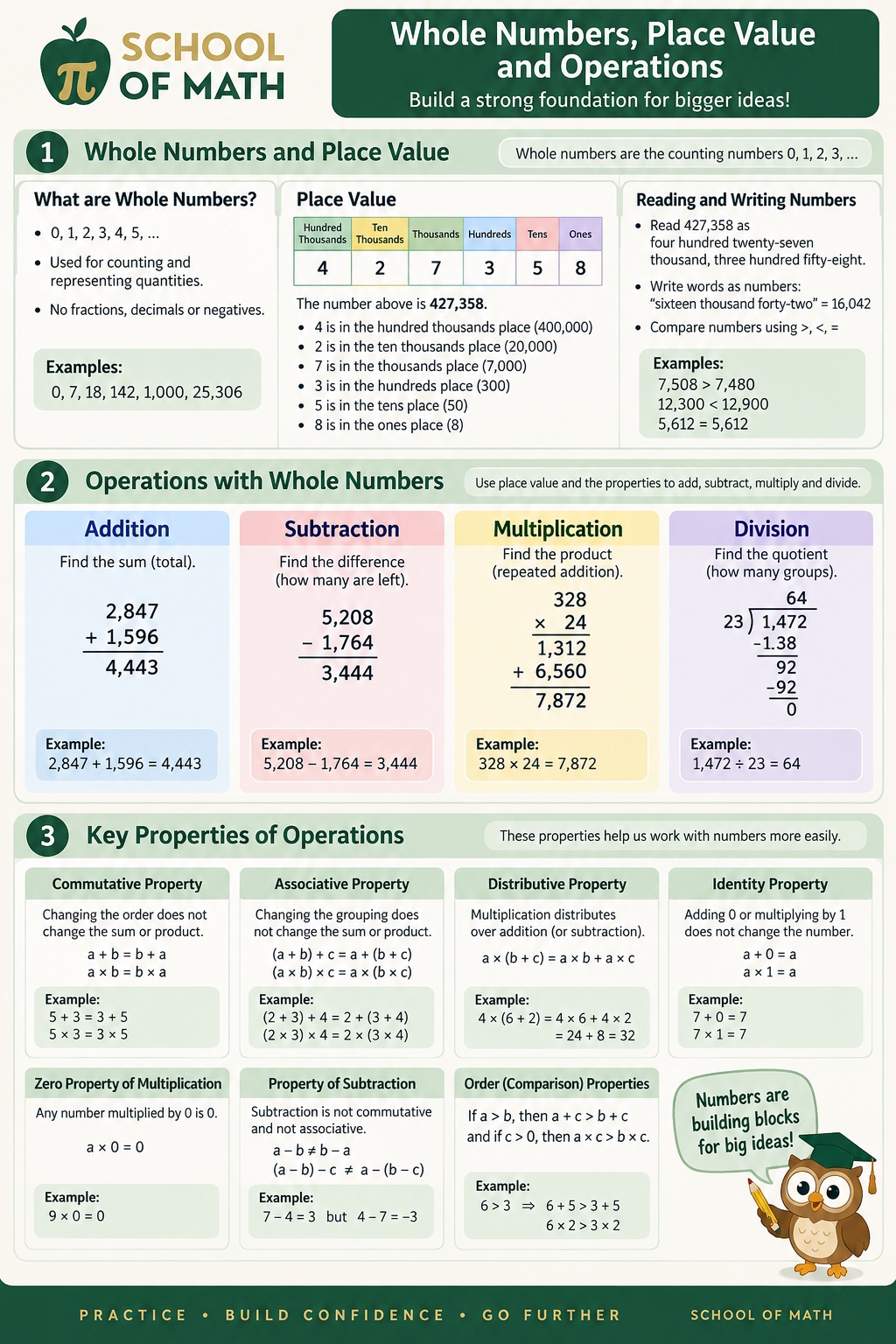
Every whole-number algorithm is really place value + the properties: line up ones under ones, tens under tens, and operate one column at a time.
Addition — find the sum
Add each column right to left. If a column total is 10 or more, carry 1. Example: 2,847 + 1,596 = 4,443.
Subtraction — find the difference
Subtract right to left. If the top digit is smaller, borrow 1 from the next place. Example: 5,208 − 1,764 = 3,444.
Multiplication — find the product
Multiplying by n is adding n times. Multi-digit: multiply by each digit, shift each partial product one place left, then add. Example: 328 × 24 = 7,872 (328×4 = 1,312; 328×20 = 6,560; sum 7,872).
Division — find the quotient
How many times does the divisor fit? Long division: divide, multiply, subtract, bring down. Example: 1,472 ÷ 23 = 64.
10 Practice Questions — Operations with Whole Numbers
3. Number Properties
Commutative, associative, distributive, identity, inverse, and zero properties are the shortcuts you already use — named.
Closure
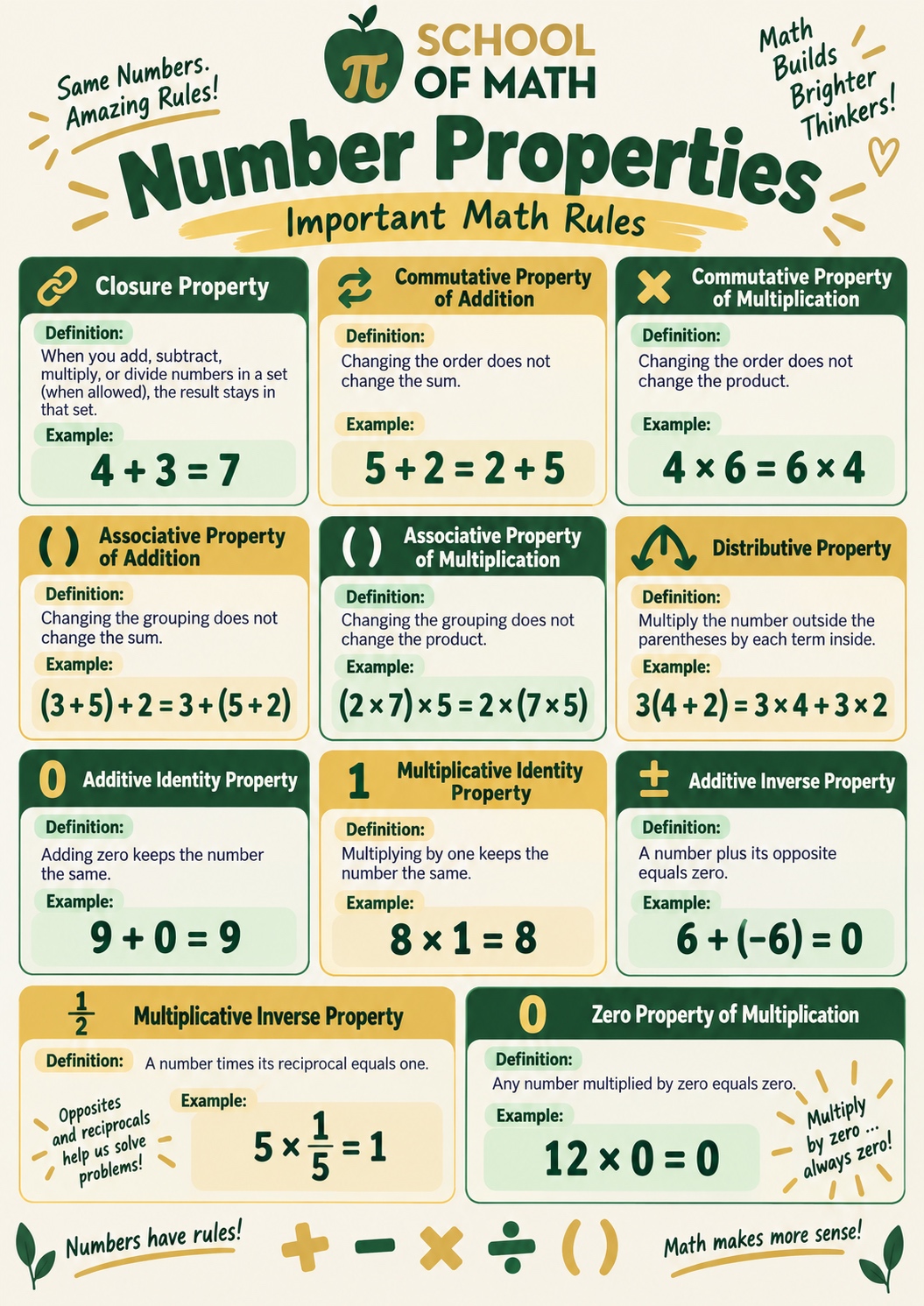
Add, subtract, multiply, or divide numbers in a set (when allowed) and the result stays in that set.
Commutative Property
Order doesn’t matter for + and ×: a + b = b + a, a × b = b × a. It does matter for subtraction and division.
Associative Property
Grouping doesn’t matter for + and ×: (3 + 5) + 2 = 3 + (5 + 2), (2 × 7) × 5 = 2 × (7 × 5).
Distributive Property
a × (b + c) = a×b + a×c. Example: 3(4 + 2) = 12 + 6 = 18. This is the property that makes mental math and algebra work.
Identity Properties
Additive identity: a + 0 = a. Multiplicative identity: a × 1 = a.
Inverse Properties
Additive inverse (opposite): a + (−a) = 0. Multiplicative inverse (reciprocal): a × (1/a) = 1 for a ≠ 0.
Zero Property of Multiplication
Any number times 0 equals 0: a × 0 = 0.
10 Practice Questions — Number Properties
4. Factors and Multiples
Factors divide a number exactly; multiples are products of it. GCF simplifies fractions; LCM adds them.
Factors
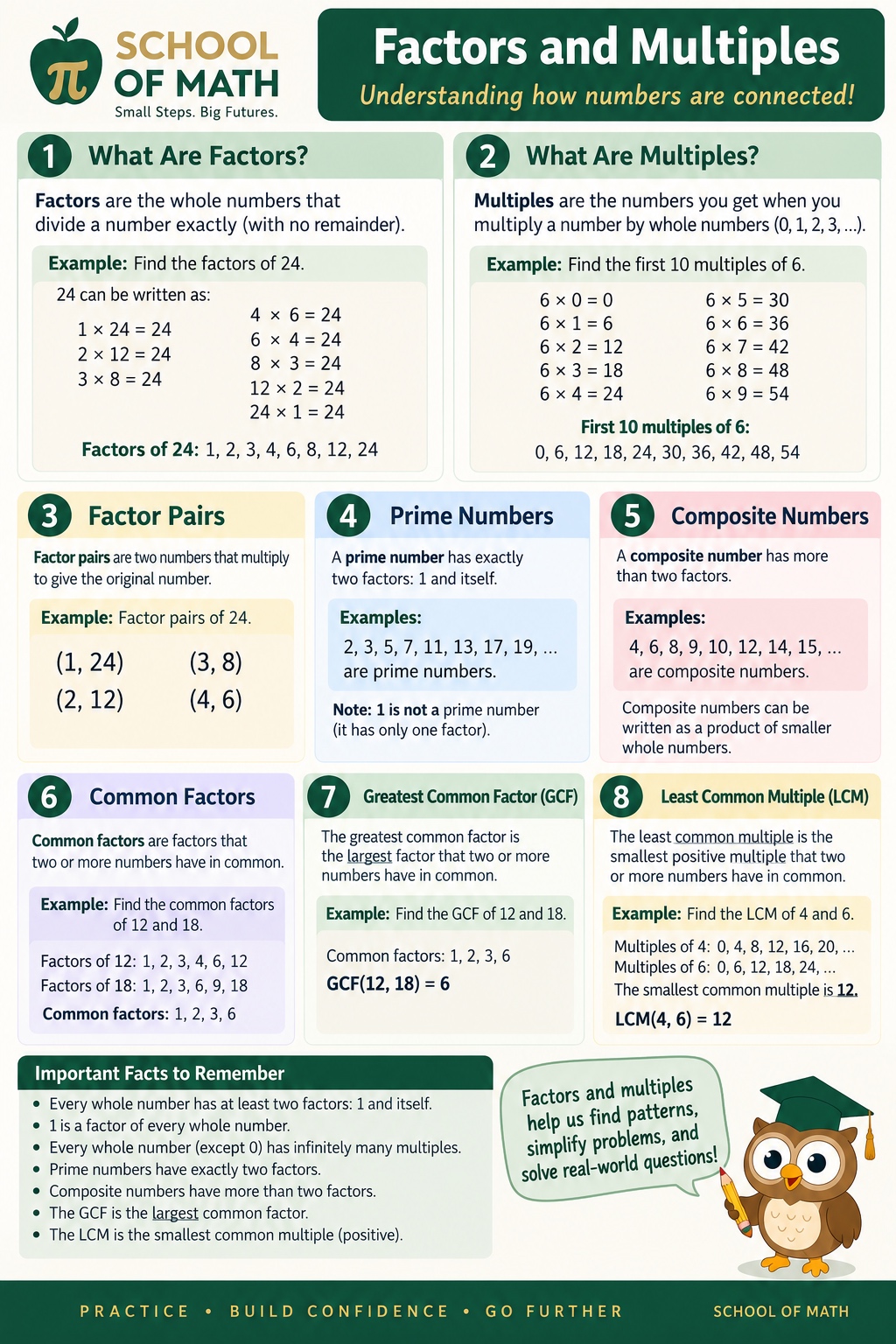
Factors of a number divide it exactly (no remainder). Factors of 24: 1, 2, 3, 4, 6, 8, 12, 24.
Multiples
Multiples of a number are what you get by multiplying it by 0, 1, 2, 3, .... First 10 multiples of 6: 0, 6, 12, 18, 24, 30, 36, 42, 48, 54.
Factor pairs
Two whole numbers whose product is the original number. Factor pairs of 24: (1, 24), (2, 12), (3, 8), (4, 6).
Prime vs composite
- Prime: exactly two factors — 1 and itself. Examples: 2, 3, 5, 7, 11, 13, 17, 19.
- Composite: more than two factors. Examples: 4, 6, 8, 9, 10, 12.
- 1 is not prime (only one factor).
GCF — Greatest Common Factor
The largest factor two or more numbers share. GCF(12, 18) = 6. Use it to simplify fractions.
LCM — Least Common Multiple
The smallest positive multiple two or more numbers share. LCM(4, 6) = 12. Use it to add fractions with unlike denominators.
10 Practice Questions — Factors and Multiples
5. Integers
Integers are whole numbers and their opposites. Same signs behave one way; different signs the other.
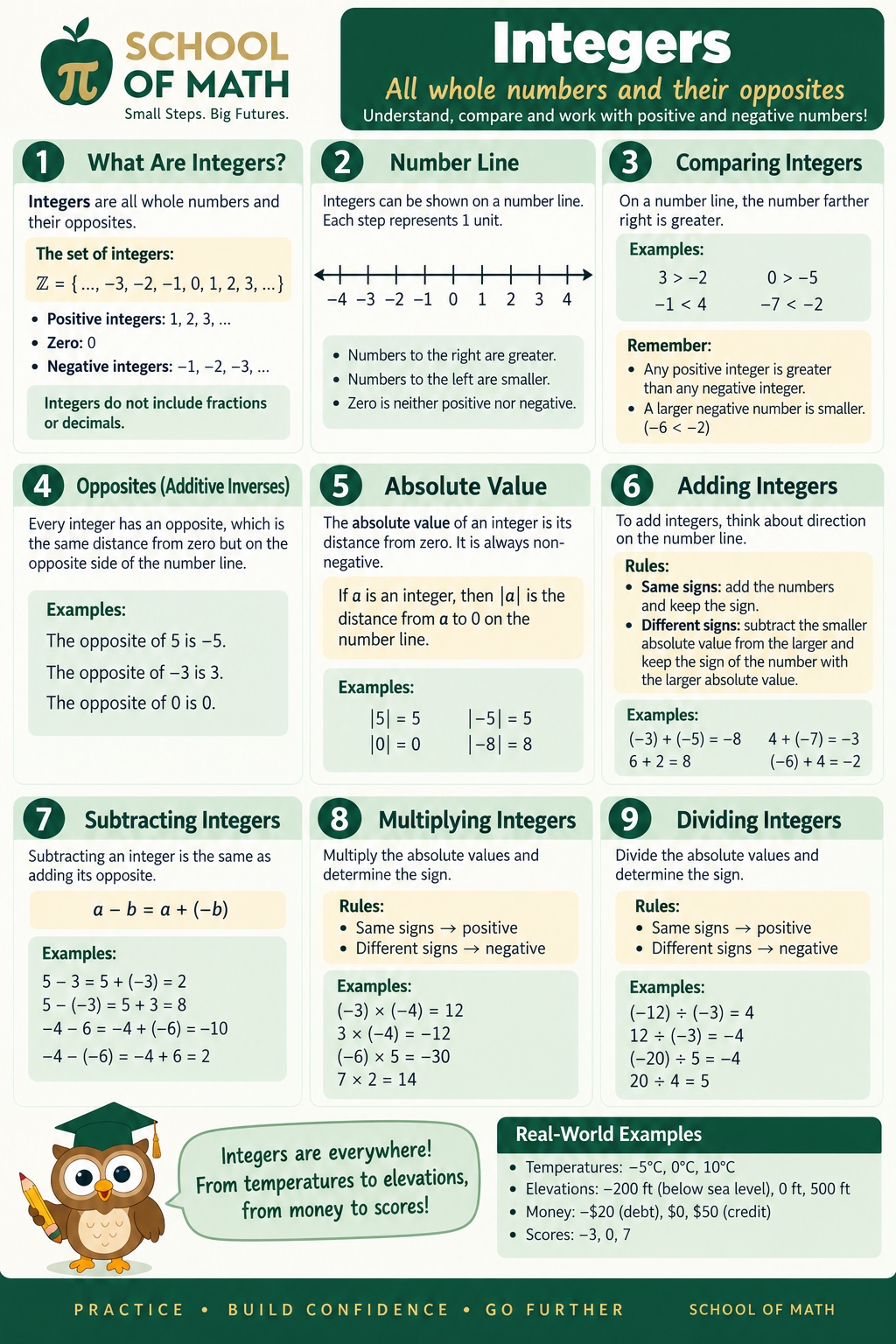
The set of integers
ℤ = {..., −3, −2, −1, 0, 1, 2, 3, ...}. Positive integers, zero, and negative integers. No fractions or decimals.
Number line and comparing
Numbers to the right are greater; numbers to the left are smaller. Any positive is greater than any negative. A “bigger-looking” negative is actually smaller: −6 < −2.
Opposites & absolute value
Every integer has an opposite (the same distance from 0 on the other side): opposite of 5 is −5. Absolute value is distance from zero, always non-negative: |5| = 5, |−8| = 8.
Adding integers
- Same signs: add absolute values, keep the sign. (−3) + (−5) = −8.
- Different signs: subtract the smaller absolute value from the larger, keep the sign of the larger. 4 + (−7) = −3.
Subtracting integers
a − b = a + (−b). Example: 5 − (−3) = 5 + 3 = 8.
Multiplying and dividing integers
- Same signs → positive: (−6) × (−7) = 42, (−56) ÷ (−7) = 8.
- Different signs → negative: 3 × (−4) = −12, (−20) ÷ 5 = −4.
10 Practice Questions — Integers
6. Equivalent Fractions
Multiply or divide numerator and denominator by the same number and the fraction's value doesn't change.
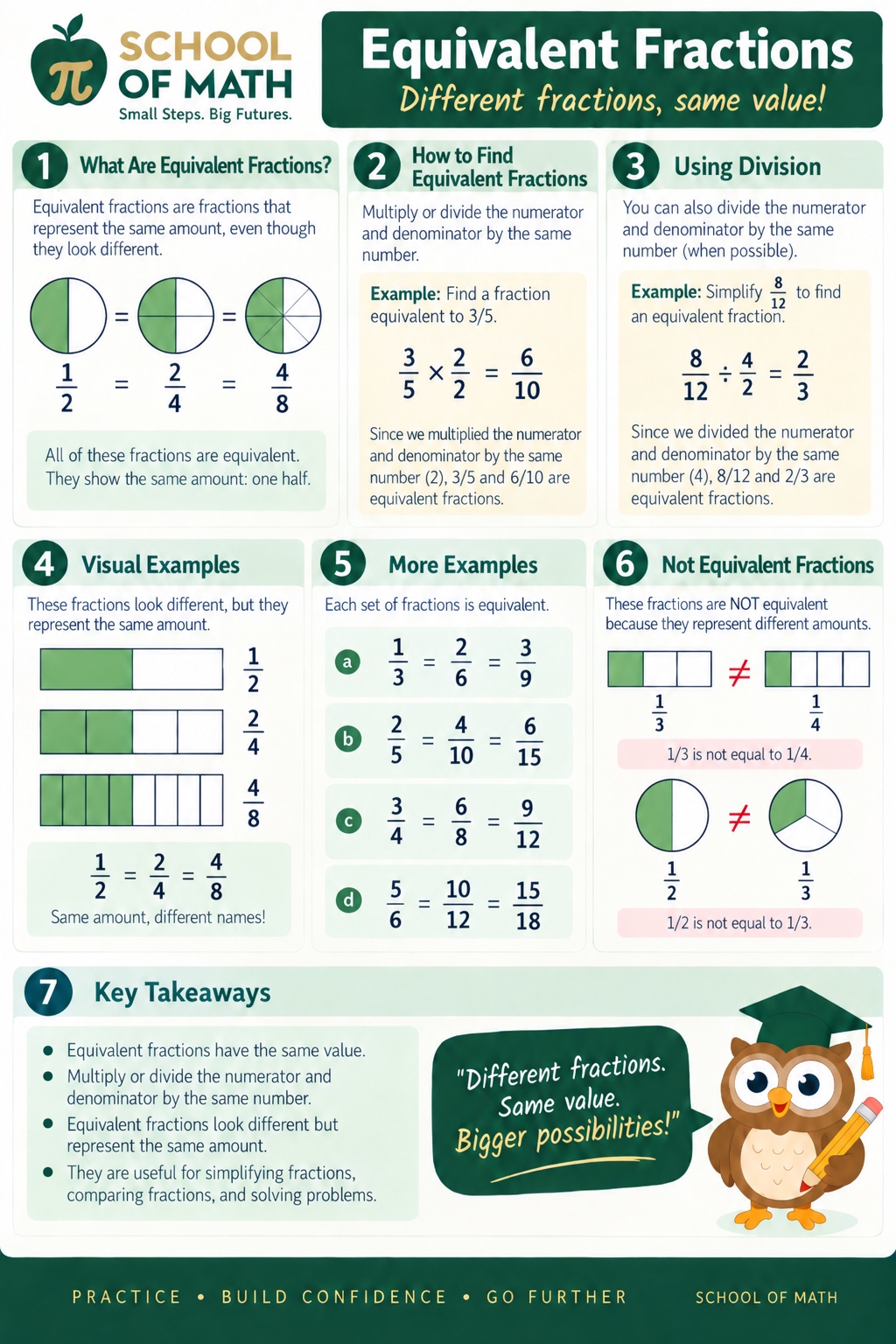
What are equivalent fractions?
Fractions that represent the same amount even if they look different: 1/2 = 2/4 = 4/8. They all shade the same portion of a whole.
Finding equivalent fractions — multiply
Multiply the numerator and denominator by the same non-zero number. Example: 3/5 × 2/2 = 6/10, so 3/5 and 6/10 are equivalent.
Finding equivalent fractions — divide (simplify)
Divide numerator and denominator by the same non-zero number (a common factor). Example: 8/12 ÷ 4/4 = 2/3. To reduce to lowest terms, divide both by their GCF.
Not equivalent
Different amounts mean not equivalent: 1/3 ≠ 1/4. Cross-multiplication check: a/b = c/d iff a×d = b×c.
Why we care
- Simplifying: reduce a fraction to lowest terms using the GCF.
- Comparing: rewrite fractions with a common denominator, then compare numerators.
- Adding & subtracting fractions: requires a common denominator — equivalent fractions get you there.
10 Practice Questions — Equivalent Fractions
Want in-person pre-algebra at SOMATH?
Small groups of 4–8 students, taught by real math teachers on the Upper West Side. Homeschool families, public/private school students, and accelerated tracks all welcome.
Book a free 30-minute evaluation · call (646) 668-6151 · 226 W 79th St, New York, NY 10024.
Related SOMATH classes and posts
- Pre-Algebra Word Problems: Linear Equations — 30 Original Questions
- SOMATH featured in the New York Post — Homeschooling in NYC
- Paper SAT May 2023 — No-Calculator Math (Section 3)
- Paper SAT May 2023 — Calculator Math (Section 4)
- SOMATH class schedule — weekly small-group classes
- Free 30-minute evaluation